---S---
D
---S---
SUBCOMMISSION
ON
DEVONIAN
STRATIGRAPHY
NEWSLETTER
N
O
.
35
R.T. B
ECKER, Editor
WWU Münster
Germany
September 2020 ISSN 2074-7268
The SDS Newsletter is published annually by the International Subcommission on Devonian
Stratigraphy of the IUGS Subcommission on Stratigraphy (ICS). It publishes reports and news from its
membership, scientific discussions, Minutes of SDS Meetings, SDS reports to ICS, general IUGS
information, information on past and future Devonian meetings and research projects, and reviews or
summaries of new Devonian publications.
Editor:
Prof. Dr. R. Thomas B
ECKERInstitut für Geologie und Paläontologie
Westfälische Wilhelms-Universität
Corrensstr. 24
D-48149 Münster, Germany
[email protected]
Circulation
130 hard copies,
pdf files of current and past issues are freely available from the SDS Homepage
Submissions have to be sent electronically, preferably as Word Documents (figures imbedded or as
separate high-resolution jpg or pdf files), to the Editor or to Mrs. S. K
LAUS, IGP, Münster
([email protected]). Submission deadline for No. 36 is the end of August 2021.
Please ease the editing by strictly keeping the uniform style of references, as
shown in the various sections !
The Newsletter contributions should be quoted as: “SDS Newsletter, 35: x-y.”
Content:
Message from the Chairman (L. SLAVÍK) 1-2 Letter from the outgoing Chairman (J. E. A. MARSHALL) 2
Obituaries
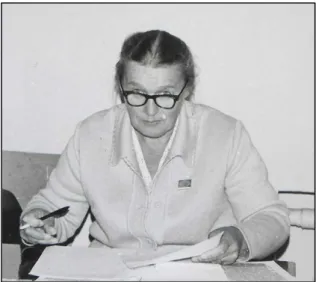
Vladimir Khromykh (1936-2020) 3-4
Bruno MISTIAEN (1946 – 2019) 4-13
Peter CARLS (1937 – 2020) 13-25
SDS Reports
Annual Report to ICS for 2019 (J. E. MARSHALL) 26-28
SDS Documents
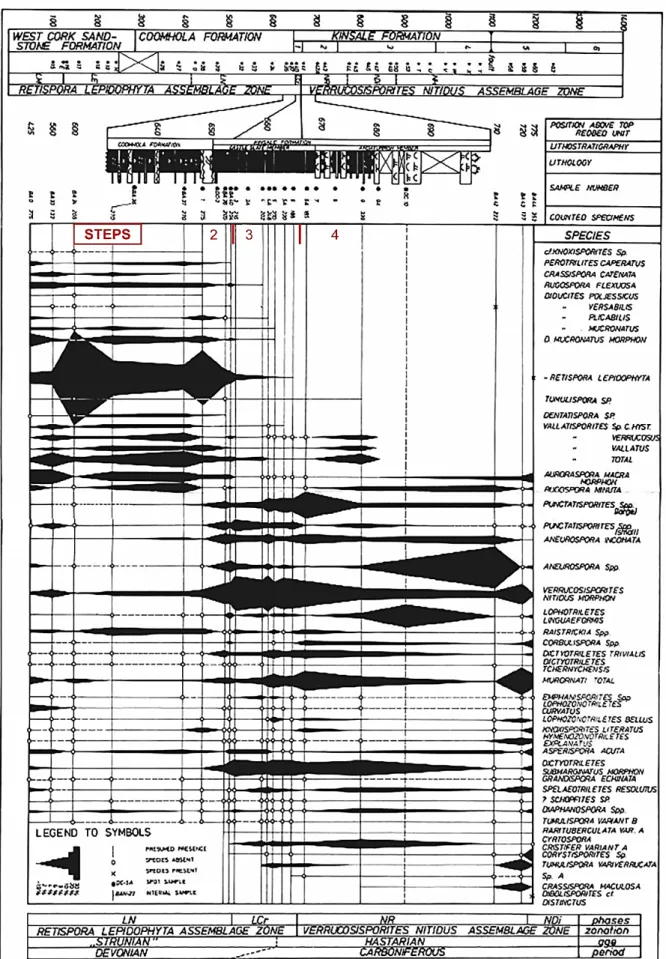
Devonian-Carboniferous miospore stratigraphy (M. STREEL &P.STEEMANS) 29-47 Kačák Episode in Belorussia (M. NARKIEWICZ et al.) 48-50 Brachiopods of Givetian Jiwozhai Reef, Dushan (GUO et al.) 51-54
Devonian Meetings
Devonian to Lower Carboniferous, Moroccan Meseta (R. T. BECKER et al.) 57-58 Devonian Global Changes, Global Planetary Change volume (G. RACKI) 58 Appalachian Geology of John M. DENNISON, GSA Special Publication 59
Devonian volumes in the pipeline 59
Membership News
CM Gordon C. BAIRD 60
TM R. Thomas BECKER, CM Z. Sarah ABOUSSALAM,CM StephanHELLING, and the
Münster Group 60-66 CM Alain BLIECK 66 CM RobertB.BLODGETT 66 TM Carlton E. BRETT 66-67 TM Rainer BROCKE 67-68 CM Carole BURROW 68 TM Carlo CORRADINI 68-69 CM Maria G. CORRIGA 69-70 TM Anne-Christine DA SILVA 70-72 CM David DE VLEESCHOUWER 72-73 CMJames R. EBERT 73 CM Raimund FEIST 73-74 CM Sven HARTENFELS 74-75
CM Rodrigo Scalise HORODYSKI and Brasilian colleagues 75-76 TM Nadezhda G. IZOKH and the Novosibirsk Group
(including CMs Olga OBUT and O. IZOKH,) 76-77
TMUlrichJANSEN 77-78
CM Peter KÖNIGSHOF 78-79
CM Semen E. KRUCHEK, C, Dmitri P. PLAX, and the Belarusian Devonian Group 79-81
TM John E. MARSHALL and the Southampton Group 81-82
CMMarekNARKIEWICZ 82
CM Atike NAZIK 82
CM Cameron PENN-CLARKE 82-83
CM Liuza C. M. O. PONCIANO 83-84
CM Gregorz RACKI and Polish colleagues 84-86
CM Eberhard SCHINDLER 87
TMLadislavSLAVÍK 87-89
TM Claudia SPALLETTA 89
CMMauriceSTREEL 90
CMThomasSUTTNER and ErikaKIDO 90
TMJosé I.VALENZUELA-RÍOS &CMJau-ChyN LIAO 90-93
CM Chuck VER STRAETEN 93-94
CMStanislavaVODRÁŽKOVÁ 94
CMMichaelWHALEN 95
1
Chairman‘s Address
Dear SDS Members,
I hope all of you are doing well and staying safe despite the present difficult situation caused by the COVID 19 disease. Here are the opening words to our SDS newsletter No. 35! The Newsletter compiles annually everything related to the Devonian and is put together mostly from your contributions.
As you might have noticed from bulk e-mails with SDS information, the new team of SDS officers have already started their work. On behalf of the new team, I would like to thank John
MARSHALL (Chairman) and Carl BRETT
(Vice-Chair) for their work for our Subcommission. During the last term, there was a lot of visible and invisible agenda and the former team kept the SDS going, moving things forward. We had the opportunity to meet (at least!) once every year and held many special Devonian sessions at various events, e.g., IPC, STRATI and several related IGCP meetings. The new coming team is: Ladislav
SLAVÍK (Chair), Nacho VALENZUELA-RÍOS
(Vice-Chair), and Uli JANSEN (Secretary). Thomas
BECKER will kindly continue our SDS Newsletter
production and Carlo CORRADINI kindly stays as the webperson.
The ICS was expected to ratify the new teams of all stratigraphic subcommissions during the 36th
International Geological Congress in New Delhi, India, last March. As many of you know, the original date of the IGC was cancelled and the Congress was postponed at a very late stage. As a consequence, the ICS executive had no chance to meet. We agreed with the former SDS Chair John
MARSHALL on the handover of the SDS on 1st June
2020. It looks that our new team should be formally ratified by the IUGS in the summer, and, following recommendation of the ICS, we have officially started as of 1st August 2020. The replacement was
scheduled for the regular SDS meeting to take place this summer (2020) in Geneseo, New York State, USA. It is a great pity that we could not have met there. The organizers – Jeff OVER and many others of the team – have invested a lot of time to welcome us in NY. In spite of the ever changing global/regional/local situation with COVID, there is still a chance for us to gather there in the next year.
For all of us, this year is very strange, with various kinds of problems being challenged. As we cannot meet anywhere due to the restrictions, we are missing scientific discussions on the Devonian, many individual professional or friendly meetings, as well as discussions on technical topics related to the running of our Subcommission. Thus, in the meantime, we have to communicate various topics on the internet and make certain decisions without directly listening to your opinions and proposals and without any benefit from the debate that takes place at our regular business meetings.
Anyway, this opening address should not be a list of things/events that did not happen. Allow me a more cheerful note: from the communication with many of you, I got the impression that our community keeps to be active and strong under these “special” conditions. Many Devonian publications have been released and many were submitted. The Subcommission on Devonian Stratigraphy will stay active and we hope that with your help and support we will finish several pending issues, including further refinements and subdivisions within the Devonian period and the GSSP redefinitions.
A few other news you should know:
1. Our SDS website that was run by Carlo
CORRADINI at University of Cagliari will no longer
be maintained. The International Commission on Stratigraphy has offered a solution for the websites of all subcommissions. Using the same platform, the websites will be of uniform style. This should be launched soon. Then, we will start to feed our SDS sub-website with information about the SDS itself, membership, SDS newsletters, and other documents.
2. The ICS executive applied to the IUGS for additional funding for ‘special projects’ last year. The project ‘Regenerating the Time Lords: Towards the completion, calibration, digitization and outreach of the geological timescale’ was awarded $50k over two years. The current global crisis and restrictions prompted a call for proposals for a single year cycle. This summer, we applied for an ICS special grant in order to obtain mainly geochemical data from Pragian–Emsian sections of the Spanish Central Pyrenees.
3. As many other things this year, the long-desired Geological Time Scale 2020 volume is a bit delayed and can be expected late this year. The Devonian
2
chapter by Thomas BECKER, Anne-Christine DASILVA, and John MARSHALL,with further help and input byFrits AGTERBERG,FelixGRADSTEIN,and Jim OGG,has been much expanded (78 pp.).
Please, keep in mind that all SDS members are expected to contribute their news. And it is always good to be informed about ongoing projects, publications in preparation, conferences, organizations of meetings, and many other activities. Also, it is a good place to let the others know about studies in regional journals that are not easily available.
The Devonian is not only a time period and wonderful rocks, it is mostly you – Devonian workers that form a strong and big family, which is making the ancient Devonian times still attractive and exciting! Let us hope the situation is settled a bit in 2021 and all of us are able to work in good conditions. Let us also hope that in the near future we are able and allowed to gather at our regular business meetings, work in the field together and go successfully ahead with our Devonian business!
Ladislav SLAVÍK
Letter from the outgoing Chairman,
John M
ARSHALLHi, I hope you are all well and staying safe in these difficult times.
Covid-19 as I am sure you know has had a direct effect on the SDS in that we had to postpone the long-planned fieldtrip and conference to New York State. That decision to postpone was taken quite early but was clearly the right one.
An indirect effect was that the IGC in New Delhi was postponed at a very late stage. This means that the ICS never met and they have to ratify the incoming SDS team led by the new Chair Ladislav before they can officially take office.
Sadly, they seem unable to make these decisions by Zoom, TEAMS, or whatever. So, after many discussions with David HARPER it has been left as our own decision to decide when the new team takes over. In discussion with Ladislav we think that 1st
June is a good date. But we must remember that the new team has yet to be formally ratified. So, given the endless debate over the validity of the new Chibanian GSSP, its probably best not to take any
‘quick’ decisions on the Emsian GSSP until the new team is formally approved!
Its always been a pleasure to attend SDS meetings. Stratigraphy has a bad image within some areas of the earth sciences but its essential to any understanding as to how the Earth System works. So, SDS goes far beyond mere GSSP’s and leads the way in understanding the Devonian world. There has certainly been a rush of Devonian geochemistry and modelling paper by people we don’t know, so our favourite Period has become very topical. We now just need to get these workers to attend SDS meetings.
Thanks to you all for entertaining me as Secretary and then Chair for 16 years. I have certainly travelled everywhere in that time. I have learnt a lot and hopefully you know a little more about spores.
I have not contributed anything technical to the base Emsian GSSP debate. But we certainly can to the D-C boundary redefinition. We have just had this paper published in Science Advances.
https://www.sciencemag.org/news/2020/05/no- asteroids-or-volcanoes-needed-ancient-mass-extinction-tied-ozone-loss-warming
This explains why I come to SDS meetings, talk about the D-C boundary, but never really come to any real conclusion as to its cause. This is because the British research evaluation system is driven by publications in Science and Nature. These journals are strict as to any pre-publication in abstracts. Anyway, the main finding it that at ‘exactly’ the D-C boundary a concentrated burst of UV-B radiation rendered most plants sterile and collapsed the terrestrial ecosystem. We expect a debate as to its cause but it is going to be very useful for defining the D-C boundary. It shows us that the UV-B burst was very brief and directly related to the extinction of many groups of spores. So, now we know what happened I think we have a time plane by which we can globally define the GSSP. Clearly something to discuss but a potential way forward.
Time to hand over to the new team. I am sure we will all support them in their essential work.
Many thanks for all your support and I think the current sign off is
3
OBITUARIES
Vladimir K
HROMYKH
(15.09.1936-23.03.2020)
Vladimir KHROMYKH, Russian paleontologist and stratigrapher passed away in Novosibirsk following a long illness. Vladimir was born in a small village, Verkhoyanie, in the Orlov region, Central Russia. After graduation from the Geological Department of the Moscow State University in 1960, he started his carrier in the geological survey at Chukotka, North-East Russia. A few years later, he moved to Novosibirsk and joined the laboratory of Paleozoic paleontology and stratigraphy at the Institute of Geology and Geophysics SB USSR AS (later the Trofimuk Institute of Petroleum Geology and Geophysics SB RAS). In 1968, Vladimir finished his doctor course (aspirantura) and defended his Ph.D. thesis dedicated to Devonian stromatoporoids of the North-East of Russia. He continued research on Lower Paleozoic stratigraphy and Ordovician, Silurian and Devonian stromatoporoids from the Siberian Platform, Central Siberia, Urals, Uzbekistan, and Kirgizia for more than 50 years. He published about 60 scientific papers and chapters in monographs. Recently, Vladimir summarized
results of his long-term investigation in a personal monograph (see references below).
Vladimir was a very open minded and cheerful person. He was very fond of fishing and gardening. Many colleagues would remember him as a sincere singer performing various distinctive ballades. Cherished memories about Vladimir KHROMYKH
will forever remain in our hearts.
Selected references
KHROMYKH, V. G. (1968). Devonian
Stromatoporoidea of the North-East USSR. - Dissertation abstract, Novosibirsk State University, 18 pp. [in Russian].
KHROMYKH, V. G. (1969). Stromatoporoidea from
Middle Devonian of the Omolon massive. - In: Upper Paleozoic of Siberian and Far East: 29-37; Novosibirsk, Nauka [in Russian].
KHROMYKH, V. G. (1974a). Devonian
Stromatoporoidea of the North-East USSR. - Trudy IGiG, 64: 1-104; Novosibirsk, Publishing House “Nauka”, Siberian Branch [in Russian].
KHROMYKH, V. G. (1974b). Phylogeny and
historical development of several genera of Stromatoporoidea. - Ancient Cnidaria, vol. 1: 45-50; Novosibirsk, Nauka, [in Russian].
KHROMYKH, V. G. (1977a). Ordovician
Stromatoporoidea of the Chukotka Peninsula. - In: Startigraphy and fauna of Ordovician and Silurian of the Chukotka Peninsula. Trudy IGiG,
351: 43-50; Novosibirsk, Publishing House
“Nauka”, Siberian Branch [in Russian].
KHROMYKH, V. G. (1977b). Devonian stratigraphy
and Stromatoporoidea of the Ulakhan-Sis Ridges. - Moscow: Nauka, 102 pp. [in Russian].
KHROMYKH, V. G. (1984). Stromatoporoidea. - In:
Paleozoic of the South-East of the West Siberian Plate. Trudy IGiG: 113-122; Novosibirsk, Publishing House “Nauka”, Siberian Branch [in Russian].
KHROMYKH, V. G. (1996). The earliest
Stromatoporoidea genera. - Russian Geology and Geophysics, 40 (2): 221-230.
KHROMYKH, V. G. (1999). The new genus of the
earliest Stromatoporoidea. - Doklady of Russian Academy of Sciences, 364 (6): 801-803.
4
KHROMYKH, V. G. (2001). New Stromatoporoidea
from the Upper Ordovician of Taimyr. - Paleontological Journal, 2001 (4): 11-15.
KHROMYKH, V. G. (2008). First finding of
Fammenian Stromatoporoidea in the Kuznetsk Basin. - Paleontological Journal, 2008 (3): 8-11.
KHROMYKH, V. G. (2010). Evolution of
Stromatoporoidea in the Ordovician-Silurian epicontinental basin of the Siberian Platform and Taimyr. - Russian Geology and Geophysics,
51 (6): 876-886.
KHROMYKH, V. G. Paleozoic Stromatoporoidea. -
LAPLambert Academic.
Bruno MISTIAEN
(1.5.1946 – 19.10.2019)
Denise BRICE
(1)& Alain BLIECK
(2) (1) 14 rue Yves Decugis, 59650 Villeneuve d'Ascq;(2) 38 rue Paul Doumer, 59320 Haubourdin;
1. Youth and background
Bruno MISTIAEN was born on May 1, 1946, in t Chapelle d'Armentières (“Nord”» French department) in the family home, where he has spent
his whole life. The fact that Bruno was born on May 1st (Labour Day in France) is symbolic. During his
life, Bruno got a great capacity of work, peacefully and over time. His father, Georges MISTIAEN (1901-1975), was a fabric seller in the house of La Chapelle d'Armentières, going door to door and on markets too. His mother, Jeanne LEGRAIN (1912-1999), accompanied her husband on markets. Both were born in Armentières. They had two children, Bruno, and a daughter, Marie-Edith, who was one year and a half younger than him.
Bruno went to boy primary school of Saint Edouard in Armentières, where he got the elementary certificate. Then, he entered the Saint Just college of Armentières until the final year, where he got the French baccalaureate in experimental sciences on 1966. Bruno lived a happy childhood, truly loved by his mother. He began to be a naturalist in the family home garden. He liked natural sciences (plants, insects, rocks…) and wished to be a missionary or an explorer. When he was a teen ager, he made jogging every morning in the neighbouring country, which gave him an excellent physical fitness. After Sunday mass, he went to Sangatte with his family and used to pick up stones. Before his geologist vocation, he was gladly a zoologist. Someday, he got a calf carcass in a farm, removed its skin and reconstituted its skeleton. Many years later, he brought back a living snake from China!
Bruno MISTIAEN entered the Sciences Faculty of the Catholic University of Lille on 1967 in order to follow a «University Degree of Higher Learning» (DUES, in French) during 2 years, completed in 1969. Then, he entered The Sciences and Technology University of Lille (USTL or Lille 1) in order to follow a Master’s Degree of Geology, completed in 1971 (Petrology and Historical Geology Certification during 1969-1970, Applied Geology and Structural Geology during 1970-1971). Bruno did his military service in Germany in 1972. Then, when he came back to Lille (USTL), he completed a Master of Advanced Studies (DEA in French) in Geology in 1973. The subject was: “Contribution to Blacourt Limestone Stromatoporoids study (Givetian of Ferques, Boulonnais)”. Bruno MISTIAEN was a dedicated field palaeontologist, with Boulonnais, the Ardennes Massif (including Avesnois), and Afghanistan as favourite areas. For his doctoral thesis, he accompanied Professor Albert de
5
CNRS (National Centre of Scientific Research) RCP 44 (Program Coordinate Research 44). After this first mission in the Afghanistan Central Mountains, there were three further ones (three months each, 1975, 1976, and 1978), as part of a “Permanent Mission of CNRS”. These missions, mainly devoted to stromatoporoids, were interrupted by the Soviet invasion of 1979. On 1973, Claude HEDDEBAUT, professor at the Catholic University of Lille, accompanied him. During this mission, Claude HEDDEBAUT contracted malaria (endemic in Afghanistan) and died at the age 48. Denise BRICE accompanied Bruno in Afghanistan in 1973 and 1975 and Alain BLIECK accompanied him in 1978. At that time, Bruno had an excellent physical fitness because he used to come back to his vehicle with tens of kilograms backpack. The collected fossil material has been the thematic of his two doctoral thesis: Ph.D. Thesis (USTL) in 1976 entitled “Devonian Stromatoporoids of Ferques”, State Doctoral Thesis in 1985, entitled “Reef phenomena in the Devonian of Aghanistan (Central Mountains). Stromatoporoids analysis and systematics”. At the end of his university career, his colleagues tenderly called him “ayatollah”, due to his long grey beard and his afghan years.2. Academic career
After one year as a delegated assistant at the Picardie University (Amiens), Bruno MISTIAEN
started his university career on 1975, as a teacher-researcher in the Faculty of Sciences and Techniques (FLST) of the Catholic University of Lille, then in the Higher Institut of Agriculture (ISA). He was successively lecturer, university lecturer, substitute teacher, and full professor in Earth Sciences at the FLST. He taught courses and practical exercises in geology (cartography, petrology, soil sciences) and entomology, particularly a course devoted to destructive insects. He supervised many students in the field, in geology, and entomology. They really appreciated him and he transmitted them his passion for natural sciences in a relaxed atmosphere. Bruno liked joking, he never hesitated to be clown, and most of the time, got a knowing smile, which made him sympathetic to his students and colleagues. As a true “boute-en-train”, he especially liked to sing Jacques BREL’S songs.
Bruno MISTIAEN did many administration and teaching tasks in ISA. He had the responsibility and animation of agronomic weeks for 1st year students
(from 1977), the responsibility of internships for 1st
year and 3rd year students (1977-1980), the
responsibility of sandwich course (1977-1978), the responsibility and animation of the earth sciences domain (1977-1992), the management of soil sciences contracts (1979-1992), and the responsibility of the environment and landscape planning department (1992-2003). He also did preparation and animation of training sessions in geology for natural sciences teachers of the Secondary Education (1977: Bray Country, 1979: Brittany; 1981: North of France geomorphology; 1983: Devonian reefs of Belgium and France Ardennes; 1985: Pyrenees; 1987: Vosges mountains; 1989: Normandy; 1991: Boulonnais; 1993: Corbières, Mouthoumet; 1995: Brittany; 1997: Vosges mountains; 1999: Ardennes). He taught 2nd year master students at USTL as part of
the Master’s Degree BEFA (“Biodiversity and fossil and living environments”). Bruno was also involved in associative activities, especially at the North Geological Society (SGN), where he was a member since 1970. He was a SGN adviser during many years and became the first vice president in 2010-2012. He also was a member of the North-Pas de Calais Environment Scientific Committee, of the North-Pas de Calais Natural Sites Conservatory, of the French Committee of Stratigraphy, and of the Regional Commission of Geological Patrimony, (CRPG) since 2013. At the international level, he was a Member of the Subcommission on Devonian Stratigraphy (SDS), of the International Commission of Stratigraphy (ICS), one of the commissions of the International Union of Geological Sciences (IUGS).
After his afghan period, Bruno MISTIAEN
studied stromatoporoids and other fossil organisms (Tabulates Corals, Worms), alone or in collaboration with colleagues, coming from many areas all over the world. The material was given by foreign colleagues or collected during several scientific missions in Europe, Iran, Mongolia, China, Australia, Vietnam, Morocco, and Siberia, as part of research unities of CNRS (GRECO 007 from 1976 to 1988, URA 1365 from 1989 to 1997, UPRESA 8014 from 1998 to 2001), and also of the International Geological Correlation Program of UNESCO (IGCP 421 and IGCP 499). Bruno supervised or co-supervised many research dissertations (Master’s Degrees and Ph.D. thesis):
6
Ph.D. Thesis at USTL by Francis DOUAY in 1993on “Soil sciences and superficial geology of Inner Flander”.
Ph.D. Thesis at Bruxelles University by F.
EZZOUBAÏR in 2000 on “Permian Tabulate
Corals from Timor and biological affinities of Trias Spongiomorphids from Austria”.
Master’s Degree by Elvire HEIDINGER in 2005 on “Stromatoporoids microstructure and ultrastructure”.
Ph.D. Thesis at Western Brittany University by Yves PLUSQUELLEC in 2006 on “Pleurodictyforms (Cnidaria Tabulata, Devonian) from Armorican Massif and Maghrebo-European areas”.
Ph.D. Thesis at USTL and Liège University (jointly supervised with Professor Frédéric BOULVAIN) by Benoît HUBERT in 2008 on “Devonian Stromatoporoids from Ardenne and Boulonnais”.
Habilitation to Conduct Researches (HDR) thesis at USTL by Jean-Pierre NICOLLIN in 2008 on “Lias Foraminifera and Devonian and Carboniferous basis Brachiopods”.
Ph.D. Thesis at USTL and Warshaw University (jointly supervised with Professor Jerzy
TRAMMER) by Mikolaj ZAPALSKI in 2008 on
“Tabulata (Anthozoa) from the Devonian of the Southern Region of the Holy Cross Mountains, Poland”.
Ph.D. Thesis at USTL and Shahid Beheshti University of Teheran, Iran (jointly supervised with Professor M.R. MOSAVI) by Reza
AARIPOUR in 2009.
Ph.D. Thesis at USTL by Emilie PINTE in 2011 on “Devonian and Carboniferous Tabulate Corals from western Europa”.
His papers on Devonian Corals and Stromatoporoids got international recognition. As long enigmatic fossils, stromatoporoids were associated to Porifera (Sponges). Spicules discovered by him in 1981 in Palaeozoic forms supported the affiliation of stromatoporoids to Sponges as well as the systematic singleness strongly discussed between Palaeozoic and Mesozoic forms until now (see papers listing). Bruno is the author of a hundred of papers in periodic reviews and books chapters.
Bruno MISTIAEN received many awards from the Lille Sciences, Agriculture and Arts Society (SSAAL): the GOSSELET Medal in 1981, the
GOSSELET Award in 1986, and the KUHLMANN
Great Award in 2005. He became a titular member of this society in 2007.
3. Boulonnais
The Boulonnais occupies a special part in Bruno
MISTIAEN’S papers. This area, located at the
northwest part of Pas de Calais, is a half exhumed and eroded anticlinal fold, notched by the Pas de Calais sound. Due to erosion, such a situation makes many old grounds particularly Devonian and Carboniferous outcrop. Quarries exploited and still exploit those grounds from, which extracting materials have evolved through time (“marble”, limestone, “aggregates”). Bruno devoted several papers to fossil reef builders collected in these grounds, especially from the Givetian (Middle Devonian) and specifically concentrated on sStromatoporoids in his Ph.D. Thesis.
From 1973, Bruno MISTIAEN, either alone, or generally accompanied by Denise BRICE and Christian LOONES (independent geologist) went very often to the Boulonnais, more precisely to Ferques, looking for stromatoporoids (and brachiopods for D. BRICE and C. LOONES) in the Givetian of the Griset and Banc Noir quarries (exploited by the Stinkal Company). Usually, these visits took place on Saturday because the Stinkal Company workers were then at rest. The results of these researches were subject to his Master of Advanced Studies in 1973, then to his Ph.D. Thesis in 1976. However, his visits to the Stinkal quarries regularly continued because the exploitation of limestone in both quarries produced constantly new stromatoporoid outcrops at different levels. Bruno wanted to check if it was the same species in order to give a maximum of precisions in the publication published on 1980 in the Bulletin du Museum national d’Histoire naturelle. These regular visits allowed close links with the Stinkal Company management that was interested in information concerning the extension of the exploited limestone. After discussions about the exceptional richness of the faunas and their excellent conservation, Bruno and his colleagues asked the company about the possibility of safeguarding a mine face at the end of the exploitation on the east side of the Griset quarry, which would become a reference section for the international scientific community. After the
7
agreement of the Stinkal Company, Bruno and some colleagues created an association called “Association highlighting the Griset Devonian” (AVDG) in June 2006, in order to safeguard, highlight and promote the geological patrimony of the exposed Givetian. Bruno MISTIAEN was the president of this association. The AVDG scientific committee was composed of researchers from Lille and Paris (France), London (England), and Brussels (Belgium)4. Bruno´s humanitarian involvement
At the beginning of the 2000s, the Esquermes House (Lille) contacted Bruno and asked him to be an interpreter for young afghan refugees. He had learned Dari, an afghan version of Persian, when he was in Afghanistan. In this light, he met Hocen REZAI on 2003 in Frelinghien. Hocen was 16 years old. Bruno became Hocen’s legal guardian in 2004, adopted him in 2005. During this period, Bruno was daily involved in the “Calais jungle” (expression, which means migrants and refugees camps, settled at the beginning of the 2000s in Calais, Coquelles and Sangatte, not very far from the French entrance of the Channel tunnel and the harbour area of Calais), to help afghan refugees. In the Catholic University and especially in ISA, Bruno found students for teaching French to young afghan men, who had true learning capacities; they managed to speak French in three months. Bruno helped them in their administrative actions with the Lille prefecture and the Afghanistan embassy in Paris to obtain resident papers. Bruno did this humanitarian involvement in several associations, such as the Franco-Afghan Friendship (AFRANE) he has contributed to create in 1979, the Refugees Network of Hospitality in Lille (RAIL), and the “Tissage Réseau Armentiérois Accueil Migrants” association (TRAAM). When they got their papers, the afghan residents could register in schools, such as Saint-Charles primary school and college. Thus, Hocen got the S baccalaureate, followed higher studies (DUT) in civil engineering in Béthune, and a professional degree in building economy in Valenciennes. Now he works in the Botte Foundation Company in Lomme as a building design draughtsman.
Bruno, as a practicing Catholic participated to “Silence Circles”, a movement initiated by the Franciscan Brothers to protest against undocumented migrant incarceration in France. Bruno joined a circle, forgathered every last
Tuesday of the month, to denounce the human rights infringements.
Bruno officially retired on 2012. However, he still did research and teaching and continued to go to the field. In October 2018, he was diagnosed a lung cancer at a late stage of the illness. He entered the private hospital of La Louvière in Lille, then the Tourcoing hospital, where he quietly died on the 19thOctober 2019, at the age of 73. He will be
remembered among his family, friends, numerous students and colleagues as a strongly humanist being, much sociable, but a reserved person at the emotional level, as well as a jolly fellow in the society.
Acknowledgements. — We thank Marie-Edith
MISTIAEN, Bruno’s sister, who gave lights,
especially on his youth years, Gaëlle GUYÉTANT
with whom Bruno collaborated as an administrator at the North-Pas de Calais Natural Sites Conservatory, and Françoise DEBRENNE, one of his colleagues, expert in fossil reef builders of Palaeozoic.
Further reading
BRICE, D. & DEFEBVRE, A. (2005). Grand Prix
KUHLMANN - Lauréat Monsieur Bruno
MISTIAEN. - Société des Sciences, de
l'Agriculture et des Arts de Lille, rapport pour la séance solennelle: 2 p. [inédit].
DEBRENNE,F. (2019). Notice sur B. MISTIAEN. -
Géochronique.
GUYETANT, G. (2020). Hommage: Bruno
MISTIAEN. - La lettre d'infos (Conservatoires
d'espaces naturels Hauts-de-France), 8 (février 2020): 17.
Bibliography
BRICE,D.,DE LAPPARENT,A.F.&MISTIAEN,B.
(1975). Le Dévonien supérieur à l'Est d'Hajigak (Afghanistan). - Annales de la Société Géologique du Nord, 94: 67-70.
BRICE, D., BULTYNCK, P., COLBEAUX, J.-P.,
LETHIERS,F.,MISTIAEN,B.&ROHART,J.C.
(1976). Une nouvelle coupe dans le Dévonien de Ferques (Boulonnais). - Annales de la Société Géologique du Nord, 96: 135-155.
BRICE,D.,BIGEY,F.,MISTIAEN,B.,PONCET,J.&
ROHART, J. C. (1977). Les organismes
constructeurs (Algues, Stromatopores, Rugueux, Tabulés, Bryozoaires) dans le
8
Dévonien de Ferques (Boulonnais-France). Associations. Répartition stratigraphique. - Mémoire du Bureau de Recherches Géologiques et Minières, 89: 136-151.BRICE, D., COLBEAUX, J. P., MISTIAEN, B. &
ROHART, J. C. (1979). Les Formations
dévoniennes de Ferques (Bas Boulonnais, France). - Annales de la Société Géologique du Nord, 98: 307-324.
MISTIAEN,B. (1980a). Stromatopores du Givétien
de Ferques (Boulonnais, France). - Bulletin du Muséum National d’Histoire naturelle, Paris. 4ème série (2) sect. C (3): 167-257.
MISTIAEN, B. (1980b). Niveaux construits à
Bryozoaires Fistuliporides dans le Dévonien de l’Hazarajat, Afghanistan central. - Bulletin de la Société Géologique de France, 7, XXII (1): 103-113.
BRICE,D.&MISTIAEN,B. (1980). Découverte de
Stringocephalus et autres Stringocephalidae (Brachiopodes Terebratulida) dans le Givétien d'Afghanistan. - Géobios, 13 (6): 849-859.
MISTIAEN, B. (1982). Comments on the
stratigraphic distribution of Stromatoporoids around the Middle-Upper Devonian boundary. – In: Papers on the Frasnian-Givetian boundary. Subcommission on Devonian Stratigraphy: 91-100.
BLIECK,A.,JANVIER,P.,LELIEVRE,H.,MISTIAEN,
B. & MONTENAT C. (1982). Vertébrés du Dévonien supérieur d'Afghanistan. - Bulletin du Muséum National d’Histoire naturelle, Paris. 4ème série, 4, sect. C (1-2): 3-19.
MISTIAEN, B. & PONCET, J. (1983). Evolution sédimentologique de petits biohermes à Stromatolithes et Vers dans le Givétien de Ferques, Boulonnais. - Annales de la Société Géologique du Nord, CII: 205-216.
BRICE, D. & MISTIAEN, B. (1984). Mission
géologique en Afghanistan. - Ensemble, 41 (3): 147-153.
MISTIAEN, B. (1984a). Comments on the
caunopore tubes: stratigraphic distribution and microstructure. - Palaeontographica Americana,
54: 501-508.
MISTIAEN, B. (1984b). Disparition des Stromatopores paléozoïques ou survie du groupe: hypothèse et discussion. - Bulletin de la
Société Géologique de France, Paris (7), XXVI 1245-1250.
MISTIAEN,B. (1985). Phénomènes récifaux dans le
Dévonien d'Afghanistan. (Montagnes Centrales). Analyse et systématique des Stromatopores. - Publication de la Société Géologique du Nord, 11, vol. I 381; vol. II :1-245.
BRICE, D. & MISTIAEN, B. (1988). Description
stratigraphique de la Formation de Blacourt - Givétien de Ferques (Boulonnais - France). - In BRICE,D. (Ed.), Le Dévonien de Ferques. Bas-Boulonnais (N. France). Biostratigraphie du Paléozoïque, Brest, 7: 43-64.
MISTIAEN,B. (1988a). Stromatopores du Givétien
et du Frasnien de Ferques (Boulonnais - France). - In BRICE,D. (Ed.), Le Dévonien de Ferques. Bas-Boulonnais (N. France). Biostratigraphie du Paléozoïque, Brest, 7: 163-195.
MISTIAEN, B. (1988b). Tabulés Auloporida du
Givétien et du Frasnien de Ferques (Boulonnais - France). – In: BRICE,D. (Ed.), Le Dévonien de Ferques. Bas-Boulonnais (N. France). Biostratigraphie du Paléozoïque, Brest, 7: 197-230.
MISTIAEN,B. (1988c). Trace d'Ophiuride dans les
grès à Cruziana, Ordovicien inférieur des Montagnes Centrales d'Afghanistan. Importance et extension du faciès à Cruziana. - Geobios, 21 (6): 797-803.
BRICE, D., MILHAU, B., MISTIAEN, B., ROHART,
J.C.&VIDIER J.P. (1989). Le Givétien supérieur (Dévonien) à Ferques (Boulonnais-France): observations nouvelles. - Annales de la Société Géologique du Nord, 108: 113-123.
MISTIAEN,B. (1989). Importance de la symétrie
d'ordre douze chez les Tabulata. Conséquences systématiques. - Compte Rendu de l'Académie des Sciences, Paris, 308 (II): 451-456.
MISTIAEN, B. & PONCET, J. (1989). Biosedimentological evolution of a stromatolitic buildup in the Formation de Blacourt (Givetian), Boulonnais. North of France. - Memoir of the Association of Australasian Palaeontologists, 8: 413-423.
FONTAINE,H.,MISTIAEN,B.,TANTIWANIT,W.&
TONG-DZUY,T. (1990). Devonian fossils from Northeast Thailand. Some new data from
9
Tabulata and Stromatoporoidea. – In: FONTAINEH. Ten years. C.C.O.P. Tech. Bull., Bangkok.
20: 319-330.
MISTIAEN, B. (1991a). Dendropora explicita
MICHELIN, 1846 et D. briceae nov. sp.
(Tabulata) dans leur localité type, le Boulonnais. Présence du genre en Afghanistan. - Geobios, 24 (2): 141-155.
MISTIAEN, B. (1991b). Nouvelle interprétation
morphofonctionnelle du Stromatopore frasnien Stachyodes australe (WRAY, 1967). - Geobios, Mémoire spécial 13: 175-182.
BRICE,D.&MISTIAEN,B. (1992a). Epizoaires des
brachiopodes frasniens de Ferques (Boulonnais, Nord de la France). - Geobios, Mémoire spécial
14: 45-58.
BRICE,D.&MISTIAEN,B. (1992b). Le G.F.P, une
rétrospective. In: Paléogéographies et biogéographies de l’Europe occidentale au Paléozoïque. Bulletin de liaison du Groupe Français du Paléozoïque, 3: 3-9.
BRICE, D., MILHAU, B.,MISTIAEN, B., ROHART,
J.C. & WEYANT, M. (1993). Précisions stratigraphiques sur le Frasnien de Ferrières-la-Grande (Dévonien supérieur, Avesnois, Nord, France). - Annales de la Société Géologique du Nord, 2 (2ème série): 91-104.
BRICE, D., MILHAU, B. &MISTIAEN, B. (1994).
Affinités nord-américaines de taxons dévoniens (Givétien-Frasnien) du Boulonnais, Nord de la France. Migrations et diachronies. - Bulletin de la Société Géologique de France, 165 (4) : 291-306.
LACHKHEM,H.&MISTIAEN,B. (1994). Stachyodes
australe WRAY, 1967: Stromatopore à morphologie et mode de croissance particuliers. - Mémoire Institut géologique Université de Louvain, Louvain-la-Neuve, 35: 191-195.
MISTIAEN,B. (1994). Skeletal density: implications
for development and extinction of Paleozoic Stromatoporoids. - Courier Forschungsinstitut Senckenberg, 172: 319-327.
TOURNEUR, F., LACHKHEM, H. & MISTIAEN, B.
(1994). Trypanopora conili nov. sp. (Annelida?) du Calcaire de Couvin, Eifélien du bord sud du Synclinorium de Dinant (Belgique). Affinités biologiques et relations avec les organismes
hôtes. - Mémoire Institut Géologique Université de Louvain, Louvain-la-Neuve, 35: 83-122.
MISTIAEN, B. (1996). Recherches et richesses
paléontologiques: le patrimoine géologique de la Catho. - Bulletin de l'Ensemble scientifique de Lille (15 mars 1996), 95: 2-3.
IVEN,C., TOURNEUR,F. &MISTIAEN,B. (1997).
New data on the morphology and microstructure of the genus Caliapora SCHLUTER 1889 (Tabulata, Middle Devonian). Systematic implications and reflections about function of squamulae. - Boletin de la Real Sociedad Española de Historia Naturale, Madrid. (Sec. Geol.), 91 (1/4): 261-271.
MENDEZ-BEDIA,I.&MISTIAEN,B. (1997). Genus
Stromatoporella NICHOLSON, 1886 from the Cantabrian Mountains (Santa Lucia Formation, Lower Middle Devonian, NW Spain). - Boletin de la Real Sociedad Española de Historia Naturale, Madrid (Sec. Geol.), 91 (1/4): 343-353.
MISTIAEN, B. (1997). Découverte du genre
Amphipora SCHULZ, 1883, dans le Famennien terminal "Strunien", de la carrière du Parcq, à Etroeungt, stratotype du Calcaire d'Etroeungt et ailleurs en Avesnois (Nord de la France). - Compte Rendu de l'Académie des Sciences, Paris, 324, sér. IIa: 665-662.
MISTIAEN, B., HOU, H.-F. & WU, X.-T. (1997). Identité des genres Stylostroma GORSKY 1938 et Pennastroma DONG 1964, Stromatopores du Famennien supérieur (Strunien). - Geobios, Mémoire special, 20: 407-414.
NGUYEN H. H. & MISTIAEN B. (1997).
Vacuustroma, un genre nouveau de
Stromatopore dendroïde du Dévonien du Vietnam et du Boulonnais (France). - Geobios,
30 (2): 193-204.
MILHAU,B.,MISTIAEN,B.,BRICE,D.,DEGARDIN,
J.M.,DERYCKE,C.,HOU,H.-F.,ROHART,J.C.,
VACHARD,D.&WU,X.-T. (1997). Comparative
Faunal content of Strunian (Devonian) between Etaoucun (Guilin, Guangxi, South China) and the stratotype area (Etroeungt, Avesnois, North of France). - Proceedings of the 30th
International Geological Congress, 12: 79-94.
MISTIAEN B. (1998a). Le Calcaire d’Etroeungt
10
- Publication de la Société Géologique du Nord,28: 81-82.
MISTIAEN,B. (1998b). Pourquoi ces séismes qui
frappent l’Afghanistan ? - Les Nouvelles d’Afghanistan, Paris, 81 :10-12.
MISTIAEN,B.,MILHAU,B.,KHATIR,A.,HOU,
H.-F., VACHARD, D. & WU, X.-T. (1998).
Famennien terminal (Strunien) d'Etroeungt (Avesnois, Nord de la France) et d'Etaoucun (Guangxi, Chine du Sud). Incidences paléogéographiques des données relatives aux Stromatopores et Ostracodes. - Annales de la Société Géologique du Nord, 2e série, 6 (2):
97-104.
NGUYEN,H.H.&MISTIAEN,B. (1998a). Some new
species of dendroid stromatoporoids from the Muc Bai Formation (Givetian) of North Central Vietnam. - Journal of Geology, Ha Noi, B
(11-12): 41-45.
NGUYEN, H. H. & MISTIAEN, B. (1998b).
Uppermost Famennian Stromatoporoids of North Central Vietnam. - Journal of Geology, Ha Noi, B (11-12): 57-75.
STREEL,M.,BRICE,D.,DEGARDIN,J.M.,DERYCKE,
C., DREESEN,R., GROESSENS, E., HANCE, L.,
LEGRAND-BLAIN,M.,LETHIERS,F.,LOBOZIAK,
S.,MAZIANE, N., MILHAU, B.,MISTIAEN,B.,
POTY, E., ROHART, J.C., SARTENAER, P.,
THOREZ, J., VACHARD, D. & BLIECK, A. (1998). Proposal for a Strunian substage and a subdivision of the Famennian Stage into four substages. - SDS Newsletter 15: 47-52.
MISTIAEN, B. (1999). On some Devonian
(Frasnian) stromatoporoids from Kerman Province, eastern Iran. - Annales de la Société Géologique du Nord, 2e série, 7 (1): 33-44.
BRICE,D.,MISTIAEN,B.&ROHART,J.C. (1999). New data on distribution of brachiopods, rugose corals and stromatoporoids in the upper Devonian of central and eastern Iran. Paleobiogeographic implications. - Annales Société Géologique du Nord. 2ème série, 7:
21-32.
MISTIAEN,B.&WEYER,D. (1999). Late Devonian Stromatoporoid from the Sudetes Mountains (Poland), and endemicity of the Upper Famennian to Uppermost Famennian (= “Strunian”) stromatoporoids fauna in Western
Europe. - Senckenbergiana Lethaea, 79 (1): 51-61.
MISTIAEN, B., GHOLAMALIAN, H,GOURVENNEC,
R., PLUSQUELLEC, Y., BIGEY, F., BRICE, D.,
FEIST,M.,FEIST,R.,GHOBADI,P.M.,KEBRIA
-EE,M.,MILHAU B.,NICOLLIN,J.P.,ROHART,J.
C., VACHARD D. & YAZDI, M. (2000a).
Preliminary data on the Upper Devonian (Frasnian, Famennian) and Permian fauna and flora from the Chahriseh area (Esfahan Province, Central Iran): charophytes, microproblematica, stromatoporoids, Tabulates, ostracods, trilobites, conodonts, and ichnofauna. - In: 1° Congresso Ibérico de Paleontologia / XVI Jornados de la Sociedad española de Paleontologia. VIII International meeting of IGCP 421: 258-259.
MISTIAEN, B., GHOLAMALIAN, H,GOURVENNEC,
R., PLUSQUELLEC, Y., BIGEY, F., BRICE, D.,
FEIST,M.,FEIST,R.,GHOBADI,P.M.,KEBRIA
-EE,M.,MILHAU,B.,NICOLLIN,J.P.,ROHART,
J.C., VACHARD, D. & YAZDI, M. (2000b). Preliminary data on the Upper Devonian (Frasnian, Famennian) and Permian fauna and flora from the Chahriseh area (Esfahan Province, Central Iran). - Annales Société Géologique du Nord, 8 (2ème série): 93-102.
MISTIAEN, B. (2001). Devonian stromatoporoids
and other reef organisms from Kal-e Sardar (Shotori Range, Iran). Biostratigraphic and palaeogeographic implications. – In: Contribution to Siberian IGCP 421/421 joint meeting, Novosibirsk (4-21 August 2001): 102-103.
MISTIAEN,B.&FERNANDEZ-MARTINEZ,E. (2001). — Alveolítidos y estromatopóridos del Devónico de Iran: considéraciones paleobiogeográficas. – In: XVII Jornadas de la Sociedad Espaňola de Paleontologia. Publicaciones del Seminario de Paleontologia de Zaragoza, 5 (2): 557-564.
BLIECK,A.,BRICE,D.,MISTIAEN,B.&FEIST,R.
(2001). 15th International Senckenberg
Conference. - Géochronique, 50: 5.
MISTIAEN,B.,BRICE,D.&ROHART,J.C. (2001). Trente années de recherche sur le Dévonien de Ferques (Boulonnais). - Annales de la Société Géologique du Nord, 9 (2ème série) (1): 5-12.
11
BRICE,D.,MISTIAEN,B.&ROHART,J.C. (2002).Progrès dans la connaissance des flores et faunes dévoniennes du Boulonnais (1971-2000). - Annales de la Société géologique du Nord, 9 (2ème série) (2): 61-74.
MISTIAEN, B. (2002). Stromatopores et coraux
tabulés du Membre des Pâtures, Formation de Beaulieu (Frasnien de Ferques, Boulonnais). - Annales de la Société géologique du Nord, 9 (2ème série): 85-90.
MISTIAEN, B., BECKER, R. T., BRICE, D.,
DEGARDIN,J.M.,DERYCKE,C.,LOONES,C.&
ROHART J.C. (2002). Données nouvelles sur la
partie supérieure de la Formation de Beaulieu (Frasnien de Ferques - Boulonnais. France). - Annales de la Société Géologique du Nord, 9 (2ème série) 2: 75-84.
BRICE,D.&MISTIAEN,B. (2002). Le Strunien. –
In: Colloque “Géologie, patrimoine et environnement en Nord – Pas de Calais” (Lille, 26-28 novembre 2002). Musée d’Histoire Naturelle de Lille: 24-25.
BRICE,D.&MISTIAEN,B. (2003). Le Dévonien:
ses subdivisions. Le Strunien un sous-étage du Famennien? - Annales de la Société Géologique du Nord, 10 (2ème série): 97-109.
FERNANDEZ-MARTINEZ, E. & MISTIAEN, B.
(2003). Alveolites parvus, tabulate coral from the Upper Devonian of Iran. - Annales de la Société Géologique du Nord, 10 (2ème série):
261-273.
PLUSQUELLEC, Y., FERNANDEZ-MARTINEZ, E.,
MISTIAEN, B. & TOURNEUR, F. (2004). Révision de Crenulipora difformis LE MAITRE, 1956 (Tabulata, Dévonien du Nord Gondwana): Morphologie, structure et microstructure. - Revue de Paléobiologie, 23 (1): 181-208.
HUBERT,B.,BRICE,D.,MISTIAEN,B.&METAIS,A.
(2005). Inventaire des éléments géologiques remarquables. - Réserve naturelle Pointe de Givet. (Rapport pour l’ONF): 1-58.
STREEL, M., BRICE, D. & MISTIAEN, B. (2006).
Strunian. - Geologica Belgica, 9 (1/2): 105-109.
BLIECK,A.,BRICE,D.,COURVILLE,P.,CRONIER,C.,
DERYCKE, C., HUBERT, B., MISTIAEN, B.,
NICOLLIN,J.P.&ZAPALSKI,M.K. (2006). La
Vie en Ardenne occidentale au Paléozoïque supérieur (Dévonien-Carbonifère, -416 à -299
Ma: paléobiodiversité, événements paléobiologiques, paléoenvironnements, paléobiogéographie. - Géologie de la France,
2006 (1/2): 21-27.
HUBERT, B., ZAPALSKI, M. K., NICOLLIN, J. P.,
MISTIAEN, B. &BRICE, D. (2007a). Selected benthic faunas from the Devonian of the Ardennes: an estimation of paleobiodiversity. - Acta Geologica Polonica, 57 (2): 223-262.
ZAPALSKI, M. K., HUBERT, B., NICOLLIN, J. P.,
MISTIAEN, B. & BRICE, D. (2007). The paleobiodiversity of stromatoporoids, tabulates and brachiopods in the Devonian of Ardennes. - Bulletin de la Société Géologique de France,
178 (5): 383-390.
HUBERT,B.L.M.,MISTIAEN,B.&ZAPALSKI,M.
K. (2007b). Excursion précongrès A2: Paleozoic of the subpolar Urals, X Fossil Cnidaria & Porifera Congress. - Géochronique,
104: 8.
MANSY, J. L., GUENNOC, P., ROBASZYNSKI, F.,
AMEDRO, F., AUFFRET, J. P., VIDIER, J. P.,
LAMARCHE,J.,LEFÈVRE,D.,SOMME,J.,BRICE,
D.,MISTIAEN,B.,PRUD’HOMME,A,ROHART,J. C.&VACHARD,D. (2007). Notice explicative de la carte géologique de France (1/50.000), feuille de Marquise (seconde édition) (5). - BRGM édit. Orléans: 1-213.
MISTIAEN, B. (2007a). Givetian coral-stromatoporoid and algal-sponge-worm buildup, Boulonnais, France. – In: VENNIN E,
ARETZ M., BOULVAIN F. & MUNNECKE A.
(Eds.), Facies from Palaeozoic reefs and accumulations. Mémoire du Muséum National d’Histoire Naturelle, 195: 195-197.
MISTIAEN, B. (2007b). An older Devonian
stromatoporoid from the Ardennes, St Joseph Formation, Emsien (Vireux, France). – In:
HUBMANN B. & PILLER W. E. (Eds.), Fossil
Corals and Sponges. Proceedings of the 9th
International Symposium on Fossil Cnidaria and Porifera. Österreischiche. Akademie der Wissenschaften, Erdwissenschaftliche. Kommissionen, 17: 153-165.
ZAPALSKY, M. K., HUBERT, B. & MISTIAEN, B.
(2007a). Estimation of the Palaeo-environmental changes: can analysis of distribution of tabulae in tabulates be a tool? – In: ALVARO J. J, ARETZ M., BOULVAIN F.
12
MUNNECKE A., VACHARD D. & VENNIN E.
(Eds.), Palaeozoic Reefs and Bioaccumulations: Climatic and Evolutionary Controls. Geological Society, London, Special Publications, 275: 275-281.
ZAPALSKI, M. K., HUBERT, B. & MISTIAEN, B.
(2007b). X Międzynarodowy Kongres Kopalnych Koralowców i Gąbek St. Petersburg, 12–16 sierpnia 2007. - Przeglad Geologiczny,
55 (10): 831, 887-888 [in Polish].
MISTIAEN, B. (2008). Analyse de l’ouvrage:
Devonian events and correlations. R.T.BECKER
&W.T.KIRGHGASSER eds., Geological Society, London, Special Publication 278. - Géochronique, 106: 48.
MISTIAEN, B.,BRICE, D.& DEVILLE, P. (2008). Recherches et richesses paléontologiques: le patrimoine géologique de l’Université catholique de Lille. - Annales de la Société Géologique du Nord, 14 (2ème série): 15-20.
ZAPALSKI,M.K.,PINTE,E.&MISTIAEN,B. (2008).
Late Famennian? Chaetosalpinx in Yavorskia (Tabulata): the youngest record of tabulate endobiont. - Acta Geologica Polonica, 58 (3): 321-324.
AHARIPOUR,R.,MOSSAVI MIR,R.,MOSADDEGH,H.
& MISTIAEN, B. (2009). Facies features and
palaeoenvironmental reconstruction of the Early to Middle Devonian syn-rift volcano-sedimentary succession (Padeha Formation) in the Eastern-Alborz Mountains, NE Iran. – Facies, 56: 279-294.
MISTIAEN,B. &BRICE,D. (2009a). Les «marbres» du Boulonnais à Ferques. Des calcaires carbonifères aux aspects très variés. – In:
ROBASZYNSKI F.&GUYETANT G. (Eds.), Des
roches aux paysages dans le Nord – Pas-de-Calais. Richesse de notre patrimoine géologique. Société Géologique du Nord et Conservatoire des Sites Naturels du Nord et du Pas-de-Calais: 64-67.
MISTIAEN,B. &BRICE,D. (2009b). Le Boulonnais sous les tropiques. Les carrières du Griset et du Banc Noir à Ferques. - In ROBASZYNSKI F.&
GUYETANT G. (Eds.), Des roches aux paysages
dans le Nord – Pas-de-Calais. Richesse de notre patrimoine géologique. Société Géologique du Nord et Conservatoire des Sites Naturels du Nord et du Pas-de-Calais: 68-71.
MISTIAEN,B. &BRICE,D. (2009c). Le Strunien. Le passage graduel entre le Dévonien et le Carbonifère. – In: ROBASZYNSKI F. &
GUYETANT G. (Eds.), Des roches aux paysages
dans le Nord – Pas-de-Calais. Richesse de notre patrimoine géologique. Société Géologique du Nord et Conservatoire des Sites Naturels du Nord et du Pas-de-Calais.: 114-115.
FERNANDEZ-MARTINEZ, E., FERNANDEZ, L. P.,
MENDEZ-BEDIA,I.,SOTO,F. &MISTIAEN,B.
(2010). Earliest Pragian (Early Devonian) corals and stromatoporoids from reefal settings in the Cantabrian Zone (N. Spain). - Geologica Acta,
8: 301-323.
MISTIAEN,B.,BRICE,D.,HUBERT,B.&LOONES,C. (2011). Classical Devonian and Carboniferous sites in the Ferques area, Boulonnais, Northern France). - Kölner Forum für Geologie und Paläontologie, 20: 51-98.
MISTIAEN, B., BRICE, D., ZAPALSKI, M. K. &
LOONES, C. (2012a). Brachiopods and their
auloporid epibiontsn the Devonian of Boulonnais (France). Comparison with other associaton globally. – In: TALENT,J.(Ed.), Earth and Life. Global Biodiversity, Extinction Intervals and Biogeographic Perturbations through Time: 159-188, 1 appendix; Dordrecht, Heidelnberg, Springer.
MISTIAEN,B.,BRICE,D.,LOONES,C.&DE SOUSA, A. (2012B). Un affleurement temporaire exposant le contact entre les Formations de Beaulieu et de Ferques (Frasnien, Boulonnais. - Annales de la Société Géologique du Nord, 19 (2ème série): 1-9.
ZAPALSKI, M. K., TRAMMER,J. & MISTIAEN,B.
(2012). An unusual growth pattern in the Frasnian Alveolites (Tabulata) from the Holy Cross Mountains (Poland). - Palaeontology, 55: 697-706.
HUBERT,B.,DEVLEESCHOUWER,X.,MISTIAEN,B.,
BRICE, D., NICOLLIN, J. P., CAMBIER, G.,
VALLET,F.,POTY,E.&MOTTEQUIN,B. (2013).
Macrofauna, rock magnetism and sedimentology in the Etroeungt Limestone (‘Strunian’, Uppermost Famennian) at Avesnelles (northern France). – In: WHALEN M. et al. (Eds.), IGCP 580-596 Geophysical and Geochemical Techniques: A Window on the Palaeozoic World, Programme with Abstracts:
13
36-37; Geological Survey of Canada and ERCB Core Research Center, Calgary.MISTIAEN, B.,BRICE, D, DEVLEESCHOUWER,X.,
HUBERT, B, KHATIR, A., MOTTEQUIN, B.,
NICOLLIN,J.P.&POTY.E. (2013). Le “Calcaire
d’Etroeungt” dans les coupes historiques d’Etroeungt et d’Avesnelles, Nord de la France. Avesnois. - Annales de la Société Géologique du Nord, 20 (2ème série): 43-51.
BLIECK.A.,BRICE.D.,CHARVET.J.,CUVELIER.J.,
DE BAERE.J.P.,DHAINAUT,A.,MATRION,A.,
MEILLIEZ, F., MISTIAEN, B., OUDOIRE, T.,
RICOUR, J., SOMME, J. & TRENTESAUX, A.
(2014). La Société Géologique du Nord et les sciences de la Terre dans le nord de la France: science, industrie et société. – In: BLIECK A.&
DE BAERE J.P. (Eds.), La Société géologique du
Nord et l’histoire des sciences de la terre dans le nord de la France. Mémoires de la Société Géologique du Nord, XVII: 1-38.
MISTIAEN,B.,BRICE,D.,HUBERT,B.&PINTE,E. (2014). Devonian paleobiogeographic affinities of Afghanistan and surrounding areas (Iran, Pakistan). - Journal of Asian Earth Sciences,
102: 102-126.
MISTIAEN,B.,BRICE,D.,BLIECK,A.,AVERBUCH,
O.,CHARLET,J.-M.,COCKS,L.M.,COLBEAUX,
J. P., DEBUYSER, M., DEMARQUE, D., DE
WEVER,P.,GROESSENS,G.,HUBERT,B.L.M.,
LOONES, C., MANSY, J. L. Ϯ, MARTINI, G.,
MEILLIEZ, F. & VIDIER, D. (2016). Le
Boulonnais (Pas-de-Calais): Un patrimoine remarquable, avec une attention particulière au Dévonien. - Annales de la Société géologique du Nord, 23 (2ème série): 31-39.
BRICE, D. & MISTIAEN, B.† (2019). M. l’abbé
Gilbert TIEGHEM (1921-2019). - Annales de la Société géologique du Nord, 26 (2ème série):
87-88.
Peter
C
ARLS
(3.10.1937- 8.9.2020)
José Ignacio VALENZUELA-RÍOS
Fig. 1. Peter at the Frasnian Alamo Breccia in
Nevada, September 2007
Peter CARLS, age 83, died in Braunschweig on September 8, 2020. He is a key figure for the progress of palaeontological and stratigraphical studies in the Palaezoic of Spain, specially of Aragón. He demonstrated the worldwide relevance of Devonian strata from the Iberian Chains, as contributions to the progress of scientific research in several topics and by creating a multidisciplinary team and facilitating the establishment of a network of researchers that continue to be very active. His enormous contribution represents a “quantum leap forward” in the knowledge of the Devonian, and specially in many palaeontological aspects of several fossil groups. Among them, the conodonts and brachiopods stand out.
Peter CARLS was born in Hannover (Germany) on January 3, 1937. However, he spent most of his childhood in Lüneburg, a small and beautiful city in Lower Saxony, which was a rich medieval town thanks to the salt trade. Peter liked to talk about the geology of this city and the consequences of the diapiric movements on the houses. He spent much time helping and learning in the workshop his uncle
14
owned. Peter learnt the basics of many techniques he later applied in his professional carrier. He also was enchanted in “gutting” motors to unlock the secrets these engines held. This curiosity in knowing in detail how things are related and work and in trying to explain every single step accompanied him all his life. And most important, in this town he met his beloved wife, Leveke (Fig. 2), when they were still teenagers.Fig. 2. Peter and Leveke CARLS having breakfast at their home in Salzdahlum, August 2019.
He started his BSc in Geology in Hamburg in 1957; the following year he left northern Germany and moved to the University of Würzburg in Franconia. There, he continued his studies of Geology and especially of Palaeontology under the supervision of Prof. Dr. Klaus SDZUY. Two years later, in August 1959, he came for the first time to Aragón (Spain), a tough territory with charming, friendly and honest people, and a complex geology that captured Peter’s attention. The people and geology of Aragón trapped Peter’s heart and he started one of the most prolific and outstanding scientific carriers on the Palaeozoic strata of the Iberian Chains. He also became one of the best, and cheapest, ambassadors that Aragón has had.
He is so closely linked to Aragón that he named numerous genera and species after this region, its mountains and inhabitants. Here, I would like to highlight some of them. The genus Baturria, dedicated to the “Baturros”, who are the inhabitants, especially the peasants, from Aragón; and the species Baturria simonae dedicated to his beloved “Tía Simona”. This love is reciprocal and in 2008, the city of Badules paid him an extremely moving homage that ended with the nomination of Peter as “Adoptive son of Badules”. Later on, this city decided to name the municipal library after him, and
since then this library is the “Peter CARLS library” (Figs. 3-4).
Fig. 3. Peter was nominated “Adoptive son of
Badules” in October 4, 2008.
Fig. 4. Peter and the Badules City Major (Alejandro
ESPINOSA) at the opening ceremony of the City
Library named after Peter.
During these sixty years of love with Aragón’s Geology and People, he spent large field campaigns, in occasions almost a year, walking up and down in the hills, rivers, paths… enjoying the torrid summers, the freezing winters and the chilly wind, and overall making friends everywhere he was. His skin turned brown and his ears were many times peeled off. Also, his relation with thorny and spiny bushes, such as gorses, brambles, rosebushes… is remarkable. The combination of sun-dried skin with these spiny shrubs produced red-dyed patches; however, these by-products of field geology in Aragón never suggested him to give up his job. Oak trees helped him in repairing the handle of many research field tools (hammers, pick-axes, mattocks, shovels, axes…). His tenacity and hard work rendered soon the first results. In December 1962, Peter finished his Master Thesis (“Diplom-Hauptprüfung für Geologie”) with the title “Erläuterungen zur geologischen Kartierung
15
bei Luesma und Fombuena in den ÖstlichenIberischen Ketten”. Subsequently, in July 1965, he successfully completed and defended his Ph. D. Thesis on “Jung-silurische und unterdevonische Schichten der Östlichen Iberischen Ketten (NE-Spanien)” before Prof. Dr. SDZUY and Prof. Dr.
KNETSCH. In this work, Peter already described
with extremely precision the Silurian and Lower Devonian succession and introduced the subdivisions into formations and alphanumeric units, which due to the enormous practical value are widely used for researchers everywhere.
He continued his teaching and research activities as Assistant Professor under the direction of Prof. Dr. SDZUY at the University of Würzburg until 1977. Then, he gained the position of Professor of Palaeontology at the Institut für Geologie und Paläontologie, TU Braunschweig. Shortly after, in January 1978, he was in charge of the Palaeontology Section, until his retirement in 2002. During all these years and even after the retirement, his department, and in particular the charm, beloved and highly productive “Baracke”, has been a mandatory visiting place for many researchers from all over the world. The Braunschweig Baracke, led by Peter, resulted in one of the more effective places for generating massive amounts of important scientific data, sharing knowledge, fomenting interpersonal relations, and at the same time favouring the development of individual learning in a family atmosphere. The cooperative character developed in the Baracke crossed political and economical boundaries and facilitated cooperation and understanding between geologists of different ages, from different cultures, many countries, and with diverse educational backgrounds. Peter was able to manage this “multicultural pot” for making possible a huge transfer of scientific, technical and vital knowledge in a healthy environment. Anyone who paid a visit to Peter returned home with the work well done and with the desire to come back as soon as possible to share again science and friendship with Peter. And most likely, everyone who has experienced the Brauschweig Baracke, will have been able to weave a social network of true friends, who share more than just scientific knowledge and who endure over time (Fig. 5).
Unfortunately, new university policies resulted in the recent demolition of the Baracke, one scientific symbol in Braunschweig for all of us who
worked there, and one of the most cost-efficient places in the world I know.
Fig. 5. Enjoying a nice rest after a working day in
Nevada, September 2007, together with Mike
MURPHY (left) and the author (middle).
In Spain we are most grateful to Peter for his generosity, comradeship and for his teachings and practical lessons in the field, as well. He has shown us with extreme passion and knowledge the Geology and Palaeontology of the Iberian Chains. He has also managed the lending of unpublished works (mostly Master and Ph. D. Thesis) of German students dealing with the geology and palaeontology of the Palaeozoic when the young Department of Palaeontology in the University of Zaragoza started to investigate the Palaeozoic outcrops. His vast knowledge on geology was also instrumental for structural geologists, mineralogists, petrologists, stratigraphers, and geomorphologists; all them have learnt and have been inspired from the great experience, knowledge and wisdom of this wise Professor. His contacts in Spain included also other research groups, such as the Devonian group of Oviedo. The Members of this group will never forget the long and hot fieldwork days in the Aragonian hills, neither the long and well wine-watered nights in the Aragonian small country inns and taverns. The mutual respect and admiration for the Oviedo’s team led Peter to visit Asturias, its geology, and to enjoy the Asturian people and traditions. Now they are not only colleagues but also deep friends. In fact, he dedicated one brachiopod species, Vandercammenina ovetensis, to his friends of this cosy city. To this point, I remember a long, and friendly discussion between Peter and, the charming “ovetense”, Jenaro GARCÍA-ALCALDE, regarding the proper use of Latin for the species name. This debate lasted several years until they met Leandro
16
SEQUEIROS in a symposium in Aragón. Leandro, an
excellent palaeontologist, and outstanding connoisseur of Latin was consulted and, Peter was right!!
Besides his lectures in the Spanish field, he opened his department and laboratory for anyone who wanted to travel to Germany and keep learning with him. Even in the 1980’s he organised a practical fieldwork on Actuogeology and Actuopalaeontology in Amrum, an island in the North Sea, for Spanish geologists. Also, the several weeks-long teaching fieldtrips he organised for his Braunschweig students, both in Spain and in Germany, were always open for anyone who wanted to learn and enjoy an unforgettable experience (Fig. 6).
Fig. 6. Three generations of the Conodont family
started by Peter. From left to right Sofie GOUWY, Teresa LIAO, Nacho VALENZUELA, Carlos
MARTÍNEZ and Jianfeng LU. Peter was Nacho’s
“Doctorvater” and Nacho has supervised four Devonian conodont students.
Peter is one of the pioneers who fuelled the takeover by conodonts as the premier fossil group for use in chronostratigraphy. Although couched in form taxonomy, his two 1969 papers (one co-authored with J. GANDL) and subsequent 1975 paper improving and expanding them, have withstood the test of time, little changed except for adaptation to multi-element taxonomy, and still stand as the standard for Celtiberian stratigraphy for most part of the Early Devonian. Perhaps, just as importantly, he integrated the conodont sequences with coeval brachiopod sequences to make the pair an even stronger tool for deciphering the geological record.
Peter is a world-renown specialist in conodonts, brachiopods, and Devonian stratigraphy. Until his
passing, he was for many decades a Corresponding Member of the International Subcommission on Devonian Stratigraphy (SDS) and a member of the German Subcommission on Devonian Stratigraphy. Other areas of expertise include other fossil groups, geological systems and laboratory techniques, especially those applied to micropalaeontology. An example of this tenacity and meticulous application of a wide array of laboratory techniques to a single fossil, he improved and implemented, based on his “Lüneburg experience”, the preparation (which lasted several years) of one of the more important and spectacular fossils housed in the Natural Sciences Museum, University of Zaragoza, the long-snouted arthrodire Carolowilhelmina geognostica (Fig. 7).
Fig. 7. Peter with his “long-snouted” placoderm
Carolowilhelmina geognostica. He prepared himself the beast, after many years of tedious, ingenious and careful work. It is deposited in the Museum of Natural Sciences in Zaragoza.
Peter has been a leader in discussions concerning the relations between the European Hercynian and Rhenish Facies emphasizing an integrated approach and subsequently to correlate European sequences to the Zinzilban GSSP (Fig. 8). His extensive and excellent research is demonstrated by profuse papers that are highly appreciated by colleagues, numerous reports to the SDS, the coordination and effective leadership of scientific fieldtrips, and the supervision of more than 30 Master Thesis and 5 Ph. D. Thesis. Regarding SDS, he was the first in opposing the current official criterion and position for the base of the Emsian in the SDS meeting held in Rennes in 1988. Subsequently, he has been very active in providing sound arguments against the “kitabicus boundary” being the base of the Emsian. Many of you will remember his “practical lessons” in the
17
field during the Uzbekistan 2008 SDS meeting in the Kitab Reserve. Currently, the SDS is considering the revision of this boundary according to his initial proposal.Fig. 8. Peter and young friends having a break after
hard work in the Zinzilban Emsian GSSP section. Photo taken at the entry to the dorms in the Kitab reserve, August 2008. From left to right: Claudia (“Dodo”) DOJEN, Ladislav SLAVÍK, Nacho
VALENZUELA, Uli JANSEN, and the late Mena
SCHEMM-GREGORY.
His study of the "Geschiebe" of the north German plain partially published in the more recent 2004 paper with Mike MURPHY and myself (see Fig. 5) has basically changed the way we look at the extremely important but broadly defined steinhornensis group of conodonts.
In the last ICOS meeting (Fig. 9), jointly organised with the SSS and SDS in 2017 in Spain, he enjoyed the field and shared many stories and knowledge with participants. He also gave a provocative opening talk titled ”Last six decades of conodonts, problems, and solutions for late Silurian and Lower Devonian Stratigraphies and Correlations”. Among other topics, he also discussed palaeographic connections in Europe and opposed the existence of a broad and deep “Rheic” ocean during early Devonian times. In this meeting he received the PANDER Medal for his long-life excellent contribution to conodont studies (Fig. 10). Before, in 2007, he was highly recognized by the Royal Sciences Academy of Zaragoza, which named him as Corresponding Academic.
Fig. 9. Peter holding the banner of the ICOS-SDS-SSS triple international meeting held in Spain, at Laspaúles in