Publisher’s version / Version de l'éditeur:
Vous avez des questions? Nous pouvons vous aider. Pour communiquer directement avec un auteur, consultez la première page de la revue dans laquelle son article a été publié afin de trouver ses coordonnées. Si vous n’arrivez pas à les repérer, communiquez avec nous à [email protected].
Questions? Contact the NRC Publications Archive team at
[email protected]. If you wish to email the authors directly, please see the first page of the publication for their contact information.
https://publications-cnrc.canada.ca/fra/droits
L’accès à ce site Web et l’utilisation de son contenu sont assujettis aux conditions présentées dans le site LISEZ CES CONDITIONS ATTENTIVEMENT AVANT D’UTILISER CE SITE WEB.
Technical Memorandum (National Research Council of Canada); no. DBR-TM-20, 1951-05-01
READ THESE TERMS AND CONDITIONS CAREFULLY BEFORE USING THIS WEBSITE.
https://nrc-publications.canada.ca/eng/copyright
NRC Publications Archive Record / Notice des Archives des publications du CNRC : https://nrc-publications.canada.ca/eng/view/object/?id=5405588d-fdf4-405e-a162-88071c58e069 https://publications-cnrc.canada.ca/fra/voir/objet/?id=5405588d-fdf4-405e-a162-88071c58e069
NRC Publications Archive
Archives des publications du CNRC
For the publisher’s version, please access the DOI link below./ Pour consulter la version de l’éditeur, utilisez le lien DOI ci-dessous.
https://doi.org/10.4224/20386568
Access and use of this website and the material on it are subject to the Terms and Conditions set forth at
Snow studies in Germany
The Associate Committee on Soil and Snow Mechanics is
one of about thirty special committees which assist the
National Research Council in its work. Formed in 1945
to deal with an urgent wartime problem involving soil and
snow, the Committee is now performing its intended task of co-ordinating Canadian research studies concerned with the
physical and mechanical properties of the terrain of the
Dominion. It does this through subcommittees on Snow and
Ice, Soil Mechanics, Muskeg, and Permafrost. The
Com-mittee, which consists of about fifteen Canadians
ap-pointed as individuals and not as representatives, each
for a 3-year term, has funds available to it for ma.ldng
research grants for work in its fields of interest.
In-quiries will be welcomed and should be addressed to: The
Secretary, Associate Committee on Soil and Snow Mechanics,
c/o The Division of Building Research, National Research
,---
._-_.---_.__..-...-.._-
_._-_
.._--_._,_
..._._-._,_
... - - .._.'"_...._._._--_
..⦅ M セNATIONAL RESEARCH COUNCIL OF CANADA
ASSOCIATE COMMITTEE ON SOIL AND SNOW MECHANICS
TECHNICAL MEMORANDUM NOo
20SNOW STUDIES
IN GERMANY
by
Major
Mo GoBekker
Directorate of Vehicle Development,
Department of National
d・ヲqョセ・LOttawa
A contribution from the Directorate of Vehicle Development
9Department of National Defence, Ottawa
Ottawa
May,
1951
FOREWORD
This report presents a summary of information regarding snow studies in Germany which was obtained during a special visit to Europe made on behalf of the Associate Committee in Aprils lY4bo
The information has been specially recorded with reference to its relevance to Canadian conditionso For some time y the original
report in which it appeared was a classified documents but the Associate Committee are now glad to make the information
available generally with the co-operation of the Directorate of Vehicle Development of the Department of National Defence,
The background of this report is as follows v The Associate
Cornmi t tee wa s set up in 1945 to inve st iga te a spec ial war pr obLern
involving soil mechanicso At the outsets and in the naming of the Committee, the importance of comparable study with snow was recognized. This association of soil and ウョッキセ in relation to a study of their physical and mechanical properties, tms proved to be most helpful; it is an association which investigators In other countries have developed only after long experience,
It was not until after the end of hostilities;< in
1945:
that the Committee were able to devote attention to pr-o oLems ( i f sncw ,A search was then £tarted for published information on the properties of this most common material but singularLy little information was to be found0 It-soon became Clear that sキゥエコ・イセ
land had pioneered in the field of snow research and, by a
fortunate chance, it proved possible to make early contact with Swiss workers in this field" As a resu1t of discussions thus
started, it was arranged that Major Bekker and the writer should visit Europe in April, 1946 in orders primarilYi to visit the Swiss snow research workers in their laboratories.
This'mission was successfully completed; the Swiss proved to be most kindly hosts and a wealth of information was obtained even during a relatively short visito Upon the return of the writer to Canad8J Major Bekker remained in Europe i by 。イイ。ョァ・セ
-ment9 and in order to follow up some clues which had been
uncovered with regard to German work in the same field of snow mec hanLcs , The success of this further mission is clearly shown
by the remarkable assembly of vital information now presented in this reporto From the information initially オョ」ッカ・イ・、セ Major Bekker was eventually able to make personal contact with all the main German workers in the field of snow mechanics 0
Fortunately, he was able to bring to Canada a large amount of lit.e r a
t
ur-e and other printed information regarding German snow worko tie has personally translated much of this andexamined all of ito This report summarises the result of this long task and constitutes in itself one of the most comprehen= sive treatments of snow, as a mat er-LaL, yet to be assembled in the Engiish languageo It contains much 、・エ。ゥャセ not of general
ゥョエ・イ・ウエセ but highly important from a technical point of view
and as a basis for further study in Canadao
The Associate Committee wishes to acknowledge the kind
」ッセッー・イ。エゥッョ of Colonel Ro Lo Franklin9 Director of Vehicle
Development9 in connection with the preparation of this version' of Major Bekker's report and particularly in connection with the provision of the illustrations. Miss Margaret Gerard, Assistant Secretary to the Committee, in addition to her usual editorial services in connection with this report, has
personally checked most of the references which add so much of value to the complete reporto
Ottawa, Canadao May, 19510
(ii)
Robert Fo Legcet, Chairman9 Associate Committee on Soil and Snow MechanicsTABLE OF CONTENTS
General
Ao Physical Properties of Snow ( i ) Specific weight
(ii) Crystalline structure (ili) Snow strength
(iv) Friction
(v) Moisture content
Eo Theoretical and Practical Problems of Snow Clearing (1) TechniquG of investigating and assessing:
snow-ploughs snow-blowers
(ii) Systematic investigation of available ・アオゥーュ・ョエセ
snow-ploughs snow-blowers
(iii) Elaboration of エセ・ッイ・エゥ」。ャ fundamentals of snow ciearing エセ」ィョゥアオ・セ
snow=ploughs snow-blowers
(iv) Results of experimental and theoretical キッイォセ
snow-ploughs snow-blowers Page Noo
1
3
3
4
6
810
13
14
19
23
27
45
54
TABLE OF CONTENTS
CONT'D
Page Noo
Co
Inter-relation Between Snow-Cover and Air Currents
58
(i)
Purpose of research
61
(ii)
Method
61
(iii)
Material tested
63
(iv)
Results obtained
63
Do
Avalanche and Ski Research
67
SNOW STUDIES IN GERMAW£ by MoGa Bekker
The impetus given to motoring by the c on s t.r-uct.Lori
of a vast "Autobahn" network involved the problem of keeping
these roads open for traffic in wintero The scale of this
enterprise necessitated the exploration of quite new problems
and initiated the applied research on snowa
By the annexation of Austria and Czechoslovakia, the problem of road clearing became a "prime requirement" as
Lieutenant Colonel Schanze, from the Wehrmacht wrote in Julyy
QYSYセ in conjunction with the discussions on snow clearing
devices (129) Q
The first organized tests on this subject were
conducted in the winter of QYSXセSYセ during which a contest for
the best snow-plough took placeo
In winter 1939-40 the Reichsminister Todt (former
General Inspector) inaugurated in Munich a special sセッキ Research
Station (Schneeforschungsstelle) organized under the auspices
of the General Inspector of the German Highways 0 The direction
of the new organization was given to Diplo Ingo Karl Cracey
who was responsible for a vast program including the clearing and protection of roads from snowo
A close 」ッセッー・イ。エゥッョ with the industry producing
road equipment as well as with the German Society for the Advancement of Road Research (Por-a chungs ge s e Ll.s chaf'f ftlr das Strassenwesen) was initiated and a special snow committee under
the eha irmanship of Herr K, Cro ce (Untergruppe ItSchne ef'o r-s chung" )
was formed fo r tha t pur-pes eo
After the winter of 1939-40y meetings were held
and the experience discussedo Papers presented were published
It
by the Forschungsgesellschaft fur das StrassenwesenJ under
the editorship of Profo otto Huber, who was the Scientific Adviser at the Reichsministerium in Berlino
A second and the last snow=plough contest was
organized during the winter of QYSYセTPッ The contest results
which reflected the scope of requirements and achievements will be discussed latero
The outbreak of war with Russia had a tremendous
effect on snow research in Germany0 The problem of costs and
man=power did not play much of a role9 as may be observed
Representatives of the w・ィイュ。」ィエセ Reischpostl and Luftwaffe
took an active part in finding the solutions of various problems which arose sometimes in quite new circumstanceso For iョウエ。ョ」・セ
durtng the winter of 1940=41 many newly established armament factories c ar.Led for help because of snowfalls which hampered the ir normal
ッー・イ。エゥッョウセ especially in mountainous areaso
The direct 」ッセッー・イ。エゥッョ of the Heereswaffenamt was
responsible for the expanding of the scope of research which also embraced at that time the problem of snow=going vehicleso
The work done by the Snow Research Station during the
period 1940=45 comprised both fundamental and applied イ・ウ・。イ」ィセ which were carried out after a previous investigation of work performed in foreign countries had been completedo
Herr Ko cイッ」・セ who personally started the study of snow in 19369 remained in touch with many of the snow workers abroadD among
whom the folloWing persons were incLuded:
(1) Diplo Ingo Eo Bucherg Director9 Snow Research
Institute for Avalanche Prevention9 Davos=
Weissfluhjoch9 SwitzerlandQ
(2) Commendatore del Gaudio e Simeoni9 Azienda
Autonoma Statale della Stradap Via Nomentana 29
Rome9 Ita Lyo
(3) cッセョ・ョ、。エッイ・ Madoini9 Azienda Autonoma della
Stradap Via degli Amedei
8
9 Milan9 Italyo(4) Ingo Einar Rosendal at Mnjf Kristiansen Uセ Govik Ostre9 Norwayo
(5) Ingo Ragnab Nokleby at Totenway 119" Govik Ostre" Norwayo
(6)
Mro Axel Riia at Dansk Vej1aboratorium セウエ・イ] voldgade6C
g cッー・ョィ。ァ・ョセ Denmark0(7)
Profo Dro Noskkentved at Laboratorium for Bygning Statik セウエ・イカッャ、ァ。、・Y Copenhageno(8)
Profo Uo Nakaya9 Hokkaido Imperial University"(9)
Herr K. Croce
セャウッexchanged some information
with Swedish scientists but could not find their
names and addresses during the
Lntez-v I ew, and
ーイッュゥウ・、セ
if
イ・アオゥイ・、セto do this latera
To the
writer's knowledge an authority in this subject
in Sweden has been Professor HoWo Ahlmann from
Stockholmo
Early discussions which took place in Snow Subcommittee
mee
tLngs , showed that very little was known in Germany about the
properties of snow
oConsequently research plans were laid down
with the purpose of investigatingg
A
The physical properties of snow which affect snow
removal,
B
Theoretical and practical problems of snow removal;
C
The inter-relations between snow-cover and air
currents;
snow fence3
9D
Avalanche preventiono
The above plan did not materialize as a wholeo
Only
the three first points were investigated and the problem of
ava lanche prevention was considered in a very general way on
Ly ,A.
PHYSICAL PROPERTIES OF SNOW
From many physical properties of snow
9the following
were considered as being intimately connected with the process
of economic snow clearingg
(i)
Specific weight,
(ii)
Crystalline structure,
(iii)
Strength (not specified clearly),
(iv)
Friction (or rather cohesion and adhesion),
(v)
Moisture content
0(i)
Specific weight was determined by means of a
conventional
ュ・エィッ、セvery similar to that used in Canada
(84)0Equipment, developed fqr this purpose
9was made from a
cylindrical snow sampler of 1 litre volumes snow cutters
wooden hammer and a precise balance (Figo 1)9
Detailed
instruc-tions on testing measurements were issued for use of District
Road Supervisors
(6)04 セ
'I'e sts coriducted Lhr-o ugh GermBny revealed tha": the e p ecific
weight of f're sh snow varies from 25 to 200 kilograms per cubic metr-e , The above figures were quoted by Cr-o c e (23) 0 Prof0 Dr, Jng . lflo
Koeniger inve stiga ted snow of 80 to ;-S50 ki Logr-ams per cubic metre
and mentioned that fresh snow may be packed by traffic up to a specific weight of 670 kilograms per cubic metre (89)0
(ii) Crystalline_ s tr-uctur-e , The nature of such a wide span between the maximum and minimum value of specific weight of snow was investigated by セ。ョウ of a microscopeJ which directly
showed the internal structure of various typeso
As
was expectedJthe lightest type was usually formed by large crystals spaced by large por-e s , whereas the heaviest snow was almost always com= posed from amorphous compact ice particlesy which are the result of
metamorphosis0 The proportion of air and water in the pores had a
considera ble effe ct on the specifi c weight, and W8 s inve stiga ted
by means of a calorimetric method which will be described Late r , In order to understand better the internal snow
structure)) attempts were made to develop a stereoscopic ュゥ」イッセ
scopeo The instrunent constructed for this purpose was provided with a swinging mirror which enabled one to take pictures of the
same crystal from two different angleso
The general view of the ml c.r-os c cpe is shown in Figo 20
The glass container in which the snow sample is observed was filled with air at a constant aub-rz er-o t.emper-a tur-e to prevent
crystals from meltingo
Pictures obtained by means of this microscope were observed through a stereoscope and gave a full :Lnpression of the spacial configuration of ice particleso
This study was extensively performed by Herr Ko Croce and his s
carr ,
It was adm lt t.e d , however9 that systematic workby Uo Nakaya (106)9 Ho Bader (7) and AoB Dobrowo18ki (49)
provided a wide basis for study of snow metamorphosiso Stereo= microscope technique proved a valuable refinement. of the
ordinary microscope technique used by other ゥョカ・Sエゥァ。エッイウセ but as such did not reveal anything hltherto unknown,
It may be useful to note that the research on snow crystals was done in Germany by Professor Hellman from Berlin University in 1893 (70) who defined and c18ss1fied various types of snow flakeso
GoFo Schumacher Vlorked in similar lines early in
1874 (133) 0
In 1889 Rc Assmmmrecorded data on various snow
セ 5
-イセエ・イL
Prof 0 Ho Hess studied generally the problem of
ice from the point of view of geophysics (72)0
Ao Wegener made numerous observations of crystals
during his Greenland expedition
pand gave much valuable
in-formation on this subject in his excellent book on Thermodynamics
of the Atmosphere (160)0
Profo Wo PaUkke published a classification of all
crystalline ice forms (Ill) and worked on snow metamorphosiso
Mo Robitsch and M
oDekart investigated the growth of
snow flakes (121)0
The study of ice crystals
9remote from any immediate
practical
。ーーャゥ」。エゥッョセwas performed by Major Do Hell who
himself made more than 3000 pictures of snow crystals and
claimed to have the largest collection of this kind in
Europe (69)0
MoKo Hoffman (Freidberg io Sao) developed a method
of producing synthetic snow Which was described in 1933 in
Profo Weickmann's Transactions from Leipzig
(75)0
A fundamental physical reseanch on ice crystallization
was performed by Profo Go Tammann in Gottingen} whose work
pdone between 1930-1935» largely contributed to the explanation
of basic phenomena
HQTTIセ(145). (146)0
It may
bementioned that similar work was performed
by Nakaya (75) in Japan who also investigated with his
」ッセキッイォ・イウthe effect of static electricity on snow
」イケウエ。ャウセbut the
General Electric Coo Laboratories under Do Langmuir brought
into the picture much more information about the crystalline
snow structure and made possible the production of large amounts
of snow
pas well as the prevention of radio disturbances due to
static electricity (188)0
The new technique by GoEo, of
producing resin casts of snowflakes
(1)9 (2)p (128)p (183),
was not challenged by the Germans
aAt
the Berlin University a large cold room existed
which was 10 1/2 mo long
p3 mo wide
pand 2 1/2 mo
ィゥセセッTemperatures up to minus 45°Co could be easily obtainedo
Profo Wo Koeniger suggested the use of this cold room for
practical experiments (89)0
However
pthis work did not seem to gp beyond the
fact finding stage at the Schneeforschungsstelleo
Hundreds
of stereophotographs and a great deal of data were seen by
the writer at Traunstein Strassen and Flussbahnamt
pwithout
any visible results of correlation between the physics of snow
structure and those features of snow which might have any
= 6 =
Herr
XoCroce explained this by the lack of time and
personnel dur-Lng the war-,
Although this study did not open any
immediate practical prospects and was rather of pill'e scientific
interests it was considered by the Germans to be as essential in
explaining the mechanical properties of snow as the investigation
of the crystalline structure of metals is essential for a better
understanding of their mechanical propertieso
In the book under preparation by Herr Ko Croce on snow
and its role in road transport problems (the manuscripts of which
were reviewed by the writer) the first chapter deals with snow
structure and is an introduction to the further chapterso
There
is the same general tendency in presenting the background of
crystallography of
ウョッキセas may be seen for instancep in works by
Seligman
HQRWIセBentley and-Humphreys
(12)pand there is no special
elaboration of some problems as it is illustrated by later papers
by
Perutz and Seligman
(117)or the newest work of Swiss
in-カ・ウエゥァ。エッイウセ
like de Quervain
(118)0(iii)
Snow
セgャB・ョァエィッThe meaning of "snow strength"
and how it affects the efficiency of a snow=plough was not
clearly definedo
As Herr Ko Croce said
s"It is the question of
forces binding the snow particles together
0"
1,1though the work
by Haefeli (65) was not
ゥァョッイ・、セan opinion prevailed that the
ideas of tensile
scompression
pand shear strengths do not
」ッョセtribute to the snow clearing technique (23)
0This is considered
rather an
オョ、・イ・ウエゥュ。エゥッョセand suggests that the development
of German applied snow research from the scientific point of
view was in its preliminary stageo
As in early works on soil mec
han Lcs , the German method
of investigating the
iセsnow strength" consisted only of measuring
the snow penetration under the pressure of a metal cone
0Although
there are doubts as to what mechanical properties may be measured
by this method
(104),
it was considered that the cone method
offers much opportunity in correlating the snow strength and
the efficiency of a snow=plougho
Whether these expectations were right or wrong is not
knoWDo
The fall of Germany interrupted the work and insufficient
data were available at the end of the waro
The Croce cone penetrometer developed for snow survey
was designed for quantitative determination of certain more or
less unknown
ーイッー・イエゥ・ウセand as such should not be compared with
the Swiss cone penetrometer (66) which has been used for a
qualitative survey of snow-cover in conjunction with the stUdy
=
7
=There
ゥウセhowever, one interesting point in the German
method ,) namely the range and prec ision of the measurement so
The
instrument is shown in Figo
30It consists of a rigid stand with
a light
(210grams) sheet cone suspended in a special rigo
The
height of the cone above the snow surface is
adjus ta.b
Le ,depending
on snow hardnesso
After release.v the cone penetrates the snow
according to the amount of resistance
・ョ」ッオョエ・イ・、セthe height
of fall and the shape of the cone
0The reading of the penetration is very accurate.v thanks
to a precise sight which enables one to determine the penetration
with accuracy up
to 0005inches o
This
9and the variation of the height of cone
ヲ。ャャセgive
the instrument a very wide range of measurementso
The conversion
of recorded data into the
"unt ts" of snow strength is as arbitrary
as it is simple
0Let "dt! nnno be the diameter of the cone impression in
snowJ) then the index of "snow strengtht!
iag4x
cone weight
(210grams)
d
2
Tests were made with
600p 75°
and
90°cones all having
the same weight,
210gramso
It was found that a definite
interrelation between these various cones exists with almost
all kinds of snow o
If» for instanceJ) the depth of penetration
of the
60°cone is
100per cent
9 t h e nthe
75°cone gives
80per
cent and the
90°cone
66per cent penetration at the constant
height of fallo
The graph shown in Figo
4refers to the penetration
vs
0 Itsnow strength" as established for
75°cone a t fall heights
from 0 to 40 cmo
From this diagram "strengthl! readings may be
obtained for the
60°cone by multiplying the respective llstrength"
figure by 10770
In the case of a
90°cone" the multiplication
fa
cto
ris
00590With very hard snow
jwhen the penetration of the cone
falling down from a 40 cmo height is only 1 to 3 emo the method
should be discarded as the readings are scattered too widelyo
An identical method of measuring the snow hardness by
an impact cone was developed in Japan in 1936 by Mo Kuroda (91)0
This methodJ) howeverJ) was considerably elaborated on by Herr Ko
Croce who used various types of cones and an adjustable height
of cone fallo
There is some analogy between this work and the
investigations by Ao Riis from Denmark
(200)0As Herr Ko Croce
- 8 =
was Ln セZNjBャャ」ィ vvi
th Mr
0Riis it is possi ble that the la tter
hadsome In.f Lue nc e
indeveloping the described method of Lnve s tiga ting
the
snow
IIs t.r-en gtih"
0Snow removal by a plough is simultaneously compacted and
forms a more or less solid mass before
it is broken again and
thrown away in a granular or pulverized form
0An attempt to in=
vestigate this problem as well as snow ttstrength
tlin general led
to the development of an experimental tensile strength appara tus
0This instrument was a copy of Haefell
i scentrifugal
tensiometer
HVWIセand was improved with a milk separator gear
(Figo
5)0It is based on the principle that a tensile stress is
applied to the snow under test by means of centrifugal forceo
For this purpose a cylindrical sample is rota ted around an axis
vertical to the axis of the cylindero
Centrifugal forces
Jactirg
on both ends of the tested snow are gradually increased and at
certain ropomo break the sample
0The stretching force may be determined from the sample
weight
Jradius of rotation and r
sp
sm,Also the sample
cAGosウセsection is
ォョッキョセhence the tensile stress of the snow may be
determinedo
Although Herr Ko Croce was not enthusiastic: about the
results obtained by means of this instrument; an interesting
design of covers which held the sample cylinder was noticedo
These covers were fully automatic and closed the cylinder under
the action of the centrifugal force exercised
bythe
coャャゥセエ・イ]weightso
Apparently the crudeness and the improvization of the
apparatus did not secure very satisfactory results, but the
experiment proved the definite possibility of making a portable
field instrument of this
ォゥョ、セprovided that the stress theory
of snow is sUfficiently clarifiedo
This had not been done i.n
Germany and again wartime conditions were blamedo
(iv)
Frictiono
Efficiency of snow-clearing devices was
found to depend on snow properties which were called "friction"
0It is admitted that friction is displayed when snow moves on
snow surface or on the surface of
ュ・エ。ャセalthough in these cases
terms "cohesion" and "adhesion" would be more adequateo
Herr
Ko Croce
J ィッキ・カ・イセdid not seem to make a distinction between
frictional and coherent properties alonff Coulombo,s
セ・ヲゥョゥエゥッョウ= 9 =
Germans knew the results of te sts made in :3witzerland with the pur-po s e of determining the c o et'fLc Lent of friction
between snow and glasso This coe.t'f'Lc Lent was f'c-urJI to vary f'r-orn
0,175 to 000005 and was a I'uncti on 01' unit pressure and 01' the temperature0
The above f Lgur-es , howeve r , did not refer to the friction between steel and snow and they were measured at speeds up to 100 rnm , perv mLnut e , :).tJeedg en cc unt.er-ed with the snow=ploughs of' tien reach a value of many met r-ea per secondo
In order to investigate the "friction" unc er- these condfti ons , special apparatus was devised by Herr Ko Cr-oc e ,
This is composed of a di s c (F'fg , 6) r-unnLng at speeds which can be regulated in a wide rangeo A snow sample resting on the disc is the sub ject of fri ct.LoriaI force which stretches the measuring spring and indicates the required valueso
In the winter of 1940=41 tests on friction between
snow and steel were made , It was found that the Swiss experiments with snow and glass have a general meaning and that the same
char-s c ter of re lat.Lo usrrLp be tween snow and steel may be ᄋセ「GS・イカ・、 0
In the latter case the coefTicient of friction also rises with the increase of speed0 It s eem s , however ," to have a certain
limiting value which varies with the variation of theW1it pressure 0 This limit is never surpassed and is reached sooner
when the pressure is higho The decrease of speed is marked by a decrease of friction which is emphasized at speeds over
I metre per secondo
F i &1.1re s determinセNセl⦅ァャN[ャjG⦅セiQァ ...⦅AMjセセNセセ⦅セ
__
N⦅セBGGヲヲセᄃセセAANャLセeNセ セ _..ウNAeAN⦅Nセィ・coefficient of friction of snow on steel as varying between 0003 and 0016 for a temperature slightly h f.ghe.r than OoC0
S-peeds were not specified but included those above a rew metres per second0 Lower tempera tures show higher val.. uds of fricti.o n ,
which is in accordance with the tests performed by Klein in Canada (85)0
Various explanations were offered by Herr Ko Croce with reference to the nature 01' friction on snowo However»
their theoretical and experimental verification was not giveno It seems that the Germans did not conduct any research on the mechanism of ice friction and that they did not follow Bowden and Hughes (15) in this subjecto
セ 10 =
(v) Moisture contento SnowJ at temperatures close to
OoCc ha s a f'ree wat er- content which consid erab1y change s mechanical
properties of this materialo The ef'f'ect of' pore waters and its
relation to cOhesive f'orces binding the solid particles エッァ・エィ・イセ
has been appreciated since the early works on soil mechanicso Herr Ko Croce spent considerable time in devising a calorimetric method of' measuring the moisture content of' snowo This method was widely used in the winter of' 1943» and is un= doubtedly based on similar work done in Japan by Zo Yosida which
was published in 1940 (166)0 The Japanese investigations» as
f'ar as it is knoWll9 are original ones and used standard laboratory
e qud.pment ,
Germans improved this method and attempted to develop
some sort 01' a portable 1'ield instrument 0 The principle 01' the
snow moisture calorimeter is based on the known 1'act that meltirg
01' ice at OOCo requires a definite amount 01' heat9 namely 7905
calories per kilograrno Consequently the amount of' water content
01' a snow sample may be determined by measuring the amount 01' heat
absorbed during the process of melting ito This may be achieved
by mixing in a calorimeter a known volume of snow and warm water, the temperature 01' the latter having been care1'ully determined! and by measuring the temperature at the end 01' the melting processo
The calorimeter used 1'or this purpose is shown in Figo
70 It has a I-liter thermos セッョエ。ゥョ・イ with a wide opening which
may be closed by a cover provided with a thermometer" Snow taken
by means 01' a sampler is taken directly to the calorimetero It was 1'ound that 1'or weighing the amount of snow and
water a scale with the accuracy of 0 001 gram is requiredo The
procedure applied 1'or measuring the moisture content is as ヲッャャセウセ
10 Weigh 500 to 600 cu, cm, of water with the a ccur-a cy
01' 001 groo and pour it into the calorimetero Water
tempera tureg 50° to 70°C0
20 Take a snow sample and weigh it with the ウ。ューャ・セ
Measure water temperature in the calorimeter
(OolOCo of accuracy)o Introduce the snow into
the watero
30 Shake the calorimetero Measure the temperature
of the melted mixture and weigh the empty snow sampler with the mixture 01' snow and water (in order to determine the exact weight of the melted snow) 0
11
-For dry snow at OOCo the following formulae may be
deduced:
Let
s
セ =weight of the warm water
(kg.)Gp
=weight of snow sample (kg.)
tB
=initial temperature of the water (per cent)
Cl
=1 cal/kg/loC.
=specific heat of water
C
= 7905cal/kg.= latent heat of fusion of ice
Then:
or
セ
(tB
=t)
=
Gp (7905
+t)
(1 )For a moist
ウョッキセ ィッキ・カ・イセthis formula must be modifiedo
If snow contains
キ。エ・イセthen the weight Gp must be
spli t into
セGw
=weight of water
G:g =weight of ice
Then:
Gp =Ow
+ GEand
セ(tB
=t)
= セ(7905+ t)
+
GW
t
(2 ):In the above
9it was assumed that the heat exchange
takes place between ice and water onlY9 which is not correcto
The calorimeter also cools and some heat is transferred from
its walls to the mixtureo
This necessitates the determination
of a constant for the calorimetero
Let this constant be denoted
by
XoCroce proposes to determine this 'ralue by using a
dry snow at a temperature below OOC
qsay tpOCo
Before melting;
- 12
-heat of ice is
005cal/kg/loC., then from the equation
(l)g
For a snow at
-8°Co the calorimeter constant X
is;x
=:G
p 159 + Rエセエー
2
(tB=t)
Once
Xis
ォョッキセequation
(2)is
、・エ・イュゥョ・、セ](X -+-
GJ3)
(tB
=t)
= セ (790.5+ t)
+Gw
t
Let the snow moisture p be defined by the
Gヲッイュオャ。セp
=
100Ow
Gp
(4 )
(5)
By substituting
GE
= Gp -Gw
into equation
(4)the following
may be
obtainedg-(X -+-
Ge)
(tB -
t)
=
(Gp =Ow)
(7905 -+-t)
-+-Gw
tor
1
79':5
( Gp (7905 + t) = (X+
Ge) (cB = t)By substituting the above determined value of
OW
into
equation (5) the snow moisture may be determined from the
ヲッイュオャ。セp =: 100 ( (79c5 + t ) = (t
b = t)
(On
+
X) )'rn:5
(
G p )Calorimeter tests were made in the winter of
1943and
about
500measurements were
baken ,The calorimeter constant was
determined a's
X :::; 000523 kg ,The average moisture content varied
between
5to
10per cent.
The accuracy of measurement was
investigated by more than
100measurements with dry snow o
It
has been found that the error was
±
5 per cent mainly due to the
fact that at the moment of introducing the snow sample a great
deal of heat from the warm water was losto
= 13 =
Herr K, Croce was dissatisfied with the a ccu r-acy obtained and planned an improvement of this method to further
decrease the erroro He envisaged a calorimeter composed of
two bottles with a heat-isolated slide in between (F'Lg , 8)0
The lower thermos bottle was supposed to contain warm water and the upper one the snow sample which could be forced into the calorimeter by using a piston and preventing any contact
of the mixture with the outside airo Also heating of the
water by means of electric current was contemplatedc
The results of some tests made in the vicinity of
Inzell were published in a special report (24)0 The Swiss
approach to the problem was concentrated on other aspects and was not directly concerned with measurements of moisture
content in the f LeLd, The German=Japanese me t.ho d , however"
undoubtedly has a definite bearing on snow investigation for
practical purposeso
A
simplified version of this method byKlein (84) proved useful in Can ada , although in the light of the German experience it seems to be very approximateo
Bo THEORETICAL AND prセctical PROBLEMS OF SNOW clセaring
Croce first started in the summer of 1941 to ゥョセ
vestigate snow-blowers and approached the problem from the
mechanical point of view (25)0
The most striking result of these tests was the fact that the efficiency of various rotative ploughs appeared to
be very low and was in the range of 10 to 20 per cento The
necessity of improving the snow clearing technique became
urgent0 The tremendous amount of snow Which was to be removed
every year from some of the German highways involved about 20 per cent of the total cost spent for highway maintenance"
. Croce estimated that nearly QVPセooojooo cUo mo
of snow had to be removed in 1938/39 in Bavaria ッョャケセ which
cost the taxpayers RYTPPセooo marks (26)0
The necessity of doing this work economically became more urgent during the warp when» apart from man=
power and ュ。エ・イゥ。ャセ time was the most important factoro
The trend towards obtaining better efficiency of
snow clearing devices embraced both ウョッキセ「ャッキ・イウ and ploughso
The snow=plough problem was strictly correlated to the problem of vehicle design and preoccupied the Wehrmacht» Which had to adapt its military vehicles to be used as plough pusherso
= 14 =
The question of training the d rivers was widely
dLac us e ed ,
Eng , AoSchr.1idt,l1 (131),\> showed how important it is in
snow
clearingeconomy ,
The same problem also was discussed by
Ingu Jungel
(81)0
The work which was performed by the Forschungsstelle
under Herr Ko Croce may be described illlder the following headings:
(1)
Development of the technique of research and of
quantitative assessment of snow clearing,
(il)
Systematic investigation of available
・アオゥーュ・ョエセ(iii)
Establishing theoretical fundamentals of snow
clearing technique,
(iv)
Application of results of experimental and
theoretical worko
Each of the above-listed paragraphs may be subdivided
into two par
ts ,one referring to the snow=ploughs and the second
to the snow=blowerso
(1)
Technique of investigating and assessing the value
of snow=ploughs was not easily determined as the nomenclature
customarily used had not been definedo
It also was not known at
the beginning what units determine the value of a snow=plough;
and how they should be expressed and measuredv
Innumerable experiments and two contests in which many
German and foreign ploughs were investigated slowly clarified
many questions and lead to the introduction of some new ideas
which later proved very usefulo
In general,l1 the plough=vehicle
unit was assessed after determiningg
(1)
its conformity to the traffic regulations,
(2)
simplicity in operation and in adaption of the
plough to the vehicle,
(3) e conomy ,
The first point was determined by means of gaugeso
Manoeuvrability and steerability were the subjects of a similar
procedureo
Simplicity in operation and in adaption to the vehicle
were easily determined by means of measuring the time required
to perform given functions,l1 and/or by means of measuring effort
needed for that purposeo
= 15 =
'I'he pr-o bLern of economy> however, appeared to be more
compl.e x arid proved to depend not only on snow clearing et'ficiencyjl but a Lso on the expLoL t.ation of the vehicle i
t
s eLf'0For instance, the additional load which was acting on the front axle of the truck, due to the attached weight of a
ウセッキMーャッオァィェャ usually decreased the manoeuvrability of the vehicle,
This reduced the speed at' idle course and affected the economy of the whole actiono
In
the same ways the surcharged front axle was subjected to additional wear which increased the maintenance costsctィ・イ・ヲッイ・セ it was considered important to assess the
loads on the t'ront axleo To do this j not only the weight of
the plough but also its location with reference to the truck wheels was decLs Lve , Herr IL Croce introduced the idea of a "Specific Front Axle Load" (Bezogene Vorderachsbelastung) which was determined from the load distribution between t'ront and rear axles (Figo 9)0
It' the distance between these axles is c the distance between front axle and centre of gravity of the plough a
+
band the ploughs weights
G
then the !lSFAL" ゥウセ SFAL=
G (a + b + c)c
The smaller the value ot' SFAL the better is the ploughs and the better is the カ・ィゥセャ・ appliedo
The value of SPAL was used for comparing various units and seems to be very useful for this purpose as it takes into consideration not oril y the economy of the pLough weight but also the effect of load distributiono
Since the German shortages emphasized saving of
materialsjl the lightness
or
ploughs was one of the major items in the assessment of their valueo For this purpose the plough weight itself was referred to the surface of the horizontal projection of the f'r-ontaL areas of' blades and was :in+}'<:c.;u"' (".by Herr K. Croce as "Specific Plough ','''e +-" 'Be zoge ne s Pfluggewicht)g
=
16
=Further economy of snow clearing depends on movement
イ・ウゥウエ。ョ」・セ
which is the result not only of snow properties but
also of plough design.
If tests are conducted in the same snow
conditions the plough design may be assessed by measuring the
resistance which is offered during the operationo
First attempts to determine this resistance were made
by using the Siemens accelerometer (Figo 10) which indicates the
deceleration or acceleration of a vehicle (134)0
A truck provided
キセエィa
ウョッキセーャッオァィwas set in motioB
at a certain speed and subsequently declutchedo
Deceleration was
indicated by the above mentioned instrument
0Since the moving mass
was known by weight, the instantaneous resistance encountered
could be determined by calculation using Newtongs Law which
defines force as mas s tiM:}s accelera
tLon ,
Values obtained by this method include rolling
resistance of the vehicleo
The
ャ。エエ・イセhowever
9was determined
in a similar manner with the plough out of actiono
Vehicle
resistance was sUbsequently subtracted from the previously found
value of the aggregate resistanceo
Thus net plough resistance
was obtained
(26)0Tests repeatedly conducted with declutching' at various
speeds gave a typical graph shown in Figo 11
9which enabled one
to assess the merits of the plough and those of the vehicleo
It is generally known that the deceleration method
used for measuring movement resistance is not very accurate
unless an elaborate system of recording speed and time is usedo
The same conclusion was arrived at later by the Germans
0The
Siemens device was used during the first
ウョッキセーャッオァィcontest
in 1938/390,
Further
wor-k,however
9which also dealt wi th the
determination of the distance over which the snow is thrown by
a plOUgh at a given speed
9required more accurate speed
measurements which were in these cases performed by means of
the well-known "fifth wheel
tt,
(Figo 13)0
The same device also
was later used by Croce for measuring the movement resistance
(27)., (87) 0
The instrument used was provided with an electric
speedometer by Hartman and Braun
0Time was marked by a contact
clock by A. Ott (Kempten).
Recording was performed by means
of a Siemens 16
mmocamera
0= 17 =
Direct measurement of plough resistance by connecting
the blades with the main frame through dynamometers was not
mentionedo
This method was undoubtedly considered tedious and
expensive, as special dynamometers would probably have had to
be made for every type of plough testedo
De Forest strain gauges were either not known or
were not contemplated
0Herr K
oCroce was fully satisfied with
the "coasting" (deceleration) mebho d ,
If the investigators
from Forschungsstelle had been better informed on tests in
automobile research, the discrepancy between the "coasting"
and dynamometer methods, especially at higher speeds, would
have been considered
(9)0
Measuring the resistance of various ploughs, even
at the same speeds and snow conditions, does not offer any
セッュー。イ。「ャ・
value in assessing the plough economyp because
plough resistance depends on the size of the bladesp which- was
not considered at allo
In order to obtain a comparable value for the
evaluation of ploughs of various
、ゥュ・ョウゥッョセunder the same
snow conditions, Croce applied in his work the idea of plough
resistance referred to 1 metre of the width of the trace
made in snow by the bladeso
=
Movement resistance of a plough
HォセッIWIdth
01' theplough trace in snowmo)
This unit
phowever, although useful for comparing
ploughs used under the same conditions, does not express the
effect of snow depth or snow volume, removed at the cost of
the measured resistanceo
Also tests made by Croce, in order
to compare one-and two=blade ploughs, revealed a wide
ウ」。エエ・イセing of
R.
valueso
A more universal unit and a more decisive .tool in
measuring plough economy was obtained after the plough
resistance had been referred to 1 metre of trace width and
to 10 kgo of the removed snow on the surface of one sqo metreo
R
v
=
10 x R
w18
-These units
ihowever
iare affected by varying physical
cond l tions of snow a-nd cannot be us ed as an accurate "measuring
rad"
0They are very valuable in determining the tendency in
plough development
ibut their: accuracy lies in extensive
・クー・イゥュ・ョエ。セ
work and in a great deal of statistical data
(27)0
To complete this survey, the writer takes the opportunity
of mentioning another unit used in his earlier work
iwhich
determines the efficiency of ploughing in terms of the volume of
snow (cu. m, ) removed, as referred to the work performed (kg , x m;)
at a constant distance of snow throwing.
C =
plough resistance
HセァッIx distance (mo)
These attempts to find a convenient way of measuring
economy of
ウョッキセーャッオァィゥョァshow that the problem is still open
although practical progress has been made by Herr
KoCroce and his
co-workers
0In assessir.g the efficiency of snow
」ャ・。イゥョァセmeasuring
of the volume of the snow removed is the most frequent operationc
It never offered any particular problem and was usually performed
by finding the dimensions of the excavation made by a plougho
This however
iwas very tedious and inaccurate when the theodolite
and foot tape had to be usedo
The Germans encountered this problem
so often that they developed a very quick method of measuring this
volume
0This method consisted of the photographic recording of
the snow profile
9which was later scaled and used for the
」ッュセputation of volumeo
For this purpose a rigid beam was placed
across the road at the height of 1
rna above the pavemento
The
beam could be moved along the road on a wooden support -and could
be fixed at any point where the snow profile had to be measuredo
Black rods spaced at a distance of 25 em. were attached to the
'beam,
These rods could be moved verti.cally so that they might be
fixed with their ends touching the snow surface.
The outer ends
of rods sticking above the cross beam automatically determined
the snow profileo
The Whole installation was
'then photographed
0The scale
painted on the beam enabled the experimenter to determine the
scale of the picture and finally the dimensions of the profileo
Thus the volume of snow could be determined very accurately.
::,)re a d van c ed study of snow-ipLough Lng iLcluced mov i.e recording of the MOVCL''lent of :,Y'0W pr.r-t LcLes along the p" 0;;,,;11
blade" and in the aLr , /. r-e ctariguLar- gr-Lc traced cn tLels\.',,;
(Fig. 14) enabled the observer to compute pathj ウーX・セウ[
accelera tions9 etc0 This work proved to be very us of'uI j n
determining the right shape of blades and in investigating the
snow-throwing effect at an economic speedo The above method
required an elaborate system of light signals for phot.ogr-aphi c
record ing of vari ous da ta0 It also served Herr K0 Croce in
the determination of critical plough speeds (87)0
The graph in Figo 12 is a sample of computations
performed in solving problems of plough resistanceo Curve
G/W shows the speed of the plougho Kl shows the respective
resistance of the plough and vehicleo K2 is the resistance
of the vehicle itself. P is the plough resistance. The lowest
curve shows the distance to which the snow is thrown at a
given speedo The curves were determined from the data obtained
by means of the methods mentioned aboveo
Inves ti ga tion and asses sment of snow-blowers offered more difficulties since these devices arc mechanically more
complicated and the process of snow clearing depenns cn.more
variables0 During the first tests made V'lith SlOW bLowers
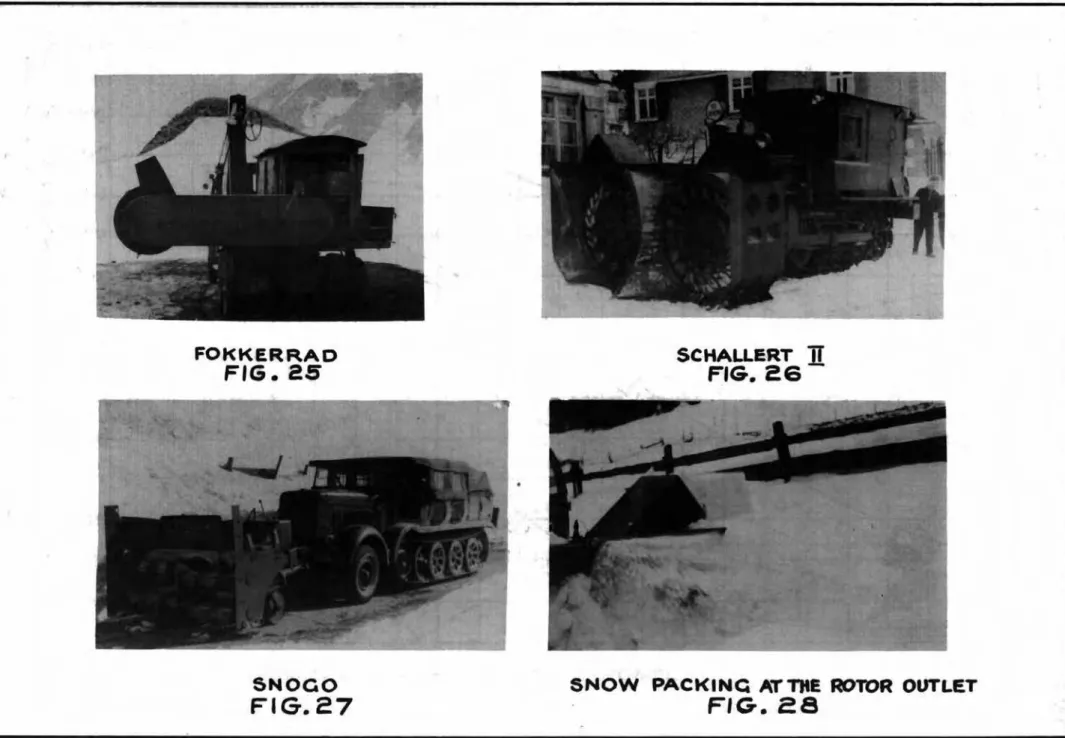
(Peterfrase BER and DEFj Schallert, FOkkerrad end Crosti) in
Grossglocknerstrasse in the summer of 1941; the following values were measured:
(1 ) Vo Lume of snow (incuomo) removed in 1 hour;
(2 ) Number of revolutions (ropomo) of the rota ting
drum,
(3 ) Distance (m.) at which the snow is thrown.
..
On the other hand; some of the snow properties also were recorded although they were not successfully correlated
to the work of snow-blowers:
(1) Specific weight,
(2) Cone Itstrength" 0
It should be noted that the cone "strengthlt was not
measured at t.ha t time by means of the apparatus descr ibed in
- 20 セN
For the above purpose a rawner made according to Haefeli's
data was used (66) and snow "strength" was determined from the
formula:
w
=
n x R x ht + G
Where n is the number of strokes of the weight R which
rell from the height h and forced the cone inm
the snow to the
depth to
G is the weight of the cone with the rod Which guided
the falling weighto
From the recorded number of revolutions of rotors and
from the ratio in the
エイ。ョウュゥウウゥッョセthe ropomo of the engines were
determinedo
Since engine characteristics were
ォョッキョセpower input
No {hopo} developed at a given speed of snow blowing could be
approxima tely determinedo
The energy A
(rnax kgo/secQ) of snow stream blown from
the device may be assumed as equal to:
A = M x V2
2
Where M is the mass of snow blown in 1 secn (kgo x
sec2/mo) and v is the speed of the stream (mo/seco)
0Accordingly,
the power represented by blown snow is:
M
x
V2 2x
75M x V2
150
The ratio of power No supplied by the engine to the
power Nl which remains in the snow when leaving the blower is a
measure of the efficiency of the deviceo
Herr Ko Croce called this value the coefficient of
internal efficiency (innerer Wirkungsgrad) of the snow-blower
(25) a
Another coefficient of efficiency was also defined by
cイッ」・セ
who referred the power No to the power N2 which would be
required if the snow were to be thrown from the road to the
distance blown without any losses due to air resistance or faulty
trajectory of fallo
It is known that the longest trajectory is
,= 21 =
obtained at the angle of 45°0 The work A (mo x kgo) required to
cover this dis tan ce is セ
A;::; Go x W
2
v'Vhere Go (kgo) is the weight of the snow thrown" and W (mo) is the distance which it f'a Ll.s ,
If the weight Go (kgo) of snow removed is expressed
in G kg. per second, then the corresponding power required ゥウセ
=
Gx
W150
and the coefficient of total efficiency (gesamte Wirkungsgrad) is:
This value expresses losses of the whole process including the losses which take place during the flight of snow
particles in the air (25)0
As has been mentioned before9 coefficients of
efficiency were found within the limits of 10 to 20 per cento However, the accuracy crf recordipg various data listed above
was not ウ。エゥウヲ。」エッイケセ especially as far as the measurement of
power input to the snow blowing process is concerned" For
Lne banc e , not all the power of the engine was used for rotation
of blowers. A portion of it was used for moving forward the
device which made the calculation of energy consumption more
inaccurate0 Engines worked at Grossglocknerstrasse at an al=
titude of 2200 to 2400 metres (7300 to 7500 feet) and did not
develop full power due to the decreased air pressureo Mechanical
efficiency of some older machinery used was not equal to the new one,eteo
These sources of inaccuracy started new trends toward the further improvement of the technique of measuring of
snow-blowers. It was emphasized on several occasions that an
economy of one per cent in power used9 or the smallest increase
of efficiency of the process means a saving of thousands of man=hours or millions of Reichsmark due to the astronomical figures of cubic feet of snow which had to be removedo
It was agreed that accuracy in assessing snow=blowers should be brought up to highest standards and that any amount of money spent for this purpose would pay in the futureo
Accordingly the most ュッ、・ャセー but probably the most expensive,
program was dev f s ed , It was arranged that all gas engines in
experimental AGQョッキセ「ャッキ・イウ were replaced by electric motors and
were supplied with DoCo by an especially built mobile generating
unito Power input was measured by means at' electric instruments,
thus securing the greatest possible accuracyo
The arrangement of the generating unit is shovm in Fig,
150 It was equipped with a 12 cylinder Diesel engine by HumboLdt>
Deutz developing 275 hopo at 1500 ropomo and with an
nEG
gener&torFG5227c/295b at' 270 Po and 500 volta DoCo This generating unit
also supplied power t'or an electric motor which propelled the whole installationo
It may be interesting to note that the importance attached to the new methods of snow=blower investigations was responsible for the designing and construction of this mobile
generating station in 5 monthso Those who 」ッセッー・イ。エ・、 in this
work with the For-s chungs st e.l.Le were Re ichsbann workshops Bond
Street Car Company in Municho Electric instruments for measuring
the power were tho s e manufactured by Hartman and Braun (Frankfurt).
Other installa tions were supplied by Zettler Co0 (Munich) 0
The ins t.r-umerrt pane1 o
r
the genera ting unit is shown inFigo 16J righto Since the readings ot' various metres were to be
made sLmu.Lt.aneoueLy , a special camer-a was installed which took
8 pictures per second at' the instrument panels thus r-ec or-dLng the
variation of power and speeds at 1/8 second intervals (Fig. 169
left)o From the photographed indication of voltmetres,; ammetres
and cLock s , the power -was later calculated and sub s eq uen t Iy the
coefficients of internal and total efficiency (Page 200 21) were
determined 0
Pictures of the generator0 セクー・イゥュ・ョエXNQ blower unit
and a photograph of instrument records are shown respectively in
Figo L'Za , b , Co
Power was supplied to the snow=blowers by means of
ヲャbクゥ「ャセ cables. The arrangement of the electrically driven
Petert'rkse Schallert is shown in Figo 180
The new equipment was used for testing the
snow-blowers during the winter of 1941-420 The great amount of data
recorded during these tests enabled the investigators to compile
many interesting graphs and tablesj which will be discussed laterv
It may be noted that p at that time.., the Germans did
not conduct any tests with small scale models.., Which were
originated later in Switzerland by Ro Aebi and Coo Although
Professor Wo Koeniger recommended in 1939 this type of test (89)
they never? a s far as it 13 knownS' mr;ter-La1Lz ed at; the
1"01' 2MG[セャャxイャgs st e Ll.e 0 Only luree SG&1c. te s ts were per-f'or-ried by Herr
Ie Croce who devised a::;recieal e xjer-Lmen t.a I blev:e,c W1U' pr-o v Lced
• t1.-
1 t ' ., i' ., 1 b ' t :.l ' セ -,セ \W1. .u e e c r1.C pr-opu.i.s on ann ex c :angea,l,E' rc -,aI'S 1.1'lgo i : , ) ; . This suggests t.hat the wartime ・イNGQBョGァVイkLケセGヲG
tLe:i;v'>v,-clearing problem in Germany favoured a f'uLl> s ca18 e:'.}:ecIrneri t wi th an immediate prospect of' pr-a o tLca L results rather than 8.
10ng-term scale model research.
The above-mentioned Swiss firmS' howeverj recently in=
augurated at the Schneeforschungsi.nstitut lit Davos an investlgation of snow-b Lowi.ng process by using mLnI atur-e ro tors and spe c LaL
mea sur-Lng installation" wh Lc h undoubtedly tetter serves systematic study of the relevant problems.
Herr K. Croce was acquainted with tllli progress made by the swiss and hoped soon to re turn to further research in this SUbject at the Bavarian Strassen and Flussbauamt in Traunstein. At the time of the writer's visit in Germany he was busy finishing his previously mentioned book in which he discusses in detail all the methods of measuring and assessing the value of snow-clearing equipment0
(ii) A systematic investigation of available equipment wa s preceded by tests on snow removal performed since 1935/36 after the Autobahn Munich-Salzburg had been constructed. For this
purpose existing equipment was オウ・、セ and the history of experience gained was described by Oberreichsbahnrat Saurler who gave Ln his paper a good picture of the difficulties encountered (123) c
An organized studys howevery independent from daily
routine and from the necessity of keeping the autobahn open for traffic started early in the winter of 1938=39 when the General Inspector organized the first contest of ウョッキセーャッオァィウッ
In July9 1939v a meeting was called in the
Reichs-ministerium in Berlin wi.th the purpose of exchanging ideas between the Highway Departmental officials2 scientists and the representatives of the industry producing the necessary equipment. The experience gained during the contest was discusseds and
conditions for a new contest planned in the winter of 1939-40 were seto
General Inspector
Dro
Todt was not satisfied9especially with the results obtained by the snow=ploughs classified in Class A (shallow snow9 flat country ploughs)o He insisted
that new ploughs be developed which would be able to throw snow on the sides of a road without forming vertical embankments at a snow depth of 25 to 30 cmo and at speeds of about 30 kmo/hro
= 24
..s ,ri::;::"sterialrat Auber-Len emphasized the new ploughs should be
セセセIQX to throw the snow further without forming [j snow c1eposiエセGョ
the SiO(38 of 8 reads especially at sraaLl snow dt:! th (5)
r-Equipment admitted tQ the contest in ャPS、セTP was divided
into four classes and was tested near Inzell and on the Autobahn
ANィュゥ」ィセs。ャコ「オイァ 0
Glaas Aセ Ploughs devised fc\r fla t country and smaLl sn,)w depth
(up to 50 CT!lo) J suLtab Le for use on the ;·.ut:.>Lahn and
country r-oads at sl>et:ds up to 30 k:n:fr,
\.-lHSS QSセ Ploughs for セL hill;,,: )uncry with La r-ge snow pr-ec Lp l t.a t.Lo ns ,
and steeper slopes.
セ ...ass C: Snow r-ernover s for r-e.nnant.s of' 5. snow-cover and ice crust
tha t remains on ィNゥセセ「キ。ケウ after- thaw pe r-Lcds0
,':lass D: Special devices er.a.c Li ng one to attach an; type ('f
plough to any type of vehie 1ea
Under the chaLr-manan.Lp or Herr K" Cr-oc e , the I'oLf.owi ng judges assessed the merits of the machinery during the 」ッョエ・ウエセ
Jungel, (responsible for snow-clearing in annexed territories in Eastern Europe called oウエュ。イォIセ Schanze and Rische (from the Obercomando del' Wehrmacht):, Kleiber (from Ministry of Interior) 9
Doll and Dlee (from Highway' Dept0) and Wallack Hhッ」ィ。ャー・ョセsエイ。ウ sen Co0 ) 0
From
27 snow=ploughs and devices tested) the following were ーイ。ゥウ・、セClass A'(, "Rampel Pflug" by J a Kronbichler Ros enhe.Lm , Obbo'
Weight 2640
kgo
Width of removed snow 805 moセセク」 snow depth 0045 ma
SPW
(See pcis}
1065kg/mo
2 "Flugelgestell MUnchen!!Weight
Width of removed
Max0 snow depth
SPW by WoUoJo Scheid 2070 kgo snow 7050
m.
0065 mo' 710 kg/m? Limburg asd , Lahn- 25 セ
Class bセ Vor-b aupfLug Type MSR by Miag COo AbL Wartlillgsmaschinen, Oberramstadt bei Darm s エ「セ セ
WeiGht
Width of removed snow
SPW
SFAL (See 1u 15) 700 kgv 0070 and 0 080 mo 323 and 377 kg/m2 980 and 1015 kg0Tests of equipment in classes C and D were considered unsatisfactoryo The results as compared with the contest of
QYSXセSY showed; ィッキ・カ・イセ an improvement especially in B classo
As the survey of the contest states (171)9 there was a tendency toward a lighter plough designo None of エィ・セオゥーュ・ョエY however, satisfied requirements with respect to the snow throwing
capac it Yo ' The most significant progress was made in reduction of types of ploughso New tendencies, like a trend toward using hydraulic or electric installations for blade adjustment were
キ・ャ」ッュ・、セ but not considered quite satisfactoryo No further
contests were contemplated and the Forschungsstelle took over the development and the elaboration of the experience gainedo
Although tests conducted in the winter of QYSXセSY were considered unsatisfactory" it may be useful to quote a few graphs which illustrate the pr-e-war- tendency of German manufacturers in plough designo
The graphs reproduced in Figo 19 show the specific plough weight (SPW) of various equipment tested at that timeo The variety of types and the large difference in weight between the lightest and heaviest plough even in the same class is
st r-Lk Lng , The full c har-ac t.er-Lsti cs of ploughs denoted on the graphs by numbers may be found in the Croce report on results of the 1938-39 contest (26)0
As will be later discussed, the variety of types listed in the above diagrams were ultimately reduced to one universal
plough unit as a result of research performed by the Forschungsstelleo One of the most important ゥエ・ュセ of this nesearch was probably
the measurement of' the economy of snow removal by means of the methods described on pages QTセQXッ
Since the data obtained has a certain comparative value9 it may be advisable to quote a few measurements which
were made during the tests carried out at the end of 1940 (27)0
Table I shows the movement resistance of various
vセエケー・ and one-blade type ploughs with reference to the speed
= 26
-TABLE I
V-TYPE PLOUGHS
Snow fllovement Resistance in kg, at Plough Plough Depth Spec M d s :
No0 Width
Gm
:}i
5 J.O 15 20 25 30 m (km/hr) 1 3015 16 280 540 640 820 4040 16 280 990 1090 1110 20 9 5 16 200 250 315 440 520 520 I 2 16 200 235 330 450 535 910 930 20 200 300 410 505 550 540 21 200 240 345 365 590 655 30 2 0 17 170- 310 500 850 905 3 24 193 430 480 700 880 1060 21 193 640 660 830 1020 1250 1370 4 20 4 0 -31 77 300 370 430 34 77 280 310 360 420 ONE=BLADE plougセs 5 20 7 5 32 60 670 620 570 6 2;;80 7 335 490 500 520 550 7 50 0 0 20 102 320 390 490 600 8 3 070 31 102 270 240 180 21 102 80 110 190 2aO 9 2 070 39 77 360 420 500Data shown in the above tablev When referred to 1 metre
of plough width are plotted in Figo 20a and bo The average values of R
w
(see po17) extrapolated on these graphs show a definitedifference between the character of resistance increase with the increase of the speed for V-blade and one=blade ploughso
The curve shown in Figo 20b iS9 however9 to be oon= sidered as less certain than that shown in Figo 20a9 because
each point is based on six measurements only.
When the resistance is referred to 10 kgo of the removed snow on ' square metre of the road then the respective Rv value (see po 17) gives a clearer picture of differences between various types of ploughs (Figo 20c and d)o