
NMR spectroscopy and ion pairing: Measuring and understanding how ions interact
Texte intégral
Figure
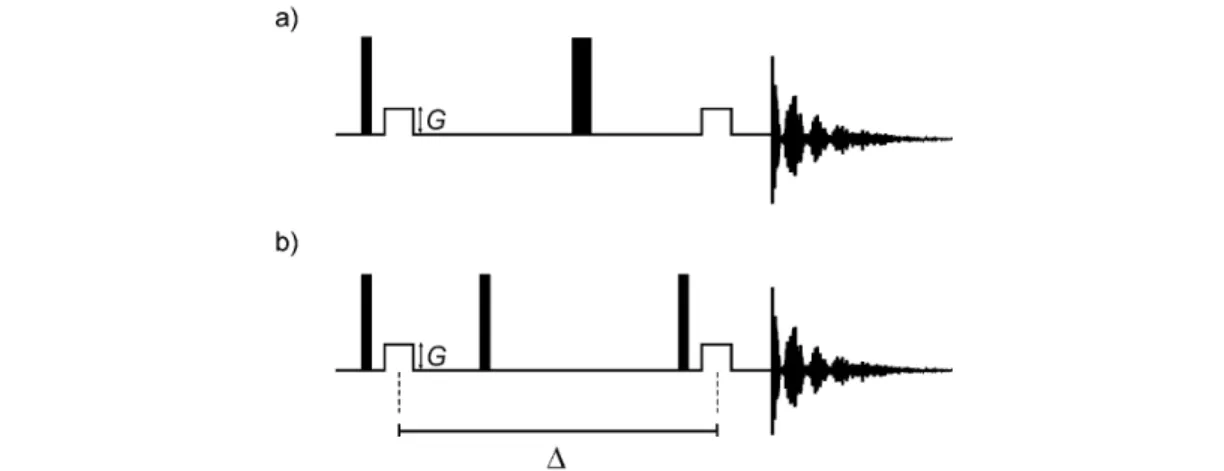
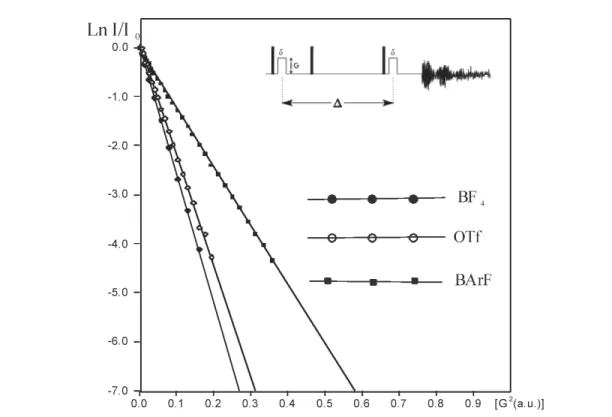
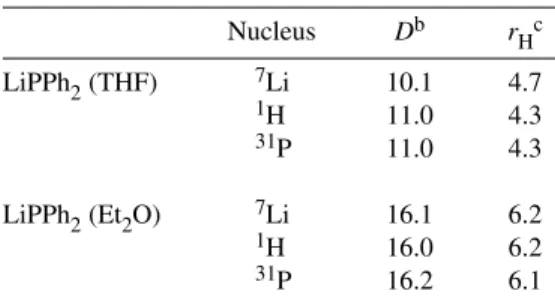
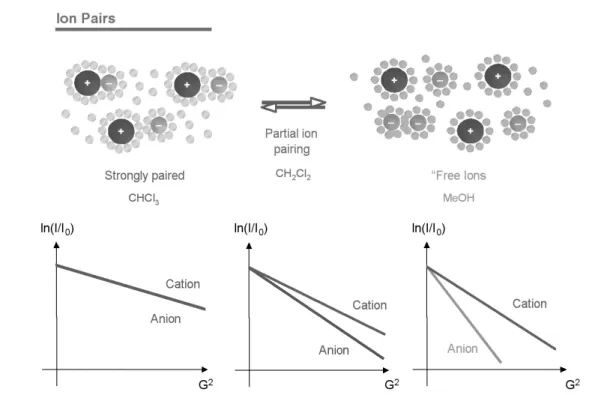
![Table 2 D ( × 10 10 m 2 s –1 ) and r H (Å) values for [ Ir(1,5-COD)(PHOX) ] (BF 4 ) as a function of solvent [ 16 ]](https://thumb-eu.123doks.com/thumbv2/123doknet/14903175.654691/7.810.94.712.106.725/table-å-values-ir-cod-phox-function-solvent.webp)
![Fig. 4 Solid-state structure for Li(THF) 4 CPh 3 , 2, from THF solution [ 17 ] .](https://thumb-eu.123doks.com/thumbv2/123doknet/14903175.654691/8.810.99.661.343.566/fig-solid-state-structure-thf-cph-thf-solution.webp)
![Fig. 5 The 1 H, 1 H NOESY spectrum of [K(18-crown-6)(NPh 2 )] reveals selective contacts from the crown ether CH 2 protons to the ortho and meta phenyl protons](https://thumb-eu.123doks.com/thumbv2/123doknet/14903175.654691/9.810.99.714.686.884/noesy-spectrum-reveals-selective-contacts-protons-phenyl-protons.webp)

![Fig. 7 1 H, 19 F HOESY spectra for 2 mmol solutions of 9 and 10 in CD 2 Cl 2 [ 18 ] .](https://thumb-eu.123doks.com/thumbv2/123doknet/14903175.654691/12.810.99.713.120.580/fig-h-hoesy-spectra-mmol-solutions-cd-cl.webp)
Documents relatifs
On Figure 2, we represent, in logarithmic ordinates, the numbers of events of different types, summed over the four departments of the Paris area (75, 92, 93 and 94): (i) the number
fixes the conformation of the central cyclohexenyl ring allowing the differentiation between the two faces of the molecule, and the additional role of the
Keywords: configuration space integrals, finite type invariants of knots and 3-manifolds, homology spheres, two-loop polynomial, rational lift of Kontsevich integral,
[r]
[r]
Application of metabolomics for the determination of serum biomarkers aiding the prognosis for septic shock and hepatocellular carcinoma using Mass Spectrometry and ¹H NMR
The agreement between the calculated and measured VDE values implied that the structure of the Cu(Asp) - complex originated with a zwitterionic form of aspartic acid
Comparison of the pseudo-absorption gas phase spectrum (pink curve) measured in the 6.4-9.7 eV energy range with the solution phase photoabsorption cross section data (black
