HAL Id: hal-02571398
https://hal.archives-ouvertes.fr/hal-02571398
Submitted on 4 Sep 2020
HAL is a multi-disciplinary open access
archive for the deposit and dissemination of
sci-entific research documents, whether they are
pub-lished or not. The documents may come from
teaching and research institutions in France or
abroad, or from public or private research centers.
L’archive ouverte pluridisciplinaire HAL, est
destinée au dépôt et à la diffusion de documents
scientifiques de niveau recherche, publiés ou non,
émanant des établissements d’enseignement et de
recherche français ou étrangers, des laboratoires
publics ou privés.
Distributed under a Creative Commons Attribution - NonCommercial - NoDerivatives| 4.0
International License
Separating silver sources of Archaic Athenian coinage by
comprehensive compositional analyses
Gillan Davis, Damian Gore, Kenneth Sheedy, Francis Albarède
To cite this version:
Gillan Davis, Damian Gore, Kenneth Sheedy, Francis Albarède. Separating silver sources of
Ar-chaic Athenian coinage by comprehensive compositional analyses. Journal of Archaeological Science,
Elsevier, 2020, 114, pp.105068. �10.1016/j.jas.2019.105068�. �hal-02571398�
Journal of Archaeological Science 114 (2020) 105068
Available online 5 January 2020
0305-4403/© 2020 The Authors. Published by Elsevier Ltd. This is an open access article under the CC BY-NC-ND license
(http://creativecommons.org/licenses/by-nc-nd/4.0/).
Separating silver sources of Archaic Athenian coinage by comprehensive
compositional analyses
Gillan Davis
a,*, Damian B. Gore
b, Kenneth A. Sheedy
a, Francis Albar�ede
c,daDepartment of Ancient History, Macquarie University, NSW, 2109, Australia
bDepartment of Earth and Environmental Sciences, Macquarie University, NSW, 2109, Australia cEcole Normale Sup�erieure de Lyon, Universit�e Claude Bernard-Lyon 1, CNRS, 69007, Lyon, France dRice University, Department of Earth Science, Houston, TX, 77005, USA
A R T I C L E I N F O
Keywords:
XRF
Lead isotope analysis Athenian coins Silver Owls
Wappenmünzen
A B S T R A C T
This article demonstrates that distinct and coherent silver sources can be discriminated from surface composi-tional analyses. In the first large-scale study of Archaic (pre-479 BC) Athenian silver coins in museum collections around the world, we analysed 788 coins by Energy Dispersive X-ray Fluorescence (XRF) spectrometry with a mathematical correction to provide a reliable composition for key diagnostic elements. Principal Component Analysis reveals compositional patterns including at least one copper-lead-gold (Cu, Pb, Au) triplet with strong clustering of data. The pattern for bismuth (Bi) was similar to, but not as clear as Pb. Considering elemental compositions in combination with a die study and isotopic analyses in the literature, we reveal when Lavrion was the metal source from which Wappenmünzen and Owl coinage types were struck, providing important new understanding about Athenian history in the pivotal period of transition from tyranny to democracy in the late sixth century BC. Beyond this specific example, we contend that XRF spectrometry could have wider application in studies of ancient silver, not least for a simplified triage protocol to help determine which silver artefacts should be subjected to slower, more costly and invasive trace elemental and isotopic analyses.
1. Introduction
The transition from the earliest silver coinage of Athens, the
Wap-penmünzen (WM), to the production of voluminous tetradrachm issues
showing the helmeted head of Athena on the obverse and a standing owl on the reverse (the famous ‘Owl’ coinage) in the late sixth century BC occurred just before the collapse of the Peisistratid tyranny and the emergence of Athenian democracy. It is of significance because it signalled a marked improvement in the economic fortunes of the Athenian state just prior to this momentous change in the state’s polit-ical institutions. The transition is connected with the exploitation of major domestic silver supplies at Lavrion in the south-east of Attica but the timing and nature of the transition has always been uncertain (Davis, 2014a).
Athens and its coinage was central to Greek history in the Archaic and Classical periods and has been the focus of considerable research. In 1962, Kraay and Emeleus conducted the first significant chemical ana-lyses of ancient Greek silver (Ag) coins (Table 1). Using instrumental
neutron activation analysis (INAA), they reported the gold (Au) and copper (Cu) contents of 36 coins from Archaic Athens. They claimed it was possible to differentiate the major Aegean silver ore sources of Lavrion and Thraco-Macedonia primarily on the basis that WM types of Athenian coins had larger Au concentrations than Athenian Owl type coins. They were acting on an a priori assumption that the WM were sourced from Thrace by the Peisistratid tyrants in the second half of the sixth century BC (Hdt. 1.64.1; Ath. Pol. 15.2), and the subsequent Owls from new exploitation of the Attic silver mines at Lavrion at the end of the century (Hdt. 7.144.1; Ath. Pol. 22.7; Plut. Them. 4.1; cf. Davis, 2014a, pp. 259-60, 268). It took almost two decades before new studies followed up this research. The later studies reported a variety of minor and trace elements including Pb, which is important because it was used in cupellation of Ag to remove impurities and remains as a minor or trace element, but cannot be quantified using INAA. Crucially, a number of studies employed lead isotope analysis (LIA) and claimed to be able to distinguish isotopic fields of Lavrion and Siphnos and possible fields in Thraco-Macedonia (Table 2; Fig. 1).
* Corresponding author.
E-mail addresses: [email protected] (G. Davis), [email protected] (D.B. Gore), [email protected] (K.A. Sheedy), [email protected]
(F. Albar�ede).
Contents lists available at ScienceDirect
Journal of Archaeological Science
journal homepage: http://www.elsevier.com/locate/jas
https://doi.org/10.1016/j.jas.2019.105068
Journal of Archaeological Science 114 (2020) 105068
2
Expectations were high that output from mining districts could be identified and matched based on use of a suite of trace elements acting as a kind of fingerprint (Price, 1980). Some fifty years later, understanding of the chemistry of coins has increased, but few scholars now put much faith in the capacity of ‘surface’ chemical analyses in isolation to answer questions relating to provenance (Birch et al., in press), though some scholars have made use of them for other analytical questions (cf. Fla-ment and Marchetti, 2004 on the question of Athenian ‘imitations’). One recent study has proposed using chemical analyses to determine ore sources (�Smit and �Semrov, 2018) but ‘surface’ analytical techniques are rarely used to answer questions relating to the internal composition of coins. This is because of an appreciation that the surface of a coin may differ from its bulk composition through changes over time and envi-ronmental exposure resulting in surface enrichment or depletion of certain elements in the patina (Ponting, 2012). The perceived need for sub-surface access leads to difficulties in obtaining coins for sampling owing to the understandable reluctance of curators of precious coins to allow holes to be drilled in them, even by minimally invasive laser
ablation. When core material can be obtained, there may be doubts about results assuming homogenous elemental distribution which has been shown, at least for some silver coins, to be untrue (Marjo et al., 2017). The small numbers of coins sampled by each analyst, combined with use of different methods and calibration standards, surface and sub-surface analyses and inconsistent reporting of elements, has made it difficult to bring the studies together and confidently derive conclusions. Elemental analyses have tended to shift to questions of characterising metal groups and understanding ancient technologies, especially refining (Birch et al., in press).
Attention has focussed on LIA because ancient silver coins were mostly (if perhaps not entirely) derived from argentiferous lead ores. Lead has four stable radiogenic isotopes, which do not appreciably change during refining or manufacturing and their ratios can be linked to specific geological regions (Gale et al., 1980, p. 10; Albar�ede et al., 2012; Blichert-Toft et al., 2016). Some scholars have sought to demon-strate problems with LIA. Baron et al. (2014, pp. 668-9) noted that the lead isotopic composition of ore is controlled by geological factors leading to significant variation within ore deposits, and there can be similar isotopic signatures for different regions. They point out that frequently the number of ore samples is inadequate, unrepresentative or poorly sourced, and there are failures to properly understand the geo-logical/mineralogical contexts or even if they are relevant at all. How-ever, expert measurement and interpretation of high-quality data, first and foremost those including measurements of 204Pb, carries rich
in-formation on the geological environment of the ores (Albar�ede et al., 2012; Blichert-Toft et al., 2016). The present study follows the same track. Lavrion is reasonably well understood; other sources are conjec-tural and cannot be limited to Siphnos and Thraco-Macedonia the latter of which encompasses many mining districts. Stos-Gale and Davis (in press) reanalysed Pb isotope data from the important study by Gale et al. (1980) to show that ore sources used to create the WM are consistent with sources located in Spain, Iran and the Rhodope Mountains in northern Greece. In general, Pb isotopes may individually help identify potential ore locations, and the combination of LIA with compositional analyses should reduce the range of possible ore sources.
The first large-scale chemical analysis of archaic Athenian coinage was conducted as part of the Early Attic Coin Project (Sheedy et al., 2009). Analyses were conducted on 788 Archaic Athenian coins using Energy Dispersive X-ray Fluorescence spectrometry (XRF) from collec-tions in six major museums around the world. This data set represents approximately one quarter of all extant specimens, a value derived from the comprehensive corpus of Archaic Attic coins assembled by Sheedy and Davis (to be published as part of a forthcoming volume on the coins).
A large data set offers considerable statistical potential relative to a small data set. The research aims to determine whether surface, chem-ical analyses of a large number of coins combined with a detailed un-derstanding of the numismatic evidence can provide information about the sources of ores used to mint the two different series of coins (WM and
Table 1
Published analyses of Archaic (pre-479 BC) Athenian coins.
Name Date Type Number Method Elements reported Kraay and
Emeleus 1962 WM 13 INAA Cu, Au Owls 23
Conophagos et al. 1976 WM 4 XRF Cu, Ag, Pb Owls 2
Cowell (cited in
Gale et al., 1980)
1980 WM 7 XRF Cu, Ag, Au, Pb Gale et al. 1980 WM 7 LIA Pb isotopes
Owls 14 Paszthory and
Hurter 1981 WM 11 XRF Fe, Ni, Cu, Zn, Au, Pb, Bi Paszthory 1982 Owls 35 XRF Fe, Ni, Cu, Zn, Au,
Pb, Bi Nicolet-Pierre
et al. 1985 WM 43 PAA Cu, As, Sn, Au, Pb, Pb isotopes Owls 28
WM 7 LIA Pb isotopes Owls 1
Blet-Lemarquand 2013 WM 11 LA-ICP-
MS Ti, Cu, Zn, As, Ni, Ru, Ag, Sn, Sb, Te, Pd, Ir, Pt, Au, Pb, Bi Owls 3
METHODS.
INAA - Instrumental neutron activation analysis; PAA - Proton activation anal-ysis;
LIA - ICP-MS/LIA Lead isotope analysis; XRF - X-ray fluorescence spectrometry; LA-ICP-MS - Laser Ablation Inductively Coupled Plasma Mass Spectrometry.
Table 2
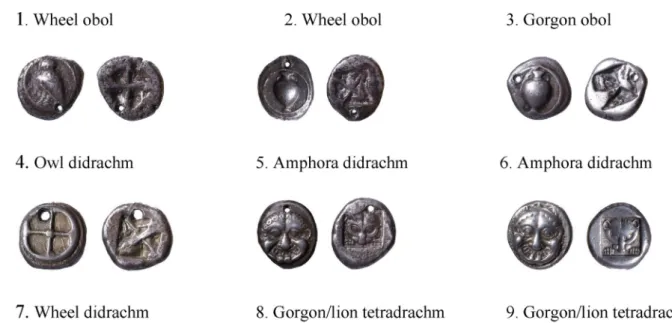
Isotopic analyses of Wappenmünzen. Images of the coins are in Fig. 1.
No. Identification Types Denomination Weight (g) Analyst Ore source
1 BNF 258 Wheel/incuse Obol 0.40 Barrandon Lavrion
2 BNF 1407 Wheel/Incuse Obol 0.51 Barrandon Lavrion 3 BNF 124 Gorgon/Incuse Obol 0.65 Barrandon Lavrion
4 BMC 1 - Diadus Owl/Incuse Didrachm 7.42 Gale et al. Spain (south), Linares or Sardinia 5 BMC 1 - Histiaea Amphora/Incuse Didrachm 8.19 Gale et al. Iran (Nakhlak)
6 BMC 3 - Histiaea Amphora/Incuse Didrachm 7.98 Gale et al. Rhodope (south) 7 BMC 9 - Chalcis Wheel/Incuse Didrachm 7.93 Gale et al. Spain (south) 8 BMC 17 - Eretria Gorgon/lion Tetradrachm 17.01 Gale et al. Spain (Mazzaron)
9 BMC 18 Eretria Gorgon/lion Tetradrachm 16.48 Gale et al. Rhodope (east) or Thrace (Iasmos) Key.
No. ¼ our number as shown on plots; BNF ¼ Biblioth�eque nationale de France, analyses by Jean-No€el Barrandon (Nicolet-Pierre et al., 1985); BMC ¼ British Museum Catalogue, analyses given in Gale et al. (1980), p. 26.
Owls; non-Lavrion vs. Lavrion) and whether the technique can have broader applications for the study of ancient silver coins and artefacts. A more ambitious aim of the research is to determine whether it is possible to discriminate between the sources of discrete coin types and denominations within the WM. Establishing when the WM were first minted, the sequence of their multiple types, and the timing of the transition to the Owl series has been of longstanding concern to histo-rians and numismatists, especially since many scholars attempt to spe-cifically link the introduction of the Owls to the so-called ‘birth of democracy’ in 508/7 BC (Sheedy et al., 2009). One of the major WM types was the ‘Gorgon’. Kraay (1956) placed the Gorgon tetradrachm (c. 17.4 g) at the end of the WM series on typological grounds because it was the first issue to include a full reverse type (previously there was a simple incuse cross – Fig. 1). It is logical to conclude that these coins were minted in this larger denomination when Lavrion silver became more abundant, since the largest earlier coin was the didrachm (some 50% smaller c. 8.7 g). Kroll suggested that Gorgon fractions (obols – c. 0.60 g) may have continued to be used after the introduction of the Owl tetradrachms (1981, p. 18). More recently, Davis (2014b) suggested, principally from hoard evidence, that ‘Wheel’ type WM fractions (drachms – c. 4.36 g and obols) also overlapped the introduction of the Owls in even more substantial numbers. If these propositions are correct, some of the Gorgon tetradrachms and a sizable proportion of Gorgon and Wheel fractions should have derived from Lavrion silver. To test these propositions, five groups of coins (Owl tetradrachms, WM didrachms and drachms, Gorgon tetradrachms, Gorgon fractions, Wheel fractions) were analysed separately. Using these analyses, we test the proposition that the ore source changed from external to domestic (Lavrion) supplies with the transition from WM to Owls. We interrogate the data by testing the numismatically-derived sequence of WM types using published LIA analyses of some of the coins as reference (Table 1). These published isotopic analyses have been placed upon the relevant plots (Table 2). Dr Zofia Stos-Gale provided the likely ore source derived from the isotopic data (OXALID data base and personal communication).
2. Materials calculation of 3D frequencies, methods and calculations
1575 analyses of coins are reported representing 788 coins. They were analysed at the American Numismatic Society, New York (116 coins), Ashmolean, Oxford (72 coins), Athens Numismatic Museum (112 coins), British Museum, London (197 coins), Biblioth�eque nationale de France, Paris (96 coins), Fitzwilliam Museum, Cambridge (32 coins) and
Staatliche Museen zu Berlin (163 coins) (Annexure A). 848 analyses were Owls and 727 WM.
Elemental analyses were conducted on-site using a PANalytical Epsilon 3 benchtop EDXRF, with 50 kV Rh anode tube. Samples were measured on both the obverse and reverse, in air, for 100 s with spinner at 1 Hz. The instrument measures a 6 � 4 mm ellipse. The PANalytical software quantified elemental compositions via an automated qualita-tive spectrum analysis combined with a fundamental parameters matrix model supplemented with matrix-matched certified reference materials (MBH Analytical Ltd, UK). The automated deconvolution of every spectrum was checked manually. An ancient Athenian silver owl was analysed at least twice daily to help correct for instrumental drift. Analytical inaccuracy of the EDXRF was constrained by measurement of 13 certified reference materials (MBH, UK: 131XAGP2A, 131XAGP3A, 131XAGP4A, 131XPAG1, 131XPAG2, 132X925Zn1, 132X925Zn3, 132XAGB87, 132XAGB92, 132XAGB94, 133XAGQ1, 133XAGQ2, 133XAGQ3 (Annexure A). In general, elements with concentrations of
<0.1 wt% have relative errors of 10–100%, and elements present at >1
wt% have relative errors of <10%.
In order to correct for differences between surface and bulk com-positions, a simple mathematical correction was adopted (Gore and Davis, 2016). The process is to subtract elements in the air (Ar), the XRF instrument (the tube anode), effects of X-ray physics such as sum peaks, elements which have come into the patina from the environment, and normalise to 100% (Gore and Davis, 2016).
Elemental data were ratioed to silver in order to circumvent the constant sum effect (Chayes, 1960; Rollinson, 2013). Data were plotted in ternary diagrams, which capture in two dimensions most of the fea-tures that normally require multiple rectangular plots. For example, in the Cu–10Au–Pb plot (or its strict equivalent the Cu/Ag–10Au/Ag–Pb/Ag plot) used below, the triangular coordinate uCu
takes the form:
uCu¼αCu½Cu�=ðαCu½Cu� þαAu½Au� þαPb½Pb�
where the weights αi were arbitrarily chosen to force the data to spread
in the triangle in a more conspicuous way, here αCu ¼1, αAu ¼10, and
αPb ¼1. Similar expressions hold for uAu and uPb. The corresponding rectangular coordinates (x, y) of each data point in the triangle, defined by the three points (0,0)-(0.5,0.866)-(1,0) are;
x ¼ uCu�0 þ uAu�0:5 þ uPb�1
y ¼ uCu�0 þ uAu�0:866 þ uPb�0
Journal of Archaeological Science 114 (2020) 105068
4
Cu/Pb ¼ uCu/uPb with similar expressions for other element pairs.
This offers the first advantage that all the ratios are visible in a single plot.A second advantage is that triangular plots are amenable to a calculation of 3D frequencies and therefore deal with correlations that may not be visible in separate rectangular plots.
We used Matlab® software to calculate 2-dimensional histograms, the corresponding rectangular coordinates (x,y) on each sample, and to contour the cumulated frequencies of each bin with equally spaced frequency intervals (0, 0.1, …, 0.9, 1, or deciles). The data are provided in Annexure A. A correlation matrix of all ratioed data was constructed using Minitab Express for Windows.
3. Results
Table 3 shows the number and percentage of the four groups of Archaic Athenian coins according to their Cu, Au and Pb contents. The compositions of the coins appear to be different (Table 3). 90% of Owl tetradrachms have ‘low’ concentrations of Au <0.05%, Pb <1% and Cu
<0.25% (defined by Kraay and Emeleus, 1962, p. 34 for Au & Pb and
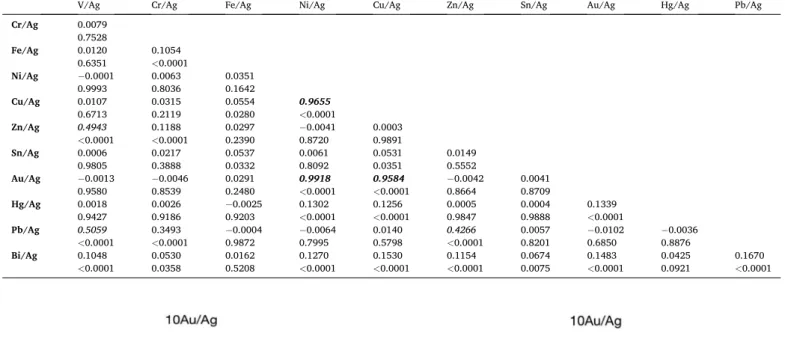
matched to c. 90% for Cu). The WM have higher average concentrations of Cu and Au with Au being >0.05% for over 4/5ths of the large WM including the large Gorgons. Pb is >1% for all groups except large WM. PCA was applied to all coin data greater than the limits of quantifi-cation. The three largest components, Cu, Pb and Au, account for 56% of the total variance. Few samples contain V, Cr, Ni and Sn at concentra-tions greater than the limit of quantification. Correlaconcentra-tions between elemental ratios (Table 4) show significant, strong positive correlations for Cu–Ni, Au–Ni and Au–Cu.
A ternary Cu–Au–Pb plot (Fig. 2) clearly defines the gap between populations of Owls (red) and WM (blue) and shows a constant ratio of Cu/Pbþ10Au. WM plot on the Cu–Au (Pb-free) edge, in contrast with the Owls which span the space between the Cu–Pb (Au-free) edge and 2/ 3rds of the way to the Au–Pb (Pb-free) edge. A ternary plot of Bi–Au–Pb (Fig. 3) shows a similar pattern.
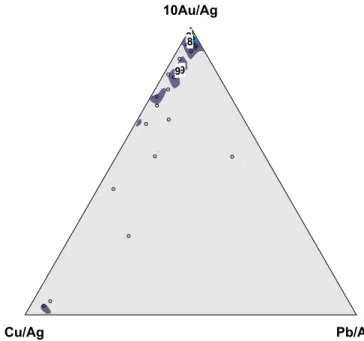
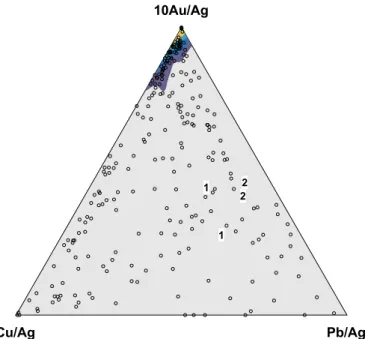
Figs. 4–8 plot the selected groups being separately analysed. Isotopic data from Lavrion metal plotted against chemical analyses of the Owl tetradrachms show a close overlap between the two methods (Fig. 4). Fig. 5 does the same for the WM didrachms and drachms showing they do not generally have a Lavrion source. Fig. 6 consolidates this finding with just Gorgon tetradrachms with similar results. The Gorgon fractions have a different source from the Gorgon tetradrachms (Fig. 7). Wheel fractions showed a Lavrion source for the two coins analysed isotopi-cally but a non-Lavrion source for most coins (Fig. 8).
4. Discussion
4.1. Effectiveness of the analytical method
For silver-rich samples (>95% Ag), the patina has minor impact on determining trace elements by XRF using the Gore and Davis correction method (2016, p.841). The depth of penetration of the primary X-ray beam into the sample, and the escape depth from which fluorescent X-rays can be detected depends on the mass absorption coefficient of the metal, as well as the energy of the characteristic radiation (the element of interest). In silver coins, for emissions of <6 keV the analytical depth is < 10 μm, while for emissions of 30–50 keV (achievable with modern
handheld or benchtop XRF spectrometers), the analytical depths can be
100–500 μm (Gore and Davis, 2016, their Fig. 1), far deeper than the
typical patina thickness on silver coins (Marjo et al., 2017). This works particularly well on silver-rich (or gold or electrum) coins especially with the thin patinas that result from abrasion from use in ancient times, or cleaning prior to analysis. Dirt on coins probably represents the greatest source of error in analyses. We emphasise that plated, debased or silver-copper alloy coins are unsuitable for quantification of elemental compositions using the Gore and Davis (2016) method. Some coinages, notably among imperial Roman issues, were manufactured with a technique to artificially enhance the silver on the surface (Beck et al., 2004). That is not the case with archaic Greek coins with their very high purity of silver. Arguments surrounding analytical methodologies to inform research questions into later Roman coins should not be conflated with them. Although it is recognised that sub-surface analyses are more robust, such analyses damage the coins and limit the number of coins obtainable for analysis. The data obtained by the method described here are fit for most purposes.
4.2. Diagnostically useful elements
Among the detectable elements, some could be diagnostically useful including Ag and the minor or trace metals V, Cr, Fe, Ni, Cu, Zn, Sn, Au, Hg, Pb and Bi. Of these, the most useful are Au and Pb. The former represents the initial concentration, while the latter reflects the refining technique (Gale et al., 1980, p. 23). It is assumed that foreign Pb did not need to be added to Ag-bearing minerals after cupellation. Gale et al. (1980, p. 8) proposed that high Bi may indicate a Bi-rich ore. Bi is re-fractory and largely survives cupellation, however, it oxidises in the last stage of cupellation (L’H�eritier et al., 2015). Here we find that Bi does not stand out as a clear indicator of Bi-rich ores (Fig. 2). It seems probable that Bi follows Pb in being indicative of the refining technique. In contrast with Pb, Bi, and Zn, Cu is rarely present in Ag-sulfide ores and is added post cupellation either for hardness or debasement. Occasion-ally, it constitutes the core of a plated coin.
4.3. Mixing and recycling
Only a small fraction of the points on the Cu–Au–Pb ternary diagram scatter strongly (see the 10% contours on Fig. 1), arguing against a prevalent practice of mixing and recycling. To a very large extent, Pb present prior to metallurgy is oxidised by cupellation and therefore eliminated. Addition of small but variable amounts of metallic Pb to metallic silver would have moved the points from the Pb apex (Figs. 1 and 2). The well-defined maxima argue therefore against a wide practice of dilution by foreign lead after cupellation (Brill and Wampler, 1967), which is consistent with the LIA data.
Most data points in Fig. 1 define a ridge parallel to the Au–Pb (Cu- free) edge, which indicates that the coin types have consistent Cu/ (Pbþ10Au) ratios. This feature clearly demonstrates that Cu was added to the metal after cupellation in the near-constant proportions defined by Cu solubility in silver (Subramanian and Perepezko, 1993). The ratios of some elements, notably Cu, Au, and Ni, are positively correlated (Table 4). Ni and Au are abundant in mantle-derived rocks, which suggests that Cu from ophiolitic deposits in Cyprus and south-eastern Asia Minor (Yigit, 2009), may have been mixed with Ag to increase metal strength (Robinson et al., 2003). Sn is rare in galena (PbS) ores. Its background concentrations are usually very low, so its presence might
Table 3
Raw number and percentage of coins in five main series of Archaic Athenian coins having less than 0.05% Au, 1% Pb and 0.25% Cu.
Type Owl tetradrachms WM (non-fractions) Gorgon tetradrachms Gorgon fractions Wheel fractions
Raw % Raw % Raw % Raw % Raw %
<0.25% Cu 383/424 90.3 36/136 26.5 10/16 62.5 28/46 60.9 59/127 46.5 <0.05% Au 380/424 89.6 20/136 14.7 3/16 18.8 25/46 55.4 53/127 41.7 <1% Pb 381/424 89.9 84/136 61.8 16/16 100.0 44/46 95.7 121/127 95.2 G. Davis et al.
indicate addition of bronze rather than pure Cu. A few Athenian coins with large concentrations of Cu (>5%) are almost certainly plated especially since they include significant traces of Sn indicating a bronze core.
4.4. Compositional differences between Owls and WM
The clear gap between the coin series of the Owls and WM observed in Fig. 2 is striking and reproduces published observations (Kraay and Emeleus, 1962). The coins analysed represent distinct populations (different maxima) and likely different sources. The blue dots in the red field indicate a few coins made from early Lavrion silver mining coming into the WM field. The broad scatter of the data and the strong influence
of a few anomalous points probably reflect limitations of using surface analyses. The dichotomy can also be observed for ternary plots of ele-ments, especially when lead is replaced by zinc, bismuth, or mercury, but is less conspicuous, presumably because of increased noise in the data.
The Archaic Owl tetradrachms provide the baseline for Lavrion silver from which they were predominantly struck (Gale et al., 1980, p. 14, 25–26, 30). Around 90% of them have <0.05% Au, <1% Pb, and
<0.25% Cu (Table 3). The remaining 10% of the coins presumably
derived their silver from non-Lavrion sources. This is expected since Athens traded for goods and would have had access to the same external silver available before the Lavrion mines came on stream. The value of 10% roughly matches the difference between numbers of extant WM and Owls (per database of corpus of all known examples of same held by
Table 4
Correlations between elemental ratios (n ¼ 788 coins). Upper value is the Pearson correlation, and lower value (in grey) is the p-value. Correlations significant (at α ¼ 0.05) and with correlation >0.9 are in bold italics.
V/Ag Cr/Ag Fe/Ag Ni/Ag Cu/Ag Zn/Ag Sn/Ag Au/Ag Hg/Ag Pb/Ag
Cr/Ag 0.0079 0.7528 Fe/Ag 0.0120 0.1054 0.6351 <0.0001 Ni/Ag 0.0001 0.0063 0.0351 0.9993 0.8036 0.1642 Cu/Ag 0.0107 0.0315 0.0554 0.9655 0.6713 0.2119 0.0280 <0.0001 Zn/Ag 0.4943 0.1188 0.0297 0.0041 0.0003 <0.0001 <0.0001 0.2390 0.8720 0.9891 Sn/Ag 0.0006 0.0217 0.0537 0.0061 0.0531 0.0149 0.9805 0.3888 0.0332 0.8092 0.0351 0.5552 Au/Ag 0.0013 0.0046 0.0291 0.9918 0.9584 0.0042 0.0041 0.9580 0.8539 0.2480 <0.0001 <0.0001 0.8664 0.8709 Hg/Ag 0.0018 0.0026 0.0025 0.1302 0.1256 0.0005 0.0004 0.1339 0.9427 0.9186 0.9203 <0.0001 <0.0001 0.9847 0.9888 <0.0001 Pb/Ag 0.5059 0.3493 0.0004 0.0064 0.0140 0.4266 0.0057 0.0102 0.0036 <0.0001 <0.0001 0.9872 0.7995 0.5798 <0.0001 0.8201 0.6850 0.8876 Bi/Ag 0.1048 0.0530 0.0162 0.1270 0.1530 0.1154 0.0674 0.1483 0.0425 0.1670 <0.0001 0.0358 0.5208 <0.0001 <0.0001 <0.0001 0.0075 <0.0001 0.0921 <0.0001
Fig. 2. A ternary Cu–Au–Pb plot. Au values were multiplied by 10 to enhance
the contrast. WM are in red (mostly top left) and Owls in blue (mostly on the right). Contours are drawn on the 2-dimensional histogram with 10 percent intervals. The gap between WM and Owls is cleanly defined. The ratio (Cu/ Pbþ10Au) is rather constant, which suggests that Cu was added for the Owls in nearly constant proportions to silver after extraction. (For interpretation of the references to colour in this figure legend, the reader is referred to the Web version of this article.)
Fig. 3. A ternary Bi–Au–Pb plot. WM are in red and Owls in blue. Contours are
drawn on the 2-dimensional histogram with 10 percent intervals. The gap be-tween WM and Owls remains visible. (For interpretation of the references to colour in this figure legend, the reader is referred to the Web version of this article.)
Journal of Archaeological Science 114 (2020) 105068
6
Sheedy and Davis, publication forthcoming). It should be noted that Gale et al. (1980, pp. 12–13; p. 29) identified two fourth century BC coins from Lavrion ore as having a higher gold content. These coins also have a high copper and tin content and the authors surmised they came from exploitation of an auriferous vein (pp. 32–33).
Data for the Owl tetradrachms (Fig. 4) also include two Wheel fractions (Table 2, numbers 1 and 2) whose Pb isotope abundances are consistent with a Lavrion source. These serve to clearly identify Lavrion ores and confirm the attribution of coins to Lavrion by chemical analyses.
In contrast to the Owl tetradrachms, the larger WM (didrachms and
drachms) are inconsistent with Lavrion ores because c. 85% have
>0.05% Au. Their non-Attic ore sources are supported by isotopic
analysis of five of them (Table 2, numbers 4–9; Fig. 5). The fact that the ore sources may have ranged from Spain to Iran suggests that the Pei-sistratid tyrants minted from whatever silver was available, and not only from northern Greece (Stos Gale and Davis, in press). The remaining 15% of coins could either have been struck from non-Lavrion ores that also have low gold, or, more likely, they demonstrate the initial influx of Lavrion silver. Picard (2001, p. 608) proposed that Lavrion must have come on stream by 515 BC well before the first literary attestation (483 BC, Hdt. 7.144.1; cf. Davis, 2014a). Only 62% of the larger WM have
<1% Pb. Given these are the first coins minted at Athens, we suggest this
reflects an initially low level of technological skill in cupellation since perfect cupellation would remove all Pb. All the coins in the later series contain <1% Pb. In support of this argument, only a quarter of these earliest WM have <0.25% Cu, and virtually all of them have some Hg
Fig. 4. Archaic Owl tetradrachms Au/Cu/Pb with isotopic data of Lavrion
silver added (Table 3, numbers 1 and 2 referring to the obverse and the reverse, respectively). Colours added to increase readability. (For interpretation of the references to colour in this figure legend, the reader is referred to the Web version of this article.)
Fig. 5. Wappenmünzen didrachms and drachms with isotopic data (Table 3, numbers 4–9). It is interesting to observe that the obverse and reverse of coins 4 and 6 are more different than for coins clustering at the maximum probability.
Fig. 6. Gorgon tetradrachms with isotopic data (Table 3, numbers 8–9).
Fig. 7. Gorgon fractions with isotopic data (Table 3, number 3).
which is only rarely detected in the later coins. Another possible explanation is that higher lead levels may be indicative of large-scale cupellation rather than lack of technological skill (see Lazarus Erker’s 1580 Treatise on Ores and Assaying which notes that by “small scale cupellation or ‘fire assay’ virtually all the lead can be removed”, though there is no evidence this technique was used even in Roman times - Butcher and Ponting, 1997, 28 and n.18). However, in the present case, the Owls, which are the last minted coins under discussion, were man-ufactured in vastly greater quantity than the WM yet have higher purity.
4.5. Transitional minting phases
Separating the WM into types allows a nuanced understanding of the data. The sixteen Gorgon tetradrachms represent a subset of the large WM. The Pb isotope abundances of two of them have been analysed (Gale et al., 1980, p.26) and may contain ore from Spain (Table 2, number 8) and Northern Greece (Table 2, number 9). However, manufacturing technology has improved to the point that 100% of them have <1% Pb, and almost two-thirds have <0.25% Cu (Fig. 6).
The Gorgon fractions indicate another change. Their Pb and Cu contents are virtually identical to that of the larger denominations. However, >55% have low gold which is indicative of Lavrion, a point supported by the isotopic analysis of one of them (Fig. 7).
Further refinement is gleaned from the Wheel fractions. Over half of them have high Au/Cu ratios, 42% of them have low gold and low lead consistent with the Gorgon fractions, and under half have low copper. Perhaps less care was taken with minting these coins. Two of them have had isotopic analyses which demonstrate (Fig. 8) that a proportion of them were minted from Lavrion silver. It is possible that silver for the fractions was derived from re-use of large WM denominations following the change to the Owls.
5. Conclusions
Earlier studies of Athenian coins have involved small numbers of samples using many different methods and inconsistent reporting of elements. The only relatively sure method of determining ore sources currently available is LIA but this is expensive and invasive. Near surface analysis by XRF spectrometry allows quick, cheap and non-invasive measurements on-site at large scale. The scale permits statistical ana-lyses which identify broad groups in the data, which can then be studied
in detail with numismatic typologies and dies. It is ideally used in con-cert with isotopic analyses. An advantage of using XRF in this way is that it can triage the material allowing the analyst to make informed de-cisions on which coins to sample for isotopic analyses. It eliminates the randomness and uncertainty in earlier studies about whether the ma-terial being analysed was representative of any specific ore source. The method therefore reduces the need to damage coins by invasive sam-pling, significantly reducing cost while improving research outcomes and preserving our heritage.
Important diagnostic elements for triaging are gold, lead and copper. Bismuth is less useful than lead, at least for the coin issues considered in the present study. Copper was added to the metal after cupellation (as copper not bronze).
This study makes important findings about the exploitation of Lav-rion silver. Initially, most of the WM were minted from non-LavLav-rion silver with sources ranging from Spain to Iran and north into the Rho-dope Mountains. However, this study confirms the suggestion made by Nicolet-Pierre et al. (1985) that Lavrion silver was already being exploited and used in the WM in the late sixth century BC. The pro-gression of increasing proportions coming from Lavrion silver continued through the Gorgon tetradrachms into the Owl tetradrachms. Crucially, non-Lavrion silver continued to be used even in the Owls, with Gorgon fractions and Wheel fractions containing a mixture of both Lavrion and non-Lavrion silver.
These findings will be used to help quantify phases of minting of Attic silver as part of Archaic Attic Coin Project by Sheedy, Gore and Davis (Australian Research Council grant DP120103519, “A Spring of Silver, a treasury in the Earth”: Coinage and wealth in Archaic Athens’). The method of using XRF to triage coins before undertaking isotopic analysis is being adopted by Albar�ede, Davis and others as part of their ‘Silver’ project (European Research Council Advanced Grant, No 741454, ‘Silver Isotopes and the Rise of Money’) in which silver from pre-monetary Near Eastern hacksilber through to Roman Republican coinage is being sampled en masse. The method has wider applications for readily iden-tifying the unknown source(s) of silver for hundreds of ancient Greek
poleis (city-states) which used near pure silver coinage, thereby
enrich-ing our understandenrich-ing of ancient trade networks.
Acknowledgments
Research funding was provided by Australian Research Council grant DP 120103519, ‘A Spring of Silver, a treasury in the Earth: coinage and wealth in archaic Athens’, and European Research Council Advanced Grant 741454-SILVER-ERC-2016-ADG ‘Silver Isotopes and the Rise of Money’ to FA. We thank the following institutions and their curators for access to the coins: ANS New York; ANM Athens; Ashmolean Oxford; BnF Paris; BM London; Fitzwilliam Cambridge; SMB Berlin.
Appendix A. Supplementary data
Supplementary data to this article can be found online at https://doi. org/10.1016/j.jas.2019.105068.
References
Albar�ede, F., Desaulty, A.-M., Blichert-Toft, J., 2012. A geological perspective on the use of Pb isotopes in archaeometry. Archaeometry 54 (5), 853–867. https://doi.org/ 10.1111/j.1475-754.2011.00653.x.
Baron, S., T�amas¸, C.C., Le Carlier, C., 2014. How mineralogy and geochemistry can improve the significance of Pb isotopes in metal provenance studies. Archaeometry 56 (4), 665–680.
Beck, L., Bosonnet, S., R�eveillon, S., Eliot, D., Pilon, F., 2004. Silver surface enrichment of silver-copper alloys: a limitation for the analysis of ancient silver coins by surface techniques. Nucl. Instrum.Methods Phys. Res. B 226 (1–2), 153–162. simsrad.net. ocs.mq.edu.au/10.1016/j.nimb.2004.06.044.
Birch, T., Kemmers, F., Klein, S., Seitz, H.-M., H€ofer, H.E., 2019. Silver for the Greek colonies: issues, analysis and preliminary results from a large-scale coin sampling project (in press). In: Sheedy, K.A., Davis, G. (Eds.), Mines, Metals, and Money: Fig. 8. Wheel fractions with isotopic data (Table 3, numbers 1 and 2).
Journal of Archaeological Science 114 (2020) 105068
8
Ancient World Studies in Science, Archaeology and History: Metallurgy in Numismatics. Volume 6. London.
Blet-Lemarquand, M., 2013. Analysis of Twenty-Nine Archaic Greek Silver Coins from the BnF. Unpublished CNRS research paper.
Blichert-Toft, J., Delile, H., Lee, C.-T., Stos-Gale, Z., Billstr€om, K., Andersen, T., Huhma, H., Albar�ede, F., 2016. Large-scale tectonic cycles in Europe revealed by distinct Pb isotope provinces. Geochem. Geophys. Geosyst. 17 (10), 3854–3864.
https://doi.org/10.1002/2016GC006524.
Brill, R., Wampler, J., 1967. Isotope studies of ancient lead. Am. J. Archaeol. 71 (1), 63–77. https://doi.org/10.2307/501589.
Butcher, K., Ponting, M., 1997. A Study of the Chemical Composition of Roman Silver Coinage A.D. 196-197, pp. 17–36. AJN Second Series 9.
Chayes, F., 1960. On correlation between variables of constant sum. J. Geophys. Res. 65 (12), 4185–4193.
Conophagos, C., Badecca, H., Tsaïmou, C., 1976. La technique Ath�enienne de la frappe des monnaies �a l’�epoque classique. Nomismatica Chronika 4, 5–33.
Davis, G., 2014a. Mining Money in Late Archaic Athens. Historia vol. 63, 257–277, 3.
Davis, G., 2014b. Where are all the little owls? In: Matthaiou, A.P., Pitt, R.K. (Eds.), Ath�enai�on Episkopos: Studies in Honour of Harold B. Mattingly. Hell�enik�e Epigraphik�e Hetaireia, Athens, pp. 339–347.
Flament, C., Marchetti, P., 2004. Analysis of ancient silver coins. Nucl. Instrum. Methods Phys. Res. B 226, 179–184. https://doi.org/10.1016/j.nimb.2004.03.078.
Gale, N.H., Gentner, W., Wagner, G.A., 1980. Mineralogical and geographical silver sources of archaic Greek coinage. In: Metcalf, D.M., Oddy, W.A. (Eds.), Metallurgy in Numismatics, pp. 3–49. Vol. vol. 1, London.
Gore, D.B., Davis, G., 2016. Suitability of transportable EDXRF for the on-site assessment of ancient silver coins and other silver artifacts. Appl. Spectrosc. 70 (5), 840–851.
https://doi.org/10.1177/0003702816638283.
Kraay, C.M., 1956. The archaic owls of Athens: classification and chronology, 16. Numismatic Chronicle 6th ser., pp. 43–68
Kraay, C.M., Emeleus, V.M., 1962. The Composition of Greek Silver Coins. Oxford. Kroll, J.H., 1981. From wappenmünzen to gorgoneia to owls. Am. Numismatic Soc. Mus.
Notes 26, 1–32 and plates 1-2. www.jstor.org/stable/43574049.
L’H�eritier, M., Baron, S., Cassayre, L., T�ereygeol, F., 2015. Bismuth behaviour during ancient processes of silver–lead production. J. Archaeol. Sci. 57, 56–68. https://doi. org/10.1016/j.jas.2015.02.002.
Marjo, C.E., Davis, G., Gong, B., Gore, D.B., 2017. Spatial variability of elements in ancient Greek (ca. 600–250 BC) silver coins using scanning electron microscopy with energy dispersive spectrometry (SEM-EDS) and time of flight-secondary ion mass spectrometry (ToF-SIMS). Powder Diffr. 32 (S2), 95–100. https://doi.org/10.1017/ S0885715617001002.
Nicolet-Pierre, H., Barrandon, J.-N., Calvez, J.-Y., 1985. Monnaies archaïques d’Ath�enes sous Pisistrate et les Pisistratides (c. 545-c. 510)’. Revue Numismatique, 6e S�erie 27, 23–44. https://doi.org/10.3406/numi.1985.1871, 1.
P�aszthory, E., 1982. Arch€aometrische Untersuchungen an archaischen Münzen aus Athen. Schweizer Münzbl€atter 32 (126), 30–37. https://doi.org/10.5169/seals- 171239.
P�aszthory, E., Hurter, S., 1981. Metallurgische Untersuchungen an archaischen Münzen aus Athen. Schweizer Münzbl€atter 31 (124), 77–86. https://doi.org/10.5169/seals- 171230.
Picard, O., 2001. La d�ecouverte des gisements du Laurion et les d�ebuts de la chouette. Revue Belge Numismatique 147, 1–10.
Ponting, M.F., 2012. The substance of coinage: the role of scientific analysis in ancient numismatics. In: Metcalf, W.E. (Ed.), The Oxford Handbook of Greek and Roman Coinage. Oxford University Press, Oxford, pp. 12–30.
Price, M.J., 1980. The uses of metal analysis in the study of archaic Greek coinage: some comments. In: Metcalf, D.M., Oddy, W.A. (Eds.), Metallurgy in Numismatics, pp. 294–311. Vol. vol. 1. London.
Robinson, P.T., Malpas, J., Xenophontos, C., Dilek, Y., Newcomb, S., 2003. The Troodos massif of Cyprus: its role in the evolution of the ophiolite concept. In: Dilek, Y., Newcomb, S. (Eds.), Ophiolite Concept and the Evolution of Geologic Thought, Geological Society of America Special Paper, pp. 295–308 vol. 373.
Rollinson, H.R., 2013. Using Geochemical Data: Evaluation, Presentation, Interpretation. Routledge, Oxford.
Sheedy, K.A., Gore, D.B., Blet-Lemarquand, M. and Davis, G. (In press). Elemental Composition of Gold and Silver Coins of Siphnos, in Sheedy, K.A. and Davis, G. (Eds.), Mines, Metals, and Money: Ancient World Studies in Science, Archaeology and History: Metallurgy in Numismatics, Volume 6. London.
Sheedy, K., Gore, D., Davis, G., 2009. “A spring of silver, a treasury in the Earth”: coinage and wealth in archaic Athens. In: Beness, J.L., Hillard, T. (Eds.), Australian Archaeological Fieldwork Abroad II, pp. 248–257 vol. 39(2).
�
Smit, Z., �Semrov, A., 2018. Analysis of Greek small coinage from the classic period. Nucl. Instrum. Methods Phys. B 417, 100–104. https://doi-org.simsrad.net.ocs.mq.edu. au/10.1016/j.nimb.2017.07.016.
Stos-Gale, Z., Davis, G., 2019. The minting/mining nexus: new understandings of archaic Greek silver coinage from lead isotope analysis (in press). In: Sheedy, K.A., Davis, G. (Eds.), Mines, Metals, and Money: Ancient World Studies in Science, Archaeology and History: Metallurgy in Numismatics. Volume 6. London.
Subramanian, P.R., Perepezko, J.H., 1993. The Ag-Cu (silver-copper) system. J. Phase Equilibria 14 (1), 62–75.
Yigit, O., 2009. Mineral deposits of Turkey in relation to Tethyan metallogeny: implications for future mineral exploration. Econ. Geol. 104 (1), 19–51.