Publisher’s version / Version de l'éditeur:
14th International Society of Scientometrics and Informetrics Conference, II, pp.
2092-2094, 2013-07-19
READ THESE TERMS AND CONDITIONS CAREFULLY BEFORE USING THIS WEBSITE. https://nrc-publications.canada.ca/eng/copyright
Vous avez des questions? Nous pouvons vous aider. Pour communiquer directement avec un auteur, consultez la première page de la revue dans laquelle son article a été publié afin de trouver ses coordonnées. Si vous n’arrivez pas à les repérer, communiquez avec nous à [email protected].
Questions? Contact the NRC Publications Archive team at
[email protected]. If you wish to email the authors directly, please see the first page of the publication for their contact information.
NRC Publications Archive
Archives des publications du CNRC
This publication could be one of several versions: author’s original, accepted manuscript or the publisher’s version. / La version de cette publication peut être l’une des suivantes : la version prépublication de l’auteur, la version acceptée du manuscrit ou la version de l’éditeur.
Access and use of this website and the material on it are subject to the Terms and Conditions set forth at
The productivity and impact of astronomical telescopes - a bibliometric
study for 2007 - 2011
Crabtree, Dennis R.
https://publications-cnrc.canada.ca/fra/droits
L’accès à ce site Web et l’utilisation de son contenu sont assujettis aux conditions présentées dans le site LISEZ CES CONDITIONS ATTENTIVEMENT AVANT D’UTILISER CE SITE WEB.
NRC Publications Record / Notice d'Archives des publications de CNRC:
https://nrc-publications.canada.ca/eng/view/object/?id=dfec5188-728d-4568-bab6-9826de3f184d https://publications-cnrc.canada.ca/fra/voir/objet/?id=dfec5188-728d-4568-bab6-9826de3f184d2092
THE PRODUCTIVITY AND IMPACT OF
ASTRONOMICAL TELESCOPES – A
BIBLIOMETRIC STUDY FOR 2007 – 2011
Dennis R. Crabtree
National Research Council Canada, 5071 West Saanich Road, Victoria, BC (Canada)
Introduction
Since the telescope was invented in the early 17th century, astronomers have
relied on increasingly complex and expensive instruments to further their studies of the Universe. The next generation of telescopes, with apertures of approximately 30-m, will cost more than $1B to construct. The main
product of modern observatories are the
publications in refereed journals based on data obtained using their telescope(s).
Increasingly, bibliometric techniques are being applied to the refereed papers produced by modern observatories. Observatory directors studiously compare their telescopes’ performance with that of similar telescopes and the funding agencies anxiously wait for the return on their massive investment in these expensive facilities.
In this paper I will examine and compare the productivity and impact of eighteen telescopes using the basic bibliometric tools of paper and citation counts.
Input Data
Observatories carefully track the refereed papers that utilize data from their telescopes. Most observatories publish their list of observatory
publications on the Web. The input data
for this study is comprised of the list of observatory publications for nineteen of the largest optical/sub-mm telescopes used for astronomical research. The lists of papers published between 2007 and 2011 were gathered from the Web in most cases, but for some telescopes the lists were sent to me by observatory staff. These lists were incorporated into a custom designed Microsoft Access database/
Bibliometric Data
The international astronomy community is fortunate to have access to the NASA Astrophysics Data System (NASA ADS) (Kurtz, et al. 2000). The ADS provides bibliometric information that is used by all professional astronomers. The NASA ADS database includes full publication information for each article (title, authors, journal, volume, page and year), as well as current citation counts. Each article in the system is assigned a unique bibliometric identifier (bibcode). This bibcode can be used to extract all the relevant information on that article from the ADS database.
For the work described in this paper, the correct bibcode was generated for each observatory publication and then the NASA ADS was queried to extract the publication information and the number of citations for that paper.
2093 Productivity
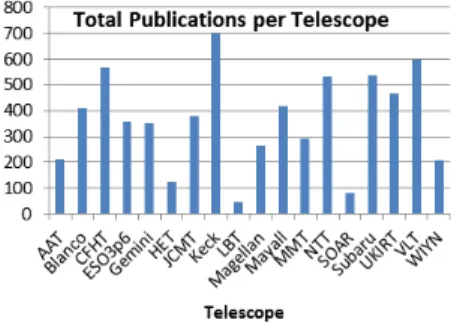
The productivity of a telescope is the number of refereed papers published during a certain time period. Figure 1 shows the total publications per telescope for the 2007-2011 period. One can see that the productivity varies significantly between the telescopes. The main reason for the very low productivity of the LBT is that it only recently began operations and it takes up to 10 years of operation for a telescope to achieve full productivity (Crabtree and Bryson 2001)
Figure 1. The total number of refereed papers published per telescope for the
period 2007-2011
Impact
Citation counts are the most frequently used metric for measuring the impact, or relevance, of a refereed publication. A publication gathers citations over time so one can’t really compare the raw citation counts of a paper published in 2007 with one published in 2011. One approach to addressing this problem is to normalize the raw citation counts by a standard measure that increases with time similar to raw citation counts. I have used the citation count of the median paper published in the Astronomical Journal (AJ) as a standard measuring stick to normalize the raw citation counts. If there are 301 papers published in a given year, then the citation count of the 150th paper
(ranked in descending citation count order) is the normalization factor all papers published in that year, regardless of the journal in which they are published.
I define the impact of a paper to be the number of citations to that paper divided by the citation count of the median AJ paper as defined above. This approach is very successful and allows papers of different publication years to be compared, and to compute aggregate impact metrics of papers published over a range of years.
One important measure of performance of a telescope’s publications is the
average impact per paper (AIPP). Since
the impact distribution of a telescope’s paper is very non-normal (very long high-impact tail), the median impact per
paper (MIPP) is also of interest. The
difference of these two metrics between the telescopes is a good measure of the relative impact performance.
Figure 2. AIPP and MIPP of each telescope for the period 2007-2011
The AIPP and MIPP are shown in Figure 2 and the AIPP is significantly higher than the MIPP due to long tail of very high impact papers. The AIPP differs by a factor of approximately two between the lower performing telescopes and the higher performing ones.
2094
A truly high performing telescope will combine high productively and a high average impact per paper, which is equivalent to a high total impact. The total impact of telescope’s papers is simply the sum of the impacts of all the individual impacts of the papers published using data from that telescope.
The total impact of each telescope is displayed in Figure 3. The best performing telescope, Keck, combines a very high productivity with a very high AIPP. While the HET has the highest AIPP its low productivity means that it is one of the lowest performers.
Figure 3. Total impact of each telescope for the period 2007-2011
Conclusions
A standard bibliometric approach provides a good measure of the comparative performance of modern telescopes. Normalizing the raw citation counts of papers to a standard measuring rod provides an age independent metric that can be used to compare publications of different ages. This approach should be used in any study that utilizes bibliometrics to study publications over a range of years.
Acknowledgments
This research has made use of NASA's Astrophysics Data System..
References
Crabtree, D.R. & Bryson, E.P. (2001). The Effectiveness of the Canada-France-Hawaii Telescope. The
Journal of the Royal Astronomical Society of Canada, 95, 259-265.
Kurtz, M.J., Eichhorn, G., Accomazzi, A., Grant, C.S., Murray, S.S., Watson, J.M. (2000). The NASA Astrophysics Data System Overview. Astronomy and