memo
BOUNDARY SHEAR STRESSES IN
CURVED TRAPEZOIDAL CHANNELS
by
Philip Aldrich Drinker B.S., Yale University
(1954)
Submitted in Partial Fulfillment of the Requirements for the Degree of
Doctor of Philosophy at the
Massachusetts Institute of Technology (1961)
Signature of Author_ _ _ _ _ _ _ _ _ Depdr)tments of Civil and Sanitary Engineering
and
Geology and eophysics August 20, 1961
Certified by
gis Supervisor
Chairman, Departmental Committee on Graduate Students
\IASI.
Of
IEC
o
SEP 20 1961
MITLibraries
Document Services Room 14-0551 77 Massachusetts Avenue Cambridge, MA 02139 Ph: 617.253.5668 Fax: 617.253.1690 Email: [email protected] http://libraries.mit.edu/docsDISCLAIMER OF QUALITY
Due to the condition of the original material, there are unavoidable
flaws in this reproduction. We have made every effort possible to
provide you with the best copy available. If you are dissatisfied with
this product and find it unusable, please contact Document Services as
soon as possible.
Thank you.
ABSTRACT
Boundary Shear Stresses in Curved Trapezoidal Channels
by
Philip Aldrich Drinker
Submitted to the Department of Civil and Sanitary Engineering, and the Department of Geology and Geophysics, in partial fulfillment of the requirements for the degree of Doctor of Philosophy.
An investigation is described on the distribution and magnitudes
of boundary shear stresses arising from subcritical flows through curvcd trapezoidal channels. A series of tests was conducted to determine
the effects on the stream patterns of variation in discharge, bend
geometry, boundary, roughness, and upstream channel alignment.
Two flumes of different bend radius and base width were used,
each consisting of a single circular curve of 600 central angle, with straight upstream and downstream tangent sections. Both flumes were constructed with 2 to 1 side slopes, and the base horizontal along all
transverse sections.
The greatest part of the test program dealt with flows in smooth
channels. For a Froude number range of 0.32 to 0.55, the stream
geome-tries varied as follows: ratio of width to depth, 7 < w/yo < 12i; ratio of width to centerline radius, 0.29 < w/rc < 0.80. Two tests were
conducted in a rough surfaced channel at stream geometries corresponding
to runs in the smooth channel series. For the final four tests des-cribed, which were conducted in a smooth channel, sets of screens were installed in the approach flow in order to simulate the disturbances
caused by additional curves upstream from the test reach. By this method, the shear distribution was studied for systems of two curves of similar sense, and for sets of reverse curves.
local boundary shear stresses werc measured with surface Fitot tubes adpted for application in free surface flows. The calibration for these instruments, originally developed for air flows through smooth pipes, was found to be valid for direct application in the smooth
channels. A modified Pitot tubc was developed and calibrated for usc on the rough test surface.
The boundary shear stress data are presented as relative shear,
1c/ To (i.e. as local shear in terms of the shear for uniform flow) in
the form of contour maps of the test reach; velocities and water surface
elevations are presented by section.
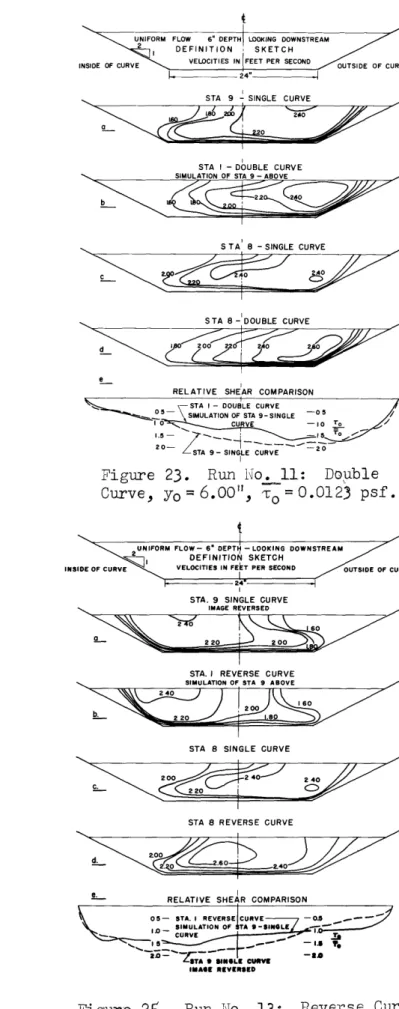
The boundary shear patterns obtained cannot be predicted quanti-tatively from the gross characteristics of the flow. Local shears were
-i-found to occur at intensities of more than double the mean tractive force computed for uniform flow; as might be expected, the intensities of these
local shears increase markedly with the stream curvature. A one-dimen-sional treatment of the energy dissipation in the curve and downstream tangent fails to indicate either the periferal locations or the intensities of the greatest boundary stresses. In general, the distributions and the relative magnitudes of the local boundary shear stresses appear to be functions of the stream geometry, for streams in subcritical motion.
The patterns of velocity and shear in a stream curve are influenced, both directly and indirectly, by the transverse and longitudinal pressure gradients in the curve. An analysis of the water surface superelevation in curving flow reveals that, for conditions of moderate curvature, the transverse water slope is quite insensitive to variations in the velocity
distribution, and that it depends only on the mean momentum of the flow
and the stream geometry.
Thesis Supervisor: Arthur T. Ippen
Title: Professor of Hydraulics
-ii-ACKNOWLEDGEENT
This investigation was conducted at the Hydrodynamics Laboratory
of the Massachusetts Institute of Technology. The work was supported,
through the Institute Division of Sponsored Research, by the Soil and Water Conservation Research Division, Agricultural Research Service,
U.S. Department of Agriculture, under Contract Number 12-14-100-2590(41) and Cooperative Research Agreement No. 12-14-100-5227(41).
The author is deeply indebted to Dr. Arthur T. Ippen, who, in
supervising the investigation, contributed immeasurably to its success.
His interest and encouragement led to the uncovering of many facets of
the problem which otherwise had been overlooked.
The author is also especially grateful to Messrs. William R.
Jobin, and Omar H. Shemdin who were associated with the project as
Research Assistants. Mr. Jobin performed much of the experimental work and analysis, and his numerous contributions were vital. Mr. Shemdin, who joined the project after the completion of the experimental work,
contributed greatly in the final treatment of the results. The drawings
prepared by both these men- are gratefully acknowledged.
Mesars. Carl R. Miller and Donald A. Parsons of the Agricultural Research Service were instrumental in setting up the cooperative inves-tigation, and their constant interest made this cooperation both pleasant and productive. The author appreciates their patient criticism and their
suggestions arising from the related field problems.
Dr. John P. Miller of Harvard University introduced the author to the field of Geomorphology. Through his guidance in the literature and from warm personal contacts in seminars and informal meetings, the author
-iii-developed a real interest in the broadest aspects of fluvial morphology.
The sudden death of Dr. Killer in July 1961 cut short the career of an
able and dedicated teacher and a leader in modern geomorphology. As with all who know him, the author feels a great personal loss in his death.
The author also expresses sincere thanks to:
Dr. Ronald E. Nece, who provided technical supervision during the
initial phases of the study.
Messrs. Charles A. GivIer and George K. Noutsopoulos, who performed
thesis research on the project, and from whose data the author has drawn
freely.
Mr. Wallace Fleming and the staff of the Laboratory Shop who
assisted in the design and instruction of much of the test equipment. Finally, acknowledgement is made for the contributions of the
various members of the Laboratory Staff who have shown interest in the
progress of this work. Many suggestions were received through informal discussions; these ideas became integrated into the final result, and as such it would be impossible to acknowledge each separately. To all who so contributed the author is sincerely grateful.
Cambridge, Massachusetts Augus t, 1961
-iv-TABLE OF CONTENTS
Page Abstract
Acknowledgement jj1
Table of Contents v
List 6f Tables vii
List of Figures ix
Definitions and Notations x
I. INTRODUCTION 1
II. FLOW THROUGH CURVED CHANNELS: A REVIEW
4
III. EXPERIMENTAL EQUIPMENT AND TECHNIQUES 11A. The Test Channel 11
B. Instrumentation 15
1. The Measurement of Boundary Shear Stress a. General Requirements
b. Shear Measurement by Surface Pitot Tubes c. Experimental Applications
(i) Smooth Surface (ii) Rough Surface 2. Additional Instrumentation
a. Pressure Measurements b. Depth Measurements
c. Velocity Measurements
IV. THE EXPERIMENTAL PROGRAM 22
A. Scope of the Study 22
B. Presentation of Data 26
V. DISCUSSION OF RESULTS 28
A. Tests Conducted with Uniform Approach Flow 28
1. Smooth Channel
2. Rough Channel
B. Tests With Simulated Compound Curve Systems 52
C. Superelevation in a Channel Curve 64
D. Energy Dissipation in the Curved Reach 72 E. Scour Patterns in Alluvial Streams 83
Page
VI. CONCLUSIONS 89
VII. BIBLIORAPHY 94
VIII. APPENDIX 97
A. The Test Channel Facility 97
B. Instrumentation 102
C. Techniques for the Measurement of Boundary Shear 109
Stress: A Review
D. The Measurement of Boundary Shear Stress with 113
Surface Pitot Tubes
E. Experimental Error 126
IX. BIOcRAPHICAL NOTE 129
-vi-LIST OF TABLES
Table Pag
I The Range of Channel Geometries Covered in the 23 Test Program
II Swmary of Test Conditions Determined in the 24 Approach Flow
III Maximum Water Surface Superelevations, Measured 68 and Computed
IV Comparison of the Average Rates of Energy 77 Dissipation in the Test Reach
APPENDIX
A-I Summary of Previous Investigation on the Cali- 118 bration of Round Surface Pitot Tubes
-vii-LIST OF FIGURES
Page
1. Zones of Separation in a Laboratory Channel Bend 7 2. Helicoidal Motion in a Channel Bend 7
3. The Two Trapezoidal Test Channels 12
4. Model III Surface Pitot Tube 19
5.
Velocity Distributions: Run No. 1 306. Velocity Distributions: Run No. 4-B 30
7. Velocity Distributions: Run No. 6 30
8. Transverse Water Surface Profiles, all Stations, 31 Run No. 1
9. Transverse Water Surface Profiles, Station
5,
31 Runs No.5,
6, 710. Peripheral Distribution of Boundary Shear in Straight 36 Trapezoidal Channels
11. Boundary Shear Contour Map: Run No. 1 37 12. Boundary Shear Contour Map: Run No. 2 38 13. Boundary Shear Contour Map: Run No. 3 39
14. Boundary Shear Contour Map: Run No. 4
40
15. Boundary Shear Contour Map: Run No.5
4116. Boundary Shear Contour Map: Run No. 6 42
17. Boundary Shear Contour Map: Run No. 7 43
18. Velocity Distributions: Run No. 9
47
19. Transverse Water Surface Profiles: Run No. 9 47
20. Boundary Shear Contour Map: Run No. 8 49 21. Boundary Shear Contour Map: Run No. 9
50
22. Velocity and Shear Distributions in the Approach Flow:
53
Run No. 1023. Velocity and Shear Distributions in the Approach Flow:
53
Run No. U24. Velocity and Shear Distributions in the Approach Flow:
53
Run No. 1225. Velocity and Shear Distributions in the Approach Flow:
53
Run No. 13-viii-Figure Page
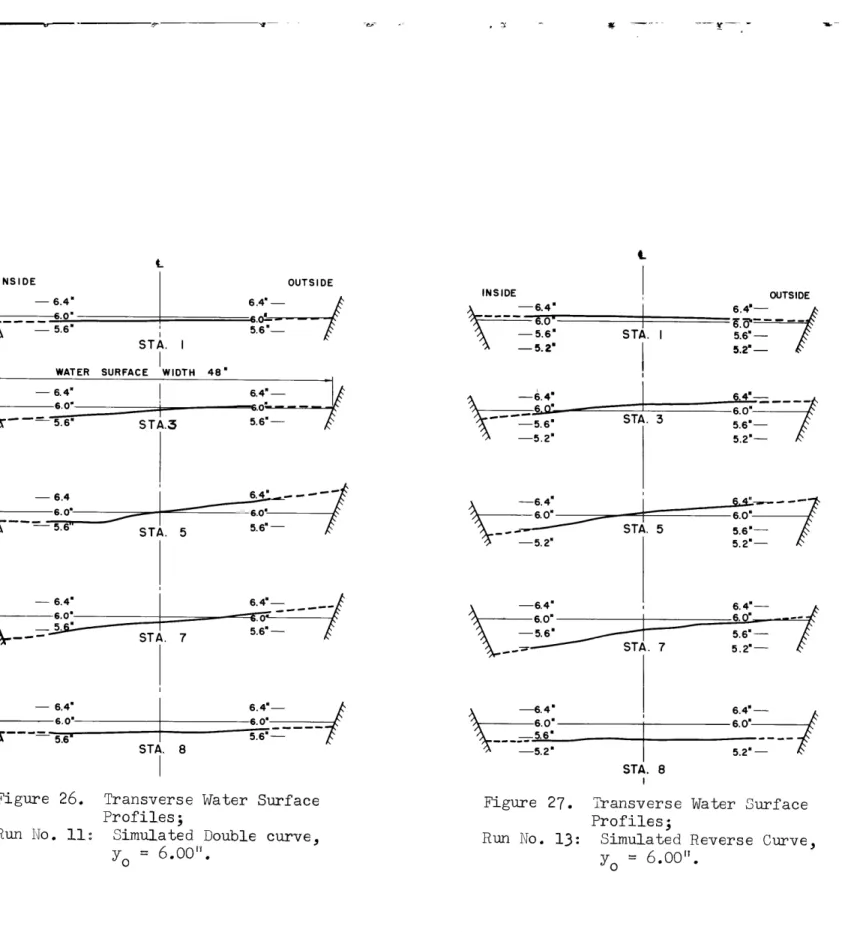
26. Transverse Water Surface Profiles: Run No. 11
54
27. Transverse Water Surface Profiles: Run No. 13
54
28* Boundary Shear Contour Map: Run No. 1057
29* Boundary Shear Contour Map: Run No. U 5830. Boundary Shear Contour Map: Run No. 12
59
31. Boundary Shear Contour Map: Run No. 13 60
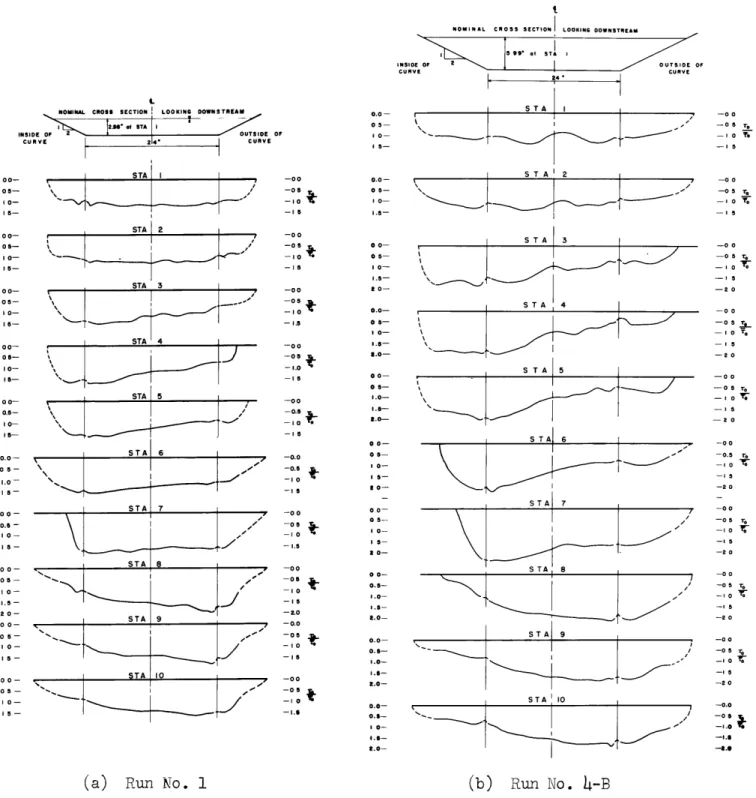
32. Plot of Computed Maximum Superelevation 68 33. Shear Distribution by Sections: Runs No. 1 and h-B 75
34.
Average Rate of Energy Dissipation through the Curve: 76Runs No. 1 and 4-b
35. Variation with Curvature of the Total Mean Shear Stress 78 36. Variation with Curvature of the Maximum Relative Shear 78
37. Variation with Curvature of Scour Areas 79
38. Map and Sections of an Alluvial Stream 85
APPENDIX
A-1 General Plan of Experimental Facility 99
A-2 Overall View of Channel 100
A-3 Instrument Carriage Mounted in the Curve 100
A-4 Baffle Screen Arrangement for Simulated Curve 101
A-5 Surface Drag Screen used in Curve Simulation 101
A-6 Pitot Tube for Measuring Velocities near the Wall 103
A-7 Model II Surface Pitot Tube 103
A-8 Micromanome ter
104
A-9 Development of the Inclined Yanometer 104
A-10 Inclined Manometer 104
A-ll Velocity Distribution above the Smooth Test Surface 121 A-12 The Simplified Preston Calibration Curve 121
A-13 Velocity Distribution above the Rough Test Surface 122
A-lh Surface Pitot Tube Calibration, Rough Boundary 122
-ix-DEFINITIONS AND NOTATIONS
A M channel cross-section area.
b a bottom width of channel.
Cfx a mean coefficient of friction at section s n X/
d a diameter of Pitot and Prandtl tubes.
IF * Froude Number a V/ 6 .
g = gravitational acceleration, ft/sec'.
H0 * specific Head, yo +V;,/2g, ft-lb/lb.
AH * manometer reading, f t. of water.
k - absolute height of roughness particle.
ks - equivalent sand roughness height.
L = centerline arc length of the test reach.
pt - total, or stagnation pressure, lb/ft.
po - static pressure, lb/ft2 .
P - wetted perimeter.
Q m volumetric rate of flow, fta/sec. r M radial distance to a point in curve.
rc = radius of curvature of channel centerline.
ro radius of curvature of outer edge of water surface. R = hydraulic radius, A/P, f t.
IR M Reynolds number, bRV/v.
Ex Boundary layer Reynolds Number Vx/v. R,% Shear Reynolds number, u,y/v.
So channel slope, ft/ft.
Se n energy gradient ft/ft.
Sex * local rate of energy dissipation at section x, ft-lb/lb/ft.
T
=
water temperature, OF.u,v * local velocity, ft/sec.
u* - shear velocity,
VTOp,
ft/sec.V a free stream velocity or average velocity, Q/A, ft/sec. w a water surface width.
x W longitudinal distance measured along channel centerline. y = distance normal to plane of channel bottom.
ym - average depth - A/w.
70o total depth of flow. z = transverse distance.
a - angular misalignment of test probe. y -- specific weight of liquid, lb/ft3
S - boundary layer thickness, ft.
9 = local central angle of curvature from beginning of bend, degrees.
= dynamic viscosity of fluid, lb-sec/fta.
v a kinematic viscosity of fluid, ft2/sec.
p - mass density of fluid, slugs/fta
T 0 a local boundary shear stress, lb/ft4.
O - averaLe boundary shear stress at curve entrance (Sta.11)lb/ft2
.
Tx - average boundary shear stress at section x. L
L average boundary shear stress over the full test reach.
f(),() function of.
i-I. INTRODUCTION
Stream meandering has become a problem of real economic importance in recent years as the amount of valuable land destroyed by bank erosion steadily increases. In large, navigable streams, meandering must be corrected and controlled by costly dredging, and by construction of revetments. The amount of agricultural land lost due to erosion by
smaller alluvial streams can hardly be estimated, but its extent has stimulated an increasing amount of research in this field. The immediate
practical interest has been in developing methods to stabilize the
streams and so to prevent further progression of the meanders.
For lack of systematic quantitative information on the modes of
erosion in curves, the installation of revetments has an empirical basis, founded upon field studies of localized stream systems (36)(42). The success of these revetment projects has been so varied that it is still
not possible to design stabilization works with assurance. In general, the cost of stabilizing small alluvial streams is in excess of
$50,000
per mile of channel. Not only is there great variation among streams in different regions of the country, but in a given stream the regime varieswith time. It is quite common to find several feet of alluvium deposited over new revetments in an area which had formerly been undergoing active erosion.
A great deal of effort has been devoted to the general study of
stream hydraulics and stream morphology (24)(27)(28)(43). Laboratory
studics (13)(26), have resulted in further understanding of the geometry
of meander patterns in alluvial streams. These investigations give a fairly good indication to the engineer of what to expect in the way of
meander patterns and downvalley progression of bands, but they do not supply him with adequate information to control these phenomena. In addition, studies of velocity distributions in bends (31)(39) have been
useful in gaining a clearer conception of the dynamics of stream flow through crxves, but they fail to delineate the extent and degree of attack on the stream bed. A flowing stream dissipates its energy through shear or tractive forces on its boundaries. For an alluvial stream which is
free from obstructions and major irregularities, erosion and movement of bed material will be controlled by this boundary shear stress and the
current pattern. The shear stress parameter has long been used in the
definition of stability of straight channels and has been extensively studied (10)(22)(25). For such a channel the average shear stress can
be computed reasonably well from a coefficient of resistance and the mean
velocity head. Within a curved reach however, the local shear stresses
vary in a manner which cannot be predicted at present due to the effects
of local accelerations and of secondary motion in the flow.
It is recognized that to completely divorce the problem of
erosion from the related problems of deposition and sediment transport
is, in the final analysis, unrealistic. Not only do all three factors
appear to be integral aspects of the continuously variable phenomenon of
sediment mechanics, but there is also compelling evidence that the presence
of suspended particles modifies the dynaric properties of the transporting fluid (3)(9)(45). However, the quantitative understanding of these latter
phenomena is still a very distant goal, and an experimental attack on the whole problem would not permit at present a clear cut separation of the
various influences inherent in this problem. For this reason a limited
excluded, the channel geometry remains clearly defined and only the effect of the flow pattern on the boundary is determined.
The experimental phase of the investigation consists of a series of tests conducted in curving trapezoidal channels. For fixed boundary geometries, boundary shear stresses were mapped under varied conditions
of flow. An attempt is made, insofar as possible, to correlate trends in
the shear patterns with variations in flow rate and geometry. Velocity
distributions and water surface configurations were recorded for
assis-tance in developing a more general understanding of curved flow, through which erosive attack in channel boundaries may be anticipated.
It is hoped that ultimately these findings may have practical
value in determining the degree and areal extent of protective works
required to stabilize natural stream channels. The practical applications of this work will be limited to those cases where mean shear stress is a dominant factor in bank stability, such as in streams flowing over sur-faces of relatively uniform texture. The introduction of individual bank protrusions creates yet another problem which is not amenable to treatment
II. FLOW THROUGH CURVED CHANNELS: A REVIEW
As a basic model of flow through channel curves, consider first the flow through a deep, smooth-surfaced, prismatic bend. If frictional
effects are assumed negligible, potential theory permits description of
the curved flow as a free vortex. M4ockmore (31), among others, has
demonstrated that at some distance from the boundaries both the velocity distribution and the transverse water surface profile are well described
by an irrotational vortex. For this case the transverse velocity
dis-tribution is given by the constant product of local tangential velocity, u, and radius, r. By equating the radial forces on a fluid particle as,
"2 U(1)
dr r
the water surface profile can be computed from
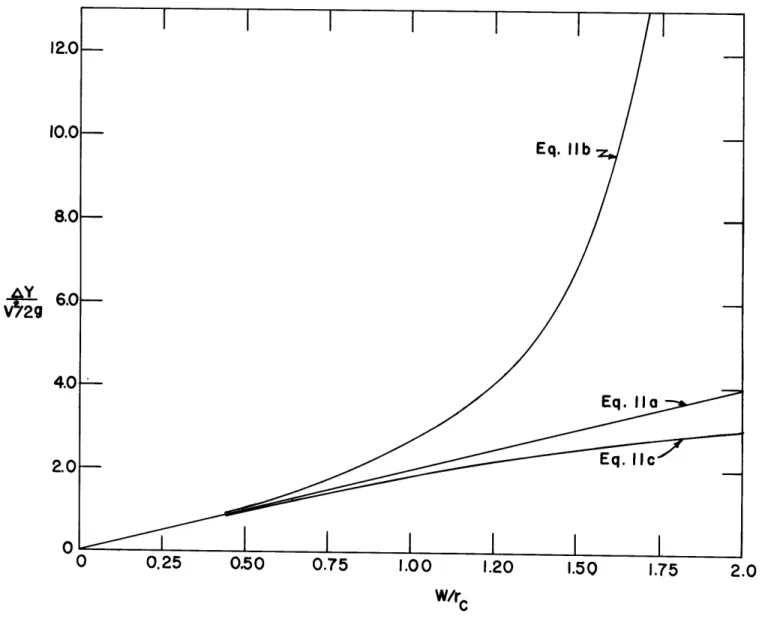
AY a1f dr ,(2)
where the flow in the curve is assumed to be concentric. For the free vortex the water surface profile is hyperbolic, convex upward.
However, examination of the flow near the boundaries shows that even in a smooth-walled flume, frictional effects combined with the
superelevation tend to cause two important deviations from potential flow:
helicoidal motion of the main stream and separation in zones of adverse pressure gradient.
In 1876 Thompson (4) gave his now familiar explanation of
helicoidal, or spiral flow as being due to the difference in centripetal
acceleration between the fluid near the bottom, which has been retarded by boundary drag, and the faster moving layers near the free surface.
00f 1'
This acceleration, which results from the radial increase in depth (and hence in pressure) causes the low velocity fluid near the bed to move
towards the center of the curve, while the fluid near the surface, having
excess momentum, moves towards the outside.
The superelevation of the water surface in a channel curve leads to two occurrences of longitudinal increase in depth: along the outer
bank of the curve as the water rises entering the curve, and at the curve exit along the inner bank where the flow recovers to normal depth (see for example, Figures
5
and 8). For channels of large curvature separation may develop in these two areas and the water surface may slope upstream locally. The fluid particles near the boundary have insufficientkinetic energy to move against a pressure gradient and separation of the boundary layer from the s treambank results. A simple circular curve
connecting two tangent channels is likely to produce larger separation zones than would a natural stream bend, with more gradual transitions. In periods of high flows separation in natural channel bends manifests itself as eddies or "bank rollers" and results in bar deposits.
It has been pointed out (26)(46) that superelevation as such in subcritical, curving flow is quite insensitive to radial variation in the velocity distribution. Substitution into Equation (2) of other assumed velocity distributions, and integration over the full width of the stream, gives only minor variations in the total elevation difference, even though the surface profiles vary in shape. Superelevation is a result of curved flow for all fluids, and is essentially independent of
the frictional aspects and the velocity distribution of the flow. It is
controlled primarily by the boundary geometry and the mean momentum of
separation and helicoid motion take place, their direct cause is boundary friction or shear stress, and in a completely frictionless flow they could
not occur.
In deep, turbulent streams, the separation zone at the concave
bank is usually obliterated by the turbulent infusion of momentum from
the main body of the stream, although bank rollers are observed at the outside of abrupt, shallow bends. The separation zone at the inner bank is more persistent, as shown by the point bar deposits common to virtually all streams except those which are deeply incised and actively degrading.
The persistence and extent of this latter zone is due both to the abrupt
rise in water surface at this point, and to the spiral motion of the stream which tends to move the faster moving fluid to the opposite bank.
Examples of helicoidal motion and separation in a laboratory flume
bend are shown in Figures 1 and 2. Both of these photographs were taken
from the bend exit, facing upstream, so that the flow is from top to
bottom of the photographs. Figure 1 was taken after dye had been injected
and allowed to spread to the full extent of the separation zones. In
Figure 2 the fainter dark streaks were caused by dye crystals moving towards the inner bank with the bottom current (the dashed arrow) while the heavier plume was made by continuous injection of dye at the surface, (the solid arrow).
These two phenomena have far reaching effects on the flow in
natural streams. The helicoidal pattern is, perhaps, the more important, in that, by shifting the faster moving fluid to the outside of the bend, it tends to suppress the free vortex pattern. Einstein and Harder (8) show experimentally that, for a curve of sufficient length, a stable velocity distribution develops in which the velocity increases radially
0007
Figure 1. (above) Zones of Separation in Laboratory Channel Bend. Figure 2. (left) Helicoidal Flow in Channel Bend.outwards. That is, of course, the phenomenon observed in long river curves in which the thalweg remains near to the concave bank.
The pattern of helicoidal flows in the bend of a rectangular flume was studied by Shukry (39) using a Pitot sphere to determine the three components of the local velocity vector. It was found that the
helicoidal (i.e. radial) velocities increase with increasing relative
curvature, w/rc and ratio of width to depth, w/y,. Einstein and
Harder (8) also observed that increasing the ratio, w/y0, as well as
increasing the boundary roughness, led to high velocities towards the outer bank, due, presumably, to a more pronounced helicoidal motion.
The laboratory bends in which the irrotational type of flow is
observed are too short to complete the transfer of the filament of
highest velocity to the outer bank. The patterns of flow in sharp bends
-- of both flumes and rivers -- represent a transitional type which, with
sufficient length of curved reach, would develop into the friction
con-trolled flow described above. The length of this transition reach,
however, has not been well defined in terms of the pertinent parameters.
Recently Leopold and co-workers (26) have reported an investi-gation on the frictional resistance of rigid sinuous channels. By
studying the overall head loss over a reach, for channels of constant shape but varied sinuosities, the authors show that not only is the total energy dissipation greater in curved channels than in straight, but that it increases discontinuously above a certain threshold Froude number, due
to the formation of local standing waves, or "spills", along the banks.
While the rate of increase in total boundary shear is not clearly defined, a relationship is suggested between the ratio of width to radius and the Froude number at which the discontinuity occurs. In the laboratory tests
the threshold Froude number varied from about 0.h to 0.6, while, from a
survey of river data, the authors found that bankfull flows generally
occur in streams in the range 0.2 < F < 0.45. They suggest that the rare occurrence of higher Froude numbers may be due to a tendency of alluvial rivers to eliminate local areas of high resistance. Such a
local reduction in boundary shear could come about through erosion of the banks at points of greatest spill occurence, where there is increased dissipation of energy.
The relationship between shear stresses and erosion is further
complicated in natural streams by loose bed material which permits an
additional degree of freedom not possessed by rigid boundary flumes. This freedom to shape its own bed undoubtedly causes a river to alter its flow pattern in ways which cannot readily be predicted from a study of
rigid, prismatic channels (23). Thus, scour will occur in regions of
high shear stress; the modifica.tions in the bed configuration caused by the scour will in turn modify the current pattern and hence the shear distribution.
Previous investigations of energy dissipation in curved flow have been restricted to one-dimensional analyses for both open and enclosed
conduits. As shown by Anderson (2), the different experimental techniques, as well as the varied definitions of a loss coefficient, used by past
investigators have led to considerable confusion. Ito (21) has
demon-strated, by a re-analysis of early data, that the loss coefficient of a smooth bend can be predicted empirically, if the measurements and defi-nitions are given a common basis. With respect to the present study, a
one-dimensional approach is not very revealing in that it gives no indication as to the distribution of the boundary shear stresses which
cause the loss in bends. Indeed, as is shown in the discussion to follow,
the mean section loss gives little indication of the magnitudes of the
local shears, and that the location and intensity of erosive attack cannot be predicted by this means.
III. EXPERIMENTAL EQUIPNFNT AND TECHNIQUES A. The Test Channel
1. Description of the Equipment
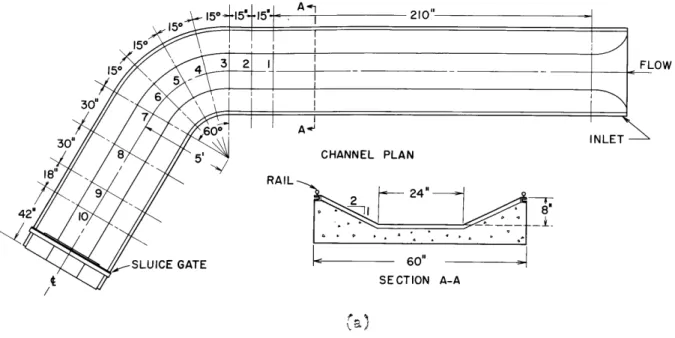
The experiments were conducted in the two trapezoidal flumes shown
in Figure 3. In both channels the general arrangement is the same,
consisting of a straight approach section 20 feet in length, a single curve of 60 degree central angle, and a straight 10 foot exit section. The side slopes are constant at 2 horizontal to 1 vertical and the
channels were constructed with the invert horizontal along all radial
sections. A smooth entrance transition from the stilling basin at the upstream end of the approach channel reduces the tendencies for local separation. Additional control of depth is provided by an adjustable sluice gate mounted at the exit section. Details of the basic design of the channel facility are given in Appendix A.
The larger flume (Figure 3a) has a 24-inch base width, and the radius of the curve centerline is 60 inches. For the smaller flume, which was laid in the bed of the larger, the base width dimension was halved, and the stream section was shifted outward to follow the concave bank of the original curve, giving a curve centerline radius of 70 inches.
In a curved trapezoidal stream, the relative curvature -- i.e. the ratio of surface width to bend radius -- varies with depth and thus cannot be given solely in terms of the boundary geometry. However, the limiting values of relative curvature are those set by the base width. Thus, the
range of curvatures which may be obtained in the two flumes is limited by - > rc rc - w 0.0 and - > rc rc- - 0.17 in the larger and smaller channels,
0012
5* 15* 50 15" 15' A.2lO1210" -5* 150 4 3 2 1 FLOW 5 30" 6 7 600 A -30" A NLET 8 5 CHANNEL PLAN 18" 9 RAIL 42" 0 9 24" SLUICE GATE 60" SECTION A-A 15* 5' 15 B 210 " 150-15- |LOW 15* 30" 54 31 21 1 30 NE 30' 5'l1" CHANNEL PLAN IL 18" 81 ,-"2 1 42 1 10SLUICE GATE GO"
SECTION B-B
Figure 3. The Trapezoidal Channels. The locations of the ten test statione are indicated by the dashed section lines.
moderate range in relative curvature, the lower limit of which is fixed by the boundary curvatures, b
r c
During the installation of the original flumne structure, the centerline slope was set at 0.00064 n 1/1563. The slope was not adjusted throughout the test program; however, after construction of the smaller channel, it was found that the approach slope had decreased to 0.00055 due to settling of the foundations.
The channels were treated with a waterproof plastic coating which dries to form a tough elastic film. For the series of smooth boundary tests it was found that this material provides a hydraulically smooth surface, giving a mean IManning coefficient of 0.010.
For the rough boundary tests which were conducted in the larger
channel the surface was prepared as follows: the channel was given two coats of varnish; while the surface was still wet, roughness particles
were spread by hand over the bottom and sidewalls of the section. After
the material had dried, the surface was scraped with a flat bar to knock off any protruding particles, and then sealed with a final coat of varnish.
The rough surface was applied over 15 feet of the approach section, through
the curve and for 8 feet in the exit reach. The roughness particles are
uniform, rectangular, lucite parallelepipeds, of the approximate dimensions,
0.18 x 0.10 x 0.10 inches. The absolute roughness height of the completed
surface was taken as 0.1 inches; for the treated channel the Manning coefficient is 0.017.
Aodification of the test facility to incorporate additional
combinations of curves would have entailed great additional expense. Therefore, the effects of varied channel alignment were studied through simulation of the flow disturbances caused by curvature in the approach
channel. For this purpose, sets of screen baffles were installed in the upstream tangent. The different screen combinations were established by
trial and error to produce the desired flow patterns at the entrance to
the curve. A typical screen arrangement is shown in Figures A-4 and A-5, Appendix A.
2. Operating Conditions
For each desired depth condition, the discharge at uniform flow
was calculated from the Manning equation. During the early tests in the
smooth channels the Manning coefficient was assumed as n = 0.009. As
the test program continued the channel resistance could be checked, and
it was found that the proper value for the plastic finish was n = 0.010.
A similar trial procedure in the rough channel gave the Manning coefficient,
n
=
0.017.With the proper discharge flowing in the channel, the sluice gate was employed to adjust the depth at the entrance to the curve. This downstream control was necessary because of the backwater effects of the
channel outfall which, before its installation, had been observed to extend through the curve and well into the approach tangent.
Flow uniformity had little significance in the tests on the
simulated curve systems due to the large scale modification of the flow
pattern produced by the screens. For these tests, therefore, the
dis-charges and sluice gate settings were those established for the corres-ponding tests at uniform approach condition.
B. Instrumentation
1. The Measurement of Boundary Shear Stress
a. General Requirements: The basic objective of this study
involved the mapping of boundary shear intensities in the curved test
reach at varied conditions of flow. Thus, the primary requirements of the shear instrument to be used were that it be readily movable and that it have a rapid response.
Because of the secondary currents in the bend region, it was
further necessary that the instrument be insensitive to moderate variations in the direction of flow. Local velocities close to the boundary in a bend possess lateral as well as longitudinal components, and consequently the boundary shear stresses are also skewed with respect the the channel centerline. For moderate skewness however (e.g. less than 20 degrees), the magnitudes of the local velocities and boundary shear stresses may be taken as equal to their downstream components. Thus, local shear
magnitudes may be adequately determined with an instrument aligned parallel to the downstream direction, provided the instrument itself is not subject to appreciable error arising from lateral components of flow.
A discussion of methods of determining local shears is given in
Appendix C; each of the techniques listed was reviewed in terms of the
requirements of this study.
b. Shear Measuremen by Surface Pitot Tubes: Of the various
means available for the measurement of boundary shear stress the surface Pitot tube technique developed by Preston (37) was found to be best suited
to the purposes of this study. By this method, the shear stress on a
( IM I I
Pitot tube resting on the surface. Preston demonstrated that, for a tube
of sufficiently large diameter, the effects of the viscous sublayer become negligible, and the mean total pressure over the face of the tube is dependent only on the velocity distribution in the turbulent boundary layer.
The velocity distribution in the turbulent boundary layer over a smooth surface can be expressed,
u -- f(- (* y U - - (3)
u* vp
Preston developed the functional groupings by which the shear stress at
the wall, T,, could be expressed as a dependent variable, and by direct
calibration in pipe flows obtained the equation,
,0d2 (pt-p )da
log - - 1.396 + 0.875 log (4)
hpva 4pv2
valid within the range,
4.5
< log< 6.5.
hpv2Here p and v are the density and kinematic viscosity of the fluid, and
(pt-p,) is the dynamic pressure recorded by a round Pitot tube of outer diameter a d. This calibration equation depends on the velocity distri-bution near the wall which was found to be expressible as the power law,
u - U*y
8.*61 (-) (5)
u, v
Although Preston developed Equation
(4)
for a set of Pitot tubes of constantratio of inner to outer diameters, Hsu (18) later showed, both analytically and by experiment, that, for a tube of given outer diameter, the internal
diameter has negligible effect on the Pitot tube calibration.
Equation (4) was verified by both Preston and Hsu on flat surfaces
under varied pressure gradients. For the present open channel work, the
calibration was first checked directly in a tilting glass flume. In the
curve of the trapezoidal test channel, however, direct calibration was not possible because of the non-uniformity of the flow. In order to
establish the validity of Equation (4) for this application, velocity
profiles in the flow immediately adjacent to the boundary (y < 1 cm) were
taken at various points in the curve. By this method the existence of
the velocity distribution given by Equation (5) was established (see
Figure A-ll, Appendix D); therefore, the validity of Equation (h) could
be assumed, subject to the restriction that the surface Pitot tube lie wholly within the established boundary layer region of similarity.
For the rough boundary tests, a surface Pitot calibration was developed, which had been suggested in principle by Preston. In
turbulent flow over a hydraulically rough surface, the velocity
distri-bution being independent of Reynolds number may be expressed,
- fa) , (6)
u* ak
where k is the absolute height of the boundary protrusions. Thus, by dimensional considerations alone, the expression analogous to Equation (h)
becomes,
(pt-p = fbP
A8I
direct application of Equation (7) would be questionable, due to the
uncertainty of consistent Pitot tube placement. Furthermore, from
analysis of Nikuradse's rough surface velocity data (33), it seems clear
that f., in EquatIon (7), should vary with the value of y0/k.
If, however, tests are conducted over a limited range of y,/k on a surface of sufficiently uniform roughness, then it should be possible
to find a single form of Equation (7). Direct calibration of a round Pitot tube was performed in a tilting flume on an artificially roughened surface, identical to that which was later used in the test channel.
The test conditions were: d = 0.432", k - 0.1", 2"< y0 < 6", for mean
velocities ranging up to
5
fps. The empirical equation obtained,- 0.021 (pyPo), (8)
is valid only for the above set of conditions. Since the calibration
was performed with only one Pitot tube, the general dimensionless expression, Equation (7), was not established, and the restricted form, Equation (8), is to be preferred.
An extended discussion of the principles underlying the use of
surface Pitot tubes, together with calibration procedures is presented in Appendix D.
c. Experimental Application: (i) Smooth Surface. Various models of surface Pitot tubes, which are described in Appendix B, were employed during the tests. The final version, designated as the Model III
instrument, is shown in Figure
h.
The static tube is positioned above the total head tube in order to minimize the effects of the total pressure0019
(a.) Instrument Mounted on Flat Surface.
TOTAL HEAD TUBE
STATIC TOTAL A TUBE SOLDER A-A FILLET
0.028" DIA. - 2 EAC14 SIDE
0.125" O.D.
0.090" 1. D. ST. STEEL WITH HEMISPHERICAL TIP
TEFLON
0.25" O.D.
0.18" I.D. ST. STEEL TUBE
2n:trvc ion. d~etil shoing the slere -ylir1erical at-he Figure 4. Model III Surface Pitot Tube
ez-i
U-assembly of the instrument it was determined that the two tubes exert no mutual interference, and that the pressurein the channel curve is
hydrostatically distributed over the depth- of flow. The two leads from the instrument are connected to a manometer to give the desired dynamic
head, (pt-p,)/y.
To measure the boundary shear stress at a paint, the instrument
is mounted vertically with the total head tube aligned parallel to the downstream direction and the tip resting on the boundary. The shear
value is computed from Equation (4) using the dynamic head as read from
a manometer. Because each test involved about 200 readings, it was expedient to re-arrange and plot Equation (4) to give a direct graphical
solution of to. (See Figure A-12, Appendix D).
In preliminary tests it was found that the instrument is quite insensitive to moderate misalignment of the probe axis with the local
direction of velocity. For deflection angles up to 200, the error in
measured shear stress varies essentially as (1-cos a); at a - 200 the
error is 60 , and at a - 150 the error is about 30,6. Dye traces in
the channel curve revealed a maximum angularity of the flow of about 200,
which is confined however to a very thin zone adjacent to the boundary. (ii) Rough Surface. For the measurement of shear stress on the rough test surface, the Model III tube was fitted with the adapter sleeve and bushing shown in Figure 4 which raised the diameter of the impact tube to 0.432 inches. This was done in order to increase the value of the manometer readings obtained, as well as to reduce the effects of local
disturbances due to the individualroughness particles. The procedure for
measuring shear stress with the modified instrument is essentially the same as the smooth surface technique, the value of to being computed in
0021
this case from Equation (8).
2. Additional Instrumentation
a. Pressure Jeasurements: Pressures were measured with the two manometers described in Appendix B and shown in Figures A-8 and A-10. The manometers could in general be used interchangeably, depending on the range and precision required. The inclined manometer, being the
faster and more convenient of the two, was used in most of the work. The micromanometer was necessary to measure head differentials outside of the range offthe inclined manometer and for those cases where absolute pressures were required.
b. Depth Measurements: Depths of water in the channel were
measured with a point gauge mounted on the instrument carriage. Ine certain of the tests it was more convenient to determine depths from static
pressure measurements which were correlated with the centerline depths as determined from the point gauge readings.
c. Velocity Measurements: Stream velocities were measured with a
5/16-inch
Prandtl Tube. The instrument was always aligned parallel to the downstream component of flow, and no attempt was made to determine the lateral velocity components.urn
002
IV. THE EXPERIMENTAL PROGRAi
A. Scope of the Study
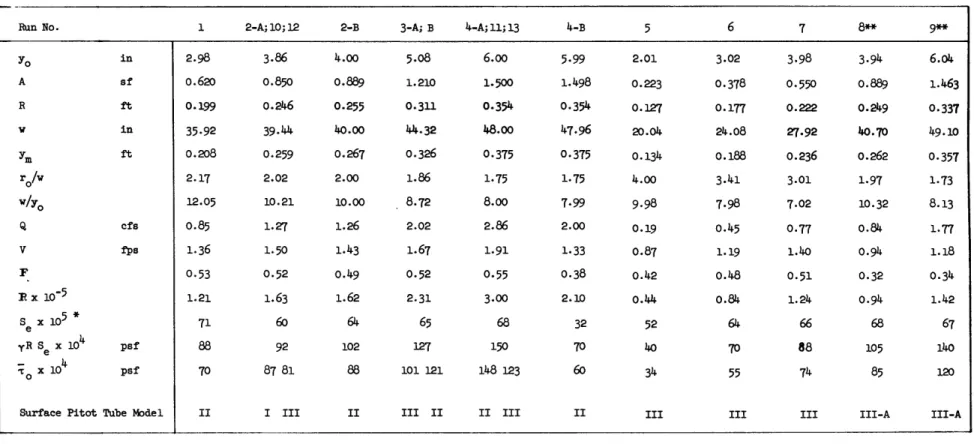
The tests were conducted in the two channels shown in Figures 3a and 3b, covering the range of flow geometries which is summarized in Tables I and II.
With the exception of Runs 10-13, the flow entering the curve was essentially uniform and symmetrical about the centerline. For purposes of discussion, therefore, it is convenient to consider Runs 1-9 as
comprising one test series covering a broad range of boundary geometries
for the simple configuration of a curve with straight tangents. Runs 1-7 comprise the complete series of smoothsurface, single curve tests;
for Runs 8 and 9, the channel roughness was increased' and flows were studied for stream geometries similar to those in Runs 2 and
h.
In Runs 10-13, the velocity distribution in the approach flow was modified through installation of various combinations of baffle screens. By superposing asymmetrical conditions on the entrance flow it was possible to simulate the effects of varied upstream channel alignments. Tests at two depths were conducted to determine the shear pattern in a
sequent bend of a double series (U>-configuration), and a reverse series (3-configuration) of curves.
During the course of the test series various modifications were made in the design of the surface Pitot tube. The classification of
instrument models, as listed in Table II, is given with a description of
the instruments in Appendix B. In order to establish that the measured
distributions of relative shear were not influenced by the specific model designs, the shear measurements were completely re-taken with
TABLE I
Summary of Channel Geometries Covered in the Test Program.
Nominal Stream Dimensions w w YO r c Channel Dimensions 12 0.60 10 0.67 b/re = 0'40 8.8 0.73 Fig. 3a 8 0.80 10 0.29 8 0.34 b/rc = 0.17 7 0.40 Fig. 3b 10 0.67 8 0.80 10 0.67 Sb/r = 0.4o 8 0.80 Fig. 3a 10 0.67 8 0.80 Boundary Roughness Velocity Distribution in Approach Flow Smooth n = 0.010 Rough n = 0.017 Smooth n = 0.010 Symmetric; Single curve with straight tangents. Asymmetric; Flow pattern modified to simulate up-stream curvature. Run No.
41- -1
TABLE II
Summary of Test Conditions Determined in the Approach Flow (Station 1).
Run No. 1 2-A;10;12 2-B 3-A; B 4-A;l1;13 4-B 5 6 7 8** 9**
YO in 2.98 3.86 4.oo 5.08 6.oo 5.99 2.01 3.02 3.98 3.94 6.04 A sf 0.620 0.850 0.889 1.210 1-500 1.498 0.223 0-378 0.550 0.889 1.463 R ft 0.199 0.246 0.255 0-311 0-354 0.354 0.127 0.177 0.222 0.249 0.337 w in 35-92 39-44 40.oo 44-32 48.00 47.96 20.04 24.08 27.92 40.70 49.10 ym ft o.208 0.259 0.267 0.326 0.375 0.375 0.134 0.188 0.236 0.262 0.357 r0/w 2.17 2.02 2.00 1.86 1.75 1-75 4.00 3.41 3.01 1.97 1.73 w/yo 12.05 10.21 10.00 8.72 8.00 7.99 9.98 7.98 7.02 10.32 8.13
Q efs o.85 1.27 1.26 2.02 2.86 2.00 0.19 0.45 0.77 o.84 1.77
V fps 1.36 1.50 1.43 1.67 1.91 1.33 0.87 1.19 1.40 0.94 1.18 F 0.53 0.52 o.49 0.52 0.55 0.38 o.42 0.48 0.51 0.32 0.34 R x 10- 1.21 1.63 1.62 2.31 3.00 2.10 o.44 o.84 1.24 0.94 1.42 S x 105* 71 60 64 65 68 32 52 64 66 68 67 yR S, x 104 psf 88 92 102 127 150 70 40 70 88 105 140 ;x 104 psf 70 87 81 88 101 121 148 123 60 34 55 74 85 120
Surface Pitot Tube Model II I III II III II II III II III III III III-A III-A
*The bottom slope, So, is assumed as 0.00064 in all but Runs 5-7; in Runs 5, 6, 7, So 0.00055.
different instruments. Comparison of the shear distributions for Run2-A (Model I) with 2-B (Model II), and Run 3-A (Model III) with 3-B (Model II), showed that, while the absolute magnitudes of the local shears varied with
the model used, there were no essential differences in the maps of
rela-tive shear given in terms of the mean shear stress measured at Station 1,
To.
In performing the runs on the simulated curve systems with the Model III tube, it was simply necessary, on the basis of the above tests,
to re-measure the shear distribution at Station 1 and then to apply the
relative shear data as computed previously. Thus the second value of
T given in Table II for Run 2-A and for Run h-A, represents the
measure-ment with the Model III instrumeasure-ment, which was used in the corresponding
compound crwe tests.
It will also be noticed that while two tests were conducted at a
6 inch depth, the energy gradient, mean velocity, and hence the shear
stress of the approach flow were varied markedly between the two runs. Unlike Runs 2 and 3 which were repeated at similar conditions in order to verify the experimental techniques, Runs h-A and -B represent essentially
different tests. The purpose of these tests, which are discussed in a
later section, was to study the effect of approach flow non-uniformity on the shear pattern in the curve.
For all of the tests boundary shear stresses were measured at the
ten test stations indicated in Figures 3a and 3b. Highly non-uniform
shear patterns in several of the runs made it necessary to add two inter-mediate sections between Stations 7 and 8. Shear measurements were taken at 2" intervals across each station, covering the full wetted perimeter except the outer 4" along each side.
velocities were made at each station in Runs
1-4.
As the test program progressed coverage of these variables was decreased in order to limit the amount of data to be processed. At all depths, however, sufficient data were taken to indicate the gross characteristics of water surface superelevation and velocity distribution.It should be mentioned that the numbering system of the test
runs shown in Table I was established to give a logical sequence to the
order of discussion, and that it does not follow the chronological order of the experiments. All of the tests involving the larger smooth channel
(Figure 3a) were completed before application of the rough surface. Following the completion of the two tests on the rough surface, the channel was modified to give the flume arrangement shown in Figure 3b, and the final three tests were those conducted in the smaller smooth surfaced channel.
B. Presentation of Data
The volume of the basic data compiled during the course of this study is such that direct presentation of the tubulated material would
make analysis difficult. Therefore, in order to facilitate the dis-cussions of the results, the data presented herein have been reduced to graphical form. The complete compilation of tabulated data has been printed and is available in the basic data supplements of Hydrodynamics Laboratory Technical Report No.
43
(19) and No.47
(to be released January 1962).The data figures for the various tests are presented in the
appropriate discussion sections in the following text. Before proceeding
with the discussions, however, it is convenient to define the method of U
-presentation of each group of data.
1. Velocity and Water Surface Profile Data.
The velocity distributions and transverse surface profiles are presented by stream sections following the sequence of test stations in
the curved reach. Because of the repetitive nature of these patterns drawings were prepared only for representative tests.
2. Boundary Shear Stress Data.
The value of the mean measured shear stress at Station 1, om,
was determined for each test by graphical integration of a plot of the local shear stress, 'To, over the wetted perimeter;
dP] (9)
P ~Sta.l1
The maps of boundary shear distributin for the full test series are
presented in terms of relative local shear, - / '0. This form is
preferable to reporting absolute values, since application of the results
is simpler, and the shear patterns for varying flow conditions are readily
compared. The absolute magnitudes of local shears may be computed from
the shear maps using the values of 7~ (Table I) obtained from Equation (9). 0
V. DISCUSSION OF RESULTS
A. Tests Conducted with Uniform Conditions of Approach: Flow Through
Single Curves
1. Smooth Channel, Runs 1-7.
a. Entrance Conditions. For the series of tests conducted in the smooth
channels with undisturbed approach conditions, the velocity, water surface
and shear stress configurations at the entrance to the test section are essentially summetrical about the centerline axis (Figures 5-10). At conditions of greater relative curvature and depth a slight asymmetry becomes evident at Station 1 due to the backwater effects of the curve. It seems clear however that the flow pattern in the bend cannot be ascribed to upstream distortion of the flow.
The existence of a fully developed turbulent boundary layer was desired at the entrance to the curve. The boundary layer thickness, 6,
may be approximated by the Blasius expression, assuming turbulent conditions from the channel entrance, x
=
0;_L - 0.38 (10)
X
(Y-)Y'5
VSubstitution of the values, V = 1.50 fps and v -
105
ft 2/sec, gives6 " 4.6 inches at x - 20 feet. Because of the relatively small variation in Reynolds numbers, the boundary layer thickness varied only a small
amount over the full set of flow conditions. Thus the boundary layer was fully developed in Runs 1-2 and
5-7,
and essentially so for the 5-inch and 6-inch depths, Runs 3 and4.
Because the low channel slope made it impossible to obtain the energy gradient accurately, it is not known to what extent fully uniform
V. DISCUSSION OF RESULTS
A. Tests Conducted with Uniform Conditions of Approach: Flow Through
Single Curves
1. Smooth Channel, Runs 1-7.
a. Entrance Conditions. For the series of tests conducted in the smooth channels with undisturbed approach conditions, the velocity, water surface and shear stress configurations at the entrance to the test section are essentially summetrical about the centerline axis (Figures
5-10).
At conditions of greater relative curvature and depth a slight asymmetry becomes evident at Station 1 due to the backwater effects of the curve.It seems clear however that the flow pattern in the bend cannot be ascribed to upstream distortion of the flow.
The existence of a fully developed turbulent boundary layer was
desired at the entrance to the curve. The boundary layer thickness, 6,
may be approximated by the Blasius expression, assuming turbulent
conditions from the channel entrance, x
= 0;
0.38 (10)
V
Substitution of the values, V - 1.50 fps and v -
10-5
ft/sec, gives6- 4-6
inches at x - 20 feet. Because of the relatively small variationin Reynolds numbers, the boundary layer thickness varied only a small amount over the full set of flow conditions. Thus the boundary layer was
fully developed in Runs 1-2 and
5-7,
and essentially so for the 5-inchand 6-inch depths, Runs 3 and
4.
Because the low channel slope made it impossible to obtain the energy gradient accurately, it is not known to what extent fully uniform
flow was achieved. However, it is believed that this condition is not of great consequence for the results of this study. It will be noted that Runs h-A and B represent the largest variation in F and Se, yet the
contours of uo/ -r for these tests were found to be virtually identical.
Thus, while the magnitude of the mean shear stress varies essentially as the mean velocity head, the distribution of relative shears is but
little affected by variations in the Froude number and energy gradient
of the approach flow.
b. Flow through the Curve. The flow through the channel bend exhibits
the expected tendency towards free vortex motion, and in the upstream
portion of the curve (Stations
3-5)
the velocity patterns and watersurface configurations are in general agreement with those found by
previous investigatbrs (31)(39). For the full range of conditions
tested the maximum total water surface superelevations (See Section V-'
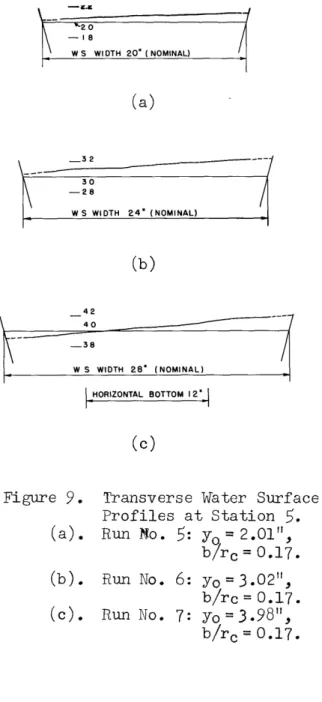
below) as well as the surface profile shapes (Figures 8 and 9) conform
quite closely to the trend predictable for free vortices.
The irrotational aspects of the flow are most pronounced at
conditions of greatest depth and curvature. In Runs 1-4, the irrotational type of motion persists over the full length of the curve, and high
velocities appear along the outer bank only at the start of the downstream
tangent. (Figures
5
and 6). However, at decreased curvature (Figure 7), the transfer of higher velocities towards the outer bank is quite evident throughout the second half of the curve, and below Station5,
the irro-tational pattern is suppressed.Attention is called here once move to the phenomenon previously discussed which are not readily apparent form the plots of velocities and surface elevation: separation and helicoidal motion.
Figures
5,
6, 7. Velocity Distributions Shown by Section for Condition of Uniform Approach, SmoothChannel.
Figure 5. Run No. 1.
yO - 2.98", w/y - 12, w/re O.6
Figure 6. Run No. h-B.
yom 5.99', w/y-8, w/r-O.8
Figure 7. Run No. 6.
YO - 3.02, w/y. - 8, w/r. - O.34.
K - W~ -- 0-tft
2 DEFINITION SKETCH
INSIDESCF 2 96 VELOCTE S N FEET OUTSIDE OF PERV SECOD CURVE
LOORING DOWNSTREAM VERTICAL SCALE MAGNIFICATION 2X 24 STA I S TA 2 STA 3 STA 4 sepin STA 5 1700 STA 6 16 1 40 I130 septn STA 7 614 I30 STA 8 +-170 14 0 ISO 16 0 140 50 0 STAI 10 0io 170)
130
15
14 IDEFINITION SKETCHSS* VELOCITIES IN FEET PER SEC INSIDE OF 'I LOOKINd. DOWNSTREAM OTSIDE OF
CURVE 24" CURVE STA I I150 I1O 140 I5O STA 2 130 140 STA 3 I160-~ 30 SA4
sep'n
16 40 50 130 ST 5 1170) 150) (10 1 60 I4E9' -130 PARATION ZONE STA 6 (j~io SO 140 130 SEPARTIONZONE SO TA SEPARATION ZONE ST 7 STA 10 40406 IS 2DEFINITION SKETCH302 VELOCITIES IN FEET PER SEC INS I DE OF LOOKING'DOWNSTREAM OUTSIDE OF CURVE 12 _ _CURVE STA I S3 STA 4 STA 5 14 3I I-SA 60 1 4 STA 7 STA. 8 5,6,7 STA 3 10-1 11