Vous avez des questions? Nous pouvons vous aider. Pour communiquer directement avec un auteur, consultez la
première page de la revue dans laquelle son article a été publié afin de trouver ses coordonnées. Si vous n’arrivez pas à les repérer, communiquez avec nous à [email protected].
Questions? Contact the NRC Publications Archive team at
[email protected]. If you wish to email the authors directly, please see the first page of the publication for their contact information.
https://publications-cnrc.canada.ca/fra/droits
L’accès à ce site Web et l’utilisation de son contenu sont assujettis aux conditions présentées dans le site LISEZ CES CONDITIONS ATTENTIVEMENT AVANT D’UTILISER CE SITE WEB.
READ THESE TERMS AND CONDITIONS CAREFULLY BEFORE USING THIS WEBSITE. https://nrc-publications.canada.ca/eng/copyright
NRC Publications Archive Record / Notice des Archives des publications du CNRC :
https://nrc-publications.canada.ca/eng/view/object/?id=e4d65a09-ab0a-4f48-a226-665a2c142d81 https://publications-cnrc.canada.ca/fra/voir/objet/?id=e4d65a09-ab0a-4f48-a226-665a2c142d81
NRC Publications Archive
Archives des publications du CNRC
Access and use of this website and the material on it are subject to the Terms and Conditions set forth at
Interrelation between extrusion process, formulation and properties of polypropylene/flax fibers composites
Title: Interrelation between extrusion process, formulation and properties of
polypropylene/flax fibers composites
Authors: Mihaela Mihai Nathalie Chapleau
Johanne Denault Christian Bélanger
ABSTRACT
This work investigates the effect of extrusion parameters and formulation on the properties of polypropylene / short flax fibers composites. The parameters that were varied during the twin-screw extrusion process were screw configuration, screw rate, extrusion temperature and flow rate. The effect of the location of the feeding zone of flax fibers is also considered. Regarding the composite formulation, the effect of flax and hemp content, presence of coupling agent and of a reactive additive on composite properties were analyzed. Composites obtained with hemp fibers in the same extrusion process were also considered for comparison purposes. The materials were characterized in terms of morphological characteristics, fiber length distribution, rheological, thermal and mechanical properties. The variation of extrusion parameters showed that polypropylene / flax fibers composites have a large process window that can be considered as an advantage of PP/flax compounds. Tensile strength evaluated on injection molded parts increased up to 50% with flax fibers content when coupling and reactive agents are used. Due to their high flexibility, flax fibers are less oriented in the flow direction and the mechanical properties will be more isotropic. Furthermore, these composites showed a good recyclability using an injection molding process by keeping the integrity of their mechanical properties after five reprocessing cycles. The processability of these materials using a cast film line and the mechanical properties of obtained sheets are also presented.
INTRODUCTION
Polypropylene/natural fibers composites have attracted the attention of researchers and manufacturers because of the renewable nature of fibers, good mechanical properties, lack of abrasion during the compounding, low environmental impact, low weight and cost savings compared to PP/glass fibers, _____________
Mihaela Mihai, Nathalie Chapleau, Johanne Denault, Christian Bélanger, Industrial Materials Institute, National Research Council of Canada, Boucherville, Quebec, Canada, J4B 6Y4
Kevlar or carbon fibers counterparts. On the other hand, natural fibers have as drawbacks low thermal stability, high humidity sensitivity, limited fiber length and, most importantly, the intrinsic variability. This variability consists in harvest conditions, quality of the soil and climate, geographic location, and the preconditioning. This variability can be observed also when considering the same plant because the fibers obtained from the stem have different mechanical and physical properties compared to fibers obtained from leaves. Composites mechanical properties and, therefore, their final applications, depend on fiber source [1-4], fiber treatment [5-9], the presence of coupling agents [1, 10-12], and compounding parameters.
If a lot of work has been done with regards to natural fiber surface treatment and polypropylene/fiber adhesion, the pre-compounding and the melt compounding aspects have less attracted attention. Concerning the compounding of polypropylene/short cellulosic fibers composites, usually a co-rotating twin-screw extruder is used before injection molding of different object shapes. On the other hand, some work exists concerning the effect of natural fibers content on the fiber damage during composites extrusion but without considering a discussion on the effect of extrusion parameters [13, 14].
This paper discusses the effect of extrusion parameters, i.e. screw configuration, screw rate, fiber feeding zone, temperature, and flow rate on the properties of polypropylene/flax fiber composites for a given composite formulation. Feeding the natural fibers in a continuous extrusion process is often problematic due to its low bulk density, which will be reflected into an inconsistent feeding rate [15]. The increase of the bulk density of natural short fibers is thus necessary to make the composite manufacture possible at small and medium scale. Hence, the flax fibers were fed in a pelletized shape obtained by passing the fibers trough a pellets mill. After setting the optimal extrusion parameters, the effect of fiber concentrations and additives on composite properties was examined. The composites re-processability using an injection molding step and the processability using a cast film line are also discussed.
EXPERIMENTAL PART Materials
Isotactic polypropylene (iPP) Pro-fax 1274 from Basell BV (Hoofddorp, Netherlands) with weight average molecular weight of 300,000 was used as the composite matrix. Flax and hemp fibers with a content of 10 wt.% impurities, mainly shives, were provided by Schweitzer Mauduit, Canada. The concentration of fibers in polypropylene was varied between 10 and 40 vol.%. The maleic anhydride-grafted polypropylene used as coupling agent was Eastman Epolene-43 (E-43) (AN = 45, Mw = 9,100, with around 4.81 wt% of MA). Its concentration was
varied between 2.5 and 5 vol.%. The calcium oxide (CaO) 98 wt.% purity from Laboratoire MAT Inc. was used as reactive filler. It is a basic reactive filler that has the role to absorb moisture in fibers, neutralize acidity of fiber impurities and therefore minimize the oxidation and degradation of fibers during melt processing.
Consequently, CaO helps also to increase strength and modulus of the final composites. The recommended concentration of CaO in PP composites with natural fibers is 3.5 % vol. (10 wt.%) [16]. Glass fibers, 6.5 mm in length, are also used to process equivalent composites with the purpose of comparison.
Extrusion Process
Regarding the appropriate way to feed natural fibers into the extrusion process, a pre-treatment step is necessary because natural fibers are fluffy and hard to feed in this shape without compromising the consistency of fiber flow rate. A proprietary technology was used to produce natural fiber pellets with minimum fiber length degradation. The extruder used to process the composites was a Leistritz 34 mm co-rotating twin-screw having 12 mixing zones and a L/D ratio of 40. Two feeding location are available in this extruder and the capillary die at the exit of the extruder had a diameter of 2 mm.
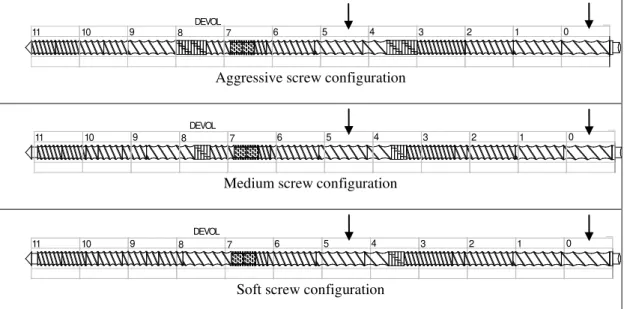
For the first part of this study, the composite formulation was kept constant, (i.e. 20 vol.% of flax and 2.5 vol.% of E43), while the extrusion parameters were varied. Three screw configurations, (a severe, a medium and a soft one) were tested. The degree of screw severity was differentiated by the ratio of shear disks situated in the 4th and 8th zones, i.e. 10/10 (Figure 1a), 5/5 (Figure 1b) and 5/0 (Figure 1c). For each configuration, the flax pellets were fed in two manners: at the same time as PP into zone 0, and secondly into the 5th zone. For the extrusion temperature, 3 flat profiles (200, 185 and 170oC) were selected and one in which the temperature was decreased constantly from 200oC down to 170o
In the second part of this study, the optimal extrusion parameters resulting from the first step were kept constant while the composite formulation was varied, and PP composites with flax, hemp and glass fiber contents from 10 to 40 vol.% were produced.
C. Three total flow rates were used: 5, 7.5 and 10 kg/h and the screw rates were 100, 150 and 200 rpm.
DEVOL
11 10 9 8 7 6 5 4 3 2 1 0
Aggressive screw configuration
DEVOL 0 1 2 3 4 5 6 7 8 9 10 11
Medium screw configuration
DEVOL 0 1 2 3 4 5 6 7 8 9 10 11
Soft screw configuration
Sheet extrusion
The pellets prepared as described above were extruded using a cast film line i.e. a Davis-Standard single-screw extruder equipped with a 20 cm wide flat die. The melt temperature was 180oC and 1 mm thick sheets were calendered between water-cooled rolls maintained at 40oC. Only selected compounds were extruded into sheets, i.e. the ones containing 10 and 30 vol.% flax. Blends containing 10 and 30 vol.% glass fibers were also extruded into sheets for comparison purposes.
Morphology
Scanning electron microscopy (SEM) was carried out on polished composites surfaces, coated or fractured. A coating of gold/palladium alloy was applied on the specimens prior to the observation. A JEOL JSM-6100 SEM at a voltage of 10 kV was used to analyze the dispersion of the fibers into the matrix and the interface between fibers and PP matrix.
Fiber Qualitative Analysis
Fiber length and fiber length distribution of cellulosic fibers obtained from composites after PP dissolution in xylene were measured using a Hi-Res FQA analyzer from OpTest Equipment Inc., Ontario, Canada. The length range was set between 0.04 mm and 10 mm which was the maximum length that the FQA can detect. At least 5000 fibers were measured for each sample and at least 5 measurements were done for each formulation.
Rheology
The rheological properties of the composites were evaluated at 185oC using a rotational rheometer, the Advanced Rheometric Expansion System ARES, with a plate-plate geometry in a dynamic mode. The plate diameter was 25 mm and the gap was around 1.7 mm. Frequency sweeps were carried out to determine complex viscosity over a frequency ranging from 0.1 to 100 rad/s. The tests were conducted for a deformation of 15%. Care was taken to dry the materials at 80o
C for 48 hours before testing. The samples were kept under a nitrogen blanket to minimize oxidation and to maintain a dried environment.
Differential Scanning Calorimetry
The DSC method was used to determine the melting and the crystallization temperature of the PP matrix. The tests were done using a TA Instrument’s Q2000 calibrated using an indium standard. The samples were heated from 30 to 200oC at 20oC/min, kept at 200oC for 5 minutes to erase the thermal history and cooled again down to 30oC at 20oC/min. The PP heat of fusion was considered 207.1 J/g [17].
Mechanical Properties
The samples designated for mechanical testing were first dried and then injection molded using a Boy injection molding press with a screw temperature of 190oC and a mold temperature of 30o
The tensile mechanical properties of cast sheets were also measured according to ASTM D638, in both machine and transverse directions. The tests were performed on rectangular 19 mm wide x 15 cm long strips cut out from the sheets. The elastic modulus, the tensile strength and the elongation at break were evaluated. A video extensometer was used to determine the elastic modulus. All reported values are the average of five tests.
C. The tensile testing was carried out according to ASTM D638 on standard type I dogbone shaped samples with a thickness of 3.2 mm. The impact testing was carried out according to ASTM D259.
Recyclability
The recyclability of flax composites was evaluated using tensile mechanical testing for formulations with 10 and 30 vol.% flax. The composite pellets were reprocessed by injection molding 5 times.
RESULTS AND DISCUSSIONS
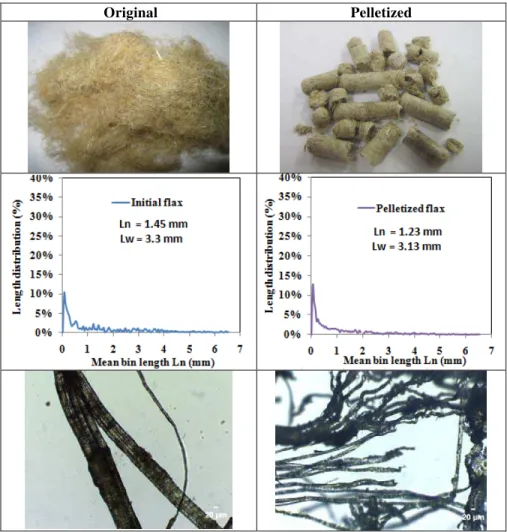
Trials to feed the flax fibers into the extruder in their natural shape failed since their low bulk density gave an important variation of fiber flow rate or produced bridges into the feeder. An increase in the bulk density was obtained using a proprietary pellet technology. To facilitate the pelletizing, the bulks of flax fibers were first cut at 6.5 mm and then uniformly wetted using equivalent water content. In the pelletizing process, the wetted flax fibers were pressed through a die plate using two rotating roll mills.
The first row in Figure 2 presents the physical aspect of flax fibers in their original/as received state and after the pelletizing step. There was no thermal degradation or important fiber shortening observed after the pelletizing step. The temperature during the process was kept constant at around 70oC. As measured using a HiRes FQA device, the length average fiber length was around 3.2 mm before and after pelletizing as could be seen in the second row. The third row shows optical micrographs of initial fibers and the ones extracted from the flax pellets. Another significant advantage of this pelletizing step is the separation of the technical fibers (diameter around 100 µm) into elementary fibers (diameter around 20 µm). Prior to extrusion, the flax fiber pellets were dried at 80o
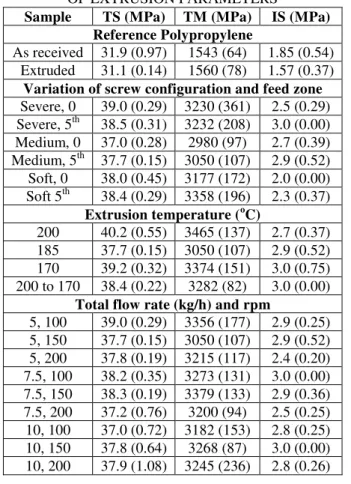
First compounding campaign of composites was dedicated to the variation of extrusion parameters as described previously in Experimental Part. The composite formulation was maintained constant, (77.5 vol.% PP, 20 vol.% flax and 2.5 vol.% E43), while screw configuration, feeding zone of fiber pellets and extrusion parameters were varied. The compounded composites were injection molded into samples for tensile and impact tests and the results are presented in Table I.
C for a minimum 48 hours.
Original Pelletized
Figure 2. Physical aspect, fiber distribution, and optical micrographs of original and pelletized flax fibers
Injection molding sample of as-received polypropylene pellets has a tensile strength (TS) of 31.9 MPa and a tensile modulus (TM) of 1543 MPa. After extrusion, it was found that PP preserved its mechanical properties and this means that the screw configuration did not damage the matrix integrity. The addition of fibers led to an increase of TS and TM to about 37-39 MPa and 3000-3300 MPa respectively, no matter the extrusion parameters were. Usually, this split out of technical fibers into elementary ones has to take place into the extruder. As explained before, the flax technical fibers were separated in elementary fibers during the fiber pelletizing step that helped further the internal extruder work for fiber dispersion and distribution. The results presented in Table I demonstrate that probably the fiber attrition in the PP matrix was similar no matter the extrusion parameters were. It seems that the extrusion window of PP/flax composites is very large and it can be considered as an advantage of flax composite compounding.
Furthermore, fiber qualitative analysis using Hi-Res FQA was done on fibers extracted by PP dissolution for all composite samples compounded by varying the screw configuration and feeding zone. This study of the fiber attrition as a function of extrusion parameters was done with the purpose to decide on the best screw
configuration with a minimum effect on fiber length. The results of FQA analysis are presented in the Table II. The fiber lengths are very similar no matter the extrusion parameters were. They confirm the mechanical properties presented in Table I so further helped us decide on the optimal extrusion operating conditions that were set at 185oC, 100 rpm and 10 kg/h.
TABLE I. MECHANICAL PROPERTIES OF COMPOSITES OBTAINED BY THE VARIATION OF EXTRUSION PARAMETERS
Sample TS (MPa) TM (MPa) IS (MPa) Reference Polypropylene
As received 31.9 (0.97) 1543 (64) 1.85 (0.54) Extruded 31.1 (0.14) 1560 (78) 1.57 (0.37)
Variation of screw configuration and feed zone
Severe, 0 39.0 (0.29) 3230 (361) 2.5 (0.29) Severe, 5th 38.5 (0.31) 3232 (208) 3.0 (0.00) Medium, 0 37.0 (0.28) 2980 (97) 2.7 (0.39) Medium, 5th 37.7 (0.15) 3050 (107) 2.9 (0.52) Soft, 0 38.0 (0.45) 3177 (172) 2.0 (0.00) Soft 5th 38.4 (0.29) 3358 (196) 2.3 (0.37) Extrusion temperature (oC) 200 40.2 (0.55) 3465 (137) 2.7 (0.37) 185 37.7 (0.15) 3050 (107) 2.9 (0.52) 170 39.2 (0.32) 3374 (151) 3.0 (0.75) 200 to 170 38.4 (0.22) 3282 (82) 3.0 (0.00)
Total flow rate (kg/h) and rpm
5, 100 39.0 (0.29) 3356 (177) 2.9 (0.25) 5, 150 37.7 (0.15) 3050 (107) 2.9 (0.52) 5, 200 37.8 (0.19) 3215 (117) 2.4 (0.20) 7.5, 100 38.2 (0.35) 3273 (131) 3.0 (0.00) 7.5, 150 38.3 (0.19) 3379 (133) 2.9 (0.36) 7.5, 200 37.2 (0.76) 3200 (94) 2.5 (0.25) 10, 100 37.0 (0.72) 3182 (153) 2.8 (0.25) 10, 150 37.8 (0.64) 3268 (87) 3.0 (0.00) 10, 200 37.9 (1.08) 3245 (236) 2.8 (0.26)
Table II. Fiber length in composites obtained at the variation of extrusion parameters
Sample Ln (mm) Lw (mm) Lww (mm) Variation of screw configuration and feed zone
Severe, 0 0.179 0.471 0.983 Severe, 5th 0.192 0.464 0.978 Medium, 0 0.191 0.443 0.883 Medium, 5th 0.203 0.459 0.894 Soft, 0 0.199 0.419 0.821 Soft 5th 0.197 0.398 0.768
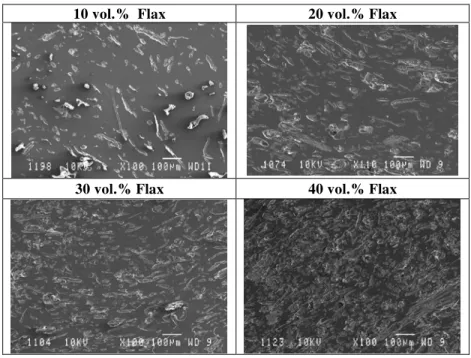
PP/flax and PP/hemp composites were obtained using these optimal extrusion parameters. Figures 3 and 4 present the morphological features of longitudinal polished surfaces of PP/flax, PP/hemp, and PP/glass fibers extruded composites. The selected extrusion parameters gave a high-quality dispersion of fibers, no matter what the fiber type and fiber concentrations were. Comparing the orientation
of the natural fibers with the one of glass fibers it is very evident that the glass fibers are more oriented in the flow direction due to their rigidity.
10 vol.% Flax 20 vol.% Flax
30 vol.% Flax 40 vol.% Flax
Figure 3. SEM micrographs of longitudinal polished surfaces of flax-composites obtained at 10, 20, 30 and 40 vol.% fibers.
10 %vol. Hemp 20 %vol. Hemp
10 %vol. Glass fibers 20 %vol. Glass Fibers
Figure 4. SEM micrographs of longitudinal polished surfaces of hemp-composites obtained at 10 and 20 vol.% fibers (hemp and glass) in the presence of E43 and CaO
a)
PP / 20%vol. flax composite medium configuration fibers feeding- 5th zone
185oC Time [sec] 100 200 300 400 500 600 E ta* [ P a. s] 1e+2 1e+3 1e+4 1e+5 gap = 1.337 mm gap = 1.73 mm b) PP /20%vol. flax Freq [rad/s]
1e-1 1e+0 1e+1 1e+2
E ta* [ P a. s] 1e+2 1e+3 1e+4 1e+5 at 185oC at 200oC at 215oC
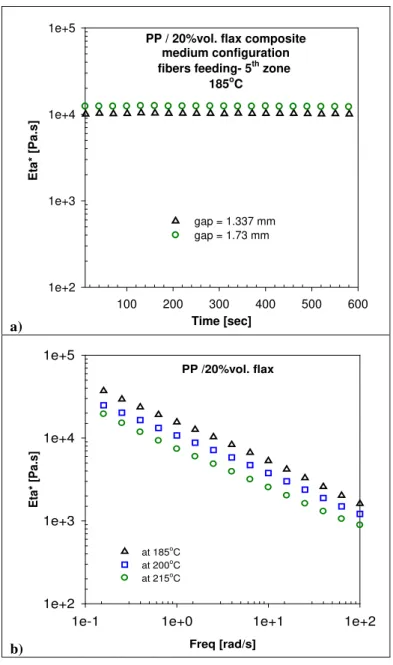
Figure 6. Complex viscosity as a function of testing time and as a function of testing temperature for neat PP/20 vol.% flax fibers
The complex viscosity dependency on test time and test temperature is presented first in Figure 6 for the neat PP/20 % vol. flax fibers. Composites stability in time is important during oscillatory tests to guarantee that the materials do not change their internal composition or structure at the testing temperature. In our case, it seems that the materials are very stable for at least 10 min at 185oC and, therefore, PP and flax fibers did not undergo thermal degradation during testing. Oscillatory tests done at two different gaps proved that composites viscosity depends on this testing parameter. For the rest of the rheological testing, a gap of 1.7 mm was selected. It is well known that the gap has to be three times higher or more than the fiber length to avoid the occurrence of wall-slip phenomena [18]. Figure 6b presents the complex viscosity dependency of PP/20%vol flax on frequency and temperature. The flexible fibers presence in PP matrix fingerprints
the composite behavior, i.e. highly shear thinning without any Newtonian plateau. As expected, at increasing the temperature the composite viscosity decreased.
a)
PP/flax and hemp composites 185oC
Freq [rad/s]
1e-1 1e+0 1e+1 1e+2
E ta* [ P a. s] 1e+2 1e+3 1e+4 1e+5 1e+6 PP pellets
PP + 0% flax + E43 + CaO PP + 10% flax + E43 + CaO PP + 20% flax + E43 + CaO PP + 30% flax + E43 + CaO PP + 10% hemp + E43 + CaO PP + 20% hemp + E43 + CaO PP + 30% hemp + E43 + CaO
b)
PP/flax and glass fibers 185oC
Freq [rad/s]
1e-1 1e+0 1e+1 1e+2
E ta* [ P a. s] 1e+2 1e+3 1e+4 1e+5 1e+6 PP pellets PP extruded PP + 10% flax PP + 20% flax PP + 30% flax PP + 40% flax PP + 10% glass fibers PP + 20% glass fibers PP + 30% glass fibers PP + 40% glass fibers
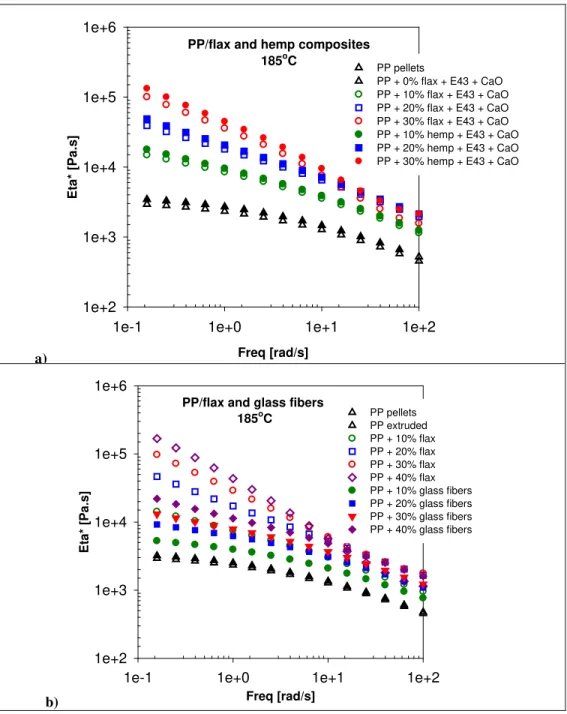
Figure 7. Complex viscosity as a function of frequency: comparison for PP/flax and hemp fibers composites (a) and PP/flax – glass fibers (b) respectively.
Viscosity measurements performed for different PP-flax, PP-hemp and PP-glass fibers composite systems obtained in similar extrusion conditions are presented in Figure 7. The extrusion process did not modify PP viscosity which is another proof that the selected screw configuration and extrusion parameters did not damage the length of PP molecular chains. The viscosity of extruded PP/E43+CaO is slightly higher than for pure PP. Their values are 3030 and 3568 Pa.s for a frequency of
0.1s-1. Increasing the flax fibers content from 10 to 30 vol.% highly increases the composite viscosity from 16962 up to 130617 Pa.s, respectively. The viscosities of hemp fiber composites are slightly higher than for flax fiber composites. This increment in PP/flax or hemp composites viscosity with fiber concentration is due to the fiber flexibility and, therefore, to the increase of fiber-fiber interactions reflected in fiber-fiber entanglements. This can also explain the behaviors observed in Figure 7b. It shows that the complex viscosity of PP/flax composites is always higher that for PP/glass fibres composites at equivalent formulations. Moreover, higher fiber content leads to a more pronounced shear thinning behavior. It should be noted that the increase of the viscosity with fiber content is more noticeable for low frequencies. At high frequencies the effect weakened probably due to the fact that fibers coagulate together and the effect of the matrix becomes dominant.
a)
b)
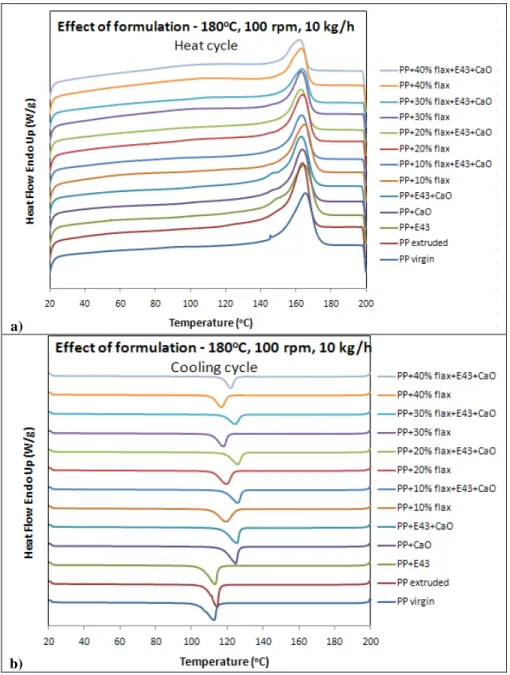
Figure 8. Heating (a) and cooling (b) curves obtained in DSC for PP/flax composites at different formulations
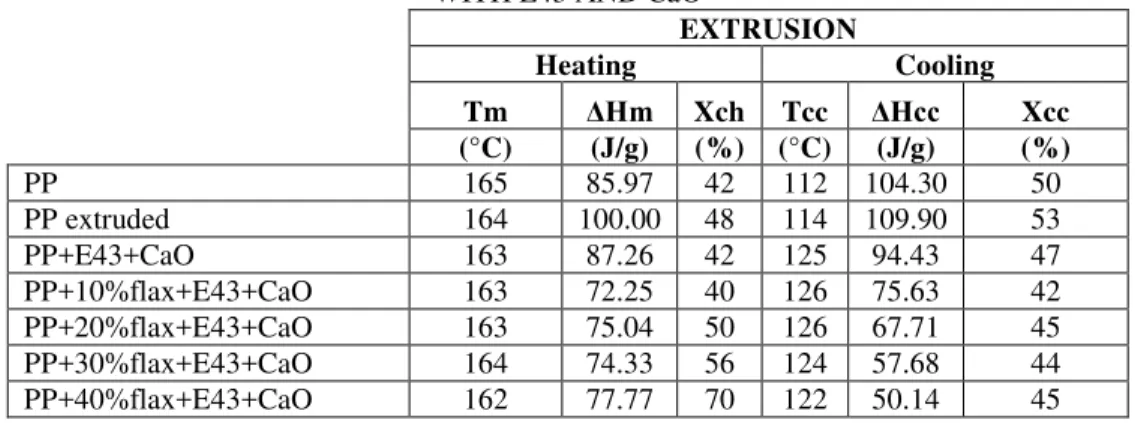
Non-isothermal crystallization behavior of PP/flax composites is presented in Figure 8. The first graphic discloses the heat curves and the second one the cooling curves obtained by DSC. The corresponding melt temperatures (Tm), crystallinity
values (Xch, Xcc) and crystallization temperatures (Tcc
The heating curves show that the PP and its composites do not crystallize during the heating cycle because they are already fully crystallized. The fiber addition did not change the T
) data are additionally presented in Table III only for full formulations.
m that is kept at around 163oC. In opposition, the initial
crystallinity was highly increased with fiber addition, i.e. from 42% for pure PP up to 70% for the formulation with 40 vol.% flax fibers and CaO. In consequence, the fibers could act as nucleating agents in the crystallization process of composites. The crystallization temperature during the cooling, Tcc, was highly affected by the
presence of CaO. It accelerates the crystallization that started 5-11oC faster than for composites without CaO. The crystallinity reached during the DSC cooling was kept at about 44%. This crystallinity level of composites was most likely limited by the imposed cooling flow rate of 20oC/min, and therefore by the limited time allowed for matrix crystallization.
TABLE III. NON-ISOTHERMAL DSC DATA FOR PP REFERENCES AND COMPOSITES WITH E43 AND CaO
EXTRUSION Heating Cooling Tm ΔHm Xch Tcc ΔHcc Xcc (°C) (J/g) (%) (°C) (J/g) (%) PP 165 85.97 42 112 104.30 50 PP extruded 164 100.00 48 114 109.90 53 PP+E43+CaO 163 87.26 42 125 94.43 47 PP+10%flax+E43+CaO 163 72.25 40 126 75.63 42 PP+20%flax+E43+CaO 163 75.04 50 126 67.71 45 PP+30%flax+E43+CaO 164 74.33 56 124 57.68 44 PP+40%flax+E43+CaO 162 77.77 70 122 50.14 45
Tensile properties of PP/flax composites obtained with the variation of flax concentration are presented in Figure 9. As expected, the tensile strength of composites obtained without compatibilizing additives decreased to some extent with the increase of fiber content. However, the addition of E43 coupling agent and CaO reactive agent promoting fiber/matrix adhesion and has an important effect on tensile strength of the composites. The tensile strength increased from 31 for pure PP up to 43 MPa for composites containing 30 vol.% of flax fibers, and a slight decrease to 40 MPa is observed for the composites consisting of 40 vol.% of flax fibers. Speaking in terms of tensile modulus, a regular increase is observed as a function of fiber loading. The tensile modulus of PP, around 1500 MPa, was increased more than three times when the flax fiber content was 40%vol. The tensile properties of PP/hemp fiber composites was not represented in Figure 9 because these composites shown very similar behavior as PP/flax composites.
a PP/ flax T ens ile s tr engt h (M P a) 0 10 20 30 40 50 185oC, 100 rpm, 10 kg/h PP ext PP E43 PP pur PP CaO PP E43 CaO 10% 10% E43 CaO 20% 20% E43 CaO 30% E43 CaO 30% 40% E43 CaO 40% b PP/ flax Y oung M odul us ( M P a) 0 1000 2000 3000 4000 5000 6000 PP ext PP E43 PP pur PP CaO PP E43 CaO 185oC, 100 rpm, 10 kg/h 10% 10% E43 CaO 20% 20% E43 CaO 30% E43 CaO 30% 40% E43 CaO 40%
Figure 9. Tensile properties of PP/flax composites: a) tensile strength and b) tensile modulus.
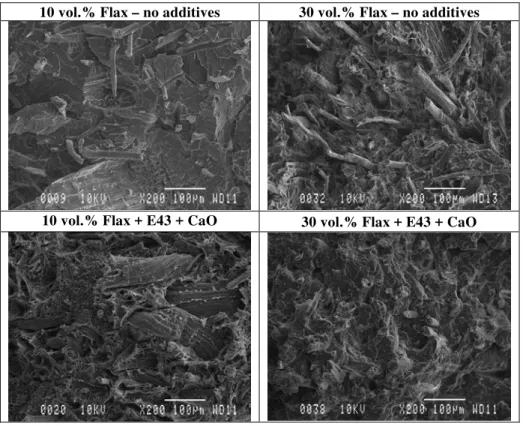
Micrographs corresponding to fractured surface of 10% flax composites (first column) and 30 vol.% flax composites (second column) without (first row) and with compatibilization (second row) are presented in Figure 10 and unveil the effect of coupling agent addition in PP/fiber adhesion. For composite that contains no additive, there is a smooth rupture surface and also more holes in matrix left by the pull-out flax. This proved a bad fiber-matrix interface. For composite that contained CaO and E43, fibrilar-like rupture and short pull-out flax could be observed. It proved that, at some level, a recovering of their good interface took place. When the matrix formulation contains both E43 and CaO, there is matrix attached or even
covered on surface of the fractured triticale, which presented the best interface. This observation corroborates with tensile and flexural results explaining the roll of additives in the adhesion between the matrix and the flax. The excellent lessening of fiber pull out is an important sign of the increment of polymer/fiber adhesion in the compatibilized system, and it confirms the tensile strength higher values with the addition of E43.
10 vol.% Flax – no additives 30 vol.% Flax – no additives
10 vol.% Flax + E43 + CaO 30 vol.% Flax + E43 + CaO
Figure 10. SEM microstructural details of fracture surface of injected samples PP/30 vol.% flax.
The mechanical performance of the cast sheets was also evaluated. The tensile modulus, tensile strength and elongation at break were evaluated in both machine (MD) and transverse (TD) directions. Figure 11 reports the data for the cast sheets of blends containing 10 vol.% flax and glass fibers. The values of the elastic modulus for neat polypropylene are similar in both MD and TD. The blends are less isotropic as the values in TD are slightly lower. This is even more pronounced for the blends containing glass fibers, which can, because of their higher rigidity, be more easily oriented in the machine direction during melt extrusion.
The modulus increases with the addition of flax fibers, with or without additives. The best results were obtained for the compatibilized blends (containing both CaO and E-43). These trends were also observed for the tensile strength. The elongation at break of neat polypropylene was very high (900%) in the machine direction but quite low in the transverse direction (20%). All blends, including the PP/glass fibers, exhibited very low elongation at break (below 10%), in both MD and TD (data not shown).
10 vol.% Flax E las ti c M odul us ( G P a) 0 1 2 3 4 5 6 MD TD
neat PP + 10% flax + 10% glass fibers + 10% flax compatib. T ens ile S tr eng th (M P a) 0 10 20 30 40 50 60 MD TD
neat PP + 10% flax + 10% glass fibers + 10% flax
compatib.
Figure 11. Tensile properties of cast sheets containing 10 vol.% flax and glass fibers. MD: machine direction. TD: transverse direction. a) elastic modulus. b) tensile strength .
Figure 12 shows the results for sheets containing 30 vol.% flax fibers. Again, an increase of the modulus and strength is observed with the addition of fibers. The sheets with flax are also more isotropic than in the case of the glass fibers.
30 vol.% Flax E las ti c M odul us ( G P a) 0 2 4 6 8 10 12 14 16 MD TD
neat PP + 30% flax + 30% glass fibers + 30% flax compatib. T ens ile S tr eng th (M P a) 0 10 20 30 40 50 60 MD TD
neat PP + 30% flax + 30% glass
fibers + 30% flax
compatib.
Figure 12. Tensile properties of cast sheets containing 30 vol.% flax and glass fibers. MD: machine direction. TD: transverse direction. a) elastic modulus b) tensile strength.
Results on recycling experiments done on composites made of 30 vol.% flax fibers formulated with E43 and CaO are presented in Figure 13. It can be easily observed that after five injection cycles, the composites did not exhibit any significant change in tensile strength and tensile modulus.
a
b
Figure 13. Tensile properties of recycled PP composites with 30 vol.% flax fiber content: a) tensile modulus and b) tensile strength
CONCLUSIONS
Polypropylene/flax and hemp fiber composites were compounded using a twin-screw extruder and specimens were obtained by injection molding. A pre-treatment step on the fibers was found to be necessary to correctly feed them into the extruder, in order to preserve consistent flow rate and, therefore, a consistent fiber concentration in the composite. The pelletizing step of flax fibers was proven to be very beneficial. In addition, during this pelletizing step, the flax technical fibers were split down into elementary fibers without compromising the fiber length. Rheological, thermal and mechanical behaviour improved significantly with fiber content. Tensile strength measured on standard specimens (dogbones) increased up to 40% with the addition of 30 %vol. of flax fibers content when coupling and reactive agents are used. Extruded cast sheets were also manufactured and their mechanical performance evaluated. The values of the elastic modulus for neat polypropylene were similar in both MD and TD. The composites were less isotropic as the values in TD were slightly lower. However, this was even more pronounced
for the blends containing glass fibers. The best results (highest tensile modulus and strength) were obtained for the compatibilized blends.
REFERENCES
1. R. Malkapuram, V. Kumar, Y. S. Negi, Journal of Reinforced Plastics and Composites, 28-10, 1169-1189 (2009).
2. S.-J. Kim, J.-B. Moon, G.-H. Kim, C.-S. Ha, Polymer Testing, 27, 801-806, (2008).
3. T. Mehdi, R. H. Falk, J. C. Hermanson, Journal of Applied Polymer Science, 101(6), 4341-4349 (2006).
4. J.-L. Julson, G. Subbarao, D.D. Stokke, H. H. Gieselman, Journal of Applied Polymer Science, 93, 2484-2493 (2004).
5. K. L. Pickering, Y. Li, R. L. Farrell, Key Engineering Materials, 334-335, 493-496. (2007). 6. M. Soleimani, L. Tabil, S. Panigrahi, A. Opoku, Journal of Polymers and the Environment,
16(1), 74-82, (2008).
7. S. Reich, A. ElSabbagh, L. Steuernage, Macromolecular Symposia, 262, 170-181, (2008). 8. Y. H. Han, S. O. Han, D. Cho, H.-I. Kim, Composites Interfaces, 14 (5-6), 559-578, (2007). 9. G. Cantero, A. Arbelaiz, R. Llano-Ponte, I. Mondragon, Composites Science and Technology,
63(9), 1247-1254, (2003).
10. T. J. Keener, R. K. Stuart, T. K. Brown, Composites: Part A, 35, 357-362, (2004).
11. A. Nechwatal, T. ReuBmann, S. Böhm, E. Richter, Advanced Engineering Materials, 7(1-2), 68-73, (2005).
12. N. Sombatsompop, C. Yotinwattanakumtorn, C. Thongpin, Journal of Applied Polymer Science, 97(2), 475-484 (2005).
13. D. Puglia, A. Terenzi, S. E. Barbosa, J. M. Kenny, Composite Interfaces (2008), 15(2-3), 111-129.
14. P. Sridhar, J. Krishnan, International Journal of Modern Physics B: Condensed Matter Physics,
Statistical Physics, Applied Physics, 20(25, 26 & 27, Pt. 3), 4607-4612, (2006).
15. C. Klason, J. Kubat, H.E. Strömvall, International Journal of Polymeric Materials, 10(3), 159-187, (1984).
16. M.-T. Ton-That, F. Perrin-Sarazin, J. Denault, US Patent 7,041,716 B2 (2006). 17. D. W. Krevelen, Properties of Polymers, New York: Elsevier Science (1997). 18. W. R. Blakeney, Journal of Colloid Interface Science, 22, 324-330 (1966).