ECP 2007 EDU 417007
ICOPER
Report on the Standardized Description of
Instructional Models
Deliverable number D3.1
Dissemination level Public
Delivery date 30 September 2009
Status Final
Author(s) Michael Derntl, Susanne Neumann, Petra Oberhuemer
Contributor(s) Colin Tattersall, Dominique Verpoorten, Roland Klemke
eContentplus
This project is funded under the eContentplus programme1,
a multiannual Community programme to make digital content in Europe more accessible, usable and exploitable.
!" #$"%"&'(")*+,+)--.("/+"!+"
Table of Contents
1 INTRODUCTION... 3
2 KEY CONCEPTS FOR INSTRUCTIONAL MODELLING IN ICOPER... 3
3 PROBLEM AND GOAL STATEMENTS FOR INSTRUCTIONAL MODELLING IN ICOPER ... 5
3.1 PROBLEM STATEMENT... 5
3.2 GOAL STATEMENT –TOWARDS A FRAMEWORK FOR GOOD TEACHING PRACTICE... 7
4 OVERVIEW OF RELEVANT INITIATIVES AND SPECIFICATIONS ... 8
4.1 INSTRUCTIONAL MODELLING INITIATIVES... 9
4.2 CRITERIA FOR GOOD TEACHING PRACTICE... 12
4.3 CLASSIFICATION INITIATIVES... 14
5 CREATING A DESCRIPTION TEMPLATE FOR TEACHING METHODS ... 18
5.1 MOTIVATION... 18
5.2 METHODOLOGY... 19
5.3 RESULTS:FIRST VERSION OF THE TEACHING METHOD DESCRIPTION TEMPLATE... 20
6 EVALUATION OF THE TEACHING METHOD DESCRIPTION TEMPLATE ... 22
6.1 PHASE I–EVALUATING THE TEMPLATE FROM THE AUTHOR’S PERSPECTIVE... 23
6.1.1 Methodology ... 23
6.1.2 Results... 23
6.2 PHASE II–EVALUATING THE TEMPLATE FROM THE USER’S PERSPECTIVE... 26
6.2.1 Methodology ... 26
6.2.2 Results... 27
6.3 OVERALL EVALUATION RESULT... 31
6.3.1 Revised Teaching Method Description... 32
7 INSTRUCTIONAL MODELLING SUPPORT IN OPEN ICOPER CONTENT SPACE... 35
7.1 SCENARIOS... 35
7.2 WP3CORE USE CASES... 36
7.2.1 Search for TM/UoL... 37
7.2.2 Retrieve TM/UoL ... 38
7.2.3 Upload TM/UoL ... 39
7.2.4 Annotate TM/UoL... 40
7.3 METADATA FOR TEACHING METHODS AND UNITS OF LEARNING... 42
8 SUMMARY AND FURTHER WORK... 43
9 REFERENCES... 44
ANNEX A: GROUPING GOOD TEACHING PRINCIPLES INTO NINE CRITERIA ... 49
ANNEX B: EXAMPLE OF A COMPLETED TEACHING METHOD DESCRIPTION... 53
ANNEX C: LIST OF TEACHING METHODS... 56
1 Introduction
One of the primary objectives of ICOPER is to make digital content accessible within an interoperable, standards-based infrastructure. An essential ingredient to achieve this objective is an empirically grounded understanding of how teaching practitioners in higher-education institutions approach the tasks of designing, describing, sharing and reusing instructional models and units of learning, in their crucial components: content (WP4), learning objectives (WP2), teaching methods (WP5) and assessment processes (WP6).
As a major step towards this understanding, this report investigates the state of the art in representing generic as well as contextualised instructional models. The report introduces a structured description template for generic teaching methods, by drawing on findings from previous projects and initiatives, and by involving teaching practitioners and educational researchers in (a) the evaluation of the template and (b) the collecting of teaching methods. A set of instructional modelling use cases is included to identify and describe key interactions of teachers and learning designers with instructional modelling artefacts in the Open ICOPER Content Space (OICS; see deliverable D1.1). An initial proposal for a metadata application profile for teaching methods and units of learning supporting the use cases within OICS is presented.
This report is structured as follows:
• Section 2 introduces the key instructional modelling concepts used in ICOPER and in this report.
• Section 3 presents an overview of relevant instructional modelling initiatives, a set of criteria for good teaching practice, and a presentation of ten of the most relevant classification initiatives related to teaching and learning.
• Section 4 outlines the problem statement and goals of WP3.
• Section 5 details the process of constructing a structured description template for teaching methods.
• Section 6 presents results of the template evaluation as well as the final template. • Section 7 specifies interactions of stakeholders with instructional modelling artefacts
within the ICOPER technical infrastructure in the form of use cases. Section 8 summarizes the report and outlines open issues to be addressed in further work.
2 Key Concepts for Instructional Modelling in ICOPER
This section introduces the key concepts and terms used in this report and in ICOPER for issues of relevance to WP3, dealing with instructional modelling. WP3 decided to start the elaboration of instructional modelling key concepts based on two central concepts: ‘teaching method’ as a generic representation of learning and teaching activities, and ‘unit of learning’ as a concrete, contextualized unit of education or training. Relevant related concepts were identified and included into the WP3 key concepts map in an iterative process. Coordination with other ICOPER work packages and refinement of concept definitions and relations resulted in the key concepts map depicted in Figure 1.
Figure 1: Map of key concepts for Instructional Modelling. The key concepts are defined as follows:
• Teaching Method. A teaching method is a learning outcome oriented set of activities to be performed by learners and learning supporters. Examples for teaching methods are the lecture method, problem-based learning, and the think-pair-share method. Teaching methods are described using a teaching method description template. Typically, teaching methods are generic descriptions of activities, independent of specific content or an application context. Teaching methods are realized in units of learning within a specific context and with associated content. A teaching method can be expressed as an IMS LD Unit of Learning. Examples of teaching methods worked out by the COSMOS project can be viewed online2.
• Unit of Learning. A unit of learning refers to a contextualized, complete, self-contained unit of education or training that consists of a teaching method and associated content (adapted from Olivier & Tattersall, 2005, p. 25). A unit of learning can be a combination of multiple teaching methods; it can be expressed as an IMS LD Unit of Learning. To view a teaching method (here: guided research model), which was adjusted to the specific context of teaching dark matter in astronomy in order to create a unit of learning, see the COSMOS portal3. The document referred to in footnote 2 also includes an example of the guided research model turned into a unit of learning (adjusted for the context of teaching circular motion).
• Teaching Method Description Template. The teaching method description template provides a text-based template for structured and meaningful description of a teaching method. It includes a number of teaching method inherent elements (e.g. sequence of activities, roles, etc.) and teaching method context elements (e.g. subject domain, target group, etc.) to enable understanding and reuse of the teaching method by
)"012"3#45#4"/67829:"1;<"=2>2?7/2="<@A":2;91@BC"D2:17=<("E1@91";62"9;??2="2=F9;:@7B;?"<92B;6@7<"@B":12@6"
:26D@B7?7CGH"
1::/HIIEEE+97<D7</76:;?+2FI97<D7<IJ@?2<I12?/I3#45#4K%2;6B@BCKL9:@>@:@2<K02D/?;:2<+/=J"""
practitioners. The construction of the template is reported in Section 5, its evaluation in Section 6, and the final version of the template is presented in Section 6.3.1.
• IMS LD Unit of Learning. An IMS LD Unit of Learning is an IMS LD-compliant, XML-based definition of a unit of learning or teaching method.
• Learning Outcomes. Learning outcomes means statements of what a learner knows, understands and is able to do on completion of a learning process, which are defined in terms of knowledge, skills and competence (European Commission, 2008, p. 11). This concept is the main link to ICOPER WP2 (see D2.1).
• Learners. Learner is a role that performs learning activities in a teaching method or unit of learning to achieve intended learning outcomes. Learner is a generic role, which can be specified by various concrete roles that are defined by the teaching method (e.g. in Jigsaw learners assume the role of experts, presenters, and so forth). • Learning Supporter. Learning supporter is a role that supports the learner role
during the activities of a teaching method or unit of learning. Learning supporter is a generic role, which can be specified by various concrete roles that are defined by the teaching method. Typical learning support roles are teacher, instructor, facilitator, external expert, moderator, etc.
• Content. Content refers to any learning object or material used in a unit of learning. This can be a website, lecture slides, a textbook, etc.
• Context. The context of a teaching method/unit of learning is the set of elements that are external to and give meaning to a teaching method/unit of learning. For instance, subject domain or target groups are elements of the teaching method context.
• Learning Assessment. This is a core concept from WP6 (assessment and evaluation), which defines learning assessment as the process of testing the learning outcomes (knowledge, skills and/or competences) attained by a certain learner and providing the corresponding information reporting about the student achievements and/or potential indications for improving them; it comprises identifying, collecting and preparing data to evaluate the achievement of program outcomes and program educational objectives.4 With regard to WP3, learning assessment is used in units of learning.
3 Problem and Goal Statements for Instructional Modelling in
ICOPER
3.1 Problem Statement
The goal of the ICOPER project is to identify best practices for using educational technology standards in European higher education institutions. More specifically relating to WP3, the goal is to identify where and how standards for instructional modelling are used at European higher education institutions. Questions that relate to this goal are:
• Where are best practices for instructional modelling performed at European higher education institutions?
• What best practices exist for the use of standards in instructional modelling?
• What best practice do we recommend for using standards for instructional modelling in higher education institutions?
Currently, only one standard for instructional modelling exists, i.e. the IMS Learning Design (IMS LD) specification (Koper, Olivier, & Anderson, 2003). From our current understanding, this standard is not being used in large scale implementations at European higher education institutions. One question in this regard may be why there is only one standard dealing with instructional modelling, when the field of Educational Technology usually spots several standards for similar purposes. Reasons for this could be that instructional modelling has only been researched for a short time. There is not a long tradition for capturing pedagogical practice and specific teaching methods. Instructional modelling could thus be called an emerging domain. This is opposite to, for instance, the Learning Object Metadata (LOM) standard (IEEE, 2002), which has predecessors in analog media storage having a long history in library science.
What adds to the problem of an emerging domain is that a career in higher education is still driven by research results that a scientist achieves rather than the teaching performance s/he exhibits. Instructors at a higher education institution are experts in their respective field but have most likely not been trained in setting up learning and teaching environments. Rather, they often teach how they were taught. It is uncommon that higher education instructors apply theoretical models from instructional systems design in their teaching practice (Beetham, 2004). In addition, teachers and instructors are not used to communicate among each other about their teaching, and they don’t document their teaching practices in a systematic manner (Beetham, 2004). Therefore, little is known about the process of how instructors (in higher education settings) go about designing their instruction.
Former initiatives at the Open University of the Netherlands, namely, the development of the Educational Modelling Language (EML) (Hummel, Manderveld, Tattersall, & Koper, 2004) and its successor IMS LD, are laudable initiatives to overcome the stated problem of the lack of teaching documentation. However, these initiatives have found little acceptance in the teaching practitioner community (Downes, 2009; Griffiths & Blat, 2005). The lack of a common central repository that stores IMS LD units of learning may be one of the reasons why adoption is hindered (Gilbert Paquette, as cited in Downes, 2009).
Last but not least, only a few evaluations of IMS LD have been performed. However, none of them was performed by/with instructors. For instance, Dolonen (2006) reports about an empirical study of IMS LD. The study found that IMS LD provided important concepts for expressing pedagogical models but exhibited problems in regard to providing dynamic group behaviour and advanced routing. Van Es and Koper (2006) evaluated IMS LD for its ability to express different types of courses. They found that IMS LD faced limitations when certain characteristics of the teaching and learning situation were unknown during design time, such as the number of repeating a certain activity (“repeat for as many groups as present”). Finally Paquette (as cited in Downes, 2009) mentions the specification’s weakness with regard to collaborative activities and its expressiveness considering competences.
So there are two problem areas to be investigated: the area of the teaching process (how instructors go about teaching), and the area that IMS LD spans. The specific problems that ICOPER WP3 will address regarding the teaching process are
• how generic teaching method descriptions support passing instructional modelling knowledge among teachers,
• how teachers contextualize generic teaching methods, as well as
• how teaching methods could be classified so that instructors can choose from are questions that this problem relates toadequate teaching methods to expand their teaching repertoire.
The problem that IMS LD pertains to is
• how instructors are able to transfer their own (representations of) teaching concepts into the structure/language that IMS LD offers
• what benefits arise for higher education instructors when doing so
• whether IMS LD is flexible enough to express instructional models of today’s higher education instructors, and
• what benefits IMS LD holds for higher education institutions.
3.2 Goal Statement – Towards a Framework for Good Teaching Practice
Higher education institutions have the goal to foster good teaching practice as can be seen from the multiple, world-wide initiatives that dedicate themselves to this topic (cp. also the initiatives described in Section 4.1 of this report). The Bologna process kicked off several reforms (e.g. the three-tier educational system, ECTS credits) aiming at the promotion of students’ mobility by increasing transparency and comparability of higher education programmes within Europe (Confederation of EU Rectors’ Conference & Associaton of European Universities, n.d.). European universities thus enter a competition for attracting students from all over Europe and abroad by offering high quality study programmes borne by good teaching practice. This goal requires that instructors know what good teaching is and what steps to take to offer good teaching themselves.
One prerequisite for encouraging good teaching practice is the communication of (good) teaching practice, implying the documentation and exchange of such practices. Although such communication is most likely to take place between instructors at the same institution, instructors may also expand their communication circles using online exchange platforms. Our goal is thus to develop an ICOPER Framework for Good Teaching Practice, inspired by the idea that “reuse” of good teaching practices is possible. The framework is meant to support teaching practitioners and learning designers in identifying, developing, documenting, and sharing good teaching practice. As depicted in Figure 2, the framework consists of four core components:
• Teaching Method Description Template: enables uniform documentation and communication of generic teaching methods that embody good teaching practice. The creation and evaluation of the description template are central parts of this report (see Sections 5 and 6, respectively). The creation of the description template was based on several previous initiatives with similar objectives as listed in Section 4.1.
• Units of Learning: these are provided as contextualized example implementations of teaching methods. Units of learning support teaching practitioners and learning designers in contextualizing generic teaching methods, and in reusing concrete existing examples of good teaching practice. Some of these units of learning will be provided as IMS LD compliant content packages.
• Criteria for Good Teaching Practice: In order to enable identification and deployment of good teaching practice by educational stakeholders, the framework provides a set of nine criteria that were collated from existing initiatives of developing criteria for good teaching. The criteria are presented in Section 4.2.
• Educational Taxonomy: The taxonomy will be developed as an easy-to-use tool for the classification of teaching methods and units of learning. The development of the taxonomy is still in progress, but the underlying existing educational classification initiatives have already been identified and evaluated (see Section 4.3).
Figure 2: ICOPER Framework for Good Teaching Practice.
The components of the framework are woven together within the ICOPER technical infrastructure5 using the LOM standard (IEEE, 2002). The work up to this point (and which is described in this report) has focussed on the description of teaching methods, on the description of units of learning as well as on the identification of criteria for good teaching practice. Future work will focus on the connection of these concepts with IMS LD as well as the Educational Taxonomy.
4 Overview of Relevant Initiatives and Specifications
This section provides an overview of initiatives that relate to the goals of WP3 and the ICOPER Framework for Good Teaching Practice. These initiatives are included to build the context into which the ICOPER WP3 initiatives fit outside the realm of ICOPER, and to help the reader understand how the WP3 work positions itself among similar initiatives. They include:
• initiatives that have proposed description schemas for instructional models (section 4.1)
• initiatives that have provided guidelines for good teaching practice, especially in higher education (section 4.2), and
." 012" J@6<:" =6;J:" 7J" :12" %#5" ;//?@9;:@7B" /67J@?2(" E1@91" 2B;T?2<" =2<96@T@BC" :2;91@BC" D2:17=<(" FB@:<" 7J"
• initiatives that focused on classifying concepts related to learning and teaching (section 4.3).
4.1 Instructional Modelling Initiatives
There are several existing initiatives that deal with instructional modelling issues of relevance to WP3. Particularly as input to the construction of a teaching method description template, the objective was to get a comprehensive overview of previous approaches to describing teaching methods for sharing and reuse. The following existing collections were analysed:
• 101 e-Learning Seminarmethoden (Häfele & Maier-Häfele, 2004): Presents 101 methods for preparing, running and evaluating e-learning seminars. These include methods for personal introduction (e.g. for breaking the ice) and advanced methods for creating and facilitating various e-learning course formats. The structured description of each method includes elements such as name, summary, goals, tools, when to use, group size, duration, sequence, examples, remarks, experiences and references.
• AUTC Learning Designs Project (Learning Designs Project, 2003): This project aimed at producing reusable, generic learning designs to assist teaching practitioners in creating technology-supported learning experiences. Besides providing generic guides and contextualized exemplars of learning designs in various contexts, the researchers in this project also pioneered in the provision of a structured description template along with visual representations of learning designs (Oliver, Harper, Hedberg, Wills, & Agostinho, 2002). Essentially, a learning design visually and textually captures the interplay of activities, resources and learning supports. The description format of learning designs includes general metadata like title, author, discipline, study program, size/scope of learning design, as well as detailed information on the learning setting and delivery context.
• BMUKK Virtual School Austria Scenario Description (Kranebitter, 2008): The Austrian Federal Ministry for Education, Arts and Culture is involved in several European Union co-funded projects, where a strong focus is put on the development of scenarios representing good technology-supported teaching practice. The initiative’s goal is to support teaching practitioners in planning and designing subject-specific courses as well as to assist them in choosing appropriate teaching methods. A template was distilled from available good practice scenarios that facilitates the documentation of teaching approaches and makes this – sometimes implicit knowledge – accessible for teacher colleagues. The template consists of three categories: The first category contains bibliographic elements, e.g. author, contact information, name of the organization etc. The second category focuses on the description of the scenario’s pedagogical characteristics, e.g. tasks, intended learning outcomes, prerequisite knowledge, and the third category finally offers descriptive elements for the required resources, e.g. educational content, infrastructure, and media.
• Template for describing a case study in e-learning practice (Beetham & Sharp, 2007, p. 242): This template has been developed by JISC (Joint Information Systems Committee; see http://www.jisc.ac.uk) in close cooperation with several UK Higher Education Academy subject centers to collate case studies at a national level. The collection of systematically described case studies represents a knowledge base that teaching practitioners can access when designing for learning. The template consists
of a set of elements that are considered to be important and useful by representatives of the subject centers. The elements are classified into six categories, Curriculum and intended learning outcomes, Activity, People involved, Environment for learning, Outcomes for learners and Reflections, each of which contains three to six elements together with explanatory remarks and examples. The template’s users are asked to tailor the template according to their specific requirements and needs.
• COSMOS Project (http://www.cosmos-project.eu): The main objective of the European Commission co-funded project “COSMOS” is to make existing educational content in astronomy and physics accessible and reusable for end users. In the project, a template for the development of technology-enhanced educational scenarios was devised and several units of learning were described based on the template. It comprises a structured set of descriptive elements, e.g. title, educational problem, scenario objectives, learner needs and characteristics, educational approach, learning activities (type, technique, interaction, etc.), participating roles, tools, services and resources, as well as a graphical representation. An official cooperation between ICOPER and COSMOS was established to pool know-how and experience gained within both projects. The COSMOS units of learning will be evaluated with respect to inclusion in the ICOPER Framework for Good Teaching Practice as contextualized example implementations of teaching methods.
• Catalogue of didactic models: Flechsig provides a German-speaking catalogue (1983) and handbook (1996) of didactic models that are described using a uniform template consisting of description elements related to didactic principles, phases, elements and their properties (learner, context, tasks, etc.), evaluation, application area, and variants. • JISC Mod4L Project (Falconer, Beetham, Oliver, Lockyer, & Littlejohn, 2007): In this project the researchers collected information requirements of teachers during browsing, choosing, developing and instantiating a learning design. In group work, teaching practitioners recorded their information requirements during these phases. The requirements were subsequently grouped into eight themes, with each theme including a set of information elements: instantiation (e.g. design, timing, sequence etc.), adaptability (granularity, flexibility etc.), pedagogy (assessment, activities, purpose, etc.), discipline (e.g. content, learning outcomes etc.), environment (e.g. resources, tools, context, delivery mode etc.), audience (group size, level etc.), quality (student feedback, peer review etc.), and operational factors (e.g. time/effort, barriers, etc.). Each information element was rated in terms of importance for each of the four phases mentioned above.
• JISC Pedagogical Vocabularies Project (Currier, Campbell, & Beetham, 2005): This project investigated, among other things, the role of vocabularies for sharing and reusing learning designs. The researchers suggest that the following elements must be separately specified for each learning design (p. 79): type of learning activity, desired learning outcomes, systems or services required in the activity, other learning environment aspects, and roles of participants.
• Organic.Edunet (http://www.organic-edunet.eu/organic/index.html): The European Commission co-funded project “Organic.Edunet” aims to facilitate access, usage and exploitation of digital educational content related to Organic Agriculture and Agroecology. In this project, a template was developed for the description of teaching scenarios and the usage of educational content. The template’s elements are
subdivided into three categories comprising general information (e.g. title, target group, language, duration, subject domain), contact information (e.g. author), prerequisites and detailed information (e.g. required hardware, infrastructure), scenario-specific information (e.g. tasks, learning outcomes, activities).
• Design pattern templates: Voigt and Swatman (2006) performed a comprehensive review of pedagogical design pattern initiatives and projects with particular emphasis on the description format and structure of patterns. While pattern initiatives in education generally rely on pioneer work by Alexander and colleagues (1977), there are substantial differences in the way these initiatives actually represent and describe their patterns. Voigt and Swatman identified dozens of design pattern description elements, which were grouped into five shared top level elements: Name; Context (problem context, conditions, educational paradigm, domain specifics etc.); Problem (general description, forces at work, example, scope etc.); Solution (introduction, detailed description, principles, visual aids, consequences etc.); and Evaluation (empirical background, method, references etc.)
• Person-Centered e-Learning (PCeL) patterns: this initiative (Derntl, 2006) has collected numerous educational design patterns capturing person-centred e-learning settings (see http://elearn.pri.univie.ac.at/patterns). As opposed to most other educational pattern initiatives, which describe patterns in the classic Alexandrian prose-style format (Alexander et al., 1977), the patterns in the PCeL repository are described using a structured, uniform set of explicit description elements, e.g. name, intent, motivation, scenario, parameters, examples, and references, thus relying on a more structured pattern description template as proposed, for instance, by the “Gang of Four” (Gamma, Helm, Johnson, & Vlissides, 1995).
• Phoebe Pedagogic Planner (http://phoebe-app.conted.ox.ac.uk/): Phoebe is a website where registered people can upload and share their learning designs. It aims to provide guidance in planning teaching and learning activities. The basic template for Phoebe pedagogic designs is structured into sections, with each section comprising a number of description elements, e.g. contextual information (author, course information, timetabling), curriculum aspects (learning outcomes, resources, teaching approach), assessment, students (number, learning styles etc.), learning activities (type, description, etc.), contingency plan (flexibility, alternatives), alternative activities, and reflections (personal impressions, quality etc.)
• ViB Project: the German Virtualization in Education project (Schröder, 2002) was concerned with formal specifications of innovative didactic conceptions using computer science methods like the Unified Modeling Language (Rumbaugh, Jacobson, & Booch, 1999). For describing didactic conceptions, the researcher refers to the pattern template that was originally proposed by the Pedagogical Patterns Project (http://www.pedagogicalpatterns.org), consisting of the following sections: name, date, author, thumbnail, problem/issue, audience/context, forces, solution, discussion, resources, contraindications, related patterns, examples, references and acknowledgements.
• Wippermann (2008) developed a catalogue of criteria for documenting e-teaching methods. Criteria include information about target group, action form, social form, process form, roles, context, content, time, etc.
• The IMS Learning Design (IMS LD) specification (Koper et al., 2003) prescribes a standardized modelling language for representing learning designs as a description of teaching and learning processes able to be executed by a software system that coordinates all involved people, resources and services. The specification hence supports the interoperability of learning designs aiming at enhancing sharing and re-usability of pedagogical settings (Heyer, Oberhuemer, Zander, & Prenner, 2007). Compared to the WP3 goals, we found that the initiatives presented above pursued different goals with their description schemas. All but one of them focussed solely on the description of instructional models without taking into account aspects relevant to the reuse of teaching methods, which is the process of an instructor going through a repository to find adequate teaching methods and units of learning. This process entails that the instructor first identifies relevant teaching methods/units of learning when browsing or searching a repository. When a selection was made, the instructor then needs to adapt the teaching method or unit of learning to his or her own teaching context. Different information is needed for the different stages of this process. The only project that focussed on this particular process was JISC’s Mod4L Project (Falconer et al., 2007). However, this initiative looked at the process without drawing conclusions on a precise description format for teaching methods. Therefore, we took the results of this project as a starting point for our efforts. In our development, we geared the structure of the template towards the needed information during repository searches and adaptation of units of learning. We set up the first version of the template based on Mod4L’s outcomes joined with the results of the above initiatives (this work is described in section 5). We then evaluated the so created template to arrive at a final proposal for a description template to be used in repository storage (this work is described in section 6).
4.2 Criteria for Good Teaching Practice
To enable identification and development of teaching methods and units of learning that embody good teaching practice, one of the components of the ICOPER Framework for Good Teaching Practice is the provision of a set of criteria for good teaching practice. For this effort, we did not create a set of criteria from our own experience. Instead, we used criteria that were presented by other organizations using the following frequently cited sources:
• Best Teaching Practice at Penn State University (Butt & Reutzel, 2005) • Fink’s Five Principles of Good Course Design (Fink, 1999)
• Guidelines for Good Teaching Practice at the University of New South Wales (UNSW, 2006)
• High Quality Learning Designs by the AUTC Project, University of Wollongong based on Boud & Prosser (2001)
• Seven Principles of Good Teaching Practice by Chickering & Gamson (1987)
• Six Key Principles of Effective Teaching in Higher Education by Ramsden (Ramsden, 1992b)
• Seven Step Program for e-Learning Improvement (Quinn, 2005)
These principles were chosen because they aimed at higher education or e-learning. We understand that this sample is not representative. However, our interest in the principles for good teaching was whether we could identify common themes across different sets of principles. Other initiatives that were not part of this selection could then later be mapped onto the criteria presented below, or could be used to create new criteria.
From the sources named above, we first isolated all principles and hereafter merged them to commonly themed groups. Nine groups of criteria turned out using this method. Of the 58
isolated principles, only six could not be mapped to any of the nine groups. For a complete list of how principles from each source were mapped to the groups see Annex A.
The nine criteria of good teaching practice are as follows: 1. Prepare (for) learning
• Prepare and communicate the agenda for learning including goals, expectations, and grading
• Create interest in students for the topic to be learned
2. Incorporate learners’ backgrounds, experiences and expectations
• Set up the learning so that it incorporates students’ prior experiences and knowledge • Tailor the learning to student’s expectations
3. Connect learning to a (larger) context
• Draw connections between the learning experience and contexts, in which the learning is or will be relevant
4. Challenge learners
• Involve learners in learning activities that are challenging to them and foster their higher order thinking skills
5. Employ multiple teaching methods
• Include different activities and methods during learning to foster different skills and cater to different learning styles
6. Actively engage learners in learning
• Involve learners in learning by including activities that place students in active roles and lets them practice
7. Facilitate interaction and collaboration
• Arrange interactions between learners and faculty and among learners themselves • Provide opportunities for learners to work collaboratively
8. Give feedback and include appropriate assessment • Provide feedback to learners that is frequent and timely
• Provide assessment opportunities that are targeted towards the learning outcomes 9. Collect feedback from learners
• Collect feedback from learners to judge learners’ knowledge levels and to find ways to improve your teaching
4.3 Classification Initiatives
As input to the development of an easy-to-use educational taxonomy within the ICOPER Framework for Good Teaching Practice, we reviewed 37 classifications that relate to learning and teaching. Investigations into teaching method taxonomies are necessary because repository storage requires that teaching methods can be easily found and retrieved. Ten of them (the most prominent and relevant ones) are introduced here and described in Table 1. Please see Neumann (2009) for a complete list of reviewed classifications.
The starting point for the literature review was a thorough search of the Joint Information Systems Committee (JISC) reports. The literature review included nearly all references cited in the classification relevant JISC reports (e.g. Conole, Littlejohn, Falconer, & Jeffery, 2005; Currier et al., 2005; Mayes & de Freitas, 2005). We then searched for additional English literature in the JSTOR, Education Resources Information Center, and google scholar databases. To offer a perspective outside English literature, we included German references as there is a long tradition of systematizing instructional knowledge in this culture. The representativeness of the chosen sample references is hard to estimate because the characteristics of the overall population are unknown. We assumed for this study that the sample references are signature examples of the field because all references are cited frequently within the community. We have included the number of citations of the 10 presented sources as part of Table 1. Citation frequencies were taken from the google scholar database on September 25, 2009.
Table 1: Classifications for learning and teaching.
Classification &
Citation Frequency Description
Anderson & Krathwohl Educational Objectives Taxonomy (Anderson & Krathwohl, 2001)
Cited 1200 times
Anderson & Krathwohl revised the original framework by Bloom et al. to refocus attention on Bloom’s Handbook and to incorporate new knowledge and thought into the framework since its introduction in 1956 (p. XXIf). The taxonomy consists of a two-dimensional matrix, where one dimension comprises six levels of cognitive processes, and the other dimension consists of four types of knowledge.
Brown et al.’s lecturing styles (Brown, Bakhtar, & Youngman, 1984)
Cited 14 times, and 44 times for the successor by Saroyan and Snell
258 lecturers at the Universities of Nottingham and Loughborough filled out questionnaires on their lecturing habits. Answers were statistically evaluated for validity and reliability. As a result, Brown et al. identified five clusters of lecturers, each having a distinctive pattern of lecturing style (oral lecturers, exemplary lecturers, information providers, amorphous lecturers, self doubters). The five types of lecturing styles were associated significantly with subject areas: Oral lecturers were more common in the humanities and social sciences, exemplaries were more common in biomedical science, information providers and amorphous lecturers were more common in science and engineering. Self doubters appeared to be distributed across subject areas.
Conole’s taxonomy of learning activities (Conole, 2007) Cited 19 times,
respectively, 197 times for the foundation laid by Laurillard’s taxonomy
The taxonomy attempts to consider all aspects and factors involved in developing a learning activity, from the pedagogical context in which the activity occurs through to the nature and types of tasks undertaken by the learner. The components of a learning activity are: context in which the activity occurs, the pedagogy adopted, and the tasks undertaken. Similar to Laurillard’s taxonomy, tasks are classified in six types: assimilative, information handling, adaptive, communicative, productive, and experiential.
Classification &
Citation Frequency Description
Felder & Silverman’s learning and teaching styles (Felder & Silverman, 1988) Cited 1257 times
The learning style model classifies students according to where they fit on a number of scales pertaining to the ways they receive and process information. Parallely, a teaching-style model is introduced which classifies instructional methods according to how well they address the proposed learning style components. The four dimensions of learning and teaching styles are
sensing/intuitive, visual/verbal, active/reflective, and
sequential/global. The corresponding teaching styles are concrete/abstract, visual/verbal, active/passive, sequential/global. The learning styles are driven by the hypothesis that if engineering instructors include elements for each of the poles for each dimension, they achieve an optimal learning environment for most students. Scales of the model are seen as independent of each other; they are orthogonal, except for the sequential/global and sensing/intuitive dimensions, which show a moderate degree of association (pp. 104 & 108).
Flechsig’s twenty didactic models (Flechsig, 1983; Flechsig, 1996)
Cited 94 times
The author describes a process of reducing complexity from teaching practice and translating these practical observations into models of teaching (didactic models). The target audience for the catalogue of didactic models are innovation-willing practitioners. The models are meant to be used for planning and construction of teaching situations, and as an aid for determining if everyone talks of the same model and its constituent action steps.
Leclerq & Poumay’s 8 Learning Events (Leclercq & Poumay, 2005)
Cited 5 times
The 8 Learning Events feature sets up matching learner and tutor activities. The 8 events are imitation / modelling, reception / transmission, exercising / guidance, exploration / documenting, experimentation / reactivity, creation / confortation, self-reflexion / co-self-reflexion, debate / animation.
Leclerq & Poumay chose the number 8 for their number of events on the basis of the limits of human cognitive processing according to Miller (1956), arguing that all learning events can be called into working memory at the same time. The authors state that the 8LEM is “not deemed to be true but useful”. Ranking of events within the list does not relate to the events’ importance or value. The events do not exclude one another.
Merrill’ thirteen classes of instructional transactions (Merrill, 1999)
Cited 197 times
According to Merrill, all instruction involves acquisition of the knowledge and skills promoted by the fundamental transactions. The thirteen classes of instructional transactions are identify, execute, interpret, judge, classify, generalize, decide, transfer, propagate, analogize, substitute, design, and discover. The transactions for IDENTIFY, EXECUTE, and INTERPRET are building blocks that account for the instructional strategies found in most of the existing instruction in training. Merrill assumes that different knowledge structures require different types of instructional transactions, and that different transactions promote
Classification &
Citation Frequency Description
the acquisition of different types of learner capability.
Ramsden’s theories of teaching (Ramsden, 1992a)
Cited 3391 times
Ramsden distinguishes three theories of teaching: 1) Teaching as telling or transmission, 2) Teaching as organising student activity, and 3) Teaching as making learning possible. The three presented theories of teaching are based on what lecturers have said about the problems and possibilities of improving learning and teaching. Ramsden states that the three theories have a "progressive, or hierarchical, structure" (p. 116). He regards the theories as logical constructs rather than descriptions of individual courses.
Reeves’ Pedagogical Dimensions (Reeves, 1997)
Cited 157 times
Reeves developed fourteen pedagogical dimensions that are used to compare computer-based education and learning systems. Using the fourteen dimensions, a cultural profile of that system can be created. Examples for dimensions are instructional sequencing, goal orientation, value of errors, and role of the instructor. Reeves wants to perform additional research to identify relationships between ratings received on the fourteen dimensions and the actual instructional effectiveness and impact of the educational programs.
Reigeluth & Moore’s Framework for
Comparing Instructional Strategies (Reigeluth & Moore, 1999)
Cited 59 times
Reigeluth & Moore provide five facets along which to compare instructional strategies. The five facets are types of learning, control of learning, focus of learning, grouping for learning, interactions for learning, and support for learning.
We provide summaries of the review results here; for a detailed description of the results, please refer to Neumann and Koper (in press). The first analysis step, which employed discriminant analysis, produced three groups of classifications:
• narrow focus classifications: these classifications placed emphasis on singled-out components of teaching methods such as learning objectives or lecturing styles, • holistic focus classifications: these classifications placed emphasis on the gestalt of
teaching methods, or placed emphasis on an overarching learning theory view on teaching methods, and
• versatile focus classifications: these classifications placed no particular emphasis on any aspect of teaching methods. Rather, they tried to cover a large set of descriptors for the same.
When the classifications were compared to taxonomy validation criteria (Lambe, 2007), only a small number of the reviewed classifications fulfilled more than one of the eight accounted for criteria. The most criteria any classification fulfilled was three. The review further showed that eventual users of the classifications were never involved during the development phase. The literature review concluded that a classification for teaching methods is still needed. Current classifications do not provide sufficient quality or purpose-related extensiveness. Suggestions for new developments of teaching method classifications should incorporate the classification users’ experiences and usage procedures to ensure that the classification reflects their perspectives, their ways of organizing, and their language. As a result of this review, one of our goals is to develop a classification of teaching methods that is oriented towards instructors’ needs when planning instruction. Instructors will be involved in the development This classification will be part of the ICOPER Framework of Good Teaching Practice.
5 Creating a Description Template for Teaching Methods
5.1 Motivation
The knowledge and experience of teaching practitioners is mostly implicit, and the concepts they draw on when deciding on teaching strategies are based on prior examples (Beetham, 2004). Teaching practitioners are generally little accustomed to systematically documenting their teaching methods for exchange and reuse. The release of the IMS Learning Design specification was one milestone in enabling the exchange of descriptions of teaching methods. The downside to this specification is, however, that it is not easy to understand and work with (Griffiths & Blat, 2005). Because of these difficulties and the slow uptake of IMS LD, several initiatives have begun to foster distribution and reuse of teaching methods, resulting in a great number of competing description formats (cp. Section 4.1). None of these formats, however, has yet reached wide acceptance (compare, e.g. Falconer & Littlejohn, 2007).
In the context of WP3, the previous efforts with respect to the documentation of teaching methods and the use of the standardized modelling language IMS LD will be brought together. This is achieved by first developing a fit for purpose teaching method description template, and second, by examining the potential of the IMS LD specification’s concepts and language to model the teaching methods described that way. This section describes development efforts and evaluation results regarding the teaching method description
template. The use of a template-based approach to describing teaching methods as opposed to free-form or narrative approaches is grounded in the conviction that a structured template provides a scaffold for efficient authoring, communication, searching, and comparison of descriptions, particularly when descriptions are provided by a multitude of practitioners and authors. This is aligned with the current trend towards more consistent and common ways of documenting teaching methods (Agostinho, 2009).
Specifically, the teaching method description template will serve two main purposes regarding the goals of WP3 and the ICOPER Framework for Good Teaching Practice. First, it serves as a starting point and assists instructors in transferring generically described teaching methods into their own teaching context. When an instructor encounters a new teaching method, s/he needs both the generically captured teaching method and an inspiring unit of learning based on that teaching method (ideally from their subject of teaching), to build their own unit of learning (Sue Bennett, personal communication, October 27, 2008). We thus need to offer both, the teaching method along with a unit of learning. Second, the description template for teaching methods is an essential component when investigating the IMS LD specification’s potential for representing teaching practice. The elements contained in the description template represent the state of the art in documenting teaching methods. This state of the art template can then be compared to the description elements (activities, act, role-part) that IMS LD offers.
5.2 Methodology
In a first step, the frequency of occurrence of descriptive elements in the description formats of the collections listed in Section 4.1 was analyzed. IMS LD was excluded from this study, as the goal is to compare the eventual description template to the IMS LD elements. As a result, more than forty distinct elements were identified. The process of “discovering” elements in each collection was executed as follows:
1. Extract the elements that are used to describe the teaching methods in the collection; 2. Match each element to either a previously identified element of another collection or
define a new element that is distinct from existing ones.
For illustration, consider the following example: In collection A there is an element “group size”. It is the first occurrence of an element relating to the (optimal) number of students for applying the teaching method. We add a new, distinct element to the set of description elements. In collection B we encounter the element “number of learners”. This element matches the “group size” element identified previously, so we record that for collection B the element “number of learners” matches the existing “group size” element identified in collection A. Following this procedure, all new elements and matches were recorded in matrix form with the identified distinct elements listed in the first column, total number of appearance of the elements within the selected sources in the second column, and matching elements of collections in the following columns. A part of the resulting matrix that displays the top ten elements (only four collections included for illustration) is given in Figure 3.
Figure 3. Teaching method description elements accumulation matrix (partial).
While the frequency of occurrence of an element in existing collections is certainly useful information, it cannot reasonably be used as the exclusive criterion for creating a description template. Therefore, a method for the final selection of elements was established. The foundation for this process was the JISC funded Mod4L project (Falconer et al., 2007), where information needs of instructors during browsing, selecting, developing, and implementing teaching methods were investigated. The Mod4L researchers collected those information needs during practitioner workshops. They identified over 60 information elements and collected practitioner “requests” for these elements during the four phases mentioned above. Since the outcomes of this project were obtained through practitioner involvement, we decided to rely, as a first step, on a selection of those elements that were requested most frequently. However, we discovered that after this step some elements, which prominently occurred in the collections we analyzed, were still missing. So we complemented these elements of the Mod4L workshop with frequently occurring elements from our own aggregation matrix (cf. Figure 3).
Additionally, we decided to split the description template into two sections in reaction to the four phases proposed by the Mod4L project: (1) a “teaser” section offering essential information for browsing and selecting, and (2) a detailed description section including information oriented more towards application and reuse. This split becomes necessary when teaching methods will be presented in a search environment. The resulting template is presented in the following section.
5.3 Results: First Version of the Teaching Method Description Template
The teaser section, which may be shown as introductory information when searching for teaching methods in a repository, includes the following elements6:
• Name: Title of the teaching method. (Example: Brainstorming)
• Author and copyright: Name and optional contact information of the person who filled out this teaching method description, as well as copyright information. (Example: Michael Derntl, University of Vienna, [email protected]; Copyright: Creative Commons)
• Summary/Thumbnail: Overview of teaching and learning activities in this teaching method; quick information about key points of the teaching method. (Example:
M""U;91"2?2D2B:"@B":1@<"?@<:"@<"=2<96@T2="TG"@:<":@:?2"/6@B:2="@B"!"#$%&'()(";"=2<96@/:@7B"@B"B76D;?"J7B:(";B="@B"
/;62B:12<2<";B"2A;D/?2"@B"!"#$!%&+"01@<"J76D;:"E;<"F<2="@B":12"V76="=79FD2B:">26<@7B"7J":12":2;91@BC" D2:17="=2<96@/:@7B":2D/?;:2":1;:"E;<"<2B:"7F:":7"/6;9:@:@7B26<":7"97??29:":2;91@BC"D2:17=<"O<22"429:@7B" M(";B="@B"/;6:@9F?;6"429:@7B"M+!+!Q+"
Plus-Two method is used to break long presentations. Instructor presents for ten minutes, learners then reflect two minutes. Repeat.)
• Rationale for teaching method: Why and when is the method being used? (Example: To foster active participation of and communication between students.)
• Subject/Discipline: In what (topical) area of study can this teaching method be used? (Example: Civil engineering, geotechnics and hydraulic engineering)
• Learning outcomes: The intended goals for learning. (Example: Learners are able to calculate forces on dams.)
• Group size: The approximate number of participants suitable for this teaching method. (Example: The method is ideal for 15-20 participants, max. 30 participants) • Duration: The amount of time it takes to complete the teaching method when it is
being used/implemented (e.g.: 2 hours, if it is a large group 3 hours)
• Learner Characteristics: Description of the “target group” of this teaching method, i.e. the learners’ age, level within the curriculum, prerequisite knowledge, special attributes, or qualities. (Example: 15-35 years of age, introductory stage in college, high knowledge of technology)
• Type of Setting: The setting in which the teaching method is intended to be implemented. (Example: Distance learning, blended learning, face-to-face)
The detailed information section includes the following descriptive elements:
• Graphical Representation: A depiction of the teaching method. (Example: flow chart, activity diagram, swim lanes). Note: The template that instructors filled out during the evaluation also included an example screenshot of an activity diagram, and a hyperlink to the Graphical Learning Modeller (Neumann & Oberhuemer, 2008), an open source tool for IMS LD compliant modeling of teaching methods and units of learning.
• Sequence of Activities: Detailed description of all activities (including assessment) performed by the participants as part of the teaching method as well as the activities’ temporal sequence. (Example: 1. [Presenter] Present the concepts to be learned for ten minutes; 2. [Learner] Share and reflect together with another learner what has been presented in the last ten minutes; 3. [Presenter] Repeat steps 1 and 2 as necessary.)
• Roles: Name and short description of roles that the participants take within the teaching method. (Example: tutor, moderator, discussion participant, expert)
• Type of Assessment: The intended method for assessing learners’ progress and learning outcomes. (Example: portfolio, multiple-choice test, oral exam)
• Resources: Detailed description of the requirements for implementing the teaching method including room equipment, IT infrastructure, software, virtual learning environment, personnel resources, learning materials, and other supports. (Example: flip chart, projector, forum or chat, at least 5 tutors, facilitator’s toolkit, study guide) • Alternatives: Description of possible variations of the teaching method. (Example: To
ensure that all participants contribute ideas during brainstorming, you may use note cards for collecting ideas instead of contributing ideas by shouting. Each participant writes their ideas on note cards and then shares them publicly.)
• Teacher Reflection: Description of experiences that teachers have had when implementing the teaching method, benefits and opportunities, risks and threats. (Example: Method works well when learners are active contributors. Preparatory effort of this method is high.)
• Student feedback: Description of feedback that students have given when they learned with the teaching method. (Example: Students liked the active participation during this method. Some students were afraid of the ill-structured nature of the method, because a lot of the responsibility is shifted to the students’ side. This may cause discomfort.)
• Peer Review: Evaluation of the quality of the teaching method by a qualified peer or a colleague instructor. (Example: The teaching method fulfils 8 of the 9 good practice criteria for teaching as identified by WP3 of the ICOPER project.)
• Comments: Any comments from people who have read or applied the teaching method.
• References: Any references to the original source of the teaching method, background literature, or to resources used within the method. (Example: Reigeluth, C.M. (1999). Elaboration Theory. In Reigeluth: Instructional Models - The New Paradigm. Mahwah, NJ: Lawrence Erlbaum.)
Note that this was the initial version of the template that was subjected to evaluation (see Section 6) and used for collecting teaching methods. It was then revised according to the obtained evaluation results (see the revised final version in Section 6.3.1).
An example of a filled out template for the teaching method “Image Sharing” is included in Annex B.
6 Evaluation of the Teaching Method Description Template
The evaluation of the teaching method description template proceeded in two consecutive phases. In phase I (see Section 6.1), evaluators were asked to describe one of their teaching methods using the description template, and to provide judgment of the template on various criteria of good descriptions. In phase II (see Section 6.2), evaluators were asked to read teaching methods written by other evaluators and to judge their confidence of implementing the method, and to make suggestions on modifying the elements included in the template. Both evaluation phases and the obtained results as well as a discussion of the results are presented in this section.
6.1 Phase I – Evaluating the Template from the Author’s Perspective
6.1.1 Methodology
Evaluators were asked to partake in the evaluation if they have had teaching experience in higher education. Some evaluators additionally had research experience regarding higher education teaching. Evaluators performed two tasks during the first phase of the evaluation. They first described one teaching method from their own teaching context using the template. After the evaluators had described their teaching method using the template, they rated the appropriateness of the template. For judging, criteria for good descriptions were used, which were derived, among others, from Lambe (2007). The criteria were formulated as statements,
and the participants had to rate for each statement on a five-point Likert scale, whether they strongly agree (5), agree (4), neither agree nor disagree (3), disagree (2), or strongly disagree (1). The participants (n = 22) were also asked to provide additional comments to any of the criteria. The following criteria/statements were used:
• Completeness: the template covers all relevant aspects of a teaching method; there are no descriptive elements missing.
• Clarity: it was clear what the descriptive elements in the template meant.
• Allocation: it was easy to allocate information regarding the teaching method within the descriptive elements of the template.
• Understandability: the descriptive elements in the template support the reader’s understanding of the teaching method.
• Distinctiveness: the descriptive elements of the template are distinctive, i.e. they do not overlap.
• Appropriateness: a structured template (compared to, for instance, a narrative) is an appropriate instrument for representing teaching methods to support readers in browsing, selecting and implementing teaching methods.
• Reusability: the template supports reusability of described teaching methods for myself as well as for others.
• Added value: filling out the template provides added value for my own work/teaching (e.g., it fosters personal reflection, supports documentation, fosters exchange with colleagues, etc.)
• Durability: the template seems durable, i.e. it seems unlikely that it needs to be changed in the (near) future.
6.1.2 Results
We collected 34 highly diverse teaching method descriptions. These descriptions included well-known teaching methods such as role play, brainstorming and reflection, creative workshops, e-portfolios, peer-to-peer teaching, and project-based learning; in addition, they included a wealth of teaching methods that are not so commonly known, e.g., resource-based analysis, online reaction sheets, image sharing, or constellation (for the complete list of teaching methods that were collected please refer to Annex C of this document). More than half of the teaching methods had a typical duration of less than a day. Blended and online teaching methods predominantly had longer durations, i.e., days to weeks. Most of the teaching methods had online elements (i.e., are either blended or purely online), and about one third had a setting that was primarily face-to-face. Only a handful of teaching methods have been described using all or nearly all elements of the template. Also, the amount of information provided varied greatly, with some evaluators providing extensive descriptions, while others provided rather brief, bullet-list descriptions.
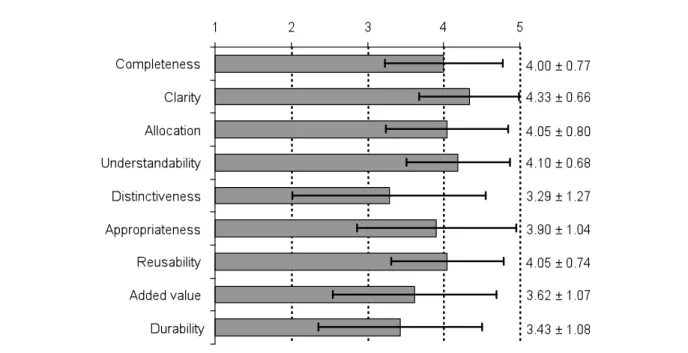
The ratings that the evaluators gave in their second task are summarized in the histogram in Figure 4. Results are explained in terms of the average of each rating (M), standard deviation of ratings (SD), and correlation coefficient (r), which were calculated according to confidence intervals (p).
Figure 4: Evaluation of the teaching method description template with respect to nine different criteria (Likert scale: 1 = strongly disagree … 5 = strongly agree; n = 22).
Five of the above criteria were rated with an average score of at least 4 points; these are completeness, clarity, allocation, understandability and reusability. These criteria also happen to have the lowest standard deviation values of all nine criteria, indicating considerable agreement among participants.
The template was broadly considered as complete (M = 4.05, SD = .79). However, some participants provided additional comments as to what aspects are still missing. In particular, participants, who rated the completeness of the template with a value of 3 or lower, missed elements where activities can be described in more detail, where one could link the teaching method to theory, or desired information on how it is embedded within other teaching methods. Another remark was that it was hard to capture the essence of a teaching method in purely written form. It is evident that some of these comments refer to missing elements that are in fact included in the template. For instance, it was not prohibited to include pictures in the text, and there was a dedicated element for providing a graphical representation of the teaching method.
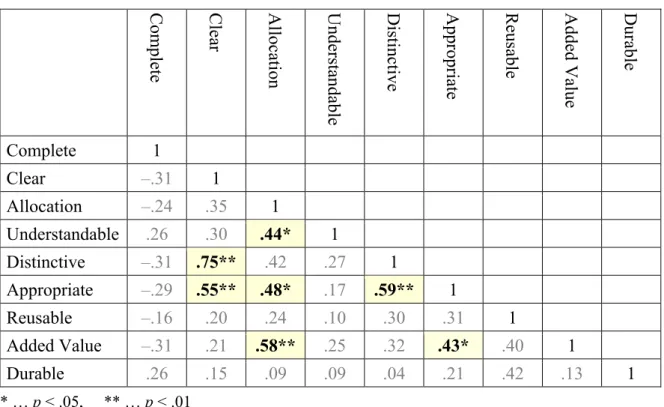
Clarity received the highest average rating (M = 4.32, SD = .66), indicating that the descriptive elements of the template have meaningful titles and purpose. Correlation analysis using Pearson’s correlation showed that clarity has significant positive correlation with the judgment of the template’s distinctiveness (r = .75, p < .01), and the template’s appropriateness (r = .55, p < .01), respectively. This seems plausible, since clear meaning of elements also helps distinguishing the elements and it also supports the positive judgment of the appropriateness of a structured description template.
Every person has his/her own mental representation of a teaching method. The allocation of those “mental chunks” to the elements of the template seemed to be easy for most participants (M = 4.05, SD = .79). Note that this criterion has a positive correlation with understandability (r = .44, p < .05), appropriateness (r = .48, p < .05) and added value (r = .58, p < .01), indicating that people who find it easy to allocate information to descriptive elements in the template also perceive added value (e.g. supporting reflection and documentation) in filling