Henri
BOULLIER
Regulating molecules “without data”:
The REACH of “prohibition through
authorization”
Henri BOULLIER,
PhD in Sociology and postdoctoral research at the Centre de Recherche Médecine, Sciences, Santé, Santé Mentale, Société (CERMES3)
[French version: December 2016 - n°126]
Thirty years after the passage of the Toxic Substances Control Act (henceforth TSCA) in the United States, the European Union adopted in December 2006 a set of far-reaching controls over substances produced by the chemical industry. Like the TSCA, this regulation on the
“registration, evaluation, authorization and restriction of chemicals (REACH)” is intended to regulate several
thousands of chemical substances.(1) REACH and the
TSCA are frequently likened to each other, in particular with regard to their scope. However REACH differs significantly because it places on firms the task of producing information on molecules and their risks (JOUZEL & LASCOUMES 2011).
The TSCA is one of the most ambitious laws ever imagined for controlling toxic substances. Signed by President Gerald Ford in October 1976, it was the first regulatory instrument with the intent of controlling
(1) Regulation (EC) No. 1907/2006 of the European Parliament
and of the Council of 18 December 2006 concerning the Regis-tration, Evaluation, Authorization and Restriction of Chemicals (REACH), establishing a European Chemicals Agency.
several thousands of chemicals through its procedures of registration, assessment and prohibition. To apply this law, the Environmental Protection Agency (henceforth EPA) has been assigned the task of identifying, for control by federal authorities, the chemicals present on the market. The TSCA authorizes the EPA to collect information on the production, uses and harmful effects of chemicals already on the market. It also enables the EPA to propose requirements for companies to conduct additional studies and tests, in certain cases, when the information provided to the agency is insufficient. This act also has a procedure for handling requests for placing new chemicals on the market. If the EPA manages to determine that a chemical has “unreasonable” risks for health or the environment, its duty is to take the necessary steps to reduce these risks.
Although REACH and the TSCA are frequently likened to each other, the American act has been a regulatory failure in the opinion of several analysts (O’REILLY 2010; VOGEL & ROBERTS 2011). The EPA has
How to control high-risk substances despite the absence, lack or confidentiality of the data
available (but unequally so) to authorities and companies? Starting with the US Toxic Substances
Control Act of 1976, the difficulties are pointed out that public authorities have encountered
while trying to control the thousands of chemicals on the market. For a long time in both the
United States and European Union, a stalemate arose out of the asymmetry of information
between regulatory authorities and firms. The EU’s REACH regulation, adopted in 2006, has
lifted this blockage. Its authorization procedure enables authorities to regulate dangerous
molecules without new data by placing on firms the burden of proving that they control health
risks and that the chemicals deemed essential to their business have socioeconomic benefits.
REACH thus deploys a new form of regulation for high-risk chemicals owing, in particular, to its
“prohibition through authorization”, which prefers a gradual withdrawal of toxic substances from
the marketplace to outright prohibition.
IN
QUEST
OF
A
THEOR
Y
prohibited only five chemical agents under this act since its adoption: PCBs, chlorofluorocarbons, dioxin, asbestos and hexavalent chromium. Furthermore, the courts overturned the ban on asbestos less than two years after it was issued. The EPA has not prohibited more substances because it lacks the authority for requiring manufacturers to carry out additional scientific studies or for making the concept of “unreasonable risk” operational. Whether referring to information management (KOCH & ASHFORD 2006), the precautionary principle (KARLSSON 2010, VOGEL 2012) or a systematic comparison of the TSCA and REACH (APPLEGATE 2008), critics have tended to be unanimous: the TSCA has failed, whereas REACH is said to be both an opportunity for innovation and a “new paradigm” for managing chemicals (FUCHS 2009), even though attention has also been drawn to its negative economic effects (CATOIRE et al. 2012). How has the EU regulation been able to control dangerous chemicals while the TSCA has failed? The hypothesis explored herein is that new “ways of regulating drugs” (GAUDILLIÈRE & HESS 2012; GAUDILLIÈRE & JOLY 2006) are part of a shift from an administrative to an industrial regulation. For a long time, administrative authorities were in charge of controlling toxic substances through government agencies that had to do most of the work of expertise and decision-making. In contrast, firms play a key role in regulatory procedures of an industrial type. Herein, I would like to explain how this shift in EU policy-making, thanks to a new control procedure (authorization), has reconfigured the relations between public authorities and firms.
This article(2) relies on research conducted between
2011 and 2014 for a doctoral dissertation (BOULLIER 2016a). Data were collected using three classical methods of research in the social sciences: semidirective interviews, observation (participant as well as nonparticipant) and the analysis of documents from the archives (in particular the working papers during the drafting of REACH). My remarks on the TSCA are based on interviews with former EPA employees and on the archives of the National Service Center for Environmental Publications, which manages EPA publications and reports. As for the filiation between REACH and the TSCA, I have drawn on the findings of two case studies wherein I traced the regulatory circuits of several molecules in the process of being
(2) This article has been translated from French by Noal Mellott
(Omaha Beach, France), who would like to quote from recital 72 of REACH, which is highly relevant to the reading of this article:
“To support the aim of eventual replacement of substances of very high concern by suitable alternative substances or technologies, all applicants for authorization should provide an analysis of alter-natives considering their risks and the technical and economic fea-sibility of substitution, including information on any research and development the applicant is undertaking or intends to undertake. Furthermore, authorizations should be subject to time-limited re-view whose periods would be determined on a case-by-case basis and normally be subject to conditions, including monitoring.” The
intent expressed in this recital is reformulated in article 60. Texts of European Union law are available at
http://eur-lex.europa.eu/legal-content/FR/TXT/?uri=CE-LEX%3A02006R1907-20140410.
prohibited, in particular, the well-known plasticizer, bis(2-ethylhexyl) phthalate (DEHP).
Although the regulatory procedures of both the TSCA and REACH suggest a similarity, the way chemicals are regulated in the EU has deeply changed. After recalling how industrial chemicals are regulated in the United States, the filiation between the two sets of regula-tions will be described along with the innovaregula-tions made under REACH, notedly its “prohibition through authori-zation”. Firms play a key role in this new approach on the borderline between administrative and industrial forms of regulation.
The EPA, firms and the lack of data
In the 1960s, American authorities started using a multi-disciplinary (instead of a sectoral) approach to address the issue of dangerous chemicals. Till then, the only arrangements for controlling chemicals targeted their uses as pesticides (the Federal Insecticide, Fungicide, and Rodenticide Act of 1910) or drugs (the Federal Food, Drug, and Cosmetic Act of 1938). At the time, no government agency was responsible for managing environmental pollution as such, nor for handling the public health problems caused by pollution. Three major factors led to the TSCA: an increasing politicization of environmental issues, the priority given by President Nixon to rationalizing federal agencies and, coming out of all this, the creation of the EPA.
Managing toxic substances regardless of the source
Prior to the EPA, the federal government had very few programs on the environment. The existing programs were unevenly applied, owing to a lack of coordina-tion among the federal agencies in charge. During the 1960s, more and more questions were being raised about toxic substances in the environment. Rachel Carson’s Silent Spring (1962) sounded the alarm and catalyzed concern. Meanwhile, several persons who would be involved in drafting the TSCA pointed out the reasons why the federal government was unable to manage pollution. The question of making a reform arose. J. Clarence “Terry” Davies, one of the first persons to imagine such a reform, would help draft the bill of law. His career, which had started by sharing time between Princeton University and various federal offices, is a guideline for tracing the evolution of the TSCA during its initial years.
It all started in the mid-1960s when Davies joined the Office of Management and Budget (OMB, part of the Executive Office of President of the United States), responsible for drafting the federal budget. The OMB also sees to it that other government services comply with the presidential policies; its employees examine how government agencies carry out federal programs. After two years devoted to assessing environmen-tal programs, Davies wrote a book drawn from his experience in the OMB (DAVIES & DAVIES 1970). Focused on federal programs related to pollution and toxic substances, this book would soon bring him back
Henri
BOULLIER
to Washington. In the last chapter, he raised questions about environmental programs. What objectives should they have? What sort of reform would enable the federal government to control the multitude of toxic substances present in the human body and environment?
Davies formulated two proposals for controlling chemi-cals on the American market. The first was to set up a federal agency in charge of managing pollution regardless of its source. No one had previously seen pollution as a problem to be handled across the board. The US Public Health Service was in charge of air pollution; and the Department of Interior, of water pollu-tion, while several government services and agencies handled health problems related to radiation or workplace safety without any of them actually being in charge. Davies’ second proposal was to institutionalize, through new regulations, a procedure for the marketing of new chemicals.
As an expert on environmental policy, Davies soon joined a group working on how to reduce the number of federal agencies responsible for environmental, agricultural and social policies. The group’s first idea was to set up a Department of Natural Resources to include the departments of Agriculture and of the Interior and, too, the services in charge of Health, Education and Social Services. Davies was not convinced of this proposal’s relevance or feasibility. Along with Douglas Costle, who would later become the EPA’s first administrator, he drafted a counterproposal whereby the future agency was to be a commission with powers for handling environmental problems across the board: a sort of independent regulatory authority.
Meanwhile, President Nixon realized he did not have the advice he needed on pollution problems. He was not familiar with this topic, and it did not figure among his priorities. The opposition would badger him on this it during the 1972 election. Conditions were ripe in 1970 for massively reorganizing the federal govern-ment’s environmental programs. In a special message to Congress, Nixon called for creating an agency to control pollution of all sorts. The EPA was set up in December 1970, and talks on what would become the TSCA started in 1971.
Setting up the EPA was a major event that vindicated the position, adopted by Davies and Costle, about a single federal body to be in charge of toxic substances, whether in water, air or soil — an agency for control-ling chemicals across the board. The agency now existed but without the power to regulate chemicals. Negotiations started on what would become, six years later, the Toxic Substances Control Act.
Preserving the asymmetry of information
From the start, the bill of law on toxic substances was a sensitive issue. Negotiations were thorny, as were the relations between Davies and Charles Lettow, a legal expert with whom Davies would write the bill’s first draft. Given their quite different careers (a political scientist from academia vs. a former employee of Dow Chemical Company), it was not evident that the two
would get along.(3) Despite their variant approaches to,
and perceptions of, chemicals, they drafted a bill of law based on two key principles in line with those for regula-ting drugs and pesticides: a procedure for requesregula-ting permission to place chemicals on the market and a division of labor that placed the burden of proof on manufacturers. However this second principle — at the core of REACH — would be left out of the act passed by Congress.
Strong opposition from the Department of Commerce to the bill led the OMB (in charge of arbitrating disagreements) to take a closer look at this first version. Taking cognizance of the objections raised by Commerce, the OMB required that the two authors renegotiate the text with James Lynn, chief attorney at Commerce. Despite the principle of placing the burden of proof on industry, Lynn obtained that the EPA would have to bring proof of the negative physiological effects of chemicals by establishing causality based on a dose-effect relationship. As a consequence of this compromise, the asymmetry of information between authorities and firms went untouched.
Apart from political obstruction on Capitol Hill, other legal issues further complicated the quest for a compromise. It would take Congress six years before adopting the TSCA in 1976 — nearly the same duration that negotiations on REACH, thirty years later, lasted in Europe. Before taking effect, the TSCA had a poor reputation in the EPA, which saw it as being so flawed that some pundits nicknamed it the “Toxic Substances Conversation Act”.
The impossibility of prohibiting chemicals
The EPA office in charge of implementing the TSCA had a hard time during the first months following passage of the act. Under the law, the EPA was to compile, publish and update a list of all chemicals manufactured or used in the country. The first major difficulty was, therefore, to make this inventory, which would be used to identify and control new chemicals. At the time, the administra-tors described this inventory work as a nightmare — at present, there are nearly seventy thousand chemicals on the list. This first feat, added to the organizatio-nal difficulties of setting up a new office in a federal agency, was a challenge. But all this did not amount to much compared with what happened after Reagan (1981-1989) became president.
In a book on the controversies surrounding carcinoge-nic chemicals, John D. Graham has described the difficult times endured by the EPA during the Reagan administration, in particular when Anne Gorsuch (1981-1983) and William Ruckelshaus (1983-1985) headed the agency (GRAHAM et al. 1988). Using similar data (which, by the way, have not changed much since then), the agency reached opposite conclusions, under Gorsuch then under Ruckelshaus, about the risks of cancer related to formaldehyde. The Gorsuch team was accused of being pro-industry.
(3) J. Clarence Davies interviewed by Jody Roberts and Kavita
IN
QUEST
OF
A
THEOR
Y
These differences were partly at the origin of a Red Book on risk analysis published by the National Academy of Sciences. This publication led to deconstructing the hypothesis of a “pure” science owing to a shift, under risk analysis, from “reliance on facts to reliance on
process” (JASANOFF 1992:202, JOLY 1999). The shift
toward risk analysis covered up the key problem facing authorities: not enough data available were available on existing chemicals, and it was not possible to force firms to provide data.
The EPA’s unfortunate attempt to regulate asbestos in 1989 relied on risk analysis tools. This setback was evidence that it was nearly impossible for the agency to prohibit toxic chemicals or restrict their introduction on the market. After ten years of research, public meetings and investigations on the best regulatory approach to adopt for controlling chemicals, the EPA opted, under section 6 of the TSCA, for a gradual but total prohibi-tion on manufacturing, importing, processing or distri-buting asbestos. Challenged in the courts by a coali-tion of manufacturers, this decision was overturned (STADLER 1992). In 1991, the court concluded that the EPA had not clearly stated whether “there is any other
regulation that would achieve an acceptable level of risk as mandated by TSCA”; and that “the EPA, in its zeal to ban any and all asbestos products, basically ignored the cost side of the TSCA equation”.(4) The court’s ruling
put an end de facto to the EPA’s recourse to section 6 of the TSCA. No other action for prohibiting a toxic substance would be taken after this ruling.
Unable, for want of data, to assess the precise “uses” of toxic molecules, the EPA tried to use the TSCA to prohibit such chemicals regardless of their uses. But the courts, deeming such a prohibition to be too radical, deprived the agency of the only option that allowed for making the ultimate decision, namely prohibition. Following a period of “adversarial procedures” involving toxic chemicals (JASANOFF 1992), the EPA more or less gave up on regulating chemicals already on the market.
This brief history of the TSCA provides a glimpse of how, in the management of risky materials, the relations between regulatory authorities and firms have been reconfigured. The arrangements foreseen under the TSCA are similar to those the EU gradually adopted after 1970. The EU regulation adopted in 2006 has similar pretensions to the TSCA’s: REACH foresees, under a single regulation, procedures of registration, assessment and prohibition that apply to thousands of chemicals. But: the reversal of the burden of proof under REACH — from public authorities to manufactu-rers — has fundamentally altered the management of dangerous molecules.
(4) Corrosion Proof Fittings v. EPA, 947 F.2d 1201 (5t Cir. 1991).
Available at http://law.justia.com/cases/federal/appellate-courts/ F2/947/1201/153685/ (consulted 17/6/17).
A new paradigm for managing toxic
substances?
The idea of a far-reaching reform like REACH emerged in the late 1990s. Two major factors stimulated the process that would lead to the adoption of REACH in 2006. For one thing, the European Commission was pursing a policy of rationalization, the “better law-ma-king agreement”, which pushed toward assessing the effectiveness of EU directives and regulations and then decreasing the number thereof. For another, several member states were demanding reforms, through their ministers of the Environment to the Council of the Union. The reform of EU regulations targeting chemicals thus came to figure on the agenda.
REACH and the TSCA: Similar pretensions
According to a story on the origins of REACH, the process of reform was set in motion at a meeting of the ministers of the Environment of member states (speci-fically, of the Council of the Union in its configuration “ministers of the Environment”) in 1998. Accordingly, the Council played a major role by insisting on gaps in the existing regulatory framework (EWALD 1986). One of the most important loopholes was the “burden of the past”:(5) firms were not under the obligation to
systematically provide data on the toxicity of the tens of thousands of chemicals already on the market.
This meeting of ministers of the Environment led the European Commission to publish a report in 1998.(6)
Presented to the Council, this report evaluated the operation of existing EU regulations on chemicals and identified shortcomings in risk management. In particu-lar, regulation 793/93 “on the evaluation and control of
the risks of existing substances” (i.e., substances placed
on the market before 1981) was found to be wanting in matters of risk assessment. Out of the 110 substances listed as a priority in this regulation, only 19, according to the report, had been subjected to a full risk assess-ment; and recommendations for reducing risks had been formulated for 14 of them. Bear in mind that the European inventory listed more than 100,000 chemi-cals! Although the EU had not waited till the turn of the century to start controlling toxic substances, this concrete assessment of the application of the dozens of regulations and directives adopted since the end of the 1960s was overpowering.
Given this failure, the Commission decided to work on objectives for a future European strategy. The objectives set in REACH often enough remind us of the TSCA’s. There was, as already pointed out, the pretension to control several tens of thousands of toxic substances
(5) European Commission, “Industrial chemicals: burden of the
past, challenge for the future”, A stakeholder workshop on the development of a future “chemicals” strategy for the European Union, Brussel, 24-25 February 1999, DOC XI/6337/99, April 1999. Available at:
www.chemicalspolicy.org/downloads/Brainstorming-WRCRecom-mendationscopy.pdf (consulted 17/6/17).
(6) European Commission, “Report on the operation of directive
67/548/EEC, directive 88/379/EEC, regulation 793/93 and directive 76/769/EEC, Brussels, 18 November 1998”.
Henri
BOULLIER
regardless of their sources. Like the TSCA, REACH was to draw up an inventory of chemicals, and assess and prohibit the most dangerous substances when the risks related to them could not be controlled.
Prohibit chemicals while authorizing uses
Let us insist that the European regulation is very similar to its American counterpart: its three underlying principles have to do with the registration and assess-ment of the thousands of chemicals on the market and the prohibition of the most dangerous. Upon a closer look however, we notice that REACH foresees a new procedure, “authorization”, whereby authorities may prohibit dangerous chemicals — without any new data — on the grounds of their general properties. The chemicals thus declared “subject to authorization” are then prohibited, unless a temporary authorization to use them is granted, case by case, to a firm that files a request.
Before the adoption of REACH, it was hard to prohibit the most toxic molecules. Ten years after its adoption, 168 chemicals figured on the “candidate list subject to authorization” at the start of 2016; and 31 of them were on the “list subject to authorization”. No other procedure for controlling chemicals has achieved such a result, moreover, in such a short time.(7) To understand how
this procedure works, let us look at a concrete example. The case of DEHP clearly illustrates how REACH prohibits chemicals that used to lie beyond the reach of regulatory authorities. Used as a plasticizer, bis(2-ethyl-hexyl) phthalate (more often known as DEHP) is omnipresent in everyday life. It was synthesized for the first time in the 1920s, and produced on a large commer-cial scale during the 1930s. Given its low production costs and many applications, it is one of the most widespread phtalates. Many manufactured products contain DEHP: shower curtains, electric cables, toys, vinyl floor coverings and, too, the bags used for blood and for dialysis and even sex toys.
Despite the risks related to its uses and the high risk of exposure, DEHP was subject to few controls till quite recently. Like many other products, it took a long time before this molecule was recognized as “toxic for reproduction” and classified in consequence. Although studies proving its toxicity date back to the 1980s (THOMAS et al. 1984), DEHP would not be classified as “probably” toxic till the turn of the century. According to the studies serving as the grounds for this decision, DEHP carries risks for human fertility (especially to children) owing to its properties as an endocrine disrup-tor. Given the large volumes produced, this phthalate was subjected to a risk assessment by EU authorities — an additional document to add onto the large number of previous studies. Despite all this evidence, this dange-rous, extremely widespread chemical, omnipresent in many everyday products, was still beyond the reach of
(7) However the scope of this authorization is “moderate” in the
words of one interviewee, a former European chemical industry representative who took part in preliminary negotiations on REACH. Approximately 1,500 chemicals could be targeted among the 100,000 in circulation (BOULLIER & LAURENT 2015).
the law. The situation changed following the adoption of REACH in 2006. Shortly after its enactment, Swedish authorities decided to submit DEHP to the authorization procedure.
The authorization procedure has two major steps. The first is for national authorities to declare a chemical to be of “very high concern”, mainly on the grounds of its classification and of the number of tonnes produced. After being placed on the “candidate list subject to authorization”, the most toxic of these molecules may be made “subject to authorization”. They are then prohi-bited from being placed on the market unless there is a precise authorization granted case by case. The second step is for the firms that would like to continue using one of these molecules to request an authori-zation from the European Chemicals Agency (ECHA), which is in charge of applying REACH. The firm filing a request can hope to be authorized to continue using the molecule but for a stated use and a limited time. This procedure was applied to DEHP.
Following the demand from Swedish authorities in June 2008, DEHP was declared a “substance of very high concern (SVHC)”. As of 2009, the committee of the member states of the ECHA placed it among the first chemicals to be “subject to authorization”. Since February 2015, this molecule may not be placed on the market without an authorization. Several big firms are affected by this listing of DEHP as a substance subject to authorization. Anticipating this decision, Arkema, a French chemical firm and one of the major European manufacturers of DEHP, filed in August 2013 two requests with the ECHA for authorizations to use DEHP to make articles in PVC.(8) On the basis of
socioeco-nomic data and information provided by the firm about its risk-management measures, Arkema obtained the authorization to use this chemical but only for the uses declared in the authorization and for a period limited to four years.
By setting conditions, the “regulatory horizon,” in parti-cular a time limit beyond which a toxic substance may no longer be used, REACH has avoided the pitfall of the EPA’s asbestos ban. Whereas the TSCA foresees an outright prohibition on the most dangerous chemi-cals, without any possibility for a dispensation, REACH provides for an authorization procedure. A chemical subject to authorization may continue being placed on the market for a given use and time on condition that a firm files a request and manages to prove that it has implemented suitable risk-management measures or that the socioeconomic analysis submitted in its request contains adequate grounds for temporarily keeping the substance on the market.
(8) Arkema, Application for authorization for Bis (2-ethylhexyl)
phthalate (DEHP) for industrial use in polymer processing by calendering, spread coating, extrusion, injection moulding to produce PVC articles except erasers, sex toys, small household items (<10cm) that can be swallowed by children, clothing intended to be worn against the bare skin; also toys, cosmetics and food contact material (restricted under other EU regulations), 2013.
IN
QUEST
OF
A
THEOR
Y
By focusing on the properties and uses of chemicals, this authorization procedure allows for numerous “special” cases. As a result, regulatory authorities are in a “hybrid” position that can be reduced neither to simply finding a solution to a purely regulatory requi-rement nor to fully delegating to private interests the power to organize the chemicals market (BOULLIER & LAURENT 2015).
Furthermore, REACH provides for many exemptions. The authorization procedure does not, for example, apply to imported goods, not even if they contain substances subject to authorization. This is very often the case for phtalates, which enter into the composi-tion of many products manufactured outside the EU. Another exemption concerns European manufacturers who export their goods outside the EU. Since the autho-rization procedure requires the manufacturer to state a “use” for placing a chemical on the European market, exporting firms benefit from the fact that the substance in question has no use on the European market since all goods containing it are exported. As a consequence, a firm that makes phtalates and exports all its production outside the EU is not concerned by the authorization procedure. Despite these exemptions, the authorization procedure allows for prohibiting molecules — something that no previous regulatory policy had achieved.
Prohibition through authorization: A new form of regulation
Unlike previous regulatory procedures, despite their pretensions and the adoption of the TSCA in the 1970s, REACH manages to exercise control over chemicals. The deployment of its authorization procedure corres-ponds to a new “form of regulation” (GAUDILLIÈRE & JOLY 2006). Borrowing John Pickstone’s (2001) “ways of knowing”, Jean-Paul Gaudillière and Volker Hess (2012) have described five forms of regulation (profes-sional, administrative, industrial, juridical and public) that were applied to therapeutic agents during the 20th century. For a long time, the control of substances produced by the chemical industry was an adminis-trative type of regulation, which assigns most tasks of expertise and control to government agencies.
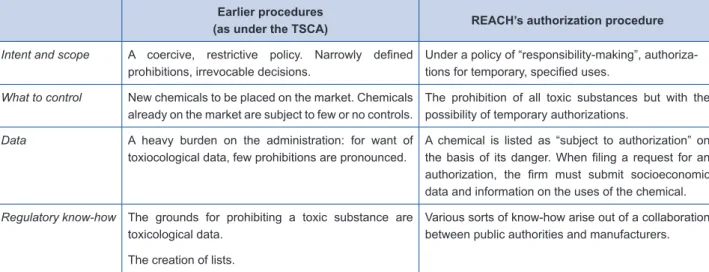
While clearly providing for interventions by regula-tory authorities, REACH adds objectives related to profit-making and productivity to the requirement of protecting human health. It thus comes close to being a regulation of an industrial type, in which firms clearly play a key role. In the EU, this change can be observed at the level of the authorization procedure. To describe how this shift involves firms in the production of regula-tory know-how during the decision-making process, Table 1 epitomizes the characteristics of procedures for controlling risky chemicals. To understand how the authorization procedure works, I would like to point out how the characteristics presented in this table follow on, and rectify, previous policies of prohibition, such as the one under the TSCA in the United States.
REACH differs in intent and scope from most previous regulatory policies, including the TSCA. In particular, it claims to make the protection of human health and the environment compatible with the improvement of the European chemical industry’s competitive advan-tage. The TSCA’s intent and scope are quite different. Lacking power over chemicals already on the market (such as asbestos), the US act focuses on controlling new chemicals. It is a coercive policy. Insofar as the EPA fails to obtain data on the uses of potentially dangerous chemicals already on the market, controls are limited to requests concerning new chemicals or new uses. Prior to 2006, the European regulatory framework was much the same: directives and regulations mainly concerned new chemicals. Under REACH’s authorization proce-dure, the decision to prohibit a chemical is easier to make since it does not take effect right away but at the end of the period during which the chemical is autho-rized for certain uses.
Whereas existing chemicals were, prior to its adoption, subject to few or no controls, REACH distinguishes between substances and their uses. This new approach, enshrined in the authorization procedure, alters the division of labor between regulatory authorities and firms. Authorities have the job of selecting the chemi-cals to be prohibited; they single them out (DODIER 1993) by declaring them to be of “very high concern” and destined for the list “subject to authorization”. The Earlier procedures
(as under the TSCA) REACH’s authorization procedure
Intent and scope A coercive, restrictive policy. Narrowly defined
prohibitions, irrevocable decisions.
Under a policy of “responsibility-making”, authoriza-tions for temporary, specified uses.
What to control New chemicals to be placed on the market. Chemicals
already on the market are subject to few or no controls.
The prohibition of all toxic substances but with the possibility of temporary authorizations.
Data A heavy burden on the administration: for want of
toxiocological data, few prohibitions are pronounced.
A chemical is listed as “subject to authorization” on the basis of its danger. When filing a request for an authorization, the firm must submit socioeconomic data and information on the uses of the chemical.
Regulatory know-how The grounds for prohibiting a toxic substance are
toxicological data. The creation of lists.
Various sorts of know-how arise out of a collaboration between public authorities and manufacturers.
Henri
BOULLIER
firms that want to continue using these chemicals must file requests to explain why certain “uses” should be temporarily authorized.
Previous procedures required information on toxic substances that regulatory authorities themselves had to provide. This imposed so heavy a burden on the administration that few prohibitions could be pronounced. Under REACH, authorities use the general information available to pronounce a prohibition. It is now possible to prohibit a dangerous substance even “without data”, i.e., without any detailed data on it.(9) In
effect, the data on the uses of toxic molecules and on their economic benefits are provided by a firm when it requests an authorization.
Previously, a decision to prohibit an existing chemical was based on a risk-assessment, but relevant toxico-logical data were not always available. Under REACH, such data are no longer the key evidence used to decide whether it is necessary to take dangerous chemicals off the market. Under the authorization procedure, attention is also given to both the chemical’s socioeconomic benefits and the time needed for R&D to invent a substitute. Knowledge is constructed by firms, along with authorities, during a process of collaboration for the purpose of gradually prohibiting dangerous chemicals (starting with those for which substitutes exist). In effect, most molecules classified “subject to authorization” are old chemicals that are now being replaced.
Conclusion
We have explored the hypothesis of a shift from an administrative type of control of high risk chemicals to an industrial form of regulation, wherein firms play a key role.
The history of the US Toxic Substances Control Act of 1976 — one of the most ambitious policies for controlling chemicals that has ever been imagined — has been reviewed. The thorny negotiations leading to its adoption stripped the TSCA of provisions for placing the burden of proof on manufacturers. Given the asymmetry of information that long prevailed in the regulation of chemical substances, the EPA was unable to prohibit toxic molecules. Its failure in prohibiting asbestos marked the end of any attempt by this federal agency to outlaw existing chemicals.
The intent of REACH’s authorization procedure is to settle problems by granting regulatory authorities the power to prohibit certain dangerous molecules in spite of this asymmetry of information. These substances are now made “subject to authorization” on the grounds of their general properties, but they may be tempora-rily authorized for certain uses, on condition that the request filed by a firm for an authorization be accepted.
(9) In the words of a representative of the Ministry of Ecology
during an interview in September 2012. As this phrase implies, a chemical may be made subject to authorization without any new data, since chemicals are singled out on the basis of generic classificatory criteria.
Given that REACH assigns firms a strong position (BOULLIER 2016b), questions arise about this reconfi-guration of the relationship between regulatory authori-ties and firms and of the “ways of knowing” under the authorization procedure. In any case, the authorization procedure signals a break with the past: managing dangerous chemicals no longer entails hurriedly making a data base with exhaustive information from relevant scientific studies and all tests on exposure levels (and related risks) and about all manufacturing processes so as to be able, at last, to decide, with full knowledge of the facts, whether to prohibit a substance. The chemicals listed as “subject to authorization” are well-known, everyday products. Our attitudes toward them are ambivalent. We know they are dangerous but they are part of everyday life. The framework of the authorization procedure is clearly defined: molecules with known dangers are to be withdrawn from the market gradually, as substitutes are introduced, so as not to upend industry or disrupt our way of life.
References
APPLEGATE (John), “Synthesizing TSCA and REACH: Practical principles for chemical regulation reform”,
Ecology Law Quarterly, 35, pp. 721-770, 2008.
BOULLIER (Henri), Autoriser pour interdire. La fabrique
des savoirs sur les molécules et leurs risques, PhD
dissertation in Sociology, Université Paris-Est, Paris, 2016a.
BOULLIER (Henri), “Évaluer des dossiers ‘vides’: l’expertise REACH face aux asymétries d’information”,
Terrains & travaux, 28, pp. 41-61, 2016b.
BOULLIER (Henri) & LAURENT (Brice), “La précaution réglementaire: un mode européen de gouvernement des objets techniques”, Politique européenne, 49(3), pp. 30-53, 2015.
CARSON (Rachel), Silent Spring (Boston, MA: Houghton Mifflin, Riverside Press, 1962).
Catoire (S.), Fou de Kerdaniel (F.), Guillet (R.) & Lebental (B.), Mise en œuvre de l’autorisation au titre
du règlement REACH. Les substances concernées par l’annexe XIV du règlement 1907/2006, report
n° 2011/17/CGIET/SG to the French Ministiry of Economy and Finances, report n° 007841-01 to the Ministry of Ecology, Sustainable Development and Energy, October 2012.
DAVIES (J. Clarence) & DAVIES (Barbara S.), The
Politics of Pollution (New York: Pegasus, 1970).
DODIER (Nicolas), L’Expertise médicale: essai de
sociologie sur l’exercice du jugement (Paris, Métailié,
1993).
EWALD (François), L’État providence (Paris: Grasset, 1986).
FUCHS (Olivier), REACH: A New Paradigm for the
Management of Chemical Risks, IFRI, Paris: Health and Environment Reports (4), 2009.
IN
QUEST
OF
A
THEOR
Y
GAUDILLIÈRE (Jean-Paul) & HESS (Volker), Ways of
Regulating Drugs in the 19th and 20th Centuries (New
York: Palgrave Macmillan, 2012).
GAUDILLIÈRE (Jean-Paul) & JOLY (Pierre-Benoît), “Appropriation et régulation des innovations biotech-nologiques: pour une comparaison transatlantique”,
Sociologie du travail, 48(3), pp. 330-349, 2006.
GRAHAM (John), GREW (Laura) & ROBERTS (Marc),
In Search of Safety: Chemicals and Cancer Risk
(Cambridge, MA: Harvard University Press, 1988). JASANOFF (Sheila), “Science, politics and the renego-tiation of expertise at EPA”, Osiris, 7, pp. 195-217, 1992. JOLY (Pierre-Benoît), “Besoin d’expertise et quête d’une légitimité nouvelle: quelles procédures pour réguler l’expertise scientifique?”, Revue française des
affaires sociales, 1, pp. 45-53, 1999.
JOUZEL (Jean-Noël) & LASCOUMES (Pierre), “Le règlement REACH: une politique européenne de l’incer-tain. Un détour de régulation pour la gestion des risques chimiques”, Politique européenne, 33, pp. 185-214, January 2011.
KARLSSON (Mikael), “The precautionary principle in EU and US chemicals policy: A comparison of industri-al chemicindustri-als legislation”, pp. 239-265 in J. ERIKSSON, M. GILEK & C. RUDEN (eds.), Regulating Chemical
Risks: European and Global Challenges, (Dordrecht,
NL: Springer, 2010).
KOCH (Lars) & ASHFORD (Nicholas), “Rethinking the role of information in chemicals policy: Implications for TSCA and REACH”, Journal of Cleaner Production, 14(1), pp. 31-46, 2006.
O’REILLY (J.T.), “Torture by TSCA: Retrospectives of a failed statute”, Natural Resources & Environment, 25, pp. 43-47, 2010.
PICKSTONE (John), Ways of Knowing: A New History
of Science, Technology, and Medicine (Chicago, IL:
University of Chicago Press, 2001).
STADLER (Linda), “Corrosion Proof Fittings v. EPA: Asbestos in the Fifth Circuit — A battle of unreason-ableness”, Tulane Environmental Law Journal, 6(2), p. 423-438, 1992.
THOMAS (John), THOMAS (Michael) & GANGOLLI (Sharat), “Biological effects of dI-(2-ethylhexyl) phthal-ate and other phthalic acid esters”, CRC Critical
Reviews in Toxicology, 13(4), pp. 283-317, 1984.
VOGEL (David), The Politics of Precaution: Regulating
Health, Safety, and Environmental Risks in Europe and the United States (Princeton, NJ: Princeton University
Press, 2012).
VOGEL (S.A.) & ROBERTS (J.A.), “Why the Toxic Substances Control Act needs an overhaul, and how to strengthen oversight of chemicals in the interim”, Health