HAL Id: tel-01648968
https://hal.inria.fr/tel-01648968v2
Submitted on 9 Feb 2018HAL is a multi-disciplinary open access archive for the deposit and dissemination of sci-entific research documents, whether they are pub-lished or not. The documents may come from teaching and research institutions in France or abroad, or from public or private research centers.
L’archive ouverte pluridisciplinaire HAL, est destinée au dépôt et à la diffusion de documents scientifiques de niveau recherche, publiés ou non, émanant des établissements d’enseignement et de recherche français ou étrangers, des laboratoires publics ou privés.
representation
Michal Koperski
To cite this version:
Michal Koperski. Human action recognition in videos with local representation. Computer Vision and Pattern Recognition [cs.CV]. COMUE Université Côte d’Azur (2015 - 2019), 2017. English. �NNT : 2017AZUR4096�. �tel-01648968v2�
UNIVERSITÉ COTE D’AZUR
ECOLE DOCTORALE STIC
SCIENCES ET TECHNOLOGIES DE L’INFORMATIONET DE LA COMMUNICATION
THÈSE
pour l’obtention du grade de
Docteur en Sciences
de l’Université Cote d’Azur
Mention:
INFORMATIQUEpresentée et soutenue par
Michał K
OPERSKI
Reconnaissance d’actions humaines
dans des vidéos utilisant une
représentation locale
Thèse dirigée par: François BRÉMOND
INRIA Sophia Antipolis, STARS
soutenue le 9/11/2017
Jury :
Président : Frédéric PRECIOSO - University of Nice
Rapporteur : Matthieu CORD - UPMC - Sorbonne Universities Rapporteur : Leonid SIGAL - University of British Columbia,
Disney Research Examinateur : Jean-Marc ODOBEZ - IDIAP
Directeur de thèse : François BRÉMOND - INRIA (STARS) Invité : Gianpiero FRANCESCA - Toyota Motor Europe
UNIVERSITY COTE D’AZUR
DOCTORAL SCHOOL STIC
SCIENCES ET TECHNOLOGIES DE L’INFORMATIONET DE LA COMMUNICATION
P H D T H E S I S
to obtain the title of
PhD of Science
of the University Cote d’Azur
Specialty : C
OMPUTERS
CIENCEDefended by
Michal K
OPERSKI
Human Action Recognition in Videos
with Local Representation
Thesis Advisor: Francois BREMOND
prepared at INRIA Sophia Antipolis, STARS Team
defended on November 9, 2017Jury :
President : Federic PRECIOSO - University of Nice
Reviewer : Matthieu CORD - UPMC - Sorbonne Universities Reviewer : Leonid SIGAL - University of British Columbia,
Disney Research Examinator : Jean-Marc ODOBEZ - IDIAP
Advisor : Francois BREMOND - INRIA (STARS) Invited : Gianpiero FRANCESCA - Toyota Motor Europe
R
ECONNAISSANCE D’
ACTIONS HUMAINES DANS DES VIDÉOS UTILISANT UNE REPRÉSENTATION LOCALEMichal Koperski
Directeur de thèse: Francois Bremond STARS, Inria Sophia Antipolis, France
RÉSUMÉ
Cette thèse étudie le problème de la reconnaissance d’actions humaines dans des vidéos. La re-connaissance d’action peut être définie comme étant la capacité à décider si une action est présente due une vidéo. Ce problème est difficile en raison de la complexité des actions humaines, dans la grande variété de leur apparence et de leur mouvement.
Les avancèes récentes dans les méthodes manuelles ou par apprentissage profond ont consid-érablement amélioré la précision de la reconnaissance d’action. Mais de nombreuses questions restent ouvertes, ce qui rend le problème de la reconnaissance d’actions loin d’être résolu.
Les méthodes actuelles basées sur les caractéristiques locales, donnent des résultats satis-faisants. Mais les actions humaines sont complexes, ce qui nous conduit à la question suiv-ante: comment modéliser les relations entre les caractéristiques locales dans leur contexte spatio-temporel? Dans cette thèse nous proposons 2 méthodes pour y répondre. La première modélise les relations spatio-temporelles entre les caractéristiques images utilisant la Covariance Brownienne, et la seconde modélise la disposition spatiale des caractéristiques locales à l’intérieur de la boite englobante de chaque personne. Les méthodes que nous proposons sont générales et peuvent améliorer aussi bien les méthodes manuelles que celles avec apprentissage.
Une autre question ouverte est: l’information 3D peut-elle améliorer la reconnaissance d’actions? Plusieurs méthodes utilisent les informations 3D pour détecter les articulations du corps. Nous proposons de les améliorer avec un nouveau descripteur, utilisant la trajectoire 3D calculée à partir des informations RGB-D.
Finalement, nous affirmons que la capacité de traiter une vidéo en temps-réel sera un facteur clé pour les futures applications de reconnaissance d’actions. Toutes les méthodes proposées dans cette thèse sont prêtes à fonctionner en temps-réel. Nous avons prouvé notre affirmation em-piriquement en créant un système temps-réel de détection d’actions. Ce système à été adapté avec succès par la compagnie Toyota pour leurs systèmes robotiques.
Pour l’évaluation, nous nous concentrons sur les actions quotidiennes à la maison telles que: manger, boire ou cuisiner. La reconnaissance de telles actions est importante pour le suivi des patients à l’hopital et pour les systèmes d’aide robotisée à domicile.
Dans ce but, nous avons créé une grande base de données, qui contient 160 heures d’enregistrement de 20 personnes âgées. Les vidéos ont été enregistrées dans 3 chambres avec 7 capteurs RGB-D. Nous avons annoté ces vidéos avec 28 classes d’actions. Les actions dans la base de données sont effectuées d’une manière naturelle et non supervisée, ce qui introduit des défis manquants dans les bases de données publiques.
Nous évaluons aussi nos méthodes en utilisant les bases de données publiques: CAD60, CAD120 et MSRDailyActivity3D. Les expérimentations montrent que nos méthodes améliorent les résultats de l’état de l’art.
H
UMANA
CTIONR
ECOGNITION INV
IDEOS WITHL
OCALR
EPRESENTATIONby
Michal Koperski
Supervisor: Francois Bremond STARS, Inria Sophia Antipolis, France
ABSTRACT
This thesis targets recognition of human actions in videos. Action recognition can be defined as the ability to determine whether a given action occurs in the video. This problem is compli-cated due to the high complexity of human actions such as appearance variation, motion pattern variation, occlusions, etc.
Recent advancements in either hand-crafted or deep-learning methods significantly improved action recognition accuracy. But there are many open questions, which keep action recognition task far from being solved.
Current state-of-the-art methods achieved satisfactory results mostly base on features, which focus on a local spatio-temporal neighborhood. But human actions are complex, thus the following question that should be answered is how to model a relationship between local features, especially in spatio-temporal context. In this thesis, we propose 2 methods which try to answer that challeng-ing problem. In the first method, we propose to measure a pairwise relationship between features with Brownian Covariance. In the second method, we propose to model spatial-layout of features w.r.t. person bounding box, achieving better or similar results as skeleton based methods. Our methods are generic and can improve both hand-crafted and deep-learning based methods.
Another open question is whether 3D information can improve action recognition. Currently, most of the state-of-the-art methods work on RGB data, which is missing 3D information. In addition, many methods use 3D information only to obtain body joints, which is still challenging to obtain. In this thesis, we show that 3D information can be used not only for joints detection. We propose a novel descriptor which introduces 3D trajectories computed on RGB-D information. Finally, we claim that ability to process a video in real-time will be a key factor in future action recognition applications. All methods proposed in this thesis are ready to work in real-time. We proved our claim empirically by building a real-time action detection system, which was successfully adapted by Toyota company in their robotic systems.
In the evaluation part, we focus particularly on daily living actions – performed by people in their daily self-care routine. In the scope of our interest are actions like eating, drinking, cooking. Recognition of such actions is particularly important for patient monitoring systems in hospitals and nursing homes. Daily living action recognition is also a key component of assistive robots.
To evaluate the methods proposed in this thesis we created a large-scale dataset, which consists of 160 hours of video footage of 20 senior people. The videos were recorded in 3 different rooms by 7 RGB-D sensors. We have annotated the videos with 28 action classes. The actions in the dataset are performed in un-acted and unsupervised way, thus the dataset introduces real-world challenges, absent in many public datasets.
Finally, we have also evaluated our methods on publicly available datasets: CAD60, CAD120 and MSRDailyActivity3D. Our experiments show that the methods proposed in this thesis improve state-of-the-art results.
Dedicated to my wife Natalia, who took the brave decision and moved with me to France, my parents Alicja and Waldemar for all love and support, my brother Bartosz for all help, my uncle Krzysztof who discovered computing science for me, and my grandfather Jozef who could not defend his PhD, due to difficult historical circumstances he had to live in.
A
CKNOWLEDGMENTS
First, I would like to express my gratitude to my thesis supervisor, François Brémond. I would like to thank François, for being a great mentor, a guide and a friend. I would like to thank him that he took a risk and offered me opportunity of being his PhD student in such an interesting topic.
I would like to thank Toyota Motor Company for supporting my PhD thesis, I would like to express my gratitude to Anja Höthker and Gianpiero Francesca for these years of collaboration and support.
Thanks to my thesis reviewers, Matthieu Cord, Leonid Sigal and my examinator Jean-Marc Odobez, that they kindly agreed to serve as a members of my thesis committee and review the manuscript.
Special thanks to Sławomir B ˛ak, who was a precious guide in a scientific world. Col-laboration with him helped me to became not only better scientist but also a better person. I also wanted to say thank you to Piotr Bili´nski, who convinced me start a PhD and helped me a lot in the early stages.
Thanks to Carlos Crispim-Junior and Farhood Negin for technical and scientific sup-port. I would like to thank all my colleagues from STARS team for our collaboration, I had great time with you and I will never forget great moment that we shared together.
I would like to thank Marc Vesin and Francis Montagnac the administrator of NEF computational cluster. Thank you for all your technical support and for managing the NEF cluster, without which vast amount of experiments done in this thesis would not be possible.
I would like to thank all friends I met at French Riviera, who made me feel like at home. Special thanks to Magda and Bartosz, Magdalena and Tomek, who converted my stay in France to an incredible adventure.
I thank also my friends in Poland: Pysio, Statek, Tomu´s and Wojtek. Thank you so much that you always had time to meet me during my rare and short visits.
My final words go to my family. I would like to thank my wife Natalia, who moved with me to France. I know that it was difficult and brave decision. I want to thank her for all the support through both the highs and lows of the time of my PhD. I would like to thank my parents, my brother and the whole family.
Contents
Résumé i Abstract iii Dedications v Acknowledgements vii 1 Introduction 1 1.1 Problem statement . . . 2 1.2 Motivation. . . 2 1.3 Research challenges . . . 6 1.4 Contributions . . . 71.4.1 Improved Fisher Vector representation . . . 8
1.4.2 Appearance and motion descriptors . . . 8
1.4.3 Recognition of action with low amount of motion . . . 9
1.4.4 Evaluation and new Smarthomes dataset. . . 10
1.5 Thesis structure . . . 10 2 Related Work 13 2.1 Introduction . . . 13 2.2 Input data . . . 15 2.2.1 RGB . . . 15 2.2.2 Depth-map . . . 18 2.2.3 Skeleton . . . 21 2.2.4 Multimodal representation. . . 22 2.3 Datasets . . . 23 2.3.1 CAD-60 . . . 23 2.3.2 CAD-120 . . . 23 2.3.3 MSRDailyActivity3D . . . 23 2.3.4 Toyota Smarthomes . . . 24
3 Action Recognition Framework 29 3.1 Introduction . . . 29
3.2 Local Features with Fisher Vector Encoding. . . 30
3.2.2 Descriptor Extraction . . . 31
3.2.3 Fisher Vector Encoding. . . 33
3.2.4 SVM . . . 34
3.3 Trajectory-Pooled Deep-Convolutional Descriptors (TDD) . . . 35
3.3.1 Appearance stream . . . 35
3.3.2 Temporal stream . . . 36
3.4 Evaluation Metric . . . 37
3.4.1 Mean Class Accuracy Metric . . . 37
3.4.2 Data Splits and Cross-Validation. . . 37
3.5 Experiments . . . 37
3.5.1 Dense Trajectories . . . 37
3.5.2 Trajectory-Pooled Deep-Convolutional Descriptors (TDD). . . 46
3.6 Conclusions . . . 54
4 3D Trajectories 55 4.1 Introduction. . . 55
4.2 2D Trajectories Detection . . . 56
4.3 2D Trajectory Shape Descriptor (TSD) . . . 57
4.4 3D Trajectories . . . 58
4.4.1 Mapping to a common coordinate system . . . 58
4.4.2 Depth-map filtering . . . 60
4.4.3 Handling missing depth values . . . 60
4.5 3D Trajectory Shape Descriptor (3DTSD) . . . 61
4.6 Experiments . . . 61
4.6.1 CAD-60 . . . 62
4.6.2 CAD-120 . . . 67
4.6.3 MSRDailyActivity3D . . . 69
4.7 Conclusions . . . 71
5 Removing hallucinations by histogram normalization 73 5.1 Introduction. . . 73
5.2 Approach Overview. . . 75
5.2.1 Histogram of Oriented Gradients . . . 75
5.2.2 Distribution of the sum of bins . . . 76
5.2.3 Expectation Maximization . . . 76 5.2.4 Algorithm . . . 78 5.3 Implementation details . . . 78 5.4 Experiments . . . 79 5.4.1 CAD-60 . . . 80 5.4.2 CAD-120 . . . 84 5.4.3 MSRDailyActivity3D dataset . . . 88 5.4.4 Smarthomes dataset . . . 92 5.5 Conclusion . . . 96
Contents xi
6 Brownian Covariance 97
6.1 Introdction . . . 97
6.2 Brownian Covariance. . . 98
6.2.1 Distance Covariance V2 . . . 99
6.2.2 Sample Distance Covariance V2 . . . 99
6.2.3 Standardization. . . 100
6.2.4 Brownian covariance W . . . 100
6.3 Brownian Covariance Descriptor for Action Recognition. . . 101
6.3.1 Low-Level Appearance Features . . . 101
6.3.2 Descriptor Definition . . . 102
6.3.3 Features Extraction Detalis. . . 103
6.4 Experiments . . . 103 6.4.1 CAD-60 . . . 104 6.4.2 CAD-120 . . . 107 6.4.3 MSRDailyActivity3D . . . 110 6.4.4 Smarthomes . . . 113 6.5 Conclusions . . . 116
7 Modeling spatial layout with Fisher Vector and people detection 117 7.1 Introduction . . . 117
7.2 Features spatial-layout encoding. . . 118
7.2.1 Direct spatial layout encoding . . . 119
7.2.2 Grid Fisher Vector (GridFV) . . . 120
7.2.3 Fisher Vectors representation and it‘s relation to Mixture of Gaussians121 7.2.4 Spatial Mixture of Gaussians . . . 122
7.3 Extension to spatio-temporal layout modeling . . . 124
7.4 Implementation details . . . 125 7.4.1 Feature descriptors . . . 125 7.4.2 People detection . . . 125 7.5 Experiments . . . 125 7.5.1 Appearance descriptors . . . 127 7.5.2 Motion descriptors . . . 128 7.5.3 Descriptors fusion . . . 129 7.5.4 Experiments Summary . . . 129 7.6 Conclusions . . . 155
8 Pose and skeleton based models 157 8.1 Introduction . . . 157
8.2 Grid HOG descriptor . . . 158
8.3 Skeleton descriptor . . . 159
8.4 Experiments . . . 159
9 Comparison with state-of-the-art 165 9.1 Introduction. . . 165 9.2 CAD-60 . . . 166 9.3 CAD-120. . . 168 9.4 MSRDailyActivity3D . . . 170 9.5 Smarthomes. . . 172 9.6 Conclusions . . . 174
10 Online Action Detection 175 10.1 Introduction. . . 175
10.2 Action Detection Framework. . . 176
10.2.1 Feature Extraction and Fisher Vector encoding with Integral Image . 177 10.2.2 Temporal window proposals and classification . . . 178
10.2.3 Window proposals pruning . . . 178
10.2.4 Integral Image . . . 179 10.3 Experiments . . . 179 11 Conclusion 183 11.1 Key Contributions. . . 183 11.2 Limitations . . . 185 11.3 Future Work. . . 185 11.3.1 Short-Term Perspectives . . . 185 11.3.2 Long-Term Perspectives . . . 186
A Smarthomes dataset details 189 A.1 Introduction. . . 189
A.2 Recording setup. . . 189
A.3 Recording protocol . . . 190
A.4 Annotation . . . 190
A.5 Conclusion . . . 193
Chapter 1
Introduction
Contents 1.1 Problem statement. . . . 2 1.2 Motivation . . . . 2 1.3 Research challenges . . . . 6 1.4 Contributions. . . . 71.4.1 Improved Fisher Vector representation . . . 8
1.4.2 Appearance and motion descriptors. . . 8
1.4.3 Recognition of action with low amount of motion . . . 9
1.4.4 Evaluation and new Smarthomes dataset. . . 10
1.5 Thesis structure . . . 10
There are many high level tasks, that humans perform automatically and subcon-sciously. But in fact those tasks involve complicated processing, which takes place in our brain. The statement above is especially true for any computer vision related task. Tasks like object detection, people identification, people re-identification, action recognition are extremely difficult tasks for computers. On the other hand even couple years old children can handle those task easily.
Computer vision tasks are difficult due to huge variations of appearance, motion pat-terns, view point angles, lighting conditions, they are easy to solve by sophisticated and specifically designed tool – human brain. Computers were primarily designed to perform fast well defined computational tasks, but not complicated reasoning. Thus the main goal of computer vision is to improve computer abilities in interpretation of image and video information. Such abilities will play key role in future intelligent machines such as robots or vehicles. Action recognition can be defined as the ability to determine whether a given action occurs in the video stream. Action recognition is one of the most important components of intelligent systems, as the most of available information is visual. Ability
to interpret such information will ultimately bring computers one step closer to human skills.
This chapter introduces the problem of action recognition. In section1.2we provide formal definition of the problem and present key applications of action recognition. In section1.3we discuss major challenges and difficulties. We conclude the chapter with the list of contributions (section1.4) and the thesis structure (section1.5).
1.1
Problem statement
In this section we define human action, action recognition and action detection problem. To define the above terms we use terminology defined by Moeslund et al. [70].
Action
It is a complex body movement, which consists of several action primitives (gestures) ordered in time.
Action Recognition
Let’s assume that we have a set of videos V and a set of corresponding action labels L. We assume that each video V ∈ V contains only one action lV. Thus the goal of action recognition problem is to predict label lV based on video representation V .
Action Detection
Action recognition problem can be extended to action detection problem. In this problem we assume that video V can contain more than one action, thus each video V ∈ V has corresponding set of labels LV. The goal is to predict all labels for given video V , as well as time when given action starts and ends.
In this thesis we focus on action recognition problem, as we claim that to solve action detection problem, first we need action recognition which achieves high accuracy. In chapter 10 we show that our action recognition framework can be extended to action detection case.
1.2
Motivation
Video Retrieval1.2. Motivation 3
(a) Frame from "Minority Report"
(b) Kinect RGB-D sensor (c) Leap Motion sensor
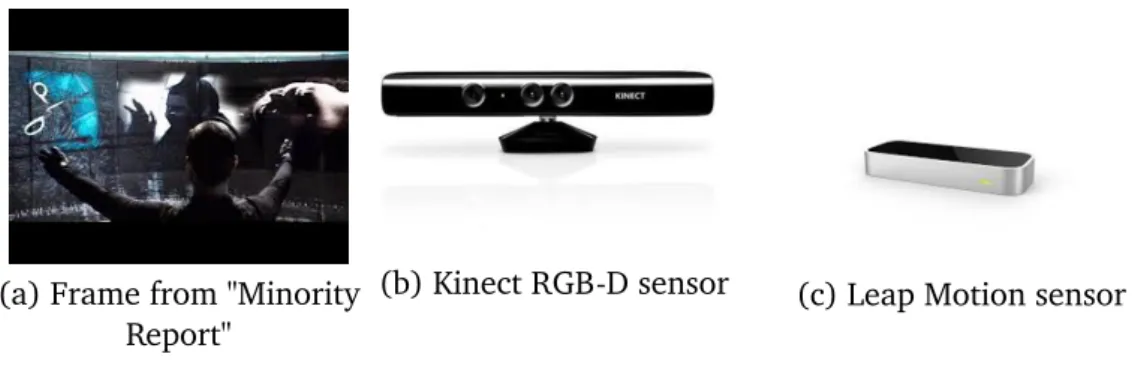
Figure 1.1: (a) – frame from "Minority Report" movie presenting computer interface con-trolled by gestures, (b) and (c) sensors which are used in modern human computer inter-faces.
YouTube or Vimeo as well as social media services such as Facebook or Twitter. Phones and other mobile devices are equipped with high quality cameras. Many mobile phone users have access to high speed mobile internet.
All above facts result in massive amount of videos being uploaded every day. For instance every minute 300 hours of videos are uploaded to YouTube1.
With such enormous amount of data – systems which can efficiently analyze videos and provide accurate search results or suggestions are becoming more and more important. Action recognition is a key part of such systems.
Video surveillance
Nowadays we can observe surveillance cameras almost at every corner of the city. They are installed in: train stations, metro stations, airports, banks, shopping malls, city streets. The primarily goal of surveillance cameras is to increase the security level and protect us from acts of violence, terrorism, vandalism, stealing. For instance 41 % of public premises in London have CCTV equipment. They estimate there is around 420,000 cameras in the city of London.
With such huge amount of cameras, it is impossible for human operators to observe all available video streams. As a result video surveillance footage is often used to find the suspects of a crime, but rarely used to prevent potentially dangerous situations.
Thanks to action recognition systems, video surveillance cameras could be analyzed 24/7 and alert could be triggered in case of any dangerous situation. Such system will be able to fully exploit potential of huge video surveillance camera networks and greatly improve safety thanks to prevention of potentially dangerous situations.
Figure 1.2: Toyota Partner Robot system.
Human Computer Interaction
From the early stages when modern computers were born, they were equipped with key-boards. At the beginning keyboard served as the only interface to communicate with computer. Further developments in computer capabilities, especially in computer graph-ics led to design of computer mouse. Similar trend emerged in electronic games industry, where keyboards were replaced by joysticks and later by advanced game-pads, steering wheels etc.
The evolution of Human Computer Interaction started with keyboards and led us to many different devices which make communication easier, faster and more comfortable. With recent advancements in computer vision and camera sensors, we have reached a point where scenes from sci-fi movies like the one from "Minority Report" are not fiction, but reality. Modern capabilities of sensors like Kinect, Leap Motion joint together with gesture or action recognition algorithms allow us to build interfaces where a user can operate computer without any need of holding any device (see fig.1.1). The computer is able to recognize actions or gestures done by a user and trigger appropriate actions. Such solutions have been already introduced to TV sets. In entertainment industry Xbox game console equipped with Kinect sensor is able to interpret whole body motion, leading to new levels of game experience – especially in sport games.
All recent advancements in Human Computer Interaction are possible thanks to devel-opment of gesture and action recognition algorithms.
Robotics
1.2. Motivation 5
the design, construction, operation, and use of robots, as well as computer systems for their control, sensory feedback, and information processing. These technologies are used to develop machines that can substitute humans. Robots can be used in any situation and for any purpose, but today many are used in dangerous environments (including bomb detection and de-activation), manufacturing processes, or where humans cannot survive.
Robots ability of human action recognition plays a key role in many robotics applica-tions. One of them are autonomous vehicles which can be considered as specific type of robot. The ability of observation and anticipation of road situation defines a good driver. Thus efficient interpretation of intention of other traffic participants will play a key role in future of autonomous vehicles. The anticipation capabilities may concern vehicles, but also pedestrians. For instance, autonomous vehicles are required to asses and anticipate pedestrian intention to cross a road. This would let autonomous car avoid potentially dangerous situations.
Partner robot systems is another area of robotics, which can widely benefit from action recognition capabilities. Partner robot systems can be defined as robotics systems which are able to assist humans with different activities. This include support of a group of doctors, nurses and other caregivers. Other group which can benefit from assistance are sick patients, elderly and disabled people in hospital or at home. Partner robots can also assist people in ordinary housework activities. All partner robots functions mentioned above require them to understand human actions and behave accordingly.
Health care
According to survey2there were 810 millions people of age 60+ in 2012 on the Earth. The
survey predicts that there will be 1 billion people of age 60+ by 2022 and 1.375 billion by 2030.
Japan is a sharp example of this global trend. The number of Japanese people aged 65+ nearly quadrupled in last 40 years reaching 33 millions in 20143, which stands for 26% of Japanese population. According to projection4people of age 65+ will account for 40% of Japanese society by 2060. This demographic trend translates to dramatic need of increase of workforce in health care. According to survey5 2.9% of Japanese people between 75-79 are permanently hospitalized, while 13.4% visited a doctor at least once in a year.
Due to above facts action recognition is becoming more and more important and is used in medicine in patient monitoring. Action recognition systems can monitor health state of the patient and early detect potential physical or mental problems. For instance
2http://www.helpage.org/
3http://www.stat.go.jp/english/data/nenkan/1431-02.htm 4
http://www.ipss.go.jp/site-ad/index_english/esuikei/ppfj2012.pdf
monitoring patient eating habits, housekeeping routine or sleep allow doctors to monitor state of a patient and react before serious health conditions arise. Thanks to such sys-tems seniors can stay longer at home without a need of being hospitalized, which greatly improve their comfort and health.
Partner robot systems mentioned in this section are also aiming to improve health care level of aging societies. Both partner robot systems and patient monitoring are in great interest of this thesis. Thus, although proposed action recognition methods are generic and can be applied to any action recognition problem, we decided to select in evaluation daily-living datasets. Such datasets contain action set, which allows to monitor patient state. In addition we recorded Smarthomes dataset which contains action set useful from patient monitoring perspective. But more importantly, actions are performed by 20 senior people. This way we introduce many challenges, which do not exist in state-of-the-art datasets.
1.3
Research challenges
Action recognition is a very challenging research problem and many unanswered questions keep action recognition from being solved. In this section we list and discuss some of most important research challenges in action recognition.
Intra-class variation
Each action can be done in many different ways. For long and more complex actions, there are many different unimaginable ways in which action can be done. The variation comes from people habits: for instance right-handed vs left-handed. For long actions there might be a different temporal order of taking different steps. For instance for making coffee action one may first put coffee to machine while other might start with pouring the water. For same action class people may use different objects: drinking from cup vs. drinking from bottle.
As we can see from the examples above, there is not a simple way to describe the actions, this makes it hard in terms of features design and as a classification problem.
Detection
Some action recognition methods take advantage of information about object (object de-tection) or pose (skeleton dede-tection). The recognition accuracy of such methods can be significantly affected by failing detection. In such case, action recognition algorithms have to deal with noise (false positives) and missing detection.
1.4. Contributions 7
Discriminative features
Human brain can perform well with problems which require ability of association and discrimination. In learning process human brain does not treat whole information equally focusing on more important parts for given task [11]. This leads us to open question: how to build a computer system, which can recognize (associate) human actions, using discriminative cues (features).
Spatio-temporal context association
Due to mentioned complexity and variation in human actions, one of the most important problems to address is how to model complicated relationships between location and time that different things happened while action was performed. The mentioned relationships could be ignored for simple actions like hands clapping or hand waving. But in order to recognize more complicated actions it will be important to model "what", "where", "when" relations and their order.
1.4
Contributions
As we mentioned in the beginning of this chapter, although methods proposed in this thesis are generic and can be used with any action recognition task. We are particularly interested in daily-living action recognition. Such problem introduces specific challenges: high intra-class variance, high amount of actions which are similar, actions are performed in the same environment i.e. apartment. We can notice that some datasets such as UCF-101 [103] or HMDB51 [49]which are focused on action recognition from videos uploaded to the internet are different in a way that their inter-class variance is high (i.e. "ride a bike" vs. "sword exercise"). But they introduce other challenges such as camera motion and noisy background. Decisions and scientific contributions proposed in this thesis were driven by the intention to improve daily-living action recognition.
One of the most important characteristic of the proposed methods is that they do not require skeleton detection. The contributions of this thesis can be divided into 4 main groups described below:
1. Improved Fisher Vector representation – we propose 3 method which incorporate spatial information into Fisher Vector. We also provide computational efficient Fisher Vector representation based on 1D integral image, which is suitable for real-time applications (eg. robotic systems).
2. New appearance and motion descriptors – we propose 2 new appearance descrip-tors which improves recognition of actions with similar motion patterns. In addition
we propose motion descriptor which take advantage of 3D information available from RGB-D sensor.
3. Recognition of actions with low amount of motion – we address the problem of lo-cal features methods which often fail when action is static and low number of points of interest is detected. We use people detection to model rough pose information, thus our method do not require skeleton detection.
4. Extensive evaluation and new dataset – we provide extensive evaluation of two baseline methods based on local features on daily-living datasets. In addition we built new large scale daily-living action recognition dataset.
Below we list and describe all groups of contributions with more details.
1.4.1 Improved Fisher Vector representation
Spatio-temporal Fisher Vector representation
In recent years local features methods (see chapter 2) were the most successful in ac-tion recogniac-tion. Those methods use simple feature detectors and model the features in local neighborhood of detected points of interest. The advantage of such methods is that they do not require complicated detection algorithm (i.e. skeleton detection) as a pre-processing step. One of the drawbacks of local features method is that they usually ignore spatio-temporal layout of detected features. Work of [115, 26, 76, 130] show that skeleton information can be especially useful in daily-living action recognition. But due to our experience with Smarthomes (section 2.3.4 and appendixA), we claim that skeleton detection in real-world scenarios is still challenging. Thus we propose to model spatio-temporal layout of features w.r.t. person bounding box, because people detection is a much less error prone task. We propose 3 different strategies of layout modeling. The method was published in [44], the detailed description is available in chapter7.
Real-time action detection framework
In chapter 10 we provide details of real-time action detection framework. We use 1D integral image representation, which let us create efficient Fisher Vector encoding.
1.4.2 Appearance and motion descriptors
3D Trajectories
We propose to model action as 3D trajectory shape of locally detected points of in-terest. Such 3D representation is able to catch more details of action motion pattern i.e. distinguish actions whose projected 2D trajectories would look the same. To obtain 3D
1.4. Contributions 9
information we use RGB-D sensor. We provide a method which deals with missing depth information and noise, which is often a problem in depth-map obtained from RGB-D sen-sors in real world scenarios. This work was published in [43] and is described in details in chapter4.
Histogram normalization
Many successful descriptors proposed in recent years (HOG, HOF, MBH) in action recog-nition are based on histogram representation. Histograms are usually normalized with L1 or L2 norms. We show that incautious application of L-like norms to the histogram based descriptors might produce a hallucination effect. Specific pattern, which was not present in unnormalized histogram, may appear in normalized representation. We propose to add an extra bin to histogram representation to avoid hallucination effect. We also propose an algorithm to find the value of extra bin. Our method is generic and can be applied to any histogram based descriptors, but in our analysis we focus on HOG descriptor. Our decision is motivated by the intention to improve appearance cues. The method was published in [79] and is described in details in chapter5.
Brownian Covariance
Many descriptors proposed in computer vision are gathering simple statistics (i.e. histograms) of hand-crafted features (HOG, HOF, MBH). We propose to model pixel-level features with higher pixel-level statistics. In our method we model relationship between pixel-level features using Brownian Covariance. Brownian Covariance is a new statistical method which models Brownian motion of particles. Using Brownian Covariance we are able to measure all type of relationships (non-linear, non-monotone). The method was published in [10] and is described in details in chapter6.
1.4.3 Recognition of action with low amount of motion
Some actions do not involve high amount of motion while being performed. For instance "using computer" action involves only motion coming from fingers and hands. Such actions are usually not recognized by local features methods, because they cannot detect enough features to describe the action, due to lack of motion. We propose simple descriptor which capture rough pose information from person bounding box. The method was published in [44] and is described in chapter8.
1.4.4 Evaluation and new Smarthomes dataset
Evaluation of local features methods on daily-living datasets
We provide deep evaluation of local features methods on daily-living datasets. We evaluate Dense Trajectories [113] and Trajectory Pooled Deep Convolutional Descriptor (TDD) [117] on 4 datasets: CAD-60 [107], CAD-120 [107], MSRDailyActivity3D [116], Smarthomes.
Smarthomes – large scale daily-living dataset
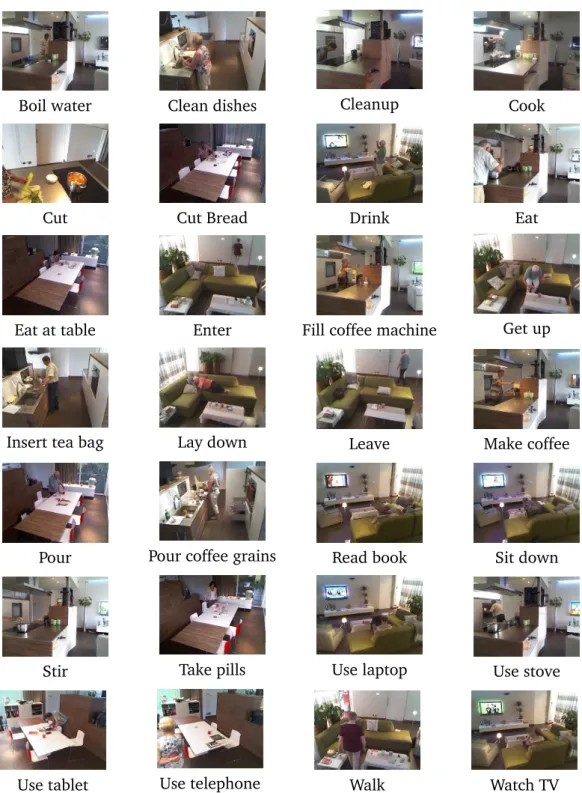
In this thesis we have built a new dataset, which contains 28 action classes. The actions are performed by 20 senior people during the day. The actions were recorded in different locations (dining room, kitchen, living room). We used 7 RBG-D sensors to record the dataset, thus we introduce different viewpoint angles. Action were performed in unsuper-vised and completely natural way. Therefore we introduce many challenges which were missing in many public datasets. The dataset can be used to evaluate action recognition methods. In this setup it contains over 17,000 video clips. Each clip contains one anno-tated action. Smarthomes dataset can be also used to evaluate action detection methods. In this setup we provide over 700 hours of video stream. The details of the dataset are available in section2.3.4and appendixA.
1.5
Thesis structure
Chapter 1introduces the action recognition problem. We describe problem motivation and provide key possible applications. Then we discuss main challenges in action recog-nition problem and summarize our contributions. The remaining chapters are organized as follows:
• Chapter 2 "Related Work" introduces of-the-art methods. We divide state-of-the-art methods, based on how they address challenges we defined. We review different RGB, RGB-D, skeleton based methods. We also review hand-crafted based and CNN based methods. We also provide comparison of public datasets and we describe datasets selected for evaluation in this thesis.
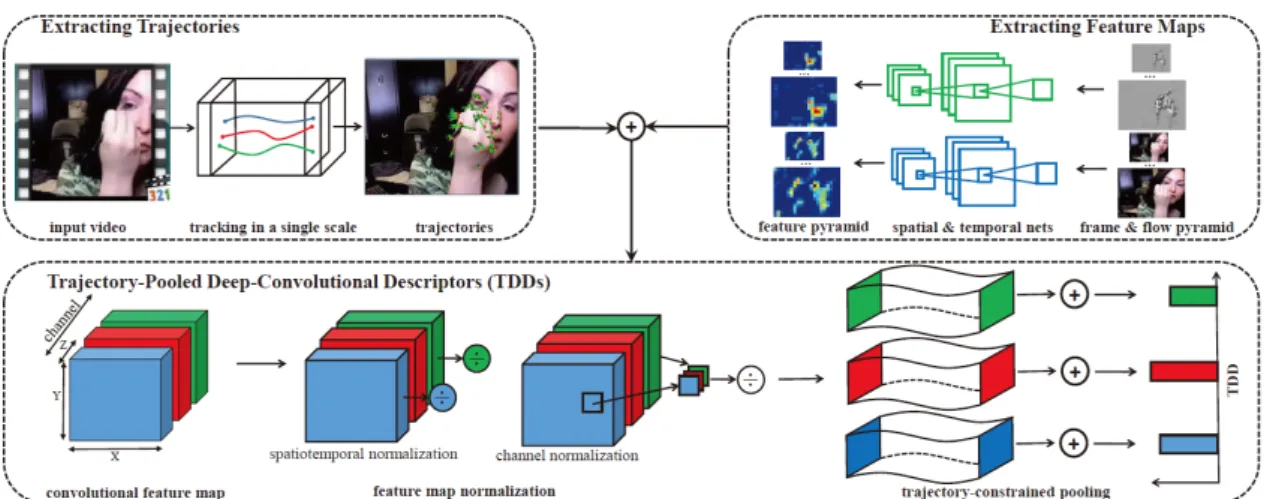
• Chapter 3"Action Recognition Framework" defines the action recognition frame-work based on Fisher Vector representation and SVM classifier. We provide detailed description of two baseline methods: Dense Trajectories (DT) [113] and Trajectory-Pooled Deep-Convolutional Descriptors (TDD) [117]. We evaluate the baseline methods on 4 datasets: CAD-60 [107], CAD-120 [107], MSRDailyActivity3D [116], Smarthomes.
1.5. Thesis structure 11
• Chapter4"3D Trajectories" proposes a new method for action recognition based on 3D Trajectory Shape Descriptor (3DTSD). In this chapter, we describe how to obtain motion 3D trajectory points, we describe how to handle noise and missing values. Finally we show that proposed representation improves recognition accuracy.
• Chapter5"Removing Hallucinations by histogram normalization" describes pos-sible problems with L2-normalization. We show that an incautious application of L-like norms to the HOG descriptor might produce a hallucination effect, i.e. spe-cific properties of high texture can appear while describing a texture-less image. To address this problem, we propose new normalization schema, where we add extra bin (EB) to the histogram representation. We show that value ofEBhas an impact on
descriptor performance, thus we propose algorithm, which is able to find EB value automatically.
• Chapter6"Brownian Covariance" proposes new appearance descriptor for action recognition which measures relationship between pixel-level features. To measure the relationship we employ Brownian Covariance, which is able to measure non-linear, non-monotonic relationships. In the experiments we show that Brownian descriptor is carrying complementary information to HOG descriptor.
• Chapter 7 "Modeling spatial layout with Fisher Vector and people detection" proposes 3 methods which model spatial layout of local features. The aim of the proposed methods is to improve Fisher Vector representation which by default ig-nores spatio-temporal layout. We model a layout of features w.r.t. person bounding box, while skeleton detection is still not an easy task. We provide extensive evalua-tion and show that proposed methods are competitive to skeleton based methods.
• Chapter 8 "Pose and skeleton based models" describes new GHOG descriptor, which models static pose information of a detected person. The proposed descriptor does not require skeleton detection. The pose information is encoded using appear-ance information inside person bounding box. Local features methods often suffer from low number of detected features with GHOG we address this problem. In ex-periments section we provide results of fusion with all previously proposed methods.
• Chapter 9 "Comparison with state-of-the-art" presents a detailed performance analysis of proposed descriptors for action recognition and shows a performance comparison of these approaches with state of the art techniques. We evaluate our approaches on publicly available datasets. We discuss challenges that each dataset introduces. We also investigate advantages and limitations of proposed methods.
• Chapter10"Online Action Detection" describes a framework for online action de-tection. In this chapter we show that our methods can be used in online action detection system. We show that effective use of 1D integral image allows to com-pute Fisher Vector representation in computationally effective way. We describe components of our action detection system which was successfully applied to Toyota Partner Robot system.
• Chapter 11 "Conclusion" outlines our approaches. We provide discussion about advantages and limitations of our work. In this chapter we also suggest future di-rections, presenting short-term and long-term perspectives.
Chapter 2
Related Work
Contents 2.1 Introduction . . . 13 2.2 Input data. . . 15 2.2.1 RGB . . . 15 2.2.2 Depth-map . . . 18 2.2.3 Skeleton . . . 21 2.2.4 Multimodal representation. . . 22 2.3 Datasets . . . 23 2.3.1 CAD-60 . . . 23 2.3.2 CAD-120 . . . 23 2.3.3 MSRDailyActivity3D . . . 23 2.3.4 Toyota Smarthomes . . . 242.1
Introduction
In this chapter we review the methods for Action Recognition published in recent years. The exhaustive reviews are available in [88, 92,54, 128]. In our review we would like to point out 4 challenges in Action Recognition and show how they are approached in state-of-the-art.
1. How to select data input type? This challenge is one of the most fundamentals, because input data type strongly determines the recognition capabilities. RGB input for instance provides a lot of texture information and it seems to be close to the input information that humans process. On the other hand RGB encodes also a lot of information which is not important in Action Recognition. For instance RGB appearance depends strongly on lighting conditions. While in action recognition preferable representation should be invariant to illumination. In such case methods
which work on RGB data have to find relevant regularities and distinguish them form other irrelevant regularities such as illumination changes. This is a non- trivial task. Depth-map input on the other hand is free of some problems which exist in RGB. For instance depth-map is invariant to illumination changes, it is easier to distinguish forward scene from background, and it provides 3D information about the scene. But depth-map has also some limitations: it does not provide texture information and usually introduces a lot of measurement noise (this is especially true for low-cost sensors eg. Microsoft Kinect, Asus Xtion). Segmented human skeleton is the last input type that we consider. This input type is usually obtained by applying different methods [98,124,83,14] either on RGB or depth-map. Thus skeleton might be consider as higher level feature, but studies of Johansson [42] show that humans can recognize a lot of actions based only on skeleton information. That is why we decided to consider skeleton as separate input type for Action Recognition methods.
2. How to model features? The problem here is the granularity level of the features. Some authors [12,33,100] propose to model the input as a whole (holistic meth-ods). Other authors [132,26,76,35] propose to use detailed segmentation (skele-ton methods). Finally some authors [51,52,53,67] propose to search for salient Points Of Interest (local features methods).
3. How to model motion? Motion seems to be the most important information in Ac-tion RecogniAc-tion. Many authors proposed different ways to model moAc-tion in AcAc-tion Recognition. Some authors proposed to design low level features (eg. optical flow) or higher level features (eg. trajectories [113,114,117]) and use then with classi-fiers which ignore temporal nature of data. Other authors [63,127] proposed to use classifiers which can model sequential data (HMMs, CRFs, RNNs) and in such way they model motion in videos.
4. How to design features? There are two common ways to approach this challenge. We can either use expert knowledge which would lead us to design of handcrafted features. On the other hand we can apply method which would automatically find features based on input data. Recent advancements in Deep Learning show that for image classification the second approach lead to superior performance over handcrafted features. This conclusion is not obvious for Action Recognition prob-lem. Handcrafted features achieve competitive results comparing with automatically learnt features with CNN (Convolutional Neural Net).
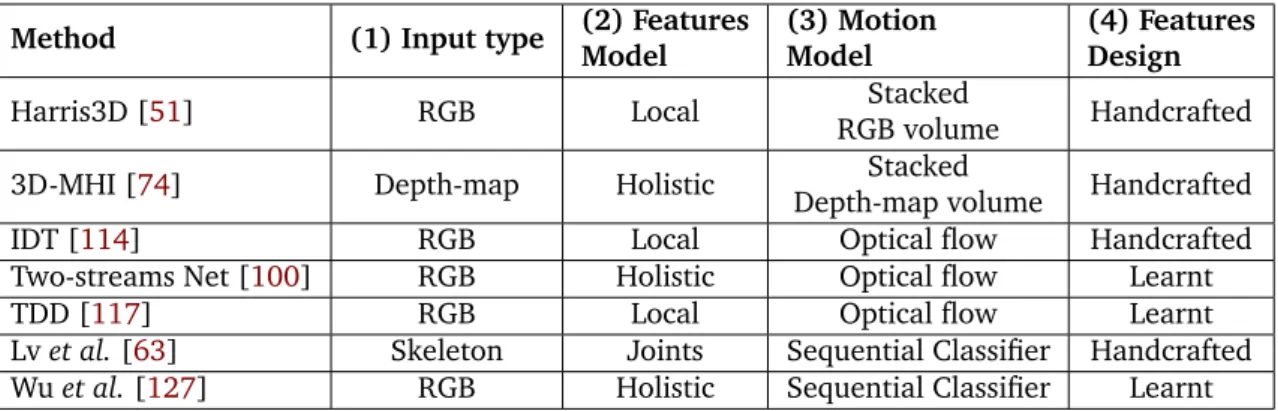
The state-of-the-art methods intersect each other in many different ways based on challenges defined above. In the following chapters we partition methods based on chal-lenge 1 and 2. But in2.1we provide overview of selected state-of-the-art methods w.r.t. all
2.2. Input data 15
challenges described above.
2.2
Input data
2.2.1 RGB
Holistic Representation In holistic representation the image Region Of Interest (ROI) is treated as a whole, which means that all pixels in the ROI are potentially used to compute the descriptor. The ROI is usually bounding box of detected person. So in fact the holistic methods involve two steps: a person detection using either background subtraction and/or tracking and descriptor computation. Common representations are silhouettes, edges and optical flow based descriptors. These methods are generally sensitive to noise, variation in viewpoint and occlusion [84].
The foreground of person in the image forms a human silhouette, which provides shape information about the human pose. The evolution of such silhouette over the time is used in action recognition. In the work of [21] the differences of binary silhouettes are accumulated over spatial domain; constructing Motion Energy Image (MEI), and over temporal domain; constructing Motion History Image (MHI). Such representation forms action template. The statistical model of moments is further used to match unknown action instance to closes template.
In [33] the actions are modeled as 3D shapes obtained by stacking the 2D silhouettes in spatio-temporal volume. Zhu et al. [141] employed an extended Radon transform on the binary silhouette. Such representation is invariant to geometrical transformations such as scaling and translation. In [136] the extremities of a human body like head, hands and feet are used to model the action. These extremities are detected from a body contour. Finally Qian et al. [86] used contours of the MEI and obtained descriptor which
Method (1) Input type (2) Features Model
(3) Motion Model
(4) Features Design
Harris3D [51] RGB Local Stacked
RGB volume Handcrafted
3D-MHI [74] Depth-map Holistic Stacked
Depth-map volume Handcrafted
IDT [114] RGB Local Optical flow Handcrafted
Two-streams Net [100] RGB Holistic Optical flow Learnt
TDD [117] RGB Local Optical flow Learnt
Lv et al. [63] Skeleton Joints Sequential Classifier Handcrafted Wu et al. [127] RGB Holistic Sequential Classifier Learnt Table 2.1: Comparison of selected state-of-the-art methods, w.r.t. to Action Recognition challenges.
is invariant to scale changes and translations.
The mentioned Holistic Methods relay heavily on people detection (to detect ROI) and background subtraction (to extract features). Recent advancements in object detection in RGB images makes people detection a minor issue. But computing stable and accurate silhouettes based on RGB images is still a challenge, especially in real-world scenario videos.
Local Features Representation The key idea behind Local Representation is to capture characteristic features from a local spatio-temporal volume of a video. Same idea was suc-cessfully applied to object detection, scene recognition etc. The main advantage of Local Representation based methods is that, they do not require neither human segmentation nor people detection, which are to some extend challenging tasks on RGB videos. In7we propose a method which improves performance of Local Representation by incorporating information from person bounding box.
So in fact the holistic methods involve two steps: Point Of Interest (POI) detection and descriptor computation. The goal of feature detector is to select a video region which max-imizes the saliency. Laptev et al. [51] proposed a feature detector which extends the Har-ris corner detector [36] to spatio-temporal case – Harris3D. Dollar et al. [23] claimed that cases when Harris3D triggers are rare. They claimed also that salient motion is present in other video regions. They proposed detector which uses spatial Gaussian kernels and temporal Gabor filters. Oikonomopoulos et al. [77] proposed detector which computes en-tropy in a cylindrical neighborhood around a given space-time position for the temporal derivative of a video. Willems et al. [125] proposed Hessian3D detector as spatio-temporal extension of the Hessian saliency measure. The detector measures saliency using the de-terminant of the 3D Hessian matrix. An integral video structure allows a speed up of computations by approximating derivatives with box-filter operations. A non-maximum suppression algorithm selects joint extrema over space, time and different scales. Most feature detectors determine the saliency of a point with respect to its local neighborhood. Wong and Cipolla [126] proposed method which finds salient features by considering global information. Video sequences are represented as a dynamic texture with a latent representation and a dynamic generation model. The dynamic model is approximated as a linear transformation. A sub-space representation is computed via non-negative matrix factorization.
When salient POIs are detected, the common strategy for Local Representation based methods, is to compute descriptor for given local volume around POI. Many authors pro-posed different descriptors: Laptev et al. [52] used HOG [20] and HOF [113] descriptor. Dollar et al. [23] used different local descriptors based on brightness, gradient, and op-tical flow. They investigate different descriptor fusion methods: simple concatenation of
2.2. Input data 17
pixel values, a grid of local histograms, and a single global histogram. They report that, concatenated gradient information leads to best performance. An extension of the SIFT descriptor [60] was proposed by Scovanner et al. [93]. For a set of randomly sampled positions, spatio-temporal gradients are computed in the local neighborhood of each po-sition. Each pixel in the neighborhood is weighted by a Gaussian centered on the given position. For orientation quantization, the authors represent gradients in spherical coordi-nates that are divided into an 8 × 4 histogram. Willems et al. [125] proposed the Extended SURF (ESURF) descriptor, which extends the image SURF descriptor [5] to videos. The authors divide 3D patches into a grid of local M × M × M histograms. Each cell is rep-resented by a vector of weighted sums of uniformly sampled responses of Haar-wavelets along the three axes.
Feature trajectories is an idea that arisen on top of Local Representation. Many au-thors claimed [67,68,106,113,114] that 2D spatial domain and temporal domain in videos have have a very different characteristics. Because of that POI should not be detected in joint 3D spatio-temporal space. Based on conclusion above many authors [67,68,106,113,114] proposed methods where they track detected spatial POI across time. The trajectory shape and descriptors computed based on volume around the trajec-tory points are then used as video representation. Messing et al. [68] extracted feature trajectories by tracking Harris3D interest points [51] with the KLT tracker [62]. Trajecto-ries are represented as sequences of log-polar quantized velocities. Matikainen et al. [67] used a standard KLT tracker. Trajectories in a video are clustered, and an affine transfor-mation matrix is computed for each cluster center. The elements of the matrix are used to represent the trajectories. Sun et al. [106] extracted trajectories by matching SIFT descrip-tors between two consecutive frames. They imposed a unique-match constraint among the descriptors and discarded matches that are too far apart. Wang et al. [113,114] proposed Dense Trajectories method where they densely sample POI from the grid. Then the POIs were tracked using optical flow. Action was represented by trajectory shape descriptor, HOG [20], HOF [113], MBH [20,113] computed in a cropped volume around each tra-jectory points. The methods which leverage features tratra-jectory information showed im-pressive results in action recognition. Many further extension of Dense Trajectories were proposed [9,117,8,7,6,137].
Deep Learning The Deep Learning methods in action recognition are closely related to efficient use of CNNs in image classification. In general one of the main advantage of CNNs is that they learn in end-to-end process both: features (filters) and classification bound-aries. Thanks to that we can obtained specialized features which describe the data better and make classification task easier. Of course such approach is prone to overfitting so the training process of CNN requires careful regularization and typically significant amount of
labeled examples. It is now clear that CNN-based approaches outperform most state-of-the-art handcrafted features for image classification [48,89]. For the action recognition such conclusion it is not obvious. Videos introduce additional temporal dimension, while CNNs initially were designed to model static images and is not clear how motion dynamics should be encoded in CNN. Thus in action recognition most of authors use CNNs trained on still images to model static appearance. Then they proposed different ways – how to model motion in the video. Ji et al. [41] proposed to used stacked video frames as an input and replace 2D convolutions with 3D. They reported improvement over 2D convolu-tion architectures, but their approach did not outperformed hand-crafted based features. Simonyan et al. [101] proposed to model motion with CNN trained on optical flow input, together with second CNN trained on still images. This approach was later extended by Feichtenhofer et al. [28], they replaced late fusion approach, by fusing two nets at lower layers and perform joint fine tuning. Wu et al. proposed to use (Recurrent Neural Net) RNN, to model motion in the video. RNN is a special architecture which can handle se-quential input. For each sequence item a copy of Neural Net is created. The RNN contains connection between neurons in hidden layers between each replica and each neural net replica shares the same model weights with the others. Wu et al. claim that actions in the video can be decomposed to local motion which can be handled effectively by opti-cal based CNN. And the global motion which can be effectively modeled by RNNs. They compute CNN feature for each video frame and then they feed them into RNN. Wang et al. [119] introduced sparsely sampled temporal fragments to model long term global motion. Ma et al. used LSTM for early activity recognition [65]. Xu et al. proposed to use transfer learning and feature embedding [131].
In general proposed Deep Learning methods perform on the same level or slightly better than models with hand-crafted features (see 2.2). Another issue is that recent state-of-the-art datasets [49,103], introduce quite high inter-class variation. In such case static appearance information is favored over motion information. For instance on UCF-101 dataset CNN trained on static images achieves 60% of classification accuracy based on single randomly sampled frame of the video. Because of the reasons above many au-thors [100,117,28] proposed to fuse hand-crafted features together with Deep Learning models, achieving superior results.
2.2.2 Depth-map
Spatial 3D information was not in the limelight of the research, until the introduction of low-cost RGB-D sensors (eg. Microsoft Kinect, Asus Xtion). The introduced devices are able to output both RGB and depth-map stream in real-time. The depth-map provides information about the distance of each pixel to the sensor. The reported distances are
2.2. Input data 19
Features Method/Dataset UCF-101 HMDB51
Hand Crafted
Improved Dense Trajectories (IDT) [114] 88.0 57.2 Modeling Video Evolution for Action Recognition [31] - 61.5
Multiskip features [50] 89.1 66.8
CNN
Two-streams Net [100] 91.5 65.9
Hybrid Deep learning net [127] 90.1
-TGP Net [118] 91.4
-CNN for unconstrained videos [138] 89.2
-Two-stream fusion [28] 92.5 65.4
Temporal Segment Network [117] 94.2 69.4
Hybrid Two-stream fusion + IDT [28] 93.5 69.2
Trajectory-Pooled Deep-Convolutional Descriptors [117] 91.5 65.9 Table 2.2: Comparison of state-of-the-art methods which use hand-crafted features vs. methods which use CNN. We compare the results on two popular datasets UCF-101 [103] and HMDB51 [49]
usually in millimeters, and sensor working range is from 0.5 m upto 7 m. The sensor‘s accuracy is a non-linear function of distance, so the further given object is located from sensor, the less accurate is the measurement. The depth-map obtained from sensor is usually noisy and contains many missing values due to occlusions and the fact that many materials absorb beams sent from the sensor. Nevertheless information obtained from RGB-D sensors played a key role in improvement of scene segmentation people detection and people segmentation.
Holistic methods As mentioned above depth information makes scene segmentation task easier. In particular it is easier to obtain reliable background subtraction. Due to this fact many authors extended existing RGB Holistic methods (see2.2.1) to RGB-D case.
Ni et al. [74], extended MHI including the depth information. They proposed 3D-MHI which extends MHI which encodes motion history in depth direction. In [55], a small set of representative 3D points sampled from the depth silhouette is used to characterize the shape of salient postures. The idea here is that the points inside the silhouette carry re-dundant information and the body shape can be described sufficiently by a small number of extreme points of the contour. The depth map is projected on to the three orthogonal Cartesian planes XY, YZ and XZ and points are sampled at equal distance along the con-tours of the projection. The temporal dynamics of these sampled points are used to infer the actions. A similar planar projection method is used in [135]. The depth maps are projected on to the three orthogonal Cartesian planes. Then motion energy obtained from the projected maps are stacked together to form Depth Motion Maps (DMM). The DMM representation encodes information about the body shape and motion in three projected planes. The approach in [117], where the 2D silhouettes are stacked to create a 3D
space-time volume, has been extended to depth sequences as well. Viera et al. [111] extended the [33]. They divided space and time axes into multiple cells to define a 4D space-time grid for a depth image sequence. A saturation scheme is used to enhance the role of the cells and make them suitable for recognition. The obtained feature vectors, called Space-Time Occupancy Pattern (STOP). Oreifej et al. [78] proposed to compute normal vectors to the surface planes. The normal vectors are compute for for each frame. Then to de-scribe video a 4D histogram of surface normal orientations (HON4D) was proposed. The features capture the distribution of the surface normal direction in the 4D space of spatial, depth and time axes.
Depth information makes people detection and background subtraction tasks less chal-lenging, which made holistic methods on RGB-D images more robust. Nevertheless some drawbacks of holistic methods are still true. The mentioned methods are still sensitive to occlusions and missed defections.
Local methods Local methods on depth-map follow same principle as on RGB videos. The key idea is to find the salient Point Of Interest (POI) and then compute the descriptor around given POI. In [87], a descriptor called Histogram of Oriented Principal Compo-nents (HOPC) is proposed. It captures the local geometric characteristics around each point within a sequence of 3D point clouds. First Principal Component Analysis (PCA) is performed on a spatio-temporal volume around the point, then the resulting Eigenvectors are projected onto a number of directions corresponding to the vertices of a polyhedron. The descriptor formed by concatenating these projected Eigenvectors is used when per-forming action recognition. The authors claim that proposed HOPC descriptor is invariant to changes in viewpoints. The Comparative Coding Descriptor (CCD) was proposed in [15]. This descriptor encodes the structural relations of points in space and time. The video is treated as a spatio-temporal volume of depth values and a set of small atomic cuboids extracted from this volume is used to construct a sequence of codes that define the descriptor. The occupancy patterns introduced in previous paragraph were applied to describe cell of spatial grid [116]. The numbers of points that fall into the cells of a a spa-tial grid are used to form descriptor called Local Occupancy Pattern (LOP). The LOP is used to describe the appearance in a sub region of the depth image and is useful for characteriz-ing the interactions with objects when an action is performed. Wang et al. [115] proposed Random Occupancy Pattern (ROP). In this method a depth sequence is considered as a 4D spatio-temporal volume in which the pixel values are binary. The ROP features are defined by the sum of the pixel values in a sub-volume. There are a number of sub-volumes with different sizes and at different locations. The set of possible sub-volumes is prohibitively large, so a random sampling approach is used to efficiently explore the sub- volumes.
skele-2.2. Input data 21
ton – where skeleton joints are used as a detector, or RGB where POI are detected on RGB video frame. Depth information does not provide a lot of texture information, that is why very often is more efficient to find salient POI on RGB frame.
Deep Learning There are only few Deep Learning based methods applied to depth-map input. There are two reasons behind it. The action recognition datasets which provides depth-map information are even smaller than RGB-only datasets. This makes training deep neural nets from scratch, a very difficult task. In addition depth-map have very different characteristics than RGB frames, which makes it also difficult re-use pre-trained RGB neural nets.
Pichao et al. [120] proposed pseudo-coloring scheme, which they applied on depth-maps. This allowed them to use RGB based pre-trained models. In [121] authors proposed Depth Motion Maps, where they compute difference between consecutive video frames and use this as an input to CNN.
2.2.3 Skeleton
Skeleton based methods became an active area of a research after introduction of low-cost RGB-D sensors and introduction of robust skeleton detection method [98], which was able to detect 20 skeleton joints from RGB-D data in real time. Many authors were motivated by study of Johansson [42], in which he demonstrated that humans can rec-ognize actions, only based on glowing landmarks attached to joints. For the long time RGB-D based skeleton detection was the only to provide reliable and real-time results. Recent advancements in Deep Neural Networks resulted in methods [83,40,124] which can detect skeleton form RGB data in nearly real-time processing time, when run on GPU (Graphics Processing Unit).
Many skeleton based methods focus on joint position representation. They model relative joints positions, pairwise joints position or angles between joints. Such represen-tations focus on pose information correlated with given action.
In [115] the feature for a joint is determined by taking the difference between the po-sition of a joint and all the other joints. The overall feature is determined by enumerating all the pairwise joints. Yang et al. [132] proposed the relative joint positions computed from several video frames are used as features. Apart from the differences between the joints in the current frame, the pairwise differences are computed between the current frame and a preceding frame to capture the motion properties. Ellis et al. [26] proposed to compute Euclidean distances between every pair of points in the current frame and pre-vious frame. In [76], the relative azimuth and elevation angles of each joint with respect to it‘s parent in the skeleton hierarchy are used to compute the features. For example, in
order to calculate the feature at the left elbow joint, first the sensor coordinate system at this joint is translated such that the origin is at the left shoulder. Then a local spherical coordinate system is constructed in terms of an elevation angle from the XY plane and an azimuth angle from the positive X axis. The methods in [75,95] also employ joint angles as features for action recognition with [95] using quaternions for representing rotations. In [130] the azimuth and elevation angles of the hip centre joint are divided into equal sized bins and the angles corresponding to the other joints are assigned to the bins in a probabilistic way. The final descriptor called Histogram of Oriented Joints 3D (HOJ3D) is computed from the histogram bins. Ma et al. proposed tree ensemble model to model space and time relations [64]. In [34], a histogram of the directions between joints in the current frame and adjacent frames is used. The resulting descriptor called Histogram of Oriented Displacements (HOD) represents the motion of an object based on the distance it moves. The covariance matrix of the joint positions is used to derive a Covariance of 3D Joints (Cov3DJ) descriptor in [39]. In some methods, authors claim that not all joints provide useful information. Some of them propose to manually select the informative joints [130], while others select sub-set of joints automatically. For instance [75] the most informative joints in a time window are identified based on the relative informativeness of all the joints in that time window. The joints that have high variance of their angular changes are defined as the most informative joints.
It is worth noting that in skeleton based methods many authors decided to use classi-fication methods which can model sequential data (eg. HMM, CRFs). The idea behind it is that it is better to let classifier learn how to model temporal evolution of skeleton, than design feature which captures that evolution manually. Lv et al. [63] proposed to use Hid-den Markov Model (HMM) with set of spatially local features based on single joints, and a combination of joints (they form hierarchical structure). Koppula et al. [46] evaluated the interaction between a human and and object. The authors encode a Markov Random Fields using a spatio-temporal sequences. They encode two types of nodes, namely object nodes and sub-activity-nodes, and edges representing the relationship between an object and the human.
2.2.4 Multimodal representation
In previous sections methods which use single modalities were described. In practice it happens very often that given data source provides more than one modality. For in-stance RGB+depth-map or depth-map+skeleton or all of them. Many authors [140,116] merge different modalities using "late fusion" strategy, where they use completely separate framework for each modality and then they use weighted average of classification scores obtained for each modality.
2.3. Datasets 23
Zhao et al. [140], proposed a Local Depth Pattern (LDP) descriptor, which is obtained by computing the average depth values in a spatial cell. The cell is constructed from the POI detected in a colour image. Wang et al. use skeleton as a POI detector, than they compute Local Occupancy Pattern (LOP) which models appearance on depth-map around each joint position. Finally they classify action using LOP features and joint position fea-tures. Cheron et al. [16] proposed to use skeleton information with RGB frames. They crop image around manually selected subset of joints. The cropped image are used as an input to pre-trained CNN. Features obtained from the convolutional layer of CNN are then used as an input to SVM classifier.
In4we propose to extend trajectory shape descriptor [113] computed on RGB to 3D by incorporating information from depth-map.
2.3
Datasets
As mentioned in chapter1we are particularly interested in daily-living action recognition due it’s application to health care and robotics. Thus we selected 3 public data-sets which contains daily-living actions to evaluate our methods. In addition we recorded large scale Smarthomes dataset. In table 2.3 we compare datasets used in this thesis with other state-of-the-art datasets to provide the context.
2.3.1 CAD-60
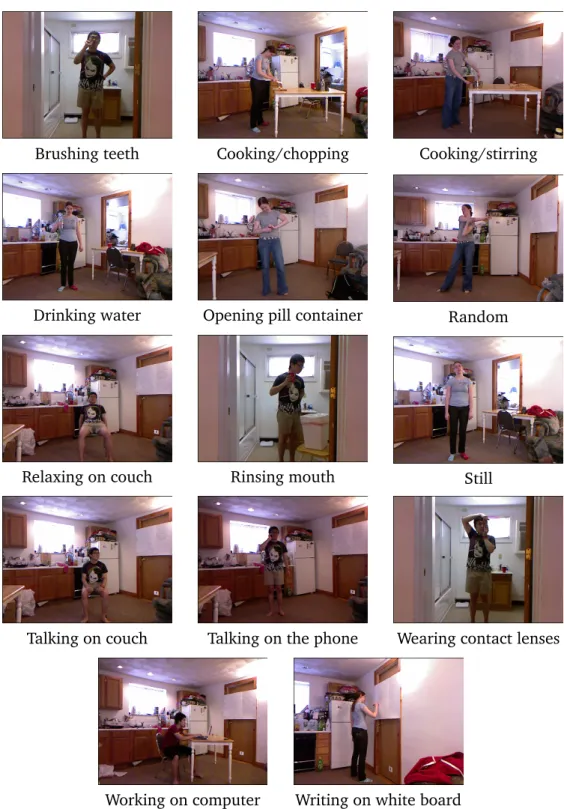
This dataset [107] contains the RGB frames, depth sequences and skeleton. The data was captured Microsoft Kinect sensor. The data set consists of 12 actions performed by 4 subjects. The actions are performed in 5 different environments: office, kitchen, bedroom, bathroom, and living room. All together data-set contain 60 videos.
2.3.2 CAD-120
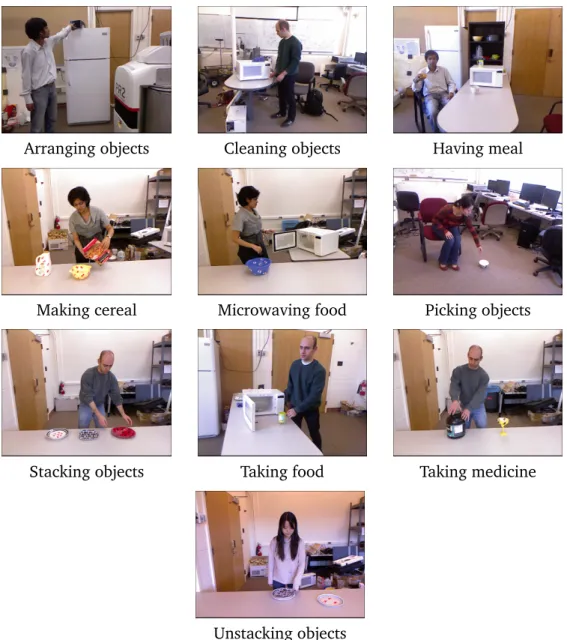
This dataset [107] contains the RGB frames, depth sequences and skeleton. All together there are 120 videos available. Actions are performed by 4 different subjects performing 10 high-level activities. Each high-level activity was performed three times with different objects. The activities vary from subject to subject significantly in terms of length.
2.3.3 MSRDailyActivity3D
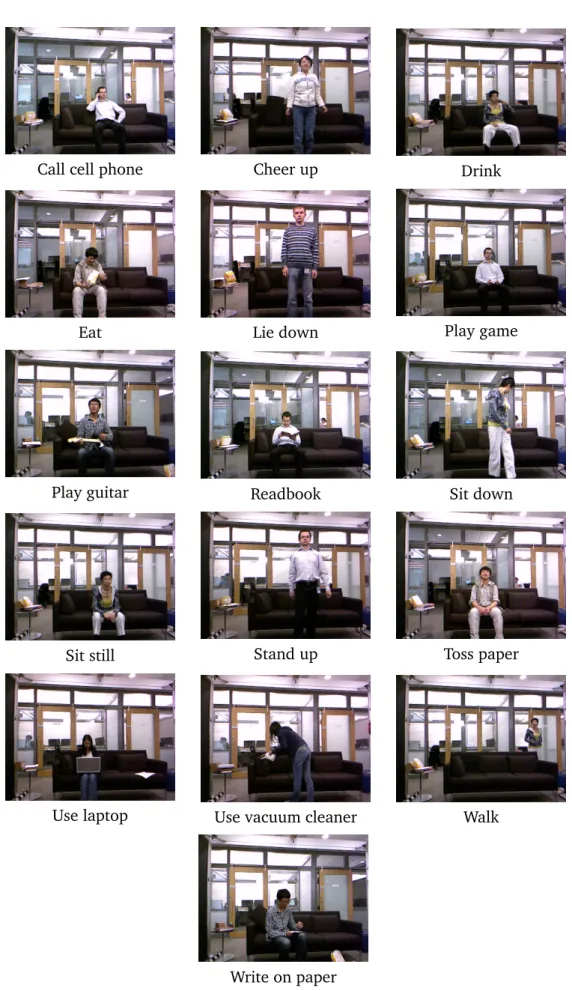
This dataset [116] consists of 16 actions such as: drink, eat, read book, call cellphone, write on a paper, use laptop, use vacuum cleaner, cheer up, sit still, toss paper, play game, lie down on sofa, walk, play guitar, stand up, sit down. Each action is performed by 10