HAL Id: tel-01140416
https://tel.archives-ouvertes.fr/tel-01140416
Submitted on 8 Apr 2015HAL is a multi-disciplinary open access archive for the deposit and dissemination of sci-entific research documents, whether they are pub-lished or not. The documents may come from teaching and research institutions in France or abroad, or from public or private research centers.
L’archive ouverte pluridisciplinaire HAL, est destinée au dépôt et à la diffusion de documents scientifiques de niveau recherche, publiés ou non, émanant des établissements d’enseignement et de recherche français ou étrangers, des laboratoires publics ou privés.
Towards Learning Organization
Mijalche Santa
To cite this version:
Mijalche Santa. Framework For Multivariate Continuous Transformation Towards Learning Organi-zation. Other [cs.OH]. University Paris 1 - Pantheon - Sorbonne, 2014. English. �tel-01140416�
DE L’UNIVERSITE PARIS 1 – PANTHEON – SORBONNE
Spécialité : Informatique
Présentée par:
Mijalche SANTA
Pour l’obtention du titre de :DOCTEUR DE L’UNIVERSITE PARIS 1 – PANTHEON - SORBONNE
Un Cadre de Référence pour la
Transformation Continue Multi-facettes
vers une Organisation Apprenante
17 Décembre 2014
JURY
Selmin NURCAN Directeur de thèse Colette ROLLAND Directeur de thèse
Erik PROPER Rapporteur
Roel WIERINGA Rapporteur
Myriam LEWKOWICZ Examinateur Samira SI-SAID CHERFI Examinateur
MULTIVARIATE CONTINUOUS TRANSFORMATION
TOWARDS
LEARNING ORGANIZATION
Mijalche Santa
A thesis submitted to the faculty of the University of Paris 1 - Panthéon - Sorbonne in
partial fulfillment of the requirements for the degree of Doctor of Philosophy (Ph.D.) in
Computer Science
17
thof December 2014
Archivist: What if no one believes you?
Sonmi-451: Someone already does.
Movie Cloud Atlas [Wachowski et al., 2012]
For Ilin and Dushica
Acknowledgements
In the past ten years I have had a dream. A dream that has kept me awake at night. A dream that needed a strong, first step in order to become reality in some future days. Six years ago I made the first step. I enrolled a PhD at University Paris 1 – Pantheon – Sorbonne. I aimed to create a scientifically based, practically useful solution to a problem, I found it important. I spent the last six years in thinking about it, working on it, hating it, loving it, being depressed by it and had some of the best moments in my life.
Now you are reading the result of those six years. However, although it is independent work, the result was not possible without the help of some people.
First, I would like to thank prof. Nurcan and prof. Rolland for accepting me as a PhD student and for giving me the freedom to explore and find my path. The discussions with and feedback from prof. Nurcan enabled me to make this thesis complete. I am very thankful for that. In finding my path I was lucky to “meet”1 people like Mark Edwards and have all these discussions with him from modeling the world to meta review and analysis. Thanks Mark. I also want to thank Igor, my friend, for helping me in building some parts of the path. I am also thankful to the management of the Faculty of Economics – Skopje at Ss Cyril and Methodius University for financially supporting a part of this PhD. I also want to thank the reviewers, editors, conference participants that gave me useful comments and suggestions. Most of them incorporated in this document.
Finally, I want to thank my wife, Dusica and my son Ilin. My wife for listening and supporting me in achieving my dream and, Ilin for his smiles :).
1 I have never met Mark in live, all our discussions are through email and Skype.
Abstract
The goal of this work is to develop a framework for multivariate continuous transformation towards a learning organization. In order to achieve this goal, by using the design science methodology, we have developed the Learning Organization Atlas Framework.
The learning Organization Atlas Framework includes the four following elements:
Facets. The facets are particular aspects of the learning organization. Each facet contains a set of
relevant attributes through which that particular aspect is clarified. The multi facet view makes it possible to look at the learning organization in a comprehensive manner.
Grid. The grid is a result of the combination of following lenses (dimensions): ecological,
developmental and stakeholder. The ecological lenses represent the learning organization entities. the following learning organization entities were identified: individuals, teams, departments, organization, direct environment and general environment. The developmental lens shows the levels at which the entity can be. the developmental lens includes three levels: Level 0 - No learning; Level 1 - Single-loop learning; and Level 2 - Double-loop learning. The stakeholder lens is a viewpoint lens. Through it, the different views that different stakeholders can have about the facets of the organization are represented. Stakeholders identified in the learning organization are employee, manager, executive.
Maps. The maps are created through a grid application on each individual facet
Atlas. An atlas is a collection of facets maps. The atlas enables the process of layering and
de-layering the individual facets's maps.
Roadmap. The roadmap provides guidelines to the organizations, their learning needs, and the
required changes to be made
The Learning Organization Atlas Framework was instantiated in a web tool. The framework, through case studies research, was implemented and evaluated in six companies.
Table of Contents
Acknowledgements...3 Abstract...5 Chapter 1 Introduction...15 1.1 Research context...16 1.2 Problem statement...171.2.1 What is a learning organization (LO)?...17
1.2.2 How to become a learning organization?...18
1.2.3 How to evaluate the learning organization?...19
1.3 Research question and goals...19
1.4 Structure of this dissertation...21
Chapter 2 Approach to solution...25
2.1 Objective...26
2.2 Design science...27
2.3 Outputs...28
2.3.1 Facets of the LO...29
2.3.2 Patterns and Ontology...29
2.3.3 Conceptual Model and Atlas Framework...30
2.3.4 Roadmap and guideline...31
2.3.5 Web tool...32
2.4 Method mix...33
2.4.1 Building methods...33
2.4.1.1 Four worlds...33
2.4.1.2 UML and Conceptual modeling...34
2.4.1.3 MAP...34 2.4.2 Evaluation methods...35 2.4.2.1 Literature analysis...35 2.4.2.2 Survey...36 2.4.2.3 Interviews...36 2.4.2.4 Case study...36 2.5 Process...37 2.6 Conclusion...38
Chapter 3 State of art...41
3.1 Objective...42
3.2 Methodology...42
3.3 Four worlds framework for the Learning organization...44
3.3.1 Subject World...44
3.3.2 Usage world...64
3.3.3 System world...67
3.3.4 Development world...70
3.4 Conclusion...71
Chapter 4 The Learning Organization Ontology...77
4.1 Objective...78
4.2 Lightweight ontology...78
4.3 Learning Organization Conceptual Model...79
4.4 Learning Organization Patterns...81
4.5 Learning Organization Generative Mechanism...97
4.6 Descriptive Lightweight Learning Organization Ontology...98
4.7 Conclusion...102
Chapter 5 The Learning Organization Atlas Framework...105
5.1 Objective...106
5.2 Related work...106
5.3 Requirements analysis...109
5.4 Map Analogy...111
5.5 Learning Organization Atlas Framework...113
5.5.1 Facets...114 5.5.2 Lenses...115 5.5.2.1 Ecological lens...116 5.5.2.2 Developmental lens...117 5.5.2.3 Stakeholder lens...118 5.5.3 Grid...119 5.5.4 Maps...120
5.5.4.1 Learning map...120 5.5.4.2 Vision map...122 5.5.4.3 Strategy map...124 5.5.4.4 Culture map...126 5.5.4.5 Power map...128 5.5.4.6 Structure map...130 5.5.4.7 Processes map...131 5.5.4.8 Technology map...133 5.5.4.9 Leadership map...135 5.5.4.10 Change map...137
5.5.5 Learning Organization Atlas...138
5.5.6 Learning Organization Roadmap...139
5.5.6.1 Triggers...141
5.5.6.2 Engine...145
5.5.6.3 Indicators...150
5.5.6.4 Feedback...150
5.6 Conclusion...150
Chapter 6 Learning Organization Atlas Framework Web Tool...153
6.1 Objective...154
6.2 Related work...154
6.3 Web tool overview...157
6.3.1 Identify...157
6.3.1.1 Questionnaire...158
6.3.2 Atlas...159
6.3.2.1 Mapping the questionnaire results...160
6.3.2.2 Calculation...162
6.3.3 Alignment...165
6.3.4 Roadmap...166
6.3.4.1 Repository of strategies...167
6.3.4.2 Rules for filtering...167
6.3.4.3 Rules for activity selections...168
6.4 Guidelines for using the tool...169
6.5 Conclusion...170
Chapter 7 Application of the LOAF Web Tool...173
7.1 Objective...174
7.2 Pilot case study...174
7.3 Company A...176 7.3.1 Atlas...176 7.3.2 Alignment...179 7.3.3 Roadmap...180 7.4 Company B...180 7.4.1 Atlas...181
7.4.2 Alignment...183 7.4.3 Roadmap...184 7.5 Company C...185 7.5.1 Atlas...185 7.5.2 Alignment...189 7.5.3 Roadmap...189 7.6 Company D...191 7.6.1 Atlas...191 7.6.2 Alignment...193 7.6.3 Roadmap...194 7.7 Company E...195 7.7.1 Atlas...195 7.7.2 Alignment...197 7.7.3 Roadmap...198 7.8 Methodological evaluation...199 7.8.1 Construct validity...199 7.8.2 Internal validity...199 7.8.3 External validity...199 7.8.4 Reliability...200 7.9 Conclusion...200
Chapter 8 Conclusion...205
8.1 Objective...206
8.2 Responses to research questions...206
8.3 PhD dissertation's outputs evaluation...208
8.4 Contributions and limitations of this dissertation...212
8.5 Future work...213 Bibliography...217 Appendix A...233 Appendix B...241 Appendix C...247 Appendix D...261
Chapter 1
Introduction
Sol: Oh, is that him? Vinny: I don't know, how many fingers did he have? Sol: I'm sorry I couldn't get the bin-noc-u-lars out in time. Vinny: Look, well let's not stand in no ceremony mate, let's start the show. movie Snatch, [Ritchie, 2001]
1.1 Research context
Managing organizations today is difficult. Organizations today operate in a complex external and internal environment. Vital planning assumptions continuously change due to dynamic developments and events in organizations’ external and internal environments [Karp, 2006], such as technological discontinuities [Romanelli and Tushman, 1994] and turbulence [Lant and Mezias, 1992].
Creating and sustaining competitiveness is harder due the challenges of globalisation, changing customer and investor demands and increasing product-market competition [Jashapara, 2004]. Furthermore, the pressure on responsiveness, emphasis on product and service quality, diversity and customization increases the level of, ever changing, complexity executives have to manage. In order to stay competitive in this context the organization needs to be on the “edge of chaos” [Burnes, 2005; Davis et al., 2007]. It needs to have the capacity to create and add value by taking effective action in varied and uncertain situations [Bennet and Bennet, 2003]. Franken & Braganza [2006] argue that in the new economy, a firm’s sustainable competitive advantage flows from its ability to create and exploit new knowledge; to learn faster than its competitors [Jashapara, 1993]; to engage in rapid and relentless continuous change [Brown and Eisenhardt, 1997]; to become a learning organization [Davis and Daley, 2008; Jashapara, 1993; Senge, 1990; Pedler et al., 1991].
According to The Boston Consulting Group [2008] in a world driven by innovation and rapid change, becoming a learning organization from top to bottom—provides a clear competitive advantage and will become more important in the future [2008; 2010]. Also, the survey of the business magazine “Strategy+business” [Kleiner, 2005] ranked "the Learning Organization" idea as the second most enduring idea about strategy and business, out of 10 ideas most likely to last at least another 10 years. The importance of the learning organization was also identified by the European Commission [2001, p.21] stating “it is essential to promote more actively enterprises and other organizations to become learning organizations”. Furthermore, in [2006] McKinsey & Company survey revealed that almost nine in ten respondents say agility is either “extremely” or “very” important to business performance, and 86 percent say the same about speed. Furthermore 91% of the respondents think that the importance of agility and speed increased in the past 5 years2.
2 In the survey an organization’s “agility” was defined as its ability to change tactics or direction quickly—that is, to anticipate, adapt to, and react decisively to events in the business environment. “Speed” was defined as a measure of how rapidly an organization executes an operational or strategic objective
According to Pedler et al. [1991] a learning organization is an organization that facilitates the learning of all its members and consciously transforms itself and its context. It is an organization skilled at creating, acquiring, interpreting, transferring, and retaining knowledge, and at purposefully modifying its behavior to reflect new knowledge and insights [Garvin, 2000, p.11]. Since the publication of Senge's [1990] highly cited book “The Fifth Discipline: The Art and Practice of the Learning Organization” the research regarding the learning organization has proliferated. A huge number of definitions have been developed and presented in literature. This has been followed by a number of models that represent the learning organization. The most notable being: Energy flow model [Pedler et al., 1991] and seven dimensions model [Watkins and Marsick, 1993]. Also, a lot of diagnostics instruments have been developed like Learning company blueprint [Pedler et al., 1991], Dimensions of the Learning Organization Questionnaire [Watkins and Marsick, 1993; Yang et al., 2004], Learning organization profile [Marquardt, 1996], Organizational Learning Survey [Goh and Richards, 1997], and the Learning organization survey [Garvin et al., 2008].
Although it has been identified that successful learning organizations elicit, code, store, and create knowledge [Marquardt and Reynolds, 1994], research from information systems' perspective is missing. The information systems research is important because, as [King, 2001] has identified, the information systems infrastructure strategy is the first strategy that should be started for development of the learning organization. The information systems and the appropriate technologies are at the centre of the learning organization [Thomas and Allen, 2006]. This PhD research aims to fill that gap.
1.2 Problem statement
Despite the extensive debate about the value of learning organizations in order to be competitive and presentation of it positive sides, the learning organization has also raised a lot of criticism and dilemmas. This criticism is focused on three issues: Concept (What is a learning organization?), Methods and models (How to become a learning organization?) and Measurement (How to evaluate the learning organization?).
1.2.1 What is a learning organization (LO)?
“A clear definition of learning organization has proved to be elusive over the years” [Garvin, 2000, p.9]. The discussions are more reverential and utopian, filled with near mystical terminology [Garvin, 1993]. All LO definitions use natural language system [Wacker, 2004; Teas and Palan, 1997] which is not precise enough for formal empirical theory-building research. The
definitions are also too inclusive, too general or too vague. This problem is clearly evident in the most cited definition of Senge [1990] which is full of vague and ambiguous terms. This creates a linguistic relativity which is a core problem of the learning organization [Grieves, 2008]. Furthermore, there is still confusion between the learning organization and the organizational learning. In this PhD the suggestion of Örtenblad [2001], to see the learning organization as a form and the organizational learning as a process, is accepted.
Although the definitions provide insight in the LO, in order to understand it in detail, it is necessary to identify all the properties of LO. This is very important for a multidimensional construct like LO [Yang et al., 2004].
1.2.2 How to become a learning organization?
The literature does not see the LO as a state that can be achieved, but as the Holy Grail [Jashapara, 1993], “snark” [Tosey, 2005], a continuous journey. A journey on which, the organization will continuously learn and change to stay on the edge of chaos [Waldrop, 1992]. There is still limited understanding of how organizations accomplish this, and even less supported by empirical research (Easterby-Smith et al. 1999; Davis & Daley 2008; Tsang 1997). The existing models are often based on the authors’ consulting experience rather than systematic and rigorous research [Tsang, 1997]. This results in no practical operational advice which managers can use [Garvin, 2000] or a template that can be used [Cavaleri, 2008]. According to the survey of The Boston Consulting Group [2008; 2010], although the learning organization is an important topic, the organizations currently have low capabilities to achieve it. In this direction, Redding [1997] explains that there is no single approach to build a learning organization, because each approach should be customized by taking in account the following aspects:
Use language that fits the company;
Build on the existing structures and processes;
Recognize past successes that support the learning organization concept.
Additionally, when developing the model of the learning organization, too many dimensions and variables need to be taken into account. It is very hard to identify the casual relationships between them [Grieves, 2008]. This is also evident in the empirical research that is more focused on the outputs of the elements of the LO than on the relationships between the elements.
This mismatch in practice, between the strong expression of importance and the need of the learning organizations and the lack of capabilities, knowledge and paths how to create a learning organization, strongly weakens the idea of the learning organization and its application.
1.2.3 How to evaluate the learning organization?
Smith and Tosey [1999] have a position that if the learning organization is achievable, it should be measurable. The measurement of the learning organization is an important aspect because as Garvin [1993] has said, 'managers have long known that if you can't measure it, you can't manage it' (p. 89) and can not improve it [Smith and Tosey, 1999]. However, tools and assessment instruments to measure the learning organizations are lacking [Garvin, 2000; Garvin et al., 2008] and there is unsubstantial empirical basis [Rebelo and Gomes, 2008].
Based on the previous, it can be concluded that the definitions, methodologies for development of the learning organization and its measures need to be improved.
1.3 Research question and goals
As a result of the above presented- the main research question (RQ) for this PhD thesis is: Main RQ: How to continuously transform an organization to a learning organization?
The goal is to create a multi-attribute and multi-level framework for continuous transformation to a learning organization that will guide the organizations in their pursuite of becoming and staying a learning organization. This framework needs to be instantiated in a web based software that the organizations can use it. To achieve this goal I need to deal with two types of problems: knowledge and practical problem [Wieringa, 2009]. As defined by Wieringa, a knowledge problem as a difference between current knowledge of stakeholders about the world and what they would like to know and a practical problem is a difference between the way the world is experienced by stakeholders and the way they would like it to be. For practical problems solutions should be provided and for knowledge problems answers should be given. In design science, these two kinds of problems are mutually nested. As a result solving a practical problem may lead the problem solver to ask knowledge questions, and answering these knowledge questions leads the problem solver to new practical problems. The top level problem is always a practical problem [Wieringa, 2009] i.e. the multi-attribute and multi-level framework in this thesis. Based on this the research questions can be divided in design questions for practical problems and conceptual questions for knowledge problems.
The following sub-questions will help me provide an answer to the main research question. For each question it is indicated is it a knowledge or design question.
RQ1 (Conceptual question): What are the elements and relations that define the learning organization?
The purpose is to design an ontology-based model that makes it possible to conceptually express the logic of the learning organization i.e. create a conceptual model and an ontology of the learning organization.
RQ 2 (Design question): How can the learning organization improve its learning?
The goal is to design a pool of dynamical (changing) processes that can be applied as a guideline for the learning organization model i.e. create a dynamic form of the learning organization.
RQ 3 (Design question): How should the learning organization identify the triggers for transformation?
The answer to this question should provide identifiable points in time, based on the internal and external environment events through which the process of new transformation should be started. RQ 4 (Conceptual question): What are the criteria for evaluation of the learning organization continuous transformation?
The answer should provide information how the continuous transformation of the learning organization may be evaluated i.e. by creation of an evaluation instrument.
Any attempt to answer these questions should take into account the following aspects:
Multi-attribute. By including as many as needed attributes of the learning organization, a better picture of it can be painted. From this pool of attributes, through a critical analysis. the important attributes and their relationships will be identified;
Multi-level. The learning organization is a multi-level construct. All its attributes should be looked through levels. For example, in learning – single-loop, double-loop and deutero learning; strategy – corporate, functional and operational level; organizational – individual, team, organization; stakeholder – employee, manager, executives, etc. By including the levels, it is recognized that the approaches used for development of the learning organization should be multi-level and customized for each level;
Context aware. Each organization can learn. Each organization learns in different contexts. These differences in the context should be anticipated in the models for the development of a learning organization. By including the context, the flexibility of the model will be provided and its wider applicability enabled;
Changing the model. Learning implies change. Learning, as the core element of the learning organization, enables it to change. The model should respect this imperative and
provide options that will enable it to change with time.
1.4 Structure of this dissertation
This PhD consists of the following chapters: Chapter 1 - Introduction
In the introduction chapter the research context is presented and justification for this research is provided. Then, three issues on which the learning organization is criticized are presented by postulating the questions: what is a learning organization, how to become a learning organization and how to evaluate a learning organization? At the end, the main research question and four research sub-questions are presented.
Chapter 2 - Approach to solution
In this chapter the overall approach to the solution is provided. It describes the structural elements of the solution and the process through which the solution will be delivered. The approach is based on the design science research methodology for information systems. The outputs of the design science research for this PhD are: facets of the LO, LO ontology, LO dynamic model, LO framework and tool. To deliver these outputs, a method mix of building and evaluating methods has been proposed.
Chapter 3 - State of art
Through this chapter an extensive analysis of the LO literature has been performed. The literature included in the research is listed in Appendices A and B. The "four worlds" framework has been used for the analysis. The result is a comparative literature analysis structured in subject, usage, system and development world.
Chapter 4 – The Learning Organization Ontology
To develop the learning organization ontology, in this chapter, first the learning organization conceptual model was presented and explained. Then, the modeling patterns were identified, graphically presented and discussed. At the end, the lightweight learning organization ontology was developed.
Chapter 5 – Learning Organization Atlas Framework
The objective of this chapter is to introduce a multilevel and multifaceted framework for dynamic development of the learning organization. First, it presents the related work by analyzing existing models. Then, it describes the map analogy and how it is applied to the proposed framework. After that, it introduces the Learning Organization Atlas Framework and its elements: facets, lenses, grid, maps, atlas and roadmap.
Chapter 6 - Learning Organization Atlas Framework Web Tool
In this chapter the web tool, as instantiation of the learning organization atlas framework, is presented. It includes a review of the existing diagnostic tools and their instantiations. It presents the elements of the web tool: identify, atlas, alignment and roadmap. Furthermore, it explains the process of transformation of the respondent's survey answers to map representation and development of the roadmaps. At the end, it presents a guideline for using the web tool.
Chapter 7 - Application of the LOAF Web Tool
The objective of this chapter is to present an application of the Learning Organization Atlas Framework and of the Web Tool in five companies. For each company the evaluation process is explained, including information gathering, mapping and roadmaping. Each element is textually and graphically explained.
Chapter 8 - Conclusion
The objective of this chapter is to discuss the future of the framework and the tool. First, the contributions to the theory and practice that this thesis makes, are explained. Then the limitations of the framework and the tool are discussed. Based on that, the future of the framework is presented, including the possible options for further development and its application in different domains.
Chapter 2
Approach to solution
Avi: Tony, there is a man I'd like you to find. Bullet Tooth Tony: Well, that depends on all the elements in the equation. How many are there? Avi: Forty thousand. Movie “Snatch” [Ritchie, 2001]
2.1 Objective
Identifying the right solution approach for this dissertation was a project in itself, due to several reasons. First, is the very topic of the learning organization. Even though it is a frequently studied topic, there is still no generally accepted way to research the concept [Davis and Daley, 2008]. Second, according to Lee [2001] the research in the information systems field should examine more than just the technological system, or just the social system, or even the two, side by side; it should investigate the phenomena that emerge when the two interact and contribute to both of these systems. Third, the outputs that this thesis aims to deliver require combination and application of different research processes, frameworks and methods.
The objective of this chapter is to develop and present a logical and scientifically based methodology through which the research questions will be answered. To achieve this, I have opted for a two-level-approach to the solution. On the first level, the approach should provide an overall guideline for the development of the solution, while the second level should consist of various research frameworks, methods and methodologies, tailored for each specific element of the solution. Taking into account the previously said the following decisions were made for the solution approach [Santa, 2013]:
The overall methodology of this PhD is based on the design science paradigm and it follows the design science research approach in information systems;
Based on the design science paradigm for each element of the solution, appropriate building methods are identified;
Every output of this PhD will be evaluated through an appropriate evaluation method. The elements for this solution approach are presented in Figure 1 and explained later in this chapter.
2.2 Design science
Information systems, as a design science is more and more acknowledged by the research community [March and Smith, 1995; Lee, 1999; Hevner et al., 2004; Wieringa, 2009; Hevner and Chatterjee, 2010; Peffers et al., 2008]. According to Hevner et al. [2004] “design science...creates and evaluates IT artifacts intended to solve identified organizational problems”. Problems that are characterized by:
unstable requirements and constraints based on ill-defined environmental contexts;
complex interactions among subcomponents of the problem;
inherent flexibility to change design processes, as well as, design artifacts (i.e., malleable processes and artifacts);
critical dependence upon human cognitive abilities (e.g., creativity) to produce effective solutions; and
critical dependence upon human social abilities (e.g., teamwork) to produce effective solutions.
Learning Organization Atlas Framework p. 27 Figure 1: PhD solution approach
The learning organization shares these characteristics and it proves itself suitable for design science research. In order to perform rigorous design science research, it is important to provide answers to three aspects: outputs, method mix and process.
2.3 Outputs
Vaishnavi and Kuechler, Jr [2007] based on the work of other researchers [March and Smith, 1995; Rossi and Sein 2003; Purao 2002] have summarized the outputs in which a design science research effort can result:
Constructs – the conceptual vocabulary of a domain;
Models – a set of propositions or statements expressing relationships between constructs;
Methods - set of steps (an algorithm or guideline) used to perform a task;
Instantiation – the operationalization of constructs, models, and methods; and
Better theories – artifact construction as analogous to experimental natural science.
The goal of this PhD is to create a multi-facet and multi-level model of continuous transformation to a learning organization that will guide the organizations in their pursuit of becoming and staying a learning organization. I propose to achieve this goal by answering the following research questions:
What are the elements and relations that define the learning organization?
How should the learning organization change itself in order to continuously transform itself?
How should the learning organization identify the triggers for transformation?
What are the criteria for evaluation of the learning organization continuous transformation?
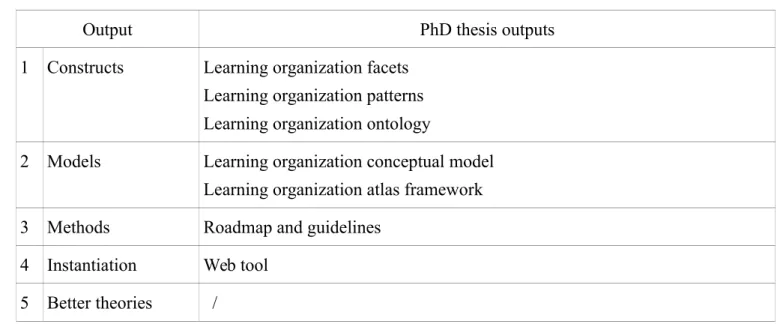
Answers to these questions will create the outputs presented in table 1. Each output is discussed afterwards.
Output PhD thesis outputs 1 Constructs Learning organization facets
Learning organization patterns Learning organization ontology
2 Models Learning organization conceptual model Learning organization atlas framework 3 Methods Roadmap and guidelines
4 Instantiation Web tool 5 Better theories /
Table 1: The Outputs of Design Science Research for this PhD
2.3.1 Facets of the LO
The learning organization is a multidimensional construct [Yang et al., 2004], and in order to understand it in detail, it is necessary to identify all facets of the LO. To go more in-depth, the corresponding attributes for each facet will be identified, and the possible values of that attribute will be presented. The “four-worlds” framework [Jarke et al., 1993; Rolland, 1998] will be used to analyze the literature and identify the facets, attributes and the values. The output will be presented in a table that contains each individual world, facets identified for the respective world, attributes for each facet and values that each attribute can have, as presented in table 2:
Learning organization
World Facet Attribute Value
1 2 3 4 1.1 1.2 2.1 …. 1.1.1 1.1.2 2.1.1 … 1.1.1.1 1.1.1.2 2.1.1.1 …
Table 2: "Four-worlds' output
2.3.2 Patterns and Ontology
The learning organization literature is full of vague and ambiguous language. There is a large number of definitions, characteristics, models and frameworks that create a conceptual jungle. As a result, we still lack a shared understanding of the learning organization and a clear representation of the learning organization concept [Grieves, 2008]. In the context of building an
IT system this leads to difficulties in identifying requirements, and thus, in defining the specification of the system [Uschold and Gruninger, 1996].
To overcome this barrier, I have identified the ontology of the learning organization as an output of this PhD thesis. Ontology is an explicit specification of a conceptualization [Gruber, 1993]. An explicit specification means the concepts and relationships of the abstract model are given in explicit terms and definitions [Gruninger and Lee, 2002]. The ontology will be based on the learning organization patterns. The patterns are defining characteristics of a system and often, therefore, indicators of essential underlying processes and structures (Grimm et al., 2005). Thus, they are appropriate base for development of the ontology. Learning organization modeling patterns and the ontology elements will be described precisely, textually and graphically.
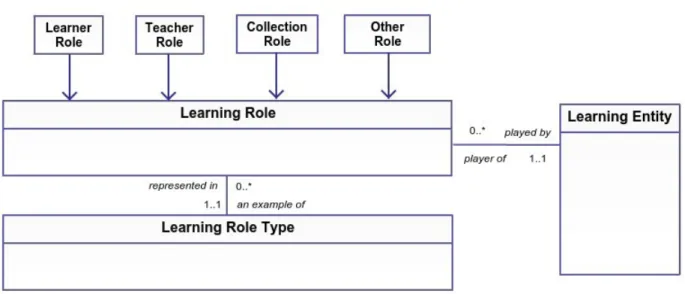
For a graphical representation of the LO modeling patterns, I will use the UML notation and class diagrams, as presented in figure 2.
2.3.3 Conceptual Model and Atlas Framework
The purpose of the conceptual model is to structure the results of the “four world” analysis. Through it, the identified facets and their relations are positioned on the dimension invisible/ visible. As such, the conceptual model supports the development of the patterns and the ontology. On the other hand, the atlas framework is built in order to respond to the challenges identified in the literature regarding the modeling of the learning organization: large number of facets,
Learning Organization Atlas Framework p. 30 Figure 2: Graphical description of LO ontology elements
attributes and variables that construct the learning organization [Yang et al., 2004]; the complex relationships within and between the facets [Grieves, 2008]; the learning organization is not a state, it is a chameleon-like target that is continuously changing [DiBella, 1995]. To meet this issues the learning organization atlas framework, based on the analogy of maps introduces the grid and maps, and combines them with the facets and the roadmap.
2.3.4 Roadmap and guideline
Reality is a dynamic entity, it is changing continuously and it has both structure and behavior. This means that the framework should support this. The roadmap is used to express and model the changes that the organization can make. The behavior is a result of the impact of change on the business goals, subsequent to changes in internal and external factors, and will secure the competitiveness of the organization in the new surroundings. The roadmap should provide options to the organization for securing this competitiveness. Furthermore, each organization is different and needs to find its own path in becoming a learning organization [DiBella, 1995; Redding, 1997]. To achieve this, the roadmap builds on the change process model of EKD – Change Management Method [Nurcan et al., 1999]. The roadmap consists of trigger box, engine, indicators and feedback. Each element will be textually described, while the engine will be also graphically described.
Trigger box (Table 3). The box contains scanners through which it collects information from the internal and external environment of the learning organization. The information is evaluated with identified values in the box and as result they can start the engine. The triggering will be a result of general rules that are instantiated later for each concrete situation.
Trigger Name
Belongs to Facet to which this trigger belongs
Information source Internal or external source which supplies information that the trigger uses Time frame Time period after which information is retrieved from the source
Values Values that the trigger can have and through which the information is evaluated Decision rules Predetermined rules that the trigger has, and based on which it can start the
engine or not
Influences what Which actions are started when the trigger is initiated
Table 3: Trigger box structure
Engine. The engine is the core element of the roadmap. Through it the actual realisation of the roadmap is determined. The engine is a collection of sections developed using the MAP framework. Each section contains intention, strategy and relationships (Table 4).
Section Name <source intention, target intention, strategy> Intention Goal that we want to achieve
Strategy An approach to achieve the target intention
Relationships Identifying the precedence/ antecedence relationship between sections
Table 4: Engine structure
To graphically describe the section, I will use the MAP as a graph.
Indicators. The indicators are used to measure the achievement of the intentions in the engine. They will contain values upon which the outcomes will be measured (Table 5). The measurement results will be sent back to the model through a feedback system.
Indicator Name
Values Values that the indicator can have and through which the output is evaluated
Table 5: Indicator element
Feedback. The feedback will be used to provide information back to the system (Table 6). Indicator The source of the feedback
Trigger The recipient of the feedback
Table 6: Feedback element
2.3.5 Web tool
Once the framework is designed, it can be turned to a tool. The web tool will be a software application that can be used by the companies to identify how they can transform to a learning company. The tool will have a simple and intuitive interface, and will be suitable for use by the
employees in the company. The tool will be evaluated and refined through company case studies.
2.4 Method mix
Hevner et al [2004] states that in order to have a research rigour, the design science research needs to rely upon the application of rigorous methods in both, the construction and evaluation of the design artifact. Design science research can, in principle, use all known methods for data gathering and analysis [van Aken and Romme, 2009]. This makes it necessary to identify an adequate method for each specific research objective and step, resulting in an overall method mix [Osterwalder, 2004]. It should be taken into account that the research efforts and methods often cover multiple cells [March and Smith, 1995]. The method mix needed for the realisation of the objectives of this PhD is presented in table 7. Afterwards each model is presented in more details.
PhD Outputs Building Methods Evaluating Methods Facets Literature research
“Four worlds” framework
Literature analysis Ontology Patterns UML Conceptual modeling Literature analysis Conceptual model Atlas framework
Conceptual modeling Interview
Roadmap MAP Case study
Web tool PHP Case study/ Survey
Table 7: Method mix (based on March and Smith, 1995)
2.4.1 Building methods
2.4.1.1 Four worlds
The “four worlds” framework was developed by Jarke et al., Roland [1993; 1998] and has been successfully used for requirements engineering [Jarke et al., 1993], process engineering [Rolland, 1998] and change engineering [Nurcan and Rolland, 2003]. The framework consists of four worlds: subject, usage, system and development.
For each world the appropriate facets, attributes and values of the attributes are identified.
2.4.1.2 UML and Conceptual modeling
Unified Modeling Language (UML) is a standardized general-purpose modeling language in the field of object-oriented software engineering. It is the standard modeling language for systems and software development. The main advantages of using the UML are [Miles and Hamilton, 2006]:
it's a formal language – Each element of the language has a strongly defined meaning, so it will not be misunderstood;
It's concise – the language uses simple and straightforward notation;
it's comprehensive – it describes all important aspects of a system;
it's scalable – it can be used for massive projects, but it can also scale down to small projects, avoiding overkill.
UML is also applicable to this PhD because it has a rich set of diagrams for the representation of both structural and behavioural aspects of a system [de Cesare et al., 2003].
2.4.1.3 MAP
While the UML is used to present the patterns and ontology, the MAP framework will be used to develop the engine of the roadmap. The MAP concept was introduced by Rolland [1998] as a notion through which we represent the “as-is” and “to-be” system. According to Rolland and Prakash [2001] a map is composed of one or more sections. A section is an aggregation of two types of intentions, the source and target intentions together with a strategy. An intention is a goal that can be achieved by the performance of a process. There are two special intentions, Start and Stop, to begin and end the map, respectively. A strategy is an approach, a manner to achieve an intention. The MAP also includes:
Path relationship through which a precedence/antecedence relationship between sections are established;
Thread relationship identifies the different ways through which the target intention is realized;
Bundle relationship is an expression of the fact that exactly one of its sections can be used in realising the target intention;
Refinement relationship shows that a section of a map can be refined as another map through the refinement relationship.
Each map will be represented as a directed graph (see Figure 3) from Start to Stop. In this graph,
intentions are represented as nodes, and strategies as edges between these. The graph is directed because the strategy shows the flow from the source to the target intention. To avoid confusion by using the word map in different context, in the remainder of this thesis this will be called “Road map”.
2.4.2 Evaluation methods
2.4.2.1 Literature analysis
Literature research (which is also part of most of the other methodologies) summarizes and synthesizes past research, and highlights some of the important conclusions. On the other hand, literature analysis examines many (perhaps all) past studies in a particular area and conducts a scientific meta analysis of the cumulative knowledge [Palvia et al., 2003]. Machi and McEvoy [2008] argue that the goal of a basic literature research (library research) is to summarize and evaluate the existing knowledge on a particular topic and to produce a position on the based on that knowledge. On the other hand, an advanced literature research (literature analysis) goes further and provides the foundation for identifying a problem that demands original research. It is a stepping stone for discovering what is not yet known about the topic. It is important to have good literature research and literature analysis because it [Creswell, 2008]:
shares the results of other studies that are closely related to the one being undertaken;
it relates the study to a larger, ongoing dialogue in the literature, filling gaps and
Learning Organization Atlas Framework p. 35 Figure 3: The map as a graph [Rolland and Prakash, 2001]
extending previous studies;
it provides a framework for establishing the importance of the study, as well as, a benchmark for comparing the results with other findings [Creswell, 2008].
The library research and analysis will be used throughout the whole dissertation as an input to the various research steps.
2.4.2.2 Survey
The “survey” method was extensively used in MIS research and is still in predominant use. While the method can attain high levels of external validity, it is known to suffer from lack of control and internal validity. Thus, research based on survey methodology should be evaluated in light of the identified weaknesses, and furthermore, researchers should take proper measures to ensure that survey methodology is not being used under inappropriate contexts [Palvia et al., 2003]. The survey should provide a quantitative description of the opinions of the targeted industries by studying a sample of that population [Creswell, 2008]. In this dissertation the survey will be used to get data from the companies for realisation of the web tool.
2.4.2.3 Interviews
Palvia et al [2003] included “interviews’ as a separate category although it is typically part of other methodologies, such as case studies and qualitative research. The main reason is that this method is repeatedly mentioned – either by itself or in combination with other methodologies – as the primary method of data collection. The purpose of the in-depth interviews is to understand the lived experience of the companies and the meaning they make from it [Seidman, 2006]. The interview will be used to evaluate the Learning Organization Atlas Framework.
2.4.2.4 Case study
The distinctive need for the case study comes from the need to understand complex phenomena and to retain the holistic and meaningful characteristics of continuous transformation of organizations [Yin, 2009, p.4]. More specifically, the case study has a distinctive advantage when questions of why or how are asked for contemporary set of events over which the investigator has little or no control [Yin, 2009, p.13]. Case studies have faced critique from the researchers preferring quantitative research [Miles, 1979] or there are misunderstandings regarding the case study approach [Flyvbjerg, 2006]. But, the case studies can be used to create generalizations [Wieringa, 2013] and build theory [Eisenhardt, 1989]. Lee [1989] provides a succinct description of this “scientific” methodology and argues that case study research can have as much rigour as quantitative research. The case study in this dissertation will be used to perform evaluation of the
Web tool. Furthermore, the input from the cases will be used to further develop the constructs.
2.5 Process
Iivari [2007] claims that the construction process should be made as transparent as possible if it is to be considered as a design science activity. It is not enough for the artifact to just come out of the blue. There are several methodologies that propose how a research in design science should be performed [March and Smith, 1995; Vaishnavi and Kuechler, Jr, 2007; Hevner, 2007; van Aken and Romme, 2009; Wieringa, 2009]. Peffers et al. [2008] through a consensus approach based on literature review has developed a methodology design science research methodology for information systems. This nominal methodology consists of six activities. In Table 8 I am relating the activities to the elements of the PhD solution approach (Figure 1).
Activity Description PhD element
1 Problem identification and motivation
Define the specific research problem and justify the value of a solution.
Research
2 Define the objectives for a solution
Infer the objectives of a solution from the problem definition and knowledge of what is possible and feasible
Research
3 Design and development
Create the artifact. This activity includes determining the artifact’s desired functionalities and its architecture, and then creating the actual artifact.
Constructs Model Method Instantiation 4 Demonstration Demonstrate the use of the artifact to solve one or more
instances of the problem
Instantiation Application 5 Evaluation Observe and measure how well the artifact supports a
solution to the problem. This activity involves comparing the objectives of a solution to actual observed results from use of the artifact in the demonstration.
Application
6 Communication Communicate the problem and its importance, the Results
artifact, its utility and novelty, the rigor of its design, and its effectiveness to researchers and other relevant audiences, such as practising professionals, when appropriate
Table 8: Design science research methodology
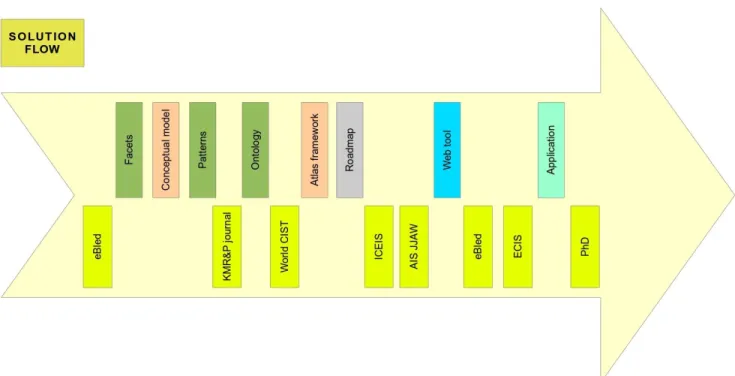
Because this PhD will deliver several outputs, I have also developed a timeline in which I present how this PhD has been realized (Figure 5). After the creation of each output, by using the identified building methods, an appropriate evaluation method has been applied. The outputs created a base for papers that have been published in conferences and journals. The final result is this PhD thesis.
2.6 Conclusion
In this chapter, I have presented how the design science methodology can be used to provide a solution for development of a learning organization. The design science methodology is
Learning Organization Atlas Framework p. 38 Figure 4: PhD solution flow
appropriate for this research for the following reasons: First, it provides a frame for inclusion of a large number of aspects and issues when developing the solution. In this frame, the aspects and the issues can be organized on a ladder from more abstract outputs to more concrete instantiations. Second, it allows the usage of different methods and tools, and provides space for justification of their usage for successful delivery of different outputs. Third, this flexibility enables, and to a large extent requires from the researcher to think bottom-up and top-down regarding the outputs. Also, it provides an opportunity, at the same time, to focus on global picture and the details in order to achieve the final goal. And finally, by being able to evaluate the outputs on each level, the number of problems and issues is minimized.
However, there are two drawbacks of using the design science methodology for achieving the goal in a PhD research. First, is the time and the resources that are needed to develop the framework, because a large number of research methods need to be learned and implemented. Second, is the time and the resources needed for creating all the outputs needed for creation of a functional solution. The creation will require development of different, sometimes not related skills like ontology and programming. Lack of time and resources can also undermine the completeness of the solution.
Chapter 3
State of art
[Tyrone just backed into Franky Four Fingers' van] Tyrone: I didn't see it there. Vinny: It's a four ton truck, Tyrone. It's not as if it's a bag of peanuts, is it? Tyrone: It was a funny angle. [All three turn and look back at the truck] Vinny: It's behind you Tyrone. Whenever you reverse, things come from behind you. Movie “Snatch” [Ritchie, 2001]
3.1 Objective
The objective of this chapter is to present a review of the scientific literature on the learning organization. It is an attempt to create an inventory by assembling the past research on learning organization from diverse views and sources. An inventory consisting of properties, relationships, measurements and criticism, that will present a complete overview of the learning organization. The inventory will be a base on which the learning organization ontology and the framework in the next chapters will be developed.
In the first part, the design process through which the research for this chapter has been performed is presented. After that, an overview of the learning organization literature and critical discussion is made.
3.2 Methodology
The literature in this chapter was analyzed by using the “four worlds” framework developed by Jarke et al. [1993] and Rolland [1998]. This framework has been successfully used for requirements engineering [Jarke et al., 1993], process engineering [Rolland, 1998] and change engineering [Nurcan and Rolland, 2003].
The framework consists of four worlds: subject, usage, system and development.
The subject world contains the knowledge about the domain, for which the system needs to supply information. In this world, the definition and the characteristics of the learning organization are evaluated.
The system world is about the representation of the subject world. It contains the models that are related to the IT support required by the usage world.
In usage world, the goals that the actors want to achieve through the concept of the Learning organization are identified and presented. It determines the reasons why they use the system and the range of facilities they require for its usage.
The development world concerns the process that allows us to build the various models of the learning organization and the enactment of the learning organization.
Appropriate facets are identified for each world. The facet defines a particular aspect of the world. Each facet contains a set of attributes through which that particular aspect is clarified.
Furthermore each attribute has values through we are able to compare and position the approaches among them. The values of attributes can be of a predefined type (integer, boolean ...) or an enumerated type (Enum {x,y}). These relations are presented in figure 5. In the text the facet will be written as Facet, attribute as ATTRIBUTE and value as value.
The literature reported in this chapter was identified and selected through a two level process. First, a pool of articles was created through a broad search in several online databases (ProQuest, Sage, Springer link, Jstor and Science Direct) by using the keywords: Learning organization concept, Learning organization definition and Learning organization characteristics. The results in each database were sorted by relevance. By applying a confidence level of 95% and confidence interval of ten, a sample size of 1037 items were identified. All the duplicates, book reviews, editorials, posters and non-English papers were eliminated. As a result, a population of 623 articles was created. By using a confidence level of 95% and confidence interval of ten, on the population of 623 selected articles, it was identified that a sample size of 83 articles was sufficient. By using random numbers the 83 articles were identified (appendix A). Through the same procedure from the journal “The Learning Organisation”, as a journal devoted to LO issues, additional 54 papers were identified (appendix B). All the articles, in both samples, were reviewed and definitions, characteristics, models, methods and methodologies were identified. Then, through the second level of analysis, the original articles and books, in which the identified definitions, characteristics, models, methods and methodologies are mentioned for the first time, were reviewed and the original text was extracted.
Learning Organization Atlas Framework p. 43 Figure 5: "Four worlds" framework relations
3.3 Four worlds framework for the Learning organization
3.3.1 Subject World
The learning organization is a multidimensional construct [Yang et al., 2004]. In order to identify its facets and attributes, a useful approach is to employ Wittgenstein's notion of the family-resemblance concept, for which his classic example was the concept of games. Not all games share the same conceptual features, some are competitive, others are not. Some are team events, others are not, but they share enough constellations or families of features to enable us to call them games [Pearn et al., 1994]. Through the literature review, thirteen facets of the learning organization were identified: Learning, Culture, Change, Leadership, Strategy, Structure,
Stakeholders, Environment, Politics, Power, Systemic thinking, Processes, Technology. Learning
The learning properties are in the focus of the literature on learning organization. In the literature it can be noted that the terms learning organization and organizational learning were used interchangeably in the beginning of the development of the organizational learning and learning organization idea. Now, based on the work of different researchers [like Örtenblad, 2001; Yang et al., 2004], there has been made a distinction between these terms. The focus here is on the organizational learning. In total, five attributes of the learning facet are identified: TYPE OF LEARNING, STYLE OF LEARNING, LEARNING SUPPORT, LEARNING STAKEHOLDERS, UNLEARNING.
Type of learning
All organizations learn [Kim, 1993; DiBella et al., 1996; Goh, 1998], but it is argued that the learning organization needs to have embedded a more radical learning [Senge, 1990; Argyris, 1999; Garratt, 1987; Thomas and Allen, 2006]. According to Senge [1990], the more radical or generative learning emphasizes continuous experimentation and feedback in an ongoing examination of the way organizations go about defining and solving problems. By having double-loop learning an individual, organization or an entity is able to modify the goal in the light of experience, or possibly even reject the goal [Argyris, 1999]. By practicing double-loop learning the organization will be able to respond better to the rapid changes in its environment, before or after they happen.
The presence of the double-loop learning does not exclude the need to also have single-loop, adaptive or maintenance learning in the learning organization. On the contrary, the single-loop
learning must also be joined by a double-loop learning [Senge, 1990; James, 2003]. Furthermore, in order to be able to practice double-loop learning, a prerequisite is to practice single-loop learning, also to be able to practice deutero learning 3 a prerequisite is to practice single-loop and double-loop learning [Hawkins, 1991]. Actually, any subsequent level of learning transcends, but it includes its predecessors. Furthermore, in the literature the deutero-learning or level 3 is discussed, and some authors [like Watkins and Marsick, 1993] suggest that in the learning organization the learning is directed towards developing the potential for learning to learn: meta learning.
TYPE OF LEARNING: Enum{ single-loop, double-loop, deutero learning }
Style of learning
In a learning organization every opportunity for learning should be used. Especially efforts should be made for “on the job learning” [Örtenblad, 2004]. Work and learning should be inseparably linked [Redding and Catalanello, 1994]. People should learn new skills while solving real business problems [Bennett and O’Brien, 1994]. Also, formal and informal learning approaches should be used [Watkins and Marsick, 1993], but it should be noted that only having trainings is not sufficient. Learning from own and others' experience should be also done [Marquardt and Reynolds, 1994; Bennett and O’Brien, 1994].
Although some authors have a normative approach to what learning style should be used, DiBella [1995] argues that different styles of learning can co-exist in the learning organizations. The styles can be different for different departments and hierarchical levels.
STYLE OF LEARNING: Enum{ on the job learning, training, formal, informal }
Learning support
Besides the embedded, more radical learning what distinguishes the learning organizations from the other organizations that just learn, is that a learning organization stimulates conscious learning [Watkins and Marsick, 1993]. In this way, the quantity and quality of learning are increased [West, 1994]. Besides the encouragement the learning organizations go a step further and develop learning infrastructure [Senge, 1990], create organizations, design work, working environments, technology, rewards, systems, structures, and policies [Watkins and Marsick, 1993] that will support learning. This support is important because the organization might have individuals who learn, but if it has not developed the associated processes for capturing and retaining knowledge, it cannot be called a learning organization [Garvin, 2000]. The learning organization should be committed to providing high-quality resources for learning [DiBella and Nevis, 1998].
LEARNING SUPPORT: Enum{ conscious learning, resources }
Learning stakeholders
In a learning organization, learning takes place at the individual, group, and organizational levels [Giesecke and McNeil, 2004]. The three levels of learning are not and should not be seen as distinct and mutually exclusive. They work together and influence each other [Redding and Catalanello, 1994]. However, in the literature there is an “individual actor bias” and the literature still emphasizes the role of individuals as active agents [Huysman, 1999]. This might be the result of seeing the individuals as the primary learning entity in the organizations [Dodgson, 1993]. On the other hand, although the individual learning is necessary, it is not a sufficient condition for organizational learning [Gould, 2000]. The later is a collective process [Watkins and Marsick, 1993; James, 2003] and the teams are the main bridges through which this process is performed. As a result of that, a lot of authors identified team learning (I would say learning through teams) as the most important feature of the learning organization [Redding and Catalanello, 1994; Thomas and Allen, 2006; Gould, 2000; Watkins and Marsick, 1993; Garvin, 1993; Senge, 1990]. Teams are the place where the rubber meets the road; unless teams can learn, the organization cannot learn [Senge, 1990]. The teams can share the knowledge better [Gould, 2000; Watkins and Marsick, 1993; Guns, 1998] and include more people in the learning process.
In the literature, it can be noticed that when the authors discuss about the organizational learning they are not referring to the learning itself, but more to managing the knowledge in order to support the learning of the individual or through teams. For example, DiBella and Nevis [1998] say that organizational learning has occurred means that new knowledge has come into the organization, has been disseminated or shared, and is or was used. In the same direction, Drew and Smith [1995] and [2004] state that organizational learning implies storing and using knowledge, thus creating the organizational memory. Other authors [like Argyris, 1999] also suggest that organizations learn when discoveries, evaluations and insights by individuals are successfully embedded in the organization's mental models or cognitive systems and memories. It is important to note that how this knowledge is gathered, stored and distributed influences on the learning within the organization [Huysman, 1999].
LEARNING STAKEHOLDERS: Enum{ individual, team, organization }
Unlearning
Unlearning had little attention in the organizational learning literature. However, unlearning is identified as important for building a learning organization [McGill and Slocum, 1993]. There are two types of unlearning: individual and organizational [Tsang and Zahra, 2008]. According to
them, organizational unlearning is discarding of old routines to make way for new ones, if any. Unlearning at the organizational level requires unlearning at the individual level. However, the reverse may not be true. Unlearning is closely related to the organizational memory [Tsang and Zahra, 2008].
UNLEARNING: Enum{ individual, organization }
Culture
Culture facet is one of the most interesting facets in the learning organization. It is a facet besides which, only the learning facet is discussed more. The culture facet also has strong relations with the other facets. When the authors discuss the other facets they explicitly or implicitly refer to the culture facet, and expect the changes in the culture facet to have occurred so the changes in the other facets can be realized. Davies and Nutley [2000] go even further and suggest that building a learning organization is, in effect, an attempt to manage the culture of that organization. However, what the large majority of authors agree with is that, the culture should support and encourage learning in the organization [Coopey, 1995; Giesecke and McNeil, 2004; Lundberg, 1995; Luthans et al., 1995; Marquardt, 1996; Marquardt and Reynolds, 1994; McGill and Slocum, 1993; Pedler et al., 1991; Pedler et al., 1989; Watkins and Marsick, 1993]. Through the literature I have identified four attributes of the culture facet: OPENNESS, EXPERIMENTATION, PARTICIPATION, DIALOGUE, TYPE OF CULTURE and LEVEL OF CULTURE.
Openness
People are able to share their ideas and speak without being afraid [Garvin, 2000; Silins and Mulford, 2002; Watkins and Marsick, 1993]. They will have trust between each other and speak their minds [Silins and Mulford, 2002; Davies and Nutley, 2000; Bennett and O’Brien, 1994].
OPENNESS: Enum{ openness, disclosure, sharing, trust }
Experimentation
Seeking new things, by taking risks, in order to create a competitive advantage for the organization. The experiments should be responsible and, with calculated risk. But even with failures or mistakes made, the learning organization should accept them in order to save the curiosity and the opportunities from the experiments.
experimentation [Coopey, 1995; Giesecke and McNeil, 2004; Goh, 1998; Pedler et al.,
1991; Slater and Narver, 1995];
curiosity [DiBella and Nevis, 1998];
take risks [Marquardt and Reynolds, 1994; McGill and Slocum, 1993; Giesecke and McNeil, 2004];
accept mistakes [McGill and Slocum, 1993; Pedler et al., 1991];
accept uncertainty [Evans, 1998; Coopey, 1995].
EXPERIMENTATION: Enum{ experimentation, curiosity, take risks, accept mistakes, accept
uncertainty }
Participation
All the employees should be able to participate and work together in order to achieve the goals. All the employees are treated equally and the vertical and horizontal barriers are eliminated.
No barriers, egalitarian [James, 2003; Kofman and Senge, 1993];
participation [Watkins and Marsick, 1993]. PARTICIPATION: Enum{ no barriers, egalitarian }
Dialogue
Discussion is not sufficient; employees should get involved in a dialogue, be able to ask any type of questions and get feedback on them. After the dialogues, the employees should have time for reflection through which they will learn.
dialogue and inquiry [Senge, 1990; Watkins and Marsick, 1993; McGill and Slocum, 1993];
questioning [Coopey, 1995; Goh, 1998];
feedback [Watkins and Marsick, 1993; Marquardt and Reynolds, 1994];
time for reflection [Garvin et al., 2008].
DIALOGUE: Enum{ dialogue and inquiry, questioning, feedback, time for reflection }
Type of culture
The development of a learning oriented culture should be supported and rewarded by the