HAL Id: hal-02743988
https://hal.inrae.fr/hal-02743988
Submitted on 3 Jun 2020
HAL is a multi-disciplinary open access
archive for the deposit and dissemination of sci-entific research documents, whether they are pub-lished or not. The documents may come from teaching and research institutions in France or abroad, or from public or private research centers.
L’archive ouverte pluridisciplinaire HAL, est destinée au dépôt et à la diffusion de documents scientifiques de niveau recherche, publiés ou non, émanant des établissements d’enseignement et de recherche français ou étrangers, des laboratoires publics ou privés.
Spatial soil fertility gradient in a mature agroforestry
system under a mediterranean climate
Esther Guillot, Isabelle Bertrand, Lydie Dufour, Christian Dupraz, Philippe
Hinsinger
To cite this version:
Esther Guillot, Isabelle Bertrand, Lydie Dufour, Christian Dupraz, Philippe Hinsinger. Spatial soil fertility gradient in a mature agroforestry system under a mediterranean climate. 3. European Agro-forestry Conference (EURAF 2016), May 2016, Montpellier, France. European AgroAgro-forestry Feder-ation (EURAF), 2016, Celebrating 20 years of Agroforestry research in Europe : Book of Abstracts. �hal-02743988�
3rd European Agroforestry Conference – Montpellier, 23-25 May 2016 Tree-crop competition and facilitation (poster)
331
SPATIAL SOIL FERTILITY GRADIENT IN A MATURE
AGROFORESTRY SYSTEM UNDER A
MEDITERRANEAN CLIMATE
Guillot E 1*, Bertrand I 1, Dufour L 2, Dupraz C 2, Hinsinger P 1 *Correspondence author: [email protected]
(1) UMR Eco&Sols, INRA, Montpellier, France (2) UMR System, INRA, Montpellier, France
Introduction
Issues of global climate change and environmental degradation underscore the need to improve our understanding of sustainable agricultural systems. Within the current agroecology context, the challenge is to increase the food production, while limiting environmental degradation and integrating ecosystem services for the purpose of understanding and designing resource-efficient agroecosystems. Furthermore, the erosion of biodiversity and soil nutrients not only affects agricultural production, soil fertility and water quality or greenhouse gas emission, they also impact the rates of organic matter mineralization, and thus the carbon sequestration capacity of soils, and ultimately the global biogeochemical cycles of carbon (C), nitrogen (N) and phosphorus (P). Because in soils, C, N and P dynamics are mainly driven by soil microorganisms, there is a need to better synchronize soil biological activity and plant nutrient uptake. A way to regulate soil biological activities and to better take advantage of soil C, N and P mineralization for the supply of nutrients to plants could be to increase plant diversity. Indeed complex plurispecific agroecosystems can use complementarity or facilitation processes to access nutrients, thus leading to higher nutrient use efficiency by plants (Hinsinger et al., 2011) and, ultimately, to the provision of a broad range of ecosystem services (Gaba et al., 2015).
Across the world, the integration of trees and agricultural crops into various agroforestry systems is viewed as an efficient mean to maintain or increase production. Agroforestry systems are indeed known to limit soil degradation (Cacho, 2001), deeply store carbon (Cardinael et al., 2015) and have positive impact on different indicators of soil quality (Silva et al., 2011; Paudel et al., 2012).
Because of the intimate relationship between vegetation and soil decomposers, any changes in the composition of aboveground plant communities may strongly affect the structure, activity and functions of belowground soil communities and vice versa (Fanin and Bertrand, 2015). A specificity of agroforestry systems is the mixture of crop and tree litters presenting contrasted quality. Therefore these systems affect soil fertility by the quantity, quality and distribution of the litter and crop residues, which are the main input of organic matter to soils. To obtain resources from litter, soil bacteria and fungi secrete a wide range of hydrolytic and oxidative extracellular enzymes that catalyze the release of nutrients and low molecular weight molecules from complex organic matter. Because microbial decomposer communities cope with substrates that vary considerably in C:N:P stoichiometry compared to that of their own biomass (Cleveland and Liptzin 2007; Mooshammer et al., 2014), changes in the relative abundance of extracellular enzymatic activities (EEA) involved in C, N, and P cycling should reflect the relative resource limitations to these microbial communities (Sinsabaugh et al., 2009). Therefore C, N and P extracellular enzymes could be used as functional indicators of the requirements of soil organisms.
Most of the published process-based studies on agroforestry systems are focusing on carbon and nitrogen storage (Nair et al., 2009, Kaur et al., 2000), crop growth, shade effect or root architecture (Cardinael et al., 2015), while few references exist on spatial and temporal dynamics of soil fertility in temperate climate, and the functional impact of such tree and crop associations on soil microbial functions involved in C, N and P recycling.
Our aim in this study was to monitor in time and space, perpendicularly to the tree line of a Mediterranean agroforestry system, the occurrence of chemical and biological fertility gradients. We aimed to identify soil organisms' strategies to acquire resources when facing an heterogeneous distribution of trophic resources. Because these strategies will strongly impact the rates of nutrient recycling, soil C, N and P mineralization fluxes will be measured.
3rd European Agroforestry Conference – Montpellier, 23-25 May 2016 Tree-crop competition and facilitation (poster)
332
Our hypothesis was that nutrient recycling is greater in agroforestry system than in monocrop and that a spatial soil fertility gradient is developing over time from the tree line to the middle of the intercrop, due to litter quality localization and its influence on the composition and functioning of microbial communities. In our agroforestry system associating walnut trees (Juglans regia x nigra) and a wheat/barley/pea crop rotation, there are two types of litter: in the intercrop, shoots (and fine roots) are easy to decompose, while under the tree, walnut leaves and roots are more recalcitrant and difficult to decompose. The first litter type would be associated with copiotrophic recycling pathway, and the second type with oligotrophic recycling pathway, which is more efficient.
Material and methods
Soils were sampled at the Restinclières experimental site, which is located 15 km north of Montpellier, France. The climate is subhumid Mediterranean with an average temperature of 14.5°C and average annual rainfall of 951mm (years 1996-2003). Soils are deep, silty alluvial fluvisols, with 25% clay and 60% silt (Dupraz et al., 1999). This site associates 21 year-old walnut trees and wheat/barley/pea crop rotation and also comprises a nearby agricultural field with the same rotation (monocrop control). Pea crop was present when the soils were sampled in April 2016.
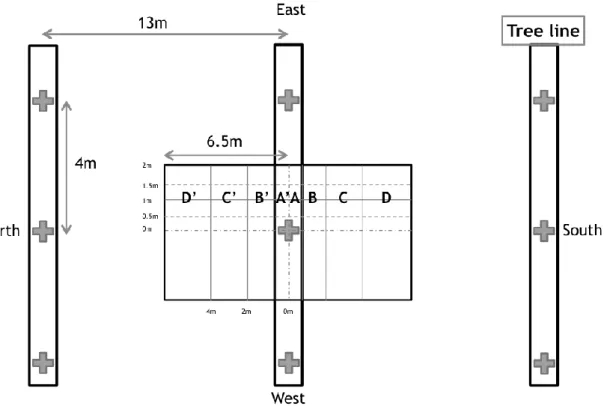
The soils were sampled along a 13-meter transect (6.5 meters on each side of the tree), perpendicular to the tree line, positioned on the first quarter of distance between 2 trees along the line. We sampled in 4 zones on the North side and 4 zones in the South side using the Voronoï diagram sampling design (Figure 1). We divided the 6.5m zone (extending from the tree line to the middle of the intercrop) in 4 sampling zones; zone 1: 0-0.5 m, zone 2 : 0.5-2 m, zone 3 : 2-4 m, zone 4: 4-6.5 m, each interval being one meter wide. There were five replicates in the agroforestry system and five in the monocrop control. Each tree line distance point was compared with the monocrop control.
Figure 1: Soil sampling plan in the agroforestry system. Cross represents walnut tree, 4m spaced, and vertical rectangle represents tree line, 13 m spaced. There are 4 sampling zones on each side of the tree line (A-B-C-D and A’-B’-C’-D’). In each zone we combined 4 soil cores in 1 sample.
To characterize biological and chemical fertility of the sampled soils we measured multiple parameters. In the laboratory we made the following determinations on the topsoils (0 -15 cm :
3rd European Agroforestry Conference – Montpellier, 23-25 May 2016 Tree-crop competition and facilitation (poster)
333
pH, carbon, nitrogen and phosphorus mineralization rates, as well as enzymatic activities (Bell et al., 2013). Peroxydase and phenol-oxidase were assayed by colorimetric methods and β-1,4-glucosidase, cellobiohydrolase, β-1,4-xylosidase, β-1,4-N acetylglucosaminidase, L-leucine amino-peptidase and acid phosphatase by fluorimetric methods. We also used the MicroRespTM (Berard et al., 201 4) method that uses different C and N substrates to evaluate soil microbial respiration. In addition, we conducted quantitative PCR to determine the bacterial-fungal ratio (based on 16S and 18S rRNA fragment amplification), and measured the soil microbial biomass C, N and P with the chloroform fumigation extraction method. We also plan to repeat these measurements over time in the future, and analyses soil nematode communities on some of the future sampling dates.
References:
Bell CW, Fricks BE, Rocca JD, Steinweg JM, McMahon SK, Wallenstein MD (2013) High-throughput Fluorometric Measurement of Potential Soil Extracellular Enzyme Activities. J Vis Exp (81), e50961.
Bérard A, Mazzia C, Sappin-Didier V, Capowiez L and Capowiez Y (2014) Use of the MicroResp™ method to assess Pollution-Induced Community Tolerance in the context of metal soil contamination. Ecological Indicators, 40: 27-33.
Cacho O, (2001) An analysis of externalities in agroforestry systems in the presence of land degradation. Ecological Economy 39: 131-143.
Cardinael R,Chevallier T, Barthès BG, Saby NPA, Théophile Parent T, Dupraz C, Bernoux M, Chenu C (2015) Impact of alley cropping agroforestry on stocks, forms and spatial distribution of soil organic carbon — A case study in a Mediterranean context. Geoderma 259–260 288–299.
Cleveland Cory C and Liptzin D (2007) C:N:P stoichiometry in soil: is there a ‘‘Redfield ratio’’ for the microbial biomass? Biogeochemistry 85:235–252.
Dupraz C, Fournier C, Balvay Y, Dauzat M, Pesteur S, Simorte V (1999) Influence de quatre années de culture intercalaire de blé et de colza sur la croissance de noyers hybrides en agroforesterie. Bois Forêts Des Agric: 95–114
Fanin N, Bertrand I (2015) Aboveground litter quality is a better predictor than belowground microbial communities when estimating carbon mineralization along a land-use gradient, Soil Biology & Biochemistry.
Gaba S, Lescourret F, Boudsocq S, Enjalbert J, Hinsinger P, Journet EP, Navas ML, Wéry J, Louarn G, Malézieux E, Pelzer E, Prudent M, Ozier-Lafontaine H (2015) Multispecies cropping systems as drivers for providing multiple ecosystem services: from concepts to design. Agronomy for Sustainable Development 35: 607-623. Hinsinger P, Betencourt E, Bernard L, Brauman A, Plassard C, Shen J, Tang X, Zhang F (2011) P for two, sharing a
scarce resource – Soil phosphorus acquisition in the rhizosphere of intercropped species. Plant Physiology 156: 1078–1086.
Kaur B, Gupta SR, Singh G (2000). Soil carbon, microbial activity and nitrogen availability in agroforestry systems on moderately alkaline soils in northern India. Applied Soil Ecology 15: 283-294.
Mooshammer M, Wanek W, Zechmeister-Boltenstern S, Richter AA (2014) Stoichiometric imbalances between terrestrial decomposer communities and their resources: mechanisms and implications of microbial adaptations to their resources. Frontiers in Microbiology.
Nair PKR, Kumar BM, Nair VD (2009) Agroforestry as a strategy for carbon sequestration. J Plant Nutr Soil Sci 172: 10–23.
Paudel BR, Udawatta RP, Kremer RJ, Anderson SH ( 2012) Soil quality indicator responses to row crop, grazed pasture, and agroforestry buffer management. Agroforestry Systems, 84: 311-323.
Silva GL, Lima HV, Campanha MM, Gilkes RJ, Oliveira TS (2011) Soil physical quality of Luvisols under agroforestry, natural vegetation and conventional crop management systems in the Brazilian semi -arid region. Geoderma, 167-168, 61-70.
Sinsabaugh RL, Hill BH, Follstad Shah JJ (2009) Ecoenzymatic stoichiometry of microbial organic nutrient acquisition in soil and sediment. Nature 08632 Vol 462.