Publisher’s version / Version de l'éditeur:
Vous avez des questions? Nous pouvons vous aider. Pour communiquer directement avec un auteur, consultez la première page de la revue dans laquelle son article a été publié afin de trouver ses coordonnées. Si vous n’arrivez pas à les repérer, communiquez avec nous à [email protected].
Questions? Contact the NRC Publications Archive team at
[email protected]. If you wish to email the authors directly, please see the first page of the publication for their contact information.
https://publications-cnrc.canada.ca/fra/droits
L’accès à ce site Web et l’utilisation de son contenu sont assujettis aux conditions présentées dans le site LISEZ CES CONDITIONS ATTENTIVEMENT AVANT D’UTILISER CE SITE WEB.
Optica, 7, 1, pp. 35-39, 2020-01-01
READ THESE TERMS AND CONDITIONS CAREFULLY BEFORE USING THIS WEBSITE. https://nrc-publications.canada.ca/eng/copyright
NRC Publications Archive Record / Notice des Archives des publications du CNRC :
https://nrc-publications.canada.ca/eng/view/object/?id=ce9d40c5-7e0b-40eb-a229-40276438a12b
https://publications-cnrc.canada.ca/fra/voir/objet/?id=ce9d40c5-7e0b-40eb-a229-40276438a12b
This publication could be one of several versions: author’s original, accepted manuscript or the publisher’s version. / La version de cette publication peut être l’une des suivantes : la version prépublication de l’auteur, la version acceptée du manuscrit ou la version de l’éditeur.
For the publisher’s version, please access the DOI link below./ Pour consulter la version de l’éditeur, utilisez le lien DOI ci-dessous.
https://doi.org/10.1364/OPTICA.7.000035
Access and use of this website and the material on it are subject to the Terms and Conditions set forth at
Single-shot carrier–envelope-phase measurement in ambient air
Kubullek, M.; Wang, Z.; Von Der Brelje, K.; Zimin, D.; Rosenberger, P.;
Schötz, J.; Neuhaus, M.; Sederberg, S.; Staudte, A.; Karpowicz, N.; Kling, M.
F.; Bergues, B.
Single-shot carrier–envelope-phase measurement
in ambient air
M. Kubullek,
1Z. Wang,
1,2K. von der Brelje,
1D. Zimin,
1,2P. Rosenberger,
1J. Schötz,
1,2M. Neuhaus,
1S. Sederberg,
3A. Staudte,
3N. Karpowicz,
2M. F. Kling,
1,2AND
B. Bergues
1,2,3,*
1Physics Department, Ludwig-Maximilians-Universität Munich, Am Coulombwall 1, 85748 Garching, Germany 2Max-Planck-Institut für Quantenoptik, Hans-Kopfermann-Straße 1, 85748 Garching, Germany
3Joint Attosecond Science Laboratory, National Research Council of Canada and University of Ottawa, Ottawa, Ontario K1A0R6, Canada
*Corresponding author: [email protected]
Received 6 September 2019; revised 8 November 2019; accepted 21 November 2019 (Doc. ID 376734); published 7 January 2020
The ability to measure and control the carrier–envelope phase (CEP) of few-cycle laser pulses is of paramount impor-tance for both frequency metrology and attosecond science. Here, we present a phase meter relying on CEP-dependent photocurrents induced by circularly polarized few-cycle pulses focused between electrodes in ambient air. The new device facilitates compact, single-shot CEP measurements under ambient conditions and promises CEP tagging at repetition rates orders of magnitude higher than most conventional CEP detection schemes, as well as straightforward implementation at longer wavelengths. © 2020 Optical Society of America under the terms of theOSA Open Access Publishing Agreement
https://doi.org/10.1364/OPTICA.7.000035
1. INTRODUCTION
Laser sources for near single-cycle pulses in the near-infrared [1] and infrared [2] developed in the past two decades allow the study of light–matter interactions with a temporal resolution reaching a few tens of attoseconds, well below the period of an optical cycle [3]. One of the keys for achieving such high temporal resolution is the ability to control the carrier–envelope phase (CEP) of the laser pulses. Mathematically, the electric field of a Fourier-limited laser pulse, propagating in the z direction, can be described as
E (t) = E0e
−t2
τ 2
√
1 + ε2 [cos (ωt + φ) , ε sin (ωt + φ) , 0] ,
where E0 is the electric field amplitude, ε the ellipticity, ω the
carrier frequency, τ the pulse duration, and φ the CEP. While the pulse envelope remains rather stable from shot to shot, the CEP is prone to vary due to fluctuations of dispersion, caused by changes in path length, and pump energy experienced by consecu-tive pulses in a pulse train. Fluctuations in the CEP translate into variations in the electric field that hamper shot-to-shot reproduc-ibility of the experimental conditions and deteriorate the temporal resolution.
Therefore, it is of importance to measure and stabilize the CEP accordingly. Several schemes have been devised to measure the CEP. The f -2f technique, for example, relies on the spectral inter-ference of the fundamental and second harmonic of sufficiently broadband fields [4–7]. Recent developments of the technique
towards 100 kHz acquisition rate and beyond include the use of a fast CCD [8], spatial sampling with a grating and a fast photomul-tiplier [9,10], or temporal dispersion with a telecom fiber and fast photodiode detection (TOUCAN) [11]. Still, transposing these techniques to different spectral regions is challenging.
Another well-established and widely used technique in the last decade relies on above-threshold ionizatin (ATI) of rare gas atoms (typically xenon). While the use of ATI was initially pro-posed for both circularly [12] and linearly [13] polarized pulses, its implementation known as the stereo-ATI phase meter [14] relies on time-of-flight (TOF) measurements of rescattered ATI electrons ionized by linearly polarized pulses. This technique has facilitated single-shot CEP measurement [15] at repetition rates up to 100 kHz [16], and has allowed major breakthroughs in the study of field-driven dynamics in atoms [17–20], molecules [21–23], nanostructures [24,25], and solids [26,27]. Despite its great suc-cess, the stereo-ATI phase meter is a rather sophisticated apparatus relying on high-vacuum components and microchannel-plate detectors needed for electron TOF measurements. Additionally, the fast decrease in the rescattering plateau signal with increasing wavelength [28] makes the extension of the stereo-ATI phase meter to longer wavelengths very challenging [29].
Therefore, the development of a more compact, single-shot CEP measurement technique that can be reduced in terms of complexity and extended in its wavelength range (and potentially operate at higher repetition rates than the stereo-ATI phase meter) is highly desirable. It has been demonstrated that strong field exci-tation and ballistic light field acceleration of the conduction band
Fig. 1. (a) Experimental setup. Few-cycle laser pulses are sent through a quarter-wave plate to convert their linear polarization to near circular, and focused into ambient air in the gap between three metal electrodes: two tip-shaped electrodes and a ground electrode. A movable pair of wedges is used to change the dispersion in the beam path. (b) Detailed view of the focus position in the gap between the electrodes. (c) Single-shot current signal flowing between the tips and ground (GND). The signal is integrated over the yellow region.
population in a wide bandgap solid can produce an electric current, whose direction and amplitude relate to the CEP of the laser pulse [30]. These currents can be detected using electronic amplifiers enabling the measurement of the CEP [31]. Single-shot sensitivity has, however, so far not been achieved with this technique.
The use of circularly polarized input pulses offers several advantages over a linearly polarized input [12,32,33]. During strong-field ionization of a single atom in a circularly polarized laser pulse, electrons are preferentially emitted in the polarization plane. When the Coulomb interaction with the ionic core is neglected, their drift momentum is perpendicular to the direction of the maximum electric field. Thus, the CEP can be directly retrieved from the preferred electron emission direction, since in this case it coincides with the angle of the maximum electric field. In general, the emission direction will coincide with the CEP up to a constant offset value [32]. ATI-based CEP measurements using circularly polarized pulses have been simulated [32] and tested experimen-tally [34]. However, the elimination of the TOF measurement with a circular-polarization phase meter (CP phase meter) allows the implementation of much simpler CEP measurement devices, as proposed in the present work. Alternatively, it has been shown that CEP measurements can also be done by sampling the THz pulses emitted from laser-generated ambient air plasma [35–37]. Here, we demonstrate a compact single-shot CP phase meter relying on the measurement of transient electrical currents in ambient air plasma. This new device is potentially the simplest conceivable implementation of the CP phase meter [32]. Combining the advantages of circular polarization and electric detection, it enables a straightforward, single-shot CEP measurement under ambient conditions. The acquisition rate is limited only by the bandwidth of the high-gain electric amplifiers (currently MHz rates). The fact that the concept relies on direct ionization makes it easily extendable to pulses with longer wavelengths with comparable peak intensities.
2. EXPERIMENTAL SETUP
The experimental setup for the single-shot CEP characterization in air is shown in Fig.1(a).
sities of about 2 × 10
a transient current. For each laser pulse, the CEP-dependent direction of the transient current vector is probed by measuring the currents I1and I2 flowing between each of the two tips and
the ground electrode. The currents are amplified by a factor of 107V/A with a transimpedance amplifier. The two amplified
single-shot signals [cf. Fig.1(c)], one for each tip [blue and red cir-cuits in Fig.1(a)], are then integrated using a boxcar integrator. The boxcar DC voltage outputs Q1and Q2, which are proportional to
the charges flowing in the two circuits, are recorded for each laser shot using a data acquisition (DAQ) card.
The laser system used in the present study is a 10 kHz titanium:sapphire chirped-pulse amplification (CPA) system (Spectra Physics, Femtopower HR CEP4) that delivers CEP stable (down to ca. 100 mrad rms [8]) pulses with 700 µJ pulse energy, sub-25 fs pulse duration, and a central wavelength of about 780 nm. The output pulses are spectrally broadened in a gas-filled hollow-core fiber and compressed with a combination of chirped mirrors and fused silica wedges to sub-two-cycle duration, typi-cally 4 fs (FWHM intensity envelope). The central wavelength is 750 nm. Pulses with an energy of about 100 µJ are sent through a broadband quarter-wave plate to convert their polarization from linear to near circular (ε = 0.84) and are focused in between the electrodes with a spherical silver mirror ( f = 350 mm). The CEP is controlled by changing the dispersion in the stretcher of the CPA multi-pass amplifier.
3. RESULT
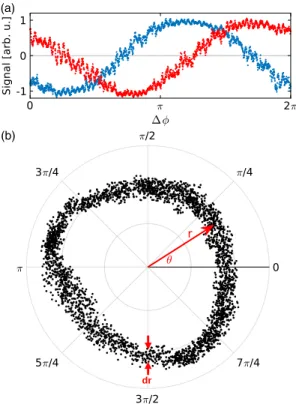
The measured signals Q1and Q2are plotted in Fig.2(a)for a series
of 1650 consecutive laser shots, recorded while linearly changing the CEP from 0 to 2π .
Both signals were centered by subtraction of the CEP averaged value and normalized in amplitude. Note that both the offset sub-traction and the normalization do not require a stable CEP and can be performed in the same way for a pulse sequence with a randomly fluctuating CEP. The CEP-dependent signals Q1and Q2oscillate
out of phase with a phase shift of 92◦, close to what is expected for
perfect positioning of the laser focus, where the angle between the lines connecting the injection point with the two electrodes spans 90◦[32].
As for stereo-ATI phase meter measurements, Q1 and Q2
can be plotted parametrically as a function of their polar angles θ = arctan 2(Q2,Q1)and r =p Q21+ Q22 [see Fig. 2(b)]. The
quantity dr /r = 0.107 rad provides a lower limit for the uncer-tainty of the measurement in Fig.2(b)[38]. While the CEP is a monotonic function φ(θ ) of the polar angle θ in the parametric plot in Fig.2(b), this function is not necessarily linear. Deviation from a linear relation may have different causes, including a slight ellipticity of the input pulse polarization, and a focus that is not perfectly centered in the gap. This is analogous to the stereo-ATI phase meter, where the shape of the parametric plot depends on the exact experimental conditions such as the position of the TOF integration gates [38]. Fortunately, in either case, the exact shape of the parametric plot is not important for the measurement, as
(b) (a)
Fig. 2. (a) Single-shot signal Q1 (blue) and Q2(red) recorded while
linearly scanning the CEP from 0 to 2π . (b) Single-shot parametric plot recorded while scanning the CEP from 0 to 2π and back. The standard deviation dr of the radius is indicated by the two red arrows.
the CEP can be retrieved from the polar angle via a rebinning pro-cedure [15]. The latter relies on the assumption that all CEP values are equally probable within the CEP scan, which is well fulfilled in the present experiment. The dependence of the CEP on the polar angle is then simply obtained by sorting the polar angles in ascending order over the range of the scan and mapping them onto a linear CEP interval from −π to π. Note that the retrieved CEP is determined up to a constant offset, which, for the sake of clarity, is ignored in the following discussions.
In order to determine the precision of the measurement, we compare in Fig.3(a)the retrieved CEP to its nominal value, which (for a perfectly stable CEP) is inferred from the known dispersion introduced in the stretcher. The latter is varied as a triangular function of time to generate a uniform CEP distribution between −π and π . The calibration function φ(θ ) was determined for each oscillation period of the triangular waveform with the method described above. An upper limit for the uncertainty of the mea-surement is calculated as the standard deviation of the difference between the measured and the nominal CEP curves [shown in Fig.3(b)]. For the data in Fig. 2(b), we obtain an upper limit of 206 mrad. On longer time scales, the accuracy evolves from 211 mrad on the time scale of a few seconds [data of Fig.3(a)] to 356 mrad for an acquisition time of one minute. The limited mea-surement accuracy on long time scales arises mainly from the beam pointing fluctuations, which are critical considering the small (∼ 90 µm) gap size between the electrodes. Operation over longer time scales would require a better beam stabilization scheme.
Even though the stability of the measurement and the signal-to-noise ratio can still be improved, the performance of the new CP phase meter is already comparable to that of the stereo-ATI phase meter. Importantly, the sensitivity of the measurement increases
Fig. 3. (a) Measured CEP while sweeping it with a triangular function from −π to π. The dashed red line was obtained by fitting the constant phase of the 3 Hz triangle function to the data points. (b) Difference between the fitted and measured triangular wave. The blue line represents the averaged value over 100 ms.
Fig. 4. Lower panels: raw single-shot signals (gray scatter plots) and averaged signal (solid lines) recorded while linearly changing the amount of dispersive material in the beam path. The signals exhibit a phase shift close to 90◦, indicated by the dashed lines. Upper panel: Fourier-limited
pulse (3.5 fs intensity FWHM) calculated from the measured laser spec-trum (center) and simulated pulses after propagation through 200 µm less (left) or 200 µm more (right) fused silica (9.3 fs intensity FWHM).
towards shorter pulse duration, while still supporting measure-ments with chirped six-cycle (10 fs) pulses. This is illustrated in Fig.4, where the signals Q1and Q2are plotted as a function of the
pulse propagation distance through glass (see alsoSupplement 1). The most important asset of the new technique, besides its striking simplicity, is its potential for single-shot CEP measure-ments at much higher repetition rates than achievable with today’s techniques. Unlike the stereo-ATI phase meter, which is intrin-sically limited to a few hundred kHz by TOF measurement, the new technique, is limited only by the gain-bandwidth product of the amplifier. Given the 2 µs duration of the amplified current signal [cf. Fig.1(c)], the technique can be readily implemented at more than 100 kHz with commercially available integrators. For an implementation at multi-MHz repetition rates, possible
meter, which enables single-shot CEP measurement with a preci-sion of about 200 mrad. While the performance of our prototype is comparable to that of the widespread stereo-ATI phase meter, its complexity is dramatically reduced since it consists only of a centimeter-sized setup that works in ambient air. Since the mea-surement rate is limited only by the bandwidth of the current amplifier, the technique can easily be applied at a repetition rate of 100 kHz and beyond. In addition, since the CP phase meter does not rely on the rescattering process, it is also applicable at longer wavelengths. The new technique thus represents an appealing alternative to the rather complex high-vacuum apparatus used nowadays for single-shot CEP detection.
Funding. Deutsche Forschungsgemeinschaft (KL-1439/11-1, SFB NOA); Max-Planck-Gesellschaft (MP Fellow program). Acknowledgment. We thank Hartmut Schröder, Matthias Kübel, Aleksey Korobenko, Kyle Johnston, and Valentina Shumakova for fruitful discussions and are grateful for support by David Villeneuve, Paul Corkum, and Ferenc Krausz.
Disclosures. The authors declare no conflicts of interest. SeeSupplement 1for supporting content.
REFERENCES
1. M. Nisoli, S. D. Silvestri, O. Svelto, R. Szipöcs, K. Ferencz, C. Spielmann, S. Sartania, and F. Krausz, “Compression of high-energy laser pulses below 5 fs,”Opt. Lett.22, 522–524 (1997).
2. X. Gu, G. Marcus, Y. Deng, T. Metzger, C. Teisset, N. Ishii, T. Fuji, A. Baltuska, R. Butkus, V. Pervak, H. Ishizuki, T. Taira, T. Kobayashi, R. Kienberger, and F. Krausz, “Generation of carrier-envelope-phase-stable 2-cycle 740 µj pulses at 2.1 µm carrier wavelength,” Opt. Express17, 62–69 (2009).
3. A. Baltuška, T. Udem, M. Uiberacker, M. Hentschel, E. Goulielmakis, C. Gohle, R. Holzwarth, V. S. Yakovlev, A. Scrinzi, T. W. Hänsch, and F. Krausz, “Attosecond control of electronic processes by intense light fields,”Nature421, 611–615 (2003).
4. R. Holzwarth, T. Udem, T. W. Hänsch, J. C. Knight, W. J. Wadsworth, and P. St. J. Russell, “Optical frequency synthesizer for precision spectros-copy,”Phys. Rev. Lett.85, 2264–2267 (2000).
5. J. Reichert, R. Holzwarth, T. Udem, and T. W. Hänsch, “Measuring the frequency of light with mode-locked lasers,”Opt. Commun.172, 59–68 (1999).
6. H. R. Telle, G. Steinmeyer, A. E. Dunlop, J. Stenger, D. Sutter, and U. Keller, “Carrier-envelope offset phase control: a novel concept for abso-lute optical frequency measurement and ultrashort pulse generation,”
Appl. Phys. B69, 327–332 (1999).
7. L. Xu, C. Spielmann, A. Poppe, T. Brabec, F. Krausz, and T. W. Hänsch, “Route to phase control of ultrashort light pulses,”Opt. Lett.21, 2008– 2010 (1996).
8. F. Lücking, V. Crozatier, N. Forget, A. Assion, and F. Krausz, “Approaching the limits of carrier-envelope phase stability in a millijoule-class amplifier,”Opt. Lett.39, 3884–3887 (2014).
9. S. Koke, C. Grebing, B. Manschwetus, and G. Steinmeyer, “Fast f-to-2f interferometer for a direct measurement of the carrier-envelope phase drift of ultrashort amplified laser pulses,”Opt. Lett. 33, 2545–2547 (2008).
(2019).
12. P. Dietrich, F. Krausz, and P. B. Corkum, “Determining the absolute car-rier phase of a few-cycle laser pulse,”Opt. Lett.25, 16–18 (2000). 13. G. G. Paulus, F. Grasbon, H. Walther, P. Villoresi, M. Nisoli, S. Stagira, E.
Priori, and S. De Silvestri, “Absolute-phase phenomena in photoioniza-tion with few-cycle laser pulses,”Nature414, 182–184 (2001).
14. G. G. Paulus, F. Lindner, H. Walther, A. Baltuška, E. Goulielmakis, M. Lezius, and F. Krausz, “Measurement of the phase of few-cycle laser pulses,”Phys. Rev. Lett.91, 253004 (2003).
15. T. Wittmann, B. Horvath, W. Helml, M. G. Schätzel, X. Gu, A. L. Cavalieri, G. G. Paulus, and R. Kienberger, “Single-shot carrier-envelope phase measurement of few-cycle laser pulses,”Nat. Phys.5, 357–362 (2009). 16. D. Hoff, F. J. Furch, T. Witting, K. Rühle, D. Adolph, A. M. Sayler, M. J. J.
Vrakking, G. G. Paulus, and C. P. Schulz, “Continuous every-single-shot carrier-envelope phase measurement and control at 100 kHz,”Opt. Lett.
43, 3850–3853 (2018).
17. B. Bergues, M. Kübel, N. G. Johnson, B. Fischer, N. Camus, K. J. Betsch, O. Herrwerth, A. Senftleben, A. M. Sayler, T. Rathje, T. Pfeifer, I. Ben-Itzhak, R. R. Jones, G. G. Paulus, F. Krausz, R. Moshammer, J. Ullrich, and M. F. Kling, “Attosecond tracing of correlated electron-emission in non-sequential double ionization,”Nat. Commun.3, 813 (2012).
18. M. S. Schöffler, X. Xie, P. Wustelt, M. Möller, S. Roither, D. Kartashov, A. M. Sayler, A. Baltuska, G. G. Paulus, and M. Kitzler, “Laser-subcycle control of sequential double-ionization dynamics of helium,”Phys. Rev. A93, 063421 (2016).
19. B. Bergues, M. Kübel, N. G. Kling, C. Burger, and M. F. Kling, “Single-cycle non-sequential double ionization,” IEEE J. Sel. Top. Quantum Electron.21, 1–9 (2015).
20. M. Kübel, C. Burger, N. G. Kling, T. Pischke, L. Beaufore, I. Ben-Itzhak, G. G. Paulus, J. Ullrich, T. Pfeifer, R. Moshammer, M. F. Kling, and B. Bergues, “Complete characterization of single-cycle double ionization of argon from the nonsequential to the sequential ionization regime,”
Phys. Rev. A93, 053422 (2016).
21. A. S. Alnaser, M. Kübel, R. Siemering, B. Bergues, N. G. Kling, K. J. Betsch, Y. Deng, J. Schmidt, Z. A. Alahmed, A. M. Azzeer, J. Ullrich, I. Ben-Itzhak, R. Moshammer, U. Kleineberg, F. Krausz, R. de Vivie-Riedle, and M. F. Kling, “Subfemtosecond steering of hydrocarbon deprotona-tion through superposideprotona-tion of vibradeprotona-tional modes,”Nat. Commun.5, 3800 (2014).
22. S. Miura, T. Ando, K. Ootaka, A. Iwasaki, H. Xu, T. Okino, K. Yamanouchi, D. Hoff, T. Rathje, G. G. Paulus, M. Kitzler, A. Baltuška, G. Sansone, and M. Nisoli, “Carrier-envelope-phase dependence of asymmetric C–D bond breaking in C2D2in an intense few-cycle laser field,”Chem. Phys.
Lett.595-596, 61–66 (2014).
23. M. Kübel, R. Siemering, C. Burger, N. G. Kling, H. Li, A. S. Alnaser, B. Bergues, S. Zherebtsov, A. M. Azzeer, I. Ben-Itzhak, R. Moshammer, R. de Vivie-Riedle, and M. F. Kling, “Steering proton migration in hydrocar-bons using intense few-cycle laser fields,”Phys. Rev. Lett.116, 193001 (2016).
24. F. Süßmann, S. Zherebtsov, J. Plenge, N. G. Johnson, M. Kübel, A. M. Sayler, V. Mondes, C. Graf, E. Rühl, G. G. Paulus, D. Schmischke, P. Swrschek, and M. F. Kling, “Single-shot velocity-map imaging of attosecond light-field control at kilohertz rate,”Rev. Sci. Instrum.82, 093109 (2011).
25. F. Süßmann, L. Seiffert, S. Zherebtsov, V. Mondes, J. Stierle, M. Arbeiter, J. Plenge, P. Rupp, C. Peltz, A. Kessel, S. A. Trushin, B. Ahn, D. Kim, C. Graf, E. Rühl, M. F. Kling, and T. Fennel, “Field propagation-induced directionality of carrier-envelope phase-controlled photoemission from nanospheres,”Nat. Commun.6, 7944 (2015).
26. D. Kormin, A. Borot, G. Ma, W. Dallari, B. Bergues, M. Aladi, I. B. Földes, and L. Veisz, “Spectral interferometry with waveform-dependent rela-tivistic high-order harmonics from plasma surfaces,”Nat. Commun.9, 4992 (2018).
27. A. Kessel, V. E. Leshchenko, O. Jahn, M. Krüger, A. Münzer, A. Schwarz, V. Pervak, M. Trubetskov, S. A. Trushin, F. Krausz, Z. Major,
and S. Karsch, “Relativistic few-cycle pulses with high contrast from picosecond-pumped OPCPA,”Optica5, 434–442 (2018).
28. P. Colosimo, G. Doumy, C. I. Blaga, J. Wheeler, C. Hauri, F. Catoire, J. Tate, R. Chirla, A. M. March, G. G. Paulus, H. G. Muller, P. Agostini, and L. F. DiMauro, “Scaling strong-field interactions towards the classical limit,”Nat. Phys.4, 386–389 (2008).
29. Y. Zhang, P. Kellner, D. Adolph, D. Zille, P. Wustelt, D. Würzler, S. Skruszewicz, M. Möller, A. M. Sayler, and G. G. Paulus, “Single-shot, real-time carrier-envelope phase measurement and tagging based on stereographic above-threshold ionization at short-wave infrared wavelengths,”Opt. Lett.42, 5150–5153 (2017).
30. A. Schiffrin, T. Paasch-Colberg, N. Karpowicz, V. Apalkov, D. Gerster, S. Mühlbrandt, M. Korbman, J. Reichert, M. Schultze, S. Holzner, J. V. Barth, R. Kienberger, R. Ernstorfer, V. S. Yakovlev, M. I. Stockman, and F. Krausz, “Optical-field-induced current in dielectrics,”Nature493, 70–74 (2012).
31. T. Paasch-Colberg, A. Schiffrin, N. Karpowicz, S. Kruchinin, Ö. Saglam, S. Keiber, O. Razskazovskaya, S. Mühlbrandt, A. Alnaser, M. Kübel, V. Apalkov, D. Gerster, J. Reichert, T. Wittmann, J. V. Barth, M. I. Stockman, R. Ernstorfer, V. S. Yakovlev, R. Kienberger, and F. Krausz, “Solid-state light-phase detector,”Nat. Photonics8, 214–218 (2014).
32. B. Bergues, “The circular-polarization phase-meter,”Opt. Express20, 25317–25324 (2012).
33. S. Fukahori, T. Ando, S. Miura, R. Kanya, K. Yamanouchi, T. Rathje, and G. G. Paulus, “Determination of the absolute carrier-envelope phase
by angle-resolved photoelectron spectra of Ar by intense circularly polarized few-cycle pulses,”Phys. Rev. A95, 053410 (2017).
34. D. A. Debrah, G. A. Stewart, G. Basnayake, J. W. G. Tisch, S. K. Lee, and W. Li, “Direct in-situ single-shot measurements of the absolute carrier-envelope phases of ultrashort pulses,”Opt. Lett.44, 3582–3585 (2019). 35. M. Kreß, T. Löffler, M. D. Thomson, R. Dörner, H. Gimpel, K. Zrost,
T. Ergler, R. Moshammer, U. Morgner, J. Ullrich, and H. G. Roskos, “Determination of the carrier-envelope phase of few-cycle laser pulses with terahertz-emission spectroscopy,”Nat. Phys.2, 327–331 (2006). 36. J. Dai, N. Karpowicz, and X.-C. Zhang, “Coherent polarization control of
terahertz waves generated from two-color laser-induced gas plasma,”
Phys. Rev. Lett.103, 023001 (2009).
37. Y. Bai, C. Li, P. Liu, R. X. Li, R. J. Xu, H. Yang, Z. N. Zeng, H. H. Lu, G. Y. Hu, A. L. Lei, Y. X. Leng, and Z. Z. Xu, “Characterizing the polarity of a few-cycle infrared laser pulse,”Appl. Phys. B106, 45–49 (2012). 38. M. Kübel, K. J. Betsch, N. G. Johnson, U. Kleineberg, R. Moshammer,
J. Ullrich, G. G. Paulus, M. F. Kling, and B. Bergues, “Carrier-envelope-phase tagging in measurements with long acquisition times,”New J. Phys.14, 093027 (2012).
39. X.-L. Liu, X. Lu, J.-L. Ma, L.-B. Feng, X.-L. Ge, Y. Zheng, Y.-T. Li, L.-M. Chen, Q.-L. Dong, W.-M. Wang, Z.-H. Wang, H. Teng, Z.-Y. Wei, and J. Zhang, “Long lifetime air plasma channel generated by femtosecond laser pulse sequence,”Opt. Express20, 5968–5973 (2012).