APPLICATION OF SIGNAL ANALYSIS TECHNIQUES TO CARDIAC ARRHYTHMIA DETECTION AND CLASSIFICATION
by
JYH-YUN WANG
B.S. in Physics, Fu Jen University, Taiwan 1970
M.S. in Physics, Northeastern University 1973
SUBMITTED IN PARTIAL FULFILLMENT OF THE REQUIREMENTS FOR THE DEGREE OF
MASTER OF SCIENCE
at the
MASSACHUSETTS INSTITUTE OF TECHNOLOGY January, 1976
Signature of Author 6A
Department of Aeronautics and Astronautics, January 26, 1976
Certified b
Accepted by
Thesis Supervisor
A
s -/
Chairman, Departmental Graduate Committee
APPLICATION OF SIGNAL ANALYSIS TECHNIQUES TO CARDIAC ARRHYTHMIA DETECTION AND CLASSIFICATION
by
Jyh-Yun Wang
Submitted to the Department of Aeronautics and Astronautics on January 26, 1976, in partial fulfillment of the requirement for the degree of Master of Science.
ABSTRACT
A completely new approach to develop an automated program for rhythm ana-lysis of electrocardiograms and vectorcardiograms using powerful statistical techniques of sequential estimation and detection theory is studied. The underlying cardiac rhythms are modeled as outputs of low-order linear sto-chastic dynamical systems. The relatively predictable persistent cardiac rhythms are detected and classified by using a multiple model hypothesis testing technique. Detection and classification of the relatively unpre-dictable transient cardiac arrhythmias are performed using a generalized likelihood ratio technique. Both the multiple model hypothesis testing and the generalized likelihood ratio identification techniques are tested extensively on a variety of actual data which includes normal sinus rhythm, bigeminy, trigeminy, PVC, PAC, dropped beat, SA block, tachycardia burst, multiple PVC, and slowing of heart rate. The results indicate that these cardiac events can be identified with great accuracy.
Thesis Supervisor: Alan S. Willsky, Ph.D.
Title: Assistant Professor of Electrical Engineering
-2-I
ACKNOWLEDGMENTS
The author wishes to express his appreciation to his thesis advisor, Professor Alan S. Willsky, for his continued encouragement and constructive advice and comments throughout his thesis research. The author is particularly grateful to Dr. Donald E. Gustafson of the Charles Stark Draper Laboratory, for introducing him to this program and for providing continued assistance, support and encouragement. It was a great pleasure to work with them.
Special thanks go to Colonel M. Lancaster and his other associates at the United States Air Force School of Aerospace Medicine for giving their support and advice on medical matters, and for providing electro-cardiographic records.
Finally, the author wishes to acknowledge the Charles Stark Draper Laboratory whose personnel and facilities contributed greatly to this work.
This thesis was prepared under CSDL Projects 52-65700 and 52-70000, sponsored by the United States Air Force School of Aerospace Medicine through contracts F41609-75-C-0013 and F41609-76-C-0004.
The publication of this work does not constitute approval by the United States Air Force or the Charles Stark Draper Laboratory of the findings or conclusions contained therein. It is published only for the exchange and stimulation of ideas.
TABLE OF CONTENTS
Chapter Page
1
INTRODUCTION 61.1 Principle of Electrocardiography 6 1.2 Computer-Aided Analysis of the Electrocardiogram 9
1.2.1 Background 9
1.2.2 Historical Review 12
1.3 Methods of Approach 15
1.4 Synopsis of Following Chapters 18
2 DATA PREPROCESSING 20
2.1 Baseline Removal 20
2.2 Fiducial Point Detection for the QRS Complex 22 2.3 Algorithm for Fiducial Point Detection 24
2.4 Experiments and Results 28
3 CATEGORIZATION OF CARDIAC ARRHYTHMIAS 48
3.1 Introduction 48
3.2 Persistent Rhythms 49
3.3 Transient Events 51
4 STATISTICAL ANALYSIS OF R-R INTERVAL DATA 55
4.1 Introduction 55
4.2 Analysis 55
4.2.1 Histogram, Sample Mean and Sample
Variance 55
4.2.2 Running Mean and Running Variance 58 4.2.3 Sliding Window Mean, Variance, 61
and Outlier Test
4.2.4 Correlation Functions and Scatter Diagram 64
4.3 Experiments and Results 70
5 DYNAMICAL MODELLING OF CARDIAC RHYTHMS BASED ON THEIR 159 R-R INTERVAL CHARACTERISTICS
5.1 Introduction 159
5.2 Dynamical Models for Persistent Rhythms 160 5.3 Dynamical Models for Transient Rhythms 167
Chapter
6 DETECTION AND CLASSIFICATION OF PERSISTENT 172 RHYTHMS
6.1 The Multiple Model Hypothesis Testing
Technique 172
6.2 The Multiple Model Hypothesis Testing 177 Algorithm
6.3 Experiments and Results 186
7 DETECTION AND CLASSIFICATION OF TRANSIENT 254 RHYTHMS
7.1 Generalized Likelihood Ratio Technique 254 7.2 Derivation of GLR Equations
7.2.1 Derivation of Rhythm Signatures 257 7.2.2 Derivation of Likelihood Ratios
and Jump Estimates 264
7.3 Additional Considerations for GLR 273
Computations
7.3.1 GLR Window Width 273
7.3.2 Filter Initialization 275
7.4 Experiments and Results 277
8 CONCLUSIONS AND RECOMMENDATIONS 359
References 365
CHAPTER 1 INTRODUCTION 1.1 Principle of Electrocardiography
It has been known for many years that a measurable amount of potential variations within the electrical field on the body surface is associated with the electrical activity of the heart. As early as
1887, Ludwig and Waller [1] experimented with the capillary electro-scope and recorded this electromotive force from the precordium. In
1899, Wenckebach [2] employed the polygraph to make simple but precise observations of the electrical events of atrial and ventricular acti-vation. Einthoven's description [3], in 1903, of the string galvano-meter for recording the potential variations, stimulated a sudden increase in both clinical and experimental studies of electrocardio-graphy. This type of galvanometer has remained one of the most
frequently used recording method because of its simplicity and porta-bility,although other principles, such as the use of vacuum tube
amplification, have been applied. Recording the potential difference between any two points on the body surface is accomplised by means of electrode from which the current is conducted to the galvanometer of the electrocardiograph via the lead wire, to be returned to the body
by way of a second lead wire and its electrode. In clinical practice twelve leads are usually recorded routinely: (1) three bipolar
extremity leads (standard limb leads), (2) three unipolar extremity leads, and (3) six unipolar precordial chest leads [4]. Using this standard twelve-lead system, the resulting potential difference record is called the Electrocardiogram (ECG).
Biophysical models of the heart and factor analysis of surface potentials have shown that the electrical effects on the surface of the body can largely be accounted for by a single equivalent electrical dipole free to rotate in three dimensions [51-[7]. Under suitable homogeneity assumptions, the components of this equivalent dipole can be estimated by measuring three potential differences in perpendicular directions on the surface of the body, or by resolving non-orthogonal measurements. In practice, the Frank orthogonal lead system which consists of seven leads resolved along mutually orthogonal axes [8],
is the most commonly used for this purpose. A record obtained by the use of this lead system is called a Vectorcardiogram (VCG).
While many differences occur in various leads from the same
subject, and different persons yield distinctive curves, they all tend to conform to a common pattern illustrated in Figure 1.1. The normal electrocardiogram of a cardiac cycle consists of a series of waves arbitrarily designated by Einthoven as the P wave, the QRS complex, and the T wave. When the heart is at rest the electrocardiogram
dis-R
T P
Q
S
plays a straight horizontal line, the so-called iso-electric line or baseline. This baseline represents a constant direct current value produced by the recording device. Alternating current developed with myocardial activity is superimposed upon this baseline and is recorded as upward (positive) or downward (negative) deflections. The baseline may be shifted whenever there is movement of electrodes or a sudden change in skin resistance. In such a case the electrocardio-graphic signal is superimposed upon the baseline variations.
The P wave represents the depolarization wave of the auricular musculature which spreads radially from the sinoauricular (SA) node to the atrioventricular (AV) node. There is a delay in transmission of the impulse at the AV node, represented on the electrocardiogram by the P-R segment. The QRS complex is the depolarization of the ventri-cular musculature. It consists, usually, of an initial downward deflec-tion, the 0 wave, an initial upward deflecdeflec-tion, the R wave, and an
initial downward deflection after the R wave, the S wave. The T wave represents the ventricular repolarization and follows the QRS complex with a delay, the S-T segment, which represents, roughly, the duration of the excited state of the ventricular musculature, or the interval of time between completion of depolarization and the beginning of repolarization of the ventricular musculature (9].
Under pathological conditions the electrocardiogram undergoes some characteristic changes. The various resulting abnormalities in the electrocardiogram may be divided into two groups:
(1) disturbances in the cardiac rhythm, and (2) changes in the
waveform are more or less related to the specific pathological process and its location in the heart, and thus, can be used to describe the state of the working muscle masses. The abnormalities in the order of the heart beat, known as cardiac arrhythmias, yields information concerning the sites and rates of cardiac pacemakers and the impulse propagation through the cardiac conduction system [9]. The electro-cardiogram is the instrument "par excellence" in the diagnosis of the following clinical conditions: myocardial infection, atrial and ventricular hypertrophy, arrhythmias, pericarditis and systemic diseases which affect the heart. A complete analysis of the electrocardiogram should include both the rhythm analysis and the waveform analysis.
1.2 Computer-Aided Analysis of the Electrocardiogram 1.2.1 Background
Due to the high cost of labor, and the large amount of ECG/VCG records to be analyzed, the time available to the interpreting cardio-logist is too limited for taking a multitude of measurements. In addition, due to the limited precision of hand measuring, which does not exceed 0.05 mm, and lack of well-defined criteria for determining the onset and end of waves especially in cases when waves are of low amplitude and have gradual slope, cardiologists are known to differ frequently in their measuring of electrocardiographic events. It is difficult to correlate mentally large numbers of ECG/VCG parameters, and extensive hand calculations for making use of efficient statistical classification techniques are also too time-consuming to be practical.
Careful studies have been made to assess the human variability in ECG interpretation. In one study, the results showed that in
repeated observations of one ECG the same cardiologist did not agree with his own diagnostic statements in 20% of the time, and different
cardiologists did not agree with each other in nearly 25% of the
statements [10]. Another study showed that 7 cardiologists completely agreed in only 28 out of 100 ECG's [11].
The advent of modern computer techniques changed this situation drastically. The unique ability of computers to perform a large number of numerical computations in a very short period of time enables one to apply a variety of mathematical operations for analyzing ECG/VCG records. ECG/VCG analysis from its engineering aspect is also an ideal field for automation. Some of the advantages of using computer-aided analysis of ECG/VCG are given in the following:
(1) Short-term and long-term cost saving.
(2) It become feasible and practical to obtain any number of ECG/VCG measurements. For instance, the slope of the wave at every point can be easily computed. Whether the signals are complex or simple, the measurements will be remarkably precise compared to those obtained manually.
(3) Best utilization of information already available on the scalar or vector electrocardiograms is obtained. Using high fidelity recording equip-ment, the computer can store and repeat the electrical signals of cardiogram; eliminating noise, interference, and other confusing artifacts which present difficulties in analysis.
(4) Application of complex statistical classification procedures no longer represent a limiting factor
(5) It is feasible to perform mass screening of large population groups which is absolutely necessary for the study and control of heart diseases.
Although the computer-aided analysis of ECG/VCG is an attractive one, problems do exist:
(1) In contrast to the human interpreter who possesses high pattern recognition capa-bility, the computer finds this one of the most difficult operations to perform. (2) The tremendous amount of variation that
occurs among subjects, which we would like to classify into the same class, makes it very difficult to invent prac-tical rules that include all instances. (3) For a computer-aided ECG/VCG analysis
pro-gram, the instructions must be listed in an orderly manner and followed precisely during interpretation. In contrast to this orderly, predetermined logical process, the human interpreter has the opportunity to review the record for any amount of time limited only by his own needs. He may review the data randomly, and even correct his initial diagnosis subject to further reviews.
(4) It is very difficult for the computer to identify the P waves, which have low am-plitude and gradual slope, and thus may be buried in noise or masked by ventricular activity. This is also true of other
1.2.2 Historical Review
The concept of computerized analysis of the ECG/VCG is not new. The requirements for practical clinical applications of such programs include two parts: (1) analysis of cardiac rhythm, and (2) analysis of the contour or waveform of the complexes. Starting in the late 1950's there have been numerous efforts to automate the analysis of
ECG/VCG's, resulting in many computer-aided programs for ECG/VCG ana-lysis being used and developed [12]-[27]. Pattern recognition in these programs are almost exclusively done using a heirarchical com-puter logic structure. Much time is spent checking validity of the data, correcting measurement errors, and extrapolating for missing data. These tests are deterministic in that specific thresholds are
set for the various tests, rather than statistical, wherein probabi-listic statements are given based on statistical models of the temporal patterns. Thus, these schemes involve very complex logic structure which are difficult to debug and to modify. Another drawback in using
the logic tree structure is the limitation of the rhythm analysis
program in their assignment of severity levels. For example, arbitrary terms such as "severe", "mild", and "regular" are used. Thus, in
spite of the amount of wo'rk done on this problem, the problem of com-puter-aided analysis of ECG/VCG is not yet completely solved.
Recent comparative studies on the performance of the available programs have indicated that the IBM program was the best overall [28]. On an overall basis, the program had a detection rate of 94.6% on a total of 1150 waveforms tested. However, the rate of correct identi-fication was lower than this detection rate, because some of the arrhythmias detected by the program were assigned to "undetermined
rhythm" by the final identification logic. The program performed even worst on ventricular arrhythmias, for which the detection rate was only 86%. In the reproducibility study, the results showed that using two different digital representations of the same analog ECG record, the output rhythm statements generated by this program did not agree with each other about 10% of the time. It would appear that available programs are too highly tuned in that some features used
for diagnosis actually contain more noise than information.
In more recent years, a variety of statistical analysis procedures for ECG/VCG analysis were studied to improve the performance of de-tection and classification for arrhythmias. Gersch, et al. [29),[30] transformed a sequence of 100 or 200 R-R intervals into a three-symbol
(namely, short, regular, and long R-R interval) Markov chain sequence. The probability that the observed sequence was generated by each set of prototype models characteristic of different arrhythmia classes, was computed. That prototype corresponding to the largest probability of generating the observed sequence was classified as the disorder.
The disorders considered were atrial fibrillation, PVC and PAC, bige-miny, sinus tachycardia with occasional bigeminy , sinus tachycardia,
and ventricular tachycardia. Tests of this approach on patients with atrial fibrillation (AF) and atrial fibrillation with occasional PVC's (AFOCC) showed that 4 out of 15 AF records were misclassified as AFOCC using 200 heart-beats. The performance was worst when using 100 heat-beats. Pipberger, et al. [31] applied linear discriminat function analysis to training and independent sets of three common arrhythmias (namely, normal sinus rhythm, sinus rhythm plus premature beats, and atrial fibrillation) using R-R interval information only.
On an overall basis, this approach correctly classified 85% of the records tested. The performance for the premature beat classification was the worst, for which a correct identification rate of only 66% was obtained.
All the above statistical analysis procedures for classification have used fixed sample tests. Among the problems with a fixed sample test is the -possibility that if the sample size is too large then a transient phenomenon may go undetected due to the large number of normal beats used in the average. Tsui and Wong [32] studied the
feasibility of utilizing Wald's sequential probability test in cardiac rhythm classification. It has provisions for controlling error rate
than sample size. The expected number of observations under pairwise testing of three selected rhythm classes (atrial fibrillation, normal sinus rhythm, and premature atrial and ventricular contractions) as a function of error rate were shown. However, no test of this approach on actual ECG data was given.
It is important to point out that, on an overall basis, arrhythmias were the greatest source of program errors of the three programs
tested (IBM-1971, PHS-D, Mayo-1968) by Bailey, et al. [28]. The im-portance of the identification of arrhythmias is further underlined by the increasing recognition of the role of arrhythmias as a cause of sudden death [33]. Further, the reproducibility results of Bailey, et al. indicate that more robust computer algorithms are needed, and the statistical results suggest that more powerful statis-tical techniques should be used. These facts have provided much of the motivation for the work of developing an automated detection and classification program for rhythm analysis of ECG/VCG studied here.
-14-1.3 Methods of Approach
The problem of automated arrhythmia analysis is, simply put, the problem of adequately reproducing the pattern recognition capabilities of the cardiologist. This problem may be only partially solvable, given the complexity of human pattern recognition capabilities and the
limitations of even the most advanced computers. It seems fair to say that, given the exact timing of P waves and QRS complexes, together with gross descriptions of these waveforms, that arrhythmia diagnosis would be considerably simplified, since the electrophysiological
me-chanisms responsible for a large number of arrhythmia patterns have been described satisfactorily [34]. Theoretically at least, powerful
pattern recognition techniques could then be brought to bear on the problem.
The techniques proposed in this research for arrhythmia detection and classification explicitly take into account uncertainties within each arrhythmia class in a systematic manner by using the very powerful statistical techniques of modern estimation and detection theory.
This approach differs significantly from previous approaches to rhythm analysis in three ways; (1) the underlying rhythms are modeled as outputs of linear stochastic dynamical systems (2) rhythm classifi-cation will be done by hypothesis testing to find the most likely operating system, (3) unpredicted disturbances will be detected using a generalized likelihood ratio technique. Thus, the emphasis is on
statistical modeling and testing of the data.
This approach has several advantages. First, since beat-to-beat variations are present and the wave intervals are never exactly regular, uncertainty has to be accommodated in any rhythm analysis scheme.
This can best be done by first obtaining detailed statistical infor-mation from actual data, which is readily available and quite exten-sive. Given a comprehensive statistical analysis of such data, it is natural to attempt to use it in the best possible manner. This can be done, for example, by trying to match the data to some dynamical model. Thus, if extensive correlation data were available and diagnostically significant, it would be feasible to construct dynamical models with the identical correlation characteristics. One can then bring the powerful techniques of sequential estimation and detection theory into action.
Alternatively, since the temporal patterns of many types of arrhythmias are known, a dynamical model may be subsumed for each "dynamically different" class. The parameters of the models can then be selected to best match the statistical characteristics of the model to the observed data. This approach has been taken in the present research and is covered in detail in subsequent chapters.
Of all of the data that can be obtained from an ECG or VCG, R-R interval data is by far the easiest to obtain and the "cleanest" in the sense of being almost error free. Such data possesses the highest "signal-to-noise ratio" and thus provides the most reliable information. On the other hand, data such as P-R and P-P intervals are inherently more noisy, as the detection of the smaller P waves introduces more errors. Considering this point, we have adopted the point of view that our first task is to understand fully the content of the more accurate R-R interval data. That is, we wish to deter-mine precisely what information concerning arrhythmias is contained in R-R data and then to determine how to best extract this information
-16-from the R-R intervals.
Our work along this direction has several natural subdivisions: (1) The Categorization of Arrhythmias - The determination of how various types of arrhythmic behavior manifest themselves in the ob-served signal. This involves the explicit determination of how various arrhythmias affect R-R interval histories (we do not categorize
the effects of arrhythmias on other observable quantities, such as P-R intervals, P-P intervals, shapes of QRS complexes, etc.; because, for the purpose of this initial study we are mostly concerned with the R-R data). (2) Statistical Analysis of Arrhythmic R-R data -The purpose of this task is to obtain further and more quantitative information about the manifestation of various arrhythmias. Certain simple statistics related to the R-R data are computed, and these statistics can be used either to identify certain arrhythmias or to provide useful inputs in the design of more sophisticated mathematical models. (3) Determination of Dynamic Models for the Generation of R-R Interval Data for Different Arrhythmias - Based on the information in (1) and (2), we can obtain relatively simple dynamic models that generate R-R intervals with the desired statistical properties. The purpose of this task is to construct models to which we can apply the powerful tools of sequential estimation, detection, and hypothesis testing. (4) The Development and Testing of Estimation, Detection, and Hypothesis Testing Algorithms for Arrhythmia Detection Based on
R-R Data - We apply several signal processing techniques to the mathematical models developed in (3).
1.4 Synopsis of Following Chapters
In Chapter 2, an algorithm for fiducial point detection of the
QRS
complex for the ECG/VCG record utilizing both slope and amplitude information is present. The detection is done using a single lead only. Results on experimental tests using actual data are presented.The categorization of arrhythmias into different distinctive classes is the subject of Chapter 3. This involves the determination of how various types of arrhythmias manifest themselves in the observed
signal, and how various arrhythmias affect the
R-R
intervals. Further and more quantitative information about the manifestation of various arrhythmias is studied in Chapter 4, by performing statistical analysis on the R-R intervals of different arrhythmia classes.Based on the information obtained in Chapters 3 and 4, we deter-mine the dynamical models for the generation of R-P interval data for different arrhythmias in Chapter 5. The purpose of this task is to construct models to which we can apply the powerful statistical analysis tools for detection and classification.
In Chapter 6, the multiple model hypothesis testing algorithm for the detection and classification of persistent rhythms is discussed. Numerical results obtained using actual data are presented. The generalized likelihood ratio detector system for the detection and classification of the transient rhythms is studied in Chapter 7. The necessary GLR equations are derived in detail. Actual data are tested, and the results are presented. Finally, some further discussion and conclusions are qiven in Chapter 8. Several. areas which need further research are also pointed out, and discussed.
All the data used in the tests were digitized at a rate of 250 samples per second, and were provided by USAF/SAM personnel. The computer used to remove the baseline drifts, to locate fiducial point for the QRS complex, and to perform the statistical analysis, was a Nova 2 minicomputer. An IBM/360 computer was used for
CHAPTER 2 DATA PREPROCESSING
Data preprocessing refers herein to the sequence of steps required to obtain the R-R interval sequence from the digitized ECG/VCG record being processed. The preprocessor may be conveniently divided into two steps: (1) remove the low frequency baseline drifts, (2) detect the fiducial points of QRS complexes. These are discussed separately in the following sections.
2.1 Baseline Removal
A crucial step in the computer analysis of ECG/VCG's is the re-moval of low frequency baseline drifts. These disturbances can be quite severe and, if not eliminated, can cause significant errors in fiducial point detection and area computation of the QRS complex, which will be used in arrhythmia detection and classification. The slow varying baseline drift is caused by a combination of factors
including:
(1) DC bias of the ECG/VCG output amplifiers (2) slow changes in temperature
(3) coding/decoding mismatch of the FM tape recording (4) variations in tape speed during data digitization (5) electrode polarization changes
(6) geometric changes of torso due to
respiration
of patientFor the present purposes, the baseline will be defined as any unwanted low frequency components of the measured cardiographic sig-nals. Let the measured signal at time t be m(i) and denote the underlying cardiographic signal by v(i). Then,
-20-m(i)
=v(i)
+ b(i) (2.1) where the baseline b(i) is an additive disturbance which includes both physiological and non-physiological effects. In order to remove this disturbance b(i) in the data preprocessing, we need to design abase-line estimator, which will take the measured signal m(i) as input and give an estimated baseline b(i) as output. Then we can get the
under-lying cardiographic signal v(i) by subtracting the estimated baseline b(i) from the measured signal m i). The structure of this recursive baseline removal process is illustrated in Figure 2.1.
Baseline Removal Filter
M)
Baseline b ()--Estimator
Figure 2.1 Recursive Baseline Removal Process
Several recursive baseline removal processes have been designed and tried in [353, [36]. The results showed that an efficient data preprocessor can best be realized by using a moving average non-causal filter for baseline removal. It is further tested in [37] on
arrhythmic data. The experimental data indicate that very little dia-gnostic information is lost. Since the problem of baseline removal has been studied in detail in [35]-[37], no further discussion is given here.
2.2 Fiducial Point Detection for the QRS Complex
The high slope segments of the QRS complex relative to the re-mainder of the waveform appear to be the most reliable indicator to identify this complex. In order to have a well defined fiducial point for the QRS complex, we use the maximum startup slope point or the maximum slope point before the maximum amplitude of the R wave as the fiducial point (see Figure 2.2). The maximum slope at the fiducial point varies markedly from lead to lead. However, most of the QRS complexes on a given lead have a higher slope at the fiducial point than any part of the P and T waves in that lead. Accordingly, the first step in detecting the fiducial point is to find the slope for each lead which distinguishes P's and T's from QRS's.
Although this method is generally quite reliable, some problems do exist. Occasionally a small number of aberrant QRS complexes are present in a record. The maximum slope at the fiducial point on these QRS complexes may be markedly lower than the maximum slope on the complexes representing the dominant rhythm, and comparable to the high
slope parts of the T waves. In this case it is not possible to find a slope which will distinguish all of the T waves from the QRS complexes. In order to detect all the QRS complexes, we therefore have to set the slope threshold at a very low value. Although we will be able to detect all the QRS complexes by doing this, at the same time we will also detect those T waves which have their maximum slopes greater than the slope threshold. The easiest way to avoid this difficulty is to
-22-R P
s
fiducial point1T
\7
Time
Figure 2.2 Fiducial Point Detection T Time w ro :1 4J .H "i 04 A 04 01 I
skip a selected number of data points after the fiducial point is de-tected. We choose the number of data points to be skipped to insure
skipping of the T wave, yet small enough so as not to miss any QRS complexes.
Another problem caused by using the low slope threshold is that we will detect noise bursts which have slopes greater than the slope threshold and which are not in the region skipped after the detection of the fiducial point. Since these have amplitudes much lower than the amplitudes at the fiducial points, we can thus reject them by
re-quiring that the fiducial point should also satisfy the condition that the product of its amplitude and slope be greater than a positive
threshold. This condition will not only reject noise bursts, but also insure that the fiducial points of the R waves detected are at the points before the maximum amplitudes of the R waves, since we require
slope times amplitude to be positive.
2.3 Algorithm for Fiducial Point Detection
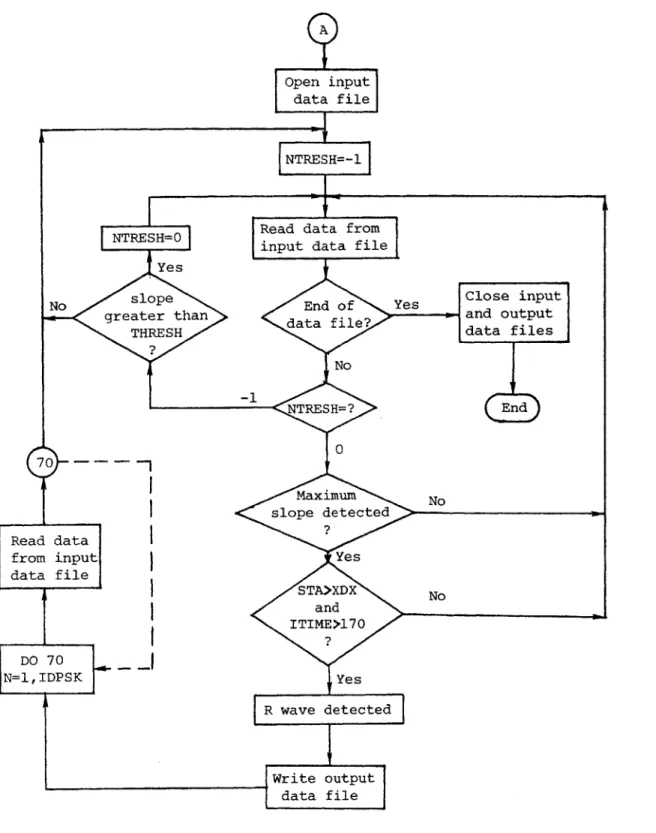
A program, RRFILE, has been developed based on the conceptdes-cribed above for detecting the fiducial points of the QRS complexes for both the arrhythmic and non-arrhythmic data from which the low frequency baseline shifts have been removed. A detailed description of the
algorithm is given in the following, and a flow chart of this program is shown in Figures 2.3(a) and 2.3(b).
First, three data points are read into REM(l), REM(2) and REM(3). The slope of a best fit straight line over these three points is
calculated as: REM(3) - REM(l). The window REM moves forward by dropping its trailing point REM(l), shifting REM(2) to REM(l), etc.,
-24-TStart
Open input data file
N= 0
Read data from input data file
REM(l), REM(2), REM(3) Eor max.
a value
slope N = N +
1
er the00
data
of inpu data Yas C ile
file? No No s N>500? En Yes Set slope threshold TRESH equal to TREM*PERC Close input data file A
Figure 2.3(a) Flow Chart for Program RRFILE Search absolut of the TREM ov first 5 points
Open
inutdata f ile
NTRESH=-l
NTRESH=O Read data from
input
data file YesNo soeEnd
o
f Yes Clo se input greater than data file? andoutput
THRESH data files
No - NTRESH=?Ed
0
70 - -Maximum No slope detected Read data?from input Yes
data file
STA>XDX
No and ITIME>l70 ? DO 70 N=1,IDPSK Yes R wave detected] Writeoutput
data fileFigure 2.3(b) Flow Chart for Program RRFILE
-26-and reading in a new data point as REM(3). The maximum absolute value of the slope, TREM, over the first 500 data points in the input data
file is searched. The slope threshold, TRESH, is then set at a
certain percent PERC of the maximum absolute value of the slope TREM. The value of PERC is an adjustable parameter.
Once the slope threshold is set for this record, we can start searching for the fiducial points from the very beginning of this input data file. When the absolute value of the slope TSUM is greater than the slope threshold TRESH, the maximum slope is searched. This maximum slope point is not the fiducial point of an R wave, unless the product, STA, of its amplitude REM(3) and slope TSUM is greater than a threshold XDX. The value of XDX is a design parameter.
Finally, we require ITIME, the point where a fiducial point is detected, to be greater than 170 before we can declare that an R wave has been detected. The reason for imposing this condition is due to the fact that some records
may
start in the middle of a QRS complex; in this case the fiducial point may be in error for this QRS complex.A safe way to avoid this problem is to neglect the fiducial point
detected within the first 50 data points, which is greater than the
width of a QRS complex. All the input data files used in this program must have their baseline shifts removed first. That is, the input to the program RRFILE is the output data file from the baseline removal filter BSLNFT, in which a moving window average is used to estimate the baseline. The baseline at the midpoint of the overall window is
estimated as the average of all the data pr4nts within this window. Thus, at the start of a record no baseline estimates can be made for the first 120 data points which are used to fill the window. Hence a
value of zero is assigned to the first 120 output data points for the
baseline removal filter. Therefore, in order to avoid false detection
we neglect the fiducial point detected within the first 170 data
points in a record.
When a fiducial point is detected, a selected number of data
points IDPSK are not searched for R waves. This will not only skip
the high slope part of the T waves but also speed up the overall
pro-cessing. The value of IDPSK is a design parameter.
2.4 Experiments and Results
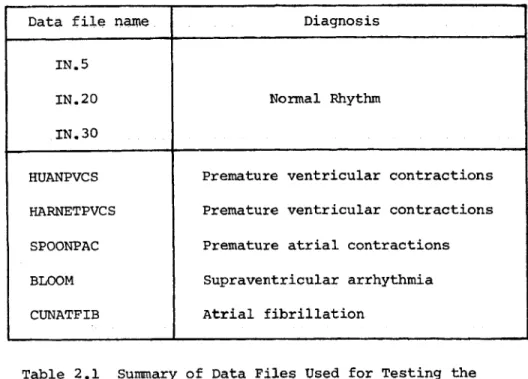
The algorithm for R wave detection RRFILE was tested for both
arrhythmic and non-arrhythmic data. A summary of all these data
files is given in Table 2.1.
Data file name
Diagnosis
IN.5
IN.20
Normal
Rhythm
IN,30
HUANPVCS
Premature ventricular contractions
HARNETPVCS
Premature ventricular contractions
SPOONPAC
Premature atrial contractions
BLOOM
Supraventricular arrhythmia
CUNATFIB
Atrial fibrillation
Table 2.1 Summary of Data Files Used for Testing the Fiducial Point Detector RRFILE
The objective of this test was to determine whether the algorithm des-cribed in Section 2.3 could detect all of the R waves and reject all T waves and noises in each record for a proper choice of the parameters PERC, XDXand IDPSK, where PERC is the percentage of the maximum ab-solute value of the slope TREM over the first 500 data points for the slope threshold TRESH, (TRESH=TREM*PERC), XDX is the slope times ampli-tude threshold for REM(3)*TSUM, and IDPSK is the number of data points skipped after a fiducial point is detected. We also wished to find a set (or sets) of numbers for the parameters PERC, XDX and IDPSK which are good in the sense that no R waves are missed in any of the data
files we have on hand (see Table 2.1). This will aid in our evaluating the robustness of the detector with respect to these parameters.
The input data files to the R wave detector RRFILE were the third lead of those in Table 2.1, from which the baseline shifts have been removed, and the output data files were the R-R intervals detected in each lead. A total of 1,000 sampling data points (250 data points
=1 second) in the third lead of all the arrhythmia data files both before and after the baseline shifts have been removed are shown in
Figures 2.4 - 2.8). From these figures we can see that there are aberrant R waves present in all these data files. Note also that the filtered waveforms appear unaffected from a diagnostic viewpoint. All these data files were tested individually at first for different values of parameters. The R waves detected for each different set of para-meters were then checked visually with the data files, which were dis-played on the Tektronics 4010 digital display. Finally, a satisfactory set of values for the parameters were found, which were good for all the data files being tested. These are given in the following:
PERC =
0.20
XDX =
3,000
IDPSK
=
70
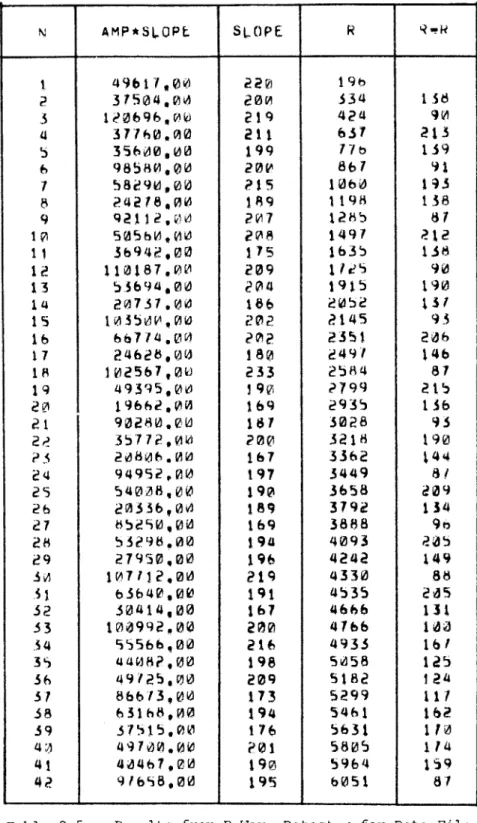
The results are given in Tables 2.2-2.9 for all the data files in Table 2.1. The fourth and fifth columns give the fiducial point
detected and the intervals between the two consecutive fiducial points (or the so called R-R intervals), respectively. We also give the slope and slope* amplitude at the fiducial point in column two and three, respectively. The R-R interval data in column five is in the output data file from program RRFILE. This R-R interval data file will be used in subsequent chapters for arrhythmia analysis.
In this section we have developed a simple procedure for the determination of fiducial points of the QRS complexes. Although good performance was obtained for the data files tested, more data should be tested to evaluate this fiducial point detector in a wide variety of situations. These tests will either be used to adjust parameters of the present detector, or suggest more robust detector designs.
1400. 1500. 1600. a00.
V.
A
I I 1' p VFigure 2.4(a) Unfiltered Data File HUANPVCS
L200.
L300.
L400.L500.
1600.
1700. vIV.
I J j.--Ak !%v
1600.
L900.
2000.A
* I. VFigure 2.4(b) Filtered Data File HUANPVCS
1000.
1t00.
S~ Ic INC=-)Goa.1900.
2000.I ffo.
ILOU.
1200.
1200.
'AWW4 !%%
. ,e
4000.
4100.
4200.4300.
4400. 500. 4600. 4700. 4800. 4900. MOCO..W*00
V
Figure 2.5(a) Unfiltered Data File HARNETPVCS
4000. 4100. 4200. 4300. W400, 4500. 4600. 4W. 4WD, 4900.
5000.
_______________ 3~ Lb ~
Figure 2.5(b) Filtered Data File HARNETPVCS .1
P~f I-
WI
.sA m&& L. Ao j.L Lo ww.- pow% dofts.
? :"&%
JAN A ftL
7600. 7700. 7800. 7900. 8000. VI .I £ t
I4~
I1-V
Figure 2.6(a) Unfiltered Data File SPOONPAC
7000. 7100. 7200. 7300. 7400. 7500. II. 7600. 7700. I. V 7800. 7900. 8000. V
Figure 2.6(b) Filtered Data File SPOONPAC
r - I --. %% 1 0% if - &% -10
1000. 1 L00. 1200. 1300. 1400.
1500.
1600. 1700.1800.
1900. 2000.A A
* I ~ 1. *1 1? '5 'I _________ 1*Figure 2.7(a) Unfiltered Data File BLOOM
1000. 1100. 120. 1300. 1400. 150. 1600. 1700.
1600,
1900.
I. y
W.
-Figure 2.7(b) Filtered Data File BLOOM
?Soo V
I'?
2000, 'Is. I
a I ..
I1400,
1500.
1600.
1700.
LOW.
1900.
2000._*-~-
-~-I.'
Figure 2.8(a) Unfiltered Data File CUNATFIB
1000.
100.
1200. 1300. 1400. 1500. 1600.L700.
Lew.
L900.
2000.1.1 I I I I
4.
Figure 2.8(b) Filtered Data File CUNATFIB
*v. w.
~?4L
*1
4
N
AMP*SLOPE
J8LQPj
R
ROR
1
309222,00
486
343
2
142400,00
467
524
181
3
289014,00
517
706
182
4
335369,00
524
893
18
5
410010,00
503
1081
188
6
302316,00
491
1266
185
7
251758,00
486
1446
10
8
383176,00
518
1629
183
9
318708,00
528
1814
185
10
371700,00
514
2001
187
11
302670,00
506
2186
185
12
179740,00
463
2366
%80
13
420332,00
479
2549
183
14
384524,00
522
2735
186
15
240672,00
514
2921
186
16
167268,00
479
3101
180
17
254380,00
477
3275
174
18
362604,00
509
3448
173
19
250332,00
534
3624
176
20
289333,00
529
3804
180
21
314730.00
475
3980
176
22
377762,00
451
4153
173
4
23
284400,00
526
4330
177
24
387660,00
507
4506
176
25
272847,00
520
4683
177
26
18732e,00
479
4854
171
27
315792,00
474
5019
165
28
322848,00
524
5187
168
29
356580,00
536
5357
170
30
227416,00
496
5533
176
31
375221,00
454
5705
172
32
234720,00
493
5871
166
33
197358,00
488
6044
173
34
292734,00
545
6218
174
35
237870,00
513
6395
177
36
307572.00
506
6567
172
37
338845,00
473
6133
166
38
283974,00
506
b903
170
39
355200,00
530
7075
172
40
324401,00
544
7248
173
41
363540,00
470
7421
173
42
283745,00
483
7592
171
43
174523,00
467
7763
171
Table 2.2 Results from R Wave Detector for Data File IN.5
N
AMP*SLOPE
SLOPE
R
RwR
I
b38420,00
639
224
2
601198,00
631
423
199
3
700036,00
636
629
206
4
624162,00
630
834
245
5
625719,00
634
1028
194
6
678700,00
619
1226
198
7
658125,00
635
1431
205
8
642178,00
622
1634
203
9
635680,00
653
1828
194
10
646323,00
625
2022
194
11
600392,00
632
2222
200
12
666357,00
633
2422
200
13
583128,00
630
2614
192
14
522886,00
629
2807
193
15
510960,00
631
3006
199
16
656051,00
632
3202
196
17
607910,00
629
3387
185
18
554228,00
630
357!
190
19
b25443,00
645
3177
200
20
638352,00
655
3980
203
21
538248,00
622
"176
196
22
500185,00
636
4378
202
23
612315,00
633
4586
208
24
605402,00
640
4790
204
25
b02141,00
624
4989
199
26
525800,00
626
5194
205
27
522110,00
635
5398
204
28
585972,00
641
5593
195
29
590187,00
636
5791
198
30
604144,00
641
5997
206
31
685035,00
661
6204
207
32
544208,00
638
6405
201
33
609224,00
642
6613
208
34
548886,00
640
6828
215
35
593388,00
637
7038
210
36
578716,00
617
7239
201
N
AMP*SLOPE
SLOPE
R
R
1
575901,00
647
376
2
601650,00
606
612
236
3
557118,00
619
854
242
4
579723,00
614
1093
239
5
550745,00
652
1325
232
6
660050,00
659
1548
223
7
304010,00
594
1778
230
8
461610,00
600
2009
231
9
608854,00
637
2239
230
10
670735,00
680
2464
225
11
653016,00
626
2692
228
12
556665,00
587
2936
244
13
624193,00
624
3185
249
14
562100,00
662
3420
235
15
475295,00
6b0
3655
235
16
474240,00
593
3899
244
17
616701,00
607
4142
243
18
664796,00
640
4373
231
19
586440,00
663
4596
223
20
620730,00
632
4821
225
21
540855,00
605
5055
234
22
571340,00
611
5294
239
23
638400,00
663
5526
232
24
567120,00
629
5758
232
25
567862,00
601
5998
240
26
544840,00
61?
6235
237
27
463246,00
632
6465
230
28
b53646,00
683
6680
215
29
592620,00
682
6892
212
30
601620,00
614
7105
213
31
529440,00
553
7323
218
32
667454,00
657
7544
221
33
b40646,00
656
7771
221
Table 2.4 Results from R Wave Detector for Data File IN.30
-38-4
N
AMP*SOPL
SLOPE
R
I49b17,00
22l
19h
2
31504,00
200
334
18
3
1;0696,00
219
424
90
4
37760,00
211
637
213
5
35610,00
199
77t>
139
6
98580,00
20V
867
91
7
58290,00
215
1060
193
8
24218,00
189
1198
138
9
9211200
207
12h5
87
10
505hO.00
208
1497
212
11
36942,00
175
1635
138
12
110187000
209
tiles
90
13
53694,00
204
1915
190
14
20731.00
186
2052
137
15
103500,00
202
2145
93
16
66714.00
202
2351
206
17
24628,00
180
2491
146
18
102567,00
233
2584
87
19
49395,00
19V
2799
215
20
19662,00
169
2935
156
21
90280.00
187
3028
93
2?
35772,00
200
3218
190
P3
20806.00
167
3362
144
24
94952,00
197
3449
8?
25
54008,00
190
3658
209
26
20336,00
189
3792
134
27
85290,00
169
3888
90
28
53298.00
194
4093
P45
29
27950,00
196
4242
149
3
107112.00
219
4330
88
.i
63640,00
191
4535
205
32
30414,00
167
4666
131
33
100992,00
200
4766
100
34
55566,00
216
4935
161
35
44082,00
198
5058
125
36
49125,00
209
5182
124
37
86613,00
173
5299
111
38
63168,00
194
5461
162
39
31515,00
176
5631
110
40
49700.00
P01
5805
114
41
40
00
190
5964
159
42
91698,00
19S
6051
87
Table 2.5 Results from R Wave Detert+jr for Data File HUANPVCS
N
AMP*SLOPL
SLOPE
R
RwR
1
187192,014
116
227
2
14833,00
98
381
154
5
16791,00
Ii6
533
152
4
12388,00
101
692
159
5
3276,00
45
798
106
6
15662,00
115
1028
230
7
11255,00
110
1190
162
81415,100
100
1348
158
9
5280,00
108
1502
154
10
4312,00
57
1649
147
11
18291,00
101
1800
151
12
26924,100
126
1951
151
13
32112,00
133
2105
154
14
28416,00
140
2257
152
15
34075,00
158
2416
159
lb
24252,00
136
2581
165
17
38148.00
165
2744
163
18
29555,00
131
2901
157
19
30702,00
150
3061
160
20
10595,00
65
3166
105
21
30492,00
135
3395
229
2p
24910,00
152
3550
155
23
31255,00
142
3712
162
24
28320,00
150
3866
154
25
21144,00
146
4016
ISO
26
28896,00
150
4170
154
27
27132,00
144
4323
153
28
27664,00
146
4471
148
29
23552,00
146
4624
153
3P
3132,00
38
4725
101
31
32562,00
135
4942
21r
32
30222,100
141
5092
150
33
25864,00
135
5246
154
34
16566,00
133
5395
149
35
30702,00
148
5545
150
36
21156,00
147
5686
141
37
23544,00
128
5831
145
38
1176,00
107
5983
152
39
4968,00
65
6086
103
40
24696,00
126
6300
214
41
30226,00
136
6451
151
42
25338,00
147
6602
151
43
29348,00
116
6759
157
Table 2.6(a) Results from R Wave Detector for Data File HARNETPVCS
-40-Table 2.6(b) Results from R Wave Detector for Data File HAPIIETPVCS
AMP*SLOPE