
Antipolar ordering of topological defects in active liquid crystals
The MIT Faculty has made this article openly available.
Please share
how this access benefits you. Your story matters.
Citation
Oza, Anand U, and Jörn Dunkel. “Antipolar Ordering of Topological
Defects in Active Liquid Crystals.” New Journal of Physics 18.9
(2016): 093006. © 2017 IOP Publishing
As Published
http://dx.doi.org/10.1088/1367-2630/18/9/093006
Publisher
IOP Publishing
Version
Final published version
Citable link
http://hdl.handle.net/1721.1/107773
Terms of Use
Creative Commons Attribution 3.0 Unported license
This content has been downloaded from IOPscience. Please scroll down to see the full text.
Download details: IP Address: 18.51.1.63
This content was downloaded on 23/01/2017 at 14:43 Please note that terms and conditions apply.
Antipolar ordering of topological defects in active liquid crystals
View the table of contents for this issue, or go to the journal homepage for more 2016 New J. Phys. 18 093006
(http://iopscience.iop.org/1367-2630/18/9/093006)
You may also be interested in:
Banding, excitability and chaos in active nematic suspensions L Giomi, L Mahadevan, B Chakraborty et al.
Intrinsic free energy in active nematics
Sumesh P. Thampi, Amin Doostmohammadi, Ramin Golestanian et al. Instabilities and topological defects in active nematics
Sumesh P. Thampi, Ramin Golestanian and Julia M. Yeomans Instabilities and chaos in a kinetic equation for active nematics Xia-qing Shi, Hugues Chaté and Yu-qiang Ma
Physics of microswimmers—single particle motion and collective behavior: a review J Elgeti, R G Winkler and G Gompper
Stressed states and persistent defects in confined nematic elastica M H Köpf and L M Pismen
Near equilibrium dynamics and one-dimensional spatial—temporal structures of polar active liquid crystals
Yang Xiao-Gang, M. Gregory Forest and Wang Qi Physics of defects in nematic liquid crystals R Repnik, L Mathelitsch, M Svetec et al. Hard-body models of bulk liquid crystals
New J. Phys. 18(2016) 093006 doi:10.1088/1367-2630/18/9/093006
PAPER
Antipolar ordering of topological defects in active liquid crystals
Anand U Oza1
and Jörn Dunkel2
1 Courant Institute of Mathematical Sciences, 251 Mercer Street, New York, NY 10012, USA
2 Department of Mathematics, Massachussetts Institute of Technology, 77 Massachusetts Avenue, Cambridge, MA 02139-4307, USA
E-mail:[email protected]
Keywords: active liquid crystals, Landau-de Gennes free-energy, Stokesflow Supplementary material for this article is availableonline
Abstract
ATP-driven microtubule-kinesin bundles can self-assemble into two-dimensional active liquid
crystals
(ALCs) that exhibit a rich creation and annihilation dynamics of topological defects,
reminiscent of particle-pair production processes in quantum systems. This recent discovery has
sparked considerable interest but a quantitative theoretical description is still lacking. We present and
validate a minimal continuum theory for this new class of active matter systems by generalizing the
classical Landau–de Gennes free-energy to account for the experimentally observed spontaneous
buckling of motor-driven extensile microtubule bundles. The resulting model agrees with recently
published data and predicts a regime of antipolar order. Our analysis implies that ALCs are governed
by the same generic ordering principles that determine the non-equilibrium dynamics of dense
bacterial suspensions and elastic bilayer materials. Moreover, the theory manifests an energetic
analogy with strongly interacting quantum gases. Generally, our results suggest that complex
nonequilibrium pattern-formation phenomena might be predictable from a few fundamental
symmetry-breaking and scale-selection principles.
Active materials[1] assembled from intracellular components, such as DNA [2], microtubules and motor
proteins[3–5] promise innovative biotechnological applications, from microscale transport and medical devices
[2] to artificial tissues [1] and programmable soft materials [6–8]. Beyond their practical value, these systems
challenge theorists to generalize equilibrium statistical mechanics to far-from-equilibrium regimes[9–26].
Recent experimental advances in the self-assembly and manipulation of colloids with DNA-mediated
interactions[27–29] have stimulated theoretical analysis that may eventually help clarify the physical principles
underlying self-replication[30–32] and evolution in viruses [33–35] and other basic biological systems. Yet,
despite some partial progress[10,18,19,36–39], our conceptual understanding of active materials, and living
matter in general, remains far from complete. We do not know whether, or under which conditions,
‘universality’ ideas [40] that have proved powerful in the description of equilibrium systems can be generalized
to describe collective dynamics of active matter not just qualitatively but also quantitatively. This deficit may be ascribed to the fact that mathematical models have been successfully tested against experiments in only a few instances[3,4,15,41–43].
Recently discovered 2D active liquid crystal(ALC) analogs [5,44–47] comprise an important class of
non-equilibrium systems that allows further tests of general theoretical concepts[40] and specific models. ALCs are
assemblies of rod-like particles that exhibit non-thermal collective excitations due to steady external[44,45] or
internal[5,47] energy input. At high concentrations, ALCs form an active nematic phase characterized by
dynamic creation and annihilation of topological defects[5,44,47], reminiscent of spontaneous particle-pair
production in quantum systems. This phenomenon was demonstrated recently[5,47,48] for ATP-driven
microtubule-kinesin bundles trapped inflat and curved interfaces. Moreover, these experiments [48] revealed
an unexpected nematic ordering of topological defects which is unaccounted for in current theoretical models.
OPEN ACCESS
RECEIVED 19 April 2016 REVISED 7 August 2016 ACCEPTED FOR PUBLICATION 10 August 2016 PUBLISHED 8 September 2016
Original content from this work may be used under the terms of theCreative Commons Attribution 3.0 licence.
Any further distribution of this work must maintain attribution to the author(s) and the title of the work, journal citation and DOI.
Understanding the emergence of such topological super-structures is crucial for the development and control of new materials, as recently demonstrated for colloidal liquid crystals[49–51].
We here develop and test a closed continuum theory for dense ALCs by generalizing the higher-order scalar and vector theories of soft elastic materials[52] and bacterial fluids [15,41] to matrix-valued fields. Specifically,
we propose a modification of the commonly adopted Landau–de Gennes (LdG) free energy to account for the inherently different microscopic buckling behaviors of passive and active LCs[5]. While bending is energetically
unfavorable in passive LCs and hence penalized by the LdG energy functional, kinesin-driven ALCs buckle spontaneously even at low concentrations due to the extensile motor action(figure1(a)). This experimental
observation[5] implies that the classical LdG framework is, by construction, ill-suited to describe experiments in
which microtubule bundles are sheared relative to each other by motor proteins[5,47,48]. The inclusion of
active bending effects in the LdG functional yields a tensor version of the Swift–Hohenberg theory [53] of pattern
formation. The resulting minimal model has only two dimensionless parameters, thus allowing a detailed comparison with recent experimental data[5,48].
In addition to the traditional Q-tensor formulation, we present an equivalent complex scalarfield
representation[14,54] that manifests an analogy with a generalized Gross–Pitaevskii theory [55,56] of strongly
coupled many-body quantum systems[57–60]. In the case of normal dispersion, the celebrated
LC-superconductor correspondence[54,61] has helped elucidate profound parallels between the smectic phase in
passive LCs and the Abrikosov vortex lattices in type-II superconductors[62,63]. The results below indicate that
a similar analogy may exist between ALCs and Bose–Einstein/Fermi condensates with double-well dispersion [58–60], suggesting that ALCs could offer insights into the dynamics of these quantum systems and vice versa.
Results
Experimental conditions
Recent experiments[5,48] show that ATP-driven microtubule-kinesin bundles can self-assemble into a dense
quasi-2D ALC layer at a surfactant-supported oil-water interface parallel to a planar solid
boundary(figure1(b)). This ‘wet’ ALC was found to exhibit local nematic alignment of bundles, persistent
annihilation and creation dynamics of topological defects[5], and remarkable nematic order of the defect
orientations in thin layers[48]. Although a large number of unknown parameters has prevented detailed
quantitative comparisons between theory and experiment, several recently proposed multi-order-parameter models of 2D ALC systems[14,20,64,65] were able to reproduce qualitatively selected aspects of these
observations, such as defect-pair creation and separation[65]. Despite providing some important insights,
traditional models often do not account for three relevant details of the experiments[5,48]. First, those models
typically assume divergence-free 2Dfluid flow within the ALC layer, which is a valid approximation for isolated free-standingfilm experiments [66] but neglects fluid exchange between the 2D interface and bulk in the ALC
experiments(figure1(b)). Indeed, the surfactant-stabilized interface causes the microtubule-kinesin bundles to
assemble into a quasi-2D layer, but places no such constraint on thefluid. As is known for classical turbulence [67,68], small-scale energy input can trigger turbulent upward cascades in incompressible 2D flow. Thus,
topological defect dynamics in the current standard models may be dominated by artificially enhanced
Figure 1.(a)Image sequence showing spontaneous buckling of a microtubule bundle (dashed) caused by extensile ATP-driven motor activity, adapted with permission fromfigure 1(c) in [5]. Time interval 11.5 s, scale bar 15 μm. For a passive or contractile bundle, one
would expect straightening instead of bending, approximately corresponding to a time-reversal of the depicted sequence.
(b)Schematic of the experimental setup reported in [5,48], not drawn to scale. A thin oil film (thickness~3 mm ) separates a 2D ALC
layer(~ –0.2 1.0μm) at the oil-water interface from a solid glass cover. Liquid can be exchanged between the ALC layer and bulk fluid, resulting in compressible 2D interfacialflow that is strongly damped by the nearby no-slip glass boundary and the viscous oil layer. (c)Extensile 2D dipole flow in the interface as predicted by the overdamped closure condition(4) forD>0 andQ=(l, 0; 0,-l) withl =exp(-r2). The central horizontal bar indicates the unit director axis, and background colors the nematic order
hydrodynamic mixing due to a simplifying 2D incompressibility assumption that is unlikely to hold under realistic experimental conditions[5,48]. Second, a relevant yet previously ignored effect is damping from the
nearby boundaries, which may promote topological defect ordering. Third, as already mentioned above, the commonly adopted standard LdG free-energy functional does not account for motor-driven spontaneous buckling[5] of microtubule bundles (figure1(a)), which is one of the key differences between passive and active
LCs(Z. Dogic, private communication). To overcome such limitations and achieve a quantitative description of the experiments[5,48], we next construct a closed continuum theory for ALCs described by a nematic tensor
fieldQ t,( r). The theory accounts for the different buckling behaviors of passive and active LCs and builds on a self-consistent hydrodynamic closure condition.
Theory
Traditional multi-field models [64,65] aim to describe the 2D nematic phase of a dense ALC suspension by
coupling thefilament concentration (c t,r)and the nematic order tensorQ t,( r)to an incompressible 2Dflow field (v t,r)that satisfies ·v=0 in the interface plane = (r x y, ). The nematic order parameter (S t, r)is proportional to the larger eigenvalue of Q, and thefilaments are oriented along the corresponding eigenvector, or directorn(t,r). To construct an alternative closed-form theory for the symmetric traceless 2×2-tensor fieldQ, we start from the generic transport law
k w d d ¶Q+ · (vQ)- [Q ]= - ( ) Q , , 1 t
where w = - [ v ( v) ] 2 is the vorticity tensor,[A B, ]=AB-BAthe commutator of two matrices and
ò
= [ ]
Q d2r Fan effective free energy. Focussing on dense suspensions as realized in the experiments[5,48],
we neglectfluctuations in the microtubule concentration, ºc 0. A derivation of the advection term · (vQ) from the probability conservation laws underlying generic advection-diffusion models is outlined in the supplementary information. It is important, however, that · (vQ)¹v·Q when ·v¹0, which is typically the case whenfluid can enter and leave the interface. Combining LdG theory [69] with Swift–
Hohenberg theory[53], we consider the effective non-equilibrium free-energy density (supplementary
information)
Figure 2. Phase diagram obtained from simulations of equation(8) for one particular set of random initial conditions showing the
emergence of turbulent nematic states for supercritical active self-advection.(a)We observe convergence to defect-free stripes (blue, panel(c), Movie S3), long-lived static and oscillatory defect lattice solutions (green, panel (d), Movie S4), oscillatory defect creation and annihilation events(black, Movies S6 and S7), and chaotic dynamics (red, panel (b), Movie S1). The white line indicates the analytical estimateDc=2(- +g2 g2+2)
2 for the transitions between ordered and chaotic states.(b)–(d) Examples of the states identified in panel (a) with-1
2-defects(black) and+ 1
2–defects (white). Panel (d) highlights the antipolar ordering of+ 1 2-defect orientations(red bars); see also figure3and MovieS5 for a realization of this state in a~ ´10 larger simulation domain.
3
g g
=
{
- + - ( ) + ( )}
( )F Tr aQ bQ Q Q
2 4 2 4 2
2 4 2 2 4 2
witha b, >0 for the nematic phase. Assumingg2can have either sign, ultraviolet stability requiresg > 04 . For
g < 02 , F penalizes bending and buckling, as is appropriate for passive LCs and possibly‘dry’ shaken nematics [44,45], forcing the system dynamics towards a homogeneous nematic ground-state manifold. By contrast,
motor-induced spontaneous buckling[5] (figure1(a)) of kinesin-driven ALCs demands g > 02 , and consequently patterns of characteristic wavelengthL ~ g g4 2become energetically favorable, as shown below.
The requirement g > 02 for ALCs has an intrinsically microscopic origin, as the ALC assembly consists of microtubules that grow against each other and spontaneously buckle due to the motor-induced extensile shear dynamics of adjacent bundles(figure1(a)). To explain this important point in more detail, let us recall that
passive LCs are modeled using g < 02 , as the corresponding term in the free energy penalizes variations in Q and thus inhibits spatial inhomogeneities at damping rate g2k2<0in Fourier space. Microscopically, the alignment dynamics of two rod-like passive LC molecules roughly corresponds to a time-reversal of the ALC
pair-interaction image sequence infigure1(a), implying that a corresponding ALC system would develop buckling
instabilities at growth rate g2k2>0. Additional empirical support for this theoretical picture comes from a comparison of the experimentally observed length scales in ALC systems: the microtubule-kinesin bundles realized in the ALC experiments[5,48] are approximately 10–30mmin length(figure 1(b) in [5]), which is on
the same scale as both the spontaneous buckling wavelength(figures 1(c) and (d) in [5], and figure1(a)) and the
typical separation distance between defects(bottom panels of figure 3(d) in [5], reproduced in figure4(a) below).
That is, there exists no substantial scale separation between the buckling microscopic constituents and emergent ALC dynamics.
Similar buckling phenomena are generically observed in many systems that are subjected to external or internal stresses, for example in elasticfilms and sheets [52,70] and in geometrically confined cellular networks
[71,72]. The ALCs experience an effective compressive stress due to the extensile ‘growth’ of the filament pairs in
a confined geometry, which arises from their motor-induced shear dynamics. Application of such a compressive stress leads to buckling of the network’s constituents [71,72]. It has been shown that out-of-plane buckling of an
elastic sheet due to an effective compressive stress may be quantitatively modeled by a Swift–Hohenberg-type equation with g > 02 in the corresponding free energy[52]. We expect the same to be true for the in-plane
buckling of microtubules confined to a planar interface, and thus analyze here an effective theory that incorporates this spontaneous motor-induced buckling phenomenologically through g > 02 . Hydrodynamic closure
To obtain a closed Q-model, we relate the 2Dflow field v to Q through the linearly damped Stokes equation [73,74]
h n z
- +2v v= - ·Q, ( )3
whereη is the viscosity and the rhs represents active stresses [10,64] with z > 0 for extensile ALCs(figure1(c)).
A pressure term does not appear in equation(3) because the interfacial flow is not assumed to be incompressible
and concentrationfluctuations are neglected. The ν-term in the force balance(3) has been used to model
interfacial damping in other contexts, such as surfactant membranes on a solid substrate[73], and accounts for
friction from the nearby no-slip boundary in the Hele–Shaw [74] approximation (figure1(b)). In the
overdamped regime nL2 h , we deduce from equation1 (3) the closure condition
z n
= - · = ( )
v D Q, D . 4
Equation(4) is conceptually similar to closure conditions proposed previously for active polar films [75].
Importantly, equation(4) predicts divergent interfacial flow, ·v¹0, and hencefluid transport perpend-icular to the interface wherever :Q¹0. Inserting(4) into(1) yields a closed Q-theory in which periodic
director patterns corresponding to local minima of the free energycan become mixed by self-generated interfacialflow.
Complex representation and ALC-quantum analogy
The traditional characterization of 2D nematic order in terms of the symmetric traceless 2×2 matrix field
l m m l
=( - )
Q , ; , is redundant, for only two real scalarfieldsl (t,r)and m (t,r)are needed to specify the nematic state at each position = (r x y, ). To obtain an irreducible representation[14,54] we define the complex
position coordinatez= +x iy, velocityfieldv t z( , )=u+i and complex order parameterw y(t z, )=l+im, such thatS= ∣ ∣2y. In terms of the Wirtinger gradient operator ¶ = (¶ - ¶x i y)
1
2 , the 2D Laplacian takes the form = ¶¶2 4¯ and the closure condition(4) reduces tov = -2D¶y. Denoting the real and imaginary parts of an operator byR{ } and I{ } , equations(1) and(2) may be equivalently expressed
as
y y d
dy
¶t +y = - ¯, ( )5
where the self-advection operator is given by
R y y k I y
= - ¶ + ¶ ¶ + 
y {( ) ( ) } { } ( )
4D 2 4 Di 2 6
and the free energy[y y =, ¯ ]
ò
dz Ghas the densityy y g y y g y y = - ∣ ∣ + ∣ ∣ + ¯ ( ¯ )¶¶ + ¯ ( ¯ )¶¶ ( ) G a b 2 4 4 . 7 2 4 2 4 2
For g < 02 and g 04 , equation(7) reduces to the energy density of the Gross–Pitaevskii mean-field model
[55,56] for weakly interacting boson gases. Historically, this limit case has been crucial [54,61] for elucidating
the analogy between the smectic phase of passive LCs and the Abrikosovflux lattice in type-II superconductors [62,63]. For g g >2, 4 0, equation(7) effectively describes double-well dispersion [57], as recently realized for
quasi-momenta in spin–orbit-coupled Bose–Einstein condensates [58,60] and Fermi gases [59]. This fact
establishes an interesting connection between dense ALCs and strongly coupled quantum systems: when self-advection is negligible(D0), thefixed point configurations of equation (5) coincide with the ‘eigenstates’ of
generalized Gross–Pitaevskii models that incorporate wavelength selection. Stability analysis
The qualitative model dynamics is not significantly altered for moderate values of κ (Movies S1 and S2), so we neglect the commutator term by setting k = 0 from now on(see supplementary information for k > 0). To understand the properties of equations(5) and (6) when self-advection is relevant, we perform a fixed point
analysis of the rescaled dimensionless equation(supplementary information) R y y y y y y g y y ¶ - {(¶ )+ ¶ ¶( ) } =⎜⎛ -∣ ∣ ⎟ - ( ¯ )¶¶ - ¶¶( ¯ ) ( ) ⎝ ⎞⎠ D 4 1 4 4 4 , 8 t 2 2 2 2
by focussing on the uniform state y =* 1e q 2
i2 , which corresponds to a nematic order parameter value S = 1and homogeneous director angleθ relative to the x-axis. Considering wave-like perturbations y=y + ˆ ( ) ·
* t eik r with ∣ ˆ∣ and extensile ALCs with1 D>0, onefinds that y* isunstablewhen g > 02 (supplementary information). For subcritical self-advection,D<Dc=2(- +g2 g2+2)
2 , the dominant instability is driven by modes with wavenumber∣ ∣k = g2 (2g4), suggesting the formation of stripe patterns with typical
wavelengthL » 8p g g2
4 2. By contrast, for supercritical advection, >D Dc, the most unstable mode propagates perpendicular to the director,(k*,f*)=( (2g2+D) (4g4),q+(p 2)), suggesting the possibi-lity of transverse mixing.
Phase diagram
To investigate the nonlinear dynamics of equation(8), we implemented a Fourier pseudospectral algorithm with
modified Runge–Kutta time-stepping [76] (Methods) and so evolved the real and imaginary parts of y (t z, )in time for periodic boundary conditions in space. A numerically obtained(g2,D)-phase diagram for random initial conditions confirms the existence of a turbulent nematic phase if active self-advection is sufficiently strong(figures2(a) and (b); Movie S1). Ordered configurations prevail at low activity (figures2(a), (c) and (d);
Movies S3, S4 and S6). Although the ground-states of the free energy (2) are in general not homogeneous, the
critical curve separating the two regimes is in fair agreement with the estimateDc=2(- +g2 g2+2) 2 from linear stability of the homogenous state(white line in figure2(a)). For subcritical values of the advection
parameter D, we observe either defect-free ground-states or long-lived lattice-like states exhibiting ordered defect configurations (figures2(c) and (d)). Regarding the subsequent comparison between theory and
experiment, it is important to note that the lattices are also found in simulations with a large domain(figure3; Movie S5). These spatially periodic states generally exhibit antipolar long-range ordering of
+1
2-defects(figures2(d);3(a)) accompanied by vortex flow lattices (figure3(c)). Numerical free-energy calculations show that defect-free states(figure2(c)) typically have slightly lower energies than the lattice states
(figure2(d)), leaving open the possibility of a very slow decay of the latter. However, regardless of whether such
lattice states are extremely long-lived metastable or truly stable states, these simulation results confirm that anti polar ordering of +1
2-defect pairs can persist over experimentally relevant time-scales. Theory versus experiment
To test our theory systematically against existing experimental data[5,48], we analyze defect-pair dynamics,
global defect ordering and defect statistics in the turbulent nematic phase. 5
Spontaneous defect-pair creation and subsequent propagation, as reported in recent ALC experiments[5]
and observed in our simulations, are compared infigure4. In the experimental system[5], a + -
(
1,)
21 2 -defect pair is created when fracture along incipient crack regions[20] becomes energetically more favorable than
buckling. After creation, the +1
2defect moves away rapidly whereas the position of the -1
2-defect remains approximatelyfixed for up to several seconds (figure4(a)). We note that an asymmetry in the speeds of
topological defects has also been observed in passive liquid crystals[77–79]. Our simulations of the minimal
model defined in equation (8) accurately reproduce the details of the experimentally observed dynamics
(figure4(b); Movies S1 and S2).
Another striking and unexplained experimental observation[48] is the emergence of orientational order of
+1
2-defects in thin ALC layers(figure5). Using the setup illustrated in figure1(b), recent experiments [48] demonstrated nematic alignment of +1
2-defects in thin ALC layers of thicknessh~250 nm(figure5(a)), whereas thicker ALC layers withh~1 m showed no substantial orientational order on large scalesm
(figure5(b)). To investigate whether our theory can account for these phenomena, we tracked defect positions ri
(Methods) and defect orientationsdi= ·Q( ) ∣ri ·Q( )∣ri [80] in simulations for different values of the
advection parameterD=z n, since Brinkman-type scaling arguments suggest that D increases with the ALC layer thickness,Dµ1 nµhpwith pÎ [1, 2 . For weakly supercritical advection,] DD
c, wefind that equation(8) predicts robust antipolar alignment of +1
2-defects(figure5(c)). In our simulations, this ordering decreases as the effective mixing strength D increases(figure5(d)), consistent with the experimental results [48]
for thicker ALC layers(figure5(b)). Similar ordering was observed in simulations that incorporated alignment of
the nematicfield near the horizontal boundaries of the simulation box (supplementary information; figure S5). To quantify the degree of orientational order, we recorded the distances dijbetween all +12-defect pairs(i, j) as
well as their relative orientation angles qij =cos-1(di·dj)Î[0,p]. The resulting pair-orientation distributionsp( ∣ )qr , and polar and nematic correlation functions,P r( ) = ádi·dj rñ and
= á ñ
-( ) (d ·d)
N r 2 i j 2r 1, are shown infigure6, withá ñ·rdenoting an average over pairs of defects separated by Figure 3. Vortex lattice states with antipolar long-range ordering of nematic defects, see also Movie S5.(a) Long-lived nematic order parameterfield with periodically aligned-1
2-defects(black) and+ 1
2-defects(red). (b) Line integral convolution (LIC) plot of the corresponding directorfield as a proxy for microtubule-bundle patterns. (c) LIC plot of the corresponding fluid velocity field, color-coded by normalized vorticity, demonstrates the formation of a vortexflow lattice. Dimensionless simulation parameters are
g
= =
D 0.25, 2 1.875.
Figure 4. Defect-pair creation and propagation in experiment and theory.(a) Experimentally observed dynamics of a defect pair, spontaneously produced by buckling and subsequent fracture offilaments; adapted with permission from figure 3(d) in [5]. Scale bar
20μm, time lapse 15 s. (b) Line integral convolution (LIC) plot of the director fields showing the spontaneous creation and propagation of a defect-pair in a simulation of equation(8) forD = 1.5, g = 12 . As in the experiments,+1
2-defects(yellow) generally move faster than-1
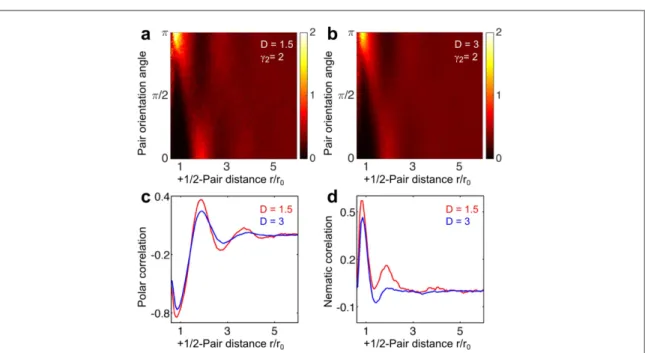
a distance r. The local maxima in the orientation distribution at q = 0 and q= signal antipolar orderingp (figure6(a)), which is also reflected in the oscillatory behavior of the polar and nematic correlation functions
(figures6(c) and (d)). The diminished intensity of the local maxima for larger values of D indicates that enhanced
hydrodynamic mixing reduces orientational order(figures6(c) and (d)).
Figure 5. Strong and weak antipolar ordering of+1
2-defects as(a), (b) observed in experiments [48] and (c), (d) predicted by our theory based on 2D simulations with periodic boundary conditions. Light-blue markers:-1
2-defects. Yellow markers:+ 1 2-defects. Red bars: orientation of+1
2-defects.(a)+ 1
2-defects in thin ALCfilms (thickness ~h 250nm) show strong nematic alignment. (b)+1
2-defects in thicker ALCfilms ( ~h 1μm) are more disordered. (c), (d) For weak effective hydrodynamic coupling D, simulations show antipolar ordering, which is inhibited for larger values of D. The average number of defects in the full simulation box is approximately(c) 240 and (d) 350. Figures (a) and (b) kindly provided by DeCamp and Dogic.
Figure 6. Increasing activity andfilm thickness decreases antipolar ordering in simulations. (a), (b) Maxima of the numerically obtained local pair orientation PDFsp( ∣ )qijr signal antipolar local ordering of+
1
2-defects as they are separated by the typical defect-lattice spacing. The defect distance r is specified in units of the mean nearest-neighbor distance r0between+
1
2-defects.(c), (d)Polar P (r) and nematic N(r) correlation functions for D=1.5 (red) and D=3 (blue). Increasing the effective hydrodynamic couplingD leads to stronger mixing and hence decreases nematic order, which is corroborated by the nematic correlation length being~40% shorter for D=3 than for D=1.5 (panel (d)). This is also reflected by the diminished intensity of the maxima in panel (b) relative to panel(a). The simulation parameters correspond to those given in figures5(c) and (d).
7
Lastly, we test the theoretically predicted defect statistics against a separate experimental data set kindly provided by DeCamp et al(private communication). Since our simulations are performed in dimensionless units, there is freedom to choose a characteristic lengthscale l0and timescale t0. To relate theory and
experiments, we determine(l0,t0)such that the joint mean speed and mean lifetime of 12-defects match the experimental valuesv¯=6.6 m sm -1and t =¯ 52.8 s. Afterfixing these global scales, we can compare details of the speed and lifetime distributions(figure7). To this end, we first locate the ‘best-fit’ simulation parameters in
the(g2,D)-parameter space explored in the phase diagram(figure2(a)). This procedure identifies
g =2 1,D=1.75as the best-match parameters, although nearby parameter values and simulations withk = 1 producefits of similar quality, corroborating the robustness of the model (figure S4). For -1
2-defects, wefind adequate agreement between experiment and theory for speed and lifetime probability density functions(PDFs), as evident fromfigures7(a) and (b). For +1
2-defects, simulation results also agree well with the experimental measurements(figures7(c) and (d)), but one notices two systematic differences. First, while the peak heights of
the PDFs agree within a few percent, experimentally measured speed values for +1
2-defects are on average slightly larger than theoretically predicted values(figure7(c)). Second, simulation data predict a miniscule
tail-fraction of long-living +1
2-defects not detected in the experiment(figure7(d)). In addition, based on the experimental density estimate of 30 defects mm−2[48], we find that the defect density at any given time in the
‘best-fit’ simulation is ~ ´2.3 lower than in the experiments. As discussed below, such deviations can be explained plausibly by specific model assumptions. Taken together, the above results confirm that the minimal model defined by equation (8) provides a satisfactory qualitative and quantitative description of the main
experimental results[5,48].
Discussion
Pattern-formation mechanism
Equations(2) and(7) epitomize the idea of ‘universality’ in spatio-temporal pattern formation, as known from
Swift–Hohenberg-type scalar field theories [53,81]. The free-energy expressions contain the leading-order
terms of generic series expansions in both order-parameter space and Fourier space, consistent with spatial and nematic symmetries. When considering passive systems with a preference for homogenization(g < 02 ), it
Figure 7. Quantitative comparison of defect statistics between predictions of equation(8) and experimental data [48], using the
parameter estimation procedure described in the text. For-1
2-defects, both(a) speed distribution and (b) lifetime distribution agree well.(c) For+1
2-defects, experimentally measured speed values are slightly larger, as our model assumes a strongly overdamped limit. (d)Simulations with periodic boundary conditions (Movie S8) predict a low-probability tail of large lifetimes which is not visible in the experiment, likely due to its restrictedfield of view or additional noise. Dimensionless simulation parameters D=1.75 and
g = 12 translate into the following dimensional values:a=0.08 s−1,b=0.32 s−1,D=1791μm2s−1,g = 1024 mm
2 2s−1,
g4=3.28´106mm4s−1. The numbers
n reflect the number of1
2-defects tracked, and the simulation domain contained∼130 defects at any given time.
usually suffices to keep only the quadratic gradient terms. By contrast, for pattern forming systems, the coefficient in front of the lowest-order gradient contribution can change sign [52,53], and one must include
higher-order derivatives to ensure stability. We hypothesize that the sign change ofg2is directly related to the motor-induced buckling of microtubule bundles(figure1(a)), an effect that is not captured by the standard LdG
free-energy for passive liquid crystals. In a few select cases, expressions of the form(2) and(7) can be
systematically derived[52,53,82]. Generally, one can regard the free-energy expansion(7) as an effective field
theory whose phenomenological parameters can be determined from experiments. This approach has proved successful for dense bacterial suspensions[15,41] and now also for ALCs, indeed suggesting some universality in
the formation and dynamics of topological defects in active systems. Nematic defect order
Although(g2,D)are varied as independent effective parameters in the simulations, they are likely coupled through underlying physical and chemical parameters. For example, it is plausible that a change in ATP-concentration orfilm thickness would affect bothg2and D. The parameter D can also be interpreted as an effective Reynolds number. In our numerical exploration of the(g2,D)-parameter space, we observe for subcritical advection D either long-lived lattice-like states exhibiting nematically aligned +1
2-defects or defect-free ground-states(figures2and3; Movies S3, S4, S5, S6 and S7). Ordered defect configurations correspond to
local minima or saddles in the free-energy landscape and have only slightly higher energy than defect-free states (figure2(c)). When the activity ζ is sufficiently large that advection is marginally supercritical,DDc, chaotic system trajectories spend a considerable time in the vicinity of these metastable lattice states, which provides a physical basis for the orientational order of defects in thin ALCfilms [48]. ForDDc, the ALC system can access a wider range of high-energy states, leading to increased disorder in the defect dynamics. Although the strongly turbulent regimeDDcrequires high time-resolution and is thus difficult to realize in long-time simulations, the inhibition of nematic defect order at larger values of D is evident from the reduced peak heights infigures6(c) and (d).
Defect statistics
The systematic speed deficit in figure7(c) likely reflects the overdamped closure condition(4), which suppresses
the propagation of hydrodynamic excitations. Sinceflow in a newly created defect pair generally points from the -1
2to the + 1
2-defect, the minimal model(8) can be expected to underestimate the speeds of + 1
2-defects. This effect could be explored in future experiments through a controlled variation of the thickness and viscosity of the oilfilm (figure1(b)). The low-probability tail of long-living +1
2-defects in the simulation data(figure7(d)) may be due to the fact that they can be tracked indefinitely in the simulations but are likely to leave the finite field of view in the experiments. In the future, the minimal theory presented here should be extended systematically by adding physically permissible extra terms[83] to the free-energy, explicitly simulating the full hydrodynamics in
equation(3), or incorporating additional terms into equation (1) that account for the interaction between the
nematicfield and the induced flow [65,83].
Future extensions
The minimal model formulated in equations(1) and (2) can be systematically extended to improve further the
quantitative agreement between experiment and theory. For instance, one may append to the right-hand side of (1) an additional fourth-order linear term of the form ( ) [+ · ( ·Q)][84],+denoting the symmetric traceless part of the operator . Such a term only affects the high-wavenumber damping at order k4and thus is not expected to alter significantly the results obtained here. We also note that extra terms coupling the nematic field to the induced flow may be added to equation (1), an example being SE, where =E (1 2)[ + v ( v) ] is the symmetrized strain rate tensor[25,65]. Our above analysis neglected such secondary hydrodynamic effects
in the interest of constructing a minimal mathematical theory capable of capturing key experimental observations. Moreover, this simplification may be justified on the physical basis that steric interactions and motor-induced buckling are expected to dominate overflow-alignment effects at high microtubule densities3. The effect of microtubule bending may be enhanced by appending a hydrodynamic interaction term
proportional toE+[25], since the closure condition = - ·v D Qimplies thatE+= -(D 2)DQ, which augments the bending term- DQg2 in equation(2). However, the scale separation between the experimentally
observedfilament buckling wavelength and the flow structures in the isotropic phase at low microtubule concentrations(see figure 1(d) in [5]) suggests that such hydrodynamic effects play a secondary role. A natural
next step would be to derive systematically the bending term from a microscopic model of motors andfilaments as introduced in[20]. Finally, it will be worthwhile to attempt constructing a fully 3D theory for the ALCs and 3
In active nematics of low to intermediate density, concentrationfluctuations can trigger additional instabilities [85].
9
fluid and subsequently project on the quasi-2D interface, although additional assumptions are required then to obtain a closed 2D system of equations.
Conclusions
Recent experimental and theoretical studies showed that fourth-order PDE models for scalar and vectorfields provide an accurate quantitative description of surface-pattern formation in soft elastic materials[52] and
orientational order in dense bacterialfluids [15,41]. Here, we have generalized these ideas to matrix-valued
fields describing soft active nematics. The above analysis demonstrates that a generic fourth-order Q-tensor model can shed light on experimental observations in 2D ALCs[48], including the emergence of orientational
order of topological defects. Physically, the higher-order generalization(2) becomes necessary because the
commonly adopted LdG free-energy, which was designed to describe passive liquid crystals, does not account for the experimentally observed spontaneous buckling of motor-driven ALCs[5]. More generally, the fact that
three vastly different soft matter systems can be treated quantitatively in terms of structurally similar higher-order PDEs[15,41,52] promises a unified mathematical framework for the description of pattern formation
processes in a broad class of complex materials. In addition, the free-energy analogy[54] between dense ALCs
and generalized Gross–Pitaevskii models suggests that the self-organization principles [40] of mesoscopic active
matter and microscopic quantum systems[57–60] could be more similar than previously thought.
Methods
Numerical solver and defect tracking
To simulate equation(8), we implemented a numerical algorithm that evolves the real and imaginary parts
l (t, r)and m (t,r)of the complex order parameterψ in time for periodic boundary conditions in space. The algorithm solves equation(8) pseudospectrally in space usingNℓ=256orNℓ=512lattice points in each
direction and a simulation box of size L= 6π (figures2and4) or L = 18π (figures3,5–7). Spectral analysis shows
thatNℓ=256is generally sufficient to resolve the fine-structure of the numerical solutions(supplementary
figure S6). The algorithm steps forward in time using a modified exponential time-differencing fourth-order Runge–Kutta method [76] with time step Dt2-10. Simulations were initialized with either a single defect pair or randomfield configurations l{ (0,r),m(0,r)}. Defects are located at the intersections of the zero-contours oflandμ, their positions tracked by implementing James Munkres’ variant of the Hungarian assignment algorithm[86] (supplementary information).
Acknowledgments
This work was supported by the NSF Mathematical Sciences Postdoctoral Research Fellowship DMS-1400934 (AO), an MIT Solomon Buchsbaum Fund Award (J D) and an Alfred P Sloan Research Fellowship (JD). The authors would like to thank Zvonimir Dogic and Stephen DeCamp for sharing their experimental data and explaining the details of their experiments, and Hugues Chaté, Michael Hagan, Jean-François Joanny, Ken Kamrin, Mehran Kardar, Cristina Marchetti, Jonasz Slomka, Norbert Stoop, Francis Woodhouse and Martin Zwierlein for insightful discussions and helpful comments.
References
[1] McEvoy M A and Correll N 2015 Materials that couple sensing, actuation, computation, and communication Science347 6228
[2] Douglas S M, Marblestone A H, Teerapittayanon S, Vazquez A, Church G M and Shih W M 2009 Rapid prototyping of 3D DNA-origami shapes with caDNAno Nucl. Acids Res.37 5001–6
[3] Schaller V, Weber C, Semmrich C, Frey E and Bausch A R 2010 Polar patterns of driven filaments Nature467 73–7
[4] Sumino Y, Nagai K H, Shitaka Y, Tanaka D, Yoshikawa K, Chaté H and Oiwa K 2012 Large-scale vortex lattice emerging from collectively moving microtubules Nature483 448–52
[5] Sanchez T, Chen D T N, DeCamp S J, Heymann M and Dogic Z 2012 Spontaneous motion in hierarchically assembled active matter Nature491 431
[6] Rothemund P W K 2006 Folding DNA to create nanoscale shapes and patterns Nature440 297–302
[7] Nickels P C, Ke Y, Jungmann R, Smith D M, Leichsenring M, Shih W M, Liedl T and Høgberg B 2014 DNA origami structures directly assembled from intact bacteriophages Small10 1765–9
[8] Studart A R and Erb R M 2014 Bioinspired materials that self-shape through programmed microstructures Soft Matter10 1284–94
[9] Toner J and Tu Y 1998 Flocks, herds, and schools: a quantitative theory of flocking Phys. Rev. E58 4828–58
[10] Simha R A and Ramaswamy S 2002 Hydrodynamic fluctuations and instabilities in ordered suspensions of self-propelled particles Phys. Rev. Lett.89 058101
[11] Saintillan D and Shelley M 2008 Instabilities, pattern formation and mixing in active suspensions Phys. Fluids20 123304
[13] Peruani F, Ginelli F, Bär M and Chaté H 2011 Polar versus apolar alignment in systems of polar self-propelled particles J. Phys.: Conf. Ser.297 012014
[14] Peshkov A, Aranson I S, Bertin E, Chaté H and Ginelli F 2012 Nonlinear field equations for aligning self-propelled rods Phys. Rev. Lett.
109 268701
[15] Wensink H H, Dunkel J, Heidenreich S, Drescher K, Goldstein R E, Löwen H and Yeomans J M 2012 Meso-scale turbulence in living fluids Proc. Natl Acad. Sci. USA109 14308–13
[16] Wensink H H and Löwen H 2012 Emergent states in dense systems of active rods: from swarming to turbulence J. Phys. Condens. Matter
24 464130
[17] Ravnik M and Yeomans J M 2013 Confined active nematic flow in cylindrical capillaries Phys. Rev. Lett.110 026001
[18] Adhyapak T C, Ramaswamy S and Toner J 2013 Live soap: stability, order, and fluctuations in apolar active smectics Phys. Rev. Lett.110 118102
[19] Marchetti M C, Joanny J F, Ramaswamy S, Liverpool T B, Prost J, Rao M and Simha R A 2013 Hydrodynamics of soft active matter Rev. Mod. Phys.85 1143
[20] Gao T, Blackwell R, Glaser M A, Betterton M D and Shelley M J 2015 Multiscale polar theory of microtubule and motor-protein assemblies Phys. Rev. Lett.114 048101
[21] Giomi L 2015 Geometry and topology of turbulence in active nematics Phys. Rev. X5 031003
[22] Krieger M S, Spagnolie S E and Powers T R 2015 Microscale locomotion in a nematic liquid crystal Soft Matter11 9115–25
[23] Trivedi R R, Maeda R, Abbott N L, Spagnolie S E and Weibel D B 2015 Bacterial transport of colloids in liquid crystalline environments Soft Matter11 8404–8
[24] Menzel A M, Saha A, Hoell C and Löwen H 2016 Dynamical density functional theory for microswimmers J. Chem. Phys.144 024115
[25] Putzig E, Redner G, Baskaran A and Baskaran A 2016 Instabilities, defects, and defect ordering in an overdamped active nematic Soft Matter12 3854–9
[26] Doostmohammadi A, Adamer M F, Thampi S P and Yeomans J M 2016 Stabilization of active matter by flow-vortex lattices and defect ordering Nat. Commun.7 10557
[27] Mirkin C A, Letsinger R L, Mucic R C and Storhoff J J 1996 A DNA-based method for rationally assembling nanoparticles into macroscopic materials Nature382 607–9
[28] Valignat M-P, Theodoly O, Crocker J C, Russel W B and Chaikin P M 2005 Reversible self-assembly and directed assembly of DNA-linked micrometer-sized colloids Proc. Natl Acad. Sci. USA102 4225–9
[29] Palacci J, Sacanna S, Steinberg A P, Pine D J and Chaikin P M 2013 Living crystals of light-activated colloidal surfers Science339 936–40
[30] Ebeling W, Engel A and Feistel R 1992 Physik der Evolutionsprozesse (Berlin: Akademie Verlag)
[31] Zeravcic Z and Brenner M P 2014 Self replicating colloidal clusters Proc. Natl Acad. Sci. USA111 1748–53
[32] England J L 2013 Statistical physics of self-replication J. Chem. Phys.139 121923
[33] Berger B, Shor P W, Tucker-Kellogg L and King J 1994 Local rule-based theory of virus shell assembly Proc. Natl Acad. Sci. USA91 7732–6
[34] Perlmutter J D and Hagan M F 2015 Mechanisms of virus assembly Annu. Rev. Phys. Chem.66 217–39
[35] Meng G, Paulose J, Nelson D R and Manoharan V N 2014 Elastic instability of a crystal growing on a curved surface Science343 634–7
[36] Baskaran A and Marchetti M C 2008 Hydrodynamics of self-propelled hard rods Phys. Rev. E77 011920
[37] Baskaran A and Marchetti M C 2009 Statistical mechanics and hydrodynamics of bacterial suspensions Proc. Natl Acad. Sci.106 15567–72
[38] Vicsek T and Zafeiris A 2012 Collective motion Phys. Rep.517 71–140
[39] Ramaswamy S 2010 The mechanics and statistics of active matter Annu. Rev. Cond. Mat. Phys.1 323–45
[40] Goldenfeld N and Woese C 2011 Life is physics: evolution as a collective phenomenon far from equilibrium Annu. Rev. Cond. Mat. Phys.2 375–99
[41] Dunkel J, Heidenreich S, Drescher K, Wensink H H, Bär M and Goldstein R E 2013 Fluid dynamics of bacterial turbulence Phys. Rev. Lett.110 228102
[42] Weber C A, Hanke T, Deseigne J, Léonard S, Dauchot O, Frey E and Chaté H 2013 Long-range ordering of vibrated polar disks Phys. Rev. Lett.110 208001
[43] Suzuki R, Weber C A, Frey E and Bausch A 2015 Polar pattern formation in driven filament systems requires non-binary particle collisions Nat. Phys.11 839–43
[44] Narayan V, Ramaswamy S and Menon N 2007 Long-lived giant number fluctuations in a swarming granular nematic Science317 105–8
[45] Aranson I S, Snezhko A, Olafsen J S and Urbach J S 2008 Comment on ‘long-lived giant number fluctuations in a swarming granular nematic’ Science320 612
[46] Shi X-Q and Ma Y-Q 2013 Topological structure dynamics revealing collective evolution in active nematics Nat. Commun.4 3013
[47] Keber F C, Loiseau E, Sanchez T, DeCamp S J, Giomi L, Bowick M J, Marchetti M C, Dogic Z and Bausch A R 2014 Topology and dynamics of active nematic vesicles Science345 1135–9
[48] DeCamp S J, Redner G S, Baskaran A, Hagan M F and Dogic Z 2015 Orientational order of motile defects in active nematics Nat. Mater.
14 1110–5
[49] Musevic I, Skarabot M, Tkalec U, Ravnik M and Zumer S 2006 Two-dimensional nematic colloidal crystals self-assembled by topological defects Science313 954–8
[50] Machon T and Alexander G P 2013 Knots and nonorientable surfaces in chiral nematics Proc. Natl Acad. Sci. USA110 14174–9
[51] Tkalec U, Ravnik M, Copar S, Zumer S and Musevic I I 2011 Reconfigurable knots and links in chiral nematic colloids Science333 62–5
[52] Stoop N, Lagrange R, Terwagne D, Reis P M and Dunkel J 2015 Curvature-induced symmetry breaking determines elastic surface patterns Nat. Mater.14 337–42
[53] Swift J and Hohenberg P C 1977 Hydrodynamic fluctuations at the convective instability Phys. Rev. A15 319–28
[54] Renn S R and Lubensky T C 1988 Abrikosov dislocation lattice in a model of the cholesteric-to-smectic-A transition Phys. Rev. A38 2132–47
[55] Gross E P 1961 Structure of a quantized vortex in boson systems Nuovo Cim.20 454–77
[56] Pitaevskii L P 1961 Vortex lines in an imperfect Bose gas Sov. Phys.—JETP 13 451–4
[57] Higbie J and Stamper-Kurn D M 2002 Periodically dressed Bose–Einstein condensate: a superfluid with an anisotropic and variable critical velocity Phys. Rev. Lett.88 090401
[58] Lin Y J, Jimenez-Garcia K and Spielman I B 2011 Spin–orbit-coupled Bose–Einstein condensates Nature471 83–6
[59] Cheuk L W, Sommer A T, Hadzibabic Z, Yefsah T, Bakr W S and Zwierlein M W 2012 Spin-injection spectroscopy of a spin–orbit coupled Fermi gas Phys. Rev. Lett.109 095302
11
[60] Parker C V, Ha L-C and Chin C 2013 Direct observation of effective ferromagnetic domains of cold atoms in a shaken optical lattice Nat. Phys.9 769–74
[61] de Gennes P G 1972 An analogy between superconductors and smectics A Solid State Commun.10 753–6
[62] Goodby J W, Waugh M A, Stein S M, Chin E, Pindak R and Patel J S 1989 Characterization of a new helical smectic liquid crystal Nature
337 449–552
[63] Srajer G, Pindak R, Waugh M A and Goodby J W 1990 Structural measurements on the liquid–crystal analog of the Abrikosov phase Phys. Rev. Lett.64 1545–8
[64] Thampi S P, Golestanian R and Yeomans J M 2013 Velocity correlations in an active nematic Phys. Rev. Lett.111 118101
[65] Giomi L, Bowick M J, Ma X and Marchetti M C 2013 Defect annihilation and proliferation in active nematics Phys. Rev. Lett.110 228101
[66] Sokolov A, Aranson I S, Kessler J O and Goldstein R E 2007 Concentration dependence of the collective dynamics of swimming bacteria Phys. Rev. Lett.98 158102
[67] Kraichnan R H and Montogomery D 1980 Two-dimensional turbulence Rep. Prog. Phys.43 547–619
[68] Kellay H and Goldburg W I 2002 Two-dimensional turbulence: a review of some recent experiments Rep. Prog. Phys.65 845–94
[69] de Gennes P G and Prost J 1995 The Physics of Liquid Crystals vol 2 (Oxford: Oxford University Press)
[70] Vetter R, Stoop N, Wittel F K and Herrmann H J 2014 Simulating thin sheets: buckling, wrinkling, folding and growth J. Phys.: Conf. Ser.487 012012
[71] Haghpanah B, Papadopoulos J, Mousanezhad D, Nayeb-Hashemi H and Vaziri A 2014 Buckling of regular, chiral and hierarchical honeycombs under a general macroscopic stress state Proc. R. Soc. A470 20130856
[72] Kang S H, Shan S, Košmrlj A, Noorduin W L, Shian S, Weaver J C, Clarke D R and Bertoldi K 2014 Complex ordered patterns in mechanical instability induced geometrically frustrated triangular cellular structures Phys. Rev. Lett.112 098701
[73] Evans E and Sackmann E 1988 Translational and rotational drag coefficients for a disk moving in a liquid membrane associated with a rigid substrate J. Fluid Mech.194 553–61
[74] Woodhouse F G and Goldstein R E 2013 Cytoplasmic streaming in plant cells emerges naturally by microfilament self-organization Proc. Natl Acad. Sci. USA110 14132–7
[75] Voituriez R, Joanny J F and Prost J 2006 Generic phase diagram of active polar films Phys. Rev. Lett.96 028102
[76] Kassam A-K and Trefethen L N 2005 Fourth-order time-stepping for stiff PDEs SIAM J. Sci. Comput.26 1214–33
[77] Tóth G, Denniston C and Yeomans J M 2002 Hydrodynamics of topological defects in nematic liquid crystals Phys. Rev. Lett.88 105504
[78] Švensek D and Žumer S 2002 Hydrodynamics of pair-annihilating disclination lines in nematic liquid crystals Phys. Rev. E66 021712
[79] Blanc C, Švensek D, Žumer S and Nobili M 2005 Dynamics of nematic liquid crystal disclinations: the role of backflow Phys. Rev. Lett.
95 097802
[80] Vromans A J and Giomi L 2016 Orientational properties of nematic disclinations Soft Mat.12 6490–5
[81] Aranson I S and Tsimring L S 2006 Patterns and collective behavior in granular media: theoretical concepts Rev. Mod. Phys.78 641–92
[82] Großmann R, Romanczuk P, Bär M and Schimansky-Geier L 2014 Vortex arrays and mesoscale turbulence of self-propelled particles Phys. Rev. Lett.113 258104
[83] Stark H and Lubensky T C 2003 Poisson-bracket approach to the dynamics of nematic liquid crystals Phys. Rev. E67 061709
[84] Bertin E, Chaté H, Ginelli F, Mishra S, Peshkov A and Ramaswamy S 2013 Mesoscopic theory for fluctuating active nematics New J. Phys.15 05032
[85] Ngo S, Peshkov A, Aranson I S, Bertin E, Ginelli F and Chaté H 2014 Large-scale chaos and fluctuations in active nematics Phys. Rev. Lett.113 038302
![Figure 1. ( a ) Image sequence showing spontaneous buckling of a microtubule bundle ( dashed ) caused by extensile ATP-driven motor activity, adapted with permission from fi gure 1 ( c ) in [ 5 ]](https://thumb-eu.123doks.com/thumbv2/123doknet/14021378.457391/4.892.180.826.92.272/figure-sequence-spontaneous-buckling-microtubule-extensile-activity-permission.webp)

![Figure 4. Defect-pair creation and propagation in experiment and theory. ( a ) Experimentally observed dynamics of a defect pair, spontaneously produced by buckling and subsequent fracture of fi laments; adapted with permission from fi gure 3 ( d ) in [ 5 ]](https://thumb-eu.123doks.com/thumbv2/123doknet/14021378.457391/8.892.177.831.414.567/creation-propagation-experiment-experimentally-observed-spontaneously-subsequent-permission.webp)
![Figure 7. Quantitative comparison of defect statistics between predictions of equation ( 8 ) and experimental data [ 48 ] , using the parameter estimation procedure described in the text](https://thumb-eu.123doks.com/thumbv2/123doknet/14021378.457391/10.892.182.826.91.457/quantitative-comparison-statistics-predictions-experimental-parameter-estimation-procedure.webp)
