HAL Id: hal-01790517
https://hal.inria.fr/hal-01790517v3
Submitted on 4 Aug 2019
HAL is a multi-disciplinary open access
archive for the deposit and dissemination of
sci-entific research documents, whether they are
pub-lished or not. The documents may come from
teaching and research institutions in France or
abroad, or from public or private research centers.
L’archive ouverte pluridisciplinaire HAL, est
destinée au dépôt et à la diffusion de documents
scientifiques de niveau recherche, publiés ou non,
émanant des établissements d’enseignement et de
recherche français ou étrangers, des laboratoires
publics ou privés.
Janna Burman, Joffroy Beauquier, Devan Sohier
To cite this version:
Janna Burman, Joffroy Beauquier, Devan Sohier. Space-Optimal Naming in Population Protocols.
[Research Report] LRI, Université Paris Sud, CNRS, Université Paris-Saclay, France. 2018.
�hal-01790517v3�
Janna Burman
1 2LRI, Université Paris Sud, CNRS, Université Paris-Saclay, France
3
4
Joffroy Beauquier
5
LRI, Université Paris Sud, CNRS, Université Paris-Saclay, France
6
7
Devan Sohier
8
LI-PaRAD, Université de Versailles, Université Paris-Saclay, France
9
10
Abstract 11
The distributed naming problem, assigning unique names to the nodes in a distributed system,
12
is a fundamental task. This problem is non trivial, especially when the amount of memory available
13
for the task is low, and when requirements for fault-tolerance are added.
14
The considered distributed communication model is population protocols. In this model, a priori
15
anonymous and indistinguishable mobile nodes (called agents), communicate in pairs and in an
16
asynchronous manner (according to a fairness condition). Fault-tolerance is addressed through
17
self-stabilization, in terms of arbitrary initialization of agents.
18
This work comprises a comprehensive study of the necessary and sufficient state space conditions
19
for naming. The problem is studied under various combinations of model assumptions: weak or
20
global fairness, arbitrary or uniform initialization of agents, existence or absence of a distinguishable
21
agent (arbitrarily initialized or not), possibility of breaking symmetry in pair-wise interactions
22
(symmetric or asymmetric transitions). For each possible combination of these assumptions, either
23
an impossibility is proven or the necessary exact number of states (per mobile agent) is determined
24
and an appropriate space-optimal naming protocol is presented.
25
2012 ACM Subject Classification Theory of computation → Distributed algorithms
26
Keywords and phrases networks of passively mobile agents, population protocols, deterministic
27
naming, self-stabilization, exact space complexity, tight lower bounds, global and weak fairness
28
Digital Object Identifier 10.4230/LIPIcs...
29
1
Introduction
30
The population protocol model was introduced as a minimalist model for mobile sensor net-31
works where the computational devices, called agents, communicate by pair-wise interactions 32
without (almost) any control on their communication schedule [3].2 The model originally 33
assumed that the memory of agents is constant, i.e., independent of the population size n. 34
Due to this, agents are prohibited from storing unique identifiers. 35
Many limitations have been discovered due to this restriction, and a lot of work has 36
been devoted to study the power added by relaxing it. For example, it was obtained in [15] 37
that a non-semi-linear predicate can be computed starting from Θ(log log n) bits of agent’s 38
memory (allowing Θ(logO(1)n) identifiers), while the original population protocols compute 39
only exactly the semi-linear predicates [4]. Furthermore, it was shown that using Θ(log n) 40
bits per agent, allowing to assign unique identifiers (names) to agents, already permits 41
1 corresponding author
2 Basically, at each step a pair of agents is scheduled to interact (subject to a fairness condition) and each
agent observes the other’s state updating its own according to the transition function.
© Janna Burman, Joffroy Beauquier and Devan Sohier; licensed under Creative Commons License CC-BY
Leibniz International Proceedings in Informatics
to compute exactly all the symmetric predicates in the class N SP ACE(n log n) (what is 42
equivalent to the power of O(n log n) space Turing machine) [28, 15]. Following these results, 43
a comprehensive study in [12] provided a complete hierarchy establishing complexity classes 44
for the cases going from non-identified agents (the original population protocol model) to 45
uniquely identified ones, passing by the case of homonyms. 46
Another line of works where the possibility of having names plays an important role 47
concerns fault-tolerant population protocols. As a motivating scenario one can think of 48
reliability critical mobile sensor networks (not necessary of a very large scale), which may be 49
hardly accessible and have to recover automatically to the correct behavior after faults. In 50
the framework of self-stabilization [20, 5], i.e. when the reliability concerns transient faults 51
(e.g., memory or communication errors), it was shown that a linear (on n) state space is 52
necessary for the realization of many tasks. Interestingly, in these cases, many proposed 53
solutions perform a sort of naming mechanism. This concerns for example the self-stabilizing 54
tasks of leader election [13], counting [7, 29, 6] and deterministic oscillation [17]. In [19], for 55
computing semi-linear predicates while tolerating a known constant number of transient and 56
crash faults, the algorithm approximately divides the population into a predefined number of 57
groups, actually creating named homonyms. Finally, some other fault-tolerant population 58
protocols assume that names are given a priori, e.g., [28, 37]. 59
These observations suggest that the task of naming in population protocols should receive 60
a particular attention. This work presents a comprehensive study of this problem. It 61
focuses on the necessary and sufficient state space conditions for naming under all possible 62
combinations of a set of classical model assumptions, like existence of a leader, weak or global 63
fairness, uniform or arbitrary initialization and symmetry of transition rules. Note that a 64
choice of a combination affects the type and the level of difficulty of breaking symmetry or of 65
achieving fault-tolerance. These parameters, their interest and effect are all discussed below. 66
The first parameter is the nature of the assumed fairness, weak or global. The formal 67
definitions and an example illustrating the difference between the two appear in the model 68
section. Intuitively, while global fairness ensures that an infinitely often reachable configura-69
tion is unavoidable, weak fairness only ensures that every pair of agents interacts infinitely 70
often. Global fairness can be viewed as a way for modeling randomized systems (without 71
introducing randomization explicitly in the model). This explains why it is generally easier 72
to get solutions under this fairness. However, such randomization cannot be always assumed 73
to be available, in particular in reliability critical systems. 74
A second parameter is the symmetry nature of the (transition) rules of a protocol. With 75
symmetric rules, two interacting agents in the same state stay in identical states. With 76
asymmetric rules, they can take different states. This latter assumption was the original one 77
proposed for population protocols and motivated by asymmetric wireless communications. 78
The symmetric rules assumption is more general (weaker), and many motivating scenarios 79
can be found for it in nature inspired population protocols, social networks (when equity is 80
an issue) or in networks with symmetric wireless communication.3 81
A third parameter is the presence or absence of a unique leader (a distinguishable agent), 82
which is obviously also useful for the sake of breaking symmetry. In the context of sensor 83
networks, this agent may represent a (possibly mobile) base station, having augmented 84
3 Note that an asymmetric population protocol can be transformed into a symmetric one using the
transformer of [11]. However, this transformer requires global fairness and doubles the number of states per agent. This makes it frequently inadequate for obtaining a space efficient symmetric solution from an asymmetric one (in terms of exact space complexity), and certainly inadequate under weak fairness.
resources comparing to the tiny mobile agents. From this perspective and similarly to 85
previous studies (e.g., [40, 6, 29]), we are not concerned with the space complexity of this 86
agent. 87
A fourth parameter is related to the initialization of system agents, i.e., of the leader (if 88
present) and of the other agents (called here mobile). In case of mobile agents, if initialization 89
is assumed, it is always uniform, i.e., to the same value for every mobile agent. In case of 90
arbitrary initialization, the given solution stabilizes starting from an arbitrary configuration 91
(i.e., resulting from any number of transient faults). In this case it is called self-stabilizing [20]. 92
The weaker initialization assumption is (e.g., only the leader is initialized, or nobody), the 93
stronger the system is against transient faults and the more adapted to repetitive execution 94
of a task (requiring less or no re-initialization). 95
Finally, the focus of this work is on deterministic protocol design, useful whenever random 96
behavior is inappropriate or deterministic guarantees are required. Moreover, as many 97
previous works [40, 17, 6, 29, 7], we perform an exact state space analysis. On the negative 98
side, this requires especially careful analysis and design, in contrast to, e.g., the asymptotic 99
analysis case. On the positive side, the exact analysis is extremely relevant in the cases 100
of particularly memory-limited devices, small sized networks and self-stabilizing protocols. 101
The less volatile memory is used by a self-stabilizing protocol, the less (probabilistically less 102
frequently) it is vulnerable to corruptions. 103
Contribution 104
Thus, we investigate the naming problem under all the possible combinations of the parameters 105
described above. All the negative results (impossibilities and lower bounds) are presented 106
in Section 3, while all the positive ones (state-optimal solutions) are given in Section 4. 107
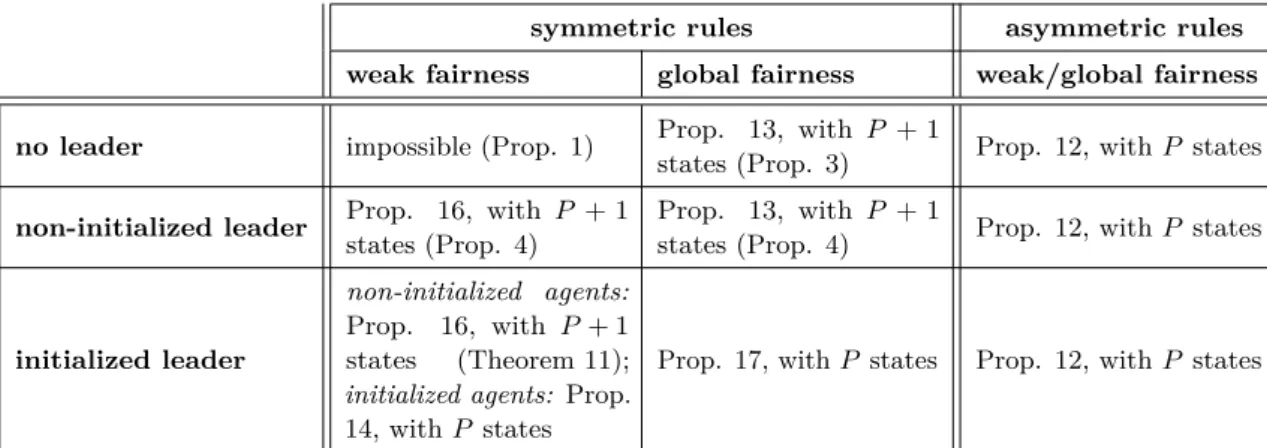
Table 1 gives a synthetic view of these results. For each case, it indicates first the statement 108
establishing the feasibility, either by proving impossibility or by construction of a space-109
optimal protocol. In the latter case, the table also indicates the optimal (used) number of 110
states and the relevant statement of the lower-bound. 111
The results are expressed in terms of P - a known upper bound on the number of 112
mobile agents n (i.e., the maximum number of agents destined to be named). This technical 113
assumption is done for dealing with bounded protocols (similarly to the related studies, 114
e.g., [29, 7]). P can be seen as a function of the manufactured memory size in each 115
(undistinguishable) mobile agent.4 Nevertheless, the results (and the lower bounds in 116
particular) can be equivalently expressed in terms of n, when considering a particular 117
population size. 118
Notice that, first of all, the table concerns the case of arbitrarily initialized mobile agents. 119
Together with that, it is also relevant to the case of uniform initialization of mobile agents. It 120
is obvious for the positive results (the protocols stay correct). However, somewhat surprisingly, 121
the impossibilities and lower bounds also hold under this stronger assumption, but with only 122
one exception. The exception concerns symmetric rules under weak fairness and with an 123
initialized leader, i.e., when a leader is present and can be initialized together with the other 124
agents (refer to the table). Then, there is a simple naming protocol with only P states per 125
mobile agent (Proposition 14), instead of the necessary P + 1 states with arbitrary initialized 126
mobile agents. In contrast with this simple protocol for completely initialized case, the 127
4 The parameter P is used in the protocols, but this explicit usage can be frequently replaced by an alert
analysis of tight negative and positive results assuming no initialization of mobile agents is 128
much more complex (see Section 3.1 and Propositions 16 and 17). 129
Additional remarks can be made about the table. First, under weak fairness and without 130
leader, no symmetric deterministic protocol is capable of breaking symmetry, and thus naming 131
is impossible. Second, if asymmetric rules are allowed, in all cases, there is a space-optimal 132
solution with P states. On the contrary, with symmetric rules, the norm is P + 1 states, 133
excluding two cases: when there is an initialized leader (in both cases) and (1) either global 134
fairness or (2) uniform initialization of mobile agents is assumed. In both cases, the problem 135
can be solved with P states per agent. 136
symmetric rules asymmetric rules weak fairness global fairness weak/global fairness no leader impossible (Prop. 1) Prop. 13, with P + 1
states (Prop. 3) Prop. 12, with P states
non-initialized leader Prop. 16, with P + 1 states (Prop. 4)
Prop. 13, with P + 1
states (Prop. 4) Prop. 12, with P states
initialized leader
non-initialized agents: Prop. 16, with P + 1 states (Theorem 11); initialized agents: Prop. 14, with P states
Prop. 17, with P states Prop. 12, with P states
Table 1 Synthesis of the relevant statements establishing the feasibility of naming and the necessary (optimal) state space, under different model parameters. If not stated otherwise, the indicated results hold for both arbitrarily an uniformly initialized mobile agents.
Note: Several minor proofs and the additional related work discussion have been moved to
137
the appendix. Though, the most relevant work is mentioned above. 138
2
Model and Notations
139
We adopt the model of population protocols [3] as a basic model. A system consists of a 140
collection A of pairwise interacting agents, also called population. Each agent can represent 141
a sensing and communicating mobile device. Among the agents, there can be a unique 142
distinguishable agent called the leader which can be as powerful as needed, in contrast 143
with the resource-limited non-leader agents. The non-leader agents are also called mobile, 144
interchangeably. The size of the population n is the number of the mobile agents. It is 145
unknown (a priori) to the agents, contrary to the upper bound parameter P ≥ n. Each agent 146
has a state taken from a set of states Q (depending on P ), the same for all mobile agents, 147
but generally different for the leader. 148
A (population) protocol can be modeled as a finite transition system defined by transitions 149
between configurations, where a configuration is a vector of states of all the agents. The 150
transitions between configurations are defined by pairwise interactions between agents. If, in 151
a configuration C, two agents x and y interact (meet), s.t. x is in state p and y in state q, 152
they execute a transition rule (p, q) → (p0, q0). As a result, x changes its state from p to p0 153
and y from q to q0. The new configuration C0, resulting from this state changes, is said to be 154
reachable from C (in one step), denoted by C → C0. If p = p0 and q = q0, the corresponding 155
transition is said null (such transition rules are specified by default), and non-null otherwise.5 156
If there is a sequence of configurations C = C0, C1, . . . , Ck= C0, such that Ci→ Ci+1 for all 157
i, 0 ≤ i < k, we say that C0 is reachable from C, denoted C→ C∗ 0. 158
The transition rules are deterministic, if for every pair of states (p, q), there is exactly 159
one (p0, q0) such that (p, q) → (p0, q0). We consider only deterministic transitions and thus, 160
only deterministic protocols. Transitions and protocols can be symmetric or asymmetric. 161
Symmetric means that, if (p, q) → (p0, q0) is a transition rule, then (q, p) → (q0, p0) is also a 162
transition rule. In particular, if (p, p) → (p0, q0) is symmetric, p0= q0. A protocol is called 163
symmetric, if all its transition rules are symmetric, and asymmetric otherwise. 164
Let (p1, q1) → (p2, q2), (p2, q2) → (p3, q3), . . ., (pk−2, qk−2) → (pk−1, qk−1), (pk−1, qk−1) → 165
(pk, qk) be a sequence of rules of a protocol. Then, we shortly write (p1, q1) ∗
→ (pk, qk) to 166
denote the successive application of the rules of the sequence, to the same pair of agents, 167
initially in states p1 and q1, leading them to pk and qk, respectively. We sometimes call an 168
agent in state p a p-state agent, or just a p-agent. 169
An execution of a protocol is an infinite sequence of configurations and transitions 170
C0, t1, C1, t2, C2, t3, . . . such that C0 is the starting configuration and for each i ≥ 0, 171
Ci→ Ci+1, ti being the transition between two particular agents used to reach Ci+1from 172
Ci. When the actual transitions are irrelevant, we denote the execution by C0, C1, C2, . . .. 173
A segment or a sub-execution is a sub-sequence of an execution. The trace of transitions 174
of a sub-execution C0, t1, C1, t2, C2, . . . tk, Ck is a sequence t1, t2, t3, . . . tk of transitions, and 175
the corresponding trace of transition rules is the sequence r1, r2, r3, . . . rk such that ri is the 176
transition rule applied in ti. In a real distributed execution, interactions of distinct agents 177
are independent and could take place simultaneously (in parallel), but when writing down 178
an execution we order those simultaneous interactions arbitrarily. 179
An execution is said weakly fair, if every pair of agents in A interacts infinitely often. An 180
execution is said globally fair, if for every two configurations C and C0 such that C → C0, if 181
C occurs infinitely often in the execution, then C0 also occurs infinitely often in the execution. 182
This also implies that, if in an execution there is an infinitely often reachable configuration, 183
then it is infinitely often reached [4]. Note that an execution where pairs of agents interact 184
according to some probabilistic distribution is globally fair with probability 1 [30]. 185
A simple example allows to better understand the difference between weak and global (or 186
probabilistic) fairness. Consider a population of 3 agents. Each agent can be white or black, 187
and initially one agent is black and the two others are white. Consider also the protocol 188
in which, when two white agents interact, they both become black and when two agents 189
of different colors interact, they exchange their colors. It is easy to see that there is an 190
infinite weakly fair execution in which there is always one black and two white agents (the 191
black color “jump” indefinitely from agent to agent). On the contrary, every globally fair 192
execution terminates in a configuration in which the 3 agents are black, because otherwise 193
there would be infinitely many configurations during an execution from which the “all black” 194
configuration could be reached, without ever being reached (contradicting global fairness). 195
A (static) problem is defined by a predicate D on configurations. A population protocol 196
P is said to solve a problem D, if and only if every execution of P reaches a configuration 197
satisfying the conditions defining D and stays in such configurations forever after. When this 198
happens, we say that the protocol has stabilized (or terminated), and a terminal configuration 199
has been reached. A self-stabilizing protocol is a protocol that stabilizes from an arbitrary 200
5 For simplicity, in some cases, we do not present protocols under the form of transition rules, but under
configuration (i.e., from a configuration where any agent, including the leader, can be in any 201
possible state). 202
In the naming problem, each mobile agent x has a variable, also called a name, that 203
eventually does not change and such that no two agents have the same name. Mobile agents 204
having the same state (thus the same name) are called homonyms. 205
We consider uniform or semi-uniform protocols (cf. [21, 38]) in the sense that all agents, 206
except the leader (whence semi-), are a priori indistinguishable and interact according to 207
the same transition rules. Moreover, given an upper bound P on n, the protocol functions 208
similarly for any n. Thus, given the bound P , by the definition of naming, an obvious lower 209
bound on the state space of a mobile agent (for solving naming) is P . 210
3
Negative Results
211
In this section, we clarify some boundaries on the possibility to obtain symmetric naming. 212
They are summarized in Table 1 and useful for establishing the space-optimality (tightness) 213
of the solutions presented in the next section. We proceed from simple to more intricate 214
results, gradually adding assumptions helping in breaking symmetry (making harder to proof 215
impossibilities). We conclude this section by Theorem 11 - a subtle result stating impossibility 216
to get a P state symmetric protocol even with an initialized leader, but non-initialized mobile 217
agents and under weak fairness. 218
The first result is obtained by observing a completely symmetric weakly fair execution 219
where at each step the population transits from one uniform configuration (all agents are in 220
the same state) to the other, by applying each time a symmetric rule between two homonyms. 221
IProposition 1. Under weak fairness and without leader (even with a uniform initialization
222
of mobile agents), symmetric naming is impossible in the population protocol model. 223
Proof. By contradiction, assume that such a symmetric protocol PP exists. With or without 224
an initialization, consider a possible starting configuration where each agent is in state s1 225
and the population size is even (this also corresponds to a uniform initialization). We build 226
a weakly fair infinite execution of PP during which no configuration with agents in distinct 227
states is reached. This execution can be described by phases. In the first phase, the agents 228
are matched in pairs and interact accordingly. As the protocol is symmetric, after this first 229
phase, each agent is in some state s2, the same for all agents. In the next phase, the agents 230
are matched again in pairs, but differently from the previous phase, and interact accordingly. 231
After this phase, each agent is in some state s3, the same for all agents. The execution 232
continues in such phases such that eventually every agent has interacted with every other. 233
From now on, such interaction sequence is repeated infinitely often, satisfying weak fairness. 234
However, this execution never assigns distinct names to agents. J
235
The following lemma states properties of the transition rules of any P state symmetric 236
naming protocol. Its short proof is given below. The lemma is used in the proofs of the 237
next two propositions: the first one assumes no existing leader, while the second one proves 238
impossibility of a self-stabilizing symmetric naming even with a leader. 239
ILemma 2. In any symmetric naming protocol using only P states per agent, the only
240
possible non-null transition rules between two non-leader agents are between two homonyms. 241
Proof. Otherwise, in a population of P agents, after stabilization (every state in {1, . . . , P } 242
is assigned to some agent), mobile agents would be able to change their states and hence 243
their names. This is a contradiction to the assumed stabilization. J
Under the conditions of the next proposition and by the lemma above, the only non-null 245
transitions are between two homonyms (resulting in another two homonyms). Such transitions 246
are useless for eliminating repeated names, implying the result. 247
IProposition 3. Even with a uniform initialization of agents, but without a leader, and
248
using only P states per agent, it is impossible to obtain symmetric naming in the population 249
protocol model, under weak or global fairness. 250
IProposition 4. There is no symmetric naming protocol with P states per agent with an
251
arbitrarily initialized leader (or without it), under weak or global fairness. 252
Proof. Assume by contradiction that such a protocol exists. By Proposition 3, a leader is 253
necessary. Consider a population of P mobile agents and a starting configuration C0(with 254
possibly uniformly initialized mobile agents) that has homonyms (with states in {1, . . . , P }). 255
By Lemma 2, only transitions with a leader can eliminate homonyms (the only possible non-256
null symmetric transition rules between homonyms create necessarily two other homonyms). 257
Thus, there is a finite execution sequence e, starting from C0, during which the leader renames 258
interacting mobile agents, and finally stabilizes to a correct naming (where every name from 259
{1, . . . , P } is assigned to some mobile agent). Denote by Ceand by se the configuration and 260
the state of the leader, respectively, at the end of e. 261
Then, assume a starting configuration C00 (with possibly uniformly initialized mobile 262
agents, as before) containing only homonyms in state s (in {1, . . . , P }) and with the leader 263
in state se. There must be a sequence of interactions between the leader and mobile agents 264
starting from C00 which ends up with a transition during which an interacting agent changes 265
its name. Such a sequence of interactions exists also starting from Ce(with either weak or 266
global fairness), because in Ce any possible state exists in the population. This contradicts 267
the assumption that the protocol has stabilized starting from Cein e. Hence, the proposition 268
follows. J
269
3.1
Impossibility of P state symmetric naming of arbitrarily initialized
270
mobile agents, under weak fairness, even with an initialized leader
271
For proving this stronger impossibility result, let us assume, for the sake of contradiction, 272
that such a solution exists. Thus, denote by N ame any symmetric protocol solving the 273
naming problem under weak fairness (for any n ≤ P ), with arbitrarily initialized P -state 274
mobile agents. By Proposition 3, under such conditions, a leader is necessary. Moreover, by 275
Proposition 4, such an agent has to be initialized. So, in this sub-section, we assume such 276
initialized unique leader. In the following, some additional necessary properties of protocol 277
N ame are proven and finally imply the impossibility of its existence (see Theorem 11). 278
Using the lemma below, the next proposition establishes an important property of any 279
protocol N ame - the existence of a unique state m, called sink. This particular state satisfies 280
the following three conditions: (1) (m, m)→(m, m); (2) for every state s ∈ Q, there is a 281
transition rule sequence (s, s)→ (m, m); (3) for any n < P , no mobile agent is assigned a∗ 282
name m at stabilization (i.e., m does not appear infinitely often in executions with n < P ). 283
ILemma 5. Consider any weakly fair execution e = C1, C2, C3, . . . , Cj, . . . of N ame on a 284
population A of size n < P . There is an integer k such that, for any j ≥ k, no mobile agent 285
is in a state m ∈ Q such that there is a sequence of transitions of N ame (m, m)→ (m, m).∗ 286
Proof. Let us assume, by contradiction, that there are infinitely many configurations in e 287
with a mobile agent in state m. Since there is a finite number of agents, there is a particular 288
mobile agent x in A which is in state m in infinitely many configurations. Let Cj1, Cj2, Cj3, . . . 289
be these configurations such that e = e1, Cj1, e2, Cj2, e3, Cj3, . . . W.l.o.g., we choose these 290
configurations such that, in every execution segment ei, every agent in A interacts with every 291
other (this is possible with weak fairness). 292
Now consider a population A0 = A ∪ {x0} of size n + 1. To prove the lemma, we will 293
construct a weakly fair execution e0of N ame in population A0where no agent can distinguish 294
e0 from e, and where consequently N ame wrongly names the agents. Precisely, in e0, x and 295
x0 will be simultaneously in state m in infinitely many configurations. 296
We construct e0 based on e. First, we assume that in e0, x0 is in state m in the 297
starting configuration, and e0 = e01, Cj0 1, e m, e0 2, Cj02, e m, e0 3, Cj03, e m, . . . Every segment e0 i 298
follows exactly the same transition sequence as in ei. In every segment e02r+1, Cj02r+1 (for 299
r ≥ 0) the interactions are exactly the same as in e2r+1, Cj2r+1, and x
0 does not interact. 300
However, in e02r, Cj02r, all the interactions are as in e2r+2, Cj2r, but the interactions with x. In 301
this case, x is replaced by x0 in the appropriate state, and x does not interact. Finally, emis 302
an execution segment where only x and x0 interact. They both start in state m, performing 303
the sequence (m, m)→ (m, m). The configurations at the beginning and at the end of e∗ m 304
are identical. The construction of e0 ensures that in every Cj0
i, both x and x
0 are in the state 305
m. 306
It is easy to verify that e0 is possible. In particular, this is because, at the end of every 307
segment e0i, Cj0i, em, both x and x0 are in the state m, so they can be exchanged in the 308
following transitions of e0i+1. Moreover, e0 is weakly fair, because x0 interacts with x in every 309
em; in every e02r+1 and e02r+2, x and x0, respectively, interact with every other agent (by the 310
assumption on ei); and all the other agents interact with all the others infinitely often, by 311
the later arguments and by weak fairness of e. 312
Finally, in e0, N ame does not name x and x0 differently. This is a contradiction to the 313
assumption that N ame is a correct naming protocol. J
314
IProposition 6. In any protocol N ame, there is a sink state.
315
Proof. As N ame is symmetric, two interacting agents, both in some state s ∈ Q, execute 316
some symmetric transition of the form (s, s) → (s1, s1). If they meet several times successively, 317
there is a possible sequence of transitions (s, s) → (s1, s1) → (s2, s2) → (s3, s3) . . . As mobile 318
agents are finite state, for some j > i ≥ 1, si= sj, i.e. (si, si) ∗
→ (si, si). By Lem. 5, si= m 319
s.t. m does not appear infinitely often in executions with n < P . As there are at least P − 1 320
states appearing infinitely often in an execution with n = P − 1 , there is at most one such 321
possible state m in a P state protocol. This implies correctness of conditions (2) and (3) of 322
the sink definition. 323
Finally, by contradiction, if (m, m)→(s, s) s.t. s 6= m, then the previous part of the proof 324
implies (s, s)→ (s, s). As m is proved (above) to be unique, this is a contradiction, implying∗ 325
the correctness of condition (1) of the sink definition. J
326
From now on, the proof assumes the sink state denoted by m, and shows the impossibility 327
for a particular kind of executions, called here reduced. In any segment of a reduced 328
execution, each time a pair of s 6= m homonyms appears, it is immediately reduced to m, 329
i.e., by applying the sequence of transition rules (s, s)→ (m, m), whose transitions and by∗ 330
extension the sequence itself are called (homonym) reducing. Thus, other transitions can 331
take place only when there are no more homonyms. Naturally, any configuration without 332
any homonyms except those in state m is called reduced. Notice that, in a reduced execution, 333
there are non-reduced configurations, but only during the reducing transition sequences. For 334
example, consider the following reduced sub-execution (where li represents a leader state): 335
[1, 2, 3, 4, m, l1], (l1, 1) → (l2, 2), [2, 2, 3, 4, m, l2], (2, 2) → (m, m), [m, m, 3, 4, m, l2], (l2, m) → 336
(l3, 3), [m, 3, 3, 4, m, l3], (3, 3) → (m, m), [m, m, m, 4, m, l3]. In this example, the reduced 337
configurations are [1, 2, 3, 4, m, l1], 338
[m, m, 3, 4, m, l2] and [m, m, m, 4, m, l3]. 339
Forcing a reducing sequence of transitions whenever possible, as in a reduced (sub-) 340
execution, does not prevent an execution from being weakly fair. Thus, we can prove the 341
following corollary. 342
ICorollary 7. Given protocol N ame, any reduced sub-execution of N ame can be prolonged
343
to a reduced weakly fair execution of N ame, i.e., in which N ame stabilizes. 344
Proof. First, recall that, by Prop. 6, and Lemma 2, the only non-null-transitions of N ame 345
are the homonym reducing transitions between non-m-mobile agents and the transitions with 346
the leader. Given a reduced segment, we prolong the execution by forcing mobile agents 347
to interact with every other agent (including the leader) in a “round-robin fashion” (not 348
necessarily in consecutive interactions). Whenever homonyms are created, this interaction 349
pattern is interrupted by the homonym reducing sequence of transitions, and then resumed 350
after the reduction. The execution constructed that way is weakly fair and uses only 351
transitions of N ame, hence it stabilizes towards a naming. J
352
The following lemma states a basic property of N ame, in a population of P agents. It uses 353
the notion of equivalent configurations. Two configurations are equivalent if both correspond 354
to the same multi-set of states6 (e.g., C1= [2, 3, 2, m, l] is equivalent to C2= [2, 2, 3, m, l], 355
where l stands for the leader state). This notion is naturally extended to equivalent executions. 356
The lemma shows that, in a population of P agents, if there is a reduced sub-execution in 357
which some particular state s 6= m never appears (in its reduced configurations), than there 358
is also an equivalent sub-execution where a particular m-agent never interacts. 359
ILemma 8. In a population of P agents, consider a reduced sub-execution e = CC1C2. . . Ck 360
of N ame, starting from a reduced configuration C and such that no agent in state s 6= m (for 361
some s) exists in any reduced configuration of e. Then, there exists a reduced sub-execution 362
e0= CC10C20. . . Ck0 of N ame in which a particular m-agent x never interacts, and, as in e, no 363
agent in state s 6= m exists in any reduced configuration of e0. Moreover, every configuration 364
Ci0 of e0 is equivalent to the configuration Ci in e. 365
Proof. In a population of P agents, in any reduced configuration (of a reduced execution of 366
N ame), there is at least one m-state agent. Thus in any reduced configuration of e there are 367
at least two m-state agents. Consider C and call one of these two agents agent x. 368
Let us construct now e0, starting in C, with exactly the same trace of transition rules of e. 369
By Prop. 6, and Lemma 2, the only non-null-transitions are homonym reducing transitions 370
between non-m-mobile agents and the transitions with the leader. By a simple induction 371
below, one can see that every transition rule in a trace of e, step by step, can be executed 372
without participation of agent x, and thus added to e0. Since no transition of e creates an 373
s-agent, no such added transition can create an s-agent. 374
Thus, starting in C, the first transition of e can be executed with any agent, except 375
x, and thus can be added to e (the base of induction). The resulting configuration C10 is 376
equivalent to C1. Then, by induction, assume that after k transitions added to e0, the reached 377
6 or if one is a permutation of the vector components of the other (recall that a configuration is a vector
configuration is equivalent to the one reached after transition k in e (without any s-state 378
agent in a reduced configuration). For k + 1, if a homonym reducing transition takes place in 379
e, x does not participate (it is already reduced) and thus the same transition can be added to 380
e0, and an equivalent configuration is reached. Otherwise, if this is a reduced configuration, 381
there is an additional m-state agent, different from x, so any transition with the leader can 382
be executed excluding x, and an equivalent configuration is reached. By such construction of 383
e0, every configuration Ci0 is equivalent to Ci in e. J
384
Now, we want to prove that N ame, in a population of size P , can reach a terminal 385
configuration C (with uniquely named agents and in particular with an agent x in some state 386
s 6= m), but such that the leader may be unaware of that. Then, the leader should manage 387
to create the possibly missing s-agent for stabilizing towards a configuration where naming 388
is realized. But, once created, this s-agent can disappear by a reduction with the “hidden” 389
s-agent x. This contradicts the fact that the reached configuration C is terminal (see the 390
proof of Theorem 11). This proof uses the following two technical lemmas. 391
The first lemma (Lem. 9) states that, in some conditions, from a reduced configuration 392
with an s-agent, a reduced configuration without such an agent is reachable. The second 393
symmetric lemma (Lem. 10) states that, if there is some constrained sub-execution to a 394
latter configuration without an s-agent, then there also exists a particular sub-execution 395
from the configuration without an s-agent to the one with it. We use the following definitions 396
to describe these aspects formally. 397
A configuration C1 is said to be far away from C2 by one state s 6= m (in agent x), 398
if there is an agent x such that C1[x] = m, C2[x] = s 6= m and ∀y ∈ A \ {x}, C1[y] = 399
C2[y] 6= s. Then, C1 is denoted by C2−s and C2 by C1+s. Agent x is called the pivot. For 400
example, C1= [1, m, 3, 4, m, l1] is far away by one state 2 from C2= [1, 2, 3, 4, m, l1], and 401
C1= C2−2, C2= C1+2. 402
ILemma 9. Consider a population of size P and two reduced configurations C1 and C1−s, 403
far away by state s, in agent x. Consider a given reduced sub-execution C1−se−s1 C2 of N ame 404
where: (i) there is no s-agent in every reduced configuration in the segment C1−se−s1 , (ii) 405
agent x does not interact in C1−se−s1 C2, (iii) C2is reduced and has exactly one s-agent. Then, 406
there exists a reduced sub-execution C1e1C2−s of N ame such that exactly one agent in state s 407
exists in every reduced configuration in C1e1, and agent x does not interact in C1 e1 C2−s, 408
except in the very last (s-homonym) reducing sequence. 409
Proof. Given a sub-execution C1−se−s1 C2, the sub-execution C1e1 is constructed, starting 410
from a configuration C1, by applying exactly the trace of transition rules of C1−se−s1 C2, on the 411
population excluding the s-state agent x (recall that agent x does not interact in C1−se−s1 C2). 412
At the end of the execution constructed till now, there are exactly two s-state homonyms 413
(x and another s-agent). Now, the transitions reducing these homonyms to m are added to 414
reach the desired configuration C2−s. In this way, the sub-execution C1e1C2−s is obtained. 415
Notice that agent x interacts only in the very last (s-homonym) reducing sequence. J 416
ILemma 10. Consider a population of size P and two reduced configurations C1 and C1−s, 417
far away by state s, in agent x. Consider a given reduced sub-execution C1e1C2−s of N ame 418
where exactly one agent in state s exists in every reduced configuration in the segment C1e1, 419
and agent x does not interact in C1 e1 C2−s, except in the very last (s-homonym) reducing 420
sequence. Then, there exists a reduced execution C1−se−s1 C2 of N ame such that there is no 421
s-agent in any reduced configuration in the segment C1−se−s1 , and C2 is reduced and has 422
exactly one s-agent. 423
Proof. In a given execution C1e1C2−s agent x does not interact, except in the very last 424
(s-homonym) reducing sequence. Starting from C1−s we construct an execution C1−se−s1 C2, 425
by using first exactly the same prefix of the trace of transition rules of C1e1C2−s, until and 426
excluding the very last (s-homonym) reducing sequence. In the given configuration, before 427
this very last reducing sequence, two s-agents necessarily exist, one of them being till now the 428
non-interacting agent x. However, in the sub-execution constructed at this point, x does not 429
interact either, but is in state m, so exactly one s-agent exists at the end of the constructed 430
sub-execution. Hence, C2 is reached and the required C1−se−s1 C2 is obtained. J 431
ITheorem 11. Under weak fairness, without the initialization of mobile agents, there is no
432
symmetric naming protocol with P states per agent. 433
Proof. By contradiction, assume that such a protocol N ame exists. Consider a population 434
of P agents. Assume an agent x that does not communicate (for long enough), while the 435
protocol is stabilizing with only P − 1 mobile agents. By Proposition 6, when this happens, 436
no agent, except possibly x, is in state m. Thus, consider two possible configurations. In 437
one, C1, the state of x is m, and in another, x is in state s 6= m. In the latter case, reduce 438
the s-state homonyms (to m) (possible by Prop. 6). The reached configuration is C1−s. 439
Assume that the actual obtained configuration is C1−s. By the correctness of N ame, 440
starting from C1−s, any execution e stabilizes to a configuration C∗where all agents are in 441
different states and no state changes thereafter. Moreover, by Corollary 7, there is such an 442
execution, which is reduced. Furthermore, any such e can be decomposed s.t. 443
e = C1−se−s1 C2 e2 C3−se−s3 C4 e4C5−s. . . Ck−se−sk C∗C∗. . .. For every odd i, no s-agent exists 444
in any reduced configuration of Ci−se−si , and Ci−s is reduced. For every even i, exactly one 445
s-state agent exists in every reduced configuration in Ciei, and Ci is reduced. By Lemma 8, 446
for every odd i, one can choose a segment Ci−se−si such that a particular m-agent xi never 447
interacts in this segment. 448
Furthermore, e is chosen such that, for every segment CieiCi−s+1with an even i, a particular 449
s-state agent yi6= xidoes not interact, except in the very last (s-homonym) reducing sequence. 450
Let us show (by induction) that such e exists. First, since in Ci−se−si , for odd i, there is 451
an m-agent y 6= xi in every reduced configuration. Thus, in the following Ci+1 (even i + 1) 452
configuration, any such agent or other non-m-agent yi6= xi can become an s-agent. This 453
implies that every agent in e has the opportunity to interact repeatedly. Second, by Lemma 9, 454
C1e1C2−sexists (such that there is exactly one agent in state s in every reduced configuration 455
of C1e1).Thus, starting from C1, at the end of C1e1C2−s, no s-agent would exist. Then, by 456
correctness of N ame, there exists C2−se−s2 C3(where no s-agent exists in C2−se−s2 ), and by 457
Lemma 8, such that, in C2−se−s2 , a particular m-state agent does not interact, e.g., the pivot 458
agent of C2−sand C2. Thus, by Lemma 9, there exists e, such that, in C2e2C3−s, a particular 459
s-state agent y2 does not interact, except in the very last (s-homonym) reducing sequence 460
(this proves the base of induction). 461
Now, one can repeat the same arguments, for any segment Ci−se−si Ci+1ei+1Ci−s+2, for an 462
odd i, in e, and show (by induction) that the chosen e exists. Recall that we assumed that 463
N ame has stabilized in C∗and then, the leader has to stop renaming the agents. In addition, 464
C∗ is reduced (all agents are distinctly named). Hence, from this point, only null-transitions 465
are possible. 466
Notice that the conditions of Lemma 9 are satisfied for the segments Ci−se−si Ci+1 with 467
an odd i, and the conditions of Lemma 10 are satisfied for the segments CieiCi−s+1e −s i with 468
an even i. Hence, by applying these lemmas repeatedly to the segments of e, one inductively 469
builds the execution segment e0 = C1e1C2−se−s2 C3e3. . . CkekC∗−s. However, C∗−s is reduced, 470
and far away by only one state from C∗. No agent except the pivot, can distinguish 471
C∗−s from C∗, since each one is in the same state in both configurations. In particular, 472
C∗−s[leader] = C∗[leader]. Thus, and by Lemma 2 and Prop. 6, the only possible transitions 473
with the leader are null transitions, as well as the transitions involving mobile agents (there 474
are no non-m-homonyms). Obviously, in C∗−s, the protocol has not stabilized yet. But, no 475
transition can change the configuration C∗−s. This contradicts the assumption that N ame is 476
correct. J
477
4
Positive Results
478
We start by a proposition that illustrates the power of asymmetric transition rules, compared 479
to symmetric ones. Basically, with asymmetric rules, a leader is not necessary for breaking 480
symmetry, even under weak fairness. Moreover, P states are sufficient and no initialization 481
is necessary, i.e., self-stabilizing space-optimal naming is possible. 482
The proof is by construction of a protocol with a single asymmetric type of rule, 483
(s, s) → (s, (s + 1) mod P ). This idea is known in the literature, e.g., [13, 7]. It aimed at 484
solving other (than naming) problems, but provided naming as a by-product. [13] considers 485
self-stabilizing leader election, assuming that the exact size of the population n is known 486
(an assumption proven to be necessary). Under this assumption, the presented protocol also 487
solves naming. In [7], a similar idea is used to count the arbitrarily initialized mobile agents, 488
assuming an initialized leader, and realizes also naming. 489
The asymmetric space-optimal naming protocol presented below is proven under more 490
general assumptions (with upper bound P , instead of exact knowledge of n, without a leader, 491
and under both fairness assumptions). Its proof uses the novel technique of hole and hole 492
distance in a configuration. 493
IProposition 12. Even if agents cannot be initialized, asymmetric naming (under global
494
or weak fairness) is possible using an optimal number of states (P ) per agent and without 495
leader. 496
Proof. Consider the following asymmetric protocol with P -state agents and only one type of 497
transition rules: (s, s) → (s, (s + 1) mod P ). 498
To prove its correctness let us use the following definitions. A hole in a configuration C 499
is an integer i such that no agent is in state i in C. The hole distance of an agent, in state i, 500
in a configuration C, is the minimum positive integer j such that i + j mod P is a hole, if 501
such an integer j exists, and 0 otherwise. The hole distance of a configuration C is the sum 502
of the hole distances of the agents in C. Let f be the function mapping each configuration 503
C to a pair of integers (number of holes in C, hole distance of C). 504
Let C and C0 be two different configurations such that C → C0. Let us show that, for 505
the lexicographical order, f (C) > f (C0). First, remark that C0 cannot have more holes than 506
C. If C0 has one hole less than C, we are done. If not (C0 has the same holes as C), there is 507
an agent in state i in C that has changed its state to i + 1 mod P in C0. Thus, the hole 508
distance of C0 is the hole distance of C minus 1. We are done also in this case. 509
Since f is upper bounded (e.g., by (P, P (P − 1))), there is a sequence of transitions that 510
reaches a configuration from which only null transitions are possible, making no effect on 511
agents’ states, that are thus necessarily distinct. Then, naming is achieved. J 512
Now we consider one of the most difficult cases for symmetric protocols - assuming no 513
leader and no initialization - impossible under weak fairness. Recall that global fairness 514
mimics, in some sense, the behavior of randomized environments. The following proposition 515
shows that this pseudo randomization is sufficient for breaking symmetry, and that a 516
distinguishable agent is not needed for that. Thus, we propose below the first symmetric 517
space-optimal self-stabilizing naming obtained without a leader (the complete proof is in the 518
appendix). Notice, that by Proposition 3, at least P + 1 states per agent have to be used in 519
this case. 520
I Proposition 13. Even if agents cannot be initialized and without a leader, symmetric
521
(self-stabilizing) naming under global fairness, for n > 2, is possible using P + 1 states per 522
agent. 523
Proof Sketch. Consider the following symmetric protocol with state space Q = {0, 1, . . . , P }
524
and defined by three types of transition rules: 525
1. if s 6= P : (s, P ) → (s, (s+1) mod P ); 2. if s 6= P : (s, s) → (P, P ); 3. (P, P ) → (1, 1).
526
From a configuration with homonyms, rule 2 can be applied repeatedly to obtain a 527
configuration C0 where there are only P -state homonyms, and possibly some other uniquely 528
named agents. If, in C0, no uniquely named agents exist, let us force transitions using rules 529
3 and then 1, to create at least one uniquely named agent. Then, rule 2 is applied again, to 530
reach a configuration C with only P -state homonyms and with at least one uniquely named 531
agent. Then, whenever there are still some P -state homonyms in C, pick an agent with a 532
unique name s such that no agent with a unique name (s + 1) mod P exists. Make the 533
s-agent interact with some P -agent, applying rule 1. The obtained configuration contains 534
one more unique name than in C. If naming is not yet reached, this scenario is repeated until 535
it is reached. Such an execution segment is possible from any configuration with homonyms. 536
Hence, naming is reached in any globally fair execution. J
537
Up to this point, we have covered the possible positive cases assuming that no leader is 538
present. Now, we show that the impossibility results of Section 3 can be circumvented by the 539
assumption of a distinguishable agent. This allows to obtain three space-optimal symmetric 540
protocols: 1) a simple P state protocol with all agents being initialized, including the leader 541
(Prop. 14; its proof is in the appendix); and two more intricate protocols: 2) a self-stabilizing 542
one (with P + 1 states) under weak fairness (Prop. 16); and 3) a protocol using only P states 543
under global fairness (Prop. 17). 544
IProposition 14. Given a unique initialized leader, and uniform initialization of mobile
545
agents, symmetric naming is possible using only P states per agent, under weak or global 546
fairness. 547
The next two results (Prop. 16 and 17) exploit the existing space-optimal counting 548
protocol from [6], which uses P states per mobile agent, and (deterministically and exactly) 549
counts such non-initialized agents under weak fairness, assuming an initialized leader . Let 550
us denote it by CountP. It was not originally intended to be a naming protocol, neither a 551
self-stabilizing one. However, it can be observed that, for the case of n < P , it performs (a 552
non self-stabilizing) naming. This property is reflected in Theorem 15 below. 553
ITheorem 15 ([6]). Protocol CountP in [6] solves the counting problem, under weak fairness, 554
for up to P mobile agents, each with P states. Moreover, for any n < P , the protocol names 555
(up to P − 1) mobile agents with distinct names in {1, . . . n}. 556
By augmenting the mobile agents’ state space to P + 1 and adapting CountP accordingly, 557
one obtains a naming protocol (also correct in the case where n = P ), though using a 558
non-optimal P + 1 number of states. Let us denote the resulting protocol by CountP+1. 559
This protocol is adapted here further for solving the naming problem in a self-stabilizing way 560
- Prop. 16, while the protocol of Prop. 17 is based on the original CountP. 561
For presenting these protocols, some more details of Count have to be given. First, 562
note that, in the new protocols here, an appropriate Count protocol is a priori executed 563
independently, by every agent. The leader (also assumed in Count) manages an estimate 564
for the population size. Let us denote it here by Count.N (or just N when the particular 565
version of Count is clear from the context). In the original version of Count, N is initialized 566
to 0 and incremented until reaching the actual size n (N is non-decreasing). Each mobile 567
agent x in Count has an arbitrary initialized variable namex, which eventually contains a 568
unique name (in {1, . . . , n}), with CountP+1 (for any n ≤ P ), or with CountP for any n < P . 569
Only the leader can assign a new (non 0) name to an interacting agent in state 0. This 570
state plays the role of the sink state (see definitions in Sect. 3.1). The only action of mobile 571
agents is to reduce homonym states to the sink. Because of that, 0-agents appear along an 572
execution until naming with names in {1, . . . , n} is reached. Notice that, even though naming 573
may not be reached in CountP (0-agents may persist forever), it terminates, i.e., agents will 574
eventually execute only null-transitions. This happens whenever a reduced configuration 575
satisfying CountP.N = n is reached (this is used in Protocol 1, Prop. 17). 576
I Proposition 16. Self-stabilizing (every agent state is initialized arbitrary) symmetric
577
naming under weak fairness is possible using P + 1 states per mobile agent, given a unique 578
(non-initialized) leader. 579
Proof. By Theorem 15, for any n ≤ P , CountP+1 assigns unique names in {1, . . . , n} to 580
mobile agents, if the leader is well initialized. However, to get a self-stabilizing version, one 581
have to abandon this latter assumption (the leader cannot be initialized). Then, it may 582
happen that CountP+1.N starts in a non 0 value and reaches P + 1, before the naming (and 583
the correct count) is realized. Notice that in this case, mobile agents in state 0 exist (since a 584
naming is not yet reached). 585
To overcome this case, we incorporate a reset technique. When a mobile agent x in state 586
0 (namex= 0) interacts with the leader and the estimate CountP+1.N is bigger than P , 587
the leader resets its internal variables (together with N ) to the initialization values of the 588
original CountP+1. It is clear that, whenever such a reset is executed, the required naming 589
is eventually and correctly obtained, by the correctness of CountP+1. This solves the only 590
problematic case described above. Hence, the proposition follows. J
591
Now, for proving Prop. 17, a protocol using only P states per mobile (non-initialized) 592
agent is constructed. It is done by modifying protocol CountP and by exploiting the global 593
fairness assumption. The resulting protocol is not self-stabilizing, as the leader is initialized 594
(and otherwise impossible by Prop. 4 - with only P states). Notice that this case is similar 595
to the conditions of Theorem 11 (stating impossibility of naming) except for the fairness 596
condition. In fact, it is not easy to see why a similar reasoning used to prove Th. 11 (roughly 597
the fact that the leader can never detect whether the naming is achieved or not) does not 598
also hold in the current case (with global fairness). Intuitively, this is because the power of 599
global fairness allows to eventually reach a favorable (for stabilization) sub-execution even 600
using a deterministic protocol (though a particular one), while with weak fairness unfavorable 601
sub-executions may persist forever. 602
IProposition 17. With an initialized leader (without initialization of mobile agents),
sym-603
metric naming under global fairness is possible using only P states per mobile agent. 604
Proof. The proposed protocol is a modification of CountP in the code of the leader. The 605
mobile agents are reducing homonyms to the sink state as in the original CountP. The 606
modified code is given below - Protocol 1. For every n < P , the new protocol works in the 607
same way as CountP. Hence, by Theorem 15, it eventually stabilizes to naming for every 608
n < P . The case of n = P is treated separately, in lines 3 - 8. For this case, a variable 609
name_ptr with possible values in {0, . . . , P } is used for indicating to the leader the name 610
to assign to a mobile agent x interacting with it (using variable namex, from the original 611
protocol). The variable name_ptr is initialized to 0. Below we consider only the case of 612
n = P . 613
Whenever n = P , the leader increments name_ptr each time it meets a mobile agent 614
whose name is the current value of name_ptr. Otherwise, the agent is named by the value 615
of name_ptr, and name_ptr is reset. 616
Let us consider only reduced (to 0) executions (see the definition in Sec. 3.1). From any 617
non-terminal configuration, there is the following possible sequence of interactions during 618
which the leader first resets name_ptr (if not 0 due to initialization), and then meets the 619
existing j < P uniquely named agents in the increasing order of their names 0, 1, 2, 3, . . . j − 1. 620
Variable name_ptr is then increased to j (≥ 1). After, the leader meets an agent in a state 621
different from j. It names the agent by the current value of name_ptr (= j), and resets 622
name_ptr again. Then, the scenario repeats, until name_ptr (and j) reaches P . No value 623
can be changed thereafter, and all agents are named by names in {0, . . . , P − 1}. By global 624
fairness, this terminal naming configuration is eventually reached. J 625
Protocol 1 Space-Optimal Naming under Global Fairness (P states per mobile agent)
Variables at the leader:
name_ptr: [0, . . . , P ], initialized to 0
Variable at a mobile agent x:
namex: non-negative integer in [0, . . . , P − 1], initialized arbitrarily
1: when a mobile agent x interacts with the leader do 2: execute CountP
3: if CountP.N = P ∧ name_ptr < P then
4: if namex= name_ptr then
5: name_ptr ← name_ptr + 1 6: else
7: namex← name_ptr
8: name_ptr ← 0
9: when two mobile agents x and y interactdo
10: execute CountP
Conclusion and Perspectives
626
This paper studies a strong form of symmetry breaking, giving distinct names to indistin-627
guishable agents in population protocols. It provides a comprehensive overview of the results 628
in terms of possibility, impossibility and space optimality, and some insights on the trade-offs 629
between criteria (global vs. weak, symmetric vs. asymmetric, need of a leader, initialization). 630
A continuation of this work could be the study of the time complexity aspects of naming 631
and, overall, of the trade-offs between time and space. Another perspective would be to 632
consider other forms of symmetry breaking (compact naming, leader election, coloring, two-633
hop coloring, majority, etc.), under constraints of optimal memory space and requirements 634
of fault-tolerance. 635