READ THESE TERMS AND CONDITIONS CAREFULLY BEFORE USING THIS WEBSITE. https://nrc-publications.canada.ca/eng/copyright
Vous avez des questions? Nous pouvons vous aider. Pour communiquer directement avec un auteur, consultez la première page de la revue dans laquelle son article a été publié afin de trouver ses coordonnées. Si vous n’arrivez pas à les repérer, communiquez avec nous à [email protected].
Questions? Contact the NRC Publications Archive team at
[email protected]. If you wish to email the authors directly, please see the first page of the publication for their contact information.
NRC Publications Archive
Archives des publications du CNRC
This publication could be one of several versions: author’s original, accepted manuscript or the publisher’s version. / La version de cette publication peut être l’une des suivantes : la version prépublication de l’auteur, la version acceptée du manuscrit ou la version de l’éditeur.
Access and use of this website and the material on it are subject to the Terms and Conditions set forth at
Formation of cementitious bonds
Sereda, P. J.; Feldman, R. F.; Ramachandran, V. S.
https://publications-cnrc.canada.ca/fra/droits
L’accès à ce site Web et l’utilisation de son contenu sont assujettis aux conditions présentées dans le site
LISEZ CES CONDITIONS ATTENTIVEMENT AVANT D’UTILISER CE SITE WEB.
NRC Publications Record / Notice d'Archives des publications de CNRC:
https://nrc-publications.canada.ca/eng/view/object/?id=cf25c82c-9a2f-4a4c-a1b9-b14170d08636
https://publications-cnrc.canada.ca/fra/voir/objet/?id=cf25c82c-9a2f-4a4c-a1b9-b14170d08636
- -
Ser
TH1
N21d
National Research
Conseil national
.o.
976
$
Council Canada
de recherches Canada
c. 2
BLDG
FORMATION OF CEMENTITIOUS BONDS
by P.
J.
Sereda, R.F. Feldman and V.S. Ramachandran
Reprinted from
7th International Congress on the
Chemistry of Cement
VoL
I, Paris
1980
p.
VI.114
*Vf-119
DBR Paper
No. 976
Division of Building Research
SOMMAIRE
Les faits concernant
la nature
de l'adhgrence dans le
ciment hydratE sont examinds et discutds en se r6fdrant au
rsle que jouent dans la structure, l'eau adsorbBe et l'eau
entre les couches. Les valeurs du module de Young et de la
microduretg sont utilis6es pour comparer les caractdristiques
structurales des diffdrents ciments dans des conditions
diverses, particulizrement
l'effet
de la dessiccation
"d-drying" sur le ciment hydrat6.
On examine 6galement
l'usage
de la
technique de compactage
a
froid pour la
prEparation d'dchantillons
"modSles"
de
corps poreux.
SUB-THEME VI
-
1
Structure formation and
development
in hardened cement pastes
P.J. SEREDA
R.F. FELDMAN
V.S. RAMACHANDRAN
Conseil National de
Recherche du Canada
Ottawa
- CANADA
1. FORMATION OF CEMENTITIOUS BONDS 1.1 INTRODUCTION
A binder is defined in the Handbook of Adhesives (1) as "a component of an adhesive composition that is primarily responsible for the adhesive forces which
-
hold two bodies together.'( In cements the property that enables a binder to act in this capacity is also responsible for the formation of a cohesive structure and, because it is usually a multi-component system, it is not obvious which component is the binder. Of course, it may be that the same component, or combination of components, may serve both as the structure (grain or micro unit) and the bihder (intergranular material).In cement research, the strength and modulus of the unit or system, rather than its bond strength, has special significance. This is understandable because the cementitious binders based on portland cement consist of submicroscopic, colloidal-like particles, produced from supersaturated solutions, and which form a porous, interconnected network. The structure formation is a very complex process and it is difficult to define the grain, micro-unit or particle and the product at the boundary. Where these are crystalline and single component as in gypsum, the interparticle bond may resemble the grain boundary in ceramic materials. Because of this complexity, it is useful to maintain the concept of intraparticle and interparticle bonds.
It is the porous nature coupled with the indefinable stress concentration regime of the cementitious binders that undoubtedly presents the greatest diffi- culty in de'fining and measuring the nature of the bond. The measured value of strength cannot be reduced to a value of bond strength without a measure of bond area, a parameter difficult to measure. Many of the mechanical properties correlate with porosity and this, along with other data, enables comparison of results obtained by various workers.
Because hydration products are colloidal in size when first formed, models of other colloidal systems or gels (xerogel) have often been used to describe the nature of the structure of hydrated cement, especiaily to explain the nature of the bonds. Whether such models represent the structure of hydrated cement depends on whether their physical and mechanical behaviour is similar with respect to all the available experimental evidence. In.such complex systems one cannot accept evidence of similarity on the basis of one type of measurement. The authors have strived to provide a body of experimental evidence for a variety of similar and dissimilar cementitious systems, including compacted porous materials, showing physical
and mechanical similarities and differences, to pr0vid.e a basis for an evaluation of the structures of these different systems.
This paper will attempt to assess the available information with these criteria in mind. Mention will also be made of those parts of the knowledge system in this area which are as yet unknown. 1.2 BINDING SYSTEMS
-
NATURE OF BONDS It is useful to use the term "binders" as itemphasizes the importance of the nature of bonds in a cementitious material. The question as to what kinds of bonds exist in cement paste has been discussed for a long time but little progress has been made because the greatest emphasis for practical applications has always been on strength and because the problem of measuring bond strength is very difficult.
Rehbinder et a1 (2) formulated theories for hardening of binders and stated that crystallization contacts are associated with the process of crystal coales- cence,' which is controlled by a given level of super- saturation. They suggested that there is a balance between the supersaturation level in the surrounding medium and the mechanical effort to maintain the crystals in a certain fixed position relative to each other. Thus internal strain is related to the pres- sure associated with the constrained crystal growth in a supersaturated solution. Strength increase is '
observed under conditions conducive to reduce inter- nal strain. Presence of strain in hydrating systems is possible since all such reactions result in a molar volume increase. A study by Gillott and Sereda (3) showed that Ca(OH)2 crystals undergo considerable strain during the hydration process. Evidence of this was found in X-ray diffraction transmission Laue photographs of Ca(OH)2 crystals. Sychev (4) has dealt with the structure formation as a synthesis of a solid body through condensation of a disperse system. He tried to link the binding property of the hydratipg system with products having polar groups, and also to verify that the first step of hardening is associated with the "cons$rained state" when particles are brought together-so close that long-range forces can begin to act and the polar groups in the surfaces can' serve as a crystal- lization contact of valency nature.
This theory suggests that bonds are based on the superficial chemical "stitching-up" ,by water molecules and thus saturate the ionic fields of the surfaces brought close together. According to Sychev, this bond can be strong only when there is a low concentration of water at the contact faces; this is possible during the active hydration
{reaction) stages due to the withdrawal of water to the reacting material.
Ubelhack and Wittman (5) concluded that thin films of water occupy the interparticle bond area. These water films exhibit a high degree of ordering due to surface force interaction, creating the so-called disjoining pressure. The work of these authors, based on measurements of Mossbauer spectrum on samples of "xerogel of hydrated,cement doped with calcium ferrite hydrates," is difficult to assess because they do not characterize the samples adequately to enable comparison with work of other researchers.
Wittman et a1 (6) obtained from Mossbauer measurement values of the coupling constant for samples of hydrated cement hydrogel. These values were found to decrease from 2 lo5 dyn/cm at 0% relative humidity
(RH), 1.4 x lo5 dyn/cm at 55% RH, to 0.8 x lo5 dyn/cm at 100% RH, which is consistent with the idea that water enters the system (including the interlayer spaces) and separates surfaces. That the modulus increases to a highest value at 100% RH, as observed by Wittman (7), can be explained, based on the fact that the water enters interlayer spaces where it reinforces the system by its interaction with the two layers. However, Wittman and Setzer (8) consider that the strength originates partly in chemical bond- ing which is not influenced by moisture. F e y esti- mate that about 50% of the total bond strength can be attributed to van der Waals' interactions, but give no explanation for .this. Their explanation of the increased modulus in the high relative humidity region is based on a two-component system, with water constituting one of the components.
These theories do not appear to have considered the theory of bond formation that involves consolidation of a dispersed system to form solid-to-solid contacts followed by polymerization of SiOH groups of the silicic acid. Collepardi (9) proposed the formation of Si-0-Si bonds by the interaction of SiOH + HO-Si. This conclusion is based on a study of pore sizes and surface area (N2 adsorption) and the changes with time, temperature and admixtures. For example, Collepardi attributes the decrease in porosity and surface area to the formation of solid-solid contacts. Various ideas regarding the structure formation and its bonds admit the possibility of both the chemical and physica1,nature of bonds and does not make any clear-cut distinction between the nature of theintra- particle bonds and interparticle (intergranular) bonds.
Sereda et a1 (10) studied the effect of different levels of relative humidity on the elastic modulus and also applied the cold compaction technique of ,breaking and making bonds. This study showed that
Young's modulus increased as the dry cement paste was exposed to progressively higher levels of relative ,humidity beyond about SO%, as was also reported b y
Wittman (7). This was unexpected because it does not fit the description presented by most previousauthors of the nature of this system, namely, that the struc- ture was formed from "gelt'-sized particles coalescing but maintaining layers of water at points of contact
(although some chemical bonds were postulated because of the limited swelling). Such a system should show a decreasing modulus as water is adsorbed unless it is assumed that this water is interlayer water and has characteristics different than that of sorbed water. Sorbed water causes a decrease in modulus in the case
of hydrogen bonded systems, such as acetate silk or cellulose.
A comparison of the behaviour of cement paste at dif- ferent levels of relative humidity with that of a high surface area material such as porous glass demonstrates that, although the porous glass hss a surface area of 175 m2/g and pore radius of 20A (similar to cement "gel"), its modulus does not change over the entire range of relative humidities from 0 to 100% despite an expansion of 0.25% (11). From these considerations, it must be concluded that water adsorbed in cement paste does not behave simply as surface adsorbed water, as in the case of porous glass, nor does it attenuate the bonds, as in the case of cellulose, but that most probably water enters the intraparticle bond area where it acts to reinforce the bonds. This conclusion was the basis for a model for the hydrated cement paste system presented by Feldman and Sereda (12). This model accounts for the highest modulus at 100% RH due to maximum influence of water on intraparticle bonds and no influence on the interparticle bond or contacts. Strength from interparticle bonds is highest at the dry state and suffers a moderate decrease when approximately a monolayer of kiater is introduced due to the crack propagation process that is characteris- tic of bodies with "fused" contacts.
The technique o f cold compaction and recompaction of hydrated products has been used to provide evidence regarding the nature of bonds and structure that can be produced in this way and enable comparison of the bonds resulting from the structure formation during the hydration reations (13)
.
In the case of the cement paste material, the modulus and microhardness give the same values for a signifi- cant range of porosities whether the material samples are compacted, recompacted or cast-in-situ. This can be explained by considering that the micro-units or particles made up of a system of interlayer C - 5 - H sheets with their complement of interlayer water were the same in each case because none was dried belov a condition of 30% RH. The compaction process produced interparticle bonds similar in nature to those produced by the hydration process; this might lead to the conclusion that these bonds represent contacts of random nature between solid surfaces. Recent work by blarchese (14) presents evidence, using the scanning electron microscope, of fracture surfaces that present strong adhesion between C-S-H gel and Ca(0H). masses in alite paste, confirming the above idea.
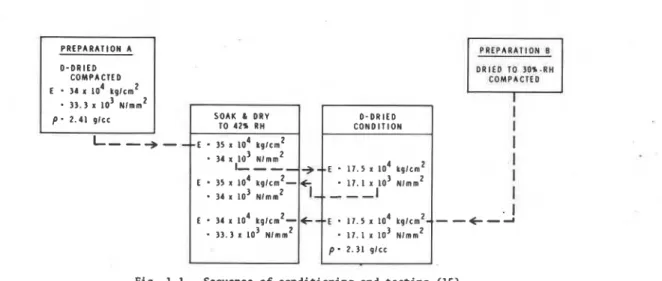
Using the compaction technique, Feldman (15) has studied the contribution of interlayer water on bond formation as measured by Young's modulus. Two series of compacted samples in the porosity range of 10 to 60% were made: Series B made from bottle hydrated cement dried to 30% RH, and Series A from the same material dried to d-dried condition. Figure 1.1 gives the sequence of wetting and drying to which the two series of compacted samples, prepared at 11% porosity, were exposed. The values for Young's modulus at each condition are given.
Series B, hydrated cement compacted with interlayer water intact, and Series A, compacted with interlayer water removed (d-dried) both give high values of modulus. However, when series B samples are driedthe modulus decreases by about one half. No changeoccurs to the modulus of series A samples on wetting butthey, too, suffer a loss in modulus when dried again.
P R E P A R A T I O N A 0 - D R I E D COMPACTED E
-
3 4 r l o 4 t g l c m 2-
3 3 . 3 r l o 3 N l n m 2 p-
2 . 4 1 g l c c SOAK 6 DRY TO 4 2 1 R H - E 35 r l o 4 t g / c m 2 34 r 10' N l m m 2 I, -, - E 35 r l o 4 tglcm2- 34 r l o 3 N l m m 2 .E-
1 7 . 5 r l o 4 k g / c m 2 1 7 . 1 r l o 3 N l m m 2 p-
2 . 3 1 g l c cFig. 1.1
-
Sequence of conditioning and testing (15) The role of interlayer water in this sequence ofmeasurements is that of contributing to the bonding, perhaps by coordinating with calcium ions which are present between the sheets. It is also evident that compaction of the d-dried material can bring the layers close together and so increase.the surface-to- surface interaction. The result of this is that the value of modulus is about the same as obtained for the system with interlayer water. The higher density product of 2.41 g/cc obtained when compacting d-dried hydrated cement (Fig. .l.2), confirms the explanation given above. C O M P A C T I O N PRESSURE. N l m m Z r 10.'
1
0 S E R I E S A 2. 25 0 2 4 6 8 10 1 2 I 4.
C O M P A C T I O N P R E S S U R E . k g l c n 2 x 10"Fig. 1.2
-
Density vs compaction pressure for bottle hydrated cement.1.3 BOND STRENCM AND MATERIAL STRENGTH
From the practical point of view, bond strengthas such may not have any significance. It is the material strength, which is the value obtained in tests, that can be used in all design calculations.
If it were possible to obtain by measurement the total interparticle contact area, it would be easy to relate the material strength to bond strength. Although this
is impossible as yet, some indirect measurements such as change in surface area have been made by
Collepardi (9).
When strength of a material is related to the total porosity, one obtains a characteristic that is probably related'to bond strength and contact area. Where modulus, hardness or strength is determined for samples at any one porosity, the results do not characterize that property and cannot be used to compare such a material as a binder with any other material. This is a feature of porous materials that does not apply to non-porous materials, andmst not be overlooked,- Much info-mtion in the current litera- ture has not considered this and is, therefwe, of limited use.
When considering contact (bond) area, it must be remembered that size of particles plays a very impor-
.
tant role. For example, when a model of uniform diameter particles is considered in a hexagonal, close-packed arrangement, the surface area per unit mass (assuming a density of 2.4 g/cm3) is related to particle diameter (Fig. 1.3). It is obvious that, for the same porosity, as the particle diameter decreasesD E N S I T Y OF S O L I D . 2 . 4 g l c c P O R O S I T Y . 2 8 1 BY VOLUME ". 5 5 0 0 111 I
.
, "yy 10 I w DIAMETER OF SPHERES. p mFig. 1.3
-
Relation of diameter of spheres to their surface area in a hexagonal close-packed systemand surface area increases, the area of.effective contact (where surfaces are within the field of force of long-range forces) increases.. This is the situation with cement gel which is first produced as sub-microscopic particles of various shapes and includes silicate sheets with a surface area of over 700 m2/g (Winslow and Diamond (16)). This fact and the presence of stress generated by the hydrating reaction (as discussed in 1.2). provides the conditions for the formation of a structure that has considerable contact area between particles.
Most binders can be characterized by a relationship of the mechanical properties to porosity. This relationship may represent the bond strength or nature of the bond. In this regard the microhardness appears particularly useful because it seems to give the characteristic behaviour that is observed with flexure strength when the material is tested at dif- ferent levels of relative humidity. Microhardness measurement must involve, wholly or in part, the progressive breaking of bonds between particles as well as fracturing of particles as the pyramid indenter penetrates the porous material. The work by Sereda (17) has shown that even different preparations of gypsum representing different morpho4ogies of the crystals when compacted could be characterized by the hardness-to-porosity relationship, as shown in Fig. 1.4.
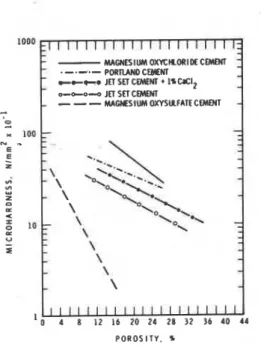
Using microhardness techniques, Beaudoin (18) charac- terized various binding cements by a hardness-to- porosity relationship (Fig. 1,s). From this relation- ship it can be seen that magnesium oxychloride
provides the strongest structure, with normal portland cement ranking second, and magnesium oxysulfate cement ranking the lowest.
C O M P A C T S OF G Y P S U M O S f L E N I T E l b - 9 . 3 1 1 8 4 . 0 pptd G Y P S U M l b - 1 . 3 1 O C Y P S U M W l T H C a ACETATE l C Y P S U M W l T H C E L A T I N E
.
. P O R O S I T Y . S C --
w u t n l u m o x v c n o n l o E c E m a n::
-
.
-.-.-
P O R r U N D C E w r n-
c c t eJET SEI CEMEPR + 1 8 C X 1 2-
p h 0 - O JET sn cw- -
-
M A C W S I U M OXYSUFATE CEMENT-
-
0 d x 100 r-
N I-
E-
-
-
VI "J-
Z C ) E \-
-
E \ U-
-
Z-
\ ? \ P O R O S I T Y . 5Fig. 1.5
-
Microhardness vs porosity for several inorganic cementitious systems (18)Bache (19) developed a model for the strength of a brittle material built up of particles joined at points of contact. In this model, the particles are large in relation to contact area. In the derivation of the equation to represent strength, the assumption is made that the mechanical properties of the contact area are the same as that of the particle. This is essentially the assumption made in dealing with polycrystalline ceramic materials. The relation between strength and the volume concentration of cement in mortars made from silica "fines" and cement as obtained by Bache, agreed well with his theoretical equation.
Attempts have been made to predict the strength of cement paste by analysing various parameters of this system. Polak (20) derived a series of equations where the strength of the hardened system is a function of 12 parameters forming 4 dimensionless complexes. In this analysis the structure is defined by chemical and mineralogical composition, system geometry and force bonds derived from the structure of the material and the structure of its porous space. He suggests that 14 experiments are required to determine the parameters for use in the mathematical analysis but it is not clear what these experiments are. Grudemo (21) stated that. 'The theoretical treatment of the strength vs structure relationship of such a system containing several solid phases in a non-random arrangement, and pores of various types in unknown proportions, is certainly very complex, if not impossible." However, he subsequently derived
equations to relate properties with porosity. Inthis analysis (22) he does not include the influence of stress concentrations, or variation in stress inten- sity factors due to differedces in pore shape or due to the heterogeneous distribution of matter in the solid phase including internal microstructural- Lawrence et a1 (23) studied physical properties of Fi.g. 1.4
-
Microhardness vs porosity for compacts h drated tricalciln and B-dicalcium silicate pastes of different samples of gypsum (17) wiere the microstructuns w e n altered by the use ofadmixtures and by temperature variations during hydration. Thus tensile strength was compared for a range of microstructures and was found to be
uninfluenced by large changes in outer C-S-H
morphology induced by admixtures. They concludedthat strength development in C3S pastes appears to depend primarily on the total capillary porosity and that changes in microsoructure have little influence on strength. Although this result agrees with those of others--that porosity is an important parameter in determining strength--their conclusion appears to be in conflict with work where unique strength vs porosity curves were obtained for different prepara- tions representing different morphologies (as dis- cussed in Section 2). Perhaps the result of Lawrence et a1 (23) is fortuitous due to the fact that onlyone W/C ratio was used in the preparation of the samples. 1.4 MICROSTRUCTURE AND BONDS
Since the emergence of the scanning electron micro- scope, a large number of micrographs have been pub- lished which show a range of morphologies of hydrated cement products. Diamond (24) summarized the infcrma- tion and proposed a classification based on 4 types of morphologies. It should be recognized, however, that it would be useful if an estimate were provided ofthe amounts of the different products characterized by a type of morphology in the microstructures, as stressed by Grattan-Bellew et a1 (25). In examining a system so lacking in distinct features as hydrated C-S-H, there is a tendency to concentrate on certain morphological features that may not represent the whole subject.
Most of the evidence from microstructural examination can be used to compare or characterize the particular samples under study but fails to indicate, even semi- quantitatively, when a given material is strong or weak, stable or unstable. When microscopic examina- tion is used as evidence for structure formation. there is a tendency to use the information obtainedat the beginning of the hydration process (at the time when the morphologies of the different products are distinct). Thus it is assumed that the microstructure and the process responsible for it are the same at the beginning and at the end. All evidence points to the conclusion that this assumption is invalid and that the nature of the first product formed and the process causing it to form is more than likely very different from the final product and process. For example, work by Double and Hellawell (26) concluded that, at the start, the hydration process is driven by osmotic pressure occurring in.fibrils which are tubular. This may not be a property that is relevant to the mature structure.
1.5 COMPACTION
-
STRUCTURE FORMATIONAs an aid to a better understanding of the behaviour and properties of porous materials, the authors have used cold compaction of various powders for the past 15 years to produce porous bodies as "models" from various materials, ranging from sodium chloride. gypsum, sulfur, to a variety of cementitious binders. In the numerous experimental studies where this tech- nique was used to prepare samples, the purpose was to provide a series of rigid, porous samples of varying porosity, thus enabling this parameter to be tested in relation to other properties such as sorption, dimen- sional change, modulus, hardness, and response to changing environmental conditions of various materials available as powders.
Compacted samples of calcium carbonate, silica gel, and molecular sieves were used successfully by Sereda and Feldman (27) and compacted samples of hydrated portland cement, by Feldman (28) to show the relation between sorption of water and dimensional change and to confirm the Bangham relation where simple adsorption occurs.
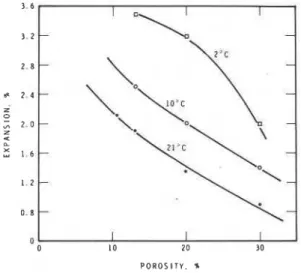
Compacted samples have been used effectively to study volume changes associated with hydration reactions of such materials as MgO (29) where it was shown that the expansion of the compact is related to the concentra- tion of MgO in lime. Similarly, the expansion of gypsum plaster on hydration was determined by meansof compacts (30) where it was shown that expansion was related to initial porosity and temperature as shown in Fig. 1.6.
0
LO 20 30
P O R O S I T Y . Z
Fig. 1.6
-
Expansion of pottery plaster as a function of porosity and temperature (30)The compaction technique was also used to study the nature of bonds in portland cement system and gypsum system, as discussed in the previous section (13,311. To show the sign,ificance of microhardness measurement in characterizing different binders, Sereda (17) used compacted samples where it was possible to distinguish between different preparations of gypsum (see
Fig. 1.4).
Hot pressing of unhydrated cement followed by hydration was shown by Roy et a1 (32) to be a successful technique to produce samples of hydrated cement of very low porosity and very high strength. It can be concluded that compaction technique can be a useful tool to study porous materials, especially the hydrated cementitious sytems. '
REFERENCES (SECTION 1)
1.
-
I. SKEIST (1963), "Handbook of adhesives," Reinhold Publishing Corp., Chapman and Hall Ltd., London, p. x of Glossary.2.- P.A. REHBINDER, E.E. SEGALOVA, E.A. AMELINA, E.P. .ANDREEVA, S.I. KONTOROWICH, 0.1. LUKYANOVA, E.S. SOLOWEVA, and E.D. SHCHUKIN (1974), "Physico-chemical aspects of hydration hardening of binders," Proc. Sixth Int. Congr., Chem of Cement, Moscow, Vol. 11, book 1, 58-64. 3.- J.E. GILLOTT and P.J. SEREDA (1966), "Strain in
crystals detected by X-rays," Nature, 209 (5018), 34- 36.
4.- M.M. SYCHEV (1974), "Regularities of binding property manifestation," Proc. Sixth Int. Congr., Chem. of Cement, Moscow, Vol. 11, book 1, 42-57. 5.- H.J. UBELHACK and F.H. WITTMAN (1976), "Dynamics of the development of structures in colloids and Brownian motion," J. de Phys., p. C6-269 to C6-271; also "Coupling of colloid particles and recoilless fraction," J. de Phys., p. C6-273-276. 6.- F.H. WITTMAN, U. PUCHNER and H. UBELHACK (1975),
"Properties of colloidal particles in hardened cement paste and the .relation to mechanical behaviour," Int. Proc. Congr., Colloid and Surface Chemistry (IUPAC), Budapest/Ungarn. 7. - F.H. WITTMAN (1973), "Interaction of hardened
' cement paste and water," J. Amer. Ceram. Soc. 56, 409-415.
8.- M.J. SETZER and F.H. WITTMAN (1974), "Surface energy and mechanical behaviour of hardened cement paste," Appl. Phys. 3, 403-409.
9.- M. COLLEPARDI (1973), "Pore structure of hydrated tricalcium silicate," Proc. Int. Congr., Colloid and Surface Chemistry (IUPAC), Prague, Vol. 1, B25-B49.
10.- P.J. SEREDA, R.F. FELDMAN and E.G. SWENSEN (1966), "Effect of sorbed water on some mechanical properties of hydrated portland cement pastes and compacts," Highway Research Board, Special Report 90, Washington, p. 58-73. 11.- P.J. SEREDA (1978), "The instability of hydrated
portland cement," published in Epitoanyag 40, 147-153.
12.- R.F. FELDMAN and P.J. SEREDA (1968), "A model for hydrated portland cement paste as deduced from sorption length change and mechanicalproperties," Matgriaux et Constructions 1, 509-520.
13.- I. SOROKA and P.J. SEREDA (1968), "The structure of cement-stone and the use of compacts as structural models,"
5
Proc. Fifth Int. Symp., Chem. of Cement, Part 111, Vol. 111, 67-73, Tokyo. 14. - B. MARCHESE (1977), "SEM topography of twinfracture surfaces of alite pastes 3 years old," Cem. Concr. Res. 7, 9-17.
15.- R.F. FELDMAN (1972), "Factors affecting the Young's modulus-porosity relation of hydrated portland cement compacts," Cem. Concr. Res. 2,
375-386.
16.- D.N. WINSLOW and S. DIAMOND (1974), "Specific surface of hardened cement paste as determined by small-angle X-ray scattering," J. Amer. Ceram. SOC. 57, 193-197.
17.- P.J. SEREDA (1972), "Significance ofmicrohardness of porous inorganic materials," Cem. Concr. Res. 2, 717-729.
18.- J.J. BEAUDOIN,"Porosity measurement by high pressure mercury intrusion
-
microstructural limitations,"
(In preparation. )19.- H.H. BACHE (1970), ''Model for strength ofbrittle materials built up of particles joined at points of contact," J. Amer. Ceram. Soc. 53, 654-658. 20. - A. F. POLOK (1974), "Kinetics of cement stone
structure formation," Proc. Sixth Int. Congr., Chem. of Cement, Moscow, Vol. 11, book 1, 64-73 21. - A . GRUDEMO (1974), "Strength vs structure in
cement paste," Proc. Sixth Int. Congr., Chem. of Cement, Moscow.
22.- A GRUDEMO (1979), "Microcracks, fracture mechanics and strength of the cement paste matrix," Cem. Concr. Res. 9, 19-34.
23.- F.V. LAWRENCE, J.F. YOUNG and R.L. BERGER (1977), "Hydration and properties of calcium silicate pastes," Cem. Concr. Res. 7, 369-377.
24.- S. DIAMOND (1976), "Cement paste microstructure - an overview at several levels," Proc. of a Conference on Hydraulic Cement Pastes: Their Structure and Properties, held at Univ. of Sheffield, p. 2-30.
25.- P.E. GRA'ITAN-BELLEW, E.G. QUINN and P.J. SEREDA (1978), "Reliability of scanning electron microscopy information," Cem. Concr. Res. 8, 333-342.
26.- D.D. DOUBLE and A. HELLAWELL (1974), "The
solidification of cement," Scientific Amer. 237, 82-90.
27.- P.J. SEREDA and R.F. FELDMAN (1963), "Compacts of powdered materials as porous bodies for use in sorption studies," J. Applied Chem. 13, 150-158. 28.- R.F. FELDMAN (1968), "Sorption and length-change
scanning isotherms of methanol and water on hydrated portland cement," Proc. Fifth Int. Symp., Chem. of Cement, Part 111, Vol. 111, p. 53-66, Tokyo.
29.- V.S. RAMACHANDRAN, R.F. FELDMAN and P.J. SEREDA (1965), "An unsoundness test for limes without cement," Materials Research and Standards, 5, 510-515.
30.- P.J. SEREDA, R.F. FELDMAN and V.S. RAMACHANDRAN (1965), "Hydration'of gypsum plaster by the compact technique." Bull. Amer. Cerarp. Soc. 44, 151-155.
31.- I. SOROKA and P.J. SEREDA (1968), "Interrelation of hardness, modulus of elasticity, and porosity in various gypsum systems," J.. Amer. Ceram. Soc. 51, 337-340.
32.- D.M. ROY, G.R. GOUDA and A. BOBROWSKY (1972), "Very high strength cement paste prepared by hot pressing and other high pressure techniques," Cem. and Concr. Res. 2, 349-366.
This publication i f i being distributed by the Division of Building R e s e a r c h of the National R e s e a r c h Cou.i-.il of Canada. I t should not be reproduced i n whole o r i n p a r t without p e r m i s s i o n of the original publisher. The Di- vision would be glad to be of a s s i s t a n c e in obtaining such permission.
Publications of the Division m a y be obtained by m a i l - ing the a p p r o p r i a t e r e m i t t a n c e ( a Bank, E x p r e s s , o r P o s t Office Money Order, o r a cheque, m a d e payable to the Receiver General of Canada, c r e d i t NRC) to the National R e s e a r c h Council of Canada, Ottawa. K1A 0 R 6 . Stamps a r e not acceptable.
A l i s t of a l l publications of the Division i s available and m a y be obtained f r o m the Publications Section, Division of Building R e s e a r c h , National R e s e a r c h Council of Canada. Ottawa. KIA OR 6.