HAL Id: hal-01350119
https://hal.archives-ouvertes.fr/hal-01350119
Submitted on 29 Jul 2016
HAL is a multi-disciplinary open access
archive for the deposit and dissemination of
sci-entific research documents, whether they are
pub-lished or not. The documents may come from
teaching and research institutions in France or
abroad, or from public or private research centers.
L’archive ouverte pluridisciplinaire HAL, est
destinée au dépôt et à la diffusion de documents
scientifiques de niveau recherche, publiés ou non,
émanant des établissements d’enseignement et de
recherche français ou étrangers, des laboratoires
publics ou privés.
Preliminary Experiments on Unsupervised Word
Discovery in Mboshi
Pierre Godard, Gilles Adda, Martine Adda-Decker, Alexandre Allauzen,
Laurent Besacier, Helene Bonneau-Maynard, Guy-Noël Kouarata, Kevin
Löser, Annie Rialland, François Yvon
To cite this version:
Pierre Godard, Gilles Adda, Martine Adda-Decker, Alexandre Allauzen, Laurent Besacier, et al..
Preliminary Experiments on Unsupervised Word Discovery in Mboshi. Interspeech 2016, Sep 2016,
San-Francisco, United States. �hal-01350119�
Preliminary Experiments on Unsupervised Word Discovery in Mboshi
Pierre Godard
1,2, Gilles Adda
1, Martine Adda-Decker
1,3, Alexandre Allauzen
1,2, Laurent Besacier
4,
H´el`ene Bonneau-Maynard
1,2, Guy-No¨el Kouarata
3, Kevin L¨oser
1,2, Annie Rialland
3, Franc¸ois Yvon
1 1LIMSI, CNRS, Universit´e Paris-Saclay, France
2
Universit´e Paris-Sud, France
3
LPP, CNRS-Paris 3/Sorbonne Nouvelle, France
4
Laboratoire d’Informatique de Grenoble (LIG)/Univ. Grenoble Alpes, France
{godard,gadda,madda,allauzen,hbm,loser,yvon}@limsi.fr,
[email protected],{guy.kouarata,annie.rialland}@univ-paris3.fr
Abstract
The necessity to document thousands of endangered languages encourages the collaboration between linguists and computer scientists in order to provide the documentary linguistics com-munity with the support of automatic processing tools. The French-German ANR-DFG project Breaking the Unwritten
Language Barrier (BULB) aims at developing such tools for
three mostly unwritten African languages of the Bantu family. For one of them, Mboshi, a language originating from the “Cu-vette” region of the Republic of Congo, we investigate unsuper-vised word discovery techniques from an unsegmented stream of phonemes. We compare different models and algorithms, both monolingual and bilingual, on a new corpus in Mboshi and French, and discuss various ways to represent the data with suit-able granularity. An additional French-English corpus allows us to contrast the results obtained on Mboshi and to experiment with more data.
Index Terms: automatic alignment, automatic transcription, machine translation, Bantu languages, language documentation
1. Introduction
The project Breaking the Unwritten Language Barrier (BULB),1 which brings together linguists and computer scien-tists, aims at supporting linguists in documenting unwritten (or hardly written) languages. In order to achieve this goal, we de-velop tools for language documentation by building upon tech-nology and expertise from the area of natural language process-ing, most prominently automatic speech recognition and bitext alignment. As a development and test bed for this methodology, three less-resourced African languages from the Bantu family have been chosen: Basaa, Myene and Mboshi.
The BULB project methodology can be summarized into three main steps: (1) Collection of a large corpus of speech at a reasonable cost. For this, we use standard mobile devices and a dedicated software called LIG-AIKUMA[1].2 After ini-tial recording, the data is re-spoken by a reference speaker to enhance the signal quality, and orally translated into a target (well-documented) language (French in our case). (2)
Auto-matic transcription of the Bantu languages at phoneme level
and the French transcription at word level, followed by the
au-tomatic alignment between recognized Bantu phonemes and
1http://www.bulb-project.org
2https://forge.imag.fr/frs/download.php/706/
MainActivity.apk
French words. (3) Tool development: Implement tools that will assist linguists in their documentation work, taking into account their needs and existing technology’s capabilities. At this stage of the project (end of first year), we have focused on the data acquisition and have also began to work on automatic transcrip-tion and alignment ([2, 3]).
Contributions. This paper is related to the second step of the project methodology. More precisely, we address the
au-tomatic alignment. This problem (also called word discovery)
consists in automatically discovering lexical units (as well as their pronunciations) in an unknown (and unwritten) language without any supervision. While several algorithms were pro-posed in the past to address this problem (see details in section 2), they were only simulating unwritten language cases using well-resourced languages such as English or Spanish. One con-tribution of this paper is to benchmark several algorithms, both monolingual and bilingual, for a real endangered (and unwrit-ten) language: Mboshi. For bilingual approaches, we also in-vestigate which unit (word or lemma) on the source (written) language is more suitable to discover words in a target (un-written) language. Finally, an additional French-English cor-pus allows us to contrast the results obtained on Mboshi and to experiment with larger amounts of data.
The rest of this paper is organized as follows. In Section 2, we summarize the related works on unsupervised word discov-ery. Details on Mboshi language and data collection are given in Section 3. Section 4 presents the algorithms used while Sec-tion 5 is dedicated to experiments and results. Finally, SecSec-tion 6 concludes and gives some perspectives.
2. Unsupervised word discovery
2.1. Previous work
The feasibility of automatically discovering lexical units (as well as their pronunciations) in an unknown (and unwritten) language without any supervision was examined in [4]. This goal was achieved by unsupervised aggregation of phonetic strings into word forms from a continuous flow of phonemes (or from a speech signal) using a monolingual algorithm based on cross-entropy. Applied to a speech translation task, this approach led to almost the same performance as the baseline approach, while being theoretically applicable to any unwrit-ten language. A phone-based speech translation approach that made use of cross-lingual supervision was introduced in [5]. This bilingual approach works on a scenario in which a
hu-man translates the audio recordings of the unwritten language into a written language. Alignment models as used in machine translation [6, 7] were then learned on the resulting parallel cor-pus made of foreign phone sequences and their corresponding English translation. [8] combined this approach with monolin-gual techniques and also did contrastive comparisons. [9, 10] then continued to work on this task by enhancing the alignment model and examined the impact of the choice of the written lan-guage to which the phoneme sequence is aligned.
Working with a similar goal in mind, and using bilingual information in order to jointly learn the segmentation of a target string of characters (or phonemes) and its alignment to a source sequence of words, [11, 12] are building on Bayesian mono-lingual segmentation models introduced by [13] and further ex-panded in [14]. This trend of research has become increasingly active in the past years, moving from strategies using segmenta-tion as a preprocessing to the alignment steps, to models aiming at jointly learning relevant segmentation and alignment. [15] reports performance improvements for the latter approach on a bilingual lexicon induction task, with the additional benefit of achieving high precision even on a very small corpus, which is of particular interest in the context of BULB.
2.2. Open issues and specificities of the BULB context Many questions still need to be addressed. Implicit choices are usually made through the way data are specified and rep-resented. Taking, for example, tones into account, prosodic markers, or even a partial bilingual dictionary, would require different kinds of input data, and the development of models able to take advantage of this additional information.
A second observation is that most attempts to learn seg-mentation and alignments need to inject some prior knowledge regarding the desired form of the linguistic units which should be extracted. This is because most machine learning schemes deployed in the literature tend to produce degenerated and triv-ial (over-segmented or conversely under-segmented) solutions. The additional constraints needed to control such phenomena are likely to greatly impact the nature of the units that are iden-tified. Supporting the documentation of endangered languages within the framework of BULB should lead us to question the linguistic validity of those constraints and the results they pro-duce. The Adaptor Grammar framework [16, 17], which en-ables the specification of high-level linguistic hypotheses ap-pears to be of particular interest. Another important aspect of our endeavour is the noisy nature of the input produced by the phonemicization of the unwritten language. Processing a phoneme lattice instead of a (one-best) phonemic transcription, following [18], seems to be a promising strategy.
More generally, a careful inventory of priors derived from the linguistic knowledge at our disposal should be undertaken. This is especially true regarding cross-lingual priors we can postulate about French on the one hand, and Basaa, Myene and Mboshi on the other hand: without taking such priors into ac-count, it is dubious that general purpose unsupervised learning techniques will succeed in delivering any usable linguistic in-formation.
3. Data collection
3.1. Mboshi
Mboshi originates from the “Cuvette” region of the Republic of Congo and is also spoken in Brazzaville and in the diaspora. The number of Mboshi speakers is estimated at 150,000 (Congo
National Inst. of Statistics, 2009). A dictionary [19] is available and, just like Basaa and Myene, the language benefits from re-cent linguistic studies [20, 21]. During the last decades, Mboshi (Bantu C 25) has been studied to describe its grammar including morphological and phonological systems [20, 22, 23].
Mboshi is a tone language. There are 2 tones (high vs low tones) which may play lexical (ibea (to borrow) vs iba (to call)) as well as grammatical (ybea (which borrows) vs yebea (it borrows)) roles. The phonemic inventory is described using 25 consonants and 7 vowels. A specificity of the consonantal system (as compared to English) are for example the labiodental consonants (pf, bv) and the pre-nasalised consonants (mb, mbv, nd, ndz).
One particular aspect of Mboshi that can impact automatic word discovery is its agglutinative morphology. Words are ba-sically formed as a sequence or more generally as a combina-tion of morphological constituants, the latter undergoing a vari-ety of phonological processes during word formation. For ex-ample, noun morphology can be quickly described as a com-bination of a root form to which a collection of affixes may be added. Simple nominal roots may be monosyllabic (/-VV/ or /-CV/), disyllabic (/-CVV/, /-VCV/ or /-CVCV/) and trisyl-labic (/-CVCVCV/ or /-CVVCV/) and may be augmented by prefixes only, wheras verbo-nominal roots also allow for suffix agglutination. There is a long tradition in describing Bantu lan-guages with the help of a rich set of nominal class prefixes [24]. Whereas Bleek’s classification proposes 18 classes, the num-ber of classes varies across languages and even within a lan-guage depending on the authors. Most recent work on Mboshi describes a system using 13-14 classes [22, 21]. The verbal morphology can be described by a prefix-root-extension-suffix pattern. Affixes allow for situating an action with respect to an acting agent, a time moment or duration, a place, etc.
A description of phonological processes in Mboshi, as well as studies of its tonal system have recently been carried out [25, 21] and a bilingual French-Mboshi dictionary is also being developed [26].
3.2. Corpus collection
Our objective was to collect large volumes of data from dozens of speakers in different speaking styles. All exist-ing written documents includexist-ing a 4,500-entry Mboshi dictio-nary [27], traditional tales and biblical texts in Mboshi were gathered. Furthermore, 1,200 reference sentences for oral language documentation [28] were translated and written in Mboshi by one of the authors (GNK) who is a native speaker of Mboshi. Only these 1,200 sentences translated in Mboshi (called Bouquiaux data set in the rest of the paper) were used in the experiments of this paper. However, this is worth men-tioning that 50h of speech data in Mboshi language were col-lected recently with LIG-AIKUMAin Congo-Brazzaville [29]. This larger data set will be used in future studies.
4. Methods assessed
4.1. Algorithms
We contrast here a series of recent methods for performing the automatic segmentation of an input stream of symbols into meaningful lexical or sub-lexical units. dpseg [13, 30]3 im-plements a Bayesian non-parametric approach, where
(pseudo)-3http://homepages.inf.ed.ac.uk/sgwater/
morphs are generated by a bigram model over a non-finite inventory, through the use of a Dirichlet-Process (DP). Esti-mation is performed through Gibbs sampling. Another im-plementation of Goldwater et al’s proposal is pgibbs4 [31], where the DP is replaced by a more general Pitman-Yor Pro-cess (PYP); this implementation notably provides an effective parallelization of the sampling process through blocked sam-pling (our experiments use a 3-gram model). An extension of this model is proposed in [14], which replaces the base distri-bution of the PYP LM by another hierarchical PYP language model at the character level ; we use here the implementation of [18], denoted latticelm5in Table 2. pypshmm [32] is another generalization of dpseg, introducing some morphotac-tics through word classes: in this model, sentences are produced by a non-parametric semi-Markov model, where both the num-ber of states and the numnum-ber of types are automatically adjusted based on the available data. Two hierarchical PYPs processes are also embedded in this architecture: one for controling the number of classes (states) and one for controling the number of words; as in [14], the base distribution is also a hierarchical PYP language model.
Having a French translation of the input at our disposal also allows us to contrast the above monolingual approaches with bilingual models. We consider here the Model 3P of [33], which generalizes the IBM alignment Model 3 of [6] to the case where the target side is an unsegmented character stream. We use the implementation (pisa6) of the authors.
4.2. Data overview
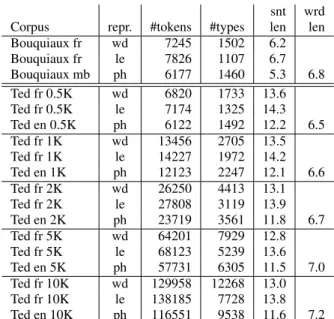
snt wrd Corpus repr. #tokens #types len len Bouquiaux fr wd 7245 1502 6.2 Bouquiaux fr le 7826 1107 6.7 Bouquiaux mb ph 6177 1460 5.3 6.8 Ted fr 0.5K wd 6820 1733 13.6 Ted fr 0.5K le 7174 1325 14.3 Ted en 0.5K ph 6122 1492 12.2 6.5 Ted fr 1K wd 13456 2705 13.5 Ted fr 1K le 14227 1972 14.2 Ted en 1K ph 12123 2247 12.1 6.6 Ted fr 2K wd 26250 4413 13.1 Ted fr 2K le 27808 3119 13.9 Ted en 2K ph 23719 3561 11.8 6.7 Ted fr 5K wd 64201 7929 12.8 Ted fr 5K le 68123 5239 13.6 Ted en 5K ph 57731 6305 11.5 7.0 Ted fr 10K wd 129958 12268 13.0 Ted fr 10K le 138185 7728 13.8 Ted en 10K ph 116551 9538 11.6 7.2 Table 1: Corpus statistics. ‘snt len’ gives the average sentence length (in words). ‘wrd len’ reports the average word length (in phones).
Our primary data source is the Mboshi-French parallel corpus derived from the 1,200 Bouquiaux reference sentences (see 3), for which we vary the representations both on the Mboshi (mb) and the French (fr) side. For the Mboshi, we com-pare a graphemic and a phonemic representation. The phoneme
4https://github.com/neubig/pgibbs 5http://www.phontron.com/latticelm/ 6https://code.google.com/archive/p/pisa/
sequence in Mboshi is considered as almost perfect (no ASR) for the moment. For this, since Mboshi has very little writ-ten material and no official agreement exists on writing conven-tions, a basic grapheme-phoneme perl script was developed to generate a pronunciation dictionary (the used writing conven-tions are very close to the oral forms). For French, we use both word (wd) and lemmatized (le) forms,7 with the hope that the
latter will yield less sparse models. We reiterate the same ex-periments and contrast with French-English data derived from the TedTalk corpus8, where we remove word separators on the
English side, and also optionally replace the orthography with phonemic strings (as found in a dictionary). The use of a well-resourced language pair allowed us to experiment with corpora of increasing sizes (up to 10K sentences). Basic statistics re-garding these datasets are given in Table 1.
5. Experiments and discussion
5.1. Protocol
For all methods evaluated in this study, we attempted to op-timize their parameters and hyperparameters on the smallest (0.5K sentences) extract of TedTalk using hyperopt [34]. The search algorithm was run several hundreds of times for each method, and the optimal parameters were then frozen to carry out the experiments on the Mboshi-French parallel corpus and the French-English corpora of larger sizes.
5.2. Results
The results in terms of word boundaries prediction are sum-marized in table 2 for the Mboshi-French parallel corpus and a TedTalk corpus of similar size (0.5K). To assess the possible impact of having more data, figures 1 and 2 show the evolution of respectively the F1-measure and precision computed on the
TED datasets of increasing sizes using a phonetic representa-tion.
The first observation is that our results in Mboshi are much worse than in English, even though the data size are compara-ble. This highlights the need to collect and process actual under-resourced languages in order to get a fair approximation of the performance of Natural Language Processing techniques – this discrepancy might be due to the fact that we use impoverished representations in Mboshi, where important phonetic informa-tion (eg. tones) regarding word structure has been removed; this might also be due to the construction of the Mboshi-French pus itself, showing less lexical diversity than the TedTalk cor-pus.9
Another general remark is that the non-parametric LMs improve their performance with more samples (see figures 1 and 2). The simpler dpseg, which only implements a 2-gram model, obtains very stable and satisfactory performance accross the board; pgibbs benefits from faster implementa-tions, yet, even after 10K sentences, its segmentation accuracy is still slightly smaller than dpseg’s. It is notable that dpseg, pgibbsand latticelm display a strong tendency to
over-7Lemmatization is performed with the TreeTagger. 8https://wit3.fbk.eu/
9We examined the distribution of words across both corpora,
plot-ting their frequencies for increasing Zipfian ranks. It appears that the French word distribution inside Bouquiaux is similar to its Mboshi counterpart, while differing significantly from the French word bution observed for the TedTalk corpus. On the latter corpus the distri-bution of French tokens presents a strong similarity to its English coun-terpart, which led us to attribute the performance discrepancy to the construction of both corpora rather than to their linguistic differences.
Phonemes Graphemes
Mboshi Ted 0.5K Mboshi Ted 0.5K
P R F1 P R F1 P R F1 P R F1 dpseg 61.0 75.5 67.5 74.6 91.5 82.2 55.8 78.2 65.1 63.9 94.4 76.2 pgibbs 60.2 78.3 68.1 67.3 91.1 77.4 54.9 93.0 69.0 55.0 92.8 69.1 latticelm 45.3 77.6 57.2 58.4 96.3 72.8 45.5 77.8 57.5 52.9 95.5 68.1 pypshmm 51.0 66.3 57.7 76.9 81.5 79.2 59.4 68.1 63.5 71.2 79.0 74.9 pisa(wd) 27.3 59.8 37.5 35.8 80.1 49.5 25.8 57.1 35.5 23.9 82.3 37.0 pisa(le) 32.2 24.7 27.9 41.4 69.4 51.8 30.2 23.9 26.7 26.1 75.3 38.8
Table 2: Precision (P), recall (R) and F1-measure for the prediction of word boundaries.
Mboshi(1460) Ted 0.5K (1492) #types P R #types P R dpseg 753 44.8 23.1 1044 48.0 33.6 pgibbs 763 43.8 22.9 1056 39.7 28.1 latticelm 726 26.7 13.3 726 33.8 20.9 pypshmm 809 30.0 16.6 1272 41.8 35.6 pisa(wd) 1954 13.9 18.6 1890 15.0 19.0 pisa(le) 2255 11.4 17.6 2081 15.5 21.6 Table 3: Number of types and precision (P) and recall (R) of the resulting vocabularies. The number of types of the reference is indicated in the first line.
segment their input, achieving very high recall ( > 90% on the phonetic English data), and a less satisfactory precision. The recent PYP semi-Markov model (pypshmm) achieves perfor-mances that are in the same ballpark, but shows a milder ten-dency to oversegment the input.
The difference between input representations on the Mboshi side are small; yet it seems that better results are obtained for all methods when using a phonetic representa-tion; pypshmm differs from the other methods in that respect: this might be because it tends to produce longer segments than the other monolingual models, which proves beneficial on graphemic forms, that are typically longer than phonetic repre-sentations.
In comparison, the bilingual method achieves disappointing results: even on the larger dataset, its performance is almost 20 points worse than the best monolingual approach. Using lem-mas instead of word forms here proves to be beneficial for the TedTalk, with a gain for all corpora sizes, while this leads to a decrease in performance on the Mboshi-French parallel corpus. Table 3 gathers statistics at the lexicon level and allows us to compare the automatically extracted lexicons with the ref-erence. From the number of types, we confirm that dpseg, pgibbs, latticelm and pypshmm tend to oversegment, resulting in a compact lexicon, while pisa exhibits the in-verse tendency. Whereas latticelm yields poor recall val-ues, dpseg and pgibbs achieve a more balanced trade off between precision and recall.
6. Conclusions
This paper presented preliminary experiments on unsupervised word discovery in Mboshi, a very under-resourced African lan-guage from the Bantu family. Several mono-lingual and bi-lingual automatic segmentation methods were assessed. Among them, dpseg, which only implements a 2-gram model, ob-tained stable and interesting performance. However, this ap-proach (as well as pgibbs and latticelm) tends to heav-ily oversegment the input, achieving very high recall and a
Figure 1: Evolution of the F1-measure on TED Talk corpora of
different sizes (phonemic representation)
Figure 2: Evolution of the precision on TED Talk corpora of different sizes (phonemic representation)
lower precision. Interestingly, the PYP semi-Markov model (pypshmm) obtained comparable performance with a milder tendency to oversegment the input. Further investigations are needed to confirm the encouraging performance obtained by dpsegand pypshmm since we only worked on a small dataset for which the Mboshi phoneme sequence was considered as per-fect.
As a consequence, our data set will be extended soon in or-der to benchmark word discovery approaches on (a) increased amount of data, and (b) true ASR outputs (word hypothesis for French and phoneme hypothesis for Mboshi). As other mid-term perspectives we intend to work with more contrasting lan-guages and to take into account tones or prosodic markers.
7. Acknowledgements
This work was partly funded by the French ANR and the Ger-man DFG under grant ANR-14-CE35-0002.
8. References
[1] D. Blachon, E. Gauthier, L. Besacier, G.-N. Kouarata, M. Adda-Decker, and A. Rialland, “Parallel speech collection for under-resourced language studies using the LIG-Aikuma mobile device app,” in Proceedings of SLTU (Spoken Language Technologies for
Under-Resourced Languages), Yogyakarta, Indonesia, May 2016.
[2] G. Adda, S. St¨ucker, M. Adda-Decker, O. Ambouroue, L. Be-sacier, D. Blachon, H. Bonneau-Maynard, P. Godard, F. Ham-laoui, D. Idiatov, G.-N. Kouarata, L. Lamel, E.-M. Makasso, A. Rialland, M. Van de Velde, F. Yvon, and S. Zerbian, “Breaking the unwritten kanguage barrier: The Bulb project,” in Proceedings
of SLTU (Spoken Language Technologies for Under-Resourced Languages), Yogyakarta, Indonesia, 2016.
[3] S. St¨ucker, G. Adda, M. Adda-Decker, O. Ambouroue, L. Be-sacier, D. Blachon, H. Bonneau-Maynard, P. Godard, F. Ham-laoui, D. Idiatov, G.-N. Kouarata, L. Lamel, E.-M. Makasso, A. Rialland, M. Van de Velde, F. Yvon, and S. Zerbian, “Inno-vative technologies for under-resourced language documentation: The Bulb project,” in Proceedings of CCURL (Collaboration and
Computing for Under-Resourced Languages : toward an Alliance for Digital Language Diversity), Portoro˜z Slovenia, 2016.
[4] L. Besacier, B. Zhou, and Y. Gao, “Towards speech translation of non written languages.” in Proc. SLT, M. Gilbert and H. Ney, Eds. IEEE, 2006, pp. 222–225.
[5] S. St¨uker, “Towards human translations guided language dis-covery for asr systems,” in Proceedings of the First
Interna-tional Workshop on Spoken Languages Technologies for Under-resourced languages (SLTU), Hanoi, Vietnam, May 2008.
[6] P. F. Brown, S. A. D. Pietra, V. J. D. Pietra, and R. L. Mercer, “The mathematics of statistical machine translation: Parameter estimation,” Computational Linguistics, vol. 19, no. 2, pp. 263– 311, 1993.
[7] F. J. Och and H. Ney, “A systematic comparison of various sta-tistical alignment models,” Comput. Linguist., vol. 29, no. 1, pp. 19–51, 2003.
[8] S. St¨uker, L. Besacier, and A. Waibel, “Human Translations Guided Language Discovery for ASR Systems,” in 10th
Inter-national Conference on Speech Science and Speech Technology (InterSpeech 2009). Brighton (UK): Eurasip, 2009, pp. 1–4. [9] F. Stahlberg, T. Schlippe, S. Vogel, and T. Schultz, “Word
seg-mentation through cross-lingual word-to-phoneme alignment.” in
Proc. SLT. IEEE, 2012, pp. 85–90.
[10] ——, “Pronunciation extraction from phoneme sequences through cross-lingual word-to-phoneme alignment,” in The 1st
In-ternational Conference on Statistical Language and Speech Pro-cessing, 2013, sLSP 2013.
[11] J. Xu, J. Gao, K. Toutanova, and H. Ney, “Bayesian semi-supervised Chinese word segmentation for statistical machine translation,” in Proceedings of the 22nd International Conference
on Computational Linguistics (Coling 2008), Manchester, UK,
2008, pp. 1017–1024.
[12] T. Nguyen, S. Vogel, and N. A. Smith, “Nonparametric word seg-mentation for machine translation,” in Proceedings of the 23rd
International Conference on Computational Linguistics (COL-ING’10), Stroudsburg, PA, USA, 2010, pp. 815–823.
[13] S. Goldwater, T. L. Griffiths, and M. Johnson, “Contextual depen-dencies in unsupervised word segmentation,” in Proceedings of
the 21st International Conference on Computational Linguistics and 44th Annual Meeting of the Association for Computational Linguistics, Sydney, Australia, 2006, pp. 673–680.
[14] D. Mochihashi, T. Yamada, and N. Ueda, “Bayesian unsupervised word segmentation with nested Pitman-Yor language modeling,” in Proceedings of the Joint Conference of the 47th Annual Meeting
of the ACL and the 4th International Joint Conference on Natural Language Processing of the AFNLP: Volume 1-Volume 1, 2009,
pp. 100–108.
[15] O. Adams, G. Neubig, T. Cohn, and S. Bird, “Inducing Bilingual Lexicons from Small Quantities of Sentence-Aligned Phonemic Transcriptions,” in 12th International Workshop on Spoken
Lan-guage Translation (IWSLT), Da Nang, Vietnam, 2015.
[16] M. Johnson, T. L. Griffiths, and S. Goldwater, “Adaptor gram-mars: a framework for specifying compositional nonparametric bayesian models,” in Advances in Neural Information Processing
Systems 19, B. Sch¨olkopf, J. Platt, and T. Hoffman, Eds. Cam-bridge, MA: MIT Press, 2007, pp. 641–648.
[17] M. Johnson, “Unsupervised word segmentation for Sesotho us-ing adaptor grammars,” in Proceedus-ings of the Tenth Meetus-ing of
ACL Special Interest Group on Computational Morphology and Phonology. Columbus, Ohio: Association for Computational Linguistics, June 2008, pp. 20–27.
[18] G. Neubig, M. Mimura, S. Mori, and T. Kawahara, “Learning a language model from continuous speech.” in Proc.
INTER-SPEECH, 2010, pp. 1053–1056.
[19] R. P. Beapami, R. Chatfield, G. Kouarata, and A. Waldschmidt,
Dictionnaire Mbochi - Franc¸¸ais. Brazzaville: SIL-Congo, 2000.
[20] C. Amboulou, “Le Mbochi: langue bantoue du Congo Brazzaville (Zone C, groupe C20),” Ph.D. dissertation, INALCO, Paris, 1998. [21] G. M. Embanga Aborobongui, “Processus segmentaux et tonals en Mbondzi – (vari´et´e de la langue embosi c25),” Ph.D. disserta-tion, Universit´e Paris 3 Sorbonne Nouvelle, 2013.
[22] P. L. Bedrosian, “The Mboshi noun class system,” Journal of West
African Languages, vol. 6, pp. 27–47, 1998.
[23] L. Fontaney, “Mboshi: Steps Towards a Grammar,” Pholia, vol. 3, 4, pp. 87–167, 71–132, 1988, 1989.
[24] W. Bleek, De nominum generibus linguarum Africae Australis. Bonn, 1851.
[25] J.-M. Beltzung, A. Rialland, and M. Embanga Aborobongui, “Les relatives possessives en mbochi (C25),” Zas Papers in Linguistics, vol. 52, pp. 7–31, 2010.
[26] G.-N. Kouarata, “Variations de formes dans la langue mbochi (bantu c25),” Ph.D. dissertation, Universit´e Lumi`ere Lyon 2, 2014.
[27] B. Roch Paulin, R. Chatfield, G. Kouarata, and A. Embengue-Waldschmidt, Dictionnaire Mbochi-Franc¸ais. Congo (Brazzav-ille): SIL-Congo Publishers, 2000.
[28] T. Bouquiaux and J. Thomas, Enquˆete et description des langues
`a tradition orale. Paris: SELAF, 1976.
[29] D. Blachon, E. Gauthier, L. Besacier, G.-N. Kouarata, M. Adda-Decker, and A. Rialland, “Parallel speech collection for under-resourced language studies using the lig-aikuma mobile device app,” 2016, submitted to SLTU 2016.
[30] S. Goldwater, T. L. Griffiths, and M. Johnson, “A Bayesian frame-work for word segmentation: Exploring the effects of context,”
Cognition, vol. 112, no. 1, pp. 21–54, 2009.
[31] G. Neubig, “Simple, correct parallelization for blocked Gibbs sampling,” Nara Institute of Science and Technology, Tech. Rep., 2014.
[32] K. L¨oser and A. Allauzen, “Une m´ethode non-supervis´ee pour la segmentation morphologique et l’apprentissage morphotactique `a l’aide de processus de Pitman-Yor,” in Actes de la conf´erence sur
le Traitement Automatique des Langues Naturelles (TALN’16),
Paris, 2016.
[33] F. Stahlberg, T. Schlippe, S. Vogel, and T. Schultz, “Word seg-mentation and pronunciation extraction from phoneme sequences through cross-lingual word-to-phoneme alignment,” Computer
Speech & Language, 2014.
[34] J. S. Bergstra, D. Yamins, and D. Tax, “Making a science of model search: Hyperparameter optimization in hundreds of dimensions for vision architectures,” in Proceedings of the 30th International
Conference on Machine Learning, ser. ICML-13, S. Dasgupta and