2009-2010
People’s Democratic Republic of Algeria
Ministry of Higher Education and Scientific Research
Mentouri University-Constantine
Faculty of Letters and Languages
Department of Languages
Dissertation Submitted in Partial Fulfillment of the Requirements for the Master Degree in Applied Language Studies
Submitted by: Supervised by
Nassima Mechitoua Dr. Haouès Ahmed Sid
Examined by:
Dr. Karima Lakhal Ayat
The Use of Academic Language and Linguistics Register
in Writing Linguistics Essays
i
Dedications
I would like to dedicate this modest work to my dear parents for their help, encouragements, and care that I will be indebted for ever.
To my brothers Hamza and Abdanour.
To all my relatives
To all my classmates and friends Meriem, Souad, Assia, Hasna, Nor EL Huda, Rym, Maha, Roquaya, Hada, Amel.
ii
Acknowledgments
I would like, first, to thank my supervisor, Dr el Haouès Ahmed Sid, for his support and guidance throughout the various stages of this research. I am very grateful to him for his encouragements and precious advice. I wish to thank him a lot for his patience and insightful feedback.
I am also grateful to, Dr Karima Lakhal Ayat, Mr Adel Boushaba, Dr Youcef Beghoul, and Dr Nacif Labed for their invaluable help and support, and their generosity in providing me with the documentation and valuable references.
I am grateful also to all my teachers for their contributions to my intellectual growth during my studies at the Department of English, university of Constantine.
Finally, I would like to express my appreciation to my family, especially my parents. Without their support, the completion of my research would have been impossible. My thanks also go to my friends Meriem, Souad, and Rym.
iii Abstract
The overall aim of the present research is to evaluate students’ writings in terms of using features of academic language, appropriate linguistics register variables, and the structure of an essay. In addition, this research develops a definition of academic language and its features, presents the notion of linguistics register variables, and tackles how an essay is structured. The research methods in this dissertation include the collection and analysis of a sample of the written data, i.e, students’ exam papers. The findings from this analysis show that students in the English Department at Mentouri University, Constantine, do not employ features of academic language and the appropriate linguistics register in their essays. So, this dissertation recommends that there should be explicit instructions and practice provided by teachers about the nature of academic language and its features.
iv List of Tables
Table 1: Selected Common Verbs, Adjectives, and Adverbs in Conversation versus Academic
Writing………..10
Table 2: Key Attributes of Academic and non-Academic Texts………..12
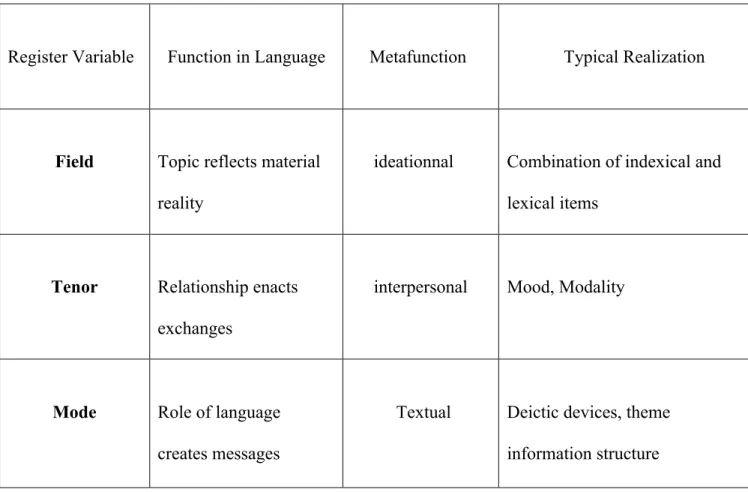
Table 3: Meaning of Field, Tenor and Mode, alignment with metafunctions, and typical realizations………...21
Table 4: Students’ Use of Present Simple compared with Use of other Tenses………...25
Table 5: Students’ Use of Passive Voice………..26
Table 6: Students’ Use of Nominalizations………..27
Table 7: Students’ Use of Academic and non-Academic Adjectives……….28
Table 8: Students’ Use of Academic and non-Academic Adverbs……….29
Table 9: Students’ Use of Reporting Verbs………30
Table 10: Students’ Use of Impersonal and Personal Forms………..31
Table 11: Students’ Use of Specialized Terms………...32
Table 12: Students’ Use of Reference……….33
Table 13: Students’ Use of Substitution………..34
v
Table 15: Students’ Use of Conjunctions………36
Table 16: Students’ Use of Repetition……….37
Table 17: Students’ Use of Linguistics Register Variables………39
vi Contents
General Introduction………..1
Chapter One: Academic Language and Linguistics Register……….3
Introduction ………3
1.1. Academic Language ………3
1.2. Features of Academic Language……….4
1.2.1. Grammatical Features………..4
1.2.1.1. Use of Present Simple………..4
1.2.1.2. Use of Passive Voice………5
1.2.1.3. Use of Nominalizations……….6
1.2.1.4. Use of Different Word Classes……….7
1.2.1.4.1. Adjectives………...7
1.2.1.4.2. Adverbs………..7
1.2.1.4.3. Reporting Verbs……….8
1.2.1.5. Use of Personal Forms……….10
1.2.2. Lexical Features………..11
1.2.3. Discourse Features………..12
1.2.3.1. Reference……….13
vii 1.2.3.3. Ellipsis………..14 1.2.3.4. Conjunction………15 1.2.3.4.1. Additive………...15 1.2.3.4.2. Adversative……….16 1.2.3.4.3. Temporal………..16 1.2.3.4.4. Conditional………..16 1.2.3.5. Lexical Cohesion………17 1.2.3.5.1. Repetition……….17 1.2.3.5.2. Synonymy………17
1.3. Definition of Linguistics Register ………..18
1.4. Variables of Linguistics Register………19
1.4.1. Mode………19
1.4.2. Tenor……….19
1.4.3. Field……….20
1.5. Structure of a Linguistics Essay……….21
viii
Chapter Two: Description and Analysis of the Written Data………..23
Introduction ………...23
2.1. The Sample………...23
2.2. Research Tool………24
2.3. Results and Discussion of the Written Data………24
2.3.1. Section One: Grammatical Features………25
2.3.2. Section Two: Lexical Features………32
2.3.3. Section Three: Discourse Features………..33
2.3.4. Students’ Use of Appropriate Linguistics Register Variables………39
2.3.5. Structure of the Students’ Essays………41
2.4. Summary of the Findings………42
Conclusion………...43
General Conclusion and Recommendations……….44
References………47
Appendix
1
General Introduction
1. Statement of the Problem
Writing a linguistics essay involves from students to follow a certain structure. This means that there should be an introduction, a body, and a conclusion. In addition, this essay should meet the common features of academic language. However, many students think that relying on theoretical issues about a particular topic is the key to end up with an acceptable English written production. Hence, they give much importance to the amount of information and tend to forget the main features of academic writing. The problem we are confronted with in this research is the relationship between features of academic writing, the variables of the linguistics register, and the ability to write and construct a linguistics essay.
2. Research Questions
The present research aims at investigating the following questions:
- Do First Year Master students use features of academic language and the appropriate linguistics register variables when they write linguistics essays? - Do these students respect the structure of a linguistics essay?
3. Aim of the Study
This study aims at evaluating features of academic language and the linguistics register variables used by First Year Master students in writing a linguistics essay, and the structure of this essay.
2 4. Hypothesis
We hypothesize that if students write linguistics essays, they will not use features of academic writing, the appropriate linguistics register variables, and the structure of an academic essay.
5. Research Methodology
Concerning data collection, twenty students’ exam papers of First Year Master level, Applied Language Studies, of sociolinguistics are chosen randomly to be observed in order to find out whether they use features of academic language, the appropriate linguistics register variables, and the structure of an essay.
After collecting the required data for this research, they would be analyzed quantitatively and qualitatively to shed more light on the students’ use of features of academic language and the linguistics register variables.
6. Structure of the Study
The present research is divided basically into two main chapters. The first chapter is devoted to the literature review on the academic language, its features, variables of a linguistics register, and the structure of a linguistics essay.
Chapter two will be devoted to the practical part of the investigation tool used to collect data and the analysis of these data.
3
Chapter One
Academic Language and Linguistics Register
Introduction
It has been suggested that learners of a particular language such as English have different kinds of language proficiency. One of these kinds is academic language proficiency. Using such a type of language helps in rendering formal style to the learners’ writings. So, this chapter is devoted mainly to academic language and the linguistics register as two different concepts. The first section emphasizes the meaning of academic language. The second section seeks the common features of academic language. The third section deals with the most agreed on definition of linguistics register, its variables, and the structure of a linguistics essay.
1.1. Academic Language
The term academic language commonly refers to the language that is used in formal situations such as classrooms, college or universities. Moreover, it is the language of textbooks and exams. According to Yopp H. k., Yopp R. H., & Bishop, academic language is the language used by teachers and students in order to acquire new knowledge and skills (2008: 16). It differs in structure and vocabulary from language used in daily social interactions. This means that academic language includes specialized vocabulary, as well as conventional text structures such as the use of nominal groups, i.e., groups of words that provide more information about particular concepts. For example, the language of linguistics includes words like morphology, language acquisition, or language learning.
4 1.2. Features of Academic Language
The uses of specific linguistic features depend on the discipline for which an assignment is written. For example, an essay in history may contain a number of past tense verbs than a paper that discusses the dialects spoken by a particular speech community in which the present tense verbs are used. According to Yopp et al., “Bailey (2007) identifies three features of academic language: lexical, grammatical, and discourse” (2008: 16).
1. 2.1. Grammatical Features
Grammatical features refer to sentence structure. These features result in the dense use of present simple, passive voice, nominalizations, different word classes (verbs, adjectives, adverbs), and impersonal forms that show the writer’s objectivity.
1.2.1.1. Use of Present Simple
In English, the present simple tense is used to describe habitual actions and events, and those that are usually true. Murphy says that the present simple is used to say that something happens all the time or repeatedly, or that something is true in general (1999: 4). As shown in the following examples:
- I take my breakfast every morning at 7 o’clock. - Nurses look after patients in hospitals.
Moreover, it is used to express facts. For example, the planets go round the sun. In the present simple, the verb does not take an ending with the following pronouns: I, you, they, and we. However, in the third person singular (he, she, and it), the verb ends with “s” or “es”, as in the following examples:
5 - I usually go away at weekends.
- Sarah catches the early train.
More precisely, in academic writing, the use of the present simple is often conventionalized and predominantly used. For example, in linguistics essays, it is used to explain a specific linguistic phenomenon which is always true.
- A child acquires language during the critical period. - Language is a set of signals by which we communicate. - Code switching occurs in bilingual societies.
1.2.1.2. Use of Passive Voice
The passive voice is one of the two voices in English. It is contrasting with active voice. In the passive, the object of the active voice becomes the subject, and the subject becomes the agent or object of the passive action. The passive sentence is indicated through a by-phrase or omitted altogether as shown in the following examples.
- In recent years, researchers have published several analyses of survey data (active sentence).
- In recent years, several analyses of survey data have been published.
Furthermore, the passive voice is used much more in academic language than in everyday language. Evans and Maggie state that certain grammatical features like the present simple and the passive voice are dominant and used frequently in academic writing than in general English (1998: 21) . So, passive constructions have been identified as one of the prominent features of academic language. Moreover, the use of the passive voice in
6
such a type of language intends to create an indirect style and shows the writer’s objectivity. This can be achieved by using another form of passive which is frequently used in academic writing (it is said that…... he is said to) as shown in the following examples:
- The child acquires the language in short period of time.
- It is said that the child acquires the language in a short period of time.
Similarly, Hinkel notes that using the passive voice in academic language is often more suitable than active constructions and is considered the most used in written genres (2002: 111).
1.2.1.3. Use of Nominalizations
There are many related specific features that are especially characteristic of academic language. One of these features is the use of nominalizations.
Nominalization refers to a verb or adjective being changed into a noun. For example, accept-acceptance, eligible-eligibility, move-movement, investigate-investigation. In academic writing, it represents formal writing style and a focus on ideas and concepts rather than action.
In addition, Gee defines nominalization as “a word linguists use for verbs that have been turned into nouns, such as production rather than produce” (2008: 61). So, nominalization is much more common in academic language especially nouns formed with: tion, ment, ness, ure, and ity. In addition, many linguists such as Hinkel note that nominalizations represent one of the conventions of academic and formal writing.
7 1.2.1.4. Use of Different Word Classes
There are three different word classes that are especially prevalent in academic language: adjectives, adverbs, and reporting verbs. These grammatical classes are more frequent in academic writing than in other registers.
1.2.1.4.1. Adjectives
In English, the primary syntactic function of adjectives is to modify nouns and noun phrases. A distinction is made between attributive and predicative adjectives. Adjectives are attributive when they premodify nouns such as: an important study. Moreover, attributive adjectives have an important place in text flow because they provide sufficient definition to referents. On the other hand, an adjective is predicative when it postmodifies verbs, i.e. the adjective comes after the verb. For example, the language of classrooms is formal.
Adjectives are frequent in academic writing rather than in conversational discourse or other types of writings (Hinkel, 2004: 209). This means that they are commonly employed in academic language rather than in interactional one which is used in informal situations. Moreover, these adjectives should be academic, i.e; there is no need to use non-academic adjectives that show the personal interpretation of the writer’s ideas such as good and best.
1.2.1.4.2. Adverbs
Adverbs are one of the largest word classes in English. They modify verbs, adjectives, whole clauses, and other adverbs as shown in the following examples:
8 - They are waiting outside.
- It is a very organized research paper.
- The two children started babbling very early.
In addition, academic writing often contains particularly high rates of intensifying adverbs such as really, very, totally. According to Bailey, “as the academic writer aims to be objective, adverbs like fortunately or remarkably may be unsuitable” (2003: 89). This means that the academic writer should avoid using adverbs that show personal attitudes.
1.2.1.4.3. Reporting Verbs
Academic texts in several disciplines such as linguistics, law, and economics use different kinds of verbs. One of these kinds is the frequent use of reporting verbs. Hinkel and Fotos state that reporting verbs are very common in academic writing when writers want to demonstrate their knowledge (2002: 187). Some of these verbs are: claim, believe, define, develop, and notice. Moreover, there are other reporting verbs that tend to convey a neutral attitude such as: suggest, point out, report, and argue. These reporting verbs play a crucial role in academic writing. They give the reader clear and accurate pictures to find their way to the source, and to show the writer’s attitude to the data. Table 1 summarizes the common adjectives, adverbs, and verbs used in academic writing versus the adjectives, adverbs, and verbs that are used in conversation.
9
Conversation Academic Writing Verbs Get Produce Go Provide Come Obtain Make Form Take Describe Say Develop Know Require Think Occur See Involve want Include Adjectives Big Same Little Different Old Important Good Necessary Nice Difficult Sure Possible Right Likely
10 Adverbs Just Often Really Usually Too Especially Pretty Relatively Real Particularly Like Generally Maybe Indeed
Table 1: Selected common verbs, adjectives, and adverbs in conversation versus
academic writing (Encyclopedia of Language and Linguistics, 2005: 478)
1.2.1.5. Use of Impersonal Forms
Academic writing attempts to be precise, formal, impersonal, and objective. This can be achieved through the use of impersonal pronouns such as (it seems, it appears that), and the avoidance of judgmental words such as emotive adjectives; great, terrible, good. According to Hinkel, “in academic and scientific writing in English, the use of “it” is conventionalized to a large extent and marks the text for a relatively formal register” (2002: 89). In addition, the writer’s objectivity should appear in academic writing through the avoidance of the personal pronoun I. For example, instead of using the sentence in my research, I will talk about …., it is preferable to use the sentence this research talks about ….
11 1.2.2. Lexical Features
“Lexical features refer to vocabulary and include both general academic terms such as: analyze, infer, and conclusion, and specialized terms for each discipline such as evaporate and civilization” (Yopp et al., 2008: 16). This means that academic language has a lexical diversity which is considered a representation of the variety of words an academic discipline may contain. Moreover, the vocabulary of academic language is formal, specialized, and precise. For example, words like speech community, language shift, and morphology are more likely to occur in linguistics writing than in scientific writing. Thus, the most linguistic difference among registers is word choices. Table 2 summarizes the key features of academic and non-academic writing.
Academic Writing Non-Academic Writing
Full forms Short forms - There is - There’s
- The test did not show - The test didn’t show Connectors Connectors
- The theory appears to provide an - I want to go to the cinema, explanation for this phenomenon. only I have to work late. - However, this is not the case on closer - Because of work , I can’t go - The experimental design was weak. to London this weekend. Any Moreover, the methodology was faulty. way,i don’t have enough money. Use of nominal groups(verbs made into nouns) Use of Pronouns
12
Table 2: Key Attributes of Academic and non-Academic Texts (Lyons and Heasley, 2006: 20)
1.2.3. Discourse Features
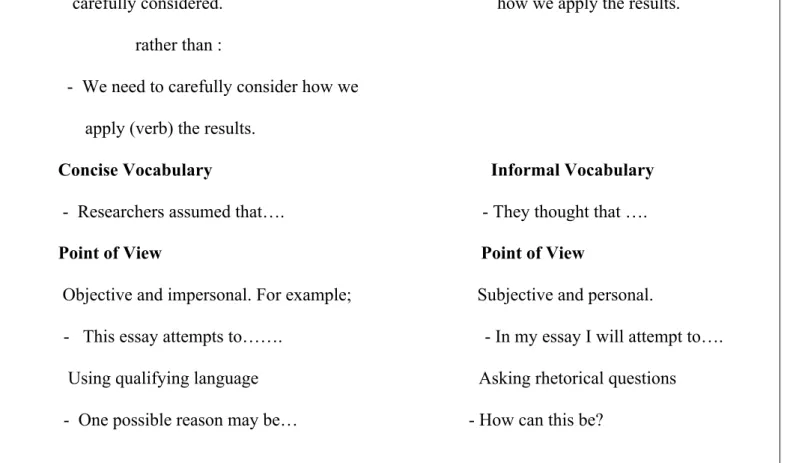
Discourse features refer to the structural organization of a piece of writing, in terms of coherence, paragraph structure, and cohesion which is the surface relations that link pieces of texts together in specific ways. According to Halliday & Hasan, “the concept of cohesion is systematized by classifying it into five distinct categories which are reference, substitution, ellipsis, conjunction, and lexical cohesion” (1976: 13). These cohesive ties are used in written discourse especially in the academic one.
carefully considered. how we apply the results. rather than :
- We need to carefully consider how we apply (verb) the results.
Concise Vocabulary Informal Vocabulary - Researchers assumed that…. - They thought that …. Point of View Point of View
Objective and impersonal. For example; Subjective and personal.
- This essay attempts to……. - In my essay I will attempt to….
Using qualifying language Asking rhetorical questions - One possible reason may be… - How can this be?
13 1.2.3.1. Reference
The term reference is used to refer to a relation between linguistic expressions where one determines the interpretation of the other (Johnson K. & Johnson H., 1998: 56). Moreover, the common reference items in English include personal pronouns such as she, he, it, and they, demonstratives like those, this, these, and comparatives. The following examples illustrate this.
- The EST paragraph (English for Science and Technology) is a unit of written English discourse. It presents the reader with an amount of information on a given subject (Trimble, 1985: 14).
Here there is a cohesive tie of reference between the pronoun it and the expression the EST paragraph.
- The components composing the urban system can be categorized into two major categories. These are the land use configuration and the transportation system.
Here there is a cohesive tie of reference between the demonstrative pronoun these and the expression: the components composing the urban system.
Furthermore, if a presupposing item follows the presupposed, as in the two examples mentioned above, the reference relation is anaphoric. The opposite order marks a cataphoric relation. So, reference allows both the hearer and reader to trace participants, entities, and events in a given piece of discourse (Baker, 1992: 181).
14 1.2.3.2. Substitution
Substitution is a grammatical rather than semantic relationship. It involves the replacement of an item by another one. Halliday & Hasan (ibid) identify three types of substitution which are: nominal (one, ones, and same), verbal (do), and clausal (so, not). In the nominal substitution, the substitute one / ones functions a head of the nominal group. For example, there are two main kinds of address forms. The first one is names, and the second is pronouns.
Here the word kinds is head of the nominal group kinds of address forms, and one is head of the nominal group first one.
Verbal substitution operates as head of a verbal group, and its position is always at the end of the group. For example, did Mary take that letter? She might have done. Here done substitutes for the verb take.
Clausal substitution is when words like so and not substitutes for a whole clause. For example, do you need more information about your research? If so, try to read a lot of books and articles.
1.2.3.3. Ellipsis
According to Donnelly, “ellipsis is the physical deletion of elements of a sentence that the writer confidently believes the readers will insert on their own as they read” (1994: 103). This means that ellipsis involves the omission of elements of a sentence in which the writer assumes are obvious from the context and the meaning can be deduced. For example, the reason for the difference between urban accents and the rural is that
15
linguistic innovations spread from one urban centre to another, and latter spread out into the surrounding countryside. Here, the omitted word is accent.
Moreover, English has three types of ellipsis. They are nominal, verbal, and clausal (McCarthy, 1991: 43). Nominal ellipsis involves the omission of a noun head word such as: she writes the essay with an introduction, yet I write it without. On the other hand, verbal ellipsis involves the omission of the verb within the verbal group. For example, have you been looking for relevant sources for your dissertation? Yes, I have. With clausal ellipsis, individual clause elements may be omitted.
E.g., Who is going to answer the question? –The lady there, is.
1.2.3.4. Conjunction
Conjunction is a cohesive relation marking logical relations between linguistic expressions and linking paragraphs. A conjunction helps in predicting what will come in a passage. According to Nation,“Conjunction has the effect of helping learners to see how ideas in a passage are related to each other and to discover the effect of a statement on other parts of the text” (2009: 46). Furthermore, if, for example, an unfamiliar word occurs in the effect clause of a cause-effect relationship, then it is possible to understand the meaning of that word, because the effect can be guessed from the cause.
Four primary types of connective relations are expressed by conjunction (Donnelly, 1994: 106).
16 1.2.3.4.1. Additive
Additive conjunctions are known as the and-relation; the second clause or sentence adds new information that is to be linked to the first clause or sentence. For example, she is an intelligent and effective student. Additive conjunctions are: and, also, furthermore, in addition, in other words, moreover, accordingly.
1.2.3.4.2. Adversative
The basic meaning of the adversative conjunction is the contrastive relation between two clauses or sentences, or as Halliday & Hasan describe it “contrary to expectation” such as: All the figures were correct; they’d been checked. Yet the total came out wrong (ibid, p.250). Adversative conjunctions include: but, yet, however, nevertheless, still, instead, although, whereas, while, on the other hand, otherwise, by contrast.
1.2.3.4.3. Temporal
Temporal relation means that two sentences or clauses are related chronologically, i.e., the one is subsequent to the other. The temporal relation is expressed in its simplest form by then. For example, “Alice began by taking the little golden key and unlocking the door that led into the garden. Then she set to work nibbling at the mushroom” (Halliday & Hasan, ibid: 261). In addition, temporal conjunctions include: next, then, before, after, first, second…..finally, when, until, while, meanwhile, in the end.
1.2.3.4.4. Conditional
In conditional relation, sentences and clauses are linked by the fact that one is the reason, cause, condition, or consequence of the other. For example, there are several
17
recessive gene diseases that result in mental retardation. Once the child lacks exposure to his mother language, therefore; he can not acquire it easily. Conditional conjunctions are: so, thus, as a result, consequently, because, due to, if, unless, on account of.
According to Hinkel, “the most common sentence transitions in formal academic writing are: however, thus, therefore, then, so” (2004: 293).
1.2.3.5. Lexical Cohesion
Lexical cohesion is cohesion resulting from the selective use of vocabulary (Donnelly, 1994: 97). This means that lexical cohesion depends on the choice by the writer of particular lexical items. Lexical cohesion is achieved by the use of two common semantic relations which are: repetition and synonymy.
1.2.3.5.1. Repetition
Repetition means that the same lexical item in several sentences subsequent to its first occurrence is repeated (Syal & Jindal, 2007: 136). For example, in this section, the phrase “lexical cohesion” is repeated more than twice. In addition, repetition helps to reinforce key ideas and new terms. However, the overuse of repetition in academic writing results in a text which sounds monotonous, i.e., it does not invite the reader to read it since it contains a lot of repetitions. This problem can be overcome by shifting the position of the repeated items in the sentence (Donnelly, 1994: 97).
1.2.3.5.2. Synonymy
The second frequently used technique for achieving lexical cohesion employs synonyms. The writer simply uses a different word that has the same meaning in the given
18
context. For example, it is possible to find two words like language shift and code switching which have the same semantic meaning but different syntactic structure.
The following passage illustrates the features of academic writing which are frequently used by academic writers:
“Acronyms are new words formed from the initial letters of a set of other words. These can be forms such as CD (‘compact disk’) or VCR (‘video cassette recorder’) where the pronunciation consists of saying each separate letter. More typically, acronyms are pronounced as new single words, as in NATO, NASA or UNESCO. These examples have kept their capital letters, but many acronyms simply become everyday terms such as laser (‘light amplification by stimulated emission of radiation’), radar (‘radio detecting and ranging’) and (‘zone improvement plan’)” (Yule, 2006: 57).
This passage indicates that academic writers use different features of academic language in their textbooks. For example, the present simple occurs twice in this passage such as “acronyms are new words”, “many acronyms become everyday terms”, and “pronunciation consists of saying each separate letters”. The same for the passive voice when it is used in the sentence “acronyms are pronounced as new single words”. Moreover, this passage includes two important discourse features which are reference and substitution. For example, the sentence “these examples have kept their capital letters” contains a cohesive tie of reference between the possessive pronoun their and the expression these examples, and substitution in which the expression these examples substitutes for the examples that are mentioned before.
19 1.3. Definition of Linguistics Register
Varieties of language associated with specific uses and communicative purposes are called registers. Schiffman defines linguistics register as a set of specialized and preferred syntactic structures used by specific groups for particular purposes (1996: 40-41). This means that the criteria of a given register are to be found in its grammar and lexis like the ones found in the linguistics register. For example, some lexical items occur in this register such as “in the morphology of this dialect there are fewer inflectional suffixes” (Yule, 2006: 259).Moreover, the register of linguistics, for example, could co-occur with a formal style as in a lecture delivered in the classroom, or with an informal style as in a discussion among students outside the classroom.
1.4. Variables of Linguistics Register
Register is defined by many linguists as linguistic variation according to the context a writer or a speaker finds himself in. This means that language differs according to the situation in which it occurs. Hence, the register of linguistics depends on three features. They are: mode, tenor, and field.
1.4.1. Mode
According to Martin and Rose, mode refers to what part language is playing in a particular situation and the organization of the text (2003: 243). The mode of discourse, spoken or written, determines choices in the textual components of language such as the cohesive markers and the grammatical structures a speaker or a writer uses. For example, in a conversation the speaker discusses a linguistics subject, uses simple sentences and clauses, yet a writer varies his language by using compound sentences.
20 1.4.2. Tenor
Tenor refers to the relationship between participants, their roles and status in a communicative situation, i.e., the language used among participants changes depending on the nature of the relationship between them and the level of formality, i.e., how formally the writer or speaker should be. For example, the language of linguistics that is used when talking to close friends is different from the one used when talking to teachers. This is called informal tenor which describes relationship involving friends and relatives, yet formal tenor involves the relationship, for example, between boss/ employee, and teacher/ students.
1.4.3. Field
Field refers to what is going on and the nature of the social action that is taking place (Malmakjaer, 2002: 169). Moreover, field, or topic of discourse, as it is called by many linguists, includes the subject area that features as the topic of communication in speech or writing. In other words, Coulthard argues that different registers are linguistically distinct and suggests that there is a register appropriate to each field (1977: 34-36). For example, the register of psycholinguistics differs from the one of sociolinguistics at both lexical and grammatical levels, for instance, words like: brain, thinking, and motivation occur in psycholinguistics rather than in sociolinguistics register. Table 3 summarizes the meaning of the three variables of linguistics register.
21
Register Variable Function in Language Metafunction Typical Realization
Field Topic reflects material reality
ideationnal Combination of indexical and lexical items
Tenor Relationship enacts exchanges
interpersonal Mood, Modality
Mode Role of language creates messages
Textual Deictic devices, theme information structure
Table 3: Meaning of field, tenor and mode, alignment with metafunctions, and typical
realizations (Byrnes, 2006: 250)
1.5. Structure of a Linguistics Essay
Generally, a linguistics essay begins with a writer’s opening paragraph which is called the introduction. It informs the reader about what the writer exactly is going to deal with. For example, if the writer intends to write an essay about the difference between American English and British English, he/she will need to make clear to readers what the purpose of the exercise is. The writer might say, for example, that he/she is going to analyze the differences in terms of phonology, syntax, and semantics. This means that the writer should treat the intended subject in a precise way.
22
According to Finch, “after the introduction comes the development section. This is where you develop those areas which you have already highlighted in your introduction” (1998: 222). This means that the body of a linguistics essay consists of paragraphs, each paragraph deals with one aspect of the subject matter, and it should include one main idea supported by arguments and examples. Finch adds: “the main requirement for a linguistics essay is that it should be clear, well illustrated, with a developing argument which balances information against discussion” (ibid, p.223).
The final part of a linguistics essay is the conclusion. It puts the subject of the essay in the right perspective and draws together all the points which have been discussed in the body of the essay.
Conclusion
In a nutshell, using the academic language and its features when writing academic essays, particularly linguistics ones, gives a formal and objective style to the learners’ written production. Thus, this chapter has mainly reviewed the notion of academic language as defined and discussed by many linguists. It consists also of a detailed discussion of features of academic language which are grammatical, lexical, and discourse ones. The chapter has also tackled both the concept of register from a linguistics perspective and the construction of a written essay.
23
Chapter Two
Description and Analysis of the Written Data
Introduction
For the purpose of evaluating the students’ use of features of academic language, the appropriate linguistics register variables, and the structure of an academic essay, a sample of written data, i.e., exam papers of twenty students are analyzed. So, the main concern of this chapter is to provide information about the sample, to describe the research tool which is a sample of written data. Furthermore, the findings are analyzed quantitatively and qualitatively to uncover the use of academic writing features, linguistics register, and the structure of students’ essays.
2.1. The Sample
The participants in this study were twenty (20) First Year English students, out of sixty three, reading for a Master degree in Applied Language Studies during the academic year 2009-2010 at Mentouri University in Constantine. The choice of this sample is motivated by the fact they are supposed to have acquired the necessary knowledge about writing. In addition, this sample consists of exam papers of these twenty students in sociolinguistics of the first semester 2009/2010 in which they were asked to write essays about the relationship between language change and language variation and the debate around the definition of the term speech community. Furthermore, this sample consists of 4 male and 16 female students, and five of them were repeating the current year, and they took their exam in sociolinguistics under similar examination conditions. The time allocated to the exam was 90 minutes. These exam papers were chosen randomly in the
24
sense that all the sixty three students’ names were written in small papers, mixed altogether, and then twenty names were picked up in order to get their exam papers. Moreover, the papers were given to me by the teacher of sociolinguistics after her evaluation.
2.2. Research Tool
The research tool of this study is a sample of written data which consists of exam papers of twenty students. These papers include essays in sociolinguistics that tackle the debate around the notion of speech community, and the relation that exists between both language change and language variation. After collecting the required data for the present research, these papers were analyzed quantitatively and qualitatively to shed light on the students’ use of academic language features which are grammatical, lexical, and discourse ones, the appropriate linguistics register, and how their essays were structured. The obtained results will be given in tabular formats. Moreover, the examples which will be given after each discussion of the results were taken from students’ papers as they are without any changes.
2.3. Results and Discussion of the Written Data
The analysis of students’ exam papers is proceeded by dividing features of academic language into its major sections and analyzing each section separately. In other words, this analysis aims at finding out the students’ insertion of academic writing features which are grammatical, lexical, and discourse in their linguistics essays.
25 2.3.1. Section One: Grammatical Features
Feature 1: Present Simple
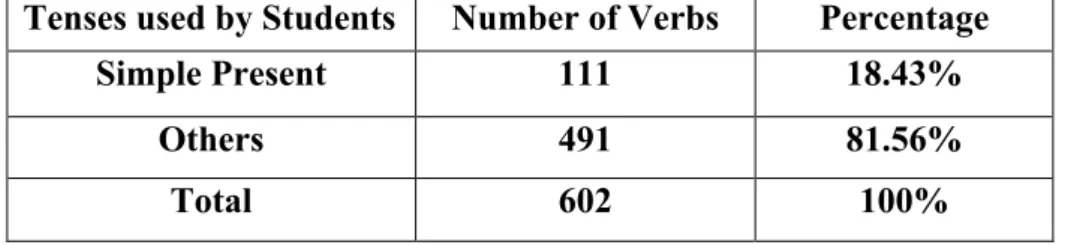
Tenses present an area of difficulty for students in learning process. So, the analysis of the number of verbs in present simple students have actually used yielded the results presented in table 4.
Tenses used by Students Number of Verbs Percentage
Simple Present 111 18.43%
Others 491 81.56%
Total 602 100%
Table 4: Students’ Use of the Present Simple Compared with Use of Other Tenses
The results reveal that the highest percentage (81.56%) of verbs are in other tenses, mainly the simple past, whereas only 111 (18.43%) out of 602 verbs, which is the total number of verbs in the twenty papers, are in the present simple. This means that students used the simple past instead of the present simple in their written production, while the required proportion should exceed 50% since it is the most frequently used tense in academic writing. The following examples, with students’ mistakes, illustrate this.
- Speech community referred to people who shared the same rules and patterns. - People in New York pronounced the /r/……
- The ethnography of communication a study which dealt with the organization of speaking.
- Language variation referred to the use of different ways of saying the same thing.
26
The examples above clarify that students did not use enough present simple in their linguistics essays because they were not generally taught that it is the most frequently used tense in academic writing, or they think that in order to refer, for instance, to linguists’ definitions of a particular notion, the required tense is the simple past since they discussed these definitions at that time. Moreover, the present simple is used in linguistics for the sake of expressing facts or for explaining a certain linguistic phenomenon such as language variation and the meaning of speech community, yet students used the simple past to express this.
Feature 2: Passive Voice
The analysis of the written data, i.e., students’ papers reveals that they did not use the passive voice. To have a clear picture of the participants’ use of this feature, table 5 below gives further details.
Total Number of Verbs in the Twenty Papers that should be in the Passive
Number of Verbs that are in the Passive
Percentage
141 25 17.73%
Table 5: Students’ Use of Passive Voice
As the table above reveals, the students’ use of the passive voice in their essays represents only 25 (17.73%) verbs out of 141 (100%) that should be in the passive voice. This means that the majority of students were ranked among those who did not use the passive constructions in their written production. Moreover, the passive voice in academic writing creates an indirect style and shows the writer’s objectivity, but students relied particularly on personal constructions as a means of providing evidence for their positions.
27
This finding is further supported by the fact that the use of such judgmental interpretations of information was high in students’ essays. The following examples which are taken from their papers illustrate this point:
- I mean by this example….
- We can say that language variation is….. - I will discuss this example.
- We can find variation without change. - We mean by language variation… - I mean by this definition…
Feature 3: Nominalizations
The use of nominalizations by the twenty students yielded the results displayed in table 6 below.
Total Number of Sentences in the Twenty papers that
should contain Nominalizations
Number of occurrences of Sentences that contain
Nominalizations percentage
50 5 10%
Table 6: Students’ Use of Nominalizations
The results in the table above show that only 5 (10%) sentences out of 50 (100%) contain nominalizations. This proportion reveals that there was a small rate of sentences that contain nominalizations in the students’ essays. So, students did not use enough nominal sentences when writing academic essays. The interpretation of these results might be that students have not enough competence to change adjectives and verbs into nouns,
28
i.e., they sometimes encountered unfamiliar verbs and adjectives which seem to them difficult to change, or they have not enough knowledge that nominalization is one feature that should be used in academic writing. Here are some examples taken from students’ papers.
- The upper middle class who pronounced the post vocalic /r/. - The language vary occurred…..
- Language variation and language change relate in the sense that…
Feature 4: Word Classes
a) Adjectives and Adverbs
The outcome of analyzing students’ papers reveals that they did not use academic adjectives and adverbs in their essays. The following tables display the results of students’ insertion of these two word classes.
Total Number of Occurrences of Adjectives Number of Academic Adjectives Percentage Number of non- Academic Adjectives Percentage Total percentage 78 15 19.23% 63 80.76% 100%
Table 7: Students’ Use of Academic and non-Academic Adjectives
As can be read from the results above, only 15 (19.23%) out of 78 (100%) adjectives are academic. The highest percentage (80.76%) of adjectives represents non-academic ones. This means that students hardly used non-academic adjectives in their essays and tended to use non-academic ones that showed their subjectivity. One possible interpretation is that students consider that there is no clear cut between adjectives, i.e., all
29
adjectives are put under one category. Moreover, the lack of instructions and guidance that there are academic and non-academic adjectives where the latter should be avoided in academic writing affect the students’ performance. The following examples from their papers illustrate this:
- This is a good reason for language variation. - The best example is Labov’s example. - Hymes give a good example.
- Demographic factor could be a good reason.
Total Number of occurrences of Adverbs Number of Academic Adverbs Percentage Number of non- Academic Adverbs Percentage Total percentage 24 6 25% 18 75% 100%
Table 8: Students’ Use of Academic and non- Academic Adverbs
As the table above reveals, only 6 (25%) out of 24 (100%) adverbs are academic. The highest percentage (75%) represents non- academic adverbs. This means that students did not use academic adverbs in their essays. This is due to the lack of competence that there are academic adverbs that should be employed in academic writing and non- academic ones that should be avoided since they give a personal and informal style to their performance. The example below is taken from a student’s paper in which he used the adverb fortunately to show his personal attitude:
30 b) Reporting Verbs
The analysis of the number of reporting verbs students have actually used in their essays yielded the results displayed in the following table.
Total Number of Sentences that should contain
Reporting Verbs
Number of Sentences that contain Reporting Verbs
Percentage
70 20 28.57%
Table 9: Students’ Use of Reporting Verbs
The results in the table above show that only 20 (28.57%) out of 70 (100%) sentences contain reporting verbs. This means that, these verbs represent a small proportion in the students’ essays. So, students did not use enough reporting verbs in their written production. This can be attributed to the fact that they know an insufficient number of reporting verbs such as argue and claim, and forget the remaining ones like suggest, point out, and demonstrate ,i.e., students are incompetent at knowing all the reporting verbs. The following examples were taken from students’ papers to illustrate this point:
- Labov and his colleagues proposed a series of steps. - Saville Troike added something very important.
Feature 5: Impersonal Forms
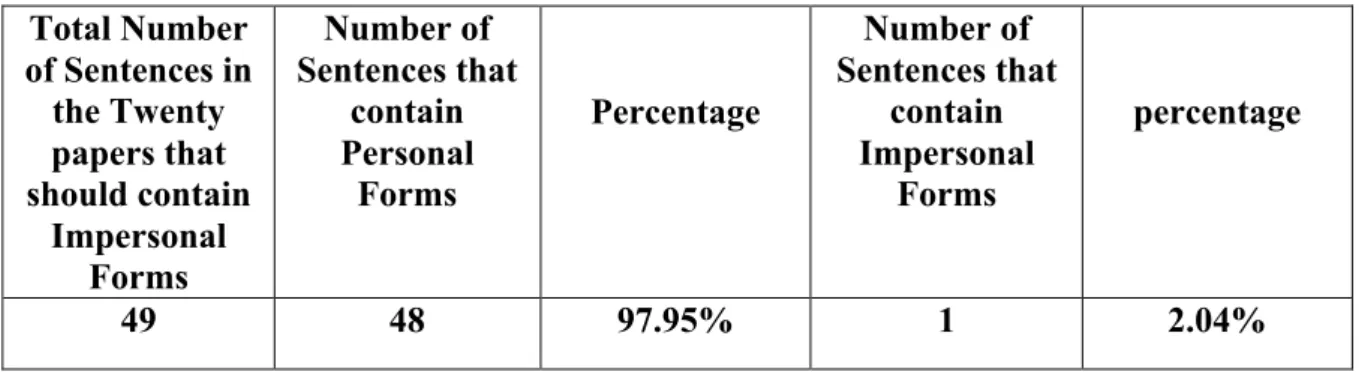
The use of impersonal forms in academic writing gives the students’ performance formal and objective style. So, the analysis of their essays shows that these forms were hardly used. The table below gives additional details about the results obtained.
31 Total Number of Sentences in the Twenty papers that should contain Impersonal Forms Number of Sentences that contain Personal Forms Percentage Number of Sentences that contain Impersonal Forms percentage 49 48 97.95% 1 2.04%
Table 10: Students’ Use of Impersonal and Personal Forms
The results reveal that the highest percentage (48) (97.95%) represents the students’ use of personal forms out of the total number of sentences (49) (100%) that should contain impersonal forms, yet there was only 1 (2.04%) sentence which contained an impersonal form. So, students did not use impersonal forms in their essays and tended to express their ideas by using personal pronouns such as I and we that showed their subjectivity. One possible interpretation is that students always want to get involved in the situation by referring to what they think as a means to convince the reader. The following examples from students’ papers illustrate this:
- We have several examples to explain. - I mean by this definition.
- We can compare between Arab countries. - We call this development of language ….. - I think that language change….
- We define speech community as……. - We vary our languages…….
32 2.3.2. Section Two: Lexical Features
Feature 1: Specialized Terms
Writing an academic essay requires a number of specialized vocabulary. This means that the most linguistic difference among disciplines is word choice, i.e., each field has its own vocabulary. Thus, the analysis of the number of specialized lexical items students have actually inserted in their linguistics essays displays the results presented in the table below.
Total Number of Occurrences of Specialized Terms in the Twenty Papers Number of Incorrect specialized Terms Percentage Number of Correct Specialized Terms Percentage 18 8 44.44% 10 55.55%
Table 11: Students’ Use of Specialized Terms
As the table above reveals, the number of correct specialized terms represents 55.55% out of the total percentage. This means that students employed these terms in their essays because of their background knowledge, vocabulary, in some areas of the linguistics register since the teacher mentioned them during the explanation of the lecture. However, they sometimes inserted incorrect specialized terms which represent 44.44%. This is attributed to the fact that students have limited vocabulary in a particular area. Hence, they were not linguistically equipped to express their ideas correctly and appropriately. The following examples from students’ papers illustrate this point.
- People of the speech community.
33 - Language variation happens.
- People change from one language to the other language.
2.3.3. Section Three: Discourse Features
Feature 1: Reference
The analysis of the twenty students’ exam papers in terms of employing the cohesive tie of reference between linguistic expressions and what it points to in the immediate context reveals the results presented in table 12.
Total Number of Expressions in the Twenty Papers that should contain Reference Number of Occurrences of Reference Percentage Number of Incorrect Reference Percentage Number of Correct Reference Percentage 56 8 14.28% 6 75% 2 25%
Table 12: Students’ Use of Reference
As the table above reveals, only 8 (14.28%) out of 56 expressions contain reference. This means that it was not used enough by students in their linguistics essays. Furthermore, there are only 2 referring expressions (25%) out of 8 which represent the correct reference, yet the highest percentage (75%) represents the incorrect references which are 6 out of 8. Although, these students have been taught this feature in EST practice module, they used incorrect reference. This can be attributed to the fact that they have only one session per week in this module, so they lack the required practice, or to the large number of students that makes the learning process impossible to create a positive learning environment, or they confuse between pronouns and demonstratives. The following
34
examples illustrate that students sometimes did not employ reference, and if they used it they used it incorrectly.
- Speech community is difficult to define because speech community is related to culture.
- Community see no reason in maintaining their ethnic language. - Linguists’ theory…….His studies….
- When speakers speak his language...
- Language maintained when it offers his members advantages.
Feature 2: Substitution
To have a clear picture about the results obtained from analyzing students’ writings in terms of using substitution, the table below gives further information.
Total Number of Expressions in the Twenty Papers that should contain
Substitution
Number of Substitutes Forms
Percentage
28 3 10.71%
Table 13: Students’ Use of Substitution
The results above reveal that only 3 cases of substitution (10.71%) out of 28 expressions that should contain it were used by students. So, the majority of students did not use substitution particularly verbal (do) and nominal (one, ones, and same) ones. Because students generally, during the exam, do not have enough time, they want to give as much information as they could, without paying attention to revision and the use of the cohesive tie of substitution. Another interpretation is that when students intend to
35
emphasize a particular idea or term, they repeat the same items. The following examples which are taken from their papers illustrate this point:
- People shift from their mother language to the dominant language. - Language was embedded in social context and linguistic context. - Smaller communities include in the larger communities.
Feature 3: Ellipsis
Using ellipsis in academic writing reduces the rate of repeating words that are easy to understand from the linguistic context. Thus, the analysis of the students’ exam papers yielded the results in the following table where ellipsis was hardly found in their papers.
Total Number of Expressions in the twenty papers that should contain Ellipsis
Number of Occurrences of
Ellipsis Percentage
24 1 4.16%
Table 14: Students’ Use of Ellipsis
The results in the table above show that only 1 instance of ellipsis (4.16%) out of 24 was used in the twenty students’ papers. This is attributed to the fact that students overused repetition of lexical items, so ellipsis was not used in their essays, or they confused between ellipsis and substitution since there is no clear cut between them, i.e., if a sentence contains a lot of repetitions, both ellipsis and substitution can be employed. The following examples from students’ papers illustrate this:
- There are other factors such as political factors and economical factors. - Similar social characteristics and linguistic characteristics.
36
- A linguistic variable are influenced by social forces and linguistic forces.
Feature 4: Conjunction
The analysis of the number of conjunctions students have actually used in their essays yielded the results presented in the table below where an insufficient number of conjunctions were used.
Total number of occurrences of Conjunctions Number of Additive Conjunctions % Number of Adversative conjunctions % Number of Temporal Conjunctions % Number of Conditional conjunctions % 24 5 20 7 30 5 30 7 30
Table 15: Students’ Use of Conjunctions
The table above reveals that the number of conjunctions represent a small rate compared with the total number of students’ essays. This means that students did not use enough conjunctions since there were only 24 conjunctions. The interpretation of these results is that students think that a conjunction relates words and not clauses; therefore, they used familiar conjunctions such as: and, but, also only to relate words. Thus, there was no logical relation between linguistic expressions and paragraphs. Furthermore, they generally used the four types of conjunctions in a fairly confused way; they used an additive conjunction instead of an adversative one, i.e., they were not able to see the difference between them. This might be due to the insufficient practice inside the classroom, mainly in grammar sessions, in the area of conjunctions. The following examples taken from students’ essays reveal how they confused between conjunctions.
37
- He will find that he is in Algeria just because the large Algerian community. - It exists well because the large number of speakers.
The two examples above show that students used because instead of because of that has to be followed by a noun phrase.
Feature 5: Lexical Cohesion
The analysis of the twenty students’ exam papers in terms of the use of repetition as a technique to achieve lexical cohesion yielded the results displayed in the following table.
Total Number of Papers Moderate Use of Repetition Normal Use of Repetition Overuse of Repetition Paper 1
×
Paper 2×
Paper 3×
Paper 4×
Paper 5×
Paper 6×
Paper 7×
Paper 8×
Paper 9×
Paper 10×
Paper 11×
Paper 12×
Paper 13×
Paper 14×
Paper 15×
Paper 16×
Paper 17×
Paper 18×
Paper 19×
38
Paper 20
×
Total 4 3 13
Percentage 20% 15% 65%
Total percentage 100%
Table 16: Students’ Use of Repetition
The obtained results in the table above show that the highest proportion (65%) represents the students’ overuse of repetition. This means that the majority of students’ papers (13) included the overuse of repetition, whereas only 3 papers (15%) represent the normal use of repetition which is the required use in academic writing. The remaining papers which are 4 (20%) were ranked among those papers which contain moderate use of repetition. One possible interpretation is that students when they want to emphasize a particular idea or term, they keep repeating the same words. The following passage taken from a student’s essay as it is to illustrate the overuse of repetition:
Speech community referred to a group of people who shair the same rules and patterns of what is to speak and when and how to speak. The ethnography communication between people is different from one person to another person from the topic what is speak and the time to say it and how should be speak.
Concerning synonymy, all the twenty students’ papers did not include any synonymous words. So, they were not used by these students in their essays. This is attributed to the fact that students had not the enough vocabulary to express views, or they lack the required knowledge that synonymy is one of the features of academic writing.
39
2.3.4. Students’ Use of Appropriate Linguistics Register Variables
The table below gives examples from papers of five students about how they used the linguistics register variables in their written production.
Number of Papers Mode Field
Paper 1
Let’s considered this example.
Let’s take this example. When we say 1st name
and the title of the name.
Addressor, listener. People who speak in a conversation.
Conversation between two people.
Paper 2
Shall we say English speaking people who live in south Africa and New Zealand
Language variation. Speakers should speak or cut the conversation.
Paper 3
The factors that leads to
language shift:
economical, social and political factors are the main reasons that leads to shift.
People tend to change the style of speech.
Paper 4
Let’s consider first language change which means ….
First of all, let’s clarify what is the meaning of speech community
Take the definition of Labov
Let’s take English as an example.
Middle class, lower classes, ethnographists. Factors help to accelerate speed of language.
40 Paper 5
To give examples, vivid examples, about the Algerian society…
The attention to some key concepts before getting to our discussion.
We move to language change.
Let me give you the example of Labov.
How can these happen?
Language change, speech community, social class. People of speech
community, the change may occur at the
vocabulary and lexicon level.
Table 16: Students’ Use of Linguistics Register Variables
As the table above reveals, students did not use the appropriate mode of the written language since they employed features of the spoken one. For example, sentences which are mentioned in the table above like let me give you the example of Labov, we move to language change, let’s take English as an example, and first of all, let’s clarify the meaning of speech community are not relevant to the written medium which should be a formal style. Moreover, students included rhetorical questions such as how can these happen? in their essays that should be avoided in academic writing. The reason behind this is that the majority of students generally used expressions and sentence structures in their writings that were used by the teacher during the explanation of the lecture without knowing that there is a difference between the written mode and the spoken one at all linguistic levels.
Concerning field, students sometimes did not use the appropriate lexical items that are related to sociolinguistics. For example, expressions like people of the community, ethnographists, and vocabulary and lexicon level are not specialized vocabulary that are
41
related to sociolinguistics. These terms should be members of speech community, ethnographers, and lexical level.
The variable of tenor which involves the nature of the relationship between participants did not appear in the students’ papers since there is no direct interaction between the teacher and students.
2.3.5. Structure of Students’ Essays
Writing an essay in academic situations involves following a certain order, i.e., there should be an introduction, a body, and a conclusion. So, the analysis of students’ papers yielded the results presented in the table below.
Total Number of Papers
Introduction Body Conclusion
Paper 1
×
×
Paper 2×
Paper 3×
×
Paper 4×
×
Paper 5×
×
Paper 6×
×
×
Paper 7×
×
Paper 8×
Paper 9×
Paper 10×
×
Paper 11×
Paper 12×
×
×
Paper 13×
×
Paper 14×
×
×
Paper 15×
Paper 16×
42
Paper 17
×
×
Paper 18
×
×
Paper 19
×
Paper 20
×
Table 18: Structure of the Twenty Students’ Essays
The results in the table above show that only 3 students respected the structure of an essay. This means that the majority of students did not follow the order of writing an essay. The remaining papers which are (17) included a body and a conclusion (1), an introduction and body (8), and the body only (8). Although, students know that an essay requires a particular order, they did not follow its structure. This is attributed to the fact that, during the exam, they had a limited time to finish writing at least two essays. Moreover, they might misunderstand that the questions should be developed into paragraphs and not essays.
2.4. Summary of the Findings
The analysis of a sample of the written data, exam papers of twenty students, has shown that students lack knowledge about academic language features and its appropriate occurrences. Moreover, reading their linguistics essays implies the following:
- The students’ essays lack features of academic language which are grammatical, lexical, and discourse ones.
- The majority of students do not respect the structure of an essay.
- Students’ essays lack the appropriate linguistics register variables mainly mode since they employed spoken medium instead of written one in their writings.