Ministry of Higher Education and Scientific Research
University of 8 Mai 1945-Guelma ﺔﻤﻟﺎﻗ -1945 يﺎﻣ 8 ﺔﻌﻣﺎﺟ Faculty of Letters and Languages تﺎﻐﻠﻟا و بادﻵا ﺔﯿﻠﻛ Department of Letters and English Language ﺔﯾﺰﯿﻠﺠﻧﻻا ﺔﻐﻠﻟا و بادﻵا ﻢﺴﻗ
Option: Linguistics
Teachers’ and Learners’ Attitudes towards the Use of ICTs ( Internet, Word
Processor and Email ) in Developing Academic Writing Compositions:
Case Study of Master One Students at the English Department - 8 Mai 1945
University-Guelma
A Dissertation Submitted to the Department of Letters and English Language in Partial Fulfillment of the Requirements for the Master degree in Anglophone Language,
Literatures, and Civilizations.
Candidates: Supervisor:
BAHDAOUI Ismahen Mr. CHETTIBI Mohammed Walid
BOUMAZA Besma
Board of Examiners
Chairwoman: Mrs. HARIDI Samia (MA/A) University of 8 Mai 1945- Guelma Supervisor: Mr. CHETTIBI Mohammed Walid (MA/B) University of 8 Mai 1945- Guelma Examiner: Mrs. LASSOUED Sabrina (MA/B) University of 8 Mai 1945- Guelma
DEDICATION
This dissertation is dedicated to the memory of my grand mother
BOUKHAROUBA Tounes May Allah grant her with mercy!
I dedicate this work to my dear family; my beloved mother, father, sister, and brothers.
To my small sweet family; my dear husband and my little angel
Hanin
To my beloved friends Ibtissem and Hasna
ACKNOWLEDGMENT
We would like to express our sincere gratitude to our supervisor
Mr CHETTIBI Mohammed Walid
We are grateful for his unaccountable guidance, support, kindness, and patience.
Special reference to all the teaches and university staff especially Pr TOULGUI Ladi and Mr BOUDECHICHE Hamid
Appreciations and recognition go also to anyone who helped us in one way or another to realize this work, especially teachers and students who have taken part in this study by
answeringquestionnaire.
At last, we owe a lot of thanks to all our friends and classmates who helped usintellectually and emotionally in fulfilling this work.
ABSTRACT
This work aims at investigating teachers’ and learners’ attitudes towards the use of ICTs (internet, word processor and email) in developing academic writing Compositions. It is based on two hypotheses: the first assumes that teachers and students may have positive attitudes towards the use of the previously mentioned technologies; whereas the second presumes that students only care about their marks not the process of writing via ICTs hence, they will not know their significance. Therefore, the descriptive quantitative method is opted and expressed via the distribution of a questionnaire to 80 students of English randomly selected, and 10 teachers of written expression at the Department of English at the University 08 Mai 1945 - Guelma. The final results display that both teachers and students have positive attitudes towards the use and manipulation of such technologies; since, the numerous online sources available facilitate their collection of information about the writing topics. Moreover, the application of spell check provided by the word processor helps in indicating and automatically correcting errors committed by students as they type their writing tasks. In addition,e-mail is considered as a communication channel between teachers and students, in order to send and receive feedback about the written productions. All in all, the findings prove that these technologies together are praised by both teachers and students, which confirm the first hypothesis, and disconfirm the second one.
LIST OF ABBREVIATIONS
EFL: English as Foreign Language
ICT: Information and Communication Technology
M1: Master One vs.: Versus i.e.: That is to say
Q: Question MA: Magister
LIST OF TABLES
Table 1: Difference between the Product and the Process Approach……….17
Table 2: Difference between the Process and Genre Approaches………...20
Table 3:Students’ Distribution according to Gender……….42
Table 4: Students’ Distribution according to Age………..43
Table 5:Students’ Choice to Study English………43
Table 6: Students’ Views about the Writing Skill………..….44
Table 7: Students Impression about the Courses of Written Expression……….44
Table 8: Students’ Level in Writing……….……45
Table 9: Students’ Most Important Elements of Academic Writing……….…...46
Table 10: Students’ Frequency of Revising Writings………..46
Table 11: Learner’s Attitude towards Revision………...47
Table 12: Students facing Difficulties in Writing …...47
Table 13: Students’ Areas of Difficulty in Writing………48
Table 14: Students’ Beliefs about the Expression “Better readers, better writers”…..….49
Table 15: Students’ Use of ICTs……….49
Table 16: Students’ Access to Internet at Home………..50
Table 18: Students’ Preferable Tool toWrite………...51
Table 19: Students’ Attitude toward the Word Processor...52
Table 20: Word Processor Indication of Errors………52
Table21: Students’ Reaction to the Errors Indicated by the Word Processor………...53
Table 22: Students’ Use of E-mail……….53
Table 23: Students’ Preferred Feedback………..54
Table 24: Students’ Reception of E-mail from their Teachers………54
Table25:Teachers’ Most Important Element of Academic Writing………..……57
Table 26: Teachers Perception towards their Student’s Level………...58
Table 27: Teachers’ Use of Approaches in Teaching Writing………58
Table 28: Teachers’ View about the Sufficiency of Time allocated to Written Expression Courses. ……….……59
Table 29:Teachers’ Perspective about Learners Facing Difficulties in Writing……….……59
Table 30: Teachers’ Perception about Students’ Problems in Writing……….…….…60
Table 31: Teachers’ Views about the Frequency of their Students’ Writing Mistakes….…..61
Table32: Teachers’ Views about the Integration of ICTs in Teaching and Learning Languages...61
Table 33: Teacher Evaluation of the Availability of technological Support at the university………...62
Table 35: Teachers Opinion about the Word Processor in Developing Academic Writing…63
Table 36: Teachers’ Opinion concerning Hand Writing vs. Word Processor……….…64
Table 37: Teachers’ Impression about the Auto Correction………..64
Table 38: Teachers’ Use of E-mail to Correct Written Compositions……….…65
LIST OF FIGURES
Figure 1: ASequence of Ideas ………80
Figure 2: Krashen’s Process Writing Model………...80
Figure 3: Correcting Grammar Mistakes……….….80
Figure 4: Correcting Spelling Mistakes………..…….…….81
Figure 5: Students’ Distribution according to Gender……….……….81
Figure 6: Students’ Distribution according to Age………81
Figure 7: Students’ Choice to Study English…...82
Figure 8: Students’ Views about the Writing Skill……….………...82
Figure 9: Students Impression about the Courses of Writing Expression……….…………82
Figure 10: Students’ Level in Writing………..………... 83
Figure 11:Students’ Most Important Elements of Academic Writing...83
Figure 12: Students’ Frequency of Revising Writing……….83
Figure 13:Learners’s Attitude toward Revision………84
Figure 14: Students Facing Difficulties in Writing ………..84
Figure 15: Students’ Areas of Difficulty in Writing………...……..84
Figure 16: Students’ Impression about the Expression “Better readers, better writers”….….85 Figure 17: Students’ Use of ICTs………..….85
Figure 18: Students’ Access to Internet at Home………..………85
Figure 19: Students’ Frequency Use of the internet as source of information………..86
Figure 20: Students’ Preferable Tool to Write………..86
Figure 21: Students’ Attitude toward the Word Processor………86
Figure 22: Word Processor Indication of Errors………...;87
Figure 23: Students’ Reaction to the Errors indicated by the Word Processor…………..…87
Figure 24: Students’ Use of E-mail………...………87
Figure 25: Students’ Preferred Feedback………..88
Figure 26: Students’ Reception of E-mail from their Teachers………..88
Figure 27: Teachers’ Most Important Element of Academic Writing…………...………….88
Figure 28: Teachers Perception towards their Student’s Level………..89
Figure 29: Teachers’ Use of Approaches in Teaching Writing………..….89
Figure 30: Teachers’ View about the Sufficiency of Time allocated to Written Expression Courses……….….89
Figure 31: Teachers’ Perspective about Learners Facing Difficulties in Writing …………..90
Figure 32: Teachers’ Perception about Students’ Problems in Writing……….………..90
Figure 33: Teachers’ Views about The frequency of their Students’ Writing Mistakes..…...90
Figure34: Teachers’ View about the Integration of ICTs in Teaching and Learning Languages...91
Figure 35: Teacher Evaluation of the Availability of Technological Support at the University……….91 Figure 36: Teachers’ Attitude toward the Use of Internet as a Source of Information……...91
Figure 37: Teachers Opinion about the Word Processor in Developing Academic Writing..92 Figure 38: Teachers’ Opinion concerning Hand Writing vs. Word Processor……….….….92
Figure 39: Teachers’ Impression about the Auto Correction……….…92 Figure 40: Teachers’ Use of E-mail to Correct Written Compositions………..……93 Figure 41: Students’ Response to Teachers’ Comments via E-mail……...……….93
CONTENTS ACKNOWLEDGEMENT………I DEDICATION………….………..…..II ABSTRACT……….….III LIST OF ABBREVIATIONS……….………..IV LIST OF TABLES……….……V LIST OF FIGURES………..….VI CONTENTS………..………VII
General Introduction
Introduction………21. Statement of the Problem………...3
2. Aims of the Study………...3
3. Research Questions………...…....3
4. Research Hypothesis……….4
5. Significance of the study………..4
6. Research Methodology………...4
7. Research Structure ………..….5
Chapter One: Academic Writing
Introduction………..…….71.1.Nature of writing skill………7
1.3.Characteristics of academic writing………...…....9
1.3.1. Organization………..………10
1.3.2. Clarity……….……10
1.3.3. Coherence………..11
1.3.4.Word choice ……….….11
1.4. Major difficulties in academic writing……… ……..12
1.4.1. Grammar……….12
1.4.2. Spelling………..….13
1.4.3. Vocabulary……….….13
1.4.4. Punctuation……….14
1.5. Approaches to teach writing………..14
1.5.1. The Product Approach……….….….15
1.5.2. The Process Approach………16
1.5.3. The Genre Approach………..…….18
1.5.4. The Content Approach………...…….20
1.6. The relationship between Writing and Reading………21
1.7. The importance of academic writing……….22
Chapter Two: Using ICT to Develop Academic Writing
Introduction……….25
2.1. Definition of ICT………...………25
2.2. ICTs in Education and EFL………...…………26
2.3. Advantages and Disadvantages of ICTs………....28
2.3.1. Advantages of ICTs ……….28
2.3.2. Disadvantages of ICTs………...……30
2.4. Developing Academic Writing through ICT Components………31
2.4.1. Internet………..32
2.4.2. Word processor………34
2.4.3. E-mail ………..36
Conclusion………39
Chapter Three: Data Analysis and Interpretation
Introduction………413.1. Students’ Questionnaire…...41
3.1.1. Aim of the Questionnaire……….………..41
3.1.2. Sample and administration of the questionnaire……….41
3.1.3. Description of the questionnaire………...42
3.1.5. Discussion of the results……….……56
3.2. Teachers’ Questionnaire………57
3.2.1. Aim of the questionnaire………...57
3.2.2. Sample and administration of the questionnaire……….…57
3.2.3. Description of the questionnaire……….………57
3.2.4. Analysis and interpretation of data……….57
3.2.5. Discussion of results……….…..68 3.3. Pedagogical implications………..69 Conclusion………70 General Conclusion………...…………73 References……….………74 APPENDICES Appendix I: Figures
Appendix II: Learners’ Questionnaire Appendix III: Teachers’ Questionnaire French Summary
Introduction
Writing is an integrative, constructive, complex, and essential skill in foreign language learning. It plays a major role for students to be successful in their educational career. At university, written expression classes focus on the production of paragraphs, essays and research papers in order to reach a particular academic achievement. Students go through different steps and structures to create the final piece of writing which indicates that the act of writing in an ongoing activity that requires an ongoing process. That is to say, writing is an active skill which can be achieved through the complementary steps since any writer feels the need to turn back to the previous step when necessary.
Academic writing is thought to be the most complicated skill in both the learning and teaching processes, through which a writer is supposed to break down ideas with a deductive reasoning and a formal voicing. This type of writing involves a great attention in foreign language classes because it requires certain criteria. In order to formulate effective academic writing productions, English as a Foreign Language (EFL) learners receive rules and knowledge about how to arrange information to get correct written compositions, in addition to a continuous practice and feedback.
Foreign language students tend to use different ways to enhance their academic writing. One of these ways, is the use of Information and Communication Technology tools (ICT) which has long been involved in education and learning. It is proved that ICTs play a remarkable role in students writing proficiency. For this sake, students are recommended to use a range of ICTs mainly: internet, word processor, and email. These tools will help check, correct and produce effective written compositions. Thus, the present research tackles the three previously mentioned tools in relation to academic writing.
1. Statement of the Problem
Academic writing has been given a high and special attention in foreign language classes, however; students still encounter some difficulties in achieving good academic written productions. Students may fail in following a particular order, making a worthy content or choosing the appropriate vocabulary that the reader expects or needs. Furthermore, a well- organized structure is also one of the major difficulties that students encounter while writing academically. They are then advised to use ICTs in order to develop their academic writing, especially the internet to get access to information and sources they need, word processor to indicate and automatically correct their mistakes ( grammar, spelling…), and email to send the final work and receive a quick feedback from their instructors. Therefore, this paper is an attempt to investigate the effectiveness of using such ICTs on developing students’ academic written performance.
2. Aim of the Study
Writing is considered as one of the most complex skills to master. with the emergence of new technologies, students tend to adopt them as part of their learning process to develop their language skills. Therefore, the research aims at investigating the attitudes of master one students towards the use of ICTs such as; the internet, word processor, and email on improving their academic writing outcomes at English department, University of Guelma.
3. Research Questions
The research to be conducted attempts to answer the following questions:
1. Do teachers and students have a positive attitudes towards the use of ICT tools ( word processor, internet and email) in developing academic writing ?
4. Research hypothesis
On the basis of the above research questions, it is hypothesized that:
1- Teachers and students may have positive attitudes towards the use of ICTs( word processor, internet and email).
2- Students only care about their marks not the process of writing via ICTs hence, they will not know their significance.
5. Significance of the study
Many previous work and research papers dealt with ICTs to investigate how they are starting to become increasingly integrated in EFL classrooms and the role it plays in developing the language learning skills. This study however is generally motivated by the desire to investigate the impact of those ICTs; mainly internet, word processor, and email; on developing one specific and essential skill, which is the academic writing. Also to know about students’ attitudes towards such technologies and to what extent they are useful and effective when it comes to written achievements. Hence, the results of this study will serve as a basis stimulus for students as well as teachers to think beyond traditional notions of writing.
6. Research Methodology
In order to draw the link between the attitudes towards the use of ICT tools and academic writing, it is opted for the use of the descriptive quantitative method to collect, analyze data and identify the relationship existing between the two variables by distributing a questionnaire to both teachers of written expression and Master One students at English department, University of Guelma. The results obtained from the analysis of the questionnaire would explain the connection between the tools (internet, word processor, email) and achieving better academic writing compositions.
7. Research Structure
The research is basically divided into three main chapters: the first chapter which entitled “academic writing” is devoted to the theoretical background of the issue that is; the nature of writing skill, some definitions of academic writing, characteristics of academic writing: organization, clarity, coherence and word choice. In addition to the major difficulties in academic writing, approaches to teach writing, the relationship between writing and reading. Finally, tackles the importance of academic writing. The second chapter “using ICTs to develop academic writing” provides some definitions and concepts which will help in understanding the relationships between the two variables, the relationship between ICTs in education and EFL by providing some of the positive and negative points about ICTs and the ways ICT components ( Internet, Word Processor and Email ) contribute in developing students’ academic written compositions. The third one concerns the analysis of both teachers and learners’ questionnaire to gather data and investigate teachers and learners’ attitude towards the use of ICTs ( word processor, internet and email ) in developing academic written compositions. Finally, concluding by some pedagogical implications based on the data collected.
Chapter One: Academic Writing
Introduction………..……..7 1.1. Nature of writing skill………7 1.2. Definition of academic writing………..8 1.3. Characteristics of academic writing………...………9 1.4. Major difficulties in academic writing……… ……..12 1.5. Approaches to teach writing………..14
1.6. The relationship between Writing and Reading………21 1.7. The importance of academic writing……….22 Conclusion………22
Introduction
Writing, as a way of communication, is proved to be the most complex language skill. It requires certain criteria and involves various elements simultaneously, through which learners enhance their proficiency. Hence, this chapter serves as a brief theoretical overview of the writing skill; including its nature and some definitions provided by scholars and linguists.In addition to the features and characteristics of the academic writing, the most common difficulties that students may encounter during the process. Finally; provides the accurate approaches in teaching writing as well as its significance and relationship with other skills, especially speaking and reading.
1.1. Nature of writing skill
Writing is a productive skill that represents language through the inscription of signs and symbols. According to Crystal (2006) “writing is a way of communicating, which uses a system of visual marks made on some kind of surface, it is one kind of graphic expression” (p.257). It means that writing is realized through a chain of symbolic graphs combined together to form comprehensive text as a tool of communication. For many years, writing was about the arrangement of symbols according to certain linguistic conventions to record speech, and it was neglected when it is compared to other skills, especially speaking. Consequently, Byrne (1988) considers writing as a way to reproduce what has been read or heard.
Today, writing is considered as the most important and sophisticated skill though which one can express him/herself, and gives a visible image of what runs through the mind. In this sense, Weigle (2002) defines writing as “encoding internal representation (idea) into written text” (p. 36). This definition insures that the mental activity is also considered as one of the most essential part in the writing process. Furthermore, Hedge (2000) illustrates that “it is a
complex process which is neither easy nor spontaneous for many second language learners” (p. 302). In the same context, Jozsef (2001) also states that “writing is among the most complex human activities; it involves the development of a design idea, the computer of mental representations of knowledge and of experience with subjects” (p. 05).
Lately, the interest in writing has improved. Harmer (2007) illustrates that “the writing skill is important as the other skills (speaking, listening, and reading). It is needed for students to know to reflect their knowledge, emotions, or ideas on a paper (how to write letters, how to reply to advertisements, how to summarize a text” (p. 03). Neman (1995) affirms the significance of this skill and defined it as “a craft, an artistic process with techniques and conventions that can be learned, employing skills that can be improved” (p. 04).
1.2. Definition of Academic Writing
Academic writing is considered as a specific genre of writing used to accomplish certain assignments and requirements within an academic setting (universities and colleges), and as an act of recording facts and ideas follows special norms and features. According to Mennens and Wilkinson (2002), Learners at colleges and universities are expected to compose various forms of assignments such as essays, reports, research papers, dissertations, etc. All those are referred to as academic writings; it has an educational purpose, addresses specific type of audience, and requires certain conventions, forms, and structures. Oshima and Hogue (1998) support the definition given to academic writing and stated that “academic writing as the name implies, is the kind of writing that you are required to do in college or university. It differs from other kinds of writing such as personal literacy, journalistic, or business writing. Its differences can be explained in part by its special audience, tone and purpose” (p. 05) This task designed for college and university students differs greatly from non-academic ones. It is considered as more complex and difficult activity which demands a language that is
according to Hartley (2008) “precise, impersonal, and objectives”. This implies that students should certainly involve a critical way of thinking, promote a good understanding of the topic, and follow some linguistic structures and language forms (p. 03). Westwoold (2008) demonstrates that “Written language is perhaps the most difficult of all skills to acquire because its development involves the effective coordination of many different cognitive, linguistic and psycho-motor processes” (p. 56).
Academic writings obviously require an academic style of writing which includes specialized patterns for educational purposes. This style of language was defined by Yopp et.al (2008).They state that “academic language is the language used by teachers and students in order to acquire new knowledge and skills” (p.16). In addition to that, academic language is used to persuade, explain, and inform the reader of such writings. In fact, it addresses a specific type of readers. In the same context, Gillet et.al (2009) illustrate that “academic writing is different from other forms of writing in its relationship with its audience, that is to say the reader” (p. 02).
In short, all the previous mentioned scholars agreed that academic writing is used to fulfill different assignments within an academic setting; it requires certain criteria and addresses a specific type of audience.
1.3. Characteristics of Academic Writing
Academic writing demands certain features and characteristics that make it even more specific than any other genre of writing. The followings are the most important and common ones suggested by Starkey (2004) for learners to follow in order to succeed in their academic writing:
1.3.1. Organization
Well-formed and organized writings are easy to be read and understood. Learners should not put ideas and information randomly while writing their assignments, however; they should range them into a logical structure of introduction, body, and conclusion; as supported by Eggenschwiler and Biggs (2001) who state that “a paragraph should be organized” (p. 163). Within the same situation Starkey (2004, p. 02) claims that
By following an organized method of writing, you will guide your reader from your first to last sentence. He or she will be able to see how the various points you make in your piece of writing work together and how they support your thesis.
A set of techniques is needed in order to organize a written material. According to Shannon (2011), there are two types of techniques: the first technique is related to the brainstorming and free writing; which help learners to shape and relate their thoughts before they start writing. The second one is related to the outline of ideas, ordered from general to detailed; which helps in structuring the work.
1.3.2. Clarity
Academic writing follows a more direct and focused style in order to avoid ambiguity in meaning and satisfy readers’ understanding. This feature is very essential in fulfilling academic assignments. According to Murray and Hughes (2008), clarity is important because it makes written materials readable and accessible. This can be realized through the use of short, relevant, and unambiguous sentences. Furthermore, Starkey (2004, p. 09-12) recommends the following ways to achieve academic writing:
Eliminate ambiguity; i.e. avoid words that may mislead the reader, especially those with
multiple interpretations
Use powerful, precise adjectives and adverbs; the exact terminology to deliver the right and
precise meaning
Be concise; go straight to the point and avoid unnecessary sentences.
1.3.3. Coherence
Academic written productions demand a coherent structure. Sentences should be linked together to create connections between the ideas. This assumption was supported by Kane (2000) who affirms that coherence is an essential characteristic of effective writing.He claimed that there is a link between coherence of ideas and readers’ understanding of a text. Along the same view, Shannon (2011) accounts that the coherent presentation of the content is consequently easy to be understood. This feature can be achieved through the logical organization of a text with all its elements, and the focus on the main ideas as they flow in a chaining order from the first idea to the following one without any incomprehensive shift that can mislead the reader. (See figure 1)
1.3.4. Word Choice
Another significant feature of academic writing is the appropriate choice of words, the formal and academic vocabulary is highly essential to explain the information throughout the text. Shannon (2011) states that “Authors should always aim for the most precise language possible in writing. In academic and scholarly writing, that principle is even more important”. (p. 18).
In order to successfully convey the meaning to the audience, it is important to use exact statements and expressions. According to Starkey (2004), effective word choice depends on one’s awareness about two aspects: denotation and connotation. Denotation on one hand is the literal and exact meaning of the word; the one extracted from a dictionary. Connotation on the other hand is what a word implies, since a word may have different interpretations due to cultural or religious assumptions.
1.4. Major Difficulties in Academic Writing
EFL learners encounter several difficulties when they write their academic assignments. Those difficulties are reflected in the mistakes that occur in their compositions on the level of both stylistics (the unconventional grammar and poor vocabulary) and mechanics (appropriate use of punctuation and misspelled word). Through his Guide to Effective Writing and Speaking, Seely (1998) illustrates the most common problems in writing as follows:
1.4.1. Grammar
Grammar is one of the most difficult and confusing aspects in any language to be applied when writing. It is used to express ideas correctly and effectively. Thornburry (1999) defines grammar as “description of the rules for forming sentences, including an account of the meaning that these forms convey” (p. 13). This implies that learners may harm the communication with readers when they produce ungrammatical structures. Seely (1998) claims that grammatical mistakes that appear in the construction of sentences may underrate learners’ writings, and emphasizes the importance of some devices for an accurate sentence such as: the appropriate use and placement of verbs, objects, adverbs, and coordinating conjunctions. All in all, learners who pay sufficient attention to grammatical accuracy would succeed in conveying the intended meaning.
1.4.2. Spelling
Proper spelling of words is an essential aspect of any written material. EFL learners may commit spelling mistakes due to the English language complicated spelling system, since it contains 26 letters which represent 44 different sounds. Another reason for spelling mistakes is when learners write words which are pronounced inappropriately. Connelly (2012, p. 553) states that
Many words are commonly misspelled. They may be foreign words, contain silent letters, or have unusual letter combination. When speaking, people often slur sounds and fail to pronounce every letter. Because you are accustomed to hearing words mispronounced, you may misspell them when you write.
Hence, spelling mistakes are unacceptable in academic writing especially the confusion between homophonic words because a writer may fail to convey certain ideas and leads the reader to question the proficiency of the writer and the quality of the written material.
1.4.3. Vocabulary
Rich vocabulary is very important in academic writing. Wilkins (cited in Schmitt 2010, p.03) illustrates that “without grammar very little can be conveyed, without vocabulary
nothing can be conveyed”. However, learners may face troubles dealing with vocabulary in writing since it is crucial to communicate idea using exact or synonymous words. It is challenging for learners to choose the appropriate vocabulary that goes with the selected purpose of an academic fulfillment. In this sense, Seely (1998) announces the problematic areas about vocabulary, the active vocabulary which is frequently used in writing, the passive vocabulary which is familiar for the learners from their reading but never used in writing, and the never heard or known vocabulary. These types; however; can move from one area to
another. i.e. Vocabulary that has never been heard or known can turn into a passive vocabulary and then into an active one, and vice versa.
1.4.4. Punctuation
Following the standard convention of punctuation is very important in academic writing since it adds clarity and precision to the written material. The proper placement of punctuation marks makes the learners’ writings easy to be read and understood and prevents readers’ confusion. Seely (1998) claims that obeying the rules and restriction of punctuation when writing is considered as a challenge for learners and that the most common mistakes occur in their writings are about the placement of the comma. He insists that “The person who has learned how to use commas has learned how to write” (p.229).
To sum up, lack of knowledge and awareness about the previously mentioned concepts may affect the academic production of EFL learners. Thus harm their scores in assignments. This genre of mistakes may represent a carless and underestimated writer, in addition to an irrelevant and underrated piece of writing. Learners can undergo such difficulties and improve their written compositions through regular practice.
1.5. Approaches to Teach Writing
In the essay “What is Academic Writing”, Irvin (2010) emphasizes that “your success with academic writing depends upon how well you understand what you are doing as you write and then how you approach the writing task” (p. 01). Approaches of writing emerged to enhance practice in writing skill and develop learners’ writing capacities. The application of one approach or another is highly dependent on the goals and objectives that learners want to achieve. The most important ones are: the product, the process, the genre, and the content approach.
1.5.1. The Product Approach
The product approach is the most traditional model of teaching writing. It enables learners to practice writing through the imitation of model texts provided by the teacher. It is defined by Gabrielatos (2002) as “a traditional approach in which students encouraged to mimic a model text, usually is presented and analyzed at an early stage” (p. 05). Along the same view, Nunan (1991) considers “… a product oriented approach , as the title indicates, focuses on the end result of the learning process; what is expected from the learner is to do as fluent and competent user of the language” (p. 86).
Pincas (1982, cited in Badger and White, 2000, p. 153), claims that this approach works through four main stages:
Familiarization: learners study and analyze the elements of the model text, such as grammar,
vocabulary, and organization.
Controlled writing: learners manipulate certain elements and patterns in isolation from the
model text.
Guide writing: learners engage in imitating model texts as they organize and range ideas.
Free witting: is the last stage where learners are expected to make use of the rules and
structures that has been learned before to develop their own writings.
The product oriented approach proved to be very beneficial for the mastery and awareness of learners about rules and conventions of language however, it was criticized of the aspect of imitation since it helped in developing language forms and structures yet it neglected content and style, and excluded learners’ imagination and creativity. This last point is supported by Richards and Rodgers (2001) who describe language through this approach as “basically a process of mechanical habit formation” (p. 57).
1.5.2. The Process Approach
The process approach emerged as an alternative to the product oriented one, as the focus shifted from the final piece of writing to the different stages that the learner goes through in order to fulfill his/her writings. Leki (1991) defines the process oriented approach as “the wondering path learners use to get the final product” (p. 10), i.e. a priority is given to the way the product is produced rather than the product itself. In this sense, Zamel (1982) considers writing as “a process through which students can explore their thoughts” (p. 147). The process oriented approach deals with writing within a variety of classroom activities where learners engage in collaborative writing and exchange drafts with each other. This would boost their motivation to write. The idea was supported by Nunan (1991) who expresses that “the approach also encourages collaborative group work between learners as a way of enhancing motivation and developing positive attitude towards writing” (p. 87).
This approach works through a sequence of stages which are related to one another as claimed by Clark (2003) who thinks that the success of one stage is related to the success of the previous one. The four stages of the process approach are: planning or pre-writing through which learners decide on a topic, determine a purpose, and generate ideas into an outline; drafting is the stage where learners write multiple drafts and establish ideas in introduction, body, and conclusion; revising is the stage where learners shift ideas, add, remove, or modify information, and revise both the content and the structure; and the last stage which is editing, where learners are expected to read, check grammar, vocabulary and mechanics, and produce a text that is correct and mistakes-free. Moreover, the interrelationship between the recursive stages of the process approach is best represented through Krashen’s model (1984). (See figure 2)
The process approach is very affective in emphasizing students’ interactions and experiences. According to Tribble (1996), it helps students to develop competence in writing using their creativity and inspiration instead of imitating a model text”. However, it was criticized for the fact that it functions through individual psychology and neglects Socio-cultural context. This is supported by Grabe and Kaplan (1996) claiming that the approach does not rise up to the expectations and norms of formal academic writing because several drafting, removing, adding are not sufficient to fulfill certain assignments within a limited period of time. Another reason for which this process was criticized is the fact that it enhances learners’ writings through internal motivation. Whereas some learners are produced well when they are externally motivated. For example, when their writings are rewarded or marked.
Nemouchi (2009, p. 81) in the table below, points at the main differences between the product and process approaches:
The Product Approach The Process Approach This is a traditional approach, in which
students focus on the study of model texts. Accuracy is given priority and conversations are taken from the model. The following stages have been identified :
Model texts are read, and then features of the genre are highlighted … students focus on where and how the writer employs these techniques.
this consists of controlled practice of the highlighted features, usually in isolation Organization of ideas. This stage is very
important. Those who favor this approach believe that the organization of ideas is more important than the ideas themselves and as important as the control of language.
This is the new trend teaching writing, in which priority is given to fluency. It is mainly based on the identification of the steps a writer goes through in his act of writing. He should be made aware of them so that he can gain control on them. These steps are :
Generating ideas by brainstorming and discussion. Students could be discussing qualities needed to do certain job, or giving reasons as to why people take drugs or gambling. The teacher remains in the background during this phase; only providing language support if required, so as not inhibiting students in the production of ideas.
Students extend ideas into note form, and judge quality and usefulness of ideas.
The end result of the learning process. Students choose from a choice of comparable writing tasks. Individually , they use the skills structures and vocabulary they have been taught to produce the product ; to show what they can do as competent users of the language
Students organize ideas into concepts map. This stage helps to make the (hierarchical) relationship of ideas more immediately obvious, which helps the students with their texts.
Students write the first draft. This is done in class and frequently in pairs or groups. Drafts are exchanged, so that students
become the readers of each other’s work. By responding as readers, students develop an awareness of the fact that a writer is producing something to be read by someone else, and thus can improve their own drafts.
Drafts are returned and improvements are made based upon peer feedback.
A final draft is written.
Students once again, exchange and read each others’ work and perhaps even write a response or reply.
Table.1: Difference between the Product and the Process Approach (Nemouchi 2009, p. 81)
1.5.3. The Genre Approach
The genre based approach to the teaching of writing came as an extension of the product approach, as regarded by White and Badgar (2000). It engages learners in writing activities to produce a final composition that involves linguistic conventions of language use in addition to social and cultural contexts. It is defined by Hyland (2004) as “a turn for grouping texts together representing how writers typically use language to respond to reoccurring situation” (p. 04). Another definition given to genre oriented approach is by Swales (1990, p. 320, cited in Hedge 2000) who claims that:
A genre comprises a class of communicative events, the members of which share some set of communicative purposes. These purposes are recognized by the expert members of the parent discourse community, and thereby constitute the rationale for the genre. This rationale shapes the schematic structure of the discourse and influences and constraint choice of content and style.
This approach; like the product one, involves a model text but in terms of purpose. That is to say, learners are not expected to study and analyze only the linguistic features of a text but also to study a text within a particular genre to reflect a specific purpose and communicate with a specific audience. This idea is supported by Swales (1990, p. 58, cited in White and Badgar, 2000, p. 155), as he states that “a genre comprises a class of communicative events, the numbers of which share some sets of communicative purposes”.
To fulfill any academic piece of writing through this approach, learners do not pay attention to language forms, vocabulary, and lexis patterns only however, they need to gain and employ language about the different genres of writing and the objectives behind and within a text as affirmed by Richards (2003) who says that “the central belief here is that we do not just write, we write to achieve some purposes: it is a way of getting something done” (p. 18).
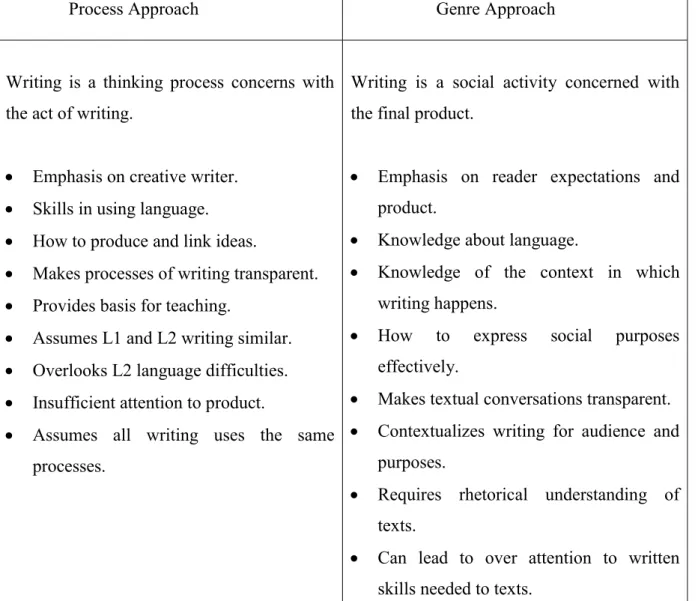
Nemouchi (2009, p. 95) made a distinction between the genre approach and the one that preceded it; process approach, in the following table:
Process Approach Genre Approach
Writing is a thinking process concerns with the act of writing.
Emphasis on creative writer. Skills in using language. How to produce and link ideas.
Makes processes of writing transparent. Provides basis for teaching.
Assumes L1 and L2 writing similar. Overlooks L2 language difficulties. Insufficient attention to product.
Assumes all writing uses the same processes.
Writing is a social activity concerned with the final product.
Emphasis on reader expectations and product.
Knowledge about language.
Knowledge of the context in which writing happens.
How to express social purposes effectively.
Makes textual conversations transparent. Contextualizes writing for audience and
purposes.
Requires rhetorical understanding of texts.
Can lead to over attention to written skills needed to texts.
Table 2: Difference between the Process and Genre Approaches. (Nemouchi, 2009, p. 95)
1.5.4. The Content Approach
Content-based approach is a recently emerged approach to teach writing skill. It gives higher attention and greater importance to the content of the written productions, and language forms and functions. Hyland (2003) illustrates that “a content orientation can also form the basis of courses that focus more on language structures and functions that help students to generate, develop, and organize their ideas on a given topic” (p. 16). According to
him, this approach helps learners to enhance their abilities and skills to read a material effectively which gives them basis on which they will be able to produce their own writings. According to Krashen (1982), the focus is not on how to write but rather on what is written. The learning skills are integrated in the content oriented approach, learners tend to read, listen, and discuss a certain topic before they engage in writing about it. Krashen (1993, as cited in Hyland 2003, p. 17) again considers both extensive reading and regular practice as essential parts, and major supports in achieving a successful writing in the second language through the content-based approach. Shih (1986) believes that the content-based approach is distinct from the other approaches to teach writing because they focus on writing and interpretation of information from different sources such as books, lectures, etc. While content approach gives priority to writing about personal observations of whatever surrounds the learners.
1.6. The Relationship between Writing and Reading
The writing skill is closely related to the other skills of language learning especially, the reading skill. Despite the difference between the two skills; reading as a receptive skill and writing as a productive one, they are closely related. Both reading and writing involve cognitive abilities which make them equally significant as tools of communication and construction of meaning and knowledge. It is claimed that good writers are often good readers and vice versa, and that learners are exposed to the written structures and the system of language when reading a text. The quality and effectiveness of learners’ written tasks depend on the amount of their reading. This view is supported by Thomas (1976, cited in Flippo and Caverly 2000, p. 15) who illustrates that “A significant relationship existed between writing achievements and the amount and variety of reading experiences”.
Reading enriches the necessary elements for learners to be able to write. According to Sabiakto and Nababan (1983), learners’ productions on paper are highly influenced by information they comprehend from reading consequently, they develop vocabulary, language mechanism, and get familiarized with the rules of grammar. However, the impact of reading is beyond the standardized system of language because it helps learners to improve their style, imagination, and creativity, in addition to the new information and ideas they are exposed to. Within this context Hyland (2003) states that “writing together with reading, is a central aspect of literacy” (p. 53).
1.7. The importance of academic writing
Hyland (2003:69) accounts for the importance of the writing skill in creating social links and connections between individuals as a system of communication by insisting on the fact that “Writing is one of the main ways that we create a coherent social reality through engaging with others”. One of the objectives behind learning a certain language is to be able to write affectively; at universities, academic writing is a substantial necessity and an essential tool to evaluate students’ proficiency level because it evolves the use of proper language structures and style. Nevertheless its significance is beyond the good grades in examinations but also when it comes to employment and expertise after graduation. Another significance of academic writing is that students learn how to be confident, objective, rational, and logical in explaining thoughts that belongs to others. According to Brown and Hood (1989), learners build self-confidence to write independently, which will reflect the way they write and learn the language.
Conclusion
This chapter gives insights about the concept of writing by exploring its nature, approaches, processes, and the different elements that contributes to its improvement. At the end we come to the conclusion that the writing skill is not an easy task to be fulfilled; knowledge about features, conventions, in addition to the awareness about the target audience are very essential and must be taken into consideration by learners in order to enhance and reinforce their writing competency.
Chapter Two: Using ICTs to Develop Academic Writing
Introduction……….25
2.1. Definition of ICT………...………25
2.2. ICTs in Education and EFL………...………26 2.3. Advantages and Disadvantages of ICTs………....30
2.4. Developing Academic Writing through ICT Components………31
Introduction
The Twenty First Century has witnessed a rapid growth of Information and Communication Technologies (ICTs). This innovation has changed all the aspects of life such as, business, marketing, trade, science, education and other fields. Today, ICT is currently used in education and offers a range of devices that helps in developing the process of teaching and learning English language skills; more precisely, the writing skill. In this respect, the present chapter discusses an overview on ICTs, through some definitions and its integration in the field of education; especially in the EFL teaching and learning. This chapter also highlights the advantages and disadvantage of using such technologies. Finally, the contribution of ICTs in developing the writing skill, dealing with the precised components: internet; as source for information, word processor; as an application for writing, and e-mail; as a medium between Teacher and learner.
2.1. Definition of ICT
ICT is an acronym that stands for “information and communication technology/technologies”, where the computer and the internet play a major role for the change and reform of many domains, mainly education, UNISCO. It was also defined by Sheridan (2002) as a “diverse set of technological tools and resources used to communicate, and to create, disseminate, store, and manage information” (p. 81). So ICT is concerned with the manipulation, storage, and the processing of digital data, it enables people to communicate in real time using technological devices and applications such as the computer and social networking.
ICTs encompass any electronic communication tools and information systems, such as computer, internet, cellular phones, wireless and broadcasting technologies. According to Deeson (2005, p. 04), information and communication technology include computers and its
different tools and sensors which are referred to as information systems to process information. These technologies are being partially integrated and used in many fields and domains such as industry, health-care, business, and education. This idea is supported by Loveless and Ellis (2003), who claim that “the words information and communication technology describe a set of technologies with particular applications which vary enormously in purpose and scope within and between subject contexts” (p. 23).
In short, ICT refers to the several technologies used in the current days all over the world; to inform and transmit data. More importantly, ICTs are the combination of a diversity of materials and tools with other electronic programs and networks in order to create, store, interpret, and transmit information. It is worth mentioning that the integration of ICTs is becoming increasingly important not only in the telecommunication areas but rather in different fields and domains, more specifically education.
2.2. ICTs in Education and EFL
The past few decades have witnessed the enormous widespread of ICT and its influential importance in the educational framework generally, and the EFL field particularly. This innovation came as an alternative to the traditional methods and ways of education, as it is today considered as a major driving force for educational change and reform. Accordingly, in introducing the concept of Grid for Learning, Blair (1991) stated that “Technology has revolutionized the way we work as it is now set to transform education. Children cannot be effective in tomorrow’s world if they are trained in yesterday’s skill”.
Weert and Tatnall (2005) point out that ICT has enhanced the standards of education, and that it enables the leaner to comprehend certain phenomenon by creating real situations inside the classroom and relating both theory and practice. Thus, ICT has extended and empowered the ways teachers and learners explore the language in the information age. This trend has
become a significant instrument and an integral part of academic development with different objectives. In this respect, Plomp et al (1996, as cited in Al-Zaidiyeen, 2010, p. 212) set three objectives for ICT use in education as: objects of study, aspects of discipline at all levels and professions, and teaching/learning medium.
Castro and Aleman (2011) claim that this innovation has changed the teaching atmosphere into a more learner-centered one. Actually, learners today are able to discover new learning topics and projects, explore new ideas, solve problems and find solutions related to real life situations, as well as discuss and exchange information in real time. This is supported by Wallet (2014), who illustrates that “ICT in education has a multiplier effect throughout the educational system, by enhancing learning and providing students with new sets of skills”. In the same vein, Padurean and Megan (2009) state that “The application of ICT gives more opportunities for communication between peer learners: they can exchange information in real time, they can participate in blog discussions, work in teams on different projects, exchange e-mails, search for information, etc” (p. 98). However, it is not only about learners’ opportunities, teachers also benefit from the integration of these digital technologies, since it allows them to prepare and display more information and activities, as well as increasing learners’ motivation and involvement in the learning process which its self becomes more interesting and productive.
In brief, ICT integration in education has become a dynamic and driving force which offers a set of opportunities for the sake of enhancing and revolutionizing the educational systems and facilitates the learning and teaching processes, as well as providing students and teachers with unlimited number of options to achieve exceptional potentials inside and outside the classroom.
2.3. Advantages and Disadvantages of ICTs
Many scholars and studies assert the positive impact and advantages when it comes to the implementation of ICT to develop the field of teaching and learning English, and education in general. However, it is important to highlight and draw attention to some risks and disadvantages ICT can result.
2.3.1. Advantages of ICTs
In the recent years, the integration of ICT in the field of education has afforded positive advantages in ameliorating insights and competences of learners, and methods and strategies of teachers. Plump et.al (2009) claim that governments and education systems all over the world consider the use of ICTs as a crucial innovation; for empowering both learning and teaching (cited in Bhasin, 2012, p. 131). Thus, the integration of ICTs improves and facilitates the teaching and learning processes through its enormous advantages provided for both teachers and learners.
In the field of EFL teaching and learning, Paas and Creech (2008, p. 4) consider ICTs as tools applied to extend the learner’s capacity to receive, comprehend and exchange information, which is best noticed through the expanded use of online learning programs and materials in the classroom to support the learning process. In the same context, Majumdar (2006, p. 7) claims that the application of ICTs in learning and teaching EFL has provided several benefits particularly for learners, he states them as the following:
Explore and represent information dynamically and in many forms. Become socially aware and more confident.
Increase motivation.
Communicate effectively about complex processes.
Greater problem-solving and critical thinking skills.
On his turn, Newhouse (2002, p.51) illustrates some positive gains of using ICTs in EFL teaching and learning as the following:
The level of learners’ motivation can be stimulated when their compositions and
performances are consulted immediately.
The writing task is proved to be facilitated through some computerized application, which
makes learners more ready to involve and engage in the redrafting and amelioration of the written productions.
Students self-esteem and pride is more likely increased and developed as a result of the
high quality of presentation made using ICTs.
ICTs often improves level of achievement for learners and makes the learning more
enjoyable due to the collaborative work, the exchange of ideas, and the open discussions possible when using particular ICTs such as e-mail, digital cameras...etc.
The personal approach is one essential advantage in EFL learning; learners are independent and able to develop their proficiency even outside the academic settings due to the wider access to online resources. According to Khvilon and Berenfeld (2005, p.182), more learning will occur outside the classrooms in the future, as learners; especially those who are home-bound or out of school for some reasons, will search and find their needs and preferences online, and also maintain communication with their peers and classmates, as well as teachers.
For teachers, the use of ICT enables them to plan and prepare the learning sources and to create a flexible learning environment with a system of information delivery that is developmental, interactive and digital based, in order to improve students’ attendance and
concentration. This implies that ICT allows teachers to facilitate the learning process and create comfortable atmosphere through which the transformation of data moves smoothly in collaborative and communicative way without any boundaries and difficulties from the learners’ side. In addition to that, ICT allows teachers to bring the whole world into classroom activities. This means that through ICT devices and programs, teachers are able to assimilate real life situations inside the classroom to meet the needs and preferences of their learners, and to create communication channels with them.
2.3.2. Disadvantages of ICTs
The potential disadvantage of ICT in EFL learning and in education in general may appear from the side of teacher, learner, and ICT equipment itself. When it comes to learners, Scrimshaw (2004, p. 09) believes that they often vary between users and non users of technologies, which may create some kind of no equivalence of levels and skills among them. Furthermore, Richards (2001, p. 94) explains that ICT materials inevitably distracts learners form the real learning objectives and purposes into the ICT requirements and skills.
In the same context, Hargreaves et.al (2010, p. 190) declare that the use of various communication tools has changed the nature of relationship between teachers and learners. Moreover, poor technical supports, bad quality of internet access, technical issues and problems, in addition to risk of the loss or damage of information and systems are major factors in disturbing the rate and quality of learning. They also highlight the ethical issue of plagiarism, since technology enables learners to download and copy information without attributing credit to the original source, which is unacceptable in academic settings.
One negative side of integrating ICTs in EFL teaching and learning is that young aged students may know how to manipulate them more than their teachers do. For this particular reason, teachers may have some concerns about using technologies in teaching due to their
lack of training, confidence, and fear of failure. Again, Scrimshaw (2004) affirms that “many teachers who do not consider themselves to be well skilled in using ICT feel anxious about using it in front of a class of children who perhaps know more than they do” (p. 7)
As a conclusion, despite all the previously mentioned disadvantages, no one can deny that this innovation has contributed a lot in developing the field of EFL. It has changed the roles of teachers and learners, and the ownership of information into a more learner-oriented one. That is to say, learners have become the center of learning and teachers are no more the dominant source of information, yet still instructors and guiders of the learning process inside the classroom. In this case, learners are more autonomous and motivated to collect, produce and present information and knowledge using ICTs.
2.4. Developing Academic Writing through ICT Components
Enhancing writing through the use of technological devices is the concern of all the educational and the academic field. Different set of ICT applications are developed and applied to improve all the language skills, particularly writing, due to the various functions they imply. The most common software used for this sake is Computer Assisted Language Learning (CALL).
In fact, CALL created a wave of educational software by the 1980s. According to Macalister and Nation (2012, p.93), the integration of ICT in the field of language teaching and learning is embodied in two main areas which are: Computer Assisted Language learning (CALL) and Computer Mediated Communication (CMC).Yet CMC is regarded as a sub-category covered under the umbrella of CALL. It is defined by Levy (1997) who claims that it is “The search for and study of applications of the computer in language teaching and learning” (p. 1). In the same context, Eastment (1999) defines it as “soft-ware which presents
activities designed to help language learners” (p.22). This indicates that CALL represents computers as tremendous support for language teaching and learning.
CALL has earned a pedagogical value because of its contributions in making computers a sophisticated and flexible tools and aids for writing, and improving learners’ attitudes towards writing. In this respect, Paschalis (2001) declares that “via computers, written texts are merged with audio sequence and graphics. Thus, effective extensive techniques and different strategies are available in constructing new ways of representing knowledge” (p.22). In the same vein, Felix (2008) states that there exists “enough data in CALL to suggest positive effect on spelling, reading, and writing”. This implies that CALL applications and components has changed the ways learners plan, draft, and present their written compositions and realizations.
Components and soft-wares included in CALL, in which we are interested embarrasses Internet as a source of information, word processor as an application for writing, and e-mail as a mediator between teacher and learner.
2.4.1. Internet
Nowadays, information and communication technologies, especially the internet, play a major role in the field of teaching and learning English. In fact, this application proved to be the most effective tool to increase learners’ knowledge and skills. It can be defined as “an international computer net-wok made up of thousands of networks linked together. All those computers communicate with one another, share data, resources and transfer information” Chisholm (2001, p .13). It is also considered as “a global linking of computers that allows information transfer” (Wanajak, 2011, p.1). In other words, the internet is one of computer programs or systems that connect a variety of computers with each other through networking lines.
These days, everyone can have access to the internet, not only via computers, but also via mobiles and other smart devices. In fact, it is a facilitator tool that is highly used in education especially in learning second or foreign languages due to the variety of materials and online sources. According to Deore (2012) “the internet is a collection of various services and resources” (p. 111), which means that the internet offers a lot of information and it is considered as helpful software in communicating and searching all different subjects.
Internet has a big deal in the field of teaching and learning foreign languages. In this respect, Yand and Chen (cited in Aydin 2007, p. 18) illustrates that “Internet enables English learners to access useful language resources and communicate directly with native English speakers... Students can learn listening, speaking, reading, and writing English interactively via real-world situations”. This means that internet has partially substituted the old and traditional sources of information like books and libraries in the digital age. Actually, Duggleby (2001, p. 19) defines internet in this context as the following
The biggest library that has ever existed and also one that you can pop into with a few mouse clicks or keyboard strokes. It is a library that you can reach from your workplace, from your home, from the place where you study and possibly from your local library.
Furthermore, Kellogg (1994) views that “during the writing process, learners are involved in certain cognitive operations which are characterized by collecting information and planning ideas” (p.16). However, learners do not rely only on their own ideas and information but rather on others’ claims and findings; this is easily managed through the use of the internet which is considered as a modernized source of information, through which learners can extract information to support their writings and researches. This is why internet is seen as the main technological software that affords a variety of resources. Accordingly, Mills (2006)