HAL Id: tel-03198502
https://tel.archives-ouvertes.fr/tel-03198502
Submitted on 21 Apr 2021HAL is a multi-disciplinary open access archive for the deposit and dissemination of sci-entific research documents, whether they are pub-lished or not. The documents may come from teaching and research institutions in France or abroad, or from public or private research centers.
L’archive ouverte pluridisciplinaire HAL, est destinée au dépôt et à la diffusion de documents scientifiques de niveau recherche, publiés ou non, émanant des établissements d’enseignement et de recherche français ou étrangers, des laboratoires publics ou privés.
lies, forwarding detours and failed IXPs
Julian Martin del Fiore
To cite this version:
Julian Martin del Fiore. Detecting hidden broken pieces of the Internet : BGP lies, forwarding de-tours and failed IXPs. Networking and Internet Architecture [cs.NI]. Université de Strasbourg, 2021. English. �NNT : 2021STRAD001�. �tel-03198502�
ÉCOLE DOCTORALE MATHÉMATIQUES, SCIENCES DE
L’INFORMATION ET DE L’INGÉNIEUR
Laboratoire ICube — UMR7357
THÈSE
présentée par :
Julián Martín DEL FIORE
soutenue le :
08 février 2021pour obtenir le grade de :
Docteur de l’Université de Strasbourg
Discipline/ Spécialité :
Informatique
Detecting Hidden Broken Pieces
of the Internet: BGP Lies, Forwarding
Detours and Failed IXPs
THÈSE dirigée par :
Mme. PELSSER Cristel Professeure, Université de Strasbourg
THÈSE co-encadré par :
M. MERINDOL Pascal Maître de conférence, Université de Strasbourg
PRÉSIDENTE DU JURY :
Mme. MAGNIEN Clémence Directrice de recherche, Sorbonne Université
RAPPORTEURS :
M. DONNET Benoit Professeur, Université de Liège
Detecting Hidden Broken Pieces
of the Internet: BGP Lies,
Forwarding Detours
and Failed IXPs
Résumé
L'objectif de cette thèse est de détecter des éléments défaillants d'Internet. Tout d'abord, nous
étudions le déploiement des points d'échange Internet (IXP) en Amérique latine et constatons que
certains pays sont en situation d'échec dans leur déploiement IXP, c'est-à-dire aucun IXP du tout, ou
bien que l'IXP n'a pas réussi à attirer suffisamment de membres. Deuxièmement, nous étudions
BGP, le protocole de routage utilisé sur Internet, et en particulier s'il existe des mensonges BGP,
c’est à dire si les routes par lesquelles les paquets circulent réellement sur Internet divergent des
chemins que les systèmes autonomes (AS) annoncent. Nous trouvons effectivement des cas où les
chemins ne correspondent pas. Enfin, nous étudions comment le trafic circule à l'intérieur des AS et
nous nous concentrons sur la détection des détours d'acheminement, c'est-à-dire les cas où les
itinéraires d'acheminement ne correspondent pas aux meilleurs itinéraires disponibles, selon le
protocole de routage utilisé. Nous mettons ainsi en évidence des détours dans plusieurs AS.
Mots clés
: BGP, IP-to-AS mapping, IXPs, Latin America, IGPs, Forwarding Detours, Load
Balancing, Traffic Engineering, Multipath Routing, Scalability, Forwarding Information Base
Abstract
The objective of this thesis is to detect hidden broken pieces of the Internet. First, we study the
deployment of Internet exchange points (IXPs) in Latin America and find that while some IXPs
across the region have managed to proliferate, some countries have failed IXPs, i.e., no IXP at all, or
the IXP has not succeeded to attract members. Second, we focus on the border gateway protocol
(BGP), the routing protocol used on the Internet, and study whether ASes carry on BGP lies, i.e., if
the forwarding routes through which packets actually flow on the Internet diverge from the AS-paths
that ASes advertise on BGP. We find cases where the paths indeed mismatch. Finally, we study how
traffic flows inside ASes and focus on the detection of forwarding detours, i.e., cases in which the
forwarding routes do not match the best available routes, according to the internal gateway protocol
(IGP) in use. We reveal such forwarding detours in multiple ASes.
Keywords
: BGP, IP-to-AS mapping, IXPs, Latin America, IGPs, Forwarding Detours, Load
Balancing, Traffic Engineering, Multipath Routing, Scalability, Forwarding Information Base
...the seek of perfection drives it, it will never settle with less... ...it does not need motivation, recognition nor validation, the words of fools.
A journey of more than 3 years is coming to an end. The things I have learned, and the title of doctor will carry on with me from now onwards. Wherever I go, whatever I do, I hope I will be able to work with the same passion as I have during my PhD. The future is to come, but now is rather the moment to express some gratitude.
I thank Cristel Pelsser, la directrice de ma thèse, for all the effort she put in helping me during this process. From the initial discussions while I was discovering the field, to her very precise and accurate feedback usually leading to the improve-ment of our articles. In addition, all the recommendation letters she wrote for me come to my mind: they allowed me to participate in two TMA PhD schools, extend my contract, etc. I was Cristel’s first PhD student, and even though many bureau-cratic requirements may have been initially unknown to her, she never hesitated in fighting the system side-by-side with me, always finding solutions to the enigmatic situations that every now and then came up. I will always remember that she also let me take her place in the AIMS-KISMET workshop, how she always tried to find opportunities to make me go present my work and make it more known. In addi-tion, I appreciate how she is now helping me to find a path to continue my research. Lastly, I am very grateful for the speech she dedicated to me the day that I defended my PhD: it makes me happy to see that she values all the effort that I put in my work, and that she enjoyed working together all this time. Thank you for saying that publicly and for not saving words to express it.
I am very grateful to Pascal Merindol, my co-encadrant, for so many reasons that it is hard to put it into words, though I will still try. My best souvenirs of the PhD will always be the outstanding amount of endless meetings that we had to discuss our work. To me, the memorable intellectual fights we had and the way we pushed each other to the limits of their knowledge are what I hope every PhD student experiences with its advisors, i.e., research in its pure state. We were the “kings” of the “what if?”, the key question in the manual of perfectionists, and the one that should also often appear in the mind of any (good) researcher. I also gave lessons at the university with Pascal, where again we gave our best, but this time to teach our students, even when the covid-era begun. Thanks for all what you taught me, your advice, your commitment to help, the passion with which you work. Thank you also for being such a good person, starting and finishing every email with a smiley, and for all the informal discussions we had about life. To conclude, I want to express
that the fact that you started calling me a researcher collegue long before my PhD defense was held meant a lot to me. Thank you for trusting my work, choices and capacity.
All in all, I also thank my two advisors because I appreciate that back in 2017, when they had to make the choice, they considered me the best candidate for this PhD, even when they knew that (i) I worked well according to a collegue, but they did not have a certain way to know who I really was, and; (ii) my background, though very solid, was from a different area. In any case, I thank them for being able to recognize my potential in the interview we had, and for having the courage to invest on me. Being chosen made me happy back then, and it still does, so I am grateful to them for that. Considering the work we have done together, I am convinced that they do not regret it neither.
Moving forward, I want to thank the complementary part of the jury in my PhD defense, i.e., Guillaume Urvoy-Keller, Benoit Donnet and Clémence Magnien, for unanimously deciding I that deserved the PhD title, as written in the report of my defense. I thank them for reading the manuscript, and for expressing that they felt that my work improved the state-of-the-art. To me it is nice that they also noticed how enthusiastic and didactic I am when I talk about my work. In particular, I am specially thankful to Guillaume, who wrote a report that helps to quantify the amount of work I did, and highlights the passion that guides the research I carry on. Finally, I thank Clémence for taking care of the extra work she had as president of the jury.
In addition, besides my advisors, I want to thank all the remaining co-authors of the publications I worked in, with a special mention for Esteban Carisimo and Valerio Persico. I have known Esteban for more than 10 years, and it makes me very happy that our PhDs have brought our paths closer, making us meet in Buenos Aires, Vienna and Paris. I particularly enjoy that he and I were able to shed some light on the status of the Internet in Latin America, a region deeply attached to our hearts. I would say that most of the work we have done with Esteban remains yet unpublished, and I hope that we will be able to honor our efforts in the future. On the other hand, I am happy to have met Valerio more than two years ago when he stayed as a research fellow in Strasbourg for some months. Thank you Valerio for being my touristic guide in Napoli and for making sure that I made it to all the good pizzerias, coffee and pasta places. I will always remember returning from the lab with you, and this view of the Vesuvio appearing in the back after one turn. The moments that Melanie and I spent with you and Marianna in Napoli and Barcelona will turn into, and in fact already are, anecdotes we will never forget. In conclusion, I think of both Esteban and Valerio as examples to follow, both as researchers and humans overall. I deeply thank the two of them for being so thorough in their work, and for making a difference in my daily life as a PhD student.
I want to thank the permanent people that make the Network Research Team in the ICube Laboratory for being nice co-workers. I wish we had been able to spend more time together over the last year, but the covid-19 reduced our chances. I will always remember the lunches at 11.45, the barbecue at the lab, the Christmas dinner in 2017 and 2018, and the nice talk we had in Academie de la Biere with Stéphane Cateloin and Julien Montavont. In particular, thanks to Fabrice Theoleyre for the multiple occasions where he helped me to deal with bureaucratic stuff, Guillaume
Schreiner for the technical support setting up VMs, Pierre David for the orange chocolate bars of each monday, and Thomas Noel for replying my emails in record time. A very special thank goes to Quentin Bramas, who was a main speaker in the seminar I organized in 2018, with whom I enjoyed a lot concurrently giving lessons, and with whom I look forward to carry on some research in future work.
Further, I want to thank the PhD students that were in the same working team as me chronologically in the period that goes from 2017 to 2021. Thanks Jean Romain Luttringer for the interesting research discussions, Philippe Pittoli for the very interesting talks about the meaning of life and the purpose of research, Loic Miller for the chess games, and the same for Jean-Philippe Abegg that, despite stealing my bench in the PhD students room when he started his PhD (I recognize that I was away in Barcelona at that time, so he did not know), also made me smile when he shared his knowledge about Argentina and talked to me about Fernet and Rodrigo. I thank Rodrigo Teles Hermeto for his help before and right after I arrived to Strasbourg, for being the delegated to prepare coffee at midday, for bringing board games to play on the pauses, for the Christmas day we spent together and with our wives in 2018, etc. To continue with the Brazilian side, I thank Renato Juacaba Neto for always bringing happiness with his characteristic laugh, for our jokes comprising AR » BR or the opposite (we both know the truth), for coming to visit me in Barcelona in 2019, for his special sense of humor, for always being present when needed as a friend, etc. I am grateful to Sebastián Lucas Sampayo and his wife that together gave the Argentinian touch that made me feel closer to home during my stay in France, for all the nice moments we spent together in bars and restaurants, and for all the help, advice and information you always provided me. I am also grateful to Andreas Guillot since he was always trying to help with any problem I might have had, hosting the gatherings of the PhD students in which we had such a fun and were able to enjoy pure friendship, visiting me in Barcelona in 2019, and also for essentially listening to me when I needed someone to talk with. I also want to thank Amine Falek because, despite the fact that he is difficult to reach, he is a good friend and as perfectionist as I am; he always listened when I explained him the problems I was trying to solve in my PhD and gave me useful feedback. I hope I will work with him in the future, and also play some guitar and chess as we did before.
In addition, I want to thank Georgios Z. Papadopoulos, my former advisor in the research lab in Rennes who recommended me to Cristel and Pascal as a good candidate for the PhD. I also want to thank Renzo E. Navas for making me feel like if I was in Argentina while I stayed in Rennes, for still being present during my PhD despite the distance, and for the invaluable feedback he gave me while I was making the final arrangements in the slides I presented on my defense. I want to thank Andra Lutu for taking me as an intern in Telefonica I+D for 3 months in Barcelona, an experience I will always remember. Similarly, I thank Antonio Pescape for receiving me as a research fellow in his lab at the University of Napoli Federico II for almost during 1 month.
There are also special friends I made over these years that I want to thank for making my life happier during my PhD. I have many positive things to say about all of them, but I will be short because, as good friends always do, they already know what I think about them. I do not have enough words to express
my love towards Nadja Groysbeck, Antonella Zerpa, Odnan Ref Sanchez and Ana Alice Torres. The same applies to the Serbian team composed by Jelica Vasiljević, Mihailo Obrenovic and his wife Aleksandra. Thanks for all the friends I made in Spain during my internship in Telefonica: Mariona Caros Roca, Gabriele Castellano, María Lara Gauder, Guillermo Cámbara. I also enjoyed meeting with Santiago Pascual, Marcos Paulucci, Patricio Pavón, Federico Longhi and Lynelle Sigona. I am also very grateful to my friends in Argentina, that sent me their support while I was away: Gonzalo J. Figueroa, Cecilia Osorio, Mathias E. Garcia, Patricio Olaberría, Philippe Clavier. I also thank Pablo Machin that sent me his support from the US. I also want to thank my family, and that of my wife, for sending their love to both of us across the ocean, from Argentina straight to France, and also for embracing us every time we went back to visit them. In particular, I enjoyed each and every talk I shared with my grandparents and my aunt. I will always be grateful to my parents, that gave me everything I could have asked for and more, without whom I would not have been able to come all along this way. I miss them all every day of my life, but the effort has paid back, and it will continue to do so.
Finally, the person I want to thank the most is my wife, Melanie Belen Castagno. She is an extraordinary person that, from the big heart that she has, irradiates love 24/7. Through these more than 3 years, I have done the research you will soon discover in the manuscript, but it is actually her that has done the hard job. She has had extraordinary patience with me, she has listened to my complaints, encouraged me when I felt out of energies, helped me to deal with my anxiety close to the deadlines, heard me telling her every day about a new pain that I had, provided me with her company when I felt sad. In short, it is her love that has been next to me all this time, and without which my PhD would not have been the same. I will always be grateful to her. I hope one day I will be able to be there for her, the same way she has been there for me.
Declaration of Honour
J’affirme être informé que le plagiat est une faute grave susceptible de mener à des sanctions administratives et disciplinaires pouvant aller jusqu’au renvoi de l’Université de Strasbourg et passible de poursuites devant les tribunaux de la République Française.
Je suis conscient que l’absence de citation claire et transparente d’une source empruntée à un tiers (texte, idée, raisonnement ou autre création) est constitutive de plagiat.
Au vu de ce qui précède, j’atteste sur l’honneur que le travail décrit
dans mon manuscrit de thèse est un travail original et que je n’ai pas eu recours au plagiat ou à toute autre forme de fraude.
I affirm that I am aware that plagiarism is a serious misconduct that may lead to administrative and disciplinary sanctions up to dismissal from the University of Strasbourg and liable to prosecution in the courts of the French Republic.
I am aware that the absence of a clear and transparent citation of a source borrowed from a third party (text, idea, reasoning or other creation) is constitutive of plagiarism.
In view of the foregoing, I hereby certify that the work described in
my thesis manuscript is original work and that I have not resorted to plagiarism or any other form of fraud.
Nom : DEL FIORE Prénom : Julián Martín
Ecole doctorale : MSII - ED 269 Laboratoire : ICube
Date : 26/03/2021 Signature :
The Internet is an interconnection of independent networks known as Autonomous Systems (ASes). Given that ASes are built on top of hardware and software, and that network operators, i.e., humans, manage ASes, then the Internet is constrained to some limitations. For example, humans are error-prone and eventually take arbi-trary decisions, enterprises are generally greedy from a revenue point of view, and hardware may fail and require maintenance or replacement. All these factors may lead the Internet to have broken pieces, i.e., malfunctioning components, networks facing limitations and even selfish networks prioritizing their own revenue rather than the better performance of the Internet.
The objective of this thesis is to detect broken pieces of the Inter-net. First, we study the deployment of Internet exchange points (IXPs) in Latin America, a region that has previously received little attention in Internet studies. We construct the most comprehensive dataset of the status of the Internet in Latin America and characterize the AS ecosystem in the region. We find that while some IXPs across Latin America have managed to proliferate, some countries have failed IXPs, i.e., no IXP at all, or the IXP has not succeeded to attract members. Second, we focus on the border gateway protocol (BGP), the routing protocol used on the Internet, and study whether ASes carry on BGP lies, i.e., if the forwarding routes through which packets actually flow on the Internet diverge from the AS-paths that ASes advertise on BGP. In practice, performing this comparison is complex since besides the multiple levels at which data needs to be synchronized, missing hops, third-party addresses and AS siblings may introduce errors by wrongly triggering the detection of BGP lies. In particular we develop a methodology allowing to filter this noise, and run measurements in the wild. We find cases where after sanitizing the dataset with our framework, paths still mismatch. Finally, we study how traffic flows inside ASes and focus on the detection of forwarding detours, i.e., cases in which the forwarding routes do not match the best available routes, according to the internal gateway protocol (IGP) in use. We develop a formalism explaining when forwarding detours occur, and implement a detector allowing to differentiate forwarding detours from load balancing and traffic engineering techniques. We run measurements with our detector and find detours in multiple ASes with a remark-able binary pattern such that transit traffic traversing between two border routers of an AS either never detours, or always does.
Journals
• Julián M. Del Fiore, Valerio Persico, Pascal Merindol, Cristel Pelsser and Antonio Pescapè. The Art of Detecting Forwarding Detours, in IEEE Trans-actions on Network and Service Management (IEEE TNSM) 2021 [1].
• Esteban Carisimo, Julián M. Del Fiore, Diego Dujovne, Cristel Pelsser, and J. Ignacio Alvarez-Hamelin. 2020. A first look at the Latin American IXPs, in SIGCOMM Comput. Commun. Rev. 50, 1 (January 2020), 18–24 [2].
Conferences
• Julián M. Del Fiore, Pascal Merindol, Valerio Persico, Cristel Pelsser and Antonio Pescapè. Filtering the Noise to Reveal Inter-Domain Lies, in 2019 Network Traffic Measurement and Analysis Conference (TMA), pages 17–24, 2019, IEEE [3].
Posters
• Julián M. Del Fiore, Pascal Merindol, Valerio Persico, Cristel Pelsser and Antonio Pescapè. Routing Inconsistencies at the FIB level, in 2019 Network Traffic Measurement and Analysis Conference (TMA), IEEE.
• Esteban Carisimo, Julián M. Del Fiore, Diego Dujovne, Cristel Pelsser, J. Ignacio Alvarez-Hamelin, Country-level influence of IXPs in Latin Amer-ica, in Latin American Student Workshop on Data Communication Networks (LANCOMM) 2019.
• Julián M. Del Fiore, Pascal Merindol, Valerio Persico, Cristel Pelsser and Antonio Pescapè. A BGP-lying Tale: Stop Blamming the Mapping, in 2018 Network Traffic Measurement and Analysis Conference (TMA), IEEE.
1 Research Questions and State-of-the-Art 1
1.1 Internet Exchange Points in Latin America . . . 1
1.2 Seeking for BGP Lies . . . 3
1.3 Modeling and Detection of Forwarding Detours . . . 6
2 Background 9 2.1 Internet . . . 10 2.1.1 BGP . . . 10 2.1.2 IXPs . . . 15 2.2 Intra-domain networks . . . 17 2.2.1 IGPs . . . 17 2.2.2 Load balancing . . . 18 2.2.3 Tunneling mechanisms . . . 19 2.3 Traceroute . . . 20 2.3.1 Standard version . . . 20 2.3.2 Paris traceroute . . . 22
2.3.3 Multi-path detection algorithm . . . 23
3 Success and Failure of IXPs in LatAm 29 3.1 Dataset . . . 31
3.1.1 Searching for IXPs in LatAm . . . 31
3.1.2 Collecting data sources . . . 32
3.1.3 Pre-processing BGP data . . . 33
3.2 Public policies and IXPs . . . 33
3.3 IXP networks topology . . . 34
3.3.1 CABASE . . . 36
3.3.2 PIT-CL . . . 36
3.3.3 IX.br . . . 37
3.3.4 DE-CIX . . . 37
3.3.5 Takeaways . . . 38
3.4 IXPs: domestic, regional or worldwide? . . . 38
3.4.1 IXP members . . . 38
3.4.2 Visible ASes: domestic impact and foreign attraction . . . 39
3.5 Reaching IXPs: from stubs to large transit providers . . . 41
3.5.1 Transit members . . . 41
3.5.2 Non-transit members . . . 44
3.6 IXPs and concentration . . . 46
3.7 Conclusions . . . 47
4 Filtering the Noise to Reveal BGP Lies 49 4.1 Modeling BGP lies . . . 51
4.2 Problem Statement . . . 53
4.3 A Modular framework to detect BGP lies . . . 55
4.3.1 Preparation stage . . . 58
4.3.2 Mapping relaxation . . . 59
4.3.3 Wildcards correction stage . . . 61
4.4 The measurement platform and our campaign . . . 63
4.5 Rate of BGP lies in the wild . . . 64
4.5.1 Performance of the different noise-filtering models . . . 64
4.5.2 Effect of SIB and TPA rules on the mismatch rate . . . 66
4.5.3 Looking closer at high mismatch rates . . . 67
4.6 Conclusion . . . 67
5 The Art of Modeling and Detecting Forwarding Detours 69 5.1 The origin of FDs: routing inconsistencies and forwarding alterations 71 5.1.1 RIes, FAs and FDs in a practical example . . . 71
5.1.2 Lookup functions: prefixes, gateways and next-hops . . . 72
5.1.3 What is an internal route of an AS? . . . 73
5.1.4 When is the routing consistent? . . . 75
5.1.5 What produces routing inconsistencies? . . . 75
5.1.6 What leads to forwarding alterations? . . . 77
5.1.7 When do forwarding detours occur? . . . 78
5.2.1 Simple but naive methods to detect FDs . . . 80
5.2.2 Forwarding patterns for LB, TE and FDs . . . 81
5.3 A detector of prefix-based forwarding patterns . . . 83
5.3.1 Exploration phase . . . 84
5.3.2 Prefix-grouping phase . . . 84
5.3.3 Multi-route discovery phase . . . 85
5.3.4 Merging phase . . . 86
5.4 An FD-detector . . . 87
5.4.1 The FD-verdict: looking for a lonely DIR . . . 88
5.4.2 The FD-detector: a tool to be run in the wild . . . 89
5.5 Capturing forwarding detours in the wild . . . 91
5.5.1 Measurement campaigns and coverage . . . 91
5.5.2 Fowarding patterns and the binary effect of FDs . . . 92
5.5.3 Distribution of FDs per AS and ASBR-couples . . . 93
5.5.4 Correlation between ingress-ASBRs and FDs . . . 94
5.5.5 Speculating on the root causes generating FDs . . . 96
5.5.6 Validation: emulations and ground truth . . . 97
5.6 Discussion: robustness of the FD-detector . . . 98
5.6.1 An FD-verdict handling all interactions of FDs and LB . . . . 98
5.6.2 A binary effect that unlikely results from routing changes . . 99
5.6.3 On the (in)sensibility of flawed ASBR detection . . . 100
5.6.4 Measurement stopping points . . . 100
5.6.5 Alias Resolution: a nice, but dangerous additional feature . . 100
5.7 Conclusion . . . 101
6 Conclusion and Research Directions 103 6.1 Takeaways . . . 103
6.2 Future Work . . . 105
6.2.1 BGP lies: more VPs, anomaly detection and malicious ASes . 105 6.2.2 Forwarding detours: finding the forwarding alteration and an FD-detector-lite . . . 107
6.2.3 Where BGP lies and FDs meet: a partial-FIB detector . . . . 109
6.2.4 A better model of LB, a more efficient MDA . . . 110
List of Figures 129
Chapter
1
Research Questions and
State-of-the-Art
The Internet appears as an infallible system that never fails, however, this is not the case. Actually, the Internet is simply an interconnection of independent networks, known as Autonomous Systems (ASes). Given that ASes are built on top of hard-ware and softhard-ware, and that network operators, i.e., humans, manage ASes, then the Internet is constrained to some limitations. First, humans not only are natu-rally error-prone, but also sometimes take arbitrary decisions that are not always the best. Moreover, for the same problem, different people may consider discrepant constraints as the most relevant, and thus propose diverging solutions as the best one, contributing another level of randomness surrounding the behavior of the Inter-net. In addition, from a business point of view, we could argue that enterprises are generally greedy, thus turning the Internet into a profit-driven ecosystem. Besides this, human-built systems are usually not perfect: they tend to comprise modules that may fail and require maintenance, or that after a given time may become ob-solete and need replacement. All these factors may lead the Internet to have broken pieces, i.e., malfunctioning components, networks facing limitations and even selfish networks prioritizing their own revenue rather than the better performance of the Internet. The objective of this thesis is to detect problems such as these. This task is challeniging since the phenomena we want to uncover may be hidden anywhere on the Internet, which counts with approximately 70K ASes as of November 2020.
1.1
Internet Exchange Points in Latin America
The first component of the Internet we study on this thesis are Internet exchange points (IXPs), the interconnection facilities commonly used by ASes. The structure of the Internet, i.e., how ASes establish connections with each other, was largely modified by the irruption of IXPs in the 2000s [4]. IXPs allow ASes to establish connections at a larger scale, and to produce monetary savings. However, the popu-larity of IXPs varies across regions. In some cases, countries may have failed IXPs, i.e., no IXP at all, or an IXP that has not succeeded to attract members. Whereas
there exist large IXPs in Europe, such as DE-CIX, LINX and AMS-IX that have been subject of study [5], there are no reports showing a similar story of success in North America. Recent studies have focused on the role of IXPs in the African AS ecosystem [6, 7, 8]. In other regions, in contrast, little is known about IXPs and even about the Internet as a whole.
In particular, the case of Latin America (LatAm), corresponding with the Re-gional Internet Registry (RIR) named LACNIC, is an interesting case of study. LatAm covers 20 million km2 [9] and comprises 20 countries: right after North America, it has the largest urban population rate (80%) [10]. Moreover, LatAm is home of 652 million people [11] and has three out of the four largest metropolitan areas in the Americas (Sao Paulo, Mexico City and Buenos Aires with populations of 21.3M, 21.2M and 15.3M habitants respectively) [12]. The region also has ap-pealing numbers regarding to Internet considering it contributes to the global AS ecosystem with 14.5% (9,988/68,912) of the active ASes. Furthermore, 6458 ASNs have been delegated by NIC.br (Brazilian national Internet registry) to Brazilian-based organizations. Between 2005-2015, LatAm experienced significant progress in fixed and mobile penetration rates, reaching 40.57% and 57.41% of the population, respectively [13]. Moreover, several countries of the region have recently benefited from the creation of domestic IXPs [14].
Despite the progressing development of the Internet in LatAm, the shape of the Latin American network remains relatively unmapped. This encourages us to ex-plore its interconnection and structure. Given that IXPs contributed to flatten the Internet in the 2000s, it is natural to wonder if 20 years later, these peering infras-tructures are also benefiting developing countries, many with much larger surface, to embrace the Internet. This brings us to our first research question.
Have all IXPs in LatAm managed to proliferate or are there failed IXPs? If some have failed, why?
Research Question
A priori, LatAm has remained quite unexplored, presumably due to a historical scarcity of representative Internet data. For example, the footprint of RIPE Atlas and Ark CAIDA in LatAm is composed of 285 out of 11,142 (2.56%), and 12 out of 190 (6.32%) probes, respectively. The numbers decrease considering IPv6: just 2.22% (101/4,556) of RIPE’s IPv6-capable probes are located in Latin America. On the other hand, it is known that the lack of BGP data allows to draw a fairly incomplete representation of AS ecosystems [15]. In that sense, Routeviews 1 and RIPE RIS 2 have only respectively deployed two and one BGP data collectors in the region, two being redundant since they are placed at the same Brazilian IXP in Sao Paulo.
Despite the aforementioned limitations, some Internet studies have focused on this region. Berenguer et al. [16] applied graph-theoretical metrics to evaluate
1
http://www.routeviews.org/
dataset augmentation when routes collected from local looking glasses are added to RIPE RIS and RouteViews BGP dumps. Brito et al. [17] gathered one BGP dump per each looking glass co-located in each regional IXP of IX.br, the Brazilian IXP network, and then compared them with IXPs from other regions in terms of connected networks and peering policies prevalence. A complementary study of the same authors included an analysis of IPv6 deployment [18], however, it is limited to IPv6 prefix size and the number of IPv6 entries in routing tables. Muller et al. [19] relied on sFlow data gathered at a regional IXP of IX.br to infer spoofed traffic traversing the IXP. Formoso et al. [20] relied on RIPE Atlas probes deployed in LatAm to measure inter-country latency, inferring asymmetric paths and poorly interconnected countries.
In particular, Chapter 3 studies the deployment of IXPs in LatAm, and shows the first broken piece of the Internet we find. Indeed, IXPs are a story of either success or failure depending on the country considered in Latin America. While Argentina, Brazil and Chile count with IXPs that have managed to proliferate, other countries have failed IXPs. We dive into the reasons of why some IXPs are able to gather a large number of members that announce multiple IP addresses while others not. We find a negative correlation between success of IXPs and the presence of monopolistic ASes concentrating the IPv4 address space delegated to countries. In addition, since LatAm has never been closely analyzed, we take the opportunity and also characterize the AS ecosystem in the region. We see that IXPs in LatAm, similar to others in developing regions, are mainly populated by domestic or regional players, whereas those internationally renown in Europe rather behave as international hubs.
1.2
Seeking for BGP Lies
The second element of the Internet we look at in this thesis is the border gateway protocol (BGP), the routing protocol used on the Internet. BGP dictates how ASes exchange reachability information concerning the IP prefixes each of them owns. With BGP, each AS announces the prefixes it owns to its neigbouring ASes, and in turn these relay the message to other ASes. In this process, the exchanged routing messages keep track of the AS-path that was followed, i.e., a list of the ASes, from the first to the last, that advertised the prefix. In this thesis, we refer to the AS-path as the control AS-path (CP), since it is built on the control plane of BGP. On the other hand, we refer to the set of ASes that packets actually traverse towards their destinations as data paths (DPs), since this occurs at the data plane of BGP. An analogy of an AS advertising a prefix with a given CP to a neighbouring AS, is the offer of a contract. More precisely, the BGP announcement plays the role of the contract, and the service that gets offered is that, to reach a given prefix, the DP will replicate the ordered set of ASes expressed in the CP. Hence, DPs are expected to match the CPs advertised for all prefixes.
The underlying assumption that CPs match DPs for all prefixes advertised in BGP is not trivial to verify: the current troubleshooting tools, e.g. traceroute, usually allow to recover IP-paths, but not the forwarding AS-level route that was followed. As a consequence, the implicit trust that ASes advertise the paths they use for packet forwarding may be misplaced. Network operators may manipulate
CPs [21] and DPs [22, 23] potentially leading them to mismatch. Whenever the CP and DP for a prefix mismatch, we say that a BGP lie occurred. We choose this name because if the paths mismatch, then the ASes that advertise the CP are lying, since the DP differs. Note that this nomenclature applies irrespectively of whether CPs and/or DPs are tweaked, or if this results from a deliberate or unintended behavior. The objective behind BGP lies may be multiple. An AS may try to redirect and intercept traffic, or hinder its tracking with consequences on the ability to trou-bleshoot connectivity issues. Moreover, BGP lies may lead to the violation of agree-ments between adjacent ASes, with potential subsequent legal retaliation. These lies may be deliberate to obfuscate traffic interceptions or be driven by economical interests, e.g. attracting traffic by promising interesting routes but using cheaper alternatives. On the other hand, they can result from incongruent logical and physi-cal topologies, in particular when BGP sessions are not set on simple point-to-point inter-domain links. Others may be rooted in technical limitations, such as limited memory on the routers hampering the storage of the full routing table, i.e. resulting in a partial-FIB. In conclusion, BGP lies generate a broken piece of the Internet.
We set our goal to detect BGP lies, however, carrying out this task requires addressing a considerable practical challenge: the CPs and DPs that need to be gathered with measurements and the IP-to-AS mapping tools usually used to trans-form the DPs from IP-level to AS-level paths are noisy, hence, BGP lies may be misinterpreted as noise, or vice versa. Therefore, to draw representative conclu-sions, the developed framework should filter the noise affecting the measurements. This motivates our second research question.
Can we develop a framework that, filtering the noise affecting the comparison of CPs and DPs, allows to quantify the daily rate of BGP lies that occur on the Internet?
Research Question
There exist many papers that have focused on the comparison of CPs and DPs, and in characterizing different souces of noise affecting this task. Mao et al. [24] find that IXPs, AS siblings, and ASes announcing IP prefixes for which they are not the real originating AS (OAS) are predominant causes for mismatches among CPs and DPs. In a follow-up work [25], they develop a systematic approach to correct inaccurate IP-to-AS mappings by reassigning the OAS of prefixes. Hyun et al. [26] also analyze the discrepancies between CPs and DPs and conclude that insertions of IXPs in the DPs and of ASes under the same ownership are the main cause that leads to mismatches. However, in their study, incomplete traces are discarded and the comparison does not rely on the latest BGP updates, i.e. CPs and DPs are not well time-synchronized. Zhang et al. [27] extract the mismatching fragments of CPs and DPs and show that the main pitfall of using traceroute in AS-level topology measurements originates from the appearance of IP addresses assigned from AS neighbors. However, their measurement platform suffers from the inability
to ensure that the data and control plane vantage points are co-located, i.e., that the DPs exit the AS (or at least traverse) the BGP speaker sharing the CPs. On the other hand, Hyun et al. [28] introduced the concept of third-party addresses (TPAs), i.e., IP address appearing in traceroute that be mapped to an AS that is off-path. Their study concludes that TPAs are not common and that they do not distort AS maps significantly. In addition, according to the authors, finding multiple TPAs in a row mapping to the same AS is unlikely, although possible. A later analysis of Marchetta et al. [29] using IP timestamp options states the contrary. They find that consecutive TPAs are common, and may even entirely hide an AS from an AS-level path. However, a subsequent study from Luckie et al. [30] reports that most observed IPs in traceroute traces are from in-bound interfaces, thus on-path. They argue that techniques using IP timestamps are not reliable to detect TPAs. Ahmed et. al [31] propose an offline method that tags up to two IPs that appear in a row as possible TPAs if they introduce an AS that either violates valley-free paths or translate into new AS relationships. Further work concerning detection of TPAs for correctly determining AS boundaries include bdrmap [32], MAP-IT [33] and bdrmapIT [34]. In the case of bdrmap, inter-AS link interface addresses between a network with a traceroute vantage point and directly connected networks are inferred relying on alias resolution probing techniques, and AS relationship inferences. On the other hand, MAP-IT attempts to achieve the same for all connected ASes based on traceroute results collected from multiple vantage points distributed in different ASes. Finally, bdrmapIT combine the previous two, improving the inference of router-ownership and identification of links between ASes.
In Chapter 4 we model how ASes may introduce BGP lies and we propose a methodology to detect them. In particular, we present a framework allowing to filter noise, i.e., mapping inaccuracies introduced by AS siblings, TPAs or IXPs and missing hops, that may affect the comparison between CPs adverised in BGP and the DPs that packets follow on the Internet. In particular, our methodology relies on heuristics to estimate whether noise may be affecting the paths we collect, and then attempts to correct them. Our framework is modular, i.e., the user can se-lect among multiple filters that vary how they estimate what results from noise or not, and thus allow to implement different noise-filtering models. We run long-term measurements on the Internet and sanitize the dataset with our framework. Our results show that, even relying on the most conservative noise-filtering model, some mismatches between the CPs and DPs we collect still remain, likely representing BGP lies. Compared to the literature, our study not only deploys more vantage points, but also goes beyond what had previously been done by providing results based on daily-analysis. Comparing the results with basic IP-to-AS mapping tools and with our framework, we see that in the vantage points where our framework is effective to filter the noise, eliminating numerous false positives, the results are sta-ble in time. On the other hand, when both methods output a high and comparasta-ble number of inferred discrepant paths, we see that results have a larger variation over time. While most of the related work essentially blames the IP-to-AS mapping for the observed discrepancies between CPs and DPs, our work relies on conservative heuristics that remove the noise in the measurements and the mapping errors, at-tempting to minimize false positives in the detection of BGP lies. In other words, different to previous studies, our aim is to detect “real” BGP lies, hence our
frame-work is designed to provide a lower bound of mismatches between CPs and DPs. The mismatches we find after applying our filters show that the IP-to-AS mapping is not the only culprit for them.
1.3
Modeling and Detection of Forwarding Detours
The last component of the Internet we analyze are internal gateway protocols (IGPs), the routing protocols that ASes use inside their networks. IGPs characterize for resulting in a forwarding scheme such that traffic traversing ASes flows through best paths that minimize the distance or cost according to a metric of choice.
In this case, the broken piece we are interested in are forwarding detours, i.e., cases where traffic flows through forwarding routes that divert or diverge from the expected best IGP paths. Contrary to hot-potato routing, FDs increase the IGP distance required to traverse an AS and arguably result in waste of resource uti-lization inside the network. Attempting to suppress FDs, network operators may implement tunneling techniques. However, these mechanisms only allow to FDs within each tunnel/segment (for BGP-free core routers in particular) but may fail to do so between endpoints of an AS.
In particular, FDs may result from side effects of scalability workarounds. In-deed, the full Internet feed, reaching ∼867K prefixes as of February 2021, has been growing at ≈50K prefixes/year over the last 10 years. The sustained increase in the number of prefixes advertised on the BGP has led ASes to exchange more update messages [35, 36, 37], and to suffer from scalability issues. Indeed, considering the current trend, maintaining a full forwarding information base (FIB) may be challeng-ing, specially for ASes incapable of upgrading their network devices regularly [38, 39, 40, 41]. In this context, networks operators have found alternatives to endure with legacy routers unable to maintain a complete FIB in memory. For example, in a BGP-free core, tunneling techniques reduce the size of the FIB on core routers [42]. In addition, partial iBGP dissemination relying on route-reflector hierarchies may also boost scalability [43]. This technique allows routers to maintain less BGP peers and, in some rare cases, may even prevent the full redistribution of BGP prefixes within the AS [44]. In addition, memory-constrained routers may aggregate routes to limit the number of FIB entries [45]. Other type of workarounds consist in storing a partial-FIB [46], and redirecting traffic via default routes towards more capable routers (e.g. having a full-FIB). Some network operators even apply this technique on switches with IP capabilities [47]. While the aforementioned techniques may look effective at first glance, ASes relying on them may suffer from forwarding detours. This may happen when routers along a route choose different exit ASBRs for the same prefix.
In addition, besides side effects of scalability workarounds, misconfigurations and bugs in router’s software, such as BGP zombies [48], may also create FDs. Consequently, network operators may ignore FDs occur on their AS, and provide degraded performance to customer ASes. This brings us to a third research question.
Can we formally model the root causes that produce forwarding detours, and design a methodology to detect them?
Research Question
Concerning related work, back in 2004, when full FIBs only had 100K entries, compared to more than 800K nowadays, Bu et al. [49] studied the increase in BGP tables caused by what they called an explosive growth of the Internet. While their study focused on the reasons behind this increase, we focus on the consequences; more precisely, on their impact on the forwarding inside ASes. Several proposals aim to reduce routing tables sizes by aggregating routes [45] and sometimes redirecting traffic to more knowledgable routers [46]. The growth of the FIB indeed favors the use of workarounds like partial-FIBs and default routes, that may lead to FDs.
On the other hand, deflections are a known phenomenon that has been studied from different angles, however, none are run at the same scale, nor with the same objective as ours. Elena et al. [50] pinpoint AS-wide deflections, though their goal is to detect path diversity on the Internet. They conclude that intra-domain load balancing was not well deployed at the time. Secci et al. [51] study end-to-end deflections created by BGP. While they also investigate intra-domain deflections, they focus on the dynamics and oscillations due to the BGP multi-exit discriminator (MED) attribute. Agarwal et al. [52] analyze BGP routing changes as deflections. They try to detect intra-domain deflections to build accurate traffic matrices. Bush et al. [53] investigate the use of safety net default routes ensuring reachability upon routing events. For this, they poison routes and then test whether associated prefixes are still reachable.
Finally, there have been multiple studies concerning the multi-path routing pat-terns that load balancing generates. This relates to FDs since the simultaneous ex-istence of prefixes subject and not subject to FDs also generates multi-path routing patterns. Augustin et al. [54] introduce Paris-traceroute, a per-flow load-balancing-aware version of traceroute allowing to avoid erroneous inference of links, loops and cycles seen in the standard traceroute, as further studied by Viger et al. [55]. Based on the principles of Paris-traceroute, Augustin et al. [56] develop the multi-path detection algorithm (MDA), allowing to detect per-flow and per-packet load bal-ancers. In subsequent studies, they extend the MDA also to detect per-destination load balancers [57, 58]. Veitch et al. [59] refine the stopping points of the MDA to bound the failure probability of full multi-path discovery. Vermeulen et al. [60] propose the MDA-Lite, a lite version of the MDA that requires less probes, but may fail to discover all nodes and links. Later, they propose Diamond Miner [61], a system able to produce Internet-wide multi-path topology maps in less than 3-day long snapshots [61]. Diamond-Miner implements the MDA with a stateless probing fashion relying on Yarrp [62], a randomized high-speed prober. Almeida et al. [63] generalize the MDA and propose the Multi-path Classification Algorithm (MCA). In general, all these works show that per-flow and per-destination load balancing are the most widespread load balancing flavors. Except for Diamond Miner, they all run measurement campaigns in the order of 10K and no more than 70K destination
IP addresses from at most 32 vantage points.
In particular, Chapter 5 describes why detecting FDs is complex, and shows the tool we develop to tackle this objective. While the related work has focused on the effect of one particular cause that could potentially create FDs, our solution allows for a systematic analysis that can be applied to detect FDs inside ASes of any kind. The methodology we propose closely analyzes how traffic flows inside ASes and does not require privileged knowledge concerning the networks being analyzed, e.g. knowing the IGP metric in use, to conclude whether FDs occur not. Note that detecting FDs is a particularly challenging task under these circumstances, i.e., when no assumption is made about the IGP metric that ASes use, since forwarding detours and best IGP paths in the end are simply forwarding routes. Moreover, similar to FDs, techniques such as load balancing and traffic engineering also generate multi-path routing patterns. Opposed to forwarding detours, these are still considered optimal in the sense of the IGP cost or for the specific needs of the AS deploying them, respectively. Our analysis may complement the studies focusing on load balancing since we also contemplate per-prefix load balancing, a flavor not discussed in the literature. Our detector not only addresses all these challenges, but also uses novel prefix-grouping step, that may allow to decrease the probing cost of load balancing discovery campaigns, and to discover additional next-hops of per-destination load balancers. We test our FD-detector in the wild and find forwarding detours in multiple ASes, with a remarkable binary pattern in which transit traffic traversing between two border routers of an AS either never detours, or always does. Finally, the concept of forwarding detours focuses on the consequences, i.e., on paths differing from best IGP paths, but does not tell anything on how these are generated, i.e., on the root causes. To shed light on this previously unexplored topic, we develop a formalism around forwarding detours allowing to formally describe the phenomenons that lead to the occurrence of forwarding detours.
Chapter
2
Background
Contents 2.1 Internet . . . 10 2.1.1 BGP . . . 10 2.1.2 IXPs . . . 15 2.2 Intra-domain networks . . . 17 2.2.1 IGPs . . . 17 2.2.2 Load balancing . . . 18 2.2.3 Tunneling mechanisms . . . 19 2.3 Traceroute . . . 20 2.3.1 Standard version . . . 20 2.3.2 Paris traceroute . . . 22 2.3.3 Multi-path detection algorithm . . . 23In this chapter we interpret background knowledge and condense it into the set of basic topics on top of which the research of this thesis is built, particularly providing complementary knowledge and insights in Sec. 2.2.2 and 2.3.3. First, Sec. 2.1 presents how the Internet works, i.e., how ASes are able to communicate with BGP. In addition, we study IXPs, the peering facilities allowing multiple ASes to peer in a single location. Then, Sec. 2.2 zooms into ASes and studies the characteristics of the routing protocols that networks operators may deploy for intra-domain routing, i.e. IGPs. Moreover, we explain how load balancing and traffic engineering techniques can be deployed to modify the forwarding routes used inside ASes. Lastly, Sec. 2.3 focuses on traceroute, the main troubleshooting and debugging tool allowing to discover the routes that packets traverse on the Internet. Moreover, we shou how the output of traceroute, lists of traversed IP addresses, can be translated into AS-level forwarding paths with the use of an IP-to-AS mapping. We study the standard version of traceroute and the Paris implementation. Finally, we present the multi-path discovery algorithm that allows to convert Paris traceroute into a tool uncovering multi-path routing, essentially load balanced paths, inside ASes.
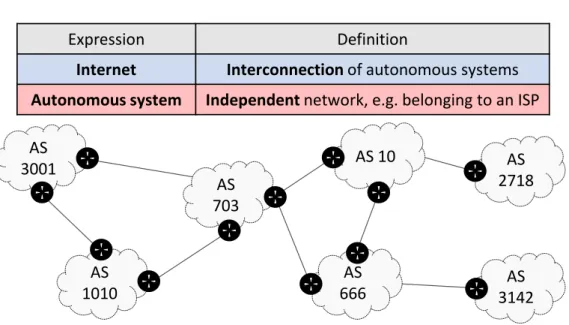
AS 3001 AS 1010 AS 703 AS 10 AS 666 3142AS AS 2718 Expression Definition
Internet Interconnection of autonomous systems Autonomous system Independent network, e.g. belonging to an ISP
Figure 2.1: Simplified representation of the Internet. The Internet is an intercon-nection of ASes that establish links among their ASBRs. Each of these independent networks is identified with a unique ASN.
2.1
Internet
In Chapter 3 and 4 we study the success of IXPs in Latin America and the occurrence of BGP lies in the wild, respectively. Both topics require understanding how the Internet works. To shed light on this, Sec. 2.1.1 explains BGP and Sec. 2.1.2 presents IXPs, the routing protocol and the peering facilities commonly used on the Internet, respectively.
2.1.1 BGP
The Internet is an interconnection of independent networks, known as Autonomous Systems (ASes). To internconnect, ASes establish links among AS border routers (ASBRs). In practice, ASes may be Internet Service Providers (ISPs), networks that belong to private companies, universities, governmental agencies, etc. On the Internet lingo, each AS is considered a domain, thus, ASes have their own intra-domain network. In addition, to differentiate among ASes, each is identified by an AS number (ASN). A simplified representation of the Internet is shown in Fig. 2.1. The Internet has been running over more than 20 years, and has been subject to an unsupervised growing process in which ASes willing to participate in the Internet simply have to connect to other domains, i.e., ASes. In these cases, ASes are said to peer. To communicate, ASes rely on BGP [64], commonly accepted as the de-facto inter-domain routing protocol.
BGP is a path-vector routing protocol where routing messages propagate across ASes. More specifically, BGP routing messages are exchanged between routers that are said to be BGP speakers. In general, ASBRs are BGP speakers. As an Origin AS (OAS), each AS announces the IP prefixes it owns to its peering ASes, and in turn, these re-advertise these prefixes to their own neighboring ASes. In this
AS X Prefix: Pj AS Y AS Z Prefix: Pj CP: X x1 y1 y2 z1 Prefix: Pj CP: Y X
Figure 2.2: Example of the basic operation of BGP. ASX announces prefix Pj as the
OAS, and the prefix is further advertised by AS Y that updates the CP including itself in the path.
process, routing messages get updated, e.g. the path they follow is tracked in a field known as BGP AS-path, and often referred to as control path (CP) in this thesis. In general, if an ASBR finds a loop in the CP, i.e., sees the ASN of the AS to which it belongs already in the CP, then the message is dropped. This basic operation of BGP is exemplified in Fig. 2.2.
As BGP speakers receive multiple announcements concerning the same prefix, they select the best route running a BGP decision process. This selection mechanism takes into account the value of 7 attributes, in decreasing order of importance, until a tie-breaker is found [64]. Among these, the local preference is the most relevant one. ASes tune the value of the local preference to express preference of some routes depending on the peer that announced them the prefix. The higher this metric is, the more appealing the route is considered. Following the local preference, the length of the control path is the attribute that matters the most. In this case, routes are only discriminated based on the length of the path, the shortest ones being the preferred ones. In some cases, ASes use AS prepending, adding multiple times their ASN to the CPs, in order to influence the likelihood that they may end up being chosen as best paths. An exhaustive list of the remaining attributes can be found in [64]. Among them, we highlight that the IGP cost appears as one of such attributes, coupling BGP with intra-domain routing protocols. This compels with hot-potato routing in which the potato that burns, i.e., transit traffic traversing ASes, flows through best paths and exits the AS as soon as possible, according to a IGP metric of choice.
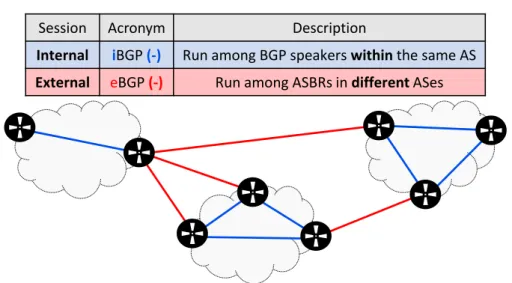
BGP speakers run two different sessions, namely external-BGP (eBGP) and internal-BGP (iBGP), as illustrated in Fig 2.3. In particular, eBGP and iBGP con-cern the exchange of information across ASBRs of different ASes and BGP speakers within the same AS, respectively. With eBGP, each ASBR in an AS announces to each peering ASBR belonging to another AS only the best path to each pre-fix. Thorough iBGP, the situation replicates between the BGP speakers of an AS. This allows each BGP speaker to find, among all routes considered the best by the different BGP speakers within the AS, the overall best route.
BGP speakers maintain a BGP routing table called BGP Routing Information Base (RIB). As routing messages are received, routers populate the RIB. There exist different fields that are completed for each entry: the prefix that was advertised in BGP, the BGP next-hop, i.e., the ASBR that announced the prefix, and the attribute values included in the message in which the prefix was advertised. For each prefix, the overall best path is chosen relying on the aforementioned BGP decision process.
Session Acronym Description
Internal iBGP(-) Run among BGP speakers within the same AS External eBGP(-) Run among ASBRs in different ASes
Figure 2.3: BGP sessions: external BGP (eBGP) and internal BGP (iBGP). The first are run among ASBRs in different ASes while the latter between BGP speakers in the same AS.
A file containing the RIB of a BGP speaker at a given point in time is usually referred to as BGP snapshot, BGP table or BGP dump among others, and usually used as a source of BGP data by researchers. There exist BGP data collection projects such as Routeviews, RIPE RIS, PCH, Isolario Project, etc.1. In general, these projects make publicly available the results of passive measurements, i.e., measurements that comprise dumping BGP data, in many cases aggregating BGP tables of multiple BGP speakers. According to the BGP decision process, the chosen overall best route may differ from BGP speaker to BGP speaker. As a consequence, the BGP data that can be collected from one to another may vary. This aspect is critical for the study we carry on in Chapter 4 since the analysis requires having a traceroute vantage point from which BGP data needs to be also available.
As a routing protocol, BGP is said to have two planes. The process we have described, concerning the construction of routing knowledge, conforms the control plane. This plane dictates the paths that should be reflected when packets exit an AS via a given ASBR, procedure that represents the data plane. In general, traffic traverses a ordered set of ASes until the destination is reached. We refer to these inter-domain forwarding paths as data paths (DPs). In other words, whereas the control plane determines best paths for each prefix, or the CPs, the data plane relies on this information to forward packets, which then flow through DPs. In particular, in Chapter 4 we study whether DPs and CPs usually match in practice, and find cases where this does not hold, i.e., where BGP lies occur. This topic could be clustered among others dealing with security in BGP such as distributed denial of service (DDoS) attacks [65, 66], BGP hijacks [67, 68], etc. More on this can be found in [69]. Even though there exist a secure version extending BGP, namely BGPsec [70], it has never been really adopted. On the other hand, the Resource Public Key Infrastructure (RPKI) [71], allowing to validate the OAS of prefixes, is
1
Routeviews: www.routeviews.org/routeviews/; RIPE RIS: https://www.ripe.net; PCH: https://www.pch.net/; Isolario Project: https://www.isolario.it/
nowadays becoming more extensively used.2. Arguably, this partially occurs since RPKI is central in in the mutually agreed norms for routing security (MANRS). 3
Another important aspect of BGP is that it allows ASes to apply filtering poli-cies, and choose to which ASes they announce the prefixes they learn. In general, this depends on the business relationships that ASes establish [72, 73]. These rela-tionships are dictated by who pays to whom when traffic gets exchanged: an AS pays its provider ASes, peers freely with sibling ASes and peer ASes, and gets paid by customer ASes. Hence, when choosing among available routes for the same prefix, the order of preference grows from last to first, and ASes set up the local preference accordingly. In other words, ASes apply import policies in which an AS chooses paths:
• advertised by customers as priority since this generates revenue;
• learned via peer-to-peer links that have a shared-cost, if no customer offers transit and;
• involving links to providers where the AS has to pay as the last option.
These policies, aiming to maximize the revenue, partially explain why BGPsec did not succeed. Indeed, BGPsec requires prioritizing security above local preference in the BGP decision process to be effective against routing attacks [74], something that numerous network operators are not willing to do [75]. In addition, when advertising prefixes, ASes apply export policies making sure control paths are valley-free, meaning that they do not provide transit for free to providers or peers. In practice, ASes enforce this by:
• advertising all paths they learn to customers and siblings;
• announcing to providers only those paths learnt via customers or siblings, and;
• filtering paths learnt via providers when advertising paths to peers.
These rules are usually referred to as Gao-Rexford policies. This study, and in particular the proposed rules, form part of research concerning BGP convergence or BGP safety, i.e., the conditions that guarantee that BGP will eventually converge to a stable routing outcome [76, 77, 78, 79, 80]. As shown in Fig. 2.4, the Gao-Rexford rules imply that:
• prefixes learned via customers and siblings are advertised to all ASes (Fig. 2.4a);
• prefixes learned via peers and providers are only announced to customers and siblings (Fig. 2.4b and 2.4c, respectively).
Though these policies are still considered the norm, studies have reported on cases associated with the application of more complex policies [81, 82, 83]. As we show in Chapter 4, BGP lies may relate to ASes attempting to avoid paying for using customer-to-provider links by sending traffic towards peer-to-peer links.
(a) Customers to everyone
(b) Peers to customers
(c) Providers to customers
Figure 2.4: BGP policies following Gao-Rexford rules. The AS in the center an-nounces all prefixes learnt via customers (green ASes) to all remaining ASes, but those learned via peers (yellow ASes) and providers (red ASes) are only exported to customer ASes.
Tier-1 ASes Small ISPs Stub ASes Large ISPs
(a) Internet structure before 2000s.
Tier1 AS Big ISP IXP Big ISP Stub AS CDN Stub AS Stub AS ISP IXP ISP Tier1 AS
(b) Current shape of the Internet.
Figure 2.5: Evolution of the (simplified) structure of the Internet. Lines with arrows indicate provider-to-customer links, and those dashed peer-to-peer links. While be-fore the Internet had a clear pyramidal structure, the appearance of IXPs increased the number of peer-to-peer links and the Internet flattened. In addition, multiple content providers developed their own CDNs, which further accelerated this process.
2.1.2 IXPs
As a result of the business relationships that ASes tend to establish, i.e., provider, customer and peer ASes, the Internet naturally adopted a hierarchical structure, as illustrated in Fig. 2.5a. The ordering among ASes is still usually described as
2
See https://rpki-monitor.antd.nist.gov/ and https://rov.rpki.net/
a pyramid in which, from base to tip, three types of ASes can be distinguished: stub ASes, transit ASes and tier-1 ASes. The set of stub ASes is composed by those ASes without customers, whereas transit and tier-1 ASes are mainly ISPs. Since stub ASes do not have customers, they only forward traffic either destined to or originated from themselves or siblings. On the other hand, transit ASes have customers ASes of which they forward traffic, but also have provider ASes. In general, transit ASes may be described as those ranging from small to large/big ISPs, usually providing a service constrained to a specific region or continent, whereas tier-1 ASes usually characterize for being ISPs with a geographical footprint covering multiple continents, thus not needing to buy transit service from any other AS.4 In general, a communication between stub ASes located in different continents required packets to traverse up and then down the pyramid.
The structure of the Internet begun a flattening process in the early 2000s, largely motivated by the massive irruption of Internet Exchange Points (IXPs) [84, 4]. A closer representation of what the Internet looks like nowadays is shown in Fig. 2.5b, where we also highlight the appearance of content distribution networks (CDNs), i.e., networks belonging to content providers. IXPs are facilities that allow multiple ASes to peer at a single location. To interconnect ASes, IXPs use layer-2-devices, i.e., switches. In addition, IXPs usually count with route servers to which ASes may opt to connect. An AS willing to participate in an IXP establishes a unique session with the IXP and, accessing the route server, is able to simultaneously peer with all the other participants in the IXP, known as IXP members or connected networks. In general, IXP members establish peer-to-peer relationships and only announce their customer cone [85] at IXPs, i.e., prefixes with AS-paths leading to customer ASes, and customers of these. Besides peering with the route server, IXPs usually allow ASes to peer privately, i.e., carry out announcements that are not advertised in the route server. In short, IXPs allow ASes to peer at a larger scale, and thus are known as peering fabrics. Indeed, the use of IXPs broke the mechanics of the hierarchical pyramid, and terms such as tier-1 ASes could arguably be considered as rather legacy. Nowadays, metrics such as the AS-rank [86] are considered more informative to give a sense of the size of the business an AS runs.
The major success of IXPs is backed by many reasons. First, IXPs allow to offload upstream traffic, resulting in monetary savings for IXP members. Second, IXPs allow to exchange local traffic within the same region, shortening end-to-end paths and reducing latency [87, 88]. Third, IXPs attract CDNs [84], and CDNs at-tract members. Indeed, CDNs place caches in IXPs to get to (multiple) eyeballs from a single peering point [5], thus allowing IXPs to offer low-cost access to content [89]. In particular, in Chapter 3 we study the multiple IXPs deployed across Latin America, a region that has received little attention in Internet studies. Besides shedding light on the status of the Internet in Latin America, we investigate whether IXPs have had a similar success than in the 2000s in the region.
4The way I describe the geographical footprint of small and large/big transit and tier-1 ASes is
only an interpretation that provides a fast way of classifying ASes into these different categories, but should not be considered strict definitions to which no exceptions exist.
2.2
Intra-domain networks
In Chapter 5 we develop a methodology to detect forwarding detours inside ASes, i.e., whether traffic traversing an AS does not flow through the best available paths in the network. Therefore, understanding how the routing works inside ASes is necessary. To build a strong foundation on such topic, while Sec. 2.2.1 studies the main characteristics of IGPs, Sec. 2.2.2 and 2.2.3 show how load balancing and tunneling techniques allow to modify the standard behavior of the usual intra-domain routing protocols.
2.2.1 IGPs
Besides BGP, ASes additionally use an Internal Gateway Protocol (IGP), i.e., a dedi-cated routing protocol for intra-domain routing. In particular, renown IGPs include Open Shortest Path First (OSPF) [90] and Intermediate System to Intermediate System (IS-IS) [91].
OSPF and IS-IS are link-state routing protocols, meaning that routers build a graph of the intra-domain network. This graph represents the connectivity status of the network, i.e., shows which nodes are connected to which other nodes.
To construct their routing knowledge, routers exchange routing messages indi-cating the links they have with other routers. In addition, every advertised link is weighted with a given IGP cost or IGP distance, according to a pre-defined IGP metric. As an example, a hop-count metric assigns a constant IGP cost of 1 to every link, but other metrics may for example vary the cost depending on the bandwidth available on each link.
With OSPF and IS-IS, each router considers that, for every destination adver-tised in the IGP, the shortest path according to the IGP metric in use represents the best IGP path. To determine such paths, routers run Dijkstra’s algorithm [92]. Once the best path to reach a prefix is decided, routers take note of the router that announced the path, and use it as IGP next-hop or next-hop towards that prefix. When the considered prefix is actually a BGP prefix, a recursive lookup is performed, and the next-hop matches the neighboring router offering the best path towards the BGP next-hop of that prefix. In general, the next-hops are further installed in a table known as Forwarding Information Base (FIB), that is optimized to perform fast the actual forwarding of packets. As we study in Chapter 5, some routers sometimes are not able to keep a full-FIB in memory, and the workarounds implemented in these scenarios may lead to forwarding detours.
The concept of best paths across IGPs and BGP do not imply the same, there are two key differences: (i) the information that routers or ASes receive to actually decide which is the best path, and; (ii) the conceptual meaning of the metrics that are taken into account to choose best paths.
While IGP best paths are globally optimal, this may not be the case in BGP. Ac-cording to IGPs, since all routers in the network receive the same routing messages, all subpaths of any best path are also best paths. This property results from the fact that routers have the same view of the network: what a router considers the best, is also seen as the best for the remaining routers. We refer to this agreement among the devices of a network as the existence of routing consistency in the network. As