HAL Id: hal-00880944
https://hal.inria.fr/hal-00880944
Submitted on 7 Nov 2013
HAL is a multi-disciplinary open access
archive for the deposit and dissemination of
sci-entific research documents, whether they are
pub-lished or not. The documents may come from
teaching and research institutions in France or
abroad, or from public or private research centers.
L’archive ouverte pluridisciplinaire HAL, est
destinée au dépôt et à la diffusion de documents
scientifiques de niveau recherche, publiés ou non,
émanant des établissements d’enseignement et de
recherche français ou étrangers, des laboratoires
publics ou privés.
TREND towards more energy-efficient optical networks
Esther Le Rouzic, Edoardo Bonetto, Luca Chiaraviglio, Frédéric Giroire, Filip
Idzikowski, Felipe Jimenez, Christoph Lange, Julio Montalvo, Francesco
Musumeci, Issam Tahiri, et al.
To cite this version:
Esther Le Rouzic, Edoardo Bonetto, Luca Chiaraviglio, Frédéric Giroire, Filip Idzikowski, et al..
TREND towards more energy-efficient optical networks. 17th International Conference on Optical
Network Design and Modeling (ONDM), Apr 2013, Brest, France. pp.211–216. �hal-00880944�
Abstract— With one third of the world population online in
2013 and an international Internet bandwidth multiplied by more than eight since 2006, the ICT sector is a non-negligible contributor of worldwide greenhouse gases emissions and power consumption. Indeed, power consumption of telecommunication networks has become a major concern for all the actors of the domain, and efforts are made to reduce their impact on the overall figure of ICTs, and to support its foreseen growth in a sustainable way. In this context, the contributors of the European Network of Excellence TREND have developed innovative solutions to improve the energy efficiency of networks. This paper gives an overview of the solutions related to optical networks.
Index Terms— Optical fiber communication, optical core
networks, optical access networks; energy efficiency
I. INTRODUCTION
Information and Communication Technologies (ICTs) are often presented as solutions to reduce the overall greenhouse gases (GHG) emission. Indeed they allow dematerialization (electronic documents instead of paper) and potentially can Manuscript received February 2 2013. The research leading to these results has received funding from the European Union Seventh Framework Programme (FP7/2007-2013) under grant agreement n. 257740 (Network of Excellence ―TREND‖).
E. Le Rouzic is with Orange Labs, Networks and Carriers, Lannion, France (e-mail: {esther.lerouzic}@orange.com).
A. Bianco and E. Bonetto are with the Department of Electronics and Telecommunications, Politecnico di Torino, Torino, Italy (e-mail: {firstname.lastname}@polito.it).
L. Chiaraviglio, F. Giroire and I. Tahiri are with COATI, INRIA, I3S, CNRS, Université de Nice Sophia, Sophia Antipolis, France, (e-mail: {firstname.lastname}@inria.fr).
F. Idzikowski is with Technische Universität Berlin, TKN, Berlin, Germany (e-mail: {filip.idzikowski}@tu-berlin.de)
F. Jiménez and J. Montalvo are with Telefónica Investigacíon y Desarrollo SA, Madrid, Spain, (e-mail: {felipej;jmg}@tid.es)
C. Lange is with Deutsche Telekom AG, Telekom Innovation Laboratories, Berlin, Germany (e-mail: {christoph.lange}@telekom.de).
F. Musumeci and A. Pattavina are with CNIT and Politecnico di Milano, Department of Electronics and Information, Milano, Italy (e-mail: {fmusumeci;pattavina}@elet.polimi.it).
A. Valenti is with Fondazione Ugo Bordoni, Rome, Italy (e-mail: {avalenti}@fub.it).
W. Van Heddeghem is with Department of Information Technology (INTEC) of Ghent University - iMinds, Gent, Belgium (e-mail: {ward.vanheddeghem}@intec.ugent.be).
Y. Ye is with Huawei Technologies Duesseldorf GmbH, Munich, Germany (e-mail: {Yeyabin}@huawei.com).
reduce the amount of carbon emissions attributed to travel (teleconferencing, telemonitoring). However, this should not be used as an alibi for ignoring the energy consumed by ICTs. The electricity consumption of communication networks has shown a growth rate of 10% per year over the last five years, with its relative contribution to the total worldwide electricity consumption increasing from 1.3% in 2007 to 1.8% in 2012 [1]. As the traffic volume and number of customers are still expected to grow for the next 10 years, the energy consumption of networks has become one of the most important issues for the community.
In this context, researchers of the European Network of Excellence TREND [2] have joined their efforts to develop new, comprehensive, energy-aware approaches to networking with a clear target towards an energy-efficient network as a whole, including core networks, wired and wireless access networks, as well as customer premises network equipment and data centers.
Optical technologies are widely accepted as a future proof and cost-effective approach for supporting the future traffic demands and services at the lowest energy footprint possible. Thus the authors present their main achievements specifically focusing on optical networks including access and core parts, as the fixed networks of the future.
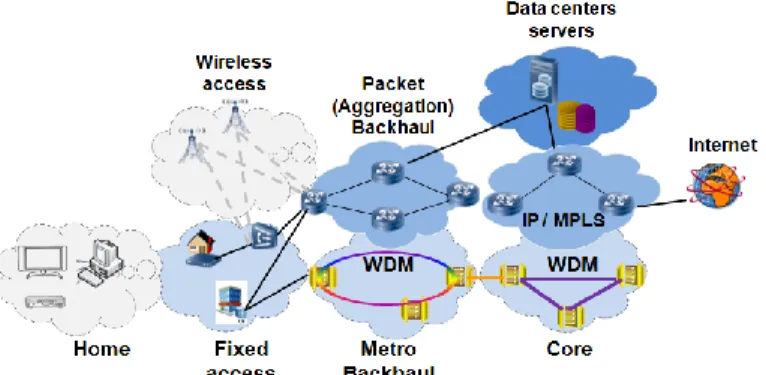
The network segments considered in this paper are illustrated in Fig. 1. The motivation for improving these segments is the following. The access network segment already represents an important part of the total network energy consumption and this part is proportional to the number of customers. The core and metro segment and especially optical transport network reversely have often been neglected.
TREND towards more energy-efficient optical
networks
Esther Le Rouzic, Edoardo Bonetto, Luca Chiaraviglio, Frederic Giroire, Filip Idzikowski, Felipe
Jiménez, Christoph Lange, Julio Montalvo, Francesco Musumeci, Issam Tahiri, Alessandro Valenti,
Ward Van Heddeghem, Yabin Ye, Andrea Bianco and Achille Pattavina
Fig. 1. Generic operator network architecture and domains covered by TREND. Blue (dark) parts are explored in this paper.
While this was justified in the past, this does not hold in the future because of the foreseen traffic increase. Core networks, including backbones and data centers, are expected to witness the biggest increase in electricity consumption in the future [3] since their energy consumption is increasing almost proportionally to the traffic. With an exponential traffic growth between 20% and 40% per year, the energy consumption in the core segment will soon become an issue if business grows as usual. Thus TREND partners have joined their efforts to propose and evaluate solutions to improve the network energy efficiency.
The work performed by TREND partners in a way prepares a ―green‖ scenario for the future communication, the challenge being to sustain traffic growth and networks transformation (usage, architectures, new technologies) while restraining the energy consumption growth (or even decreasing it with respect to today’s situation). To fulfill this objective, the general approach consists of analyzing the global energy consumption, identifying where savings can be obtained and proposing solutions that can lead to these reductions. Such a study has already performed for the backbone networks [4]. Using an analytical model it was shown that to achieve large savings (i.e. more than 10 times reduction of the current power consumption), efforts will need to be concentrated on those techniques that i) reduce the traffic volume in the core (especially the traffic switched in the power-consuming IP network layer) and ii) improve the equipment power efficiency (amount of power in Watt per provided capacity in bps).
The TREND solutions presented in this paper target both objectives. These solutions are presented from the device, the architecture and the network operation points of view and they span the access, metro and core network segments.
In Section II, we discuss approaches that reduce the power consumption of individual systems or components. In Section III we consider those approaches that require more profound changes in the network architecture. In Section IV we present approaches that improve the scaling of power to the actual traffic. Finally, in Section V we wrap up with the expected energy savings of these approaches, and discuss a number of important open issues.
II. MORE EFFICIENT DEVICES
A. Towards all optical technologies
Photonic technologies can improve the scalability of network nodes in terms of power consumption. Indeed, on the broadband fixed access part, optical technologies not only increase the power-efficiency of the access devices, but also increase the user data rate compared to xDSL (Digital Subscriber Line).
Based on measurement of actual devices on a multivendor access network test-bed [5], the power consumption per user of different access technologies has been derived. Measurements on Ethernet Passive Optical Network (EPON) Optical Line Terminal (OLT), Gigabit Passive Optical Network (GPON) OLT and Asymmetric Digital Subscriber
Line (ADSL2+) Digital Subscriber Line Access Multiplexer (DSLAM) showed that thanks to infrastructure sharing and to the different splitting ratio between EPON and GPON, it results that GPON consumes 0.45 W per user against 0.71 W and 2.81 W for EPON and ADSL2+, respectively.
At customer premises, E/GPON Optical Network Terminals ONTs (including radio frequency video overlay) consume about 10 W against 8 W for ADSL2+ modems. GPON ONTs account for 95% of overall power consumption in GPON networks. Although these values seem low, the number of network elements placed at customer premises is very high and represents an important part of the total energy consumption. We have thus also proposed energy efficient ONT hardware design. Considering a reference home network architecture for PON services employing an ONT with four Gigabit Ethernet (GbE) interfaces and a regular routed Residential Gateway (RG) with Layer 3 (L3) functionalities, Wi-Fi and Plain Old Telephony Services (POTS) interfaces, we proposed two energy efficient ONT hardware design alternatives [6]. The power consumption target values of the ―European Code of
Conduct on Energy Consumption of Broadband
Communication Equipment Version 4‖ is used as reference for estimating the power savings of each ONT type and RG use cases.
Firstly, single GbE port ONTs are suitable for triple-play services while using a RG which performs the L3 functions, thus saving the power consumption corresponding to three unused (and redundant) ONT Ethernet ports. An ONT power saving of 31% and 20% in active and idle states, respectively, is estimated with this approach.
Secondly, Small Form-factor Pluggable (SFP) type ONT attached to the WAN interface of a regular RG with a SFP socket is also an energy efficient approach to the reference scenario. Due to improved technology chipsets and avoiding unused RJ45 GbE interfaces, power saving of around 57% comparing to a reference ONT is estimated.
B. Smart electronics
In core networks, the next generation transmission systems may benefit from Dynamic Voltage and Frequency Scaling (DVFS) techniques. This could make the optical transponder consumption mainly dependent on the symbol rate. As a consequence, advanced modulation formats carrying more bits per transmitted symbol would allow a reduction of energy consumption per bit. This could be the case of shortly available 16QAM formats which would double the capacity of current 100 Gbps QPSK while maintaining the same power consumption. An alternative solution consists of adapting the symbol rate thanks to DVFS. Since a large part of the power consumption of coherent receivers is due to the data processing, adaptation of the symbol rate permits to reduce both frequency and voltage of the ASICs or FPGA. Power reduction as high as 30% was obtained in [7].
Rate adaptation can also be used in more dynamic context of daily traffic patterns to make the rate follow the exact traffic requirements as will be shown in section IV.
III. MORE EFFICIENT ARCHITECTURES
The previously presented solutions are based on hardware improvements and could be implemented in current networks provided that such capabilities are commercially available. A more disruptive vision rethinks the networks architectures in order to include the energy consumption as a given constraint or optimization goal in the design phase. New architectures can be implemented that change the traffic distribution in the network in such ways that important reduction in terms of consumption could be achieved either through an improvement of the efficiency or through a reduction of traffic volume.
A. Energy-Aware Network Design
Core networks are usually designed looking at performance indices such as latency or congestion minimization, disregarding in the design phase network energy efficiency. Thus, energy reduction techniques were initially devised for already designed networks. Given the increasing importance of energy consumption from both the cost and environmental point of view, we investigate several design choices of core networks taking into account energy constraints in the network design phase. It is important to properly choose and install energy-efficient and reliable devices (including fiber links), and to properly configure them (including routing of lightpaths over the physical topology and routing of IP traffic) so that the predicted peak traffic demand is satisfied with a certain over-provisioning level, and the network power consumption is as low as possible during the peak hour [8].
Energy savings in the range of 10% to 30% with respect to traditional design are possible for core networks [9]. Multipath exploitation may further enhance energy savings, creating more opportunity for traffic grooming. Indeed, splitting traffic demands over multiple paths permits to use spare capacity in the network improving traffic aggregation. Thus, fewer resources are needed to support the given traffic, reducing energy requirements.
B. Energy Efficient Architecture
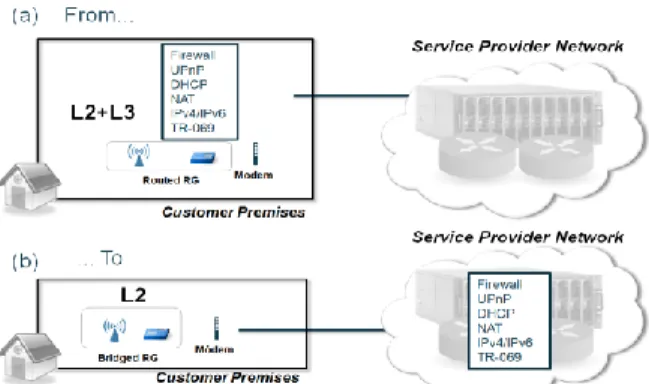
The virtualization of the L3 home network equipment functionality within the service provider network is a novel access architecture aiming at diminishing operator’s capital and operational expenditures (CAPEX and OPEX) in home equipment associated to the deployment of broadband services [10]. In this scenario, the L3 functionalities of a routed RG (Fig. 2a) are translated into the service provider’s network, thus simplifying the structure of the RG and reducing its power consumption (Fig. 2b). Various Bridged RG design options have been analyzed. A first design option with a Bridged RG (BRG) consisting of two separated devices, an 802.11n Wi-Fi fat Access Point (AP), and one L2 GbE switch with four RJ45 ports and no CPU functions for management, is considered. The power saving of this option with respect to a regular routed RG is estimated to be around 30% both in active and idle states. A second design option with a BRG without Wi-Fi interface is considered, which may be suitable for business services where security is an important issue or for low-profile
residential services. The estimated power saving of this scenario is close to 60% and 50% in active and idle states, respectively.
In [11,12] we proposed a new approach to reduce power consumption for Internet Service Providers (ISPs) and Content Providers (CPs). In particular, we aim at controlling the whole system composed of the ISP and the CP to find the minimal set of network resources and servers that minimize the total power consumption while satisfying the current content requests. The main finding of this work is that up to 71% of energy savings are possible when the CP and the ISP cooperate to reduce jointly the power consumption. Moreover, we investigated the impact of different server placement of the CP inside the ISP topology, showing that placing the CP servers close to nodes with the highest number of links is in general an energy-efficient choice. Motivated by these works, we are currently targeting the reduction of power consumption in the ISP by assuming that the operator manages a set of contents. Our idea is to exploit the characteristic of the content (type, popularity, etc.) to decide where to store it inside the ISP network to save energy [13]. Indeed, there is a tradeoff (in terms of power consumption) between storing multiple version of a given content versus transporting repeatedly this content over the network.
IV. MORE PROPORTIONAL TO LOAD
One important feature of today network equipment is that they consume almost the same amount of energy no matter whether they are loaded or not. However more proportionality to load could bring an important reduction in all parts of the network, e.g. theoretical savings of 20-40% for sinusoidal traffic variations can be expected.
Sleep mode is a way to introduce more proportionality as will be shown in this section. The load adaptation is then binary, putting a device into either working or sleep mode. Rate adaptation of equipment is also a solution that is particularly studied for Elastic Optical Networks. Rate adaptation provides a more gradual adaptation of available capacity to the actual traffic demands. Lastly, it is important to ensure that the power supply of equipments and cooling elements can efficiently support variable equipment power levels.
Fig. 2. Energy efficient access architecture by means of virtualization of Layer 3 functionalities of Residential Gateways from the Customer Premises (a) to the Service Provider Network (b).
A. Usage of sleep mode: binary adaptation
An effective method to reduce the energy consumption in access networks is to implement sleep mode policies at the ONTs. Indeed, we estimated that the majority of the users is using their line connection for a limited amount of time during the day [14]. This practice can significantly reduce the energy consumption at the users' side, but not at the operator's side. Indeed, since the OLT is shared between several ONTs, it is very unlikely that all the ONTs associated to a given OLT are idle.
The amount of energy saved at the ONTs with respect to the case that no sleep mode policies are implemented depends strongly on how much the ONT is consuming during the standby state. We evaluated that the energy saved ranges from the 65% in the best case (the ONT in sleep mode consumes a negligible amount of power) to about 30% when a more conservative case is selected (the ONT in sleep mode consumes 50% of the power consumption in working mode).
Aggregated traffic in metro and core networks varies relatively smoothly over time. The day-night traffic variation offers the possibility to reduce power consumption of the network during low demand hours by deactivation (either switch off or power saving mode) of idle network devices [15]. The method usually consists of rerouting traffic over a smaller number of devices in order to reduce the overall power consumption of the network.
Several heuristics for the IP and optical layers have been proposed within TREND [16]. In general, simple mechanisms provide lower power savings than the sophisticated ones, but require low computation times. Moreover, our studies showed that the algorithms addressing the IP layer achieve remarkable results (up to 81% of energy savings in the investigated realistic scenarios), and should be considered (subject for further improvements) by the standardization bodies. Finally, the number of changes dynamically performed in the network needs to be considered since it may impact the Quality of Service (QoS). However, we have proven in [17] that sleep modes are effective even when only 2 to 3 network (re)configurations are allowed per day.
B. Dynamic rate adaptation: gradual adaptation
In the core, Elastic Optical Networking (EON) has been
assessed in TREND as a potential solution to improve transmission equipment power efficiency
EON’s benefit is based on the current trend towards coherent 40 Gbps and 100 Gbps solutions and even higher speed implementations. Instead of having transparent connections underutilized (either because of their overcapacity with respect to actual traffic demands or due to the wide capacity gap between the transponder types), EON exploits the so called Bit-rate Variable Transponder (BVTs), which have different working modes.
BVTs can be dynamically reconfigured to accomplish a specific capacity-reach tradeoff. Together with flexible grid Reconfigurable Optical Add Drop Multiplexers (ROADMs), they provide a great deal of flexibility on the assignment of physical resources, which can be leveraged for energy saving purposes.
Analysis in terms of energy efficiency in different network scenarios and conditions (i.e. different-sized network topologies, static and dynamic traffic operations, unprotected and protected networks, and different traffic loads) showed significant improvements with respect to the conventional WDM networks. These advantages mainly come from the possibility of providing dynamic resource adaptation to the actual load, but EON also has better spectral efficiency with respect to conventional WDM networks, which can be further translated to reduced energy consumption.
EON clearly outperforms all the WDM approaches in energy efficiency per GHz (power [W] spent on providing capacity [bps] using a certain spectrum [GHz]) providing between 60% and 150% improvement compared to single line rate (SLR) and multiple line rate (MLR) architectures [18]. Besides, in [19] we proposed a novel protection scheme, with the rate of the backup transponders adapted to the current required bandwidth requirements to reduce the energy consumption. Fig. 3 shows the average energy savings that could be achieved with the different approaches on a working and weekend day. As can be noticed, EON is the technology that could benefit the most from such an innovative protection scheme (i.e. energy savings up to 11% and 18% can be achieved on a working and a weekend day, respectively).
C. Adaptation of the power supply chain and cooling overhead
The assumption that the network elements couple the power consumption to the traffic load—i.e. a power-proportional network element and network behavior is established—leads to variable electrical loads which energy converting elements in central offices have to handle. In particular during time periods of low traffic demands the energy converting elements in central offices then work at non-optimum operating points which lead to increased relative power losses. A modular controlled approach for energy conversion that switches the power conversion capacity of the power converting elements in steps—as described in [20] —permits the adaptation of the power supply chain to the variable network element power draws observed in load-adaptive network operation. This leads to an overall stabilized level of efficiency of the power supply Fig. 3. Average energy savings of different architectures on a working and a
weekend day with respect to the conventional 1+1 dedicated protection (DP 1+1) scheme for different traffic load conditions for the Telefónica I+D’s network model.
chain over the whole operating range of activated network element capacity: Power conversion efficiency improvements in particular at low traffic—and thus electrical—loads of up to the factor of 1.5 to 2 are obtained during low-demand times. Housing energy efficiency in addition includes HVAC (heating, ventilation, and air conditioning) for central offices and is an important factor in overall telecommunication network energy efficiency—and should also be included in overall load-adaptive network operation concepts.
V. DISCUSSION AND CONCLUSION
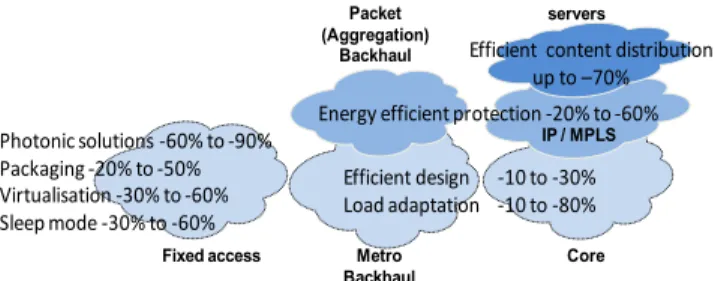
The schemes proposed in this paper could lead to the following (estimated) power reductions (Fig. 4):
In the access segment, the use of optics instead of electronics could reduce the power consumption of access points by a factor 3 to 8. The customer’s optical network terminal could benefit from another 20% to 50 % reduction thanks to an improved design. Additionally the use of sleep mode would permit 30% to 60% reduction. Lastly virtualization would allow 30% to 60% reduction.
In the metro-core transport segment, up to 81% reduction could be obtained thanks to sleep mode or rate adaptation. 10-30% could be saved thanks to power aware network design. More efficient content distribution combined with efficient transport architecture could lead to 70% reduction and more importantly to a reduction of the traffic volume in the network and processed by equipments, thereby reducing the dependency factor on traffic increase.
The numbers provided above and in Fig. 4 should be treated as purely indicative ones, as the savings in various parts of the network depend on many factors such as dimensioning of the reference network. Determining if all these solutions can be combined is part of our future work and it is not addressed here. Instead we mention several important issues.
Paving the way towards improved power efficiency
Improving power efficiency is certainly under the responsibility of equipment vendors, but incentives are to be initiated from operator side with requests and specifications. Improved power efficiency requires new technologies or new network architectures (virtualization). It is then an operator decision to upgrade network or change its architecture. Regulations play an important role as an incentive toward vendors and operators to meet certain standards. As an example, due to the free-market, the publication of the power consumption values could be a positive trigger for vendors to make their equipment more energy-efficient. Regulation
though may also have negative impact on the total network power consumption, for instance when it leads to the deployment of multiple infrastructures or equipments to avoid a dominant position of an operator. On the operator side, cost savings generated by power consumption reduction are already an incentive. For example, the usage of GPON in the access segment could reflect in economic savings through OPEX reduction. In [5] we calculated that in a country like Italy, where there are about 25.3 million of house units, GPON could allow to save up to 500 GWh/year with respect to ADSL2+, leading to a reduction of OPEX equal to 800 million € in 10 years.
However, operator responsibility should also be considered beyond its own equipments. Here again, regulation and incentives are useful tools to envisage power efficiency and power consumption as a global challenge including network equipments at customer premises but also ―over-the-top‖ actors such as content providers.
As an example, operators have no direct advantages to adopt sleep mode policies in PONs because the power savings are achieved only at the customer premises, while increasing complexity and possibly cost at the operators premises. Furthermore, the implementation of these policies require investment and research to modify the hardware of the ONUs and the existing protocols, as well as the sleep mode policies of Ethernet-based customer premises equipment. Thus, some initiatives that can reduce the energy consumed in the PON can be undertaken, but it is necessary to understand and reduce the possible impact of energy efficiency in the services and enhance collaborations between the operators and the vendors on this subject.
Considering operator constraints: protection and QoS
A critical issue when dealing with optical transport networks is their resiliency, since a failure of a single fiber link produces the breakdown of several traffic demands, carrying large amounts of data flows. In order to avoid this and to provide an acceptable QoS level to the end-users, network resiliency is typically achieved through a dedicated protection 1+1 scheme, where data is first duplicated and then transmitted onto two different link-disjoint paths. This requires the deployment of redundant devices and, consequently, increases the power consumed by the network, since both have to be active on the working and protection paths.
When accomplishing network design and operation of resilient networks, several strategies can be adopted to enable at the same time energy-efficient networking. Among these, we can take into consideration the load-proportional solutions described in Section IV, e.g., the possibility of setting unused/protection resources in low-power sleep state, as well as the devices rate-adaptation to the traffic dynamics. Furthermore, as high protection degree could be unnecessary for some kinds of services, a more power-friendly strategy, based on a differentiated Quality of Protection (QoP) scheme, can be exploited so that a lower number of redundant resources are utilized. To this scope, some demands can be
Photonic solutions -60% to -90% Packaging -20% to -50% Virtualisation -30% to -60% Sleep mode -30% to -60% Efficient design -10 to -30% Load adaptation -10 to -80% Energy efficient protection -20% to -60%
Core Metro Backhaul Packet (Aggregation) Backhaul IP / MPLS Fixed access
Efficient content distribution up to –70%
Data centers servers
served and protected via a shared protection strategy or they can be even unprotected.
However, note that these mechanisms should have no impact on current reliability and QoS levels, that is, they need to be well designed and to account for adequate security margins on failure events, e.g., they should be applied to protection resources that do not carry useful information under normal operation. Moreover, the issue of maintaining proper QoS and protection levels must be taken into account also in the design of new energy-efficient devices (i.e., they should have acceptable lifetimes) and network architectures (proper resource over-provisioning is still needed).
During TREND project, several works dealt with energy-efficient protection schemes, demonstrating that relevant savings can be obtained by setting protection resources into sleep state (in the order of 60% [21]), or exploiting differentiated QoP schemes and rate-adaptive technologies such as EON (in the order of 20% [22]).
Integrating energy efficiency from end to end
However, energy savings may reduce or deteriorate either QoS or protection guarantees. These aspects should be taken into due account to ensure that energy saving techniques become a reality in operational networks. For example, the possible service disruption due to adaptation should be avoided and thus devices that implement the power saving modes and quick wake-up mechanisms need to be developed. Even though, service disruption may occur due to the standby mode, for example in ONUs. Services should thus also support standby of equipment. This means that energy efficiency should be considered from end to end.
Applying load adaptation
Although reduction of power consumption is becoming more and more important in the area of networking, several constraints covering physical layer, QoS, computation time, network knowledge, reconfiguration costs, and protection need to be met. For example, the impact on failure rate due to frequent power cycling must be integrated. In the case of optical transponders, it may be desirable to keep the optical power above a certain level even in ―standby mode‖, in order to avoid laser cycling that may greatly degrade its failure rate and also to avoid important transients in the amplified links.
Besides the load-adaptivity of the uninterruptable power supplies and HVAC systems are also important for the overall network-site energy efficiency. Including those supporting systems in network efficiency optimizations helps to improve the overall network-site energy efficiency already in static but even more in load-adaptive operation regimes of telecommunication networks.
Taking a global view on energy-efficient optical networks is a complex task. While we pointed out the current solutions and open issues, which have been partially addressed within TREND, simulation or detailed modeling of the network as a whole (including core and access networks, as well as customer premises network equipment and data centers) remains an open issue for further investigations.
REFERENCES
[1] S. Lambert, W. van Heddeghem, W. Vereecken, B. Lannoo, D. Colle, and M. Pickavet, ―Worldwide electricity consumption of communication networks,‖ Opt. Express 20, B513-B524, 2012. [2] TREND web site: ―fp7-trend.eu‖
[3] C. Lange, D. Kosiankowski, R. Weidmann, and A. Gladisch, ―Energy consumption of telecommunication networks and related improvement options,‖ IEEE J. Sel. Top. in Quantum Electronics, vol. 17, no. 2, pp. 285 –295, 2011.
[4] W. Van Heddeghem, M. C. Parker, S. Lambert, W. Vereecken, B. Lannoo, D. Colle, M. Pickavet and P. Demeester, ―Using an analytical power model to survey power saving approaches in backbone networks,‖ in Proc. NOC, pp.1-6, 2012.
[5] A. Valenti, F. Matera and G. T. Beleffi, ―Power consumption measurements of access networks in a wide geographical area test bed and economic perspectives,‖ Future Network & Mobile Summit, pp.1-6, 2012.
[6] J. Montalvo et al., ―Energy Efficiency in PON Home Network Scenarios With Network Located Residential Gateways,‖ IEEE ICNSC 2013 (in press).
[7] A. Morea, O. Rival, N. Brochier and E. Le Rouzic, ―Datarate Adaptation for Night-Time Energy Savings in Core Networks,‖ Lightwave Technology, Journal of , vol.31, no.5, pp.779-785, 2013. [8] F. Idzikowski, L. Chiaraviglio, and F. Portoso, ―Optimal Design of
Green Multi-layer Core Networks,‖ In Proc. of the e-Energy, 2012. [9] A.Bianco, E.Bonetto and A.Ahmad, ―Energy awareness in the design of
optical core networks,‖ In Proc. Of OFC/NFOEC 2013 (in press). [10] Network Enhanced Residential Gateway, Working Text 317 (in
development), Broadband Forum, 2013.
[11] L. Chiaraviglio and I. Matta, ―Energy-Aware Network Management and Content Distribution,‖ in Jinsong Wu, Sundeep Rangan, and Honggang Zhang (Editor), Green Communications: Theoretical Fundamentals, Algorithms, and Applications, CRC Press, 2012.
[12] L. Chiaraviglio and I. Matta, ―An Energy-Aware Distributed Approach for Content and Network Management,‖ IEEE INFOCOM 2011 Workshop on Green Communications and Networking 2011.
[13] E. Bonetto, A. Finamore, M.M. Munafò and R. Fiandra, ―Sleep Mode at the Edge: How Much Room is There?,‖ in Proc. of Networks 2012. [14] J. Araujo, F. Giroire, Y. Liu, R. Modrzejewski, J. Moulierac, Energy
Efficient Content Distribution, in Proc. ICC 2013.
[15] F. Idzikowski, S. Orlowski, C. Raack, H. Woesner, and A. Wolisz, ―Dynamic routing at different layers in IP-over-WDM networks – Maximizing energy savings,‖ Optical Switching and Networking, Special Issue on Green Communications, vol 8, no. 3, pp. 181–200, 2011.
[16] F. Idzikowski et al., ―Final report for the IRA Energy-efficient use of network core resources,‖ TREND Deliverable D3.3, June 2012. [17] L. Chiaraviglio and A. Cianfrani, ―On the Effectiveness of Sleep Modes
in Backbone Networks with Limited Configurations,‖ In Proc. Of SoftCOM, 2012.
[18] J. L. Vizcaino, Y. Ye, V. López, F. Jiménez, R. Duque and P. Krummrich, ―On the Energy Efficiency of Survivable Optical Transport Networks with Flexible-grid,‖in Proc. of ECOC2012
[19] J. L. Vizcaino, Y. Ye, V. López, F. Jiménez, R. Duque, P. Krummrich, F. Musumeci, M. Tornatore and A. Pattavina, ―Traffic and Power-Aware Protection Scheme in Elastic Optical Networks,‖ in Proc. Networks 2012.
[20] C. Lange and D. Kosiankowski ―Energy Efficiency Improvements in Telecommunication Networks — Optimizing the Power Supply Chain,‖ in Proc. of Photonics in Switching (PS) 2012, Paper We-S31-I01. [21] F. Musumeci, M. Tornatore, J. Lopez, Y. Ye and A. Pattavina,
―Energy-Efficiency of Protected IP-over-WDM Networks with Sleep-Mode Devices,‖ in Journal of High Speed Networks, Special Issue on Green Networking and Computing (in press).
[22] J. Lopez, Y. Ye, V. Lopez, F. Jimenez, R. Duque, F. Musumeci, A. Pattavina and P.M. Krummrich, ―Differentiated Quality of Protection to Improve Energy Efficiency of Survivable Optical Transport Networks,‖ in Proc. of OFC 2013 (in press).