HAL Id: hal-00079522
https://hal.archives-ouvertes.fr/hal-00079522
Submitted on 29 Jan 2021
HAL is a multi-disciplinary open access
archive for the deposit and dissemination of
sci-entific research documents, whether they are
pub-lished or not. The documents may come from
teaching and research institutions in France or
abroad, or from public or private research centers.
L’archive ouverte pluridisciplinaire HAL, est
destinée au dépôt et à la diffusion de documents
scientifiques de niveau recherche, publiés ou non,
émanant des établissements d’enseignement et de
recherche français ou étrangers, des laboratoires
publics ou privés.
Reduction of ringing effects by an improved
deconvolution algorithm - Application to A370 CFHT
image of gravitational arcs
Muriel Roche, Christian Bracco, Claude Aime, Henri Lantéri, Yannick Mellier
To cite this version:
Muriel Roche, Christian Bracco, Claude Aime, Henri Lantéri, Yannick Mellier. Reduction of ringing
effects by an improved deconvolution algorithm - Application to A370 CFHT image of gravitational
arcs. Astronomy and Astrophysics - A&A, EDP Sciences, 2003, 409, pp.387-394.
�10.1051/0004-6361:20031111�. �hal-00079522�
c
ESO 2003
Astrophysics
&
Reduction of ringing effects by an improved deconvolution
algorithm
?
Application to A370 CFHT image of gravitational arcs
M. Roche
1,2, C. Bracco
1, C. Aime
1, H. Lant´eri
1, and Y. Mellier
3,41 UMR 6525 Astrophysique, Universit´e de Nice Sophia Antipolis, Parc Valrose, 06108 Nice Cedex 2, France 2 Institut Fresnel, UMR 6133, ´Ecole Nationale Sup´erieure de Physique de Marseille,
Domaine Universitaire de Saint J´erˆome, 13397 Marseille Cedex 20, France e-mail:[email protected]
3 Institut Astrophysique de Paris, UMR 7095, 98bis boulevard Arago, 75014 Paris, France 4 Observatoire de Paris, LERMA, UMR 8112, 61 avenue de l’Observatoire, 75014 Paris, France Received 4 February 2003/ Accepted 17 June 2003
Abstract.We develop a self-consistent automatic procedure to restore information from astronomical observations. It relies on both a new deconvolution algorithm called LBCA (Lower Bound Constraint Algorithm) and the use of the Wiener filter. In order to explore its scientific potential for strong and weak gravitational lensing, we process a CFHT image of the galaxy cluster Abell 370 which exhibits spectacular strong gravitational lensing effects. A high quality restoration is here of particular interest to map the dark matter within the cluster. We show that the LBCA is especially efficient to reduce ringing effects introduced by classical deconvolution algorithms in images with a high background. The method allows us to make a blind detection of the radial arc and to recover morphological properties similar to those observed from HST data. We also show that the Wiener filter is suitable to stop the iterative process before noise amplification, using only the unrestored data.
Key words.galaxies: clusters: individual: cluster Abell 370 – cosmology: gravitational lensing – cosmology: dark matter – methods: data analysis – techniques: image processing
1. Introduction
Despite its oustanding image quality, the small field of view of the Hubble Space Telescope (HST) still hampers its use for deep surveys covering angular size beyond a de-gree scale. Wide field surveys, like those used for gather-ing large sample of lensgather-ing clusters or for cosmic shear, are therefore specific territory for panoramic CCD cameras, like Megacam at CFHT (Boulade et al. 2000) or Omegacam at ESO (Valentijn et al. 2001). However, the intrinsic limitation of ground-based telescopes produced by atmospheric seeing puts severe bounds on the detection limits of these surveys and
Send offprint requests to: M. Roche,
e-mail:[email protected]
? Based on observations obtained at the Canada-France-Hawa¨ı
Telescope (CFHT) which is operated by the National Research Council of Canada (NRCC), the Institut des Sciences de l’Univers (INSU) of the Centre National de la Recherche Scientifique (CNRS) and the University of Hawa¨ı (UH), and on observations made with the NASA/ESA Hubble Space Telescope, obtained at the Space Telescope Science Institute, which is operated by the Association of Universities for Research in Astronomy, Inc., under NASA contract NAS 5-26555.
on the lowest gravitational distortion amplitude one can mea-sure with these cameras. Image degradation dilutes the light from small faint galaxies below the limiting threshold, blurs image details and increases the uncertainties on shape mea-surement of lensed galaxies. Both arc detection and the cosmic shear signal are therefore altered by the seeing.
Improving image quality from ground based telescopes is therefore an important technical goal that may have a signif-icant scientific impact when surveys are pushed to the limits. In principle, image deconvolution can both improve the im-age quality and enhance the flux emitted by low surface bright-ness galaxies. Unfortunately, because deconvolution is a slow process and often produces unwanted artifacts, like ringing, it cannot be easily used on wide field ground based images. Furthermore, in the case of very large data sets from panoramic cameras, objective convergence criteria must be defined and ap-plied automatically to images. These technical limitations turn out to be challenging if one envisions a massive image decon-volution of surveys.
Although it is not yet applicable to large ground based data sets, we explore new image deconvolution techniques that could be used in the future. More precisely, we compare the
388 M. Roche et al.: Reduction of ringing effects by an improved deconvolution algorithm performances of the Richardson-Lucy (RL) algorithm with a
modified version called the Lower Bound Constraint Algorithm (LBCA) that has been developed in Lant´eri et al. (2001). This algorithm, as well as the RL algorithm, shows noise amplifi-cation when the iteration number increases too much. A pro-cedure to control automatically the iteration has then been im-plemented and validated on real data. It uses a HST image as a reference to stop the deconvolution process when a given dis-tance between the HST image and the restored image is min-imum. We choose to minimize a Euclidean distance criterion. This minimization technique also enables us to check the qual-ity of the restoration.
Although the comparison with HST data turns out to be a successful way to test the method, it is unpractical for most images. Operating cosmological surveys will provide a huge amount of data that must be automatically processed, without any reference images. So, we generalized our empirical conver-gence criterion using the HST images to develop a systematic procedure to stop the deconvolution algorithm. This technique is based on the Wiener filtering and relies on the information contained in the data only.
In this first paper, we applied the deconvolution on CFHT images of the famous giant arc in Abell 370 and com-pare the result to HST data. Both the CFHT and the HST im-ages are described in Sect. 2. We determine the Point Spread Function (PSF) in the CFHT image in Sect. 3 and apply the deconvolution techniques in Sect. 4. We show that the LBCA must be preferred to the standard RL algorithm. In Sect. 5, we use the technique based on the Wiener filter to stop the LBCA iterations without the need of any reference image. We show that the quality of the restored image then obtained with this independent procedure is satisfactory. We sum up our con-clusions in Sect. 6.
2. The data
Abell 370 is the most distant cluster of galaxies in the Abell catalogue, at a redshift z = 0.374 (Sarazin et al. 1982). The cluster structure is dominated by two giant ellipti-cal galaxies, identified as #20 and #35 from the notations in Soucail et al. (1987b)1. The image of Abell 370 exhibits
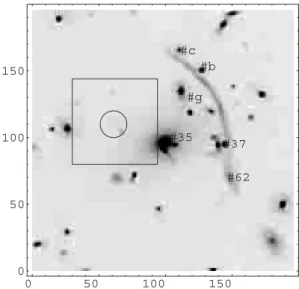
a giant arc extending over 60 arcsec wide discovered by Soucail et al. (1987a) and Lynds & Petrosian (1986). This arc has been identified as an extremely distorted image of a back-ground galaxy at z = 0.724 (Soucail et al. 1988), thus bring-ing the evidence of a cosmological gravitational lensbring-ing ef-fect. The arc is split into five distinct regions #b, #c, #g, #37 and #62 (see Fig. 6. in the present paper) and shows an intensity breaking between the galaxies #37 and #62. The galaxies #37 (z#37 = 0.37), #b (z#b = 0.363) and #c (z#c= 0.373) are
super-imposed to the arc. On the contrary, the object #62 belongs to it. The detection of a weak radial arclet in a HST/WFPC1 image (noted R) has been reported in Smail et al. (1996). Its existence was confirmed in B´ezecourt et al. (1999) who argued its red-shift should be about 1.3. The detection of arclets, as well as the
1 We use thereafter the notations of Soucail et al. (1987b) and Mellier et al. (1998) to refer to the details in our images.
determination of sub-structures in the giant arc, are important to constrain the mass profile of Abell 370 as well as to scale its absolute mass.
2.1. CFHT observations of A370
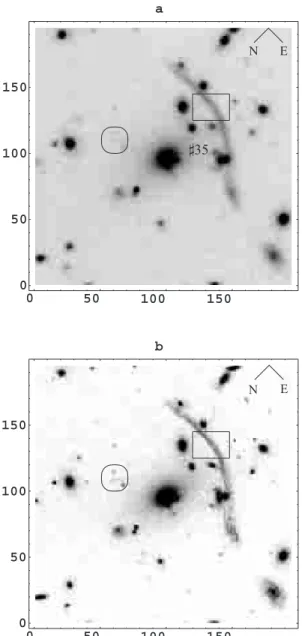
The A370 image was obtained at the 3.60 m telescope of the CFHT (Canada France Hawa¨ı Telescope) observatory in November 1991 (see Kneib et al. 1993 for details). The FOCAM (Faint Object CAMera) imager installed on the prime focus of the telescope uses the filter #1808 centered on 832 nm with a width of 196 nm. This image is integrated over 1800 s and corrected with standard CCD frame packages. The field extends over about 6 × 6 arcmin (0), with a sampling of 0.206 arcsec per pixel. The objects of specific interest corre-spond to the strong lensing effects observed close to the central galaxy (#35 in Fig. 1a). Thus we extract a sub-image extend-ing over 0.60× 0.60approximately centered on this galaxy (im-age 196× 196 pixels).
2.2. HST observations of A370
We also have an A370 image with 622 s of integration time obtained with the HST in a wavelength domain close to the CFHT observations (F675W filter centered on λ = 673.5 nm and width of 88.9 nm). The WFPC2 (Wide Field Planetary Camera 2) gives a wide field about 150× 150 arcsec (00). We have extracted a region of about 34× 3400(0.100/pixel) contain-ing the region of the giant arc. The high spatial resolution of the HST allows to observe details invisible in the CFHT image as sharp breakings in the giant arc and the presence of the radial arc R. We make the assumption that the HST image can be used as a reference for comparison with the restored image, i.e. we neglect any alteration induced from the HST instrument. We cannot exclude differences between the two original astronom-ical fields, because they are seen through different filters, but these differences are probably negligible for the study under-gone here. This assumption is also supported by a mere visual inspection of the two images.
2.3. Comparison between HST and CFHT observations
The direct comparison between CFHT and HST images re-quires a linear transformation of the HST image since both ori-entation and spatial sampling are different. Let (x0, y0) and (x, y) be the spatial coordinates of a star photocenter in the HST and CFHT images respectively. The linear transformation be-tween (x0, y0) and (x, y) may be written as:
(
x0= a.x + b.y + c
y0= d.x + e.y + f (1)
where a, b, c, d, e and f are unknown scalars. We then com-pute the linear transformation of the HST image with a bilin-ear interpolation. Solving the system (1) for a set of stars both identified in the CFHT and the HST 196× 196 sub-images, al-lows an accurate determination of the scalars a, b, c, d, e and f .
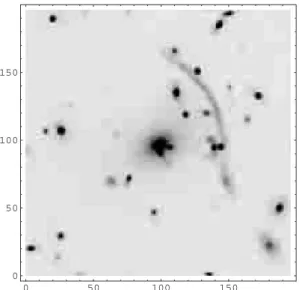
Fig. 1. a) Extraction of a sub-image (196× 196 pixels) of Abell 370
observed with the CFHT. The circle represents the region where the ra-dial arc R must be located. The rectangular box (20× 28 pixels) repre-sents the mask used for the comparison of the two images in the case of the arc reconstruction. b) Extraction of a sub-image (196×196 pixels) of Abell 370 image obtained by applying the linear transformation (1) on the HST image. The circle identifies the radial arc R.
The comparison between the CFHT image and the transformed HST one is presented in Fig. 1.
The transformation (1) may be interpreted as a combination of a 110◦rotation followed by a 2.07 pixels dilatation from the center of the galaxy #35 and a translation.
3. The Point Spread Function (PSF)
Ground-based observations suffer degradations due to the transmission of light by the atmosphere and the optics. The images obtained are then blurred by the system atmosphere-instrumentation. The field of the CFHT image extends over a few arcminutes and corresponds to a long exposure time. In these conditions we can make the assumption that the
degradation due to the atmosphere is space invariant in the im-age plane. Such an assumption is also safe for the instrumental distortions. The relation between the noiseless image ˜y(r) and the object x(α) is then a convolution one:
˜y(r)= Z +∞
−∞
h(r− α)x(α)dα = h(r) x(r) (2) where r is the spatial coordinates at the telescope focus and h the kernel of the integral Eq. (2) is the PSF of the system atmosphere-telescope.
The discretization of Eq. (2) leads to the matrix relation:
˜y= Hx (3)
where ˜y is a vector corresponding to the noiseless image, x a vector corresponding to the object and H a matrix representing the convolution effects of the PSF. In real cases, the observa-tions y are a noise corrupted version of ˜y. In all what follows, we assume a Poisson noise process.
The restoration technique we propose in this paper are then based on the deconvolution of the noisy image y by an es-timated PSF in order to reconstruct the object x in the best conditions.
The first step consists in estimating the PSF from the stars (unresolved objects) in the full CFHT image.
3.1. Stars selection
We first identify the stars by using SExtractor (Bertin & Arnouts 1996). This software extracts the ob-jects in the field and gives characteristic parameters such as the centro¨ıd position, the Full Width at Half Maximum (FWHM) in the light distribution and the magnitude of the object. An object is defined as a number of connected pixels (fixed by the user) above a given threshold (1.5 σ in our study, where σ corresponds to the standard deviation of the image background assuming a Gaussian distribution). The star identification is then achieved by representing on a diagram the magnitude of each object versus the FWHM. The stars gather in a region with a FWHM approximatively constant (between 0.600 and 0.6800) independently of the magnitude. A refined selection is carried out by only preserving the stars whose magnitude is greater than a lower bound to avoid saturated stars images and smaller than a higher one to avoid galaxy contamination. Each star image is extracted over a 32 × 32 pixels frame. After dropping images exhibiting neighbors we are left with a sample of 23 individual stars images.
3.2. Estimation of the PSF
The second step consists in adding the 23 stars to synthesize the PSF. The summation of these objects imposes the perfect superposition of the photo-center of each star up to a frac-tion of pixel. This could not be done directly as the light centro¨ıd is not located on an full pixel. We have to estimate the vector shift between each star fi(x, y) where (x, y) are the spatial coordinates and a reference one f∗(x, y) chosen arbitrar-ily. This is achieved by determining the argument of the inter-spectrum between each couple of images. We first compute
390 M. Roche et al.: Reduction of ringing effects by an improved deconvolution algorithm
Fig. 2. Normalized PSF of the A370 image. a) Contours Plot. The
contours represent successively 100, 80, 60, 40, 20, 10, 5, 3.5, 2.5, 1.5, 0.8, 0.5, 0.2, 0.1% of the image maximum. b) 3D representation.
the Fourier Transform (FT) for each star image noted bfi(u, v) and bf∗(u, v) for the reference, where (u, v) are the spatial fre-quencies. Let us denote ξi,1 and ξi,2 the unknown shifts be-tween fi(x, y) and f∗(x, y) along the x and y axes respectively. The argument ϕi(u, v) of the inter-spectrum between bfi(u, v) and bf∗(u, v) is:
ϕi(u, v)= −2π(uξi,1+ vξi,2). (4)
We fit ϕi(u, v) by a plane in the low frequencies range (where the Signal to Noise Ratio (SNR) is better) to obtain ξi,1and ξi,2. This leads to an accurate determination of the shift vector in the direct space. Each star is then translated in this latter space to the position of the reference by using a bilinear interpolation. Since the background, noted back, changes slightly in the field, we substract its mean specific value in each star image. We finally compute a SNR for each image, defined as:
S NR= (Max∗)
2
Max∗+ back (5)
where (Max∗) represents the maximum intensity of the star. The images are then weighted by their SNR and summed up. The result is normalized to yield the PSF in the field. This PSF shows a rather axial symmetry with a slight anisotropy (Fig. 2). The PSF is then put into a 196×196 frame as the deconvolution process requires. We denote by H the matrix corresponding to the effects of the PSF.
Fig. 3. Relative error curve Rkbetween the CFHT reconstructed image and the HST one as a function of the iteration number for RL. The images used are those of the Fig. 1, the PSF is the one of Fig. 2 and the mask used correspond to the rectangular box (20× 28 pixels).
4. Deconvolution of the A370 CFHT image
4.1. Limitation of the standard Richardson-Lucy algorithm: Ringing effects
We first deconvolve the A370 image with the classical Richardson-Lucy algorithm (Lucy 1974; Richardson 1972) and the PSF previously estimated:
x(k+1) = x(k).HT y
H x(k) (6)
where x(k)represents the reconstructed object at the iteration k,
y is the observation, H is the PSF matrix and HTits transposed.
To stop the iterations of the algorithm we define an error criterion between the image reconstructed at iteration k (de-noted x(k)) and a reference image. In this section we use the
HST image (denoted xHST) as the reference. We then
mini-mize a criterion Rk based upon a relative Euclidean distance between x(k)and xHST:
Rk=k x
HST− x(k)k
k xHSTk (7)
wherek . k represents the Euclidean distance.
The objects in the field are rather different (giant arc, galaxies, stars...) and would not require exactly the same it-eration number to be reconstructed at the best. The crite-rion Rk must then be computed preferably over the area to be preferentially restored. We focus here on the region of the giant gravitational arc and thus minimize Rk (see Fig. 3) within the rectangular box indicated in Fig. 1. The best recon-structed image obtained at iteration k = 50 is represented in Fig. 4. Its background shows a granular structure typically of the size of the PSF. An early ringing effect (Cao et al. 1999; Lucy 1994a; Lagendijk & Biemond 1991) appears around the brightest point-like objects. It is both caused by the important background in the CFHT image and the discontinuities in the FT due to bright point-like objects (White 1993). These phe-nomena prevent any accurate measurement on the restored im-age and render necessary the use of a modified version of the algorithm to remove the oscillations. It is achieved by taking into account the background in the image and by introducing it as a lower bound constraint in the deconvolution algorithm itself. Hence, the reconstruction is not allowed to take values less than the background.
Fig. 4. Abell 370 reconstructed image by RL at the 50th iteration. The
image used is the one of Fig. 1a, the PSF is the one of Fig. 2 and the mask used correspond to the rectangular box (20× 28 pixels).
4.2. Amelioration: Lower Bound Constraint Algorithm (LBCA)
The LBCA is developed from a method proposed in Lant´eri et al. (2001) and studied in detail in Roche (2001) and Lant´eri et al. (2002). The method is based on the minimization of a convex function under lower bound constraint (denoted m). It consists in writing that at the optimum, the Kuhn-Tucker con-ditions (Kuhn & Tucker 1951) are fulfilled. We then write the algorithm under a modified gradient form using the successive substitution method (Hildebrand 1974). After simple algebra, this leads in the non-relaxed case to the following multiplica-tive expression of the LBCA:
x(ki+1) = mi+ (x(k)i − mi) " HT y (H x(k)) # i (8) where i is the current pixel in the image. A similar al-gorithm has been proposed by Snyder et al. (1993) and by Nunez & Llacer (1993) with, however, a slightly different for-mulation. A comparison between the two approaches is given in the Appendix. Note that when m= 0 whatever the iteration, the RL algorithm is recovered.
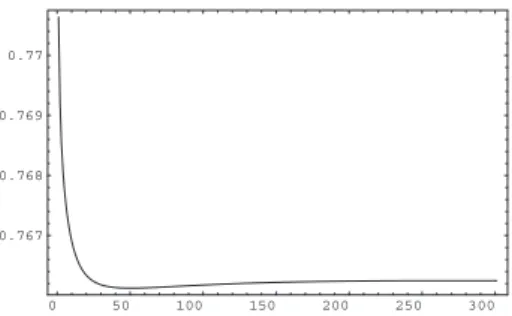
The lower bound m can be constant or variable over the im-age. The algorithm implementation is just as simple in both cases. The difficulty consists in obtaining an accurate back-ground map specially in the region of bright structures. This estimation is out of the scope of this paper. We have then cho-sen to take for m a constant value overall the image estimated as the mean background in the global normalized CFHT image. We still stop the LBCA by minimizing the Rkcriterion (7). We evaluate Rk within the rectangular box of Fig. 1 as in the previous section. The corresponding Rkcurve is represented in Fig. 5. The best restoration for this region of the giant arc is obtained for the iteration 269 (Fig. 6). We see from Fig. 5 that a range of about 50 iterations around this value would yield reconstructions of similar quality.
The reconstructed image with the LBCA shows an impor-tant reduction of both granularity and ringing effects.
Fig. 5. Relative error curve Rkbetween the CFHT reconstructed image and the HST one as a function of the iteration number for LBCA. The images used are those of the Fig. 1, the PSF is the one of Fig. 2 and the mask used correspond to the rectangular box (20× 28 pixels).
Fig. 6. Best reconstructed image with LBCA using the HST reference
image at the iteration 269.
We use a criterion derived from Rkto measure the amelio-ration brought by the deconvolution. We compute a quantity D defined by:
D= 100 ×Ry− Ropt
Ry (9)
where Ryand Roptare defined as:
Ry=k x
HST− y k
k xHSTk , Ropt=
k xHST− x(kopt) k
k xHSTk (10)
Ry and Ropt measure the relative Euclidean distances between
the HST reference xHSTand the CFHT image before deconvo-lution y, and between xHSTand the optimal restoration x(kopt).
D gives the averaged amelioration in percent with respect to the Euclidean measure. It raises up to 53% for the gi-ant arc. We have also carried the minimization of Rk for the full 196× 196 image and obtained a 47% amelioration with respect to the D criterion. This means that the image obtained after deconvolution with the LBCA is closer to the HST image by roughly a factor 2 than the image before deconvolution. No significant amelioration is brought by the RL algorithm with this criterion.
This study shows a great amelioration carried out by the simple introduction of the lower bound constraint.
392 M. Roche et al.: Reduction of ringing effects by an improved deconvolution algorithm
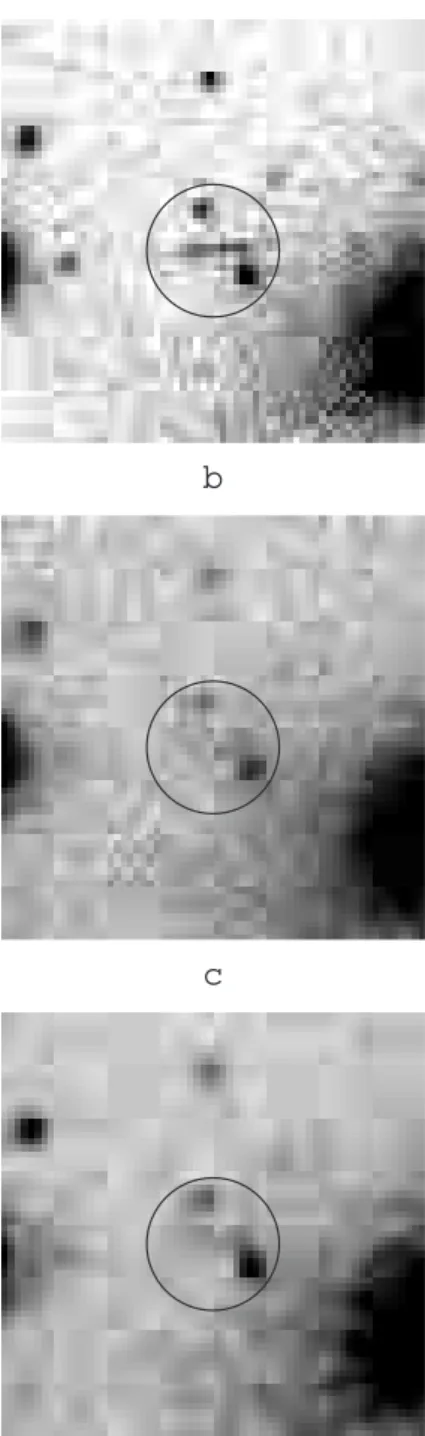
Fig. 7. Zoom on the radial arc R. HST image a), raw CFHT
im-age b) and deconvolved CFHT imim-age c).
The deconvolution allows in particular to restore severals structures in the giant arc (#b, #c, #g, #37, #62), and the break-ing between #37 and #62. Moreover, the reconstructed image evidences a radial gravitational arc (circle in Figs. 6 and 7c). This arc is clearly visible in the HST image (Fig. 7a) but does not appear in the raw CFHT data (Fig. 7b).
Ringing residuals, while attenuated, are still present around high intensity objects. These drawbacks are due to an incorrect estimation of the background in these regions. The reconstruc-tion can be improved by estimating a variable background.
We emphasize that the LBCA process takes the same com-putation time as the RL algorithm.
5. Wiener filtering for stopping iterations
We have used in the previous section a HST image to stop the iterations of the deconvolution. Usually, such a reference image is not available. Further, the objective is precisely to restore information from the sole ground-based observations without any external help. So it is necessary to develop a self-consistent method relying on the ground-based data only.
The technique we used is the one proposed by Lant´eri et al. (1999). It makes use of a comparison of the mod-ulus of the Fourier transform of the deconvolved image at the iteration k with the modulus of the Fourier transform given by a Wiener filtering. For clarity, let us briefly recall some well-known results on Wiener filtering. The Wiener filter W(u, v) is a zero-phase filter that prevents the amplification of the noise if a raw inverse filter technique is used. Denoting r the angu-lar coordinates and u and v the 2D spatial frequencies,by(u, v) and bh(u, v) the FT of the observation y(r) and the PSF h(r), the inverse Wiener filtered image transformbxw(u, v) may be written
as (Brault & White 1971): bxw(u, v)=by(u, v)
bh(u, v)W(u, v) (11)
where W(u, v) is defined as: W(u, v)= PH x(u, v)
PH x(u, v)+ Pn(u, v)· (12)
The quantities PH x(u, v) and Pn(u, v) are the power spectra of the noiseless image and of the noise itself respectively. Estimating these quantities is the main difficulty in the imple-mentation of a Wiener filter. Only approximated expressions can be worked out. Assuming that the signal and noise are sta-tistically independent, Pn(u, v) can be taken as a constant. Its value may be estimated in the very high frequencies ofby(u, v), where no astronomical signal is expected. Estimating PH x(u, v) is more difficult since it implies an a priori knowledge of the object FT. In the present work, we have assumed that PH x(u, v) could be approximated by Ph(u, v), the power spectrum of the telescope-atmosphere PSF. This tends to overestimate W(u, v). So, after this procedure, Eqs. (11) and (12) permit to have an es-timate ofbxw(u, v). Following the work of Lant´eri et al. (1999),
we use only its modulus Abs[bxw(u, v)] to define a stopping
cri-terion for the LBC algorithm. At each iteration k, we compute the euclidean distance Ew(k) of the form:
Ew(k)=k Abs[bx
(k)(u, v)]− Abs[bx
w(u, v)]k
k Abs[bxw(u, v)]k · (13)
The raw application of this criterion fails to give a satisfactory iteration stop. A much better solution was found in using only in this comparison a range of intermediate frequencies. Indeed it was found necessary to suppress the very low frequencies that have a too important weight in the calculus. The compar-ison must also exclude the highest spatial frequencies that are suppressed by the Wiener filter used. The overall effect is to apply an annular mask in the frequencies plane.
Both Abs[bx(k)(u, v)] and Abs[bx
w(u, v)] are normalized inside
this mask for comparison. The distance Ew(k) is represented as a function of the iteration number k in Fig. 8. The best
Fig. 8. Relative error curve Ew(k) between the modulus of the FT of the reconstructed image at iteration k (Abs[bx(k)(u, v)]) and the FT of the Wiener reconstructed image (Abs[bxw(u, v)]).
Fig. 9. Best reconstructed image with LBCA using a criterion based
on the Wiener filter at the 129th iteration.
reconstruction is obtained for the iteration k = 129 (Fig. 9). The amelioration brought by the deconvolution estimated from the D criterion (9) reaches 48%. It is close to the 53% amelio-ration obtained in Sect. 4.2 using the HST reference. It shows that independently of a reference HST image, a rather satis-fying approximate solution may be found by using a stopping criterion based on the data themselves. This procedure can be fully and easily automated.
6. Conclusion
We have used a modified version of the RL algorithm, called LBCA, to deconvolve a CFHT image of Abell 370. The LBCA introduces a lower-bound constraint which prevents the reconstructed image to take values below this bound. It allows to reduce considerably the ringing effect that appears around bright objects when classical algorithm are used (in particu-lar RL). In the present paper, the lower bound is taken equal to an estimation of the mean sky background over the whole CFHT 196× 196 image.
We have used at first an HST image of A370 as a refer-ence to stop the iteration of the algorithm and to evaluate the amelioration brought by the deconvolution. An Euclidean dis-tance criterion is then minimized between the reconstructed im-age at a given iteration and the HST reference to yield the best
reconstruction. The LBCA reconstruction of A370 is twice as close to the HST image than the raw CFHT data, while no ame-lioration is brought by using the RL algorithm. Remarkably, our iterative process has permitted us to detect blindly the ra-dial arc seen earlier in a HST image of A370 and to recover its morphological properties. This is an encouraging demonstra-tion of its efficiency, and an interesting example of a practical application. It also emphasizes the interest of the LBCA to re-store images with a high background.
In a more general case where no HST image is available, the convergence and stopping rules of the algorithm must rely on the information contained in the data themselves. We have thus developed a technique using the Wiener filter. It proceeds from an estimation of the noise in the CFHT image and the evaluation of the Power spectrum of the PSF. This method is based on the minimization of an Euclidean distance between the FT modulus of the LBCA reconstruction and the structed image by the inverse Wiener filter. The best recon-structed image is close to the former one obtained with the HST as a reference.
The present study gives two important results. First, it al-lows us to improve the quality of an image with a high back-ground, using a new algorithm as simple and as fast as the RL one: the LBCA. Finally, the overall data processing involv-ing the LBCA together with the Wiener filterinvolv-ing may be fully automated. Hence, it could be fruitfully used for the processing of huge numbers of ground-based observations and particularly in the perspective of current or forthcoming wide field surveys.
Appendix A
We show in this appendix the similarities between the algorithm used in the present paper and the algorithm previously proposed by Snyder et al. (1993) and by Nunez & Llacer (1993), to take into account the effect of the background.
In our algorithm written in the form (8): x(ki +1)= mi+ (x (k) i − mi) " HT y (H x(k)) # i (A.1) x is clearly the overall value of the solution, and we must have:
xi≥ mi∀i. (A.2)
Therefore, x includes the background (the background m is in the object space). The model used is ˜y = Hx and the actual data y is Poisson with mean H x. Now, introducing u = x − m in this algorithm, we obtain immediately:
u(ki+1)= u(k)i " HT y (H(u(k)+ m) # i · (A.3)
This the form previously proposed by Snyder et al. (1993) and by Nunez & Llacer (1993). Here the model used is ˜y= H(u + m), u is the part of the signal over the background m, and ui ≥ 0∀i. The background is again in the object space and the actual data y is Poisson with mean H(u+ m).
Except for these small conceptual differences, both algo-rithms are similar and lead to the same results, however another
394 M. Roche et al.: Reduction of ringing effects by an improved deconvolution algorithm important point must be underlined. Because of the
convolu-tion, the mean H(u+ m) can also be written Hu + m (so the background m appears in the data space). However it does not mean that we can subtract the background m from the data y to obtain modified data y0= y − m; indeed if y is Poisson with mean Hu+m , then y0is not Poisson of mean Hu (y0might also be negative). Then, whatever the form of the algorithm, the es-timated background is used in the algorithm (Hanisch 1993), but the data y must be left unchanged.
References
Bertin, E., & Arnouts, S. 1996, A&AS, 317, 661
B´ezecourt, J., Kneib, J. P., Soucail, G., & Ebbels, T. M. D. 1999, A&AS, 347, 21
Boulade, O., Charlot, X., Abbon, P., et al. 2000, SPIE, 4008, 657 Brault, J. W., & White, O. R. 1971, A&A, 13, 169
Cao, Y., Eggermont, P. P. B., & Terebey, S. 1999, IEEE. Trans. Image Processing, 8(2), 286
Hanisch, B. 1993, Newsletter of STScI’s Image Restoration Project, 1, 70
Hildebrand, F. B. 1974, Introduction to numerical analysis (New York: Mac Graw Hill)
Kuhn, W. W., & Tucker, A. W. 1951, Proc. 2nd Berkeley Symp. on Mathematical Statistics and Probabilities (Berkeley: University of California Press), 481
Kneib, J.-P., Mellier, Y., Fort, B., & Mathez, G. 1993, A&A, 273, 367 Lagendijk, R. L., & Biemond, J. 1991, Iterative identification and restoration of images (Boston, Dordrecht, London: Kluwer Academic, Publishers)
Lant´eri, H., Roche, M., Gaucherel, P., & Aime, C. 2002, Signal Processing, 82, 1481
Lant´eri, H., Roche, M., Cuevas, O., & Aime, C. 2001, Signal Processing, 81(5), 945
Lant´eri, H., Soummer, R., & Aime, C. 1999, A&AS, 140, 235 Lucy, L. B. 1974, AJ, 79, 745.
Lucy, L. B. 1994, The restoration of HST images and spectra II. Space Telescope Institute, ed. R. J. Hanisch, & R. L. White, 79 Lynds, R., & Petrosian, V. 1986, BAAS, 18, 1014
Mellier, Y., Soucail, G., Fort, B., & Mathez, G. 1998, A&A, 199, 13 Nunez, J., & Llacer, J. 1993, PASP, 105, 1192
Roche, M. 2001, Ph.D. Thesis, University of Nice Sophia Antipolis Richardson, W. H. 1972, J. Opt. Soc. Am., 62(1), 55
Sarazin, C. L., Rood, H. J., & Struble, M. F. 1982, A&A, 108, L7 Sekko, E., Thomas, G., & Boukrouche, A. 1999, Signal Processing,
72, 23
Smail, I., Dressler, A., Kneib, J. P., et al. 1996, ApJ, 469, 508 Snyder, D. L., Hammoud, A. W., & White, R. L. 1993, JOSA A, 10,
1014
Soucail, G., Fort, B., Mellier, Y., & Picat, J. P. 1987a, A&A, 172, L14 Soucail, G., Mellier, Y., Fort, B., Hammer, F., & Mathez, G. 1987b,
A&A, 184, L7
Soucail, G., Mellier, Y., Fort, B., Mathez, G., & Cailloux, M. 1988, A&A, 191, L19
Valentijn, E. A., Deul, E., & Kuijken, K. 2001, in The New Era of Wide Field Astronomy, ed. R. Clowes, A. Adamson, & G. Bromage, ASP Conf. Ser., 232
White, R. L. 1993, Newsletter of STScI’s image restoration project, Summer, 1, 11
Wiener, N. 1949, Extrapolation, interpolation and smoothing of sta-tionary time series with engineering applications (Cambridge (Mass.): The MIT Press; New York: Wiley and sons; London: Chapman & Hall)