HAL Id: hal-00302116
https://hal.archives-ouvertes.fr/hal-00302116
Submitted on 19 Sep 2006HAL is a multi-disciplinary open access
archive for the deposit and dissemination of sci-entific research documents, whether they are pub-lished or not. The documents may come from teaching and research institutions in France or abroad, or from public or private research centers.
L’archive ouverte pluridisciplinaire HAL, est destinée au dépôt et à la diffusion de documents scientifiques de niveau recherche, publiés ou non, émanant des établissements d’enseignement et de recherche français ou étrangers, des laboratoires publics ou privés.
Source and origin of atmospheric trace elements
entrapped in winter snow of the Italian Eastern Alps
P. Gabrielli, G. Cozzi, S. Torcini, P. Cescon, C. Barbante
To cite this version:
P. Gabrielli, G. Cozzi, S. Torcini, P. Cescon, C. Barbante. Source and origin of atmospheric trace elements entrapped in winter snow of the Italian Eastern Alps. Atmospheric Chemistry and Physics Discussions, European Geosciences Union, 2006, 6 (5), pp.8781-8815. �hal-00302116�
ACPD
6, 8781–8815, 2006 Atmospheric trace elements in Alpine snow P. Gabrielli et al. Title Page Abstract Introduction Conclusions References Tables Figures J I J I Back Close Full Screen / EscPrinter-friendly Version Interactive Discussion
EGU
Atmos. Chem. Phys. Discuss., 6, 8781–8815, 2006 www.atmos-chem-phys-discuss.net/6/8781/2006/ © Author(s) 2006. This work is licensed
under a Creative Commons License.
Atmospheric Chemistry and Physics Discussions
Source and origin of atmospheric trace
elements entrapped in winter snow of the
Italian Eastern Alps
P. Gabrielli1, G. Cozzi2, S. Torcini3, P. Cescon1,2, and C. Barbante1,2
1
Institute for the Dynamics of Environmental Processes-CNR, 30123 Venice, Italy
2
Department of Environmental Sciences, University of Venice, Ca’ Foscari, 30123 Venice, Italy
3
ENEA, Casaccia, Roma, Via Anguillarese, 301 00060 S.Maria di Galeria, Roma, Italy Received: 14 June 2006 – Accepted: 13 July 2006 – Published: 19 September 2006 Correspondence to: C. Barbante ([email protected])
ACPD
6, 8781–8815, 2006 Atmospheric trace elements in Alpine snow P. Gabrielli et al. Title Page Abstract Introduction Conclusions References Tables Figures J I J I Back Close Full Screen / EscPrinter-friendly Version Interactive Discussion
EGU
Abstract
Trace elements concentrations were determined in shallow snow samples from 21 sites in the Italian Eastern Alps in order to identify the sources of the contaminants present in the tropospheric winter boundary layer. The collection of superficial snow layers was carried out weekly at altitudes between 1000 and 3000 m next to meteorological 5
stations, far away from villages, roads and ski slopes. Ultra clean procedures were adopted in order to avoid contamination of the snow during the different experimental phases. Trace elements (Ag, Ba, Bi, Cd, Co, Cr, Cu, Fe, Mo, Mn, Pb, Sb, Ti, U, V and Zn) were determined by Inductively Coupled Plasma Sector Field Mass Spectrometer (ICP-SFMS). Ancillary parameters such as major ions (SO2−4 , NO−3, Ca2+, Mg2+, K+, 10
Na+, Cl−) were measured by Ion Chromatography (IC) and were useful in identifying the trace elements sources. The structure of the data was studied by using Principal Component Analysis (PCA) applied on the ranked data set matrix in order to minimize the weight of the outliers. Although concentrations were low at high altitudes in the heart of the Alps, and higher at lower altitudes (Pre-Alps), the structure of the chemical 15
content deposited by wet/dry mechanisms, resulted as rather uniform over the territory studied during the time considered. PCA shows that the chemical content of the snow is characterised by an anthropogenic component (V, Sb, Zn, Cd, Mo, Pb, Ag, Bi, SO2−4 , NO−3), mainly originating from the traffic in the adjacent Alpine valleys and the nearby heavily industrialised area of the Po Valley, a crustal component (Ca2+, Mg2+, Mn, U, Ti, 20
Fe, Cr, Co, Cu and Ba) mainly from the geological carbonate background (Dolomites) of the Eastern Alps, and a marine component (Na+, Cl−) from the Mediterranean Sea. It is likely that transport and mixing of trace elements in the winter boundary layer occurred at a local (∼10 km) and regional (∼100 km) scale, and was due not only to the weak convection within the winter boundary layer but also to orographically induced 25
winds and turbulences arising in the Alpine valleys due to the action of the synoptic wind.
ACPD
6, 8781–8815, 2006 Atmospheric trace elements in Alpine snow P. Gabrielli et al. Title Page Abstract Introduction Conclusions References Tables Figures J I J I Back Close Full Screen / EscPrinter-friendly Version Interactive Discussion
EGU
1 Introduction
Snow deposited on the Alps has the potential to provide valuable information on the atmospheric concentrations of short-living species, such as aerosol particles, and to document the effects of anthropogenic emissions on air in Europe (Schwikowski, 2003). In fact, since snow crystals form in the clouds, they entrap aerosol particles called ice 5
nuclei (Fuzzi, 1994). In addition, atmospheric water drops, containing condensation nuclei, can freeze on the surface of a snowflake (riming process) and, during their pre-cipitation, can scavenge other particles below the clouds (aerosol scavenging) (David-son, 1989). These mechanisms are widely known as wet deposition processes. Alter-natively, aerosol particles are transported by wind turbulences and directly deposited 10
onto the snow at the soil level (dry deposition process) (Cadle, 1991). This is the rea-son why the snow is characteristically marked by the chemical content both of the cloud generating air masses and by the aerosol particles contained in the troposphere dur-ing and after a precipitation event. In this context, snow concentrations reflect better the atmospheric concentration in the case of wet deposition, whereas fluxes are bet-15
ter suited to describing atmospheric concentrations in the case of predominantly dry deposition (Alley et al., 1995).
Since the last decade the interest in the snow and ice contaminants has extended from studies conducted in the extremely remote polar site of Antarctica (Wolff Suttie, 1994; Gabrielli et al., 2005; Gaspari et al., 2006), Greenland (Hong et al., 1996; Bar-20
bante et al., 2003; Gabrielli et al., 2004) and the Arctic (Gauchard et al., 2004; Krachler et al., 2005; Shotyk et al., 2005) to cover the high altitude zones of different mountain-ous areas in the world such as remote sites in the Andes (Ferrari et al., 2001; Correia et al., 2003; Hong et al., 2004) and also those next to heavily populated areas such as the European Alps (Van de Velde et al., 1998, 1999, 2000; Barbante et al., 2001a, 2002, 25
2004; Veysseyre et al., 2001). Although many studies, aiming at understanding the evolution of atmospheric contaminants in Europe during the past few centuries have been conducted on Alpine ice archives, studies regarding the present trace elements
ACPD
6, 8781–8815, 2006 Atmospheric trace elements in Alpine snow P. Gabrielli et al. Title Page Abstract Introduction Conclusions References Tables Figures J I J I Back Close Full Screen / EscPrinter-friendly Version Interactive Discussion
EGU
content of the Alpine snow are rare (Veysseyre et al., 2001). These kind of stud-ies are extremely valuable because some contaminants can provide not only a better understanding of important global biogeochemical cycles but also because some are potentially very toxic to humans and to other organisms even at low concentrations.
Polar studies provide information about the presence of natural contaminants and 5
pollutants in the global atmosphere (Barbante et al., 2001b; Planchon et al., 2002; Shotyk et al., 2005) and efforts on European Alpine Glaciers have been mainly de-voted to the reconstruction of the history of trace elements pollution over the last few centuries (Barbante et al., 2004; Schwikowski et al., 2004). However, this study aims at identifying these contaminants by focusing on a regional scale and offering a picture of 10
the recent situation in the delicate and complex environment of the Alps. This mountain chain is a valuable observation point since it is located in the centre of Europe, one of the most densely populated and industrialised regions in the world. In addition, Alps are themselves very heavily influenced by man, especially by the international and re-gional highways, industries, refuse incineration plants and also by the highest density 15
of winter sport infrastructures for a mountain area in the world.
Due to the typically lower mixing heights during the winter, pollutants remain en-trapped in the rather stable Alpine boundary layer, which extends its influence up to an altitude of 3000 m in the Eastern Alps (Kappeberger and Kerkmann, 1997) and does not allow an easy exchange between upper and lower levels. Thus we can expect the 20
winter snow collected at an intermediate altitude in the Eastern Alps (up to 3000 m) to be representative of the atmospheric chemical content of the lower Alpine troposphere and of the adjacent regions.
We collected shallow snow samples in the Italian Eastern Alps and we determined trace elements (Ag, Ba, Bi, Cd, Co, Cr, Cu, Fe, Mo, Mn, Pb, Sb, Ti, U, V and Zn) 25
and major ions (SO2−4 , NO−3, Ca2+, Mg2+, K+, Na+, Cl−) in order to study directly the chemical composition of the snow and indirectly the structure and the sources of the contaminants present in the low Alpine troposphere. To have more specific information on the atmospheric path taken by the contaminants to reach the Alpine snowfield,
ACPD
6, 8781–8815, 2006 Atmospheric trace elements in Alpine snow P. Gabrielli et al. Title Page Abstract Introduction Conclusions References Tables Figures J I J I Back Close Full Screen / EscPrinter-friendly Version Interactive Discussion
EGU
particular attention was paid to the relationship between the snow chemical content and the meteorological conditions.
2 Experimental
2.1 Sampling sites
Shallow snow samples were collected weekly from December 1997 to April 1998 in 21 5
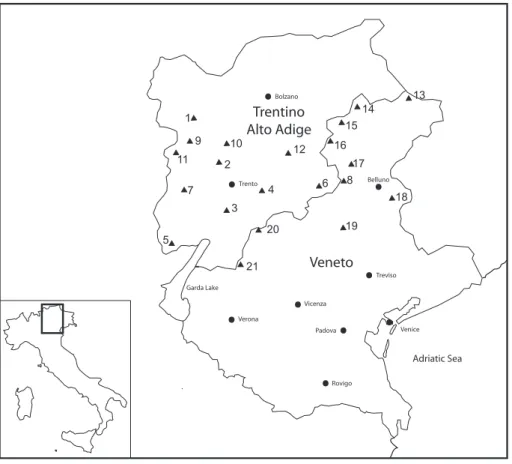
sampling sites located in the North-East of Italy (see Fig. 1 and Table 1). This area has a surface of ∼15 000 km2. The mean sampling site density was 1.4×100 km2, which constitutes a high level of detail for this kind of study. This mountain area is approxi-mately 100 km from the Gulf of Venice, and has a maximum elevation of 3905 m (Mount Ortles). It is located on the southern slope of the Italian Eastern Alps, which is crossed 10
by the important highway connecting Northern Europe with the south through the Bren-ner Pass in the Southern Tyrol. This territory is roughly divided into two main geological domains, the eastern part (the Dolomites) is characterised by carbonates (dolomite), whereas the western part (Mount Adamello and Mount Ortles groups) is mostly silicate (granites and metamorphic rocks). During winter this area is normally characterized by 15
an anti-cyclonic pressure field, whose influence is alternated with an Atlantic meteoro-logical regime that conveys humid air masses to the southern Alpine slopes, producing snowfall events that often run concurrently with strong southern winds (Latini, 1987).
The 21 sampling sites were chosen mainly in rural/remote areas in order to avoid contamination from nearby sources of emissions such as roads, villages, tourist sta-20
tions, Alpine huts and artificial snow guns. However, most of the sampling sites were close to ski areas at an average altitude of ∼1800 m. The lowest site was located at 1040 m (Noana valley) and the highest at 3040 m (Mount Presena).
Each sampling site was chosen by proximity to manual and/or automatic meteoro-logical stations, which recorded local meteorometeoro-logical parameters such as maximum, 25
ACPD
6, 8781–8815, 2006 Atmospheric trace elements in Alpine snow P. Gabrielli et al. Title Page Abstract Introduction Conclusions References Tables Figures J I J I Back Close Full Screen / EscPrinter-friendly Version Interactive Discussion
EGU
start/end time of snowfall/rain, depth of snow, quantity of rain and presence/absence of superficial rime. These data were ancillary to our data set and allowed us to have precise information, especially concerning precipitation and snow conditions. The ter-ritorial meteorological offices provided daily data, which were significant for the entire sampling area, such as the wind velocity/intensity, the wind flow in the free troposphere 5
(estimated from the on line station of Mount Pradazzo (Dolomites)), the vertical profile of temperature (at soil level, 1000, 2000, 3000 m) and the altitude of the 0◦C isotherm (from the radiosonde vertical profile in Udine).
2.2 Sampling and materials
Snow collection was carried out by adopting the stringent contamination free proce-10
dures used to sample the snow in Antarctica (Planchon et al., 2001). During the winter of 1998, shallow snow was collected weekly at all sites, obtaining a total amount of 366 samples. Operators wore special clean-room clothing and polyethylene gloves. Sampling was conducted by plunging low-density polyethylene (LDPE) ultra cleaned wide mouth bottles (500 ml) directly into the snow, downwind of the technicians. The 15
containers were then capped, sealed in double polyethylene bags and stored frozen until analysis (Barbante et al., 1997; Planchon et al., 2001).
LDPE sampling bottles were previously acid cleaned inside a class 100 clean bench installed inside a class 10 000 clean room. For the acid cleaning we adopted a 5-step procedure (Barbante et al., 1997) using ultra pure water, obtained by coupling 20
a reverse osmosis system (Milli-RO) with a four-column ion exchange system Milli-Q (Millipore, Bedford, MA), Merck “Suprapur” HNO3 (Merk, Darmstadt, Germany) and HNO3 (70%) doubly distilled at the National Institute of Standards and Technology (NIST, Gaithersburg, MD) were used for the acid cleaning stages. At the end of the cleaning steps the LDPE bottles were rinsed three times and filled with ultra pure water 25
ACPD
6, 8781–8815, 2006 Atmospheric trace elements in Alpine snow P. Gabrielli et al. Title Page Abstract Introduction Conclusions References Tables Figures J I J I Back Close Full Screen / EscPrinter-friendly Version Interactive Discussion
EGU
2.3 Analytical methods
Samples were treated and melted in LDPE sampling bottles in a class 100 laminar flow clean bench inside a clean laboratory (Boutron, 1990). A 5 ml aliquot was trans-ferred in a 10 ml ultra clean LDPE vial and acidified (2%) with ultra pure concentrated HNO3(NIST) for the quantification of Ag, Ba, Bi, Cd, Co, Cr, Cu, Fe, Mo, Mn, Pb, 5
Sb, Ti, U, V and Zn by Inductively Coupled Plasma Sector Field Mass Spectrometry (ICP-SFMS) (Finnigan MAT Element, Thermo, Bremen, Germany) according to the procedure described by Barbante and co-workers (Barbante et al., 1999). The rela-tive standard deviation ranged from 12% to 46% depending upon the metals and the concentration levels. Accuracy was verified by adopting the standard reference mate-10
rial SLRS-3 Riverine Water from the National Research Council of Canada. Working analytical conditions, blanks, accuracy and precision are described in detail elsewhere (Barbante et al., 1999).
30 ml aliquots were also taken in a 100 ml ultraclean LDPE bottle for the determi-nation of SO2−4 , NO−3, Ca2+, Mg2+, K+, Na+, Cl− by Ion Chromatography (IC), ac-15
cording to the procedure described in detail elsewhere (Gragnani et al., 1998), using a DIONEX AS5 column and NaOH (Baker) as eluant for anion determination and a DIONEX CS12 column with Methane sulphonic acid (MSA) as an eluant for the de-termination of cations. In addition a Cation Self Regenerating Suppressor (CSRS-DIONEX) and an Anion Self Regenerating Suppressor (ASRS-(CSRS-DIONEX) were applied 20
at the end of the columns. The relative standard deviation ranged from 0.5% to 9.2% depending upon the different species and ion concentration. Other analytical aspects are given in detail elsewhere (Gragnani et al., 1998).
ACPD
6, 8781–8815, 2006 Atmospheric trace elements in Alpine snow P. Gabrielli et al. Title Page Abstract Introduction Conclusions References Tables Figures J I J I Back Close Full Screen / EscPrinter-friendly Version Interactive Discussion
EGU
3 Results and discussion
3.1 Main characteristics of the data set
The main statistics of the chemical data set are given in Table 2. As expected, low average concentrations were found for trace elements, ranging from 8.6 ppt of U (1 ppt=1 pg g−1=10−12g g−1) up to 27 ppb of Fe (1 ppb=1 ng g−1=10−9g g−1), whereas 5
higher mean values were determined for the major ions ranging between ∼900 ppb of NO−3 and ∼100 ppb for Mg2+.
In some cases, concentrations of some major ions were found to be below the de-tection limit. This mainly occurred for K+, which was determined only in 153 of the 366 samples. Looking at the distributions, median values represent in average 47% of the 10
arithmetic mean; the mean skewness (positive asymmetry of the distribution) value is 7 and the mean kurtosis (indicating the distribution around a central value) is 70. The chemical data set is therefore characterised by log normal like distributions.
In general, mean trace elements concentrations found on the Eastern Alps are higher than those obtained by Veisseyre and co-workers (Veysseyre et al., 2001) in shallow 15
snow samples taken in the French western Alps (1150–3532 m) at comparable alti-tudes. This is essentially due to the fact that in the Veyssyre’s study, only fresh snow samples, representative of wet deposition, were considered. If we take the lowest Eastern Alps concentration values, which were determined in fresh snow samples as well, then concentrations found in the two studies are in good agreement. For example 20
Pb shows a minimum concentration of 23 ppt in a sample collected during the snow event recorded on 3 December 1997 at Mount Presena (3020 m) whereas minimum Pb concentration reported by Veisseyre and and co-workers was 65 ppt at 3080 m in the Vall ´ee Blanche (Mount Blanc, France). As previously observed (Veysseyre et al., 2001), trace elements concentrations in Alpine fresh snow collected at medium alti-25
tudes can be comparable to values determined in remote Greenland snow samples (Barbante et al., 2003). In the Eastern Alps, for instance, a minimum U concentration of 0.1 ppt was found on 3 December on Mount Presena whereas in Greenland, the
ACPD
6, 8781–8815, 2006 Atmospheric trace elements in Alpine snow P. Gabrielli et al. Title Page Abstract Introduction Conclusions References Tables Figures J I J I Back Close Full Screen / EscPrinter-friendly Version Interactive Discussion
EGU
minimum U concentration found in samples from a snow pit was 0.2 ppt (Barbante et al., 2003).
In general, the Eastern Alps trace elements data set is more directly comparable with concentrations determined in relatively recent (after 1970) summer firn and ice, such as those drilled at Colle Gnifetti (4450 m) (Mount Rosa, Swiss-Italian Western Alps), a 5
particular Alpine site where summer snow accumulation is dominant (Barbante et al., 2004). For instance, mean Zn and Cd concentration were found to be 3176 ppt and 58 ppt on Colle Gnifetti, whereas at the lower altitudes of the Eastern Alps sampling sites, mean winter values of ∼3450 ppt and ∼60 ppt were determined. This similarity is likely due to the fact that the trace elements content of summer snow taken on the high 10
altitude Alpine glaciers and trace elements deposited on and within the winter snow layers of the lower Eastern Alps snow fields, originate from areas characterized by the same categories of emissions.
A strong vertical air mixing occurs in fact in the Alpine region especially during sum-mer, that transports anthropogenic contaminants from cities, roads and industrialized 15
areas, such as the Po valley for instance, upwards to ∼4000 m of altitude. In con-trast during winter, the occurrence of a rather low altitude stable boundary layer, does not allow contaminants to reach the highest Alpine glaciers and confines them in this portion of troposphere. For example, winter firn/ice drilled above the winter boundary layer, such those drilled at Dome du Gouter (4304 m, Mont Blanc, French-Italian west-20
ern Alps), show much lower values (Van de Velde et al., 1998) than in summer. In this latter case, since winter snow concentrations are minimally influenced by regional emissions, they can represent a larger scale atmospheric trace element background. In contrast, summer Alpine snow at whatever altitude and Alpine winter snow within the winter boundary layer (this study) are more likely to be representative of a regional 25
ACPD
6, 8781–8815, 2006 Atmospheric trace elements in Alpine snow P. Gabrielli et al. Title Page Abstract Introduction Conclusions References Tables Figures J I J I Back Close Full Screen / EscPrinter-friendly Version Interactive Discussion
EGU
3.2 Temporal variability and fluxes
Snowfalls affected the entire territory from December until the first half of January and then again in April. In contrast, from the second half of January until the end of March, stable weather conditions were observed with a general lack of snowfall. Thus, wet de-position occurred mainly in the first and in the last part of the sampling period whereas 5
dry deposition dominated in-between. In general, for all trace elements and at all sam-pling sites, maximum concentrations were observed in periods characterized by dry deposition, whereas minimum concentrations coincided with wet deposition.
For instance, Ba concentrations determined in fresh and old (several weeks old) snow samples, taken in Malga Bissina (1780 m), varied by 2–3 orders of magnitude 10
from 0.05 up to 13 ppt (see Fig. 2). Fe varied in a similar way at Folgarida (1910 m) from 0.1 up to 79 ppb. In general, trace elements temporal profiles were found to be redundant and concentrations varied by about 2–3 orders of magnitude depending only on whether snow samples were collected during or just after wet deposition events, or after a period of dry deposition. The Ba profile reported in Fig. 2 is quite representative 15
of the relative temporal variation of most of the trace elements in the whole territory considered. The only clear exception is Cd, which generally varied by less than one order of magnitude during the sampling period as can be shown, for instance, from snow samples collected on the Mounts of Ornella (2250 m) where Cd concentration values varied only from 0.02 ppb up to 0.07 ppb during the field season.
20
The long dry deposition period during February and March, which was broken only by two minor snow events on 23 February and on 23 March, offers the possibility of estimating the dry fluxes of trace elements and species to the Eastern Alps. For this investigation, concentration data from the four highest sampling sites were selected. This minimized the influence of local contamination and ruled out the possibility of 25
percolation of molten snow that would have modified the original analyte concentra-tions (Davis, 1991). Data from Mount Presena (3040 m), Ravales (2615 m), Mounts of Ornella (2250 m) and Mount Pradazzo (2200 m) were thus selected specifically
dur-ACPD
6, 8781–8815, 2006 Atmospheric trace elements in Alpine snow P. Gabrielli et al. Title Page Abstract Introduction Conclusions References Tables Figures J I J I Back Close Full Screen / EscPrinter-friendly Version Interactive Discussion
EGU
ing two time periods when the maximum temperature was continuously below 0◦C (19 January–4 February ; 24 February–11 March. The flux (F) was obtained as:
F = {(∆C/∆t)m} × ρ × h (1)
where (∆ C/∆t)m is the mean difference of concentration of samples collected in suc-cessive week, ρ is the mean snow density (∼300 kg m−3) and h the height of the snow 5
layer sampled (∼2 cm).
Fluxes obtained for each trace element and ions are reported in Table 3. It should be noted that the fluxes calculated over the two different periods show on average a deviation of only ∼24%, which can be considered for most of the trace elements and ions within the range experimental error. It is also interesting to compare the fluxes 10
found for trace elements and major ions with the critical loads that are available for these ecosystems in the literature (Posch et al., 2005). Critical loads of Pb and Cd for forests and soils are 10 and 1 g ha−1y−1whereas Pb and Cd fluxes to the Eastern Alps are estimated to be 4.2 and 0.09 g ha−1y−1, respectively. For S and N the critical loads in alpine and sub-alpine grassland are 39 and 42 kg ha−1y−1 whereas S and N fluxes 15
(estimated from the fallout of sulphate and nitrate only) are 0.44 and 0.63 kg ha−1y−1. It can be observed that trace elements and major ions fluxes are significantly below the critical loads, with the exception of Pb, indicating that it needs to be more carefully monitored in the future.
3.3 Spatial variability 20
The spatial variability of the average concentrations is illustrated in Table 4. This is very high, reflecting the heterogeneity of the sampling sites due to their different altitudes, geographic positions and distances from anthropogenic sources of emis-sion. In general the lowest concentrations are found in snow collected at more than 2000 m of altitude, whereas higher concentrations are determined in snow taken at 25
low-medium altitudes and especially in the Pre-Alps. For instance, mean V concentra-tions on Mount Pradazzo (2200 m) were 0.08 ppb, on Mount Vioz (2030 m) 0.09 ppb, on
ACPD
6, 8781–8815, 2006 Atmospheric trace elements in Alpine snow P. Gabrielli et al. Title Page Abstract Introduction Conclusions References Tables Figures J I J I Back Close Full Screen / EscPrinter-friendly Version Interactive Discussion
EGU
Mounts Ornella (2250 m) 0.1 ppb and on Presena Summit (3040 m) 0.1 ppb whereas at Viote (1500 m) it was 0.23 ppb, on Mount Grappa (1540 m) 0.4 ppb and in Faverghera (1605 m) 0.5 ppb.
Our results are in contrast with other studies performed by determining heavy metal concentrations in mosses sampled on the Alps. They observed in fact the highest 5
concentrations at mid altitudes (1400–1800 m) (Gerdol, Bragazza, 2006) or reported a remarkable increase in heavy metals concentrations with rising altitude (Zechmeister, 1995) (these two studies both occurred in late summer). The decrease of concen-trations values concomitant to the increasing altitude observed in our study can be explained by first considering that the higher Alpine sites are less influenced by the 10
anthropogenic emissions originating from the adjacent Alpine valleys (Veysseyre et al., 2001) and secondly that snow accumulation at higher altitudes is likely to be higher than at lower altitudes, causing a dilution effect. Very high concentrations on the Pre-Alps can be explained by taking into account the proximity of the Pre Alpine sites to the Po valley, the most extended industrialised area of Italy, that probably heavily contami-15
nates the closest sub Alpine areas.
High concentrations are observed sometimes also at rather elevated Alpine sites but in these few cases this observation is explained by the presence of local intense anthro-pogenic sources, which strongly influenced the chemical composition of the snow, es-pecially during the dry deposition periods. This is the case of the Tonale Pass (1860 m) 20
snow samples that were certainly influenced by the emissions from the intense traf-fic of the adjacent (∼1 km) tourist station. This is also the case for the snowfield of Ravales in the Dolomites. This station is at 2615 m of altitude and is exactly above the very important tourist station of Cortina d’Ampezzo (1200 m). In Ravales, average concentrations of 3.3 ppb of Zn, 3.8 ppb of Ti, 0.052 ppb of Sb and 0.30 ppb of Cu were 25
found. In comparison, at the heavily anthropized Tonale Pass, average concentrations of 7.4 ppb of Zn, 9.3 ppb of Ti, 0.56 ppb of Sb and 3.13 ppb of Cu were found, whereas at the remote site of Val Noana (1025 m) 0.6 ppb of Zn, 1.3 ppb of Ti, 0.027 ppb of Sb and 0.17 ppb of Cu were observed.
ACPD
6, 8781–8815, 2006 Atmospheric trace elements in Alpine snow P. Gabrielli et al. Title Page Abstract Introduction Conclusions References Tables Figures J I J I Back Close Full Screen / EscPrinter-friendly Version Interactive Discussion
EGU
3.4 Sources assessment of the contaminants 3.4.1 The statistical method
To evaluate the origin of the trace elements determined in the snow of the Eastern Alps, a principal component analysis (PCA) (Stanimirova et al., 2005) was carried out in order to reveal linear relations existing in the chemical data set.
5
The large range covered by the concentrations values (∼6 orders of magnitude), the lognormal like distributions of the chemical variables and the frequent occurrence of several outliers, highlighted the need to adopt a data set transformation before applying the PCA. This consisted of the substitution of the chemical concentration with its rank position (Baxter, 1995). This yielded several advantages: firstly, ranking avoids the data 10
set being constrained by the unity of measure that could produce a virtual variability, secondly a PCA based on ranks can be expected to be more robust to outliers (Baxter, 1995) and thirdly this transformation accentuates the essential variability of the data set, by ignoring the secondary variability (background noise) (Molinaroli et al., 1999).
Coherent with the ranking, is the substitution (before the rank transformation) of 15
missing data with the median, a robust parameter depending only on the rank position (Thomson, 1993). PCA was adopted by applying the varimax rotation. In order to represent at least one variable, the minimum acceptable variance (eigenvalue) of the principal components selected for the following discussion was 1. In addition, a variable was considered significant and representative for this statistical description when the 20
fraction of its explained variance (communality) obtained at least the value of 0.50. 3.4.2 Results of the PCA
PCA applied on the entire chemical data set put in evidence three principal compo-nents, summarising the information contained in 22 chemical variables on the 23 avail-able. K+ resulted in fact as not significant when compared to the above fixed criteria. 25
chem-ACPD
6, 8781–8815, 2006 Atmospheric trace elements in Alpine snow P. Gabrielli et al. Title Page Abstract Introduction Conclusions References Tables Figures J I J I Back Close Full Screen / EscPrinter-friendly Version Interactive Discussion
EGU
ical variables are reported in Tables 5 and 6 respectively. It is remarkable to mention that the application of PCA to sub groups of selected samples such as those coming from high/low altitude sampling sites, fresh/old snow samples, remote/rural sampling sites did not produce substantially different results from those reported below for the PCA applied to the entire data chemical set (Gabrielli, 1998).
5
Trace elements (Ag, Ba, Bi, Cd, Co, Cr, Cu, Fe, Mo, Mn, Pb, Sb, Ti, U, V and Zn) obtained high scores on the first principal component, Cl−, Na+, SO2−4 and NO−3 on the second, Mg2+ and Ca2+on the third. It should be noted that some trace elements such as Ti, U, Mn, Fe, Ba and to a lesser extent Cu, Co and Cr obtained rather high scores also on the third principal component governed by Mg2+ and Ca2+. On the 10
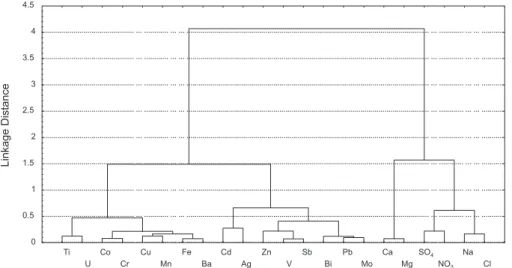
other hand, another group of metals, composed of V, Sb, Zn, Cd, Mo, Pb obtained sig-nificant scores also on the second principal component governed by SO2−4 , NO−3 Cl−, Na+. This is visually emphasized, by applying a cluster analysis on the principal com-ponent score matrix (Fig. 3), adopting the Euclidean distance and the Ward method for group aggregation (Swan Sandilands, 1995). Trace elements are into two sub-groups 15
composed of Ti, U, Mn, Fe, Ba, Cu, Co, Cr on one side and V, Sb, Zn, Cd, Mo, Pb, Ag and Bi on the other. In addition, the cluster analysis disaggregates distinctly also the second principal component in two sub-groups composed of SO2−4 and NO−3 on one side and Na+ and Cl−on the other.
3.4.3 Sources analysis 20
The crustal contribution
An explanation of the trace elements disaggregation into two distinct clusters can be obtained by comparing the trace elements concentrations in the snow with the average trace element concentration determined in the carbonates (Taylor McLennan, 25
1985), that constitute the geological background of the Dolomites. The Ca2+ contri-bution from remote crustal sources can be considered negligible since no significant
ACPD
6, 8781–8815, 2006 Atmospheric trace elements in Alpine snow P. Gabrielli et al. Title Page Abstract Introduction Conclusions References Tables Figures J I J I Back Close Full Screen / EscPrinter-friendly Version Interactive Discussion
EGU
transport of Saharan dust to the Alps occurred during the winter of 1998. This type of transport is in fact usually not occurring in the Alps during the cold season (De Angelis Gaudichet, 1991). Ca2+ can thus be adopted as the most characteristic crustal species over the examined territory. The prevalent regional origin of Ca2+ (but also of Mg2+) is confirmed considering that its average concentrations in the sampling 5
sites, mostly characterised by a granitic and metamorphic background such as Malga Bissina (226 ppb), Presena Summit (88 ppb) and Mount Vioz (149 ppb), are mainly lower than elsewhere (∼300–600 ppb), where, in contrast, carbonates dominate.
For a given trace element, Mn for instance, the percentage of the carbonates contri-bution to its budget can be calculated as
10
[((Mn)r/(Ca2+)r)/(Mn)s/(Ca2+)s)] × 100 (2)
where, (Mn)s and (Ca2+)s represent the concentration in the snow sample and (Mn)r and (Ca2+)r the average concentration in the carbonates (Taylor McLennan, 1985). The carbonates average contribution resulted as high for Mn (100%), U (91%), Ti (65%), Fe (50%), Cr (32%), V (24%), whereas for Ag, Cd, Co, Sb, Mo, Cu, Pb, Ba 15
and Zn it was less than 3%. Thus we can conclude that trace elements such as Ti, U, Mn and Fe obtained rather high scores on the third principal component governed by Ca2+and Mg2+ because they were most likely originating from the Alpine geological background and in particular from the Dolomites. However, a concurrent secondary crustal contribution from different geological backgrounds, such as granitic and meta-20
morphic rocks, which are particularly diffuse in the western part of the examined terri-tory (and more in general in the entire Alpine chain), is likely not only for Ti, U, Mn, Fe but especially for Cr, Co, Cu and Ba. These latter elements showed in fact a crustal behaviour linked to their association with Ti, U, Mn, Fe but had rather low or negligible carbonate contributions.
25
An important rock and soil dust contribution for Cu, Mn, Ti, Fe, Ba, Co and U was found in Alpine ice and snow also from Van de Velde and Veysseire and co-workers (Van de Velde et al., 1998; Veysseyre et al., 2001). Interestingly, U on the Eastern
ACPD
6, 8781–8815, 2006 Atmospheric trace elements in Alpine snow P. Gabrielli et al. Title Page Abstract Introduction Conclusions References Tables Figures J I J I Back Close Full Screen / EscPrinter-friendly Version Interactive Discussion
EGU
Alps was not found to show an excess above the crustal contribution, in contrast with the excesses recently reported for U determined in Mont Blanc snow and ice, which was attributed to extensive mining activity in former Eastern Germany (GDR) during the ’80s (Barbante et al., 2001a).
5
The marine contribution
The excellent linkage between Na+ and Cl−, concurrently with the mean mass concentration ratio Cl−/Na+ of 2.5 (not far from the marine ratio of 1.8; the slight Cl− excess in our samples could be attributed to a minor anthropogenic contribution of 10
HCl; Puxbaum, 1991; Nickus et al., 1997; Winiwarter et al., 1998), clearly shows a prevalent marine input for these two major ions. This is likely due to the close proximity of the Mediterranean sea and the Adriatic sea in particular, since there is an apparent spatial concentration gradient (also shown previously by Della Lucia and co-workers; Della Lucia et al., 1996) amongst the more sea exposed sampling sites in the Pre-Alps 15
(for Na+, Mount Tomba (170 ppb), Mount Grappa (330 ppb), Faverghera (138 ppb)) and the more internal snow fields in the north western part of Trentino (for Na+, Mount Presena (47 ppb), Mount Vioz (43 ppb), Malga Bissina (53 ppb)).
A prevalent marine origin for SO2−4 can be ruled out because the non sea salt-sulphate average contribution is ∼90%. This calculation was carried out by considering 20
the nss-sulphate concentration as
(SO2−4 )nss=(SO2−4 )s−(Cl−)s(SO2−4 )m/(Cl−)m, (3) where Cl− is considered as the marine reference (the calculation performed with Na+ gives essentially the same result), (SO2−4 )s and (Cl−)s are concentrations in the snow and (SO2−4 )m/(Cl−)m is the mean concentration ratio in the sea. The marine 25
contribution to the budget of trace elements determined in the Eastern Alps snow was found also always negligible.
ACPD
6, 8781–8815, 2006 Atmospheric trace elements in Alpine snow P. Gabrielli et al. Title Page Abstract Introduction Conclusions References Tables Figures J I J I Back Close Full Screen / EscPrinter-friendly Version Interactive Discussion
EGU
The anthropogenic acid factor
The linkage between SO2−4 and NO−3 suggests an anthropogenic origin for these two major ions and this study also demonstrates this well known anthropogenic acid factor (SO2−4 and NO−3) (Maupetit et al., 1995; Schwikowski et al., 1999; Preunkert et 5
al., 2001). The emissions of their original compounds (NOxand SO2) are in fact greatly predominant when compared to their corresponding natural sources. SO2−4 and NO−3 average concentrations in snow were found generally higher in the Pre-Alpine sites, which are next to the heavily anthropized Po Valley (NO−3 in Faverghera (1288 ppb), Mount Grappa (1371 ppb) and Mount Tomba (1047 ppb)), when compared to other 10
less exposed internal sites (NO−3 on Mount Vioz (743 ppb), Prarodont (752 ppb) and Viote (888 ppb)) in the western part of the territory examined. Similar north-south spatial gradients were previously reported by Nickus and co-workers for SO2−4 (Nickus et al., 1998) and from Balestrini and co-workers (Balestrini et al., 2000). Interestingly, the NO−3/SO2−4 ratio is very often higher than 1, as already previously reported in 15
the Eastern Alps (Nickus et al., 1997). This can be ascribed to the fact that air masses coming from the Po Valley contain higher concentrations of NO2 compared to SO2 because of the large use of methane in domestic heating, which enriches the air in NO2 (Camuffo et al., 1991). In addition, in Trentino, emissions of NOx (15 000 kg y−1) mainly due to road transport are much higher than emissions of SOx 20
(1000 kg y−1) that are mainly due to agriculture and industry (Provincia di Trento, 1998).
The trace element anthropogenic contribution
V, Sb, Zn, Cd, Mo, Pb, Ag and Bi cannot be linked to a regional geological 25
background because they have a low or negligible carbonate contribution and very low scores on the third principal component, governed by the crustal variables. With the exception of Ag and Bi, this group of trace metals obtains rather significant scores on the second principal component, showing a relationship with its governing variables,
ACPD
6, 8781–8815, 2006 Atmospheric trace elements in Alpine snow P. Gabrielli et al. Title Page Abstract Introduction Conclusions References Tables Figures J I J I Back Close Full Screen / EscPrinter-friendly Version Interactive Discussion
EGU
represented by the anthropogenic acid factor (SO2−4 and NO−3) (Maupetit et al., 1995; Schwikowski et al., 1999; Preunkert et al., 2001) and the marine component (Na+ and Cl−).
Among these trace elements, Pb and Cd can be associated to anthropogenic emis-sions, as concluded from other Alpine snow and ice studies (Van de Velde et al., 1998; 5
Barbante et al., 2004; Schwikowski et al., 2004), because their contribution from an-thropogenic sources is greatly prevalent over natural sources (Nriagu Pacyna, 1988; Pacyna, 2001). Just to give an example, in Italy in 1992, Pb was emitted mostly by road transport traffic (∼2000 t y−1) and industrial activities (∼1000 t y−1), and Cd by refuse incineration/electric power plants (∼20 t y−1), industrial activities (∼15 t y−1) and 10
road transport traffic (∼15 t y−1), whereas natural emissions where negligible; Techne, 1998). In particular the intensive automobile and truck traffic in the alpine valleys was likely responsible for the emission of Pb and Cd in the considered territory. For in-stance in Trentino, these sources were responsible in 1995 of the emission of remark-able quantities of Cd (∼0.25 t y−1) and Pb (∼40 t y−1) (Provincia di Trento, 1998). In 15
addition, significant contributions of Pb and Cd could have originated from the elec-trometallurgical and electrochemical industries present in the Po Valley.
The linkage with two typically anthropogenic trace elements such as Pb and Cd to-gether with the association with the anthropogenic acid factor (SO2−4 and NO−3) and the negligible carbonate contribution, leads us to consider as anthropogenic other trace 20
element determined in our snow samples and emitted by different activities (in paren-theses) such as Mo and Sb (coal and oil combustion in power plants), Ag (waste incin-eration plants), Zn (refuse incinincin-eration, nonferrous metal and steel production) and V (thermal power plants and industrial, commercial and residential use of fuel).
The significant relationship evidenced by the second principal component (see Ta-25
ble 6) between the anthropogenic acid factor (SO2−4 , NO−3) (Maupetit et al., 1995), and the anthropogenic trace element contribution (V, Sb, Zn, Cd, Mo, Pb) but also, unex-pectedly, with the marine component (Na+, Cl−) can be tentatively explained with a common transport trajectory that was taken by the air masses from the Adriatic basin
ACPD
6, 8781–8815, 2006 Atmospheric trace elements in Alpine snow P. Gabrielli et al. Title Page Abstract Introduction Conclusions References Tables Figures J I J I Back Close Full Screen / EscPrinter-friendly Version Interactive Discussion
EGU
to the Alpine sites through the Po Valley (Seibert et al., 1998). These air masses prob-ably had an initially prevalent marine signature and, due to their passage above the Po Valley, they became polluted by anthropogenic contaminants such as SO2−4 , NO−3, V, Sb, Zn, Cd, Mo, and Pb. This tentative explanation is supported by the high occurrence of southern winds observed during the winter of 1998. In general the second principal 5
component might thus show a southern provenance for ionic species such as Na+, Cl−, SO2−4 , NO3and the anthropogenic trace elements.
3.5 Meteorological data and transport processes
Chemical data, determined from our samples with the frequency of a week, were cou-pled to the continuous meteorological data set, by calculating for every meteorological 10
data point a mean time period from the snowfall day until the sampling day. The PCA applied to the entire chemical and meteorological data set evidenced a clear separa-tion between chemical and meteorological parameters. This could be due to the fact that strictly local meteorological parameters are independent from wet and dry depo-sition phenomena characterized by a larger spatial scale. This could also mean that 15
the descriptive linear statistics used (PCA) and/or the frequency of sampling was not suitable to evidence possible non-linear relationships between the meteorological and wet/dry deposition phenomena.
However, the evidenced independence of the chemical variables from large-scale transport parameters, such as the wind direction in the free troposphere, is also con-20
sistent with the kind of transport characterized by convective turbulences that diffuse local and regional contaminants within the boundary layer. During the winter of 1998, particularly high temperatures were recorded at soil level and in the free troposphere (isotherm of 0◦C at 3000 m during the first half of February, for instance). This may have produced a frequent enhancement of the upper limit of the winter boundary layer. 25
Eastern Alps sampling sites, located between 1000 m and 3000 m, were therefore prob-ably within the boundary layer and were often exposed to the deposition of local and regional contaminants.
ACPD
6, 8781–8815, 2006 Atmospheric trace elements in Alpine snow P. Gabrielli et al. Title Page Abstract Introduction Conclusions References Tables Figures J I J I Back Close Full Screen / EscPrinter-friendly Version Interactive Discussion
EGU
In any case, it seems unlikely that the weak convection originating from the low tem-perature gradient was the unique cause of the transport of contaminated air masses from the lower to the upper tropospheric levels. During the sampling period, the Alpine troposphere had very often conditions of neutral stability up to 3000 m (with a gradi-ent of 6◦C/km in average). Orographic induced vertical transport, originating from the 5
action of the synoptic wind, was probably responsible for a more efficient vertical air mixing. Air masses impacting frequently on the southern slope of the Alps might have in fact transported contaminants from the Po Valley to the more exposed slopes of the Pre-Alps. In addition, turbulences generated by the synoptic wind within the more inter-nal Alpine valleys, might have assisted in mixing contaminants at different levels. This 10
interpretation is coherent with the suggestions of Seibert and co-workers that defined as “sub-grid vertical transport” these modalities of advection not included in their model (Seibert et al., 1998).
4 Conclusions
We found that trace element content and structure of the winter snow of the Eastern 15
Alps is complex because of the superimposition of several contributions from different sources. The crustal component is represented mainly by Ca2+ and Mg2+ originating from the carbonates background of the Eastern Alps (Dolomites) and from trace ele-ments such as Mn, U, Ti, Fe and to a lesser extent Cr, Co, Cu and Ba. The marine component as represented by Na+ and Cl−, probably originated from the nearby Adri-20
atic basin. The anthropogenic contribution is represented by trace metals such as V, Sb, Zn, Cd, Mo, Pb, Ag, Bi and by the major ions SO2−4 and NO−3 representing the an-thropogenic acid factor. Considering the winter structure of the low Alpine troposphere, the anthropogenic contaminants entrapped within the boundary layer, have probably a local and a regional origin. Our data suggests that the very industrialised Po Valley 25
can affect especially the more exposed Southern Pre-Alpine slopes. The influence on the chemical snow composition of other very diffuse sources of emission (roads, tourist
ACPD
6, 8781–8815, 2006 Atmospheric trace elements in Alpine snow P. Gabrielli et al. Title Page Abstract Introduction Conclusions References Tables Figures J I J I Back Close Full Screen / EscPrinter-friendly Version Interactive Discussion
EGU
stations, villages) in the internal alpine valleys is also very likely. The mechanism of transport of contaminants from low altitude to the snow of the Alpine fields could be due, in addition to the weak convective turbulence inside the winter boundary layer, as well as the vertical transport and turbulences generated by the synoptic wind.
Acknowledgements. This project was carried out in collaboration with the Snow Avalanches
5
and Meteorology Office of the Trento Province, the Environmental Protection Agency of the Trento Province, the Experimental Centre For Avalanches and Idrogeology Defence of the En-vironmental Protection Agency of Veneto Region. The authors are thankful for the technical and scientific support in particular from G. Tecilla, M. Mazzola, G. Tognoni, P. Cestari and M. Tava (Trento Province), A. Luchetta, M. Valt, T. Corso and A. Cagnati (Veneto Region) and for the
pre-10
cious help in data elaboration with G. Rampazzo (University Ca’Foscari of Venice). W. Cairns (IDPA) is acknowledged for useful discussions. The financial support of Istituto Nazionale della Montagna (IMONT) is kindly acknowledged.
References
Alley, R. B., Finkel, R. C., Nishiizumi, K., Anandakrishnan, S., Shuman, C. A., Mershon, G.,
15
Zielinski, G. A., and Mayewski, P. A.: Changes in continental and sea-salt atmospheric load-ings in central Greenland during the most recent deglaciation: model-based estimates, J. Glaciol., 41, 503–514, 1995
Balestrini, R., Galli, L., and Tartari, G.: Wet and dry atmospheric deposition at prealpine and alpine sites in northern Italy, Atmos. Environ., 34, 1455–1470, 2000
20
Barbante, C., Bellomi, T., Mezzadri, G., Cescon, P., Scarponi, G., Morel, C., Jay, S., Van de Velde, K., Ferrari, C., and Boutron, C. F.: Direct determination of heavy metals at pico gram per gram level in Greenland and Antarctic snow by Double Focusing Inductively Coupled Plasma Mass Spectrometry, J. Anal. At. Spectrom., 12, 925–931, 1997
Barbante, C., Boutron, C. F., Moreau, A. L., Ferrari, C., Van de Velde, K., Cozzi, G., Turetta,
25
C., and Cescon, P.: Sasonal variations in nickel and vanadium in Mont Blanc snow and ice dated from the 1960 and 1990s, J. Environ. Monit., 4, 960–966, 2002
ACPD
6, 8781–8815, 2006 Atmospheric trace elements in Alpine snow P. Gabrielli et al. Title Page Abstract Introduction Conclusions References Tables Figures J I J I Back Close Full Screen / EscPrinter-friendly Version Interactive Discussion
EGU
Cescon, P.: Seasonal variations of heavy metals in central Greenland snow deposited from 1991 to 1995, J. Environ. Monit., 5, 328–335, 2003
Barbante, C., Cozzi, G., Capodaglio, G., Van de Velde, K., Ferrari, C., Boutron, C. F., and Cescon, P.: Trace element determination in alpine snow and ice by double focusing induc-tively coupled plasma mass spectrometry with microcentric nebulization, J. Anal. At.
Spec-5
trom., 14, 1433–1438, 1999.
Barbante, C., Schwikowski, M., Doring, T., Gaggeler, H. W., Shottered, U., Tobler, L., Van de Velde, K., Ferrari, C., Cozzi, G., Turetta, A., Rosman, K., Bolshov, M. A., Capodaglio, G., Cescon, P., and Boutron, C. F.: Historical Record of European Emission of Heavy Metals to the Atmosphere Since the 1650s from Alpine Snow/Ice cores Drilled near Monte Rosa,
10
Environ. Sci. Technol., 38, 4085–4090, 2004
Barbante, C., Van de Velde, K., Cozzi, G., Capodaglio, G., Planchon, F., Hong, S., Ferrari, C., and Boutron, C. F.: Post-World War II Uranium Changes in Dated Mont Blanc Ice and Snow, Environ. Sci. Technol., 35, 4026–4030, 2001a
Barbante, C., Veysseyre, A., Ferrari, C., Van de Velde, K., Morel, C., Capodaglio, G., Cescon,
15
P., Scarponi, G., and Boutron, C. F.: Greenland snow evidence of large scale atmospheric contamination from platinum, palladium and rhodium, Environ. Sci. Technol., 35, 835–839, 2001b
Baxter, M. J.: Standardization and Trasformation in Principal Component Analysis, with Appli-cations to Archaeometry, App. Stat., 44, 513–527, 1995
20
Boutron, C. F.: A clean laboratory for ultralow concentration heavy metal analysis, Fresenius J. Anal. Chem., 337, 482–491, 1990
Cadle, S. H.: Dry deposition to snowpack. Seasonal snowpacks, in: series, edited by: Davis, T. D., Tranter, M., Jones, H. G., NATO ASI series, 28, Springer Verlag, Berlin, 1991.
Camuffo, D., Bernardi, A., and Bacci, P.: Transboundary transport of atmospheric pollutants
25
through the eastern alps, Atmos. Environ., 25, 2863–2871, 1991
Correia, A., Freydier, R., Delmas, R. F., Simoes, J. C., Taupin, J. D., Dupr ´e, B., and Artaxo, P.: Trace elements in South America aerosol during 20th century inferred from a Nevado Illimani ice core, Eastern Bolivian Andes (6350 m a.s.l.), Atmos. Chem. Phys., 3, 1337–1352, 2003 Davidson, C. I.: Mechanism of wet and dry deposition of atmsopheric contaminants to snow
30
surfaces, in: The environmental record in glacier and ice sheets, edited by: Wiley, J., New York, 1989.
ACPD
6, 8781–8815, 2006 Atmospheric trace elements in Alpine snow P. Gabrielli et al. Title Page Abstract Introduction Conclusions References Tables Figures J I J I Back Close Full Screen / EscPrinter-friendly Version Interactive Discussion
EGU
Chemical Change in Snowpacks, Springer-Verlag, edited by: Davies, T. D., Tranter, M., and Jones, H. G., Berlin, 115–139, 1991.
De Angelis, M. and Gaudichet, A.: Saharan dust deposition over Mont Blanc (French Alps) during the last 30 years, Tellus, 34B, 61–75, 1991
Della Lucia, M., Marchetto, A., Mosello, R., and Tartari, G.: Studies on a chemical gradient of
5
atmospheric deposition from the Po Valley to the Alps, Water Air Soil Pollut., 87, 171–187, 1996
Ferrari, C. P., Clotteau, T., Thompson, L. G., Barbante, C., Cozzi, G., Cescon, P., Hong, S., Maurice-Bourgoin, L., Francou, B., and Boutron, C. F.: Heavy metals in ancient tropical ice: initial results, Atmos. Environ., 35, 5809, 2001
10
Fuzzi, S.: Clouds in the troposphere, in: Topics in atmospheric and interstellar physics and chemistry, edited by: Boutron, C. F., Les Editions de physique, Les Ulis, 1994.
Gabrielli, P.: Elementi in traccia nelle precipitazioni nevose delle Alpi Orientali: origine, evoluzione stagionale e relazione con le condizioni meteorologiche, Tesi di laurea, University of Venice, 1998.
15
Gabrielli, P., Barbante, C., Boutron, C. F., Cozzi, G., Gaspari, V., Planchon, F., Ferrari, C., and Cescon, P.: Variations in atmospheric trace elements in Dome C (East Antarctica) ice over the last two climatic cycles, Atmos. Environ., 39, 6420–6429, 2005.
Gabrielli, P., Barbante, C., Plane, J. M. C., Varga, A., Hong, S., Cozzi, G., Gaspari, V., Planchon, F., Cairns, W., Ferrari, C., Crutzen, P., Cescon, P., and Boutron, C. F.: Meteoric smoke fallout
20
over the Holocene epoch revealed by iridium and platinum in Greenland ice, Nature, 432, 1011–1014, 2004.
Gaspari, V., Barbante, C., Cozzi, G., Cescon, P., Boutron, C. F., Gabrielli, P., Capodaglio, G., Ferrari, C., Petit, J. R., and Delmonte, B.: Atmospheric iron over the last deglaciation: Climatic implications, Geophys. Res. Lett., 33, L03704, doi:10.1029/2005GL024352, 2006.
25
Gauchard, P. A., Aspmo, K., Temme, C., Steffen, A., Ferrari, C., Berg, T., Planchon, F., Dom-mergue, A., Bahlmann, E., Magand, O., Ebinghaus, R., Banic, C., Storm, J., Barbante, C., Boutron, C. F., and Baussand, P.: An international study of Mercury, Ny- ˚Alesund spring 2003: Characterizing atmospheric mercury depletion events, Atmos. Environ., 39, 7620– 7632, 2004.
30
Gerdol, R. and Bragazza, L.: Effects of altitude on element accumulation in alpine moss, Chemosphere, 64, 810–816, 2006.
ACPD
6, 8781–8815, 2006 Atmospheric trace elements in Alpine snow P. Gabrielli et al. Title Page Abstract Introduction Conclusions References Tables Figures J I J I Back Close Full Screen / EscPrinter-friendly Version Interactive Discussion
EGU
snow pits and shallow firn cores on Campbell Glacier (Northern Victoria Land, Antarctica, Ann. Glaciol., 27, 679–684, 1998.
Hong, S., Barbante, C., Boutron, C. F., Gabrielli, P., Gaspari, V., Cescon, P., Thomson, D. S., Ferrari, C., Francou, B., and Bourgoin, M.: Atmospheric heavy metals in tropical South America during the past 22 000 years recorded in a high altitude ice core from Sajama,
5
Bolivia, Jour. Env. Monitor., 6, 222–226, 2004.
Hong, S., Candelone, J. P., Patterson, C. C., and Boutron, C. F.: History of ancient copper smelting pollution during Roman and medieval times recorded in Greenland ice, Science, 272, 246–249, 1996.
Kappeberger, G. and Kerkmann, J., Il tempo in montagna, manuale di meteorologia alpina,
10
Zanichelli, Milano, 1997.
Krachler, M., Zheng, J., Koerner, R. M., Zdanowicz, C., Fisher, D. A., and Shotyk, W.: Increasing atmospheric antimony contamination in the northern hemisphere: snow and ice evidence from Devon Island, Arctic Canada, J. Environ. Monit., 7, 2005.
Latini, A.: Analisi della distribuzione delle precipitazioni nevose sulle Alpi italiane in relazione
15
ai tipi di tempo e alle correnti in quota, Rivista di meteorologia areonautica, 47, 198, 1987. Maupetit, F., Wagenbach, D., Weddeling, P., and Delmas, R. F.: Seasonal fluxes of major ions
to high altitude cold alpine glacier, Atmos. Environ., 29, 1–9, 1995
Molinaroli, E., Pistolato, M., Rampazzo, G., and Guerzoni, S.: Geochemistry of natural and anthropogenic fallout (aerosol and precipitation) collected from the NW Mediterranean: two
20
different multivariate statistical approaches, App. Geochem., 14, 423–432, 1999.
Nickus, U., Kuhn, M., Baltensperger, U., Delmas, R. F., Gaeggeler, H. W., Kasper, A., Kromp-Kolb, H., Maupetit, F., Novo, A., Pichlmayer, F., Preunkert, S., Puxbaum, H., Rossi, G. C., Schoner, W., Schwikowski, M., Seibert, P., Staudinger, M., Trockner, V., Wagenbach, D., and Winiwarter, W.: SNOSP: Ion deposition and concentration in high alpine snow packs, Tellus,
25
49B, 56–71, 1997.
Nickus, U., Kuhn, M., Novo, A., and Rossi, G. C.: Major element chemistry in Alpine snow along a North-South transect in the Eastern Alps, Atmos. Environ., 32, 4053–4060, 1998
Nriagu, J. O. and Pacyna, J. M.: Quantitative assessment of world-wide contamination of air, water and soils by trace metals, Nature, 333, 134–139, 1988.
30
Pacyna, J. M. and Pacyna, E. G.: An assessment of global and regional emissions of trace metals to the atmosphere from anthropogenic sources world-wide, Environ. Rev., 9, 269– 298, 2001.
ACPD
6, 8781–8815, 2006 Atmospheric trace elements in Alpine snow P. Gabrielli et al. Title Page Abstract Introduction Conclusions References Tables Figures J I J I Back Close Full Screen / EscPrinter-friendly Version Interactive Discussion
EGU
Planchon, F., Boutron, C. F., Barbante, C., Cozzi, G., Gaspari, V., Wolff, E. W., Ferrari, C., and Cescon, P.: Changes in heavy metals in Antarctic snow from Coats Land since the mid-19th to the late-20th century, Earth Planet. Sci. Lett., 200, 207–222, 2002.
Planchon, F., Boutron, C. F., Barbante, C., Wolff, E. W., Cozzi, G., Gaspari, V., Ferrari, C., and Cescon, P.: Ultrasensitive determination of heavy metals at the sub-picogram per gram
5
level in ultraclean Antarctic snow samples by inductively coupled plasma sector field mass spectrometry, Anal. Chim. Acta, 450, 193–205, 2001.
Posch, M., Slootweg, J., and Hettelingh, J. P.: European Critical loads and Dynamic modelling: CCE Status Report 2005, 2005.
Preunkert, S., Legrand, M., and Wagenbach, D.: Sulfate trends in a Col du Dome (French Alps)
10
ice core: A record of anthropogenic sulfate levels in the European midtroposphere over the twentieth century, J. Geophys. Res., 106, 31 991–32 004, 2001.
Provincia di Trento, Piano provinciale di risanamento e tutela della qualit `a dell’aria, in: APPA, (Ed), Provincia di Trento, 1998.
Puxbaum, H.: Chemical composition and fluxes of wet deposition at elevated sites (700–
15
3195 m a.s.l.) in the Eastern Alps (Austria), in: Seasonal Snowpacks Processes of Compo-sitional Change 28, edited by: Davies, T. D., Tranter, M., and Jones, H. G., Springer-Verlag, Berlin, p. 471, 1991.
Schwikowski, M.: Reconstruction of European air pollution from Alpine ice cores, in: Earth paleoenvironments: Records preserved in Mid and low Latitude Glaciers, edited by: Cecil,
20
L. D., Thompson, L. G., Steig, E. J., and Green, J. R., ,Kluwer Academic/Plenum Publishers, 2003.
Schwikowski, M., Barbante, C., Doering, T., Gaeggeler, H. W., Boutron, C. F., Schotterer, U., Tobler, L., Van de Velde, K., Ferrari, C., Cozzi, G., Rosman, K., and Cescon, P.: Post-17-Century Changes of European Lead Emissions Recorded in High-Altitude Alpine snow and
25
Ice, Environ. Sci. Technol., 38, 957–964, 2004
Schwikowski, M., Doscher, A., Gaeggeler, H. W., and Shottered, U.: Anthropogenic versus natural sources of atmospheric sulphate from an Alpine ice core, Tellus, 51B, 938–951, 1999 Seibert, P., Kromp-Kolb, H., Kasper, A., Kalina, M., Puxbaum, H., Jost, D. T., Schwikowski, M., and Baltensperger, U.: Transport of polluted boundary layer air from the Po Valley to
30
high-Alpine sites, Atmos. Environ., 32, 3953–3965, 1998
Shotyk, W., Zheng, J., Krachler, M., Zdanowicz, C., Koerner, R. M., and Fischer, D.: Predomi-nance of industrial Pb in recent snow (1994–2004) and ice (1842–1996) from Devon Island,
ACPD
6, 8781–8815, 2006 Atmospheric trace elements in Alpine snow P. Gabrielli et al. Title Page Abstract Introduction Conclusions References Tables Figures J I J I Back Close Full Screen / EscPrinter-friendly Version Interactive Discussion
EGU
Arctic Canada, Geophys. Res. Lett., 32, L21814, doi:10.1029/GL023860, 2005.
Stanimirova, I., Daszykowski, M., Massart, D. L., Questier, F., Simeonov, V., and Puxbaum, H.: Chemometrical exploration of the wet precipitation chemistry from the Austrian Monitoring Network (1988–1999), Jour. Env. Manag., 74, 349–363, 2005.
Swan, A. and Sandilands, M. H.: Introduction to Geological Data analysis, Blackwell Science
5
Ltd., Oxford, 1995.
Taylor S. R. and McLennan, S. M.: The continental crust: its composition and evolution, Black-well Scientific publications, 1985.
Techne, Statistiche di emissioni, Roma, 1998.
Thomson, M.: Efficacy of robust analysis of variance for the interpretation of data from
collab-10
orative trials, Analyst, 118, 235–240, 1993
Van de Velde, K., Boutron, C. F., Ferrari, C., Bellomi, T., Barbante, C., Rudnev, S., and Bol-shov, M. A.: Seasonal variation of heavy metals in the 1960s Alpine ice: sources versus meteorological factors, Earth Planet. Sci. Lett., 164, 521–533, 1998
Van de Velde, K., Boutron, C. F., Ferrari, C., Moreau, A. L., Delmas, R. F., Barbante, C., Bellomi,
15
T., Capodaglio, G., and Cescon, P.: A two hundred years record of atmospheric Cadmium, Copper and Zinc concentrations in high altitude snow and ice from the French-Italian Alps, Geophys. Res. Lett., 27, 249–252, 2000
Van de Velde, K., Ferrari, C., Barbante, C., Moret, I., Bellomi, T., Hong, S., and Boutron, C. F.: A 200 Year Record of Atmospheric Cobalt, Molybdenum, and Antimony in High Altitude
20
Alpine Firn and Ice, Environ. Sci. Technol., 33, 3495–3501, 1999
Veysseyre, A., Moutard, K., Ferrari, C., Van de Velde, K., Barbante, C., Cozzi, G., Capodaglio, G., and Boutron, C. F.: Heavy metals in fresh snow collected at different altitudes in the Chamonix and Maurienne valleys, French Alps: initial results, Atmos. Environ., 35, 415–425, 2001
25
Winiwarter, W., Puxbaum, H., Schoner, W., Bohm, R., Werner, A., Vitovec, W., and Kasper, A.: Concentration of ionic compounds in the wintertime deposition: results and trends from the Austrian Alps over 11 years (1983–1993), Atmos. Environ., 32, 4031–4040, 1998
Wolff, E. W. and Suttie, E. D.: Antarctic snow record of Southern Hemisphere lead pollution, Geophys. Res. Lett., 21, 781–784, 1994
30
Zechmeister, H. G.: Correlation between altitude and heavy metals deposition in the Alps, Environ. Pollut., 89, 73–80, 1995
ACPD
6, 8781–8815, 2006 Atmospheric trace elements in Alpine snow P. Gabrielli et al. Title Page Abstract Introduction Conclusions References Tables Figures J I J I Back Close Full Screen / EscPrinter-friendly Version Interactive Discussion
EGU
Table 1. Sampling sites in Trentino (TN) and in Veneto (Province of Belluno (BL), Province of
Vicenza (VI) and Province of Verona (VR)) in the Italian Eastern Alps. Further information can be found in Internet on http://www.meteotrentino.it/AspWeb/Monitoraggi/stations/yeti/Campi neve/mappa/mappa neve.aspandhttp://www.arpa.veneto.it/csvdi/nivo.htm\#ubicazione.
N◦ Area Locality Altitude (m) 1 Mount Vioz Tarlenta (TN) 2030 2 Brenta Prarodont (TN) 1530 3 Bondone Viote (TN) 1500 4 Lagorai Panarotta (TN) 1875 5 Ledro Tremalzo (TN) 1550 6 Lagorai Brocon Pass (TN) 1550 7 Adamello Malga Bissina (TN) 1780 8 Primiero Noana valley (TN) 1025 9 Adamello/Presanella Tonale Pass (TN) 1880 10 Presanella Folgarida (TN) 1910 11 Adamello/Presanella Mount Presena (TN) 3040 12 Latemar Pampeago (TN) 1900 13 Comelico Mount Croce Pass (BL) 1960 14 Tofane Ravales (BL) 2615 15 Dolomites Mounts of Ornella (BL) 2250 16 Dolomites Mount Pradazzo (BL) 2200 17 Agner Gosaldo (BL) 1350 18 Pre – Alps Faverghera (BL) 1605 19 Pre – Alps Mount Grappa (VI) 1540 20 Folgaria-Asiago Campomolon (VI) 1735 21 Lessini Mount Tomba (VR) 1620
ACPD
6, 8781–8815, 2006 Atmospheric trace elements in Alpine snow P. Gabrielli et al. Title Page Abstract Introduction Conclusions References Tables Figures J I J I Back Close Full Screen / EscPrinter-friendly Version Interactive Discussion
EGU
Table 2. Summary of statistics.
N◦ Mean SD Median Minimum Maximum Max/Min Skewness Kurtosis (ppb) (ppb) (ppb) (ppb) (ppb) Ag 366 0.005 0.007 0.003 0.001 0.11 107 9.4 117.3 Ba 366 1.3 2.7 0.5 0.009 36.5 365 7.7 85.7 Bi 366 0.006 0.011 0.003 0.0001 0.12 116 5.9 47.5 Cd 366 0.061 0.033 0.052 0.016 0.22 14 1.7 3.5 Co 366 0.048 0.084 0.025 0.002 0.97 487 6.1 50.9 Cr 366 0.10 0.21 0.045 0.003 3.0 995 8.5 97.9 Cu 366 0.72 1.86 0.28 0.008 29.1 2911 11.2 157.4 Fe 366 27.3 74.6 10.1 0.067 1.1×10³ 10577 9.4 112.3 Mn 366 4.3 14.0 1.2 0.001 173 1731 9.1 97.3 Mo 366 0.052 0.054 0.040 0.011 0.72 66 6.4 66.5 Pb 366 1.8 2.9 0.87 0.023 33.7 337 5.2 44.7 Sb 366 0.076 0.362 0.031 0.0017 6.2 3087 14.7 233.8 Ti 366 2.6 6.7 0.9 0.008 106 1063 10.9 158.4 U 366 0.0086 0.0228 0.0025 0.0001 0.27 2654 7.8 73.6 V 366 0.22 0.37 0.13 0.003 4.6 460 6.2 58.3 Zn 366 3.5 6.2 1.7 0.002 63.1 631 5.4 38.4 Ca2+ 332 0.51×10³ 0.84×10³ 0.23×10³ 4 7.4×10³ 1862 4.3 24.5 Cl− 365 162 0.33×10³ 70 5 4.0×10³ 800 6.5 58.0 K+ 153 114 0.29×10³ 32 1 2.7×10³ 2700 5.9 43.3 Mg2+ 302 102 133 63 4 1.1×10³ 282 4.0 23.4 Na+ 325 112 0.24×10³ 37 1 2.7×10³ 2729 6.1 52.6 NO−3 366 0.90×10³ 0.81×10³ 0.64×10³ 27 5.4×10³ 198 2.1 6.2 SO2−4 362 0.53×10³ 1.3×10³ 0.31×10³ 15 22.3×10³ 1488 13.9 230.3
ACPD
6, 8781–8815, 2006 Atmospheric trace elements in Alpine snow P. Gabrielli et al. Title Page Abstract Introduction Conclusions References Tables Figures J I J I Back Close Full Screen / EscPrinter-friendly Version Interactive Discussion
EGU
Table 3. Mean trace elements and major ions fluxes to the snow and the deviation of the
two mean fluxes averaged for each of the two selected periods of dry deposition (data from 19 January–4 February; 24 February–11 March on sites N◦ 11 Mount Presena (3040 m) in Trentino, N◦14 Ravales (2615 m), N◦15 Mounts of Ornella (2250 m) and N◦16 Mount Pradazzo (2200 m) in Veneto).
Flux Deviation Flux Deviation g ha−1yr−1 g ha−1yr−1 g ha−1yr−1 g ha−1yr−1 Ag 0.011 0.003 Ti 9 2 Bi 0.017 0.003 Mn 9 2 U 0.02 0.01 Zn 19 2 Mo 0.12 0.05 K+ 34 11 Cd 0.09 0.03 Fe 68 25 Co 0.14 0.03 Sb 0.19 0.05 Na+ 243 122 V 0.5 0.3 Mg2+ 254 58 Cr 0.27 0.03 Cl− 240 7 Cu 1.4 0.4 SO2−4 1314 289 Ba 2 1 Ca2+ 1454 363 Pb 4.2 0.3 NO−3 2797 280
ACPD
6, 8781–8815, 2006 Atmospheric trace elements in Alpine snow P. Gabrielli et al. Title Page Abstract Introduction Conclusions References Tables Figures J I J I Back Close Full Screen / EscPrinter-friendly Version Interactive Discussion
EGU
Table 4. Mean concentrations (ppb) of trace metals and major ions at the sampling sites in the
Eastern Alps. 1 T ar lenta 2 Pr arodon t 3 Viote 4 P anarott a 5 T remalz o 6 Brocon P ass 7 Malga B issina 8 Noana v alle y 9 T onale P ass 10 F olg ar ida 11 Mou nt Prese na 12 P am peago 13 Mo unt. Croc e P ass 14 Ra v ales 15 M ounts of O rnella 16 M ount Pr a dazz o 17 G osaldo 18 F a v erghe ra 19 Mount Gr appa 20 Campom olon 21 Mount T omba Ag 0.005 0.005 0.007 0.003 0.002 0.003 0.007 0.003 0.011 0.003 0.005 0.004 0.004 0.004 0.002 0.002 0.002 0.007 0.005 0.004 0.004 Ba 0.6 1.7 1.7 1.4 0.9 0.6 2.7 0.7 3.9 2.4 0.4 0.8 2.0 0.5 0.5 0.4 0.6 1.5 1.2 0.8 0.5 Bi 0.002 0.007 0.004 0.009 0.003 0.004 0.015 0.004 0.013 0.005 0.003 0.004 0.004 0.004 0.002 0.002 0.003 0.010 0.009 0.006 0.004 Cd 0.046 0.071 0.050 0.079 0.068 0.070 0.070 0.053 0.088 0.077 0.054 0.051 0.063 0.064 0.044 0.042 0.048 0.067 0.054 0.056 0.046 Co 0.052 0.039 0.052 0.026 0.037 0.030 0.069 0.036 0.216 0.048 0.045 0.045 0.022 0.043 0.025 0.019 0.021 0.046 0.036 0.032 0.030 Cr 0.050 0.084 0.116 0.083 0.061 0.060 0.154 0.031 0.398 0.067 0.065 0.072 0.047 0.077 0.071 0.052 0.080 0.186 0.116 0.090 0.053 Cu 0.42 0.89 0.57 0.72 0.43 0.31 1.04 0.17 3.13 1.05 0.25 0.64 0.48 0.30 0.27 0.25 0.38 0.92 0.86 0.91 0.44 Fe 18.7 26.0 46.3 14.1 17.1 13.4 59.7 15.5 113.7 23.2 12.7 26.3 13.0 14.5 15.6 11.2 10.7 36.8 27.0 15.2 11.4 Mn 3.0 8.9 1.3 5.4 1.0 1.7 4.5 3.1 8.9 28.0 1.4 2.5 1.7 1.7 2.0 1.6 2.8 3.7 2.1 2.1 1.5 Mo 0.044 0.049 0.061 0.051 0.047 0.038 0.066 0.039 0.130 0.061 0.039 0.047 0.047 0.052 0.031 0.028 0.030 0.060 0.057 0.053 0.042 Pb 0.7 2.7 1.8 1.5 1.3 1.1 3.6 1.0 4.7 2.9 0.8 1.4 1.4 1.2 0.7 0.6 0.9 3.0 2.5 1.7 1.2 Sb 0.022 0.044 0.065 0.041 0.038 0.034 0.076 0.027 0.562 0.053 0.026 0.045 0.043 0.052 0.030 0.023 0.029 0.082 0.073 0.057 0.045 Ti 0.8 1.8 4.1 0.8 3.7 1.9 3.0 1.3 9.3 2.3 0.9 2.5 2.3 3.8 1.3 1.4 3.1 4.0 2.3 1.5 0.9 U 0.0064 0.0084 0.0147 0.0030 0.0073 0.0038 0.0293 0.0041 0.0226 0.0087 0.0038 0.0066 0.0069 0.0058 0.0042 0.0025 0.0030 0.0128 0.0085 0.0057 0.0034 V 0.09 0.18 0.23 0.18 0.18 0.12 0.28 0.07 0.74 0.20 0.10 0.13 0.13 0.21 0.10 0.09 0.15 0.48 0.38 0.26 0.23 Zn 1.9 4.2 2.5 3.5 2.4 1.5 9.5 0.6 7.4 5.8 3.7 2.1 2.8 3.3 1.9 2.0 1.6 3.6 3.2 3.7 2.3 Ca2+ 149 214 772 177 1713 425 226 721 848 297 88 439 670 527 430 478 885 618 494 301 437 Cl− 66 81 349 87 402 140 93 45 219 160 65 133 122 82 74 71 73 247 448 101 286 K+ 43 115 27 224 42 198 22 126 119 501 20 45 56 20 17 31 31 129 47 22 33 Mg2+ 59 53 164 58 72 79 46 137 101 80 29 160 137 100 104 87 130 161 168 88 74 Na+ 43 54 202 40 298 96 53 17 155 81 47 92 126 47 41 127 42 138 330 62 170 NO− 3 743 752 888 786 947 904 858 261 1132 1054 609 858 961 728 946 1017 760 1288 1371 795 1047 SO2− 4 282 316 395 392 675 295 383 154 615 396 384 630 1157 382 320 404 295 1774 596 451 703