Data Mining Industry: Emerging Trends and New
Opportunities
By:
Walter
Alberto Aldana
B.S. Electrical Engineering and Computer Science MIT, 2000
Submitted to the Department of Electrical Engineering and Computer Science at the Massachusetts Institute of Technology.
Master of Engineering in Electrical Engineering and Computer Science at the Massachusetts Institute of Technology
May 2000
The author hereby grants to MIT permission to reproduce and to distribute publicly paper and electronic copies of this thesis document in whole or in part.
Signature of Author:_____________
Department of EE & CS May 19, 2000
Accepted by:
0
Dr. Amar Gupta Co-Director, "PROFIT" Initiative Sloan Sehool of Manag ment
Thesis
rvi or--Accepted by:Arthur C. mith
Table of Contents:
Abstract: ... 6
Introduction: ... 8
Historical Perspective:... 12
From Tools to Solutions...13
1 " Generation:... 15
2nd Generation:... 15
3rd Generation: ... 16
Knowledge Discovery Process: ... 18
Data M ining Supporting Technologies Overview:... 19
Figure 1: Data M ining Technologies ... 20
Data M ining: Verification vs. Discovery ... 20
Decision Support Systems... 22
OLAP:. ... 23
Desktop DSS: ... 25
Data W arehouse:... 26
Four M ain Characteristics of a W arehouse: ... 27
The Data M ining Process. ... 30
Data M ining Specific Tool Trends: ... 36
Associations:... 55
Sequential Patterns:... 55
Classifiers and Regression:...67
Decision Trees ... 71
Attrasoft Boltzmann M achine (ABM ) ... 82
Attrasoft Predictor...82
DynaM ind Developer Pro... 84
Neural Connection ... 85
Neural W orks ... 86
Visualization:... ... 88
Clustering:.. ... 92
Evaluation of Data M ining Tools. ... 94
Specific Uses of Data Mining Applications (Credit Fraud):... 99
Current Data M ining Tools (W eb mining) ... 107
Data M ining/W eb M ining Trends:... 108
M ost Current M ining Techniques... 114
Filtering. ... 114
Information ... 115
Information Filtering:... 115
Collaborative Filtering ... 116
ERP & Data M ining System s. ... 121
ERP & ASP Introduction: ... 121
Application Outsourcing ... 136
Estim ates of Growth/Trends of ASP... 137
Realizable Advantages of ASP... 138
The Added Value o SP ... 139
Em ergence of ASPs ... 145
ASP Characteristics... 148
ASP Pricing M odel ... 149
ASP & ERP & Data M ining Tradeoffs:... 152
Core Services ... 154
Managed Services... 154
Extended Services... 154
ASP Applications... 157
Leading Companies in ASP M arket N iche: ... 158
ASP ... 167
Acknowledgements:
I would like to thank all the people who kindly gave me the support to continue
progressing through many long nights of research and steadfast dedication in providing. an in depth study of data mining and its future applications. I would like to thank my family especially my brother Carlos Aldana, who is currently obtaining his PHD in EE at Stanford University, for giving me inspiration to complete this thesis. As my undeclared mentor, he really provided some thoughtful and very constructive feedback in improving my thesis. In addition, I would like to thank my peers for helping me in the revision process of my thesis. In addition, I would like to add a special thank you to my advisor, Dr. Amar Gupta, who through his leadership was able to guide me in the right direction when I needed assistance.
Data Mining Industry: Emerging Trends and New
Opportunities
By
Walter Alberto Aldana
Submitted to the Department of Electrical Engineering and Computer Science on May 20, 2000 in Partial Fulfillment of the Requirements for the Degree of Master
of Engineering in Electrical Engineering and Computer Science
Abstract:
Data mining is part of the knowledge discovery process that offers a new way to look at data. Data mining consists of the nontrivial extraction of implicit, previously unknown, and potentially useful information from data. It uses machine learning,
statistical and visualization techniques to discover and present knowledge in a form that is easily comprehensible to humans [4]. Data mining is then the process of discovering meaningful new correlations, patterns and trends by sifting through vast amounts of data using statistical and mathematical techniques. As Fortune 500 organizations continue to amass substantial quantities of information into their respective databases, data mining can offer the opportunity to learn from this data. Furthermore, current trends indicate that
century data mining companies is the creation of real-time algorithms for web mining analysis in this age of the Internet.
Thesis Supervisor: Dr. Amar Gupta
Introduction:
An important new trend in information technologies is to identify meaningful data collected in information systems. As this knowledge is captured, this can be key to
gaining a competitive advantage over competitors in an industry. This then creates an important need for tools to analyze and model these data. The value of data mining is to proactively seek out the trends within an industry and to provide this understanding to organizations that maintain substantial amounts of information. The goal then of data mining is to improve the quality of the interaction between the organization and their customers.
In earlier times, due to lack of existing information systems able to store the data and to analyze them, companies suffered. However, in this day and age, a new pattern of
looking into data and extrapolating patterns has come about offered at many levels to organizations. Data mining usually denotes applications, under human control, of low-level data mining methods [82]. Large scale automated search and interpretation of discovered regularities belong to Knowledge Discovery in databases (KDD), but are typically not considered part of data mining. KDD concerns itself with knowledge discovery processes applied to databases. KDD deals with ready data, available in all domains of science and in applied domains of marketing, planning, control, etc.
Typically, KDD has to deal with inconclusive data, noisy data, and sparse data [8]. Thus, KDD refers to the overall process of discovering useful knowledge from data while data
springing up to the challenge of providing this service. Though data mining is improving the interaction between a business organization using data mining and its customers, there are many data mining companies that are trying to vertically integrate to offer the best services to broad markets. This is done by focusing on a particular industry and trying to understand the types of information collected by companies in that sector. Data mining is then the process of extracting out valid and yet previously unknown
information from large databases and using it to make critical business decisions [3]. Data mining or exploratory data analysis with large and complex datasets brings together the wealth of knowledge and research in statistics and machine learning for the task of discovering new snippets of knowledge in very large databases.
Over the last three decades, increasingly large amounts of critical business data have been stored electronically and this volume will continue to increase in the future. Despite the growing volume of data collected by businesses, few have been able to fully
capitalize on its value. This is due to the difficult task of fully analyzing these data and discerning the underlying patterns that can emerge. An example of a difficult problem that data mining will try to solve is the following. Suppose a retail company, such as Wal-Mart, which collects large quantities of information from every buyer that comes through the store, wants to investigate the problem of inventory management. Predicting inventory optimization for a large client who sells millions of products is not an easy problem. There are many sub-problems complicated enough to take sufficient time to figure out. One such sub-problem involves understanding and predicting Wal-Mart's customer and consumer preferences. A data-mining tool can be used in this example to discern the subtle patterns in customer behavior to help Wal-Mart stock the proper
amounts of inventory. Since an organization may hold data that can consume many gigabytes or terabytes of storage, data mining can probe through this mass of data and
sort out all important pieces of information and present it to a CEO of a client to better understand his client's business structure.
An overview of the evolution of data mining is shown in Table 1. Data mining techniques are the result of a long process of research and product development [3]. This evolution began when business data was first stored on computers, continued with
improvements in data access such as more recently generating technologies that allow users to navigate through their data in real time. Data mining is ready for application in the business community because it is supported by three technologies that are mature [3]:
* Massive data collection
0 Powerful multiprocessor computers
* Data mining algorithms
Commercial databases are growing at unprecedented rates. A recent META Group survey of data warehouse projects found that 19% of respondents are beyond the 50 gigabyte level, while 59% expect to be there by second quarter of 1996 [3]. In some industries, such as retail, these numbers can be much larger. The accompanying need for improved computational engines can now be met in a cost-effective manner with parallel multiprocessor computer technology. Data mining algorithms embody techniques that have existed for at least 10 years, but have only recently been implemented as mature,
navigation applications, and the ability to store large databases is critical to data mining. From the user's point of view, the four steps listed in Table 1 were revolutionary because they allowed new business questions to be answered accurately and quickly. The core components of data mining technology have been under development for decades, in research areas such as statistics, artificial intelligence, and machine learning. Today, the
maturity of these techniques, coupled with high-performance relational database engines and broad data integration efforts, make these technologies practical for current data warehouse environments.
Table 1: Evolution of Data Mining
Evolutionary Business Enabling Product Characteristics
Step
Question
Technologies Providers"What was my
Data Collection total revenue Computers, tapes, IBM, CDC Retrospective, static data
(1960s) in the last five disks delivery
years?"
"What were Relational databases Oracle, Sybase, Retrospective, dynamic Data Access unit sales in (RDBMS), Structured Informix, IBM data delivery at record (1980s) New England Query Language Microsoft level
last March?" (SQL), ODBC
"What were On-line analytic
Data Warehousing umt sales i processing (OLAP), Pilot, Comshare, Retrospective, dynamic &Decision Support New England multidimensional Arbor, Cognos, data delivery at multiple
(1990s) last March? databases, data Microstrategy levels Drill down to warehouses
Boston."
"What's likely Advanced algorithms, Pilot, Lockheed,
Data Mining to happen to multiprocessor IBM, SGI, Prospective, proactive (Emerging Today) Boston unit computers, massive numerous startups information delivery
onth? hy?" databases (nascent industry)
A continuing trend in the data mining industry is the presence of Enterprise
Resource Planning (ERP) vendors and Application Service Providers (ASP). Many large companies (Global 2000) have benefited from implementing ERP systems [31]. ERP systems attempt to integrate all departments and functions across a company onto a single computer system that can serve all those different departments' particular needs.
Application Service Provider companies on the other hand, seek to offer similar services as ERP vendors but to smaller organizations helping these companies leverage their data management. These two types of companies, ERP & ASP companies, could gain even greater footing in the marketplace with the addition of providing data mining services. Providing a software tool that can integrate a companies' existing data across many departments with the addition of providing a data-mining tool that is maximized to work most efficiently with that software package could yield significant benefit to client organizations.
Historical Perspective:
From Tools to Solutions:
Data mining has been the subject of many recent articles in business and software magazines. However, just a few short years ago, few people had not even heard of the term data mining. Though data mining is the evolution of a field with a long history, the term itself was only introduced relatively recently, in the 1990s.
The roots of data mining can be traced back along three family lines. The longest of these three is classical statistics. Without statistics, there would be no data mining, as these statistics are the foundation of most technologies on which data mining is founded upon. Classical statistics embrace concepts such as regression analysis, standard
distribution, standard deviation, standard variance, cluster analysis, and confidence intervals, all of which are used primarily to study data and data relationships. These are the very building blocks on which more advanced statistical analyses are built upon. Even in today's data mining tools and knowledge discovery techniques, classical statistical analysis still plays a significant role.
The second longest family line for data mining is artificial intelligence, Al. This discipline, which is built upon heuristics as opposed to statistics, attempts to apply human thought-like processing to statistical problems. Because this approach requires vast amounts of computer processing power, it was not practical until the early 1980s, when
computers began to offer useful power at reasonable prices [13]. AI found relatively few applications at the very high-end scientific and government markets, and the required
notable exceptions were certain AI concepts that were adopted by some high-end commercial products, such as query optimization modules for Relational Database Management Systems. Over time, this changed, as Al was used to create new ways in addressing and solving very complex and math-driven problems. At the Artificial
Intelligence Laboratory at MIT, founded in the 1960s, there is extensive research in many aspects of intelligence. Their aim is two-fold: to understand human intelligence at all levels, including reasoning, perception, language, development, learning, and social
levels; and to build useful artifacts based on intelligence.
The third family line of data mining is machine learning, which is more accurately described as the union of statistics and Al. While Al was not a commercial success, and is therefore primarily used as a research tool, its techniques were largely co-opted by machine learning. Machine learning, able to take advantage of the ever-improving price/performance ratios offered by computers of the 1980s and 1990s, found more applications because the entry price was lower than Al. Machine learning could be considered an evolution from Al because it blends AI heuristics with advanced statistical analysis. Machine learning attempts to let computer programs learn about the data they
study, such that programs make different decisions based on the characteristics of the studied data, using statistics for fundamental concepts, and adding more advanced Al heuristics and algorithms to achieve its goals.
within. Data mining is finding increasing acceptance in science and business areas that need to analyze large amounts of data to discover trends that they could not otherwise find.
1't Generation:
The first generation of what is now called data-mining systems appeared in the 1980s and consisted primarily by research-driven tools focused on single tasks [11]. During this time, there was not much of a need to fully understand multi-dimensional layers of data as one-dimensional analysis tools could solve these tasks. This pre-Internet era consisted of analyzing single problems in a largely maintained database. These tasks included building a classifier using a decision-tree or a neural network tool, finding clusters in data, and data visualization (described later) [II]. These tools addressed a generic data-analysis problem and their intended user needed to be technically
sophisticated to understand and interpret the results [11]. Furthermore, using more than one of these tools was very complicated and involved significant data and metadata transformations, which was not an easy task to achieve even for expert users.
2"d Generation:
Data-mining vendors developed the second-generation data-mining systems called suites around 1995 [11]. These second generation tools are driven largely by the realization that the knowledge discovery process requires multiple types of data analysis with most of the effort spent in data cleaning and preprocessing [11]. This discovery process generally consists of discovering patterns in data [82]. The suites, such as
perform several discovery tasks (usually classification, clustering, and visualization) and support data transformation and visualization.
3rd Generation:
Despite the goals 2nd generation systems tried to solve, the problem with them lies
in that business users cannot use these systems directly. Instead, they require significant statistical theory to be able to support multiple discovery tasks. This implies that in order to extract hidden patterns of information, substantial amounts of time need to be spent to understand what type of algorithm should be used and how it should be applied to
generate useful results. As such, the third generation of systems came about. These third generation came about as a result of business users' needs resulting in vertical data-mining based applications and solutions in the 1990s [11]. These tools were primarily driven to solve specific business problems such as predicting future customer purchases or inventory optimization for a specific organization. This knowledge discovery process was done by sifting through piles of information stored in large databases to discover hidden patterns. The end results were pushed to front-end applications such as a decision
support system to allow the business user to determine the strategy based to the specific problem the data mining tool was supposed to address and abstract away the data mining tool specifics.
Data mining vertical applications were developed to provide a high payoff for the correct decisions. These applications often solve the most popular and at the same time,
data. Furthermore, with the Internet changing the ways in which well-established corporations battle with the competition, data mining offers new potential to client organizations. Now these established corporations equipped with vast amounts of information can value the rewards provided by a data-mining tool. These corporations largely having accumulated several orders of magnitude of data can now apply these data to mining tools helping corporations determine optimal decisions.
The Internet has infused many new types of data to be at the forefront of database storage. With increasing numbers, digital libraries are being used to store data such as voice, text, video, and images [88]. Web data mining or web mining presents a new set of challenges for data mining companies. Analyzing the click stream data found in customer logs to determine in real time the right advertisement or offer for a particular customer is a new problem faced by data mining companies [11]. To determine in real time what the right customer pop-up menu should be several technologies are becoming the forefront of providing this service to corporations. Researchers are developing new ways to make predictions for web sites. Collaborative filtering was originally developed at MIT and implemented in systems such as Firefly Network (later acquired by Microsoft in 1998) and NetPerceptions [11] are currently used on web sites in trying to predict what
future customer purchasing patterns. Collaborative filtering is based on the premise that people looking for information should be able to make use of what others have already found and evaluated. As such, these systems make use of information on items
purchased or selected to predict what future customers may want to purchase. Current collaborative filtering systems provide tools for readers to filter documents based on
aggregated ratings over a changing group of readers. Further analysis and discussion will follow in later sections.
Knowledge Discovery Process:
Data mining is part of a larger iterative process called knowledge discovery. The following summarizes the steps of the knowledge discovery process.
" Define the Problem. This initial step involves understanding the problem and
figuring out what the goals and expectations are of the project.
" Collect, clean, and prepare the data. This requires figuring out what data are
needed, which data are most important and integrating the information. This step requires considerable effort, as much as 70% of the total data mining effort [14].
" Data mining. This model-building step involves selecting data mining tools,
transforming the data if the tool requires it, generating samples for training and testing the model, and finally using the tools to build and select a model.
" Validate the models. Test the model to ensure that it is producing accurate and
adequate results.
" Monitor the model. Monitoring a model is necessary as with passing time, it will be necessary to revalidate the model to ensure that it is still meeting requirements.
A model that works today may not work tomorrow and it is therefore necessary to
Data Mining Supporting Technologies Overview:
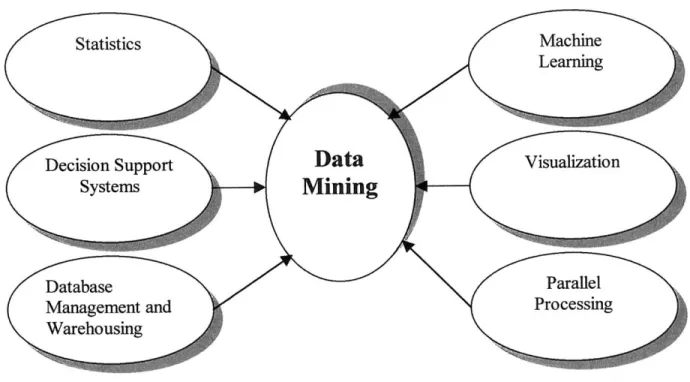
Data mining is an integration of multiple technologies as shown in Figure 1 [82]. Each of these technologies: Statistics, Decision Support Systems, Database Management and Warehousing, Machine Learning, Visualization, and Parallel Processing are all tools that interact and support a data mining tool [83]. Statistics and Machine Learning continue to be developed for more sophisticated statistical techniques [83]. Decision Support Systems, which are discussed in a separate section in greater detail, are a collection of tools and processes to help managers make decisions and guide them in management [84]. For example, tools used for scheduling meetings, organizing events, spreadsheets graph tools, and performance evaluation tools are example of support systems. Visualization techniques, also described in greater detail in the data mining techniques section, are used to aid the data mining process. Researchers from the computer visualization field are approaching data mining in a different way: present the data miner an interactive data-mining tool. Database management and data warehouses aid the data mining process in integrating various data sources and organizing the data in
such a way so that this data can be effectively mined. Finally, achieving scalability of data mining algorithms is of primary concern. Techniques that use parallel processing is another key technology-supporting data mining progress.
Figure 1: Data Mining Technologies
Data Mining: Verification vs. Discovery
Data mining is not simply a query extraction verifying analysis tool. Decision support systems (DSS), executive information systems, and query writing tools are used mainly to produce reports about data. In this matter, these query tools serve mainly to access the records already existing in large databases. After the data are extracted, they are examined to detect the existence of patterns or other useful information that can be used in answering questions of interest. This kind of data extraction methodology that finds trends in existing data is called the verification method. Under this scheme the data
approach in finding a potential solution to the problem posed. Little information is created using this retrieval approach [1].
The approach used by data mining is different. Instead, data mining uses a discovery methodology whereby based on the method used, this technology will try to detect trends and produce results about the data with very little guidance from the user. This technology is designed to find the most significant sources of data and draw conclusions from the data it selectively sifts through. In data mining, large amounts of
data are inspected; facts are discovered and brought to attention of the person doing the mining. As such, data mining is a discovery tool where a more efficient mode of seeking relevant data and bringing forth this information to the data miner is accomplished.
Decision Support Systems:
A Decision Support System (DSS) is often interfaced with a data-mining tool to
help executives make more informed decisions (See Figure 1). Though there are a variety of Decision Support Systems in the market today, their applications consist mostly of synthesizing the data to executives so that they can make more objective decisions based on the data analyzed. DSS technologies have sprung up since the mid 1980's and there has been a continuing trend to improve the analyzing tools of DSS. In this day and age of the Internet, on-line analytical processing or OLAP is slowly
replacing aging support systems. Essentially if a computerized system is not an on-line transaction processing system (OLTP), then the system is regarded as a DSS [5]. Increasingly, OLAP and multi-dimensional analysis is used for decision support systems to find information from databases [85]. Executive Information Services (EIS),
geographic information systems (GIS), OLAP, and knowledge discovery systems can all be classified into the category of systems referred to as DSS [5]. Two major categories of DSS include enterprise-wide and desktop. In enterprise-wide, the DSS is linked to a large data warehouse and usually serves many managers within an organization. This large infrastructure allows managers to access information quickly. In enterprise-wide
DSS, the most sophisticated enterprise-wide analysis systems provide access to a series
that is mostly used by a single manager. In most organizations today, there is a constant flow of communication between enterprise-wide, data warehouses, and desktop DSS [84]. There are a variety of DSS architectures that an organization can implement. For example, a single enterprise-wide DSS can exist to handle all the data and operations flow of an organization or can have multiple layers with other decision support systems
such as a desktop DSS that resides on the desktop of a single user. A client-server architecture can further transmit information flow between client desktop and associated
DSS tools that reside on a server. OLAP:
OLAP is a technology that enables the building of a multidimensional data cube from information stored in relational and tabular 2D databases [29]. Users can use the data to answer real-world complex business questions. On-line Analytical Processing (OLAP) is a software technology that enables fast analysis of shared multidimensional
information [85]. Multi-dimensional data are data organized to allow for viewing and comparing across multiple dimensions simultaneously-as distinct from the two dimensions (horizontal and vertical) of a spreadsheet (See Appendix) [30]. While a spreadsheet allows a user to compare data in just two dimensions, multidimensional structures enable an almost infinite number of views and associations. Multidimensional analysis is necessary to obtain fast answers to such complex organizational questions as "What is the best-selling product line in North America during Q4, 1995, with a profit margin of at least 20 percent, and selling through the indirect sales channel?"
OLAP enables better decision making by giving business users quick, unlimited views of multiple relationships in large quantities of summarized data. This can result in
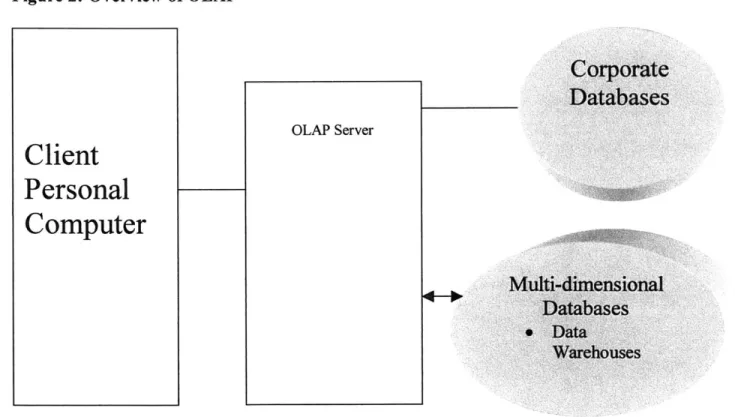
high performance access to large amounts of summarized data for multidimensional analysis. With OLAP, managers and analysts can rapidly and easily examine key performance data and perform powerful comparison and trend analyses, even on very large data volumes. Data comparisons can be used in a wide variety of business areas, including sales and marketing analysis, financial reporting, quality tracking, profitability analysis, manpower and pricing applications, and many others. OLAP uses data
warehousing techniques to create a repository of information that is built from data from an organization's systems of enterprise-wide computing (see Figure 2). Regardless of where the data reside, they are accessible to requesting applications on any supported platform anywhere on the network, including Web-based applications.
Figure 2: Overview of OLAP
Corporate
Databases
OLAP ServerClient
Personal
Computer
Multi-dimensional
Databases
* Data-WarehousesDesktop DSS:
Desktop single-user DSS are not as popular as enterprise-wide systems because they do not allow for multiple users to link to large data warehouses for information. However, desktop DSS are indeed useful. An individual user can analyze information using Microsoft Excel, Lotus 1 2 3, or some other specific DSS applications for individual managers. Expert Choice is an example of a specialized software Windows package that serves as a desktop DSS. Expert Choice is a software tool mainly used to
support decision situations through an analytical hierarchical model consisting of a goal, possible scenarios, criteria, and alternatives. E.g., an analyst at Goldman Sachs using
Excel to model a financial problem can present his/her findings to managers at large as programmed components in enterprise-wide DSS. Analysts can then proceed to conduct the analysis and once done can disclose their findings on the company's intranet.
In general, DSS has a well-defined purpose whether it is strategic or operational decision to be solved. The tools that are available for retrieving and analyzing data, the database, the variables included, and the time series of the data available determine the questions that can be posed and the decision-relevant information that can be generated
[5]. In the long run, however, DSS can help managers retrieve, summarize, and analyze
Data Warehouse:
Data mining and DSS are two kinds of applications that can make use of the data warehouse. Through a DSS alone a manager can make much more informed decisions. However, by interacting with a data warehouse a DSS can make better use of quality information and interpreting the information in a more efficient manner. Essentially, a data warehouse is a central repository for all or significant parts of the data that an enterprise or organization's business systems collect. Typically, a data warehouse is housed on an enterprise mainframe server. Data from various on-line transaction
processing (OLTP) applications and other sources are selectively extracted and organized on the data warehouse database for use by analytical applications such as data mining tools. Thus, it is used for supporting the informational processing for organizations needing data management by providing a platform of integrated, historical data from which to do analysis [6].
Four Main Characteristics of a Warehouse:
A data warehouse consists of the following four main characteristics:
" Subject-oriented " Integrated
e Time-Variant
" Nonvolatile
(Data enterin warehouse)
Data Warehouse
Data are entered into the data warehouse from the operational environment. That is the data warehouse is always logically a separate storage of data transformed from the application data found in the operational environment [6]. One of the primary features of the data warehouse is that it is subject-oriented. As an example, the data warehouse could be structured around an organization's customers, its products, or its R & D development. In contrast, the operational system can be mostly organized around applications and functions of a subject area. The main difference in the structuring of these two systems is that a data warehouse will exclude all information not used by a
DSS tool [6]. However, an operational system will include all data regardless of whether
or not a DSS tool will use the data.
Application data found in the
Operational Environment
Another distinguishing feature of a data warehouse is that the data contained within the bounds of a warehouse are consistent. For example, instead of allowing many date formats, one particular dating format will be used. This consistency will abound for all data entering into a warehouse; all variables, naming schemes, and encoding structures will all follow a particular pre-determined convention. For the DSS analyst studying the
data, his or her concern will be on using the data in the warehouse as opposed to wondering about the consistency and credibility of the data [6].
The third characteristic of a data warehouse is that of time-variance. In the
operational environment, data are expected to be accurate at the moment of access. In a data warehouse, however, data are accurate at some moments in time. This difference lies in the underlying fact that the time horizons for the operational vs. the warehouse environment vary significantly. In a data warehouse, data are kept over long periods of time, usually for a span of several years. In contrast, for the operational environment, data are maintained for a span of months [6]. Thus, applications in the operational environment must carry a high degree of flexibility as data are continuously updated. In a warehouse environment, vast numbers of records are maintained making it very difficult to update the data warehouse as the need arises.
Lastly, the fourth interesting characteristic of a warehouse is that it is nonvolatile. Whereas changes are updated regularly in an operational environment, in a data warehouse once data are loaded no further updates to the data can occur. Needing to
As such, these four underlying characteristics allow for an environment that is significantly different from an operational environment. Note however, that all the data that enter a data warehouse comes from the operational environment. The data
warehouse functions as a tool that transforms these data into more a more useful way of analyzing and synthesizing the data. The maintenance of a warehouse and the simplicity of design allow for the data warehouse to be a significant factor in the relaying of higher quality information to data mining tools. Being subject-oriented, integrated, time-variant, and nonvolatile are all significant contributors to maintaining consistent data for other systems to interact with.
The Data Mining Process:
The goal of identifying and utilizing information hidden in data has three requirements [1]:
e The captured data must be integrated into organization-wide views instead of
specific views.
" The information contained in the integrated data must be extracted.
* The obtained information must be organized in ways that enable decision-making. The data mining process can be classified as going through a series of four steps. This consists of transforming the already summarized data found in a data warehouse into information than can produce useful results. These four steps can be summarized into [1]:
e Data selection e Data transformation
* Mining the Data
e Interpretation of Results
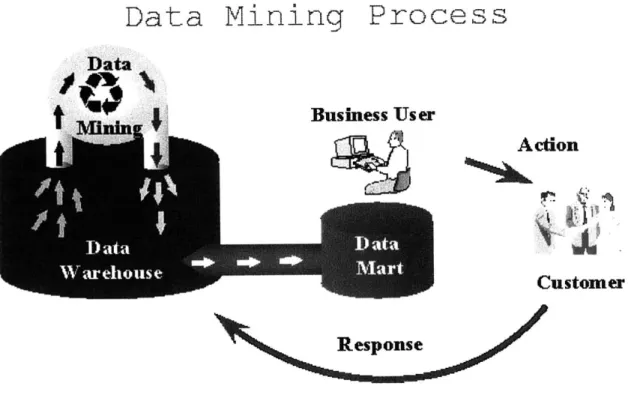
Data selection consists of gathering the data for analysis. Data transformation will then convert appropriate data to a particular format. Data mining will then extract the desired type of information yielding in results to be interpreted. In Figure 3, the data-mining tool will extract the relevant information from the data warehouse environment. In order for the data-mining tool to work, the sub-processes of data selection and
based on the results and put the recommendations into action. Of course this assumes that all of the four steps will be successfully completed, which is not always the case.
Figure 3: Data Mining Process
Data Mining Process
Data
t iBusiness User
Action
Customer
Response
Data selection can be the most important step in the process. This is due to the complexity in finding and constructing pre-selection criteria before the extraction of data actually transpires. The variables selected and the range of each of them should be determined in this step. For example, a marketing executive wishing to improve sales figures will pre-select those customers that have been most active in making purchases and observe their behavior. An executive can mine all the data, but this can turn out to be a very costly operation because the data-mining tool will have to search through all this data and moreover if results are generated, they have more risk in predicting an optimal
Once the data to be mined has been chosen the next step in the data mining
process usually consists of transforming the data into the particular formats needed by the data-mining tool. Data are further synthesized by computing certain rations and applying
algorithms to convert the data to a particular type suitable for future applied tools [1]. Once the data have been selected and required transformations done, a data-mining tool can now be applied. Specific predictions about futuristic events based on previous collected data can yield in significant hidden findings through the use of well designed algorithms, a topic of discussion in later sections. Using a data warehouse alongside with a mining tool is usually recommended as this allows for a more efficient organization of the collected data in ways that can facilitate and optimize analysis. Furthermore, the mining tool can also interface with a DSS for further interpretation of the data. However, a data mining system need not always interact with a data warehouse, and in fact, data mining can still extract pertinent information if given raw data from a database. The main advantage of using a data warehouse is that most of the data are already in already integrated in a suitable format of choice making it easier for a
data-mining tool to extract the higher quality information.
The final step in the data mining process consists of interpreting the results. Once the extracted information is analyzed and interpreted, the most relevant information can be passed onto the decision-maker through a DSS. Result interpretation can consist not only of interpreting the output but also of further filtering the data and passing that
As such, data mining is a very complex process. Many steps need to be
performed correctly before feeding of data to the data mining tool. Furthermore it is not guaranteed that the data-mining tool will yield significant results in any steps of the mining process. Certainly, performing many trials are recommended as this can reveal error corrections in any of the four steps. Any of the previously mentioned steps can be modified to continue investigating the data and searching for hidden patterns. This is the challenge of the data mining organization and though it can be a painstaking process, the more data that is mined, the more likely the data miner will learn from the process.
The use of tools such as DSS and a warehouse environment complement the data mining tools used to find useful facts buried in layers of data. To maximize the
efficiency of data mining, both of these other tools must provide high quality delivery information to the data-mining tool. The use of good complementary tools to sift through data along with a powerful data-mining tool should be part of a well designed
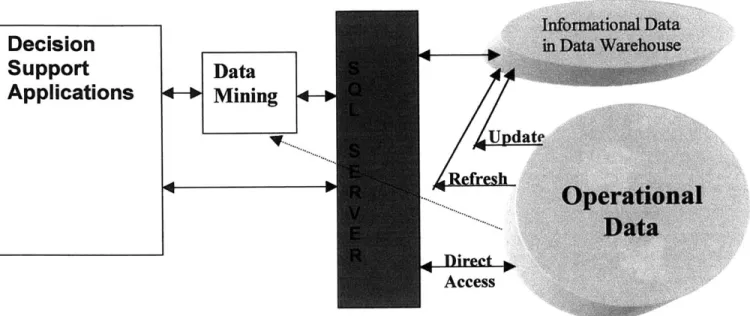
Figure 4: Integration of Tools
Source: Data Mining: Extending the Information Warehouse Framework, IBM. 2000.
The way in which a DSS along with a data warehouse all integrate with a data mining tool to extract hidden patterns in data can be summarized by Figure 4 seen above. Shown are all three major components necessary for a data mining framework extraction tool used today. A DSS, as discussed in the previous section, is needed to allow a manager to be able to examine the data and help him or her make a decision. A DSS will
obtain the results passed from the data-mining tool [87]. The data fed to this data-mining tool will have been synthesized and integrated by the data warehouse system. Thus, the
environment having multiple files or databases. Facilities for doing these data
transformations are usually provided with mining tools. This is as a result of the mining developers also building tools that will integrate and merge well with the data mining functions. An important note is that for data mining to occur, it is not necessary to require that a data warehouse be built. In can be the case that data can be downloaded directly from the operational files to flat files that contain the data ready for the data mining analysis [1]. However, in most situations, the data fed into a data-mining tool will need to be synthesized and integrated. This is the task performed by a data warehouse. A data-mining tool will often access the data warehouse synthesized data through an SQL interface. Communication between the data warehouse to the
data-mining tool to the decision support system will continue to operate with one another until an optimal solution deemed by the data miner is found.
Data Mining Specific Tool Trends:
Certain types of tools seem to be growing over other data mining tools. In a . recent study conducted by KDNuggets.Com, a leading data mining news provider placed the following commercial and public-domain tools in the different categories shown in Table 2. This table shows that the growth of suites and other data mining tools continue to increase. Over 100% growth was experienced in suites over a 2 2 year period.
Furthermore, there is also strong evidence supporting continued research tool growth such as association and sequence algorithms, clustering, and visualization. Text and web mining is a growing field that can take advantage of the worldwide usage of the Internet and the many companies investing to develop online strategies.
Data on the Internet has to be effectively managed. This data could to be mined to gain insights into customer purchasing patterns and trends. The explosion of users on the Internet and the increasing number of World Wide Web servers are rapidly increasing digital libraries. Digital libraries are digitized information distributed across several Internet sites containing information such as multimedia data such as voice, text, video
and images [88]. Thus, text and web mining are techniques employed to serve in finding trends amongst these piles of data. With information overload on the web, it is highly desirable to mine the data and extract patterns and relevant information to the user. This will inevitably make the task of browsing on the Internet easier for the user. Therefore,
Table 2: The growth of commercial and public-domain data mining tools Suites 18 30 37 37
Classification:
Multi-approach 4 8 8 10 Decision Tree 14 18 18 19 Rule Discovery 10 11 12 14 Neural Network 50 60 76 100 Bayesian 0 0 10 20 Other 6 7 12 13 Total 84 104 126 176 Associations and 0 0 6 13 sequences Clustering 6 5 10 12 Visualization 5 12 26 31Text and Web mining 0 5 7 15
Source: Shapiro, Greg. The Data Mining Industry Coming of Age. KDNuggets.Com. 1999.
IEEE Intelligent Systems.
Table 2 shows the growing trend of specific data mining tools. Suites seem to have saturated the market, as there was no increase in over an 8-month period. This stabilization in the number of suites shows that the market for commercial tools is growing [11]. Association and sequence algorithms, Bayesian networks, and data
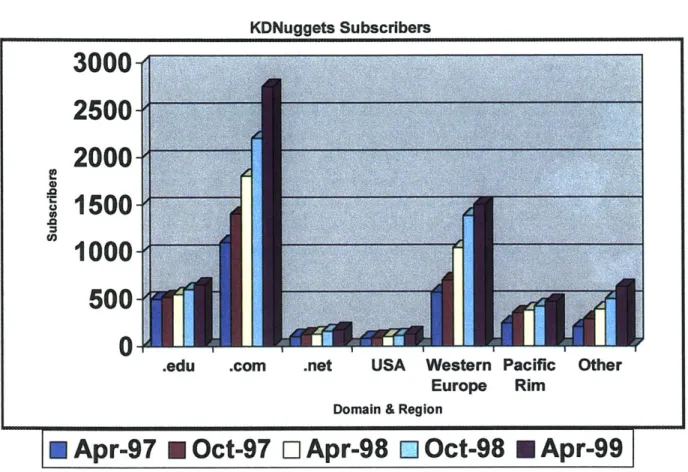
Furthermore, the growth trend of data mining tools is also reflected in the number of users subscribing to the KDNuggets newsletter, which is today regarded as of the leading newsletter provider in data mining and knowledge discovery in Figure 5. As data mining continues to catch the public's eye, already there exists reason to prove why data mining will be a technology used and understood by more people. Figure 5 illustrates the growing acceptance of the data mining technologies. Researchers made up the majority of KDNuggets subscribers, but now most are from commercial domains. The region analysis indicates the growing acceptance of data mining worldwide. Already
KDNuggets has over 8,000 subscribers for its newsletter all over the globe compared with a mere 50 people in 1993. Another interesting observation is that data mining is not a technology offering solely in the United States. Data mining is a global technology being developed to aid companies worldwide. However, with the increasing demand for web mining, most of the revenue generated in this particular sector will be predominant
in the United States and Western Europe.
As the popularity of data mining continues to emerge, one of the main challenges for this technology in the 2 1s" century will be generating algorithms that are able to cope with real-time predictions. Third generation data mining systems will have to be
designed to meet the growing demand of analyzing real-time on-line information.
Whereas today companies can implement data mining solutions that take many months to implement, offering solutions online and in real-time can be a very complex procedure as
Figure 5: KDNuggets Subscribers by Region and Domain KDNuggets Subscribers
3000
2500
2000
2 000
0500-0
.edu cor net USA Western Pacific Other Europe Rim
Domain & Region
Apr-97
0
Oct-97
l
Apr-98 E Oct-98
U
Apr-99
Source: KDNuggets
Software products are becoming a growing presence in the data-mining arena. To illustrate the point that more companies are trying to offer data mining products to
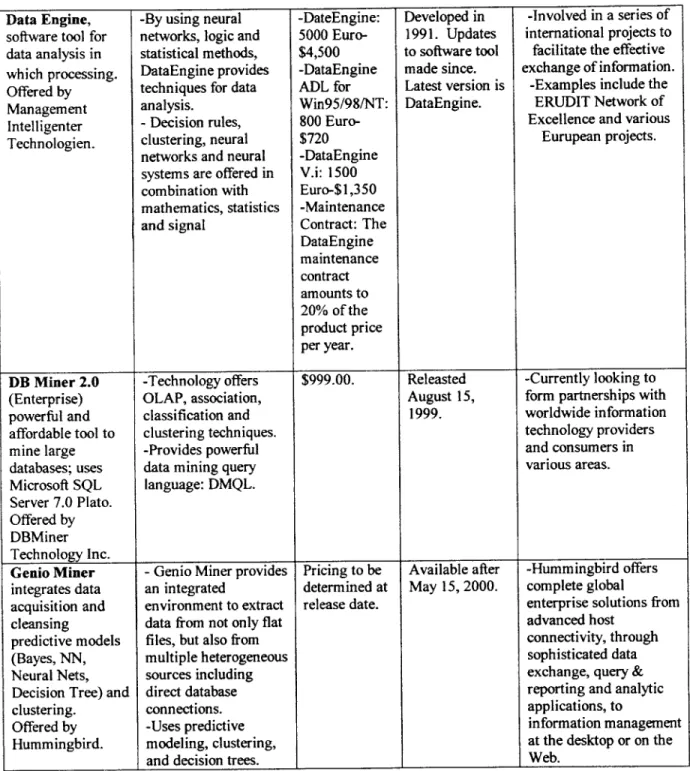
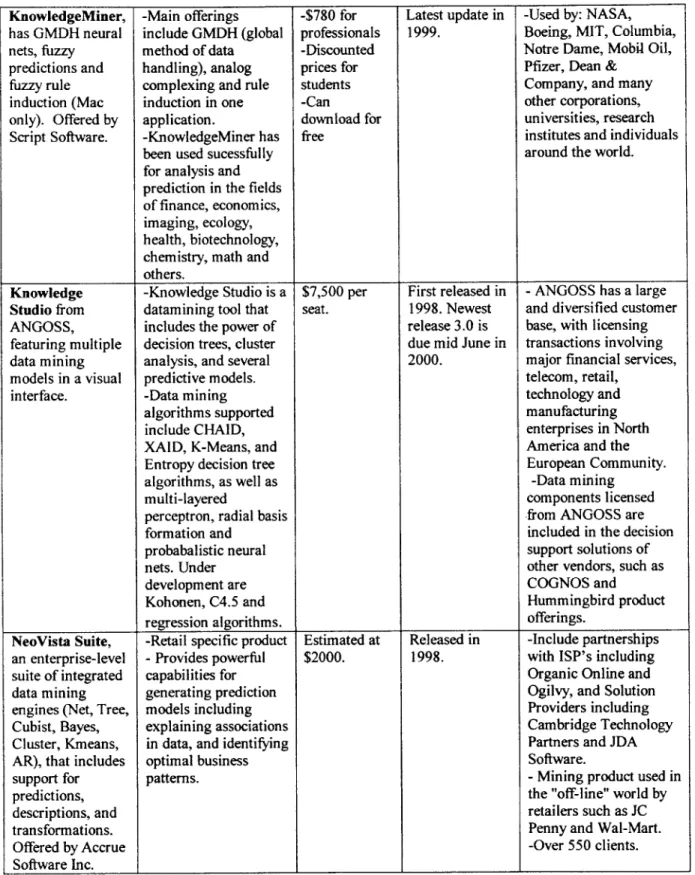
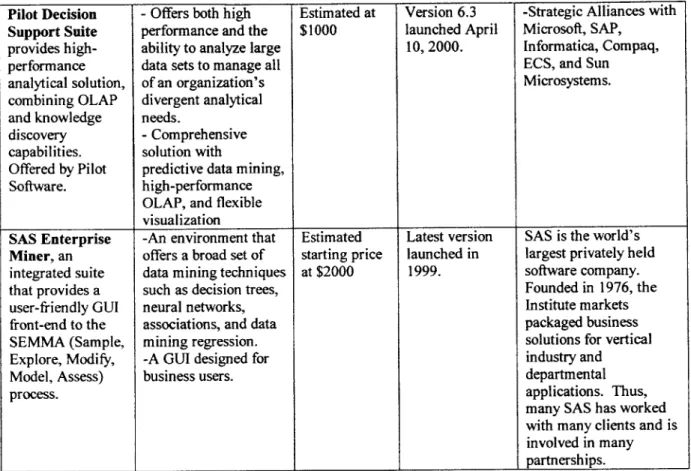
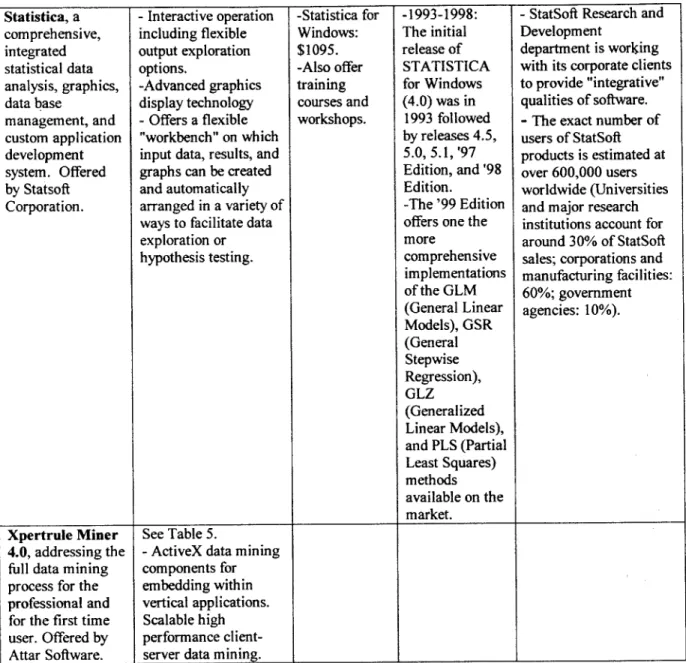
different companies, one just needs to look at the distinct methodologies of applying the data-mining concept to solve classes of problems. Table 3 shows that suites are still an important part of data mining software products provided. Some of these leading commercial vendors include leading corporations such as IBM, SPSS, Angoss, and Oracle. Table 4 shows some of the leading companies in providing software products for web mining including some free services offered by other corporations.
Table 3: Leading Suites Supporting Full Knowledge Discovery Process ' . lw I L (2 Alce disof, a streamlined version of ISoft's decision-tree-based AC2 data-mining product, is designed for mainstream business users. -An on-line Interactive Data Mining tool. -Discovers hidden trends and relationships in the data and makes reliable predictions using decision trees Estimated starting price at $1000. Version 6.1 launched in 1999.
ISoft has a strong partnership strategy, illustrated by broad marketing and technical alliances with
information technology companies.
Clementine from -Users create and Estimated Updated version Strategic partnerships
SPSS, leading interact with a stream: starting price launched in with partnering in the visual rapid a visual map of the at $2499. 1998. areas of application modeling entire data mining Clementine was development, data
environment for process. the first management, analytical
data mining. Now -Range of applications enterprise- consultation, and includes including web-mining strength data solution implementation. Clementine capabilities to client's mining offering More than 250 Clients.
Server. sites. aimed at
business users.
Darwin (now part -Darwin enables $1,495 Updated version -Oracle has joined forces of Oracle), high- improved marketing by released in with high-value
performance data segmenting customers 1999. warehouse companies mining software, and predicting their that are recognized in
optimized for behavior. their fields of expertise,
parallel servers. -Multiple algorithms including System
used Integrators, Independent
Software Vendors
IBM Intelligent -Offers a suite of tools -Price can Updated version -Seeks to acquire
Miner for Data, offering data widely vary released in application and service enables users to processing, statistical depending on 1998. partners.
mine structured analysis, and results project needs. data stored in visualization to Estimated conventional complement a variety starting price databases or flat of mining methods. at $2500 for files. -Mining operations software only.
can be performed directly on DB2.
Data Detective -Several analysis tasks -Price -Founded in -Revenues come has a modular are supported such as dependent on 1990 with the primarily from design consisting normal queries, fuzzy per project objective to turn consultancy, carrying of an associative queries (selections objective. adaptive out data analysis projects analysis engine, a defined by soft criteria
Table 3 Continued:
Data Engine, software tool for data analysis in which processing. Offered by Management Intelligenter Technologien.
-By using neural
networks, logic and statistical methods, DataEngine provides techniques for data analysis.
-Decision rules, clustering, neural networks and neural
systems are offered in combination with mathematics, statistics and signal -DateEngine: 5000 Euro-$4,500 -DataEngine ADL for Win95/98/NT: 800 Euro-$720 -DataEngine V.i: 1500 Euro-$1,350 -Maintenance Contract: The DataEngine maintenance contract amounts to 20% of the product price per year. Developed in 1991. Updates to software tool made since. Latest version is DataEngine. -Involved in a series of international projects to
facilitate the effective exchange of information.
-Examples include the ERUDIT Network of Excellence and various
Eurupean projects.
DB Miner 2.0 -Technology offers $999.00. Releasted -Currently looking to (Enterprise) OLAP, association, August 15, form partnerships with powerful and classification and 1999. worldwide information affordable tool to clustering techniques. technology providers
mine large -Provides powerful and consumers in
databases; uses data mining query various areas.
Microsoft SQL language: DMQL. Server 7.0 Plato.
Offered by DBMiner Technology Inc.
Genio Miner -Genio Miner provides Pricing to be Available after -Hummingbird offers integrates data an integrated determined at May 15, 2000. complete global
acquisition and environment to extract release date. enterprise solutions from
cleansing data from not only flat advanced host
predictive models files, but also from connectivity, through
(Bayes, NN, multiple heterogeneous sophisticated data
Neural Nets, sources including exchange, query &
Decision Tree) and direct database reporting and analytic
clustering. connections. applications, to
Offered by -Uses predictive information management
Hummingbird. modeling, clustering, at the desktop or on the
and decision trees. Web.
'I
' '
Table 3 Continued: KnowledgeMiner, has GMDH neural nets, fuzzy predictions and fuzzy rule induction (Mac only). Offered by Script Software. Knowledge Studio from ANGOSS, featuring multiple data mining models in a visual interface. NeoVista Suite, an enterprise-level suite of integrated data mining engines (Net, Tree, Cubist, Bayes, Cluster, Kmeans, AR), that includes
-Main offerings include GMDH (global method of data handling), analog complexing and rule induction in one application.
-KnowledgeMiner has been used sucessfully for analysis and prediction in the fields of finance, economics, imaging, ecology, health, biotechnology, chemistry, math and others.
-Knowledge Studio is a datamining tool that includes the power of decision trees, cluster analysis, and several predictive models. -Data mining algorithms supported
include CHAID, XAID, K-Means, and
Entropy decision tree algorithms, as well as multi-layered
perceptron, radial basis formation and probabalistic neural nets. Under development are Kohonen, C4.5 and regression algorithms. -Retail specific product - Provides powerful capabilities for generating prediction models including explaining associations in data, and identifying optimal business -$780 for professionals -Discounted prices for students -Can download for free $7,500 per seat. Estimated at $2000. Latest update in 1999. First released in 1998. Newest release 3.0 is due mid June in 2000.
Released in
1998.
-Used by: NASA, Boeing, MIT, Columbia, Notre Dame, Mobil Oil, Pfizer, Dean &
Company, and many other corporations, universities, research
institutes and individuals around the world.
-ANGOSS has a large
and diversified customer base, with licensing transactions involving major financial services, telecom, retail,
technology and manufacturing enterprises in North America and the European Community.
-Data mining components licensed from ANGOSS are included in the decision support solutions of other vendors, such as
COGNOS and
Hummingbird product offerings.
-Include partnerships with ISP's including Organic Online and Ogilvy, and Solution Providers including Cambridge Technology Partners and JDA
Table 3 Continued: Pilot Decision Support Suite provides high-performance analytical solution, combining OLAP and knowledge discovery capabilities. Offered by Pilot Software. SAS Enterprise Miner, an integrated suite that provides a user-friendly GUI front-end to the SEMMA (Sample, Explore, Modify, Model, Assess) process.
-Offers both high performance and the ability to analyze large data sets to manage all of an organization's divergent analytical needs.
-Comprehensive solution with
predictive data mining, high-performance OLAP, and flexible visualization
-An environment that offers a broad set of
data mining techniques such as decision trees, neural networks, associations, and data mining regression.
-A GUI designed for
business users. Estimated at $1000 Estimated starting price at $2000 Version 6.3 launched April 10, 2000. Latest version launched in 1999. ____________________________________ i ____________________________________________ 2. ____________________________ .2 ________________________________ .2
--Strategic Alliances with Microsoft, SAP,
Informatica, Compaq,
ECS, and Sun
Microsystems.
SAS is the world's
largest privately held software company. Founded in 1976, the Institute markets packaged business solutions for vertical industry and
departmental applications. Thus, many SAS has worked with many clients and is
involved in many partnerships. ' ' ' '
Table 3 Continued: Statistica, a comprehensive, integrated statistical data analysis, graphics, data base management, and custom application development system. Offered by Statsoft Corporation. -Interactive operation including flexible output exploration options. -Advanced graphics display technology -Offers a flexible "workbench" on which input data, results, and graphs can be created and automatically arranged in a variety of ways to facilitate data exploration or hypothesis testing. -Statistica for Windows: $1095. -Also offer training courses and workshops. '
-StatSoft Research and Development
department is working with its corporate clients to provide "integrative" qualities of software. - The exact number of users of StatSoft products is estimated at over 600,000 users worldwide (Universities and major research institutions account for around 30% of StatSoft sales; corporations and manufacturing facilities:
60%; government
agencies: 10%).
Xpertrule Miner See Table 5.
4.0, addressing the -ActiveX data mining full data mining components for process for the embedding within professional and vertical applications. for the first time Scalable high user. Offered by performance client-Attar Software. server data mining.
' -1993-1998: The initial release of STATISTICA for Windows (4.0) was in 1993 followed by releases 4.5, 5.0, 5.1, '97 Edition, and '98 Edition. -The '99 Edition offers one the more comprehensive implementations of the GLM (General Linear Models), GSR (General Stepwise Regression), GLZ (Generalized Linear Models), and PLS (Partial Least Squares) methods available on the market.
Table 4: Software Tools for Web Mining
\ 11 P ](-'(
Customer Interaction
System's Micro Marketing module
collects click streams at the application server level so it can generate very rich data,
transform it automatically to the data warehouse, and provide mining operations. Offered by Blue Martini Software.
-Results are presented through Intelligence Reports
designed for the business decision-maker that combine statistics, business rules, aggregated customer profiles, and data visualizations. -Customer segmentations -rncmg is subscription-based calculated on the length of the engagement and on the volume of transaction and click stream data analyzed.
rebruary 2,
2000.
-tsua oranu equity and raise revenues across all sales channels by interacting with customers through call centers and web sites for merchandising, marketing, and e-service.
Clementine offers See Table 3. sequence association
and clustering used for Web data analysis. Offered by SPSS.
CustomerConversion -Customer Retails between -Company -Quadstone focus from Quadstone, focused E40,000- founded in is on delivering customer-centric automated E250,000=$60,000- 1995. customer behavior analysis and graphical knowledge $373,000 -Product intelligence reporting of web and discovery and released in solutions to drive
other data. data mining January 2000. B2C business
-Integrated profitability. analysis of web and traditional customer data -A visual and statistical mining suite driven by the business user. -Tracks page performance: customer
Table 4 Continued: EasyMiner, features Cross-session analysis; Click-stream analysis; Cross-sales by MINEit Software.
HitList, powerful and flexible server logs analysis with over 300 report elements by Accrue Software. Captures information across multiple Web and application servers at the network or at the Web server level.
-Offers click stream analysis and visitor segmentation. - Claims to optimize web site for maximum commercial impact by understanding the dynamic behaviour of web site visitors. -Collects and
updates database with Web traffic
data in near real time. -Combines Web data with multiple enterprise data sources, such as transaction or demographic information onto a single report. -Builds custom reports utilizing more than 375 data elements. Estimated starting price at $1500.
Software licensing for Accrue Hit List begins at $10,000. -Released in 1999. 1 Company founded in 1996. Version 1.0 released in 1996. Version 4.51 released in December 1999. -Current seeking strategic partnerships with resellers, systems integrators, consultancies, and Independent Software Vendors (ISVs). -Alliances with Doubleclick, Vignette, Art Technology Group, Microstrategy, Informix, Oracle, IBM, Sun Microsystems, Microsoft, and Netscape. ' '
i
I
Table 4 Continued:
KnowledgeWebMiner,
combines ANGOSS KnowledgeSTUDIO with proprietary algorithms for click stream analysis, Acxiom Data Network, and interfaces to web log reporting tools and to design and deploy proprietary intelligent agents to drive content selection, visitor interaction, and transacting options and outcomes.
Net.Analysis, e-business intelligence
solution, providing the scalability required by large e-business enterprises. Offered by NetGenesis. This device-independent data collection architecture provides continuous streaming of site activity data in conjunction with rich sets of historical information and trend analysis
-Measuring the effectiveness of on-line and
off-line promotion strategies in driving traffic, click-throughs and transaction volumes at client's Web sites. -Exploring and understanding differences in visitor usage patterns and behaviours. -Segmenting visitors, guests and members more precisely to enable more relevant, effective, and personalized interactions. -High-end cross-platform enterprise database support -Provides high-end performance on NT 4.0/SQL Server 7.0; Oracle 8.i on Solaris 2.6; and Sun/Solaris and Sun/Sybase. -Provides more than 150 predefined reports with sophisticated drill-down capabilities to meet differing information needs of all members of an enterprise Introductory pricing for KnowledgeWebMiner starts at $85,000 for Windows NT/2000 and SUN Solaris platforms and includes a client-server based solution and comprehensive training for up to 5 e-business analysts.
-Price range varies according to consultation. Usually in ranges from $1000-$3000 for software product only. -Company founded in 1984. -Knowledge WebMiner released in May 1, 2000. -Founded in 1994 by Matt Cutler and Eric Richard, two MIT undergraduates, -Recognized worldwide as a leader in e-customer intelligence. -More than 400 Internet-enabled and Fortune 500 customers now use NetAnalysis worldwide. -Latest version of product released in 1999. -Strategic partners with IBM, Oracle, Sun Microsystems, Microstrategy, Doubleclick, Microsoft, Art Technology Group -Involved with seeking alliances with ASP companies. -Over 50 clients. -Fiscal first quarter of 2000 quarterly revenues of $3.8 M. -Partnerships with Whitecross Data Exploration, Tantau Software, Compaq, Microsoft, IBM, Oracle, Siebel, Sybase, NCR, Sequent, Informix, Polk Inc, Experian Database
Marketing
Solutions, Acxiom, Hummingbird Communications, Cognos, Sasi, and Customer Analytics.
Table 4 Continued:
NetTracker, powerful
and easy-to-use Internet usage tracking
programs by Sane Solutions.
Enterprise Suite, a suite for Data Mining of web traffic information. Offered by Web Trends. -Provides web server traffic analysis -Exports results from WebTrends database to high-end Oracle, Microsoft SQL, Sybase, Informix and other ODBC-compliant databases for further data analysis. -NetTracker 4.5 Professional: $495 -NetTracker 4.5 Professional Support Agreement, entitle users to telephone and
e-mail support for a period of one year:
$195
-NetTracker 4.5 Enterprise (analyze multiple web sites):
$995 -NetTracker 4.5 eBusiness Edition: $5995 -Enterprise Suite: $1999 -Suite Subscription: $599 -Suite & Subscription: $2398 - Founded in March 1996 -Latest updated version released early 2000. -Over 150 Clients -Predominantly Internet Partners including Sun, Cobalt Networks,
SGI, and Compaq.
-Strategy is to integrate NetTracker with other eBusiness solutions as well as to optimize our products on a wide variety of platforms. -Each version of NetTracker contains a variety of standardized summaries, which provide detailed information about client's Internet traffic: -All versions of NetTracker analyze web
server log files and create thirty web server
summaries that provide detailed information about web site traffic. , ' ' I -Company founded in 1995. -Enterprise Suite 3.0 released in December 1998. Partnerships with AbleCommerce, Allaire, Covision, Hewlett Packard, Intershop, Lotus, Microsoft, Novell, Netscape, Oracle, and Vignette Technology Partner.