People’s Democratic Republic of Algeria
Ministry of Higher Education and Scientific Research
UNIVERSITY 8 MAI 1945 / GUELMA ةملاق \ 1945 يام 8 ةعماج FACULTY of LETTERS AND LANGUAGES تاغللا وبادلآا ةيلك DEPARTMENT of LETTERS & ENGLISH LANGUAGE ةيزيلجنلاا ةغللا و بادلآا مسق
Option: Linguistics
Investigating the Effects of Self-Confidence on Students
’ Speaking
Performance
The Case of First Year Students at the University of 8 Mai 1945, Guelma
A Dissertation Submitted to the Department of English Language in Partial Fulfillment of the Requirements for a Master Degree in Anglophone Languages, Literatures, and
Civilizations
Submitted by: supervised by:
Aguebet Chems Rahma Mebarki Katia
BOARD OF EXAMINERS
Chairwoman: Mrs. CHAKKAT Ilhem MA/A University of 8 Mai 1945- Guelma Supervisor: Mrs. MEBARKI Katia MA/B University of 8 Mai 1945- Guelma Examiner: Ms. SERHANI Meriem MA/A University of 8 Mai 1945- Guelma
i
DEDICATION
I dedicate this work to:
My beloved parents for their patience, support and prayers. To my future husband: Said
To my sweet hearts: Rawiya and Sabrine
To my precious sisters: Nacira and Selma and to their husbands.
To my darling brothers: Fateh and his wife Amina, Billel and his wife Faiza. Hamza, Ala El-ddine and khaled.
To my Nephews: Idriss, Fadjer El-ddine, Abd El-waddoud, Rouaya, Jaber, Chahine and Hanine.
To all my aunts and uncles, especially Aisha and Abid
To all my friends with whom I shared the University life and memories: Amina, Warda, Leila, Sarra and Ilhem.
ii
ACKNOWLEDGEMENTS
I am grateful to my supervisor Mrs. Mebarki Katia for her help, support and valuable advice.
I am also so grateful to our teachers who have always been there to help whenever needed in spite of their responsibilities
Special gratitude must go to the jury: Ms. Serhani Meriem, Mrs. Chekkat Ilhem and Mrs. Mebarki Katia
I would like to thank the English language teachers and students who have answered the questionnaire
I would like to extend my deep appreciation to all the staff members of the library of Guelma University.
iii
Abstract
The objective of the present research is to investigate the correlation between self-confidence and students’ speaking performance at the Department of letters and English language at the University of Guelma. Students of English are facing problems that affect their speaking skill; the lack of self-confidence is one of them. Thus, we hypothesize that if students have high level of self-confidence their oral performance would increase. To test this hypothesis, a qualitative (descriptive) research has been conducted. Group of first year students LMD has constituted our sample. A questionnaire has been conducted to both teachers and students to gather data about students’ self-confidence and speaking performance. Based on the questionnaires’ results, our hypothesis was confirmed that self-confidence has a great impact on students’ oral performance; having a high level of confidence may lead to better oral performance. Thus, we recommend the implementation of public speaking techniques as successful tools for enhancing learners’ self-confidence, as well as; teachers' role in improving learners’ speaking skill.
iv
List of Abbreviation
ELT: English Language Teaching FLL: Foreign Language Learners
FL: Foreign Language L2: Second Language L1: First Language
EM: Extrinsic Motivation IM: Intrinsic Motivation
LA: Learner Autonomy
LAD: Language Acquisition Device
LIST OF SYMBOLS
N: Number of Subjects
%:
Percentage
v
LIST OF TABLES
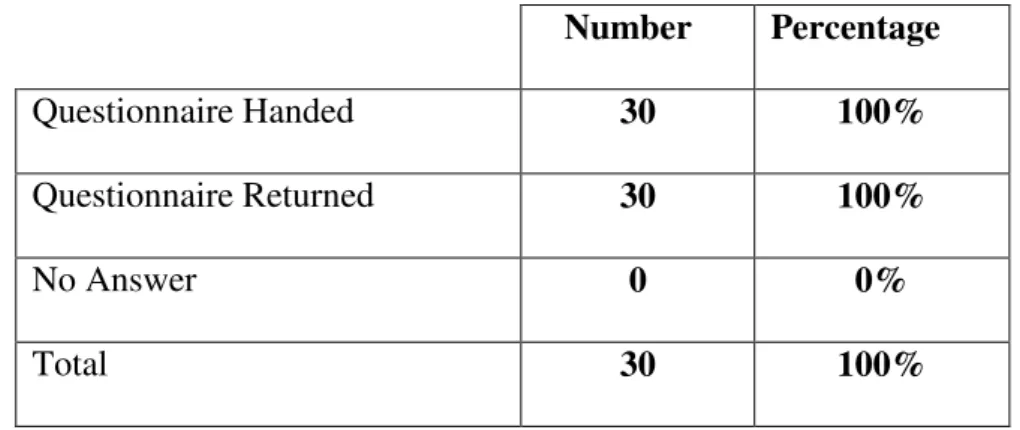
Table 1: the representation of the learners’ questionnaire ………37
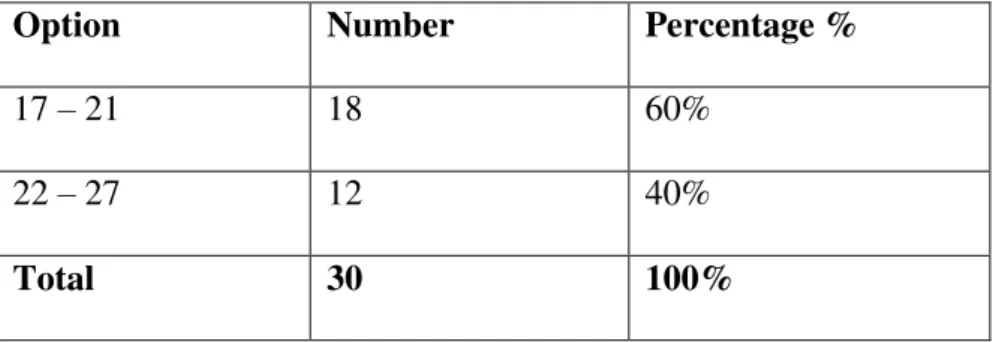
Table 2: Students’ Age ………...39
Table 3: Table 3: Students’ Choice to Study English at the University ………39
Table 4: years of Studying English ………40
Table 5: The Skill that Students Want to Develop Most ………40
Table6: Learners’ Obstacles while Performing an Oral Presentation. ………41
Table7: Students’ Opinion about the Lack of Practice as One of Speaking Problems’ Causes……….41
Table 8: Students’ Appreciation of their Speaking Level ………..42
Table 9: Improving Oral Performance through Oral Expression Activities ………..42
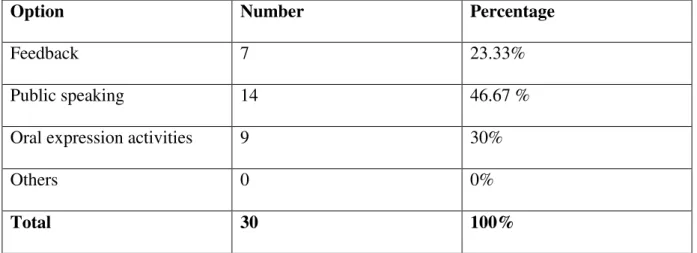
Table10: Most Techniques that Students Prefer to Use in Increasing Speaking Performance……….43
Table 11: Students’ Feeling during an Oral Evaluation ………..44
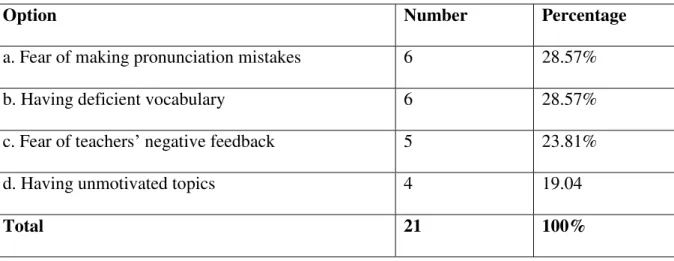
Table 12: Causes of Unconfident Learners in an Oral Performance Tasks ………44
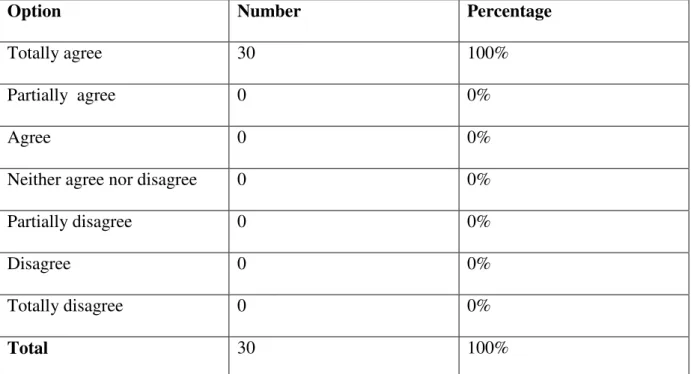
Table 13: Students’ Agreement about whether Self-Confident Affects their Speaking Skill ………..45
Table 14: Students’ Feeling while Speaking ……….46
vi
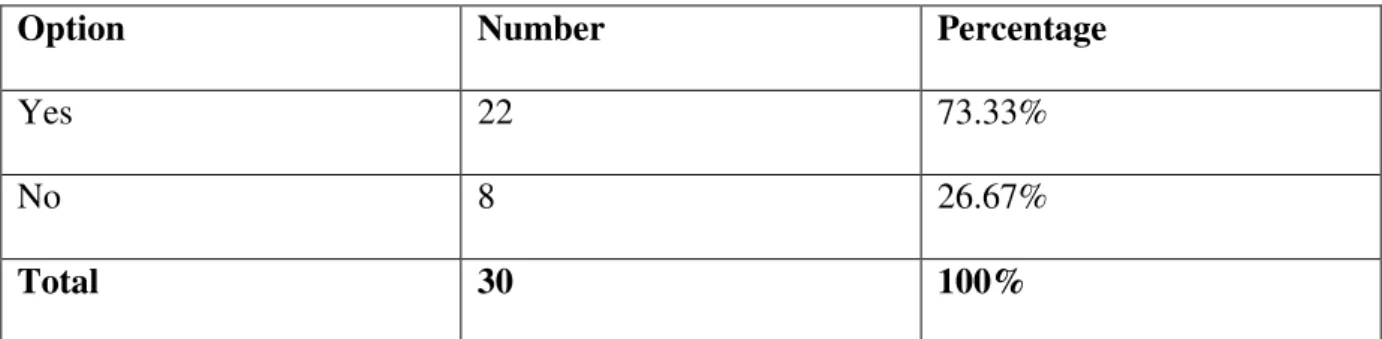
Table 16: Students’ Choice about whether Public Speaking Strategies improve the speaking
skill ………...47
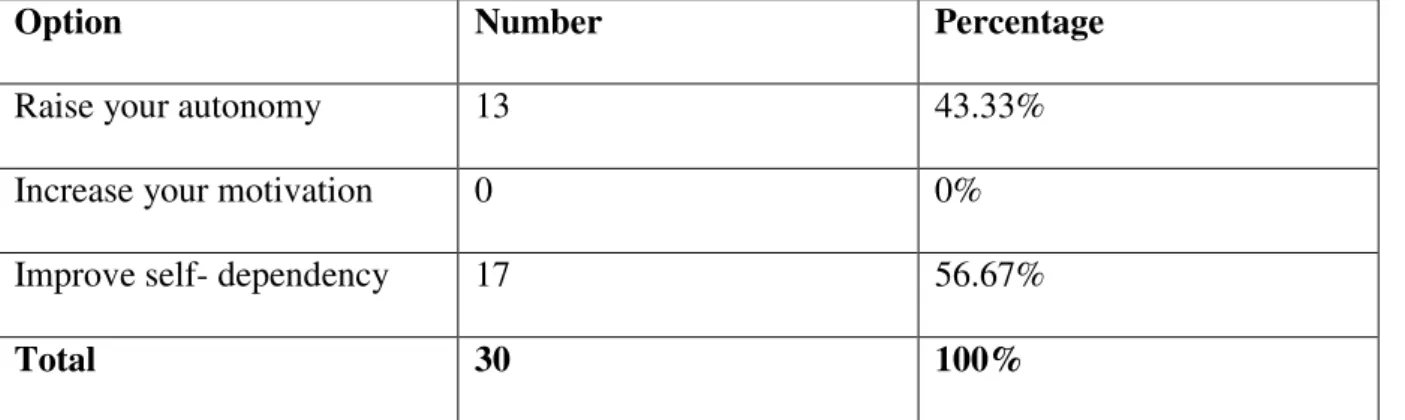
Table 17: The Role of Self-Confidence in Improving Speaking Performance ………...47 Table 18: the Role of Teachers in Helping Non-Confident Learners to overcome Their
Problems and Difficulties in the Classroom………..48
Table 19: Teachers’ Opinions about the Important of Self-Confidence for Effective
Speaking ………...55
vii
LIST OF FIGURES
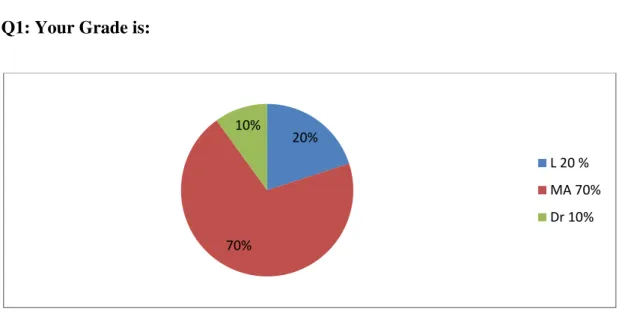
Figure n° 1: teachers’ Grade ………53
Figure n°2: Teachers Experience and specialty……….54 Figure n° 3: Teachers’ Views about if Self-Confidence Influences Learners’ Speaking
Performance………56
viii
LIST OF CONTENT
DEDICATION ………i
ACKNOWLEDGMENTS ……….ii
ABSTRACT……….iii
LIST OF ABBREVIATIONS………iv
LIST OF TABLES………..v
LIST OF FIGURES ………....vii
TABLE OF CONTENTS………viii
Introduction……….1
1. Statement of the Problem………2
2. Aims of the Study………...2
3. Research Hypothesis………...2
4. Research Methodology and Design ………...3
4.1. Research Method ……….3
4.2. Population of the Study ………..3
4.3. Data Gathering Tools ……….3
5. Structure of the study ………4
Chapter One: Speaking Skill
Introduction ………51.1. Definition of the Speaking Skill ………..5
1.2. Importance of the Speaking Skill ……….………6
1.3. Components of the Speaking skill………..6
1.3.1. Speakers ………..6
1.3.2. Listeners………6
ix
1.4. Types of Speaking Situations….………..7
1.4.1. Interactive Speaking Situation ……….7
1.4.2. Non- Interactive Speaking Situation ………...7
1.4.3. Partially Interactive Situation ………...8
1.5. The Criteria of Achieving Fluent communication ………...8
1.5.1. Vocabulary ……….8
1.5.2. Pronunciation ………..8
1.5.3. Grammar ……….9
1.5.4. Accuracy ……….9
1.5.5. Fluency ………...9
1.6. Relationship Between Speaking and Other Language Skills ………..9
1.7. Teaching Speaking ………..10
1.7.1. Mechanical Practice ………...11
1.7.2. Meaningful Oral Work ………...11
1.7.3. Free Oral Production ………..11
1.8. Teachers’ Role During Speaking Activities ………..11
1.8.1. Prompter ……….12
1.8.2. Participant ………..12
1.8.3. Feedback Provider………...12
1.9. Speaking Difficulties in EFL ………..12
1.9.1. Inhibition ………...12
1.9.2. Nothing To say ………...13
1.9.3. Low Uneven Participation ………13
1.9.4. Mother Tongue Use ………...13
x
1.11. Speaking Activities in The Classroom ………...14
1.11.1. Awareness ……….15
1.11.1.1. Using Records ………15
1.11.1.2. Using Live Listening ……….15
1.11.2. Appropriation ……….15
1.11.2.1. Drilling and Chants Activities……….15
1.11.2.2. Reading Aloud Activities ………...16
1.11.2.3. Dialogue Activities ………16
1.11.3. Autonomy ………..16
1.11.3.1. Stories, Jokes and Anecdotes ……….16
1.11.3.2. Role Play ………...16
1.11.3.3. Discussion and Debate ………...17
Conclusion ……….17
Chapter two: Students
’ Self-Confidence
Introduction ………..182.1. Definitions of self- confidence………..….18
2.2. The importance of self-confidence ………19
2.3. Characteristics of high self- confidence ………..…19
2.3.1. Ambitious ………...20
2.3.2. Good Oriented ……….….20
2.3.3. Visionary ………..………20
2.3.4. Good Performers and Attractive ………20
2.4. Characteristics of low self-confidence ………..…20
xi
2.4.2. Pessimistic ………20
2.4.3. Facing Difficulties in Communication ………..20
2.5. The effects of high and low self-confidence on performance ……….21
2.6 The impact of self-confidence on motivation and autonomy ………...21
2.6.1. The Concept of Motivation……….21
2.6.1.1. Definition of Motivation ………..21
2.6.1.2. Types of Motivation ………..22
A: Intrinsic Motivation ………22
B: Extrinsic Motivation ……….22
2.6.2. The Concept of Autonomy ……….23
2.6.2.1. Definition of Learner Autonomy ……….23
2.7. Self-Efficacy, Self-Confidence and Self-Esteem ………23
2.8. Anxiety and Self-Confidence ……….24
2.8.1. Definition of Anxiety ………24
2.8.2. Facilitative and Deliberative Anxiety ………25
2.8.3. Types of Anxiety ………25
A: Trait Anxiety ………..25
B: State Anxiety ………..25
C: Situation-Specific Anxiety ……….…..26
2.8.4. The Impact of Anxiety on students’ speaking performance and Confidence………....26
2.9. Teachers role in developing students' self-confidence ……….26
2.9.1. Using praise ……….27
2.9.2. Giving positive help and caring ………..27
xii
2.10. Tips for Building Confidence in Learners………28
2.10.1. Keep your inner voice positive ………28
2.10.2. Do not compare yourself with others ………..28
2.10.3. Look at what you have achieved ……….28
2.10.4. Read aloud and speak up ………..29
2.11. The Role of Public Speaking Strategies in Developing Learners’ Self-Confidence……….29
2.11.1. Definition of Public Speaking ………..29
2.11.2. Public Speaking Techniques ………30
a) Preparing to Speak ……….30
b) Using Relaxation Techniques ……….….30
c) Organizing the Topic ………31
d) Starting Slowly ……….31
e) Changing Your Tone ………....31
f) Using the Body ……….31
g) Using Visual Aids ……….31
Conclusion ………..32
Chapter Three: Field of Work
Introduction ……….333. Research Methodology and Design………..33
3.1. Research Method ………34
3.2. Population and Sampling ………..34
3.2.1. Students ……….34
3.2.2. Teachers ………34
xiii
Section One: The Analysis of
Learners’ Questionnaire
………..363.1.1. Students Questionnaire Analysis ………...37
3.1.2. Description of the Questionnaire ………37
3.1.3. Students’ Questionnaire Results ………39
3.1.4. General Summary of Students’ Questionnaire Results ……….49
Section Two: The Analysis of Teachers
’ Questionnaire
……….513.2.1. Teachers’ Questionnaire Analysis ……….52
3.2.2. Description of the Questionnaire ………52
3.2.3. Teachers’ Questionnaire Results ………...53
3.2.4. General Summary of Teachers’ Questionnaire Results ………....59
Conclusion ………...60
Recommandations and General Implications ………..61
General Conclusion ………..63
References ………65 Appendices
Appendix 01: Students’ Questionnaire Appendix 02: Teachers’ Questionnaire Arabic Summary
General Introduction
In the learning process, language is essential element because it facilitates learners’ social relationships. So, to learn a language it is necessary to practice the four skills; reading, listening, writing and speaking. Speaking as a productive skill requires very special abilities to be mastered. Teachers want their students to use the language correctly, however; students sometimes feel more anxious and afraid from talking to their teachers or even with their classmates, mainly because of some psychological factors that act as a barrier which prevent them from communicating. Lack of confidence is one of those factors which make the speaking process difficult or hard to be achieved. Moreover, many EFL students face difficulties in speaking during the lesson and they are always afraid and anxious from contact with their teacher or even with their classmates. Any EFL students, especially introverted type are always scared of standing up with confidence and performing in front of their teacher and classmates. There is no logic to this fear that most students feel when giving a presentation or speech. In one hand, Self-confidence helps students appreciate their own worth and take pride in their abilities. On the other hand, lack of confidence will prevent students from accepting challenges in speaking in the classroom.
2
1. Statement of the Problem
Since speaking requires challenges in the classroom, it is considered as the most difficult skill. Most EFL learners want to develop their speaking skill, but they face many language obstacles which prevent them from communicating. Those problems may be due to learners’ individual differences, such as the fear of making mistakes, shyness, hesitation or anxiety… or to some linguistic factors, such as the lack of vocabulary... These speaking issues may be due to what is known as low of self-confidence that hinders their success.
What is the relation between self-confidence and oral performance? What should be done to make learners more confident?
2. Aims of the Study
The present study aims at investigating the link between the two variables; self-confidence and students’ speaking performance by using public speaking strategies in addition to, teachers’ role in the classroom. We believe that this study will provide learners, as they are future teachers, with the appropriate ways to develop their speaking skill. Teachers must give some opportunities that help them to express their thoughts and thus develop their self-confidence, as well as, oral performance. Hence the aim of our study is:
Raising students’ oral performance through enhancing their confidence.
Helping students to overcome their speaking problems by using public speaking strategies.
3. Research hypothesis
Some of the issues that prevent students from speaking is that the fear of making mistakes which makes them incapable of interacting in the classroom.
3
We hypothesize that if students have high level of self-confidence their speaking performance would increase. Students’ oral performance can be improved when they use public speaking strategies. In addition to, teachers’ role in the classroom.
4. Research Methodology and Design
4.1 Research Method
Since, self-confidence cannot be measured; our research will be conducted through the qualitative (descriptive) method. So this method helps us in knowing the link between self-confidence and students’ speaking performance.
4.2 Population of the Study
The population of the study is composed of one group of first year students of English department. The group consists of thirty students of mixed sex and age and they are chosen randomly in order to generalize the results. But for teachers, we limit our sample only to ten teachers of oral expression.
4.3 Data Gathering Tools
This research will be conducted through two questionnaires: The first one is administered to random sample of thirty LMD students of first year, in order to know their points of view about self-confidence and oral performance.
The second one is delivered to ten teachers of Oral Expression, because their responses help us in analyzing the results. Since they interact with learners for long time what help us to confirm or reject the hypothesis. Both samples are at English department.
4 5. Structure of the Dissertation
The dissertation is divided into three main chapters. The first two chapters are related to the theoretical part, while the third chapter is devoted for the analysis of the practical part, in which we discuss the results of the questionnaires and teacher-students’ responses.
The first chapter deals with speaking skill, the importance of oral interaction in EFL classes with some psychological problems. The chapter also deals with the role of teachers in the classroom to enhance students’ participation.
The second chapter deals with a brief theoretical overview about self-confidence. In addition to some key factors to increase self-confidence and mainly its relation to learning foreign language. It tackles also autonomy and motivation as a result of self-confidence. Moreover, it deals with the differences between self-esteem and self-efficacy. Finally, this chapter highlights some roles for both teachers and students to promote self-confidence among students. Also, it sheds light on public speaking strategies in fostering learners’ self-confidence and raising their oral performance.
The last chapter is about field of investigation, which deals with a detailed analysis of both teachers and learners’ questionnaires.
This study will end with a general conclusion in which we will try to answer the research questions.
5
CHAPTER ONE
SPEAKING SKILL
Introduction
Speaking is a very important skill for students; it has always been part of the classroom context. Learners want to speak in order to use the language effectively. However, while learning it, many students face a lot of problems that prevent them from communicating.
In this chapter, we will discuss some details about the speaking skill, namely its definition, its importance, its aspects and characteristics, the relation between speaking and other skills focusing on some activities to enhance students’ speaking skill, we will present too some techniques for teaching speaking. Afterwards, we will shed light on the common problems in speaking class that may hinder the speaking proficiency in addition to the roles of teachers in EFL classroom. All of these titles will provide the learners with some solutions to cover many of their speaking problems.
1.1. Definition of the speaking skill
The majority of EFL students attempt to learn the foreign languages in order to communicate and speak freely like natives. So, speaking is derived from the verb “to speak” that means articulating sounds in order to make meaningful utterances with a simple voice. It is a productive skill that gives the students the ability to express their language effectively. Chaney (1998) reported that “Speaking is the process of building and sharing meaning through the use of verbal and non-verbal symbols, in variety of contexts” (as cited in Rahimy, 2012, p.50). This means that speaking is the ability to use the language orally for different purposes either, for expressing thoughts and opinions, looking for explanation or sharing
6
meaningful ideas between people in order to communicate in real life situations. According to Chaney speaking is not only about using the language orally to communicate, but also about using the body language as facial expression, gestures… as means for communication too.
1.2. The importance of Speaking Skill
Speaking reflects the success of a given language, it gives the students the opportunity to share their ideas and exchange opinions. So, mastering the speaking skill will facilitate learning and makes students curios to know the culture of that language.
Celce-Murcia (2001: 103) argues that: “for most people the ability to speak a language is synonymous with knowing that language since speech is the most basic means of human communication”. That is to say speaking fosters students’ beliefs and abilities to know everything about that language, it gives them the capacity to achieve and deliver information easily in different contexts.
1.3. Components of Speaking
According to Vanderkevent (1990), there are three elements that should be available for achieving effective communication which are: the speakers, the listeners and the utterances. But, if one element is missed communication cannot take place.
1.3.1. The Speakers
Speakers are people who present correct language to the listeners. Without speakers, the ideas, opinions and thoughts cannot be transmitted clearly.
1.3.2. The Listeners
Listeners are people who listen very carefully to the speaker in order to understand his/her message. Without listeners, the speakers can express their emotions and ideas by writing them down to be read.
7 1.3.3. Utterances
Harmer (2007: 29) explains that: “When speaking, we construct words and phrases with individual sounds, and we also use pitch change, intonation, and stress to convey different meanings”.
According to Harmer, utterances are the words and sentences which are produced by the speakers to the listeners in which they express their different and meaningful information. Without the utterances, speakers and listeners can communicate using the written form or non-verbal language (the body language; gestures, facial expression, signs….).
1.4. Types of Speaking Situations
Speaking requires different real life situations. Bentayab (2008: 28) claims that there are three kinds of speaking situations:
1.4.1. Interactive Speaking Situation
Interactive Speaking Situation is a situation in which the listener can open a conversation with the speaker either by asking questions or for repeating information. This type contains different activities between people such as discussing topics, making dialogues or debates either face to face or via internet chats ... etc
1.4.2. Non -Interactive Speaking
There are some speaking situations that do not require conversations between people; they are called Non-Interactive Situations in which the listeners cannot interrupt the speaker. Those situations occur when recording a speech or speaking via radio broadcast or television.
8 1.4.3. Partially Interactive Situation
It is neither interactive nor non-interactive situations. Partially Interactive Situations happen when there is speech directed to live audience, in which the audience cannot discuss or interrupt the live speech. They only look and listen carefully to the speaker.
1.5.
The Criteria of Achieving Fluent Communication:
There are some features presented for FL learners who want to communicate the language perfectly and correctly. They should know the language and how it works in different situations in order to develop their communicative skills in an appropriate way. Riggenbach (1998, cited in Itkonen, 2010) stated that: “pronunciation, vocabulary, grammar, accuracy, and fluency are commonly thought as the principle components of speaking”. This means that, in order to master the language, students should focus on some features related to that language; they should know its grammar, vocabulary, accuracy, pronunciation and fluency.
1.5.1. Vocabulary
Learners often face speaking difficulties at the vocabulary level. One major problem is of that misplacing words, i.e. they use the same word in different contexts without regarding its meaning. So, learners should know how to accurate, choose and place the appropriate word for the appropriate context.
1.5.2. Pronunciation
Learners want to speak the FL correctly, but they do not know the phonological rules. Students should know its phonological rules and the different articulation of its sounds in order to speak the language effectively.
9 1.5.3. Grammar
In order to achieve the grammar of any foreign language, learners should have an explicit knowledge about its grammatical concepts, categories and rules in order to make well structured sentences in terms of length and complexity.
1.5.4. Accuracy
FL learners study the FL in order to master the speaking skill. However, mastering the speaking is not achieved if students perform ungrammatical sentences. So, learners should pay attention to the correctness of language structure, vocabulary and pronunciation while producing the language orally. In other words, accuracy in speaking is to use correct forms of grammar, vocabulary, pronunciation and meaning of the message without making mistakes like; misplacing some words while communicating. Accuracy is about the correctness of the spoken language.
1.5.5. Fluency
Fluency is the main characteristic in an oral performance and it is an essential element in teaching the speaking skill, it is not about speaking fast as many students think, it requires pauses in order to speak slowly in a normal speed .Thornbury, (2005) argues that speaking speed is an important factor in fluency because speakers need to take breath in order to let the listeners understand what they say, thus, communication takes place.
1.6. Relationship Between Speaking and Other Language Skills
In the teaching process, teachers should pay attention to the four skills speaking, listening, reading, and writing. Also, they should know how to integrate them together in the activities in order to facilitate learning the FL.
In fact, speaking is incorporated to listening through the use of some speaking activities that require the listening skill both of them complete each other. Byrne (1976: 8) stated that: “Inside the classroom, speaking and listening are the most often used skills” which means that
10
listening and speaking cannot occur in isolation, they are correlated to each other because the speaker who produces correct and coherent utterances makes the listeners understand the message what leads to an effective communication as mentioned by White (1998: 13) “Listening is also closely connected with speaking”.
Speaking also can be effectively exercised through reading. Thus, teachers may improve students’ speaking skill through reading some articles and ask them to summarize what they read. The combination of speaking and reading provides learners with many advantages; it helps students in improving their oral proficiency automatically because of the interesting topics they read which give them speaking topics to discuss. In addition, it facilitates the acquisition of English vocabulary and grammar.
Speaking and writing are productive skills, in teaching speaking the teacher should take into account the writing because for some students it is easy to speak some words but, when it comes to writing it becomes very difficult task. Speaking and writing are different from each other; the spoken language contains different voices, different intonations and different gestures in order to transmit the message. In contrast, all these are absent in the written language which contains only punctuation. Speakers use short and easy utterances, in the other hand, writers use a more complicated vocabulary because they have time to think about what they write.
1.7. Teaching the Speaking Skill
The value of teaching speaking had changing from being an undervalued process that based on repetition and memorization to a communicative one by which students can express their thoughts appropriately.
(Celce-Murcia, 2000:105) stated that: “What academic English second language students need most is extensive authentic practice in class participation, such as taking part in discussions, interacting with peers and professor, and asking and answering question. With
11
academic adults, practice in activities such as leading and taking part in discussions and giving oral report is needed to be done”. In teaching speaking, teachers should focus on practicing the speaking skill; they should avoid confusion either in grammar, vocabulary or pronunciation for facilitating the understanding by giving chances and opportunities to students in order to learn how to speak fluently and effectively.
There are three phases in teaching speaking as El MATAWA and El KAILANI (1989:104) claimed:
1.7.1. Phase 01: Mechanical Practice
Mechanical practice is a kind of exercises which take place in oral expression classes where students listen to some recorded words for repeating. After that, if mistakes are committed, students will correct them. In this activity, learners are taught pronunciation, vocabulary, and grammar rules. In this activity, teacher’s role is to help students to overcome their speaking problems.
1.7.2. Phase 02 Meaningful Oral Work
This type of activities provides learners with sentences to express their ideas and opinions in order to engage in an oral communication task, the role of the teacher in this activity is to make students practicing the language by giving them some interesting topics to be discussed or some roles to be played for raising participation in the class.
1.7.3. Phase 03: Free Oral Production
Free oral production is the final phase in teaching speaking in which learners gain the ability to speak and express their thoughts freely without teachers’ help.
1.8. Teachers’ Role in Enhancing Speaking
Teachers are the key element for successful students because of the roles they play in the classroom from encouraging students to use the language to creating a good atmosphere
12
for learning. According to Harmer (2001: 275) teachers have different role within the classroom. These are the three major ones for teachers in the classroom.
1.8.1. Prompter
Teachers should help students not in everything, but when they lose words, they should create a joyful learning atmosphere by organize students’ performance, supporting them to participate and think creatively during the lesson.
1.8.2. Participant
When students present their ideas and topics, teachers prefer to participate in the discussion in order to give extra information related to the topic. According to Harmer teacher mainly acts as a resource but if they participate too much in the activity, they will disturb students’ ideas as a result; students will forget their words and stop speaking.
1.8.3. Feedback Provider
When communication breaks down, teachers should intervene by giving feedback. Teachers’ feedback may occur after students complete their speech. However, the over correction may block communication in one hand. On the other hand, positive feedback and gentle correction may help students to become more confident.
1.9. Speaking Difficulties in EFL
Speaking is not an easy task for FL learners; this is why most of them are facing difficulties and problems while performing the language. According to Ur (2000) there are four main speaking problems in foreign language classrooms:
1.9.1. Inhibition
This problem happens when learners try to participate in classroom activities. However; there are some factors that prevent them from speaking such as; the feeling of shyness, the fear of making mistakes, anxiety and low self-confidence are due to the inferiority and inadequacies of students.
13 1.9.2. Nothing To Say
Nothing to say is another common problem experienced by FL learners. In which students lose words and kept silent even when they asked to participate they say “no comment” or “I have nothing to say…” because they lack motivation, lack interesting topics to discuss or lack vocabulary which affect their speaking negatively.
1.9.3. Low Uneven Participation
This problem is about participation in the class, it is much more related to the previous problem. However it is the teachers’ responsibility because if they do not motivate learners, they will show no interest and stop participation. Teachers should create a comfortable atmosphere to help students in speaking in order to achieve high level of classroom participation. In addition, when teachers ignore students who want to speak in the class, participation will decreased.
1.9.4. Mother Tongue Use
According to Baker and Westrup (2003: 12) “barriers to learning can occur if students knowingly or unknowingly transfer the cultural rules from their mother tongue to a foreign language”. SL learners do not feel comfortable and at ease, only if they use their mother tongue inside the classroom because they are not able to produce correct utterances while using the FL. Also, the lack of vocabulary makes students use their mother tongue in the class.
14
1.10. Assessing Speaking
The process of assessment which is a general term involves the examination of students' learning process. According to Harmer (2007) the role of the teacher is to correct learners’ errors and mistakes which are made in the exercises, but if the teacher corrects learners many times during the exercises by stopping them this will inhibits the students from activating their language knowledge and breaks down the purpose of speaking in the classroom as well as, decrease their participation. There are different activities employed by the teacher in order to check students’ oral language and performance.
Underhill (1987: 51) claimed that, “Role- play situations may be chosen to test the learner's command of general social language or to elicit particular types of language”. This means that; the majority of teachers are using role play as a test activity to assess their students’ performance because each student will take his turn to speak. Using role play will help teachers to know their students’ speaking level. Another helpful activity to test students’ oral performance is making a conversation between two students.
Long et al. (2011: 51) have stated: “Clearly, without any assessment, teaching would become a rather unfocused activity as teachers would be unable to determine what their pupils had learned and what they needed to learn”. So, assessing the speaking skill is very important for students to know what exactly is needed to improve.
1.11. Speaking Activities in The Classroom
The main purpose of foreign language teachers, especially, teachers of oral expression, is to increase students’ performance. There are many activities used by teachers to enhance students’ speaking skill.
According to Thornburg (2008) there are three different stages in teaching the speaking skill. The first stage is awareness; which means that students should be aware about
15
the characteristics of the target language. The second stage is appropriation which is the relation between students’ knowledge and language. The last stage is autonomy, which is about learners’ ability and responsibility in using the language.
1.11.1. Awareness
The awareness activities tend to use records and live listening…those activities help students to know the features of the target language; its socio-cultural rules, grammar, vocabulary, stress and intonation…
1.11.1.1. Using Records
Teachers should give students some audio tapes to listen to, either authentic conversations or some dialogues of native speakers in order to raise their awareness about the language they listen to with much more focus on the grammar, the intonation, vocabulary…
1.11.1.2. Using Live Listening
Using live listening is like using records activity. However; in using live listening, there is an interaction between the speaker and the students in which they may open conversation by asking questions or giving comments. Students should listen to the teachers’ speech or to another speaker in order to increase interactivity, to get some new vocabulary and to know some grammatical rules.
1.11.2. Appropriation
Is the second stage, in which students use and produce the language features they were exposed to. Appropriation activities contain drilling and chants, reading aloud and dialogue activities.
1.11.2.1. Drilling and Chants Activities
In one hand drilling activities are words, sentences or expressions that are repeated by students in the class; like repeating dialogues. On the other hand Chants are very entertaining
16
and very helpful for students who listen to songs or play games in order to memorize words or idiomatic expression.
1.11.2.2. Reading Aloud Activities
Reading aloud activity is a useful tool for the appropriation of language. In which the teacher can give the learners a text in order to indicate the pauses, highlight the stressed words and intonation. After that, they can practice reading the text. Moreover, this type of tasks helps students to focus on pronunciation without feeling stressed.
1.11.2.3. Dialogue Activities
This activity is about making dialogues between students in which the teacher gives hints or drawing a situation and asks the learners to imagine the situation and perform it in dialogues.
1.11.3. Autonomy
Autonomy is students’ independence and responsibility in taking their own learning. In other words, it is the quality of being spontaneous. There are some activities used in the classroom to foster students’ autonomy which are:
1.11.3.1. Stories, Jokes and Anecdotes
Are activities mostly used in EFL classes, they give the students the chance to practice their oral skills, as well as enrich their vocabulary. Those activities help students to be more autonomous and more confident while speaking.
1.11.3.2. Role Play
Role play is a very helpful technique by which students face their fear and reduce their shyness. Role plays open the chance for all students even the weak ones to choose the role they feel comfortable with in order to engage in real life communication. Underhill (1987: 51) claimed that: “The learner is asked to take on a particular role and to imagine himself in that role in a particular situation”
17 1.11.3.3. Discussion and Debate
Discussion and debates make students feel free to speak and express their thoughts and opinions without hesitation, because teachers cannot intervene in their speech when communication is taking place. They are most used in EFL oral classes to foster students’ autonomy, build up their confidence and reduce their anxiety and stress.
Conclusion
In this chapter, we dealt with an overview about the speaking process in EFL classes since; it is the most difficult skill. We have dealt also, with the obstacles and problems that face EFL learners. Moreover, this chapter emphasized the role of the teacher in providing effective conditions and important activities in order to help students improve their oral performance.
18
CHAPTER TWO
SELF-CONFIDENCE
Introduction
This chapter provides an overview and background about self-confidence and its importance on students' oral proficiency. Indeed, it is better for students to recognize the characteristics of both high and low confidence. Moreover, it tackles the two important items; autonomy and motivation as a result of self-confidence and we mention also, the differences between self-confidence with its close synonyms: self-esteem and self-efficacy.
It deals with the concept of anxiety as a main cause that reduce students’ confidence; its definition, types, and its impact on FL learning. This chapter highlights the role of teachers in developing students’ self-confidence. Finally, we will discuss public speaking techniques and strategies which enhance students’ oral performance and self-confidence as well.
2.1. Definitions of Self-Confidence
The term confidence means to have faith or to trust in something, more than this, it is a belief in the abilities for achieving and realizing specific goals. So that, learners with high self-confidence never give up until they succeed in their goals because they believe and have faith in their capacities. In the same context, Lland (2013: 11) claimed that: “Confidence originated from the Latin word confidentia " meaning " to trust " and " to have faith " Confident students always trust their abilities, and they really know how to achieve their goals, since they realize that they can do it.
Adalikwu ( 2012: 5-6 ) suggested another definition, “ Self-confidence can be summed up as the belief that a person has it in their ability to succeed at a task, based on whether or not they have been able to perform that task in the past ”.
19
In other words, students who have the relevant basis of skills and talents, and know what they set, they easily achieve what they want. When students feel that they are capable of realizing and completing a given task, they will gain the capacity for performing it in a good way.
2.2. The Importance of Self-Confidence
Self-confidence is a very essential factor that FL students should possess, and as it plays an important role in communicating. When students trust their abilities, they will facilitate their learning process and engage in the task without any difficulties, in addition, they will control everything they do.
Kakepoto (2012:71) stated that: “Confidence is an essential aspect of any good presentation. It provides impetus to speakers to communicate his or her ideas effectively”. That is to say; learners with high self-confidence trust their capacities in accomplishing their future objectives, they are more successful in performing the foreign language and they overcome their obstacles that prevent them from progress and success. Mckerrow et al. (2007: 61) have stated, “Appearing confident will help put your audience at ease as they listen to your ideas”. So, learners who show their confidence in the class or among group of people, they have the chance to attract their attention because confidence makes them more successful and creative while producing the language.
2.3. Characteristics of Students with High Self-Confidence
Wright (2008: 14) suggested some characteristic for students who have high self-confidence:
2.3.1.
AmbitiousConfident learners set specific objectives and they are ambitious and curious about achieving them, since they believed in their capacities and abilities they can make success and do whatever they want while learning.
20
2.3.2.
Goal OrientedStudents with high self-confidence face their challenges in order to achieve what they set; they concentrate only on their goals.
2.3.3.
VisionaryConfident students are visionary; they are always optimistic and never think about failure. They seek for success not only in the learning process, but also in life as a whole.
2.3.4.
Good Performers and AttractiveStudents with high self-confidence know how to attract teachers, they are intelligent enough to present their oral production in a very interesting way and they can create relaxed atmosphere.
2.4. Characteristics of Students with Low Self-Confidence
Lack of self-confidence can be an obstacle for students who seek for success. Those students have specific features as Wright (2008: 13) suggested:
2.4.1.
Fearful of Change:Students with low self-confidence are totally anxious about everything and they feel afraid from trying anything new.
2.4.2.
Pessimistic:Unconfident students are pessimistic about everything, they never make efforts to succeed in their tasks; they predict only the bad things happen during their presentations. They give up easily because they feel afraid and insecure while learning.
2.4.3.
Facing Difficulties in CommunicationStudents who have low self-confidence see everything difficult, even when they speak they face obstacles; either they hesitate, stutter, make slips of the tongue or they lose words…. all this prevents them from communicating or performing.
21
2.5. The Effects of High and Low Self-Confidence on Performance
Obviously, low and high self-confidence have different impact on learners’ performance. Learners with high Self-confidence give the maximum efforts they have in order to achieve positive results; they have the desire to take opportunities and chances while performing, those students know how to react positively in the classroom because they never think about failure. Confident learners believe in their skills this is why they deliver a well performance.
However, students of low self-confidence are gaining negative impact on their presentation; as a result they will give poor performance. Unconfident learners cannot focus on their goals and cannot think about the outcomes this is why they gain negative attitudes concerning their presentations.
So, the level of confidence is an indicator for the performances’ results of students. For example, a well delivered performance is an indicator of students’ high self-confidence. While, poorly performance is signal of students’ low self-confidence. (Hale, 2004).
2.6. The Impact of Self-Confidence on Motivation and Autonomy
Self-confidence helps learners build stronger personality which can guide them to be more involved in the course. Self-confidence has effective results on the students' achievement; it enhances students’ motivation in the classroom and makes them autonomous.
2.6.1.
The Concept of MotivationMotivation is a basic element and it has an important role in successful learning, which indicates that motivated learners are better than non-motivated ones.
2.6.1.1.
Definition of MotivationLee (2005:330) defined motivation as: “The source behind behavior and provides an explanation for why people do things”.
22
Brophy (2004: 4) defined it as, “Motives are usually construed as relatively general needs or desires that energize people to initiate purposeful action sequences”. In general, motivation is a tendency behavior and reinforcements that allow people to do their jobs perfectly. It is a students' desire that pushes them to learn the foreign language in preferable way. When students build up their self-confidence, they will be more motivated during the course because they will engage in the task without fear. Indeed, motivation is helpful for teachers too, to eliminate boredom and anxiety in the classroom.
2.6.1.2.
Types of MotivationMotivation has two different types which are:
A: Intrinsic Motivation
Intrinsic motivators are those behaviors, desires and needs which come from the individuals and their enjoyment in learning without any intervention from the environment. Teachers can motivate their students intrinsically by certain means like: be close to them, direct their goals, also the materials used in the class are able to provide intrinsic motivators for learners. In the same context Oelmüller (2006: 5) suggested that: “Intrinsic motivation can be described as an appeal for the sake of the subject or topic itself”.
B: Extrinsic Motivation
Extrinsic motivators are external factors that motivate individuals to take actions and to fulfill their goals and objectives as: praise, money, job… that is to say; students’ efforts and desires to learn the FL are only come from external factors as Oelmüller (2006: 7) who declared that: “Extrinsic motivation is just able to achieve short term results”
To sum up, both kinds of motivation are different from each other. EM does not last for a long time because whenever goals are achieved, EM will disappear. However, IM is lasts for a long time; it is everlasting because it comes from students’ inner side. So, students who have
23
a high level of confidence, they trust their capacities and they will try their best in order to achieve their objectives what makes them motivated concerning their learning.
2.6.2.
The Concept of Autonomy“Give a man a fish and he eats for a day. Teach him how to fish and he eats for a life time”
An ancient proverb It is not known when the term ‘learner autonomy’ was first used as pedagogy; it appeared officially for the first time in the publication of Holec’s 1981 seminal report entitled Autonomy and Foreign Language Learning in which he defined learner autonomy as the “ability to take charge of one’s own learning” (Holec, 1981: 3).
2.6.3.
Definition of Learner AutonomyA number of definitions of LA exist in education generally and in second language learning in particular. For example, Littlewood (1996: 427) defined autonomy as “learners’ ability and willingness to make choices independently”, he added that “this capacity depends on two main components: ability and willingness” (p: 428). Students who have the knowledge, the skills, motivation and possess a high level of self-confidence will be more autonomous and achieve better oral performance in the classroom.
Confident students are responsible and independent in learning this is why they act in a freedom way and they are responsible about their choices and the teacher is just guiding them. So, confidence develops autonomy in learners what leads them to make a good presentations.
2.7. Self-Efficacy, Self-Confidence and Self-Esteem
Self-efficacy, self-confidence and self-esteem are interrelated concepts and they are used interchangeably. There are many linguists who distinguish between them. There is Bandura (1995: 11) who defined self-efficacy as “human accomplishments and positive
well-24
being require an optimistic sense of personal efficacy”. That is to say, Students with self-efficacy are more optimistic about accomplishing positive goals because they trust their abilities while doing specific activity. However, if they do not believe in their capacities, they lose their self-efficacy and fail in completing their goals. In fact, with low Self-efficacy students will be pessimistic toward their learning.
Self-confidence is students’ beliefs and feelings of trust about themselves in order to complete goals they set. Students with high level of confidence are able to achieve whatever they want because they never feel afraid about the consequences. Murray (2006: 53) states that: “if you are confident about something, you don’t worry about its outcomes; you just take it for granted that it will go well”. Self-confidence is about trusting and having faith with taking risks about accomplishing given objectives.
Self-esteem in contrast, is defined by Lland (2013:6) who states that: “self-esteem is the capacity to respect and think well of you. It means that you appreciate yourself as a unique individual with your own set of skills, talents, and abilities”. This means, self-esteem is students' evaluation of themselves. Students with high self-esteem appreciate their selves, as a result; they build strong relations with friends and family. However having low self-esteem makes learners neglect everything even what is beneficial for them, they will never appreciate their selves as a result, a poor delivered presentation will occur.
2.8. Anxiety and Self-Confidence
Anxiety is a serious problem for many EFL learners because it threatens their self-confidence.
2.8.1. Definition of Anxiety
Anxiety is one of the most negative psychological factors; it is a psychological state of fear and tension accompanied with disorder, nervousness, stress and worry.
25
Anxiety is a mixture of negative feelings comes from students’ doubts and low self-confidence they have. Moreover, it is closely related with classroom context where learners try to produce, practice and communicate using the FL.
Teachers’ negative feedback and opinions opened the doors for students’ anxiety.
2.8.2. Facilitative and Deliberative Anxiety
Students’ anxiety can be facilitative or debilitative. Indeed, anxiety can be helpful to facilitate learners’ speaking abilities. It is considered as a motivator or push that may guide learners to better oral performances. Whereas having severe anxiety can be debilitating and harm learners’ learning process to make negative impact on their performance. Stressed and worry learners avoid communicate using the target language and trying to escape from learning.
2.8.3. Types of Anxiety
Anxiety is classified into three types: trait anxiety, state anxiety, and situation-specific anxiety.
a): Trait Anxiety
MacIntyre and Gardner (1991: 87) refer to it as a more permanent feeling of anxiety, i.e. learners who suffer from this type is likely to be highly nervous in all situations. Students with such feeling don’t speak or participate; they prefer keep silent rather making mistakes.
b): State Anxiety
Unlike trait anxiety, state anxiety is a temporary feeling, it is a unique emotional case characterized by feeling of tension concerning a specific or a given activity such us exams and oral tests and it will disappear after that. Salkind (2008:38) stated that: “It may negatively influence FL learning and learners‟ performance, as it can interfere with their learning, social, and emotional development”.
26 c): Situation-Specific Anxiety
This type focuses on the situations in which anxiety is aroused. It refers to the experienced fear by EFL learners in some learning contexts. i.e. it is manifested under specific contexts; in public speaking, in class participation, in oral exams… It refers to the “apprehension experienced by EFL learners in oral expression skills in some learning contexts”. (ibid).
2.8.4. The Impact of Anxiety on Students’ Oral Performance and
Confidence
Shumin (2002: 204) claimed that: “It is difficult for EFL learners, especially adults, to speak the target language fluently and appropriately”. Many students of FL have experienced how stressful the foreign languages are in the classroom; this difficulty has a great impact on students’ personality as well as, their learning. It makes them feel afraid and anxious while communicating. As a result, they will produce poor performance.
Anxiety threatens learners’ self confidence by eliminating their abilities and making it at risk of failure, this risk occurs in a FL classroom, which may lead students to embarrassment and disengagement i.e. learners who have high level of self-confidence are less to be anxious. They tend to be more engaged in the learning tasks. Whereas, less confident students are more anxious, they miscomprehend the message sent by the teacher, which may lead to unsuccessful communication.
Oral proficiency can be achieved only in a relaxed and friendly atmosphere where students feel at ease and comfortable with the teacher and with each other.
2.9. Teachers’ Role in Developing Students' Self-Confidence
Teachers’ role in the classroom is not limited only to the transfer of knowledge. In fact, it is more than this. Teachers are the key element in building students' confidence by using many techniques and methods among them:
27
2.9.1.
Using PraisePraises in the classroom are very helpful to make students trust their capacities. Using praises include all the positive remarks which encourage students to perform better. Knight and Lee (2008: 38) suggested that: “Good”, “nice job”, and “thanks” are all examples of unlabeled praises that instructors may give to students”. Indeed, students will give the best they have without any obstacles, since their work is appreciated.
2.9.2.
Giving Help and CareTeachers’ feedback has a considerable impact on students speaking skill. This is why students are always interested about their teacher's opinion as a reaction to their performance. Teachers’ care will build strong relationship with students and reduce any kind of anxiety and stress which students experience during their performance. In addition, teachers will be more close to their students, which help them in turn to be better performers. Kyriacou (1995:73) stated that: “In your interactions with pupils, the two areas that probably have the greatest effect are how you treat pupils' errors and the extent to which you take a personal interest in their progress”.
2.9.3.
Treating Students Equally and FairlyStudents lose their confidence when there is bias in the classroom. So that, students will feel neglected and avoid participation and start hate each other. Stronge (2007:25) suggests that students expect teachers to treat them equitably -when they behave as well as when they misbehave- and to avoid demonstrations of favoritism. Thus, teachers have to give all their students the opportunity to perform. So; teachers should give equal chances for all the students and use the same methods if they misbehave.
28
2.10. Tips for Building Confidence in learners
There are many steps to build up students’ self-confidence. Building self-confidence starts from the person himself, if the learner lacks self-confidence s/he will ignore her/himself and face difficulties while producing the FL.
2.10.1.
Keep your inner voice positiveThe key element of building up self-confidence is thinking in a positive way. Students have to be always optimistic concerning their performance. Each student has the ability to examine their internal voice and decide to keep only the positive ideas because they change behavior. Adalikwu (2012:31) presented examples for positive inner talking, he suggested that: “I’m so stupid” becomes “OK, I made a mistake. Next time I’ll not do the same”. Thus, Confidence can be changed according to the internal talk.
So, students never feel confident if they have a negative commentary running through their minds telling them that “you’re not good”. They should think about things that they are good at.
2.10.2.
Do not compare yourself with othersComparing ourselves with others is a big mistake that all students’ commit.When students start comparing themselves with those who have better achievements. In this case, they will neglect their goals and focus more on their weaknesses rather than their talents and strengths.
2.10.3.
Look at what you have achievedOne of the helpful techniques that build up self-confidence is writing a list of proud things that were achieved; even when getting good marks. Unconfident or upset students should return to the list and celebrate those things.
29
2.10.4.
Read aloud and speak upPractice the foreign language and speak up is an essential step that makes students
proud of their language. After positive thinking, learners should set their goals that they are capable of achieving. Also, they should avoid comparing themselves with others who are better. After all the previous steps, it is the students turn to move on and speak up in order to take risks and challenges.
Adalikwu (2012: 27) claimed that: “Make it a game with you. Decide that you will speak up at least one time in every group discussion that you're in. You will find that it gets easier in time”. Furthermore, reading aloud may help students practice, build their self-confidence and even may concentrate on their strengths and talents.
2.11. The Role of Public Speaking Strategies in Enhancing Self-Confidence
The majority of EFL learners are struggling to improve and develop their speaking skills. However, most of them face difficulties in expressing their ideas and thoughts appropriately. Public speaking techniques are helpful for EFL students to overcome their obstacles and build up their self-confidence.
Public speaking strategies are very important for all FL students in order to succeed in their presentations. Using public speaking techniques help learners to satisfy themselves and to attract their classmates and teachers, it is not only a strategy or technique but it is an art of speaking.
2.11.1.
Definitions of Public SpeakingPublic speaking was defined by many researchers. Nikitina (2011: 10) defined it as; “a process, an act and an art of making a speech before an audience” Therefore, public speaking is to be motivated to speak in front of group of people, self-confidence is required in such speech to be more effective, in the same way; public speaking helps the speakers to build their
30
self-confidence. Each foreign language students need public speaking techniques in order to improve their oral performance as well as, to foster their confidence.
2.11.2.
Public Speaking Techniques
Speaking to group of people is a difficult task for many EFL learners. Especially for those who feel anxious while speaking. Mckerrow et al. (2007: 15) claimed that: “As you think about speaking publicly, you're likely to feel some anxiety because you don't want to fail. This fear of failure or embarrassment may be even stronger than your desire to speak”.
The fear of making mistakes and low self-confidence make EFL students passive in the class. As a result, they should be aware about some strategies which make their speech effective, perfect and efficient. Cole et al. (2007: 53) claimed that: “Learners need to know what makes a conversation effective – such as appropriate language and tone of voice”. These are some techniques to an effective oral presentation:
a) Preparing to Speak
Students should prepare in advance what they will talk about in order to have an idea about the topic. So, preparation is a very essential step before presenting, it facilitates the understanding of the topic and motivates students in answering the questions that given to them. Mckerrow et al. (2007:15) have insisted, “Prepare well enough to know what you're talking about”.
b) Using Relaxation Techniques
When there is a good and relaxed atmosphere, students will feel free to express their ideas clearly without hesitation. Taking breath is also a very relaxed technique that students should use after speaking; it helps them to deliver a better presentation. Griffin (2009: 4) claimed that: “Take some calming breaths in your seat before you get up to speak”.
31 c) Organizing the Topic
Students should know how to organize their topics to attract their audience because
organization makes the audience listen and understand the topic. Students should know that not only the written form should be organized but the spoken language too should have such organization. To start any presentation, students should begin with a good introduction in order to make the audience feel curious and to attract their attentions.
d) Starting Slowly
Starting slowly is a useful method to avoid anxiety and stress. Moreover, speaking slowly facilitate the understanding of the message, whereas, speaking fast can make audience bored, lose attention and cannot absorb the information.
e) Changing Your Tone
Ryan (2006: 25) stated, “Practice speaking loudly, then softly, then normal”. Varying in using one's tone can make the students more relaxed and motivated. Therefore, to use different tones will give students more chances to gain audience’ attention what improves students’ confidence as well.
f) Using the Body
Using the body language help students to deliver their message easily and make it more
comprehensible. Speaking with hands and using facial expression motivate audience to engage in the speech and to get better performance. Wallwork (2010:33),“ Move your hands around as soon into the presentation as possible ” .
g) Using Visual Aids
Using the visual aids organizes students' presentations and enhances their performance as well as, gives extra information and facilitates the understanding.
The art of Public speaking is an essential skill that is developed over time with extensive practice. As Spilsbury ( 2014: 5 ) assumed, “ Learning to speak in front of others is
32
a skill that is developed over time, not over night. You can learn public speaking skills step by step, just like any other task or subject”. He believed that public speaking helps students in:
Developing their confidence and speaking in a convincing way Organizing their thoughts and ideas.
Achieving their goals
In short, all those techniques are very beneficial for FL students to be effective performers and gaining more confidence, in addition, those strategies helping students to be good listeners as well.
Conclusion
In teaching the FL, the first professional interest is improving the speaking proficiency, since it is considered the basic element of success because it requires a confident speaker. In this chapter we have dealt with definition of self-confidence with major titles associated with it, namely, its importance, its effects on motivation and autonomy. In addition to, the concept of anxiety as a threat that decrease confidence among students.
Public speaking strategies are very important for students to improve their confidence, reduce all kinds of anxiety and improve their speaking performance. The role of the teachers too, is significance in improving students’ self-confidence. Indeed, if the teacher uses harsh criticism, students lose confidence and stop concentrating. Moreover, the teacher should enforce the idea of taking risks between students in order to enhance their abilities for engaging actively in the tasks without any problems.