Dissertation submitted to the Department of English Languages in Partial Fulfillment of the Requirement for the Magistére Degree in Educational Psychology
Presented by: Supervisor:
Miss. BAGHLI Asmaa Prof. Merbouh Zouaoui
Board of Examiners:
Prof. MELOUK Mohamed Prof President UDL, Sidi Bel Abbes
Prof. MERBOUH Zouaoui Prof Supervisor UDL, Sidi Bel Abbes
Prof. OUERAD Abass Prof Examiner UDL, Sidi Bel Abbes
Ministry of Higher Education and Scientific Research Djilali Liabes University of Sidi Bel Abbes
Faculty of Letters, Languages and Arts English Language Department
I
Any work, has untraceable links to teachers and supervisors. The reader of the present paper will recognize rather soon that its contents have been influenced, in fundamental ways, by some great teachers who have contributed in its realisation. I would like to respectfully acknowledge the decisive impact they have had upon my own personality. First and foremost, I am heartily thankful and appreciative to my supervisor Prof. MERBOUH, who has generously and continuously invigorated me, given me feedback and support. Without his guidance and persistent help, this dissertation would not have been materialized.
By the same means, my intellectual debt is for all members of the jury Prof. Melouk and Prof. Ouerrad for, not only, agreeing to read the manuscript and to participate in the defense of this thesis but also for the great pieces of advice afforded. It is also a pleasure to thank my former teachers, namely Dr Menazla, Mrs Mouaffak, Miss Zoulim , Dr. Mostari and my friend and colleague Miss Mokaddem, who accepted kindly to be part of this research. My thanks are also extended for their students who have excitedly expressed their readiness for any data provision.
I owe my deepest gratitude to my teachers mainly Dr. Benaissi, Mrs Zahaf and Dr Guerroudj who have had an imprinted touch in my personality as a student. Also, my sincere appreciation is extended to the Library staff, specially, Mrs. Zaidi Fatima who has deeply and seriously contributed to the success of, not only this work, but in my entire university career. Without her spontaneous pieces of advice, assistance and support, I would have never come to this point.
I take this opportunity to express gratitude to all of the Department staff specifically: Mr. Sanour, Miss Nadia, Safia and Mrs Amina for their services. I also share the credit of this work withmy dear friend Mrs Arrab Kheira for her great patience and attentiveness. Likewise, Mrs Benafla Djamila and Mr Khelifi’s assistance have always been beneficial. Then, I place on record, my sincere thanks to my colleagues of The Environmental Sciences Department namely: Mr. Bouzidi and Mr Cherifi for being so patient, helpful and understanding.
Finally, it is an honor for me to show my huge appreciation to my dear loving parents and sisters for their incomparable love and material providence, especially “Meriem” for her unremitting spiritual help and compassion.
III
Abstract
Self-esteem is one of the notions that is widely conferred with researchers. The image provided by oneself can be the core foundation for either his/her success or failure. Its heightening is related to the logical concomitant of a number of personality aspect’s growth such as: self-confidence, self-acceptance and self-efficacy. Hence, the balance between these factors is believed to result in a healthy level of self-esteem. Then, students’ success or failure can be the upshot of teachers’ self-esteem level. Hitherto, the present research is meant to divulge the influence that teachers’ self-esteem has on students’ academic and personal development. The notable objective is to scrutinize teachers’ self-esteem sources, and to examine its impact on students’ learning and personality growth. Then, to seek some appropriate and plausible techniques for a healthy level of self-esteem. The study is structured into four chapters. The first chapter is a portrayal to the English language learning and teaching at the Djilali Liabes University, Sidi Bel Abbes, as well as a presentation of the main methodology followed. It endeavours to demonstrate the educational system at this department, then, to describe teachers and students’ profile. It also presents the main tools used in collecting data. The second chapter is devoted to the literature review of self-esteem. It tries to present the history of self-esteem, and its connection to the other concepts. It also stabs at revealing the linkage between self-esteem and language learning and teaching. The third chapter accentuates on the analysis and interpretation of the data collected. It incorporates the Analysis of four prime tools: test, questionnaire, interview and observation. The last chapter suggests some plausible strategies for improving teachers’ self-esteem.
BAC: Baccalauréat
CEST : Cognitive-Experiential Self-Theory ESP : English for Specific Purposes
JFS : Jenis Field Scale
LMD : License, Master, Doctorate
MAB: Assistant Master Class "B" (Maitre Assistant Class “ B”) MAA: Assistant Master class "A" (Maitre Assistant class “ A”)
MCB : Conference Master Class "B" (Maitre de Conférence class “ B”) MCA : Conference Master Class "A" (Maitre de Conférence class “ A”) TD: Tutorial classes (Travaux Dirigés)
TEFL: Teaching English as a Foreign Language USA: United States of America
UK: United Kingdom
V
C
hapterO
neTable 1.1. Sampling Methods ……….…...13
Table 1.2. Types of Questionnaire’ Questions ………... 17
Table 1.3. Types of Observation in Research ……….…… 19
Table 1.4. Classical System Modules ……….….… 24
Table 1.5. First Year 1st/ 2nd Semester LMD System Modules ……….. 27
Table 1.6. Second Year 3rd/ 4th Semester LMD System Modules ………. 28
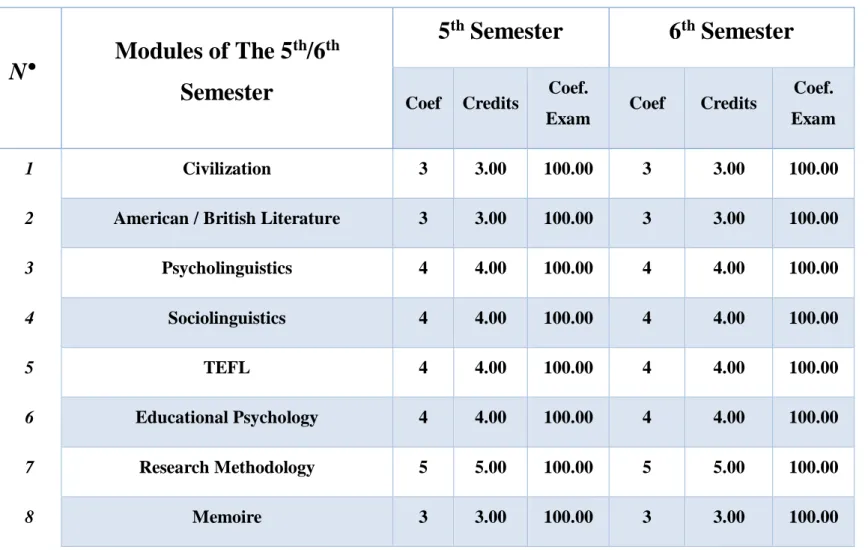
Table 1.7. Third Year 5th / 6th Semester LMD System Modules ……….. 29
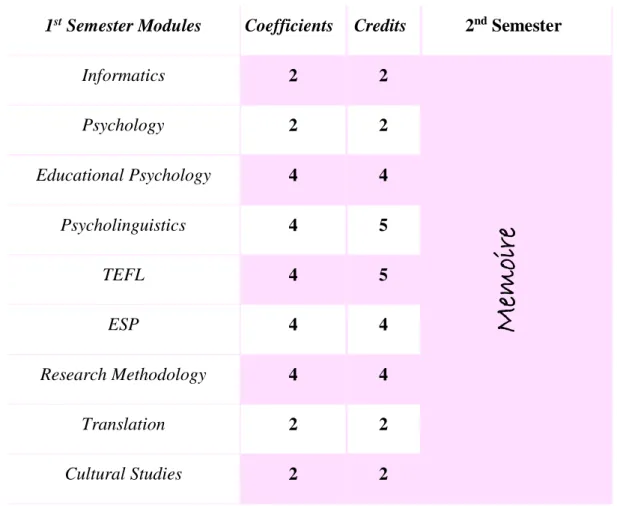
Table 1.8. Modules of the 1st Year Master Didactics (LMD), 1St/2nd Semester ….…. 30 Table 1.9. Modules of the 2nd Year Master Degree ……….… 31
Table 1.10. Doctorate Degree Modules 1st Year ……….… 32
Table 1.11. Teachers’ Qualification (2014-2015) ……….….. 34
C
hapterT
wo Table 2.1. Components of Personality ……….. 47C
hapterT
hree Table 3.1. Self-Acceptance and Self-Concept Connection ……….….. 105Table 3.2. Self Acceptance and Self-Evaluation Linkage ……….…. 106
Table 3.3. Teachers’ Consciousness and Concern with Students ………..110
Table 3.4. Teachers’ Openness and Reactions ………....118
Table 3.5. Teachers’ Sights towards Self-Efficacy ……… 119
Table. 3.6. Students’ Language Level Improvement ………...126
Table 3.7. Students’ Perception towards Teachers’ Qualities ……….133
Table 3.8. Students’ Perception to Teachers’ Values ……… 136
Table 3.9. Students’ Communication Stress vs. Teachers’ Communication Improvement Strategies ………... 137
C
hapterF
our Table 4.1. Students’ Satisfaction Questionnaire Template ………..170C
hapterO
neFigure 1.1. Sources of Self-Esteem According to Coopersmith (1967) ……….……08
Figure 1.2. Objectives of the Study ……….…...10
Figure 1. 3. Main Research Tools ……….…….14
Figure 1.4. The Main Personality Tests ……….……. 14
Figure 1.5. Personality Test Questions’ Meaning ……….… 16
Figure 1.6. Research Limitations ………... 20
Figure 1.7. Statistics on Students’ Number ……….…... 23
Figure 1.8. The Classical System ……….……. 23
Figure 1. 9. The LMD System ……….…...26
C
hapterT
wo Figure 2.1. Marwell’s Approaches to Self-Esteem (1978) ………..…. .49Figure 2.2. Wells and Marwell’s Different Interpretations of Self-Esteem ……..…..50
Figure 2.3. The Nature of Self-Esteem ……….….. 51
Figure 2.4. James’ Contemplation to Self-Esteem Components (1890) ………….….54
Figure 2.5. Mechanisms of the Self ……….55
Figure 2.6. Sources of Self-Esteem According to White (1959) ………. 56
Figure 2.7 GECAS’ Division to Self-Esteem (1982) ……….. 58
Figure 2.8. Self-Esteem Connection to Other Concepts ………. 64
Figure 2.9. Tajfel Self-Concept Components ………..66
Figure 2.10. Aspects of Self-Concept ………. 67
Figure 2.11. Self Concept’s Domains According to Bracken (1992) ………. 67
Figure 2.12. Self-Concepts Parts According To Rogers ……….….…68
Figure 2.13. Ashton Self-Efficacy Dimensions ………...70
Figure 2.14. Bandura Sources of Self-Efficacy ……….. 71 Figure 2.15. Self-Confidence in Language Teaching According to Valazza (2011)…76
VII
Figure 2.17. Factors Affecting Teachers’ Self-Esteem ………78
Figure 2.18. Coopersmith (1967) Sources of Self-Esteem ………. .81
Figure 2.19. Types of Self-Esteem ……….. 83
C
hapterT
hree Figure 3.1. Research Methods and Tools ………. 89Figure 3.2. Teachers’ Professional Self-Esteem at the Djilali Liabes University, the English Department, Sidi Bel Abbes. ……….…. 91
Figure 3.3. Teachers’ Self-Acceptance ……….….. 91
Figure 3.4. Teachers’ Sense of Self- Worthiness and Inferiority ……….….. 93
Figure 3.5. Teachers’ Self-Efficacy ………..….. 93
Figure 3.6. Teachers’ Body Image ……….……….… 94
Figure 3.7. Teachers’ Self-Evaluation ………...….. 95
Figure 3.8. Teachers’ Self-Consciousness ………..….... 96
Figure 3.9. Definition of Self-Confidence in Teaching ………..…… 98
Figure 3.10. Sources of Self-Confidence in Teaching ………..…. 100
Figure 3.11. Teachers’ Strategies for Developing Self-Confidence ………….….… 101
Figure 3.12. Teachers’ Definition of Self-Acceptance ……….….… 103
Figure 3.13. Teachers with high self-esteem’ Major Ways for Self-Evaluation…....107
Figure 3.14. Teachers with Average and Low Esteem’ Major Ways for Self-Evaluation ……….…. 107
Figure 3.15 Teachers’ Understanding of Self-Consciousness In Teaching …….…. 108
Figure 3.16. Teachers’ Carness about Students ……….... 111
Figure 3.17. Teachers with High, Average and Low Self-Esteem Common Behaviours……….……..112
Figure 3.18. Teachers Views towards Accolades ……….……… 114
Figure 3.19. Praise and Professional Self-Esteem Improvement ………….………..115
Figure 3.20. Students’ Partialities towards the Module ……….…... 125
Figure 3.21. Students’ Expectancies about the Learning Outcome (s) ……….…… 128
Figure 3.22. Students’ Attendance Motives ……….…..129
Figure 3.25. Students’ Evaluation to the Teachers ………...131
Figure 3.26. Students’ Opinion about Teacher’s Leadership ……….…... 132
Figure 3.27. Students’ Categorization to Teachers ………..…. 132
Figure 3.28. Teachers’ Students’ Relationship ………..……135
Figure 3.29. Teachers with High, Average and Low Self-Esteem Values ……..…..136
Figure 3.30. Students’ Motivation ………..…...136
Figure 3.31. Students’ Motivation Sources ……….…..136
Figure 3.32. Palm Kinds and Positions ……….….... 140
Figure 3.33. Arm Cross Gesture ………...… 141
Figure 3.34. First Teacher’s Handwriting (high self-esteem) ……… 141
Figure 3.35. Second Teacher’s Handwriting (high self-esteem) ………...… 141
Figure 3.36. Defensive Standing Position ………..….. 143
Figure 3.37. Teacher’s Handwriting (Average self-esteem) ………...…...….. 143
Figure 3.38. Teacher’s Handwriting (Average self-esteem) ……….……... 143
Figure 3.39. Crossed Arms ………..….145
Figure 3.40. Hands in the Pocket ………..….145
Figure 3.41. Teacher with Low-Self-Esteem Handwriting ………..…..145
C
hapterF
our Figure 4.1. Teachers’ Personality’ Types ……….……....156Figure 4.2. Teachers’ Personality Type Owing To Wenglinsky (2001) …….……..156
Figure 4.3. Teachers’ Personality Development Components ……….…… 157
Figure 4.4. Types of self-Awareness ……….……... 158
Figure 4.5. Teachers’ Professional Self-Awareness ……….……… 159
Figure 4.6. Stephen Covey Time Management (1994) ………160
Figure 4.7 Tips for Time Management by Exforsys (2007) ……….……….160
Figure 4.8. Teachers’ Personality and Body Language Development …………... 161
Figure 4.9. Negative Body Language ………162
Figure 4.10. Gripping Hands, Arms and Wrists ………... 163
IX
Figure 4.15. Steps To Be a Facilitator Teacher ……….…... 174
Figure 4.16. Nunan’s Classification to Needs’ Analysis ……….….…… 176
Figure 4.17. Team-Teaching Models by Alyssa Zelkowitz ……….……. 177
Figure 4.18. Types of Assertiveness (Garner 2012) ………..180
Figure 4.19. Tips for Being a Good Assertive Teacher ……… 181
Figure 4.20. Responding To Compliments ……….. 182
Figure 4.21. Responding to Criticism ……… 182
Figure 4.22. Saying “No” To Others ……… 183
Figure 4.23. Overcoming Shyness ……….………... 183
Figure 4.24. Expressing Feelings ……….………. 184
Figure 4.25. Confessing Mistakes ……….……… 184
Figure 4.26. Assertive Communication and Management ……….……185
Figure 4.27. Teacher / Student Feedback ……….…. 186
Figure 4.28. Cooperative Teaching and Learning ……….…… 186
Figure 4.29. Tips for Perfectionism Avoidance ……….…... 187
Table of Contents
Dedications ………... I Acknowledgments ……….………… II Abstract ……….………... III List of Abbreviations and Acronyms ……….… IV List of Tables ……….………..….. V List of Figures ………... VI Table of Contents ……….. X
General Introduction ………....…... 01
C
hapterO
ne:
D
escription of theT
eaching andL
earningS
ituation 1.1. Introduction ……….……….…….………071.2. Background of the Study ………....……….….…...…. 07
1.3. Significance of the Study ……….………..08
1.4. Statement of the Problem ……….………..09
1.5. Purpose of the Study ………. 10
1.6. Objective (s) of the Study ………. 10
1.7. Research Questions ………11
1.8. The Scope of the Study ………..…11
1.9. Personal Motives of the Study ………11
1.10. Research Method (s) ………11
1.11. Sampling ……….12
1.12. Research Tools ………14
1.12.1. Personality Tests ……….. 14
1.12.1.1. Rosenberg Self-Esteem Scale ……….………..…... 15
1.12.1.2. Janis-Field Feeling of Inadequacy Scale (JFS) ……….…..… 15
1.12.1.3. Measurement of The Revised Janis-Field Feeling of Inadequacy Scale (JFS)….... 15
1.12.2. Questionnaire……… 16
1.12.3. Observation ……….. 18
1.12.4. Interview ………... 20
1.13. The Research Limitations ………...20
1.13.1. Lack of References ………...…...21
1.13.2. Difficulties in The Questionnaire Application ………….……….…..……….21
XI
1.13.5. Students’ Sloppiness and Lack of Vocabulary ………..….22
1.14. Description of the English Department ………..22
1.14.1. Historical Review ………...……22
1.15. The Educational Systems ………...……….23
1.15.1. The Classical System ………...23
1.15.2. The LMD System ………25
1.15.2.1. The Aims of the LMD System ………...25
1.15.2.2. The LMD system Structure ………26
1.15.2.2.1. Bachelor Art of Degree in English (BAC + 03 Years) ……….………26
1.15.2.2.2. Master Degree (BAC + 5 years) ……….…... 30
1.15.2.2.3. Doctorate Degree (BAC + 10 Years) ……….……...31
1.16. Teachers’ Views and Problems with the LMD System ……….…32
1.17. Teachers’ Profile ………33
1.17.1. Teachers’ Qualification and Ranks ………. 33
1.17.2. Teachers’ Attitudes to English Language Teaching ………34
1.17.3. Teachers’ Teaching Experience ……….. 34
1.17.4. Teachers’ Personality ……….. 35
1.18. Students’ Profile ……….35
1.18.1. Students’ Motivation ………... 35
1.18.2. Students’ Attitudes To English Language Learning ……… 36
1.18.3. Students’ Attitudes Towards Teachers ……….36
1.18.4. Students – Teachers’ Relationship ………37
C
hapterT
wo:
L
iteraryR
eview2.1. Introduction ………...…43
2.2. Definition of Teaching ………...…43
2.3. Definition of Effective Teaching ………...44
2.4. Definition of Learning ……….46
2.5. Definition of Personality in Psychology ………..46
2.6. Components of Personality ……….47
2.7. Definition of Self-Esteem ………48
2.8. The Nature of Self-Esteem ………51
2.8.1. Global self-esteem ………..………..51
2.8.2. Feelings of Self-Worth ………..………...52
2.8.3. Self- Evaluations ……….………..…………..…………..53
2.9. History of Self-Esteem as a Construct ………53
2.10. Self-Esteem as Competence ………59
2.11. Self-Esteem as Worthiness ………..62
2.12. Self-Esteem as Competence and Worth ………..63
2.13. Self Esteem in Relations to Other Concepts ………...64
2.13.1. Self-Esteem In Connection to Self-Concept ………..…...64
2.13.2. Self-Esteem In Connection to Self-Confidence ………...69
2.13.3. Self-Esteem in Connection to Self-Efficacy………..69
2.13.3.1. Teachers’ Self-Efficacy ………..………..70
2.13.3.2. The Role of Self-Efficacy ………..……...71
2.13.3.3. Strategies to Improve Self-Efficacy ………..…………...72
2.13.4. Self-Esteem In Connection to Self-Evaluation ………..………72
2.13.5. Self- Esteem in Connection to Body Image ………..………...73
2.13.6. Self-esteem In Connection to Academic Performance ………..…...74
2.14. Self-Esteem and Foreign Language Learning ………74
2.15. Self-Esteem and Language Teaching ……….75
2.15.1. Self-Confidence and Knowledge ……….……….76
2.15.2. Self-Confidence, Teaching Ability and Skills ………..77
2.15.3. Self-Confident and Awareness ……….…………77
2.15.4. Self-confidence and Attitude ……….……...…77
XIII
2.16.1.1. Family Presence ………..……...…78
2.16.1.2. School/ or Institution Impact ………..……...79
2.16.1.3. Acquaintances / Colleagues Presence ……….………..….79
2.16.2. Failure/ Success Experiences ……….………….…...79
2.16.2.1. New Experience/Situation ………...79
2.16.3. Physical / Mental Appearance ……….………….…..80
2.16.3.1. Self-Body Image ………...…….80
2.16.3.2. Maturation and Mental Progress ……….………..….80
2.16.4. Other Factors ……….…….80
2.16.4.1. Doubting Words From A Loved One ………..………. 81
2.16.4.2. Excessive Negativity and Criticism ……….………..………81
2.16.4.3. Perfectionism ………..……...81
2.17. Sources of Self-Esteem ……….81
2.17.1. Acceptance vs. Rejection ………..…82
2.17.2. Virtue vs. Powerlessness ………..…….82
2.17.3. Achievement vs. Failure ………...…….82
2.17.4. Competence and Worthiness ……….……...…….82
2.18. Types of Self-Esteem ……….……….……….83
2.18.1. High Self-Esteem ……….………..83
2.18.2. Features of High Self-Esteem ……….………83
2.18.3. Secure vs. Fragile Self-Esteem ………...84
2.18.4. Explicit vs. Implicit Self-Esteem ………84
2.18.5. Low Self-Esteem ………...84
C
hapterT
hree:
D
ataA
nalysis andI
nterpretation3.1. Introduction ………..….…..88
3.2. Research Procedures and Methodology ……….…..…...88
3.2.1. A Pilot Study ……….………88
3.2.2. Research Methodology ……….………...….89
3.2.2.1.Qualitative and Quantitative Tools ……….….…..…..89
3.3. Subjects of The Study ……….….…...90
3.4. Data Analysis and Interpretation ………..…..90
3.4.1. Revised Janis and Field Scale ………..……….…...90
3.4.1.1.Revised Janis and Field Scale Analysis and Interpretation ………..…....91
3.4.1.1.1. Part One: Teachers’ Self-Acceptance ………....……91
3.4.1.1.2. Teachers’ Sense of Self- Worthiness and Inferiority ………..…..….92
3.4.1.1.3. Teachers’ Self-Efficacy ………...…..…..93
3.4.1.1.4. Teachers’ Body Image ……….…...…94
3.4.1.1.5. Teachers’ Self Evaluation ………..…..…..95
3.4.1.1.6. Teachers’ Self-Consciousness ……….…...….96
3.4.2. Questionnaire ……….………..…....97
3.4.2.1. Teacher’s Questionnaire Structure ………...…………..….…97
3.4.2.2. Teacher’s Questionnaire Analysis and Interpretation ………...……..…..…..98
3.4.2.2.1. Part One: Professional Self-Esteem and Self-Confidence ………….…….…..…98
3.4.2.2.2. Part Two: Professional Self-Esteem and Self-Acceptance ……….……….……103
3.4.2.2.3. Part Three: Professional Self-Esteem and Self-Consciousness ……….…..…...108
3.4.2.2.4. Part Four: Professional Self-Esteem, Teachers’ Goals, Values and the Effect of Reward ………...…………..113
3.4.2.2.5. Part Five: Professional Self-Esteem and Teacher’s Behaviour (s), and Self-Efficacy ………..……114
3.4.3. Comparative Analysis of Teachers’ Questionnaire ……….121
3.4.4. Students’ Questionnaire Structure, Analysis and Interpretation ………..…..…124
3.4.5. Observation ………139
3.4.5.1.Teachers with High Self-Esteem ………139
3.4.5.2.Teachers with Average Self-Esteem ……….……….……142
3.4.5.3.Teacher with Low-Self-Esteem ………..………144
3.4.6. Comparative Analysis of Students’ Questionnaire and Observation ……….146
XV
3.5. Conclusion ………..150
C
hapterF
our:
S
uggestions andR
ecommendations 4.1. Introduction ……….………...…1554.2. Teacher’ Personality Training ……….………...155
4.3. Teachers’ Personality Development ………..156
4.3.1. Believe One Self ………157
4.3.2. Self-Awareness ………..157
4.3.2.1. Types of Self-Awareness ………..……..158
4.3.2.1.1. Public Self-Awareness ………...158
4.3.2.1.2. Private Self-Awareness ………..158
4.4. Time Management ……….159
4.4.1. Time Management Matrix ………159
4.5. Body Language ………...161
4.5.1. Basic Do’s For Body Language ………...161
4.5.1.1. Maintaining Eye Contact ………..…….……...161
4.5.1.2. Facial Expressions ………..…..161
4.5.2. Negative Body Language ………...162
4.5.2.1. Fidgeting ………..……....162
4.5.2.2. Standing too close ……….……..162
4.5.2.3. Crossing your arms ……….………163
4.5.2.4. Gripping Hands, Arms and Wrists ……….….……163
4.6.Teachers’ Speech Development ………..………163
4.6.1. Others’ Positive Perception ……….………..……164
4.6.2. Self-Expression ………...………..……164
4.6.3. Tips For Improving Teachers’ Speech Communication Skills ……….…....…164
4.6.3.1. Self-Confidence ……….………….…..…165
4.6.3.2. Polite Speech and Body Language ………...………….………...…165
4.6.3.3. Voice Tone ………...………….………165
4.7.Developing Teacher’s Character ………..…………...………….…….…….…166
4.8.Self-Esteem and Leadership ………..…………...………….…….…….…166
4.8.1. Bad Teachers Leaders Behaviours ………..…………...………...…….…166
4.8.2. Good Teachers Leaders Behaviours ………..……….…....……….…..…….…167
4.8.2.1. Accepting Differences and Others Shines ………..…….……...………..……..……167
4.8.2.3. Avoid Blaming Others ……….…..…..168
4.8.2.4. Be The leader Not The Boss ……….168
4.9.Teacher Constructivist ( Constructivism) ………168
4.10. Learner Centeredness Approach………..168
4.11. Students’ Satisfaction Questionnaire ………..169
4.12. Reflective Teaching ………172
4.12.1 Techniques to Be A Reflective Teaching ……….………..172
4.12.1.1. Teacher Diary ……….……...173 4.12.1.2. Peer Observation ………...173 4.12.1.3. Recording Lessons ………173 4.12.1.4. Students’ Feedback ……...………173 4.13.Teachers’ Roles ………...….……..173 4.13.1. Teacher as a Facilitator ………..……….……174
4.13.1.1. Raise learners’ Awareness ………..…….……..175
4.13.1.2. Recognize Students’ Goals ………...….…175
4.13.1.3. Students’ Involvement ………....…...175 4.13.1.4. To Go Beyond Classroom ………....……175 4.13.1.5. Be A Good Observer ……….…....…175 4.13.1.6. Be a Good Listener ………....……176 4.14.Needs Analysis ……….…..176 4.15.Team Teaching ……….…..177
4.15.1. One teach, One Observe ……….………….…...178
4.15.2. One Teach, One Assist ……….…….…….178
4.15.3. Station Teaching /or Rational Teaching ……….…….…...178
4.15.4. Parallel Teaching ……….….……..178
4.15.5. Alternative Teaching ………..………178
4.15.6. Tag Team / or Traditional co-teaching ………..……179
4.16. Assertiveness ……….…...179 4.16.1. Types of Assertiveness ………..………….…...179 4.16.1.1. Passive Assertiveness ………..….……….180 4.16.1.2. Aggressive Assertiveness ………..…….…...…180 4.16.1.3. Good Assertiveness ………...………180 4.16.2. Assertiveness Application ……….…….181 4.16.2.1. Responding To Compliments ……….……...181
XVI I
4.16.2.3. Saying “No” To Others ……….……182
4.16.2.4. Overcoming Shyness ………...…..……183
4.16.2.5. Expressing Feelings ………....….…..183
4.16.2.6. Admitting Mistakes ……….…..184
4.16.3. Assertive Communication and Management ……….184
4.16.3.1. Description and Specification ………..…….…….185
4.16.3.2. Constructive Feedback ……….…….……185
4.16.3.3. Co-Operation ……….…….…..186
4.16.3.4. Diversity not The Sameness ……….….……187
4.16.3.5. Fairness not Favoritism ……….….…...187
4.17. Avoiding Perctionism ………187
4.17.1. Forgive oneself and Shortcomings ………...………..188
4.17.2. Separate Results from Judgement ………...…...188
4.17.3. Reflect on Failures ………...…..188 4.17.4. Reflect on Success ………...…..189 4.18. Conclusion ………...…189 General Conclusion ………190 Bibliography ………..195 Web-bibliography ………..203 Glossary ……….214 Authors’ Index ……….…..217 Appendices ………220
- Appendix A: Revised Janis and Field Scale Self Esteem Test ………….………….221
- Appendix B: Teachers’ Questionnaire ……….………. 222
- Appendix C: Teacher’s Interview ……….……….…226
General Introduction
It is undeniably clear that the state of any country depends mainly on the quality of the education provided since it contributes to the development of both personal and societies’ level. The fact that the existence of human beings would be worthless without education makes the later paramount. It is meant to be the means of respect, recognition and identification that humans possess.
Education stands for the holistic and continuous process of learning and seeking knowledge in several disciplines. It has a positive and constructive impact on humans’ lives as well their community. The prime aim of education is to foster , not only, students’ knowledge and crafts, but also their personality. This means that the teaching process aims at nurturing individual moral and intellectual capacities so as to make them valuable members in society.
As a matter of fact, teaching is a noble profession. The terms of teaching has materialized a positioned area of research as embraces an endless range of meanings. Since the teaching process involves a cluster of activities, researches’ attention was deeply drawn into the secret behind effective teaching.
Notwithstanding the reality that myriad studies accentuated on the teaching effectiveness relevancy, still there is no clear or absolute definition of effective teaching. Teaching effectively may differ due to multifaceted cultures, perceptions and interpretations. In some cultures, a good and effective teacher is that who monitors students’ learning and puts a strong emphasis on individual creativity and independent learning. In such atmosphere, students may be able to question, challenge and sometimes are free to gainsay what the teacher says.
Thus, creating a conductive learning atmosphere depends basically on teachers’ personal beliefs and principles about both the teaching and learning processes, as well as their personality type. Despite the fact that researchers diverged in defining teachers’ effectiveness in a foreign language class, portfolios of studies have proved that teachers’ personality, tends to contribute to a large extent in the progress of students’ language learning.
Indeed, one of the most important personality traits that teachers need to possess is self-esteem. It solely defined as the personal image that people provide for themselves, how they perceive themselves as being valuable and worthy members in society.
2
character. For teachers, it is deemed to be the secret behind their efficient teaching. The fact of holding a high or low self-esteem in language teaching is crucial. It has been acclaimed for teachers, more than others, to develop their personal self-esteem since it can level off both the teaching and learning processes.
In many cases, the teacher is viewed as an ideal person, with a particular attractive character that tends to influence students desire to language learning. If that teacher’s self-esteem is either high or low, students are more likely to recognize and depict it. Although several studies had been conducted on the concept, few of them approached teachers’ self-esteem.
For that reason, the motive behind undertaking this research is to delve into the self-esteem notion in general, and to pore over teachers’ professional self-esteem in particular. In view of the fact that teachers are different in terms of self-esteem level which impacts their behaviour, decisions, contact with students and the way (s) of dealing with conundrums in classroom, the researcher thought to divulge the connection between teachers self-esteem and students language learning and personality development. Since the issue “teachers’ professional self-esteem” has been absent from most of educational psychology discussions, the researcher believes that it would be worthy to scrutinize the significance of that self-esteem in foreign language classes as a means to revitalize the teaching process.
Henceforth, the present study represents an attempt towards enlightening the concept of teachers’ professional self- esteem at the level of the English Language Department, Djilali Liabes University, Sidi Bel Abbes. The primary objective of the investigation is to confirm that both successful teaching and learning can be discernibly linked to self-esteem and to affirm the extent to which its development is necessary for efficiently teaching foreign language learners’ classes.
Thus, the core question of this research is:
Does teachers’ professional self-esteem impact students’ willingness to learn besides to their academic and personal improvement?
Then, further sub-questions are raised:
1. Do teachers believe that self-esteem contributes to their effective teaching?
2. Does students’ academic failure / or success affect teachers’ self-esteem?
3. Is students - teachers’ relationship important in developing teachers’ professional self-esteem?
The following hypotheses are proposed to conduct the research:
1. Students are more likely to be motivated to learn especially when teachers possess an acceptable level of self-esteem to which students’ accomplishment is linked.
2. Most teachers confess the importance of professional self-esteem in their teaching career.
3. Students’ academic failure/ or success can either nurture or decrease teacher’s professional self-esteem.
4. Students- teachers’ relationship is part of teachers’ professional self-esteem development.
The following research is based on a “comparative study” that is made between teachers with different levels of self-esteem. The aim is to compare teacher’s professional self-esteem and to examine its impact on students’ at both academic and personal level. Therefore, students’ views will be also taken into account, i.e. the way they perceive their teachers’ self-esteem and whether they are emotionally and academically affected or not. This signifies that the research sample embraces both teachers and students. Then, in order to achieve the pre-ordained objectives, four main tools have been utilized: Janis Field Test for teachers, questionnaire for both teachers and students, interview for teachers, and observation.
Subsequently, in trying to explain the concept and analyzing the situation, the study consists of four chapters. The first chapter is a description to the teaching and learning situation. It aims to provide a general portrayal to teachers and students’ profile, teachers’ teaching experiences, and the main hindrances faced by teachers in trying to develop professionally. The second chapter is a literary review. It focuses on defining self-esteem in general, and tries to find out its affiliation with other concepts. It recapitulates the prime leading self-esteem theories, and list some of the main factors that impact teachers’ self esteem.
The third chapter is devoted for analyzing the data that is gathered through a number of tools, then, interpreting it. The goal of this section is to figure out the difference between possessing a high/ and low self esteem, and to notice its impact on students in practice. The final chapter is concerned with offering some ideas and suggestion about the way (s) to develop teachers’ self-esteem. It tries to propose some techniques that can improve teachers’ personal view, and that would fit our objective that is rejuvenate the teaching process via enhancing educator’s self-esteem.
C
hapterO
ne:
D
escription of theT
eaching andL
earningS
ituation1.1.Introduction ……….……….…….………07 1.2. Background of the Study ………....……….….…...…. 07 1.3. Significance of the Study ……….………..08 1.4. Statement of the Problem ……….………..09 1.5. Purpose of the Study ………. 10 1.6. Objective (s) of the Study ………. 10 1.7. Research Questions ………11 1.8. The Scope of the Study ………..…11 1.9. Personal Motives of the Study ………11 1.10. Research Method (s) ………11 1.11. Sampling ……….12 1.12. Research Tools ………14 1.12.1. Personality Tests ……….. 14 1.12.1.1. Rosenberg Self-Esteem Scale ……….………..…... 15 1.12.1.2. Janis-Field Feeling of Inadequacy Scale (JFS) ……….…..… 15 1.12.1.3. Measurement of The Revised Janis-Field Feeling of Inadequacy Scale (JFS)….... 15 1.12.2. Questionnaire……… 16 1.12.3. Observation ……….. 18 1.12.4. Interview ………... 20 1.13. The Research Limitations ………...20 1.13.1. Lack of References ………...…...21 1.13.2. Difficulties in The Questionnaire Application ………….……….…..……….21 1.13.3. The Sample Size ………..…..……...21 1.13.4. Questionnaire Responses ……….…..…. 21 1.13.5. Students’ Sloppiness and Lack of Vocabulary ……….…..….22
6
1.14. Description of the English Department ………..22 1.14.1. Historical Review ………...……22 1.15. The Educational Systems ………...……….23 1.15.1. The Classical System ………...23 1.15.2. The LMD System ………25 1.15.2.1. The Aims of the LMD System ………...25 1.15.2.2. The LMD system Structure ………26 1.15.2.2.1. Bachelor Art of Degree in English (BAC + 03 Years) ……….………26 1.15.2.2.2. Master Degree (BAC + 5 years) ……….…... 30 1.15.2.2.3. Doctorate Degree (BAC + 10 Years) ……….……...31 1.16. Teachers’ Views and Problems with the LMD System ……….…33 1.17. Teachers’ Profile ………33 1.17.1. Teachers’ Qualification and Ranks ………. 34 1.17.2. Teachers’ Attitudes to English Language Teaching ………34 1.17.3. Teachers’ Teaching Experience ……….. 35 1.17.4. Teachers’ Personality ……….. 35 1.18. Students’ Profile ……….36 1.18.1. Students’ Motivation ………... 36 1.18.2. Students’ Attitudes To English Language Learning ……… 36 1.18.3. Students’ Attitudes Towards Teachers ……….37 1.18.4. Students – Teachers’ Relationship ………38 1.19. Conclusion ……….38
1.1. Introduction
This chapter sheds light on the status quo of professional self-esteem in regard to teaching and learning the English language at the level of the English Department at Djilali Liabes University , Sidi Bel Abbes. First, a stab will be made at explaining, briefly, what self-esteem means and stating its importance in teaching. Then, it is necessary to provide a clear portrayal of the English department and determine the difference between the contemporary LMD educational system and the Classical system that is fading away. After that, teachers’ profile, their teaching experience and their behaviours in classroom will be looked at. It also intends to highlight teachers’ students contact and relationships in class. Finally, it describes the methodology followed, and the tools used in this study.
1.2. Background of the Study
In Educational psychology, self-esteem has materialized an important area of research. James and Mead (1890) were the first ones to launch some studies about self-esteem. They claim that self-esteem is the source of one’s success. In order to increase self-esteem, one may either improve his/ her successes, or decline his/her negative expectations for accomplishment. This affects one understanding of self-esteem (Wickline, 2003).
In addition, owing to Bednar and Peterson (1999), each person relies on the creative self as a means to build up his own real view. So, self-esteem is that feeling of satisfaction that is the outcome of one success. In his turn, Coopersmith (1967) mentioned that the feeling of unworthiness and inadequacy makes people experience a sense of inferiority and incapability to tackle or improve their situation.
Then, as the figure below demonstrates, Coopersmith (1967) suggests three prime sources that lead to the development of self-esteem, which are: personal value provided to one experience of success, personal definition of success and failure, as well as the ways of dealing with negative feedback and criticism. As for the humanists, self-esteem is regarded as the prime source of academic achievements.
8
Figure 1.1. Sources of Self-Esteem According to Coopersmith (1967)
In the western and European culture, students’ academic performances are depending mainly on their self-esteem (Spinath et al..., 2006; Skaalvik and Valas; 1999). But, the ability to generalize the findings on other cultures is still questioned. On the same line, a research done in Kenya focuses on the link between self-esteem and academic performance in Math and English reveals that students who have high grades tend to possess a high self-esteem (Herbert W. M; 2006).
1.3. Significance of the Study
As evaluating students’ language progress is necessary, measuring teachers’ improvement is relevant too. That is to say, if teachers are professionally developed, they would possess a healthy self-esteem. It is for this reason that knowledge about the role which teacher’s professional self-esteem plays in second language class is to be clear for both teachers and students.
Hence, self-esteem is significant not only in one’s personal life, but also in the professional one. Greater understanding of how far teachers’ professional self-esteem impacts students’ academic progress will facilitate the improvement of learners. The absence of healthy professional self-esteem has a negative influence that has been shown by sundry studies as Mwiti (1989), in the sense, that it would change the desire of students to excel in their studies and the teachers’ aspiration in their teaching.
Personal value provided to one experience of success Personal Definition to Success or Failure The Ways of Dealing with Negative Feedback or Criticism
1.4. Statement of the Problem
In Algeria, the concept of students ‘self-esteem is discussed on a large scale. Yet, little attention is provided for teachers’ self-esteem and its influence on student’s improvement especially in language learning. Still, one of the common beliefs is that teachers play a vital role in shaping students’ lives. Indeed, most of Algerian students claim that they have been deeply touched and encouraged by their teachers. They feel so attached to their tutors that they would sometimes, change their attitudes, beliefs, or learning habits ; teachers’ helped them to gain an insight vision about themselves.
When it comes to language learning, students tend to be quite attracted by their teachers and so fellow them up, because they influence them. That is to say, they would imitate their teachers in their way (s) of speaking, behaviours…etc. However, if these teachers do not pay attention to their behaviours in classroom, or do not try to further develop their level, deepen their knowledge or learn some new skills, they will not be able to influence their students. This fact would lead to decrease students’ desire for learning.
Still, the problem is that little attention is provided for teachers’ professional self-esteem and what influence it has on students. If teachers are bound to provide necessary knowledge for learners and to help them improve, who is responsible for teachers’ improvement? Then, it is also believed that university teaching is somehow different from High/ middle school teaching, teachers need to be professionally, but mainly, psychologically prepared for facing hundreds of learners and ready to change their lives.
Nevertheless, as it is the case for most Algerian teachers, no training courses are provided for university teaching. The big issue is about teachers’ ability to create a professional self-esteem that would help them to be more dynamic and flexible with learners. In return, it would enable students to develop both academically and personally.
For these reasons, the major problematic of this study is to investigate teachers own understanding of self-esteem, and to evaluate it based on some selected research instruments. The study aims to rejuvenate the concept of self-esteem in teaching; it tries to examine teachers’ professional self-esteem and see what impact it has on learners while learning a language. It also tries to show the link existing between teachers’ professional self-esteem and students’ language learning development.
10 1.5. Purpose of the Study
The main purpose of the study is to pore over the essence influence of teachers’ professional self-esteem on learners. It is meant to discover teachers’ estimation of their professional self-esteem and how can it interact with learners’ language learning development. On the basis of this purpose, some objectives have been formulated.
1.6. Objective (s) of the Study
Figure 1.2. Objectives of the Study
To revitalize the importance of the self-esteem concept in language teaching.
To reveal the relationship that exists between teachers’ professional self-esteem and students’ development.
To examine the impact of teachers’ professional self-esteem on students both academic
and personal improvement; how can teachers affect students language learning development/ or failure . Ojectives To revitalize self-esteem in teaching Teachers’ professional self-esteem and students’
development. The impact of teachers’ professional self-esteem on students
1.7. Research Questions
On the basis of the previously mentioned objectives, four main questions were underscored:
1. Does teachers’ professional self-esteem impact students’ willingness to learn
besides to their academic and personal improvement?
2. Do teachers believe that self-esteem contributes to their effective teaching? 3. Do students’ academic development affect teachers’ self-esteem?
4. Is students - teachers’ relationship important in developing teachers’ professional
self-esteem?
1.8. The Scope of the Study
The study is conducted at the level of Djilali Liabes University, faculty of Letters, Languages and Arts; English Department, in Sidi Bel Abbes, Algeria. The Department contains students from different towns, the majority possessing the same nationality, Algerian. The location is selected because it is thought to encompass a variety of teachers who hold different kinds of academic degrees and distinct professional self-esteem level.
1.9. Personal Motives of the Study
Many students believe that some teachers have shaped their lives. Such teachers could influence their students either personally or academically, i.e. either throughout their teaching methodology or personality and behaviours. Then, teacher-students’ relationship is, also, said to be paramount in improving student’s willingness to learn, and maintaining teachers’ positive self-image. Hence, the essence derive behind undertaking such investigation is to reveal the link between teachers’ self-esteem and students’ personal and academic growth.
1.10. Research Method (s)
The research is based on a comparison between teachers who have different types of professional self-esteem: high, average and low self-esteem. Since the notion of professional
12
self-esteem has gained little attention, that is, few data and methods could be found and followed, a Pilot study 1 was first conducted.
In addition, as the prime aim is to measure teachers’ professional self-esteem as well as describe it, a combination between qualitative and quantitative method within a single research framework seem to be an appropriate method to follow. This later is called “The Mixed Method”. This means that a variety of instruments will be selected as to facilitate data collection and to make the study somehow reliable.
1.11. Sampling
There are many methods of selecting the right sample for the research. The main ones are: Probability methods - Quota methods - Selective methods - Convenience methods - Ethnographic methods (see the table 1.1 below). As the study is concerned with teachers’ professional self-esteem, teachers of the English language at the Djilali Liabes University will be the target population. Then, since the majority of teachers are available and easy to contact, the simple random sampling method seems the appropriate sampling method. Although the total number of teachers at this department is does not exceed 38, only 22 teachers have been selected to be questioned and tested and 05 teachers would be picked up for observation.
Moreover, as to compare teachers’ personal professional view with students’ sight towards teachers , third year LMD students will, also, be part of the study sample. Yet, since third year LMD students’ number is between 180 up to 260; and it is difficult to question all of them, only one group “E” will be chosen.
1 Pilot Study: A small study conducted in advance of a planned project, specifically to test aspects of the research
Definition Methods Use P robabil it y M eth ods It is believed to be the best as it is possible to use the most powerful statistical Analysis on the results.
Simple Random
Sampling Whole population is available.
Stratified Sampling
There are specific sub-groups to investigate (ex. demographic groupings).
Cluster Sampling
When population groups are separated and access to all is difficult (ex: in many distant cities)
Quot
a
meth
ods Often used when the study involves groups where sub-groups are small.
Quota Sampling
Accessibility to a wide population, including sub-groups, only needed are selected.
Proportionate Quota Sampling
When normal sampling may not give enough in minority groups
Non- Proportionate Quota Sampling
Minimum number from each sub-group is selected he study is about characteristic within minority groups S elec ti ve meth ods When there is a particular groups Purposive Sampling
Study focuses on a particular groups.
Expert Sampling Seeking expert opinions Snowball Sampling When recommendations are
required, Modal Instance
Sampling 'Typical' opinions are sought. Diversity sampling When the study seeks specific
differences C on ve n ience M eth ods If there is no time or funds, convenience methods are suitable.
Snowball Sampling Similar subjects are sought. Convenience
Sampling
The sample is selective from people who are available
Judgment Sampling
It is to guess a good-enough sample
E th n ogr aph ic M eth ods
The study is based on who is available and willing to participate.
Selective Sampling Focus is needed in particular group, location, subject, etc.
Theoretical Sampling
Theories are emerging and focused sampling may help clarify these. Convenience
Sampling Others samples cannot be found. Judgment
Sampling
It is a quick sample selection representative of the study purposes.
14 1.12. Research Tools
In order to attain the intended objectives, a combination of instruments have been chosen: Personality Test (Revised Janis and Field Scale) – questionnaire – interview and observation.
Figure 1. 3. Main Research Tools 1.12.1. Personality Tests
There exist several methods of self-esteem measurement; one of the most common way is the use of a “test”. Some of these tests are particularly designed for younger children as for: Coopersmith Self-Esteem Inventory, Pope's 5-Scale Test of Self-Esteem for children, and Kid- kindl, whereas the others means are premeditated for adults such as: Rosenberg Self-Esteem Scale and Janis-Field Feeling of Inadequacy Scale.
Figure 1.4. The Main Personality Tests Personality
Test Questionnaire Interview Observation
Self-Esteem Measurement
Self-Esteem Tests for Younger Children
Coopersmith Self-Esteem Inventory
Pope's 5-Scale
Kid-Kindl
Self-Esteem Tests for Adults
Rosenberg Self-Esteem
Janis-Field Feeling of Inadequacy Scale
1.12.1.1. Rosenberg Self-Esteem Scale
Self-esteem test was a pioneer idea come up by Rosenberg. The later believed that self-esteem is shown when the person has the same positive/ or negative attitude towards oneself and the others (person/objects). In this respect, if the attitudes towards other objects can be measured, then, measuring attitudes toward oneself is also plausible. Rosenberg test comprises 10 questions evaluated using four level scale.
1.12.1.2. Janis-Field Feeling of Inadequacy Scale (JFS)
Janis- Field Feeling of Inadequacy Scale represents only one part of a large number of instruments used to measure self-esteem. The original JFS was developed in 1959 and designed for adults. It embraces 23 questions meant to reveal people’s self-consciousness, anxiety and personal worthlessness. People express their agreement on the questions asked using five alternative responses: very, fairly, slightly, not very and not at all. Those items are scored from zero to four (0 to 4) for a possible feeling of inadequacy from 0 to 92. Low scores indicate low self-esteem, and high scores indicate high self-esteem. (Cited in John P. Robinson, Phillip R. Shaver, Lawrence S. Wrightsman, page 124).
JFS was modified so many times in accordance with Shavelson et al hierarchical facet model of self-esteem. Items added tackle self-regard, academic abilities, social confidence and appearances. Thus, the scale scoring changed from (0 to 4) to (0 to 7). The JFS was recommended for researchers dealing with the main components of self-esteem.
1.12.1.3. Measurement of The Revised Janis-Field Feeling of Inadequacy Scale (JFS)
The JFS test was the first selected tool as a means to measure teachers’ professional self-esteem. Yet, among the 36 questions of the revised Janis-Field Feeling of Inadequacy Scale, only 15 questions were picked up. These questions are believed to be linked to the current study, whilst the remaining questions (21) do not.
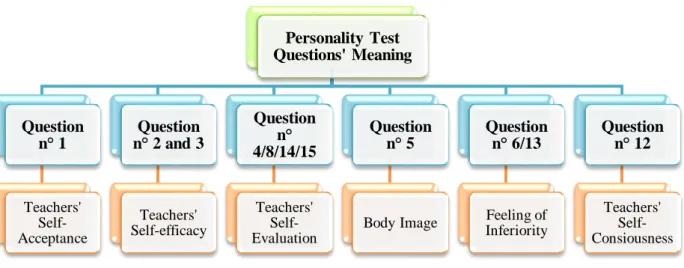
To put it clear, questions (1/7/9/10/11) are meant to discover teachers’ self-acceptance, while questions (6/13) are considered as the outcome of the previous questions (1/7/9/10/11). This means that, if teachers experience a sense of inadequacy, and worthlessness, they would experience a sense of inferiority as well. Questions (2/3) deal with teachers’ self-efficacy, whilst only one question (5) caters body image. Questions (4/8/14/15) are meant to discover teachers’
16
self-evaluation, i.e. if people’s views affect teachers’ personal evaluation or not. The last question (12) tackles teachers’ self-consciousness.
Figure 1.5. Personality Test Questions’ Meaning
Henceforth, teachers need to express their view on the 15 questions using four items: very often, sometimes, once in a great while and practically never, or the extent of their confidence using the items: very confident, slightly confident, not very confident and not at all confident. The items are, then, scored from 1 to 4. The total score can range from 30 up to 60.
Then, the Likert scale is used as the means to calculate teachers’ professional self-esteem mean. The general teacher’s test score will be divided by the number of questions (15). The mean will determine teachers’ professional self-esteem level. That is to say, if the mean is more than one and less than two (1 ≤ the mean ≤ 2) it is a low self-esteem. If it is more than two less than three (2 ≤ the mean ≤ 3) it is a medium self-esteem. If it is more than three nearly four high self-esteem (3 ≤ the mean ≤ 4), for instance: 2 ≤ 2.3 ≤ 3 is an medium level of self-esteem.
1.12.2. Questionnaire
There are sundry ways for gathering information; surveys are the wide known ones. That is to say, a survey is a simple discussion or interview done with individuals about a specific topic. A questionnaire can be simply defined as series of questions addressed to participants to gather specific answers. It helps to describe the nature and find out the truth behind an existing condition or determine the relationship between events in a natural setting.
Personality Test Questions' Meaning Question n° 1 Teachers' Self-Acceptance Question n° 2 and 3 Teachers' Self-efficacy Question n° 4/8/14/15 Teachers' Self-Evaluation Question n° 5 Body Image Question n° 6/13 Feeling of Inferiority Question n° 12 Teachers' Self-Consiousness
Types of Question Explanation Example Dichotomous
Questions
It is two possible responses questions like : Yes/ or No.
If your learners challenge the information you provided, will you accept it?
Open-ended questions
Open-ended questions can be answered by more than one word, sometimes a sentence.
What definition would you give to goals, values in teaching?
Likert Scale Questions
These questions are used when the researcher is trying to determine respondents’ attitudes or feelings about something
How would you rate your self-confidence in teaching? ( high/ low/ medium)
Multiple Choice Questions
The aim behind this kind of questions is to make the respondents choose the best possible answer among all options presented
What are the sources of your self-confidence in teaching?
1. Your students’ trust and satisfaction from lectures’ presentation. 2. Your evaluation to your personal teaching practices and teaching
experience (s).
3. Your colleagues/ and student respect.
4. Your professional self-image and self-esteem
5. Your contribution(s) to different seminar (s), conferences and academic publications.
6. The academic degree (s) (diploma) you have.
Categorical Questions
It means when the researcher gives possible answers that are categorized, and the respondent must belong to one category.
What definition can you give to self-confidence in Teaching?
1. Always seek to be up-to-date in your field.
2. Use a diary to write workable strategies used each day.
3. Enlarge your knowledge by reading books related to your field. 4. Maintain a good relationship, and contact with both colleagues and
students.
5. Team-teach a class to develop your teaching practices. 6. Always seek help from experts and specialized of the field.
18
For this reason, the second tool chosen for the current study is a questionnaire. The later is meant to scrutinize teachers’ professional self-esteem depending on five of its main components: confidence, acceptance, consciousness, behaviours and self-efficacy, and teachers’ goals, values and the effect of reward.
In this respect, the questionnaire embraces five parts; each one tackles a specific component of self-esteem. The questions asked are a mixture of six main types of questions: Yes/No questions – Open-ended questions – Close-ended questions – multiple-choice questions – Categorical questions – Likert Scale questions. Therefore, the questionnaire is dedicated, at the first place, to teachers of the English language at the level of the English department at Djilali Liabes University, Sidi Bel Abbes. Then, a second questionnaire is distributed to students.
1.12.3. Observation
One the most significant tools in a research is observation. It has been claimed to be an effective way to collect data for enquiries’ purposes. The origins of observation date back to the early natural sciences development. In contemporary education researches, it caters highly complex social phenomenon.
In other words, as defined by Marshall and Rossman (1989), observation is "the systematic description of events, behaviours, and artifacts in the social setting chosen for study" (p.79). Thus, using observation, the researcher is able to describe an existing situation (cited in Barbara B. K, 2005). In addition, among the sundry types of observation (see the table 1.2); a combination of two kinds are selected in the current study: the structured and non-participant observation. This means that, the researcher will be a non-non-participant observer; all that is to be observed is premeditated beforehand.
Type of
Observation Definition
Casual Observation
It means observing the right thing at the right place by a matter of chance
Natural
Observation It is the observation of behaviours in a natural setting. Subjective and
Objective Observation
It is the observation of owns own instantaneous experience. Whilst objective observation is to observe the thing as being separated from the rest of things being observed.
Direct Observation
In a direct observation, the researcher collect necessary information with no intervention the situation. That is to say, the researcher is the observer, s/he gathers data from the sample being observed but without becoming involved in the entire context
Indirect Observation
It involves observing and recording but depending on another person.
Participant Observation
Participant observation means that the researcher is actively involved in the situation being observed; s/he contributes in the same activities of the sample for the sake of gathering as much data as possible.
Non Participant Observation
Contrary to participant observation, non-participant observer is meant to observe the setting but without being integrated. The observer should have no relationship with the sample.
Structured Observation
In the structured observation, the researcher observes things that are pre-ordained. This means, that structured observation depend on a plan already managed, all that is to be observed is decided beforehand.
Unstructured Observation
In the unstructured observation, all things that to be observed are not decided. The researcher simply selects a sample, and the setting, then, the observer takes notes of what is relevant for the study.
20 1.12.4. Interview
Interviews are represent an important tool in research project. There exist three essence types of interviews: structured – semi-structured and unstructured interviews. As far as the former type is concerned “structured interview”, it is usually used in a quantitative research when specific information is required. It needs obedience to particular set of rules. The researcher is ought to read the interview questions word by word with no deviations.
The semi-structured interviews are bit relaxant than the former one and often use in qualitative research. The interviewer can be friendly and sociable with the interviewee. The last genre is the unstructured interview that frequently utilized in case studies (qualitative). It is simply described as free discussion between the interviewer and the interviewee. It is more like a conversation than an interview.
Henceforth, among the three main kinds of interview the second type seems to be appropriate for the current research. The semi-structured interview will be concerned with teachers that are selected for observation. It is a means to collect much more information for the study.
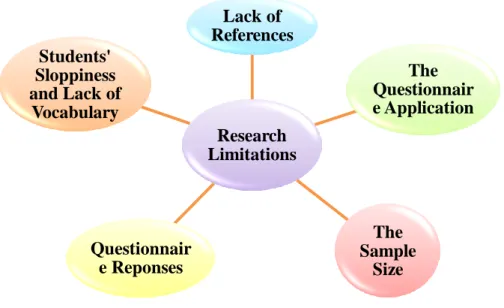
1.13. The Research Limitations
The research had five basic limitations: lack of references the questionnaire application , the sample size, questionnaire responses and students’ sloppiness and lack of vocabulary.
Figure 1.6. Research Limitations Research Limitations Lack of References The Questionnair e Application The Sample Size Questionnair e Reponses Students' Sloppiness and Lack of Vocabulary