arXiv:1607.07627v2 [hep-ex] 10 Jan 2017
Measurement of top quark polarization in t¯
t
lepton+jets final states
V.M. Abazov,31B. Abbott,67 B.S. Acharya,25 M. Adams,46 T. Adams,44 J.P. Agnew,41 G.D. Alexeev,31G. Alkhazov,35 A. Altona,56 A. Askew,44 S. Atkins,54 K. Augsten,7 V. Aushev,38 Y. Aushev,38 C. Avila,5
F. Badaud,10 L. Bagby,45B. Baldin,45D.V. Bandurin,74S. Banerjee,25 E. Barberis,55P. Baringer,53 J.F. Bartlett,45
U. Bassler,15V. Bazterra,46 A. Bean,53M. Begalli,2 L. Bellantoni,45 S.B. Beri,23 G. Bernardi,14 R. Bernhard,19
I. Bertram,39M. Besan¸con,15R. Beuselinck,40 P.C. Bhat,45 S. Bhatia,58 V. Bhatnagar,23 G. Blazey,47 S. Blessing,44
K. Bloom,59 A. Boehnlein,45 D. Boline,64 E.E. Boos,33G. Borissov,39M. Borysoval,38 A. Brandt,71 O. Brandt,20
M. Brochmann,75R. Brock,57 A. Bross,45 D. Brown,14X.B. Bu,45 M. Buehler,45 V. Buescher,21 V. Bunichev,33
S. Burdinb,39 C.P. Buszello,37E. Camacho-P´erez,28B.C.K. Casey,45 H. Castilla-Valdez,28 S. Caughron,57
S. Chakrabarti,64K.M. Chan,51 A. Chandra,73 E. Chapon,15 G. Chen,53 S.W. Cho,27 S. Choi,27B. Choudhary,24
S. Cihangir‡,45 D. Claes,59 J. Clutter,53 M. Cookek,45 W.E. Cooper,45 M. Corcoran,73 F. Couderc,15
M.-C. Cousinou,12J. Cuth,21 D. Cutts,70 A. Das,72 G. Davies,40 S.J. de Jong,29, 30 E. De La Cruz-Burelo,28
F. D´eliot,15 R. Demina,63D. Denisov,45S.P. Denisov,34S. Desai,45 C. Deterrec,41 K. DeVaughan,59 H.T. Diehl,45
M. Diesburg,45 P.F. Ding,41A. Dominguez,59 A. Dubey,24 L.V. Dudko,33 A. Duperrin,12 S. Dutt,23 M. Eads,47
D. Edmunds,57 J. Ellison,43V.D. Elvira,45 Y. Enari,14 H. Evans,49 A. Evdokimov,46 V.N. Evdokimov,34
A. Faur´e,15L. Feng,47 T. Ferbel,63 F. Fiedler,21 F. Filthaut,29, 30 W. Fisher,57 H.E. Fisk,45 M. Fortner,47
H. Fox,39 J. Franc,7 S. Fuess,45 P.H. Garbincius,45 A. Garcia-Bellido,63J.A. Garc´ıa-Gonz´alez,28V. Gavrilov,32
W. Geng,12, 57 C.E. Gerber,46Y. Gershtein,60 G. Ginther,45 O. Gogota,38G. Golovanov,31 P.D. Grannis,64
S. Greder,16 H. Greenlee,45 G. Grenier,17Ph. Gris,10 J.-F. Grivaz,13 A. Grohsjeanc,15 S. Gr¨unendahl,45
M.W. Gr¨unewald,26 T. Guillemin,13 G. Gutierrez,45 P. Gutierrez,67 J. Haley,68 L. Han,4K. Harder,41A. Harel,63
J.M. Hauptman,52 J. Hays,40 T. Head,41 T. Hebbeker,18 D. Hedin,47H. Hegab,68 A.P. Heinson,43 U. Heintz,70
C. Hensel,1 I. Heredia-De La Cruzd,28 K. Herner,45G. Heskethf,41 M.D. Hildreth,51 R. Hirosky,74 T. Hoang,44
J.D. Hobbs,64 B. Hoeneisen,9 J. Hogan,73 M. Hohlfeld,21 J.L. Holzbauer,58I. Howley,71 Z. Hubacek,7, 15
V. Hynek,7 I. Iashvili,62Y. Ilchenko,72 R. Illingworth,45 A.S. Ito,45S. Jabeenm,45 M. Jaffr´e,13A. Jayasinghe,67
M.S. Jeong,27R. Jesik,40 P. Jiang‡,4 K. Johns,42 E. Johnson,57 M. Johnson,45 A. Jonckheere,45 P. Jonsson,40
J. Joshi,43 A.W. Jungo,45 A. Juste,36E. Kajfasz,12D. Karmanov,33I. Katsanos,59M. Kaur,23 R. Kehoe,72
S. Kermiche,12 N. Khalatyan,45 A. Khanov,68A. Kharchilava,62Y.N. Kharzheev,31I. Kiselevich,32J.M. Kohli,23
A.V. Kozelov,34 J. Kraus,58 A. Kumar,62 A. Kupco,8 T. Kurˇca,17V.A. Kuzmin,33S. Lammers,49 P. Lebrun,17
H.S. Lee,27 S.W. Lee,52 W.M. Lee,45 X. Lei,42 J. Lellouch,14 D. Li,14 H. Li,74 L. Li,43 Q.Z. Li,45 J.K. Lim,27
D. Lincoln,45J. Linnemann,57 V.V. Lipaev‡,34R. Lipton,45 H. Liu,72Y. Liu,4 A. Lobodenko,35 M. Lokajicek,8
R. Lopes de Sa,45 R. Luna-Garciag,28 A.L. Lyon,45 A.K.A. Maciel,1 R. Madar,19 R. Maga˜na-Villalba,28
S. Malik,59 V.L. Malyshev,31 J. Mansour,20 J. Mart´ınez-Ortega,28R. McCarthy,64 C.L. McGivern,41
M.M. Meijer,29, 30 A. Melnitchouk,45 D. Menezes,47 P.G. Mercadante,3 M. Merkin,33 A. Meyer,18J. Meyeri,20
F. Miconi,16 N.K. Mondal,25 M. Mulhearn,74E. Nagy,12 M. Narain,70R. Nayyar,42 H.A. Neal,56 J.P. Negret,5
P. Neustroev,35 H.T. Nguyen,74 T. Nunnemann,22 J. Orduna,70 N. Osman,12 A. Pal,71 N. Parashar,50
V. Parihar,70 S.K. Park,27R. Partridgee,70 N. Parua,49A. Patwaj,65 B. Penning,40 M. Perfilov,33
Y. Peters,41 K. Petridis,41 G. Petrillo,63P. P´etroff,13 M.-A. Pleier,65 V.M. Podstavkov,45 A.V. Popov,34
M. Prewitt,73 D. Price,41 N. Prokopenko,34J. Qian,56 A. Quadt,20 B. Quinn,58 P.N. Ratoff,39 I. Razumov,34
I. Ripp-Baudot,16 F. Rizatdinova,68 M. Rominsky,45A. Ross,39C. Royon,8P. Rubinov,45R. Ruchti,51 G. Sajot,11
A. S´anchez-Hern´andez,28 M.P. Sanders,22 A.S. Santosh,1 G. Savage,45 M. Savitskyi,38 L. Sawyer,54
T. Scanlon,40 R.D. Schamberger,64 Y. Scheglov,35 H. Schellman,69, 48 M. Schott,21 C. Schwanenberger,41
R. Schwienhorst,57 J. Sekaric,53H. Severini,67 E. Shabalina,20 V. Shary,15 S. Shaw,41A.A. Shchukin,34O. Shkola,38
V. Simak,7 P. Skubic,67 P. Slattery,63 G.R. Snow,59 J. Snow,66 S. Snyder,65 S. S¨oldner-Rembold,41
L. Sonnenschein,18 K. Soustruznik,6 J. Stark,11N. Stefaniuk,38 D.A. Stoyanova,34 M. Strauss,67 L. Suter,41
P. Svoisky,74M. Titov,15 V.V. Tokmenin,31 Y.-T. Tsai,63 D. Tsybychev,64 B. Tuchming,15 C. Tully,61
L. Uvarov,35 S. Uvarov,35 S. Uzunyan,47 R. Van Kooten,49 W.M. van Leeuwen,29 N. Varelas,46 E.W. Varnes,42
I.A. Vasilyev,34A.Y. Verkheev,31 L.S. Vertogradov,31M. Verzocchi,45 M. Vesterinen,41 D. Vilanova,15 P. Vokac,7
H.D. Wahl,44 M.H.L.S. Wang,45 J. Warchol,51 G. Watts,75 M. Wayne,51 J. Weichert,21 L. Welty-Rieger,48
M.R.J. Williamsn,49 G.W. Wilson,53 M. Wobisch,54 D.R. Wood,55 T.R. Wyatt,41 Y. Xie,45 R. Yamada,45
J. Zennamo,62 T.G. Zhao,41 B. Zhou,56 J. Zhu,56 M. Zielinski,63 D. Zieminska,49 and L. Zivkovicp14
(The D0 Collaboration∗)
1LAFEX, Centro Brasileiro de Pesquisas F´ısicas, Rio de Janeiro, Rio de Janeiro 22290, Brazil 2Universidade do Estado do Rio de Janeiro, Rio de Janeiro, Rio de Janeiro 20550, Brazil
3Universidade Federal do ABC, Santo Andr´e, S˜ao Paulo 09210, Brazil
4University of Science and Technology of China, Hefei 230026, People’s Republic of China 5Universidad de los Andes, Bogot´a, 111711, Colombia
6Charles University, Faculty of Mathematics and Physics, Center for Particle Physics, 116 36 Prague 1, Czech Republic 7Czech Technical University in Prague, 116 36 Prague 6, Czech Republic
8Institute of Physics, Academy of Sciences of the Czech Republic, 182 21 Prague, Czech Republic 9Universidad San Francisco de Quito, Quito 170157, Ecuador
10LPC, Universit´e Blaise Pascal, CNRS/IN2P3, Clermont, F-63178 Aubi`ere Cedex, France 11LPSC, Universit´e Joseph Fourier Grenoble 1, CNRS/IN2P3,
Institut National Polytechnique de Grenoble, F-38026 Grenoble Cedex, France 12CPPM, Aix-Marseille Universit´e, CNRS/IN2P3, F-13288 Marseille Cedex 09, France 13LAL, Univ. Paris-Sud, CNRS/IN2P3, Universit´e Paris-Saclay, F-91898 Orsay Cedex, France
14LPNHE, Universit´es Paris VI and VII, CNRS/IN2P3, F-75005 Paris, France 15CEA Saclay, Irfu, SPP, F-91191 Gif-Sur-Yvette Cedex, France 16IPHC, Universit´e de Strasbourg, CNRS/IN2P3, F-67037 Strasbourg, France
17IPNL, Universit´e Lyon 1, CNRS/IN2P3, F-69622 Villeurbanne Cedex, France and Universit´e de Lyon, F-69361 Lyon CEDEX 07, France
18III. Physikalisches Institut A, RWTH Aachen University, 52056 Aachen, Germany 19Physikalisches Institut, Universit¨at Freiburg, 79085 Freiburg, Germany
20II. Physikalisches Institut, Georg-August-Universit¨at G¨ottingen, 37073 G¨ottingen, Germany 21Institut f¨ur Physik, Universit¨at Mainz, 55099 Mainz, Germany
22Ludwig-Maximilians-Universit¨at M¨unchen, 80539 M¨unchen, Germany 23Panjab University, Chandigarh 160014, India
24Delhi University, Delhi-110 007, India
25Tata Institute of Fundamental Research, Mumbai-400 005, India 26University College Dublin, Dublin 4, Ireland
27Korea Detector Laboratory, Korea University, Seoul, 02841, Korea 28CINVESTAV, Mexico City 07360, Mexico
29Nikhef, Science Park, 1098 XG Amsterdam, Netherlands 30Radboud University Nijmegen, 6525 AJ Nijmegen, Netherlands
31Joint Institute for Nuclear Research, Dubna 141980, Russia 32Institute for Theoretical and Experimental Physics, Moscow 117259, Russia
33Moscow State University, Moscow 119991, Russia
34Institute for High Energy Physics, Protvino, Moscow region 142281, Russia 35Petersburg Nuclear Physics Institute, St. Petersburg 188300, Russia 36Instituci´o Catalana de Recerca i Estudis Avan¸cats (ICREA) and Institut
de F´ısica d’Altes Energies (IFAE), 08193 Bellaterra (Barcelona), Spain 37Uppsala University, 751 05 Uppsala, Sweden
38Taras Shevchenko National University of Kyiv, Kiev, 01601, Ukraine 39Lancaster University, Lancaster LA1 4YB, United Kingdom 40Imperial College London, London SW7 2AZ, United Kingdom 41The University of Manchester, Manchester M13 9PL, United Kingdom
42University of Arizona, Tucson, Arizona 85721, USA 43University of California Riverside, Riverside, California 92521, USA
44Florida State University, Tallahassee, Florida 32306, USA 45Fermi National Accelerator Laboratory, Batavia, Illinois 60510, USA
46University of Illinois at Chicago, Chicago, Illinois 60607, USA 47Northern Illinois University, DeKalb, Illinois 60115, USA
48Northwestern University, Evanston, Illinois 60208, USA 49Indiana University, Bloomington, Indiana 47405, USA 50Purdue University Calumet, Hammond, Indiana 46323, USA 51University of Notre Dame, Notre Dame, Indiana 46556, USA
52Iowa State University, Ames, Iowa 50011, USA 53University of Kansas, Lawrence, Kansas 66045, USA 54Louisiana Tech University, Ruston, Louisiana 71272, USA 55Northeastern University, Boston, Massachusetts 02115, USA
56University of Michigan, Ann Arbor, Michigan 48109, USA 57Michigan State University, East Lansing, Michigan 48824, USA
58University of Mississippi, University, Mississippi 38677, USA 59University of Nebraska, Lincoln, Nebraska 68588, USA 60Rutgers University, Piscataway, New Jersey 08855, USA 61Princeton University, Princeton, New Jersey 08544, USA 62State University of New York, Buffalo, New York 14260, USA
63University of Rochester, Rochester, New York 14627, USA 64State University of New York, Stony Brook, New York 11794, USA
65Brookhaven National Laboratory, Upton, New York 11973, USA 66Langston University, Langston, Oklahoma 73050, USA 67University of Oklahoma, Norman, Oklahoma 73019, USA 68Oklahoma State University, Stillwater, Oklahoma 74078, USA
69Oregon State University, Corvallis, Oregon 97331, USA 70Brown University, Providence, Rhode Island 02912, USA
71University of Texas, Arlington, Texas 76019, USA 72Southern Methodist University, Dallas, Texas 75275, USA
73Rice University, Houston, Texas 77005, USA 74University of Virginia, Charlottesville, Virginia 22904, USA
75University of Washington, Seattle, Washington 98195, USA (Dated: July 27, 2016)
We present a measurement of top quark polarization in t¯t pair production in p¯p collisions at √s = 1.96 TeV using data corresponding to 9.7 fb−1of integrated luminosity recorded with the D0 detector at the Fermilab Tevatron Collider. We consider final states containing a lepton and at least three jets. The polarization is measured through the distribution of lepton angles along three axes: the beam axis, the helicity axis, and the transverse axis normal to the t¯t production plane. This is the first measurement of top quark polarization at the Tevatron using lepton+jet final states and the first measurement of the transverse polarization in tt production. The observed distributions are consistent with standard model predictions of nearly no polarization.
I. INTRODUCTION
The standard model (SM) predicts that top quarks produced at the Tevatron collider are almost unpolar-ized, while models beyond the standard model (BSM) predict enhanced polarizations [1]. The top quark polar-ization Pnˆ can be measured in the top quark rest frame
through the angular distributions of the top quark decay products relative to some chosen axis ˆn [2],
1 Γ dΓ d cos θi,ˆn = 1 2(1 + Pnˆκicos θi,ˆn), (1) where i is the decay product (lepton, quark, or neutrino), κi is its spin-analyzing power (≈ 1 for charged leptons,
∗with visitors from aAugustana College, Sioux Falls, SD 57197,
USA, bThe University of Liverpool, Liverpool L69 3BX, UK, cDeutshes Elektronen-Synchrotron (DESY), Notkestrasse 85,
Ger-many,dCONACyT, M-03940 Mexico City, Mexico,eSLAC, Menlo
Park, CA 94025, USA,fUniversity College London, London WC1E
6BT, UK, gCentro de Investigacion en Computacion - IPN, CP
07738 Mexico City, Mexico,hUniversidade Estadual Paulista, S˜ao
Paulo, SP 01140, Brazil,iKarlsruher Institut f¨ur Technologie (KIT)
- Steinbuch Centre for Computing (SCC), D-76128 Karlsruhe, Ger-many, jOffice of Science, U.S. Department of Energy,
Washing-ton, D.C. 20585, USA,kAmerican Association for the
Advance-ment of Science, Washington, D.C. 20005, USA, lKiev Institute
for Nuclear Research (KINR), Kyiv 03680, Ukraine,mUniversity
of Maryland, College Park, MD 20742, USA,nEuropean
Orgnaiza-tion for Nuclear Research (CERN), CH-1211 Geneva, Switzerland,
oPurdue University, West Lafayette, IN 47907, USA, andpInstitute
of Physics, Belgrade, Belgrade, Serbia. ‡Deceased.
0.97 for d-type quarks, −0.4 for b-quarks, and −0.3 for neutrinos and u-type quarks [3]), and θi,ˆn is the angle
between the direction of the decay product i and the quantization axis ˆn. The mean polarizations of the top and antitop quarks are expected to be identical because of CP conservation. The Pnˆ can be obtained from the
asymmetry of the cos θ distribution
AP,ˆn=
N (cos θi,ˆn> 0) − N(cos θi,ˆn < 0)
N (cos θi,ˆn> 0) + N (cos θi,ˆn < 0)
, (2)
where N (x) is the number of events passing the require-ment x and the polarization is then Pnˆ = 2AP,ˆn. The
quantization axes are defined in the t¯t rest frame, while the decay product directions are defined after succes-sively boosting the particles to the t¯t rest frame and then to the parent top quark rest frame. We measure the po-larization along three quantization axes: (i) the beam axis nˆp, given by the direction of the proton beam [2];
(ii) the helicity axis ˆnh, given by the direction of the
parent top or antitop quark; and the (iii) transverse axisnˆT, given as perpendicular to the production plane
defined by the proton and parent top quark directions, i.e., ˆnp× ˆnt(or by ˆnp× −ˆntfor the antitop quark) [4, 5].
The D0 Collaboration published a short study of the top quark polarization along the helicity axis in p¯p colli-sions as part of the measurement of angular asymmetries of leptons [6], but no measured value was presented. Re-cently, the D0 Collaboration measured the top quark po-larization along the beam axis in t¯t final states with two leptons [7], finding it to be consistent with the SM. The ATLAS and CMS collaborations measured the top quark
polarization along the helicity axis in pp collisions, and the results are consistent with no polarization [8, 9]. The polarization at the Tevatron and LHC are expected to be different because of the difference in the initial states, which motivates the measurement of the polarizations in Tevatron data [10, 11]. For beam and transverse axes, the top quark polarizations in p¯p collisions are expected to be larger than those for pp [2, 4], therefore offering greater sensitivity to BSM models with nonzero polarization.
The longitudinal polarizations along the beam and he-licity axes at the Tevatron collider are predicted by the SM to be (−0.19 ± 0.05)% and (−0.39 ± 0.04)% [12], re-spectively, while the transverse polarization is estimated to be ≈ 1.1% [5]. Observation of a significant depar-ture from the expected value would be evidence for BSM contributions to the top quark polarization [1].
We present a measurement of top quark polarization in ℓ+jets final states of t¯t production using data collected with the D0 detector [13], corresponding to an integrated luminosity of 9.7 fb−1 of p¯p collisions at√s = 1.96 TeV.
The lepton is most sensitive to the polarization and is easily identified. We therefore examine the angular dis-tribution of leptons. After selecting the events in the ℓ+jets final state, we perform a kinematic fit to recon-struct the lepton angles relative to the various axes. The resulting distributions are fitted with mixtures of signal templates with +1 and −1 polarizations to extract the observed values. The down-type quark has an analyzing power close to unity, but its identification is difficult. It is therefore not used in the measurement. However, to gain statistical precision we use reweighted Monte Carlo (MC) down-type quark distributions in forming signal event templates.
II. EVENT SELECTION
Each top quark of the t¯t pair decays into a b quark and a W boson with nearly 100% probability, leading to a W+W−b¯b final state. In ℓ+jets events, one of the
W bosons decays leptonically and the other into quarks that evolve into jets. The trigger selects ℓ+jets events with at least one lepton, electron (e) or a muon (µ). The efficiency of the trigger is 95% or 80% for t¯t events containing reconstructed e or µ candidates, respectively. This analysis requires the presence of one isolated e [14] or µ [15] with transverse momentum pT > 20 GeV and
physics pseudorapidity [16] |η| < 1.1 or |η| < 2, re-spectively. In addition, leptons are required to originate from within 1 cm of the primary p¯p interaction vertex (PV) in the coordinate along the beam axis. Accepted events must have a reconstructed PV within 60 cm of the center of the detector along the beam axis. Fur-thermore, we require an imbalance in transverse momen-tum /pT > 20 GeV, expected from the undetected
neu-trino. Jets are reconstructed using an iterative cone al-gorithm [17] with a cone parameter of R = 0.5. Jet energies are corrected to the particle level using
calibra-tions from studies of exclusive γ+jet, Z+jet, and dijet events [18]. These calibrations account for differences in the detector response to jets originating from glu-ons, b quarks, and u, d, s, or c quarks. We require at least three jets with pT > 20 GeV within |η| < 2.5, and
pT > 40 GeV for the jet of highest pT. At least one jet
per event is required to be identified as originating from a b quark (b tagged) through the use of a multivariate al-gorithm [19]. In µ+jets events, upper limits are required on the transverse mass of the reconstructed W boson [20] of MW
T < 250 GeV and /pT < 250 GeV to remove events
with misreconstructed muon pT. Additional selections
are applied to reduce backgrounds in muon events, and to suppress contributions from multijet production. A detailed description of these requirements can be found in Ref. [21]. In addition, we require the curvature of the track associated with the lepton to be well measured to reduce lepton charge misidentification.
III. SIGNAL AND BACKGROUND SAMPLES
We simulate t¯t events at the next-to-leading-order (NLO) in perturbative QCD with the mc@nlo event generator version 3.4 [22] and at the leading-order (LO) with alpgen event generator version 2.11 [23]. Parton showering, hadronization, and modeling of the underly-ing event are performed with herwig [24] for mc@nlo events and with pythia 6.4 [25] for alpgen events. The detector response is simulated using geant3 [26]. To model the effects of multiple p¯p interactions, the MC events are overlaid with events from random p¯p collisions with the same luminosity distribution as the data. The main background to the t¯t signal is W +jets events, where the W boson is produced via the electroweak interaction together with additional partons from QCD radiation. The W +jets final state can be split into four subsam-ples according to parton flavor, W b¯b + jets, W c¯c + jets, W c+ jets, and W +light jets, where light refers to gluons, u, d, or s quarks. The W +jets background is modeled with alpgen and pythia [23, 25], as is the background from Z+jets events. Other background processes include W W , W Z, and ZZ diboson productions simulated us-ing pythia, and sus-ingle top quark electroweak produc-tion simulated using comphep [27]. The multijet back-ground, where a jet is misidentified as an isolated lep-ton, is estimated from the data using the matrix method [21, 28]. We use six different BSM models [29] to study modified t¯t production: one Z′boson model and five
ax-igluon models with different axax-igluon masses and cou-plings (m200R, m200L, m200A, m2000R, and m2000A, where L, R, and A refer to left-handed, right-handed, and axial couplings, and numbers are the particle masses in GeV). Some additional axigluon models such as m2000L are not simulated as they are excluded by other measure-ments of top quark properties. The BSM events are gen-erated with LO madgraph 5 [30] interfaced to pythia for parton evolution.
IV. ANALYSIS METHOD
A constrained kinematic χ2fit is used to associate the
observed leptons and jets with the individual top quarks using a likelihood term for each jet-to-quark assignment, as described in Ref. [31]. We assume the four jets with largest pT to originate from t¯t decay in events with more
than four jets. The algorithm includes a technique that reconstructs events with a lepton and only three jets [32]. The addition of the three-jet sample almost doubles the signal sample as shown in Table I. In our analysis, all possible assignments of jets to final state quarks are con-sidered and weighted by the χ2 probability of each
kine-matic fit and by the b tagging probability.
To determine the sample composition, we construct a kinematic discriminant based on the approximate likeli-hood ratio of expectations for t¯t and W +jets events [33]. The input variables are chosen to achieve good separation between t¯t and W +jets events, and required to be well modeled and not strongly correlated with one another or with the lepton polar angles used in the measurement. Sets of input variables are selected independently for the ℓ+3 jet and the ℓ+ ≥ 4 jet events, each in three subchan-nels according to the number of b tagged jets: 0, 1, ≥ 2. The channels without b tagged jets are used to determine the sample composition and background calibration, not to measure the polarization.
The input variables used for the ℓ+3 jet kine-matic discriminant are kmin
T = min(pT,a, pT,b) · ∆Rab,
where ∆Rab = p(ηa− ηb)2+ (φa− φb)2 is the
angu-lar distance between the two closest jets (a and b), min(pT,a, pT,b) represents the smaller transverse
momen-tum of the two jets, and the φ are their azimuths in radians; aplanarity A = 3/2λ3, where λ3 is the
small-est eigenvalue of the normalized momentum tensor; Hℓ T,
which is the scalar sum of the pT of the jets and lepton;
∆R between the leading jet and the next-to-leading jet; and ∆R between the lepton and the leading jet.
The input variables for the ℓ+ ≥ 4 jet discriminant are kmin
T ; aplanarity; H ℓ
T; centrality, C = HT/H, where
HT is the scalar sum of all jet pT values and H is the
scalar sum of all jet energies; the lowest χ2 among the
different kinematic fit solutions in each event; (pbhad
T − pblep T )/(p bhad T + p blep
T ), the relative pT difference between
blep, the b jet candidate from the t → bℓν decay, and
bhad, the b jet candidate from the t → bqq′ decay; and
mjj, the invariant mass of the two jets corresponding to
the W → qq′ decay.
The sample composition is determined from a simul-taneous maximum-likelihood fit to the kinematic dis-criminant distributions. The W +jets background is normalized separately for the heavy-flavor contribution (W b¯b + jets and W c¯c + jets) and for the light-parton contribution (W c + jets and W +light jets). The sam-ple composition after imsam-plementing the selections, and fitting the maximum likelihood to data, is broken down into individual channels by lepton flavor and number of
jets, and summarized in Table I. The obtained t¯t yield is close to the expectations.
3 jets ≥ 4 jets
Source e+jets µ+jets e+jets µ+jets
W +jets 1741 ± 26 1567 ± 15 339 ± 3 295 ± 3 Multijet 494 ± 7 128 ± 3 147 ± 4 49 ± 2 Other Bkg 446 ± 5 378 ± 2 87 ± 1 73 ± 1 tt signal 1200 ± 25 817 ± 20 1137 ± 24 904 ± 23 Sum 3881 ± 37 2890 ± 25 1710 ± 25 1321 ± 23 Data 3872 2901 1719 1352
TABLE I: Sample composition and event yields after im-plementing the selection requirements and the maximum-likelihood fit to kinematic distributions in data. Only sta-tistical uncertainties are shown.
The lepton angular distributions in W +jets events must be well modeled since these events form the lead-ing background, especially in the ℓ+3 jet sample. We therefore use a control sample of ℓ+3 jet events with-out b tagged jets, as such events are dominated by W +jets production with > 70% contribution. This sam-ple is not used for the polarization measurement. We reweight the W +jets MC events so that the cos θℓ,ˆn
distributions agree with those for the control events in data with t¯t and other background components sub-tracted. We use the relative polarization asymmetry defined as [Nj(cos θl,ˆn) − N−j(cos θl,ˆn)]/[Nj(cos θl,ˆn) +
N−j(cos θl,ˆn)], where j refers to bins of cos θℓ,ˆn values
between 0 and 1 and −j refers to bins between −1 and 0. The distributions of simulated W +jets events and sub-tracted data are shown in Fig. 1. The correction to MC obtained from the control sample is applied to the back-ground templates used in our signal extraction. The cor-rections are 0.047 ±0.002 for polarization along the beam axis, 0.011±0.001 for the transverse axis, and a negligible amount for the helicity axis. The uncertainties are prop-agated to the measurement as a systematic uncertainty of the background modeling. We observe the W +jets events to have polarization, calculated as in Eq. (2), of +0.18 along the beam axis, −0.23 along the helicity axis, and −0.02 along the transverse axis. Other backgrounds give polarizations of +0.05 (beam axis), −0.30 (helicity axis), and +0.01 (transverse axis).
To measure the polarization, a fit is performed to the reconstructed cos θℓ,ˆn distribution using t¯t templates of
+1 and −1 polarizations, and background templates nor-malized to the expected event yield. The signal templates arise from the t¯t MC sample generated with no polariza-tion but reweighted to follow the expected double differ-ential distribution [2], 1 Γ dΓ d cos θ1cos θ2 = 1 4(1 + κ1Pˆn,1cos θ1+
+ ρκ2Pˆn,2cos θ2− κ1κ2C cos θ1cos θ2), (3)
where indices 1 and 2 represent the t and ¯t quark decay products (the leptons and down quarks, or their charge
FIG. 1: The simulated W +jets events before correction and data with t¯t and other than W +jets background components subtracted compared in cos θℓ,ˆn distributions in the ℓ+3 jet and no b tagged jet control sample.
conjugates), κ is the spin-analyzing power, and C is the t¯t spin correlation coefficient for a given quantization axis. We use the SM values C = −0.368 (helicity axis) and C = 0.791 (beam axis), both calculated at NLO in QCD and in electroweak couplings in Ref. [2]. The spin cor-relation factor is not known for the transverse axis, and thus we set C = 0 and assign a systematic uncertainty by varying the choice of this factor. The Pn,iˆ represents
the polarization state we model (here Pˆn,i = ±1) along
the chosen axis ˆn. In the SM, assuming CP invariance, Pˆn,1= Pˆn,2and gives the relative sign factor ρ a value of
+1 for the helicity axis and −1 for the beam and trans-verse axes [2].
A simultaneous fit is performed for the eight samples defined according to lepton flavor (e or µ), lepton charge, and number of jets (3 or ≥ 4). The observed polarization is taken as P = f+− f−, where f± are the fraction of
events with P = +1 and −1 returned from the fit. The fitting procedure and methodological approach are veri-fied using pseudoexperiments for five values of polariza-tion, and through a check of consistency with predictions, using the BSM models with nonzero generated longitudi-nal polarizations. The fitted polarizations and the model inputs are in good agreement, as shown in Fig. 2 for the polarizations along the beam axis, thus verifying our template methodology. The distributions in the cosine of
the polar angle of leptons from t¯t decay for all three axes are shown in Fig. 3.
(beam) generated P -0.2 -0.1 0 0.1 0.2 (beam) measured P -0.2 -0.1 0 0.1 0.2 Axigluon models m200R m200L m2000A m2000R SM (MC@NLO+Herwig) SM (ALPGEN+PYTHIA) Z’ DØ Simulation
FIG. 2: Comparison of measured and generated polarizations along the beam axis for the SM and several non-SM models. The uncertainties are statistical.
A previous measurement of top quark polarization and the forward-backward t and ¯t asymmetry in dilepton fi-nal states [7] noted a correlation between these two mea-surements. This correlation is caused by acceptance and resolution effects in the kinematic reconstruction of the events. We determine the dependence of the observed polarization on the forward-backward asymmetry at the parton level, AFB, using samples in which the t and ¯t
ra-pidity distributions are reweighted to accommodate the polarizations. We then use a correction for the differ-ence between the nominal mc@nlo production-level AFB
of (5.01 ± 0.03)% and the next-to-next-to-leading-order (NNLO) calculation [34] of (9.5 ± 0.7)%. The observed correction is −0.030 for the polarization along the beam axis, less than 0.002 for the polarization along the helic-ity axis, and is negligible for the transverse polarization. The uncertainty on the expected AFB is propagated to
the measurement as part of the methodology systematic uncertainty.
V. SYSTEMATIC UNCERTAINTIES
We have evaluated several categories of systematic un-certainties using fully simulated events: unun-certainties as-sociated with jet reconstruction, jet energy measurement, b tagging, the modeling of background and signal events, PDFs, and procedures and assumptions made in the anal-ysis. The sources of systematic uncertainties and their contributions are listed in Table II and added in quadra-ture for the total uncertainty. Details about the
evalua-FIG. 3: The combined e+jets and µ+jets cos θ distributions for data, expected backgrounds, and signal templates for P = −1, SM, and +1. Panels (a), (c), and (e) show ℓ+3 jet events; (b), (d), and (f) show ℓ+ ≥ 4 jet events; (a) and (b) show distributions relative to the beam axis; (c) and (d) show distributions relative to the helicity axis; and (e) and (f) show distributions relative to the transverse axis. The hashed areas represent systematic uncertainties. The direction of the cos θ axis is reversed for the ℓ−events for beam and transverse spin-quantization axes plots.
tion of the uncertainties can be found in Refs. [21, 31]. Additionally, we assign an uncertainty in modeling the invariant mass of the t¯t system (mt¯t) based on the
differ-ence in mt¯tdistributions in our signal MC and the NNLO
predictions [35].
Source Beam Helicity Transverse
Jet reconstruction ±0.010 ±0.008 ±0.008
Jet energy measurement ±0.010 ±0.023 ±0.006
b tagging ±0.009 ±0.014 ±0.005
Background modeling ±0.007 ±0.021 ±0.004
Signal modeling ±0.016 ±0.020 ±0.008
PDFs ±0.013 ±0.011 ±0.003
Methodology ±0.013 ±0.007 ±0.009
Total systematic uncertainty ±0.030 ±0.042 ±0.017 Statistical uncertainty ±0.046 ±0.044 ±0.030
Total uncertainty ±0.055 ±0.061 ±0.035
TABLE II: Summary of the uncertainties in the measured top quark polarization along three axes. The systematic un-certainty source indicates the difference in polarization when the measurement is repeated using alternative modeling, after applying uncertainties from the employed methods, or from assumptions made in the measurement. The uncertainties are added in quadrature to form groups of systematic sources and the total uncertainty.
VI. RESULTS
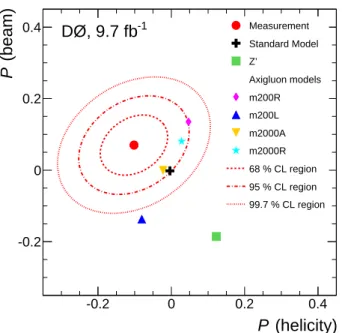
The measured polarizations for the three spin-quantization axes are shown in Table III. Results on the longitudinal polarizations are presented in Fig. 4 and
compared to SM predictions and several of the BSM models discussed previously. The measurement along the beam axis is consistent with the previous D0 result in the dilepton channel [7], P = 0.113 ± 0.093. We estimate the correlation between this result for the beam axis and that of Ref. [7] to be 5%. The combination using the method of Refs. [36, 37] yields a top quark polarization along the beam axis P = 0.081 ± 0.048.
Axis Measured polarization SM prediction
Beam +0.070 ± 0.055 −0.002
Beam - D0 comb. +0.081 ± 0.048 −0.002
Helicity −0.102 ± 0.061 −0.004
Transverse +0.040 ± 0.035 +0.011
TABLE III: Measured top quark polarization from the t¯t ℓ+jet channel along the beam, helicity, and transverse axes, and the combined polarization for beam axis with the dilepton result by the D0 Collaboration denoted as Beam - D0 comb.. The total uncertainties are obtained by adding the statistical and systematic uncertainties in quadrature.
VII. CONCLUSION
In summary, we measure the top quark polarization for t¯t production in p¯p collisions at√s = 1.96 TeV along sev-eral spin-quantization axes. The polarizations are consis-tent with SM predictions. The transverse polarization is measured for the first time. These are the most precise measurements of top quark polarization in p¯p collisions.
(helicity)
P
-0.2 0 0.2 0.4(beam)
P
-0.2 0 0.2 0.4 Measurement Standard Model Z’ Axigluon models m200R m200L m2000A m2000R 68 % CL region 95 % CL region 99.7 % CL region -1DØ, 9.7 fb
FIG. 4: Two-dimensional visualization of the longitudinal top quark polarizations in the ℓ+jets channel measured along the beam and helicity axes compared with the SM and the BSM models described in the text. In this case, the m200A model is not shown as it is indistinguishable from m2000A model. The correlation of the two measurement uncertainties is 27%.
VIII. ACKNOWLEDGMENTS
We express our appreciation to Helen Edwards for her role in designing and building the Tevatron, and her
oversight of the D0 detector project in its early days. We thank R. M. Godbole and W. Bernreuther for en-lightening discussions. We thank the staffs at Fermilab and collaborating institutions, and acknowledge support from the Department of Energy and National Science Foundation (USA); Alternative Energies and Atomic En-ergy Commission and National Center for Scientific Re-search/National Institute of Nuclear and Particle Physics (France); Ministry of Education and Science of the Rus-sian Federation, National Research Center “Kurchatov Institute” of the Russian Federation, and Russian Foun-dation for Basic Research (Russia); National Council for the Development of Science and Technology and Car-los Chagas Filho Foundation for the Support of Re-search in the State of Rio de Janeiro (Brazil); Depart-ment of Atomic Energy and DepartDepart-ment of Science and Technology (India); Administrative Department of Sci-ence, Technology and Innovation (Colombia); National Council of Science and Technology (Mexico); National Research Foundation of Korea (Korea); Foundation for Fundamental Research on Matter (Netherlands); Science and Technology Facilities Council and The Royal Soci-ety (United Kingdom); Ministry of Education, Youth and Sports (Czech Republic); Bundesministerium f¨ur Bildung und Forschung (Federal Ministry of Education and Re-search) and Deutsche Forschungsgemeinschaft (German Research Foundation) (Germany); Science Foundation Ireland (Ireland); Swedish Research Council (Sweden); China Academy of Sciences and National Natural Science Foundation of China (China); and Ministry of Education and Science of Ukraine (Ukraine).
[1] S. Fajfer, J. F. Kamenik and B. Melic, Discerning New Physics in Top-Antitop Production using Top Spin Ob-servables at Hadron Colliders, J. High Energy Phys. 08 (2012) 114.
[2] W. Bernreuther and Z.-G. Si, Distributions and corre-lations for top quark pair production and decay at the Tevatron and LHC, Nucl. Phys. B837, 90 (2010). [3] A. Brandenburg, Z.-G. Si and P. Uwer, QCD corrected
spin analyzing power of jets in decays of polarized top quarks, Phys. Lett. B 539, 235 (2002).
[4] W. Bernreuther, A. Brandenburg and P. Uwer, Trans-verse polarization of top quark pairs at the Tevatron and the large hadron collider, Phys. Lett. B 368, 153 (1996). [5] M. Baumgart and B. Tweedie, Transverse Top Quark Polarization and the tt Forward-Backward Asymmetry, J. High Energy Phys. 08 (2013) 072.
[6] V. M. Abazov et al. (D0 Collaboration), Measurement of Leptonic Asymmetries and Top Quark Polarization in t¯t Production, Phys. Rev. D 87, 011103 (2013).
[7] V. M. Abazov et al. (D0 Collaboration), Simultaneous Measurement of Forward-Backward Asymmetry and Top Polarization in Dilepton Final States from t¯t Production
at the Tevatron, Phys. Rev. D 92, 052007 (2015). [8] G. Aad et al. (ATLAS Collaboration), Measurement
of Top Quark Polarization in Top-Antitop Events from Proton-Proton Collisions at√s = 7 TeV Using the AT-LAS Detector, Phys. Rev. Lett. 111, 232002 (2013). [9] S. Chatrchyan et al. (CMS Collaboration), Measurements
of t¯t spin correlations and top-quark polarization using dilepton final states in pp collisions at √s = 7 TeV, Phys. Rev. Lett. 112, 182001 (2014); V. Khachatryan et al. (CMS Collaboration), Measurements of t¯t spin cor-relations and top quark polarization using dilepton final states in pp collisions at√s = 8 TeV, Phys. Rev. D 93, 052007 (2016).
[10] J. A. Aguilar-Saavedra, Portrait of a colour octet, J. High Energy Phys. 08 (2014) 172; J. A. Aguilar-Saavedra, in Proceedings of the 7th International Workshop on Top Quark Physics, Cannes, France, 2014 (unpublished). [11] D. Choudhury, R. M. Godbole, S. D. Rindani and
P. Saha, Top polarization, forward-backward asymmetry and new physics, Phys. Rev. D 84, 014023 (2011). [12] W. Bernreuther, M. F¨ucker and Z.-G. Si, Weak
Contributions from quark-gluon and b anti-b induced re-actions, Phys. Rev. D 78, 017503 (2008); W. Bernreuther and Z.-G. Si (private communication).
[13] V. M. Abazov et al. (D0 Collaboration), The Upgraded D0 Detector, Nucl. Instrum. Methods Phys. Res. Sec. A 565, 463 (2006); R. Angstadt et al., The layer 0 inner sil-icon detector of the D0 experiment, Nucl. Instrum. Meth-ods Phys. Res., Sect. A 622, 298 (2010); V. M. Abazov et al. (D0 Collaboration), The muon system of the Run II D0 detector, Nucl. Instrum. Methods Phys. Res., Sect. A 552, 372 (2005).
[14] V. M. Abazov et al. (D0 Collaboration), Electron and Photon Identification in the D0 Experiment, Nucl. In-strum. Methods Phys. Res., Sect. A 750, 78 (2014). [15] V. M. Abazov et al. (D0 Collaboration), Muon
recon-struction and identification with the Run II D0 detector, Nucl. Instrum. Methods Phys. Res., Sect. A 737, 281 (2014).
[16] The pseudorapidity is defined as η = − ln[tan(θ/2)], where θ is the measured polar angle of an object. [17] G. C. Blazey et al., hep-ex/0005012.
[18] V. M. Abazov et al. (D0 Collaboration), Jet energy scale determination in the D0 experiment, Nucl. Instrum. Methods Phys. Res., Sect. A 763, 442 (2014).
[19] V. M. Abazov et al. (D0 Collaboration), Improved b quark jet identification at the D0 experiment, Nucl. Instrum. Methods Phys. Res., Sect. A 763, 290 (2014).
[20] J. Smith, W. L. van Neerven and J. A. M. Vermaseren, The Transverse Mass and Width of the W Boson, Phys. Rev. Lett. 50, 1738 (1983).
[21] V. M. Abazov et al. (D0 Collaboration), Measurement of differential t¯t production cross sections in p¯p collisions, Phys. Rev. D 90, 092006 (2014).
[22] S. Frixione and B. R. Webber, Matching NLO QCD com-putations and parton shower simulations, J. High En-ergy Phys. 06 (2002) 029; S. Frixione, P. Nason, and B. R. Webber, Matching NLO QCD and parton show-ers in heavy flavour production, J. High Energy Phys. 08 (2003) 007.
[23] M. L. Mangano, M. Moretti, F. Piccinini, R. Pittau and A. D. Polosa, alpgen, a generator for hard multiparton processes in hadronic collisions, J. High Energy Phys. 07 (2003) 001.
[24] G. Corcella, I. G. Knowles, G. Marchesini, S. Moretti, K. Odagiri, P. Richardson, M. H. Seymour, and B. R. Webber, herwig 6: An Event generator for hadron emission reactions with interfering gluons (including su-persymmetric processes), J. High Energy Phys. 01 (2001) 010.
[25] T. Sjøstrand, S. Mrenna, and P. Skands, pythia 6.4
physics and manual, J. High Energy Phys. 05 (2006) 026. [26] R. Brun and F. Carminati, Geant: Detector descrip-tion and simuladescrip-tion tool, CERN Program Library Long Writeup W5013 (1993) (unpublished).
[27] E. Boos, V. Bunichev, M. Dubinin, L. Dudko, V. Ed-neral, V. Ilyin, A. Kryukov, V. Savrin, A. Semenov, and A. Sherstnev (CompHEP Collaboration), CompHEP 4.4: Automatic computations from Lagrangians to events, Nucl. Instrum. Methods Phys. Res., Sect. A 534, 250 (2004).
[28] V. M. Abazov et al. (D0 Collaboration), Measurement of the tt production cross section in pp collisions at√s = 1.96 TeV using secondary vertex b tagging, Phys. Rev. D 74, 112004 (2006).
[29] A. Carmona, M. Chala, A. Falkowski, S. Khatibi, M. M. Najafabadi, G. Perez, and J. Santiago, From Teva-tron’s top and lepton-based asymmetries to the LHC, J. High Energy Phys. 07 (2014) 005.
[30] J. Alwall, R. Frederix, S. Frixione, V. Hirschi, F. Maltoni, O. Mattelaer, H.-S. Shao, T. Stelzer, P. Torrielli, and M. Zaro, The automated computation of tree-level and next-to-leading order differential cross sections, and their matching to parton shower simulations, J. High Energy Phys. 07 (2014) 079.
[31] V. M. Abazov et al. (D0 Collaboration), Measurement of the forward-backward asymmetry in top quark-antiquark production in p¯p collisions using the lepton+jets channel, Phys. Rev. D 90, 072011 (2014).
[32] R. Demina, A. Harel and D. Orbaker, Reconstructing t¯t events with one lost jet, Nucl. Instrum. Methods Phys. Res., Sect. A 788, 128 (2015).
[33] V. M. Abazov et al. (D0 Collaboration), Measurement of the t¯t production cross section in p¯p collisions at √s=1.96 TeV using kinematic characteristics of lepton + jets events, Phys. Rev. D 76, 092007 (2007).
[34] M. Czakon, P. Fiedler and A. Mitov, Resolving the Teva-tron Top Quark Forward-Backward Asymmetry Puzzle: Fully Differential Next-to-Next-to-Leading-Order Calcu-lation, Phys. Rev. Lett. 115, 052001 (2015).
[35] M. Czakon, P. Fiedler, D. Heymes and A. Mitov, NNLO QCD predictions for fully-differential top-quark pair pro-duction at the Tevatron, J. High Energy Phys. 05 (2016) 034.
[36] L. Lyons, D. Gibaut and P. Clifford, How to Combine Correlated Estimates of a Single Physical Quantity, Nucl. Instrum. Methods Phys. Res., Sect. A 270, 110 (1988). [37] A. Valassi, Combining correlated measurements of
sev-eral different physical quantities, Nucl. Instrum. Methods Phys. Res., Sect. A 500, 391 (2003).