Rings, chains and helices: new antimicrobial silver coordination compounds with (iso-)nicotinic acid derivatives †
Inès Chevrier,
aJorge L. Sagué, ‡
aPriscilla S. Brunetto,
aNina Khanna,
bZarko Rajacic
band Katharina M. Fromm*
aComplexes with silver ions have great potential for applications in medicine. Appropriate bidentate ligands, binding to silver ions, are able to generate coordination polymers as well as molecular entities as a function of ligandflexibility, conformation and length. Here we present the continuation of our pre- vious studies in thisfield with ligands based on oligomers of polyethylene glycol, functionalized at both ends with either nicotinic or isonicotinic acid. The structures of three ligands and nine new coordination compounds are presented. A large variety of structures are obtained as a function of counterion, solvent and ligand-to-metal ratio, such as isolated rings, offset stacked rings, parallel chains and entangled chains, and their antimicrobial properties as well as biocompatibility are assessed.
Introduction
“
Metal
–organic frameworks or networks
”(MOFs) or
“metal
–organic coordination polymers
”are compounds based on the coordinative interaction of metal ions or clusters with charged or neutral organic ligands.
1–3Depending on the metal, its oxi- dation state and coordination number, and depending on the ligand functionality and flexibility, a large panel of geometries can be obtained. The metal ions or clusters, acting as nodes, can be linked via the ligands into one- (1D),
4two- (2D)
5or three-dimensional (3D) arrays.
6In addition to the metal ion connectivity and the ligand functionality, it was shown that the choice of anions,
7solvents,
8and synthetic and crystalliza- tion parameters such as temperature and pressure
9plays important roles in the formation of the final structure.
Among all metal ions, the silver ion Ag
+is considered to have the lowest coordination number of two. It can therefore be considered as an ideal candidate to form 1D-coordination polymers with approximately linear, bifunctional donor ligands. Indeed, numerous examples of chain-like structures
have been reported, mainly involving N-donor ligands. They include pyrazine
10and its derivatives,
114,4
′-bipyridine
12and longer bridged bipyridyl ligands.
13Based on its soft character, the silver ion has a quite flexible coordination sphere, and it is possible to obtain several di
fferent coordination geometries with the same metal ion and ligand. Those systems are inter- esting for studying the reaction conditions under which diverse di
fferent topologies can be obtained, and to study in particular the cases of polymorphism in crystal engineering.
14Silver ions are furthermore interesting targets for the con- struction of coordination compounds due to the di
fferent properties of this metal ion. Light stability
15and antimicrobial properties
16are important driving forces for silver-based research. Such new compounds may indeed have great poten- tial for applications in medicine.
17The Fromm group has a long-standing expertise in the gen- eration of silver-based coordination polymers and has shown that such compounds are useful as antimicrobial coatings for implants.
18–23Our most basic ligand employed for the con- struction of silver coordination polymers is based on the flexi- ble ethylene glycol, to which, at each end, a moiety of isonicotinic acid is fused (L1i, Scheme 1). The advantage of
Scheme 1 Ligand familiesLxiandLxn,x= 1, 2, 3,….
†Electronic supplementary information (ESI) available: Additional figures and a table with crystallographic data for all new compounds. CCDC 765998, 849905, 849908–849912, 884807.
‡Currently at RMS-Foundation, Bettlach, Switzerland.
aDepartment of Chemistry, University of Fribourg, Chemin du Musée 9, CH-1700 Fribourg, Switzerland. E-mail: [email protected]; Fax: +41 263009738;
Tel: +41 263008732
bDepartment of Biomedicine, University Hospital Basel, Hebelstrasse 20, CH - 4031 Basel, Switzerland
Published in "'DOWRQ7UDQVDFWLRQV"
which should be cited to refer to this work.
http://doc.rero.ch
this kind of ligand lies in its straightforward synthesis, its flexibility as well as its biocompatibility as it is all formed of non-toxic moieties.
18–23These ligands can be further made in large quantities due to affordable starting materials.
For our studies, this ligand has been tuned in two ways: (i) the ligand length by variation of the central polyethylene oxide unit, and (ii) the position of the N-donor atom in the pyridyl unit (either 3- or 4-position), choosing either isonicotinic or nicotinic acid as a starting compound in the synthesis of the ligands. Depending on the oligomer of polyethyleneglycol as a spacer, and on the position of the N-atoms, we have esta- blished a nomenclature for our ligands (Scheme 1).
For L1i, L1n, L2i and L3i, we have already reported a series of silver coordination compounds, which form chains, metalla- cycles, and helices or double-helices.
24Working with neutral ligands, we have also shown the influence of counterions and solvents during the production of these silver coordination compounds, showing that polymorphs,
22,26,27,29pseudo-poly- morphs (or solvates),
26,29or isomers
25–27can be obtained. We now report on the solid state structures of the new ligands, further coordination compounds of the L3 and L4 with silver salts, and their possible use in medicine.
Results and discussion
The used ligands are described with their acronym in Table 1.
The synthesis of the ligands L3i, L3n, L4i and L4n is usually carried out, reacting the corresponding di-alcohol with the desired acid chlorides in a ratio of 1 : 2, always obtaining good yields.
In the following, the results of coordination of these four ligands to silver salts will be classified as a function of ligand type.
Ligand L3i and its coordination compounds with silver salts The ligand L3i crystallizes from a THF solution in the triclinic space group P1
ˉ(No. 2). The asymmetric unit contains half of the ligand, as an inversion centre is located in the geometrical middle of the C9–C9#1 bond. The ligand adopts a Z-like shape, with the triethylene moiety almost perpendicular to the plane formed by both aromatic rings (about 17 Å between N- atoms). Both N-atoms are pointing to opposite directions (Fig. 1). Torsion angles around O–C–C–O are ca. 76° and 180°.
Reaction of L3i with AgNO
3in a 1 : 1 ratio leads to a stair- like chain motif of [{Ag(L3i)NO
3}(H
2O)
2], 1 (triclinic, P1
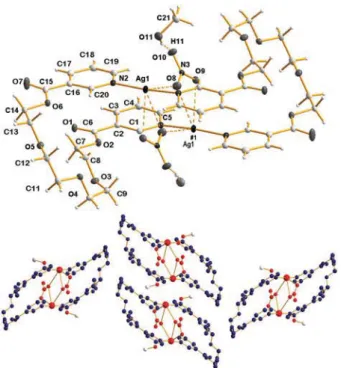
ˉ). Eachsilver ion is coordinated nearly linearly (N1–Ag1–N2 ca. 175°) by N-atoms of two different ligands, with Ag1–N1 of 2.178(4) Å, Ag1–N2 of 2.175(4) Å (Fig. 2). The metal ion coordination is completed by a weakly coordinating nitrate anion (Ag1–O9 2.980(4) Å). Opposite to the nitrate anion (angle N1–Ag1–O2 91.19°), two O-atoms of the ethoxy part of a ligand belonging to a neighbouring chain bind with Ag1–O2 2.849(4) Å and Ag1–O3 2.944(4) Å. The coordination geometry around the silver ion can thus be described as a distorted trigonal bipyra- mid (distances >3 Å neglected).
The
⋯L3i
–Ag
–L3i
–Ag
⋯-chains run parallel along the (111)- direction, but are o
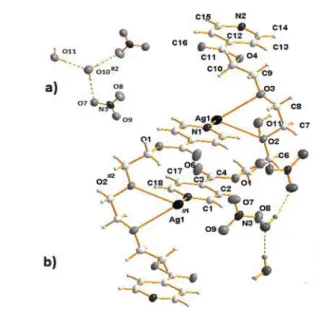
ffset to each other by ca. 8 Å (Fig. 2), due to O2 and O3 of the polyether moiety of L3i of one chain coordi- nating to a silver atom of a neighbouring chain. Two water molecules O10 and O11 form H-bonds to the nitrate anions
Fig. 1 Structure of ligandL3ialone; #1:−x,−y,−z. Table 1 Table of the ligands
Name Structure
L3i
L3n
L4i
L4n
Fig. 2 Double chain arrangement of1; (a) a view of the hydrogen bonding system, (b) offset of1shown with labelling; #1:−1 +x,y,zand #2: 1−x, 1−y, 1−z.
http://doc.rero.ch
and build up an H-bonded system, which connects the offset chains. Thus, O8 of the nitrate forms H-bonds with O10 at O8–
O10 2.889(6) Å, while O10 itself is H-bonded to O11 at 2.849(3) Å. Furthermore, O7 also binds to the symmetry equivalent of O10 with 2.944(3) Å. The Ag–Ag distance within the same chain is around 18.92 Å, while the distance between Ag-ions of two different chains is roughly 8.72 Å.
A compound of similar composition as 1, but with one water molecule instead of two per asymmetric unit, is obtained if THF instead of MeOH and water is used, yielding [{Ag(L3i) NO
3}(H
2O)], 2. While the formula indicates simply a loss of solvent versus 1, the structure is however very different from the parallel chains in 1. Indeed, compound 2 forms a double- helical motif and cannot be obtained by heating of 1.
The single crystals of 2 (medium quality, triclinic, P1
ˉ(No.
2)) contain a ligand, a silver cation coordinated by a nitrate counterion and a water molecule per asymmetric unit. The crystallographic data allow us to obtain a partial determination of the structure. Two ligand molecules coordinate a cation via the N-atoms with Ag1–N1 and Ag1–N2 of ca. 2.2 Å. The nitrate anion coordinates in a monodentate way to the silver cation with a distance of ca. 3.0 Å (Ag1–O8). The distorted coordi- nation geometry of the metal ion is completed by the polyether O-atoms of a second chain, leading now to a double-helical motif with distances of Ag1–O3#2 and Ag1–O4#2 of ca. 2.9 Å, and torsion angles of O2–C7–C8–O3 (ca. 60°), O3–C9–C10–O4 (ca. 61°) and O4–C11–C12–O5 (ca.
−78°).Double helices of 2 are aligned parallel to each other with alternating chirality. Ag–Ag distances of ca. 9.2 Å are observed between helices with the same chirality and of 7.7 Å between two closest silver ions for helices with opposite chirality. Weak
π–πinteractions are present between aromatic rings of different chains within the helical motif. Other supramolecu- lar interactions like H-bonds exist between the nitrate ion and hydrogen atoms of the nearby pyridine ring (both coordinating to the same silver cation) (C18–H18⋯O8 ca. 2.7 Å). The helices linked by H-bonds form 2D-sheets in the crystalline array, while water molecules occupy the empty space in between (Fig. 3).
Using AgO
3SCF
3as starting material, the water-free com- pound, [Ag(L3i)O
3SCF
3], 3 is obtained (monoclinic, P2
1/c (No.
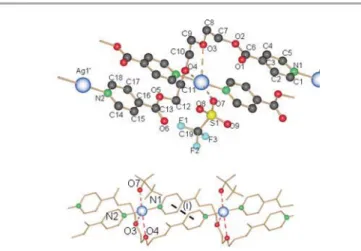
14)). It can be described by a repetitive motif of one silver co- ordinated linearly (ca. 178°) by two half ligands via the N-atoms with Ag–N1 of 2.159(10) Å and Ag–N2 of 2.144(10) Å, forming an infinite helical chain with a pitch of ca. 17.86 Å (distance Ag1–Ag1′, Fig. 4). As in 2, two chains wrap around each other, forming a double-helical motif with Ag–O-distances to O3 and O4 greater than 3 Å. The triflate anion binds via O7 to the metal ion at ca. 2.71 Å, yielding a trigonal bipyramidal environ- ment around the silver ion. Thus, the triflate anion in 3 binds stronger to the metal ion than the nitrate anion in 2. This is compensated by longer Ag–O distances to the polyether O-atoms in 3 compared to 2.
Comparing compounds 2 and 3, a very similar space filling motif is found. Whereas the triflate anion of 3 is quite large compared to a nitrate anion, the latter, together with the
H-bonded water molecule, occupies about the same space as the triflate anion. Both anions act as coordinating anions in the first coordination sphere of the metal ion. We therefore suspect that this is the reason why both compounds can adopt the same structure. Two water molecules in addition to the nitrate would have been too large, and, as shown in compound 1, they then form an H-bonded motif with the nitrate anions and a different structural motif.
Examples have already been published how the counterion, due to its multiple coordination and H-bonding abilities, can play a decisive role in the crystal packing.
27It can act as a bridge between metal cations,
27or it can approach and connect structural motifs that otherwise would be indepen- dent.
25The CF
3SO
3−ion belongs to the anion type that can act in a polydentate or monodentate fashion. In 3, the oxygen atom (O7) of the CF
3SO
3−anion not only coordinates to the metal cation, but is also involved in H-bonding with H1 and H14 (C1–H1⋯O7, 2.68 Å and C14–H14⋯O7, 2.49 Å). Further H-bonds are formed between the carbonyl group and H2 of the pyridine group of a closest neighbour (C2–H2⋯O1, 2.56 Å),
Fig. 3 Double-helix formed by compound2, once shown without H-atoms and with labels (top), once as a spacefilling model (bottom).
Fig. 4 Close-up of the coordination of silver in compound3(top), and double helix formation withπ–π-interactions indicated by the dashed line (bottom).
http://doc.rero.ch
and between O8 of the anion and another C17
–H17 at 2.46 Å.
At last one F-atom also coordinates to an H-atom of a nearby lateral chain (C9A–H9A⋯F1, 2.91 Å).
Using a formally less coordinating anion such as PF
6−, we were intrigued by the possible formation of new structural motifs deviating from the
–helical or not
–1D motif. Indeed, compound [Ag(L3i)PF
6]
2, 4, is obtained (triclinic, P1
ˉ(No. 2)) , of which the formula already indicates a molecular motif.
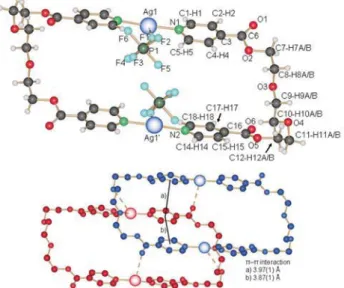
Indeed, a metallacyclic entity is obtained with two silver ions and two ligands forming a ring-like molecular unit, while two PF
6-anions are weakly coordinating to the silver ions
–one above, the other below the mean ring plane (Fig. 5). The dimensions of the metallacycle are ca. 6.8 Å across, measured from Ag1 to Ag1
′, and ca. 18.1 Å in length (measured from C9 to C9′).
The N-atoms N1 and N2
′of two di
fferent L3i-molecules coordinate to the metal ion at 2.14(2) Å and 2.19(2) Å, respect- ively. The N1–Ag1–N2′ angle of 161.9(9)° is inclined in the direction of the triethylene glycol moiety of an offset neigh- bouring ring, indicating a stronger interaction with O3 of the latter (Ag1–O3 ca. 2.84 Å) rather than with the anion (F1–Ag1 of ca. 3.68 Å). The counterion has thus, if any, an extremely weak contact to the metal cation.
The pyridine rings coordinating to the same metal ion are twisted by ca. 11.6°. While the carbonyl group O6–C13 remains coplanar to the neighbouring aromatic ring containing N2, the other carbonyl O-atom O1 coordinates to the Ag-ion of an adja- cent metallacycle (O1–Ag1 2.936 Å). This ester group O1–C6–
O2 is twisted against the plane of the aromatic ring containing N1 by ca. 22.8°. With O1, O3 and O4, the silver ion reaches again a trigonal bipyramidal coordination.
Two different kinds of H-bonds are present in the structure.
The O-atoms of the lateral chain coordinate to H-atoms of the pyridine (C1–H1⋯O3, ca. 2.59 Å), thus bringing adjacent metallacycles closer together. More interestingly, the O-atom
of the carbonyl group O1 of a first ring and the H-atoms of the ethylene moiety of a third ring form H-bonds passing through the cavity formed by a second metallacycle and join separated metallacycles that otherwise would not be in contact (Fig. 6).
Other weak interactions like
π–πinteractions (Fig. 5) are present and sustain the crystalline array. The PF
6-anions form weak hydrogen bonds with H-atoms of the surrounding metal- lacycles, acting like cement in the crystalline motif.
Compared to the 1D-structures, the ligand clearly adopts a different conformation. Indeed, two torsion angles O2–C7–C8–
O3 (ca.
−77°) and O3–C9–C10–O4 (ca.−63°) are similar to2, while a third torsion angle with the same sign O4–C11–C12–
O5 (ca.
−70°) turns the molecule to the metallacycle formationand prevents the stretching of the ligand L3i to form a helical array like in 2.
In the following, we investigated the effect of the position of the N-atom within the pyridine moiety of the ligand on the structural motifs and used thus nicotinic acid instead of isoni- cotinic acid to prepare the ligand.
Ligand L3n
We have shown previously for shorter ligands L1 and L2 that the position of the N-atom in the pyridine ring plays an impor- tant role in the formation of the final compounds.
24We there- fore formally shifted the position of the N-atom in L3i to the 3-position to obtain ligand L3n.
The reaction of L3n with AgNO
3yields the compound [Ag- (L3n)NO
3], 5 (monoclinic, P2
1/c (No. 14)) . Two ligands L3n bind to the metal ion via N1 and N2 with identical Ag–N dis- tance of 2.182(4) Å, and an N1–Ag–N2 angle of ca. 162°. L3n adopts a U-shape conformation with almost parallel pyridyl rings, with the N-atoms pointing to opposite directions (in contrast to the Z-shape of L3i). Thus, compound 5 forms pair- wise interdigitated simple helices (Fig. 7), which are more compact and less elongated than in 2 and 3 (helical pitch ca.
8 Å in 5 compared to ca. 18.4 and 17.8 Å, in 2 and 3, respect- ively). Indeed, the torsion angles around the O–C–C–O moi- eties of 5 are O3–C8–C7–O2 76.3(7)°, O4–C10–C9–O3 81.5(6)°
and O5–C12–C11–O4 78.6(6)°, and thus larger as compared
Fig. 5 Atom labelling for the ring formed in compound4(top) and stacking of rings (bottom).
Fig. 6 Polycatenation-type of interpenetration of rings of 4 via H-bonding motifs: schematic representation (top) and H-bonds (bottom).
http://doc.rero.ch
with 2 and 3. As the N-atoms of the pyridyl units in 5 point in opposite directions, a helical arrangement rather than a ring- compound is observed. Similar as in 1, two helices of 5 are arranged pair-wise, not wrapping around each other, but in contrast to 1, they are stacked parallel to each other with short Ag
–Ag contacts of the order of 3.12 Å. This attractive inter- action between the metal ions is also supported by the N1
–Ag
–N2 of 162° already mentioned above. These two silver ions are weakly and asymmetrically bridged by two symmetry related nitrate anions, above and below the metal connecting line with Ag–O8 of ca. 2.64 Å, while Ag–O7 is >3 Å. With the metal–
metal interaction, the silver ion can be considered as coordi- nated in a T-shape by two N- and one O-atoms.
The two aromatic ring systems containing N1, respectively N2 of the same ligand are almost parallel and ca. 6.6 Å away (C4–C17). This distance is ideal for intercalating another pyri- dine ring. Two parallel pyridyl units of two parallel chains are ca. 3.55 Å (distance N1–N2) away from each other, indicating
π–πinteractions (see also ESI†).
Reacting the same ligand L3n with two equivalents of AgNO
3leads to a so far unique compound [Ag
2(L3n)(NO
3)
2], 6 (monoclinic, C2/c (No. 15)). Two silver ions are now coordi- nated by one ligand. The first silver ion Ag1 is coordinated lin- early only by the N1 and N1
′of two di
fferent ligands, yielding the primary motif in the form of a winding chain (N1
–Ag1 2.160(2) Å). The second silver ion Ag2 is found ligated by the four O-atoms of the polyether moiety of the ligand (O3(O3′)–
Ag2 of 2.522(2) Å; O2(O2′)–Ag2 of 2.910(2) Å) (Fig. 8).
Similar to a crown ether motif, the four O-atoms of the poly- ether ligand, O2, O3, O2′ and O3′, lie approximately within a plane, giving rise to O–C–C–O torsion angles of ca. 74°. Thus, the ligand L3n is so tightly wrapped around Ag2 that the N-atoms of the same ligand are only ca. 3.5 Å away from each other, allowing no intercalation of a second ligand in the
helical groove as in 5. The coordination sphere of Ag2 is com- pleted by two nitrate anions formed around N2 and its sym- metry equivalent, binding via O4 and O5, at Ag2
–O4 2.388(2) Å and Ag2
–O5 with 2.689(2) Å, resulting in a distorted square bipyramid around the metal ion (considering the nitrate O- atoms as apical ligands). Although Ag2 seems to have an
“
open side
”from which no ligands coordinate, the space filling model shows that the metal ion is not accessible (ESI
†2, space filled projection).
As the chains formed by the ligand molecules and Ag1 arrange such that the ligand winds alternatingly to the left and to the right, the Ag(NO
3)
2-units around Ag2 of every second ligand come to stack o
ffset on top of each other with short dis- tances between the nitrate anions of O6
–O6
′< 3 Å. Repulsion between these anions is however diminished by O6
–H inter- actions (C4
–H3
⋯O6 ca. 2.58 Å and C5
–H4
⋯O6 ca. 2.95 Å) with adjacent pyridyl entities.
Our interest in preparing mixed metal compounds with multitopic ligands
32alet us to investigate the even longer ligands L4i and L4n.
Ligands L4i and L4n
The ligands L4i and L4n were crystallized and their structures are given in Fig. 9. L4i crystallizes in the triclinic space group P1
ˉ(No. 2), while L4n is orthorhombic with space group F2dd (No.43).
33aL4i adopts a U-shape while L4n, like L3i, has a Z-shape.
This is due to the differences in torsion angles around the ethyl groups. For L4i, the two middle O–C–C–O angles are nearly perfectly oriented anti with ca. 176°, while the two outer O–C–C–O angles are almost perfectly gauche with ca. 65°.
Although L4i adopts a U-shape, the N-atoms are oriented such that they point to different directions (Fig. 9), with a distance between the two N-atoms of 12.6 Å. For L4n, the structure is more elongated with a total length of ca. 15.6 Å measured between both N-atoms. The torsion angles in L4n are much nearer the all-gauche conformation, with ca. 65° and 75°. We have observed such a general trend of alternating Z- and U-shapes as a function of even and uneven numbers of ethylene oxide groups on one hand, and the position of the N-atom on the other. Thus, L1i, L2n,
25–27L3i and L4n adopt a Z-shape,
Fig. 8 Helical silver coordination polymer6, [Ag2(L3n)(NO3)2] with labelling of the asymmetric unit. (ellipsoids are at 40% probability level, #1−x,y, 1.5−z).
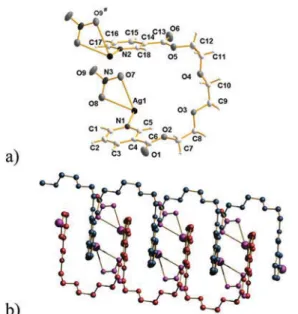
Fig. 7 (a) Labelling of compound5, (b) parallel helices of compound5, con- nectedvianitrate anions connecting the chains.
http://doc.rero.ch
while L1n, L2i,
25–27and L4i (and presumably also L3n) adopt the U-shape. As the energy of rotation around a C
–C-bond is weak, we do not expect large di
fferences in the energies of the di
fferent conformers. However, packing e
ffects such as H- bonds and segregation along hydrophilic and hydrophobic parts of the chains seem to play roles. For example, the nico- tinic acid moiety is asymmetric and thus likely more polar than the isonicotinic unit. Indeed, the isonicotinic acid moiety of L4i interacts with another isonicotinic acid unit of another ligand via short contacts between the N-atom and a C
–H group of a pyridine ring (N1
⋯H2 2.77 Å) and forms edge-to-face interactions between two aromatic rings (H1
⋯C5 2.78 Å). For L4n, the N-atom of the pyridyl group interacts more strongly with a CH
2-group of the polyether chain of a neighbouring ligand (N1
⋯H10B 2.65 Å). In our previous results, we found out that L1 and L2 seemed to maintain their preferred solid state
“shape
”upon coordination to silver.
17–29If this is also the case for the L4 ligand family will be described in the following.
Upon reaction of L4i with AgO
3SCF
3, the compound [Ag- (L4i)O
3SCF
3]
2, 7, is obtained (triclinic, P1
ˉ(No. 2)). The asym- metric unit of 7 is composed of one ligand L4i, one silver ion and one anion. Two silver ions and two ligands form an almost rectangular metallacycle as the basic building block of compound 7 (Fig. 10). The metal ion is coordinated by N1 and N2 of two di
fferent ligands at 2.179(9), respectively 2.169(9) Å, forming an angle of 150.1(3)°. This deviation from linearity already indicates interactions with O3, O4 and O5 of a ligand belonging to a neighbouring metallacycle, coordinating to Ag1 with 2.774(7), 2.561(8) and 2.736(7) Å, respectively. This gives the silver ion a T-shaped coordination with additional two donors in the equatorial plane similar to a fan. On the oppo- site side with respect to these O-donor atoms, the triflate anion is found, but not directly coordinating with a distance O10
–Ag1 >4 Å. O8 of the anion forms H-bonds to a neighbour stack of rings (O8
⋯H3
–C5 ca. 2.71 Å and O8
⋯H24
–C20 ca.
2.51 Å). Thus, these metallacycles are stacked stair-wise on top of each other (Fig. 10), similar as in compound 4, but with rings of larger dimension (ca. 7.3 Å across from metal to metal ion, and 20.1 Å long from C11 to its symmetry equivalent). As in 4, an H-bonding system exists between every first and third ring, based on a short contact between O7 and H19 (O7
⋯H19
–C14 ca. 2.54 Å), and pointing through the cavity of the second ring. Torsion angles around the O
–C
–C
–O are 66° on average.
Thus, the general shape of the ligand (U-shape) is maintained to form the ring systems, but the middle part of the ligand is now nearly in gauche conformation, probably due to the coordination of the involved O-atoms to a silver ion of a neigh- bouring ring.
Exchanging the position of the N-atom and using L4n with AgNO
3lead to the compound [Ag(L4n)NO
3(CH
3OH)]
2, 8 (monoclinic, P2
1/c (No 14)). Again, metallacycles based on two silver ions and two ligands are obtained (Fig. 11). Within a ring, the silver ions are coordinated by N1 and N2 of two di
fferent ligands with 2.175(7) and 2.164(2) Å, respectively, forming a nearly linear angle N1
–Ag1
–N2 of almost 176°, thus contrasting 7. Two symmetry equivalent nitrate anions bridge the two silver ions of the same metallacycle via O8 (O8
–Ag ca.
2.76 Å on average) while O9 binds only to one silver ion at ca.
2.83 Å as well, leading thus to a T-shaped coordination sphere for the silver ion with two additional O-atoms in a fan-like arrangement as in 7. O9 forms also weak interactions with H4, H10 and H22 of the surrounding pyridyl units, and to H21A of the methyl group of the methanol molecule. The oxygen atom O10 of the nitrate forms also an H-bond with O11 of the methanol.
Including the methanol O-atoms in the coordination sphere of the metal ions would lead to a pentagonal
Fig. 10 Metallacycle of 7 with labelling (top) and stacking of the rings, H-atoms omitted for clarity (bottom).
Fig. 9 LigandL4i(top) with #1:−x, 1−y, 1−zandL4n(bottom) with #1:
x,−y,−z.
http://doc.rero.ch
bipyramidal environment, however, the Ag
–O11 distance is greater than 3 Å. We have reported smaller metallacycles with L2i, which are, depending on the anion, either bridged within the same ring (intra-ring), between two neighbouring rings (inter-ring) or via both ways.
25,26In compound 8, the nitrate bridges internally, while the methanol molecule acts as a weak connector between the rings.
In contrast to 7, the polyether moieties of the ligand L4n do not coordinate to metal ions of neighbouring metallacycles.
Thus, the torsion angles around the O
–C
–C
–O groups of L4n range from 64 to 74° and are thus similar as in the free ligand.
The rings of 8 are so twisted that the mean plane through the O-atoms of the polyether part forms an angle of ca. 70° to the mean plane containing the two silver ions and four N-atoms.
Due to this distortion, stacking cannot occur as in 7. Instead, the ligand is so twisted that the two aromatic rings of a ligand are parallel but o
ffset, so that C2 and C19 come to lie on top of each other with the shortest contact between the rings of about 3.6 Å (Ag
⋯Ag of ca. 4.8 and C11
⋯C11
′of ca. 17.3 Å).
Furthermore, two pyridyl moieties, one with N1, the other with N2, of two adjacent neighbouring rings, have o
ffset close contacts, with N1
–C20 being the shortest with ca. 3.3 Å. The metallacycles are thus arranged parallel to each other.
The polyether chain of L4n is in principle large enough to accommodate a second metal ion, as shown for compound 6 where already the smaller ligand L3n is able to coordinate to two metal ions. Indeed, we tested this possibility by reaction of the same ligand with two equivalents of silver nitrate, yielding compound [Ag
2(L4n)(NO
3)
2]
2, 9 (monoclinic, P2
1/c) with one ligand, two silver and two nitrate ions per asymmetric unit.
Two ligands L4n form with two silver ions, Ag1 and its sym- metry equivalent, again a metallacycle (Ag1
–N with 2.139(9) for N1 and 2.164(9) Å for N2, N1
–Ag1
–N2 168.6(4)°), which is now much flatter than the one in 8. The ligand L4n of compound 9 features torsion angles of ca.
−14° (from O2 to O3),
−67°
(from O3 to O4), a third of ca. 67° (O4 to O5) and the last at ca.
−
80° (O5 to O6). This is clearly due to the coordination of O4 and O5 to the second silver ion Ag2 with 2.430(8) and 2.495(9) Å, respectively. O6 is only very weakly connected to Ag2 with
>3.3 Å. Similar as in 6, Ag2 is coordinated by two nitrate anions around N3 and N4 with Ag2
–O distances between 2.292(9) Å (O10) and 2.805(9) Å (O9). O11 and O13 of the nitrate around N3 also connect to Ag2 with 2.698(9) respect- ively 2.564(9) Å. O11 connects to Ag1 of the same ring with a distance of 2.637(9) Å. O12 of the nitrate anion around N3 con- nects with 2.842(7) Å to a silver ion of a neighbouring metalla- cycle. Vice versa, the symmetry equivalent O12 of this neighbouring ring binds also to Ag1 of the first ring. Ag1 has thus a T-shaped coordination sphere where only the shortest contacts are taken into account, while Ag2 is best described as having a distorted square pyramidal environment. The aro- matic rings of adjacent metallacycles are in parallel planes, but o
ffset, with the shortest contact between C1 of one pyridyl unit and N2 of the other (ca. 3.3 Å). Hereby, an inter-ring con- nectivity via O12 and its symmetry equivalent, as well as via aromatic stacking is maintained, overall leading to a 1D stack of rings (Fig. 12 bottom). These stacks of rings are oriented with alternating inclination, leading thus to a fishbone motif (Fig. 12) (see also ESI
†3). The dimension of the ring in 9 is 19.6 Å in length, measured from O6 to O6
′, but only 3.3 Å in width, measured between O1 and O2
′.
Fig. 11 Metallacycle of compound8with numbering (top) and packing of rings, H atoms omitted for clarity (bottom).
Fig. 12 Metallacycle of9with numbering (top) and linking of two metalla- cyclesvianitrate and aromatic stacking (bottom). Blue indicates the ligands of the metallacycles (L4nAg)2, red indicates the (AgNO3)2-motif which connects the rings together. Ellipsoids are at 40% probability level, #1−x, 1−y,−z.
http://doc.rero.ch
Comparison
Role of coordination number
These nine new coordination compounds show different struc- tural motifs related with the (nearly) linear coordination of silver ions by the N-donor atoms. For a ligand to silver ratio of 1 : 1, chains can occur in different variations, e.g. as simple offset chains with L3i, as pairs of helical chains with L3n or as double helices with L3i. Among all reactions tested with L3i or L3n, only one case of a metallacyclic compound was observed with a non-coordinating anion and L3i. For the same ratio, both ligands L4i and L4n seem to form preferentially metalla- cycles, no double-helices, helices or chains were observed so far. We have observed such a similar behaviour with the shorter homologues, where L1i or L1n most often yields 1D coordination polymers,
22,27,28while with L2i and L2n, 0-D ring-structures are more frequently observed.
26For the ligand to metal ratio 1 : 2, L3n gives a chain-like compound, while L4n and L4i prefer to yield rings. Surprisingly, the coordi- nation of silver by O-atoms is not limited to the linear arrange- ment. Thus, in compound 6 (with a ligand to metal ratio 1 to 2) we observe for the first time in our series of silver coordi- nation compounds with Lxi and Lxn that silver can be coordi- nated by solely O-atoms of the polyether chain and of the counterion.
Role of the ligand length
A first conclusion from previous results
17–30might be drawn that Lxi and Lxn with x being even numbers of ethylene oxide groups lead more frequently to metallacyclic compounds whereas uneven numbers rather lead to chain-like compounds.
However, the longer the ligands get, the more conformational possibilities we observe, as can be seen in the different torsion angles about the O–C–C–O-moieties.
For ligand L1i, many 1D structures are known, some of them are true polymorphs,
26,29others are isomers
25–27or sol- vates ( pseudo-polymorphs).
26For L2i however, we have reported that both 1D and 0D-structures can occur with a ring and a helix occurring as polymorphs from the same reaction.
30Hosseini et al. have also reported a double-helix with the longer ligand L6i, showing that the trend to form alternating chains and rings with uneven and pair numbers of ethylene oxide units is not strict.
31aThey also described a double helix formation when L4n or L6n was reacted with silver salts con- taining rather non-coordinating anions such as AgBF
4or AgPF
6.
31bRole of solvent
Upon complexation of L3i to silver, the solvent seems to play an important role. Reactions in THF seem to yield preferen- tially chains (linear of helical chains), while a ring compound is obtained from acetonitrile. From a thermodynamic point of view, ring compounds should be preferred over chain com- pounds due to entropy. However, chains are frequently observed, also because of their insolubility, once they are formed. THF is not a good solvent for such 1D compounds as
it does not coordinate well to silver ions. The kinetic product can thus be obtained. Acetonitrile however is an N-donor ligand and thus competitive versus L3i (and the other ligands as well), hence the thermodynamic products, the ring com- pounds, are favoured. This seems to be confirmed when MeOH is used during the reaction, which leads again to 1D compounds, independently from the ligand to metal ratio.
MeOH is however a better donor than THF, as also metalla- cycles can be obtained with L4i and L4n from MeOH as solvent. For the metallacycle formed with L4i the dimensions of the ring allow intercalated, offset stacking of the rings. For L4n the metallacycle is much more compressed, not allowing offset stacking. Both L4n compounds have rings packed in a fishbone motif.
Role of the anion
For compounds 2, 3 and 4, there seems to be a trend that strongly coordination anions lead to double helices, as the ligand L3i alone is not able to complete the coordination sphere of the silver ion. While nitrate seems always to interact strongly with the silver ion, other anions, like triflate or PF
6−, seem to be less interacting, as it was also already observed in previous compounds with shorter ligands.
17,26–30In com- pound 9, the nitrate anions connect the silver ions of two different metallacycles into an inorganic silver nitrate moiety.
Such an asymmetric coordination of nitrate to silver ions was hitherto unknown to the best of our knowledge. Also, only the Lxn ligands gave us 1 : 2 adducts with silver salts, while the Lxi ligands gave so far only 1 : 1 compounds, even if the silver salt was added in excess.
Antimicrobial properties
versusbiocompatibility
Our silver compounds with L1i and L1n have shown excel- lent antimicrobial properties.
18,20These properties are based on the solubility and thus silver ion release into the environment. The more silver ions are released, the stron- ger the effect. On the other hand, if silver compounds want to find applications in the medical sector, they also have to be biocompatible, which is only guaranteed if the silver ion concentration remains below a cytotoxic threshold.
18–23Thus, the solubility of silver compounds is one of the main issues in this respect. While L1i and L1n are not signifi- cantly soluble in water, the solubility of the ligands increases with the chain length of the spacer. The solubi- lity of the ligand strongly influences the solubility of the silver ion when linked to these ligands compared to pure AgNO
3(solubility of 1.22 kg l
−1at 0 °C). For instance, silver coordination compounds based on L1i and AgNO
3release only ca. 5–10 ppm of silver ions into water.
18,20We have shown that silver coordination compounds based on L2x are more soluble than the ones with L1x and have a stron- ger antimicrobial effect.
20,23On the other hand, coatings based on L2x and silver nitrate show, at the same concen- tration coating as L1x-compounds, a higher cytotoxicity towards 3T3 fibroblast cells. L3x and L4x have even longer polyether chains and are better soluble than the
http://doc.rero.ch
shorter ligands. Furthermore, the molecular, ring- based compounds should again be in general more soluble than the coordination polymers. Thus, we expect good antimicrobial properties, yet poor biocompat- ibilities for our compounds 1
–9. The four ligands tested alone did not show any antimicrobial e
ffect or cytotoxicity (data not shown).
We determined the MIC (minimal inhibitory concentration) and MBC (minimal bactericidal concentration) for a chosen number of our compounds with a 1
–5 × 10
5CFU mL
−1inoculum of S. epidermidis 1457. The results are given in Table 2.
The MIC and MBC for all compounds are similar with a trend of a stronger e
ffect for compounds 1 and 9. The inhi- bition zones obtained from agar di
ffusion tests for compounds 5, 6, 7 and 9 with concentrations between 0.1 and 5 mg mL
−1are each ca. 15 mm in diameter for inoculum of 10
7CFU mL
−1of S. epidermidis 1457, ca. 20 mm with 10
6CFU mL
−1and ca.
25 mm for 10
4CFU mL
−1inoculum. All compounds, except 1, start to be active against S. epidermidis 1457 at ca. 50
μg mL
−1. Compound 1 at a concentration of 10
μg mL
−1shows already an inhibition zone of 10 mm for 10
4CFU mL
−1S. epidermidis 1457 and 8 mm for 10
6CFU mL
−1, while it is not active against 10
7CFU mL
−1. This confirms the trend of MIC and MBC measurements that compound 1 has the best antimicrobial activity among the tested samples. This e
ffect holds still true when converting the mass into molar amounts of silver ions exposed. Compound 1 is based on the least soluble (in polar solvent water) ligand L3i. A slow and continuous release of silver is expected and should kill bacteria e
fficiently over longer times. Compound 9 on the other hand releases for the same mass twice as many silver ions and appears thus strong in terms of mass, but it is not so e
fficient in terms of silver ion release.
The in vitro biocompatibility of a number of compounds was assessed by a MTT assay, measuring the optical density of cell growth cultures using mouse fibroblast as model cells.
The highest concentration at which the optical density increases as desired within a period of four days is 10
μg mL−1for compounds 2 (18.28 mmol Ag mL
−1), 5 (18.90 mmol Ag mL
−1) and 9 (26.95 mmol Ag mL
−1), while compounds 1 (17.70 mmol Ag mL
−1), 6 (28.65 mmol Ag mL
−1) and 8 (16.53 mmol Ag mL
−1) are cytotoxic at this concentration, showing no cell growth whatsoever. Thus, all compounds show no reasonable therapeutic window for use within coatings on medical devices to be utilized in the human body.
Conclusions
In conclusion, we present three new ligands derived from oli- gomers of polyethylene glycol, substituted at both ends with nicotinic or isonicotinic acid moieties. Almost no metal com- plexes are known for these ligands,
32and only one silver com- pound with L4n was known before our study,
31bsuch that we therefore contribute nine new coordination compounds with silver. Upon coordination to silver salts in organic solvents, we have observed the structure types as recollected in Table 3.
The structures can be categorized on the one hand into 1D coordination polymer motifs, featuring closely packed linear chains, helical chains as well as double helices. On the other hand, metallacycles were observed, representing the class of 0D compounds. No interpenetrated or catenated com- pounds were observed, but we cannot exclude that they can exist.
While general trends can be identified, the role of the reac- tion solvent and the co-crystallizing solvent as well as the role of the anion remains di
fficult to predict, but may play a crucial role in the structure assembly.
The ligands seem to adopt preferential conformations in the solid states, which are roughly maintained upon coordi- nation to silver. The longer the ligands, the more possibilities of di
fferent conformations can in principle be expected, especially when changes in anions and solvents occur as well. For the first time in our series of silver coordi- nation compounds, we observed (i) a 1 : 2 ratio of ligand to silver salt in the final coordination compound, and (ii)
Table 2 MIC and MBC values of silver complexes
Compound
MIC (μg/mL (and mmol Ag/mL))
MBC (μg/mL (and mmol Ag/mL))
1 3.90 (6.90) 7.81 (13.82)
5 7.81 (14.76) 15.63 (29.54)
6 7.81 (22.38) 15.63 (44.79)
7 7.81 (11.83) 15.63 (23.68)
9 3.90 (10.51) 15.63 (42.13)
Table 3 Classification of silver complexes in family of networks
Linear chain
Metallacycle Helix
Regular Distorted Single Double
1[{Ag(L3i) NO3}*(H2O)2] 4[Ag(L3i) PF6]2 8[Ag(L4n)NO3(CH3OH)]2} 5[Ag(L3n)NO3] 2{[Ag(L3i)NO3}(H2O)]
6[Ag2(L3n)NO3)2] 7[Ag(L4i)] O3SCF3]2 9{[Ag2(L4n) (NO3)2]2 3[Ag(L3i)O3SCF3]
http://doc.rero.ch
that silver could be coordinated only by O-atoms of the polyether chains and of the anions, but without connection to N-donors.
While all the silver coordination compounds described here, especially 1 and 9, exhibit strong antimicrobial proper- ties, the therapeutic window is too small, respectively non- existing for uses in which biocompatibility of the compounds is required.
We expect such multitopic ligands with medium and long polyether chains, featuring O- as well as N-donor atoms as potentially interesting for the preparation of mixed metal com- pounds as precursors for oxide materials and are currently working in this area.
33Experimental
All starting products are commercially available and were pur- chased from Acros Organics and Sigma Aldrich.
Chromatography purification and analysis
Analytical thin sheet chromatography (TLC) was performed with Merck silica gel 60 F-254 plates. Column chromatography was performed using Merck silica gel 60.
Infrared spectroscopy
Fourier transform infrared (FTIR) spectra were acquired on a Shimazu FTIR-8400S spectrometer equipped with a Golden Gate ATR (attenuated total reflection) system.
Spectra were recorded over a range of 4000
–400 cm
−1with a resolution of 0.01 cm
−1(16, number of scans). Abbreviations used are: s, strong; m, medium and w, weak.
1
H-NMR,
13C-NMR measurements
High resolution
1H- and
13C-NMR spectra were recorded on a Bruker AM 300 MHz.
Inductively coupled plasma (ICP)
ICP measurements were recorded on a Perkin Elmer Optical Emission Spectrometer, Optima 7000 DV.
A synthesis of the ligands
Ligands were synthesized based on a two-step reaction:
First the nicotinic (or isonicotinic acid) is chlorinated to avoid for a second time the nucleophilic substitution of this chloride by the alcohol of the polyethylene glycols (Scheme 2).
Ligand L3i
2 g of isonicotinic acid (0.016 mol) are dissolved in 100 mL of dimethylchloride. In an ice bath and under mixing 1.4 mL of oxalyl chloride (0.016 mol) is added dropwise. The reaction occurs overnight at room temperature. The system is con- nected to a trap of NaOH to absorb formed HCl. The precipi- tate (isonicotinic acid chloride) is filtered and dried. Then 2 g of isonicotinic chloride (0.014 mol) are dissolved in 40 mL of toluene with 2.12 g (0.024 mol) of Et
3N and 0.93 mL (1.05 g, 0.007 mol) of triethylene glycol. The reaction occurs overnight under reflux. The organic phase is extracted four times with DMC, and washed twice with water and once with saturated NaHCO
3-solution. The resulting product is purified on a silica column eluting with a 6 : 2 hexane–ethyl acetate mixture.
Yield: 40%.
IR (cm
−1):
ν(Ar–H) 3083.0 s, ν(–HC–H) 2957.7 s, ν(CvO)1714.5 s,
ν(CvC) 1588.5 m,ν(ArC–C, CvN), 1415.4 s,ν(CO–O)1273.7 s,
ν(–C–O) 1108.8 s,ν(ArC–H) 738.9 m.1
H NMR (CD
3Cl) ppm 8.49 (d, J = 4.09 Hz, 2 H), 7.59 (br. s, 2 H), 4.11–4.39 (m, 2 H), 3.79 (br. s, 2 H), 3.57 (d, J = 4.09 Hz, 2 H), 3.34–3.51 (m, 8 H), 3.31 (br. s, 2 H).
13
C NMR (CD
3Cl) ppm 164.42, 164.38, 149.86, 136.83, 122.46, 77.52, 76.80, 72.19, 70.00, 69.87, 69.65, 69.45, 68.31, 64.30, 60.74.
Ligand L3n
The same procedure as for L3i is used but instead of isonicoti- nic acid, nicotinic acid is used.
Yield: 35%.
1
H NMR (CD
3Cl) ppm 9.10 (br. s, 2 H), 8.64 (br. s, 2 H), 8.17 (d, J = 7.72 Hz, 2 H), 7.25 (s, 1 H), 7.28 (s, 1 H), 4.38 (t, J = 4.54 Hz, 4 H), 3.68–3.89 (m, 4 H), 3.61 (s, 6 H).
13
C NMR (CD
3Cl) ppm 165.16, 150.54, 137.51, 123.22, 72.62, 70.82, 70.49, 69.08, 64.84, 61.85.
Ligand L4i
The same reaction as for L3i is used but instead of triethylene glycol, 1.36 g (0.007 mol) of tetraethylene glycol is used.
Yield: 45%.
IR (cm
−1):
ν(Ar–H) 3115.1 s, ν(–HC–H) 2987.2 s, ν(CvO)1723.8 s,
ν(CvC) 1534.2 m,
ν(ArC–C, CvN).1412.1 s,
ν(CO–O) 1278.8 s, ν(–C–O) 1045.3 s, ν(ArC–H)746.2 m.
1
H NMR (CD
3Cl) ppm 8.49 (d, J = 4.09 Hz, 2 H), 7.59 (br. s, 2 H), 4.11–4.39 (m, 2 H), 3.79 (br. s, 2 H), 3.57 (d, J = 4.09 Hz, 2 H), 3.34–3.51 (m, 8 H), 3.31 (br. s, 2 H).
13
C NMR (CD
3Cl) ppm 164.42, 164.38, 149.86, 136.83, 122.46, 77.52, 76.80, 72.19, 70.00, 69.87, 69.65, 69.45, 68.31, 64.30, 60.74.
Ligand L4n
The same procedure is used as for L4i but instead of isonicoti- nic acid, nicotinic acid is used.
Yield: 40%.
Scheme 2 The two step reaction for the synthesis of the ligands.
http://doc.rero.ch
1
H NMR (CD
3Cl) ppm 9.21 (br. s, 2 H), 8.75 (br. s, 2 H), 8.28 (d, J = 8.17 Hz, 2 H), 7.36 (dd, J = 7.27, 5.00 Hz, 2 H), 4.33–4.64 (m, 4 H), 3.72–3.96 (m, 4 H), 3.65 (br. s, 9 H).
13
C NMR (CD
3Cl) ppm 164.94, 153.23, 150.68, 136.97, 125.80, 123.16, 77.52, 76.81, 70.51, 68.90, 64.26.
B Formation of the silver coordination compounds Typical synthesis (for complexes 1 and 5 to 9).
One (or two) equivalent of silver salt (depending on the desired ratio M : L) and one equivalent of ligand are mixed in methanol at a typical concentration of around 100–150 mg of the compound in 15 mL of the solvent. The reaction occurs during ca. 24 hours at room temperature. In the case of solubi- lity problems, the reaction solution in the Schlenk tube is heated under reflux.
After filtration, the method of slow diffusion is used to obtain a single crystalline product. In the bottom of the flask the mother solution is deposited, representing ca. 30% of the total volume of the solution. On top of this, a second phase is carefully layered with a syringe in order not to mix the two phases. Slow diffusion occurs at room temperature. After one to six months, crystals are obtained.
The syntheses of compounds 2 and 4 are following the same principle of slow diffusion by layering but in place of MeOH and hexane, THF and CH
3CN are used. Compound 3 is obtained from an H-tube using CH
3CN and THF.
Compound 1: [{Ag(L3i)NO
3}(H
2O)
2]
100 mg (0.27 mmol) of L3i and 47 mg (0.27 mmol) of AgNO
3are dissolved in THF and heated under reflux for 24 hours.
After filtration, 1 mL of the solution is placed in a flask.
0.5 mL of water and 3 mL of hexane are added carefully without mixing.
The crystals are obtained after six months at room tempera- ture in the dark.
Yield: 26 mg (0.046 mmol), 17% calc. with respect to AgNO
3.
ICP Ag: calculated 18.92%, measured 20.46%.
IR (cm
−1):
ν(–O–H) 3428.4 broad,ν(Ar–H) 3073.8 s,ν(–HC–H) 2885.6 m,
ν(CvO) 1719.3 s, ν(CvC) 1601.0 s, ν(ArC–C,CvN) 1430.7 s,
ν(NO3) 1352.3–1284.0 s,
ν(–C–O) 1090.0 s, ν(ArC–H) 695.5 s.Compound 2: [{Ag(L3i)NO
3}(H
2O)]
A solution of THF containing 35.7 mg of L3i (0.09 mmol) and 25 mg of AgNO
3(0.09 mmol) was stirred together for an hour.
Afterwards the solution was filtered and deposited in capil- laries. Single crystals of the complex suitable for X-ray diffrac- tion were able to be collected the next day. After two days crystals are formed in the vessel where the filtrate was collected.
Yield: 19.1 mg (0.02 mmol), 48% calc. with respect to AgNO
3.
Anal. calcd for: C 47.56, H 4.44, N 9.25%. Found: C 45.2, H 5.1, N 9.1%.
IR (cm
−1):
ν(Ar–H) 3098.7 s, ν(–HC–H) 2957.7 s, ν(CvO)1730.1 s,
ν(CvC) 1548.9 w,ν(ArC–C, CvN) 1407.2 w s,ν(NO3)1391.5–1187.2 s,
ν(–C–O) 1116.3 s,ν(ArC–H) 691.0 m.Compound 3: [Ag(L3i)O
3SCF
3]
Crystals of 3 were obtained by layering an acetonitrile solution of silver triflate (30 mg, 0.17 mmol, in 6 mL) onto a THF sol- ution containing L3i (64 mg, 0.17 mmol, in 15 mL). After 1 week of slow evaporation single crystals of medium quality were isolated and measured. Slow di
ffusion of 20 mL THF linking 5 mL of a silver triflate solution in water and 5 mL of the ligand in THF in an
“H
”-shaped tube a
ffords the same crystal structure after 45 days.
Yield: 50 mg (0.08 mmol), 48% calculated with respect to AgSO
3CF
3.
Anal. calcd for: C 36.9, H 3.27, N 4.54%. Found: C 36.8, H 3.30, N 4.58%.
IR (cm
−1):
ν(Ar
–H) 3065.3 s,
ν(
–HC
–H) 2948.4 s,
ν(C
vO) 1731.1 s,
ν(C
vC) 1543.9 w,
ν(ArC
–C, C
vN) 1422.3 w,
ν(SO3CF3) 1267.7 s, broad,
ν(SO
3CF
3) 1102.6 s, broad,
ν(ArC
–H) 631.6 m.
Compound 4: [Ag(L3i)PF
6]
215 mg of L3i (0.04 mmol) and 10.7 mg (0.04 mmol) of AgPF
6were stirred in a CH
3CN solution (5 mL) in a dark place. 3 mL of EtOEt were layered over the filtered solution, affording single colorless crystals suitable for X-ray crystallography after slow evaporation in a few days. Single crystals suitable for X-ray are obtained in the solution vessel.
Yield: 15.4 mg (0.02 mmol), 63% calc. with respect to AgPF
6.
Anal. calcd for: C 35.24, H 3.29, N 4.57%. Found: C 34.9, H 3.32, N 4.5%.
IR (cm
−1):
ν(–HC–H) 2918.7 s, ν(CvO) 1716.5 s, ν(CvC)1510.1 m,
ν(ArC–C, CvN) 1462.4 m,ν(C–O) 1298.2 s,δ(ArC–H)1054.5 m,
ν(PF6) 636.2–530.5 s, broad.Compound 5: [Ag(L3n)NO
3]
40 mg (0.235 mmol) of AgNO
3and 85 mg (0.235 mmol) of L3n are mixed in 15 mL of MeOH during 3 days at room tempera- ture. After filtration and deposition of 1 mL of the solution and 3 mL of hexane in a flask at room temperature and in the dark, crystals are obtained in one month.
Yield: 34.8 mg (0.066 mmol), 28% calc. with respect to AgNO
3.
ICP Ag: calculated 20.21%, measured 22.16%.
IR (cm
−1):
ν(Ar
–H) 3073.4 s,
ν(
–HC
–H) 2884.5 s,
ν(C
vO) 1719.9 s,
ν(C
vC) 1601.0 s,
ν(ArC
–C, C
vN) 1474.7 w,
ν(NO
3) 1364.3
–1283.8 s,
ν(
–C
–O) 1090.0,
ν(
–C
–O) 1090.5 s, (ArC
–H) 695.6 s.
Compound 6: [Ag
2(L3n)(NO
3)
2]
40 mg (0.235 mmol) of AgNO
3and 42 mg (0.117 mmol) of L3n are mixed in 15 mL of MeOH and placed under reflux during three days. After filtration and deposition of 1 mL of the
http://doc.rero.ch
solution in a flask, 3 mL of hexane are added. After one month at room temperature and in the dark, crystals are obtained.
Yield: 51.6 mg, 63% calc. with respect to AgNO
3. ICP Ag: calculated 30.63%, measured 32.6%.
IR (cm
−1):
ν(Ar–H) 3073.1 s, ν(–HC–H) 2884.2 s, ν(CvO)1719.2 s,
ν(CvC) 1600.8 s, ν(ArC–C, CvN) 1430.6 s, ν(NO3) 1364.0 s–1280.0 s,
ν(–C–O) 1089.8 s,ν(ArC–H) 695.5 s.Compound 7: [Ag(L4i)O
3SCF
3]
2300 mg (0.742 mmol) of L4i and 191 mg (0.742 mmol) of AgCF
3SO
3are dissolved in 20 mL of MeOH and heated to 30 °C during three days. After filtration, 1 mL of the solution is placed in a flask. On top of this phase, 3 mL of hexane are added. After four months at room temperature and in the dark, crystals are obtained.
Yield: 201 mg (0.304 mmol), 41% with respect to AgCF
3SO
3. ICP Ag: calculated 16.20%, measured 17.16%.
IR (cm
−1):
ν(O
–H) 3434.5 broad,
ν(Ar
–H) 3075.5 s,
ν(
–HC
–H) 2922.6,
ν(C
vO) 1731.8 s,
ν(C
vC) 1612.7 s,
ν(ArC
–C, C
vN) 1421.8 s,
ν(SO
3CF
3) 1221.6 s,
ν(
–C
–O) 1064.3 s,
ν(ArC
–H) 699.3 s.
Compound 8: [Ag(L4n)NO
3(CH
3OH)]
242 mg (0.247 mmol) of AgNO
3and 100 mg (0.247 mmol) of L4n are dissolved in 5 mL of MeOH and heated to 60 °C for 30 minutes. After filtration, 1 mL of the solution is placed in a flask with 0.5 mL of EtOH. After six weeks at room temperature and in the dark, crystals are obtained and measured.
Yield: 16.46 mg (0.027 mmol), 11% calc. with respect to AgNO
3.
ICP Ag: calculated 17.67%, measured 19.17%.
IR (cm
−1):
ν(–O–H) 3441.3 broad,ν(Ar–H) 3071.8 s,ν(–HC–H) 2871.5 m,
ν(CvO) 1719.5 s, ν(CvC) 1599.2 s, ν(ArC–C,CvN) 1432.5 s,
ν(NO3) 1385.0 s, 1280.0 s,
ν(–C–O) 1089.7 s, ν(ArC–H) 699.0 s.Compound 9: [Ag
2(L4n)(NO
3)
2]
2280 mg (0.693 mmol) of L4n and 118 mg (0.694 mmol) of AgNO
3are heated in 15 mL of MeOH to reflux overnight. After filtration and deposition in a flask, 3 mL of hexane are added.
After two months at room temperature and in the dark, crys- tals are obtained.
Yields: 278.8 mg (0.375 mmol), 54% with respect to AgNO
3. ICP Ag: calculated 28.82%, measured 26.43%.
IR (cm
−1):
ν(Ar
–H) 3071.3 s,
ν(
–HC
–H) 2881.2,
ν(C
vO) 1718.8 s,
ν(C
vC) 1600.9 s,
ν(ArC
–C, C
vN) 1434.9s,
ν(NO
3) 1363.5 s
–1285.1 s,
ν(
–C
–O) 1088.9 s,
ν(ArC
–H) 699.0 s.
Single-crystal X-ray diffraction
Prismatic single crystals of compounds 1–9 were carefully selected under a polarizing microscope. Compounds 1, 5–9 are glued in a loop and measured at 200 K. Compounds 2–4 are fixed on a capillary and measured at 293 K. Diffraction data were collected on a Stoe IPDS XArea diffractometer, using in all cases graphite monochromated Mo-Kα radiation.
Absorption effect was also corrected by using Platon
35for compounds 1, 5–9. The structures 1–9 were solved by direct methods (SHELXS 97
34) and then refined by the full-matrix least squares procedure based on F
2, using the SHELXL 97 computer program belonging to the WINGX software package.
36Anisotropic thermal parameters were assigned to the non-H atoms. The hydrogen atoms were generated geometrically.
Representation of graphics
Crystal graphics were carried out using POV-RAY and DIAMOND v3.0 softwares, WINGX softwares package.
35Antimicrobial tests
B
ACTERIAL STRAINS AND GROWTH CONDITIONS. Staphylococcus (S.) epidermidis 1457 bacteria were freshly grown in tryptic soy broth (TSB) for 7 h at 37 °C without shaking and then diluted 1 : 100 for an overnight (ON) culture, which was used for the experiments. Bacterial numbers were estimated by determin- ing the optical density at 600 nm and assessed by plating serial dilutions on Müller Hinton Agar (MHA).
I
N VITROANTIMICROBIAL SUSCEPTIBILITY. A standard inoculum of 1
× 10
5to 5 × 10
5CFU mL
−1of S. epidermidis 1457 was used.
Minimal inhibitory and bactericidal concentrations (MIC and MBC, respectively) of silver compounds for logarithmically growing bacteria were determined using a macrodilutions method according to the Clinical and Laboratory Standards Institute (CLSI) guidelines (Murray, P. R., E. J. Baron, J. H. Jorgensen, M. A. Pfaller, and R. H. Yolken (ed.). 2003.
Manual of clinical microbiology, 7th ed. American Society for Microbiology, Washington, DC). The MIC was the lowest con- centration of silver compounds that inhibited visible bacterial growth. The MBC was defined as the lowest concentration of silver compounds which killed
≥99.9% of the initial bacterialcounts (i.e.,
≥3 log10(CFU mL
−1)) in 24 h.
A
GAR INHIBITION ASSAYS. Agar inhibition assays were performed in dishes with a size of 24 × 24 cm containing 160 mL agar.
S. epidermidis 1457 was diluted to 10
4, 10
6and 10
7CFU mL
−1in the agar. Solutions of silver compounds were pipetted into the holes each of 1 cm diameter in the agar. The agar plates were incubated for 18 h at 37 °C, and the inhibition zones around the solutions of the silver compounds were measured.
Biocompatibility tests
F
IBROBLAST CELL CULTURE. L-929 fibroblast murine cell lines (ATCC number: CCL-1) were used as a cell model to investigate the effects of material variations on soft tissue response. The fibroblast cultures were maintained in RPMI supplemented with 0.25 mM HEPES, 10% fetal bovine serum, 1X NEEA, 1 mM sodium pyruvate and 1% penicillin/streptomycin at 37 °C in humidified air and 5% CO
2. Cultures were subdivided by trypsination using Trypsin-EDTA solution. The culture medium was changed every 3 days.
MTT
ASSAY OF FIBROBLAST CELLS. A quantitative colorimetric MTT test was performed after 2, 3 and 4 days of culture to
http://doc.rero.ch
characterize cellular metabolism (vitality) and, by implication, proliferation. Cells were seeded at the right concentration onto the 96-well plates, grew for 24 h before adding the silver-com- pounds. As a control substrate for cell attachment and growth, fibroblasts were plated directly onto tissue culture polystyrene plastic. At day 2, 3 and 4, 10
μL of MTT solution [5 mg mL−13-(4,5-dimethylthiazol-2-yl)-2,5-diphenyl-tetrazolium bromide in PBS] was added to each well, and the cells were incubated at 37 °C for 4 h. The reaction was stopped at 4 °C for hours. The medium was then removed and 100
μL of dimethylsulfoxidewas added to each well, followed by 30 min incubation at room temperature on a shaker. The optical density (OD) was measured at 540 nm with an ELISA Reader. The mean absor- bance values were corrected for a blank (medium only) and results were reported as optical density.
Acknowledgements
The authors thank the Swiss National Science Foundation, the University of Fribourg and the Fribourg Center for Nanomater- ials FriMat for generous support.
Notes and references
1 (a) J. Song, Z. Luo, D. K. Britt, H. Furukawa, O. M. Yaghi, K. I. Hardcastle and C. L. Hill, J. Am. Chem. Soc., 2011, 133, 16839–16846; (b) S. Wan, F. Gandara, A. Asano, H. Furukawa, A. Saeki, S. K. Dey, L. Liao, M. W. Ambrogio, Y. Y. Botros, X. Duan, S. Seki, J. F. Stoddart and O. M. Yaghi, Chem. Mater., 2011, 23, 4094–4097;
(c) J. Gassensmith, H. Furukawa, R. A. Samldone, R. S. Forgan, Y. Y. Botros, O. M. Yaghi and J. F. Stoddart, J. Am. Chem. Soc., 2011, 133, 15312–15315; (d) K. M. Choi, H. J. Jeon, J. K. Kang and O. M. Yaghi, J. Am. Chem. Soc., 2011, 133, 11920–11923; (e) A. J. Cairns, J. A. Perman, L. Wojtas, V. Ch. Kravtsov, M. H. Alkordi, M. Eddaoudi and M. J. Zaworotko, J. Am. Chem. Soc., 2008, 130, 1560–1561;
(f ) F. Nouar, J. F. Eubank, T. Bousquet, L. Wojtas, M. J. Zaworotko and M. Eddaoudi, J. Am. Chem. Soc., 2008, 130, 1833–1835; (g) M. Fujita, Y. J. Kwon, O. Sasaki, K. Yamaguchi and K. Ogura, J. Am. Chem. Soc., 1995, 117, 7287.
2 (a) C. Janiak, Angew. Chem., 1997, 109, 1499–1502;
(b) C. Janiak, Dalton Trans., 2003, 2781–2804;
(c) S. R. Batten, B. F. Hoskins and R. Robson, J. Am. Chem.
Soc., 1995, 117, 5385–5386.
3 (a) S. R. Batten and R. Robson, Angew. Chem., 1998, 110, 1558–1595; (b) M. Eddaoudi, D. B. Moler, H. Li, B. Chen, T. M. Reineke, M. O’Keeffe and O. M. Yaghi, Acc. Chem.
Res., 2001, 34, 319–330; (c) O. M. Yaghi, M. O’Keeffe, N. W. Ockwig, H. K. Chae, M. Eddaoudi and J. Kim, Nature, 2003, 423, 705–714; (d) O. M. Yaghi, H. Li, C. Davis, D. Richardson and T. L. Groy, Acc. Chem. Res., 1998, 31, 474–484; (e) A. J. Blake, N. R. Champness, P. Hubberstey,
W.-S. Li, M. A. Withersby and M. Schröder, Coord. Chem.
Rev., 1999, 183, 117–138; ( f) A. N. Khlobystov, A. J. Blake, N. R. Champness, D. A. Lemenovskii, A. G. Majouga, N. V. Zyk and M. Schröder, Coord. Chem. Rev., 2001, 222, 155–192; (g) P. J. Hagrman, D. Hagrman and J. Zubieta, Angew. Chem., 1999, 111, 2798–2848; (h) S. Kitagawa and S. Kawata, Coord. Chem. Rev., 2002, 224, 11–34;
(i) S. Kitagawa and M. Munakata, Trends Inorg. Chem., 1993, 3, 437–462; ( j) M. Munakata, Adv. Inorg. Chem., 1998, 46, 173–303; (k) M. J. Zaworotko, Chem. Soc. Rev., 1994, 23, 283–288; (l) B. Moulton and M. J. Zaworotko, Chem. Rev., 2001, 101, 1629–1658.
4 (a) A. N. Khlobystov, A. J. Blake, N. R. Champness, D. A. Lemenovskii, A. G. Majouga, N. V. Zyk and M. Schröder, Coord. Chem. Rev., 2001, 222, 155–192;
(b) K. Biradha, C. Seward and M. J. Zaworotko, Angew.
Chem., 1999, 111, 584–587; (c) B. F. Hoskins, R. Robson and D. A. Slizys, J. Am. Chem. Soc., 1997, 119, 2952–2953.
5 (a) J. Konnert and D. Britton, Inorg. Chem., 1966, 5, 1193;
S. R. Batten, B. F. Hoskins and R. Robson, New J. Chem., 1998, 22, 173–175; (b) B. F. Abrahams, S. R. Batten, B. F. Hoskins and R. Robson, Inorg. Chem., 2003, 42, 2654–
2664; (c) O.-S. Jung, Y. J. Kim, K. M. Kim and Y.-A. Lee, J. Am. Chem. Soc., 2002, 124, 7906–7907;
(d) K. V. Domasevitch, I. Boldog, E. B. Rusanov, J. Hunger, S. Blaurock, M. Schroder and J. Sieler, Z. Anorg. Allg. Chem., 2005, 631, 1095–1100; (e) D. M. Proserpio, CrystEngComm, 2003, 5, 269; D. M. Proserpio, Coord. Chem. Rev., 2003, 246, 247; (f) S. Banfi, L. Carlucci, E. Caruso, G. Ciani and D. M. Proserpio, Cryst. Growth Des., 2004, 4, 29–32;
(g) D. Whang and K. Kim, J. Am. Chem. Soc., 1997, 119, 451–452; (h) N. R. Brooks, A. J. Blake, N. R. Champness, J. W. Cunningham, P. Hubberstey, S. J. Teat, C. Wilson and M. Schroder, J. Chem. Soc., Dalton Trans., 2001, 2530–2538;
(i) L. Carlucci, G. Ciani, D. M. Proserpio and S. Rizzato, CrystEngComm, 2002, 4(22), 121–129; ( j) L. Carlucci, G. Ciani, D. M. Proserpio and S. Rizzato, CrystEngComm, 2002, 4, 413–425; (k) Y.-B. Dong, P. Wang, R.-Q. Huang and M. D. Smith, Inorg. Chem., 2004, 43, 4727–4739.
6 (a) S. Q. Liu, H. Konaka, T. Kuroda-Sowa, M. Maekawa, Y. Suenaga, G. L. Ning and M. Munakata, Inorg. Chim. Acta, 2005, 358, 919–926; (b) L. Carlucci, G. Ciani, D. M. Proserpio and A. Sironi, J. Chem. Soc., Chem.
Commun., 1994, 2755; (c) A. Klein, E. Graf, M. W. Hosseini and A. De Cian, New J. Chem., 2001, 25, 207–209;
(d) L. Carlucci, G. Ciani, D. M. Proserpio and S. Rizzato, Chem.–Eur. J., 2002, 8, 1520–1526; (e) K. A. Hirsch, D. Venkataraman, S. R. Wilson, J. S. Moore and S. Lee, J. Chem. Soc., Chem. Commun., 1995, 2199–2200;
(f ) J.-P. Zhang, Y.-Y. Lin, W.-X. Zhang and X.-M. Chen, J. Am. Chem. Soc., 2005, 127, 14162–14163;
(g) M. A. Withersby, A. J. Blake, N. R. Champness, P. Hubberstey, W.-S. Li and M. Schroder, Angew. Chem., Int.
Ed. Engl., 1997, 36, 2327; (h) L. Carlucci, G. Ciani, P. Macchi, D. M. Proserpio and S. Rizzato, Chem.–Eur. J., 1999, 5, 237–243; (i) Y. M. Chow and D. Britton, Acta