HAL Id: hal-01966579
https://hal.archives-ouvertes.fr/hal-01966579
Submitted on 28 Dec 2018HAL is a multi-disciplinary open access archive for the deposit and dissemination of sci-entific research documents, whether they are pub-lished or not. The documents may come from teaching and research institutions in France or abroad, or from public or private research centers.
L’archive ouverte pluridisciplinaire HAL, est destinée au dépôt et à la diffusion de documents scientifiques de niveau recherche, publiés ou non, émanant des établissements d’enseignement et de recherche français ou étrangers, des laboratoires publics ou privés.
Internalized activities
Jean-Christophe Buisson, Jean-Charles Quinton
To cite this version:
Jean-Christophe Buisson, Jean-Charles Quinton. Internalized activities. New Ideas in Psychology, Elsevier, 2010, 28 (3), pp.312-323. �hal-01966579�
Jean-Christophe BUISSON, [email protected]
Jean-Charles QUINTON, [email protected]
University of Toulouse (INP/ENSEEIHT), IRIT (Computer Science Research Institute of Toulouse)
Internalized activities
Abstract
This paper argues that interactive mental processes in humans have a natural tendency to replay internally and cyclically, a typical example being the tunes that run 'in our head' for hours. The existence of these 'internalized activities' may be shown by both simple introspection and neurological experiments, which also reveal that they occur in all sensory modalities and involve everything from perception to more abstract activities.
We will show that this hypothesis provides new ways to explain 1- how real activity is guided by similar internalized activities, 2- how goals are represented to an agent by persistent internalized activities, 3- how the pursuit of these goals subordinates other activities.
We account for such internalized activities by means of the sorts of interactive processes described by the interactivist model. They have a tendency, like that of Piaget schemes, to run cyclically, whenever possible. They are similar to real activities in that they draw on the same neural machinery, but their sensory-motor aspects are somehow inhibited. Not being enslaved to reality and its timing, they can run faster and in a discontinuous way. Multiple internalized processes may also co-occur with compatible sensory-motor operations, even though the latter are inhibited.
When an activity is actually performed by an agent, we argue that a synchronization phenomenon makes previous similar activities run in an internalized way in parallel, and that they help to guide real activity by providing anticipated potentialities in real time. When we make a basketball shot, previous analogous shots run in internal synchrony at the same time, guiding the current attempt.
A goal such as a successful shot can be initially present in the agent's mind as a persistent internalized activity. The tendency of internalized activities to run whenever possible allows for a sequence construction mechanism, which operates forward and backward, and permits the creation of sequences of internalized processes projecting from a current activity, such as dribbling against an opponent, to a goal activity, such as shooting.
These ideas have been applied 1- to a computer program able to recognize musical rhythms by synchronizing actual rhythms to internalized ones, and 2- to the construction of a model of how an agent represents the routes it knows in a town and how these routes coordinate internally to produce sequences from a current location to a destination.
1- Introduction
The ideas presented in this paper will be developed within the interactivist framework promoted by Bickhard (Bickhard 1995, Bickhard & Christensen 2002). This model is committed to a process metaphysics in which the fundamental form of representation for the agent is not constituted by encodings, but emerges out of the presuppositions implicit in an agent’s anticipatory mental processes.
Bickhard has shown that the fundamental form of representation for an agent cannot consist in static elements such as symbols and brain states, but must rather emerge out of the processes occurring in (living) agents and their environment. Representation is then functional and implicit rather than constructed out of explicit, substantial elements. Such a process-based framework dissolves the so-called ‘symbol grounding problem’ (Harnad, 1990) and the ‘frame problem,’ which arises only for cognitivist theories of representation that require a basic alphabet of primitive symbols.
The main thesis of this paper is to argue that the interactive processes by which an agent acts have a tendency to replay themselves internally and cyclically in a weaker form. Introspection will furnish us with some evidence, for example the familiar experience of being obsessed by tunes that ‘run in our heads’ for hours. A review of the literature on neural activity will also provide evidence of the existence of such weak, cyclical internal replays. We will try to determine more precisely the nature of such processes, their timing, and the conditions that facilitate or inhibit their occurrence.
Having hypothesized their existence, we will examine several aspects of the important consequences such internalized activities must have on an agent’s actual activity.
First, we will show that on-going external activities can be guided by similar internalized activities running simultaneously and in synchrony--as occurs, for example, when we listen to music. We will present a computer program that exploits this synchrony in learning to recognize musical rhythms.
Secondly, we will argue that an agent’s representation of a goal, such as a particular destination, is constituted by the internal activity similar to the actual activity which will take place once the destination is reached, running cyclically and providing as such the stable ‘attractor’ necessary for other activities to coordinate and continuously guide the agent toward the strongest attractors. We will present another computer program for route-planning that represents goals in this way.
2- Introspection reveals the existence of internalized activities
First of all, everybody is aware of the fact that some tunes 'run in our head' for hours and even days after having been listened to. Similar phenomena also exist in all other modalities of perception and cognition. When I play several games of chess a day, I keep playing chess 'in my head' as soon as I'm not engaged in any other taxing activity, for example when I lie in bed before sleeping. Other examples, more difficult to characterize objectively, but nonetheless important, include our responses to past important or distressing meetings or conversations, which are 'replayed' continuously 'in our head', not to mention past events which may have had a strong impact.
A similar phenomenon also accompanies the anticipation of future events. For example, before a very important meeting at which we have to make a presentation, we are haunted days before by internalized possible scenarios of this future event, both good and bad.
We will use 'internalized activities' to refer to the cognitive phenomena underlying these experiences. They are not of fundamentally different nature from actual activities, since they are sometimes partly actual themselves. Consider high-jump competitors preparing for a jump: we observe that they are internalizing their jump, outlining some movements. Or consider someone obsessed by one of those tunes: without being aware of it, he sometimes actually hums parts of the melody, while the rest remains completely internal. The same occurs when the sound of a well-known song fades out. At some point it is hard to decide whether one is still hearing the lyrics, or just relying on internal processes that were synchronized with the environment and keep running until their activity drops down in turn. Of course such introspection activity does not provide any objective material for an experimental study, and it is easy to introspectively 'feel' whatever we want. However, obsessive tune replay and all related phenomena are so common, that a model to account for them is needed.
3- Direct neurological evidence of internalized activities
Tsien and his colleagues (Lin et al, 2006) have recorded the firing of 260 hippocampal CA1 cells in mice during various mnemonic startling episodes. Using multiple-discriminant analysis and principal component analysis they found patterns of activities for each kind of episode in a low-dimensional-encoding subspace. They found that mice were also subject to spontaneous reactivations of these neuronal patterns, with similar geometric shapes but smaller amplitudes. These occurred randomly at intervals ranging from several seconds to minutes after a discrete startling event.
A previous study by Wilson and McNaughton (1994) also recorded hippocampal "place cells" in rats during the performance of spatial behavioral tasks. Cells that fired together when the animal occupied particular locations in the environment exhibited an increased tendency to fire together during subsequent sleep, by comparison with sleep episodes preceding the behavioral tasks.
Several studies have been done to assess the maximal degree of shared neural processing in visual mental imagery and visual perception (Ganis & al., 2004; Lamm & al., 2001). The results indicate that visual imagery and visual perception draw on most of the same neural machinery.
4- Environments of internalized activities
The tendency of mental processes to run whenever possible was already described by Piaget (1952, 1954). During the very first days after birth, newborns run their ‘sucking and swallowing schema’ as often as possible. Even after a meal, when hunger has been satisfied, they suck fingers, the blankets, etc., forcing this initial schema to adapt and generalize. Similarly, when children first learn how to switch on a light, they do so every time they encounter a light switch.
Of course, as we age and develop, we learn more and more such schemas, but we do not run all of them constantly. In most situations, we are able to perform a large variety of activities, and our chief problem is not one of performance, but of selecting which to perform next. This choice is usually guided by goals, of which we will say more later.
So we will suppose that, as soon as a process/schema concludes, there is a tendency to run it again as long as the situation can still be assimilated. This tendency to cyclically repeat
activities has been described by Luria (1966). After localized injuries to the brain, he showed that some patients who are asked to draw a circle cannot help but draw dozens of them.
Interactive processes run whenever possible, but they also impede each other, since they all use the same motor apparatus. For example, in the case of car-driving activities, you cannot imagine yourself driving down a straight street and a curve at the same time, since this would imply incompatible steering-wheel movements. However, you can imagine yourself driving while whistling, since these activities do not use the same parts and muscles of your body. Since we cannot simultaneously perform two incompatible actions in reality, neither can we perform them internally, as internalized activity implies partially inhibited real activity. We can classify environments according to their capacity to facilitate or impede an internalized activity. By ‘environment’, we mean either a real external situation or the mental state associated with a given suite of simultaneous internalized activities.
Neutral environments: let internal activities develop without impeding them. When you’re lying on your sofa, all muscles at rest, you can think about any activity: it can run at any pace, in a weak form. But these internal activities synchronize with one another, forming chords, and threads and sequences of such chords.
Contradictory environments: impede internal activities. For example, it is almost impossible to hum a tune while listening to some other music. Or you cannot simultaneously think of yourself walking down a street twice at two different positions and speeds. The environment does not directly inhibit the activity, it simply fails to fit the intrinsic rhythm and anticipations of the relevant processes. The associated perception and action schemes are thus constantly prevented from synchronizing with the environment, resulting in the diminished confidence in their anticipations and activity.
Matching environments: are actual, real environments that correspond to the situation presupposed by a given schema. The running schema is forced to synchronize with the environment. In such an environment one might think of an activity, to find that one’s actual behavior is slightly modified. For example, when we become obsessed by a tune, we begin to breathe in a compatible rhythm. Or try to scream mentally for a few seconds: you will notice yourself exhaling or holding your breath for the duration.
Depending on the activity level of processes and their coupling strength, an internalized activity may run faster or slower than a real one. For example, when not synchronized with external events, dreaming and daydreaming are not bound by the laws of physics and temporality that govern the environment. Similarly, if we strongly believe or expect something, meaning that the associated internal activity is high and stable, we may not even notice a contradictory event in the environment. If we focus on specific features of a situation, concentrating all activity on a few processes and allowing them to control and guide our perception, we lose our reactivity to disturbing events. These two aspects of the relationship between internal activity and the environment account for hallucinations and perceptual blindness (O'Regan, 2001). But, the relativity and inertia of activity are also what make our perception so efficient and resilient, capable of coping with noise or deformations.
More generally, when a process is ‘internally activated’, the agent internally engages in the corresponding behavior, even without actually performing it. The result is a weak form of the anticipations associated with the activity, such as proprioceptive, kinesthetic or visual sensations. It is a feeling of almost ‘being there’, weakly perceiving all (known) aspects of the situation. The simulated activity can run much faster than the corresponding real activity, therefore failing to resonate with slower real events, but still providing related internal
processes with an attenuated perception. Though activity associated with such weak recursive propagations may rapidly dampen, it may also at some point synchronize with other processes or the environment, generating a new stable ‘idea’ about the given situation).
5- Nature and properties of interactive processes
We have discussed the existence of internal activities and processes, but have yet to describe their form or detail any model. Internalized activities may be well accounted for within many different frameworks. For example, the notion of an internal model, an important concept in the theory of motor control, may account for the phenomena described above (Wolpert & Kawato, 1998; Kawato, 1999). Wolpert and Kawato argue that fast and coordinated limb movements cannot be executed with feedback control alone, since biological and robotic feedback loops are relatively slow and have low gains. For visual feedback on arm movement, the delay ranges from 150-200ms (Kawato, 1999). Forward-directed internal models are now used in robotics to predict sensory consequences from copies of issued motor commands. We prefer to consider the agent’s behavior as emerging from a huge network of interactive processes (Bickhard, 2002). Every process continuously tries to synchronize with its environment, including the internal and external milieus. Promoting motor commands, the matching between perceived and anticipated situations defines its level of assimilation (in Piaget’s sense). We propose that a balanced combination of assimilation and coordination between interactive processes explains most of the aspects of internalized activities considered above.
In allowing agents to anticipate the effects of interactions, internal models have a structure very similar to our internalized activities. Careful attention to the main properties of our model reveals important differences:
Sensory-motor
Ours is a sensory-motor model in the sense that the agent running an internalized activity is at the same time perceiving a situation, and engaging in it. Sensory and motor aspects are often separated in theories that treat perception as a bottom-up translation, followed by reasoning, planning, then the top-down generation of commands. On our model, sensory and motor aspects are not, and must not be conceived as exclusive: internal processes cut off from direct contact with the agent’s environment still interact dynamically with their internal environment. They may monitor and influence the activity of any surrounding processes in the implicit hierarchy emerging from coupling and coherence.
Anticipative
All processes are future-oriented, anticipating the evolution of internal and external dynamics rather than reacting to it. This property is one of the greatest strengths of models like ours: it not only makes perception highly resistant to noise and imperfection, it also allows planning by chaining predictions. At some point in development, it enables object permanence (Piaget, 1952). For example, infants learn to follow moving objects, sometimes obscured, partially or even totally hidden behind a screen, by predicting the path of the target without immediate sensory confirmation (Johnson, Amso & Slemmer, 2004). We will have more to say on anticipation and sequences of activities below, when we take up the coordination of means and ends.
Function-oriented
Using a knob to open a door is a different kind of activity than examining it while attempting to repair the door. When we use the knob, we are able to locate it, and to adapt our hand movements to its shape, but we are usually unable to recollect its visual characteristics afterwards. The perceptual aspects of this activity are limited to the minimum necessary for handling the knob so as to open the door, though knobs come in various shapes and sizes. They form an implicit class of objects, not by virtue of sharing in an exhaustive list of properties, but because they are all highly assimilated by the associated activity.
Normative
The possible choices following completion of an interaction serve as anticipated outcomes of this interaction. If one of them is not possible, something is wrong for the agent. Similarly, the interaction itself might not be applicable, in which case, again, something is wrong. These are two situations in which a given interaction is not well suited to the environment, and the agent is able to internally detect the mismatch without the help of an external observer. The interaction is a piece of representation for the agent itself, providing genuine epistemic contact with the situation.
Rhythmic and regulative
All activities can slow down or accelerate, regulating their pace to accommodate environment timing. But they can also cope with imperfections or variations in the sensory and motor flow, as occurs in the maintenance of smooth eye tracking when a living target departs from its anticipated trajectory, or in controlling a strained muscle in response to its new kinesthetic response. Both aspects combine when we listen to a known tune whose tempo increases gradually, or when instruments or arrangements are added progressively, as in Ravel’s Bolero. We have designed a computer program which uses these principles in the unsupervised
recognition of musical rhythms (Buisson, 2004). The user was asked to rhythmically strike a single key on the keyboard. Whenever the program recognized a rhythm, its score was
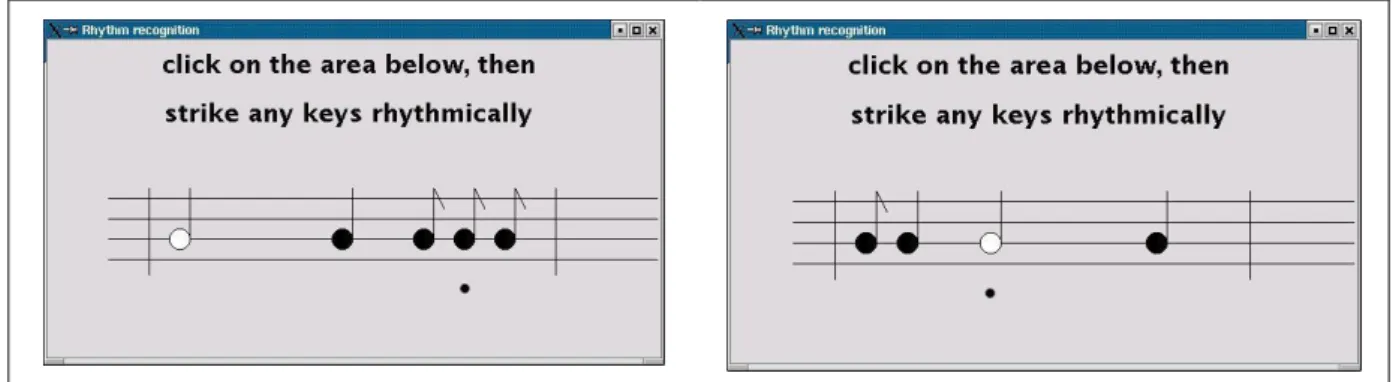
displayed on the screen. At the beginning, the program recognized only the binary rhythm. As the user tries more complex rhythms, the program learns to accommodate and recognize them. Moreover, it displays a moving black dot under the score’s notes in real time, following the user’s pace exactly, by anticipation (figure 1). We perform similarly when tapping our foot feet to rhythmic music. Notice that, given the slow biological feedback loop from ear to foot, good synchrony is impossible to achieve unless we already know the rhythm and anticipate the beats.
Figure 1. Screenshots of the rhythm recognition program. Whenever a rhythm performed on the keyboard is recognized, its score is displayed on the screen and a black dot under the notes follows and anticipates the user’s activity.
What distinguishes this program from others with similar objectives is that it does not perform any kind of pattern matching of recorded keystrokes against pre-stored models; it relies
entirely on dynamical internal processes.
These processes have been called Sensory-Motor Schemas (SMS) and they play the role of internalized activities. An SMS is a closed loop of moments associated with the score notes, each moment lasting the corresponding note duration and ending with the anticipation of the next keystroke. Figure 2 shows an SMS with 3 moments and its corresponding score.
Figure 2. Sensory Motor Schema (SMS) as a sequence of three interactions; each of them being a keystroke followed by a wait of a particular amount of time corresponding to a half-note or a full-half-note. At the end of each interaction, the following half-note is anticipated as the next interaction.
At the beginning, only the SMS corresponding to the binary rhythm is running internally, attempting to assimilate the user’s input. When the user strikes a binary rhythm, this SMS synchronizes on the strokes in phase and rhythm, and displays its score on the screen,
succeeding because its assimilation degree is very high. If the user strikes a slightly different rhythm, such as a quarter-note following a half-note, the binary rhythm SMS will not be able to synchronize perfectly. It will then enter a phase of creating mutant clones of itself, all of which begin to run internally, attempting to assimilate the situation. A selection process ensures that the useless mutants die soon, but the better adapted ones will survive to better assimilate the new situation. In a few rounds of this process of diversification/selection, an SMS perfectly assimilating the new rhythm will emerge, and its score is displayed on the screen. It takes about four to five periods for a new rhythm to be ‘learned’ by the program; subsequently only one or two periods are enough for it to ‘recognize’ this already memorized rhythm.
half-note
half-note
6- Guiding real activity by internalized activities
This paper develops an account of thought as the coordination of internalized activities. What is the place of real activity? How and when does it take place?
Most theories share the distinction between external influence of the environment and internal activity of the agent. They typically stipulate both bottom-up and top-down progressions through “mind layers”, one being responsible for reactivity, the other linked with anticipation, attention or memory. Nevertheless it is often hard to determine where the internal-external boundary lies, as studies on perception blindness show (O’Regan & Noe, 2001). Moreover pure internal processes within the brain may well be unable to distinguish signals from “real” objects in the world from the agent’s own arbitrary creations or representations; at the neuronal level, all are simply chemical and electrical signals.
Therefore we bridge the gap by only considering the relative level of activity of internalized processes, influenced by both the internal and external dynamics. As schemes are associated with very specific activities, they are influenced by a limited number of processes. Only by combining synchronized internal anticipations and external confirmation/information will a scheme increase its activity and propagate itself through the mind. A slight but highly anticipated sensation may be noticed or even welcomed (the example of hunger exalting smell and taste is often cited), but a strong signal from the environment will not affect an agent if he’s concentrated enough on a task not involving this perception (Dehaene & al, 2006).
We propose that the agent actually moves when several internalized activities adopt the same pace and promote similar motor commands. In general they must also be synchronized with the real situation. As these commands are effectively executed, the resultant proprioceptive and exteroceptive sensations increase in proportion to the assimilation degree of these processes, which continue to accompany the real situation. This coordination of simultaneous internalized activities, each of them assimilating different aspects of the situation dynamics, explains only why and how we continue performing a task in progress. Still, we think that a similar phenomenon, now no longer restricted to synchronous processes, but generalized to temporally or predictively coherent processes, can explain goal attainment.
We claim that when our goal is to drive to our office in the morning, aspects of our running internalized activity are already at work, roughly outlining how things are going to be. So when we start driving, the goal of going to the office is continually constituted by this sketched internalized activity of already being at work. If we’re distracted by something else, we may take a wrong turn, usually toward some other habitual destination. This conception of goals contrasts with the traditional one, where goals represent desired environmental conditions. Our goal conception requires only interactive processes, and their propensity to run internally.
Using the model of interactive processes presented above, attaining a goal activity consists in finding a way to it through the huge network of internalized activities. This movement is of course reflected externally by the agent’s behavior in the world, but also internally by the map of activity degrees. This global map is constantly modified by sensory-motor information about the external situation, and by the intrinsic dynamics resulting from activity propagation between related processes.
Even though internal processes and perceptions are continuous, the network can be simplified to an oriented graph in which links correspond to activities and nodes to choices. More generally, nodes reflect the level of coupling between activities. Even if all processes within an organism might be weakly and indirectly coupled (the simple movement of one arm
influencing the whole body balance via laws of inertia and gravity), considering several levels of emergence and examining highly connected parts of the network helps structure it. Nearly closed networks or clusters might emerge from interactions drawing on the same motor apparatus, coherently organized in sequences or dealing with one ‘object’.
Several efficient algorithms for finding the shortest path in a graph already exist and have been extensively studied, such as the Dijkstra’s algorithm or the Ford-Bellman algorithm (Cormen & al., 2001). We have not tried to find such an efficient routing algorithm; instead we look for a plausible cognitive mechanism for subordinating activities to a goal, integrating regulation with unpredicted developments in the environment, in accordance with interactivist principles. This mechanism, when applied to ongoing cognitive processes, will have the propensity to find a path towards a destination, but we expect it to be no more efficient than we humans are at finding optimal trajectories. Actually we expect it to perform worse, since we have only modeled the topological aspects of the task, whereas humans also routinely use cardinal directions and additional abstract reasoningto orient themselves.
Even if the graph elements and the basic form of representation are discrete, imperfections in feedback and knowledge about the world make a simple optimization algorithm unrealistic. Rough learning, generalization from isolated events or variations in the agent’s own functioning, induce increasing deviation from predicted behavior, and therefore require a dynamical approach to means-end coordination.
7- Evolution from physiology to abstract internal activities
What makes a thirsty person swallow water already present in her mouth? Instead, for example, she might as well rinse her mouth out. A reactive approach cannot account for the anticipated effects of both activities and decide which action to engage in, even though they are both perfectly compatible with the situation. The problem remains the same when we consider much more abstract levels of behavior. For example, why would someone grasp a bottle, open it, and drink to quench his thirst, after reading the words “mineral water.” on it?
Figure 3. Simplified process of thirst. When the body lacks water, neurohormones are produced and the resulting thirst activity propagates to other behaviors leading to drinking. When real actions are performed, the fluid in the gut allows thirst to decrease and reduces the attraction of drinking behaviors.
water ingestion
thirst inhibition
thirst generation from body monitoring activity propagation to
We believe that the same principles apply–the coordination of ongoing internalized activities– the only further specificity involving the direct perception of bodily indicators. The only difference between such indicators and signals coming from other sensory modalities is their relatively slower evolution and greater stability. An innate network of physiological or metabolic schemes might emerge during phylogenesis, providing a basic set of attractors for the agent to choose among (see Piaget for biology and constructivism or Bickhard/Dennett for the transition to ontogenesis during evolution). Neurohormones such as angiotensin, related to dehydration at different scales for thirst (McKinley & Johnson, 2004), then bridge the gap between purely physiological phenomena and cognitive processes. When hormone level is high, a scheme anticipating the hormone decrease in the brain milieu when water passes through the gut, partially assimilates the situation. The activity of this scheme, continuously excited by ongoing thirst and unable to satisfy its anticipations, needs to be propagated to other schemes to allow the agent to take adequate actions. If, together, they reach a sufficiently high level relative to other processes, they will guide the agent to drink. The initial scheme is then perfectly assimilating the situation, and progressively loses its attractive force. Water eventually flows down the throat, and metabolic processes inhibit the production of angiotensin, thus removing the excitatory source.
We argue that initial schemes linked with survival and metabolic activities inherited from phylogenetic history are progressively differentiated during development. Networks of stable patterns of interactions, habits, and more abstract values derived from them emerge, and run internally throughout everyday life. When generalized, basic schemes lose or broaden their connections to direct body monitoring, but their tendency to attract and guide the agent’s behavior remains. For higher animals, they reach a point where they are only weakly coupled with the biological substrate.
Even if our higher values match the above description, habits are better explained in terms of acquired expertise about an activity. Returning to the navigation example, accustomed paths are mastered in their sensory-motor details as well as at the sketch level. Associated networks of interactions are more stable for them than for a newly discovered shortcut. Therefore their activity tends to sustain itself more easily and constitute stronger attractors for future behavior. To avoid a deadly impredicativity, unknown areas might be more subject to variations in their exploration. Indeed, a recently learned way to reach a given destination will be easily modified, the sub-network of navigation interactions remaining dependent on ongoing activities. To take one banal example, a really thirsty person will stop by a shop to buy a drink, even in the midst of his well-practiced trip home. But a tourist wandering through a city will be attracted by anything of potential interest.
8- Internalized activities, regulation of actions, and goal attainment
In an effort to further explicate the concepts considered above, and observe several additional properties, we introduce a continuous version of our model. It has been implemented and tested in a simple two dimensional navigation application. Though the examples offered so far have been based on high-level activities, the algorithms described can also operate at the sensory-motor level. They are based on the assumption that regulation at any level (as described by Merleau Ponty (1963) for bodily movement), goal-attainment, and motivation all rest on the same principles. For a general review of goals and motivation, see Berridge (2004) on neuroscientific accounts including homeostasis and intervening variables, and Prudkov & Rodina (1999) for synthesis of relevant work in psychology.
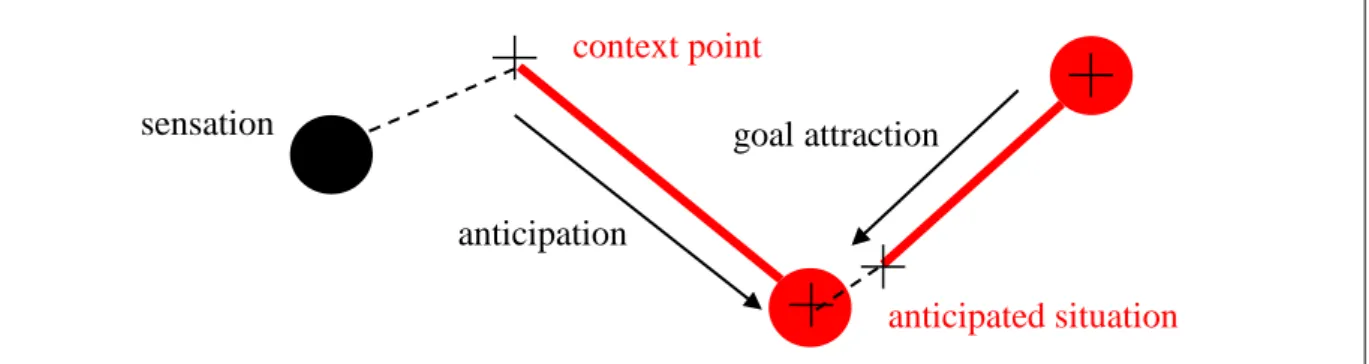
Figure 4. Graphical representation of the ‘schemes’ in the program as a red segment and dot. Hatched lines correspond to the level of assimilation for the scheme. The closer to the context point the sensation, the better the situation is assimilated. The same applies for the weakened perception propagated back from another internalized activity. Propagation of activity using anticipation and attraction of blocked schemes is indicated by the arrows.
Whereas assimilating schemes are reduced to their simplest expression in the current version of our demonstration program, the resulting behavior matches the basic expectations of a general navigation algorithm. A scheme consists of a contextual situation, including sensory and motor information, an anticipated situation with the same structure, and an activity represented by a real number and reflecting its assimilation level. It can be represented as a link between two points in a state space whose dimensions are all sensory and motor signals (plus potential reflexive activity signals). Even if what we call a “scheme” in this algorithm might seem like a mere caricature when considering complex activities, we recall that such schemes can be recursively coupled to smaller pieces of knowledge of the same form. They thus provide for the decomposition of activities at any level, from immediate unconscious muscle fiber feedback to long-term abstract anticipations.
This recursive and chaotic structure accounts for redundancy and the ability to skip details when planning long-term behaviors. Thus the decision to take one path or another might be made rapidly when trying to reach a long-range goal without being able to anticipate the exact evolution of the dynamics of both the environment and the agent. For example, detours, landscapes or traffic signs can be imagined, but never known for sure before they are encountered. Only by driving towards the goal will the sensory-motor loops required to stay on the road be able to synchronize with reality and select for appropriate motor commands. Schemes for braking, turning or even coping with road irregularities require rapid interactions with an ever-changing perceptual world. High-level or long-range schemes modulate global activity, strongly modifying but not determining the detailed shape of the dynamic landscape. In fact, long range anticipations act as shortcuts, allowing the mind to elide details. These detailed interactions coordinate with more abstract processes only temporarily, when the agent is actually engaging in the behavior. This fact accounts for an agent’s various conceptions of time, decoupling the timing of the neural machinery and its physical limitations from subjective psychological time (Dennett, 1996). Moreover low-level interactions are highly unstable, reflecting the rapid dynamics of individual sensory and motor signals. But higher-level networks of anticipations arise that depend on them, stochastically integrating details into stable abstract concepts (Hawkins & Blakeslee, 2005). The optical flow, striking millions of retinal cells, and totally transformed during a slight rotation, is nevertheless perceived as structured and composed of solid objects.
sensation
anticipated situation
anticipation
goal attraction
With the navigation application in mind, this structure can be metaphorically compared to roads connecting cities within a country. Highways will connect metropolises, roads cities and streets urban blocks. When we plan a journey through the country, or peruse the national map, the exact route leading from the closest city to a particular stopping place remains unknown. Though the main direction of the trip is clear, it is not only useless to master the details, it would be downright confusing, given the likelihood of traffic jams and detours.
Back to our model, each point in the state space can be activated by a direct external sensation or by propagated activity from surrounding processes. The activation degree is attenuated when diffusing to close schemes contexts, reflecting the similarity between the anticipated and actually perceived situation (see figure 4 for details about the diffusion and propagation). To better illustrate the algorithm, emphasize its underlying interactive operation, and draw connections with the previous section, we consider an abstract example from everyday life: a person returning home. After a hard day at work, she may be tired and hungry; Eating and sleeping at home is the usual and safest way to satisfy both needs. Excited by this prospect or by other activities such as reuniting with her family or watching television, our subject runs the process of being at home internally. Continuously trying to synchronize this process with the environment, and currently unsatisfied by the ‘being at work’ situation, the scheme diffuses its activity to connected behaviors, i.e. those anticipating some of the perceptions associated with ‘being at home’. Processes leading home, such as passing through the house door or parking the car in front of the house, are excited in turn. By propagating further back from the goal, activity finally reaches behaviors that can at least approximately assimilate the situation: walking from the office to the car.
Internalized interaction paths leading to the goal are not explicitly stored or represented, but simply reflected by the activity of blocked schemes. These schemes all partially assimilate the situation, internally perceiving weakened predictions. The entire network may be slightly influenced by the goal for a short time (given computational or physical limitations), but the decrease in activity during propagation will confine significant effects to the shortest paths. In the end, only a few schemes will assimilate both internal and external perceptions enough to assume control over actions. A simple orientation of the agent toward the goal will satisfy one of these schemes, increase its confidence in predictions and allow it to rapidly synchronize with the environment. At this point, all other schemes will have lost their relative power as attractors. Meanwhile, the agent will have indirectly modified its sensations through its effective actions. The current situation having changed, activity propagating in the network may also differ, but as long as the initial goal remains strongly activated, the agent will continue acting toward it. Even though every single scheme in the network is a potential attractor and (intermediate) goal, the agent only moves up the activity gradient by merging promoted actions, leading to the strongest attractors.
Activity is continuously updated in a fast and massively parallel way. If hunger is or becomes the strongest attractor, returning home may not be the most direct route to its satisfaction. Schemes such as ‘entering and eating in a restaurant’ may synchronize with visual perception when passing by an eatery, therefore affording an easy way to the goal as hunger reaches its climax. Once satiated, the local attractor will disappear and a new map of activities will define new goals. The agent may finally return home, still exhausted and looking forward to lying in her bed. But, responsive not only to physiological needs, she may also change directions after meeting an old friend in the restaurant, anticipating the regret of not speaking to him again for a long time. She may even return to the restaurant, though no longer driven by hunger.
Such dynamics, emerging from specific interactions and disappearing after a time, explain obstacles avoidance or behavior alternation. The priority of local behavior over long-term
goals is explained in terms of varying assimilation level rather than fixed structure, as in Brooks’ subsumption architecture (Brooks, 1999) or Sprague and Ballard’s notion of reward maximization (Sprague & Ballard, 2004).
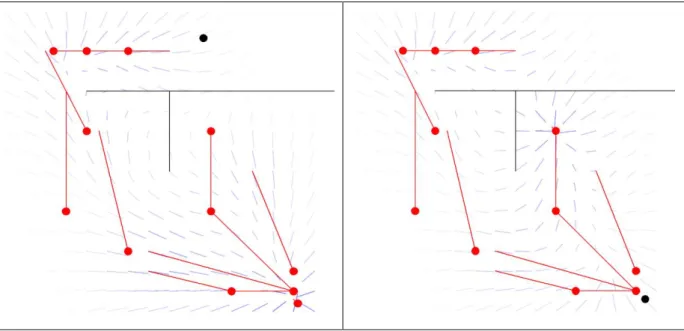
Figure 4. A two dimensional representation of state space. Red lines correspond to
anticipations, the black dot to the current position. Though actions are missing, they can be easily inferred from the blue field towards the attractors. This field is derived from
propagated activity and interpolation from all schemes, each of them trying to assimilate the situation. Left: The strongest current attractor lies in the lower right corner, diffusing activity to its neighbors and guiding actions towards it. Avoided obstacles, represented as black lines, are unknown to the agent, only aware of assimilation levels from the set of schemes. Right: With the same anticipating schemes but a different situation and internal activity, the main attractor has changed and the promoted actions are totally different.
The direct mapping between topological knowledge of the environment and the model used for representing interactions makes it easier to understand the concepts underlying both this form of representation and the coordination of processes. Behaviors ranging from reflexes to complex chains can be modeled when we consider additional dimensions related to perception, action, and scheme activity. But because learning algorithms have not yet been implemented, and accommodation not generalized to all perceptual dimensions, much work remains before the current model can be applied to complex robotic or human behavior.
Conclusion
Even if a great deal of work must be done to better integrate time and learning in our motivation model, it still demonstrates the very basic aspects of goal-attainment and regulation in everyday human behavior. Moreover, concepts of assimilation and accommodation, as extended from Piaget’s work and implemented in the rhythm application, provide a normative explanation of adaptation and remove the need for reward or evaluation of activities. Indeed, decisions and internalized activities are here neither good nor bad, but still attract the dynamics of the agent. Though their organization structures the propagation, only their activity indicates how relevant they are for the current situation. Part of the activity
may directly depend on physiology, its positive or negative evaluation defined through evolution and genetics, but most of it is weakly coupled with bodily needs, and simply participates in the stable, far-from-equilibrium functioning of the agent.
With the development of the current theory and the use of computer programs to model simple behaviors and test hypotheses, we wish to bridge the gap between phylogenesis and psychological ontogenesis. We wish to understand how such a huge repertoire of activities arises, produces adapted individuals, and exploits the many degrees of freedom our own development permits.
References
Berridge K., C. (2004). Motivation concepts in behavioral neuroscience. Physiology & Behaviour, 81, 179-209.
Bickhard M.H. (1995). Foundational issues in artificial intelligence and cognitive science. Impasse and solution. Elsevier.
Bickhard M.H., Christensen W.D. (2002) Process Dynamics of Normative Function. Monist, 85(1), 3-28.
Brooks R.A. (1999). Cambrian Intelligence - The early history of new AI. MIT Press.
Buisson J.-C. (2004). A rhythm recognition computer program to advocate interactivist perception. Cognitive Science, 28, 75-88
Cormen T.H., Leiserson C.E., Rivest R.L., and Stein C. (2001). Introduction to Algorithms, Second Edition. MIT Press and McGraw-Hill.
Dehaene S., Changeux J.-P., Naccache L., Sackur J., and Sergent C. (2006). Conscious, preconscious, and subliminal processing: a testable taxonomy. Trends in Cognitive Sciences, 10 (5).
Dennett D. (1996).Kinds of Minds: Toward an Understanding of Consciousness. The Science Masters Series. New York: Basic Books.
Ganis G, Thompson W.L., Kosslyn S.M. (2004) Brain areas underlying visual mental imagery and visual perception: an fMRI study. Cognitive Brain Research. 20(2), 226-41.
Harnad, S. (1990). The symbol grounding problem. Physics D, 42, 335–346.
Hawkins J., Blakeslee S. (2004). On Intelligence: How a New Understanding of the Brain will Lead to the Creation of Truly Intelligent Machines. Time Books.
Johnson S.P., Amso D., Slemmer J.A. (2003). Development of object concepts in infancy: Evidence for early learning in an eye-tracking paradigm. PNAS, 100, 10568-10573.
Kawato M. (1999). Internal models for motor control and trajectory planning, Current Opinion in Neurobiology, 9, 718-727.
Lamm C., Windischberger C., Leodolter U., Moser E., Bauer H. (2001) Evidence for premotor cortex activity during dynamic visuospatial imagery from single-trial functional magnetic resonance imaging and event-related slow cortical potentials. Neuroimage, 14(2), 268-83.
Lin, L., Osan, R., Tsien, J.Z. (2006). Organizing principles of real-time memory encoding neural clique assemblies and universal neural codes. Trends in Neurosciences. 29(1), 49-57.
Luria, A.R. (1966). Higher Cortical Functions in Man. New York, Basic Books. Merleau-Ponty M. (1963). The Structure of Behavior. Beacon Press, Boston.
O'Regan J. K., Noë A. (2001). A sensorimotor account of vision and visual consciousness. . Behavioral and Brain Sciences, 24(5), 939-1011.
Piaget, J. (1954). The construction of reality in the child. New York: Basic.
Prudkov, Pavel N. and Rodina, O. N. (1999). Synthesis of Purposeful Processes. Psycholoqy, 10 (70). Sprague N., Ballard D. (2003). Eye Movements for Reward Maximization. Advances in Neural Information Processing Systems, 16, MIT Press.
Wilson, M.A and McNaughton, B.L. (1994). Reactivation of hippocampal ensemble memories during sleep. Science, 265, 676-679.
Wolpert, D.M. and Kawato, M. (1998). Multiple paired forward and inverse models for motor control, Neural Networks, 11, 1317-1329.