for Instance Completion in Knowledge Graphs
Paolo Rosso
[email protected] University of Fribourg, SwitzerlandDingqi Yang
∗ [email protected]State Key Laboratory of Internet of Things for Smart City and Department of Computer and Information Science,
University of Macau, Macao SAR, China
Natalia Ostapuk
[email protected] University of Fribourg, Switzerland
Philippe Cudré-Mauroux
[email protected]University of Fribourg, Switzerland
ABSTRACT
Knowledge Graph (KG) completion has been widely studied to tackle the incompleteness issue (i.e., missing facts) in modern KGs. A fact in a KG is represented as a triplet (ℎ, 𝑟, 𝑡 ) linking two entities ℎand 𝑡 via a relation 𝑟 . Existing work mostly consider link prediction to solve this problem, i.e., given two elements of a triplet predicting the missing one, such as (ℎ, 𝑟, ?). This task has, however, a strong assumption on the two given elements in a triplet, which have to be correlated, resulting otherwise in meaningless predictions, such as (Marie Curie, headquarters location, ?). In addition, the KG com-pletion problem has also been formulated as a relation prediction task, i.e., when predicting relations 𝑟 for a given entity ℎ. Without predicting 𝑡 , this task is however a step away from the ultimate goal of KG completion. Against this background, this paper studies an instance completion task suggesting 𝑟 -𝑡 pairs for a given ℎ, i.e., (ℎ, ?, ?). We propose an end-to-end solution called RETA (as it sug-gests the Relation and Tail for a given head entity) consisting of two components: a RETA-Filter and RETA-Grader. More precisely, our RETA-Filter first generates candidate 𝑟 -𝑡 pairs for a given ℎ by ex-tracting and leveraging the schema of a KG; our RETA-Grader then evaluates and ranks the candidate 𝑟 -𝑡 pairs considering the plausibil-ity of both the candidate triplet and its corresponding schema using a newly-designed KG embedding model. We evaluate our methods against a sizable collection of state-of-the-art techniques on three real-world KG datasets. Results show that our RETA-Filter gen-erates of high-quality candidate 𝑟 -𝑡 pairs, outperforming the best baseline techniques while reducing by 10.61%-84.75% the candidate size under the same candidate quality guarantees. Moreover, our RETA-Grader also significantly outperforms state-of-the-art link prediction techniques on the instance completion task by 16.25%-65.92% across different datasets.
∗Corresponding author
This paper is published under the Creative Commons Attribution 4.0 International (CC-BY 4.0) license. Authors reserve their rights to disseminate the work on their personal and corporate Web sites with the appropriate attribution.
WWW ’21, April 19–23, 2021, Ljubljana, Slovenia
© 2021 IW3C2 (International World Wide Web Conference Committee), published under Creative Commons CC-BY 4.0 License.
ACM ISBN 978-1-4503-8312-7/21/04. https://doi.org/10.1145/3442381.3449883
CCS CONCEPTS
• Computing methodologies → Knowledge representation and reasoning.
KEYWORDS
Knowledge graph embedding, Entity Types, Instance completion
ACM Reference Format:
Paolo Rosso, Dingqi Yang, Natalia Ostapuk, and Philippe Cudré-Mauroux. 2021. RETA: A Schema-Aware, End-to-End Solution for Instance Completion in Knowledge Graphs. In Proceedings of the Web Conference 2021 (WWW ’21), April 19–23, 2021, Ljubljana, Slovenia. ACM, New York, NY, USA, 12 pages. https://doi.org/10.1145/3442381.3449883
1
INTRODUCTION
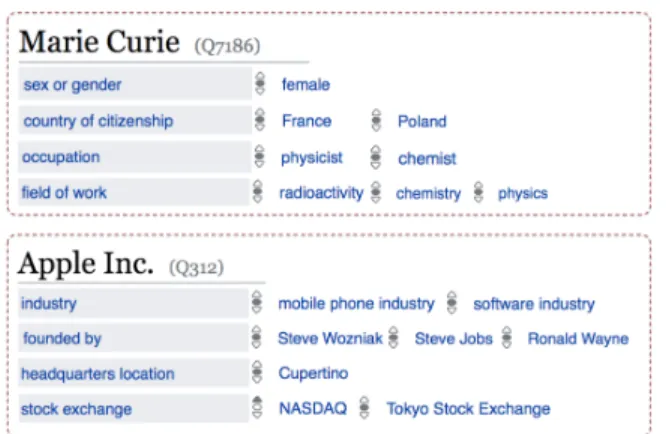
Knowledge Graphs (KGs), such as Freebase [5], Wikidata1or Google’s Knowledge Graph2, have become a key resource powering a broad spectrum of Web applications, such as semantic search [48], question-answering [51], or recommender systems [54]. A typical KG repre-sents a large collection of entities (real-world objects or abstract concepts) interconnected via relations, where entities contribute to the description of other entities via relations. Using a triplet representation scheme, a KG consists of a set of triplets, (head, rela-tion, tail), or (ℎ, 𝑟, 𝑡 ) for short, each of which encoding a relation connecting a head entity to a tail entity, such as Marie Curie (head) sex or gender (relation) female (tail). Figure 1 shows two real-world examples of entities Marie Curie and Apple Inc. from Wikidata; each example is associated with a set of triplets having the entity as head in Wikidata. Despite the fact that modern KGs contain high-quality structured data, they are also known to suffer from an incomplete-ness issue, i.e., missing facts. For example, 71% of all people from Freebase have no place of birth [31].
In this context, Knowledge Graph completion problems have been widely studied. In the current literature, these problems are mostly formulated as a link prediction task [31, 43], i.e., to pre-dict missing links in a KG. More precisely, given two elements of a triplet, the task is to predict the missing one, such as (ℎ, 𝑟, ?), (ℎ, ?, 𝑡 ) or (?, 𝑟, 𝑡 ), where the question mark represents the missing entity/relation. However, despite the wide adoption of such link
1http://wikidata.org/
2
Figure 1: Examples of entities Marie Curie and Apple Inc. from Wikidata. For each entity, we present a subset of triplets having that entity as head from Wikidata.
prediction tasks by existing work for KG completion, this task is often impractical due to its strong assumption on knowing two elements in a triplet. In fact, the two known elements in a triplet must somehow be correlated in order to make a meaningful pre-diction, otherwise the task will result in meaningless results. For example, the predictions for (Marie Curie, headquarters location, ?) or (Apple Inc., sex or gender, ?) do not make any sense, while they would both be considered as valid input for the link prediction task. Although existing work on link prediction implement this task by taking out one element from a true triplet in a KG and then making predictions on the triplet (which implicitly ensures the correlation between the two remaining elements in the triplet), such an experi-mental setting indeed departs from many real-world use cases of KG completion where we are not given two correlated elements in a triplet. Another thread of work on KG completion focuses on the relation prediction task3, suggesting missing relations to a given entity by collaboratively using the information about other enti-ties that are similar to the given entity, for example [2]. However, these techniques only suggest relations for a given head, without predicting the tails and hence are only part of the solution.
In this paper and toward the ultimate goal of KG completion, we tackle a more complex instance completion problem. Specifi-cally, considering a (head) entity as an instance, we complete its descriptions by suggesting relation-tail pairs. In other words, we make predictions on (ℎ, ?, ?), suggesting 𝑟 -𝑡 pairs to a given ℎ. Dif-ferent from the link prediction task, our instance completion task has a more realistic setting without assuming knowing two corre-lated elements in a triplet. However, such an instance completion problem on KGs is a challenging task, due to a large number of potential 𝑟 -𝑡 pairs for a given ℎ; directly evaluating and ranking all combinations of 𝑟 and 𝑡 not only incurs a significant computation cost, but also results in poor performance due to the large number of candidate triplets to consider. For example, such an approach takes 350.7 hours (CPU time) even with an efficient link prediction technique TransE on our JF17K dataset (see our experiments for more detail), resulting in poor performance of 0.0097 for recall@5.
3This task is also known as property prediction or recommendation by [7, 24, 52],
as these works refer to a triplet by (entity,property,value), which is equivalent to our notion of triplet as (head, relation, tail).
A straightforward solution to this problem is to combine the relation prediction and link prediction tasks [7]; for a given ℎ, we first predict a set of relations using a relation prediction technique, and then predict (ℎ, 𝑟, ?) using a link prediction technique for each predicted relation 𝑟 . Subsequently, with a small set of predicted relations, the number of candidate 𝑟 -𝑡 pairs fed to the link pre-diction technique can be significantly reduced. However, such an approach still shows subpar performance, as it fails to fully con-sider the triplewise correlation of the three elements in a triplet, in particular the schema information encoded in the entity-typed triplet (ℎ_𝑡𝑦𝑝𝑒, 𝑟, 𝑡 _𝑡𝑦𝑝𝑒). Taking real-world examples from Wiki-data, a relation prediction technique may suggest two relations, headquarters location and industry, to the head entity Apple Inc.; a link prediction technique then predicts on (Apple Inc., headquarters location, ?) and (Apple Inc., industry, ?), resulting in a ranked list of candidate 𝑟 -𝑡 pairs. Although such a scheme reduces the number of candidate 𝑟 -𝑡 pairs by predicting relevant relations, it still fails to fil-ter out many noisy 𝑟 -𝑡 pairs, such as headquarfil-ters location-software industry or industry-Mountain View. In Wikidata, the entities Ap-ple Inc., software industry and Mountain View are all associated with types (enterprise, economic branch and city, respectively). If we have the schema information represented as entity-typed triplets (ℎ_𝑡𝑦𝑝𝑒, 𝑟, 𝑡 _𝑡𝑦𝑝𝑒) —(enterprise, headquarters location, city) and (en-terprise, industry, economic branch), we could easily filter out such noisy 𝑟 -𝑡 pairs that do not match the schema of the KG (to the given ℎ).
Against this background and to effectively solve our instance completion problem over KGs (ℎ, ?, ?), we propose an end-to-end solution fully leveraging schema information encoded in triplets. Specifically, our solution consists of two components. First, to effec-tively filter out noisy 𝑟 -𝑡 pairs for a given ℎ, we design RETA-Filter, a Relation-Tail pair filter based on entity types. More precisely, al-though the schema of a KG implies valuable information about the structure of the KG, open-domain KGs such as Wikidata do not have a fixed schema [2]. Therefore, by extracting entity-typed triplets from an input KG, we build a head_type-relation-tail_type tensor, which encodes the schema information of the KG. Based on this ten-sor, we can efficiently search for candidate 𝑟 -𝑡 pairs schematically matching a given ℎ via tensor operations. In essence, RETA-Filter outputs a set of coarse-grained candidate 𝑟 -𝑡 pairs fitting the schema of the KG. Second, to predict the most promising 𝑟 -𝑡 pairs from the filtered candidates, we design RETA-Grader, a Relation-Tail pair grader leveraging a newly designed KG embedding model scoring each candidate 𝑟 -𝑡 pair with a particular consideration on the plau-sibility of both the input triplet and its corresponding schema. To achieve this goal, we design two neural network pipelines. On one hand, we learn from a triplet (ℎ, 𝑟, 𝑡 ), generating a triplet relatedness feature vector. On the other hand, we learn from the corresponding entity-typed triplet(s) (ℎ_𝑡𝑦𝑝𝑒, 𝑟, 𝑡 _𝑡𝑦𝑝𝑒), generating one or multi-ple (when ℎ or 𝑡 has multimulti-ple types) relatedness feature vector(s), based on which we then compute a schema relatedness feature vec-tor by taking the minimum value along each feature dimension over these relatedness feature vectors. The basic assumption behind this operation is that for a given valid triplet (ℎ, 𝑟, 𝑡 ), the relatedness of all its entity-typed triplets (ℎ_𝑡𝑦𝑝𝑒, 𝑟, 𝑡 _𝑡𝑦𝑝𝑒) should be high; subsequently, the minimum relatedness along each feature dimen-sion is expected to be high. Afterward, we fed the concatenated
triplet and schema relatedness feature vectors to a fully connected projection to output the final predicted score of the input triplet (ℎ, 𝑟, 𝑡 ).
Our contributions can be summarized as follows:
• We revisit the impractical settings of existing approaches to KG completion, and propose to study a novel instance com-pletion problem with more realistic settings, i.e., predicting relation-tail pairs given a head (ℎ, ?, ?).
• We propose an end-to-end solution to our instance comple-tion problem. We first propose RETA-Filter, a 𝑟 -𝑡 pair filter based on entity-typed triplets, generating a set of coarse-grained candidate 𝑟 -𝑡 pairs matching the schema of the KG (to the given ℎ). We then propose RETA-Grader, a 𝑟 -𝑡 pair grader leveraging a newly designed KG embedding model scoring each candidate 𝑟 -𝑡 pair with a particular consider-ation on the plausibility of both the input triplet and its corresponding schema.
• We conduct a thorough evaluation of our proposed tech-niques compared to a sizable collection of baselines on three real-world KG datasets. Results show that our RETA-Filter is able to generate a set of high-quality candidate 𝑟 -𝑡 pairs for a given ℎ, outperforming the best baseline techniques with 10.61%-84.75% reduction on the candidate set size, un-der the same candidate quality guarantees. Moreover, our RETA-Grader also significantly outperforms state-of-the-art link prediction techniques on the instance completion task by 16.25%-65.92% across different datasets.
2
RELATED WORK
Knowledge Graph completion predicts missing facts in a KG. In the following, we briefly discuss existing work implementing one of the three types of tasks for KG completion: 1) link prediction tasks suggesting one missing element in a triplet; 2) relation prediction tasks predicting missing relations to a given entity; and 3) instance completion task suggesting relation-tail pairs to a given head entity.
2.1
Link Prediction Task
In the current literature, KG completion has been mostly formu-lated as a link prediction task, i.e., predicting one missing element in a triplet, i.e., (ℎ, 𝑟, ?), (ℎ, ?, 𝑡 ) or (?, 𝑟, 𝑡 ). To solve this problem, early work resorted to rule/feature-based relational learning, such as association rules [11] or hand-crafted features [25, 33] (e.g., paths linking entities) for link prediction. Recently, KG embedding tech-niques have been proposed to learn latent representations of enti-ties/relations in a KG, which can then be effectively used for link prediction tasks over the KG. These techniques can be classified into two broad categories. First, translational distance models that exploit distance-based scoring functions to create the embeddings. One representative model of this family is TransE [6], which learns from triplets (ℎ, 𝑟, 𝑡 ) such that the relation between the head and tail are preserved as ℎ +𝑟 ≈ 𝑡 . Several works further improve TransE to capture richer KG structures, such as involving relation-specific hyperplanes [45] or spaces [9, 17, 26], for example. Second, seman-tic matching models that exploit similarity-based scoring functions. One typical model in that context is RESCAL [32], which repre-sents each entity as a vector and each relation as a matrix, and then
uses a bilinear function to model the relation between two entities. Several works extend RESCAL by reducing the complexity of the models [38, 50] or of the training processes [53], by improving the model expressiveness [4], by capturing asymmetric relations [42], by considering unbalanced data in KGs [18], or by modeling non-linear relations using neural networks [3, 8, 30, 37, 39].
In addition, there are also a few works on link prediction com-bining triplets with other data. According to the sources of such data, these works can be classified into two categories, i.e., data in the KG and third-party data. On one hand, besides triplets link-ing entities via relations, literals [12, 22], images [28] or types [16, 34, 47] associated with entities in the KG can be combined with triplets to improve the performance on link prediction. On the other hand, some other techniques learn entity/relation embeddings from triplets in a KG jointly with third-party data sources, in particular with text (e.g., Wikipedia articles) [36, 41, 44, 49].
However, we argue in this paper that such link prediction tasks are impractical in the sense that they assume knowing two of the elements in a triplet, which is often not the case in practice. Those two elements must be correlated to make meaningful predictions, which otherwise result in meaningless outputs such as (Marie Curie, headquarters location, ?). Therefore, we study an instance comple-tion problem in this paper, suggesting relacomple-tion-tail pairs for a given (head) entity.
2.2
Relation Prediction Task
KG completion problems have also been studied as a relation predic-tion task, suggesting missing relapredic-tions to a given entity [1, 2, 7, 10, 24, 52]. Specifically, for a given entity, the objective is to suggest a list of relations (so-called properties by some of these works) which are relevant to the entity. For example, Zangerle et al. [52] built a “property suggester” for Wikidata, suggesting candidate properties based on association rules learnt from existing triplets in Wikidata. Lajus et al. [24] studied the problem of determining obligatory rela-tions for a given entity in a KG by extracting and using the class hierarchy (of entities) in the KG. Cao et al. [7] designed a relation prediction technique by applying an attention-based graph neural network model to a bipartite entity-relation graph built from a KG. Recoin [2] suggests properties to an entity on Wikidata by collabo-ratively using the information about other entities that are similar to that entity; to ensure the high quality of the suggested properties, it sometimes involves much prior knowledge when defining the similarity between entities on Wikidata. For example, for entities of type human, a (Boolean) similarity is defined as whether the two entities have the same occupation or not.
Our work differs from these techniques by considering a more complex problem, that of predicting relation-tail pairs for a given (head) entity. Although these relation prediction techniques can be combined with link prediction techniques to perform our instance completion task, such an approach yields subpar performance, as it does not fully leverage the schema information encoded by the triplets.
2.3
Instance Completion Task
A closely related work to our instance completion problem is OKELE [7], which suggests relation-tail pairs to a long-tail head (i.e., a less
popular/frequent entity) in a KG, using open Web data. Specifically, for a given head ℎ, OKELE first implements a relation prediction technique by applying an attention-based graph neural network model to a bipartite entity-relation graph built from a KG, predicting a list of relations; for each suggested relation 𝑟 , it then extracts and verifies potential tails from open Web data including semi-structured vertical websites, unsemi-structured plain text in Web content and structured HTML tables. To the best of our knowledge, this is the only work in the current literature considering the instance completion task, i.e., predicting relation-tail pairs to a given head. However, OKELE differs from our work by extensively using open Web data. In contrast, our proposed solution only requires triplets and entity types from a KG, without the need of involving any extra data sources.
We also note that the so-called instance reconstruction task on KGs has been defined by [55] for n-ary (or multi-fold) rela-tional facts, where an n-ary relation consisting of a set of relations {𝑟1, 𝑟2, ..., 𝑟𝑛} links multiple entities {𝑒1, 𝑒2, ..., 𝑒𝑛}, respectively. For example, the n-ary relation “PeopleMariage” containing the fol-lowing three relations person, spouse, location, links three entities Kobe Bryant, Venessa Bryant and California. The authors define the instance reconstruction task as follows: given an n-ary relation {𝑟1, 𝑟2, ..., 𝑟𝑛} and a subset of the entities linked by this relation, predict the rest of the entities, such as {𝑒1,?, ..., ?}. With the help of relation paths [46], this task boils down to a link prediction task, i.e., predicting (𝑒1, 𝑟1𝑟2,?), (𝑒1, 𝑟1𝑟3,?) and so on. Therefore, it fun-damentally differs from our instance completion task, where we do not assume any information about the relations.
3
SCHEMA-AWARE INSTANCE COMPLETION
To solve our instance completion problem on KGs, we propose an end-to-end solution leveraging the explicit and implicit schema information encoded through the triplets. More precisely, we first design RETA-Filter, a 𝑟 -𝑡 pair filter based on entity-typed triplets, generating a set of coarse-grained candidate 𝑟 -𝑡 pairs matching the schema of the KG (to the given ℎ). We then propose RETA-Grader, a 𝑟 -𝑡 pair grader leveraging a newly designed KG embedding model scoring and ranking these candidate 𝑟 -𝑡 pairs with a particular con-sideration on the plausibility of the triplets and their corresponding schema.
3.1
RETA-Filter
Our RETA-Filter is designed to generate a set of coarse-grained 𝑟-𝑡 pairs by extracting and leveraging the schema of an input KG. Specifically, a KG contains a set of triplets (ℎ, 𝑟, 𝑡 ), where ℎ, 𝑡 ∈ 𝐸 and 𝑟 ∈ 𝑅; 𝐸 and 𝑅 are the sets of all entities and relations in the KG, respectively. Each entity ℎ (or 𝑡 ) can have one or multiple types ℎ_𝑡𝑦𝑝𝑒1, ℎ_𝑡𝑦𝑝𝑒2, ...∈ 𝑇 , where 𝑇 is the set of all entity types in the KG (we will discuss later the case where an entity does not have any type). Subsequently, the schema of a KG can characterized by a set of entity-typed triplets (ℎ_𝑡𝑦𝑝𝑒, 𝑟, 𝑡 _𝑡𝑦𝑝𝑒), indicating that an entity of type ℎ_𝑡𝑦𝑝𝑒 could be linked to an entity of type 𝑡 _𝑡𝑦𝑝𝑒 via a relation 𝑟 . Such information can serve as an important guideline to identify eligible 𝑟 -𝑡 pairs for a given ℎ, thus avoiding many meaningless predictions.
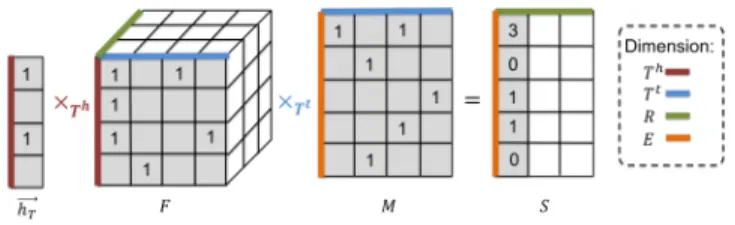
Figure 2: A toy example of our filter, where we highlight an example of computation for one relation (in gray). Given an head entity ℎ, RETA-Filter fetches its type vector ®ℎ𝑇and mul-tiply it with the tensor F. The resulting matrix is then multi-plied with the type matrix M𝑇 in order to compute the can-didate 𝑟 -𝑡 pairs for ℎ.
To implement our filter, we first extract entity-typed triplets (ℎ_𝑡𝑦𝑝𝑒, 𝑟, 𝑡 _𝑡𝑦𝑝𝑒) from the triplets (ℎ, 𝑟, 𝑡 ) in a KG, by consider-ing all the combinations of the types of ℎ and 𝑡 for each triplet (ℎ, 𝑟, 𝑡 ). For example, if ℎ and 𝑡 have 𝑚 and 𝑛 types, respectively, we extract 𝑚 × 𝑛 entity-typed triplets. Afterward, we represent all these entity-typed triplets as a head_type-relation-tail_type tensor F ∈ B|𝑇ℎ|× |𝑅 |× |𝑇𝑡|, where 𝑇ℎ
and 𝑇𝑡
are the sets of all head and tail types, respectively, while 𝑅 is the set of all relations in the KG. Note that 𝑇ℎ
and 𝑇𝑡
are the same as 𝑇 in practice, as they are both the set of all entity types. We use different notations for them to distinguish the semantic meaning of the corresponding dimensions of F, where the first and third dimensions of F refer to head and tail types, respectively. Finally, by representing ℎ using its type vector
® ℎ𝑇 ∈ B
|𝑇ℎ| and all tails using a type matrix M
𝑇 ∈ B
|𝐸 |× |𝑇 |, we can efficiently compute the candidate 𝑟 -𝑡 pairs for ℎ via a tensor product:
S = ®ℎ𝑇×𝑇ℎF ×𝑇𝑡 M (1)
where ×𝑛denotes the mode-𝑛 tensor product [21]. The resulting matrix S ∈ N|𝑅 |× |𝐸 |encodes the number of matches between ℎ and each 𝑟 -𝑡 pair, under the extracted schema. Figure 2 shows a toy example of our filter. To implement this filter, we have to take into account the following two practical considerations:
• Frequency of entity-typed triplets. Entity-typed triplets (ℎ_𝑡𝑦𝑝𝑒, 𝑟, 𝑡 _𝑡𝑦𝑝𝑒) encode the schema of the corresponding KG. When converting the triplets of a KG into entity-typed triplets, we also obtain the frequency of each entity-typed triplets, indi-cating how many times it appears in the KG. Intuitively, a low frequency indicates a small contribution of the corresponding entity-typed triplet to the schema of the KG, which could also be considered as noise. Subsequently, we could select frequent entity-typed triplets (whose frequencies are higher than a thresh-old 𝛼) to build F. However, a too high value of 𝛼 could also remove useful entity-typed triplets, resulting in an incomplete schema captured by F. In other words, 𝛼 controls the quality of the ex-tracted schema, and subsequently balances the tradeoff between the size of the candidate (𝑟 -𝑡 pair) set and its coverage of true 𝑟 -𝑡 pairs being included in the candidate set. On one hand, a too low value of 𝛼 could include noisy entity-typed triplets in F, result-ing in a large candidate set with noisy and redundant 𝑟 -𝑡 pairs. On the other hand, a too high value of 𝛼 captures incomplete
schema information when building F, resulting in a small but low-coverage candidate set (i.e., missing true 𝑟 -𝑡 pairs). We note that once we select frequent entity-typed triplets (whose frequencies are higher than 𝛼), we build F as a Boolean ten-sor without considering the absolute frequency of each selected entity-typed triplet, since the absolute frequencies of these fre-quent entity-typed triplets are not useful when representing the schema of the KG. For example, an entity-typed triplet (hu-man, occupation, profession) with a frequency of 10,000 does not necessarily mean that it is (ten times) more important than an entity-typed triplet (enterprise, headquarters location, city) with a frequency of 1,000 when representing the structure of the KG; such a frequency difference may just be caused by the varying popularity of different entity types in a KG. Therefore, we do not distinguish the selected (frequent) entity-typed triplets by their frequencies when building F.
•Number of matches between 𝑟 -𝑡 pairs and ℎ. The resulting matrix S encodes the number of matches between ℎ and each 𝑟 -𝑡 pair under the extracted schema. Intuitively, a higher number of matches indicates a higher plausibility of the corresponding 𝑟-𝑡 pair being a candidate for ℎ. Following the example in Figure 2, the number of matches between ℎ and the first 𝑟 -𝑡 pair is S0,0=3. Subsequently, instead of taking all 𝑟 -𝑡 pairs with non-zero matches (in S) as the candidate 𝑟 -𝑡 pairs, we could further select higher-quality 𝑟 -𝑡 pairs whose numbers of matches are higher than a threshold 𝛽 as candidate 𝑟 -𝑡 pairs. Obviously, a lower value of 𝛽 selects more candidate 𝑟 -𝑡 pairs and thus leads to a higher coverage of true 𝑟 -𝑡 pairs being included in the candidate set, and vice versa. In essence, 𝛽 directly balances the tradeoff between the size of the candidate (𝑟 -𝑡 pair) set and its coverage. In summary, our RETA-Filter is designed to efficiently generate a set of coarse-grained 𝑟 -𝑡 pairs by matching with the KG schema extracted from the entity-typed triplets of a KG. We use two tunable parameters 𝛼 and 𝛽 balancing the tradeoff between the size of the candidate (𝑟 -𝑡 pair) set and its coverage. By varying 𝛼 and 𝛽, our RETA-Filter is able to achieve the best Pareto frontier when trading off the size of the candidate (𝑟 -𝑡 pair) set and its coverage, compared to a sizable collection of baselines (see our experiments for more detail).
3.2
RETA-Grader
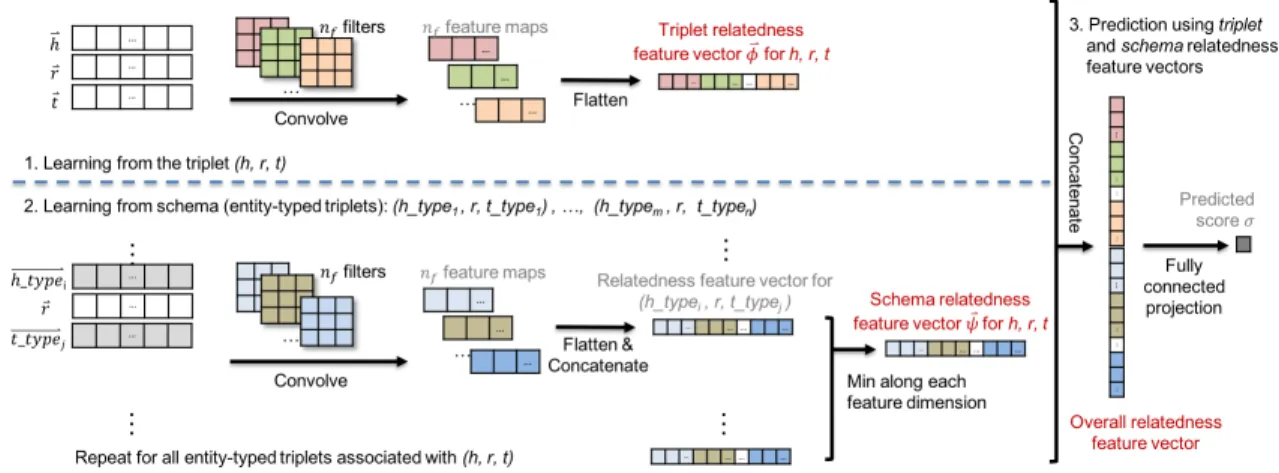
Based on the set of candidate 𝑟 -𝑡 pairs provided by our RETA-Filter, our RETA-Grader further evaluates and ranks these candi-date 𝑟 -𝑡 pairs considering the plausibility of both the triplet and its corresponding schema using a subtly designed KG embedding model. Figure 3 shows our embedding model consisting of three parts. Specifically, for each fact (ℎ, 𝑟, 𝑡 ), it 1) learns to capture the structural information of the triplet (ℎ, 𝑟, 𝑡 ), generating a triplet relatedness feature vector, and 2) learns to capture the correspond-ing schema information encoded by the triplet, generatcorrespond-ing a set of relatedness feature vectors, one for each entity-typed triplet (ℎ_𝑡𝑦𝑝𝑒, 𝑟, 𝑡 _𝑡𝑦𝑝𝑒), and then merges them into a unique schema relatedness feature vector. Finally, it concatenates the triplet and schema relatedness feature vectors into an overall relatedness feature
vector to output a final prediction score, measuring the plausibil-ity of both the input triplet and its corresponding schema. In the following, we discuss the detailed design of these three modules. 3.2.1 Learning from triplets. To learn from a triplet (ℎ, 𝑟, 𝑡 ), we use a Convolutional Neural Network (CNN) to model the interaction between the three elements in the triplet, i.e., head ℎ, relation 𝑟 and tail 𝑡 . We adopt a CNN here, as it has been successfully used to learn from triplets in KGs by previous work [8, 29]. As shown in Figure 3, we start by concatenating the three embedding vectors ®
ℎ,𝑟 ,®®𝑡∈ R𝐾 (𝐾 is the embedding dimension), resulting in a matrix 𝐼∈ R3×𝐾. The matrix 𝐼 is fed to a 2D convolutional layer with 𝑛𝑓 filters of size 3 × 3. We set the filter size to 3 × 3 to capture the triple-wise relatedness between the embeddings of ℎ, 𝑟 and 𝑡 . This convolutional layer returns 𝑛𝑓 feature maps of size 𝐾 − 2 each, which are then flattened into a triplet relatedness feature vector ®𝜙 ∈ R1×𝑛𝑓(𝐾 −2). This relatedness vector ®𝜙characterizes the plausibility
of a fact (ℎ, 𝑟, 𝑡 ) of being true.
3.2.2 Learning from schema (entity-typed triplets). The schema information encoded by the triplet (ℎ, 𝑟, 𝑡 ) is also an important predictor for the plausibility of the triplet. To capture such schema information, we extract and learn from entity-typed triplets con-sidering all the combinations of the types of ℎ and 𝑡 . When ℎ and 𝑡 have 𝑚 and 𝑛 types, respectively, we extract a set of 𝑚𝑛 entity-typed triplets {(ℎ_𝑡𝑦𝑝𝑒𝑖, 𝑟 , 𝑡_𝑡𝑦𝑝𝑒𝑗) |1 ≤ 𝑖 ≤ 𝑚, 1 ≤ 𝑗 ≤ 𝑛}. Afterward, we learn from each of these entity-typed triplet (ℎ_𝑡𝑦𝑝𝑒𝑖, 𝑟 , 𝑡_𝑡𝑦𝑝𝑒𝑗) to generate its relatedness feature vector, using a similar method as for learning from triplets. Specifically, as shown in Figure 3, by con-catenating three embedding vectors for head type−−−−−−→ℎ_𝑡𝑦𝑝𝑒𝑖, relation ®
𝑟, tail type𝑡−−−−−−→_𝑡𝑦𝑝𝑒𝑗, we also resort to a 2D convolutional layer with 𝑛𝑓 filters of size 3 × 3 to capture the triple-wise relatedness between −−−−−−→
ℎ_𝑡𝑦𝑝𝑒𝑖, ®𝑟, and −−−−−−→
𝑡_𝑡𝑦𝑝𝑒𝑗; the resulted feature maps are then flattened into a relatedness vector of size 1 × 𝑛𝑓(𝐾 − 2). Note that the filters in this module are different from the filters in the first module. We repeat this process for all the 𝑚𝑛 entity-typed triplets associated with the input triplet. Finally, we concatenate these relatedness feature vectors into a matrix of size 𝑚𝑛 × 𝑛𝑓(𝐾 − 2), and then take the minimum value along each feature dimension, resulting in a unique schema relatedness feature vector ®𝜓. The basic assumption behind this min operation is that for a true triplet, the relatedness of the three elements (ℎ_𝑡𝑦𝑝𝑒, 𝑟 , 𝑡 _𝑡𝑦𝑝𝑒) of any entity-typed triplets should be high; subsequently, the minimum relatedness along each feature dimension is expected to be high. Similar ideas have also been successfully applied by previous works to merge relatedness scores in a neural network [13].
3.2.3 Prediction using triplet and schema relatedness feature vectors. In the two previous modules, for each triplet, we obtain a triplet and a schema relatedness feature vectors ( ®𝜙and ®𝜓, respectively). We then concatenate ®𝜙 and ®𝜓 into an overall relatedness feature vector of size 2𝑛𝑓(𝐾 − 2). Finally, we use a fully connected layer to output the predicted score 𝜎 from the overall relatedness feature vector.
3.2.4 RETA-Grader Training Process. To train our RETA-Grader model, we minimize a softplus loss, which is defined as the negative
Figure 3: Architecture of RETA-Grader log-likelihood of the logistic model:
Õ
𝜔∈Ω
𝑙𝑜𝑔(1 + 𝑒−𝜎 (𝜔)) + 𝑙𝑜𝑔(1 + 𝑒𝜎(𝜔
′)
) (2)
whereΩ represents the set of training triplets. For each triplet 𝜔 = (ℎ, 𝑟, 𝑡 ), one negative sample 𝜔′is generated by randomly corrupting one element in the triplet ℎ, 𝑟 or 𝑡 . 𝜎 (𝜔) and 𝜎 (𝜔′) denote the predicted score of our RETA-Grader model for the true fact 𝜔 and the negative fact 𝜔′, respectively. The loss function in Eq. 2 is minimized using the Adam optimizer [20], and the model parameters are learnt via back propagation. We use rectified linear units (ReLU) as the activation function [23] and batch normalization [15] after the two CNN layers for fast training.
3.2.5 Practical considerations on design choices. To implement our RETA-Grader, we have to take into account the following two prac-tical considerations:
•Number of types learnt per entity. Our RETA-Grader evalu-ates a triplet considering the plausibility of both the input triplet and its corresponding schema, where the schema information is represented by a set of entity-typed triplets. For a given triplet (ℎ, 𝑟, 𝑡 ) where ℎ and 𝑡 have 𝑚 and 𝑛 types, respectively, the sec-ond module in Figure 3 is repeated 𝑚𝑛 times when evaluating this triplet; this could incur a large computation overhead for large values of 𝑚 and 𝑛. To overcome this issue, we choose to learn at most top-𝑘 types (according to the frequency of types in a KG dataset) for each entity, resulting in min(𝑚𝑘, 𝑛𝑘, 𝑘2) repeti-tions of the second module, rather than 𝑚𝑛 times. We empirically show in our experiments below that a small value of 𝑘 is able to achieve a good performance on our instance completion task. •Entities without types. Although most entities in modern KGs
are associated with one or multiple types, there is still a small por-tion of entities without types. To accommodate these entities in our instance completion task, we make the following adaptation to our proposed solution.
First, to generate a set of candidate 𝑟 -𝑡 pairs for a head ℎ, if any entity (ℎ or 𝑡 ) does not have a type, we assume the entity could be associated with any type, such that we do not miss any potential candidates. Specifically, we have the following three cases: 1)
when ℎ has no type but 𝑡 has types, ®ℎ𝑇 becomes an all-one vector, where our RETA-Filter still considers the match between 𝑟 and 𝑡 ; 2) when 𝑡 has no type but ℎ has types, the corresponding row of M becomes an all-one vector, where our RETA-Filter still considers the match between ℎ and 𝑟 ; 3) when both ℎ and 𝑡 have no type, ®ℎ𝑇 and the corresponding row of M become all-one vectors, where our RETA-Filter generates a full matrix S (without zero entry); in the last case in particular, if we set the threshold 𝑏𝑒𝑡𝑎 to 1, our RETA-Filter indeed degrades to keep all combinations of 𝑟 -𝑡 pairs as candidates.
Second, to let our RETA-Grader learn from entities without types, we assign an “unknown” type to such entities, and then keep the same processing pipeline for score prediction. For example, for a triplet (ℎ, 𝑟, 𝑡 ) where ℎ has no type and 𝑡 has 𝑛 types, the set of entity-typed triplets becomes {(𝑢𝑛𝑘𝑛𝑜𝑤𝑛_𝑡𝑦𝑝𝑒, 𝑟, 𝑡 _𝑡𝑦𝑝𝑒𝑗) |1 ≤ 𝑗 ≤ 𝑛}. From a schema point of view, such an “unknown” type could be linked to any type in a KG via a relation, which makes the schema relatedness feature vector less discriminative for prediction. Subsequently, the fully projected layer in the third module in Figure 3 is able to automatically learn more from the triplet relatedness feature vector to make predictions.
The implementation of RETA and used datasets are available here4.
4
EXPERIMENTS
We conduct an extensive evaluation on our instance completion task. In the following, we start by presenting our experimental setup, followed by our results and discussions.
4.1
Experimental Setup
4.1.1 Datasets. We use three popular KG datasets JF17K, FB15K andHumanWiki in our experiments. More precisely, the JF17K and FB15K datasets are extracted from Freebase by [46] and [6], respectively. We extract the HumanWiki dataset from Wikidata by extracting all triplets involving a head entity of type human (i.e., class Q5 human on Wikidata)5. As our instance completion task
4https://github.com/eXascaleInfolab/RETA_code/
5We choose to extract the HumanWiki dataset because one of the state-of-the-art
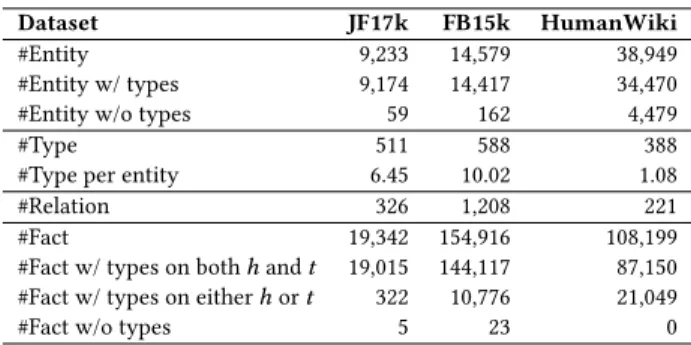
Table 1: Statistics of the datasets
Dataset JF17k FB15k HumanWiki
#Entity 9,233 14,579 38,949
#Entity w/ types 9,174 14,417 34,470
#Entity w/o types 59 162 4,479
#Type 511 588 388
#Type per entity 6.45 10.02 1.08
#Relation 326 1,208 221
#Fact 19,342 154,916 108,199
#Fact w/ types on both ℎ and 𝑡 19,015 144,117 87,150
#Fact w/ types on either ℎ or 𝑡 322 10,776 21,049
#Fact w/o types 5 23 0
suggests relation-tail pairs for a given head, for each unique head, we randomly split its 𝑟 -𝑡 pairs in the datasets into 80% training and 20% test datasets. Table 1 shows the main statistics of the three datasets.
4.1.2 Baselines. We compare our proposed method against a siz-able collection of state-of-the-art techniques from the following three categories.
• Relation (property) prediction techniques. BPR [35] is a recom-mendation technique generating an entity-specific ranked list of relations (where we consider the relation prediction task as rec-ommending relations to entities). Property suggester (WikiPS) [52] recommends relations to an entity using association rules learnt from existing triplets in Wikidata; this technique is an API6 on Wikidata, and thus can only be applied to our HumanWiki dataset. Recoin [2] suggests relations to an entity by collabora-tively using the information about other similar entities, where the similarity is manually defined using a Boolean similarity function that considers two entities as similar if they share at least one type. In particular, it has a special setting for entities of type human using heuristics and prior knowledge, where the Boolean similarity is defined as whether two humans have the same occupation or not, i.e., whether the two head entities of type human have the same tail entity linked via the relation oc-cupation or not. OKELE [7] predicts relations associated with an entity using an attention-based graph neural network model7. As these relation prediction techniques suggest a ranking list of relations to a given head, we take the top-𝑁 relations from the list as the predicted relations; tuning 𝑁 actually balances the tradeoff between the size and the coverage of the resulting candidate (𝑟 -𝑡 pair) set.
• Tail candidate refinement techniques. Based on the predicted list of relations returned by the above techniques, a straightforward approach to form a set of candidate 𝑟 -𝑡 pairs is to combine each predicted relations with all entities (All). One possible improve-ment to this step is to have a filtered list of relevant 𝑡 rather than instances on Wikidata, using prior knowledge for better performance on relation prediction.
6https://www.wikidata.org/w/api.php?action=help&modules=wbsgetsuggestions 7Note that we consider only the relation prediction technique from OKELE as a baseline
technique in this paper, as its link prediction technique extensively uses open Web data, which fundamentally differs from our instance completion task requiring only triplets and entity types from a KG, without the need of involving any extra data sources (see more detail in our Related Work section).
using all entities, i.e., generating a subset of potential 𝑡 for given ℎand 𝑟 . Note that this differs from the link prediction task, as we generate a subset of 𝑡 rather than ranking 𝑟 -𝑡 pairs. In the current literature, an entity relatedness prediction task has been intro-duced by [55] for n-ary relational facts where an n-ary relation links multiple entities {𝑒1, 𝑒2, 𝑒3, ..., 𝑒𝑛}); this task predicts the relatedness between entities in such an n-ary relational fact, in order to perform an instance reconstruction task {𝑒1, 𝑒2,?, ..., ?} (see more detail in our Related Work section). The proposed tech-niques by [55] evaluate the relatedness between two entities, i.e., whether two entities should be linked by a relation or not, which can thus be adopted for our tail candidate refinement. Specifically, two techniques have been proposed by [55]. First, a relatedness affiliated embedding (RAE) model, which learns a multi-layer perceptron neural network to predict a relatedness score between two entities, and considers them to be relevant if the score is higher than a threshold 𝛾 . Tuning 𝛾 balances the tradeoff between the size and the coverage of the resulting candidate (𝑟 -𝑡 pair) set. Second, a schema based predictor (Sch), which leverages the type requirements on the entities dictated by the schema of a relation, generating a set of (tail) entities schematically matching a given relation. Subsequently, one can also combine the refined sets of candidate tails from RAE and Sch by taking their intersection (RAE&Sch).
• Link prediction techniques. Based on a set of candidate 𝑟 -𝑡 pairs for a given ℎ, we apply the following link prediction techniques. First, we consider classical link prediction techniques evaluating the plausibility of a triplet. The translational distance models we consider include: TransE [6], which learns to preserve the relation between two entities as ℎ + 𝑟 ≈ 𝑡 ; TransH [45], which extends TransE to better capture multi-mapping relations using relation-specific hyperplanes; TransR [26], which introduces relation-specific projections to also better capture multi-mapping relations; TransD [17], which further extends TransR by decom-posing the projection matrix into a product of two vectors for an improved efficiency. The semantic matching models we con-sider are as follows: Rescal [32], which represents each entity as a vector and each relation as a matrix, and uses a bilinear function to model the relation between a pair of entities; Dist-Mult [50], which simplifies Rescal by representing each relation embedding as a diagonal matrix; ComplEx [42], which further extends DistMult in the complex space in order to better model both symmetric and asymmetric relations; Analogy [27], which explicitly models analogical structures in multi-relational KG em-beddings; SimplE [19], which is an expressive and interpretable KG embedding techniques based on canonical polyadic tensor de-composition; RotatE [40], which defines a relation as a rotation from a head to a tail in the complex vector space, capturing richer relation patterns. For each of these link prediction technique, we use the hyperparameters as recommended by [14]. We also con-sider a variation of RETA-Grader as an additional baseline, where we learn from triplets only, without learning from the schema (entity-typed triplets); we refer to this baseline as RETA-Grader (no type).
Second, we also consider link prediction techniques using addi-tional information about entity types as baselines, as our RETA-Grader also evaluates a triplet considering the plausibility of
both the input triplet and its corresponding entity-typed triplets. TypeDM and TypeComplex [16] are extended from DistMult and ComplEx, respectively, by explicitly modeling entity type compatibility.
For our RETA-Grader, we set the number of types learnt per entity 𝑘 = 2, 1 and 4, and the number of Filters 𝑛𝑓 =50, 200 and 100 for JF17K, FB15K and HumanWiki, respectively. More details on these parameter sensitivity study will be present later. 4.1.3 Evaluation Protocol. To implement our instance completion task, for a test ℎ, we first generate a set of candidate 𝑟 -𝑡 pairs, and then score and rank them. We evaluate this task in two steps.
First, we evaluate the quality of the generated candidate 𝑟 -𝑡 pair sets. We consider two metrics: 1) the coverage of the candidate set (i.e., the percentage of the ground truth 𝑟 -𝑡 covered by the candidate set), and 2) the size of the candidate set. Intuitively, a good candidate set should have higher coverage and a small size at the same time. Due to the intrinsic tradeoff between the coverage and size of the candidate set, we plot and compare the Pareto frontier of different techniques. Specifically, to generate a set of candidate 𝑟 -𝑡 pairs using our baseline techniques, we can use any relation prediction technique (BPR, WikiPS, Recoin, Recoin_Human or OKELE) combined with any tail candidate refinement technique (All, RAE, Sch or RAE&Sch). We first take the top 𝑁 relations generated by a relation prediction technique and then use one tail candidate refinement technique to generate a set of candidate 𝑟 -𝑡 pairs. By tuning 𝑁 (and also 𝛾 for RAE when applicable), we balances the tradeoff between the size and the coverage of the resulting candidate (𝑟 -𝑡 pair) set. For our method, we tune 𝛼 and 𝛽 to balance this tradeoff.
Second, by fixing the set of candidate 𝑟 -𝑡 pairs ensuring 95% coverage using our RETA-Filter, we evaluate the performance of different (link prediction) techniques and our RETA-Grader when ranking these candidate 𝑟 -𝑡 pairs. We report Recall (Rec), Mean Average Precision (MAP), and Normalized Discounted Cumulative Gain (NDCG).
4.2
Performance on Filtering 𝑟 -𝑡 Pairs
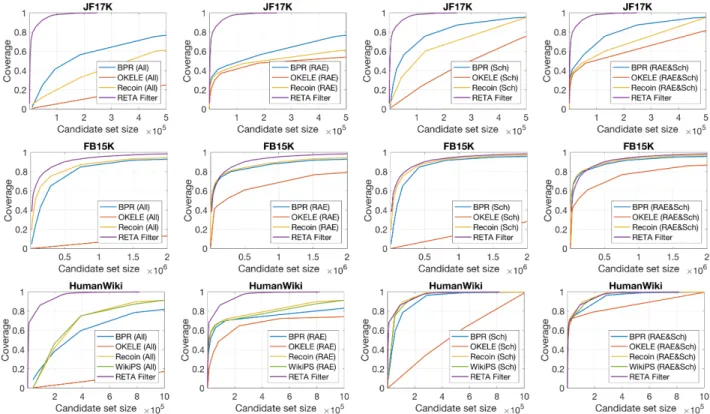
In this section, we evaluate the first step of our instance completion task by investigating the performance of filtering 𝑟 -𝑡 pairs using different techniques. Figure 4 shows the Pareto frontier when trad-ing off the size and the coverage of the candidate 𝑟 -𝑡 pair set ustrad-ing each baseline technique and our RETA-Filter.
We observe that our RETA-Filter outperforms state-of-the-art techniques in general by achieving a better tradeoff in most cases, i.e., the resulting Pareto frontier is closer to the upper-left corner of the plot. Moreover, we find that adding tail candidate refinement techniques to relation prediction techniques does indeed help im-prove the quality of the resulting 𝑟 -𝑡 pair sets, where combining RAE and Sch (RAE&Sch) shows the best performance.
Furthermore, under the tail candidate refinement technique RAE&Sch, we find that Recoin (RAE&Sch) is the most competi-tive baseline, which is able to achieve comparable results to our RETA-Filter on FB15K and HumanWiki. More precisely, RETA-Filter is better than Recoin (RAE&Sch) by achieving a slightly smaller candidate set under the same coverage when the coverage is higher than 82% on FB15K (95% on HumanWiki), while we observe the
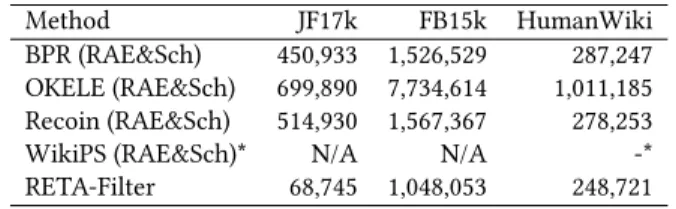
Table 2: Size of candidate set with at least 95% coverage. *WikiPS works only on HumanWiki and fails to reach 95% coverage, due to the fact that its suggested relations (re-turned from its API online) do not include all relations in our HumanWiki dataset.
Method JF17k FB15k HumanWiki BPR (RAE&Sch) 450,933 1,526,529 287,247 OKELE (RAE&Sch) 699,890 7,734,614 1,011,185 Recoin (RAE&Sch) 514,930 1,567,367 278,253 WikiPS (RAE&Sch)* N/A N/A -* RETA-Filter 68,745 1,048,053 248,721
opposite result when the coverage is lower than 82% on FB15K (95% on HumanWiki). However, Recoin achieves such results by using heuristics and prior knowledge on the structure of a KG (i.e., manually defined similarity between entities), in particular on HumanWiki where the similarity between entities is defined as whether two humans have the same occupation or not, i.e., whether the two head entities of type human have the same tail entity linked via the relation occupation or not. In addition, WikiPS (RAE&Sch) also performs well on HumanWiki (the second best baseline). How-ever, it cannot reach high coverage, due to the API limitations, as the returned relations do not include all relations in our HumanWiki dataset.
In practice, as the first step of our instance completion task, the 𝑟 -𝑡pair filtering step should generate a set of candidate 𝑟 -𝑡 pairs with a high coverage (95% or even higher), in order to let the following link prediction techniques or our RETA-Grader identify the true 𝑟-𝑡 pairs by scoring and ranking the candidate 𝑟 -𝑡 pairs. Otherwise, the prediction on a candidate set with a low coverage will certainly lead to low performance on our instance completion task, as a candidate set with a low coverage excludes many ground-truth 𝑟 -𝑡 pairs, which can never be correctly predicted. In other words, the coverage of the candidate set in this step is indeed the upper bound of recall@N when ranking the candidate 𝑟 -𝑡 pairs in the following prediction step. Therefore, we set the coverage to 95% and compare the size of the candidate sets generated by different methods using the best-performing tail candidate refinement technique RAE&Sch. Table 2 shows the results. We see that our RETA-Filter consistently outperforms the baseline techniques, and reduces the size of the candidate set by 84.75%, 31.34% and 10.61% compared to the best performing baselines on JF17k, FB15k and HumanWiki, respectively. In the following experiments, we use our RETA-Filter to generate the set of candidate 𝑟 -𝑡 pairs with 95% coverage.
4.3
Performance on Ranking 𝑟 -𝑡 Pairs
Based on the candidate 𝑟 -𝑡 pair set generated by our RETA-Filter, we then evaluate the performance of our RETA-Grader on our instance completion task. Table 3 shows the results. We observe that our RETA-Grader consistently outperforms all baseline techniques on our instance completion task in general. Taking MAP as an example, it yields an improvement of 16.25%, 65.92% and 35.58% over the best performing baselines on JF17K, FB15K and HumanWiki, respec-tively. Moreover, compared to RETA-Grader (no type), which is the
Figure 4: Tradeoff between the size and the coverage of the resulting candidate (𝑟 -𝑡 pair) set from different filtering techniques. Note that our RETA-Filter has a unique tradeoff line on each dataset, as it does not use any tail candidate refinement tech-niques.
Table 3: Performance of different methods on our instance completion task. We highlight the top-2 best-performing tech-niques for each metric.
Method JF17K FB15K HumanWiki
Rec@10 Rec@5 MAP NDCG Rec@10 Rec@5 MAP NDCG Rec@10 Rec@5 MAP NDCG
TransE 0.0682 0.0321 0.0230 0.0233 0.0411 0.0162 0.0242 0.1654 0.0098 0.0008 0.0147 0.1140 TransH 0.0410 0.0188 0.0173 0.1248 0.0216 0.0069 0.0175 0.1505 0.0110 0.0007 0.0119 0.1086 TransR 0.0657 0.0316 0.0229 0.1343 0.0441 0.0124 0.0240 0.1648 0.0052 0.0006 0.0124 0.1118 TransD 0.0465 0.0238 0.0179 0.1253 0.0253 0.0086 0.0196 0.1566 0.0050 0.0005 0.0108 0.1061 Rescal 0.0074 0.0057 0.0048 0.0791 0.0009 0.0004 0.0002 0.0566 0.0000 0.0000 0.0000 0.0474 Distmult 0.0892 0.0499 0.0367 0.1392 0.0596 0.0260 0.0245 0.1559 0.1400 0.1035 0.0767 0.1747 ComplEx 0.0841 0.0523 0.0317 0.1377 0.1235 0.0683 0.0597 0.1994 0.0986 0.0586 0.0416 0.1365 Analogy 0.1129 0.0679 0.0414 0.1424 0.1496 0.0841 0.0625 0.2017 0.0136 0.0064 0.0077 0.0891 SimplE 0.0881 0.0398 0.0290 0.1336 0.0483 0.0198 0.0245 0.1536 0.1151 0.0812 0.0573 0.1520 RotatE 0.1745 0.0996 0.0529 0.1694 0.0583 0.0341 0.0359 0.1805 0.0429 0.0064 0.0171 0.1172
RETA-Grader (no type) 0.1414 0.0976 0.0528 0.1600 0.1262 0.0653 0.0538 0.2114 0.1606 0.1109 0.0860 0.2038
TypeDM 0.1481 0.0524 0.0452 0.1651 0.1274 0.0693 0.0576 0.1999 0.1285 0.1143 0.0789 0.2079
TypeComplex 0.0665 0.0425 0.0203 0.1204 0.0985 0.0552 0.0439 0.1755 0.0581 0.0015 0.0165 0.1082
RETA-Grader 0.1916 0.1153 0.0615 0.1855 0.2104 0.1288 0.1037 0.2658 0.2049 0.1545 0.1166 0.2332
variant of our proposed model without learning from the schema, our RETA-Grader learning from both triplets and their correspond-ing schema significantly achieves better performance; this shows that learning from entity-typed triplets is indeed helpful for the instance completion task. Compared to link prediction techniques using additional information about entity types, our RETA-Grader
yields better performance by evaluating the plausibility of both the input triplet and its corresponding schema using a subtly designed KG embedding model. Note that TypeComplex, which further con-siders entity types on top of the ComplEx model, underperforms ComplEx; opposite results are reported in [16]. This is due to the different implementations of the ComplEx model. More precisely,
Table 4: Performance of RETA-Grader on different test facts.
Test Facts JF17K FB15K HumanWiki
MAP NDCG MAP NDCG MAP NDCG
known types 0.0614 0.1857 0.1075 0.2780 0.1440 0.2912
unknown type 0.0651 0.1577 0.0790 0.1846 0.0608 0.1154
we tested two different implementation of ComplEx from [16] and [14], respectively, and report the results from the best-performing implementation from [14] in this paper.
Moreover, we further investigate the performance of our RETA-Grader when handling entities without types, where we assign an artificially created “unknown” type to such entities. To this end, we divide all test facts into two sets depending on whether a fact involves an “unknown” type or not: 1) test facts with types on both ℎ and 𝑡 (denoted asknown type); and 2) test facts involving “unknown” type (denoted asunknown type), including both facts with types on either ℎ or 𝑡 and facts without types at all. We then compare the performance of our RETA-Grader on these two sets of test facts. Table 4 shows the results. We observe that the perfor-mance on the facts with known type is generally better than the facts with unknown type. On one hand, for the facts with known type, our RETA-Grader is able to fully leverage the corresponding entity-typed triplets to evaluate the plausibility of a triplet from a schema perspective, resulting in better performance. On the other hand, for the facts with unknown type, our RETA-Grader can only evaluate the schematic plausibility based on the assumption that an “unknown” type could be linked to any type in a KG via a re-lation, which makes the schema relatedness feature vector less discriminative for prediction.
We note that the results of known type in Table 4 are very close to the results on all test facts from Table 3 (MAP and NDCG) on JF17K and FB15K, but not on HumanWiki. This difference can be explained by the fact that facts with known type dominate the set of all test facts on JF17K and FB15K, representing 98.3% and 93.0% of all test facts on JF17K and FB15K, respectively, while this statistic on HumanWiki is 80.5% (see Table 1 for more detail).
4.4
Parameter Sensitivity Study
We also study the impact of two key parameters in our RETA-Grader, i.e., the number of types learnt per entity 𝑘 and the number of filters 𝑛𝑓, on both instance completion performance and evaluation time. In this section, we focus on test facts with known type only, i.e., test facts with known types on both ℎ and 𝑡 , as these test facts can be fully evaluated by our RETA-Grader considering the plausibility of both the input triplet and its corresponding schema. In addition, these test facts also dominate the set of all test facts.
4.4.1 Number of types learnt per entity by Grader. Our RETA-Grader evaluates a triplet considering the plausibility of both the input triplet and its corresponding schema, where the schema infor-mation is represented by a set of entity-typed triplets. For entities with many types, the size of this entity-typed triplet set is large, incurring a large computation overhead. To solve this issue, our RETA-Grader considers at most top-𝑘 types for each entity. In this
experiment, we investigate the impact of 𝑘 on instance completion performance and evaluation time. Figure 5 shows the results.
On one hand, we observe that a small 𝑘 is able to achieve a good performance on our instance completion task. Although con-sidering entity types could improve the performance on instance completion, learning from a too large set of entity-typed triplets indeed makes it hard to capture the key schematic structure of the KG, due to the noise included in the large set of entity-typed triplets, resulting in degraded performance.
On the other hand, the evaluation time consistently increases with 𝑘, as our RETA-Grader repeats its second module min(𝑚𝑘, 𝑛𝑘, 𝑘2) times for a triplet where ℎ and 𝑡 have 𝑚 and 𝑛 types, respectively. We observe an exponentially increasing time on JF17K (and FB15K), as for most triplets in the dataset we have min(𝑚𝑘, 𝑛𝑘, 𝑘2) = 𝑘2 (the average number of types per entity is 6.45 on JF17K (and 10.02 on FB15K), which is larger than 𝑘 in Figure 5). Note that on Human-Wiki, both instance completion performance and evaluation time have a small variation when increasing 𝑘, due to the small number of types per entity in the dataset. In essence, as the average number of types per entity is only 1.08 on HumanWiki, increasing 𝑘 affects only very few entities which have more than 𝑘 types.
In summary, we select the best performing 𝑘 = 2, 1 and 4 for JF17K, FB15K and HumanWiki, respectively, for all other experi-ments.
4.4.2 Number of Filters. We also investigate the impact of the number of filters 𝑛𝑓 used by RETA-Grader. Figure 6 shows the results. We observe that the optimal 𝑛𝑓 varies across datasets, while the evaluation time monotonically increases with 𝑛𝑓. Therefore, in all other experiments, we selected the best performing 𝑛𝑓 =50, 200 and 100 for JF17K, FB15K and HumanWiki, respectively.
5
CONCLUSION
By revisiting the KG completion task, this paper studies an instance completion problem over KGs, where we predict relation-tail 𝑟 -𝑡 pairs for a given head ℎ. To this end, we propose an end-to-end solution consisting of two components: the Filter and RETA-Grader. More precisely, our RETA-Filter first generates candidate 𝑟-𝑡 pairs for a given ℎ by extracting and leveraging schema informa-tion from the KG; our RETA-Grader then evaluates and ranks these candidate 𝑟 -𝑡 pairs considering the plausibility of both the candidate triplet and its corresponding schema using a newly designed KG embedding model. We conduct a thorough evaluation of our pro-posed techniques compared to a sizable collection of state-of-the-art techniques on three real-world KG datasets. Results show that our RETA-Filter is able to generate a set of high-quality candidate 𝑟 -𝑡 pairs for a given ℎ, outperforming the best baseline techniques with 10.61%-84.75% reduction on the candidate set size under the same candidate quality guarantee. Moreover, our RETA-Grader also sig-nificantly outperforms state-of-the-art link prediction techniques on the instance completion task by 16.25%-65.92% across different datasets. In future work, improving the generation of negative sam-ples by corrupting 𝑟 -𝑡 pairs may further improve the performance of RETA-Grader.
Figure 5: Impact of the number of types learnt per entity 𝑘 on instance completion performance and evaluation time
Figure 6: Impact of the number of filters 𝑛𝑓 on instance completion performance and evaluation time
6
ACKNOWLEDGEMENTS
This project has received funding from the European Research Council (ERC, grant agreement 683253/GraphInt), and from the Sci-ence and Technology Development Fund, Macau SAR (SKL-IOTSC-2021-2023).
REFERENCES
[1] Alessio Palmero Aprosio, Claudio Giuliano, and Alberto Lavelli. 2013. Extending the Coverage of DBpedia Properties using Distant Supervision over Wikipedia.. In NLP-DBPEDIA@ ISWC. CEUR-WS.org.
[2] Vevake Balaraman, Simon Razniewski, and Werner Nutt. 2018. Recoin: relative completeness in Wikidata. In WWW Companion. 1787–1792.
[3] Ivana Balazevic, Carl Allen, and Timothy M Hospedales. 2018. Hypernetwork Knowledge Graph Embeddings. arXiv preprint arXiv:1808.07018 11731 (2018). [4] Ivana Balažević, Carl Allen, and Timothy M Hospedales. 2019. Tucker: Tensor
factorization for knowledge graph completion. In EMNLP-IJCNLP). 5185––5194. [5] Kurt Bollacker, Colin Evans, Praveen Paritosh, Tim Sturge, and Jamie Taylor.
2008. Freebase: a collaboratively created graph database for structuring human knowledge. In ACM SIGMOD/PODS. ACM, ACM, 1247–1250.
[6] Antoine Bordes, Nicolas Usunier, Alberto Garcia-Duran, Jason Weston, and Ok-sana Yakhnenko. 2013. Translating embeddings for modeling multi-relational data. In Advances in neural information processing systems. 2787–2795. [7] Ermei Cao, Difeng Wang, Jiacheng Huang, and Wei Hu. 2020. Open Knowledge
Enrichment for Long-tail Entities. In WWW. 384–394.
[8] Tim Dettmers, Pasquale Minervini, Pontus Stenetorp, and Sebastian Riedel. 2017. Convolutional 2d knowledge graph embeddings. In AAAI. 1811–1818. [9] Takuma Ebisu and Ryutaro Ichise. 2018. Toruse: Knowledge graph embedding
on a lie group. In AAAI.
[10] Luis Galárraga, Simon Razniewski, Antoine Amarilli, and Fabian M Suchanek. 2017. Predicting completeness in knowledge bases. In WSDM. 375–383. [11] Luis Antonio Galárraga, Christina Teflioudi, Katja Hose, and Fabian Suchanek.
2013. AMIE: association rule mining under incomplete evidence in ontological knowledge bases. In WWW. 413–422.
[12] Alberto Garcia-Duran and Mathias Niepert. 2017. Kblrn: End-to-end learning of knowledge base representations with latent, relational, and numerical features. arXiv preprint arXiv:1709.04676 (2017).
[13] Saiping Guan, Xiaolong Jin, Yuanzhuo Wang, and Xueqi Cheng. 2019. Link Prediction on N-ary Relational Data. In The World Wide Web Conference. ACM, 583–593.
[14] Xu Han, Shulin Cao, Xin Lv, Yankai Lin, Zhiyuan Liu, Maosong Sun, and Juanzi Li. 2018. Openke: An open toolkit for knowledge embedding. In EMNLP. 139–144. [15] Sergey Ioffe and Christian Szegedy. 2015. Batch normalization: Accelerating deep network training by reducing internal covariate shift. arXiv preprint arXiv:1502.03167 (2015).
[16] Prachi Jain, Pankaj Kumar, Soumen Chakrabarti, et al. 2018. Type-sensitive knowledge base inference without explicit type supervision. In Proceedings of
the 56th Annual Meeting of the Association for Computational Linguistics (Volume 2: Short Papers). 75–80.
[17] Guoliang Ji, Shizhu He, Liheng Xu, Kang Liu, and Jun Zhao. 2015. Knowledge graph embedding via dynamic mapping matrix. In ACL and IJCNLP, Vol. 1. 687– 696.
[18] Guoliang Ji, Kang Liu, Shizhu He, and Jun Zhao. 2016. Knowledge Graph Com-pletion with Adaptive Sparse Transfer Matrix.. In AAAI, Vol. 16. 985–991. [19] Seyed Mehran Kazemi and David Poole. 2018. SimplE Embedding for Link
Prediction in Knowledge Graphs. , 4284–4295 pages.
[20] Diederik P Kingma and Jimmy Ba. 2014. Adam: A method for stochastic opti-mization. arXiv preprint arXiv:1412.6980 (2014).
[21] Tamara G Kolda and Brett W Bader. 2009. Tensor decompositions and applications. SIAM review 51, 3 (2009), 455–500.
[22] Agustinus Kristiadi, Mohammad Asif Khan, Denis Lukovnikov, Jens Lehmann, and Asja Fischer. 2019. Incorporating literals into knowledge graph embeddings. In ISWC. Springer, 347–363.
[23] Alex Krizhevsky, Ilya Sutskever, and Geoffrey E Hinton. 2012. Imagenet classifi-cation with deep convolutional neural networks. In NIPS. 1097–1105. [24] Jonathan Lajus and Fabian M Suchanek. 2018. Are all people married?
Determin-ing obligatory attributes in knowledge bases. In WWW. 1115–1124. [25] Ni Lao, Tom Mitchell, and William Cohen. 2011. Random walk inference and
learning in a large scale knowledge base. In EMNLP. 529–539.
[26] Yankai Lin, Zhiyuan Liu, Maosong Sun, Yang Liu, and Xuan Zhu. 2015. Learning entity and relation embeddings for knowledge graph completion.. In AAAI, Vol. 15. 2181–2187.
[27] Hanxiao Liu, Yuexin Wu, and Yiming Yang. 2017. Analogical inference for multi-relational embeddings. In ICML. 2168–2178.
[28] Ye Liu, Hui Li, Alberto Garcia-Duran, Mathias Niepert, Daniel Onoro-Rubio, and David S Rosenblum. 2019. MMKG: Multi-modal Knowledge Graphs. In European Semantic Web Conference. Springer, 459–474.
[29] Dai Quoc Nguyen, Tu Dinh Nguyen, Dat Quoc Nguyen, and Dinh Phung. 2018. A novel embedding model for knowledge base completion based on convolutional neural network. In NAACL. 327––333.
[30] Dai Quoc Nguyen, Thanh Vu, Tu Dinh Nguyen, Dat Quoc Nguyen, and Dinh Phung. 2018. A Capsule Network-based Embedding Model for Knowledge Graph Completion and Search Personalization. arXiv preprint arXiv:1808.04122 (2018). [31] Maximilian Nickel, Kevin Murphy, Volker Tresp, and Evgeniy Gabrilovich. 2015.
A review of relational machine learning for knowledge graphs. Proc. IEEE 104, 1 (2015), 11–33.
[32] Maximilian Nickel, Volker Tresp, and Hans-Peter Kriegel. 2011. A Three-Way Model for Collective Learning on Multi-Relational Data.. In ICML, Vol. 11. 809– 816.
[33] Mathias Niepert. 2016. Discriminative gaifman models. In NIPS. 3405–3413. [34] Guanglin Niu, Bo Li, Yongfei Zhang, Shiliang Pu, and Jingyang Li. 2020.
Au-toETER: Automated Entity Type Representation for Knowledge Graph Embed-ding. arXiv preprint arXiv:2009.12030 (2020).
[35] Steffen Rendle, Christoph Freudenthaler, Zeno Gantner, and Lars Schmidt-Thieme. 2012. BPR: Bayesian personalized ranking from implicit feedback. arXiv preprint arXiv:1205.2618 (2012).
[36] Paolo Rosso, Dingqi Yang, and Philippe Cudre-Mauroux. 2019. Revisiting Text and Knowledge Graph Joint Embeddings: The Amount of Shared Information Matters!. In BigData. 2465–2473.
[37] Michael Schlichtkrull, Thomas N Kipf, Peter Bloem, Rianne Van Den Berg, Ivan Titov, and Max Welling. 2018. Modeling relational data with graph convolutional networks. In European Semantic Web Conference. Springer, 593–607. [38] Baoxu Shi and Tim Weninger. 2017. ProjE: Embedding projection for knowledge
graph completion. In AAAI. 1236–1242.
[39] Richard Socher, Danqi Chen, Christopher D Manning, and Andrew Ng. 2013. Reasoning with neural tensor networks for knowledge base completion. In NIPS. 926–934.
[40] Zhiqing Sun, Zhi-Hong Deng, Jian-Yun Nie, and Jian Tang. 2019. Rotate: Knowl-edge graph embedding by relational rotation in complex space.
[41] Kristina Toutanova, Danqi Chen, Patrick Pantel, Hoifung Poon, Pallavi Choud-hury, and Michael Gamon. 2015. Representing text for joint embedding of text and knowledge bases. In EMNLP. 1499–1509.
[42] Théo Trouillon, Johannes Welbl, Sebastian Riedel, Éric Gaussier, and Guillaume Bouchard. 2016. Complex embeddings for simple link prediction. In ICML. 2071– 2080.
[43] Quan Wang, Zhendong Mao, Bin Wang, and Li Guo. 2017. Knowledge graph embedding: A survey of approaches and applications. TKDE 29, 12 (2017), 2724– 2743.
[44] Zhen Wang, Jianwen Zhang, Jianlin Feng, and Zheng Chen. 2014. Knowledge graph and text jointly embedding. In EMNLP. 1591–1601.
[45] Zhen Wang, Jianwen Zhang, Jianlin Feng, and Zheng Chen. 2014. Knowledge Graph Embedding by Translating on Hyperplanes.. In AAAI, Vol. 14. 1112–1119. [46] Jianfeng Wen, Jianxin Li, Yongyi Mao, Shini Chen, and Richong Zhang. 2016. On the representation and embedding of knowledge bases beyond binary relations.
In IJCAI. AAAI Press, 1300–1307.
[47] Ruobing Xie, Zhiyuan Liu, and Maosong Sun. 2016. Representation Learning of Knowledge Graphs with Hierarchical Types.. In IJCAI. 2965–2971.
[48] Chenyan Xiong, Russell Power, and Jamie Callan. 2017. Explicit semantic ranking for academic search via knowledge graph embedding. In WWW. 1271–1279. [49] Ikuya Yamada, Hiroyuki Shindo, Hideaki Takeda, and Yoshiyasu Takefuji. 2016.
Joint learning of the embedding of words and entities for named entity disam-biguation. In CoNLL. 250–259.
[50] Bishan Yang, Wen-tau Yih, Xiaodong He, Jianfeng Gao, and Li Deng. 2015. Em-bedding entities and relations for learning and inference in knowledge bases. In ICLR.
[51] Scott Wen-tau Yih, Ming-Wei Chang, Xiaodong He, and Jianfeng Gao. 2015. Semantic parsing via staged query graph generation: Question answering with knowledge base. In ACL and IJCNLP. 1321–1331.
[52] Eva Zangerle, Wolfgang Gassler, Martin Pichl, Stefan Steinhauser, and Günther Specht. 2016. An empirical evaluation of property recommender systems for Wikidata and collaborative knowledge bases. In OpenSym. 1–8.
[53] Chuxu Zhang, Huaxiu Yao, Chao Huang, Meng Jiang, Zhenhui Li, and Nitesh V Chawla. 2020. Few-Shot Knowledge Graph Completion. In AAAI. 3041–3048. [54] Fuzheng Zhang, Nicholas Jing Yuan, Defu Lian, Xing Xie, and Wei-Ying Ma. 2016.
Collaborative knowledge base embedding for recommender systems. In KDD. ACM, 353–362.
[55] Richong Zhang, Junpeng Li, Jiajie Mei, and Yongyi Mao. 2018. Scalable instance reconstruction in knowledge bases via relatedness affiliated embedding. In Pro-ceedings of the 2018 World Wide Web Conference. International World Wide Web Conferences Steering Committee, 1185–1194.