HAL Id: hal-00773100
https://hal.archives-ouvertes.fr/hal-00773100
Submitted on 29 Jul 2016
HAL is a multi-disciplinary open access
archive for the deposit and dissemination of
sci-entific research documents, whether they are
pub-lished or not. The documents may come from
teaching and research institutions in France or
abroad, or from public or private research centers.
L’archive ouverte pluridisciplinaire HAL, est
destinée au dépôt et à la diffusion de documents
scientifiques de niveau recherche, publiés ou non,
émanant des établissements d’enseignement et de
recherche français ou étrangers, des laboratoires
publics ou privés.
BibRank: a language-based model for co-ranking entities
in bibliographic networks
Laure Soulier, Lamjed Ben Jabeur, Lynda Tamine, Wahiba Bahsoun
To cite this version:
Laure Soulier, Lamjed Ben Jabeur, Lynda Tamine, Wahiba Bahsoun. BibRank: a language-based
model for co-ranking entities in bibliographic networks. ACM/IEEE Joint Conference on Digital
Li-braries (JCDL 2012), Jun 2012, Washington, DC, United States. pp.61-70, �10.1145/2232817.2232832�.
�hal-00773100�
BibRank: a Language-Based Model for Co-Ranking
Entities in Bibliographic Networks
Laure Soulier
IRIT - Paul Sabatier University 118 route de Narbonne 31062 Toulouse, France
[email protected]
Lamjed Ben Jabeur
IRIT - Paul Sabatier University 118 route de Narbonne 31062 Toulouse, France
[email protected]
Lynda Tamine
IRIT - Paul Sabatier University 118 route de Narbonne 31062 Toulouse, France
[email protected]
Wahiba Bahsoun
IRIT - Paul Sabatier University 118 route de Narbonne 31062 Toulouse, France
[email protected]
ABSTRACT
Bibliographic documents are basically associated with many entities including authors, venues, affiliations, etc. While bibliographic search engines addressed mainly relevant doc-ument ranking according to a query topic, ranking other re-lated relevant bibliographic entities is still challenging. In-deed, document relevance is the primary level that allows inferring the relevance of the other entities regardless of the query topic. In this paper, we propose a novel inte-grated ranking model, called BibRank, that aims at rank-ing both document and author entities in bibliographic net-works. The underlying algorithm propagates entity scores through the network by means of citation and authorship links. Moreover, we propose to weight these relationships using content-based indicators that estimate the topical re-latedness between entities. In particular, we estimate the common similarity between homogeneous entities by ana-lyzing marginal citations. We also compare document and author language models in order to evaluate the level of author’s knowledge on the document topic and the docu-ment representativeness of author’s knowledge. Experidocu-ment results on the representative CiteSeerX dataset show that BibRank model outperforms baseline ranking models with a significant improvement.
Categories and Subject Descriptors
H.3.3 [Information Systems]: Information Search and Re-trieval
General Terms
Algorithms, Experimentation, Performance
Permission to make digital or hard copies of all or part of this work for personal or classroom use is granted without fee provided that copies are not made or distributed for profit or commercial advantage and that copies bear this notice and the full citation on the first page. To copy otherwise, to republish, to post on servers or to redistribute to lists, requires prior specific permission and/or a fee.
JCDL’12, June 10–14, 2012, Washington, DC, USA.
Copyright 2012 ACM 978-1-4503-1154-0/12/06 ...$10.00.
Keywords
Multi-entity Ranking, Bibliographic Network, Heteroge-neous Information Network, HomogeHeteroge-neous Information Net-work
1. INTRODUCTION
Bibliographic indexers and scientific search engines, such as CiteSeerX1and Google Scholar2have largely contributed
to develop sophisticated models for bibliographic access and scientific document ranking. For this purpose, several fea-tures such as citation links and document recency are used in order to rank bibliographic resources. Meanwhile, these approaches remain document-centered and do not consider other entities participating in scientific activities.
From a larger point of view, the bibliographic resources involve several entities comprising documents, authors, venues, research institutions, etc. In addition to the tra-ditional keyword-based search that aims at retrieving docu-ments discussing a specific topic, scientists express usually their need for accessing to relevant information related to other different bibliographic entities. For instance, they are interested in finding authors working on a specific topic, rele-vant venues to their research activity and specialized institu-tions in some research area. These information needs reveal a new information retrieval task that consists on ranking jointly different bibliographic entities considering a particu-lar topic.
To tackle this problem, previous approaches in the area of literature access propose to either estimate the relevance of a bibliographic entity from related ones or jointly rank the multiple types of entities that interact with each other. In the first category of approaches, some work propose to estimate the importance of an author from his/her co-authorship links [18]. Likewise, the importance of docu-ments can be estimated from their corresponding authors [11, 15]. The second category of approaches models bib-liographic entities using heterogeneous networks and ranks entities according to their relationships to both similar and different types of entities [23, 27, 28, 30, 31]. This category differs from the first one by producing multiple ranking sets
1http://www.citeseer.ist.psu.edu/ 2http://www.scholar.google.com/
as much as the number of entity types are embedded within the network.
In this paper, we are mainly interested in ranking both documents and authors considering a specific topic. We propose a novel ranking model that jointly ranks author and document entities according to their relationships. This model integrates content-based features to evaluate the top-ical relatedness between connected entities. In particular, a language model is used in order to estimate the author’s knowledge on document topic and the document represen-tativeness of author’s knowledge.
The rest of this paper is structured as follows. Section 2 reviews related work. Section 3 introduces problem def-inition and used notations. We present in section 4 our BibRank algorithm for co-ranking bibliographic entities and we detail the proposed link-based and content-based indica-tors. Section 5 describes experiments carried out using Cite-SeerX dataset and discusses the obtained results. In section 6, we conclude the paper and outline research directions for future work.
2.
RELATED WORK
A bibliographic information retrieval system aims at re-trieving and ranking bibliographic resources considering a particular topic. Previous work in the domain have inves-tigated bibliometric indicators in order to evaluate the sci-entific quality of documents and therefore rank the search results by their importance [8, 10, 25]. These indicators help to evaluate document quality [25] as well as the prestige of corresponding authors [2, 6, 10, 13, 29] and journals [3, 8, 24]. In this context, the importance of a document is derived from related entities such as authors, journals, venues, etc. These entities mutually reinforce the quality of each other.
Having the meaningful relationships shown between the different bibliographic entities, some work propose to rep-resent bibliographic resources using bibliographic networks. Such representation allows modeling the different relation-ships between entities. Two categories of bibliographic net-work models are proposed in the literature. The first cat-egory relies on representing bibliographic resources using a homogenous network including only one type of entities. The network model introduced in [16, 17, 20] represents docu-ments and citation links between them. Work in [18] propose to model the bibliographic resources with a co-authorship network. The second category of models represents biblio-graphic resources using a heterogeneous network involving several entities. Zang et al [30] propose to include docu-ments, authors and venues in the network. These entities are associated to both similar and different entities in the network.
Based on bibliographic network models introduced above and aiming at evaluating the scientific quality of biblio-graphic entities, related work have proposed alternative indi-cators for entity ranking. These indiindi-cators take into account the entity position in the network. In the case of homoge-neous networks, link analysis algorithms such as PageRank [20], HITS [16] and Salsa [17] have been investigated for com-puting authority indicators for bibliographic entities [5, 7]. In the case of heterogeneous networks, previous approaches propose to either rank one type of entities by considering its relationships or jointly rank several types of entities. The first category of approaches are called mono-type entity rank-ing approaches in heterogeneous bibliographic networks. The
second category is known as multi-type entity ranking ap-proaches in heterogeneous bibliographic networks.
Focusing on mono-type entity ranking approaches in het-erogeneous networks, previous work propose to rank biblio-graphic entities based on their topical relevance in response to the query and also according to their position in the net-work. In this context, bibliographic networks have been addressed from a social network point of view where doc-uments are ranked by combining their topical relevance and the social importance of their corresponding authors [11, 15]. Liu et al. [18] propose to apply a revisited PageRank on a authorship network, where edges are weighted by co-authorship frequency, to evaluate the impact of an author in the network.
In comparison to mono-type entity ranking approaches in heterogeneous bibliographic networks, multi-type entity ranking approaches in the same networks jointly rank dif-ferent types of entities based on the possible relationships between them. Arnetminer3, Microsoft Academic Search4
and Rexa5are typical examples of search engines that rank at least two types of entities, generally authors and docu-ments. Related work for multi-type entity ranking models propose to either use link analysis approaches [27, 28, 31] or integrate topical indicators to represent entity-query sim-ilarity [23, 30].
Considering the link analysis for multi-type entity rank-ing approaches, Yan and Din [27] propose to jointly rank documents, authors and journals presuming that important authors publish important documents and important enti-ties cite important ones. This model computes entity scores based on the relationships between them by propagating connected entity scores. Document scores are computed dif-ferently. First, an initial score is attributed to each docu-ment based on the score of other connected entities. After-wards, a PageRank score is computed on the homogeneous network of documents. Yang et al. [28] propose to extend the Topical PageRank Model, previously introduced in [19], in order to highlight topical authorities in the bibliographic network. This algorithm propagates scores through the net-work by simulating the surfer behavior. Three actions are considered: stay on the same topic “Follow-stay”, move to a different topic “Follow-jump” or move to a random topic “Jump-jump”. In the same line, Zhou et al. [31] propose to rank jointly different types of entities by combining a PageRank score, expressing the authority of an entity in the homogeneous network, and a BiWalk score that emphasizes the authority of an entity through inter-graph relationships. Beside the previous link analysis-based approaches, some work propose to integrate topical-based indicators in order to rank entities in a bibliographic network. Zang et al. [30] propose to recommend entities in the bibliographic network by combining two scores. The first, namely the topical score, is computed with a language model-based informa-tion retrieval framework [21]. The second score evaluates the authority of the entity in the heterogeneous network us-ing a PageRank-like algorithm. “Author-Topic-Conference” (ACT) model, proposed by Tang et al. [23] and used in Ar-netminer search engine, represents entities thanks to topic distributions inferred by the Latent Dirichlet Allocation
3http://www.arnetminer.org/
4http://www.academic.research.microsoft.com/ 5http://www.rexa.info/
(LDA) model [26]. The ACT model ranks authors, docu-ments and venues using a PageRank-like algorithm.
In this paper, we propose a novel ranking algorithm for heterogeneous bibliographic networks. In comparison to pre-vious related work, our approach is different in at least three respects:
– First, we propose an integrated approach for ranking bibliographic entities unlike modular approaches that combine distinct relevance scores [11, 15, 30, 31]. The aim of the integrated approach is to consider, at the same time and within a unified process, both topical and link-based features.
– Second, our approach is based on content-based and link analysis features unlike previous work [27, 28, 31] that consider only link-based indicators. We propose in this work a ranking model that estimates, by means of a language model, the author’s knowledge on the document topic and the document representativeness to author’s knowledge. We also propose to consider marginal citations to discredit non topical relation-ships unlike work presented in [23] that models entities through topical distributions.
– Third, the core idea of our approach relies on the use of a language model-based approach to estimate the strength and/or weakness of the topical relationship between the bi-type entities jointly with the link-based relatedness. In contrast, [30] focuses on the link-based relatedness between entities and the topical feature is only addressed at the query level.
3.
PROBLEM DEFINITION AND
NOTA-TIONS
In this work, we propose to model bibliographic resources using a bi-type network that integrates documents and au-thors of scientific publications. In response to a user query Q, each type of entities is ranked according to a relevance score computed using a co-ranking function called BibRank. Below, we introduce some definitions and notations.
Definition 1. Document: A scientific document, noted di, is represented by a weighted vector of terms
⃗
di = (wi1, . . . , wip, . . . , wiT). wip denotes the weight of
the pthterm occurring in document d
i. T is the number of
indexed terms.
Definition 2. Author: A scientific author aj may publish
one or more documents. Let D(aj) be the set of
docu-ments authored by ⃗aj. An author aj is represented by a
weighted vector including terms present in all his/her docu-ments ⃗aj = !d
i∈D(aj)
⃗ di.
Definition 3. Bi-type bibliographic network: Biblio-graphic resources are represented by a directed graph G = (V, E) where nodes V = A ∪ D denote biblio-graphic entities with D and A corresponding to document set D = {d1, ..., dn} and author set A = {a1, ..., am}
respec-tively. The set of edges E : V × V represents bibliographic relationships between entities. A directed edge from x ∈ V to y ∈ V is represented by the pair e = (x, y).
Definition 4. Document subgraph and author subgraph: Document and author subgraphs are directed graphs which
include the subset of homogeneous nodes represented in the bi-type bibliographic network G. The document subgraph GD = (D, D × D) ∈ G represents bibliographic documents
and possible relationships between them. The author sub-graph GA = (A, A × A) ∈ G represents authors of
bibli-ographic documents and all possible relationships between them.
Definition 5. Bibliographic relationships: In a bi-type bibliographic network and homogeneous related subgraphs, relationships are represented by edges that model seman-tic links between entities. Three types of relationships are identified:
Document citation associations: Two documents di
and dkare connected by a document citation
associa-tion if document di cites document dk. This
relation-ship is modeled by an edge (di, dk) ∈ D × D.
Author citation associations: Two authors aj and al
are connected by an author citation association if one of the publications of author ajcites at least one of the
publications of author al. This relationship is modeled
by and edge (aj, al) ∈ A × A.
Authorship associations: An author aj and a document
di are connected by an authorship association if
au-thor aj has authored document di. This relationship
is established in both directions and is modeled by a couple of edges (di, aj) ∈ D × A and (aj, di) ∈ A × D.
Definition 6. Intra-graph and inter-graph relationships: A relationship (x, y) is called intra-graph association if both source node x ∈ X and target node y ∈ X are included in the same subgraph GX where X ∈ {A, D}. Document and
author citation associations are intra-graph relationships. A relationship (u, v) is called inter-graph association if source node u ∈ X and target node v ∈ Y belong to two dif-ferent subgraphs GXand GY with X ∈ {A, D}, Y ∈ {A, D}
and X ̸= Y . Authorship associations are inter-graph rela-tionships.
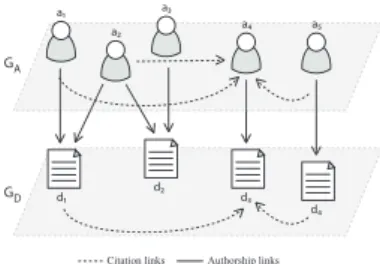
Figure 1 presents an example of a bibliographic network and illustrates a graphical representation of the extracted bi-type bibliographic network.
a1 a2 a3 a4 d1 d2 d3 a5 d4 GA GD
Citation links Authorship links
Figure 1: Bi-type bibliographic graph G
Definition 7. Entity Rank: A Relevance Status Value RSV(di, Q) evaluates the document di ∈ D relevance
con-sidering a query Q. This function measures the query-document similarity. Extending this notation, an entity-query similarity between a bibliographic entity x ∈ A ∪ D and a query Q is represented by a Relevance Status Value
RSV(x, Q). This function ranks entities according to a rel-evance score. Let rank(x) be the rank of entity x. The reciprocal rank is defined as follows:
rx=
1
rank(x) (1)
Definition 8. BibRank function
Considering a bi-type bibliographic network G = (V, E) and a query Q, BibRank function co-ranks author and document entities. A ranked list is produced for each type of entities. BibRank function is defined as follows:
BibRank: {Q, G} −→ {RA, RD} (2)
∀aj∈ A, 0 < RA(aj) < 1,!a
j∈ARA(aj) = 1
∀di∈ D, 0 < RD(di) < 1,!di∈DRD(di) = 1
with RD is the set of document scores. RA is the set of
author scores. RD(di) associates to each document di the
corresponding score in RD. Respectively, RA(aj) associates
to each author ajthe corresponding score in RA.
4.
BIBRANK ALGORITHM
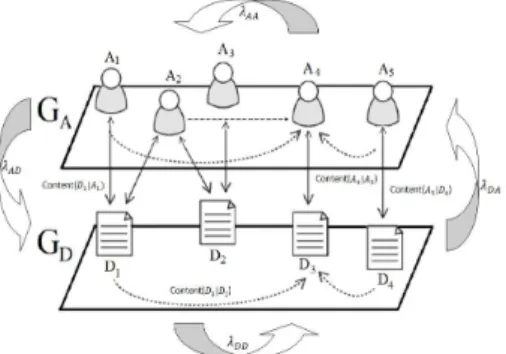
In this section, we present our BibRank algorithm which computes a co-relevance score for both document and au-thor entities of a bi-type bibliographic network. We no-tice that basic assumptions introduced in [28, 30, 31] are also maintained by our algorithm, particularly the assump-tion that important entities are cited by important ones. Indeed, BibRank algorithm introduces transition probabil-ities between the two homogeneous subgraphs and propa-gates relevance scores through connected entities. In ad-dition to transition probabilities, content-based indicators are defined between connected entities to model the topi-cal relatedness between them. Figure 2 illustrates transition probabilities and content-based indicators in the bi-type bib-liographic network. These features are detailed in the next sub-sections.
Figure 2: Transition probabilities and content-based indica-tor in a bi-type bibliographic network
4.1 Computing Transition Probabilities
be-tween Homogeneous Document and
Au-thor Subgraphs
Transition probabilities measure the possibility that a surfer moves from a subgraph to another one. Accessing a document node, the surfer has two choices: either stay on the same subgraph or move to the author subgraph. There-fore, we estimate the probability of moving from a subgraph to another one based on the current position of the surfer.
We compute the transition probability from a subgraph GX
with X ∈ {A, D} to a subgraph GY with Y ∈ {A, D} as
follows:
λXY = |{∀(x,y)∈X×Y }||E| (3)
λAD+ λAA= 1
λDA+ λDD= 1
where |E| is the number of edges in the bibliographic net-work. The transition probabilities of staying on the same subgraph GX with X ∈ A ∪ D is represented by λXX.
Four types of transition probabilities are identified in the bi-type bibliographic network: λAA, λDD, λDA and λAD.
The intra-graph transition probabilities are represented by λAA and λDD. The inter-graph transition probabilities are
represented by λAD and λDA.
4.2 Computing Content-Based Indicators
The content-based indicators measure the topical relat-edness between two connected entities. Our bi-type bibli-ographic network is characterized by two types of relation-ships: inter-graph and intra-graph relationships. Accord-ingly, two content-based indicators are proposed. A first score is attributed to inter-graph relationships based on the topical relatedness between entities. This score is measured by a language model indicator that expresses, depending on the sense of the bi-directed edge, the document representa-tiveness of author’s knowledge and the author’s knowledge on the document topic. Second, we attribute a content-based score for intra-graph relationships that estimates the significance of citation links and detects marginal citations. This score expresses the common interest of the two con-nected entities that they address regarding the query topic.
4.2.1 Document Representativeness of Author’s
Knowledge
For each author aj, a content-based score is attributed to
his/her authored document di ∈ D(aj). This score
de-termines the likelihood for document di to be
representa-tive for the author’s knowledge. The content-based score Content(di|aj) from author ajto document diis computed
as follows: Content(di|aj) = P(aj|Mdi) max ∀(al,dk)∈A×D P(al|Mdk) (4)
P(aj|Mdi) is the probability of observing author aj
con-sidering the language model Mdiof document di. This
prob-ability is computed using the Jelineck-Mercer formula [12]: P(aj|Mdi) =
"
t∈ ⃗aj
[(1 − λ)P (t|Maj) + λP (t|Mdi)]
n(t, ⃗aj) (5)
n(t, ⃗aj) is the number of times that term t appears in ⃗aj.
P(t|Maj) is the probability of observing term t having the
language model Maj of author aj. P (t|Mdi) is the
proba-bility of observing term t having the language model Mdi of
document di.
For convenience, the probability P (t|Mx) of a term t
ac-cording to language model of entity x ∈ A ∪ D is computed as follows:
P(t|Mx) = tf(t, x)
where tf (t, x) is the frequency of term t in x and |x| is the number of terms included in x.
4.2.2 Author’s Knowledge on the Document Topic
For a document di, we note the set of corresponding authors
A(di). The likelihood of each author aj∈ A(di) considering
the topic of document di is computed by a content-based
score Content(aj|di) : Content(aj|di) = P(di|Maj) max ∀(al,dk)∈A×D P(dk|Mal) (7)
P(di|Maj) is the probability of observing document di
ac-cording to the language model Maj of author aj. This
prob-ability is computed as follows:
P(di|Maj) =
"
t∈ ⃗di
[(1 − λ)P (t|Mc) + λP (t|Maj)]
n(t, ⃗dj) (8)
where the collection c is represented by the weighted vec-tor of terms included in all documents of the collection c= !d
i∈D
⃗
di. Let n(t, ⃗di) be the number of times that
term t appears in ⃗di. P (t|Mc) is the probability of
observ-ing term t havobserv-ing to the language model Mc of collection c.
This probability is computed as follows:
P(t|Mc) =
tf(t, c)
|c| (9)
where tf (t, c) is the frequency of term t in the collection c and |c| is the number of terms included in the collection c.
4.2.3 Marginal Citations
Marginal citations are detected by semantic links between two homogeneous entities. We assume that the significance of a citation link can be estimated by the relevance of each entity considering the query topic. The content-based in-dicator detects semantically related entities for intra-graph relationships. For this aim, we propose to discredit thus marginal citations and emphasize significant citation links by comparing the rank of each cited and citing entity in the result set. The closer the ranks of entities are, more significant the citation link is. The common similarity be-tween two entities x, y of a homogeneous subgraph GX with
X∈ {D, A} is measured by the closeness of entity ranks:
Simcom(x, y) = 1
|rank(x) − rank(y)| (10) Similarly to inter-graph relationships, a content-based score Content(x|y) of entity x from entity y is computed for intra-graph relationships:
Content(x|y) = Simcom(x, y) max
(v,w)∈X×XSimcom(v, w)
(11)
4.3 Detailed Algorithm
BibRank is a PageRank-like algorithm that ranks jointly document and author entities using both topical-based and link-based features. BibRank algorithm is processed in three main steps. First, it attributes for all the entities in the homogeneous subgraph an initial score based on the total number of similar nodes. Then, it propagates entity scores
through the graph proportionally to the transition probabil-ities defined in formula 3. At each iteration, a new score is attributed to document and author entities as the sum of the predecessor node scores. These scores are weighted us-ing a topical-based feature, modeled by the reciprocal rank defined in formula 1, and content-based indicators, as pre-sented in formula 4, 7 and 11. Finally, a ranked list is pro-duced for each type of entities.
Algorithm 1: BibRank Data: Q, G = (V, E) Result: BibRank : {Q, G} −→ {RD, RA} begin /* Step 1: Initialize */ θ← 0 Rθ D(di) ←|D|1 Rθ A(aj) ← |A|1
/* Step 2: Propagate scores using transition
probabilities, query input, graph structure and
content-based scores */
repeat
/* Computing document scores */
Rθ+1D (di) ← |V |d + (1 − d)× (λAD ! al; (al,di) RθA(al).waldi O(al) + λDD ! dk; (dk,di) RθD(dk).wdidk O(dk) ) Rθ+1D (di) = N orm(Rθ+1D (di))
/* Computing author scores */
Rθ+1A (aj) ←|V |d + (1 − d)× (λDA ! dk; (dk,aj ) RθD(dk).wajdk O(dk) + λAA ! al; (al,aj ) RθA(al).wajal O(al) ) Rθ+1A (aj) = N orm(Rθ+1A (aj)) θ← θ + 1 until convergence
/* Step 3: Ranking result sets */
RD← Rank(RD)
RA← Rank(RA)
Return {RD, RA}
where
– θ is the iteration number,
– d ∈ [0, 1] is a damping factor fixed to d = 0.15, – wdi al , w di dk, w aj al and w aj
dk are the weighted factor for
relationships (al, di), (dk, di), (al, aj) and (dk, aj)
re-spectively. For convenience, the weighted factor wy x
from entity x ∈ A ∪ D to entity y ∈ A ∪ D is computed as below:
wxy= rx∗ Content(y|x) (12)
– the normalization functions N orm(RDθ+1(di)) and
N orm(Rθ+1
A (aj)) normalize document and author
scores as follows: N orm(Rθ+1D (di)) = Rθ+1D (di) !|D| k=1R θ+1 D (dk) (13) N orm(Rθ+1A (aj)) = Rθ+1A (aj) !|A| l=1Rθ+1A (al)
– the ranking functions Rank(RD) and Rank(RA) rank
respectively document set and author set according to their BibRank score RD(di) and RA(aj).
5.
EXPERIMENTAL EVALUATION
We conduct a series of experiments in order to evaluate the effectiveness of BibRank ranking model within the task of accessing a bibliographic corpus. This section describes the experimental setup and discusses the obtained results.
5.1 Experimental Framework
5.1.1 Data Collection Description
We use in this experimental evaluation the CiteSeerX6 dataset downloaded in April 2011. This collection includes document title, abstract, the list of authors and outgoing citation links. We notice that the citation links between au-thors are extracted from document citation links by applying an exact matching on the name of authors. Table 1 and Fig-ures 3, 4 and 5 show general statistics about the dataset and the extracted bibliographic network. Analyzing the distri-bution of nodes and relationships in the network, we note that the giant component includes about 73% of documents and authors entailed in the network. We also notice that author citation links represent 71.1% of the relationships in the network.
Documents 1 472 735
Authors 1 366 540
Citation links between documents 16 598 502 Citation links between authors 51 306 409 Document citation links per document 11.270 Author citation links per author 37.545 Authorship links 4 209 980 Documents per author 3.081 Authors per document 2.858
Table 1: CiteSeerX collection statistics
0 20 40 60 0 200 400 600 node Degree, d # of n od e s w it h D r e g r e e d
(a) Document citation network
0 200 400 600 0 100 200 node Degree, d # of n od e s w it h D r e g r e e d
(b) Author citation network Figure 3: Citation network density
5.1.2 Topics and Assessments
We used the Latent Dirichlet Allocation (LDA) model [1] to extract first automatically a set of 200 topics. The LDA
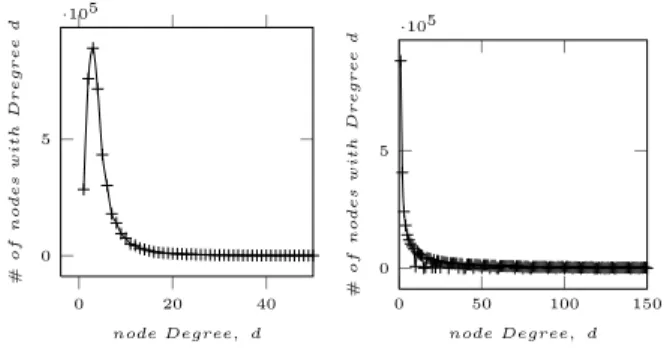
6http://citeseer.ist.psu.edu/ 0 20 40 0 5 ·105 node Degree, d # of n od e s w it h D r e g r e e d
(a) Authors per document
0 50 100 150 0 5 ·105 node Degree, d # of n od e s w it h D r e g r e e d
(b) Documents per authors Figure 4: Distribution of authors and documents in the au-thorship network
71.1%
23% 5.9%
u Author citation links
u Document citation links
u Authorship links
Figure 5: Distribution of links in the network
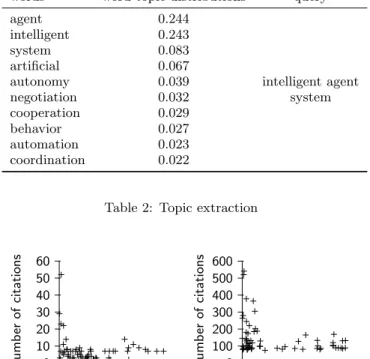
algorithm analyzes word-topic distributions and document-topic distributions. These probabilities allow determining the optimal number of extracted topics from the dataset, in our case a set of 200 topics. Starting from this set, we manually identified generic topics. Then, we extracted man-ually a subset of 35 topics. Each topic is represented by a list of terms that have been annotated manually to gener-ate a query as shown in Table 2. For instance, three of the 35 topics are ”web services”, ”intelligent agent system”, and ”markov chain model”. For each topic, a subgraph including top documents and their authors is extracted.
Considering the query ”intelligent agent system”, Figure 6 illustrates, for an entity, its number of incoming citation links regarding its rank obtained with the BibRank model. It appears the most cited entities are highly ranked entities, that highlights the impact of graph structure in our ranking algorithm. Taking into account the fact that a subgraph is extracted from a query topic on one side, and the impact of graph structure on our ranking algorithm on the other side, we can confirm through observed values that the fi-nal relevance score is a combination of a topical relevance assessment and an authority relevance one.
The topical relevance assessment expresses the similarity of the document content to address the query topic. It was performed using a pool-based process. First of all, BibRank ranking and baseline rankings have been computed. We have merged the top 20 documents obtained in each ranking model. We then asked 25 colleagues to assign to documents a binary topical relevance score considering the query topic. Among assessors, we count 9 assistant professors, 13 Phd students, 2 Master students and 1 engineer. Each query is assessed by two different judges. The average agreement be-tween assessors, measured by the Kappa indicator [4], is a
words word-topic distributions query
agent 0.244
intelligent 0.243
system 0.083
artificial 0.067
autonomy 0.039 intelligent agent
negotiation 0.032 system
cooperation 0.029 behavior 0.027 automation 0.023 coordination 0.022
Table 2: Topic extraction
0 250 500 0 10 20 30 40 50 60 BibRank rank Nu m b e r o f c it a t io n s
(a) Document entities
0 500 1000 0 100 200 300 400 500 600 BibRank rank Nu m b e r o f c it a t io n s (b) Author entities Figure 6: Number of incoming citation links according to the BibRank ranking for the query ”intelligent agent system”
moderate agreement of k = 0.57. Finally, a topical relevance score is automatically computed for each author as the top-ical assessment score average of his/her documents in the collection.
The authority relevance assessment expresses how much the author expertise covers the query topic. It was inferred from a PageRank score classification computed in each ho-mogeneous subgraph. Entity authority relevance is equal to 1 if the PageRank score is higher than the average PageRank score or equals to 0 otherwise.
5.1.3 Baselines
We compare the retrieval effectiveness of our model to three baselines:
– the BM25 model [22] denotes a classical IR match-ing model that computes the query-entity similarity by a probabilistic model.
– the Language Model (LM) [9] denotes a classi-cal IR matching model that computes the query-entity similarity by a smoothed language model, namely the Hiemstra model. The language model is used in our model to compute the content-based score.
– the PRank model [27] denotes a matching model for ranking entities in a bibliographic network. This model has been adapted considering author and docu-ment nodes rather than author, docudocu-ment and journal nodes.
5.2 Results and Discussion
We have analyzed the retrieval effectiveness of the BibRank algorithm for ranking both document and author entities. To evaluate the retrieval effectiveness for each en-tity type ranking and considering the two-levels assessment, we use the Normalized Discount Cumulative Gain at 20th
document, denoted NDCG@20 as the effectiveness metric that normalizes the n-top retrieved results by the ideal rank-ing. Improvement significance was computed using student t-test.
We underline that document and author rankings are jointly produced by the BibRank model as outlined in algo-rithm 1 but for convenience, they are presented below and discussed separately.
5.2.1 Document Ranking Effectiveness
We compare in Table 3 the effectiveness of BibRank al-gorithm with state-of-the-art and traditional ranking mod-els. “% change” column denotes the percentage of BibRank improvement regarding the baselines. We notice signifi-cant improvements between 7.03% for PRank model and 113.13% for the Hiemstra language model. The difference of NDCG@20 values for BibRank and PRank rankings is less important comparing to other baseline rankings because PRank is the closest one since it aims at ranking jointly het-erogeneous entities, as BibRank algorithm, whereas BM25 and LM are devoted to rank only one type of entities. We also conclude that considering only a topical feature, as in baselines BM25 and LM, or only graph structure, as in PRank algorithm, is not sufficient to estimate the rel-evance of documents. Compared to these three baselines, our algorithm integrates jointly in addition to these features a content-based score that analyzes the topical relatedness between linked entities.
Model NDCG@20 % change BM25 0.429 59.77% *** LM 0.322 113.13% *** PRank 0.641 7.03% * BibRank 0.686
Table 3: Document ranking retrieval effectiveness. % change: BibRank improvement. Student test significance *: 0.01 < t ! 0.05 ; **: 0.001 < t ! 0.01 ; ***: t ! 0.001
Figure 7 illustrates the NDCG values at different levels of rank. We notice that the BibRank curve is always over the baseline ones and more particularly when NDCG is com-puted before rank 5. This means that our algorithm returns in the top 5 results the most relevant documents.
5.2.2 Author Ranking Effectiveness
Considering the ranking of author entities, our model overpasses significantly the different baselines, as shown in Table 4. This confirms the benefit of integrating biblio-graphic topical and content features in addition to the graph structure for ranking entities in a bibliographic network. However, we notice that NDCG@20 values for author rank-ing are less important than for document rankrank-ing. It can be explained by the way of modeling topical relevance as-sessments. As said previously, author topical relevance have been inferred from document topical one.
0 5 10 15 20 0.4 0.6 0.8 rank, ri NDC G @ ri BM25 LM Prank BibRank
Figure 7: NDCG at different document entity rankings
Model NDCG@20 % change BM25 0.376 38.26% ***
LM 0.428 21.47% **
PRank 0.455 14.29% * BibRank 0.520
Table 4: Author ranking retrieval effectiveness. % change: BibRank improvement. Student test significance *: 0.01 < t !0.05 ; **: 0.001 < t ! 0.01 ; ***: t ! 0.001
As for document ranking, Figure 8 introduces the NDCG values computed at different levels of rank. BibRank curve rises above the baseline ones. Compared to document rank-ings where the BibRank curve remains higher than the base-line ones but decbase-lines, this latter grows for author ranking, probably also due to the way of inferring topical relevance assessments for authors.
0 5 10 15 20 0.3 0.4 0.5 rank, ri NDC G @ ri BM25 LM Prank BibRank
Figure 8: NDCG at different author entity rankings
5.2.3 Ranking Correlation Analysis
Ranking correlation analysis is performed through the Kendall’s tau (τ ) rank correlation coefficient [14] that ana-lyzes the agreement between two ranking models considering concordant and discordant pairs. The more similar (respec-tively reversed) the rankings are, the more the correlation coefficient τ approaches 1 (respectively −1). If ranking mod-els are independent τ is null.
Table 5 shows entity ranking coefficient correlation τ . For both document and author rankings, a couple of ranking models is particularly correlated: BibRank and PRank mod-els. They both integrate graph structure and have close rankings. Nevertheless, we have noticed in Table 3 that PRank and BibRank ranking effectivenesses are significantly different.
For document ranking, BM25 and Hiemstra models are weakly correlated. Indeed, they are both classical match-ing models that rank entities accordmatch-ing to a query. Other couples of ranking models are not particularly correlated. In other words, the different rankings between these models considered by pairs are not similar.
For author ranking, we notice that some couples of rank-ing models are weakly correlated by a negative value, that means that one model ranks authors in a decreasing order regarding the other model.
For instance, Figure 9 shows an instance of rank correla-tion coefficient for a particular query ”intelligent agent sys-tem”. Both axes represent entity rank for a given ranking model (BM25, LM, PRank or BibRank). LM-BM25, for in-stance, compares BM25 ranking to LM ranking.
For document ranking, most of the scatter plots have points distributed in the whole graph, it explains therefore the weak coefficients reported in Table 5. The graph that opposes BibRank and PRank rankings illustrates a diagonal line that emphasizes the Kendall rank correlation value of 0.594 re-ported in Table 5.
For author ranking, scatter plots have a different point repartition with the diagonal line only in graph opposing BibRank and PRank which represents indeed the most cor-related couple of ranking models. In the other graphs, points are not correlated and present moreover a vertical trend, re-lated to a negative value for Kendall rank correlation co-efficient in Table 5. We also notice that some points are concentrated along the abscissa axis as in Figures (b)-(2) to (b)-(5). This expresses the fact that the authors returned by the ranking model represented within the abscissa axis are not returned by the ranking model represented within the ordinate axis. This confirms the negative correlation between the ranking models. This fact is emphasized par-ticularly, as shown in Figures (b)-(2) to (b)-(5), in the case of BM25 and LM ranking models that return few results regarding only the query.
6. CONCLUSION AND FUTURE WORK
In this paper, we proposed a bi-type entity ranking al-gorithm for bibliographic networks, called BibRank. This algorithm propagates entity scores by considering both link-based and content-link-based features in the network. For this purpose, we estimate the significance of citation links by measuring the common similarity between homogeneous en-tities regarding a topic and we also evaluate, using a lan-guage model, the document representativeness to author’s knowledge and the author’s knowledge on document topic.
We conducted a series of experiments on CiteSeerX dataset that shows a significant improvement in compari-son to other models for both document and author rank-ings. We also conclude that matching models based only on the query topic are not sufficient for ranking entities in heterogeneous subgraphs. Analyzing ranking correlations, we note that PRank and BibRank algorithms present cor-related entity rankings. Meanwhile, this correlation agree-ment is counterbalanced by a significant improveagree-ment for BibRank algorithm.
For future research work, we plan to extend our model to large-scale bibliographic networks including more entity types and relationships, such as co-authorship, the author’s affiliation to an institution. We also plan to integrate tempo-ral aspects of citation links in order to measure the
author-BM25 LM PRank BibRank BM25 1 0.160 0.002 0.015
LM 1 0.022 0.039
PRank 1 0.594
BibRank 1
(a) Document rankings
BM25 LM PRank BibRank BM25 1 -0.187 -0.082 -0.160 LM 1 -0.072 -0.151 PRank 1 0.600 BibRank 1 (b) Author rankings Table 5: Rank correlation coefficient for document and author rankings
(a) Document rankings (b) Author rankings Figure 9: Comparison of document and author rankings for query ”intelligent agent system”
ity acquired by a document regarding its publication date. In this mind, the importance of documents is not therefore measured by the number of in-coming links but by the aver-age number of citation links per year. We expect that this revised approach would favour efficient entities rather than basically most cited ones.
7.
REFERENCES
[1] E. Agichtein, E. Brill, and S. Dumais. Improving web search ranking by incorporating user behavior information. In Proceedings of the 29th annual international ACM SIGIR conference on Research and development in information retrieval, SIGIR ’06, pages 19–26, New York, NY, USA, 2006. ACM.
[2] S. Alonso, F. J. Cabrerizo, E. H. Viedma, and F. Herrera. hg-index: a new index to characterize the scientific output of researchers based on the h- and g-indices. Scientometrics, 82:391–400, 2010. [3] C. T. Bergstrom, J. D. West, and M. A. Wiseman.
The eigenfactor metrics. Journal of Neuroscience, 28(45):11433–11434, 2008.
[4] J. Cohen. A coefficient of agreement for nominal scales. Educational and Psychological Measurement, 20(1):37–46, 1960.
[5] A. Dahlan and B. Sitohang. Combining pagerank and citation analysis to measure information credibility in internet. In Proceedings of iiWAS, pages 375–382, 2007.
[6] L. Egghe. An improvement of the h-index: the g-index. ISSI Newsletter, 2:8–9, 2006.
[7] M. Frick´e and D. Fallis. Indicators of accuracy for answers to ready reference questions on the internet. J. Am. Soc. Inf. Sci. Technol., 55:238–245, 2004. [8] E. Garfield. The history and meaning of the journal
impact factor. JAMA: The Journal of the American Medical Association, 1, 2006.
[9] D. Hiemstra. A linguistically motivated probabilistic model of information retrieval. In Proceedings of the Second European Conference on Research and Advanced Technology for Digital Libraries, ECDL ’98, pages 569–584, London, UK, 1998. Springer-Verlag. [10] J. E. Hirsch. An index to quantify an individual’s
scientific research output. Proceedings of the National Academy of Sciences of the United States of America, 102:16569–16572, 2005.
[11] L. B. Jabeur, L. Tamine, and M. Boughanem. A social model for literature access: towards a weighted social network of authors. In Proceedings of Adaptivity, Personalization and Fusion of Heterogeneous Information, RIAO ’10, pages 32–39, 2010.
[12] F. Jelinek and R. L. Mercer. Interpolated estimation of markov source parameters from sparse data. In Proceedings of the Workshop on Pattern Recognition in Practice, pages 381–397, Amsterdam, The Netherlands: North-Holland, 1980.
[13] B. Jin, L. Liang, R. Rousseau, and L. Egghe. The r-and ar-indices: Complementing the h-index. Chinese Science Bulletin, 52:855–863, 2007.
[14] M. G. Kendall. A new measure of rank correlation. Biometrika, 30(1/2):81–93, 1938.
A. D. Rheinischen. Social information retrieval, 2005. [16] J. M. Kleinberg. Authoritative sources in a
hyperlinked environment. J. ACM, 46:604–632, 1999. [17] R. Lempel and S. Moran. The stochastic approach for
link-structure analysis (salsa) and the tkc effect. Comput. Netw., 33:387–401, 2000.
[18] X. Liu, J. Bollen, M. L. Nelson, and H. Van de Sompel. Co-authorship networks in the digital library research community. Inf. Process. Manage.,
41:1462–1480, 2005.
[19] L. Nie, B. D. Davison, and X. Qi. Topical link analysis for web search. In Proceedings of the 29th annual international ACM SIGIR conference on Research and development in information retrieval, SIGIR ’06, pages 91–98, New York, NY, USA, 2006. ACM.
[20] L. Page, S. Brin, R. Motwani, and T. Winograd. The pagerank citation ranking: Bringing order to the web. Technical Report 1999-66, Stanford InfoLab,
November 1999.
[21] J. M. Ponte and W. B. Croft. A language modeling approach to information retrieval. In Proceedings of the 21st annual international ACM SIGIR conference on Research and development in information retrieval, SIGIR ’98, pages 275–281. ACM, 1998.
[22] S. E. Robertson and S. Walker. Some simple effective approximations to the 2-poisson model for
probabilistic weighted retrieval. In Proceedings of the 17th annual international ACM SIGIR conference on Research and development in information retrieval, SIGIR ’94, pages 232–241, New York, NY, USA, 1994. Springer-Verlag New York, Inc.
[23] J. Tang, R. Jin, and J. Zhang. A topic modeling approach and its integration into the random walk framework for academic search. In Proceedings of the 2008 Eighth IEEE International Conference on Data Mining, pages 1055–1060, Washington, DC, USA, 2008. IEEE Computer Society.
[24] S. Uddin, L. Hossain, A. A., and K. Rasmussen. Trend and efficiency analysis of co-authorship network. Scientometrics, In press, 2011.
[25] D. Walker, H. Xie, K.-K. Yan, and S. Maslov. Ranking scientific publications using a simple model of network traffic. Society, pages 1–5, 2006.
[26] X. Wei and W. B. Croft. Lda-based document models for ad-hoc retrieval. In Proceedings of the 29th annual international ACM SIGIR conference on Research and development in information retrieval, SIGIR ’06, pages 178–185, New York, NY, USA, 2006. ACM.
[27] E. Yan and Y. Ding. Measuring scholarly impact in heterogeneous networks. In Proceedings of the 73rd ASIS&T Annual Meeting on Navigating Streams in an Information Ecosystem - Volume 47, ASIS&T ’10, pages 1–7, Silver Springs, MD, USA, 2010. American Society for Information Science.
[28] Z. Yang, L. Hong, and B. D. Davison. Topic-driven multi-type citation network analysis. In Proceedings of Adaptivity, Personalization and Fusion of
Heterogeneous Information, RIAO ’10, pages 24–31, 2010.
[29] C.-T. Zhang. The e-index, complementing the h-index for excess citations. PLoS ONE, 4, 2009.
[30] J. Zhang, J. Tang, B. Liang, Z. Yang, S. Wang,
J. Zuo, and J. Li. Recommendation over a
heterogeneous social network. In Proceedings of the 2008 The Ninth International Conference on Web-Age Information Management, WAIM ’08, pages 309–316, Washington, DC, USA, 2008. IEEE Computer Society. [31] D. Zhou, S. A. Orshanskiy, H. Zha, and C. L. Giles.
Co-ranking authors and documents in a heterogeneous network. In Proceedings of the 2007 Seventh IEEE International Conference on Data Mining, pages 739–744, Washington, DC, USA, 2007. IEEE Computer Society.