HAL Id: hal-00547940
https://hal.archives-ouvertes.fr/hal-00547940
Submitted on 17 Dec 2010HAL is a multi-disciplinary open access archive for the deposit and dissemination of sci-entific research documents, whether they are pub-lished or not. The documents may come from teaching and research institutions in France or abroad, or from public or private research centers.
L’archive ouverte pluridisciplinaire HAL, est destinée au dépôt et à la diffusion de documents scientifiques de niveau recherche, publiés ou non, émanant des établissements d’enseignement et de recherche français ou étrangers, des laboratoires publics ou privés.
Multilingual Extraction of functional relations between
Arabic Named Entities using NooJ platform
Abdelmajid Ben Hamadou, Odile Piton, Héla Fehri
To cite this version:
Abdelmajid Ben Hamadou, Odile Piton, Héla Fehri. Multilingual Extraction of functional relations between Arabic Named Entities using NooJ platform. Nooj 2010 International Conference and Work-shop, Le Département de Philologie Grecque de l’Université Democritus de Thrace, le Laboratoire de Sémio-Linguistique et Didactique (LASELDI) de l’Université de Franche-Comté et la Maison des Sciences de l’Homme et de l’Environnement Ledoux, May 2010, Komotini, Greece. pp.192-202. �hal-00547940�
Multilingual Extraction of functional relations between Arabic
Named Entities using NooJ platform
Abdelmajid Ben Hamadou (1) Odile Piton (2) and Héla Fehri (3) (1) MIRACL-University of Sfax, Tunisia.
(2) SAMM-University of Paris1 Pantheon-Sorbonne, Paris, France.
(2) MIRACL-University of Franche-Comte and University of Sfax, Tunisia
hela.fehri @ fss.rnu.tn
Abstract
The extraction of relation between Named Entities (NE) has become the last few years an interesting research domain. It is very useful for many applications such as Web mining, Information extraction and retrieval, Business intelligence, Automatic databases filing with Entities & types, Questions answering task and document Summarization.
Several works has been performed for relation discovery in texts written in Latin languages and as far as we know, very few works has been done for Arabic language. In this paper, we focus on functional relations between ENAMEX and ORG Arabic Named Entities. The extraction approach is rule based and the implementation is performed using NooJ Platform.
Keywords: Relations between Named Entities, Extraction Process, NooJ transducers,
Relation translation
1. Introduction
The extraction of semantic relations between Named Entities (NE) has become the last few years an interesting research domain. It is very useful for many applications such as Web mining, Information extraction and retrieval, Automatic databases filling with Entities & types, Questions answering task and document Summarization.
Relations between Named Entities can be binary (involving two entities) or more complex up to notion of event. There are also several types of relations based on the types of the involved Named Entities.
Several works related to semantic relations discovery has been performed for Euro-pean languages and especially for English. As far as we know, very few works has been done for Arabic language.
In this paper we propose a rule based relation extraction system for Arabic lan-guage. We focus on functional relations between ENAMEX and ORG Named Entities (director, responsible, president…). Functional Relation can be explicit or implicit. Explicit relation is indicated by a special word or sequence of words in the text. Im-plicit relation is a relation that can be mined from the text using the context.
The extraction process is performed in three steps: Identification of the Named En-tities (ENAMED and ORG), Detection of relations between identified Named Enti-ties, Generation of the predicate form representing the relation in Arabic and French. The translation of the relation allows cross lingual information retrieval.
The rest of the paper is organized as follows. We begin by giving an idea about the proposed approaches for extraction of semantic relations between NEs. Then, we ad-dress the major challenges posed by extraction of semantic relations between NEs for
Arabic language. After that, we detail our approach and its implementation using NooJ linguistic platform [Silberstein 2005]. Finally, we present the evaluation results obtained from a test corpus.
2. Approaches for NE relation Discovery
Discovering Relations between Named Entities can be done using a linguistic or a numerical or hybrid approach.
The first approach is rule-based, which tried to use syntactic and semantic patterns to capture the corresponding relations by means of manually written linguistic rules. This approach is very interesting for restricted domain and has a good quality of analysis. The major drawback of this approach is the poor adaptability and the poor robustness in handling large-scale or new domain data. This is due to two reasons: rules have to be rewritten for different tasks or when the application is enlarged to dif-ferent domains and generating rules manually is quite laborious and time consuming (Santos and al., 2010).
The statistical approach (Jun and al., 2009), (Culotta and al., 2006) is based on a learning process from an annotated corpus which can be supervised when the corpus is large, or weakly supervised when the corpus is reduced, or unsupervised if the cor-pus is not needed. The supervised approach (Miller S. and al., 2000), (Zelenko and al., 2003), (Culotta and al., 2004) and (Kambhatla and al., 2004) costs time and efforts to annotate the corpus, and its performance depends on the size of the corpus. So, to de-crease the corpus annotation requirement, some researchers turned to weakly super-vised learning approaches, which rely on a small set of initial seed (bootstrap) instead of a large annotated corpus (Agichtein and al., 2000), (Stevenson, 2004). However, the major problem lies in selecting the initial corpus and deciding its “optimal” size. The unsupervised approach works effectively on high-frequent entity pairs. However, this approach has a limited quality in analysis (Hasegawa and al., 2004).
3. Arabic Named Entities Relations discovery challenges
Arabic Named Entities Relations discovery is not an easy task. In fact, besides the problems related to the Arabic Named Entities recognition (Ben Hamadou and al., 2010), (Shaalan and al. 2009), the extraction of relations between Named Entities poses some specific challenges:
Discontinuity of the multiple relations concerning the same NE (person). أ. د . دﺎﻤﻋ تﺎﺒﺳﺎﺤﻟا تﺎﻴﻠآ ﺔﻴﻌﻤﺠﻟ مﺎﻌﻟا ﻦﻴﻣﻷا بﺮﻟا ﻮﺑأ
-مﻮﻠﻌﻟا ﺔﻴﻠآ ﺪﻴﻤﻋ Prof. Dr. Imed
Abou-Roub the secretary general of organization of computational faculties – Dean of Science Faculty
The Person Name: Prof. Dr. Imad Abou-Roub is concerned by the relation
Secre-tary-General and the relation Dean-of in the same time. Between the Person Name
and the second relation (Dean-of ) there is a gap.
Implicit Relations: they are relations that are not directly specified in the text. They are mined from the text using contextual elements.
ﺐﻄﻟا ﺔﻴﻠﻜﻟ ﺔﻴﺒﻌﺸﻟا ﺔﻨﺠﻠﻟا ،ﻰﺳﻮﻣ يدﺎﻬﻟا ﺪﺒﻋ رﻮﺘآﺪﻟا Doctor Abd el Hadi Moussa, pupil’s
committee of medicine Faculty
The relation between the two NEs: Doctor Abd el Hadi Moussa and pupil’s
com-mittee of medicine Faculty is not explicitly indicated by a specific word in the text.
Necessity to use the previous context of the relation in order to know the miss-ing element involved in the relation.
مﺎﻌﻟا ﻦﻴﻣﻷا ﻢﺷﺎه ﺢﻟﺎﺻ رﻮﺘآﺪﻟا ذﺎﺘﺳﻷا Professor Doctor Salah Hachem the secretary
general
In this example the ORG named entity is absent, but it can be recovered from the right context.
Interference between implicit relation and discontinuity. In the text we have in the same time implicit relation and discontinuity as shown in this example.
أ . د . ﻢﺳﺎﻘﻟا ﻲﻠﻋ ﻢﺳﺎﻘﻟا ﺔﻋارﺰﻟا ﺔﻴﻠآ – مﻮﻃﺮﺨﻟا ﺔﻌﻣﺎﺟ / ﺔﻋارﺰﻟا تﺎﻴﻠآ ﺔﻴﻌﻤﺠﻟ ﻦﻴﻣﻷا ﺪﻋﺎﺴﻣ
Prof. Dr. El-Kacem Ali El-Kacem – Agricultural Faculty – university of Khar-toum / assistant of secretary of faculties’ agriculture organization.
The first implicit relation is Belong-to and there is a discontinuity between the Person Name Prof. Dr El-Kacem Ali El-Kacem and the Relation Assistant-of.
4. The proposed approach
As indicated above, the proposed approach for relation discovery is rule based. It is founded on a balance between grammar and lexical resources. The grammar indicates the composition rules of the lexical components, in order to form the different patterns of functional relations. Patterns are transformed into transducers implemented using NooJ Platform.
The lexical resources correspond to one dictionary for each entity type used by the transducers.
a. Patterns of relations
The approach of extraction functional relations between ORG and ENAMEX Named Entities is based on a notion of linguistic pattern that we transform into rules and transducers.
Patterns are considered as regular expressions integrating different elements repre-senting relations and concerned Named Entities.
These patterns are identified semi-automatically from our journalistic learning cor-pus using NooJ facilities. Indeed, NooJ allows to identify regular expressions in a corpus such as all First Names with the right and the left contexts, all passengers con-taining a specific relation with the right and the left context.
In the following, we give a list of the main patterns identified in the learning cor-pus:
<Pattern 1>:= {<Title>} <PersName> {<P>} <REL> < ORG > ﺮﻳﺪﻣ يﺮﺠﻳﻮﺘﻟا ﻲﻠﻋ سﺪﻨﻬﻤﻟا
ﻲﺋﺎﻴﻤﻜﻟا ﻊﻤﺠﻤﻟا
Engineer Ali Al-Touijri Director of Chemical group <Title> Engineer سﺪﻨﻬﻤﻟا
<PersName> Ali Al-Touijri يﺮﺠﻳﻮﺘﻟا ﻲﻠﻋ <REL> Director-of ﺮﻳﺪﻣ
<Pattern 2>:= <REL> <ORG > {<P>} {<Title>} <PersName> يﺮﺠﻳﻮﺘﻟا ﻲﻠﻋ سﺪﻨﻬﻤﻟا ﻲﺋﺎﻴﻤﻜﻟا ﻊﻤﺠﻤﻟا ﺮﻳﺪﻣ :
Engineer Ali Al-Touijri Director of Chemical group <Title> Engineer سﺪﻨﻬﻤﻟا
<PersName> Ali Al-Touijriيﺮﺠﻳﻮﺘﻟا ﻲﻠﻋ <REL> Director-of ﺮﻳﺪﻣ
<ORG> Chemical group ﻲﺋﺎﻴﻤﻜﻟا ﻊﻤﺠﻤﻟا <P>:
<Pattern 3>:= {<Title>} <PersName> {<P>} <ORG > يﺮﺠﻳﻮﺘﻟا ﻲﻠﻋ سﺪﻨﻬﻤﻟا /
ﻲﺋﺎﻴﻤﻜﻟا ﻊﻤﺠﻤﻟا
Engineer Ali Al-Touijri Director of Chemical group <Title> Engineer سﺪﻨﻬﻤﻟا
<PersName> Ali Al-Touijri يﺮﺠﻳﻮﺘﻟا ﻲﻠﻋ <Implicit-REL> Belong-To
<ORG> Chemical group ﻲﺋﺎﻴﻤﻜﻟا ﻊﻤﺠﻤﻟا <P> /
<Patern 4>:= <REL> < demonym -ADJ> {<Title>} <PersName> ﻲﻜﻳﺮﻣﻷا ﺲﻴﺋﺮﻟا
:
ﺎﻣﺎﺑوأ كارﺎﺑ US President : Barack Obama <REL> President ﺲﻴﺋﺮﻟا
< demonym -ADJ> American ﻲﻜﻳﺮﻣﻷا <PersName> Barack Obama ﺎﻣﺎﺑوأ كارﺎﺑ <P> :
<Patern 5>:= <REL> <Toponym > {<Title>} <PersName> ةﺪﺤﺘﻤﻟا تﺎﻳﻻﻮﻟا ﺲﻴﺋر
:
ﺎﻣﺎﺑوأ كارﺎﺑ US President : Barack Obama <REL> President ﺲﻴﺋر
<Toponym > USةﺪﺤﺘﻤﻟا تﺎﻳﻻﻮﻟا
<PersName> Barack Obama ﺎﻣﺎﺑوأ كارﺎﺑ <P> :
{ V } Means that the category “V” is optional <P> Means any punctuation: , /, (-…
b. NooJ grammar
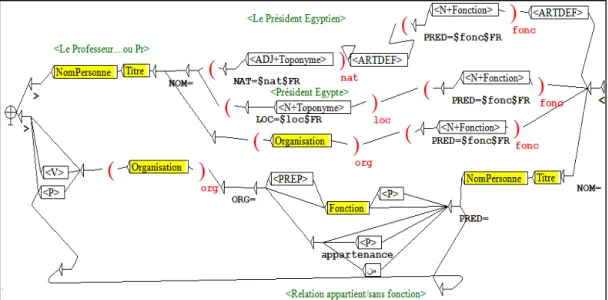
The figure 1 shows the main graph allowing the recognizing of the functional relation between ENAMEX and ORG Named Entities. Each path of this graph represents a different pattern.
Figure 1: The main graph
The sub graphs:
- NomPersonne allows to recognize the Person Names
- Titre allows to recognize triggers words preceding the Person Name - Organisation allows the recognition of the ORG Named Entity.
- Fonction allows the recognition of the relation between Person Name and ORG Named Entities.
The figure 2: details the Organisation graph. It allows the recognition of the ORG Named Entity witch has a complex structure and it includes ENAMEX (Person Name) and LOC (i.e. SN Lieu) Named entities.
Figure 2: Organisation graph
Beside those graphs, we use a graph for splitting the agglutinated particles (prepositions, defi-nite articles, conjunctions,..) in the analysed Arabic words as shown in this example :
Analysed word: ةرادﻹﺎﺑو et dans l’administration
c. NooJ Dictionaries
As mentioned above, the recognition of the relations is based on the following main modules:
- Recognition of the Person Names, including the possible Title, - Recognition of the ORG Named Entity
- Recognition of the Relation between the indicated Named Entities.
Each module uses its own dictionaries whose entries contain lemmas with the corre-sponding possible flexional model to generate all derived forms and the correcorre-sponding French lemmas.
The recognition of the Person Names module uses the following dictionaries:
- For the Person Names Recognition Step, we build the following dictionaries: o Titles Dictionary
o First Names Dictionary o Last Names Dictionary
- For the ORG Recognition module, we build the following dictionaries: o Geographical names Dictionary
o Type institution Dictionary o Adjectives Dictionary
- For the Recognition of relations module, we build the following dictionaries: o Demonym adjectives Dictionary
o Functions Dictionary
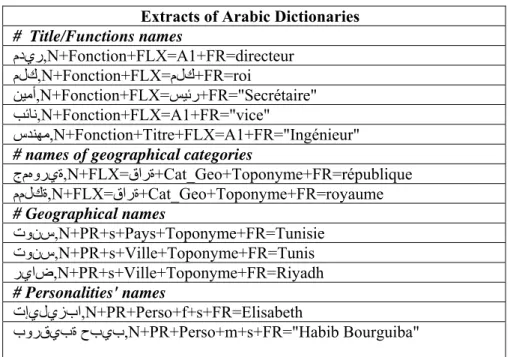
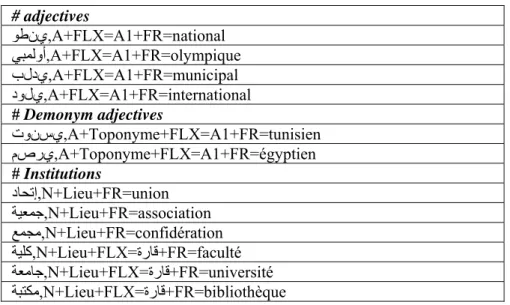
Table 1 gives extracts of those dictionaries
Extracts of Arabic Dictionaries # Title/Functions names مدير,N+Fonction+FLX=A1+FR=directeur ملك,N+Fonction+FLX=ملك+FR=roi ﻦﻴﻣأ,N+Fonction+FLX=ﺲﻴﺋر+FR="Secrétaire" ﺐﺋﺎﻧ,N+Fonction+FLX=A1+FR="vice" سﺪﻨﻬﻣ,N+Fonction+Titre+FLX=A1+FR="Ingénieur" # names of geographical categories
جمﻩورية,N+FLX=قارة+Cat_Geo+Toponyme+FR=république مملكة,N+FLX=قارة+Cat_Geo+Toponyme+FR=royaume # Geographical names تونس,N+PR+s+Pays+Toponyme+FR=Tunisie تونس,N+PR+s+Ville+Toponyme+FR=Tunis رياض,N+PR+s+Ville+Toponyme+FR=Riyadh # Personalities' names تإيليزبا,N+PR+Perso+f+s+FR=Elisabeth بورقيبة حبيب,N+PR+Perso+m+s+FR="Habib Bourguiba"
# adjectives وطني,A+FLX=A1+FR=national ﻲﺒﻤﻟوأ,A+FLX=A1+FR=olympique بلدي,A+FLX=A1+FR=municipal دولي,A+FLX=A1+FR=international # Demonym adjectives تونسي,A+Toponyme+FLX=A1+FR=tunisien مصري,A+Toponyme+FLX=A1+FR=égyptien # Institutions دﺎﺤﺗإ,N+Lieu+FR=union ﺔﻴﻌﻤﺟ,N+Lieu+FR=association ﻊﻤﺠﻣ,N+Lieu+FR=confidération ﺔﻴﻠآ,N+Lieu+FLX=ةرﺎﻗ+FR=faculté ﺔﻌﻣﺎﺟ,N+Lieu+FLX=ةرﺎﻗ+FR=université ﺔﺒﺘﻜﻣ,N+Lieu+FLX=ةرﺎﻗ+FR=bibliothèque
Table 1: Extracts of Arabic dictionaries
d. Predicate Representation of the Relations
Recognized explicit relations are represented using First Order Logic in the form of a Predicate (i. e. Relation Name) with two arguments: Person Name as the First Argu-ment and the ORG Named Entity as the second ArguArgu-ment. The Name of the relation is the Lemma extracted from the Function Dictionary.
Example:
مﺎﻋ ﻦﻴﻣأ )
تﺎﻣﻮﻠﻌﻤﻟاو تﺎﺒﺳﺎﺤﻟا تﺎﻴﻠآ ﺔﻴﻌﻤﺟ ، بﺮﻟا ﻮﺑأ (
Secretary-General (Abu al-Rub, Association of Colleges of Computing and Informa-tion)
For the implicit relation we generate systematically the name “Belong_to” ﻰﻟإ_ﻲﻤﺘﻨﻳ. Example: ﻲﻤﺘﻨﻳ _ ﻰﻟإ ) ﻋ ﻢﺳﺎﻘﻟا ﺔﻋارﺰﻟا ﺔﻴﻠآ ، ﻢﺳﺎﻘﻟا ﻲﻠ (
Belong_to (Al-Kacem Ali Al-Kacem, Faculty of Agriculture)
e. Translation of the relations
The translation of the recognized relations is done in the perspective of a multilingual assimilation of the analysed texts or documents. And the target language is the French but we can add other languages easily.
So we do not pay a great attention to the quality of the translation process, and we translate only lemmas of the words (i. e., nouns and adjectives) and not their derived forms as they occur in the text. For example:
تﺎﻌﻣﺎﺟ Universities is translated as ﺔﻌﻣﺎﺟ University, ﺔﻣﺎﻋ Générale is translated مﺎﻋ Général (masculine form).
French corresponding lemmas are added to the entries of the different Dictionaries that are used in the recognition process.
This translation, although it is not very good, allows us to question an Arabic text using French language and get answers in Arabic or even in French.
Example:
For the question: Qui est le Président de l’Université Al-Albeit? (see figure 4), we get the answer in Arabic: ﺔﻔﻗﻮﺸﻟا رﻮﺘآﺪﻟا ذﺎﺘﺳﻷا and in French: Professeur Docteur Al-Chaouakfa.
5. Experimentation and Evaluation
For the system evaluation, we created a new corpus composed of the learning corpus and Wikipedia pages.
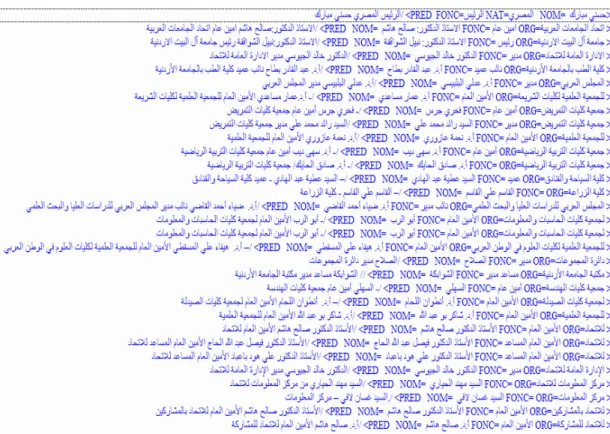
Figure 3 gives a sample execution of the proposed recognition system given by NooJ platform on the indicated corpus. It represents the recognised Relations between Person Names and ORG Named Entities with its corresponding Predicate representa-tion.
Figure 3: A sample of the concordances obtained from the test corpus
Figure 4: A sample of the concordances with their corresponding translation
The evaluation metrics we used for the recognition process, are Recall, Precision and F_measure (2*P*R/(P+R)). Let’s remember that the recall measures the quantity of relevant responses of the system compared to the ideal number of responses; Preci-sion is the number of relevant responses of the system among all the responses he gave and the F-measure is a combination of Precision and Recall for penalizing the very large inequalities between these two measures. The values obtained in the evaluation of our work are:
Precision Recall F-measure
Sports venues 63% 78% 70%
The values obtained can be explained by the fact that our dictionaries are not very large, especially for First Names and Last Names, and also by the fact that the names of organizations are very long and complex.
6. Conclusion
In this paper, we have presented a rule based approach for the extraction of functional relations between ENAMEX and ORG Arabic Named Entities. We particularly high-lighted the NE relation Discovery problems. Some of them are specific to the Arabic language. These problems have been largely resolved, but some merit special consid-eration. The approach was implemented using NooJ platform. We have also given ex-perimentation on a journalistic test corpus. The exex-perimentation and the evaluation results are satisfactory.
As perspectives, we are working on expanding the dictionaries, especially for First Names and Family Names with corresponding translations. Also, we are interested in new types of relations for the economic domain in order to recognize events. Finally we project to integrate our system in a question answering system as a component for factoid questions.
References
Agichtein E. and Gravano L. 2000. Snow-ball: Extracting Relations from Large Plain-text Collections. Proceedings of the Fifth ACM International Conference on Digital Libraries.
Ben Hamadou A., Piton O., Fehri H. 2010. Recognition and translation
Arabic-French of Named Entities: case of the Sport places, CoRR abs/1002.0481.
César P., Juan P., Isabel S., Paloma M. 2009. The UC3M team at the Knowledge Base
Population task.
Shaalan Kh. and Raza H. (2009), “NERA: Named Entity Recognition for Arabic”. Journal Of The American Society For Information Science And Technology, Vol. 60, N° 8, pp: 1652-1663, August 2009
Culotta A., Mccallum A. & Betz J. 2006. Integrating probabilistic extraction models
and data mining to discover relations and patterns in text. Human Language
Technology Conference of the North American Chapter of the Association of Computational Linguistics, Morristown, NJ, USA. +.
Culotta A. and Sorensen J. 2004. Dependency Tree Kernel for Relation Extraction. Proceeding of ACL-04.
Jun Z., Zaiqing N., Xiaojiang L., Bo Z. and Ji-Rong W. 2009. StatSnowball: a
Statistical Approach to Extracting Entity Relationships. 18th international
World Wide Web conference (WWW 2009).
Hasegawa T., Sekine S. and Grishman R. 2004. Discovering Relations among Named
Entities from Large Corpora. Proceeding of ACL-04.
Kambhatla N. 2004. Combining Lexical, Syntactic, and Semantic Features with
Maximum Entropy Models for Extracting Relations. Proceeding of ACL-04,
Poster paper.
Miller S., Fox H., Ramshaw L. and Weischedel R. 2000. A novel use of statistical
parsing to extract information from text. Proceedings of NAACL-00.
Santos D., Mamede N., Baptista J., 2010. Extraction of Family Relations between
Entities.
Silberstein M. (2005), “NooJ’s dictionaries”. Actes de la conférence internationale LTC, 2005, Poznan, Pologne.
Silberstein M. (2009), Syntactic parsing with NooJ. Proceedings of NooJ 2009, Finite State Language Engineering, Touzeur, Tunisia.
Stevenson M. 2004. An Unsupervised WordNet-based Algorithm for Relation
Extraction. Proceedings of the 4th LREC workshop "Beyond Named Entity:
Semantic Labeling for NLP tasks".
Zelenko D., Aone, C. and Richardella A. 2003. Kernel Methods for Relation