HAL Id: hal-01830905
https://hal.archives-ouvertes.fr/hal-01830905
Submitted on 5 Jul 2018
HAL is a multi-disciplinary open access
archive for the deposit and dissemination of
sci-entific research documents, whether they are
pub-lished or not. The documents may come from
teaching and research institutions in France or
abroad, or from public or private research centers.
L’archive ouverte pluridisciplinaire HAL, est
destinée au dépôt et à la diffusion de documents
scientifiques de niveau recherche, publiés ou non,
émanant des établissements d’enseignement et de
recherche français ou étrangers, des laboratoires
publics ou privés.
Categorization of B2B Service Offers: Lessons learnt
from the Silex Use case
Molka Dhouib, Catherine Faron Zucker, Andrea Tettamanzi
To cite this version:
Molka Dhouib, Catherine Faron Zucker, Andrea Tettamanzi. Categorization of B2B Service Offers:
Lessons learnt from the Silex Use case. 4ème conférence sur les Applications Pratiques de l’Intelligence
Artificielle APIA2018, Jul 2018, Nancy, France. �hal-01830905�
Categorization of B2B Service Offers: Lessons learnt from the Silex Use case
Molka Tounsi Dhouib
1 2Catherine Faron Zucker
1Andrea Tettamanzi
11
Université Côte d’Azur, Inria, CNRS, I3S, Sophia Antipolis, France
2Silex France
{dhouib, faron, tettamanzi}@i3s.unice.fr
Résumé
Dans le domaine de la recherche d’information et du traite-ment automatique du langage, la tâche de classification de textes est devenue une tâche cruciale. Dans cet article, nous partageons notre expérience de la classification de textes dans un contexte industriel et présentons une évalu-ation comparative de différents algorithmes de classifica-tion binaire et multi-label appliqués à des textes décrivant des offres de services, issus de la plateforme B2B SILEX pour la recommandation de prestataires de services. Nous montrons que dans certains cas pratiques comme celui que nous considérons, une représentation des données sous la forme de "bags of words" donne de meilleurs résultats de classification qu’une représentation réputée plus promet-teuse par "word embeddings".
Mots Clef
Catégorisation de textes, Apprentissage automatique, Sac de mots, Plongement lexical
Abstract
In the domain of Information Retrieval and Natural Lan-guage Processing, text classification has become a crucial task. In this article, we share our experience of text cate-gorization in an industrial context and we present a com-parative evaluation of binary and multi-label classification algorithms applied to texts describing service offers, in the SILEX B2B platform. We show that for some use cases like the one we consider, a traditional representation of texts by "bags of words" gives better classification results than the promising representation by "word embeddings".
Keywords
Text categorization, Machine Learning, Bag of words, Word embedding
1
Introduction
The Silex France company offers a SaaS sourcing tool for identification of the service providers that are best suited to meet the service requests expressed by companies. The Silex platform is used by more than 5000 professionals to quickly identify and exchange with B2B service providers. Silex’s ultimate aim is to provide a network of qualified
companies to service buyers combined with the best func-tionality to consult it.
In the framework of a collaborative project between Silex and the I3S research laboratory, we aim at introducing se-mantics into the B2B platform in order to enable automatic reasoning on service requests and offers and improve the recommendation of service providers.
As a first step, we are interested in automatically categoriz-ing the textual description of companies, service requests and service offers. With data’s exponential growth, text categorization has become a crucial issue in Natural Lan-guage Processing (NLP). It consists in classifying texts ac-cording to their contents, into one or more predefined cate-gories [2]. In recent years, the number of machine learning (ML) techniques that automatically generate text catego-rization has increased considerably [3].
In this paper we report some experiments we conducted to answer the Silex use case, using supervised ML tech-niques to classify Silex textual data into predefined cate-gories. Meanwhile, we addressed the following questions: (1) What is the best representation of Silex textual descrip-tions of service offers and requests to categorize it? (2) What is the best ML algorithm to categorize Silex tex-tual descriptions of service offers and requests?
This paper is organized as follows: Section 2 presents state-of-the-art text categorization methods. Section 3 in-troduces our approach of text categorization to answer the SILEX use case. Section 4 reports and discusses the results of our experiments of categorization of NL descriptions of service requests and offers. Section 5 draws some conclu-sions and directions for future work.
2
Related Works
Text categorization is the task of classifying data into a pre-defined set of categories. In other words, given a set of cat-egories and a set of textual documents, text categorization is the process of automatically finding the correct category for each document [4].
2.1
Feature Vector Models
In the text categorization process, the first step consists in preprocessing textual documents, to convert them into feature vectors, a representation that can be automatically interpreted by machine. This step includes tokenization,
stemming and removing of stop words before the creation of feature vectors.
Bag-Of-Words (BOW). is the most common feature vector model. In this model, the features are the frequen-cies of each word in the textual document. The feature space’s dimension is the number of all different words in all documents [4]. The limitation of this model is that it ignores the semantic relations between words.
Word Embedding (WE). In order to overcome the weakness of BOW, a new model called Word Embedding (WE) has been successfully used in several NLP tasks. Word embeddings are projections in a continuous space of words that preserve the semantic and syntactic similarities between them [6]. There are many models that can produce a word embedding. In the following, we introduce the most important ones.
[7] proposes Word2Vec, a popular tool that produces word embeddings based on two models: CBOW and Skip-gram. CBOW is a Neural Network and log-linear model. It re-moves the non-linear hidden layer, and projects the con-textual words on the same position. Word’s prediction is obtained according to its past and future contexts. The pro-cess consists in computing the average of the contextual word vectors and running a log-linear classifier on the av-eraged vector.
Skip-gram is similar to CBOW and is also a Neural Net-work and log-linear model. Contrary to CBOW, Skip-gram predicts the contextual words given the current word [6]. Another model was introduced by [8] and is called GloVE. This model is based on global matrix factorization that cal-culates the co-occurrence of words in the corpus [6]. Finally, FastText 1 is a library for learning word repre-sentations and sentence classification. FastText published pre-trained word vectors for 294 languages, trained on Wikipedia. These vectors with dimension 300 were ob-tained using the skip-gram model [13].
2.2
Binary classification
After the construction of feature vectors, the second step of text categorization is the learning step. We present here some of the many learning algorithms for binary classifica-tion and multi-label classificaclassifica-tion.
Naive Bayes (NB) [9]. is a supervised, probabilistic al-gorithm based on Bayes theorem and the hypothesis of the independence between features. This algorithm is power-ful due to the independence between features that ignores features’ order, and consequently, the presence of a feature does not affect other features in classification tasks [14]. Support Vector Machine (SVM) [10]. is one of the most common and successful supervised classification al-gorithm used for text classification tasks [14]. This algo-rithm transforms training data into higher dimensions and searches for linear optimal separating hyperplane [1].
1https://github.com/facebookresearch/fastText
Neural Networks (NN). The NN is composed by many layers to perform text categorization. The perceptron is the simplest kind of a neural network and it has only two lay-ers: the input nodes receive the feature values, the output nodes produce the categorization status values, and the link weights represent dependence relations. The NN text cat-egorization process starts by loading feature weights into the input nodes; the categorization’s final result is present in the output nodes after the propagation of the activation of the nodes forward through the network. The neural net-works are trained by back propagation in order to mini-mize the error. In case of misclassification, the error is propagated back through the network and modifies the link weights [15].
2.3
Multi-label classification
Multi-label classification is an approach to classification problems that allows each data point to be assigned to more than one class at the same time. There are two multi-label classification methods: (i) problem transformation and (ii) algorithm adaptation [11]. Here we describe the most pop-ular algorithms of each category.
Problem transformation. A first approach consists in transforming the multi-label problem into one or more single label classification problem. Among the methods adopting this approach, we can highlight:
• The Binary Relevance method (BR) is based on one-vs-all ensemble approach. BR transforms any multi-label problem into binary problems to predict the relevance of each label to a data point. All binary classifiers are then aggregated to form a set of relevant labels [11].
• The label PowerSet method (LP) considers the multi-label problem as a single multi-class classifica-tion problem. In order to create a transformed multi-class dataset, each combination of relevant labels is mapped to a class [11].
• The Random K-label set (RAKEL) aims at finding a better balance between BR and LP. RAKEL generates a series of label subsets and builds a label powerset model for each of them [11].
Algorithm adaptation. Algorithm adaptation extends specific algorithms to carry out multi-label classification.
• Multi-label lazy algorithm (ML-KNN) is one of the most famous adaptation algorithms. MLKNN uses the maximum a posteriori principle in addition to the K-nearest neighbour algorithm [11].
• Multi-label decision tree (ML-DT) is an extension of C4.5 decision tree algorithm. ML-DT allows the creation of multiple labels in the leaves, and chooses node splits based on a pre-defined muti-label entropy function [11].
• AdaBoost is based on the addition of simple classi-fiers to a pool and the use of their weights to define the final classification [16].
3
Experimental methodology
To answer the Silex use case, we conducted some experi-ments to compare the performance of the above described state-of-the-art feature vector models and learning algo-rithms for the categorization of textual descriptions of ser-vice offers or requests.
3.1
Dataset
Silex distributes a service to purchasing departments that support the sourcing system within the company. Silex users can describe their company (company description), their needs (service request description) and the descrip-tion of the offers provided by the company (service offer description) in Silex web application. All descriptions are written in French.
The dataset considered in our experiments comprises 3188 company descriptions, 580 service offers descriptions and 155 service requests descriptions.
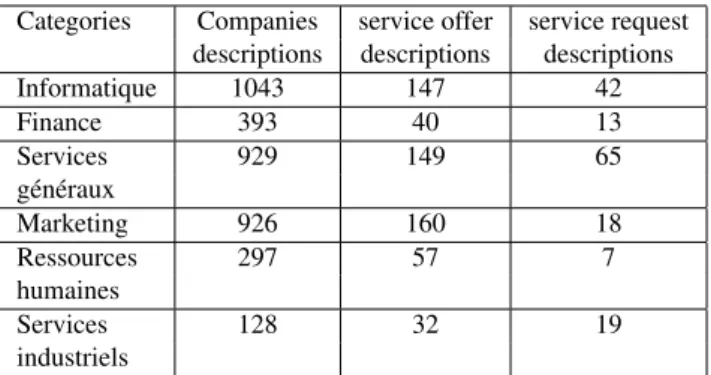
Six main categories are defined by Silex to classify these descriptions. One description can be categorized in one or more classes. The categorization phase is done manu-ally by experts in the current version of the Silex platform. Table 1 shows the distribution of all the descriptions into the different categories. We observe that the distribution of our dataset is unbalanced, for instance the Informatique (Information Technology) class has 915 more companies descriptions than the Services_industriels (Industrial Ser-vices) class.
Categories Companies service offer service request descriptions descriptions descriptions Informatique 1043 147 42 Finance 393 40 13 Services 929 149 65 généraux Marketing 926 160 18 Ressources 297 57 7 humaines Services 128 32 19 industriels
Table 1: Distribution of the textual descriptions in the cor-pus.
3.2
Implementation
In our implementation, we focused first on two methods to construct our feature vectors:
• The BOW representation is achieved by applying a traditional process of tokenization, stop words re-moval and lemmatization. Then we use the TFIDF to construct the matrix. This matrix will be used in different algorithms.
Figure 1: Building WE feature vectors representing the Silex textual descriptions from pre-trained word embed-dings
• There are two methods to obtain Word embeddings representation: (i) build word embeddings from scratch using a model like word2vec or FastText. This approach needs a very large corpus to train these word embeddings; and (ii) use a pre-trained word embed-dings in any desired language. For our case, we used the latter approach to obtain word embeddings be-cause we do not have a large enough dataset. After studying the different pre-trained word embeddings, we decided to use the FastText model because it is the only model that provides French word embeddings pre-trained on a Wikipedia dump. This word embed-ding model 2 contains 1,152,449 tokens, which are
mapped to vectors in a space with 300 dimensions. Our approach to produce the feature vectors repre-senting the SILEX textual descriptions is inspired by [12] and [17]: As illustrated in Figure 1, the first step is to convert textual descriptions to lower case and remove all French stop words. Then the words are checked against the pretrained French vector. If the word exists in the dictionary, the vector representation of description is constructed by averaging the word embeddings vectors along each dimension for all the words in the description. If the dictionary does not contains the word, the zero vector is returned:
DescriptionW ordEmbeddings =Pk
i=1 wi
k
where k is the number of words in a description and wi ∈ Rndenotes the word embeddings vector of the
ith word. The vector representation of each descrip-tion has exactly the same dimensions as the word em-beddings vector wi [17]. The vector representations
of each description are then used as features and input for each classifier.
In order to test our feature vectors, we trained two methods of categorization: (i) three binary classification algorithms (NB, SVC, RNN) and (ii) three multi-label classification algorithms: two of them are problem transformation meth-ods (Binary Relevance, Label PowerSet) and three of them are algorithm adaptation methods (Multi-label lazy algo-rithm (ML-KNN)). All these algoalgo-rithms are implemented using scikit-learn3, and executed on a machine with 8 GB of memory and an Intel Core i7-7500U CPU.
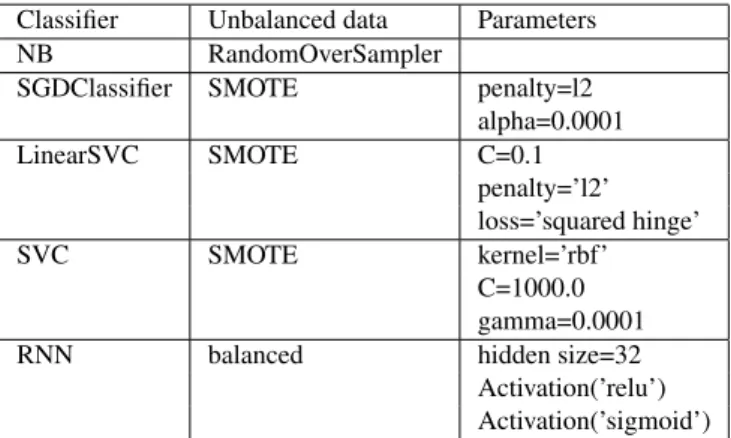
To deal with the unbalanced data, there are two main state-of-the-art approaches to adjust the distribution of dataset: (i) over-sampling adds copies of instances from the under-represented class. The most common technique of over-sampling is called Synthetic Minority Over-sampling Technique (SMOTE), (ii) under-sampling deletes instances from the over-represented class. In our implementation, we tested first a very large parameter with a grid function in scikit-learn to identify the best parameters for each classi-fier and the best method to deal with unbalanced data. We obtained the best results with SMOTE method for SVM algorithm, and RandomOverSampler method for NB. Ta-ble 2 shows all parameters used in binary classification and Table 3 shows all parameters used in multi-label classifica-tion.
Classifier Unbalanced data Parameters NB RandomOverSampler
SGDClassifier SMOTE penalty=l2 alpha=0.0001 LinearSVC SMOTE C=0.1 penalty=’l2’ loss=’squared hinge’ SVC SMOTE kernel=’rbf’ C=1000.0 gamma=0.0001 RNN balanced hidden size=32 Activation(’relu’) Activation(’sigmoid’)
Table 2: Parameters used for binary classification
Classifier multi-label methods Parameters LSVC Binary Relevance C=1, penalty=’l2’ LSVC Label Powerset C=1, penalty=’l2 MLkNN Algorithm adaptation
-Table 3: Parameters used for multi-label classification
4
Experiments and discussion
4.1
Evaluation procedure
The experiments were conducted using the 5-fold cross-validation methodology. To evaluate our experiments, we calculated the classification duration and various evalua-tion measures inspired by [18] and described in the follow-ing.
3http://scikit-learn.org/stable/
Binary algorithms. To evaluate binary classification algorithms, we used the F1 score measure, defined as the harmonic mean between precision and recall:
F 1score = N1 PN
i=1
2×|h(xi)∩yi| |h(xi)+yi|
Multi-label algorithms. To evaluate multi_labels algo-rithms we used the following metrics:
• Accuracy allows to compute the percentage of correctly predicted labels among all predicted and true labels. It is defined as follows:
Accuracy(h) = N1 PN i=1 h(xi)∩yi h(xi)∪yi
• Micro-precision is defined as the precision averaged over all the example/label pairs:
M icroprecision= PQ j=1tpj PQ j=1tpj+ PQ j=1f pj
where tpj, fpj are the number of true positives and false positive for label λj.
• Micro-recall is defined as recall averaged over all the example/label pairs: M icrorecall= PQ j=1tpj PQ j=1tpj+ PQ j=1f nj
where fnj is the number of false negatives for the label λj.
• Micro-F1 is the harmonic mean between micro-precision and micro-recall and is defined as:
M icro − F 1 = 2×microprecision×microrecall
microprecision+microrecall
• Hamming loss allows to evaluate how many times an example-label pair is misclassified. The performance is perfect when the value of this metric is equal to 0. Hamming loss is defined as
Hamming_loss(h) = N1 PN
i=1 1
Q|h(xi)∆yi|
where ∆ is the symetric difference between two sets, N is the number of examples and Q is the total number of possible class labels.
4.2
Results and Analysis
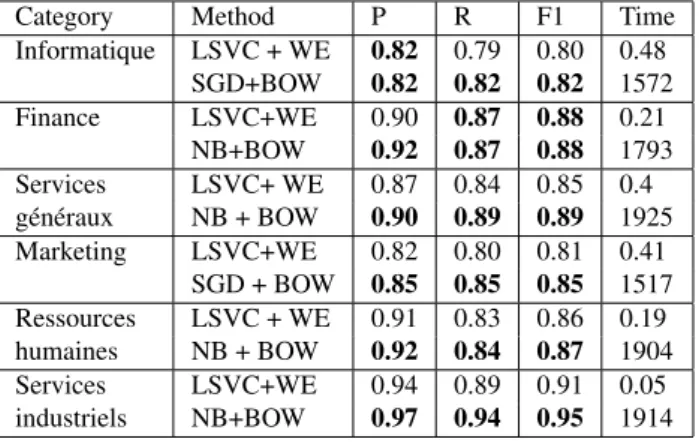
The results of binary classification algorithms reported in Table 4, Table 5 and Table 6 show that there is not a sig-nificant difference between the results with a BOW sentation and the results with a word embeddings repre-sentation. For example, for category "Informatique" , we obtain the same precision value that equals to 0.82. The recall value equals to 0.82 for BOW representation, and is a bit better compared to WE recall value that equals to 0.79. The classification processing time is much better for WE (0.48 seconds) than for BOW (1572 seconds). This is due to the BOW expansive phases of lemmatization and matrix building compared to the vector representation of word embeddings.
Table 4: Best classifier of binary classification of compa-nies descriptions
Category Method P R F1 Time Informatique LSVC + WE 0.82 0.79 0.80 0.48 SGD+BOW 0.82 0.82 0.82 1572 Finance LSVC+WE 0.90 0.87 0.88 0.21 NB+BOW 0.92 0.87 0.88 1793 Services LSVC+ WE 0.87 0.84 0.85 0.4 généraux NB + BOW 0.90 0.89 0.89 1925 Marketing LSVC+WE 0.82 0.80 0.81 0.41 SGD + BOW 0.85 0.85 0.85 1517 Ressources LSVC + WE 0.91 0.83 0.86 0.19 humaines NB + BOW 0.92 0.84 0.87 1904 Services LSVC+WE 0.94 0.89 0.91 0.05 industriels NB+BOW 0.97 0.94 0.95 1914
Table 5: Best classifier of binary classification of service offer descriptions
Category Method P R F1 Time
Informatique RNN+WE 0.80 0.78 0.79 8.53 RNN +BOW 0.78 0.78 0.78 332 Finance SVC-RBF+ WE 0.82 0.87 0.84 0.083 SGD + BOW 0.91 0.90 0.86 323 Services RNN+ WE 0.82 0.81 0.81 6.97 généraux RNN+BOW 0.79 0.79 0.79 348 Marketing SGD+WE 0.80 0.77 0.78 0.028 NB + BOW 0.90 0.90 0.90 459 Ressources RNN + WE 0.90 0.91 0.90 7.42 humaines NB + BOW 0.87 0.87 0.87 419 Services SVC-RBF+ WE 0.91 0.92 0.91 0.09 industriels SVC-RBF+BOW 0.96 0.97 0.96 347
We can draw similar conclusions when comparing multi_label classification algorithms, with a slight advan-tage to BOW compared to word embeddings in terms of accuracy and hamming_loss but not in term of time. If we compare binary classification and multi_label classi-fication algorithms, we can see that the results of the first alogrithm are better than the second one. These results are as expected because first we don’t have a very large corpus, and second when we use a binary classification we can play
Table 6: Best classifier of binary classification of service request descriptions
Category Method P R F1 Time Informatique NB +WE 0.82 0.77 0.79 0.006 NB+ BOW 0.79 0.74 0.76 101.31 Finance RNN +WE 0.97 0.48 0.62 2.44 LSVC + BOW 0.94 0.94 0.92 84.82 Services NB+ WE 0.74 0.74 0.74 0.006 généraux NB + BOW 0.74 0.74 0.74 103.49 Marketing RNN + WE 0.73 0.77 0.74 2.74 NB +BOW 0.89 0.81 0.84 104.10 Ressources NB+ WE 0.88 0.94 0.90 0.006 Humaines BOW - - - -Services RNN + WE 0.91 0.90 0.88 2.62 industriels LSVC+BOW 0.94 0.94 0.94 79.07
Table 7: Best classifier of multi_label classifications.
Classifier Feature Micro- Accuracy Hamming Time
F1 loss MLKNN WE 0.66 0.53 0.12 7.00 BOW 0.72 0.57 0.10 1945 BR WE 0.61 0.35 0.17 6.54 BOW 0.73 0.52 0.10 1850 Label WE 0.54 0.39 0.19 9.44 Powerser BOW 0.69 0.51 0.13 1945
on the classifier parameters for each category to enhance its performance, which is not the case for multi_label classi-fication. The different binary classification algorithms per-form more or less well in categorizing our dataset using the same representation. For example, only the LSVC al-gorithm categorized correctly this text as "informatique" "Ascot accompagne les dirigeants et cadres de PME dans la définition, la maitrise et le suivi de leur transforma-tion numérique. Plus aucune organisatransforma-tion ne peut ignorer l’impact global sur son métier, ses outils et ses processus. Notre expérience, de plus de 20 ans, en Conseil, Assistance technique, Développement, Ingénierie, ... est entièrement dédié à nos clients. Sous contrat ou à la carte, nos presta-tions leur apportent valeur et sérénité.".
We obtained also different results when comparing the BOW and WE representations. For example, using the same LinearSVC algorithm, this text "Agence WebMar-keting 360 de nouvelle génération exploitant de nom-breux leviers marketing pour optimiser vos campagnes dig-itales & booster votre chiffre d’affaires Kalipseo développe pour vous les stratégies digitales les plus pertinentes et s’emploie à promouvoir l’image de votre marque." was wrongly categorized as "Informatique" when using the WE representation, but the categorization was right when using BOW representation.
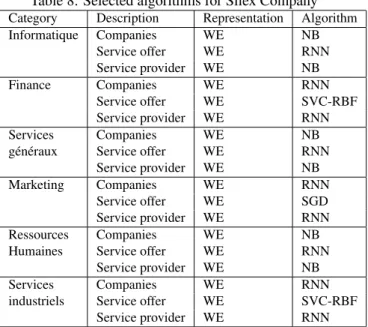
As a conclusion, to best answer the Silex use case, we de-cided to use a binary classification algorithm with a word embedding representation. Table 8 shows the algorithms that are selected to classify each category of Silex data.
Table 8: Selected algorithms for Silex Company
Category Description Representation Algorithm Informatique Companies WE NB Service offer WE RNN Service provider WE NB Finance Companies WE RNN Service offer WE SVC-RBF Service provider WE RNN Services Companies WE NB
généraux Service offer WE RNN Service provider WE NB Marketing Companies WE RNN
Service offer WE SGD Service provider WE RNN Ressources Companies WE NB Humaines Service offer WE RNN
Service provider WE NB Services Companies WE RNN industriels Service offer WE SVC-RBF
Service provider WE RNN
5
Conclusion
In this paper we reported the results of the experimental evaluations of various vector feature models and machine learning algorithms conducted to answer the real-world use case of the Silex company: how to categorize textual de-scriptions of service offers and requests with the ultimate goal of recommending service providers that better answer services requests. We compared the two main state-of-the-art feature vector models. A BOW representation is a bit better than a WE representation regarding the evaluation measures. This is due to the use of a generic pre-trained vector for WE descriptions, that is based on Wikipedia dump and that does not cover well our data set. On the other hand, a WE representation has the advantage of be-ing less time consumbe-ing because of the additional lemma-tization and matrix building phases specific to the BOW representation. Based on these results, we choose to use classifiers with word embeddings data for Silex company as shown in Table 8.
As future work, we aim to define a specific B2B pre-trained vector that best covers the Silex dataset instead of using a general reference like Wikipedia. We also aim to study a combined approach based on both word embeddings and knowledge engineering approaches. The objective is to im-prove the representation of texts by introducing semantics to increase the performance of algorithms. To achieve this, we are going to use our built ontologies to represent the sourcing domain, and we are going to enrich the original texts with additional information based on semantics rela-tions between concepts such as generalization or specifica-tion.
6
Aknowledgement
This work is supported by the ANRT, CIFRE I3S-SILEX 2016/0947
References
[1] Patra, Anuradha and Singh, Divaka A survey report on text classification with different term weighing meth-ods and comparison between classification algorithms International Journal of Computer Applications, vol-ume.75, pp.7,2013,Foundation of Computer Science. [2] Sadiq, Ahmed T and Abdullah, Sura Mahmood,
Hy-brid intelligent technique for text categorization Ad-vanced Computer Science Applications and Tech-nologies (ACSAT), 2012 International Conference on, pp.238-245,2012,IEEE.
[3] Tan, Ah-Hwee and Lai, Fon-Lin, Text categorization, supervised learning, and domain knowledge integra-tion To appear, proceedings, KDD-2000 Internaintegra-tional Workshop on Text Mining, Boston, Vol.20,2000. [4] Feldman, Ronen and Sanger, James,The text mining
handbook: advanced approaches in analyzing unstruc-tured data,2007,Cambridge university press.
[5] Sriram, Bharath and Fuhry, Dave and Demir, Engin and Ferhatosmanoglu, Hakan and Demirbas, Murat, Short text classification in twitter to improve infor-mation filtering, Proceedings of the 33rd international ACM SIGIR conference on Research and development in information retrieval,pp.841–842, 2010, ACM [6] Ghannay, Sahar and Favre, Benoit and Esteve, Yannick
and Camelin, Nathalie, Word Embedding Evaluation and Combination,LREC,2016
[7] Mikolov, Tomas and Chen, Kai and Corrado, Greg and Dean, Jeffrey,Efficient estimation of word representa-tions in vector space,arXiv preprint arXiv:1301.3781, 2013
[8] Pennington, Jeffrey and Socher, Richard and Man-ning, Christopher,Glove: Global vectors for word rep-resentation,Proceedings of the 2014 conference on empirical methods in natural language processing (EMNLP),pp.1532-1543,2014
[9] Schneider, Karl-Michael, Techniques for improving the performance of naive bayes for text classification, Computational Linguistics and Intelligent Text Pro-cessing, pp.682-693, 2005,Springer
[10] Cortes, Corinna and Vapnik, Vladimir,Support-vector networks, Machine learning, Vol.20,3,pp.273-297,1995,Springer
[11] Pakrashi, Arjun and Greene, Derek and MacNamee, Brian,Benchmarking Multi-label Classification Algo-rithms,24th Irish Conference on Artificial Intelligence and Cognitive Science (AICS’16), Dublin, Ireland, 20-21 September 2016,2016, CEUR Workshop Proceed-ings
[12] Bayot, Roy and Gonçalves, Teresa,Author Profiling using SVMs and Word Embedding Averagesâ ˘Aˇ TNote-book for PAN at CLEF 2016,2016,CEUR
[13] Bojanowski, Piotr and Grave, Edouard and Joulin, Armand and Mikolov, Tomas,Enriching Word Vec-tors with Subword Information, arXiv preprint arXiv:1607.04606,2016
[14] Mohare, Punam Kishor Itkar, A, A Survey on Different Types of Approaches to Text Categoriza-tion,V5,nternational Journal of Emerging Trends & Technology in Computer Science
[15] Bassil, Youssef, A Survey on Information Retrieval, Text Categorization, and Web Crawling,rXiv preprint arXiv:1212.2065,2012
[16] Benbouzid, Djalel and Busa-Fekete, Róbert and Casagrande, Norman and Collin, François-David and Kégl, Balázs,MultiBoost: a multi-purpose boosting package,V.13,pp.549-553,Journal of Machine Learn-ing Research,2012
[17] Yang, Xiao and Macdonald, Craig and Ounis, Iadh,Using word embeddings in twitter election clas-sification,arXiv preprint arXiv:1606.07006,2016 [18] El Kafrawy, Passent and Mausad, Amr and
Es-mail, Heba,Experimental comparison of methods for multi-label classification in different application do-mains,V.114, N.19,Foundation of Computer Science, International Journal of Computer Applications,2015 [19] Sokolova, Marina and Japkowicz, Nathalie and
Sz-pakowicz, Stan,Beyond accuracy, F-score and ROC: a family of discriminant measures for performance evaluation,V.4304, pp.1015-1021,Australian confer-ence on artificial intelligconfer-ence,2006