HAL Id: hal-01988054
https://hal.archives-ouvertes.fr/hal-01988054
Submitted on 21 Jan 2019
HAL is a multi-disciplinary open access archive for the deposit and dissemination of sci-entific research documents, whether they are pub-lished or not. The documents may come from teaching and research institutions in France or abroad, or from public or private research centers.
L’archive ouverte pluridisciplinaire HAL, est destinée au dépôt et à la diffusion de documents scientifiques de niveau recherche, publiés ou non, émanant des établissements d’enseignement et de recherche français ou étrangers, des laboratoires publics ou privés.
Prokaryotic responses to hydrostatic pressure in the
ocean - a review
Christian Tamburini, Mehdi Boutrif, Marc Garel, Rita Colwell, Jody Deming
To cite this version:
Christian Tamburini, Mehdi Boutrif, Marc Garel, Rita Colwell, Jody Deming. Prokaryotic responses to hydrostatic pressure in the ocean - a review. Environmental Microbiology, Society for Applied Microbiology and Wiley-Blackwell, 2013, 15 (5), pp.1262-1274. �10.1111/1462-2920.12084�. �hal-01988054�
1
Prokaryotic responses to hydrostatic pressure in the ocean – a
review
Christian Tamburini1*, Mehdi Boutrif1, Marc Garel1, Rita R. Colwell2 & Jody W. Deming3
1
Aix-Marseille University, Mediterranean Institute of Oceanography (MIO), 13288, Marseille, Cedex 9, France; Université du Sud Toulon-Var, 83957, La Garde Cedex, France CNRS-INSU/IRD UM 110
10
2
University of Maryland, College Park and the Johns Hopkins University Bloomberg School of Public Health, University of Maryland Institute for Advanced Computer Studies, University of Maryland, College Park, Maryland 20742, USA
3
School of Oceanography, University of Washington, Campus Box 357940 Seattle, WA 98195-7940, USA
*Corresponding author: [email protected]
Keywords: Hydrostatic pressure, Deep-sea prokaryotes 20
Submission date: September 22th, 2012 Re-submission date: October 30th, 2012 Revised manuscript sent: December 30th, 2012
2
Summary
30
Effects of hydrostatic pressure on pure cultures of prokaryotes have been studied extensively but impacts at the community level in the ocean are less well defined. Here we consider hydrostatic pressure effects on natural communities containing both unadapted (piezosensitive) prokaryotes originating from surface water and adapted (including piezophilic) prokaryotes from the deep sea. Results from experiments mimicking pressure changes experienced by particle-associated prokaryotes during their descent through the water column show that rates of degradation of organic matter (OM) by surface-originating microorganisms decrease with sinking. Analysis of a much larger data set shows that, under stratified conditions, deep-sea communities adapt to in situ conditions of high pressure, low temperature and low OM. Measurements made using decompressed samples and atmospheric pressure thus underestimate 40
in situ activity. Exceptions leading to overestimates can be attributed to deep mixing events, large
influxes of surface particles, or provision of excessive OM during experimentation. The sediment-water interface, where sinking particles accumulate, will be populated by a mixture of piezosensitive, piezotolerant and piezophilic prokaryotes, with piezophilic activity prevailing deeper within sediment. A schematic representation of how pressure shapes prokaryotic communities in the ocean is provided, allowing a reasonably accurate interpretation of the available activity measurements.
3
Introduction
50
Hydrostatic pressure influences the physiology of organisms living at depth in the ocean, the most extensive habitat of the biosphere in terms of volume (1.3 x 10¹⁸ m3) (Whitman et al., 1998). The realm below 200 m, the dark ocean, is characterized not only by permanent darkness (insufficient light to support photosynthesis) but also by cold temperature (except for the Mediterranean, Red, and Sulu Seas), high inorganic nutrients, and low organic carbon concentration. Lauro and Bartlett (2007) described this physically uniform environment as being occasionally interrupted by outbursts of activity at sites of hydrothermal vents (Prieur et al., 1995), whale falls (Smith et al., 2003), cold seeps (Elvert et al., 2000), and deep hypersaline anoxic basins (van der Wielen et al., 2005; Daffonchio et al., 2006). In this review, organic 60
aggregates and other anomalies in the water column are shown to have the capacity to interrupt this uniformity.
In the 1840s, the azoic-zone theory of Edwards Forbes prevailed, thus making presence of viable microorganisms in deep ocean water and sediment one of the first important discoveries in marine microbiology (Certes, 1884). ZoBell and Johnson (1949) began studies of the effect of hydrostatic pressure on microbial activity using pure cultures. “Barophilic” was the first term used to define optimal growth at a pressure higher than 0.1 MPa or for a requirement for increased pressure for growth (ZoBell and Johnson, 1949), but was subsequently replaced by Yayanos (1995), who suggested "piezophilic" (from the Greek “piezo”, meaning pressure). Current terminology (reviewed by Fang et al. 2010 and Kato 2011) defines pressure-adapted 70
microorganisms either as piezotolerant (similar growth rate at atmospheric pressure and high pressure), piezophilic (more rapid growth at high pressure than atmospheric pressure), or
4 hyperpiezophilic (growth only at high pressure), with pressure maxima increasing in rank order (highest for hyperpiezophiles). Organisms that grow best at atmospheric pressure, with little to no growth at increased pressure, are termed piezosensitive.
Pressure-adapted microorganisms have been isolated from many deep-sea sites by researchers around the world. Isolates include representatives of the Archaea (both Euryarchaea and
Crenarchaea kingdoms) mainly from sea hydrothermal vents, and Bacteria from cold,
deep-sea habitats. Most of the bacterial piezophiles have been identified as belonging to the genera
Carnobacterium, Colwellia, Desulfovibrio, Marinitoga, Moritella, Photobacterium,
80
Pyschromonas, and Shewanella (reviewed by Bartlett et al., 2007). The membrane properties of
piezophiles have been described and other characteristics of piezophiles, including motility, nutrient transport, and DNA replication and translation under elevated hydrostatic pressure, have been explored (Lauro et al., 2008). Protein structural adaptation to high pressure has also been described in comparative studies of piezophilic and piezosensitive microorganisms (Kato et al., 2008).
Although the deep ocean supports a diversity of prokaryotes with functional attributes interpreted as adaptation to a pressurized environment (Lauro and Bartlett, 2007; Nagata et al., 2010), the contribution of the natural microbial assemblages to the carbon cycle of the biosphere remains poorly understood. Recent reviews (Arístegui et al., 2009; Nagata et al., 2010; Robinson 90
et al., 2010) strongly suggest reconsidering the role of microorganisms in mineralizing organic matter in the deep pelagic ocean.
The deep-sea microbial food web is essentially dependent on particulate organic carbon (POC) flux from primary production in the euphotic zone, i.e., sunlit surface waters (Nagata et al., 2010). Recent discoveries challenge the paradigm that cycling of organic matter is slow in the
5 deep sea and mediated by microbial food webs of static structure and function. Data showing spatial variation in prokaryotic abundance and activity support the hypothesis that deep-sea microorganisms respond dynamically to variations in organic matter input to the bathypelagic realm (Nagata et al., 2010). About 30% and 19% of the water column-integrated prokaryotic heterotrophic production occurs in meso- and bathypelagic water, respectively, meaning that 100
almost half of the total water column heterotrophic prokaryotic production takes place below the epipelagic layer (Arístegui et al., 2009). Over time, the deep ocean presumably exists in a steady state, with sources and sinks balanced. Recently compiled global budgets and intensive local field data suggest that the estimate of metabolic activity in the dark pelagic ocean exceeds the input of organic carbon (Burd et al., 2010). This imbalance indicates both existence of unaccounted sources of organic carbon (slowly degradable organic carbon, suspended organic matter, and de
novo organic matter produced by dark CO2 fixation) and overestimation of metabolic activity in
the dark ocean. Budgets based on organic carbon flux and metabolic activity in the dark ocean are fraught with uncertainties, including environmental variability, measurement reliability, conversion accuracy, and insufficient sampling or estimation of key processes (Arístegui et al., 110
2009; Burd et al., 2010). In fact, rates of heterotrophic, prokaryotic biomass production and respiration are based on a relatively small data set and in many cases determined under atmospheric (sea surface) pressure.
Initial estimates of deep-sea microbial activity under elevated pressure were based on the unintentional experiment involving the "sandwich in the lunchbox" from the sunken research submarine Alvin, “incubated” in situ more than 10 months at 1540 m depth in the Atlantic Ocean (Jannasch et al., 1971). According to Jannasch et al. (1971), the crew’s lunch was recovered and “from general appearance, taste, smell, consistency, and preliminary biological and biochemical
6 assays, [...] was strikingly well preserved.” Based on subsequent studies carried out employing in
situ conditions of high pressure and low temperature, the Jannasch team concluded that deep-sea
120
microorganisms were relatively inactive under in situ pressure and not adapted to high pressure and low temperature. However, Jannasch and Taylor (1984) offered the caveat that the type of substrate influenced the results and concluded, from laboratory experiments, that “barophilic growth characteristics have been unequivocally demonstrated”. These early observations of deep-sea microbial activity were accompanied by development of pressure-retaining water samplers, with the conclusion from results of experiments employing these samplers that "elevated pressure decreases rates of growth and metabolism of natural microbial populations collected from surface waters as well as from the deep sea" (Jannasch and Wirsen, 1973). Contrary to this early conclusion, virtually all subsequently collected data from the water column under in situ conditions have shown that the situation is the reverse, namely those microorganisms 130
autochthonous to depth are adapted to both the high pressure and low temperature of their environment.
In this review, we address the important point of microbial activity in the dark ocean and clarify the effect of hydrostatic pressure, focusing on origin of prokaryotes, i.e., surface-derived
versus autochthonous deep-sea prokaryotes, and stratified versus mixed water conditions. We
consider hydrostatic pressure effects in both the mesopelagic (depth range of 200–1000 m) and bathypelagic (1000–4000 m) realms and focus on results of experiments mimicking changes in pressure that prokaryotic communities experience in the water column when attached to sinking particles, during mixing, or undergoing deep-water convection. We also discuss results of in situ research whereby pressure (and temperature) of the deep sea are employed to evaluate adaptation 140
7 literature, according to pressure during incubation, rather than absolute rates, we aim to inform experimental design and the achievement of more accurate estimates of microbial activity in the deep ocean.
Pressure effects on particle-attached prokaryotes sinking through
the water column
Biogenic aggregates (> 500 µm in diameter), including marine snow and fast-sinking fecal pellets of large migrating macrozooplankton, constitute the majority of vertical particle flux to 150
the deep ocean (Fowler and Knauer, 1986; Bochdansky et al., 2010). These aggregates can transport large numbers of attached prokaryotes to great depth (Turley and Mackie, 1995); e.g., 1.7 x 10¹⁰ bacteria g–1 fecal pellet at 4715 m (Deming, 1985). Enzymatic dissolution and mineralization of particulate organic matter (POM) by attached prokaryotes during descent can provide important carbon sources for free-living prokaryotes, thereby playing important biogeochemical roles in mesopelagic and bathypelagic carbon cycling (Cho and Azam, 1988; Smith et al., 1992; Turley and Mackie, 1994; Turley and Mackie, 1995). Attached prokaryotes, however, tend to comprise a small fraction (5%) of the total prokaryotic biomass (Cho and Azam, 1988), reaching somewhat higher proportions (10–34%) only when the concentration of aggregates is high (Turley and Mackie, 1995). Prokaryotic detachment from particles during 160
rapid descent through the dark ocean would represent only a weak contribution to total prokaryotic biomass in deep waters (Turley and Mackie, 1994).
The extent to which sinking particles contribute to microbial community structure in the deep sea remains an open question. Relatively little information on phylogenetic diversity of
particle-8 associated and free-living microorganisms is available. Early phylogenetic analyses of particle-attached versus free-living prokaryotic assemblages in shallow waters revealed distinct communities associated with the two environments (DeLong et al., 1993; Crump et al., 1999). Results of molecular fingerprinting of microorganisms present in deeper mesopelagic water samples supported the ‘generalist’ hypothesis, in which a sizeable proportion of similar ‘operational taxonomic units’ are shared between both the attached and free-living fractions 170
(Hollibaugh et al., 2000; Moeseneder et al., 2001; Ghiglione et al., 2007). Recent results obtained from a few samples collected at 6000 m (in the Puerto Rico Trench), however, suggest that exchange between the particles and surrounding water is limited. Indeed species richness estimates for Bacteria (though not Archaea) were much greater in the particle-associated fraction than the free-living fraction, including significant compositional differences (Eloe et al., 2011). The extent to which particle-associated prokaryotes contribute to structure of the surrounding community is a function of particle residence time (Kellogg and Deming, 2009), which can be expected to increase when there are mixing anomalies or in the benthic boundary layer of the deep sea.
In the early work on heterotrophic microbial activity associated with particulate matter in the 180
deep sea, comparative responses to moderate (surface water) versus extreme (abyssal) temperatures and pressures were used to diagnose prokaryotic origin (Deming, 1985). Samples of sinking particulates, fecal pellets, and deposited sediments were collected in bottom-moored sediment traps and boxcores at station depths of 1850, 4120, and 4715 m in the North Atlantic and incubated for 2 to 7 days under both surface water and simulated deep-sea conditions (the latter in sterile syringes in pressure vessels at 3°C). In most cases, shallow water microbial activity was essentially predominant in sediment trap samples. However, microbial activity
9 associated with fecal pellets was increasingly piezophilic with increasing depth. In deposited sediments, the microbial response was always piezophilic. These results suggested that sinking POM, prior to burial in abyssal sediments, is altered by deep-sea pressure adapted prokaryotes, 190
some of which are capable of surprisingly rapid activity at low temperature and elevated pressure (Deming, 1985).
To better understand the metabolic capacity of prokaryotes of shallow-water origin, that are carried below the euphotic zone on sinking particles, to degrade organic matter in the deep sea, different approaches proved informative. Turley (1993) applied increasing pressure to collections of sinking particles, obtained by trapping for 48 h at 200 m depth and containing microbial assemblages. These samples were placed in sealed bags incubated in pressure vessels at 5°C. Pressures of 0.1, 10, 20, 30 and 43 MPa were applied in step function (within 30 min, then maintained constant for 4 h), to simulate pressure at the deep sediment-water interface. Seawater samples collected at depths of 10 and 40 m were incubated under similar conditions, with 200
microbial activity of both the seawater and sediment trap samples analyzed using leucine and thymidine incorporation. Results indicated that DNA and protein synthesis carried out by both free-living and particle-associated bacteria were significantly adversely affected by pressure (without loss in cell number). On the time scale employed in these experiments, it can be concluded that particle-associated bacteria from shallow water are unlikely to have a significant impact on degradation in the bathypelagic zone. In that zone, the activity of pressure-adapted bacteria, whether piezophilic or piezotolerant, are likely to have the greatest impact. Nevertheless, the observations of Turley (1993) help explain how labile organic matter associated with sinking particles can reach the seafloor with minimal degradation. This is consistent with the conclusion of Deming (1985) that degradation near and within the seabed is carried out by 210
10 pressure-adapted microorganisms. Both studies underscore pressure as an important factor constraining deep-sea carbon cycling that is not adequately appreciated.
To simulate more accurately the increase in pressure (and decrease in temperature) prokaryotes associated with particles experience in sinking to depth, Tamburini et al. (2009b) created a PArticulate Sinking Simulator (PASS) system. High-pressure bottles (HPBs) were used to incubate samples while pressure was increased continuously (linearly) by means of a piloted pressure generator. The HPBs were rotated (semi-revolution) to maintain particles in suspension during incubation in water baths reproducing temperature changes with depth. The PASS system can be used in the laboratory or at sea, depending on samples being analyzed and objectives of the study. Tamburini et al. (2006, 2009b) focused on prokaryotic processes and particle 220
degradation in the mesopelagic zone, at the time just after particles exit the euphotic zone and before they arrive on the deep sea floor, employing a realistic settling velocity. The first such experiments used diatom detritus (Thalassiosira weisflogii) as particle source and was based on the experimental design of Bidle and Azam (1999, 2001) and Bidle et al. (2002, 2003), but modified to allow analysis of pressure effects on dissolution of biogenic silica and associated prokaryotic assemblages during simulated particle fall at a sinking rate of 150 m d-1 over eight days. The results indicated significantly lower (nearly 5-fold) aminopeptidase activity with increasing pressure, compared to constant atmospheric pressure which, in turn, limited biogenic silica dissolution to a simulated depth of 800 m (Tamburini et al., 2006). Although the rates decreased, in keeping with Turley (1993), phylogeny of the prokaryotic assemblages changed 230
little during this simulated sinking event.
In another set of PASS experiments, using freshly recovered particulate matter, the change under in situ hydrostatic pressure that particles experience when sinking (200 m d-1) from
11 mesopelagic to bathypelagic depths was simulated. The concentration (normalized to POC) of particulate chloropigment, carbohydrate and transparent exopolymer particles decreased both under increasing pressure and at atmospheric pressure. However, less degradation occurred under increasing pressure. Dissolved carbohydrate (normalized to DOC) increased under both sets of conditions, but more so under atmospheric pressure. In any case, these results indicate production by microorganisms associated with the particulate fraction. Particulate wax/steryl esters (normalized to POC) increased only under pressure, suggesting metabolic response of the 240
prokaryotes to increasing pressure. After incubation, Bacteria dominated (~ 90%) the prokaryotic community, with Gammaproteobacteria comprising the largest fraction, followed by Cytophaga–
Flavobacter-Bacteroides and Alphaproteobacteria. Tamburini et al. (2009b) hypothesized that Cytophaga-Flavobacter-Bacteroides are more sensitive to elevated pressure, hydrolyzing less
particulate carbohydrate and thereby limiting the dissolved carbohydrate available to metabolism by Alphaproteobacteria and explaining the lower abundance of these organisms under increasing pressure. The Archaea played a less significant role in degradation of particulate organic matter (Bidle and Azam, 2001; Simon et al., 2002; Tamburini et al., 2006), and they did not increase in number on the particles in surface water (Simon et al., 2002). Exceptions have been observed in river-impacted seas, where nepheloid (particle-rich) layers advecting offshore contained elevated 250
concentrations of Archaea (Wells and Deming, 2003) and aggregates supported archaeal communities phylogenetically distinct from their free-living counterparts (Kellogg and Deming, 2009). PASS experiments have also shown that detritus-associated Archaea will decrease rapidly upon pressurization (Tamburini et al., 2006), suggesting that the large number of free-living Archaea in the deep sea (DeLong et al., 1999; Karner et al., 2001; Church et al., 2003; Teira et al., 2004; Herndl et al., 2005; Tamburini et al., 2009a) is not explained by vertical transport of
12 sinking particles. Again using the PASS system, Tamburini et al. (2006, 2009b) obtained chemical and microbial evidence that OM degradation by prokaryotes associated with particulate material sinking through mesopelagic waters is limited by increasing pressure.
An approach to measuring pressure-induced microbial succession on sinking particles was 260
developed by Grossart and Gust (2009). They used a computer-controlled pressure system in the laboratory to simulate sinking at 1000 m d-1, i.e.,from surface to 4000 m in an isothermal ocean. Instead of natural communities, they tracked a mixture of five bacterial strains, isolated from aggregates in surface water and belonging to different taxa [Cytophaga, Gammaproteobacteria,
Bacillus, Alphaproteobacteria (non-Roseobacter and Roseobacter)]. These results must be
interpreted with caution, because the cultures and system were artificially enriched (Marine Broth) and incubation was conducted at a constant temperature of 20.5°C even as pressure was increased (an unrealistic ocean). Nevertheless, the approach itself is promising as a method for monitoring microbial community response to pressure, especially since some strains (Bacteroides and Bacillus) were reported to grow only at moderate pressures, i.e., up to 15 MPa, while others 270
(non-Roseobacter and Gammaproteobacteria) grew at pressure of at least 40 MPa, suggesting pressure-induced succession may occur.
The origin, i.e., surface versus depth, and role of prokaryotes in the deep sea were recently addressed by Egan et al. (2012) using seawater samples collected from a depth of 3170 m in the NE Atlantic Ocean. Shifts in bacterial community structure were evaluated according to incubation pressure (atmospheric versus 31 MPa), using in situ deep-sea temperature (4°C) and the same artificial nutrient enrichment in each case. The behavior (fitness) of individual community members (Operational Taxonomic Units: OTUs) was determined before and after incubation for one month using denaturing gel gradient electrophoresis (DGGE) of the 16S rRNA
13 gene (rDNA). Of the resulting sequenced DGGE bands, 70% scored as OTUs favored by one set 280
of conditions or another (atmospheric or in situ pressure). Six of the OTUs were classified as autochthonous, i.e., adapted to in situ pressure. Nine of the OTUs were concluded to be surface-derived allochthonous microorganisms (not adapted or native to deep-sea conditions).
Gammaproteobacteria and, to a lesser extent, Cytophaga–Flavobacterium–Bacteroides and Deltaproteobacteria sequences dominated regardless of treatment. The results of Egan et al.
(2012) provide useful phylogenetic data that support the hypothesis developed over the past several decades (Deming, 1985; Turley, 1993; Tamburini et al., 2009b) that surface-derived Bacteria reach the deep sea but most of the carbon cycling in the deep sea is accomplished at depth by pressure-adapted and/or piezophilic microorganisms. Archaea, which represent a significant fraction of prokaryotic communities of the deep ocean (Karner et al., 2001; Church et 290
al., 2003; Teira et al., 2004; Herndl et al., 2005; Tamburini et al., 2009a), have not been similarly studied.
In summary, the effect of pressure on surface-derived Bacteria attached to sinking organic matter is that their contribution to decomposition and dissolution of organic matter decreases with depth. This reinforces the conclusion that rapidly settling particles are less degraded during passage through the mesopelagic water column and, therefore, this phenomenon results in a labile food supply for bathypelagic and epibenthic communities (Honjo et al., 1982; Turley, 1993; Wakeham and Lee, 1993; Goutx et al., 2007). It also fits the results of in situ experimentation (Witte et al., 2003) and the calculation of recently proposed models (Rowe and Deming, 2011) that show effective competition between metazoa and microorganisms for resources reaching the 300
14
Comparative effects of in situ high versus low pressure on deep-sea
prokaryotic communities
Microbiology of the deep realm is limited by both the expense of the equipment and time involved in sampling remote parts of the ocean. Remotely operated vehicles (ROVs) and human occupied submersibles have provided an extraordinary capability for deep-sea microbiology but, for the most part, have been employed to investigate hydrothermal vents, with stunning success. Nevertheless, most marine microbiologists do not have access either to an ROV or submersible, 310
or even to pressure-retaining samplers. Thus, decompressed samples brought on board oceanographic ships are subjected to rapid recompression in order to reinstitute in situ conditions. Stainless steel pressure vessels are most commonly employed (reviewed by Deming, 2007). This method has been used to study sediment samples or samples collected at the sediment-water interface (see Table S1), as well as to isolate piezophilic deep-sea strains and bring them into culture. When temperature is held stable after collection, many bacterial isolates can survive and adjust to less drastic changes in pressure (ZoBell, 1970; Deming, 1993). Yayanos and DeLong (1987) and Deming et al. (1988) showed that the rate of cell division of obligatory piezophilic bacterial strains cultivated under copiotrophic conditions is not altered by repeated (brief) compression-decompression sequences. However, Bianchi and Garcin (1993) showed that, under 320
oligotrophic conditions, the metabolic rate of deep-water microbial populations that have been decompressed during retrieval and then recompressed is clearly lower than that of their undecompressed counterparts. The effect of successive pressure shock on the metabolic rate of natural microbial populations has yet to be fully described.
A limited number of high-pressure vessels have been constructed during the past 50 years to measure microbial activity in the cold deep ocean and evaluate the effects of hydrostatic pressure,
15 as well as decompression, on deep-sea microbial activity. Sterilizable pressure-retaining samplers for retrieving and sub-sampling undecompressed deep-sea water samples have been developed independently by three laboratories including Jannasch/Wirsen at the Woods Hole Oceanographic Institution (USA), Colwell/Tabor/Deming at the University of Maryland (USA), 330
and Bianchi at the Aix-Marseille University (Marseille, France) (Jannasch and Wirsen, 1973; Jannasch et al., 1973; Tabor and Colwell, 1976; Jannasch and Wirsen, 1977; Deming et al., 1980; Bianchi and Garcin, 1993; Bianchi et al., 1999a; Tholosan et al., 1999; Tamburini et al., 2003). Extensive sampling equipment for cold deep-sea high pressure work has also been developed by Horikoshi and his team (Jamstec, Japan) exclusively devoted to recovering new piezophilic microorganisms and to study the effect of pressure on those isolates, as described in the Extremophiles Handbook (Horikoshi, 2011). At least two other groups are developing pressure-retaining samplers, the Royal Netherlands Institute for Sea Research (NIOZ) and the National University of Ireland (Galway), but the designs or initial results have not yet been published.
To evaluate the state of the field of piezomicrobiology, we have compiled data from published 340
studies of deep samples where prokaryotic activities were measured under conditions of in situ pressure and the results compared with those obtained using incubation at atmospheric pressure after decompression (Table S1). Sampling site, depth at which samples were collected, nature and concentration of substrate, incubation time, metabolic process studied (assimilation and respiration of monomers – or more complex substrates, prokaryotic heterotrophic production, and ectoenzymatic activity), and activity values obtained under elevated (in situ) pressure (HP), with the decompressed (DEC) sample aliquot incubated at atmospheric pressure. Samples are identified according to hydrological conditions (e.g., mixed water versus stratified water). Some samples were collected at sites where swarms of fecal pellets from migrating zooplankton were
16 present. Other samples collected from near bottom water, sediment contact water, and different 350
strata within sediment samples are also listed. We have calculated, when feasible, the pressure effect (Pe), defined as the ratio between activity obtained under HP and that obtained under DEC conditions (Pe = HP/DEC), where a ratio > 1 indicates piezophily (adaptation to high pressure) and a ratio < 1, piezosensitivity. The literature citation for each value is given. Finally, to serve as comparative or “negative” controls, we assembled published data on microbial rates determined in shallow water samples (≤ 200 m), incubated at both atmospheric and deep-sea pressure (Table S2), and calculated the associated Pe values (Pe = HP/ATM).
As stated above, the first report of deep-sea microbial activity measured without change from the in situ pressure was published by Jannasch and Wirsen (1973), who concluded that elevated pressure causes a decrease in rate of growth and metabolism of natural microbial populations 360
collected from both surface water and the deep sea. As pointed out earlier, this conclusion has not stood the test of time, based on data in the literature and calculation of Pe values as shown in Table S1. Of the total Pe values calculated (n = 252), the majority (76%) were greater than 1, indicating some form of adapting to pressure. Piezosensitivity or pressure inhibition (n = 60 for Pe < 1) was indicated in approximately 40% of the samples for which data were generated in the early work of Jannasch’s laboratory. Labeled substrates were added to samples collected at the sediment-water interface, the arrival point of sinking particles, involved at concentrations between 30 and ~ 300 µM, well above those in deep-sea water where concentrations of organic matter are low. Also, the endpoint incubation periods were unequal (several weeks for HP samples, compared to a few days for DEC samples), precluding calculation of first-order rates 370
(Table S1). However, the effect of increased pressure on metabolic rate is, indeed, substrate-dependent, as shown by Jannasch and Taylor (1984).
17 Calculation of Pe values (Table S1) has proven to be a useful diagnostic tool for evaluating the effect of decompression on metabolic rate in sea samples. A Pe ratio > 1 indicates the deep-sea prokaryotic assemblage is adapted to predominantly the in situ pressure and prokaryotic activity will be underestimated if the sample is decompressed and incubated at atmospheric pressure. On the other hand, if the Pe < 1, inhibition by high pressure is indicated and metabolic activity will be overestimated if the sample is decompressed. Figure 1a illustrates distribution of Pe values for the entire set of data on deep-sea samples shown in Table S1 (n = 252), along with values for shallow water or “negative control” samples (n = 30; Table S2). As expected, the latter 380
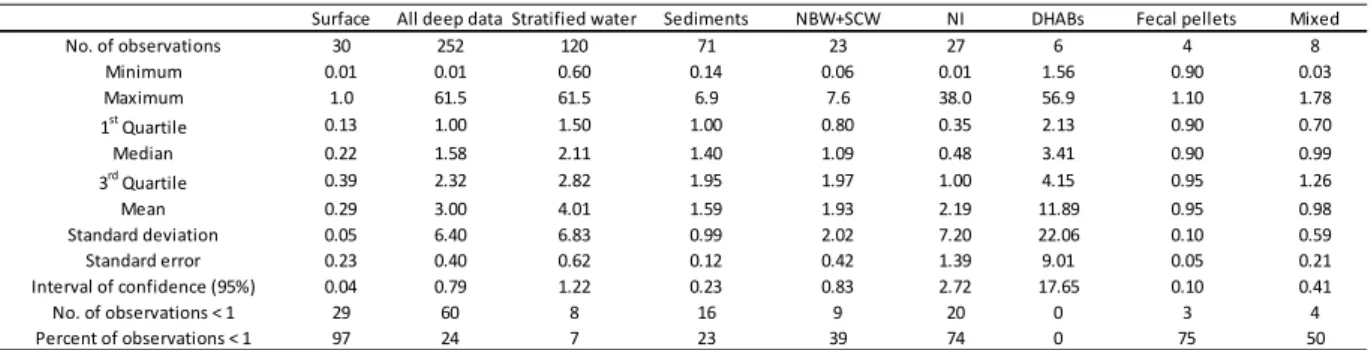
samples yielded values < 1, indicating piezosensitivity, with the single exception of a sample from 200-m depth indicating piezotolerance (Pe = 1; Table 1). In contrast, the median Pe value for the deep samples was calculated to be 1.58 and mean 3.00 ± 0.40 (± s.e.), with 50% of the values distributed between 1.00 and 2.32 (Table 1). A maximum value of 61.5 was calculated from microbial production measurements for deep stratified water (Poremba, 1994), while a minimum of 0.01 was calculated from Jannasch and Wirsen (1973). To constrain distribution, the Pe values were categorized according to nature of the sample (see descriptive statistics in Table 1). The three major sample categories were deep-sea water collected during stratified conditions (n = 120), sediment (n = 71), and near bottom water (NBW) and deep-sea sediment contact water (SCW) (NBW + SCW, n = 23). Three other categories with fewer observations were 390
differentiated (Table 1): water samples collected during a mixing event (n = 8) as described by Bianchi and Garcin (1994) and Boutrif (2012); samples of a swarm of fecal pellets discharged by migrating zooplankton (n = 8) as described by Bianchi et al. (1999b); and samples collected from deep hypersaline anoxic basins of the Eastern Mediterranean Sea (DHABs, n = 6) as described by
18 Tamburini (2002). When the nature of a sample was not indicated by the cited reference, the Pe was classified as NI (n = 27).
Figure 1b shows the distribution of Pe values for the three major categories of deep-sea samples described above. The mean Pe (n = 120) for stratified water was 4.01 (median 2.11), with 50% of values between 1.50 and 2.82 and 90% between 1.12 and 8.17 (Fig. 1b). During stratified conditions, the prokaryotic assemblage was adapted to high pressure (Wilcoxon rank 400
test Pe > 1, p < 2.2 x 10⁻¹⁶) and the metabolic rate has to be determined under in situ pressure conditions to avoid underestimating activity. For sediment, the mean Pe was lower, at 1.59 (n = 71) and closer to the median of 1.40. Box plots of the data (Fig. 1b) show that if 50% of the Pe values are above 1, the lower bar crosses Pe = 1. However, sediment samples, when decompressed and recompressed to in situ pressure, appear to be significantly piezophilic (Wilcoxon rank test Pe > 1, p = 1.143 x 10⁻⁸). In contrast, near bottom and sediment contact water samples showed the opposite (Wilcoxon rank test Pe > 1, p = 0.1996). Although the mean Pe was 1.93 (n = 23), the median (less influenced by extreme values) approached 1 and the box plot crosses the Pe = 1 line (Fig. 1b). For near bottom and sediment-water interface samples, the arrival point of sinking particles, this interface can be considered a “mixing bowl,” with both 410
autochthonous deep-sea microorganisms and allochthonous surface organisms that had colonized sinking particles from the surface (Deming, 1985). The former population functions well under ambient high pressure, while the latter does not and is inhibited by deep-sea conditions (Jannasch and Wirsen, 1973; Turley and Lochte, 1990; Turley, 1993; Bianchi and Garcin, 1994), as indicated by the low (< 1) Pe values for shallow water samples (Fig. 1a).
Although the data sets were too small for statistical analysis, the Pe values calculated for samples collected from a swarm of fecal pellets discharged by migrating zooplankton (Fecal
19 pellets, n = 4), during mixed water conditions (Mixed, n = 8), and from deep hypersaline anoxic basins (DHABs, n = 6) are instructive (Tables 1 and S1). The first two represent surface-derived prokaryotes rapidly transferred to depth, with Pe < 1 including the mean and median values for 420
both data sets. These prokaryotic communities were inhibited by high pressure and weakly active at depth. With decompression, metabolism and growth were enhanced. The third case, deep hypersaline anoxic basins, provides a clear observation of adaptation to the pressure of an extreme environment. All metabolic rates were higher in samples incubated under high pressure, compared to those for samples decompressed during retrieval (mean Pe = 11.9, median = 3.4, n = 6). These data suggest the populations were adapted to the deep hypersaline anoxic environment. Metagenomic analysis will surely provide useful genomic information concerning the associated microbial assemblages and their function in the deep sea.
Conclusion
430
A schematic model of the effect of pressure on microbial populations according to origin (surface water versus deep sea) and fate is presented in Figure 2. Microbial communities found in the deep ocean comprise those microorganisms autochthonous to the deep sea and adapted by some degree to in situ temperature and pressure of the deep-sea environment and allochthonous microorganisms transported from the sea surface via sedimenting particles, deep migrating zooplankton or other mechanisms. Metabolic activity of an allochthonous community decreases with depth, limiting its capacity to degrade organic matter sinking through the water column (Turley, 1993; Turley et al., 1995; Tamburini et al., 2006). Such microbial communities may be inactive (not dead) under conditions of low temperature and elevated pressure of the deep sea, but 440
20 they can become dominant, i.e., more numerous and metabolically active when incubated under atmospheric pressure. Thus, community activity measured at atmospheric versus deep-sea pressure can reflect an entirely different mixture of community components.
Under conditions of elevated pressure and low temperature, microorganisms in the bathypelagic ocean can metabolize complex mixtures of organic matter and respond to changes in the biogeochemical state of the ocean (Nagata et al., 2010). The conceptual framework of the “microbial carbon pump” includes microbial production of recalcitrant dissolved organic matter and, thus, a mechanism for long term carbon storage (Jiao et al., 2010). Related arguments have been made for the contribution of microbial communities in deep-sea sediment to carbon storage (Rowe and Deming, 2011). Clues from genomic and transcriptomic analysis (Vezzi et al., 2005; 450
DeLong et al., 2006), as well as measurement of degradation of refractory organic matter in deep water compared to surface water (Hoppe and Ullrich, 1999; Teira et al., 2006; Tamburini et al., 2009a; Boutrif et al., 2011), indicate that organic compounds resistant to microbial degradation at one depth horizon can serve as substrate for populations of heterotrophic microbes at greater depths (Carlson et al., 2011).
The response of deep-sea microbial lineages to exported DOC indicates that microbial processes carried out in the deep ocean include metabolism of persistent polymeric compounds. Genomic and transcriptomic data indicate the potential of marine bacterioplankton to utilize a range of DOM (Kujawinski, 2011; Giovannoni and Stingl, 2005; McCarren et al., 2011). For example, a large number of genes putatively involved in polysaccharide degradation has been 460
identified in deep sea microbial populations compared to surface populations (DeLong et al., 2006). When isolated in culture, piezophiles can degrade complex organic matter (Vezzi et al., 2005) by modifying gene expression and protein regulation (Lauro and Bartlett, 2007). A good
21 example is that of the metabolic pathways employed by Photobacterium profundum to degrade polymers, such as chitin, pullulan, and cellulose, controlled by pressure, with up-regulation of proteins occurring above 28 MPa and down-regulation below 0.1 MPa. In the NW Mediterranean Sea, Boutrif et al. (2011) discovered natural assemblages that under in situ pressure and temperature (conditions of the deep sea) could degrade semi-labile exopolysaccharides (3H-EPS). They observed higher cell-specific assimilation of 3H-EPS by the deep sea prokaryotes compared to microbial communities in the surface water. Euryarchaea were identified as the main 470
contributor to 3H-EPS assimilation under in situ conditions, i.e., those found at a depth of 2000 m. Perhaps the best example of in situ microbial degradation of unusual organic compounds comes from another “unintended experiment,” namely that of the Deepwater Horizon oil spill, where a deep-water plume of hydrocarbons triggered significant in situ microbial response, in the form of a bloom of members of the genus Colwellia originally described by its pressure adaptation (Deming et al., 1988). Members of the genus Cycloclasticus previously studied only in shallow waters were also dominant in the plume of the hydrocarbon from the spill (Valentine et al., 2011).
In conclusion, microbial metabolic rates are best measured under in situ conditions, which in the case of deep-sea microbial populations include high pressure, low temperature, and 480
appropriate concentration (usually low) of ambient nutrient. An improved understanding of the biogeochemical roles of microorganisms in the deep sea will come from an expansion of studies that couple gene-based analyses with pressure incubations to measure microbial activity; e.g., microautoradiography coupled with in situ hybridization techniques under deep-sea conditions. Further application of “omic” approaches (genomic, transcriptomic, metabolomic) to the bathypelagic realm will reveal both metabolic potential and activity in powerful ways if the
22 critical factor of pressure is accommodated. New and improved methods are needed to measure the rate of enzymatic degradation of semi-labile and refractory organic matter and of microbial respiration in the deep sea, parameters crucial to a quantitative resolution of carbon fluxes as altered by prokaryotes (Burd, 2010). Although we have focused on physical (high pressure) 490
control of microbial activity in the deep sea, biological controls (viruses [Danovaro et al. 2008] and other components of the microbial loop) also merit further study. Finally, recent highlights of possible chemolithoautotrophy in the dark realm (Herndl et al., 2005; Swan et al., 2011; Wuchter et al., 2006) stress the need for knowledge of chemolithoautotrophic activity (gas-consuming as well as gas-producing) under in situ conditions. Methanotrophy in cold deep water has already been identified as inherently piezophilic (de Angelis et al., 1991), based not only results of comparative pressure incubations, as emphasized in this review, but also on the fact that cold fluid under high pressure contains higher gas concentration than warmer or decompressed fluid. Recent events suggest urgency to understanding pressure effects on methane and other gas-dependent microorganisms in the deep sea, where they appear to be serving as effective biofilters 500
(Kessler et al. 2012) against the release of potent greenhouse gases from the ocean.
Acknowledgements
This work was funded by the ANR-POTES program (No. ANR-05-BLAN-0161-01 awarded to CT) supported by the Agence Nationale de la Recherche (ANR, France), NSF Grant Number 0813066 and NOAA Grant number SO660009 (awarded to RRC). CT thanks Francesca Giuliano for her contribution (graphical conception of figure 2). MB was granted a MERNT fellowship (Ministry of Education, Research and Technology, France). JWD was supported by the Walters Endowed Professorship.
23 510
24 Figure captions
Figure 1: Box-and-Whisker plot of pressure effect (Pe) (a) based on the entire data set of calculated Pe values for
deep samples (All; Table S1), as well as for shallow water controls (Surface; Table S2), and (b) according to the nature of the deep samples (Table S1). Pe is the ratio of rate measured under in situ pressure and rate measured after decompression and incubation at atmospheric pressure. Deep samples were collected from stratified water (Stratified water); sediment (Sediment); and near bottom water and sediment contact water (NBW+SCW). The top and bottom of each boxplot represent 75% and 25% of all values, respectively, the horizontal line is the median, and the lower and upper bars represent 10% and 90% limits, respectively. Outliers are shown as black dots.
520
Figure 2: Schematic representation of prokaryotic response to high-pressure conditions in diverse marine
environments and estimation of the subsequent effect of sample decompression and/or incubation at 0.1 MPa (atmospheric pressure) on prokaryotic activity. From left to right, diverse conditions include: particles sinking through the water column; mixing conditions during winter or deep water convection from surface to deep; and stratified water. A-sP: attached surface prokaryotes (piezosensitive); FL-sP: free-living surface prokaryotes (piezosensitive); FL-dsP: free-living deep-sea prokaryotes (piezophilic); Sed-dsP: prokaryotes from the sediments (piezophilic).
25 Table 1. Descriptive statistical analyses of pressure effect (Pe), with values according to nature of the sample.
Surface = shallow water samples subjected to an increase in pressure (described in Table S2). All deep data = entire data set obtained from deep samples (described in Table S1). Stratified water = samples obtained during stratified water conditions; Sediment = samples obtained from different strata of the sediment; NBW + SCW = samples obtained from near bottom water and sediment contact water; NI = hydrological conditions not indicated in the cited reference (Table S1); DHABs = samples from deep hypersaline anoxic basins; Fecal pellets = samples from a swarm of fecal pellets discharged by migrating zooplankton; Mixed = samples obtained during mixed water conditions.
540
Surface All deep data Stratified water Sediments NBW+SCW NI DHABs Fecal pellets Mixed No. of observations 30 252 120 71 23 27 6 4 8 Minimum 0.01 0.01 0.60 0.14 0.06 0.01 1.56 0.90 0.03 Maximum 1.0 61.5 61.5 6.9 7.6 38.0 56.9 1.10 1.78 1st Quartile 0.13 1.00 1.50 1.00 0.80 0.35 2.13 0.90 0.70 Median 0.22 1.58 2.11 1.40 1.09 0.48 3.41 0.90 0.99 3rd Quartile 0.39 2.32 2.82 1.95 1.97 1.00 4.15 0.95 1.26 Mean 0.29 3.00 4.01 1.59 1.93 2.19 11.89 0.95 0.98 Standard deviation 0.05 6.40 6.83 0.99 2.02 7.20 22.06 0.10 0.59 Standard error 0.23 0.40 0.62 0.12 0.42 1.39 9.01 0.05 0.21 Interval of confidence (95%) 0.04 0.79 1.22 0.23 0.83 2.72 17.65 0.10 0.41 No. of observations < 1 29 60 8 16 9 20 0 3 4 Percent of observations < 1 97 24 7 23 39 74 0 75 50
26 Table S1. Pressure effect on microbial activity measurements for deep-sea samples incubated under both ambient
(high) and atmospheric pressure, compiled from the literature.
HP = rate measured on samples under ambient high pressure (value ± SE); DEC = rate measured on decompressed counterparts incubated at atmospheric pressure (value ± SE).
a = in situ incubation in sampler at the sampling-depth pressure during the entire incubation b = in situ incubation at the sediment-water boundary layer using man-operated submersible
c = calculated by applying a factor of 12 to % utilization measured under atmospheric pressure for a 1-month period
d = sample incubated in the transfer unit for 45 days before transfer to the culture vessel, at the start of the
550
incubation period
e = data originally presented as graphs of time-course incorporation, or respiration, of added substrate
f = within the set of data presented, the authors note that most experiments were conducted immediately after sampling, but some used undecompressed and concentrated subsamples kept in cold storage for an undetermined period before processing in the laboratory onshore. Authors did not indicate which samples were analyzed after storage under high pressure conditions.
g = set of six samples collected 30 nautical miles southeast of Marseille at the same sampling station and depth (reported data are mean value ± SD)
h = set of samples collected 28 nautical miles south of Nice in the Ligurian Sea at the same sampling station and depth during different water conditions (n = 8 for stratified, n = 3 for mixed); rate is mean ± SD
560
i = set of samples collected 28 nautical miles south of Nice in the Ligurian Sea at the same sampling station and depth over a few days, with some including a swarm of fecal pellets discharged by migrating zooplankton REC = Decompressed then recompressed under in situ pressure conditions
NI = not indicated in the cited reference
ND = not determined by authors reporting the original data
Hr = Hydrolysis rate constant (see Tamburini et al. 2002 for details) Vmax = maximum velocity
27 Table S2. Pressure effect on microbial activity measurements for shallow-water samples incubated under both
atmospheric and higher pressures, compiled from the literature.
28
References
Arístegui, J.G., Josep M., Duarte, C.M., and Herndl, G. (2009) Microbial oceanography of the dark ocean’s pelagic realm Limnol. Oceanogr. 54: 1501–1529.
Bartlett, D.H., Lauro, F.M., and Eloe, E.A. (2007) Microbial adaptation to high pressure. In
Physiology and Biochemistry of Extremophiles. Gerday, C., and Glandsdorf, N. (eds).
Washington, D. C.: American Society for Microbiology Press, pp. 333-348.
Bianchi, A., and Garcin, J. (1993) In stratified waters the metabolic rate of deep-sea bacteria 580
decreases with decompression. Deep-Sea Res. I 40: 1703–1710.
Bianchi, A., and Garcin, J. (1994) Bacterial response to hydrostatic pressure in seawater samples collected in mixed-water and stratified-water conditions. Mar. Ecol. Prog. Ser. 111: 137–141.
Bianchi, A., Garcin, J., and Tholosan, O. (1999a) A high-pressure serial sampler to measure microbial activity in the deep sea. Deep-Sea Res. I 46: 2129–2142.
Bianchi, A., Garcin, J., Gorsky, G., Poulicek, M., and Tholosan, O. (1999b) Stimulation du potentiel de dégradation dans les eaux marines profondes par les bactéries barotolérantes colonisant les fèces du plancton migrateur. C. R. Acad. Sci. 322: 1113–1120.
Bidle, K.D., and Azam, F. (1999) Accelerated dissolution of diatom silica by marine bacterial 590
assemblages. Nature 397: 508–512.
Bidle, K.D., and Azam, F. (2001) Bacterial control of silicon regeneration from diatom detritus: significance of bacterial ectohydrolases and species identity. Limnol. Oceanogr. 46: 1606–1623.
Bidle, K.D., Manganelli, M., and Azam, F. (2002) Regulation of oceanic silicon and carbon preservation by temperature control on bacteria. Science 298: 1980–1984.
Bidle, K.D., Brzezinski, M.A., Long, R.A., Jones, J.L., and Azam, F. (2003) Diminished efficiency in the oceanic silica pump caused by bacterially-mediated silica dissolution. Limnol.
Oceanogr. 48: 1855–1868.
Bochdansky, A.B., van Aken, H.M., and Herndl, G.J. (2010) Role of macroscopic particles in 600
deep-sea oxygen consumption. Proc. Natl. Acad. Sci. USA 107: 8287–8291.
Boutrif, M. (2012) Dégradation de la matière organique dissoute de haut poids moléculaire par les communautés procaryotiques des zones méso- et bathypélagique In. Thèse Aix-Marseille Université, 233 p.
Boutrif, M., Garel, M., Cottrell, M.T., and Tamburini, C. (2011) Assimilation of marine extracellular polymeric substances by deep-sea prokaryotes in the NW Mediterranean Sea.
Environ. Microbiol. Rep. 3: 705–709.
Burd, A.B., Hansell, D.A., Steinberg, D.K., Anderson, T.R., Arístegui, J., Baltar, F. et al. (2010) Assessing the apparent imbalance between geochemical and biochemical indicators of meso- and bathypelagic biological activity: What the @$#! is wrong with present calculations of 610
carbon budgets? Deep Sea Res. II 57: 1557–1571.
Carlson, C.A., Hansell, D.A., and Tamburini, C. (2011) DOC persistence and its fate after export within the ocean interior. In Microbial Carbon Pump in the Ocean. N. Jiao, F.A., S. Sanders (ed). Science/AAAS, Washington, DC, 2011, pp. 57–59.
Certes, A. (1884) Sur la culture, à l'abri des germes atmosphériques, des eaux et des sédiments rapportés par les expéditions du Travailleur et du Talisman. C. R. Acad. Sci. 98: 690–693.
29 Cho, B.C., and Azam, F. (1988) Major role of bacteria in biogeochemical fluxes in the ocean's interior. Nature 332: 441–443.
Church, M.J., DeLong, E.F., Ducklow, H.W., Karner, M.B., Preston, C.M., and Karl, D.M. (2003) Abundance and distribution of planktonic Archaea and Bacteria in the waters west of the 620
Antarctic Peninsula. Limnol. Oceanogr. 48: 1893–1902.
Crump, B.C., Armbrust, E.V., and Baross, J.A. (1999) Phylogenetic analysis of particle-attached and free-living bacterial communities in the Columbia River, its estuary, and the adjacent coastal ocean. Appl. Environ. Microbiol. 65: 3192–3204.
Daffonchio, D., Borin, S., Brusa, T., Brusetti, L., van der Wielen, P.W.J.J., Bolhuis, H. et al. (2006) Stratified prokaryote network in the oxic-anoxic transition of a deep-sea halocline. Nature
440: 203–207.
Danovaro, R., Dell'Anno, A., Corinaldes, C., Magagnini, M., Noble, R., Tamburini, C., and Weinbauer, M. (2008) Major viral impact on the functioning of benthic deep-sea ecosystems.
Nature 454: 1084–1087.
630
de Angelis, M.A., Baross, J.A., and Lilley, M.D. (1991) Enhanced microbial methane oxidation in water from a deep-sea hydrothermal vent field at simulated in situ hydrostatic pressures. Limnol. Oceanogr. 36: 565–570.
DeLong, E.F., Franks, D.G., and Alldredge, A.L. (1993) Phylogenetic diversity of aggregate-attached vs. free-living marine bacteria assemblages. Limnol. Oceanogr. 38: 924–934.
DeLong, E.F., Taylor, L.T., Marsh, T.L., and Preston, C.M. (1999) Visualization and enumeration of marine planktonic archaea and bacteria by using polyribonucleotide probes and fluorescent in situ hybridization. Appl. Environ. Microbiol. 65: 5554–5563.
DeLong, E.F., Preston, C.M., Mincer, T., Rich, V., Hallam, S.J., Frigaard, N.-U. et al. (2006) Community genomics among stratified microbial assemblages in the ocean's interior. Science 640
311: 496–503.
Deming, J.W. (1985) Bacterial growth in deep-sea sediment trap and boxcore samples. Mar.
Ecol. Prog. Ser. 25: 305–312.
Deming, J.W. (1993) 14C tracer method for measuring microbial activity in deep-sea sediments. In Handbooks of Methods in Aquatic Microbial Ecology. Kemp, P.F., Sherr, B.F., Sherr, E.B., and Cole, J.J. (eds). Boca Raton, Ann Arbor, London, Tokyo: Lewis Publishers, pp. 405–414.
Deming, J.W. (2007) Extreme high-pressure marine environments. In ASM Manual of
Environmental Microbiology, Third Edition. Hurst, C.J., Crawford, R.L., Garland, J.L., Mills,
A.L., and Stetzenbach, L.D. (eds). Washington, D.C.: ASM Press, pp. 575–590. 650
Deming, J.W., Tabor, P.S., and Colwell, R.R. (1980) Deep ocean microbiology. In Advanced
concepts in Ocean Measurements for Marine Biology. Diemer, F., Vernberg, J., and Mirkes, D.
(eds). Columbia St: University of South Carolina Press, pp. 285–305.
Deming, J.W., Somers, L.K., Straube, W.L., Swartz, D.G., and MacDonell, M.T. (1988) Isolation of an obligately barophilic bacterium and description of a new genus, Colwellia gen. nov. Syst. Appl. Microbiol. 10: 152–160.
Egan, S.T., McCarthy, D.M., Patching, J.W., and Fleming, G.T.A. (2012) An investigation of the physiology and potential role of components of the deep ocean bacterial community (of the NE Atlantic) by enrichments carried out under minimal environmental change. Deep Sea Res. I
61: 11–20.
30 Eloe, E.A., Shulse, C.N., Fadrosh, D.W., Williamson, S.J., Allen, E.E., and Bartlett, D.H. (2011) Compositional differences in particle-associated and free-living microbial assemblages from an extreme deep-ocean environment. Environ. Microbiol. Rep. 3: 449–458.
Elvert, M., Suess, E., Greinert, J., and Whiticar, M.J. (2000) Archaea mediating anaerobic methane oxidation in deep-sea sediments at cold seeps of the eastern Aleutian subduction zone.
Org. Geochem. 31: 1175–1187.
Fang, J., Zhang, L., and Bazylinski, D.A. (2010) Deep-sea piezosphere and piezophiles: geomicrobiology and biogeochemistry. Trends Microbio. 18: 413-422.
Fowler, S.W., and Knauer, G.A. (1986) Role of large particles in the transport of elements and organic compounds through the oceanic water column. Prog. Oceanogr. 16: 147–194.
670
Ghiglione, J.F., Mevel, G., Pujo-Pay, M., Mousseau, L., Lebaron, P., and Goutx, M. (2007) Diel and seasonal variations in abundance, activity, and community structure of particle-attached and free-living bacteria in NW Mediterranean Sea. Microb. Ecol. 54: 217–231.
Giovannoni, S.J., and Stingl, U. (2005) Molecular diversity and ecology of microbial plankton. Nature 437: 343–348.
Goutx, M., Wakeham, S.G., Lee, C., Duflos, M., Guigue, C., Liu, Z. et al. (2007) Composition and degradation of sinking particles with different settling velocities. Limnol. Oceanogr. 52: 1645–1664.
Grossart, H.-P., and Gust, G. (2009) Hydrostatic pressure affects physiology and community structure of marine bacteria during settling to 4000 m: an experimental approach. Mar. Ecol. 680
Prog. Ser. 390: 97–104.
Herndl, G.J., Reinthaler, T., Teira, E., van Aken, H., Veth, C., Pernthaler, A., and Pernthaler, J. (2005) Contribution of Archaea to total prokaryotic production in the deep Atlantic Ocean.
Appl. Environ. Microbiol. 71: 2303–2309.
Hollibaugh, J., Wong, P., and Murrell, M. (2000) Similarity of particle-associated and free-living bacterial communities in northern San Francisco Bay, California. Aquat. Microb. Ecol. 21: 103–114.
Honjo, S., Manganini, S.J., and Cole, J.J. (1982) Sedimentation of biogenic matter in the deep ocean. Deep-Sea Res. 29: 609−625.
Hoppe, H.-G., and Ullrich, S. (1999) Profiles of ectoenzymes in the Indian Ocean: phenomena 690
of phosphatase activity in the mesopelagic zone. Aquat. Microb. Ecol. 19: 139–148.
Horikoshi, K. (ed.) (2011) Extremophiles Handbook. Springer, Tokyo, Dordrecht, Heidelberg, London, New York, 608 p, DOI 10.1007/978-4-431-53898-1.
Jannasch, H.W., and Wirsen, C.O. (1973) Deep-sea microorganisms: in situ response to nutrient enrichment. Science 180: 641–643.
Jannasch, H.W., and Wirsen, C.O. (1977) Retrieval of concentrated and undecompressed microbial populations from the deep sea. Appl. Environ. Microbiol. 33: 642–646.
Jannasch, H.W., and Taylor, C.D. (1984) Deep-sea microbiology. Ann. Rev. Microbiol. 38: 487–514.
Jannasch, H.W., Wirsen, C.O., and Winget, C.L. (1973) A bacteriological pressure-retaining 700
deep-sea sampler and culture vessel. Deep-Sea Res. 20: 661–664.
Jannasch, H.W., Eimhjellen, K., Wirsen, C.O., and Farmanfarmaian, A. (1971) Microbial degradation of organic matter in the deep sea. Science 171: 672–675.
31 Jiao, N., Herndl, G.J., Hansell, D.A., Benner, R., Kattner, G., Wilhelm, S.W. et al. (2010) Microbial production of recalcitrant dissolved organic matter: long-term carbon storage in the global ocean. Nature Rev. Microbiol. 8: 593–599.
Karner, M.B., DeLong, E.F., and Karl, D.M. (2001) Archaeal dominance in the mesopelagic zone of the Pacific Ocean. Nature 409: 507–510.
Kato, C., Sato, T., Abe, F., Ohmae, E., Tamegai, H., Nakasone, K. et al. (2008) Protein adaptation to high-pressure environments. In Protein Adaptation in Extremophiles. Molecular 710
Anatomy and Physiology of Proteins Series. Thomas, T., and Siddiqui, K.S. (eds): Nova Science
Publisher, pp. 167-191.
Kato, C. (2011) Distribution of Piezophiles. In Extremophiles Handbook. Horikoshi, K. (ed). Tokyo: Springer Japan, pp. 643-655.
Kellogg, C.T.E., and Deming, J.W. (2009) Comparison of free-living, suspended particle, and aggregate-associated bacterial and archaeal communities in the Laptev Sea. Aquat. Microb. Ecol.
57: 1–18.
Kessler, J.D., Valentine, D.L., Redmond, M.C., Du, M., Chan, E.W., Mendes, S.D., Quiroz, E.W., Villanueva C.J., Shusta, S.S., Werra, L.M., Yvon-Lewis, S.A., and Weber, T.C. (2011) A persistent oxygen anomaly reveals the fate of spilled methane in the deep Gulf of Mexico. 720
Science 331: 312–315.
Kujawinski, E.B. (2011) The impact of microbial metabolism on marine dissolved organic matter. Annu. Rev. Mar. Sci. 3: 567–599.
Lauro, F., and Bartlett, D. (2007) Prokaryotic lifestyles in deep sea habitats. Extremophiles 12: 15–25.
Lauro, F.M., Tran, K., Vezzi, A., Vitulo, N., Valle, G., and Bartlett, D.H. (2008) Large-scale transposon mutagenesis of Photobacterium profundum SS9 reveals new genetic loci important for growth at low temperature and high pressure. J. Bacteriol.: JB.01176-01107.
McCarren, J., Becker, J.W., Repeta, D.J., Shi, Y., Young, C.R., Malmstrom, R.R. et al. (2011) Microbial community transcriptomes reveal microbes and metabolic pathways associated with 730
dissolved organic matter turnover in the sea. Proc. Natl. Acad. Sci. USA 107: 16420–16427. Moeseneder, M.M., Winter, C., and Herndl, G.J. (2001) Horizontal and vertical complexity of attached and free-living bacteria of the eastern Mediterranean Sea, determined by 16S rDNA and 16S rRNA fingerprints. Limnol. Oceanogr. 46: 95–107.
Nagata, T., Tamburini, C., Arístegui, J., Baltar, F., Bochdansky, A.B., Fonda-Umani, S. et al. (2010) Emerging concepts on microbial processes in the bathypelagic ocean – ecology, biogeochemistry and genomics. Deep Sea Res. II 57: 1519–1536.
Poremba, K. (1994) Impact of pressure on bacterial activity in water columns situated at the european continental margin. Neth. J. Sea Res. 33: 29–35.
Prieur, D., Erauso, G., and Jeanthon, C. (1995) Hyperthermophilic life at deep-sea 740
hydrothermal vents. Plan. Space Sci. 43: 115–122.
Robinson, C., Steinberg, D.K., Anderson, T.R., Arístegui, J., Carlson, C.A., Frost, J.R. et al. (2010) Mesopelagic ecology and biogeochemistry – a synthesis. Deep-Sea Res. II 57: 1504– 1518.
Rowe, G.T., and Deming, J.W. (2011) An alternative view of the role of heterotrophic microbes in the cycling of organic matter in deep-sea sediments. Mar. Biol. Res. 7: 629–636.
Simon, M., Grossart, H.-P., Schweitzer, B., and Ploug, H. (2002) Microbial ecology of organic aggregates in aquatic ecosystems. Aquat. Microb. Ecol. 28: 175–211.
32 Smith, Craig, R., Baco, and Amy, R. (2003) Ecology of whale falls at the deep-sea floor. In
Oceanography and Marine Biology: an Annual Review. Gibson and R. J. A. Atkinson, E. (ed).
750
Boca Raton, FL, USA: CRC Press, Taylor & Francis, pp. 311–354.
Smith, D.C., Simon, M., Alldredge, A.L., and Azam, F. (1992) Intense hydrolytic enzyme activity on marine aggregates and implications for rapid particle dissolution. Nature 359: 139– 142.
Swan, B.K., Martinez-Garcia, M., Preston, C.M., Sczyrba, A., Woyke, T., Lamy, D. et al. (2011) Potential for chemolithoautotrophy among ubiquitous Bacteria lineages in the dark ocean.
Science 333: 1296–1300.
Tabor, P., and Colwell, R.R. (1976) Initial investigation with a deep ocean in situ sampler. In. Proceedings of the MTS/IEEE OCEANS'76, W.D. (ed), pp. 13D-11 – 13D-14.
Tamburini, C. (2002) La dégradation du matériel organique profond par les microflores 760
profondes: de la mesure des vitesses potentielles au flux de CO2 généré in situ. In. Thèse Université de la Méditerranée, 222 p.
Tamburini, C. (2006) Life under pressure. Deep-sea microbial ecology. In Life as We know It.
Series: Cellular Origin and Life in Extreme Habitats and Astrobiology. Dordrecht, The
Netherlands Springer, pp. 125–143.
Tamburini, C., Garcin, J., and Bianchi, A. (2003) Role of deep-sea bacteria in organic matter mineralization and adaptation to hydrostatic pressure conditions in the NW Mediterranean Sea.
Aquat. Microb. Ecol. 32: 209–218.
Tamburini, C., Garcin, J., Grégori, G., Leblanc, K., Rimmelin, P., and Kirchman, D.L. (2006) Pressure effects on surface Mediterranean prokaryotes and biogenic silica dissolution during a 770
diatom sinking experiment. Aquat. Microb. Ecol. 43: 267–276.
Tamburini, C., Garel, M., Al Ali, B., Mérigot, B., Kriwy, P., Charrière, B., and Budillon, G. (2009a) Distribution and activity of Bacteria and Archaea in the different water masses of the Tyrrhenian Sea. Deep-Sea Res. II 56: 700–712.
Tamburini, C., Goutx, M., Guigue, C., Garel, M., Lefèvre, D., Charrière, B. et al. (2009b) Effects of hydrostatic pressure on microbial alteration of sinking fecal pellets. Deep-Sea Res. II
56: 1533–1546.
Teira, E., van Aken, H., Veth, C., and Herndl, G.J. (2006) Archaeal uptake of enantiomeric amino acids in the meso- and bathypelagic waters of the North Atlantic Limnol. Oceanogr. 51: 60–69.
780
Teira, E., Reinthaler, T., Pernthaler, A., Pernthaler, J., and Herndl, G.J. (2004) Combining catalyzed reporter deposition-fluorescence in situ hybridization and microautoradiography to detect substrate utilization by bacteria and Archaea in the deep ocean. Appl. Environ. Microbiol.
70: 4411–4414.
Tholosan, O., Garcin, J., and Bianchi, A. (1999) Effects of hydrostatic pressure on microbial activity through a 2000 m deep water column in the NW Mediterranean Sea. Mar. Ecol. Prog.
Ser. 183: 49–57.
Turley, C.M. (1993) The effect of pressure on leucine and thymidine incorporation by free-living bacteria and by bacteria attached to sinking oceanic particles. Deep-Sea Res. I 40: 2193– 2206.
790
Turley, C.M., and Lochte, K. (1990) Microbial response to the input of fresh detritus to the deep-sea bed. Palaeogeography, Palaeoclimatology, Palaeoecology 89: 3–23.