Publisher’s version / Version de l'éditeur:
Vous avez des questions? Nous pouvons vous aider. Pour communiquer directement avec un auteur, consultez la première page de la revue dans laquelle son article a été publié afin de trouver ses coordonnées. Si vous n’arrivez pas à les repérer, communiquez avec nous à [email protected].
Questions? Contact the NRC Publications Archive team at
[email protected]. If you wish to email the authors directly, please see the first page of the publication for their contact information.
https://publications-cnrc.canada.ca/fra/droits
L’accès à ce site Web et l’utilisation de son contenu sont assujettis aux conditions présentées dans le site
LISEZ CES CONDITIONS ATTENTIVEMENT AVANT D’UTILISER CE SITE WEB.
Designing for fire safety: the science and its application to building codes:
[proceedings of] Building Science Insight '87, pp. 9-20, 1987-11
READ THESE TERMS AND CONDITIONS CAREFULLY BEFORE USING THIS WEBSITE. https://nrc-publications.canada.ca/eng/copyright
NRC Publications Archive Record / Notice des Archives des publications du CNRC :
https://nrc-publications.canada.ca/eng/view/object/?id=bb89a47e-3f78-4ad8-a108-5037ca18698e
https://publications-cnrc.canada.ca/fra/voir/objet/?id=bb89a47e-3f78-4ad8-a108-5037ca18698e
NRC Publications Archive
Archives des publications du CNRC
This publication could be one of several versions: author’s original, accepted manuscript or the publisher’s version. / La version de cette publication peut être l’une des suivantes : la version prépublication de l’auteur, la version acceptée du manuscrit ou la version de l’éditeur.
For the publisher’s version, please access the DOI link below./ Pour consulter la version de l’éditeur, utilisez le lien DOI ci-dessous.
https://doi.org/10.4224/20328410
Access and use of this website and the material on it are subject to the Terms and Conditions set forth at
Combustibility of building materials
Combustibility of Building Materials
J.R. Mehaffey, Ph.D.
Introduction
Building codes and other regulations often put restrictions on the ignitability and combustibility of building materials and contents, as well as on the proper uses of potential ignition sources. If fires are difficult to ignite, remain localized once ignited or, at worst, spread and burn slowly, then building occupants are likely to have sufficient time to escape. It must be recognized though, that it is not practical to specify the exclusive use of noncombustible building materials or noncombustible contents.
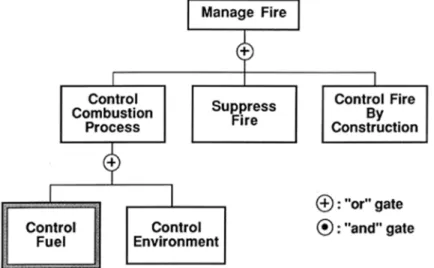
In this paper a review of test procedures aimed at segregating building materials into combustible and noncombustible categories is presented, as well as an explanation of the intent of requirements for noncombustible construction contained in the National Building Code of Canada (NBC).1Whether a building must be of noncombustible construction or not depends on the building size, the hazards it contains, the mobility and level of alertness of occupants, how many streets it faces, and whether or not it is sprinklered. Controlling the combustible content of buildings (or controlling the fuel) in this manner plays a significant role in the Manage Fire sub-branch of the Fire Safety Concept Tree (Figure 1).
Figure 1 Control Fuel element in Manage Fire sub-branch of Fire Safety Concept Tree
The paper concludes with a discussion on the need for the development of a more general test method for evaluating the degree of combustibility of building materials.
The Basic Chemical and Physical Nature of Fire
A chemist envisions a fire as a complex series of chemical reactions involving the oxidation of fuel, usually containing carbon. Physically, of course, a fire is characterized by visible flame, heat and smoke.
The fire triangle, depicted in Figure 2, illustrates the three components required for a fire: fuel, oxygen and heat. The fire triangle can be looked upon as a physicist's descriptive model of fire. Its utility becomes evident when considering extinguishment (suppression), which can be achieved by isolating one of the three components from the other two. Fire can be suppressed by removing heat (with water spray, for example), by removing the fuel (turning off the flow of fuel in a Bunsen burner, for example), or by removing the oxygen (by smothering the fire with a fire blanket).
Figure 2 Fire triangle - three components required for a fire
This physical representation of fire is useful, but the fact that chemical reactions are also needed to keep the fire going cannot be ignored. The basic components of fire then should also include the uninhibited chain reactions within the flame and at the fuel surface, as depicted in Figure 3. This allows for the possibility of a fourth extinguishment (suppression) technique: that of inhibiting the chain reaction (quenching the flame) with fire retardant chemicals. Halogens, such as chlorine and bromine (found in halons), are elements that act in this fashion.
Figure 3 Fire tetrahedron - chemical reactions required to keep a fire going
Of course there is more to a fire than the presence or absence of these three or four components. Are is a complex phenomenon involving chemical kinetics, fluid mechanics, heat transfer,and thermodynamics. The process of ignition of a solid, for instance, can be described as follows.
Consider an external heat source (an overheated wire) in contact with a combustible material(wood, for example). The temperature at the surface of the wood increases steadily to 100 ° C, at which point water is driven off as steam. As the temperature continues to increase, the wood starts to undergo pyrolysis; that is, it starts to decompose into volatiles (vapors) and char. The volatiles, being hotter and hence less dense than the surrounding air, rise and mix with the air.
At around 300 ° C, this mixture of volatiles and air can ignite, producing a flame. Some of the heat generated by the flame escapes with the rising hot gases, but a portion of it is 'fed back' to the fuel (by radiant, convective or conductive heat transfer), causing its temperature to increase further and pyrolysis to proceed at a greater rate. In turn, the flame grows. If the heat
feedback to the fuel is sufficient to cause it to pyrolyze and burn by itself, one has 'sustained flaming combustion'. The original ignition source is no longer needed (Figure 4).
Figure 4 Sustained flaming combustion
Char formation, which occurs only in some materials, can play an important role in the burning process. In its position between the flame and the burning object, it can act as a shield, slowing down heat transfer to virgin fuel and in turn decreasing the rate of burning or of heat release. Fires do not burn well on the top surface of a piece of wood.
On the other hand, in geometries such as that depicted in Figure 5, air drawn into the flame can play directly on the hot char. The char can undergo oxidation (it glows) and the heat released can cause pyrolysis of the virgin fuel below the char. Sticks of wood burn well if ignited from below.
Figure 5 Flaming combustion of a char-forming solid
Products of combustion rise above the flame in the form of smoke and heat. Smoke consists of airborne solids (soot), liquid droplets, and gases,some of which may be toxic. Of the toxic gases produced, carbon monoxide is certainly the most prominent; however, hydrogen cyanide and hydrogen chloride may also be produced when polyurethane or polyvinyl chloride is burning. Being quite buoyant, smoke and the toxic gases within it can migrate to areas fairly remote from the fire, presenting the primary threat to occupants of a building. It is this that makes them the leading cause of fire deaths.
Flaming combustion is easily differentiated from another type of combustion called smouldering. Essentially, smouldering combustion is typified by low temperatures and a very slow rate of combustion. It takes place when the volatiles liberated from the surface of the fuel are not hot enough or in sufficient quantity to ignite, but sufficient heat is generated to keep the fuel pyrolyzing. The lack of buoyant forces means that little air is drawn over the fuel surface,limiting the rate of combustion. Such products as loose-fill cellulose insulation, fibreboard and, of course, cigarettes, have a propensity to smoulder for a considerable period of time with only a small ignition source.
Solid fuels or combustible materials can be categorized in a number of ways. For instance, a distinction is made between charring and noncharring materials, based on the capacity of the material to form a char as it pyrolyzes. Most materials with a high cellulosic content, such as wood, produce a char residue; however, so does hydrocarbon-based polyvinyl chloride and certain thermosetting resins, such as phenolic and polyisocyanurate foams. Other materials,such as polystyrene, produce little or no char when they burn.
Another differentiation is made between synthetic polymers according to their propensity to soften and melt (deform) at a temperature below that required for thermal decomposition or ignition to occur. When this characteristic prevails, the polymer is called a thermoplastic. When involved in a fire, such materials can have quite an effect on its behavior, due to falling droplets or the spread of a burning pool of molten polymer on the ground. Polymers that have a cross-linked molecular structure will not melt when heated. Instead, at a sufficiently high temperature, they will decompose, giving off volatiles directly from the solid, often leaving behind a carbonaceous residue, much as wood does. These polymers are called thermosetting resins.
Table 1 lists a few examples of thermoplastic and thermosetting polymers. Rigid polyurethane foams commonly used as building insulation in exterior walls or over roof decks, and flexible polyurethane used for cushioning in upholstered furniture, are generally thermosets, although the extensive use of plasticizers may make certain polyurethane foams behave as thermoplastics. Phenolics are thermosetting materials used in circuit breakers.
Table 1 Some Synthetic Polymers
Thermoplastics(melting) Thermosetting(non-melting) Polyethylene Epoxy
Polymethylene Polyester (fibreor glass reinforced) Polymethylmethacrylate(PMMA) Polyisocyanurate
Polypropylene Polyurethane (rigid or flexible) Polystyrene
Polyvinyl chloride (PVC) Phenolics
Thermoplastics find varied applications in the marketplace. Polyvinyl chloride (PVC) is used mainly for piping and conduit, polystyrene for foam insulation, polyethylene as a vapor barrier and PMMA, also known as Plexiglass*, for glazing.
Ignition Sources In Building Fires
Obviously, a sound fire protection measure would be to limit the number of fires by limiting the number of ignitions. Building fires usually start with the ignition of a single item, which involves two factors: the ignition source and the first item ignited.
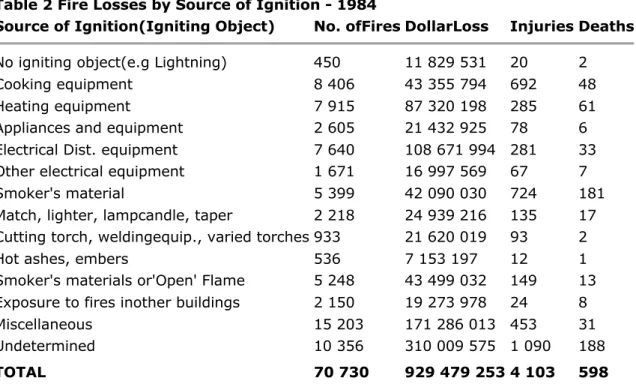
Statistics on ignition sources in building and vehicle fires are collected annually by the Fire Commissioner of Canada. Fire losses by source of ignition for the year 1984 are summarized in Table 2.2The most common ignition sources include cooking, heating, and electrical distribution equipment, and smoker's materials or open flame.The hazards associated with such ignition sources have been known for some time. It is certainly not practical to eliminate these sources. Instead, standards and codes have been developed to mitigate the hazards. Some of these are summarized in Table 3.
Table 2 Fire Losses by Source of Ignition - 1984
Source of Ignition(Igniting Object) No. ofFires DollarLoss Injuries Deaths No igniting object(e.g Lightning) 450 11 829 531 20 2 Cooking equipment 8 406 43 355 794 692 48 Heating equipment 7 915 87 320 198 285 61 Appliances and equipment 2 605 21 432 925 78 6 Electrical Dist. equipment 7 640 108 671 994 281 33 Other electrical equipment 1 671 16 997 569 67 7 Smoker's material 5 399 42 090 030 724 181 Match, lighter, lampcandle, taper 2 218 24 939 216 135 17 Cutting torch, weldingequip., varied torches 933 21 620 019 93 2 Hot ashes, embers 536 7 153 197 12 1 Smoker's materials or'Open' Flame 5 248 43 499 032 149 13 Exposure to fires inother buildings 2 150 19 273 978 24 8 Miscellaneous 15 203 171 286 013 453 31 Undetermined 10 356 310 009 575 1 090 188
TOTAL 70 730 929 479 253 4 103 598
Table 3 Standards or Codes regulating ignition sources
Ignition Source Standards and Codes
Cooking equipment NBC - installation requirementsCSA- product specificationsCGA - product specifications
Heating equipment NBC - installation requirementsCSA- product specificationsCGA - product specifications
Appliances and equipment CSA- product specifications
Electrical distribution equipment CEC - installation requirementsCSA- product specifications
Open flames NFC - permitted practices
Welding and cutting equipment NFC - permitted practices
NBC - National Building Code of anada CSA - Canadian Standards Association CGA- Canadian Gas Association CEC - Canadian Electrical Code NFC - National Fire Code of Canada
Ignition requires both an ignition source and a combustible fuel. As with ignition sources, it is impractical to simply eliminate combustibles from buildings. Instead one attempts to control their ignitability or combustibility.
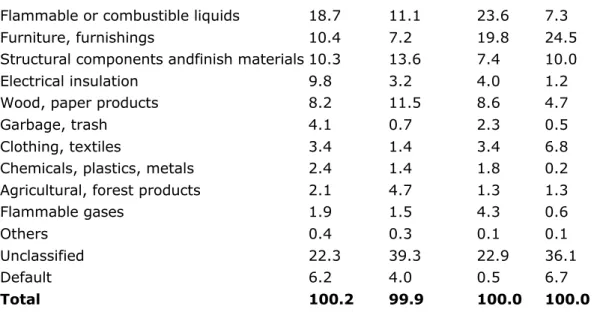
In a recent study conducted by Consumer and Corporate Affairs Canada,3 provincial statistics were reviewed to establish which materials are most likely to be the first item ignited in building or vehicle fires. The results of the study are summarized in Table 4.
Table 4 Materials first ignited in building or vehicle fires Percent of Total
Material First Ignited Incidents DollarLoss Injuries Deaths Flammable or combustible liquids 18.7 11.1 23.6 7.3 Furniture, furnishings 10.4 7.2 19.8 24.5 Structural components andfinish materials 10.3 13.6 7.4 10.0 Electrical insulation 9.8 3.2 4.0 1.2 Wood, paper products 8.2 11.5 8.6 4.7
Garbage, trash 4.1 0.7 2.3 0.5
Clothing, textiles 3.4 1.4 3.4 6.8 Chemicals, plastics, metals 2.4 1.4 1.8 0.2 Agricultural, forest products 2.1 4.7 1.3 1.3
Flammable gases 1.9 1.5 4.3 0.6
Others 0.4 0.3 0.1 0.1
Unclassified 22.3 39.3 22.9 36.1
Default 6.2 4.0 0.5 6.7
Total 100.2 99.9 100.0 100.0
By far the most common materials first ignited are flammable or combustible liquids, such as gasoline, cooking oil, or fat. The hazard represented by such materials is well known. Provisions for safe handling and storage of some of these liquids are contained in Part 4 of the 1985 edition of the National Fire Code of Canada,4and are beyond the scope of this seminar.
The second most common class of materials first ignited is furniture and furnishings, such as upholstered furniture, bedding, and mattresses. Whereas 10.4% of fires appear to involve furniture or furnishings as the first item ignited,these same fires amount for 24.5% of deaths and 19.8% of injuries. They are very hazardous fires indeed, as far as occupants are concerned. In recognition of this hazard, some classes of furniture or furnishings are regulated under the Hazardous Products Act. To be sold in Canada, mattresses must exhibit resistance to ignition by cigarettes,5curtains (and other textiles) to ignition by a small flame,6and carpets to ignition by a methenamine tablet (slightly more intense than a cigarette).7Recently, provisions have been made under the Act to encourage manufacturers of upholstered furniture to test their products for resistance to ignition by cigarettes.
The third most common class of materials first ignited are building elements, such as structural components and finish materials. They account for 10.3% of fires, 13.6% of dollar losses, 7.4% of injuries, and 10.0% of deaths. They represent a significant cause for concern and are the principal subject of the rest of this paper.
The Need for Noncombustible Building Materials
Building materials are generally classified within the National Building Code of Canada as either combustible or noncombustible. It is important to distinguish between the ignitability and the combustibility of a material. Its ignitability is its ability to be ignited; its combustibility its ability to be ignited and to burn. Ignitability is not addressed directly in the NBC. It is not clear to
what ignition sources building materials must demonstrate ignition resistance. The combustibility of building products is an issue regulated by the NBC.
Faced with serious fire problems, the code committees decided years ago that some buildings, particularly high buildings, or those with large areas, needed to be built of noncombustible materials to effect a so-called `fireproof construction'. Such construction would help provide sufficient time for building occupants to evacuate, and would make fire fighters' tasks more manageable, by inhibiting fire spread through the building, particularly through concealed spaces. In addition, fireproof construction, together with adequate fire resistance provisions, is intended to ensure that the building will not sustain excessive damage or collapse before evacuation and fire fighting are completed. Finally, fire spread to other buildings should be abated. In Canada, during the 1800'sand 1900's, such fire spread often led to conflagrations which destroyed large sections of towns or cities.
The Noncombustibillty Test
A building material is classified as noncombustible if it meets the acceptance criteria contained in CAN4-S114-M80, Standard Method of Test for Determination of Non-Combustibility in Building Materials.8 The test method is intended to assess the performance of elementary building materials only: it does not apply to materials with a decorative or protective coating, or impregnation, or those built up of laminations of dissimilar materials.
The test is conducted in a small electrically heated furnace, shown in Figure 6. Temperatures in the furnace are determined by a controlling thermocouple, used to stabilize the furnace temperature prior to the test, and an indicating thermocouple, used to measure any temperature rise during testing. A mirror is used to make visual observation through the gas vent during testing.
Figure 6 lathe non-combustibility test furnace
Test specimens have a base of 38 by 38 mm and a height of 50 mm. If the specimen is likely to disintegrate or melt during the test, it must be supported in a metal gauze or a thin sheet-metal dish. At least three specimens of the material must be tested. Before testing, these specimens must be dried at 60 + 3 ° C for 24 to 48 hours and allowed to cool to room temperature in a dry atmosphere.
Before conducting the test, the furnace is heated to 750 + 3 ° C at the controlling thermocouple and stabilized at that temperature to within 1 ° C for 15 minutes. The specimen
is placed in the sample holder and inserted into the furnace from below. The test is continued for fifteen minutes, unless it becomes clear earlier that the specimen has failed the test.
Materials subjected to the test are considered to be noncombustible if:
The mean of the maximum temperature rises (measured by the indicating thermocouple) for the three (or more) specimens during the test does not exceed 36 ° C;
There is no flaming of any of the three (or more) specimens during the last 14 minutes and 30 seconds of the test;
The maximum loss of mass of any of the three (or more) specimens during the test does not exceed 20%.
Note that the test is a pass/fail test; that is, the material is found to be either combustible or noncombustible. There is no measure of the degree of combustibility of the material provided. Testing Laboratories
The following Canadian laboratories are equipped to perform the noncombustibility test:
National Research Council of Canada,Ottawa, Ontario
Ontario Research Foundation,Mississauga, Ontario
Underwriters' Laboratories of Canada,Scarborough, Ontario
Warnock Hersey Professional Services Ltd.,Coquitlam, B.C.
It is not common for NRC to conduct tests for product manufacturers, as this is generally understood to be the responsibility and livelihood of the commercial laboratories.
Product Testing
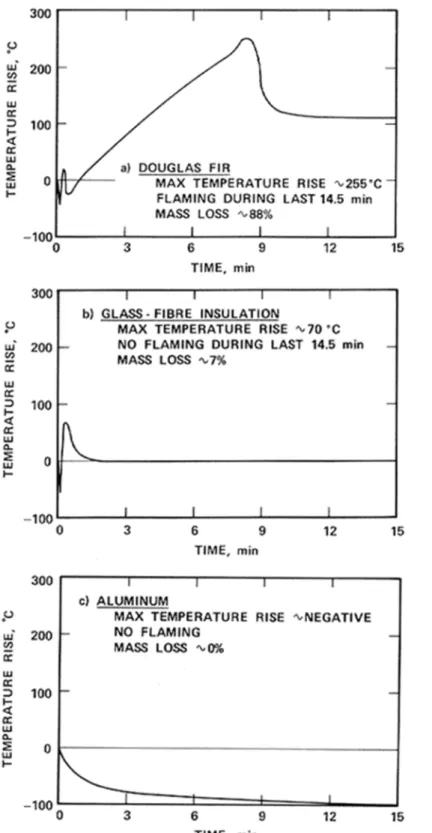
Data generated at NRC on the combustibility of Douglas fir, glass-fibre insulation, and aluminum are summarized in Figure 7. On the testing of all products there is a drop in temperature (as recorded on the indicating thermocouple) at the start of the test, when the cool specimen is inserted into the hot furnace.)
Figure 7 Data fROm tests conducted in accordance with the noncombustibility test CAN-S114-M80. The Douglas fir and glass fibre specimens were found to be combustible; the aluminum is noncombustible.
The Douglas fir specimen is classified as combustible, as it failed all three acceptance criteria. The maximum temperature rise was 255 ° C; flaming was witnessed after the 30-second mark in the test (in fact, at times flames issued through the gas vent), and the mass loss was about 88%. It comes as no surprise to find that a wood product is classified as combustible.
The glass-fibre insulation is also classified as combustible. Although there was no flaming in the last 14.5 minutes of the test and the mass loss was only 7%, the temperature rise of 70 °C exceeded the permitted value by a slight margin. It was the resins (binders) employed in this particular product which caused it to fail the test. There may be formulations of glass-fibre insulation which could pass this test.
It should come as no surprise that the solid aluminum specimen was found to be noncombustible. The specimen underwent some melting during the test and in this way absorbed heat from the furnace, causing relatively low temperatures to be recorded. There was no flaming and no mass loss during the test, as the molten aluminum was contained within a small dish.
The results of the test imply that aluminum building components will not undergo rapid oxidation in building fires. This is not to suggest that aluminum can never undergo rapid oxidation; under some conditions, generally quite different from those encountered in building fires, it can.9
After many years of testing, much has been learned about the test performance of common building materials. Some of that information is summarized in Chapter 2 in the Supplement to the National Building Code of Canada 1985.
Most materials from animal or vegetable sources are classified as combustible by CAN4S114. Wood, wood fibreboard, paper, felt made from animal or vegetable fibres, cork, plastics, asphalt and pitch would be classed as combustible. Materials that consist of combustible and noncombustible elements in combination, such as gypsum wallboard, will in many cases also be classed as combustible, unless the proportion of combustible elements is very small. Some mineral wool insulations with combustible binder, cinder concrete, cement and wood chips,and wood-fibred gypsum plaster would also be classed as combustible. The addition of a fire retardant chemical is not usually sufficient to change a combustible product to a noncombustible product.
Noncombustible materials include brick, ceramic tile, concrete made from Portland cement with noncombustible aggregate, asbestos cement, plaster made from gypsum with noncombustible aggregate, metals commonly used in buildings, glass, granite, sandstone, slate, limestone and marble.
Building Code Requirements
In addition to distinguishing between noncombustible and combustible materials, the present version of the NBC distinguishes between noncombustible construction and combustible construction. Since combustible construction is defined as construction that does not conform to the requirements for noncombustible construction, it is useful to first consider what is meant by noncombustible construction.
In noncombustible construction, building assemblies must be constructed of noncombustible materials, although, for practical reasons, some combustible elements are permitted. However, only those combustible elements considered not to represent an undue hazard and specifically listed in Article 3.1.4.5. of the NBC may be used. For example, gypsum wallboard, although it is considered to be combustible itself, is permitted in noncombustible construction. Where combustible materials are permitted, additional restrictions are often placed on their use. For instance, combustible insulation is permitted, provided it meets certain flame-spread requirements and (in some cases) provided it is protected by a thermal barrier such as gypsum wallboard. For combustible interior finishes, restrictions are also placed on the thickness of the material.
If an assembly constructed essentially of noncombustible material contains combustible elements not specifically permitted by the Code for noncombustible construction, the assembly falls within the category of combustible construction. Combustible construction is usually conventional wood frame or heavy timber.
The NBC requires that a building be of noncombustible construction if occupants could experience undue difficulty in evacuating in the event of a fire. Buildings over a certain height or area are required to be of noncombustible construction. The building area and building height limits below which the building is permitted to be of combustible construction depend on the major occupancy classification, the number of streets the building faces, and whether or not the building is sprinklered.
As an example, the pertinent requirements for residential buildings are summarized in Figure 8. Residential buildings which do not exceed three storeys in height or an area (single storey area) of 600 m2(such as one- and two-family dwellings and small apartment buildings), can be of combustible construction and can be built in accordance with Part 9 of the NBC. It is assumed that occupants have sufficient time to escape from a fire and that fire fighting capabilities are adequate to deal with fires in smaller buildings. All other residential buildings must be built in accordance with the more stringent requirements of Part 3 of the NBC.
Figure 8 NBC requirements for noncombustible construction in residential buildings
Residential buildings which exceed three storeys in height must be of noncombustible construction. Those which do not exceed three storeys in height but do exceed 600 m2 in building area may be required to be of noncombustible construction, depending upon whether the building is sprinklered, the number of storeys, the building area, and how many streets the building faces. The exact requirements are contained in Figure 8. Evacuation and fire fighting activities are assumed to proceed more smoothly in sprinklered buildings, in buildings of fewer storeys and smaller area, and where there is direct access for firefighters from more sides. For some buildings either combustible or noncombustible construction is permitted. Generally, more stringent requirements are placed on other fire protection provisions (such as fire resistance ratings) in the combustible buildings to allow for equivalent levels of safety.
This rather involved logic for residential buildings is in sharp contrast to the logic employed in establishing requirements for prisons. As the mobility of prisoners is generally restricted, evacuation in the case of fire is very much hampered. In addition, fire fighting activities are often hampered due to difficulty in gaining access to the fire. For these reasons all prisons are required to be of noncombustible construction, independently of such factors as building height, building area, or presence of sprinklers.
The Noncombustibillty Test - Shortcomings
CAN4-S114 is a very severe test which is intended to determine whether a material is combustible or not. In this sense it is a pass/fail test: numerical test results are not provided. It is generally not practical to construct a building solely from noncombustible materials. Consequently, numerous combustible materials are permitted in noncombustible construction.
For more than a decade now, code writers have wanted to be able to distinguish between various levels or degrees of combustibility: from noncombustible to highly combustible. Specifying the use of noncombustible materials was a convenient but conservative measure. A more practical solution would be to allow some degree of combustibility, within safe limits. Although Code committees have wanted to move in this direction, the lack of a suitable test has prevented them from doing so. Attempts to modify CAN4-S114 to serve this function have not met with success. The apparatus can determine readily if a material is combustible or not; it cannot easily be used to assess the degree of combustibility of combustible materials.
A New Noncombustibillty Test
Efforts are under way to develop a test method to determine the degree of noncombustibility of materials. It is intended that the test method be modelled after an existing American test developed for a different purpose.11
The test specimen will be put into a small ventilated chamber and subjected to two different levels of radiant thermal exposure. Piloted ignition will be attempted with a small flame. The critical measurement will be the heat release rate of the material for two exposures.
Using these data it will be possible to set up categories of combustible materials. These categories, which would reflect the contribution of a material to fire development and severity, could be referenced in the NBC.
Equivalencies and Design Considerations
Fire protection requirements in the NBC are intended to ensure a minimum level of life safety in buildings. It is argued that these requirements provide, for the most part, adequate time for occupants to reach an area of safety within or outside the building.
From time to time, in considering the design of some buildings it is found that these requirements are inconsistent with the spirit of the design. In these cases the requirements are generally felt to be too 'restrictive'. This may occur in the design of a new building or in a major renovation of an existing building.
It is not possible to foresee all design considerations in developing the NBC. To encourage the use of new technologies or design options which are not expressly covered in the NBC, Subsection 2.5 permits the use of solutions which can be demonstrated to yield levels of safety equivalent to those provided by the NBC requirements. Most provincial building codes adopt a similar policy in some form. It is generally necessary to provide documentation supporting the claim that the design meets the intent of the NBC requirements.
One of the purposes of this seminar is to demonstrate, using examples, how equivalent solutions can be developed. These examples have been chosen strictly to demonstrate the processes and logic involved. There may well be design scenarios in which these examples would yield solutions which are not up to the mark.
Take for example the case of a large lumber company that wishes to build a new corporate head office. The company insists that the building be of combustible construction, as it is to be a show-piece of wood-frame construction with several larger rooms lined with the finest in wood panelling.
An architect, well versed in wood-frame construction, has been selected to design the building. In his first meeting with the company he learns that the building is to be 3 storeys in height and each storey is to be 5,500 m2in area. He immediately points out that according to Article 3.2.2.30 in the NBC, the building must be of noncombustible construction. The largest storey area permitted in a three storey office building of combustible construction is 4,800 m2, provided the building is sprinklered and faces three streets.
As the company insists that the building be of wood-frame construction, the architect must develop an equivalent solution. This may entail exceeding building code requirements for
buildings of this size in order to provide sufficient time for occupants to escape. The architect may propose any combination of the following actions:
exceed the required number of exits and provide for shorter travel distances to exits than required;
exceed the number of required fire detectors and alarms;
employ fast-response sprinklers in place of ordinary sprinklers;
build in improved compartmentation within the building;,
provide for an in-house fire brigade.
To ensure that neighbouring buildings are not likely to become involved in a fire should this building burn, the minimum required limiting distances to lot lines should be exceeded.
As the proposed storey area of 5,500 m2exceeds the permitted value of 4,800 m2 by a small amount, it is possible that by exceeding the minimum requirements in the NBC, the architect may persuade the authorities having jurisdiction to permit the building to be of woodframe construction. The architect should be prepared to demonstrate that the equivalent solution provides a level of safety equal to or better than that provided by NBC requirements. Fire experience, testing and computer models (presented in the following paper) may provide the information needed to demonstrate the equivalency.
Summary
Restricting the combustibility of building materials plays an obvious role in the provision of fire safety. Yet specifying the use of noncombustible materials is not always a practical solution, In this lecture, a review of test procedures aimed at segregating materials into combustible and noncombustible categories was presented, as well as an explanation of the intent of requirements for noncombustible construction contained in the NBC. The need for development of more useful test methods for evaluating the degree of combustibility of building materials was also discussed. Finally it has been shown that designs which can be demonstrated to yield equivalent levels of safety to NBC requirements, can often find acceptance by authorities having jurisdiction.
References
1. National Building Code of Canada 1985.Associate Committee on the National Building Code, National Research Council of Canada, Ottawa, NRCC 23174. 454 p.
2. Fire Losses in Canada, Annual Report 1984. Office of the Fire Commissioner of Canada, Ottawa, Ontario, 1986. 23 p.
3. Phillips, D., and Kasem, M. A.,1985, "Upholstered Furniture Fires in Canada", Consumer and Corporate Affairs Canada, L10127-F32 84/85, 29 p.
4. National Fire Code of Canada 1985, National Research Council of Canada, Associate Committee on the National Fire Code, NRCC 23175. 168p.
5. Method of Test for Combustion Resistance of Mattresses - Cigarette Test, 1977. CAN24.2-M77, Method 27.7, Canadian Government Specifications Board, Ottawa, 6 p.
6. Standard Test Method for Flammability of Clothing Textiles, 1980. ASTM D1230-61, Annual Book of ASTM Standards, Part 18, American Society for Testing and Materials, Philadelphia, 5p.
7. Method of Test for Flammability - Methenamine Tablet Test for Textile Floor Coverings, 1977 .CAN2-4.2-M77, Method 27.6, Canadian Government Specifications Board, Ottawa, 2 p.
8. Standard Method of Test for Determination of Non-Combustibility in Building Materials, 1980. CAN4-S114-M80, Underwriters' Laboratories of Canada, Scarborough, Ontario, 15p.
9. "Metals" Section 5/Chapter 10 in Fire Protection Handbook,1986. 16th Edition, National Fire Protection Association, Quincy, MA
10. Supplement to the National Building Code of Canada 1985, Associate Committee on the National Building Code, National Research Council of Canada, Ottawa, NRCC 23178, 278 p.
11. Standard Test Method for Heat and Visible Smoke Release Rates for Materials and Products, 1986. ASTM E906, Annual Book of ASTM Standards, Vol. 04.07, American Society for Testing and Materials, Philadelphia, pp. 915-936.