Publisher’s version / Version de l'éditeur:
Official Digest, 34, 455, pp. 1343-1354, 1963-01-01
READ THESE TERMS AND CONDITIONS CAREFULLY BEFORE USING THIS WEBSITE. https://nrc-publications.canada.ca/eng/copyright
Vous avez des questions? Nous pouvons vous aider. Pour communiquer directement avec un auteur, consultez la première page de la revue dans laquelle son article a été publié afin de trouver ses coordonnées. Si vous n’arrivez pas à les repérer, communiquez avec nous à [email protected].
Questions? Contact the NRC Publications Archive team at
[email protected]. If you wish to email the authors directly, please see the first page of the publication for their contact information.
NRC Publications Archive
Archives des publications du CNRC
This publication could be one of several versions: author’s original, accepted manuscript or the publisher’s version. / La version de cette publication peut être l’une des suivantes : la version prépublication de l’auteur, la version acceptée du manuscrit ou la version de l’éditeur.
Access and use of this website and the material on it are subject to the Terms and Conditions set forth at
Analysis for pigment volume concentration
Ashton, H. E.
https://publications-cnrc.canada.ca/fra/droits
L’accès à ce site Web et l’utilisation de son contenu sont assujettis aux conditions présentées dans le site LISEZ CES CONDITIONS ATTENTIVEMENT AVANT D’UTILISER CE SITE WEB.
NRC Publications Record / Notice d'Archives des publications de CNRC:
https://nrc-publications.canada.ca/eng/view/object/?id=86bbf1cd-347f-4041-b2bb-8c403aa71b3e https://publications-cnrc.canada.ca/fra/voir/objet/?id=86bbf1cd-347f-4041-b2bb-8c403aa71b3eSer
TH1
N21r2
no.
177
c. 2
NATIONAL
RESEARCH
COUNCIL
CANADA
D I V I S I O N OF B U I L D I N G R E S E A R C H
ANALYSIS FOR PIGMENT VOLUME CONCENTRATION
R E P R I N T E D F R O M
OFFICIAL DIGEST. VOL. 34, NO. 455. DECEMBER 1962, P.1343-1354
R E S E A R C H P A P E R N O . 177 O F T H E
D I V I S I O N OF B U I L D I N G R E S E A R C H
T h i s publication i s being d i s t r i b u t e d by the Division of Building R e s e a r c h of the National R e s e a r c h Council. It should not be r e p r o d u c e d in whole o r in p a r t , without p e r m i s - s i o n of the o r i g i n a l p u b l i s h e r . T h e Division would be glad to be of a s s i s t a n c e in obtaining such p e r m i s s i o n .
Publications of the Division of Building R e s e a r c h m a y be obtained by m a i l i n g the a p p r o p r i a t e r e m i t t a n c e , ( a Bank, E x p r e s s , o r P o s t Office M3ney O r d e r o r a cheque m a d e pay- able a t p a r in Ottawa, to the R e c e i v e r G e n e r a l of Canada, c r e d i t National R e s e a r c h Council) to the National R e s e a r c h Council, Ottawa. S t a m p s a r e not acceptable.
A coupon s y s t e m has been introduced to m a k e pay- m e n t s f o r publications r e l a t i v e l y s i m p l e . C3upons a r e avail- able in denominations of 5 , 2 5 and 50 c e n t s , and m a y be ob- tained by making a r e m i t t a n c e a s indicated above. These coupons m a y be u s e d f o r the p u r c h a s e of a l l National R e s e a r c h Council publications including specifications of the Canadian Government Specifications B o a r d .
THIS PAPER WAS AWARDED THE THIRD PRIZE OF $175 IN THE OPEN COMPETITION CATEGORY
For Pigment Volume
Concentration
By H. E. ASHTON*
T h e analytical procedure foi ineasuring pigment volume con- centration has been studied to improve the accuracy oE the method. Clear vehicles were tested fiist and included bodied linseed oil a n d alkyd resins. T h e specific gravity procedure and the effects of driers and anti-oxidant on the vehicle volume were cxaminecl. I t was found possible to determine the volume of vehicle with an ac- curacy close to 100%. Pigmented samples were made i n enclosed inills to ensure known composition. Factors st~idied were measure- ment of pigment volume, eRect of specific gravity and particle size of one and two pigments, range of I'VC and composition of extrac- tion solvent. T o obtain the correct pigment volume it was necessary to measure the specific gravity and weight of the pigment. T h e final PVC's were about 0.4% high and the standard deviation be- tween duplicates was 0.13%. T h e main source of error was i n the pigment volume determination and use of a more accurate density method should eliminate the tendency to slightly high results.
T h e introduction 01 the concept of critical pigment volume concen- tration (CPVC) by Asbeck ancl Van Loo was a n important step towards more scientific formulation of pigmented c0atings.l Since then several papers have been published on different aspects of using CPVC,"32"5 but they have been directed toward formulators because the use of PVC can often reduce the time required to develop a new product.
There are times, however, when the analyst is interested in PVC. This usually occurs when a specification authority wishes to use a PVC
' Xationz~l Resenrcli Council, Division of Building Researcli, hlontreal Road, Otti~rrra, Ontario, Czlnad;!.
An
Official DIGEST
Reprint
requirement and a method for its determination is therefore required. T h e work now reported resulted from such an occasion.
Several industrial members of the Committee on Paints of the Cana- dian Government Specifications Board had suggested that in some specifi- cations pigment volume concentration would be more meaningful than the old requirements for pigment content by weight. T h e question of a suitable procedure was referred to the Test Methods Subcommittee; they decided to use the method given in the U. S. Federal StantlardG as a start- ing point.
In this method the volume of total solids is determined on one sample by evaporating the solvent and weighing the dish and contents in air and in water. Another sample is then centrifuged in a graduated tube and the pigment volume obtained by adding a known volume of solvent and reading the total volume. T h e accuracy of measuring the solids volume is affected by two factors: the solvent evaporation, which is not generally complete in three hours, ancl the weighing of the solids and dish in water. In the latter case it is difficult to eliminate all air bubbles, especially those in contact with the rough surface of the dried coating. I n addition, the specific gravity of the dish, being much higher than that of the solids, tends to influence the result. These considerations led to the suggestion of measuring the specific gravity of the isolated vehicle. Some members of the subcommittee questioned whether this would be possible and the Paint Laboratory of the Division of Building Research, National Research Council, was asked to investigate the modified pro- cedure.
A program was accordingly undertaken to check the accuracy with which the PVC of known compositions could be determined. T h e measurement of the volume of clear vehicles was first examined. When a satisfactory procedure was developed, analysis was extended to pig- mented materials which contained one, and later two, pigments. Other factors studied were the level of PVC and the specific gravity of the pigments.
TESTS AND RESULTS
General Procedure
Clear solutions of resinous materials were inacle up in volumetric flasks at a standard temperature of 20°C. Samples were removecl by pipette only after the solutions had been kept at 20" for one hour. T h e specific gravity of the recovered vehicle was measured at the same tem- perature.
T o determine the amount 01 vehicle solids most of the solvent was removecl by clistillation from a ground-glass jointed flask immersed in a hot water bath. T h e concentrated solution was transferred either to a 80-mm evaporating dish or to a 25-ml Hubbard-Carmick pycnometer. T h e remaining solvent ancl washings were removed first on the steam bath
ANALYSIS FOR PIGMENT VOLUME CONCENTRATION
and then in a vacuum oven at 105OC and 26-to 30-in. vacuum. T h e solvent was considered to be removed when the total weight loss from two consecutive three-hour heating periods was less than 10 mg. T h e weight and specific gravity of the isolated vehicle were determined to obtain its volume.
Pigmented materials were prepared in a closed mill to eliminate loss of solvent. Samples were weighed into tared centrifuge tubes and cen- trifuged to separate the pigment and vehicle. T h e vehicle extract was concentrated and treated as above. T h e extracted pigment was warmed to remove the ether and dried to constant weight at 105°C. Its weight a n d volume were then measured. Where different treatments were being compared, samples were run in a random order.
Volume of Vehicle
Clear vehicles were investigated first because it was thought that measuring the volume of vehicle would be the most difficult part of the method. T h e most accurate way to obtain the vehicle volume is to weigh the vehicle and determine its density, whence volume z weight
+density. T h e accuracy is chiefly dependent upon the specific gravity procedure. For hard resins the usual manner of suspending a piece from a fine wire is adequate. For viscous vehicles which are prevalent in the paint field, suspension is impossible. Preliminary tests with bodied oils and alkyd resins using full and partially full pycnometers indicated that the procedures then available were not entirely satisfactory. T h e use of a petroleun~ thinner of low solvent power, low specific gravity and low volatility in place of water was found to improve the determination. Subsequent work led to a modified specific gravity method which can be used for viscous resins.7 I n the work reported here low odor solvent was used in all cases.
T h e best way to place the extracted vehicle in the widemouth pycnometer was then studied. Raw castor oil of predetermined specific gravity was weighed into a volumetric flask, dissolved in mineral spirits
- -- -- -
Harry
E.
Ashton
was gracl~ta~etl from the University of British Columbia in 1945 with First Class Honors in Chetnistry. H e was ctnploycd for three years with the Canadian Fishing Co., Ltd., where duties includetl oil analysis, fish product development, and control work. I n 1948 Mr. Ashton joinecl the General Paint Corp. of Canada, Ltd., and performccl development work, paint analysis, production statistics a n d costing. Since 1956, hc has been with the Paint Lab- oratory of the Divisioi~ of Building Research, National Research Council, wherc his work has consisted mainly of dcvclopmcnt and impl-ovcnlcnt of paint test n ~ e t h o d s , spccial pl.oduct tlevc~opmcnt f o r government departments, and assistancc with specification writing.
and benzene, ancl aliquots taken for different treatments. Some ot the tests were also carried O L I ~ o n a bodied linseed oil ancl a n alkycl resin. Evaporation of the solvent from an evaporation clish followecl by trans- ferring as much vehicle as possible to the pycnometer was found to be the fastest method. T h i s method was also slightly more accurate in most cases than placing the concentrated vehicle in the pycnometer ancl clis- tilling off the remaining solvent through a moclifiecl three-way head. T h e pycnometer methocl was slower ancl less accurate because i t was difficult to transfer all the vehicle to the small pycnometer, while i t was relatively simple to wash the sample into an evaporating clish.
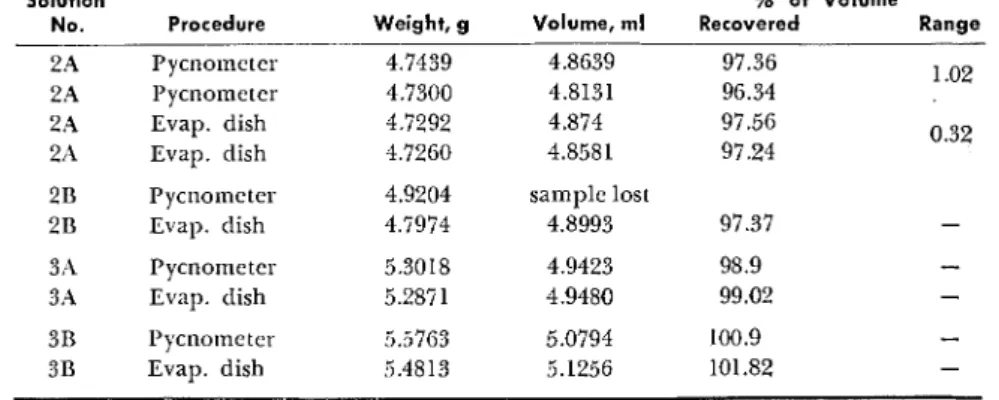
Coatings contain driers ancl a practical analytical scheme shoulcl not be affected by their presence. T h e effect of driers o n he volume measurement o l the vehicle was therelore one ol the first lactors in- vestigated. Concentrated solutions of a bodied linseecl oil and of a solventless alkyd resin were made and aliquots taken f o r lurther dilution as shown in T a b l e 1. T h e effects of the driers and o l the procedure for evaporating the solvent are shown in T a b l e 2.
T h e driers dicl not affect the bodied linseed oil result b u t dicl cause slightly high results with the more viscous alkycl resin. T h i s probably occurred because the alkycl tenclecl to skin over during the time required to remove the last traces o l solvent.
T a b l e I-Vehicle S o l u t i o n s W i t h and W i t h o u t D r i e r s
Material
Sample 3
Sample 2 100% Alkyd Resin Bodied Linseed Oil (Rezylm 869)
Viscosity (reported) 2-2
SIX gravity (determined) 0.9658
I\rcigh t, g. 96.5017 F i ~ s t dilution to 250 ml with 100 m l ~ n i n c r a l spiiits a n d 50 ml benzene Sample 2A Second tlilution 62.5 m l d i l u ~ e d to 250 1111. ThereEorc 50 ml contain: -1.8251 g 4.9959 in1 Drier addition Sample 2 8 125.0 m l oil solution 0.42 m l 24% lcatl 0.2-1 1111 GC/C cobalt d i l u t e d to 500 m l with benzene. 50 nll contain: Z-6 1.0706 107.0001 to 250 1111 with 100 ml mineral spirils alld 50 ml benzene Sample 3A 62.5 nll dililtcd to 250 ml. T h e r e l o r e 5 0 ml contain: 5.3500 g = 4.9972 m l Sample 3B 125.0 m l alkyd solution 0.42 m l 24% lcatl 0.26 m l 6 % cobalt dilutetl to 500 ml w i t h benzene. 50 1111 contain:
ANALYSIS FOR PIGMENT VOLUME CONCENTRATION
Table 2-Recovery of Clear Vehicles
Solution % of Volume No. Procedure Weight, g Volume, ml Recovered Range
2.4 Pycnomctcr 4.7439 4.8639 97.36 1.02
2.4 Pycnomctcr 4.7300 4.8131 96.34
2A Evap. dish 4.7292 4.874 97.56 0.32
2A Evap. dish 4.7260 4.8581 97.24
2B Pycnomctcr 4.9204 samplc lost
2B Evap. dish 4.7974 4.8993 97.37 -
3A Pycnomctcr 5.3018 4.9423 98.9
-
3.4 Evap. dish 5.287 1 4.9480 99.02
-
3B Pycnomctcr 5.5763 5.0794 100.9
-
3B Evap. dish 5.48 13 5.1256 101.82 -
Acltlition ol an anti-oxidant was suggested to overcome the skinning problem and thus reduce the evaporation time and minimize changes in the specific gravity of the vehicle. T h e anti-oxidant selected was 2, 6 di- tert butyl p-cresol (DBPC, B H T or Ionol-CP) ; solutions of 1 and 2y0 were made u p in benzene. T h e effect of 10 ml of the l y O solution on the vehicle volume ol the bodied oil (sample 2B) and the alkyd resin (3B) was determined as shotvn in T a b l e 3. A higher viscosity alkyd (sample 5) was then tested with both 1 and 2% solutions. T h e results are given in
T a b l e 4.
From T a b l e s 2 and 4 it can be seen that the evaporating dish is more accurate and slightly more reproducible than the pycnometer procedure. This was also true in additional tests not reported here. Driers did not influence the volume ol linseed oil but with the more highly polymerized alkyds tended to give high results because ol oxidation. This tendency was countered by the addition ol anti-oxidant and for the Z-10 alkyd, 10 ml ol 2% solution was required. This amount was 11sec1 in all subsequent work.
Only one more test was run on clear vehicles. All tests had been carried out on vehicles which were sornetvhat fluid at 25°C. It was decided to try the procedure on a material that would be solid at room
Table 3-Effect of Anti-Oxidant on Volume Recovery (10 ml 1% Solution DBPC Added: Evaporating Disli Procedure)
% of Volume Solution No. Weight, g Volume, ml Recovered Range
2B 4.7990 4.9527 98.43
2B 4.7912 4.9429 98.24 0.19
3B 5.3206 4.9804 98.94 0.82
T a b l e 4-Effect of A n t i - O x i d a n t o n Alkyd S o l u t i o n
Material 100qo alkyd resin (DuraplexB C-45LV)
Viscosity (reported) ZlO+
Spec. gravity (determined) 1.0886
Solution No. 5 55.8093 g alkyd
0.5013 g 24q0 lead 0.2594 g 6q0 cobalt 50 m l mineral spirits
Diluted to 500 ml with benzene .50 rnl contain: 5 5809 5.1267 0.0341 ,0237 0.0145 .0138 5.6295 g = 5.1642 m l VOLUME RECOVERY 10 ml 1% DBPC 10 ml 2% DBPC
Procedure Volume % Volume Volume % Volume Mean % Range
Pycnometer 5.2606 101.86 5.1938 100.57 101.22 1.29
Evap. dish 5.1645 100.01 5.1321 99.38 99.69 0.63
Mean
Yo
- 100.94 - 99.98 - -Range - 1.85 - 1.19 - -
Duraplex is a registered t~ademark of Rohm X. Haas C o .
temperature. I n order to have a sample of known solids and specific gravity, a hard resin was added to the last alkyd. T o determine the true specific gravity, the hard resin was melted at 65°C. in a vacuum oven until all air bubbles had disappeared. T h e density was measured by both the fine wire and solvent addition methods. T h e formula of the solution and the volume recovery are shown in Table
5.
T h e values were slightly high but were considered sufficiently ac- curate for the purpose. T h e method was then applied to pigmented materials.
T a b l e 5-Recovery of Solid R e s i n (Solution 6)
Resin Spec. Grav. Weight, g
Duraplex C-45LV 1.0886 13.9201
Poly pale ester gum 10 1.0855 13.8997
Diluted to 250 ml with 25 in1 mineral spirits and balance benzene
50 ml contain 5.564 g = 5.1184 ml
Weight
s
Volume, -Percent of Volume ml Recovered Mean Range
ANALYSIS FOR PIGMENT VOLUME CONCENTRATION
Determining Pigment Volume and PVC
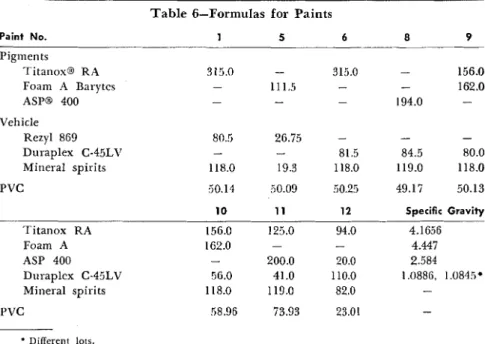
Paints were made up in a "Quickie" ball mi118 so that there would be no loss of ingredients. T h e materials were weighed to 0.1 g into the mill using a triple-beam balance. The steel balls were added at two or three stages during the loading of the mill to ensure adequate mixing, especially with paints containing a high percentage of pigment. When properly charged, a Hegman reading of 6% was obtained in 30 to
45
minutes from batches containing extenders. T h e formulas for the paints are listed in Table 6.T h e pigments used were first dried at 105°C. to ensure absence of water. Their specific gravities were also measured to calculate the volume of pigment present in the samples. The apparatus described in ASTM method D-153"as not available so the same wide-mouth pycnometers and low odor solvent used to obtain the vehicle densities were used together with a vacuum oven with the heat shut off. Weld pycnometers might have been a better choice although it is slightly more difficult to place the pigment in them. T h e procedure was to add the pigment and only part of the solvent to the pycnometer and expose to a vacuum of
28 in. for two hours. The vacuum was then released and the pycnometer gently agitated and tapped to remove air bubbles. Vacuum was again
Paint No.
Table 6-Formulas for P a i n t s
1 5 6 8 9 Pigments Titanox@ RA 315.0 - 315.0 156.0 Foam A Barytcs - 111.5 - - 162.0 ASP@ 400 - - - 194.0 - Vehicle Rezyl 869 80.5 26.75 - - - Duraplex C-45LV - - 81.5 84.5 80.0 Mincral spirits 118.0 19.3 118.0 119.0 118.0 PVC 50.14 50.09 50.25 49.17 50.13 10 11 12 Specific Gravity Titanox RA 156.0 125.0 94.0 4.1656 Foam A 162.0 - - 4.447 ASP 400 - 200.0 20.0 2.584 Duraplcx C-45LV 56.0 41 .O 110.0 1.0886, 1.0845+ Mineral spirits 118.0 119.0 82.0 - PVC 58.96 73.93 23.01 - Different lots.
Titanox is a registered trademark o f Titanium Pigment Corp., and ASI' is a registered trade- mark of Minerals 8: Chemicals Philipp Corp.
Table 7-Analysis of Single Pigment Paints
Percent Recovered
Paint Pigment Pigment Vehicle Vehicle PVC No. Weight Volume Weight Volume Determined % Error
applied f o r an hour after which the pycnometer was filled with solvent to obtain the total weight. Specific gravity values outside a range of 0.02 for four or more determinations were discarded.
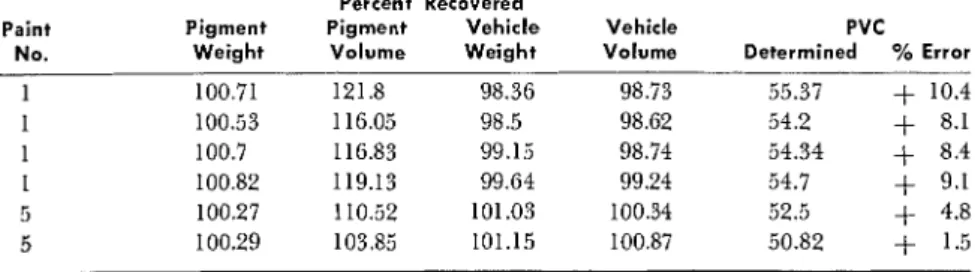
T h e analytical procedure was applied to the first two paints that were successfully produced. One colltainecl a hitling pigment with a particle size of about 0.4, microns. T h e other was made with a n extender with a particle size at least 10 times larger. Both pigments had about the same specific gravity a n d were dispersed i n the low viscosity alkyd. With these paints the volume of pigment was measured by adding 10 ml of kerosene containing 0.5% oleic acid a n d reading the total volume, as directed in the U. S. Federal Methoc1.6 T h e results in terms of the recovered percent by weight and percent by volume of the pigment a n d the vehicle are given in Table
7.
Obviously the main source of error was i n the measurement of the pigment volume, particularly with the fine particle pigment. T h e vehicle weight and volume ancl the pig men^ weight were all close to the correct values. Paint 6 was then subjected to analysis in which the volume of pigment was measured both by addition of solvent ancl through its specific gravity, as shown i n T a b l e 8.
By using the weight and specific gravity of the pigment its volume can be determined much more accurately than by estimating the volume directly. T h e resulting PVC's were accordingly closer to the true values. Placing the kerosene ancl pigment mixture under vacuum, as suggested
Run No. - 6-1 6-3 6-2 6-2 6-4 6-4 - -
-Table 8-Effect of Pigment Volume Measurement on PVC (Paint Sample No. 6)
Pigment Procedure Weight S. G. 100.49 S. G. 100.5 Addition 100.51 S. G . 100.51 Aclditiorl 100.5 S. G. 100.5 Pigment Volume Vehicle Weight 101 .67 101.64 101.5 101.5 101.88 101.88 Vehicle Volume 101.37 101.22 100.35 100.35 101.63 101.63 PVC Determined % Error 50.42
+
0.3 50.69+
0.9 52.95+ 5.4
50.66+
0.8 53.31+
6.1 50.5+
0.5ANALYSIS FOR PIGMENT VOLUME CONCENTRATION
in the Federal Methotl, d i d not affect the results. T h e specific gravity procedure was usecl in all subsequent work.
With the first pigmentetl samples the extracts were placed directly i n evaporating tlishes and the solvents removed after each extract was added. This meant that most of the vehicle which was obtained in the first ex- tract was heated four times which led to skinning in the vacuum oven. I t was fount1 preferable to keep the extracts in a florence flask a n d periodically distill off the solvent by immersing the flask in a hot water bath only to the level of the contents. After most of the solvent from the last extract had been removed, the coilcentrated vehicle was trans- ferred to the evaporating dish using benzene as wash liquid. As well as avoitling exhaustion of the anti-oxidant, this procetlure tended to floc- culate the fine pigment which hacl been carried into the extract. It was then possible to decant off the vehicle.
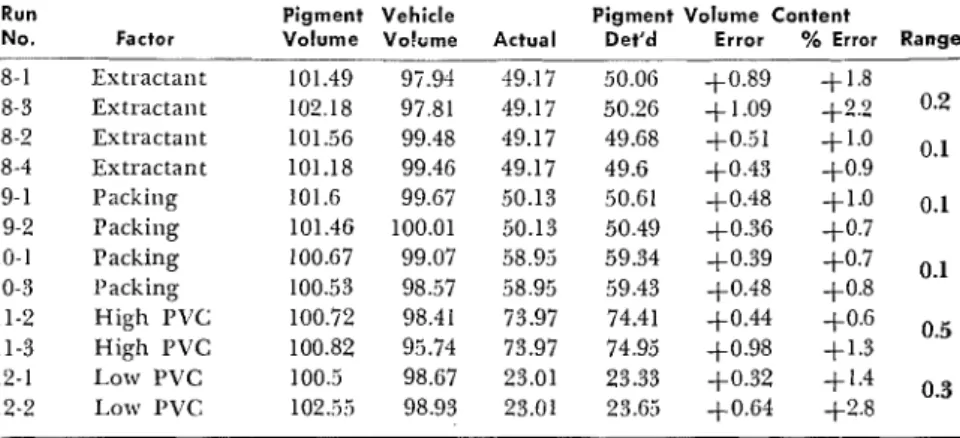
T h e last five paints were prepared ant1 analyzed to investigate the following factors: No. 8-low specific gravity pigment and effect of ex- traction solvent; Nos. 9 and 10-mixtures of coarse ant1 fine pigments of the same specific gravity; Nos. 11 and 12-mixtures of coarse and fine pigments of differing specific gravities at extremes of the PVC range. T h e results are s ~ ~ m i n a r i z e d in Table 9.
Four analyses were r u n o n paint 8 because it hat1 been noticed that it was not always possible to get a clear extract by centrifuging. Also when analyzing ail aluminum silicate sample the vehicle recovery hacl been low by almost 10%. U p to this time the usual extraction mix- ture listed in ASTh4 D-215, Gardner, and Federal Standart1 141 h a d been used. I11 a n attempt to get better separation a mixture which the author hacl developed some years previously for gravity settling of pig- ments was usecl. T h e stantlartl mixture was tried on runs 1 and 3, the special 011 rllns h a n t l .'I. As shown in T n b l c 9 the special solvent had
Run No. - 8-1 8-3 8-2 8-4 9- 1 9-2 10-1 10-3 11-2 11-3 12-1 12-2 Factor EstracLan t Extractant Extractant Extractant Packing Packing Packing Packing High PVC High PVC Low I'VC Low I'VC
Table 9-Final PVC Determinations
Pigment Volume - 101.49 102.18 101.56 101.18 101.6 101.46 100.67 100.53 100.72 100.82 100.5 102.55 Vehicle Volume 97.94 97.81 99.48 99.46 99.67 100.01 99.07 98.57 98.4 1 95.74 98.67 98.93 Actual 49.17 49.17 49.17 49.17 50.13 50.13 58.95 58.95 73.97 73.97 23.01 23.01
Pigment Volume Content Det'd Error % Error
50.06 +0.89 +1.8 50.26
+
1.09 +?.? 49.68 +0.51 +l.O 49.6 +0.43 +0.9 50.61 +0.48 +l.O 50.49 +0.36 +0.7 59.34 +0.39 +0.7 59.43 +0.48 +0.8 74.41 +0.44 +O.G 74.93 +0.98 +1.3 23.33 +0.32 +1.4 23.65 +0.64 +2.8 Range-
somewhat better vehicle recovery. Since it had also been of value in other analyses, it was used for the remaining samples. T h e composition of the two mixtures was as follows.
Extraction Mixtures (all parts by volume)
Standard Ethyl ethel. 10 Benzene 6 Methanol 4 Acetone 1 Special Benzene G Ethanol (95%) 2.5 Petroleum ethcl- 1.5
Table 9 shows the lower specific gravity of the pigment in sample 8 did not affect the results. Neither did differences in particle size, which might lead to pigment packing, whether the pigments were of similar or different density. T h e procedure was not noticeably affected by high or low pigment volume concentration.
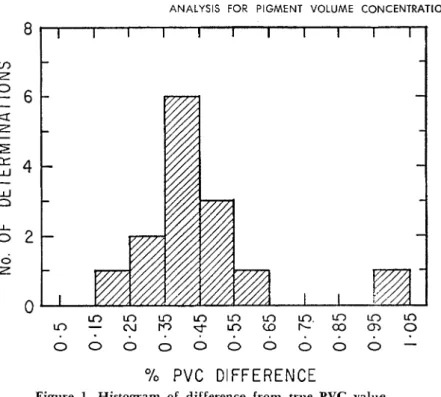
T h e results consistently tended to be high by about 0.4%. Figure 1
is a histogram of the differences between the cleterillinecl and the actual PVC's for paints 6 to 12. Considering the small number, the approxima- tion to the normal distribution curve is good. Run 11-3 can be re- jected as anomalous on the basis of Dixon's Q test for extreme values.1°
Errors in the determined PVC are chiefly attributable to the pig- ment volume. This is illustrated in run 12-2 where the recovered pig- ment weight was 100% but the pigment volume was 102.5%. Other runs showed the same trend although not to the same extent. T h e accuracy of the pigment volume depends upon the specific gravity measurement. In this work equipment normally available in a laboratory was used. Duplicates were run on each isolated pigment and the mean range was 0.02 although this value is the maximum allowable range in ASTM D-
1 5 3 . V t is considered that if a more reproducible method liad been used, or if the method used had been refined, even better PVC results coulcl have been obtained.
T h e standard deviation between duplicate PVC determinations was calculated to be 0.129a/o, excluding sample 11. Using the "studentized" range, the maximum permissible differences between duplicates should be 0.6% at the 99% confidence level. T h e usual 95
%
confidence range is not given because results from one operator are biased in favor of the accuracy of the method.SUMMARY
A procedure which has overcome some of the original objections has been developed for the analytical determination of PVC. Its chief disadvantage is the long time required, even in a vacuum oven to re- move all the solvent so that the true vehicle weight can be obtained. Contrary to the original assumption, pigment volume is the main source
ANALYSIS FOR PIGMENT VOLUME CONCENTRATION
O/o
PVC DIFFERENCE
Figure 1-Histogram of difference from true PVC value
of difficulty. Finally, the footnote in method 4312 of Standard 1416 should be revised since it has been demonstrated that the specific gravity pro- cedure is more accurate than that given in the method for obtaining the pigment volume.
T h e complete method is as follows.
Weigh about 15 ml of the pigmented material into a tared 50-ml ceiltrifuge tube. Add 10 ml of 2 % DBPC in benzene and mix with a
tared stirring rod. Add 15 ml extraction mixture, mix again and wash the rod with mixture to make a total volume of about 45 ml. Place the t ~ i b e in a centrifuge tube shield containing water and balance with a
duplicate tube. Whirl at a moderate rate until the pigment is well settled and decant the supernatant liquid into a tared 125 ml standard taper florence flask using benzene as wash liquid. Repeat the extraction twice with 40-ml mixture and once with 40-ml ethyl ether. During extractions distill most of the solvents from the flask by immersing it in a hot water bath to a depth equal to the level of contents. After the last extraction and distillation, transfer the concentrated resin solution to a tared evaporating dish, using benzene as wash liquid and leaving any floc- culated pigment in the flask. Heat on a steam bath until only traces of solvent remain and then place in a vacuum oven. Heat at 105°C. and 26- to 30-in. vacuum until the total loss in weight from two consecutive 3-
hour periods is less t l u n 10 mg. Cool in a tlesiccator antl weigh. I~Varnl
in he oven and transfer as much resin a possible to a tared Hubbard- Carmick pycnometer. Determine the specific gravity of tlie isolated vehicle as clescribed.7
Rileanwhile clry the pigment in the centriluge tube to constant weight after driving olf' the ether by immersing the tube in warm water. Cool in a desiccator antl weigh. Adtl the weight of any pigment in the Rask or atlhering to the stirring rod. Grind the pigment to a fine powtler and determine the specific gravity according to A S T M D-155.9
Vehicle Volume (V.V.) = IVcight of Vehicle Specific Gravity Pigment Volunle (P.V.) = IVcig11 t of Pigment
Spccific Gravity Pigmcnt Volume
Concentration (P.V.C.) = 1'.V. P.v.
+
V.V. X 100 Pcrcent Pigmcnt by IVeight of Pignlc?Weight
-
- IVeigllt of S;lmplcReferences
Asbcck, W. I<., ;nit1 \'an Loo, RI., "Critical Pigment Volunle Ilclationships," I n d . E12g Chciia., f I , p. 1470, (1949).
Philatlclphia Society for Paint Tcclinology, "Dctcrinination of C.P.V.C. by Cal- culation," Oficinl DIGEST 33, NO. 442, p . 1437 (1961).
Philadell>hia Paint a n d Varnish Production Club, "Prcdicting t h e Oil Absorp- tion and the C.P.V.C. on Multi-Component Pigment Spstc~ns," Oficiczl DICI.:ST 31, No. 418, p . 1490 (1959).
Sticg, F. B., "Color and C.P.V.C.," Oficiril DIGEST 25, No. 379, p . G95 (1956)
.
"Critical P.V.C. of Various P i g i n c t - E t c d c r Systcll~s," Titanium PigmentsCOI-p. (1951)
.
Method 4312, ' ' T ~ o ~ L I ~ ~ c I'erccntagc of l'igillcnt ill Total SOII-Vol:~tilc (Ccntri- fnge Ricthod) ," 1:cdcral Tcst IvIcthod Standard No. 141, Gcncral Scrviccs Atl- ministration, Washington, D. C. (1958) .
Ashton, H. E., "RIcasuring SpcciGc C;l.avity of Viscous Matel.ials," ;\Iatcrials Ice- scarch and Standards Joul.na1, ASTXI, Vol. 1, No. 7, p. 549 (1961)
.
Orwig, B. R., "The Quickic-A High Spccd Ball RIill," Oficicrl llrc~rn 26, N o .
356, p . 830 (1951).
A S T M Stnizrlnrds, Part 8, Methotl 11153-54, "Spccific GI-a\,ity of Pigments" (1961). Crow, E. L., Davis, F. A., and hiaxficld, XI. IV., "Statistics Maniial," Dovcr P u b - lications, Ncw York, p. 102 (1960).
Reprinted from t h e December 1962 issue o f Official DIGEST Volume 34; Number 455; Pages 1343-1354
Copyright 1962 by the Federation of Societies for P a i n t Technology Philadelphia, Pennsylvania, U.S.A.