READ THESE TERMS AND CONDITIONS CAREFULLY BEFORE USING THIS WEBSITE. https://nrc-publications.canada.ca/eng/copyright
Vous avez des questions? Nous pouvons vous aider. Pour communiquer directement avec un auteur, consultez la première page de la revue dans laquelle son article a été publié afin de trouver ses coordonnées. Si vous n’arrivez pas à les repérer, communiquez avec nous à [email protected].
Questions? Contact the NRC Publications Archive team at
[email protected]. If you wish to email the authors directly, please see the first page of the publication for their contact information.
NRC Publications Archive
Archives des publications du CNRC
This publication could be one of several versions: author’s original, accepted manuscript or the publisher’s version. / La version de cette publication peut être l’une des suivantes : la version prépublication de l’auteur, la version acceptée du manuscrit ou la version de l’éditeur.
Access and use of this website and the material on it are subject to the Terms and Conditions set forth at
Anisotropic thermal conduction in clay sediments
Penner, E.
https://publications-cnrc.canada.ca/fra/droits
L’accès à ce site Web et l’utilisation de son contenu sont assujettis aux conditions présentées dans le site
LISEZ CES CONDITIONS ATTENTIVEMENT AVANT D’UTILISER CE SITE WEB.
NRC Publications Record / Notice d'Archives des publications de CNRC:
https://nrc-publications.canada.ca/eng/view/object/?id=40743e5f-1a1e-4a59-b476-dc788034fbab https://publications-cnrc.canada.ca/fra/voir/objet/?id=40743e5f-1a1e-4a59-b476-dc788034fbab
Reprinted from
Internattonal c l a y Conference 1963
PERGAMON PRESS
A h l & k Y Z E D
OXFORD. LONDON
.
NEW YORK.
PARIS 1963ANISOTROPIC THERMAL CONDUCTION
I N CLAY SEDIMENTS?
E. PENNER
Soil Mechanics Section, Division of Building Research, National Research Council, Ottawa, Canada
A B S T R A C T
The parallel alignment of particles causes clay sediments t o be anisotropic t o thermal conduction. I n marine sediments with a flocculated structure the anisotropy is small. while in fresh water clays thnt have a regular alignment of clay particles it is shown to be large. The anisotropy was allown to he relnted t o particle alignment by comparing it with shrinltago results and particlo orientation observad in thin sections. The sensitive relationships between anisotropic thermal conduction and particle arrangement are useful for investigating soil structure and because of this the transient heat flow method used is clescribed in some detail.
IT
has been known for some time that the thermal conductivity of the mica minerals is highly anisotropic. Recent measurements for phlogopite indicate that the thermal conductivity is about one order of magnitude greater along the planes of cleavage than in the perpendicular direction (Goldsmid and Bowley, 1960). The structural similarity between the micas and the clay mineral group suggests this anisotropy to thermal conduction should apply also t o clays. I n both groups, the structure of the minerals consists of sheets or laycrs which are continuous in the a and b directions and are stacked one above the other in the third direction, c .Since clay minerals exist as small, discrete particles, usually less than 2p
in size, some regular alignment or preferred orientation would be required for anisotropy t o be evident in an assemblage of clay particles. Because most clay minerals are plate-like in shape-with the longer dimensions parallel to the cleavage planes-various degrees of alignment can occur in nature ranging from complete randomness to a perfect parallel arrangement depend- ing largely on the environments during deposition. Assuming the thermal conductivity of the individual clay particles is anisotropic by comparing it with the structure of the micas, a clay body composed of particles that have a preferred orientation should show similar behaviour.
This paper is a contribution from t h e Division of Building Research, National Research Council, Canada, and is published with the approval of the Director of the Division.
There is little information regarding this aspect of heat flow in soil, although various related heat flow studies have been carried out. The effect of the macro soil structure type on thermal conduction in the pedological horizons of arable soils has been studied by Smith (1942). Kersten (1949) experimentally evaluated the influence of moisture, density, and temperature on thermal constants for a number of structureless soils and derived empirical ther- mal conductivity equatioils for different soil types. Others have studied the thermal diffusion of water in soil under temperature gradient (Hutcheon, 1958; ICuzmak and Sereda, 1958) and its attendant influence on heat con- duction (Woodside, 1958a; Woodside and Cliffe, 1959).
The semi-theoretical treatment reviewed by De Vries (1952), Van Rooyan and Winterltorn (1957), and Woodside (1958b) indicates that sometimes the thermal conductivity of soils can be successfully predicted. Although some of these worlrers have alluded to the anisotropic nature of the soil particles to heat conduction, the laboratory measurements and theoretical predictioils have been made on the basis of random particle orientation in bulk.
This paper reports the results of thermal conductivity measurements for several naturally seclimented clays in the directions parallel and normal to the ground surface and also for laboratory consolidated soils. The most recent views about the relation between the kind of clay fabric formed duiing deposition and the nature of the environment, the alignment of clay particles actually observed in thin sections, and the dimensional changes observed during shrinking, substantiate the view that the anisotropic thermal con- ductivities measured are a result of particle arrangemellt.
E X P E R I M E N T A L
A transient heat flow method using a line heat source was employed to measure the thermal conductivity. The line heat source* is a hollow metal probe with an outside diameter of 0.02 in. (0.051 cm) and 4 in. long (10.2 cm) (Fig. 1) and has been described by D'Eustachio and Schreiner (1952). The probe contains a uniformly spaced heating coil with a resistailce of about 885 ohms and a constantan-Cl~romel P thermocouple inside the heater coil half- way along the probe. The probe thermocouple was calibrated over the required temperature range with a platinum thermometer and a G-2 Mueller bridge capable of measuring temperatures to about l/lOOO°C. The e.m.f. of the probe thermocouple was measured during calibration with a K-3 Leeds and Northrup potentiometer.
The power supply circuit for the probe contained a number of variable resistors for current adjustment, t o ensure a constant heating rate, and a calibrated 10 ohm standard resistor. The voltage drop across the standard resistor was monitored with the K-3 Leeds and Northrup potentiometer and adjustments to keep the heating current constant were made accordingly.
*
The probe was constructed for the author by Custom Scientific Instruments Inc., Kearney, New Jersey, U.S.A.A dummy resistor equal to that of the probe was keyed into the circuit t o stabilize the wet-cell batteries before each run. The entire circuitry was subinergcd in a temperature controlled oil bath.
The soil specimcns were brought t o 25OC inside a 1 ft3, insulated, tempera- ture-controlled box. The box contained a temperature-conditioned metal plate for chaiiging the spccimen temperature rapidly. Prior t o each thermal conductivity determination the sample was lifted from the temperature plate and was suspended in air in the centre of a box to avoid any sudden tcmperature fluctuations of the specimen.
The probe e.m.f. was pre-amplified 200 times and recorded on a 5-mV Leeds and Northrup line recorder with the paper moving a t 30 in. (76.2 cm) per hr. E.m.f. measurements were started exactly 2 min after turning on the supply current to the probe and continued until the 15-min mark. The conductivity was then calculated from the formula:
where, t 2 and tl are the times corresponding to the probe temperatures
e2
and 81, andQ
is the heat input. Ry plotting ln t z-
1; t l versus temperature change, a straight line was obtained between tl = 2 min and t2 = 15 min. Most of the determinations were done at a current of 0.019 mA which gives a heat input of 0.957 W per foot of probe. While this is high compared t o that used for insulation materials, this input was necessary to achieve a satisfactory e.m.f. output because of the higher thermal conductivity of soil. The probe results were checlred on a material of knomin conductivity.It
was found t o give higher values than those obtained from the guarded hbt plate technique. Decreasing the size of the specimen to the length of the probe (4 in. or 10.2 cm) gave values more in agreement with other methods. From this it appeared that there were end heat losses which were greatly reduced by not having the specimen material extend beyond the length of the probe. Some end losses could not be avoided since one end of t h e probe was fixed in a plastic block. It was still necessary, therefore, to apply a correc- tion. This was done on the basis of condiictivitv values for rubber obtained from the standard guarded hot plate technique.Since the thermal conductivity of the soil specimens was to be determined in two directions a t right angles t o each other in successive measurements, the test specimens were cut into 4 in. cubes. This provided a t least a 2 in. thiclrness of material a t right angles t o the long axis of the probe when it was positioned on any of the three possible centre lines of the cube. Theoretical temperature calculations with time and distance as variables showed this to be a sufficient thickness t o avoid any boundary interference during the period of measurement.
The conductivity measured with the probe position normal t o the long axis of preferentially oriented clay particles was called
kh
(position 1); with the probe a t right angles t o this, i.e. parallel t o the long axis, it was called ki(position 2) (Fig. 2). From these measurements it can be shown that the thermal conductivity in the direction across the clay platelets is given by (kr)2/(kh) =
k,
and along the long axis of the clay platelets is kh (Carlslaw and Jaeger, 1957). Joy also used this method for measuring the anisotropic thermal conductivity of insulating building materials consisting of oriented fibres (Joy, 1957). P O S I T I O N I' PROOE POSITIONED NORMAL TO TOP OF SAMPLE, CONDUCTIVITY M E A S U R E D I S khorizontol O R l E I i T E D PLATELETS WIRES POSITION 2 PROBE P D S I T I O N E D HORIZONTAL TO TOP OF SAMPLE, CONOUCTIVITY MEASURED I S k~Fro. 2. Schematic drawing of 4 in. cube sample containing clay platelets with the long axis horizontally oriontod to ground surface. The position of tho probe and t h e direction i n which conductivity is measurod are also shown. Memuroments a r e - t a k e n on t h e centro line of t h e cube.
S O I L S
The three clay deposits studied were a postglacial marine sediment (Leda clay) from the Ottawa area in Ontario, a glacial lacustrine sediment from the Seven Sisters dykes in the province of Manitoba and a clay shale of marine origin of Upper Cretaceous age known as Bearpaw shale from the South Saskatchewan River damsite near Outlook, Saskatchewan.
Leda Clay
A recent mineralogical study (Brydon and Patry, 1961) of Leda clay shows that mica is the predominant clay mineral and is also well represented in the silt and sand fractions. Feldspars predominated in the coarser fractions but occurred also in significant amounts in the clay size range. I n general, quartz, feldspars, amphiboles and mica were always present in the clay fraction. Chlorite, vermiculite and montmorillonite and mixed-layered min- erals were usually but not always present. Leda clay has a low cation ex- change capacity of less than 20 m-equiv/100 g and a pore water salt concen- tration of less than 2 g/l. in the Ottawa area (Penner, 1963).
FIG. 1. Pittsburgh Corning thcrmnl conductivity probe.
FIG. 3. Photomicrographs of sediments of different origins showing t h e degree of horizontal orientation. Top row: Maximum reinforcement; Bottom row: Maximum interference. Mag. x 90. (A, Seven Sisters Clay- Lacustrine; B, Bcrtrpaw Shale-Mnrinc Clay Shale; C, Ledn Clny-Marine).
ANISOTR~PIC THERMAL CONDUCTION w CLAY SEDJXENTS 369 The peculiar geotechnical properties of Leda clay from the Ottawa area have been described (Crawford, 1961) and are thought to be the result of its marine origin and its subsequent reduction in salt concentration by l e a o w . Swelling and shrinkage studies (Warkentin and Bozozuk, 1961) suggest a nearly randomly oriented structure since it shrinks only slightly more hori- zontally than in the vertical direction. The soil is shghtly to moderately overconsolidated ranging from
g
to 3 tonsjftz (or kg/cmz). The undrained shear strength ranges from to 2 tons/ftZ (or kglcmz). Sensitivity, the ratio of the undisturbed shear strength to the remonlded shear strength, is often in the hundreds. Frequent flow slides along river terraces are characteriatio of this deposit.Bearpaw Shale
The clay-size fraction of Bearpaw shale in Saskatchewan of the Upper Cretaceous is mineralogically a mixture of illite and montmorillonite of varying proportions (Lambe and Martin, 1953). Some kaolinite is also reported.
Deposition of this sediment took place in an extensive sea which stretched from the Arctic to the Gulf of Mexico (Edmunds, 1950), and hence a floccu- lated structure could be anticipated. These deposits are estimated to have been subjected to pressures between 100 to 150 tons/ftz (or kg/omz) arising from the past overburden and ice pressures. Subsequent unloading from erosion has resulted in a softening and swelling depending somewhat on the depth below ground surface. The present sample was taken well within the hard zone in which the least rebound has taken place. The undrained shear strength ranges from tonjft2 (or kg/cm2) in the soft shale to 19 tonsjft.2 in the hard shale (Peterson, 1958).
Seven Sisters Clay
The glacial Lake Agassiz lacustrine deposit from the Seven Sisters dykes area is mineralogically similar to the Bearpaw clay shale acaording to the results given by Lambe and Martin (1956). Illite and montmorillonite make
up 95 per cent of the clay minera1s. The clay sue content is nnusually high with almost 100 per cent of the particles falling within the clay sue range. From the geotechnical properties reported by Peterson et al. (1957) it is obvious that the deposit varies considerably. At a depth of 14 ft (4.25 m), where the present sample was taken, the soil is highly plastic, has a low semi- tivity of 1 or 2 and a range of undrained shear strengths &om
&
to 1 ton/ft2 (or kg/cmZ) based on laboratory unconfined tests (Peterson et al., 1957). Unpublished results a t the Division of Building Research indicate the deposit to be normally consolidated or perhaps slightly overconsolidated although there is some diffculty in determining reliable values for highly-swelling clay deposits.The percentage of particles in the clay and silt sue range for the three soils is given in Table 1.
Maine Clay-Led* Clay 103 9 6 1 3 9 6 8 0 < 2~ Clay % Silt %
SAMPLE P R E P A R A T I O N AND P R O B E PLACEMENT The undisturbed specimens were cut from block samples into 4-in. cubes (10.20 cm) (noting the orientation with reference to the ground surface) and were coated with a thin film of carbowax to prevent water loas during the test period. The isotropically-consolidated samples were consolidated from remoulded Leda clay in a 6-in. (15.24 cm) diameter mould and cut into the required cubes and waxed.
The Seven Sisters soil and the natural and remoulded Leda clay sample8 were soft enough to insert the heat probe directly. For the
labor at or^.-con-
solidated specimens and the Bearpaw shale, the probe was iastalled in two ways: either by slicing the sample and sandwiching the probe along a groove or by inserting the probe in a pre-drilled hole. The former was considered to be the better method.R E S U L T S AND DISCUSSIONS
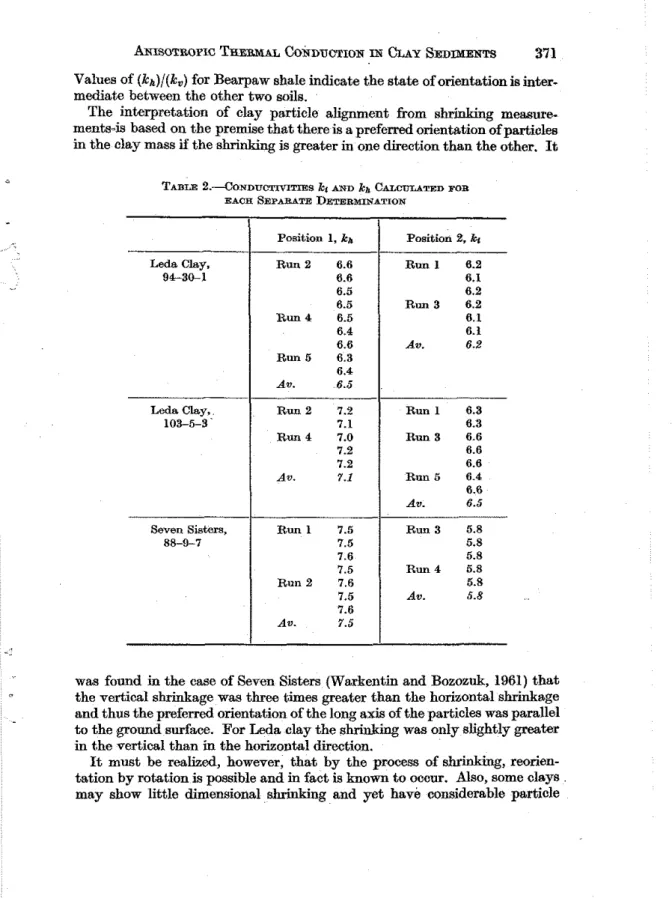
Typical examples of the precision in successive thermal measurements are shown by the calculated conductivities &om the individual measurements for two Leda clay samples and one Seven Sisters sample in Table 2.
The average conductivity results for all soils are given in Table 3 together with their moisture contents and densities. The moisture contents are for the fully saturated state as obtained from the field.
From the magnitude of the measured ratios of the horizontal to vertical condudivities for the three soils in their natural structure, it can be deduced that the Seven Sisters soil has the best horizontal orientation of particles (ratio 1.59 to 1.70), followed by the Bearpaw shale (ratio 1.24 to 1.26) and Leda
clay (ratio 1.05 t o 1.13) shows the least orientation. Thia is in agreement with the extent of shrinking in the horizontal and vertical direction from the results of Warkentin and Bozozuk (1961) for Seven Sisters and Leda clay.
Values of (kh)/(k,) for Bearpaw shale indicate the state of orientationis inter- mediate between the other two soils.
The interpretation of clay particle alignment from shrinking measure- ments-is based on the premise that there is a. preferred orientation of particles in the clay mass if the shrinking is greater in one direction than the other. It
TABLE ~ . ~ O N D U O T M T I E S kt I W D kh C A L ~ T E D FOB
EACH S E P ~ T E DETEBM~ATION
was found in the case of Seven Sisters (Warkentin and Bozozuk, 1961) that the vertical shrinkage was three times greater than the horizontal shrinkage and thus the preferred orientation of the long axis of the particles was parallel to the gronnd surface. For Leda clay the s h r i n k i i was only slightly p t e r in the vertical than in the horizontal direction.
It must be realized, however, that by the process of shrinking, reorien- tation by rotation is possible and in fact is known to occur. Also, some clays may show little dimensional shrinking and yet have considerable particle
Leda. C h y , 94-30-1 Lede Clay, 10b5-3 Seven Sisters, 88-9-7 Poaition 1, En Run 2 6.6 6.6 6.5 6.5 Run 4 6.5 6.4 6.6 Run 5 6.3 6.4 Au. 6.5 Run 2 7.2 7.1 Run 4 7.0 7.2 7.2 A v . 7.1 R u n 1 7.5 7.5 7.6 7.5 Run 2 7.6 7.5 7.6 Av. 7.5 Position 2. k+ Run 1 6.2 6.1 6.2 Run 3 6.2 6.1 6.1 Av. 6.2 Run 1 6.3 6.3 Run 3 6.6 6.6 6.6 Run 5 6 4 6.6 Av. 6.5 Run 3 5.8 5.8 5.8 Run 4 5.8 5.8 A". 5.8
T A ~ E 3.-REYUM~ Ox THE&MAL CONDUCRVITIES FOR THE V-ous S&WR*TED ~ Y S ( B ~ u in./ft2/hi"B')
Y dry density.
ha horizontal thermal conductivity measured.
ki thermal conductivity measured with probe in horizontal position (kdz
k, vertical oonductivity calculated from 7
.
-n
*
for isotropiedly oonsolidsted soil8 in the laboratory, the horizontal direotion is taken an normal to the direction of consolidation.alignment. The method therefore has limiting features and is not always applicable.
Information on orientation can also be obtained from thin sections prepared from natural clays since a group of clay particles oriented in the same direc-
tion display crystal properties. This was done for the three soils by the
-
technique of allowing replacement of the water in the clay with a melted wax(Mitchell, 1956). After wax impregnation, mmplea were mounted on glass , slides using a mld setting adhesive. Grinding and polishing were done with kerosene as the lubricant instead of water; otherwise the procedure was the same as for the making of thin sections from rock specimens.
y , lb/ft5 60.5 67.4 69.3 68.5 61.7 95.2 73.7 92.4 04.3 66.8 65.5 108.0 106.0 Soil typo iMari-Ledo 103 94-30-1 94-30-2 9P30-3 94-13-1 103-5-3 103-7-1 105-7-3 Lanrslrine-Seven Moisture content % 67.0 56.0 56.3 58.9 65.2 29.8 48.6 31.7 58.2 56.3 66.8 21.4 21.5 kn* 6.1 6.5 6.5 6.4 6.1 7.1 6.5 7.2 7.5 7.4 7.3 9.7 9.9 N a t d structufe or laborstory consolideted Cloy Natural structure Natural structure N a t u d struoture Natural structure Natural stmoture Remoulded and lab.
consolidated t o 28 tons/ftz Remoulded, and lab.
consolidated to 1.5 tona/ftz
Rsmoulded, lab. con- mlidated to 28 tons/fts and rebounded Sisters ki 5.8 6.2 6.3 6.3 5.8 6.5 6.1 6.6 5.8 5.8 5.8 8.7 8.9 I 88-9-7 Natural structure
I
88-1P1 Natural structure 88-14-2 Natural stmoture Marine Cloy Shale-Beovpaur Shale88-13-1 88-13-2 (kt)% kn . k" =
-
5.5 5.9 6.1 6.1 5.4 5.9 5.7 ' 6.0 4.4 4.6 4.6 7.7 8.0 I Natural structure Natural structure ka (kn)= ku (k'p-
=-
-
1.11 1.10 1.07 1.05 1.13 1.20 1.14 1.20 1.70 1.62 1.59 1.26 1.24 IANI~~TROPIC THERMAL CONDUCT~ON
w
CLAY SEDIMENTS 373By viewing thin sections of oriented clay particles during 360 deg of rotation between crossed polaroids, four stages of light reinforcement and interference are observed when the direction of observation is normal to the short axis of the clay particles and rotation is at right angles to the line of viewing. When the direction of observation is parallel to the short axis and rotated
at right angles to the line of viewing there is no change in the illumination. Similarly, if thin sections of randomly oriented clays are viewed in this way, no change in the illumination is observed. To determine the existence and/or direction of orientation, thin sections are made from both vertical and bori- zc.ntal slices of the soil being examined.
Paired micro-photographs of maximum interference and reinforcement of thin sections of vertical slices are shovn in Fig. 3. The differerne in illumina- tion between the light and dark stages in each pair give the degree of orien- tation. It is obvious from this that the Seven Sisters soil has the best align- ment of particles followed by the Bearpaw shale and then Leda clay. In all
cases the preferred orientation of the long axis of the particles was parallel to the ground surface. This is in agreement with anisotropic conductivity results as given in Table 3. Thm sections of all horizontal slices of all soils 3hwed a uniform greyness under the above conditions.
There were also differences between the Leda clay samples. Sample 9 M 0 , m t h a high sensitivity of around 1500, showed the least orientation based on (k*)/(k,) ratios. Sample 94-13 had a sensitivity of about 30 and Sample 103, also with low sensitivity, had slightly higher (kh)/(k,) ratios, indicating slightly m3re particle alignment. Vertical thin sections showed the same trend, i.e. there was slightly more contrast between maximum interference and rein- fozcement for sample 94-13 and 103 than for sample 9630.
As has been shown by others, isotropic consolidation produces some akgnment of clay particles with the long axis normal to the direction of consolidation. Samples 1 0 3 4 3 and 105-7-3 were consolidated at 28 tons/ftZ (kjcm2) (using remonlded soil) to a dry density of over 90 lb/ft3 (1.44 g/cm3) from an original field density of around 60 lb/ft3 (0.96 glcm3). The latter sample was allowed to swell after consolidation but did so only by a small anount. Both showed (kh)/(k,) ratios of 1.20. Sample 103-7-1 which was mnsolidated to only a slightly higher density than existed in the field also had a slightly higher conductivity ratio than did the natural soil.
These studies show that heat Aow measurements can detect the preferred amentation of clay particles in saturated soils and that the transient heat flow method using a line heat source is a simple, fast and suitable method. Both the thin-section and heat flow method have the advantage that the orientation
3 determined without permitting any further realignment which is not the
o m in the relative dimensional swelling and sg- method. Further, aa
stated before, in non-swelling clays some methods other than those based on relative dimensional change must be used.
Comparing the heat flow and thin-section methods, the latter provides a permanent record and also allows other visual studies of the fabric to be
carried out by microscopic means. On the other hand, the heat flow method has the advantage of simplicity and of being less time consuming once the equipment is assembled.
Since the study indicates that thermal conductivity can be used to detect the degree of alignment of clay particles it follows that when thermal conductivity determinations of clay soil. are made in the laboratory for application in the field, the nature of the soil fabric produced in sample pre- paration must be similar to the natural structure. If this cannot be done, the values would not necessady apply. Differences in the fabric and hence in thermal conductivity might be anticipated between different methods of sample preparation such as isotropic-consolidation, kneading or dynamic compaction.
Such studies as these also permit some tentative deductions about the soil fabric in natural sediments. Leda clay is thought to have been sedimented in salt water (as yet of unknown concentration) n.aulting in a fluc~~~~lntcd ntruc- ture. SuLsrqurnt Ioadi~~g ~ I I P to thr weight of tltyosi~ above thc puint of sampling appears to have caused some horizontal orientation of particles. This is supported by shrinkage, heat flow measurements and thin-section studies. The Bearpaw clay shales, also of marine origin, have been subjected to a much higher pressure (probably 100 to 150 tons/ft2) and while a greater degree of horizontal alignment exists in these deposits, both the heat flow and thin-section studies indicate the alignment is less perfect than that exist-
ing in the Seven Sisters Lake Agassiz fresh water deposit. It follows from this that overburden or other pressures have only a secondary effect on the alignment of particles and that the soil structure is "built-in" at the time of sedimentation. This is further borne out by s u b j e d i g remoulded Leda clay to unidirectional pressures of 28 tons/ftz. The alignment was only slightly improved as shown by the results in Table 3.
SUMMARY AND CONCLUSIONS
1. These studies show that thermal conductivities in the vertical and horizontal direction in clay sediments are not always the same. Since clay particles are small, the anisotropy can be measured only in an assemblage of particles. The anisotropy of individual clay particles to thermal conduction is a reasonable assumption because of their structmal similarity t o the micas. 2. The anisotropy to thermal conduction was shown to be conclusively related to particle alignment by comparing it with the particle orientation observed in thin sections of soil specimens a t the natural moisture content.
It was also in agreement with the deduced alignment from shrinkage studies reported by others.
3. The structure deduced from thermal conductivity measurements is also consistent with present opinion about the influence of sedimentation environ- ment on clay particle arrangement
in
clay deposits. The h s h water clay Gom Lake Agassiz showed the greateat anisotropy, followed by a h t a c e o n sclay-shale of marine origin and lastly a phst-glacial marine deposit. There is a suggestion from results of isotropically-consolidated marine clay that such pressures have only a secondary S u e n c e on particle arrangement.
4. Heat conductivity measurements on laboratory compacted clay soila are not necessarily applicable to the field if a similar structure to the field condition is not attained, although the density and moisture content may be the same.
5. The transient heat flow method for determining thermal conductivity with a line heat probe is a fast, simple and convenient technique for detecting the preferred orientation of particles in clay sediments.
REFERENCES
Brydon,
J.
E. and Patry, L. M. (1961) Mineralogy of a Ridesu clay profile and some Champlain Sea sedimente: Con. J. Sod Sci., v. 41, No. 2, pp. 169-181.Carlslaw, H. S. m d Jaeger, J. C. (1957) Conduction oj HeQt in Solida. Oxford, Clarendon
Press, 1957 edition, pp. 256-261.
Crawford, C. B. (1961) Engineering studies of Led* clay. In Royal Society of Cm&. Special Publieation No. 3, pp. 200-217.
D'Euatachio, D. and Schreiner, R. E. (1952) A sttldy of s transient heat method for me-ing t h e r r d eonduetivity, ASHVE, J o u d Section, June 1952, pp. 113-117. De Vrins, D. A. (1952) The thermal oonduetivity of soil: Mededellngen, "on de Land-
bmwhogeschool te Wageningen, v. 52, No. 1, pp. 1-73.
Edmunds, F. H. (1950) Geology and its relationship to mi18 in Saskatchewan: University of Saskatohewan, Soil Survey Report No. 13.
Goldsmid, H. J. and Bowley, A. E. (1960) Thermal eonduotion in mice along the planes of cleavage: Ndure, v. 187, pp. 864-865.
Hutohson, W. L. (1958) Moisture flow induced by thermal gradients within unsaturated soils. =ghway Research Board, Special Report No. 40, Water and I t s Conduction in Soils, An Internstional Symposium, 1958, pp. 113-133.
Joy, F. A. (1957) Thermal conductivity of insulation containing moisture: American Soe. of Tasting Materials, Speoial Publiontion No. 217, pp. 65-79.
Kersten, M. S. (1949) Thermal properties of soils: University of Minnesota, Engineering Experiment Station B d e t i n No. 28.
Kuzmak, J. M. and Sereda, P. J. (1958) On the mechanism by which water moves through a, porous material subjected to s. temperature gsdient. Highway Research Bomd, Special Report No. 40, Water and Its Conduction in Soils, A n Intemtional Symposium, 1958, pp. 136146.
Lamba, T. W. and Martin, R. T. (1953) Composition and engineering properties of soil: Highway Research Bosrd, Proo. 32ad Annual Meeting, pp. 676-690.
Lsmbe, T. W. and Martin, R. T. (1956) Compaction and engineering properties of soil (IV): Highway Rs-earch Board, Proo. 35th Annual Meeting, pp. 661-677.
Mitchell, J. K. (1956) The fabric of n ~ t w a 1 c l a p and its relation to engineeringproperties. Highway Resesrch Bosrd, Proo. 35th Annu4 Meeting, pp. 693-713.
Penner, E. (1963) Sensitivity in Leda day, Natuve, v. 197, p. 347.
Peterson, R., I v e m n , N. L. snd Riwrd, P. J. (1957) Studies of eeveral dam failures on clay foundations : Proc. 4th I d . Conj. onSdl Meckan5~~ond Pwndotim E+mering. v. 2, pp. 348-352.
Peterson, R. (1958) Rebound in the Bearpaw ~hals, Western Canada: Bdl. awl. Soo.
Arne?., v. 69, pp. 1113-1124.
Smith, W. 0. (1942) The thermal conductivity of dry soi1:Soil Science, v. 63, No. 6 , pp. 435459.
Van Rooyan, M. and Winterkorn, H. F. (1957) Theoretical and practical m p t s of the thermal oonduotivity of soil and similar granular soil: Highway Ra-oh Board. Bulletin No. 168, pp. 14.3-205.
Warkentin, B. P. and Bozozuk, M. (1961) Shrinking and swellingpmpertissof two Cana- d i m clays: P ~ o o . 6th lint. Conf. on Soil MecFanw and Foundation E w i d n g , v. 1. pp. 851-855.
Woodside, W. (1958a) Probe for thern~al conductivity measurement of dry and moist merteds: ASHAE Jounull Section, Heatiw, Piping and Air CmdiAming, v. 30, No. 9, pp. 163-170.
Woodside, W. (1968b) Calculation of thermal oonduct~vity of pomusmedis: Can. J. Phys., v. 36, No. 7, pp. 816-823.
Wwdside, W. and GI&, J. B. (1959) Heat and moisture transfer in closed systems of two granular materials: Soil Sciem, v. 87, No. 2, pp. 7E-82.