THE CASE OF KENYA's HOUSING POLICY
by
John Temediari Obomanu B.A., Rutgers University
(1981)
Submitted to
the Department of Urban Studies and Planning in Partial Fulfillment of the Requirements
for the Degree of Master of City Planning
at the
Massachusetts Institute of Technology May 1983
John T. Obomanu 1983
The author hereby grants to M.I.T. permission to reproduce and to distribute copies of this thesis document in whole or in part.
Signature of Author
Department of Urban Studies and Planning May 25, 1983 Certified by: Karen R. Polenske Thesis Supervisor Accepted by: Donald A. Schon Chairman, Department Graduate Committee
qotchl
MASSACHSE1JS INSrTiTrWOF TECHNOLOGY
JUL 2 1 1333
Abstract
CONSTRAINTS IN PLAN IMPLEMENTATION: THE CASE OF KENYA'S HOUSING POLICY
by
John Temediari Obomanu
Submitted to the Department of Urban Studies and Planning on May 23, 1983, in partial fulfillment of the requirements
for the degree of Master of City Planning
A great deal of attention has been paid to housing policy in Kenya. Yet there remains a general feeling among the KenyanS that the performance of the public housing sector has been less than satisfactory. The public housing sector has produced only a fraction of the housing called for during the last two development plan periods and it appears as if the housing objectives of the Fourth National Development Plan of providing each Kenyan with a decent house to live in will not be realized in the near future. Numerous theories and methods of resolving the housing problem have been used, yet it is evident that they have not been able to achieve their objectives. This thesis is an attempt to understand the problems surrounding the approaches that have been used in solving Kenya's housing problems.
It is the contention in this study that the housing problems realized in Kenya result from their inability to implement their policies and strategies such as the "basic needs" approach (BNA). Furthermore, it is the contention of this study that the BNA is not implementable in a country such as Kenya, that does not possess the necessary requirements for a successful strategy.
Some of the recommendations provided in this study call for (1) genuine commitment on the part of the administration; (2) providing clearer definitions as to policy goals and how they are to achieve such goals; (3) setting their goals accordingly with the amount of resources available in the country; and (4) restructuring the government, so that lower-income groups can be better served.
Thesis Supervisor: Karen R. Polenske
ACKNOWLEDGEMENTS
I would like to thank the following people for their assistance in enabling me to complete this thesis: Karen Polenske, my thesis advisor, for her help and advice when I needed it most; Lloyd Roduwn for his constructive criticisms and guidance; Phil Clay for his patience and comments; Ebelechukwu Agba for finding the time to discuss and review the study with me; Jennifer Hill for her editing; Earl Douglass and Michele Richardson for typing initial drafts; Marie Southwick for her professionalism in completing the final draft; and Israel and Mary Obomanu, my parents, for their support throughout my stay in college. This thesis is dedicated to them.
TABLE OF CONTENTS Abstract . . . . . . . . . . . . . . . . . Acknowledgements . . . . . . . . . . . . . Table of Contents. . . . . . . . . . . . . List of Tables . . . . . . . . . . . . . . CHAPTER ONE: CHAPTER TWO: CHAPTER THREE: CHAPTER FOUR: CHAPTER FIVE: INTRODUCTION. . . . . . . Statement of the Problem. Purpose and Objectives.
Rationale . . . . .. . . Plan of the Thesis. . .
THEORETICAL BASIS ON WHICH THE BASIC NEEDS APPROACH IS FOUNDED Housing Development Approaches
in Kenya since Independence . . . . Kenya's Fourth National Development Plan: The "Basic Needs" Approach Housing Strategies Adapted
from the "Basic Needs" Approach Case for and Criticisms of the
"Basic Needs" approach. . . . . . . HISTORY AND IMPLICATIONS OF
KENYA'S HOUSING POLICIES. . . . . . Indicators of Housing Performance . Conclusion. . . . . . . . . . . . . CONSTRAINTS IN THE IMPLEMENTATION OF THE "BASIC NEEDS" APPROACH
IN KENYA's HOUSING POLICY... Introduction. . . . . . . . . . . . Formulation . . . . . . . . . . . . Centralization. . . . . . . . . . . Resources . . . . . . . . . . . . . CONCLUSION. . . . . . . . . . . . . Review of the Purpose and
Objectives. . . . . . . . . . . . . Page 2 3 4 6 7 9 11 11 13 15 17 23 30 32 38 43 55 58 58 58 72 84 89 89
Table of Contents (Continued) Page Recommendations . . . . . . . . . . . . 91 BIBLIOGRAPHY. . . . . . . . . . . . . . . . . . . . . . 104 Appendix . . . . . . . . . . . . . . . . . . . . . . .. 112
LIST OF TABLES 2.1 Projected Need and Cost of
Housing Units by Type in Kenya. . 2.2 IBRD/IDA Lending by Sectors . . . . . 2.3 Shares of GNP Accruing to
Income Groups in Kenya. . . . . . . . 2.4 Nairobi Household Income Distribution
3.1 Annual Allocation of Development
Funds for Housing--Public and Private Sectors (Planned) . ... . . . . . . . 3.2 Percentage Distribution of Urban
Dwelling Units by Sector. . . . . . . 3.3 Local Authority Housing Stock . . . . 3.4 Urban Growth Projections to Year 2000 3.5 Value of Residential Building Plans
Approved by Municipalities. . . . . . 3.6 Rent Index for Nairobi, 1975-79
by Income Group.. . ... 4.1 Geographical Distribution of Houses
by Income Group . . . . . . . . . . . 4.2 Construction of Infrastructure
Services for Completed Schemes. . . .
Page 16 25 35 36 44 46 47 50 51 54 79 81
CHAPTER ONE INTRODUCTION
Despite many years of sustained efforts by the international community, the problems of economic development seem to be growing in size and complexity in Kenya. Many solutions to Kenya's development problems have been proposed over the last two decades. These development problems have changed from being almost exclusively concerned with achieving rapid rates of growth in gross national product (GNP) to being more immediately concerned with the living conditions of the poorest economic strata of societies. Over a period of several years, various general development theories have been introduced--namely (ILO, 1977, p. 1): "capital accumulation," "availability of foreign exchange," "industrialization," "import substitution," "export-oriented substitution," "rural development," "population control," "human resource development," employment strategies, and redistribution with growth--just to name a few. Yet, despite these development strategies, a large proportion of mankind still exists in the most abject conditions of material deprivation.
According to the International Labor Office (ILO):
More than 700 million live in acute poverty and are destitute. At least 460 million persons were estimated to suffer from a severe degree of protein-energy malnutrition even before the food crisis [in the 70's]. Scores of millions live constantly under a threat of starvation. Countless millions suffer from debilitating diseases of various sorts and lack access to the most basic medical services. The squalor of urban slums is too well known to need further
emphasis. . . . The tragic waste of human resources in the Third World is symbolized by nearly 300 million persons unemployed or underemployed in the mid-1970's.
(ILO, 1977a, p. 1)
In Third World countries, there are a large number of people who live in poverty, live without adequate housing and basic medication, and live without adequate job opportunities. These conditions remain despite impressive rates of growth in many countries. Sharp inequalities in the distribution of
income and of wealth within and between countries have highlighted the depths of impoverishment. For instance, in Kenya, a report by the ILO noted that although Kenya was developing at a growth rate of about seven percent, there were still people in Kenya who were without, and the unemployment rate was at fifteen percent and rising (ILO, 1972). The issue, however, was not only that of unemployment. There existed also groups of people who were working diligently and strenuously, yet their employment was not productive in meeting their basic needs. These needs included minimum housing, clothing, education, utilities and nutritional standards. Meanwhile, new solutions are continuously introduced to the ever-changing ideas and strategies of development concepts, objectives and theories. The "basic needs approach to development" has become another development strategy proposed to ameliorate Kenya's plight. According to the ILO:
Basic needs are defined as the minimum standards of living which a society should set for the poorest groups of its people. The satisfaction of basic needs means meeting the minimum requirements of a family for personal consumption with regards to food, shelter, and clothing, and it implies access to essential services, such as sanitation, transportation, health and education; it demands that every person available for and willing to work should have an adequately renumerated job. It further implies the satisfaction of needs of a more qualitative nature. It aims at providing a healthy, humane and satisfying environment. It also assumes that even the most common people of a country will participate in decision making that will affect the lives and livelihood of the people and that will assure freedoms.
(ILO, 1977a, p. 7)
Statement of the Problem
The problems that this thesis addresses are the constraints prevalent in implementing the "basic needs" approach with regard to Kenya's housing problem. The problem this thesis addresses may be further clarified by posing a number of questions.
1. Why is there a need for a "basic needs approach" (BNA) in Kenya? What are the objectives of the BNA? What criticisms can be posed about it?
2. How have housing development approaches historically dealt with Kenya's housing problems? What implications have previous development strategies had on more recent housing policies?
3. How effective is the BNA in complementing the existing governmental structure and institutions? How effective is
it in complementing the cultural belief system of the Kenyan people?
4. How does a centralized government administration impact on Kenya's housing problems? Are decentralization and the existence of land resources prerequisites to the success of the BNA? Are there other factors relevant in resolving Kenya's housing problems?
5. How effectively have development plans been translated into development programs by the Kenyan government?
The problem this thesis examines is important for a number of reasons. First, this analysis aims to enhance the understanding of why the "basic needs" approach, a new concept that was recently adopted by the Kenyan government in their Fourth National Development Plan 1979-1983, does not seem to be resolving Kenya's housing problems. Second, since a great deal of attention has historically been paid to housing problems in Kenya, it hopes to further the understanding of why no resolution has been found. Third, given the fact that many housing development plans have failed in Kenya, this analysis may provide insight as to whether previous development strategies have been faulty in implementation or whether economic uncertainties are responsible for the failures of previous development plans. Finally, this thesis may provide new insights into how housing plans may be more effectively
Purpose and Objectives
The purpose of this thesis is to imply that there are institutional constraints found in the implementation of a "basic needs" approach with regard to Kenya's houisng problems. The specific objectives of the study are listed below:
1. To demonstrate that the "self help" strategy of the BNA has not alleviated the problems of urban informal housing, the squatter settlements in Kenya.
2. To demonstrate that decentralization and adequate redistribution or allocation of land resources do not exist in Kenya's institutional structure as they did in other developing countries that successfully used the BNA.
3. To demonstrate that Kenya's housing problems primarily exist as a result of the government's inability to translate housing policies into implementable housing programs. For the purposes of this thesis, the term "policy" refers to goals stated in development plans, whereas the term "program" refers to the implementable objectives of policies.
4. To demonstrate that the governmental structures do not exist to enact the proposed alternatives of loan provisions or public housing provisions.
Rationale
The basis on which the case can be made that institutional constraints prevalent in the "basic needs" approach make the
implementation of the "basic needs" approach infeasible lies in the studies on development approaches.
In an analysis of the performance of the Fourth Development Plan (1979-1983) of the Kenyan government, Shaw (1983) cites that to date this implementation of the "basic needs" approach to provide adequate housing has not accommodated the rapid population growth of Kenya. Morawetz
(1977) suggests that three steps are essential in formulating a need-oriented strategy: an approach applicable to Kenya's housing problems. Morawetz suggests that these components include explicitly defining the target groups, estimating their consumption needs, and defining the implementation strategies. There is no evidence to demonstrate that these steps have been
implemented in Kenya.
The "high growth and trickle down" strategy and the "redistribution of income through growth" strategy were development approaches adopted with implications for alleviating Kenya's housing problems. However, these development strategies failed because of their faulty assumptions that economic growth would redistribute incomes among Kenyan people without the need for specific gov-ermnt-al sE-ate.-es g-rew-t-i m4---mem governmental intervention in
implementing the redistribution of income.
Most criticisms of development strategies are that they lack the clarity necessary for implementation. Streeten (1979), who is a proponent of the "basic needs" approach, however, criticizes it as a concept because it has difficulties
being definitive about incorporating some objectives necessary for successful development. Rather, it limits itself to basic needs strategies often ignoring the political realities encountered from institutional difficulties that result from economic uncertainty, politician's interventions, and changing needs.
Failure in the implementation of development strategies also result from the adoption of successful development strategies from governments with dissimilar circumstances. The World Bank's (1980) study of the "basic needs" approach noted that three common characteristics pre-existed in countries which successfully implemented this plan. These countries all had equitable distribution of assets, decentralized decision-making, and women as participants in their political system.
Based on these observations, it seems logical to conclude that the implementation of the "basic needs" approach is restricted by inadequately defined strategies, inappropriate and unclear goals, and inadequate research into the suitability of this strategy for the identified group.
Plan of the Thesis
In summary, this thesis will attempt to identify the institutional constraints prevalent in Kenya's implementation of a "basic needs" approach. Chapter 1 introduces the purpose for the analysis of the institutional constraints prevalent in Kenya's implementation of a "basic needs" approach. Chapter 1 also introduces the case that the "basic needs" approach is not
an effective strategy in resolving Kenya's housing problems. Chapter 2 gives a general overview of the objectives of the "basic needs" approach as a strategy for economic development in Kenya. it also focuses on the implications of the "basic needs" approach in resolving Kenya's housing problems. A critique of the implementation of this strategy is also presented in this chapter. Chapter 3 provides a framework for analysis by providing an historical perspective of Kenya's housing sector with an indication of Kenya's current performance in meeting its housing needs. Chapter 4 focuses on the identifiable constraints of formalization, centralization and land resource for implementing an effective "basic needs" approach. The case studies will deal specifically with Kenya's land policy government's administration and the institutional constraints prevalent in the development of urban informal housing areas. By examination of these cases, especially the issue of implementation, it will be possible to determine whether Kenya actually needed a new strategy in order to resolve her housing problems, or whether she needed a more effective and/or efficient implementation program. Finally, Chapter 5 summarizes, and explains the inferences that can be drawn from this analysis. Some brief recommendations are also suggested.
CHAPTER TWO
THEORETICAL BASIS ON WHICH THE BASIC NEEDS APPROACH IS FOUNDED
The provision of housing in Kenya is considered to be the second most important priority by the Kenyan government (Kenya, 1979). Kenyan authorities admit to their inability to provide houses and services for the masses of low income groups despite huge expenditures to rectify the housing problem. The Fourth Development Plan (1979-1983) of the Kenyan government estimates that 290,000 housing units are needed per year in urban areas. However, Kenya has failed to meet the necessary goal of constructing 290,000 housing units per annum. Having only 1,623 units actually completed during the period of 1979-1980 (see Table 2.1) indicates that fewer than the projected 5,708 units deemed necessary during this period by the Fourth Development Plan had been constructed (Kenya, 1979, p. 172). As a result, an additional 140,000 new housing units would be needed over a five year time frame to compensate for previous housing under-production. The outlook for increasing housing construction to meet the current demand seems bleak. The existing number of service plots alone (794 existed by 1980) would have to triple in order to achieve the planned physical output of housing projected to be 11,532 by the end of the
implementation period of the Plan.
The projected increase in housing demands due to Kenya's rapid population growth suggests that an additional 150,000 units will need to be constructed. These figures become more
Table 2.1
Projected Need and Cost of Housing Units by Type in Kenya
(1980)
% in Money
% in Physical
Units Cost K Value Value
Sites and Services 794 870,120 28 48.9 Tenant Purchase 808 2,095,100 66 49.8
Mortgage 15 153,187 5 0.9
Rental 6 26,500 1 0.4
TOTAL 1,623 3,144,907 100 100.0
alarming when one takes into consideration that in 1982, which in economic terms can be said to be the year when Kenya's annual population exceeded the economic growth rate (Shaw, 1983, p. 23), Kenya's population will be increasing at an approximate meteoric rate of 4.1% per annum. Thus, the increase in population will only add to the existing housing shortage.
In Kenya's rural areas, the total housing construction requirement is estimated at 1,075,000 units over the course of the five-year period of the Fourth National Development Plan (1979-1983). The majority of the units needed in rural areas, approximately 625,000 units, are needed to replace existing housing units that are beyond repair.
Housing Development Approaches in Kenya since Independence
Kenya's strategies have not been very successful in dealing with her housing problems. Since her Independence in 1963, two strategies have been adopted in an attempt to resolve Kenya's housing problems. The "high growth and trickle down" strategy and the "redistribution with growth" strategy have both been housing development strategies aimed at raising the housing standards for Kenya's masses of poor people.
Kenya's initial strategy was the "high growth and trickle down" strategy of the 1950's and 1960's. This strategy was based on the assumption that either the elimination of poverty should be left to the government through the redistribution of the elements of growth or that it should be achieved through an increase in the Gross National Product. This plan, it was
believed, would raise the standard of living of the poor. In the "high growth and trickle down" strategy there were no active housing provisions for the Kenyan people. The government believed problems of shelter would be eliminated in the course of rapid growth (Kenya, 1973, p. 170). Satisfaction with the achievements in eliminating poverty and shelter needs during the "trickle down" period suggests that the government's assumptions were incorrect. An implicit assumption was that economic development would be achieved through industrialization and that achieving aggregate or national economic growth would, in time, benefit the individual citizen. No explicit policies for redistribution were felt desirable or necessary (see Williamson, 1965). However, the problem with this policy during this period was its reported difficulty in making any headway in solving development problems in the face of multiple objectives (such as the reduction in income, inequalities, economic growth, and the achievement of self-sufficiency) and interlocking vicious circles (Morawetz, 1977, p. 8). The rich seemingly got richer, and inequities in
income become paramount (Kenya, 1973).
In summary, the "trickle down" strategy focused on national income growth, by promoting industrial activities and ensuring higher domestic savings and foreign investments, as a means of improving Kenya's housing standards. This meant the promotion of a new national industrial economy, with priorities given to urban and industrial development.
Kenya adopted a new strategy in its second development plan period (1970-74) in another attempt to deal with the problems of inequality still manifest in the economy. The "redistribution with growth" strategy was a modification of the "high growth and trickle down" strategy influenced by the realization that Kenya's progress thus far had meant only "very rapid development in no more than one or two relatively small sections of the economy" (ILO, 1972). As a result, there were serious "inequalities in income between a small number of highly placed individuals on the one hand (in essence, large farmers, people in business, politicians, the civil service and certain professions) and the great mass of the people on the other" (ILO, 1972).
The "redistribution of income through growth" strategy utilized the tactics of deliberate intervention to redistribute resources to the poorest sections of society, thus raising their relative position. The objective was to reduce inequities in incomes vis-a-vis the diffusion of development benefits to the urban and rural poor. If a high growth rate was accompanied by a falling share of income for the poorest categories of people, then redistribution of income could be achieved by reducing the economic growth rate while maintaining the absolute level of income of the poor.
Two additional hypotheses can be rendered about the failure of the "redistribution of income through growth" (ILO, 1977, Morawetz, 1977). The internal redistribution of assets and incomes is a crucial strategy for reducing income
inequality. David Morawetz asserts that in a society (such as that of Kenya) where economic growth has already commenced amidst unequal income distribution, it is quite unlikely that redistribution of income will occur (1977, p. 41). [This argument may not be true in the case of Japan and the United States.] Morawetz suggests that redistribution of income is unlikely because the people who own capital assets are usually unwilling to relinquish their advantageous position in order to achieve equality in income.
In summary of the critical components of the "redistribution with growth" strategy, this strategy primarily attempted to redistribute development benefits to those needing the most assistance--the urban and rural poor (Murison and Lea, 1979, p. 37). The emphasis of the strategy was on employment generation, thereby eliminating rural poverty (Murison and Lea, 1979, p. 37).
With regard to the failure of Kenya's first two development strategies, the "high growth and trickle down" plan and the "redistribution through growth" planrquestion remains as to whether they failed because (1) the government did not desire to implement redistribution of wealth among the Kenyan people, or whether (2) the strategies ignored how economic uncertainties would affect implementation plans. Streeten and Stewart (1976) suggest that the "high growth and trickle down" strategy did fail but it was not because the Kenyan government did not have the will to implement these policies. Rather, Streeten and Stewart (1976) hypothesize that they failed for the following reasons (Streeten and Stewart, 1976, p. 388).
First, Streeten and Stewart (1976) indicate that it is possible that the government lacks the knowledge and/or the
administrative power to redistribute income effectively. "Public expenditure programs for rural areas are hard to administer. Similarly, tax systems are notoriously inefficient."
Streeten and Stewart's (1976) second argument suggests that income inequities are an integral part of any development strategy aimed at achieving economic growth through capitalism. Third, they propose that when policy-makers benefit directly or indirectly through the success of economic strategies. The actions of government officials, they therefore hypothesize, are autonomously imposed because of the possibility of obtaining personal advantages from certain strategies.
Streeten and Stewart's (1976) arguments implying that the government's naivete is a h benign force in the implementation of development strategies may appear valid on the surface, but when examined, there are some inconsistencies in this assumption. For instance, the argument that the Kenyan government lacks the knowledge, or the administrative power necessary to accomplish the strategy such as the redistribution of income is contradicted by the government's ability to administer complex problems with regard to import restrictions on i-veet investment licensing (see Ghai, et al., 1979). Rather, the failure to implement a redistribution of wealth strategy seems most related to the government's primary concern for the elites in Kenyan society. These same elites control
government policies and are responsible for policy implementation. Morawetz (1977) questions the feasibility of a "redistribution through growth" strategy. His reason is that economic growth is incongruent with the goals of income redistribution, and the structure of growth often determines the pattern of distribution until much higher levels of per capita income are approached. What Morawetz recommends is that if a "redistribution through growth" strategy were attempted, it would become necessary to address, as an interim policy, housing and utilities provisions, land reform, and mass education, rather than leaving these items until later when growth has occurred (Morawetz, 1977, p. 41).
Although it can be said at this point that the policy-makers of Kenya may have reasons for failing to
recognize warnings of growth failures from historical evidence, the government has the responsibility for failures in carrying through policies and strategies successfully.
Streeten and Stewart's (1976) argument that income inequity is inherent in some development strategies thus suggests that the government has no responsibility in devising development strategies and policies to decrease inequities in income, housing, education, nutrition, and clothing. If no strategies exist to redistribute income through growth, the government should focus her public assistance efforts on programs that will at least ease the hardship of the poor, or leave the plight of the poor in Kenya to market forces. Without programs to redistribute income through growth, Kenya
will remain dependent on capitalist countries for technological development because Kenya will not have the skilled labor of her poor people to produce products nor will the Kenyan government, burdened by its masses of poor people, have the capital to invest in technological development. The multi-national corporations, with skilled labor and financial resources, will continue to provide products of luxurious quality which only the rich can afford, will continue to flood Kenya's job market, swelling the ranks of Kenya's poor and unskilled, and will continue to make large profits often not reinvested in the Kenyan economy.
As for the third argument, that policy-makers benefit from success or failure, the author feels that it is highly unlikely that policy-makers would want to relinquish their power unless they found that they had no other choices. Such limitations in choices would probably result from either a threat to their positions or the possibility of rebellion by the masses (in essence, a coup).
Kenya's Fourth National Development Plan: The "Basic Needs" Approach
Kenya's most recent development strategy is the "basic needs" Approach (BNA). Given the fact that past development strategies introduced by the Kenyan government have failed to work in solving Kenya's problems of economic development and housing provisions, the question can be posed as to whether the BNA is capable of achieving the primary objectives of alleviating poverty and eliminating income inequities in Kenyan
society. Furthermore, what is the rationale for the Kenyan government selecting the BNA? The answers to these questions lie in the plan and programs of the "basic need" approach and its specific strategies with regards to Kenya's housing problems. Considering the failures of the "high growth and trickle down" strategy and the "redistribution through growth" strategy, the question can be raised as to what ways the "basic needs" approach remedies the failures of previous development strategies.
The World Bank has been a major proponent of the "basic needs" approach, suggesting that it will alleviate poverty and eliminate income inequities. They have published a number of reports promoting this relatively new idea of development for developing countries to adopt as their strategy (see World Bank, 1980a; Streeten, 1981). The World Bank rationale for proposing the "basic needs" approach as a superior strategy is that as an approach, it has the ability to (1) encourage
resources and materials, and (2) satisfy certain basic needs and improve the quality of labor. The "basic needs" approach is also attractive because it is congruent with the major revisions that have occurred over the past ten years in World Bank's lending patterns and policies (see Table 2.2).
Ten years ago, more than 58% of the World Bank's lending activities were devoted to infrastructure projects. This proportion dropped to about 37% by fiscal year 1980 (World Bank, 1980, p. 34). An increasing proportion of its lending
(in fiscal years) Sectors of Lending 1970 In Millions of 1980 Dollars 1980 (Preliminary) In millions of % 1980 Dollars % Average Annual Growth 1970-1980 Infrastructure(l) Sectors directly linked to increas-ing the productivity of the poor
Production sectors "New Style Projects"2 "Basic Needs Programs"3 Other Production Sectors4 TOTAL 3,784 58.3 506 166 340 7.8 2.6 5.2 2,197 33.9 6.487 100.0 0.8 20.8 28.6 14.4 I, 4,090 3,352 2,053 1,299 3,558 11.000
Source: World Bank, Poverty and Basic Needs, Washington, D.C., World Bank Publications, 1980, p. 34.
Note: There is some overlap between various categories. Also, all lending has varying degrees
of impact on poverty, directly or indirectly. This table is only illustrative to bring out the major shift in sectoral emphasis over time.
1. Includes communications, energy, power, transportation and tourism.
2. Includes rural development and small scale industry projects where over 51% of the total benefit is directed to poverty target groups.
3. Includes education, population, health, Sites and Services, and water supply.
4. Includes agriculture (excluding rural dev.), industry, technical assistance, and non-project lending. 37.2 30.5 18.7 11.8 32.3 100.0 4.9 5.4
the objective of poverty alleviation. In 1982, for instance, the International Development Agency approved a $61 million loan for Kenya's agricultural and housing sectors for the implementation of strategies aimed at meeting the needs of Kenya's poor. It is possible, therefore, that the Kenyan government, pressured by a shift in the International Development Agency's lending trends, may have adopted the "basic needs" approach to improve its opportunities for loans. There have certainly been cases to verify the assumption that Kenya primarily adopted the "basic needs" approach because it
is a preferred policy by lending agencies. In Kenya's housing sector for example, the World Bank (1975) was only amenable to participating in the implementation of Kenya's housing objectives when the Kenyan government adopted the recommendation made by the World Bank for a Sites and Services project.
The World Bank mission had recommended the Sites and Services projects to encourage low-income groups to participate in the construction of their own houses with the Kenyan government's providing the building materials. The objective of Dandora projects, a location on the eastern side of Nairobi, Kenya, was to decrease the demand for housing by supplying new homes. Planning was made for 6,000 plots to be given to low-income Kenyans. In addition, the low-income Kenyans targeted to develop the plots were given loans for the the purchase of building materials. The construction of community facilities such as schools, health centers, markets, and
innovative approaches were to be provided by the government. The government would also provide the city planning strategies necessary for the installation of utilities. These plans would have lost effectiveness as primary goals in the implementation of city planning (Beardmore, 1978). Effective housing strategies led to the official endorsement of the sites and services concept in the 1974-1978 and 1979-1983 National Development Plans for Kenya and the agreement of the World Bank to finance the Dandora Sites and Services Housing Project
(Kenya, 1973, p. 70; Kenya, 1979, p. 172).
The persuasiveness of the World Bank and the adoption of the "basic needs" approach in Kenya depicts the vulnerability of the Kenyan government to external forces (in essence, the dependency of the government on other countries to provide development aid).
Some critics may argue that Kenya did not have to accept aid that included housing strategy stipulations. They suggest that the Sites and Services project recommended by the World Bank was not appropriate for Kenya (HRDU, 1979). Nevertheless, when we consider that the World Bank has been involved in the Kenyan housing sector since 1971, and that most of the funds, technology, and capital, devoted to housing developments in Kenya, come from donor agencies and/or other governments, it is not surprising that a donor agency, like the World Bank, would have the control and influence to determine what strategies Kenya would adopt to resolve her housing problems. The BNA is even more attractive because its name has political appeal.
Its name can enable the Kenyan government to suggest to her people that the government is attempting to at least attend to "basic needs." With the illusions provoked by the name "basic need" the government might avoid major responsibilities, such as the construction of homes for the poor. The BNA, after all, is another form of redistribution through growth which might counter the personal aims of government officials. The government could maintain the existing direction of the housing
policy simply by describinq it with a more palatable name.
The "basic needs" approach is a strategy designed to accomplish the following goals (World Bank, 1980a, pp. 9-12):
First, what is made clear by the "basic needs" approach as cited in publications of World Bank studies, is that the provisions of basic needs--better education, nutrition, and health are beneficial in reducing fertility, raising labor productivity, enhancing people's adaptability and capacity for change, and creating a political environment for stable development.
Second, the pressing basic needs of low-income people can be met successfully without sacrificing economic growth.
Third, the BNA provides housing solutions which can be implemented within a framework by improved management of resources.
The World Bank also recommends the re-allocation of existing resources to facilitate and achieve the objectives of meeting basic needs. The World Bank is also a proponent of the acquisition of external assistance from developed countries to embark on such redevelopment.
The fundamental feature of a basic needs strategy is its central emphasis on meeting the basic needs of the poor masses within the shortest possible period.
Streeten, another development economist and proponent of the basic needs approach, further elaborated on the objectives of basic needs. According to him, the basic needs approach to development has three objectives (Streeten, 1979, p. 4):
(1) The provision of real incomes that are adequate to buy necessities such as food, clothing, household goods, transportation, fuel, and shelter. This implies productive and remunerative livelihoods (employment and self-employment) that give people a primary claim to what they produce, and
recognition of their contribution.
(2) Access to public services such as education, health care, water, and sanitation. This implies a physical and social infrastructure adequate to provide basic goods and services on a sustained basis and to allow for the growth fulfillment of basic needs.
(3) Participation in the formulation and implementation of projects, programs, and policies by the people affected, and local mobilization of under-utilized resources. These objectives are controversial. Countries that adopted basic needs as a strategy seemed to have three common characteristics
(World Bank, 1980a, pp. 10-12):
(1) They all had fairly equitable distribution of physical assets, particularly land;
(2) They all had decentralized decision-making, providing support and giving the local level more autonomy; and
(3) In countries that had relatively partial success with "basic-needs" strategy (for example, Sri Lanka), all more fully recognized the role of women in the political systems.
The above findings seem to imply that these countries with equitable distribution of land, decentralized decision-making and the recognition of women in political systems, were able to achieve a measure of success by adopting the "basic-needs" approach. Thus, if basic needs were successfully adopted in such countries, the question then arises as to whether the "basic-needs" approach can successfully be applied to other countries deficient of such characteristics, or as can be restated, can the "basic-needs" approach strategy be adopted in countries such as Kenya, where equitable distribution of land and decentralization of decision-making could be said to be less evident? These -kinds of problems are rarely addressed in the literature.
Housing Strategies Adapted from the "Basic Needs" Approach
The Kenyan government, in their Fourth National Redevelopment Plan, adapted several general objectives from the "basic needs" approach to alleviate Kenya's housing problems. The objectives aimed at (Kenya, 1979, pp. 172-173):
1. Increasing the stock of housing in the urban areas to meet the growing demand by urban residents.
2. Attending to the existent housing shortage.
3. Ensuring the deliverance of housing produced to targeted groups.
4. Maintaining a healthy and safe urban environment, free from the dangers of fire and epidemics.
5. Improving the conditions of rural housing.
With regards to specifically addressing Kenya's urban housing problems, the Kenyan government intended to:
1. Allocate most of its resources to the provision of housing for its low-income families. Site and Services housing supposedly functions as a realistic and useful tool for use in satisfying the housing needs for the majority of low-income groups. In order to minimize travel costs from places of employment, Site and Service schemes were to be
located near industrial areas.
2. Improve standards of dwelling units in slum areas. However, additional squatter settlements were to be discouraged.
3. Introduce rent control to prevent abuses by landlords, while ensuring a profitable return for the landlord on the capital invested in housing.
4. Subject to the availability of funds, provide tenant-purchase housing for those that could afford it.
Rural housing objectives derived from the "basic needs" approach differ from some urban housing objectives. Development of rural housing is to be undertaken by the rural people themselves (Kenya, 1979, p. 173). The role of the
government in rural housing is to be one of encouraging the improvement of rural housing conditions through the "self help" approach.
Case For, and Criticisms of, the BNA
Proponents (Ghai, 1979, Streeten, 1979) for the "basic needs" approach summarize the rationale for a "basic needs" approach as follows:
1. The basic needs approach saves resources, mobilizes resources, and increases the productivity obtained from resource use. The "basic needs" approach therefore can achieve a given objective sooner than can a housing development plan solely based on an income-oriented approach.
2. The resource gap in the provision of basic needs would be closed or narrowed in terms of meeting the needs of Kenya is low-income groups and achieving the government's objectives. 3. The "basic needs" approach is valid in its own right because
it raises productivity and lowers reproductiSty.
Critics of the "basic needs" approach find fault with the definition of basic needs itself. The "basic needs" approach
to housing development seemingly is a culmination of selective features from twenty-five years of previous housing development plans. Even proponents, such as Streeten (1979), for the strategy refer to the initial definition of the "basic needs"
intellectually clumsy because of the difficulties of demarcation and of incorporating objectives other than basic needs; it therefore suffers from political unreality. More generally, this definition tends to blur the features that distinguish the "basic needs" approach from other strategies and makes it more difficult to define areas of disagreement and thereby reach agreement.
(Streeten, 1979b, p. 43)
Streeten also had comments about a revised definition. Here, he finds that the approach emphasizes the "paradigmatic change."
This approach has the tactical defects of its intellectual merits: it tends to evoke controversy, arouse opposition to certain aspects and may reduce the changes of reaching agreement on action.
(Streeten, 1979b, p. 43)
Streeten does, however, acknowledge that the approach has both intellectual and political appeal, "because it cannot be accused of simply pouring old wine into new bottles or of concealing behind a polemical slogan questions calling for serious analysis and experiment" (Streeten, 1979b, p. 43).
The World Bank's experiences in using the "basic needs" approach have indicated the possibility of providing adequate and acceptable shelter within certain income constraints for all except possibly those in the lowest 5 to 10 percent of the income distribution (World Bank, 1980, pp. 4-5). This figure may seem small, but if one considers household income
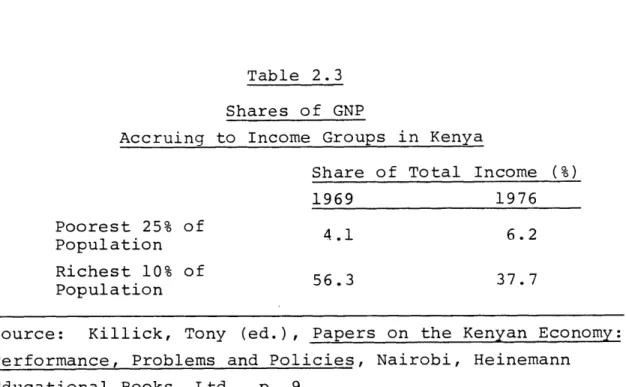
distribution in Nairobi, for example, the "lowest 5 to 10 percent" of the income distribution consists of almost the entire low-income population group (see Tables 2.3 and 2.4). In effect, studies conducted by the World Bank suggesting the BNA as a good approach to Kenya's housing problems would not be of much help to Kenya. The low-income groups would still be without homes. In fact, it seems as if World Bank strategies for low-income housing never seem able to accommodate the needs of the lowest 20 percent of income groups.
Continuing with the criticisms of the "basic needs" approach, we find that the concept of basic needs is fast becoming an endangered code word (Stewart, 1979, p. 1). To some, the concept of providing for the basic needs of the poor represents a futile attempt to redistribute income and provide welfare services to the poor without stimulating corresponding increases in their productivity to pay for them. To others, the "basic needs" approach conjures up the image of a move towards socialism, with reference being made to China and Cuba (World Bank, 1980a, p. 32). Yet, others view it as a capitalist conspiracy to deny industrialization and modernization to the developing countries, thereby keeping them dependent on the developed world (Frank, 1980, p. 289).
The question remains to be whether the poor obtain what they want or what some external authority believes they need. This remains the central conflict because there exists a distributional dilemma, similar to the one inherent in using statistics on average Gross National Product as a measure of
Table 2.3 Shares of GNP
Accruing to Income Groups in Kenya
Share of Total Income (%)
1969 1976
Poorest 25% of 4.1 6.2
Population
Richest 10% of 56.3 37.7
Population
Source: Killick, Tony (ed.), Papers on the Kenyan Economy: Performance, Problems and Policies, Nairobi, Heinemann
Table 2.4
Nairobi Household Income Distribution, 1974
Household Income Group (KSh/mo.) 0-99 100-199 200-299 300-399 400-499 500-699 700-999 1,000-1,499 1,500-1,999 2,000-2,499 above 2,499
Mean per capita Income (KSh/mo.) 15.3 71.6 91.2 100.6 147.7 143.9 179.2 288.0 291.0 386.0 1,003.5 Percent Population 1.0 1.0 6.5 8.0 6.0 14.1 18.1 17.6 8.4 3.0 16.4
Source: "Household Budget Survey," Central Bureau of Statistics. This table is reproduced from Poverty and Growth in Kenya, Annex I of
Growth and Structural Change in Kenya, IBRD, 1981.
Percent Income 0.05 0.21 1.80 2.45 2.73 6.19 9.88 15.49 7.44 3.54 50.22
welfare. The use of statistics as an indicator of average GNP creates the impression that Kenyans are financially better off when the majority of Kenyans are not. The statistics are used to support the existing economic development plans because the government has deemed the statistical proof more important then the human condition. The ranking of a country's development plan priorities always occur. "A 10 percent increase in literacy and complete freedom from malaria or a 60 percent increase in literacy and no improvement in health" (Morawetz, 1977, p. 44).
Housing provisions in Kenya's development plans have always been prioritized. The next chapter provides some explanations as to why housing provisions have been important in the development strategies of Kenya as well as to her Third World countries. It presents an historical account of Kenya's housing policies, and it examines and critiques the performance of Kenya's housing sector.
CHAPTER THREE
HISTORY AND IMPLICATIONS OF KENYA'S HOUSING POLICIES
Housing provisions are considered to be important to the development of a developing country (i.e., Kenya) for economic, social, and political reasons (World Bank, 1975, pp. 4 and 5).
1. Economic
" Next to food, housing usually constitutes the second largest item of housing expenditure (15% to 20%).
* Investment in housing represents up to 20% to 30% of fixed capital formation in countries with vigorous housing programs (Grimes, 1976, p. 30).
e Housing enables countries that have under-utilized labor, materials, and financial resources to be more productive at lower costs.
2. Social
* Housing shelters people from the elements.
* Housing provides access to jobs, sanitation facilities, security, and education (Stern, 1978, p. 2).
* Housing in proximity to employment is a way of saving people time, and money.
* Housing is the principal transaction by which communities are created.
3. Political
* Housing can be used as a tool for mobilizing political support.
It was not until 1966 that the Kenyan government officially became involved in housing (HRDU, 1979, p. 19). This involvement by the government was stipulated in a Sessional Paper (Government of Kenya, 1966/67), following a United Nations (UN) sponsored Bloomberg/Abrams Report on Kenya's housing needs (Bloomberg and Abrams, 1964). According to the Housing Research and Development Unit (1979) report:
The terms of reference of the UN Mission were to conduct a study of short- and long-term housing needs and to make recommendations to the Government on housing policies within the framework of social and
economic development planning. (p. 19)
Consequently, the Sessional Paper discussed inter-alia, "the issue of aided self-help schemes, which were identified as the panacea for the housing problems facing the disadvantaged urban workers. The paper endorsed a recommendation to the effect that a National Housing Authority be established to coordinate housing programs, particularly those relating to the local authorities" (HRDU, 1979, p. 19). As a result of the UN study recommendation, the National Housing Corporation was founded in 1967, to succeed the now defunct Central Housing Board. The Corporation's responsibilities were to deal with the practical, technical, and administrative dimensions of housing, particularly those pertaining to project implementation (HRDU,
1979, p. 19).
The Government's initial allocation of funds for housing in the 1970-74 National Development Plan (NDP) came as no
surprise because indications already existed that this would occur in the Sessional paper. The only problem at the time, however, was that the development strategy and objective was aimed at the achievement of rapid growth through industrialization (Kenya, 1969). Thus, Kenya was somewhat reluctant in investing much of their capital and resources into housing production. For example, the National Development Plan went as far as fixing a maximum cost limit of Kb1,200 per unit for housing financed from NDP funds. Housing that cost over KL1,200 would have to be taken care of by the Housing Finance Company of Kenya, together with the private sector (HRDU, 1979, p. 21). At that time, economists and government officials envisioned the provision of public housing as an investment in a non-productive sector, and they argued that the same
resources could have been used to purchase more machinery or to build more factories (Wu, 1979, pp. 38-39). The Kenyan government later realized that their policies raised conflict between demands of public housing and the promotion of effective national growth (in essence, the housing problem still persisted) (Stern, 1978, pp. 220-221). For example, after a new City Council housing list was established, it grew rapidly--reaching 27,756 by March 1975. As the Economic Survey commented:
In Nairobi 60 percent of the people on [this] waiting list earned less than K.Sh.833 a month compared with a rental of K.Sh.650 a month for a three-bedroom flat in Nairobi's most recently completed housing scheme. The sharp rise in building costs is making it now progressively more difficult for people on low incomes to be provided with adequate housing.
Also of some controversy at this time was the "self-help" approach utilized by the government for solving the housing problem (Kenya, 1969).
The rationale behind the "self-help" approach taken by the government of Kenya was that it allowed the people to build what they wanted. The idea was that the individual is in a better position to provide more suitable living conditions for himself, and the individual can build a house at a cheaper rate than can the government. The assumption of self-help would imply that, because underemployment exists in the economy, the individual will have the time to construct his own house. It is also assumed that the self-help approach will be able to economize resources and materials, satisfy certain basic needs, and improve the quality of labor (Ghai, 1979, p. 33).
Proponents of the "self-help" construction strategy seemingly failed to take into consideration, however, that the individual may be unskilled in housing construction. Hence, a longer time-period might be required to build a house, which means incurring more costs. Not unrelated to this fact, is that an individual could adjust his time to be spent either in the labor market or with his family, since Kenyan people sometimes have two or three jobs (Kitching, 1980, p. 1). The person in the rural areas can be a farmer in the morning and a trader in the afternoon. The value of time (in essence, the opportunity cost) for this person would therefore be considered
high (Ghai, 1979, p. 33). The main criticism of "self-help" projects, therefore, is that the government cannot just assume that the costs will be cheaper if an individual constructs his own home. In fact, the government may also be taking away the jobs of private contractors when employing the "self-help" concept. Contracts that are supposed to be allocated for small contractors have been known to end up in the hands of brothers or tribesmen of the elite, who probably prefer to build housing for upper-income groups so as to gain more profit (Leys, 1974). The purpose of providing homes for low-income families is therefore self-defeating.
The housing policy for the 1974-78 Development Plan was somewhat changed by incorporating a desire to streamline housing design and construction in an accordance with Government determined standards. That is to say, each housing unit constructed in an urban setting would be expected to have a minimum of two habitable rooms, plus a kitchen and toilet (HRDU, 1979, p. 21). In addition, the plan advocated government action against further spread of squatter settlements, slum clearance through the process of resettlement, and improving of sub-standard urban housing (in essence, the Strategy for Housing Policy [for example, Sites and Services] was aimed at areas of high unemployment) (Kenya, 1973). Similarly, by addressing itself to such issues as unit cost, services, zoning, and affordability, the plan constituted a very significant chapter i4 the history of housing policy and programming in Kenya (HRDU, 1979, p. 21). For example, for the
1974-78 plan period, there was an increase of 230% in the allocation of funds for housing. "The total amount allocated was Kh34.5 million as compared to Kbl4.9 million in the previous five-year period" (HRDU, 1979, p. 26).
The 1979-83 Development Plan did not offer any new policies or programs for housing. According to the Housing Research and Development Unit (1979) report:
it merely underlines the policies and programmes of the previous plan, notably those aspects regarding squatter upgrading, promotion of the sites and services strategy, and the advancement of the housing interests of the disadvantaged urban worker. (p. 21)
Allocation for housing in the 1979-83 Development Plan was increased by 66% (in essence, KB57.2 million) (see Table 3.1). Table 3.1 is a breakdown of funds allocated to housing form 1964 to 1983 by the government of Kenya. As we can observe from the table, the housing fund allocation has increased virtually every year.
Considering all the attention and money spent by the Government to solve Kenya's housing problem, it would be expected that the performance of the housing sector would be impressive. Instead, the opposite has been the case, as will be demonstrated in the analysis presented in the next section.
Indicators of Housing Performance
In 1979, when the fourth development plan was introduced, we were told that the current short-fall of units located in
Annual Allocation of Development Funds for Housing
Public and Private Sectors (Planned) 1964-1983
Funds Funds Funds Funds
Allocated to Allocated to Allocated to Allocated to
Housing Housing Housing Housing
Year (1964-68) Year (1969-73) Year (1974-78) Year (1979-83)
1964 N/A 1969 N/A 1974 25.14 1979 38.22 1965 N/A 1970 13.32 1975 28.36 1980 47.27 1966 N/A 1971 18.32 1976 32.71 1981 48.44 1967 N/A 1972 20.31 1977 36.07 1982 48.82 1968 N/A 1973 23.29 1978 42.06 1983 51.36 TOTAL N/A 75.25 164.34 234.11
Sources: National Development Plans
urban areas came to 140,000 units (Kenya, 1979, p. 172). To meet the present demand for houV§ng, 30,000 units needed to be constructed annually. This, of course, does not take into account the rapid urban growth rate of approximately 7% that is now occurring (Farugee, 1978, p. 110).
Due to the inadequacy of reliable data, it is difficult to provide an accurate assessment or evaluation of the current performaonTe of proposed targets for the housing sector. Nevertheless, data that are usually used are obtained from a 1979 Central Bureau fo Statistics (CBS) Rent Survey of urban areas. This Survey probably provides the most accurate coverage of the housing stock that is currently available (see Table 3.2).
The table is a breakdown of the existing housing stock in urban areas by ownership pattern. A brief examination shows that over 80% of the urban stock is owned by the private sector, 23% of which are squatter settlements (i.e., informal housing). The picture of the public sector is worse when we consider that the public sector consists of staff housing and private rental units constructed prior to 1976.
One of the goals of the housing policy for Kenya of having each individual own at least a two-room dwelling unit is yet to be realized (see Table 3.3).
Table 3.3 also provides information on the types of structures and tenancy statutes of the private housing stock. An examination of the table shows that by the end of 1979, only 4% of the housing stock was owner-occupied. The majority of
Table 3.2
Percentage Distribution of Urban Dwelling Units by Sector, 1979 (percent) (a)
Private Sector Formal (b) 64 Informal (c) 18 Sub-Total 82 Public Sector Local Authorities 10 Central Government (d) 8 Sub-Total 18 Notes:
(a) A dwelling unit is defined as a place of residence for a family, an individual, or a group of persons eating together and sharing the budget for common provisions. A single housing structure may contain multiple dwelling units.
(b) Includes site and service plots provided by the public sector. (c) Informal housing includes both squatter settlements and housing
developed ty land-owners who have not completed the required legal procedures of sub-division and registration. Much of the latter type of housing is owned by land companies, such as those holding large tracts of Marthare Valley in Nairobi.
(d) Includes public boards and corporations.
Source: "Report on the 1979 Rent Survey in Urban Areas of Kenya, CBS, 1981.
Table 3.3
Local Authority Housing Stock, 1969,80
1969 1976 1980
Type Number % Number %1 Number /0 Rental Housing 27,092 90 30,674 80 34,820 69 Tenant Pruchase 1,852 6 4,185 11 6,243 12 Site-and-Service Plots 1,321 4 3,593 9 9,861 19 TOTAL 30,265 100 38,452 100 50,924 100 Source: Up to 1974, "Local Authority Housing in Kenya,"