MIT Sloan School of Management
MIT Sloan School Working Paper 4778-10
Creating Connections For the Disadvantaged: Networks and Labor Market Intermediaries at the Hiring Interface
© Roberto M. Fernandez
Roberto M. Fernandez
All rights reserved. Short sections of text, not to exceed two paragraphs, may be quoted without
explicit permission, provided that full credit including © notice is given to the source.
Creating Connections For the Disadvantaged: Networks and Labor Market Intermediaries at the Hiring Interface Roberto M. Fernandez MIT Sloan School of Management [email protected] Word count: 14,981 March 22, 2010 Key words: Race, poverty, networks, brokerage, intermediaries
Creating Connections For the Disadvantaged: Networks and Labor Market Intermediaries at the Hiring Interface Abstract Scholars interested in race inequality have been particularly attracted to network accounts of the stratifying effects of social networks in the labor market. A recurring theme in policy‐oriented research on poverty is that institutional connections can be engineered to create connections between job seekers and employers in ways that parallel social network processes. Yet, there has been little empirical research on how such linkages work across the various steps of the recruitment, screening, and hiring process. We examine how labor market intermediaries can serve as functional substitutes for social network processes for disadvantaged workers. Consistent with policy arguments about the desirability of creating connections to employers, applicants who are connected to this employer via formal labor market intermediaries exhibit a number of the advantages experienced by those applying to the firm via social network ties. Across the two stages of the hiring process, the net result is that applicants with such “created connections” are more likely to be offered jobs, and ultimately hired than other groups of applicants. We conclude with a discussion of the implications of these findings for research on labor market intermediation and other forms of brokerage and the feasibility of policy efforts to “create connections” in the labor market.
There is by now a rich tradition of research on the role of networks in job‐person matching processes. Scholars interested in race and gender inequality have been particularly attracted to network accounts of the stratifying effects of social networks in the labor market (for a recent review of the role of networks and race in the labor market, see Fernandez and Fernandez‐Mateo 2006; for a review of gender and labor market networks, see Fernandez and Sosa 2005). Scholars interested in poverty, too, have made research on networks a key research focus (e.g., Elliott 1999; Fernandez and Harris 1992; Newman 1999; Reingold 1999; Royster 2003). Another literature concerned with understanding how persons and jobs are matched is the scholarship on formal labor market intermediaries (e.g., Kazis 2004; Osterman 2004). Similar to the research on social networks in the labor market, studies of labor market intermediaries have also examined the stratifying consequences of labor market intermediation (e.g., Fernandez‐Mateo 2009; Vosko 2000). As with the study of social networks in labor markets, students of poverty have also been examining how labor market intermediaries can help the plight of poor and disadvantaged job seekers (e.g., Burtless 1985). Interestingly, a number of these suggestions are explicitly modeled on how social network processes work in the labor market (e.g., Granovetter 1979; Melendez and Harrison 1998; Wilson 1996). Numerous scholars have argued for poverty reduction programs to remediate the poor’s presumed network deficits (see Fernandez and Fernandez‐Mateo 2006) and use labor market intermediaries to “create connections”—i.e., to use social programs to engineer relationships between poor and disadvantaged job seekers and employers (Granovetter 1979; Gueron and Pauly 1991; Holzer 2009; Wilson 1996). While the social network and labor market intermediary literatures are parallel in their conceptualization of job‐person matching, their emphases have been different. Studies have appeared examining informal social network processes from the perspective of all three actors involved: 1) potential job‐seekers (e.g., Bridges and Villemez 1986; Lin 2001); 2) the perspective of the people connecting the job and the person (Smith 2005, 2007; Fernandez and Castilla 2001; Fernandez and Fernandez‐Mateo 2006: 52‐58; Fernandez and Sosa 2005: 876‐880); and 3) the firms’ hiring agents (e.g., Fernandez and Weinberg 1997; Fernandez et al. 2000; Petersen et al. 2000). So, too, research on labor market intermediaries has been conducted from multiple perspectives. For example, George and Chattopadhyay (2005) have looked at the phenomenon from the contractor’s point of view, examining their divided loyalties between the client and the contracting firm. Research by Fernandez‐Mateo (2007, 2009) adopted the point of view of the labor market intermediary, focusing on the intermediary’s brokerage role. Other
research using the broker’s perspective has specifically targeted disadvantaged populations (Granovetter 1979). Another strand of research uses data on samples of firms to examine which organizations use temporary and contract labor (e.g., Davis‐Blake and Uzzi 1993; Houseman et al. 2003; Kalleberg et al. 2003; Uzzi and Barsness 1998). Other studies have focused on low‐wage workers using broad samples of job seekers to assess the effectiveness of policy programs that use temporary help agencies (Autor and Houseman 2010; Houseman 2001). Less well‐understood, however, is how employers make choices among candidates from brokered and non‐brokered sources. While social network research has numerous employer studies of hiring network applicants in comparison with candidates from other sources (e.g., Fernandez and Weinberg 1997; Fernandez et al. 2000; Petersen et al. 2000, 2005), parallel studies of employer’s choices between candidates from intermediated and non‐intermediated sources are missing from the research on intermediaries. This limitation is unfortunate. Without counterfactual information on other candidates the employer might have chosen‐–the options the employer has between intermediated and non‐intermediated candidates‐–it is difficult to determine the value that labor market brokers provide. Moreover, since labor market intermediaries can deliver benefits through multiple mechanisms—providing a higher quality applicant pool, information advantages in recruiting, signaling and screening (see below)—data on the employer’s choices is crucial for distinguishing among the various processes at work at the hiring interface (for a similar argument, see Fernandez and Weinberg 1997). In this paper, we seek to fill this gap in our understanding by examining unusually rich data on the hiring process for entry‐level jobs at one employer. We compare candidates who are connected to this employer via social network ties with those who have been referred to the employer by formal labor market intermediaries. This latter group consists of people who have been sent to the focal firm by public and private labor market intermediary organizations that have been charged with “creating connections” between the poor and local employers. Rare among studies of screening among job candidates, we are able to identify the race, gender, and poverty status of the applicants to this firm, thus we are able to study the implications of using “created connections” for poor and minority populations. We determine whether and to what extent “created connections” serve the same functions as social networks in matching people to jobs, and how these processes differ by race, gender and poverty. We conclude with a discussion of the implications of these findings for research on labor
market intermediation and other forms of brokerage and the feasibility of policy efforts to “create connections” in the labor market. Creating the Connections for the Disadvantaged Numerous scholars have examined the various forms of labor market intermediation (e.g., Houseman 2001; Kazis 2004; Osterman 2004). While there are many forms of labor market intermediaries—ranging from public job placement agencies (Marano and Tarr 2004), temporary help firms (Autor 2001; Davis‐Blake and Uzzi 1993; Houseman et al. 2003; Vosko 2000), contract staffing agencies (Fernandez‐Mateo 2007), and executive search firms (Finlay and Coverdill 2000, 2002)—these organizations share the feature that they broker between the supply and demand sides of the labor market, matching people to jobs (Autor 2009; Fernandez‐Mateo 2007). While much of this research has tended to look at markets for high skilled and higher paying jobs (Barley and Kunda 2004; Benner 2002; Finlay and Coverdill 2000, 2002; Khurana 2004), scholars concerned with poverty have especially been interested in the role of labor market intermediaries for poor and disadvantaged job seekers (e.g., Anderson et al. 2009; Burtless 1985; Melendez and Harrison 1998). Osterman (1999) is explicit in this diagnosis: “…too often training programs are isolated from employers and are not linked to clear paths of job mobility. Making these connections is the job of labor market intermediaries…” (p. 133). Other scholars too have called for poverty reduction programs to “create connections” between employers and poor and disadvantaged job seekers (e.g., Granovetter 1979; Wilson 1996). While labor market intermediaries of all types aim to place workers with employers, especially with respect to poor populations, there is some disagreement about how these linkages work. Although strengthening connections being poor job seekers and employers is often seen as desirable, past research has questioned whether labor market intermediaries actually perform this function for those most in need. Recently, Autor and Houseman (2010) have are argued that in the low wage sector temporary services can help workers in the short‐ term, but is not helpful in the longer‐term because temp employment weakens workers’ search efforts for direct hire jobs. On the employer’s side, a number of studies have shown that employers often stigmatize low wage workers who are sent to them by public and private labor market intermediaries (e.g., Laufer and Winship 2004). In general, employers are concerned that since intermediaries targeting poor populations specialize in hard‐to‐ employ populations, candidates referred by these organizations will be adversely selected, constituting the labor
market “left‐overs” who could not find a job through other means (Autor 2009; Burtless 1985; Van Ours 1994). Other scholars have argued that, perhaps in response to employers’ concerns, these agencies tend to cream the best job candidates, avoiding those who are most in need of assistance and (e.g., Anderson et al. 1993; Gueron and Pauly 1991; Thomas 1997). From the perspective of the hiring firm, such creaming suggests that one of the functions of the intermediary firm is to deliver candidates that have been pre‐screened for positions at the firm, and thus, are of higher quality than candidates from other sources (see Houseman [2001] and Autor [2001] for evidence that many employers use agency temporaries to pre‐screen candidates). This screening argument is exactly parallel to one of the reasons offered for why employee referrals are often preferred over other applicants, i.e., that referred applicants have been pre‐screened by the referring employee, and thus provide a “richer pool” of higher quality, more hirable candidates than other recruitment sources (Fernandez and Weinberg 1997; Fernandez et al. 2000). Indeed, employers’ complaints about the ineffectiveness of employment agencies often center on intermediaries not doing enough to screen candidates (e.g., see Rees 1966:564; Laufer and Winship 2004:230). In addition to screening benefits, another alleged function of intermediaries is to increase employers’ flexibility in responding to variability in workload and labor market conditions. In the research on labor market intermediaries, this discussion has been centered on employers’ use of temporary help (Autor 2001; Autor and Houseman 2010; Houseman 2001). More generally, however, employers have been found to shift among recruitment sources as a way of managing fluctuations in labor market conditions (Gorter and van Ommeren 1999), and previous research has studied the use of employee referrals in this manner (Fernandez and Weinberg 1997; Fernandez et al, 2000). To our knowledge, no studies have examined whether relationships with labor force intermediaries are used in a similar way to provide a flow of candidates at times of relative labor shortage. To the extent that labor market intermediaries direct applicants to firms when competition for job vacancies is lower, then such intermediary‐referred candidates will experience greater success at the hiring interface. Even if labor market intermediaries do direct applicants to firms at more favorable times, the question remains as to the nature of the connection beyond the initial contact with the firm. As mentioned above, to the extent that intermediaries pre‐screen applicants, then such candidates will be more likely to advance in the hiring process. However, since there are often multiple steps involved in hiring, with the first step being one in which
screeners decide who to interview, different kinds of information are relevant for the different stages. Although HR recruiters generally attempt to reflect the wishes of line managers (Fernandez et al. 2000), it is line managers and not HR personnel that set job requirements (Fernandez and Mors 2008; Rynes and Boudreau 1986). While intermediaries might do well screening on relatively easily measured paper criteria that will impress HR screeners, they might do less well in screening for harder to measure “soft‐skills” (Moss and Tilly 1996) that are more likely to be revealed in interviews with hiring managers (for evidence of this, see Manning 2000:766‐67). For this reason, distinguishing among the multiple steps of the hiring process is important for understanding the consequences of connections created by labor market intermediaries. While there have been a few employer‐side studies addressing the question of intermediaries (Houseman [2001] and Houseman et al. [2003] are exceptions), what is crucially missing from extant studies is information on how applicants with “created connections” fare in comparison to other non‐brokered candidates. While the issue of alternative paths around the broker is a general issue (Ryall and Sorenson 2007), understanding employers’ options is of particular concern in the case of labor market since intermediaries. Without information about the employer’s choice set, it is difficult to determine the particular functions served by intermediaries, or the value that these functions provide for employers. Since these functions might work through multiple mechanisms at the hiring interface, data on the employer’s choice set is crucial for distinguishing among these (for a similar argument, see Fernandez and Weinberg 1997). We address these issues by examining unusually rich data on the hiring process for entry‐level jobs at one employer. This firm has established a relationship with a number of public and private intermediaries which channel job applicants to this firm. We compare candidates who are connected to this employer via social network ties with those who have been referred to the employer by formal labor market intermediaries. This latter group consists of people who have been sent to the focal firm by public and private labor market intermediary organizations that have been charged with “creating connections” between the poor and local employers. Rare among studies of screening among job candidates, we are able to identify the race, gender, and poverty status of the applicants to this firm, thus we are able to study the implications of using “created connections” for poor and minority populations. We compare both those connected to employers via social networks and referrals from labor market intermediaries with candidates that sought out this employer on their own (i.e., non‐referred, non‐
networked candidates). We examine these three groups at initial contact with the firm, and at the interview and job offer steps of the screening process. Specifically, we measure the degree to which the processes followed by intermediary‐referred candidates parallel those of networked candidates. Thus, we determine whether and to what extent these labor market intermediaries serve as functional substitutes for social network processes in matching people to jobs, and how these processes differ by race, gender and poverty. We conclude with a discussion of the implications of these findings for research on labor market intermediation and other forms of brokerage. Data and Setting We study these issues with unique data collected on the hiring process for entry‐level jobs at one company site. The company we are studying is a private, medium‐sized (approximately 1,200 person) firm located in the western United States. While the company employs people at numerous locations, we focus here on its headquarters and main production facility. The company hires workers for full‐time jobs with benefits, is not unionized and does not employ temporary workers. These entry‐level jobs are factory‐production are for occupations that fall into the broad category of “Other Production Occupations” (Bureau of Labor Statistics SOC code 51‐9000; see www.bls.gov/soc/home.htm). As a case study, we can make no claims with respect to the broad representativeness of the plant under study. However, we do know that this firm does maintain relationships with a number of public sector labor market intermediaries, and has hired some people—including candidates from poverty backgrounds—and has also been the recipient of financial incentives provided by the Federal government designed to encourage the hiring of poor and disadvantaged workers. Over the course of our study, the company received a total of $19,200 from these agencies to subsidize the training of 16 new hires. The firm under study, therefore, is an example of a firm that is both aware of, and open to the overtures of labor market intermediary organizations that are attempting to create connections to employers. Additionally, the in‐depth information on the hiring process we have available here makes this an ideal setting for studying a number of the mechanisms by which the poor and minorities are matched to jobs via social networks and labor market intermediaries. Thus, the theoretical significance of this case is that it provides a window through which one can view the operations of a set of processes that are normally hidden from view.
Although we do not have the benefit of random assignment of candidates in this field setting, we have collected and triangulated numerous sources of data to address as many of the internal threats to validity as possible. We have coded an unusually rich set of variables measuring background variables that the firm’s hiring agents use to screen, as well as some longitudinal information for repeat applicants to address unmeasured fixed characteristics of applicants (see below). We also have the benefit of screeners’ reports of how they deal with applicants from different recruitment source. In contrast to audit studies (e.g., Bertand and Mullianathan 2004; Pager 2003; Pager et al. 2009) that are limited to examining only the initial stages of contact with employers (Blank et al. 2004), we not only study the initial point of contact with the firm, but also the reactions to intermediary‐ referred, employee‐referred, and “Other” candidates by different organizational actors – HR screeners and hiring managers – at later steps in the hiring process. As we show below, the reactions of the organization’s screeners vary significantly by stage. We assembled data on the pool of all applicants, interviewees, job offers, and hires for all production floor jobs. While it is very rare to have information of the race of the applicant (other examples are Petersen et al. [2000] and Petersen and Saporta [2005]), the human resources department’s standard operating procedure at this company is to record applicants’ apparent race and gender. In order to apply, all job candidates must come into the receptionist’s area to turn in a completed and signed application form. After accepting the application form, the receptionist logs the receipt of the application and records the applicant’s apparent race and gender. We matched the race and gender information gleaned from the logs to paper application materials (a standardized application form and, occasionally, resumes) for 1,582 applications. A total of 88 percent of these applications (1,389) arrived over the 29 month period July 1, 1998 – November 30, 2000.1 We obtained an additional 193 cases that were made during the prior ten‐month period. We matched these 193 applications to repeat applications from the same people who applied during the period during which the receptionist coded race. 1 During the period September 1, 1997 – June 30, 1998, the receptionist checked off the apparent race and gender of each applicant, but did not record the specific name of the applicant in the log. For the 29 month period of this study, however, the receptionist recorded the name of each individual applicant in the log. The receptionist was very consistent in her coding of race. Looking at the 29 months during which receptionist coded race, 119 people generated 146 pairs of multiple applications. The receptionist coded 89 percent of these pairings as the same race (for more details, see Fernandez and Fernandez‐Mateo [2006: Appendix A]).
We then coded race for these applications based on how the receptionist coded race for the later application.2 From the paper application forms, we coded a number of human capital factors that company personnel say they screen for from candidates’ applications. Because we also had access to the names and signatures on the original application forms, we did not need to rely solely on the logs to identify gender. We were successful in coding gender for 97.2 percent of the applications. HR personnel said in interviews that they do not consider years of formal education a very important screening criterion for these factory jobs. However, there is often a gap between what employers say and what they do (Pager 2005), and since it is the quintessential measure of human capital (e.g., Becker 1993), we tested the degree to which education is important for screeners’ actions. The application form explicitly asked candidates to list their educational background, and we coded the number of years of education from these responses. In contrast, the HR screeners said that labor force experience was quite important. Applicants are asked to list their past employment experience, including dates and wages. From this, we coded years of labor force experience. However, HR screeners say they tend to avoid “job hoppers”—people who frequently change jobs. Consequently, we also coded the applicant’s number of jobs. In addition, we coded a dummy variable for whether the applicant reported any work experience in the firm’s specific industry based on the applicant’s response to the question: “Have you ever worked in the [NAME OF INDUSTRY] industry?”. As a measure of their labor market value, we also coded the applicant’s hourly wage on their last job. For applicants who had never before been employed, the last wage is coded zero. Only 2.4 percent of all applicants had never been employed at the time of application. As has been found in other settings (e.g., Fernandez et al. 2000; Manning 2000), company’s HR personnel say that they prefer applicants who are currently employed. We coded a dummy variable indicating whether the applicant was employed at the time of application. Finally, we coded a dummy variable measuring the response to the question: “Have you ever been convicted of a felony or job related crime (civilian or military)?” While this self‐report question might lead to underreporting of convictions, it is important to note that the application form states explicitly that the company conducts background checks as a part of screening (see Finlay 2 These repeat cases are helpful for checking whether the key results are due to unmeasured fixed characteristics of applicants. Eliminating these 193 cases does not change the other substantive results.
2009).3 Another very special feature of this setting is that the company’s standard operating procedures include asking every applicant to identify their poverty status at the point of application. In addition to the paper application, all applicants submit to the receptionist IRS form 8850 “Pre‐Screening Notice and Certification Request for the Work Opportunity Credit” (see Figure 1 for an anonymized sample form from the study). This form asks a series of questions which identify whether the person comes from a welfare or poverty background. If the person is hired, and is confirmed as being eligible, the hiring firm may then receive monies from the Work Opportunity Tax Credit (WOTC) or Welfare to Work (WtW) programs to subsidize the new hire’s training costs up to approximately $1,200.4 These monies are normally disbursed by local public sector organizations, which often also serve as vendors for training services. While many companies routinely ask new hires to fill out the 8850 form as a part of routine paperwork during the intake process for new hires, this company is rare in asking for this information at the point of initial application. We coded positive answers to any of the four questions listed on the form as evidence that the applicant came from a poor background. A total of 13.4 percent of applicants (14.3 percent of females, and 11.8 percent of males) had a poverty background using these criteria. We also used the applications to distinguish among three groups of applicants: networked candidates, candidates who have been referred by labor market intermediaries, and candidates applying from any other recruitment sources (e.g., newspaper ads, walk‐ins). The application form has an item that explicitly asks about recruitment source: “How did you find out about the job?” and lists several boxes to check. One of the boxes is “Current [NAME OF COMPANY] employee,” and includes space for the name of the referrer. Of the applications for 3 HR personnel said that they do screen on this factor, but unlike the case in the Fernandez et al. (2000), a felony conviction does not automatically disqualify a candidate from further consideration at this company. Indeed, ex‐offenders are one of the subcategories listed on the WOTC‐WtW eligibility form that the company collects (see below and Figure 1). A total of 31 applicants responded yes to the question on convictions. 19.3 percent (6 of 31) of people responding yes to the question on convictions were interviewed. Half of those (3 of 31) were offered a job and ultimately hired, an overall rate of 9.7 percent for convicted applicants. Contrary to the employers studied in Pager (2003) and Pager et al. (2009) did, these rates of success in the hiring process are not statistically different from those who do not report a conviction (i.e., 17.7 percent of non‐convicted are interviewed; 7.5 and 7.0 percent of the non‐convicted are respectively offered a job and ultimately hired). 4 While many companies collect such information once a person is hired, unique in our experience, this company asks all applicants to fill out the welfare‐to‐work form and to sign it. Once they have hired a welfare‐to‐work person, a background check is done to confirm that the person is indeed eligible for the training credit. Although they have made filling out this form part of the standard operating procedures for hiring, the company HR personnel says that is does not use the form itself as part of the screening process. The firm does not reap any direct benefit from the $1,200 even in the event they were to hire a welfare‐to‐work person. They never see the check—it is absorbed by the central human resources office, in a far away office located in another state. In interviews with HR personnel on the topic, they expressed that they consider the $1,200 per hire trivial in comparison to the costs associated with making a hiring “mistake.”
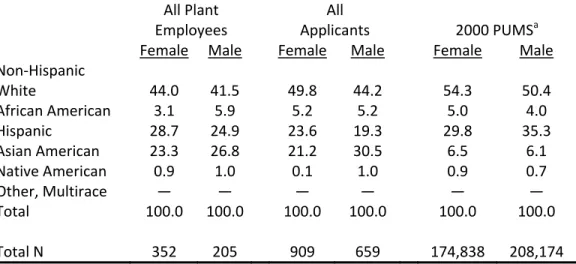
whom we could identify recruitment source (1,551 of 1,582), 30.2 percent were employee referrals. However, there were also applications that simply listed “friend,” or the name of someone not employed at the company.5 We combined these non‐employee referrals (an additional 5.4 percent of applicants) with employee referrals to define a dummy variable for “network” job candidates. Most important for the purposes of this paper, we identified 148 candidates who listed intermediary organizations as their recruitment source. The vast majority of these applications (94.6 percent) were from public (e.g., “Job Corps”) or private non‐profit agencies, the latter often simply listed as “PIC” (short for “Private Industry Council”). Private Industry Councils (PIC) are private non‐profit corporations that provide services, usually at the county level. PICs usually receive federal money for training and placing people into local jobs. In a very real sense, these organizations seek to create connections between poor, often displaced job‐seekers, and local employers. PICs employment counselors will often send applicants to particular employers, sometimes providing the applicant with a “Referral Card” (see Figure 2) introducing the applicant to the firm’s screeners. As noted above, PICs often manage the reimbursement for training costs when the firm hires WOTC or WtW eligible trainees. In our discussions with the company’s HR managers, they indicated that they were well aware of these potential benefits, and that they had established good working relations with staff at many of these intermediary organizations. A few additional applications (6 in total) listed private for‐profit temp or job search firms as their job source. We combined these cases by coding a dummy variable distinguishing applications from any labor market intermediary from other applications. The remaining 53.4 percent of applications—828 of 1,551—were applicants from non‐ network, non‐intermediary sources. Analysis Table 1 presents some background information on the company and the local setting. Columns 1 and 2 of Table 1 show the race distribution of the firm’s employees for both genders. Women constitute 63.2 percent of the workforce at the plant. For both sexes, the populations are racially diverse, with minorities accounting for over 50% of those employed at this site. The third and fourth columns show that the race distribution of the pool of 5 Note that this company does not pay employees for their referrals (cf. Fernandez and Weinberg 1997; Fernandez et al. 2000). Thus, workers do not have any financial incentive to ensure that applicants fill in their name as referrers on the application form (see Neckerman and Fernandez [2003] and Fernandez and Castilla [2001] for analyses of referring incentives). This fact is likely to account for the relative laxity these applicants show in providing the name of their referrer.
applicants roughly matches that of the employees for both sexes. The last two columns, however, show that Asian Americans are clearly overrepresented, both among employees and applicants to this company.6 While African Americans are well‐represented in both the firm and the application pool compared with the metro area data, non‐Hispanic whites are somewhat underrepresented in both the firm and application pool. This relative paucity of whites is probably due to the fact that whites are less likely to be attracted to these low‐wage jobs than are minorities. Analysis of the PUMS data for the non‐college population in the local area (i.e., the same population analyzed in columns 5 and 6 of Table 1) shows that the company’s offered hourly wage of $8.05 falls at the 19th percentile of the local wage distribution for white males, and the 31st percentile for white females. The corresponding figures for minorities are 35th percentile for males and 42nd percentile for females. Thus, the company’s offered wages are relatively low compared to whites’ wages in the local labor market, but for minorities the offered wage is much more attractive when compared with their wages in the open labor market. Although differences in definition make the comparison only approximate, Table 2 shows the representation of poor applicants to the firm compared with the official poverty definition by race and sex. By these definitions, the firm is attracting a greater percent of poor whites and African Americans of both sexes than their representation in the metro area. In contrast, poor Hispanics of both sexes are well‐represented, and poor Asian Americans are somewhat underrepresented in the firm’s application pool. Table 3 shows that the three recruitment channels are delivering applicants with different racial compositions (females: p < .003; LR chi‐square = 19.96 with 6 d.f.; males: p < .0001; LR chi‐square = 27.76 with 6 d.f.). In particular, white females are underrepresented among intermediary‐referred applicants (40.0 percent vs. 49.8 of the overall population). Also noteworthy is the fact that Asian males are 7.8 percent more plentiful among networked candidates than one would expect on the basis of their representation in the applicant pool (38.0 vs. 30.2 percent). However, both male and female African Americans are represented among the intermediary‐ referred population at rates that are considerably higher than their representation in the applicant pool 6 While the company does ask for proof of citizenship and immigration status at hire, the application does not ask whether the candidate is an immigrant. There is, however, some information on the application form (e.g., address of previous employers, address of schools attended) that gives yields some information about the immigrant composition of the applicant pool. Using these criteria, 23.7 percent of applicants are immigrants (22.9 percent of females and 25.0 percent of males). Only 2.5 percent of African Americans are immigrants, but the percentages are much higher for Hispanics (17.2 percent) and Asian Americans (54.3 percent).
(respectively, 13.4 and 13.7 percent of intermediary‐referred applicants, compared with 5.3 percent of the overall applicant pool for both sexes). As would be expected if public and private labor market intermediaries are performing their mission of connecting poor people to jobs, poor applicants are a higher proportion of applicants applying agencies than those applying via other means (22.3 percent of intermediary referrals vs. 12.2 percent for network applicants and 14.7 percent for applicants applying via all other means). This overall pattern is statistically significant (p < 0.011; LR X2 = 9.0 with 2 d.f.). So too is the contrast between intermediary‐referred and “Other” applicants (p < 0.019; LR X2 = 5.53 with 1 d.f.). As noted above, it is not a foregone conclusion that public labor market intermediaries will actually perform this function for the poor. With respect to sex differences, the pattern of poor applicants being more common among agency referrals is also found within sex (females: 25.0 percent for agency referrals vs. 11.9 percent for network applicants and 16.8 percent for “Other” applicants; males: 19.1 percent for agency referrals vs. 12.3 percent for network applicants and 11.0 percent for other applicants). While the overall pattern for females is statistically reliable (p < 0.012; LR X2 = 8.89 with 2 d.f.), the pattern is not statistically significant for males (p < 0.209; LR X2 = 3.12 with 2 d.f.). The specific contrast between intermediary‐referred and “Other” applicants, however, is reliable for both male and females at the .10 level of significance (males: p < 0.077; LR X2 = 3.12 with 1 d.f.; females: p < 0.051; LR X2 = 3.82 with 1 d.f.). Examining race differences, none of the recruitment source by poverty contrasts are statistically reliable at the 5 percent level. For whites and African Americans, however, the specific contrasts between intermediary‐ referred and “Other” applicants are statistically reliable at the 0.10 level. For whites, 22.9 percent of intermediary‐ referred applicants are poor compared with 14.0 percent of “Other” applicants (p < 0.084; LR X2 = 2.99 with 1 d.f.). The contrast in the percent poor between these two recruitment sources is even greater among African Americans (45.0 percent of intermediary‐referred African Americans are poor, compared with 20.6 percent of “Other” African American). Despite the fact that the analysis is based on very few African American applicants (i.e., 20 intermediary‐referred and 34 “Other” applicants), this contrast is sufficiently large that it is statistically significant at the .10 level (p < 0.060; LR X2 = 3.53 with 1 d.f.).7 As noted in Table 2, the poverty rate for African Americans in the local area is substantial. The fact that poor African Americans are well‐represented among intermediary‐
7
referred applicants is additional evidence that the local labor market intermediary organizations are serving the function of connecting poor people to job openings. Better‐Qualified at Application The question remains as to how these organizations’ connections work. To the degree that these labor market intermediaries serve as functional substitutes for social network processes in matching people to jobs, the recruitment and hiring processes followed by intermediary‐referred candidates should parallel those of networked candidates. The first network‐based process we examine is what has been termed the “richer‐pool” mechanism (Fernandez et al. 2000; Fernandez and Weinberg 1997). In particular, employers often infer that applicants who apply via social networks will be more qualified than those applying through other means. Fernandez et al. (2000) identify a number of the ways by which this result might come to pass. In particular, Fernandez et al. (2000: 1291) identify three mechanisms: M1, expansion of the recruitment horizon, M2, homophily between the referrer and the referral, and M3, reputation protection of the referrer. With the possible exception of homophily,8 we would expect parallel processes to be at work for labor market intermediaries charged with placing candidates at firms. For these reasons, the pool of candidates referred by intermediaries should show a more qualified profile of background characteristics at the application phase than candidates applying via “Other” means. To the extent that M1‐M3 are at work for candidates referred by social ties, we would expect the candidate profile for networked‐referred applicants to also be more qualified than “Other” candidates. Table 4 shows data on how applicants from the three sources—intermediary‐referred, network‐referred, and “Other”—compare along dimensions that the human resources personnel use to screen. Intermediary referrals are somewhat better educated than “Other” applicants, but this difference is quite small (12.34 vs. 12.20 years of education) and is not statistically significant (one‐tailed test p < .208, t‐value = 0.81). Intermediary‐ referred applicants show higher average wages in their last job than “Other” applicants, but here too the difference is not statistically reliable ($8.22 vs. $8.13; one‐tailed test p < .361, t‐value = 0.36). Applicants sent by 8 While it is possible that staff at labor market intermediaries might prefer to recommend candidates who are socially similar to themselves (for some German evidence, see Behncke et al. 2008), we do not have data on the race or gender of which specific employee of the intermediary firm referred the candidate. As described above, however, the organizational incentives are for all of these people to place whomever they can at hiring firms.
intermediary organizations are more likely to have industry‐specific experience than “Other” applicants (14.4 vs. 12.3 percent), but this difference is not statistically significant (p < .499, LR Chi‐square = 0.45 with 1 d.f.). More reliably, however, intermediary referrals are worse than “Other” applicants on several other dimensions. In general, HR recruiters prefer people who are employed at the time of application, and have had fewer jobs since they want to avoid what they describe as “job‐hoppers.” But perhaps not surprising in light of their charge, intermediary‐referred candidates are less likely than “Other” candidates to be employed at the time of application (15.1 percent for Intermediary‐referred candidates vs. 29.6 percent for “Other” applicants), and this difference is statistically reliable (p < .001, LR Chi‐square = 13.71 with 1 d.f.). Intermediary‐referred candidates have also had more jobs than “Other” applicants (3.36 vs. 3.14), and thus are at greater risk of being classified as “job hoppers” by the firm’s screeners than are “Other” applicants. This difference is in the opposite of the predicted direction and is statistically significant (one‐tailed test p < .036, t‐value = ‐1.80). Also noteworthy, intermediary‐referred applicants report a significantly higher rate of having been convicted of a “felony or job related crime” than “Other” candidates, 6.5 vs. 1.4 percent (p < .002, LR Chi‐square = 10.37 with 1 d.f.). Overall, there is little evidence that intermediary organizations are producing a richer, more hirable pool of applicants. The evidence with respect to network candidates is more mixed, however. Network candidates are somewhat better educated than “Other” applicants (12.32 vs. 12.20), but this contrast is not statistically significant (one‐tailed test p < .142, t‐value = 1.07). Network candidates are significantly more likely than “Other” applicants to be employed at application (36.3 vs. 29.6 percent; p < .012; LR chi‐square 6.37 with 1 d.f.). Although this does not control for years of work experience (see below), networked candidates also have had significantly fewer jobs than “Other” applicants (one‐tailed test p < .001, t‐value = ‐4.81). Network applicants are not better than “Other” applicants on any other measure. Indeed, network candidates are significantly worse than “Other” candidates on years of work experience (6.08 vs. 7.17, one‐tailed test p < .002, t‐value = ‐2.92) and wage on last job ($7.67 vs. $8.13, one‐tailed test p < .003, t‐value = 2.75). While it is informative to look at each of the background factors separately, this ignores the degree to which applicants from each of the three sources form distinct profiles. This is especially important to consider since the value of some of these background factors (e.g., years of work experience and number of past jobs) are likely to be seen as interdependent by screeners. Table 5 reports the results of a multivariate analysis designed to
identify which factors distinguish among the three recruitment sources, while controlling for each of the other background factors. The coefficients in the table show the relative risks associated with each independent variable of being referred by intermediary sources (columns 1) and network sources (columns 2). The coefficients can be read as the odds of people with higher values on the background variable being in a category of the recruitment source (either intermediary‐ or network‐referred), relative to the excluded category (“Other”). For intermediary‐referred applicants, the profile that emerges by considering these background factors in a multivariate framework is decidedly negative. Intermediary‐referred applicants are clearly less qualified than “Other” applicants. A Wald test rejects the hypothesis that intermediary‐referred applicants have the same profile as “Other” applicants (p < .0003; Chi‐square 26.94 with 7 d.f.). Controlling the other factors, intermediary‐referred applicants are less likely to be employed (relative risk compared with “Other” applicants of .408), over 4 times more likely to have had a felony conviction (relative risk compared 4.274), and more likely to be “job hoppers” (i.e., those with a greater number of jobs, even after controlling for years of work experience; relative risk of 1.149) than “Other” applicants. The first two of these factors are clearly understandable in terms of the charge of these public sector labor intermediary organizations: these organizations are dedicated to helping hard‐to‐employ populations. The profile that emerges for networked candidates is more positive, however. Compared to “Other” applicants, these candidates are somewhat better‐educated (relative risk = 1.054), 1.45 times more likely to be employed (relative risk = 1.45), and 82 percent as likely to be “job hoppers” (relative risk = .821). Here, too, a Wald test of equality of the Network and “Other” applicants’ profiles is rejected (p < .0001; Chi‐square 41.27 with 7 d.f.). In this respect, these results replicate the findings of two previous studies examining the profiles of networked applicants, Fernandez and Weinberg (1997) and Fernandez et al. (2000). Most important for the goals of this paper, however, these results offer little support for the idea that intermediary organizations produce better applicants than candidates who are applying via other means. At least along these observed dimensions, not only are the results inconsistent with the “richer‐pool” hypothesis, but it would be more accurate to say that intermediary‐referred applicants are significantly worse than other applicants. If intermediaries are engaged in creaming from among their clientele when sending candidates to this employer, then it is important to understand that the net result of those efforts does not out‐perform the firm’s other
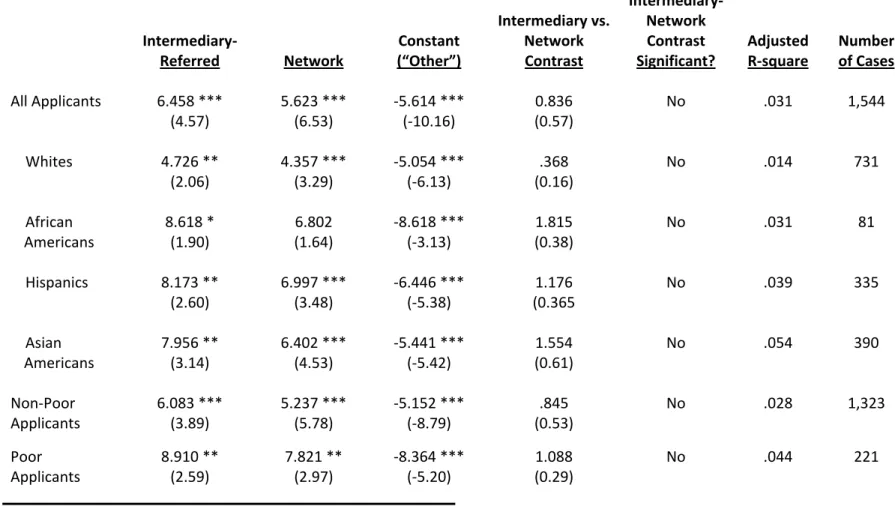
options. In this respect, the results support employers’ concerns about public sector intermediaries’ ability to supply employable candidates (e.g., Laufer and Winship 2004). In contrast, the results for networked applicants are more consistent with the “richer pool” hypothesis. All totaled, applicants produced by intermediary organizations are not working in a parallel manner to naturally occurring networks in this setting.9 Better Timing of Applications Another mechanism by which networked applicants are often theorized to be advantaged in the recruitment process is by means of their having better information about the firm and its hiring practices (Fernandez et al. 2000). Here, we focus specifically on the tendency for networked candidates to apply at times when their chances of being hired are more favorable (Fernandez and Weinberg 1997; Fernandez et al. 2000; Manning 2000). In parallel fashion, intermediary organizations can provide this form of job search benefit for their job‐seeking clientele. By routinely communicating with recruiters about their needs, these intermediary organizations have the capacity to direct people to apply at times when their chances of success are higher than usual. The fact that local labor market intermediaries can serve as a buffer to labor market volatility and supply applicants at times of labor shortages is also seen as an advantage from the employer’s perspective (Laufer and Winship 2004:228). We examined this hypothesis by measuring the degree to which demand (number of job openings) exceeded supply (number of applicants) on the day the candidate applied to the firm. We subtracted the number of applicants from the number of job openings on the day that each candidate applied. Thus, positive numbers indicate that there is a shortage of applicants relative to the number of job openings, and negative numbers show that the number of applicants exceeds the number of available jobs.10 Table 6 shows the results of regression analyses distinguishing the state of the market by recruitment channel for various populations of applicants. The column labeled “Other” shows all negative coefficients that are significantly different from zero. This indicates that on average, for all race and poverty groups, the “Other” candidates applied on days when there were significantly more candidates than there were job openings. 9 For completeness, we also tested whether the difference between networked and intermediary‐referred applicant profiles is statistically reliable. A Wald test rejects the hypothesis that these two profiles are the same (p < .0001; Chi‐square 53.06 with 7 d.f.). 10 The substantive results do not change if we define shortage at the level of the week. When shortage is defined at the level of month, the results are consistently correct sign, but are not statistically significant.
Consistent with the idea that applicants referred by intermediary organizations are receiving information about the nature of the competitive situation at the firm, the coefficients in the first column show that intermediary candidates are applying when there is significantly less competition than that experienced by “Other” applicants. Across all race and poverty groups, the coefficients for intermediary‐referred candidates are positive and statistically reliable. For example, looking at row 1 (“All Applicants”), “Other” candidates are applying when there are 5.614 more candidates than there are openings. The coefficient for intermediary‐referred applicants in row 1 is 6.458, meaning that on average intermediary‐referred candidates are applying on days when the market conditions are more favorable for the candidate than when “Other” candidates are applying. Comparing these two coefficients shows that intermediary‐referred candidates are applying when the number of openings exceeds the number of applicants by 0.844 (6.458 – 5.614). Except for whites and African Americans, comparisons of the coefficients show that on average intermediary‐referred candidates apply when the number of job openings exceeds the number of candidates. Similarly, candidates network referred applicants (column 2) also apply at times when their chances are significantly better than “Other” applicants. Across the various populations, network candidates tend to apply on days when the state of the market is better than the situation for “Other” applicants. With the exception of the smallest subgroup—African Americans—this pattern is statistically reliable. All totaled, there is strong support for the idea that intermediary organizations provide information for applicants to apply at times when their chances of being hired are more favorable. While a comparison of the point estimates show that intermediary‐referred candidates are applying at times that are more favorable than when network candidates apply (cf. columns 1 and 2), the information in columns 4 and 5 show that the degree of advantage is not statistically reliable. This suggests that the mechanism by which intermediary‐referred applicants are advantaged in application timing is quite parallel to the way that networks produce such an advantage, and that the degree of advantage in application timing is of comparable magnitude for all race and poverty subgroups. Consequences for Hiring The question remains whether intermediary‐referred and networked applicants experience superior hiring outcomes than “Other” applicants. Although it is not likely to be a universal pattern (see Fernandez et al. 2000), a number of studies have shown preferences for networked candidates in the hiring process (e.g.,
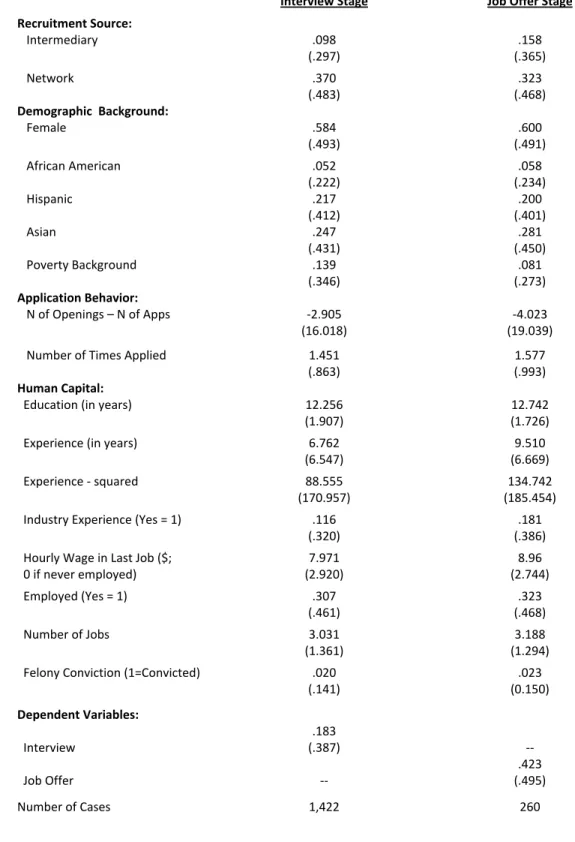
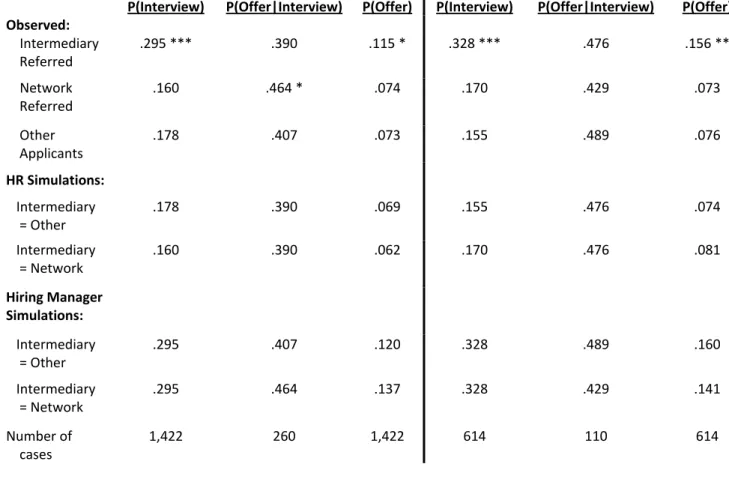
Fernandez and Weinberg 1997; Fernandez et al. 2000; Petersen et al. 2000). The evidence on firms’ reactions to public intermediary‐referred candidates is mixed (for evidence of positive effects, see Melendez and Harrison 1998; also see Holzer [2009] and Thomas [1997] and the studies reviewed therein). To the degree that local public intermediary firms have “created connections” with this firm, we would expect these connections would result in better hiring outcomes for intermediary‐referred applicants. To address these questions, we developed predictive models of the chances of interview and job offer. Table 7 presents the descriptive statistics of the background factors and application behavior variables we used to predict success in the hiring process. The first column shows the figures for the overall applicant pool; the second column reports the statistics for those who have been interviewed by personnel from the company’s human resources department and are under further consideration for a job offer. In addition to the factors listed in Table 3, we added a squared term for years of labor market experience to measure decay in the value of experience over time (Mincer 1974). We also control for the number of times an individual applies to the firm, since people were free to apply multiple times over the course of the study. The number of applications per individual varied between 1 (accounting for 76 percent of applications) and 6 (0.4 percent of applications). Overall, the probability of being interviewed by HR is 18.3 percent (see the next to last row of Table 7). However, the chances of a job offer are substantially higher for those who survive the interview phase since 42.3 percent of interviewees are offered jobs. Of particular interest for the purposes of this paper is the comparison for the recruitment source variables. While applicants referred by intermediary organizations are about 10 percent of the applicant pool, they comprise almost 16 percent of those being considered for job offers. Although we have yet to control for other background factors, this is an initial indication that intermediary‐referred candidates are indeed being given some preference in screening by HR personnel. Interview Stage We begin by examining the first step of the screening process—the interview decision—controlled by personnel in the factory’s Human Resources (HR) department. Without controls, the interview rate of 29.5 percent for intermediary referrals is 8.7 percentage points higher than the interview rate for “Other” applicants (17.8 percent). This contrast is statistically reliable (p < .002; LR chi‐square 9.306 with 1 d.f.). The interview rate for networked applicants is only 16.0 percent, however, and is not statistically different from the rate of 17.8 percent
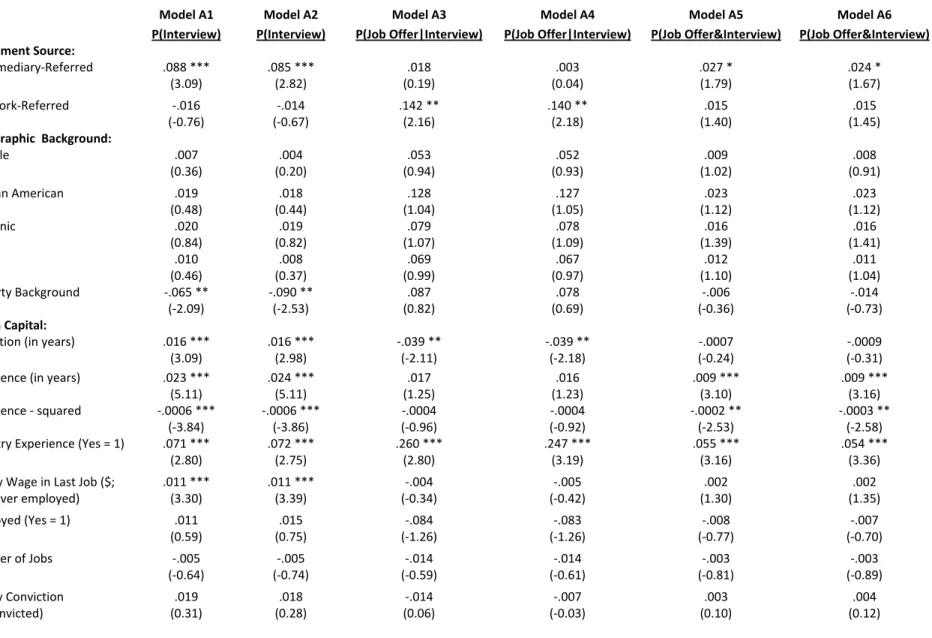
for the “Other” applicants (p < .381; LR chi‐square 0.766 with 1 d.f.). This suggests that, at least at this step of the hiring process, intermediary organizations have successfully created connections to this firm. The question remains as to the nature of these connections, however. As discussed above, although they are applying at more favorable times, intermediary‐referred applicants are of significantly lower quality on several dimensions that the recruiters screen for. Since these factors can be traded‐off,11 it is not clear what the net impact of these factors is. The interview rates just presented do not control for any background factors, and it is possible for these background variables to account for the higher interview rates observed for applicants referred by labor market intermediaries. Model 1 of Table 8 presents the results of a probit model predicting the chances of interview among all applicants. The marginal effects for the human capital variables show that ceteris‐paribus HR screeners are significantly more likely to grant interviews to candidates with more education, experience in the firm’s industry, higher wages in their last jobs (a signal of applicants’ labor market value), fewer jobs (i.e., are not “job‐hoppers”), and more general labor market experience, although the experience‐squared term is negative showing the expected pattern of decay (Mincer 1974). Persistence also pays off with HR recruiters: applicants are 2.0 percent more likely to be granted an interview each subsequent time they apply. Surprising in light of the results reported in Table 6, applying when there is a shortage or surplus of applicants relative to job openings is not significantly related to the chances of interview. Turning to the demographic background variables, in contrast to studies in other settings, we find no statistically reliable evidence that race (cf. Petersen et al. 2000) or gender (cf. Fernandez and Sosa 2005) affect the chances of interview at this firm. Nor was there evidence of significant race or gender interactions with the recruitment source variables (see below). However, applicants from poverty backgrounds are 6.5 percent less likely to be interviewed than “Other” applicants by HR. This is after controlling for the other human capital factors, and despite the potential of gaining training subsidies for the firm if poor applicants are hired. Consistent with the views expressed in interviews (see note 4), the possibility of training subsidies apparently does not outweigh these applicants’ other perceived liabilities in HR’s eyes. 11 See Rees (1966:562) for a discussion of employers’ willingness to relax hiring standards when there is a shortage of applicants.
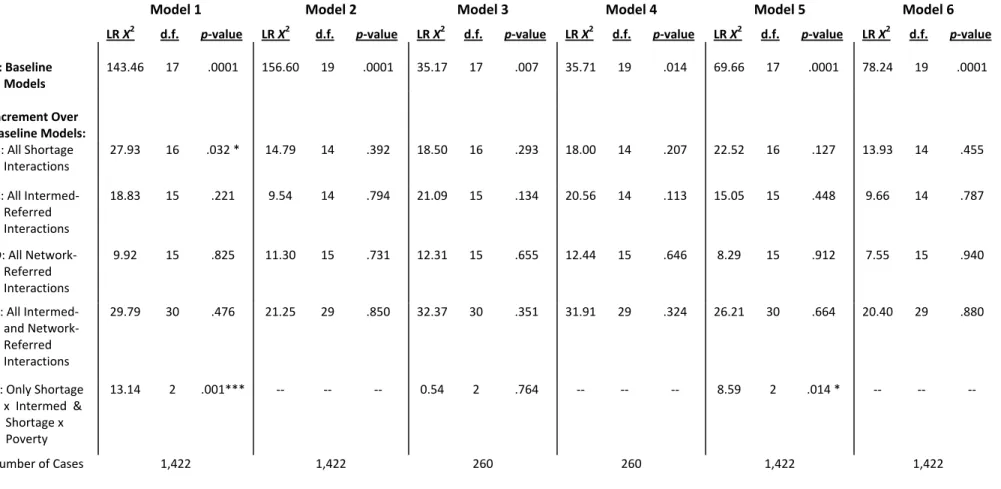
Most important, however, the results in Model 1 show that even after controlling the other factors in the model, intermediary‐referred applicants are significantly more likely to be granted an interview than “Other” applicants. The magnitude of the effect in Model 1 is 8.8 percent, which is virtually identical to the zero‐order advantage noted above. It is clear that the observable factors included among the controls in Model 1 do not erase the advantage that HR personnel are giving intermediary‐referred applicants at this stage of the hiring process. Similar to the zero‐order difference, the effect in Model 1 for network‐referred applicants is small and statistically insignificant. Interaction Tests While intermediary‐referred applicants are more likely to be interviewed than other applicants, the analysis in Model 1 does not address how the effects of recruitment sources (intermediary‐referred and network‐ referred vs. “Other”) might affect the chances of interview in conjunction with other variables. This might be the case if HR screeners were to adjust their standards for granting an interview depending on the applicant’s recruitment source. To the extent that intermediaries supply applicants that are more likely to be eligible for training subsidies associated with poverty background, the firm’s screeners might be tempted to relax hiring standards. Especially in light of the findings showing that intermediary‐referred candidates are applying at times when hiring conditions are more favorable (Table 6), we are also interested in exploring interactions of the other predictor variables with applicant shortage. Such interactions would be expected to the degree that HR recruiters raise or lower their standards in response to a surplus or shortage of applicants. Table 9 reports the results of tests for various interactions. Looking at the figures in the first three columns labeled “Model 1,” the first row shows the Likelihood‐ratio X2, degrees of freedom and level of statistical significance for Model 1 in Table 8. This model has no interaction terms at all, and thus forms the baseline against which the interaction tests reported in subsequent rows of the table are assessed. The second row labeled “B: All Shortage Interactions” shows the improvement in LR X2 associated with adding all interactions between shortage and the other independent variables in Model 1 of Table 8, a total of 16 interaction terms. The LR X2 improvement of 29.04 with 16 d.f. is statistically significant (p < .031) indicating that the effect of at least some of these variables differ depending on the level of applicant shortage.
The analyses reported in the subsequent rows of Table 9 are designed to isolate which variables are interacting. The third row labeled “C: All Intermediary‐Referred Interactions” reports the improvement in LR X2 associated with interacting all the predictors variables with the dummy variable for Intermediary Referral. This addition does not significantly improve the fit of the model (p < .223; LR X2 improvement = 18.81 with 15 d.f.). The next row (labeled “D”) repeats this exercise for the dummy variable for Network Referrals. Here, too, the improvement in fit is not statistically significant (p < .820; LR X2 improvement = 10.00 with 15 d.f.). Nor is the improvement in fit statistically significant when both Intermediary‐ and Network‐referred sets of interaction terms are included (the row labeled “E;” p < .474; LR X2 improvement = 29.83 with 30 d.f.). However, adding two specific interactions with applicant shortage to Model 1—interactions for Intermediary Referral and Poverty Background—does significantly improve fit over the baseline model (row labeled “F;” p < .001; LR X2 improvement = 13.19 with 2 d.f.). In order to determine whether these two interactions account for the significant LR X2 improvement in row B, we examined whether the addition of the other 14 interactions terms for shortage improve fit over the model with only the shortage x intermediary referral and shortage x poverty interactions. Column 2 of Table 9 reports the results of these tests. Row A shows the model fit for Model 2 of Table 8 containing the main effects plus the Shortage x Intermediary Referral and Shortage x Poverty Interactions. Thus, compared to Model 1, Model 2 uses 2 additional degrees of freedom (19 vs. 17), and forms a new baseline for the tests reported for Model 2. Row B of column 2 shows the LR X2 improvement of adding the 14 remaining interaction terms for shortage over the new baseline model with only the Shortage x Intermediary Referral and Shortage x Poverty interaction terms. Adding these interaction terms does not significantly improve the fit of the model (p < .389; LR X2 improvement = 14.84 with 14 d.f.). Considered against this new baseline, adding the other interaction terms for Intermediary Referral (row C), Network Referral (row D), or both sets of these interactions (row E), does not significantly increase the LR X2. Consequently, we are safe in concluding that it is only the Shortage x Intermediary Referral and Shortage x Poverty interactions that improve the fit of the model. These interaction terms show that HR screeners apparently adapt to applicant shortages in two ways when making decisions about whom to interview. First, the positive interaction term for Shortage x Intermediary Referral (see Table 8, Model 2) shows that compared to those applying via other sources, the chances of being