Published in Deep‐Sea Research II, 142: 109‐124.
https://doi.org/10.1016/j.dsr2.2017.06.003
Aliphatic hydrocarbons and triterpenes of the Congo deep sea fan
Laurence Méjanelle(1)*, Béatrice Rivière(1), Laurence Pinturier(2), Alexis Khripounoff(3), François Baudin(4) and Jordi Dachs(5)
(1) Sorbonne Universités, UPMC‐Univ. Paris 06, CNRS, Laboratoire d’ECObiogéochimie Benthique, UMR 8222, 18 Avenue du Fontaulé, 66650 Banyuls Sur Mer, France (corresponding author:
(2) Total E&P, Norge AS, Finnestadveien 44, 4029 Stavanger, Norway
(3) Ifremer Centre Bretagne, Institut Carnot‐Ifremer‐EDROME, Laboratoire Environnement Profond, (REM‐ EEP‐LEP), 29280 Plouzané, France
(4) Sorbonne Universités, UPMC‐Univ. Paris 06, CNRS, Institut des Sciences de la Terre de Paris, 4 place Jussieu, 75005 Paris , France
(5) Department of Environmental Chemistry, Institute of Environmental Assessment and Water Research (IDAEA‐CSIC), Barcelona, Catalonia, Spain.
Abstract :
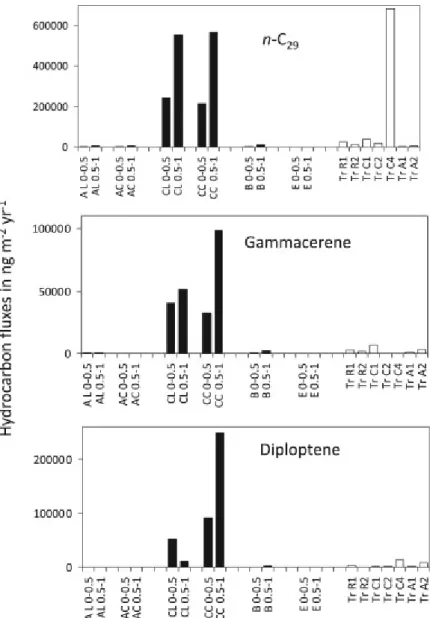
Hydrocarbons were analyzed in sediments from the Congo River deep‐sea fan, from the Congo River, and in sinking particles collected by sediment traps 40 m above the sediment. Studied sites encompassed three lobes of decreasing age of formation along the canyon: sites A, F and C and a another lobe system, disconnected from the active channel since 4 ka, Site E. Terrestrial long‐chain odd n‐alkanes were dominant in all sediments of the lobe system. Unsaturated terpenoids sourced by higher plants, such as gammacerene, lupene, ursene and oleanene, were also detected. At site C, characterized by high accumulation rates (10– 20 cm yr−1), the organic matter spends less time in the oxic layer than at other sites and high phytadiene concentrations 10–17 μg gOC−1) evidenced recent terrestrial and phytoplanktonic remains reworked in anaerobic conditions. In these sediments, organic carbon‐normalized concentrations of terrestrial alkanes and terpenoids were several fold higher than in the lobe sediments with lower accumulation rates (sites A and F), arguing for a more rapid degradation of terrestrial hydrocarbons than bulk organic carbon in the first steps of pre‐diagenesis. Ample variations in the contributions of biomarkers from higher plants, ferns, bacteria and angiosperms, indicate an heterogeneous contribution of the soil and vegetation detritus delivered to the Congo lobe sediments. Lower concentrations in terrestrial hydrocarbons at site E, 45 km away from the active canyon, indicated that river particles are still admixed to the dominant marine organic matter. Diploptene and hop‐7(21)‐ene have a dual origin, from terrestrial and marine microorganisms. Scatter in their relationship to gammacerene argues for a contribution of marine microorganisms, in addition to soils‐sourced microorganisms. The close distribution patterns of diploptene, hop‐21‐ene, hop‐7(21)ene and neohop‐13(18)‐ene is in line with the hypothesis of sequential clay‐catalyzed isomerisation of bacterial hopenes. Terrestrial biomarker accumulation fluxes at site C are one order of magnitude higher than vertical pelagic flux, demonstrating the magnitude of the inputs delivered through turbiditic transport in the submarine canyon. Crude oil contamination was evidenced at the disconnected site E (UCM, C21 to C26 tricyclic diterpanes, CPI) and, in smaller amounts, in some sediments from sites A and C. It may be related to marine crude oil extraction and transport. A short‐chain mode of alkanes with an even predominance is evidenced in sediments of the lobe complex and likely sources, crude oil, microorganisms and ferns, are discussed.
1. Introduction
The effort to quantitatively understand and predict the carbon cycle includes the assessment of the inventory of marine reservoirs of organic carbon and the prediction of its oxidation and transfer back to atmospheric CO2. However part of the terrestrial organic carbon escapes degradation and is buried in sedimentary horizons where no more oxidation occurs. Marine sediments are among the largest sinks of organic carbon, and half of this organic carbon reservoir is sourced by terrestrial plants and organisms (Blair and Aller, 2012; Burdige, 2005, 2007). This preserved organic carbon accounts for less than half the rivers inputs (Burdige, 2007 and references therein) which pictures the ocean margins as efficient in both remineralizing terrestrial organic matter and sequestering it (Middelburg et al., 1993). The organic carbon budget bridges processes on different times scales. The water column biogeochemical cycling and early diagenesis processes integrate annual to decadal time scales. In contrast, the cycle of organic carbon that is ultimately preserved in marine sediments as geopolymers, kerogen or source rocks eroded from the continent, may exert feedbacks on atmospheric CO2 over thousand years to geologic time scale, with enhanced carbon burial during low sea level glacial ages (Cartapanis et al., 2016).
The Congo River (ex‐Zaire) has a large intertropical watershed mainly covered by C3 rain forest vegetation. It delivers a large flux of higher plant debris and fine particles eroded from soils to the Atlantic Ocean, while it carries a minor contribution of riverine planktonic organic matter (Spencer et al., 2012). The particulate organic carbon exported to the Atlantic Ocean by the Congo River accounts for an input of 2 Tg organic carbon per year (Coynel et al., 2005). The Congo River is connected to a sinuous submarine canyon that starts within the river mouth, deeply incises in the shelf and slope and further extends in the deep basin through an active channel‐levees–lobe system. The active terminal lobe complex is located at 4750 m depth, 760 km away from the river mouth (Savoye et al., 2009; Vangriesheim et al., 2009).
Overload of river sediments and sliding of sediment at the canyon head can initiate energetic gravity currents that transport most of the river particles to the terminal lobe complex. Besides terrestrial organic matter, sediments of the Congo‐Angola margin also comprise a remarkable contribution of marine organic matter sourced by the coastal upwelling North and South the Congo River plume and within the plume itself (Schefuß et al., 2004). As a result, the gravity currents may transport an admixture of organic carbon sourced by this coastal autochthonous production together with the river inputs. Times series studies have captured very energetic turbidity events upstream the terminal lobe complex (Khripounoff et al., 2003; Vangriesheim et al., 2009). For example, a turbiditic event in 2001 caused a massive particle flux within the canyon but also spilled over its edge thereby yielding a high pulse of terrestrial clay on the levee, 18 km away from the canyon channel, in an area otherwise characterized by marine pelagic particle flux (Khripounoff et al., 2003). In 2004, two intense events were recorded by intense peaks in turbidity and in particle flux, and by mooring breaking (Vangriesheim et al., 2009). When reaching the terminal lobe system, even though the current looses velocity, it can still deliver intense particle flux (Vangriesheim et al., 2009). Besides turbitic currents smaller pulses in particle flux with no current increase were also recorded, and indicate local sliding of sediment accumulated on the walls or terraces on the sides of the channel (Vangriesheim et al., 2009). The Congolobe project aims at studying the geology, geochemistry and ecology of the Congo terminal deep‐ sea fan system (Rabouille et al., 2017), a hotspot of terrestrial carbon burial (Baudin et al., 2017b). The sediments of the lobe complex are organic‐rich silts and silty‐clays, their C/N and δ13C values indicated that 70–80% of the OM was terrestrial in origin (Baudin et al., 2010; Stetten et al., 2015), and was mostly composed by river particles conveyed from the Congo mouth by turbiditic currents. Sediment palynofacies
revealed predominant well preserved particles derived from plant structures. In addition, amorphous organic matter was relatively more abundant in the studied levee whereas the denser well preserved wood fragments and transparent intact phytoclasts were enriched in the channel sediment, suggesting a general sorting of particles according to the density of particle (Schnyder et al., 2017). Palynofacies also evidenced a vertical gradient in the upper 20 cm of the cores. Amorphous organic matter is relatively enriched upcore with respect to denser terrestrial components, which further supports hydraulic sorting of particles in the turbiditic deposits.
Molecular geochemistry brings complementary views to bulk geochemical information. Terrestrial molecular biomarkers fall into extractable lipids or non extractable macromolecules. Typical terrestrial biomarkers such as lignin phenols for instance, have revealed selective sorting of higher plant debris and soil particles (Cathalot et al., 2013; Gordon and Goñi, 2004; Rezende et al., 2010). Branched glycerol dialkyl glycerol tetraethers (DGDT) are used to trace soil inputs to aquatic sediments (Kim et al., 2012; Lopes dos Santos and Vane, 2016). Even if lipids comprise less than 1% of the bulk terrestrial organic pool, terrestrial lipid biomarkers are routinely used to detect variations in terrestrial inputs and in their preservation in sediments. Odd long‐chained (C25‐C35) alkanes are higher plant biomarkers resistant to degradation and are commonly used as vascular plant proxy, in present day environments as well as in paleoreconstruction studies (Castañeda et al., 2011; Gogou et al., 2000; Mangelsdorf et al., 2000; Romero‐Viana et al., 2012). A 3 year survey of n‐alkanes in suspended particles from the Congo River showed that they integrate the catchment signal with minimal seasonality (Hemingway et al., 2016).
The present contribution examines the hydrocarbon composition of sediments of the lobe complex, of Congo River sediments and of sediment traps in order to complement bulk proxies and palynofacies evidences. It aims at bringing information on the source of the organic matter preserved in the lobe sediments and questions whether the spatial distribution of terrestrial hydrocarbon biomarkers reflects the variability evidenced by palynofacies. Concentrations of both aliphatic and terpenic hydrocarbons in recent marine sediments are very seldom reported in the literature and concentrations of both aliphatic and terpenic hydrocarbons presented here provides original reference data for this region, displaying uncommon terpene abundances. In addition, fluxes have seldom been reported previously. Comparing sedimentary mass accumulation rates and water column fluxes of aliphatic and terpenic hydrocarbons brings new understanding of the importance of terrestrial hydrocarbon inputs.
Five sites representative of an upstream‐downstream gradient in the lobe complex, including both the active lobe system and an abandoned lobe, and a site in the Congo River were selected for sedimentary hydrocarbon molecular study. This sample set has been previously characterized for grain size, organic carbon concentration (OC), δ13C, C/N ratio, Rock‐Eval and other geochemical approaches (Baudin et al., 2017a; Stetten et al., 2015; Schnyder et al., 2017). Particles collected by sediment trap moored 40 m above the lobe sediment beds were also analyzed to understand the contribution of sinking particles.
2. Material and methods
2.1 Sampling strategy The samples were collected during two cruises that took place in 2011 on the RV Pourquoi Pas? The first one, WACS (Olu, 2011) was conducted in February 2011 and the second one, Congolobe, was performed betweenDecember 2011 and January 2012 (Rabouille et al., 2009). The objectives of the Congolobe project, the sampling rationale and geological and geochemical characteristics of the studied sites are detailed in Rabouille et al. (2017). The distal lobe complex of the active canyon is the area where the canyon depth progressively decreases and the sediments accumulate, as shown by the maxima in sediment accumulation rates (Rabouille et al., 2017). The lobe complex comprises 5 prograding lobes partly stacked one over the other and having increasing age of formation, from ca 4 ka for the most upstream and oldest lobe (numbered lobe 1, Fig. 1) to present time for the most distal and youngest lobe (numbered lobe 5, Fig. 1) (Bonnel, 2005; Dennielou et al., 2017; Rabouille et al., 2017). In addition, the high resolution bathymetric study showed an abondoned channel that led to the lobe complex in the past, on the northern levee. This presently inactive channel departs from the active one upstream from site A. Close to the area where both channels depart one from another, the presently inactive one is 25 m deep and 1000 m wide and it extends to lobe 3. The channel that is currently active is 45 m deep and 1400 m wide and connects to the more recent lobe 5. When turbidite particles spill over the levees of the active channel, they may fill the inactive channel, and create the smoothed morphology of that canyon while filling it. The morphology of this canyon may also allow some particle transport to lobe 3.
Fig. 1. Study area. Red dots on the top figure shows the locations of the Congo River sediments K1, K2 and K3, at the entrance to the Malebo Pool. Sediment trap moorings at the Regab site (Tr R1 and Tr R2) at the site WACS Tr C (Tr C1, Tr C2 and Tr C4) are indicated by blue triangles. The lower panel shows the general bathymetric map of the Congo River deep‐sea fan. The boundaries of the terminal lobe complex are outlined by a black line, while dotted lines outline distinct lobes, from the older lobe 1 to the youngest lobe 5. The presently active channel fuels the lobe 5. The locations of coring sites are indicated by black dots. The Site E is located at the end of the abandoned channel. The location of the sediment trap mooring at site A (A‐WPPART03) is indicated by a blue triangle.
Table 1 reports the locations and depths of the analyzed sample set. Sites A, F and C are located along an upstream – downstream gradient along the active southern channel. Site A is located in lobe 2 (A), where the canyon is a 45 m deep channel in which the sediment core CoL‐A‐MTB03 was recovered. This core was collected on the southern levee displaying gentle flanks (Rabouille et al., 2017). Site F is located at the onset of lobe 4, 40 km downstream of site A and the sediment core CoL‐F‐MTB‐04 was collected on the northern levee of this site. At site F, the canyon is a 45 m deep and 2500 m wide channel. Site C is located 25 km downstream of site F, at the distal part of the lobe 5, where the canyon structure fades into a 11 m deep channel, as a result of the accumulation of recent particle deposits. At this site, the sediment core CoL‐C‐ MTB‐06 was collected on the levee and CoL‐C‐MTB‐11 on the channel. CoL‐B‐MTB‐12 was sampled on lobe 3 at site B, located on the northern levee in the vicinity of the inactive channel. At the coring location the presently inactive channel leading to lobe 3 is only a few meters deep. Site E characterizes an abandoned northern lobe complex, 45 km north of the active channel that receives little turbiditic matter since at least 4 ka BP (Rabouille et al., 2017; Stetten et al., 2015). This site refers to conditions where mainly pelagic inputs build up the sediments, as opposed to the other sites where turbidites are the main deposit types. The sediment core CoL‐E‐MTB‐14 was collected at this site.
In order to characterize the Congo River particulate inputs, sediments from the river floodplain were analyzed (Table 1). They were collected at three sites at the Malebo Pool, permanently flooded, inundated during high discharge months, and recently exposed, and were donated from H. Talbot and R. Spencer (Talbot et al., 2014, Supplementary Table 2). At these sites the particulate organic carbon composition compares well to that in the estuary and these 3 river sediments are considered as representative of the Congo particulate export to the Atlantic (Spencer et al., 2012).
In order to characterize the vertical rain of pelagic particles, a limited set of sediment trap samples from 3 sites were considered (Table 1). Two sediment traps were located at a mid distance between the canyon head and the lobe complex, one is located 10 km north of the canyon channel and is located above a large cold seep pockmark (samples TrR1 and TrR2), the other is above the canyon itself (TrC1, TrC2 and TrC4). The third trap was moored at the entrance of the lobe complex above the site A (TrA1 and TrA2).
2.2 Hydrocarbon molecular analyses
Known amounts of C24D50 were added to the lyophilised samples prior to extraction as a surrogate for non aromatic hydrocarbons. The lyophilised sediment samples (ca. 0.2 to 6 g d.w.) were extracted using accelerated solvent extraction. The samples were homogenised with diatomeous powder previously combusted at 450oC and sequentially extracted using accelerated solvent extraction (Dionex ASE 350). The first extraction, with acetone at 100oC and 1500psi for 1 static cycle of 5 min. and 60% of flush, was followed by 3 static cycles of 5 min. with acetone/dichloromethane (1:1) at 100oC and under a pressure of 140 bars. The sequence was previously optimized using coastal sediments to ensure no cross‐contamination. The lipid extracts were treated with acid‐activated copper to remove elemental sulfur. The extracts were concentrated using rotary evaporation, solvent exchanged to iso‐octane and concentrated down to 200 l. They were purified into different fractions on a dual silica/alumina column made of 5g of silica deactivated at 5% and 3 g of alumina deactivated at 3%. The first fraction, eluded by 25 ml of hexane, contained the aliphatic and cyclic hydrocarbons.
This fraction was first analyzed for aliphatic compounds by gas chromatography (GC) coupled to a flame ionization detector (FID) equipped with a DB‐5MS capillary column (J&W, 30m x 0.249 mm i.d. x 0.25 µm thick phase film). The carrier gas was helium at a pressure of 110 kPa. The oven temperature, initially at 60°C was brought to 100°C at a rate of 25°C/min, then to 310°C at a rate of 2°C/min. The final isotherm of 310°C was held for 60 minutes. The FID was kept at 330°C. Aliphatic hydrocarbons were quantified relatively to the internal standard added prior to extraction. For river and trap samples the quantity of available material (0.2 to 1g) did not allow a proper quantification by GC‐FID. These samples were quantified by GC‐Mass Spectrometry (GC‐MS) on an Agilent 6890 Series GC system coupled to an Agilent 5973 Network Mass Selective Detector. A DB‐5MS capillary column (Agilent DB5, 30m x 0.25 mm i.d. x 0.25 µm thick phase film) was used. The carrier gas was helium at a flow of 1.2 ml/min. The initial oven temperature of 60°C was held for 5 minutes, then brought from 60°C to 160°C at a rate of 25°C/min, then increased to 310°C at a rate of 3°C/min with a final isotherm of 10 minutes. Full acquisition program scan (from 40 to 600 amu) under electron impact ionization at 70eV was used. Individual hydrocarbons were quantified relatively to the surrogate (C24D50) and corrected with relative response factors (RRFs). Calibration solutions containing 25 target n‐alkanes (prepared from Alkane mix 10, Dr Erhenstorfer GmD), chosen to bracket the sample concentrations, were used to derive the RRFs of the analytes. Carbon Preference Index (CPI) was calculated as:
)
)
C
C
C
C
C
(C
)
C
C
C
C
C
(C
)
C
C
C
C
C
(C
)
C
C
C
C
C
(C
(
2
1
CPI
36 34 32 30 28 26 35 33 31 29 27 25 34 32 30 28 26 24 35 33 31 29 27 25 34 ‐ 24
Hopanes and other triterpenes were semi‐quantified by integrating peaks on the ion current at m/z 191. The major hopanoid, hop‐17(21)‐ene, was quantified by GC‐FID, and the other triterpene abundances were calculated by relating their area to that of the hop‐17(21)‐ene. In a few samples, hop‐17(21)‐ene could not be quantified on the GC‐FID trace. In those few samples, the hopane abundances were calculated by relating their area to that of the n‐C31 n‐alkane, and correcting with response factors determined from the samples where both n‐C31 and hop‐17(21)‐ene were unequivocally quantified by GC‐FID responses.Procedural blanks were processed and analyzed. They were clear of contamination. The method was also tested for reproducibility and repeatability. The disparity was less than 5%.
Sedimentary accumulation fluxes of the given hydrocarbons were calculated as :
Φ
alk
C
alk
AR
d
(1
p)
10
4With Φalkthe mass accumulation rate of the hydrocarbon in ng m‐2 yr‐1, Calk the concentration of a given hydrocarbon in ng.g‐1 of dry weight, AR the sediment accumulation rate in cm yr‐1, d the sediment density in g cm‐3, p the sediment porosity.
3. Results
3.1 n‐alkanes molecular profiles and concentrations
A total of 31 n‐alkanes ranging from C10 to C40, and 8 isoprenoid hydrocarbons were identified and quantified in the samples. The dominant biomarkers in most sediments of the lobe complex sediments are a suite of n‐alkanes dominated by high‐MW compounds (> C24) with predominance of odd over even carbon chain alkanes (CPI values from 4.0 to 9.6) (Fig. 2, Table S1 Supplementary material, p. 40‐47). They derive from higher plant waxes (Table 2). Their concentrations in the lobe sediments varied from 50 to 6070 ng gDW−1, from 320 to 1150 ng gDW−1 in Congo River banks and from 470 to 2040 ng gDW−1 in sediment traps. Their range compares well with other river deltas (Table 3).
Table 2. Source assignment of hydrocarbon biomarkers detected in the present study.
Biomarker Source organisms Source environment References
C25‐C35 odd alkanes waxes of higher plants terrestrial inputs Eglinton et al., 1962; Eglinton and Hamilton, 1967
C17 phytoplankton marine Clark and Blumer, 1967
C16, C18 bacteria marine Grimalt and Albaigés, 1987; Nishimura and Baker, 1986
grass terrestrial Kuhn et al., 2010 sedimentary rocks terrestrial Tao et al., 2016
petroleum oil input Tao et al., 2016
Phytadienes reducing environment marine Grossi et al., 1998
UCM petroleum oil input Broman et al., 1987
Gammacerene ciliates, ferns, bacteria terrestrial, marine Bravo et al., 2001; Hamed et al., 2014; Kleemann et al., 1990, Banta et al. 2015
Oleanene, ursene angiosperms terrestrial Peters et al., 2005
Fernenes ferns terrestrial Ageta and Arai 1983; Paull et al., 1998 anaerobic bacteria Marine Volkman et al., 1986; Marynowski et al., 2007b
bacteria Brassel and Eglinton1893
Diploptene and bacteria marine Rohmer et al., 1984; Talbot et al., 2014, Banta et al., 2015 hop‐21‐ene soil bacteria terrestrial Prahl et al., 1992
Hop‐17(21)‐ene ferns terrestrial Patitucci et al., 1995; Shiojima and Ageta, 1990
Table 3. Concentration levels (ng gDW‐1 and ngOC‐1) and fluxes ( g m‐2 yr‐1) of terrestrial alkanes, Short‐chain alkanes, UCM and terpenoids in marine, lacustrine and continental sediments in comparison with sediments from the terminal Congo lobe system.
Study location Reference
ng gDW -1 g g OC -1 g m-2 yr-1 ng gDW -1 g g OC -1 g m-2 yr-1 ng gDW -1 g m-2 yr-1 ng gDW -1 g g OC -1 g m-2 yr-1 Atlantic Ocean
SE margin, including Congo fan C27‐C33 odd 20 ‐ 290 nc nc nc Rommerkirshen et al., 2003
SE margin, including Congo fan C25‐35 odd 460 ‐ 39 000 6 000 nc nc nc Schefuss 2004
Congo River particles C23‐35 66.0 ‐ 207.1 Hemingway et al., 2016
Congo deep sea fan C25‐35odd 30 ‐ 2 050 2.2 ‐ 56.4 0.23 ‐ 2 702 nd‐350 nd‐16.4 nd‐651 nd ‐ 10 470 nd‐2 050 Neohopene nd‐69 nd‐2.85 nd ‐ 68 This study
Congo deep sea fan Diploptene nd‐303 nd‐7.34 nd ‐ 249 This study
Southwest African coast C25‐33 2 000 ‐ 31 000 nc nc nc Hermann et al., 2016
Washington Coast C25‐31 odd 600 ‐ 2 500 nc nc Diploptene 30‐500 Prahl et al., 1992
Amazon estuary C29+C31 46‐ 424 nc nc nc Haggi et al., 2016
Brazilian estuary‐shelf transition C21‐C35 100 ‐ 4 900 nc nc nc Maciel et al., 2016
Brazilian Coast Sum Alkanes 1 560 ‐ 104 750 nd ‐ 189 100 Venturini et al., 2004
Pacific Ocean
Californian margin C25‐C35 odd 40 ‐ 150 100 ‐ 500 nc nc nc Mangelsdorf et al., 2000.
Mediterranean Sea
Rhone prodelta Sum alkanes 830‐ 1699 nc 1 798 ‐ 13340 39 ‐ 205 nc Tolosa et al., 1996
Ebro prodelta 458 ‐ 854 nc 1 072 ‐ 12 056 29 ‐ 295 nc Tolosa et al., 1996
Cretan margin C25‐C35 odd 94 ‐ 417 343 ‐ 4 800 Gogou et al., 2000
Black Sea sapropels C29+C31 7500 ‐ 83 600 140‐350 Diploptene 2 300‐9 900 40‐ 180 Wakeham et al., 1995
Pacific Ocean
Yangtze estuary C15‐38 160‐1880 Hopanes ca 2‐11 Bouloubassi et al., 2001
Yellow Sea C15‐35 240‐1340 6 ‐ 47 Liu et al., 2012
China Sea C15‐35 140‐1680 2.5 ‐ 27
Chinese marginal Sea C15‐C33 C29+C31 40 ‐ 300 2‐ 200 nc nc Tao et al., 2016
New Zealland coast 158 000 ‐ 516 000 nd‐830 000 Sikes et al., 2009
Lacustrine environments
Equatorial Africa, Lake Challa des‐A triterpenoids 20 ‐ 700 van Bree et al., 2016
Caspian Sea C14‐C32 249 200 ‐ 3 899 500 897 000‐25 541 000 Hopanes 429 ‐ 21691 Shirneshan et al., 2016
Cretaceaous Black Shales Neohopenes nd‐87 Sinninghe Damsté et al., 2014
Terrestrial alkanes Short-Chain alkanes C16 + C18 UCM Terpenoids
The three sediments from the Congo River show an identical hydrocarbon composition, maximizing at n‐C29, and with the n‐C23 to n‐C35 mode accounting from 91% to 95% of total non cyclic hydrocarbons. These patterns are consistent with the molecular composition described for suspended particles in the Congo River (Hemingway et al., 2016). This strong higher plant signature is mirrored in alkane molecular patterns from many of the studied sediments: the levee of site A, the channel at site C, and in the deeper part of the site E (>10 cm horizons), confirming that the Congo River is the primary supply of the organic matter accumulated in the lobe complex (Fig. 3). In the sinking particles collected by sediment traps, the higher plant fingerprint is faint at the Regab site, located away from the active channel, marked at the canyon site, and variable at site A (Fig. 3).
Fig. 2. Molecular profiles of n‐alkanes in River sediments (K1), in sediment traps collected during WACS at 3420 m (TrC1) and at the site A (TrA1), and in surficial (0–0.5 cm) sediments collected in the terminal lobe complex, in the levee of site C (CL 0–0.5), in the channel of site C (CC 0–0.5) and at site E (E 0–0.5). n‐Alkane homologues are assigned by their carbon number, and their abundance is expressed as concentrations, in ng per gram of dry weight (ng gDW−1).
Fig. 3. Top panel shows the spatial distribution of terrestrial n‐alkane concentrations normalized to organic carbon, in sediments from the Congo River (grey bars), in surficial sediments collected from the Congo deep‐ sea fan (black bars, Lev: levee, Cha: channel, sediment layers from 0 to 0.5 cm and from 0.5 to 1 cm), and in sediment trap samples (white bars). Terrestrial n‐alkanes are defined here as odd n‐alkanes from C25 to C37. n‐
Alkanes levels are expressed in ng per gram of organic carbon (ng gOC−1). Carbon Preference Index (CPI)
calculated from C25 to C35 is plotted on the right axis. Bottom panels show the vertical profiles of terrestrial n‐
alkane concentrations and CPI in two cores, from the channel at site C, and from site E.
In sediments from the channel of site A, the levee of site F, the levee and upper horizons of the channel at site C and of site E, the terrestrial imprint co‐occurs with a low molecular weight mode of n‐alkanes, with even predominance maximizing at n‐C14 and n‐C16 (Fig. 2, right middle and bottom panels; Fig. 4). The phytoplanktonic biomarker n‐C17 indicates recent input of phytoplanktonic biomass (Table 2; Marty et al., 1994). Its higher contribution in sediment trap particles than in sediments and soils underlines the predominantly marine origin of the sinking particles, in line with Rock‐Eval assessment (Baudin et al., 2017a).
Fig. 4. Top panel shows the spatial distribution of C16n‐alkane concentrations normalized to organic carbon, in
sediments from the Congo River (grey bars), in surficial sediments collected from the Congo deep‐sea fan (black bars, Lev: levee, Cha: channel, sediment layers from 0 to 0.5 cm and from 0.5 to 1 cm), and in sediment trap samples (white bars). C16 levels are expressed in ng gOC−1. Bottom panels show the vertical profiles of C16
concentration in two cores, from the channel at site C, and from site E. The star indicates petroleum contamination, in this sample the low molecular mode of alkane showed no even predominance.
Chromatographically unresolved hydrocarbons were detected in 12 samples. The unresolved complex mixture (UCM), potentially composed of over 250 000 cyclic and branched hydrocarbons (Sutton et al., 2005) brings evidence for the occurrence of petrogenic hydrocarbons (Table 2). UCM concentration was the highest in the surface sediments of site E (10 500 ng gDW−1), and took lower values in some sediments of the sites A and B (up to 8 000 ng gDW−1 and up to 1 500 ng gDW−1, respectively).
Three phytadiene isomers were the dominant isoprenoids in the vast majority of sediment samples, but they were absent in river sediments and nearly absent in sinking particles (Fig. 5). The concentrations of the three isomers were similar and that of the third one took a maximum value 202 ng gDW−1 in the surface sediment of the levee at site C, and of 1 ng gDW−1 in the sole trap sample where phytadienes could be identified.
Fig. 5. Top panel shows the spatial distribution of phytadiene concentrations normalized to organic carbon, in sediments from the Congo River (grey bars), in surficial sediments collected from the Congo deep‐sea fan (black bars, Lev: levee, Cha: channel, sediment layers from 0 to 0.5 cm and from 0.5 to 1 cm), and in sediment trap samples (white bars). The sum of three phytadiene levels are expressed in ng gOC−1. Bottom panels show the vertical profiles of concentration of phytadienes, in two cores, from the channel at site C, and from site E. 3.2. Triterpene molecular profiles Substantial amounts of triterpenes were present in the sediment extracts from the terminal lobe, in particular at site C. The hopane and hopene mass spectra interpretation was inferred from retention times and published spectra. Representative m/z=191 hopanograms and mass spectra of the major hopanoids are presented in the Supplementary material (Figs. S2, S3, S4 and S5, p. 59‐62). Triterpene distribution patterns within the lobe complex sediments shared common features such as the predominance of C30 and C31 hopanes in the 17β(H),21β(H) (ββ) and 17β(H),21α(H) (βα) configurations, and of unsaturated hopanoids (Figs. 6–8). Both characteristics are a clear signature of recent immature organic matter, as opposed to oil contamination. Hopane and C31 homohopane having retained their precursor ββ configuration are abundant in terrestrial clays and sediments (Kvenvolden at al, 1990; Marynowski et al., 2007a). In the lobe complex sediments, they likely traced soil inputs (Fig. 7). A few samples showed contrasting composition: in surficial sediments (0–0.5 cm and 0.5‐and 1 cm) of the disconnected E site, tricyclic diterpanes with 20, 21, 23, 24 and 25 carbon
atoms were the dominant homologues, and hopenes were less abundant or non detected (Fig. 6, Fig. S2 in Supplementary material, p. 59). Tricyclic diterpanes have been described as the major homologues in saline lacustrine and marine crude oils (Tao et al., 2015), and their occurrence points to oil contamination of site E surficial sediment, in agreement with the UCM concentrations and CPI values. However the hopane profile in the lobe complex sediments did not show the characteristics of a mature oil (αβ and moretane dominance over ββ‐hopanes), as the hopene profile was the same as in the other non‐contaminated sites, and as in the non‐contaminated deeper horizons at site E (hop‐17(21)‐ene, ββ− C30 hopane and ββ−C31‐homohopane (Fig. 6) (Fig. 8).
Fig. 6. Molecular profiles of dominant triterpenes in River sediments (K1), in sediment traps collected during WACS at 3420 m (TrC1) and at the site A (TrA1), and in surficial (0–0.5 cm) sediments collected in the terminal lobe complex, in the levee of site A (AL 0–0.5), in the channel of site C (CC 0–0.5) and at site E (E 0–0.5). Hopanes, hopenes and other triterpenes are quantified as peak area in the fragmentogram m/z= 191, and by relating their area to the area of hop‐17(21)‐ene, quantified by GC‐FID. Triterpene levels are expressed in ng gDW−1.
Fig. 7. Top panel shows the spatial distribution of gammacerene concentrations normalized to organic carbon, in sediments from the Congo River (grey bars), in surficial sediments collected from the Congo deep‐sea fan (black bars, Lev: levee, Cha: channel, sediment layers from 0 to 0.5 cm and from 0.5 to 1 cm), and in sediment trap samples (white bars). Fernene level is represented by white circles, plotted on the right axis. Gammacerene and fernene are terrestrial biomarkers, while fernene can also be sourced by microorganisms. Their levels are expressed in ng gOC−1. Bottom panels show the vertical profiles of concentrations of
Fig. 8. The top panel shows the spatial distribution of the concentrations of C31 ββ‐homohopane normalized to
organic carbon, in sediments from the Congo River (grey bars), in surficial sediments collected from the Congo deep‐sea fan (black bars, Lev: levee, Cha: channel, sediment layers from 0 to 0.5 cm and from 0.5 to 1 cm), and in sediment trap samples (white bars). C31 ββ‐homohopane levels are expressed in ng gOC−1. White circles
represent the mean grain size of the lobe complex sediment, in μm and is plotted on the right axis. Bottom panels show the vertical profiles of concentration of C31 ββ‐homohopane and of mean grain size, in two cores:
from the channel at site C, and from site E.
In most lobe sediments, hop‐17(21)‐ene, ββ‐hopane and diploptene (hop‐22(29)‐ene) were the dominant homologues (Figs. 9 and 10). Diploptene is present in various types of bacteria and is related to the membrane constituent bacterihopanetetraol (Table 2). In contemporary sediments, its diagenesis starts with double bond migration into hop‐21‐ene, then into hop‐17(21)‐ene, and further proceeds by rearrangement and migration of the methyl at C‐18 to the position C‐17 forming norneohop‐13(18)‐ene (Simoneit, 2005). In the present sample set, the four isomers were detected in variable proportions. Hop‐17(21)‐ene prevailed in most sediments, in particular at the site C, and also in the sinking particles collected by sediment traps. Hop‐17(21)‐ene concentrations were from non detected to 9 ng gDW−1 in the Congo River sediments, maximized at 335 ng gDW−1 in some sediments of the site C and varied from non detected to 303 ng gDW−1 in the sediment trap samples.
In river samples and in a few samples (site A levee, site C surficial layers), diploptene was equally prominent in the m/z 191 fragmentograms. Diploptene concentrations reached 25 ng gDW−1 in the Congo River sediments, 294 ng gDW−1 in some sediments of the site C and 215 ng gDW−1 in the sediment trap samples. Neohop‐13(18)‐ene seldomly prevailed, for instance in surficial sediment of the levee of the site A (Fig. 6). A C27 22,29,30trisnorhop‐13(18)‐ene was also detected in most samples (Figs. S3 and S4, Supplementary material, p. 60).
Fig. 9. Top panel shows the spatial distribution of diploptene concentrations normalized to organic carbon, in sediments from the Congo River (grey bars), in surficial sediments collected from the Congo deep‐sea fan (black bars, sediment layers from 0 to 0.5 cm and from 0.5 to 1 cm), and in sediment trap samples (white bars). Hop‐ 21‐ene concentration is represented by white circles, plotted on the right axis. Diploptene is a terrestrial biomarker (soil microorganisms), and marine bacteria can also be its biological precursor. Diploptene and hop‐ 21‐ene levels are expressed in ng gOC−1. Bottom panels show the vertical profiles of concentration of diploptene
Fig. 10. Scatter plots of OC‐normalized concentrations of selected terpenoids versus gammacerene concentration. Gammacerene is a synthesized by ferns and bacteria. In the Congo terminal lobe system, it covariates with δ13C, therefore have a terrestrial origin.
Gammacerene was the most abundant non‐hopanoid triterpene in the lobe sediments. It differs from hopanoid by a six‐, instead of 5‐, membered E ring. Other non‐hopanoid triterpenes produced by higher plants were detected in the lobe sediments: oleanene, lupene, ursene and fernenes (Fig. 6). The ursane and oleanane skeletons derive from α‐ and β‐amyrins and are the most frequently encountered in recent sediments (Simoneit, 2005). Oleanene accounted for a higher portion of triterpenes at the levee of site A, and was less abundant at the other sites (Fig. 6). Even though bulk indices showed a rather homogeneous, mostly terrestrial, organic matter at the sites A, F and C of the lobe, the contribution of vascular plants and soil bacterial biomarkers may differ by as much as one order of magnitude in the terminal lobe sediments (Figs. 2, 7 and 8). Oleanene, ursenes, and hop‐17(21)‐ene are reported in shelf sediments at other locations worldwide and in terrestrial clays (Brassell, 1984; Ten Havens and Rullkötter, 1989; van Dongen et al., 2006; Marynowski et al., 2007a). ββ‐homohopane is also one of the dominant terpenoids in immature terrestrial organic matter (Kvenvolden et al., 1990). The saturated homologues of higher plant triterpenes were not detected, nor gammacerane, bringing another evidence of the immaturity of the soil and plant organic matter present in the sediments. Pearson correlations show that gammacerene is related to the bulk terrestrial indicator δ13C, suggesting that it quantitatively contributed to the bulk terrestrial matter, while oleanene and fernenes did not, and may represent a less abundant higher plant contribution (Table S2, Supplementary material, p. 48‐58). Des‐A‐triterpenoids are formed by A‐ring degradation under anoxic conditions (Van Bree et al., 2016). They are detected in low levels in the terminal lobe system and indicate the occurrence of degraded C3/C4 plants (Table S1, Supplementary material, p. 40‐47).
Steranes, sterenes and diasterenes showed a minor contribution to the Congo River and lobe sediments. Higher C29 sterene concentrations characterized the sediment trap samples. They more probably stem from the degradation of higher plant and phytoplankton sterols.
4. Discussion
4.1. Organic matter sources and degradation by microorganisms, spatial heterogeneity
Sedimentary hydrocarbons in the terminal lobe complex show a conspicuous dominance of terrestrial n‐alkanes, and of terrestrial and microbial triterpenes. Their dominance evidences the primary terrigenous source of the organic matter, which is already established by δ13C and C/N values of the same sediments (Stetten et al., 2015), and by their Rock‐Eval characterization (Baudin et al., 2017a, 2007b). Rock‐Eval results typified the organic matter as non mature Type III kerogen, sourced by terrestrial biomass and soils. The CPI values confirm that the lobe complex is a site of large accumulation of terrestrial organic carbon exported from the Congo catchment area to the deep ocean. The concentrations of terrestrial n‐alkanes were in the same range as other marine coastal and marginal locations such as the Mediterranean Rhône and Ebro prodelta (Table 3), showing that the massive export of terrestrial organic matter through the Congo canyon results in similar terrestrial fingerprint as coastal shallow deposition sites, but at an abyssal location.
On top of this general homogeneous trend, terrestrial biomarker concentrations show some degree of variability (Figs. 3 and 8), which will be discussed in the present section.
Site B is located in the lobe 3 where a branch of the northern channel is only a few meter deep and is supposed to convey much less turbiditic inputs than the active southern channel ending at site C.
Terrestrial n‐alkane signatures at site B and site C are however comparable, revealing that B receives the same organic matter as C, either from the northern channel or from overspilling of the turbidites going through the southern active channel. At disconnected site E, δ13C values show a dominance of marine organic matter (−22.8 to – 24.2‰, Stetten et al., 2015). Phytadienes reflect the decay of recent algal remains in anaerobic conditions. Other phytoplanktonic fingerprints (n‐C17 dominance) were not present. The lower accumulation rate (0.1 cm yr−1) and the larger oxic layer (6.6 cm, Pozzato et al., 2017) than at the other studied sites involve a more extensive degradation at this site. The first centimetre of sediment has been accumulated during at least 20 years and the reported degradation rates of marine short‐chain n‐ alkanes are coherent with their decay during this time period (Cheng et al., 2014; Grossi et al., 2002; Miralles et al., 2007). The sediment core collected at site E has been deposited in less than a thousand years, while the corresponding channel ceased to fuel river particles to the lobe ca 4 kyr ago (Rabouille et al., 2017). A striking characteristic of the upper 13 cm of the sediments at site E is that its higher plant biomarker content compares well to that of sites A, F, or B, presently connected to the active canyon, despite the large difference in δ13C opposing the site to the others (Fig. S1, Supplementary material, p. 59). Given the hemipelagic source of the organic matter at E, a marked contribution of n‐C17, a planktonic alkane, would be expected, but is not found (Fig. 2). A plausible explanation to this mismatch is the faster degradation of short‐chain marine alkanes, relatively to more refractory terrestrial hydrocarbons. The molecular fingerprint (proportions in n‐C29, gammacerene and hop‐17(21)‐ene) of the terrestrial organic matter at site E reflects the same origin as at sites connected to the Congo canyon, and can be ascribed to Congo River inputs rather than from atmospheric aerosol deposition, the dominant source of terrestrial hydrocarbons at other open sea locations (Gogou et al., 2000). This is a striking evidence that significant river matter is admixed to the pelagic particles at site E, 45 km away from the active channel. The deeper sedimentary horizons of site E showed an increase in several higher plant indicators, a feature also observed in the deeper horizon of the channel at site C. These signals seem to reveal an input of higher plant detritus in these horizons, in line with the slightly higher grain size and terrestrial phytoclasts (Stetten et al., 2015; Schnyder et al., 2017).
Pearson correlations of hydrocarbons concentrations normalized to organic carbon are shown in Table S2 (Supplementary material, p. 48‐58). They indicated that hydrocarbons with similar structures covaried, for instance, long‐chain homologues on one hand, and short‐chain homologues on the other, pointing to common source and comparable sensitivity to degradation (Table S2, Supplementary material, p. 48‐58). The Spearman correlations show that vascular plant n‐alkanes covaried with some hopanes with αβ (C20) and βα (C30) configurations, but vascular plant alkane concentrations showed no covariation neither with those of gammacerene nor fernene, biomarkers of ferns, nor with concentrations of oleanene and ursene, biomarkers of angiosperms. This suggests the occurrence of terrestrial remains from distinct types of vegetation and from soils. Palynofacies also showed variable relative abundances of amorphous organic matter (AmOM) and terrestrial phytoclasts (T‐Phyt), however they did not allow to distinguish fern and angiosperm remains (Schnyder et al., 2017). The denser T‐Phyt were enriched in the channel of station A relatively to the less dense AmOM, whereas AmOM was enriched in the levee sediments at station A and C, suggesting hydraulic sorting of the turbiditic particles. In the sediments enriched in AmOM, hydrocarbon concentrations are higher. It could be hypothesized that the lighter particles may be enriched in hydrocarbons. The enrichment in terrestrial alkanes in the deepest (19–22 cm) horizons
of the channel of station C and of station E corresponds to the highest T‐Phyt palynomorphs and a more terrestrial organic matter as seen by δ13C values (Fig. S1, Supplementary material, p. 59). It suggests either a physical sorting of particles within the same turbidite, or the occurrence of a second turbidite in the deepest layers, enriched in coarser terrestrial particles.
Interestingly, δ13C and CPI, both classical indicators of higher plant contribution, showed no significant covariation in the present data set (Table S2, Supplementary material, p. 48‐58). δ13C did not covary significantly with any of the concentrations of aliphatic nor terpenoid terrestrial indicators. In the channel of site C, δ13C of the organic matter is shifted towards more negative values, and the proportion of terrestrial phytoclasts in the palynofacies is higher. Both signals agree to indicate a higher fraction of non degraded terrestrial matter at this site.
Hydrocarbons are effectively degraded under oxic conditions. Experiments in coastal sediments have showed that alkanes having less than 25 C atoms were degraded within one year. For example, between 29% and 84% of n‐C17 alkane was degraded in 500 days (Grossi et al., 2002; Miralles et al., 2007). The degradation of longer chain hydrocarbons is slower but also effective (80% in one year, Grossi et al., 2002; 20–88% in 500 days, Miralles et al., 2007). The efficient mineralization of long‐ chain alkanols, another class of terrestrial lipids, was previously evidenced at a site located closer to the canyon head (Treignier et al., 2006). Diffusive oxygen uptake values showed that organic carbon was actively remineralized in the first centimeters of the Congo lobe sediments (Pozzato et al., 2017). The average sediment accumulation at site C was exceptionally high, with a turbidite layer (of 10– 20 cm) being deposited every 2–3 years, while the sediment accumulation at A and F is one order of magnitude lower (Rabouille et al., 2017). Therefore the organic matter at station C remains in the oxic layer ca 10 times less than at A and F. This shorter exposure to oxic degradation may result in less degraded terrestrial material at the distal site C than at site A.
Phytadienes are produced by degradation of the phytyl side chain of chlorophylls during early diagenesis, while they are not produced during water column degradation processes (Grossi, 1996; Grossi et al., 1998). They have been shown to be readily degraded in aerobic sediments while low oxygen exposure favoured their preservation in cyanobacterial mats (Grossi, 1996; Pagès et al., 2014; Slowakiewicz et al., 2014). The spatial distribution pattern of phytadienes in the Congo lobe system contrasts with that of terrestrial n‐alkanes and terpenoids (gammacerene, fernene, diploptene) by their absence in the river sediments and sediment traps and their marked enrichment at the site C where they almost reach the concentrations of terrestrial n‐alkanes. Phytadienes’ occurrence confirms a greater input of labile chlorophylls, present in fresh plants or algae, to the sites C and B, followed by their hydrolysis into phytadienes and the preservation of phytadienes under anaerobic conditions. The longer residence of turbidite particles in the oxic layer at sites A and F may have resulted in chlorophyll hydrolysis before they reached the anaerobic layer and explain the low abundance of phytadienes in these cores. Whereas covariation was observed for hydrocarbons with similar structures (short‐chain and long‐chain alkanes, short‐chain even hydrocarbons, hopenes, phytadienes), phytadienes and terpenoids, of markedly difference structures, show significant covariation (Table S2, Supplementary material, p. 48‐58). It evidences that phytadienes and terpenoids share a common source and shows that terpenoids are associated with recent inputs of terrestrial matter.
The bulk terrestrial signature at all sites is equivalent, but all aliphatic and terpenoid terrestrial hydrocarbons have higher concentrations at sites C and B, normalized to organic carbon or to dry weight. The higher concentrations at site C could indicate that terrestrial hydrocarbons have been exposed to degradation for a shorter time within the sediments of site C relatively to sites A and F, and that terrestrial hydrocarbons decay faster than bulk terrestrial organic matter. According to its location at the end of an inactive channel, site B has a low sediment accumulation rate (0.3 cm yr−1, Rabouille et al., 2017), comparable to that of site A. Therefore its hydrocarbon content was expected to be in the same range as that of site A. Surprisingly, concentrations of terrestrial n‐alkanes, of terrestrial terpenes, and of phytadienes at site B are similar to those of site C and in turn, much higher than those of sites A and F (Figs. 3, 5, 7, 8 and 9). Amongst the studies carried out by the Congolobe consortium, only palynofacies characterization evidenced differences in the contribution of terrestrial organic matter pools between stations A and C, but station B was not considered (Schnyder et al., 2017). Bulk characteristics, like δ13C and C/N did not differenciate sediments from sites A, F, B and C. The enrichment in phytadienes and terrestrial hydrocarbons indicates a larger fraction of recent terrestrial organic matter at sites C and B, within an organic matter that is equally predominantly terrestrial at all sites A, F, C and B. Site B is located 10 km away from the active channel. In march 2001 sediment overspilling over the channel levees caused a significant flux of particles at site ZD, located 13 km off the channel (Khripounoff et al., 2003; Vangriesheim et al., 2009). The sedimentation rate recorded at site B (Rabouille et al., 2017) is consistent with aggradation due to spillover from the feeding channel, and the less dense upper part of the turbidity currrents may reach site B (Dennielou et al., 2017). Therefore the larger proportion of terrestrial hydrocarbons at site B may reflect deposition of labile terrestrial organic matter having recently overflown the levee. The morphology of the sediments at sites A and F showed blocks and headscars (Dennielou et al., 2017) and indicates that sediments are eroded by sliding and levee dismantling. The lower proportion of phytadienes at sites A and F may be linked to the erosion of recent turbiditic deposits at these sites.
4.2. Processes driving the hopene and triterpene spatial and temporal variabilities
The prevalence of hopanes and hopenes over steranes and sterenes indicates some contribution of microbiota as source of organic matter (Peters et al., 2005; Simoneit, 2005; Volkman et al., 1986; Volkman, 2005). The biological sources of the dominant triterpenes in the lobe sediments, hop‐ 17(21)‐ene, ββ‐hopane and diploptene (hop‐22(29)‐ene) are microorganisms and ferns (Douka et al., 2001; Innes et al., 1997, 1998; Patitucci et al., 1995; Rohmer et al., 1984; Rohmer, 1993; Rontani and Volkman, 2005; Sinninghe‐Damsté et al., 2014; Welander et al., 2010). They are dominant triterpenes in terrestrial environments with low maturity of the organic matter (Garel et al., 2014). Their predominance in the Congo River sediments suggests that the export of land particles to the lobe complex is a significant source of these triterpenes (Fig. 6). The three river samples showed a larger abundance of the C30 moretane (αβ‐hopane) than lobe sediments, suggesting that other inputs than river sediment contribute to hopenes in the lobe sediments.
Diploptene is a well‐recognized terrestrial biomarker (Prahl et al., 1992) and gammacerene is a constituent of ciliates, ferns, purple non‐sulfur bacteria and N‐fixing symbionts of plant roots (Bravo et al., 2001; Hamed al, 2014; Kleemann et al., 1990). Both are the only hydrocarbons covarying with the bulk terrestrial indicator δ13C (Table S2, Supplementary material, p. 48‐58), which shows that their spatial variability is related to the dominant fraction of terrestrial organic carbon. Both marine
and terrestrial lineages of aerobic methane‐oxidizing bacteria were characterized in the studied sediments (Bessette et al., 2017) and diploptene and gammacerene variations may reflect alive bacteria associated to soil and river organic matter.
Spearman correlations discriminate fern‐8‐ene, β,α‐hopane and hop‐21‐ene from the other terpenoids because in addition to covarying with other terpenoids, they also show significant covariance with terrestrial n‐alkanes. Most terpenoids of Congo River sediments were transferred to the lobe sediments in similar relative proportions (Ts, hop‐17(21)‐ene, gammacerene, αβ‐ and ββ‐ hopane, ββ‐C31homohopane). In contrast, hop‐17(21)‐ene and diploptene showed a variable contribution to total terpenoids (some sediments are devoid of diploptene), and both dominate at site C (Fig. 6). Diploptene and hop‐21‐ene are constituents of anaerobic Geobacter and Zygomonas bacteria (Douka et al., 2001; Hartner et al., 2005), and the similarity in their vertical profiles favors the interpretation of a common anaerobic bacterial source for these isomers (Fig. 9). Clay‐catalyzed isomerisation of diploptene into hop‐21‐ene, further isomerisation into hop‐17(21)‐ene, and further degradation into neohop‐13(18)‐ene occur in immature sediments and may alter the precursor signature (Simoneit, 2005; Sinninghe‐Damsté et al., 2014). The interplay between the soil contribution and the prediagenetic production of diploptene is illustrated by plotting the selected terpenoids concentrations versus that of gammacerene, synthesized by ciliates and bacteria, and generally considered as a terrestrial biomarker. In the present set of samples gammacerene covaries with δ13C and is therefore considered to stem from terrestrial bacteria or ciliates (Table S2, Supplementary material, p. 48‐58). The covariation of gammacerene with C27 18(H)−22,29,30‐ trisnorhopane (Ts) shown in the cross plot of their concentrations is consistent with a same continental source of both compounds (Fig. 10). In contrast, the scatter in the plots of neohop‐ 13(18)‐ene and hop‐17(21)‐ene versus gammacerene suggests additional contributions of organic matter than those from terrestrial origin (Fig. 10). The plot of diplotene versus gammacerene concentrations shows some degree of scatter but still with a clear covariance, suggesting the existence of a mixture of terrestrial organic matter inputs with other inputs of organic matter, more likely a contribution from marine bacteria added to terrestrial soil microorganisms.
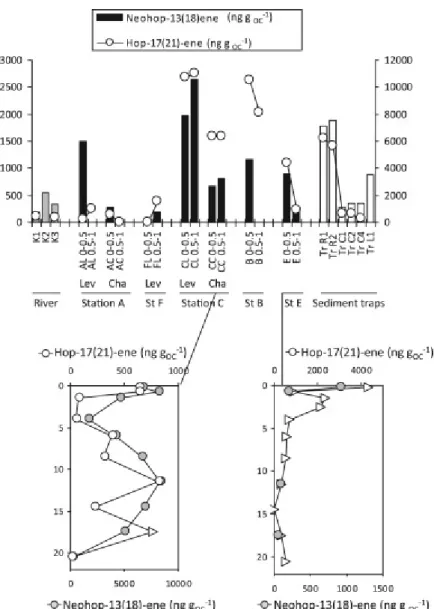
Diploptene and its Δ21 isomer show identical subsurface peaks at site E (Fig. 9). In the upper sediment layers of site E, palynofacies and δ13C values indicate low proportion of higher plant remains and bacteria may be major contributors to these hopenes. Almost identical vertical profiles of hop‐17(21)‐ene and neohop‐13(18)‐ene at sites C and E suggest either common precursor organisms or sequential isomerisation of hop‐21‐ene into hop‐17(21)‐ene and further transformation into neohop‐13(18)‐ene (Fig. 11). Similar correlations were observed in a more mature terrestrial set of samples (Garel et al., 2014). In a large set of immature marine and lacustrine samples, matching δ13C values of both compounds evidenced a diagenetic relationship or a common source (Sinninghe‐ Damsté et al., 2014). The series of neohop‐13(18)‐enes identified in a range of recent and ancient sediments included C27 to C30 homologues. In the Congo lobe sediments, the series was limited to the C30 and C27 neohop‐13(18)‐enes, and corresponds to the composition of recent sediments from other locations (Sinninghe‐Damsté et al., 2014).
Fig. 11. The top panel shows the spatial distribution of neohop‐13(18)‐ene concentrations normalized to organic carbon, in sediments from the Congo River (grey bars), in surficial sediments collected from the Congo deep‐sea fan (black bars, Lev: levee, Cha: channel. sediment layers from 0 to 0.5 cm and from 0.5 to 1 cm), and in sediment trap samples (white bars). Concentrations of hop‐17(21)‐ene are represented by white circles plotted on the right axis. Diploptene and hop‐17(21)‐ene levels are expressed in ng gOC−1. Bottom panels show
the vertical profiles of concentration of neohop‐13(18)‐ene and hop‐17(21)‐ene, in two cores: from the channel at site C, and from site E.
4.3. Petroleum contamination
The occurrence of oil hydrocarbons (UCM, C23 and C24 tricyclic triterpanes) indicate a notable petroleum contamination of the first surface centimetre of the sediment at site E, but absent underneath (Table S1, Supplementary material, p.40‐47). Below the contaminated layers, the CPI is consistent with a higher plant source of the high molecular weight alkanes, alike at the other studied sites. Oil hydrocarbons are also evidenced in lower concentrations at site A and C. A strong petroleum odour was noted when slicing the top of contaminated cores (site E, site C). UCM and alkanes concentrations remained on the same order of magnitude as moderately contaminated coastal sites (Bouloubassi et al., 2001; Tolosa et al., 1996) and are at least one order of magnitude less abundant than in heavily contaminated coastal areas such as Alexandria harbor, the Rhine