RESEARCH OUTPUTS / RÉSULTATS DE RECHERCHE
Author(s) - Auteur(s) :
Publication date - Date de publication :
Permanent link - Permalien :
Rights / License - Licence de droit d’auteur :
Bibliothèque Universitaire Moretus Plantin
Institutional Repository - Research Portal
Dépôt Institutionnel - Portail de la Recherche
researchportal.unamur.be
University of Namur
Designing for intimacy: how fashion design can address privacy issues in wearable
computing
Jacob, Cindy; Dumas, Bruno
Published in:
Adjunct Proceedings of the 2014 ACM International Symposium on Wearable Computers (ISWC '14)
DOI:
10.1145/2641248.2641353
Publication date:
2014
Document Version
Peer reviewed version
Link to publication
Citation for pulished version (HARVARD):
Jacob, C & Dumas, B 2014, Designing for intimacy: how fashion design can address privacy issues in wearable
computing. in Adjunct Proceedings of the 2014 ACM International Symposium on Wearable Computers (ISWC
'14). ACM Press, pp. 185-192. https://doi.org/10.1145/2641248.2641353
General rights
Copyright and moral rights for the publications made accessible in the public portal are retained by the authors and/or other copyright owners and it is a condition of accessing publications that users recognise and abide by the legal requirements associated with these rights. • Users may download and print one copy of any publication from the public portal for the purpose of private study or research. • You may not further distribute the material or use it for any profit-making activity or commercial gain
• You may freely distribute the URL identifying the publication in the public portal ?
Take down policy
If you believe that this document breaches copyright please contact us providing details, and we will remove access to the work immediately and investigate your claim.
Designing for Intimacy: How Fashion
Design Can Address Privacy Issues in
Wearable Computing
Abstract
This position paper discusses how computer science and fashion design can gracefully enrich each other to address privacy, invasiveness and
non-disruptiveness issues. A use case providing intimate, remote communication for a couple is described, as well as potential tracks to solve this use case from a technological as well as fashion design points of view. We show that fashion designers closely collaborating with computer scientists can help address complex issues such as privacy when integrating smart garments together.
Author Keywords
Intimate design; fashion design; wearable computing; smart garments.
ACM Classification Keywords
H.5.m. Information interfaces and presentation (e.g., HCI): Miscellaneous.
Introduction
In his infamous article “The computer for the 21st
century” [13], Mark Weiser introduced the concept of ubiquitous computing as a long-term goal for computer science. According to Weiser, ubiquitous computing was
Permission to make digital or hard copies of all or part of this work for personal or classroom use is granted without fee provided that copies are not made or distributed for profit or commercial advantage and that copies bear this notice and the full citation on the first page. Copyrights for components of this work owned by others than the author(s) must be honored. Abstracting with credit is permitted. To copy otherwise, or republish, to post on servers or to redistribute to lists, requires prior specific permission and/or a fee. Request permissions from [email protected].
ISWC'14, September 13-17 2014, Seattle, WA, USA
Copyright is held by the owner/author(s). Publication rights licensed to ACM. ACM 978-1-4503-3048-0/14/09…$15.00.
http://dx.doi.org/10.1145/2641248.2641353
Cindy Jacob
Atelier Lannaux 95 rue Henri Maubel 1190 Brussels Belgium
Bruno Dumas
Web & Information Systems Engineering Lab
Vrije Universiteit Brussel Pleinlaan 2
1050 Brussels Belgium
to become “[…] the age of calm technology, when
technology recedes into the background of our lives”.
As one of the many sub-visions of ubiquitous
computing, wearable computing has seen impressive development in the last decade [3]. However, these last years academy and industry have focussed prominently on accessories such as smart glasses (e.g. Google Glass1). As much as smart accessories help
push forward wearable computing as a research field, we believe that Mark Weiser’s vision of “calm
technology” involved a stronger embedding of computing within mundane objects. In this article, we look at smart garments in the context of interpersonal sharing in a couple.
This domain has been relatively scarcely explored. A core paper in the domain is “Hug Over a Distance” from Mueller et al. [10] who imagined a vest that could send hugs between partners of a couple. As one of the few other authors who explored intimate design for smart garments in the context of couples wishing to exchange messages, Clawson et al. [2] explored ensembles of on-body devices designed to support private, intimate, communication in public settings. However, to the depth of our knowledge, their work remained unimplemented. Furthermore, the authors only focussed on the technical side of smart garments for couples. In a more theoretical and recent study, Branham and Harrison [1] presented the two concepts of abstracted presence and deep interpersonal sharing when reviewing digital systems intended for couples. These works all explored prototypes and/or relatively technical aspects of transmitting intimate messages
1 http://www.google.com/glass/.
between two connected, smart garments. Two key issues with such applications are however non-disruptiveness and privacy. To the depth of our knowledge, these two issues have been scarcely studied by researchers. We also believe that a purely technical approach will only result in imperfect or incomplete solutions. In this position paper, we advocate a multidisciplinary approach to address non-disruptiveness and privacy. In particular, we show how computer science and fashion design can gracefully solve these issues when working hand in hand.
Case Study: a Connected Garment for
Couples
As a demonstration use case, let us consider two users in a relationship. These two partners wish to stay connected and let the other loved one know that they think about each other during the day. Current technologies to do so would involve calling each other, sending emails or text messages, or even sending pictures through mobile applications such as Snapchat2.
Clare Lloyd had underlined already in 2004 [8] the prominent and very intimate place that the mobile phone has taken in our lives, in particular when communicating with relatives. However, using a mobile device is disruptive, necessitates a change of focus from the user, and might not be allowed or at the very least frowned upon in a typical workplace. Furthermore, it asks the user to shift their attention towards an electronic device. Thus, the members of a couple wishing to maintain some form of intimate remote communication during their working and social life currently face a number of dilemmas. However, this form of intimate communication does not necessarily
have to rely exclusively on extended text messages, especially in the context of a well-developed long-term relationship. A key form of communication in couples can be summarised in intimate messages such as “I’m currently thinking of you”. About this kind of messages, Vetere et al. [12] state:
“While the informational content of intimate acts may be low and seemingly trivial to outsiders, the act itself can be laden with emotional significance for those involved... Much of what passes between intimates is unsaid and premised on deep knowledge and understanding of one another and occurs in the context of a rich, shared and sometimes idiosyncratic view of the world that may be difficult for others to fathom and comprehend.”
We believe that such communication can be integrated in smart garments. The rationale behind this belief is that the kind of communication we are looking into can be compared to some form of nonverbal, interpersonal sharing. In more details, a smart garment that could address our use case would work in the following way: each partner of a couple would wear one exemplar of a smart cloth enabling intimate communication. The individual wishing to send a message to his or her significant other would activate an input sensor, for example by pressing the garment’s sleeve part a specific number of times. The input would be interpreted and transmitted wirelessly to his/her partner’s garment that would convey the message through an output modality such as LEDs or heat generation electronics. Technologically speaking, such a use case is not overly complex. However the main
challenge lies in the graceful integration of the input sensors and output actuators in the garment such that producing the message and receiving it remain an intimate experience, private to the couple only. We can define a preliminary set of requirements that have to be met by a system implementing our use case as follows:
• Remote: the two garments forming the system need to communicate wirelessly with each other over long distances. This communication also needs to be secured.
• Non invasive: the garments should keep the standard affordance expected from any normal piece of clothing, with the added functionality of the use case described above. The only preparatory task necessary before being able to use the garment’s full capabilities should entail some form of pairing with the partner’s garment. Without that pairing action, the smart garment should work as a “normal” piece of clothing.
• Non disruptive: receiving the message should not disrupt the users’ current tasks, but be part of their ambient environment. Also, the user should have the possibility to turn on and off the smart functions of the garment.
• Private: sending and receiving a message should only be visible or sensed by the two users. The action of sending or acknowledging the message should also be socially acceptable.
This last requirement is key if one wants to achieve user-friendly intimate interaction. We argue that, to address this use case, computer science and fashion design should work together closely. We demonstrate it by discussing the four requirements. The first requirement, Remote, should be answered technically, by embedding some form of networking technology within the garment. Researchers have already explored how to integrate different networking technologies in garments or accessories typically considered in wearable computing. The second requirement, Non invasive, requires skills in human computer interaction, with some input from fashion design. The third requirement, Non disruptive, requires both a technological and design approach. Indeed, the embedding of input and output interaction channels asks for a careful selection of relevant technologies that can be used in an ambient manner as well as their seamless integration in the garment. The last requirement, Private, has to be approached too by a joint approach from the technological and design sides, as the choice of input and output modalities, their integration in the garment as well as the form of the garment itself will have a strong overall influence on privacy issues. In fact, we argue that the last factor, i.e. the form of the garment, has been approached by the Wearable Computing community in a relatively conservative manner. As an example, a workshop held during ISWC 2007 [9] and named “The Role of Design in Wearable Computing” makes the following statement
in its introductory paper: “Design in wearable
computing, is often associated with fashion shows, which is great for media coverage, but misses the point”. We disagree with that viewpoint. During the last
few years, fashion design has seen tremendous experimentation with novel shapes and designs for garments as well as a growing interest for wearable computing. However, in the academic world, both fields have stayed relatively shy of each other, except for some isolated initiatives such as MIT’s Seamless Fashion Show or the Design Show collocated with the ISWC conference. In our opinion, we have reached a state where both fields have more than ever a lot to gain in sharing their respective expertise. It now makes full sense to link advanced networking technologies and state of the art interaction methods from the computer science world with novel garment shapes and textiles devised by fashion and textile designers. In the next two sections, we explain how the use case described above can be addressed by gracefully combining the expertise of computer scientists and fashion designers.
Designing for Intimacy: Fashion Design Side
As discussed above, fashion design plays a critical role if one wants to address the above four requirements. Fashion designers will in particular bring their expertise on two aspects: first, where and how to integrate the sensors and actuators in the garment, and second, how to model the garment to ensure non-disruptiveness and privacy.In this section, we suggest two different designs that address these two aspects and both implement the use case described above. The first of these designs
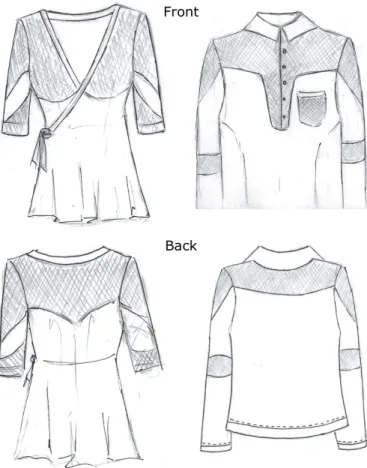
consists out of two garments, one for a man and one for a woman, with integrated heat zones. As her partner activates one of the zones on his own garment, the user receives a slight raise in temperature in the corresponding zone on her garment. The right side of Figure 1 shows the man version as a round neck jumper, while the left side of Figure 1 depicts the woman version as a wrapover top. Aside from the general design of the garments, the main contribution from the fashion designer lies in the careful selection of the zones where heat generating textiles3 or heat
generating electronics are best embedded. We realised that the neck, shoulders and armpits are the most judicious places in terms of sensitivity. A final heat generation zone is placed around the heart region. This design answers primarily the non-disruptiveness requirement, as it tries to balance sensitivity with the positioning of the heat-generating zones.
The second design is centred on a set of four LEDs embedded in the sleeve of a shirt, long sleeve dress or jacket. As one of the partners wants to communicate with her significant other, she would activate the LEDs from his shirt by pushing the zone around the LEDs embedded in her own garment’s sleeves. The two partners would define the actual meaning associated to the different LEDs. A potential design for the sleeve with LEDs is depicted in Figure 2. As one can see, we chose to embed the LEDs in an inverted pleat. Furthermore, an added thin layer of cloth is added above and below the LEDs so as to minimize light scattered in unwanted directions. With this design, the light from LEDs can only be seen when looking directly
3 E.g. heat-generating textiles such as Heattech from Uniqlo:
http://www.uniqlo.com/ht_w/us/
Figure 1. On the left are pictured a woman's wrapover top and
on the right, the back and front of a man's jumper; greyed out zones indicate the locations of heat generating zones.
into the inverted pleat. Thus, the privacy requirement is answered by working on the shape of the garment.
Designing for Intimacy: Technological Side
The designs presented above all integrate sensors and actuators in some way or the other. Thus, from a technological point of view, the creation of the garments described above will require us to answer three specific questions:• How to best transmit information from one garment to another remotely?
• How to let a user input a message for her partner in a non-invasive and private way? What are the sensors needed to achieve this goal?
• Which kinds of actuators are needed to let the partner know of the message?
Let us begin by exploring the first question. The wireless communication between the two garments can be achieved in a similar fashion than what Iso-Ketola et al. present in [6]. In their article, a mobile phone is used as a communication bridge between a smart garment and the Internet. The smart garment is equipped with either a Bluetooth or Wifi chip that establishes the local connection with the mobile phone (see Figure 3). Note that the authors’ solution is machine washable and wirelessly rechargeable. Additionally, using the user’s mobile phone as a communication bridge allows us to use the phones to pair the two garments together. Also the phones could be used to interact with the partner’s garment when the user does not wear her own smart garment. As for the two last questions, they are a classical case of multimodal interaction [5]. In the garments presented above, for the output actuators, the first potential implementation would need either heat-generating textiles or electronics. The second
implementation would primarily need LEDs. As for the input interaction, the first design would ask for pressure sensitive sensors embedded in the different heat zones, while the second design would consist of touch or pressure sensors located in the sleeves of the garments next to the LEDs. Please note that these are examples of the kind of sensors and actuators that would meet our use case. Clawson et al. present in [2] a more complete categorisation of the different input and output sensors that can be used in the context of intimate design for smart garments. They notably investigated which modalities were the most socially appropriate or subtle. As an alternative to direct touch input, Costanza et al. [4] explored the use of the electromyographic signal (EMG) to input subtle and
Figure 2. Integrating four LEDs in an inverted pleat to
minimal mobile interaction. However, a finer and more
thorough categorisation of sensors and actuators for intimate remote communication is still needed.
Future Work
The main future work will be to actually create and implement the use case described in this position paper. The creation of the use case should serve as a first validation of the concept, before exploring further how combined input from both computer science and fashion design can improve issues in wearable computing such as intimacy and privacy. As data is collected by the different sensors, one important issue is the interpretation of the different pieces of data so as to differentiate between actual input from users and noise that could lead to false positives. This issue has already been explored in the multimodal interaction community [7], however
wearable computing has its own characteristics that will ask for specific algorithms, especially when targeting the requirements presented above.
As they currently stand, the requirements are linked to our use case and are as such incomplete. We believe however that a set of generic requirements can be defined for enabling intimate design for smart garments. This set of generic requirements would enable computer scientists and fashion designers to explore which aspects of a novel garment design they can best address in their respective field.
One aspect not discussed in this position paper is the feedback to the user. As a user sends a message, she should get information about whether the message was indeed correctly delivered. Some form of feedback
should be ideally added to the garments’ functionality while still observing the four requirements defined above.
Conclusion
In this position paper, we have presented ideas and concepts to help integrate sensors and actuators in smart garments while answering requirements such as non-disruptiveness and privacy. These ideas and concepts all rely on a close collaboration between computer scientists and fashion designers. We have first presented a generic use case in the form of two connected garments for a couple. From the description of the use case, we drew four requirements to be answered when creating such garments. We then showed how remote communication, non-invasiveness, non-intrusiveness and privacy could be answered either from a mainly technological or a mainly design side. We have however discussed that close collaboration of both fields helped best answer the requirements. We then illustrated how the use case could be created from the technological and design points of view with two different designs. We think that wearable computing as a field can tremendously profit from close collaboration between very different fields of expertise, not only when answering issues such as privacy or
intrusiveness. A future goal would be to fully explore and categorise sensors, actuators and related designs that could optimise invasiveness,
non-disruptiveness and privacy for remote intimate communication.
References
[1] Branham, S. and Harrison, S. Designing for Co-located Couples. In C. Neustaedter et al. (eds.),
Connecting Families, Springer-Verlag (2012), 15-37.
[2] Clawson, J., Patel, N. and Starner, T. Digital Kick in the Shin: On-body communication tools for couples trapped in face-to-face group conversations. Unpublished.
[3] Chan, M., Estève, D., Fourniols, J.-Y., Escriba, C. and Campo, E. Smart wearable systems: Current status and future challenges. In Artificial Intelligence in
Medicine, 56, Elsevier (2012), 137–156.
[4] Costanza, E., Inverso, S.A., Allen, R. and Maes, P. Intimate Interfaces in Action: Assessing the Usability and Subtlety of EMG-based Motionless Gestures. In
Proc. CHI 2008, ACM Press (2008), 819-828.
[5] Dumas, B., Lalanne, D. and Oviatt S. Multimodal Interfaces: A Survey of Principles, Models and
Frameworks. In Human Machine Interaction: Research
Results of the MMI Program, Springer-Verlag (2009),
3-26.
[6] Iso-Ketola, P., Karinsalo, T., Myry, M., Hahto, L., Karhu, H., Malmivaara, M. and Vanhala, J. A Mobile
Device as User Interface for Wearable Applications. In
PERMID, 2005, 5-9.
[7] Lalanne, D., Nigay, L., Robinson, P., Vanderdonckt, J.,and Ladry, J.F. Fusion engines for multimodal input: a survey. In Proc. of ICMI 2009, ACM Press (2009), 153-160.
[8] Lloyd, C. Intimate mobile connections: a tool for intimacy. In McCallum, K. (ed), Proc. of ANZCA
Conference, 2010.
[9] Martin, T. The Role of Design in Wearable Computing. Workshop held in conjunction with ISWC 2007. In proc. of ISWC 2008, IEEE (2008), 128-128. [10] Mueller, F. F., Vetere, F., Gibbs, M. R., Kjeldskov, J., Pedell, S., Howard, S. (2005). Hug over a distance.
Proc. of CHI 2005 Extended Abstracts, ACM Press
(2005), 1673-1676.
[11] Trosby, F., Holley, K. and Harris, I. Short Message Service (SMS): The creation of personal global text messaging. Edited by Friedhelm Hillebrand. John Wiley & Sons, 2010.
[12] Vetere, F., Gibbs, M. R., Kjeldskov, J., Howard, S., Mueller, F. F., Pedell, S., Mecoles, K. and Bunyan, M. Mediating intimacy: designing technologies to support strong-tie relationships. In Proc. CHI 2005, ACM Press (2005), 471–480.
[13] Weiser, M. The Computer for the 21st Century.