Autonomous planning and resource allocation in
reconfigurable smart sensing networks.
by
James Long
B.Eng., University of Limerick (2012)
S.M., Massachusetts Institute of Technology (2014)
Submitted to the Department of Civil and Environmental Engineering
in partial fulfillment of the requirements for the degree of
Doctor of Philosophy in Civil and Environmental Engineering
at the
MASSACHUSETTS INSTITUTE OF TECHNOLOGY
June 2019
@
Massachusetts Institute of Technology 2019. All rights reserved.
Signature redacted
A uthor
...
Department of
C ertified by ...
Civil and Environmental Engineering
r May 17th, 2019
Signature
redacted-/
Oral Buyukozturk
Professor of Civil and Environmental Engineering
A ccepted by ...
Donald and Martha Harleman
MASSACHUSETTS INSTITUTE OF TECHNOLOGY
JUL 10 2019
Thsis Supervisor
Signature redacted
Heidi
.
Nepf
Professor of Civil and Envir cnmental
Engineering
Chair, Graduate Program Committee
Autonomous planning and resource allocation in
reconfigurable smart sensing networks.
by
James Long
Submitted to the Department of Civil and Environmental Engineering on May 17th, 2019, in partial fulfillment of the
requirements for the degree of
Doctor of Philosophy in Civil and Environmental Engineering
Abstract
Structural health monitoring (SHM) uses sensor data to quantitatively assess the integrity and performance of infrastructure, as a basis for extending the lifespan of aging systems. Wireless sensor networks promise to enable the installation of dense arrays of battery operated sensor nodes at dramatically lower cost than traditional wired systems. However, typical vibration based health monitoring approaches sam-ple at high frequencies, and wirelessly transmitting the resulting large volumes of data can rapidly deplete sensor node batteries. Rather than emulating the behaviour of a traditional wired SHM system, intelligent sensor nodes can analyse vibration data within the sensor network, reducing transmission volumes and conserving bat-tery. Coordinating, configuring, and managing the resources of networks of intelligent sensor nodes, is however a significant challenge.
In this research, we first propose a new computational framework for distributed in-network processing of vibration sensing data, and develop a sensor system which implements this framework. A critical advantage of this framework is its flexibility, allowing data processing logic to be remotely reconfigured almost instantaneously. We then extend this approach, developing a resource allocation algorithm which continu-ally tracks network resources (battery life, computational power and communication bandwidth), and ensures that in-network computations utilise these resources opti-mally. The efficacy of this approach is then demonstrated by deploying a wireless sensor network on a steel frame tower and conducting a series of experiments investi-gating the performance of the proposed framework. Lastly, we consider the problem of event detection in energy-harvesting wireless sensor networks. In SHM applica-tions, long periods of time elapse without the occurrence of any event of interest. To conserve resources, a subset of nodes can actively listen for events, while the remain-der power down. Judicious planning of the sequence of active node assignments is needed to ensure that as many nodes as possible can be reached upon the detection of an event, and that the system maintains the ability to detect events in times of low energy availability. We propose and develop a novel reinforcement learning approach to this problem, and through simulation demonstrate that strategies learned by the
reinforcement learning agent outperform baseline approaches. The integration of the proposed computational framework, resource allocation algorithm and collaborative event detection strategy enables fully autonomous operation of intelligent wireless
SHM systems.
Thesis Supervisor: Oral Buyukozturk
Acknowledgments
To my advisor, Professor Oral Buyukozturk, thank you for all your guidance, mentor-ship and encouragement, and for fostering an exceptionally productive and supportive group atmosphere which made this work possible, and greatly enhanced my time as a PhD student. I am truly grateful for the opportunities you have provided me.
A sincere thank you to my committee, Dr. Abel Sanchez, Prof. Daniele Veneziano,
and Prof. John Williams, whose advice and feedback was of tremendous help through-out this entire process.
To my labmates Justin, Reza, Steve, Hao and Murat, and my CEE colleagues and friends, especially Isabelle and Affi, your friendship and good humour was at all times much appreciated.
A special thank you to Kathy Briana, Kiley Clapper, and all the CEE staff, who
have been incredibly kind and helpful throughout.
I would like to thank Shell Global and MITEI for funding this research, Dr. Dirk Smit for his vision and support, as well as Dr. Lorna Ortiz-Soto and Dr. Xander Campman for their oversight. The work in this thesis is a small part of a much larger project, and was greatly aided by Dr. Mike Feng and his team at Draper Lab, as well as Dr. William Moyne, Jay Petrie, Chris Boutiette, Michelle Estaphan Owen, Jerry Earl, Lewis Mendall and everyone else at Shell Techworks.
Declan Phillips, Tom Cosgrove, Michael Quilligan, and my other lecturers at the University of Limerick, were instrumental in my undergraduate education, and I am thankful for all of their efforts and assistance.
MIT Rugby has been a big part of my life as a PhD student, and has provided both a welcome distraction from research, as well as many lifelong friends.
To my parents Peter and Siobhan, and my sister Ruth: You were my first teachers, and have always supported me and believed in me, and I have been lucky to have you as my family.
Finally to Cecilia, thank you for understanding, for supporting me, and for always being there to listen.
Contents
1 Introduction 19
1.1 Background and motivation . . . . 19
1.2 Structural Health Monitoring . . . . 22
1.3 Challenges in wireless sensing . . . . 24
1.4 Smart sensing . . . . 27
1.5 Research objective . . . . 28
1.6 Research approach . . . . 29
1.7 Thesis organisation . . . . 30
2 A reconfigurable and autonomous smart sensing system for wireless vibration monitoring 35 2.1 Introduction . . . . 35
2.1.1 Problem statement . . . . 41
2.2 System architecture . . . . 42
2.3 Distributed computing framework . . . . 45
2.3.1 Example problem . . . ... . . . . 47
2.4 Implementation details . . . . 49
2.4.1 Node level multitasking . . . . 49
2.4.2 Computational library . . . . 53
2.4.3 Message passing . . . . 54
2.4.4 Fault tolerance . . . . 55
3 An integer linear programming approach for energy efficient smart sensing.
3.1 Job profiling . . . .
3.2 Tracking network performance . . . .
3.3 Integer program formulation . . . .
3.4 Extended system architecure . . . .
3.5 Summary and Conclusions . . . .
4 Case study: Sensor system deployment
4.1 Description of the structure . . . .
4.2 Sensor node details . . . .
4.3 System setup . . . .
4.4 Experiments . . . .
4.4.1 Single node . . . .
4.4.2 8 node network . . . .
4.4.3 24 node network . . . .
4.5 Summary and conclusions . . . .
on a real
5 Planning collaborative duty cycling strategies
energy harvesting sensor networks
5.1 Introduction . . . .
5.2 Related work . . . .
5.3 Problem statement . . . .
5.4 System model . . . .
5.4.1 Node energy consumption . . . .
5.4.2 Energy harvesting . . . . 5.4.3 Wireless connectivity . . . . 5.5 Reinforcement Learning . . . . 5.5.1 Deep
Q Learning . . . .
5.5.2 Problem formulation . . . . 5.5.3 Experimental procedure steel structure. 59 61 62 64 71 72 75 75 7677
79 80 81 84 89 for event detection in91 91 93 96 97 99 100 102 103 105 106 108
5.6 R esults . . . . 113
5.6.1 Analysis . . . . 116
5.7 Conclusions . . . . 122
6 Summary, conclusions and future work 125 6.1 Conclusions . . . . 126
6.2 Future Work . . . . 128
6.2.1 Smart sensing system . . . . 128
6.2.2 Computational framework . . . . 128
6.2.3 Resource allocation . . . . 128
6.2.4 Event detection . . . . 129
A Source code repositories 131
List of Figures
1-1 Photograph of the aftermath of the collapse of the Viadotto Polcevera
(Morandi Bridge), Genoa, Italy
[31]
..
. . . .
21
1-2 Photographs of pre-collapse cracking on Florida International
Univer-sity pedestrian bridge, as shown in
[81.
. . . .
33
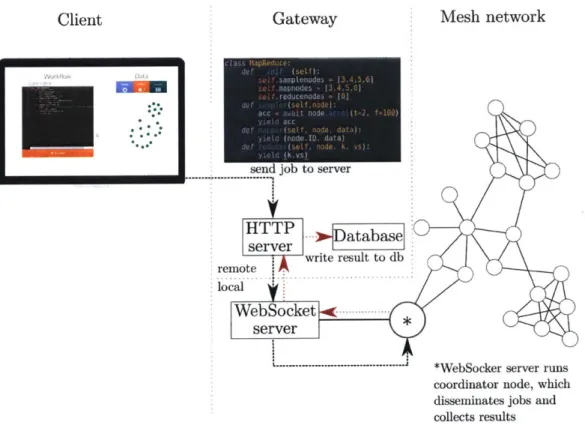
2-1 Schematic of the overall system architecture showing client, server and mesh network components. . . . . 44 2-2 Executing the code in example 2.3.1 results in the following flow of
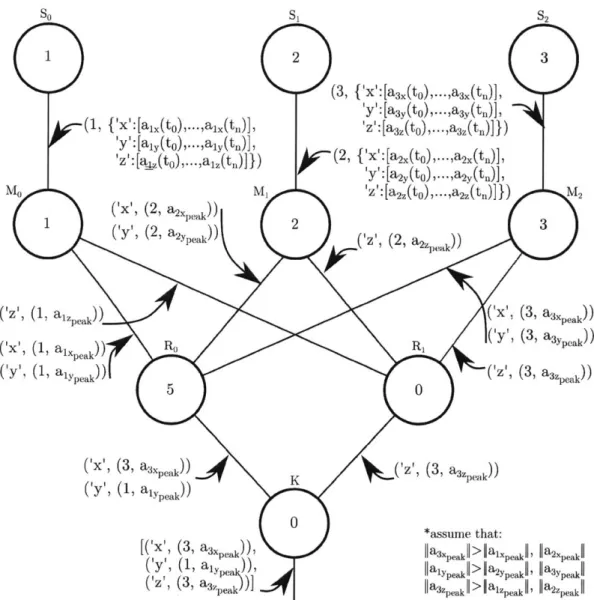
data from sampling to map to reduce tasks. The output of map tasks is shuffled and sorted by key, so that all similar keys are sent to the sam e reduce task. . . . . 50 2-3 The coroutine based concurrency model for multitasking is illustrated
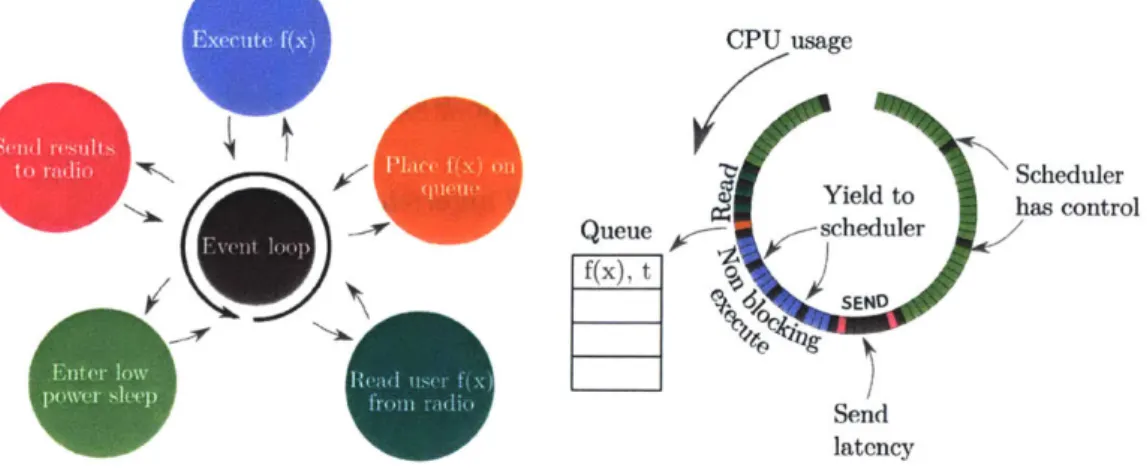
in this figure. Each node switches between tasks such as reading sensor data, and reading radio messages. . . . . 53
2-4 This flowchart illustrates how errors and communication timeouts prop-agat through the network in tandem with computed results, and are returned to the end user.. . . . ... 57
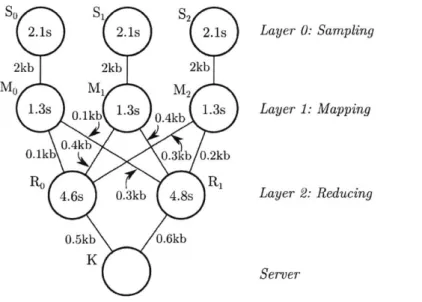
3-1 Submitted MapReduce jobs are modelled as a directed acyclic graph, and profiled to obtain an estimate of the computational burden of each subtask in the DAG, as well as the volume of data required to be transmitted between these subtasks. . . . . 62
3-2 Illustration of a DAG vertex where the incoming alpha has an assigned
child node which is inconsistent with the parent node of the outgoing alpha . . . . 67 3-3 Illustration of a DAG vertex where the incoming alpha has an assigned
child node which is inconsistent with the parent node of the outgoing alpha . . . . 69
3-4 Schematic of extended version of system architecture from Figure 2-1 illustrating job profiling and network tracking and integer linear pro-gramming solver components are incorporated in the gateway server. 73
4-1 Schematic of experimental steel tower showing location of sensor nodes, accelerometers and shakers. . . . . 76
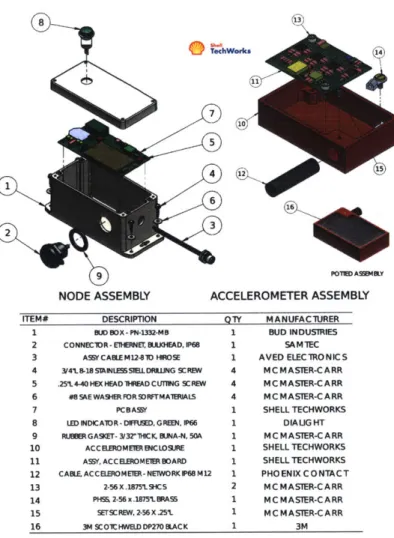
4-2 Assembly details of the node enclosure (left) and accelerometer enclo-sure (right) used to instrument the experimental steel tower. (Credit to Shell Techworks) . . . . 77
4-3 Photographs of the instrumented steel tower on site during testing, and closeups of the node and accelerometer enclosures used on the tower. 78
4-4 Comparison of predicted and observed probability of message failure for varying values of received signal strength indicator (RSSI). .... 79
4-5 Comparison of predicted and observed total execution times for the node strategy and the server strategy for increasing values of node processing speed relative to server processing speeds. . . . . 80
4-6 Implementation of the frequency domain decomposition algorithm within the proposed distributed computing framework, showing the flow of data from sampling, to computation of frequency amplitude at the map step, to assembly and decomposition of the spectral matrix at the reduce step. . . . . 82
4-7 Comparison of how choice of reduce node effects total execution time for frequency domain decomposition in an 8 node network, showing the predicted and observed total execution times at the optimal chosen location, at the server node and at the worst possible location. .... 83
4-8 A force directed graph visualisation of the topology of the 8 node
net-work, where node to node distance is inversely proportional to com-munication strength . . . . 84 4-9 Implementation of the decentralised frequency domain decomposition
algorithm, illustrating how the network is divided into overlapping neighborhoods, allowing parallel estimation of modeshapes for each neighborhood which are ultimately combined to return a noisy version of the full network modeshape . . . . 85
4-10 Comparison of observed and predicted total execution times for cen-tralised and decencen-tralised frequency domain decomposition with in-creasing network size. Error bars on observed values denote the ninety fifth percentile confidence interval . . . . 86
4-11 Force directed graph representation of the 24 node network, with node to node distance inversely proportional to signal strength, and red circles indicating nodes which act as data reducers in the decentralised frequency domain decomposition algorithm. . . . . 87
4-12 Calculated modeshapes for the 15.1 Hz vibration mode, with sensor locations illustrated. (a) shows the modeshape calculated with the centralised FDD algorithm. (b) shows the modeshape calculated with the decentralised algorithm. (c) shows the static configuration of the tow er. . . . . 88 5-1 Overall schematic of the proposed system architecture, showing the
peer to peer communication in the local network, and remote node to power manager communication used for reporting state and action instructions . . . . 98
5-2 Illustration of chosen lattice network configuration, with a typical ran-dom field instance, active and idle nodes assignment, and instantaneous
network connectivity. . . . . 110
5-3 Time series of harvested energy by node for two contrasting days shows
the variance around the mean modelled by the Gaussian Random Field realisation, and the disparity in available solar energy between cloudy
and sunny days. . . . . 112
5-4 Neural network architecture for both
Q
and target networks, showingthe input layer, three fully connected layers of 512 neurons with Relu
activation functions, and the softmax output layer predicting the
Q-value of each action. . . . . 113
5-5 Learning curve of the DDQN agent, showing increase in average
re-ward per run over training episodes. The DDQN agent eventually
outperforms both the independent node ENO strategy and the greedy
strategy. . . . . 115
5-6 Performance of the DDQN agent compared with greedy and eno agents
on both unseen and training data . . . . 116
5-7 Fraction of time spent in active duty time by each node under the
control of the trained DDQN agent is shown here, illustrating a large
disparity between individual node's behaviour. . . . . 117
5-8 Based on a steady state analysis of the status time series under the
control of the DDQN agent, the highest probability configurations of the 16 node lattice network are shown here, illustrating several different
modes of behaviour . . . . . 118
5-9 A 5 day segment of node status time series under the control of the DDQN agent is shown here. Node 2 illustrates the foresight of the DDQN agent's strategy, saving battery during the day in order to
assume active duty at night when other nodes have fully depleted their
5-10 A spatio-temporal visualisation of the evolution of network wide bat-tery and status over a single day is shown in this figure, with each
2D slice representing a single time period. The colour of each
circu-lar node represents its status, while the length of the arc around each
circle marker represents the battery level. . . . . 121
5-11 The behaviour of the network over an entire month is examined, where
the proportion of time spent in active duty versus the proportion of time in idle duty is calculated for each day. A variety of different types of behaviour are illustrated: Worker nodes spend almost all their time active, depleting their batteries quickly. Idle nodes conserve power so they are reachable all day by active nodes. Standby nodes enter deep sleep mode during the evening, so they can assume active duty when
List of Tables
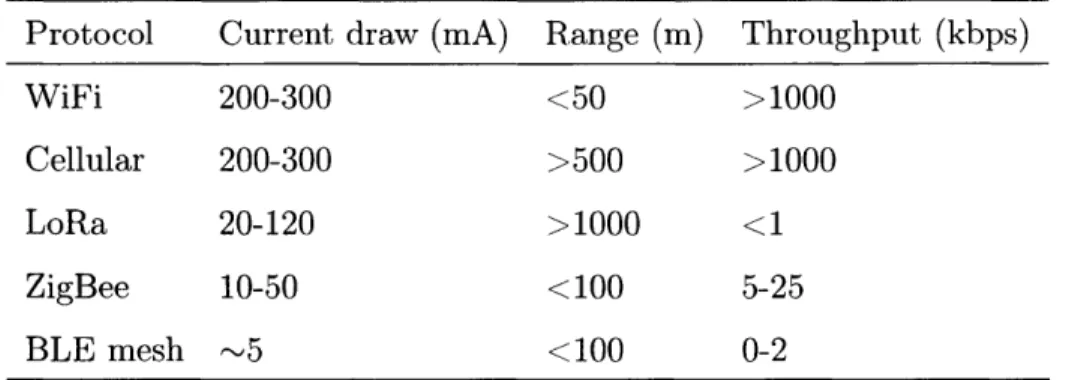
1.1 Comparison of wireless technology options for structural health
moni-toring . . . . 25
2.1 Comparison of existing smart sensing system characteristics . . . . . 37
5.1 Power consumption of individual sensor node components in deep sleep,
Chapter 1
Introduction
1.1
Background and motivation
Civil infrastructure is an integral part of modern economies and societies. We depend on the reliable operation of roads, railways, tunnels and bridges to transport people and goods. The production of energy depends on the safe operation of dams, wind turbines, oil and gas platforms and pipelines. Water distribution and treatment networks provide clean water for households, as well as agriculture and manufacturing. The structural integrity of all of these components deteriorates over time. This can happen gradually due to corrosion, every day wear and tear, or fatigue arising from stress cycling. Sudden changes can also occur due to unexpected loading caused
by poor design, or natural hazards like earthquakes and extreme wind events.
Care-ful inspection and maintenance regimes can combat deterioration, helping to extend infrastructure lifetime and prevent disaster.
In the United States, the National Bridge Inspection Program requires all public road bridges longer than 20 feet to be regularly inspected, typically every 24 months. These inspections, as described in the Bridge Inspectors Reference Manual [801 rely heavily on qualitative visual assessment. Inspection reports are submitted to the Federal Highway Administration and used to compile the National Bridge Inventory. Each bridge in the National Bridge Inventory is rated as good, fair, poor or struc-turally deficient. To warrant being rated strucstruc-turally deficient, a bridge must have a
significant load-carrying element which is in poor condition as a result of damage or deterioration. Structurally deficient bridges can be required to post a weight limit, or if deemed unsafe, closed. In 2018, roughly 9 % of the greater than 600,000 bridges in the inventory were given a rating of structurally deficient. This figure, while alarming,
has actually been decreasing in recent years: In 2000 nearly 15% bridges were rated structurally deficient.
The structurally deficient rating, and the National Bridge Inspection Program, attracted a great deal of attention in the aftermath of the 1-35 West bridge collapse in Minneapolis, Minnesota in August 2007, when it emerged that the bridge has been
rated structurally deficient prior to its catastrophic failure. After investigation
17],
thecause of failure was determined to be an under-designed gusset plate, which finally failed under increased loading as a result of roadworks. Photo evidence from inspec-tions retroactively showed this critical gusset plate in a noticeably bowed condition, but no note of this issue was ever made in inspections.
More recently, the Morandi Bridge in Genoa, Italy collapsed on August 7th 2018, resulting in 43 fatalities. Built in the 1960s, the bridge exhibited an unusual de-sign, utilising steel cables encased in pre-stressed concrete as the primary stays in a cable-stayed system. As described in [31], corrosion of the steel cables in these main stays was an ongoing concern from at least the late 1990s. In October 2017, Pro-fessor Carmelo Gentile of Politecnico di Milano was contracted to perform vibration based assessment of the condition of the bridge. Based on these tests, the vibration behaviour of two stays on the southern end of the bridge was deemed anomalous, and it was recommended that the bridge be outfitted with permanent sensors, to
allow more detailed studies. Initial analysis of eye witness reports and videos of the collapse suggest that the collapse of the bridge was initiated by the tension failure of the southern stays.
Catastrophic collapses such as the 1-35 W collapse, and the Genoa bridge collapse while thankfully rare, are unfortunately not limited to aging bridges. In March 2018, a concrete pedestrian bridge on the Florida International University campus in Miami, Florida collapsed suddenly while still under construction, killing 6 people and injuring
Figure 1-1: Photograph of the aftermath of the collapse of the Viadotto Polcevera (Morandi Bridge), Genoa, Italy [31].
9. An initial investigative update issued by the National Transportation Safety Board
concluded that a design mistake led to an overestimate of the load capacity of a critical section of the bridge. According to
[91,
cracking consistent with this design error was observed prior to the collapse of the bridge. This pre-collapse cracking can be seen in Figure 1-2, originally provided in [8].Rather than rely on intermittent, mostly visual inspection techniques, the in-stallation of sensors for structural health monitoring (SHM) purposes has long been
suggested as an alternative [341,1[221[151. It is impossible to definitively say whether
structural collapses such as the 1-35 W collapse, the Florida International University pedestrian bridge collapse, or the Genoa bridge collapse could have been prevented
by more sophisticated monitoring approaches. However, the deployment of SHM
systems does promise to reduce the economic cost of structural integrity evaluation, allow much more frequent, and more quantitative assessment, and mitigate the haz-ard to human life incurred by conducting inspections in dangerous circumstances, e.g. offshore or in the aftermath of natural disasters.
Significant research focus has been devoted to the development of effective al-gorithmic approaches for using sensor data outputs to detect, locate and quantify
damage in structures. As a result, many of these approaches (which will be sum-marised in Section 1.2) are now quite mature. The development of reliable, low cost sensor systems is critical to enable the widespread adoption of SHM, and the use of these algorithmic approaches.
In particular, battery powered wireless networks of sensors can greatly reduce the installation cost and logistical challenges of deploying SHM systems in the field. Due to a combination of high sampling rates and low communication bandwidth typical of SHM sensing systems, "smart sensing" networks which are made up of sensor nodes, capable of analysing data at source, offer significant performance advantages. An overview of the typical design parameters of wireless networks for SHM will be provided in Section 1.3. As SHM data processing methodologies mature and become more complex, technical challenges exist in coordinating, configuring and deploying low power smart sensing systems which meet the requirements of the SHM field. This thesis presents a comprehensive smart sensing system which a) provides users a high degree of re-configurability and adaptability to implement SHM methodologies, b) develops a novel resource allocation algorithm which ensures that these deployed data processing methodologies are efficiently executed, c) uses state of the art planning techniques to optimally balance long term preservation of battery life and system functionality.
1.2
Structural Health Monitoring
The goal of structural health monitoring is evaluate structural integrity using data measured from sensors. Evaluation of structural integrity can range from simple bi-nary damage detection (is the structure damaged?), to damage localisation (where is the damage?), to severity assessment (how bad is the damage?), to lifetime prognos-tication (how long will the structure survive?).
Various different sensor types can be used to achieve these goals. Fibre Bragg Grating sensors can be used to directly measure strain [13]. Strain measurements provide high value information for damage detection purposes, but these sensor
sys-tems are costly and difficult to install. Acoustic emission sensors [67],[32] which measure high frequency (0.5-3 MHz) elastic waves in structures can be used to detect and monitor crack propagation, and are a popular choice in aerospace applications of
SHM. Guided wave systems use actuators to propagate ultrasonic mechanical waves
in structures which sensors then measure. Changes in wave propagation indicate damage in the structure, but the analysis of these changes is difficult and relies on a good understanding of the behaviour of the underlying medium. Popular applications include pipeline and plate systems, but typically not more complex civil structures. Camera based approaches for SHM offer an affordable and practical alternative to installing sensors. Data obtained from cameras can be used to either directly detect cracks and visual abnormalities from images [121, or to extract displacement time his-tories from videos (16],
[561,
[24], [76]. Image processing techniques can be used as an alternative to manual inspections, but suffer from the same limitation. Video-based displacement extraction, while cheaper and easier than using contact sensors, may be more suitable for modal analysis than damage detection, due to low signal to noise ratios and difficulty measuring higher frequency signals.Vibration based damage detection, typically using contact accelerometers, is per-haps the most commonly used approach in civil infrastructure monitoring, and a large body of research exists dealing with the analysis of acceleration measurements for damage detection purposes. Damage detection algorithms can generally be divided into either model-based or data-based. Model based approaches to damage identifi-cation compare measured structural response data with predictions from a numerical model of the structure in question, with discrepancies between predictions and mea-surements indicating damage. Model updating schemes, which vary model parameters (mass and stiffness) such that the difference between measured and predicted data is minimised, can be used for quantitative damage localisation and severity assessment
[881, [5], [64].
While model based approaches can be helpful in localising and quantifying the severity of damage, the development of an accurate numerical model is not always possible. Data-based approaches generally use the statistical pattern recognition
paradigm described in [861. In this paradigm, raw data is transformed into damage-sensitive features, and then these features are compared to baseline values obtained from the intact structure, using statistical or machine learning algorithms. A wide variety of damage sensitive features have been proposed in the literature, from tra-ditional structural dynamics based features like mode shapes and frequencies
(73],
to wavelet analysis based features [681, to features based on anticipated nonlinearities arising from damage [971, [61]. Despite concerns about their sensitivity to damage, modal analysis techniques remain popular as they provide physically interpretable insight into the dynamic behaviour of the instrumented structure. Once raw data is transformed to the damage-sensitive feature(s) of interest, it is then compared with an existing catalog of data in order to detect damage. If the existing data is rep-resentative of just the intact condition of the structure, this is a novelty detection problem. If data from one or more damaged conditions are available a priori (typi-cally untrue in civil applications), this can be cast as a classification problem. Many different algorithms have been proposed for this purpose, including simple statistical hypothesis testing [691, kernel based classification algorithms1511,
graphical models[301 and neural networks [11,[451.
Machine learning based approaches to damage detection are typically very data hungry, requiring a large catalog of historical data to perform well. In both model and data based damage detection, the capability to cheaply and easily acquire structural response data is a key requirement.
1.3
Challenges in wireless sensing
Traditional sensing systems for structural health monitoring rely on cables to provide power to sensors, and transfer data to a base station. The installation of these cables is a serious impediment to deploying SHM in the field, as it is costly, time consuming, and impractical. Battery operated sensors which use wireless communication alleviate these issues, and can be used to deliver low cost systems which are quick and easy to install even in inhospitable settings. A number of choices of protocol, and associated
Table 1.1: Comparison of wireless technology options for structural health monitoring
Protocol Current draw (mA) Range (m) Throughput (kbps)
WiFi 200-300 <50 >1000
Cellular 200-300 >500 >1000
LoRa 20-120 >1000 <1
ZigBee 10-50 <100 5-25
BLE mesh ~5 <100 0-2
hardware, are available for wireless communication. The specific choice of protocol and hardware depends on the design constraints of the sensor network.
This thesis is in part motivated by the specific challenges associated with deploy-ing wireless sensor systems based on low power networkdeploy-ing protocols popular in SHM. In particular, these protocols have limited bandwidth, which encourages the develop-ment of autonomous sensor systems which have in-built data processing capable of significantly reducing the volume of data to be transmitted. Each wireless protocol has pros and cons, and the choice of which technology to use is dependent on the constraints under which the deployed sensor system must operate. In this section we will offer a brief overview of currently available technology for wireless communication
and comment on their applicability to SHM.
Table 1.1 gives an overview of popular protocols for wireless communication, com-paring their power usage, range, and typical data throughput capabilities. Note that these data rates are approximate, and are meant to represent real performance in the field, and so are much lower than the ideal data rates.
WiFi, based on the IEEE 802.11 standard, is a high data rate, but high power
consumption choice. With speeds typically higher than 1 Megabit per second, WiFi is attractive for applications that require high data rates. WiFi networks use a star topology, with each node connecting only to the central router. Typically one router can support approximately 10 devices, with effective range less than 50. As a result, the deployment of large scale SHM systems can require the installation of a signifi-cant number of wireless routers. If installation and powering of routers is not a major
challenge, the advantage of the high data rate may outweigh the disadvantage of the high power consumption. In structural health monitoring of buildings, for example, WiFi routers may already be installed, offering a practical solution to wireless net-working. Even so, providing wired power to every sensor node, in addition to routers, is not usually feasible, and careful management of the sleep behaviour and power usage is required to achieve acceptable battery life. The requirement to install and power wireless routers, combined with the high power consumption of the radios, often means that WiFi is not a feasible option.
Cellular (3G/4G) can provide relatively high data rates (for an ongoing data usage cost), depending on the network provider and local coverage availability. If the planned SHM deployment is in an area of good coverage, cellular can be competitive with WiFi, and does not require the installation of routers. Power consumption is in the same range as WiFi, and so poses similar challenges. The combination of high device power consumption, data usage charges, and lack of universal coverage mean that cellular networks are not always a feasible choice. However for deployments where power usage and cost is not a key concern, but where installing WiFi is impractical, cellular can be a convenient choice.
LoRa is a proprietary protocol, which provides very long range transmission capa-bility, and low power consumption. The primary use case for LoRa is for infrequent, short messaging, and so data throughput rates are extremely low. For SHM applica-tions, this necessitates the development of sensors which operate with a high degree of autonomy, only communicating vital information.
Bluetooth Low Energy (BLE) is very energy efficient, and widely used in consumer electronics applications where battery life is a key concern. Until recently, BLE operated only in a point-to-point topology, with one master device required per 3-4 maximum nodes. BLE mesh extends this technology to mesh topologies, allowing for the instrumentation of large structures without the need for supporting infrastructure. This same combination of low power usage and ease of installation have made low-power mesh networking protocols based on the IEEE 802.15.4 standard (e.g. ZigBee) popular in SHM applications.
1.4
Smart sensing
The low cost, energy efficiency, and ease of installation make ZigBee and similar 802.15.4 based wireless networks the most popular choice for SHM deployments. However, low data rates mean that transmission of large volumes of data is slow, and therefore consumes battery life that the low power protocol is supposed to pre-serve. Using the processing capabilities of sensor nodes to process data locally can reduce the volume of data to be transmitted, therefore saving energy.
For example, Lynch et al [521, develop a methodology in which an autoregressive model is fitted to acceleration time series on board a sensor node. Once fitted, the coefficients of the model are transmitted to a base station. Because the model coeffi-cients are far smaller than the original time series, this approach leads to a reported
50 % reduction in consumed energy. In
1471,
Lei et al instrument a steel arch bridge, and demonstrate that on-board execution of a peak-picking algorithm for modal iden-tification significantly reduces the volume of data to be transmitted, thereby savingan estimated 80 % in consumed power, compared to transmitting the raw data. While [52] and [47] present fully decentralised methodologies, where each node operates independently of the others, more complex applications have also been pro-posed in the literature. Zimmerman and Lynch [101], Gao et al [281, and Rice et al
[77],
propose distributed computing frameworks for determining global structural mode shapes. These frameworks enforce a specific pattern defining the flow of data between distributed computational operations. Because all data processing must ad-here to this pattern, control flow and communication logic can be integrated into the smart sensing system and performed autonomously. The adoption of such a frame-work can also enable additional decision making and optimisation strategies, e.g. in[1011,
to improve performance and reduce energy consumption.Most smart sensing approaches are not reconfigurable, and so once the system is deployed, processing logic can not be altered remotely. Because SHM deployments are generally expected to have a long lifetime, and research into damage detection and system identification algorithms is an active field, this is a serious limitation.
Flouri et al
[25],
develop sensor node firmware which allows for reconfiguration of both sensing parameters (sensor type, frequency and sampling schedule), and data processing methodologies. This is however limited to fully decentralised strategies, and does not provide the functionality to develop more complex data processing methodologies requiring node to node coordination.1.5
Research objective
Low power wireless sensor networks promise to reduce the cost of deploying struc-tural health monitoring systems and drive greater adoption. These systems utilise the computational capabilities of sensor nodes to reduce data transmission require-ments, and therefore save battery life. As damage detection and system identification algorithms continue to mature, these systems must enable the execution of ever more sophisticated methodologies, while maintaining low enough energy consumption to operate adequately on battery power.
In this thesis we first aim to develop a reconfigurable smart sensing system, which allows for remote specification and alteration of data acquisition and processing tasks typical of structural health monitoring applications. Processing of data for damage detection, modal analysis, and system identification frequently requires sharing of data between sensor nodes to calculate global structural properties. One of the goals of the developed system is to allow the in-network calculation of these global prop-erties. We then develop resource allocation and planning algorithms to allow the sensor network to autonomously operate in an energy-efficient manner. In particular we consider both the immediate concern of efficiently executing user-specified smart sensing tasks, and the long term problem of preserving battery life while maintain-ing sufficient functionality to respond to user-initiated requests and other events of interest.
1.6
Research approach
The approach of this thesis is to develop a comprehensive autonomous sensor system for wireless structural health monitoring, involving firmware and software develop-ment, the formulation of optimisation algorithms to augment this system and reduce its power consumption, and experimental validation of the system's performance in a field deployment on a real steel structure.
We first propose and implement a novel smart sensing system for SHM. This system is easily reconfigurable, allowing users to remotely specify and submit data acquisition and processing queries to a deployed sensor network. A distributed com-puting framework is proposed to facilitate the specification of these acquisition and processing tasks. This framework can accommodate both fully parallel data process-ing methodologies, and methodologies which merge data from multiple nodes (e.g. modal analysis). The framework is then implemented through a combined hardware and software solution, with low level details of networking, data coordination, and error handling managed autonomously. Particularly careful consideration is given to handling errors and communication failures, and a robust and transparent approach to fault tolerance is incorporated into the framework. Comprehensive details of the overall architecture of this system, sensor node firmware development, and coordina-tion software are provided.
A novel resource allocation algorithm is then developed to minimise the energy
consumed by the execution of these user specified requests. Specifically, we first de-scribe how jobs which use the proposed computational framework can be modelled as directed acyclic graphs, whose vertices represent individual computational subtasks, and edges represent the flow of data between these subtasks. By profiling submitted requests, an estimate of the computational burden of subtasks, and the communi-cation volume between them, can be obtained. We then formulate an integer linear program, which optimally allocates subtasks to physical sensor node locations in the network, to minimise the total summed time taken by the job. This optimisation in-corporates statistics on node to node communication strength and processing speed.
The optimal solution to the integer linear programming therefore depends not only on the details of the processing methodology, but also the current state of the sensor network resources. This algorithm, and the supporting tracking of network statistics, and profiling of submitted requests, are incorporated into the smart sensing system, which solves the integer program to create an execution plan for each submitted request.
This extended system is then demonstrated and validated with a real field deploy-ment on an experideploy-mental steel frame structure. Details of both the structure itself and the sensing hardware used are provided, and a number of case studies which show the efficacy of the developed system in typical SHM applications are conducted and described.
The deployed system allows users to initiate requests to acquire and process sens-ing data, and optimises the execution of these requests. Between these requests, or other events of interest like high wind or ground motion, battery life must be pre-served, while maintaining the functionality to detect and respond to events. This can be achieved through duty cycling: If all sensor nodes sleep, then events will go undetected, but if a subset of nodes remains on, while others sleep to preserve bat-tery, events can still be detected. In energy harvesting sensor networks, adapting the subset of active nodes over time can allow some nodes to recharge their battery, while active nodes listen to detect events. We formulate this adaptive duty cycling problem as one of sequential decision making under uncertainty. A detailed numerical simulation environment is first developed, and then a reinforcement learning based solution is proposed and investigated.
1.7
Thesis organisation
The chapters in this thesis are organised as follows:
Chapter 1: Provides general background information and motivation. Outlines research objective and approach and chapter organisation.
Chapter 2: Introduces a new framework for distributed in-network data
pro-cessing. Describes the development of the hardware and software components which enable this framework. This includes sensor node firmware which runs on low power wireless nodes in the network, as well as high-level software for coordinating nodes, which runs on a powered web server acting as a gateway to the sensor network. Provides sample code demonstrating how data acquisition and processing tasks are specified by users in this framework, and how these tasks are executed by the sensor network. Develops a comprehensive strategy for error handling and fault tolerance in this system.
Chapter 3: Proposes and formulates a novel resource allocation algorithm,
which minimises the energy expended in executing data acquisition and process-ing tasks described in Chapter 2. Models these tasks as directed acyclic graphs comprised of processing subtasks linked by data dependencies. Describes how this model can be used to profile submitted requests, and obtain an estimate of computational and communication costs. Implements tracking of network statistics, including node to node communication strength and node process-ing speeds. Combines modellprocess-ing and profilprocess-ing of tasks with network statistic tracking and formulates an integer linear program which optimally allocates pro-cessing subtasks to sensor nodes, such that total energy expended is minimised. Describes how this resource allocation algorithm, and supporting network statis-tic tracking and job profilig is incorporated into the system architecture outlined in Chapter 2.
Chapter 4: Provides experimental validation of the smart sensing system
de-scribed in Chapter 2, and extended in Chapter 3. Describes the structure and geometry of the steel frame test bed, as well as details of the deployed sen-sor system. Includes specifications of all relevant hardware incorporated into the developed smart sensing system, including MEMS accelerometers, ZigBee radios, and processor boards. Demonstrates the performance of the proposed system under real environmental conditions through several experimental case
studies.
Chapter 5: Introduces a simulation environment for emulating the long term
behaviour of sensor nodes in energy harvesting sensor networks. Proposes an adaptive duty cycling scheme, which aims to preserve sensor node battery life while maintaining capabilities to detect user requests, and other events. Pro-poses and implements a novel deep reinforcement learning algorithm which learns duty cycling strategies by interacting with the developed simulation envi-ronment. Investigates and visualises the learned strategies and compares these with manually developed algorithms.
Chapter 6: Presents summary and conclusions of the most important aspects
I
(a)
Vertical Member 12
Deck
(b) (c)
Figure 1-2: Photographs of pre-collapse cracking on Florida International University
Chapter 2
A reconfigurable and autonomous
smart sensing system for wireless
vibration monitoring
2.1
Introduction
Wireless sensor networks alleviate the need to install cables to supply sensors with power and communication capability when deploying structural health monitoring systems. This dramatically reduces the cost and time required to set up the system, as well as enabling the instrumentation of structures and facilities where the installation of cables is impractical or impossible, for example offshore structures, structures on factory floors, or structures in remote locations. However, without a constant supply of power and a reliable, fast communication link, the management of sensor resources, for example battery life, and available bandwidth, become major issues. Wireless vibration monitoring in particular, poses some difficult challenges. Sampling rates of accelerometers for structural vibration monitoring are typically in the 100s of Hz, and it is often required to simultaneously collect data from many different sensors in the network. Mesh network protocols, desirable for their low power, long range, and self-forming and self-healing properties, are not well suited to the inundation of data
created by this type of task.
One example is given in Pakzad et al [721, where it is reported that 1600 seconds of data at a 50 Hz sampling rate was recorded from 64 nodes installed on the Golden Gate Bridge. To transmit this data from all nodes to a central data sink required a total of 9 hours. To combat this problem, rather than viewing the sensor network as a collection of data sources which push their data to a centralised sink, it can be viewed as a distributed computing system, where each node in the network is capable of processing data before transmitting. This is a paradigm generally referred to as smart sensing. In many real world applications, the desired end result of data acquisition, is not the raw time series itself, but rather some much lower dimensional metadata, and so carrying out some or all of the processing within the network can reduce the volume of data transmitted and alleviate the bandwidth saturation problem.
Smart sensing systems can be characterised by whether their processing capability is static or dynamic. Static systems require manual reprogramming of devices to alter the processing logic, while dynamic systems allow for remote, usually query based, adaptation of processing logic.
Smart sensing systems can also be characterised by the level of node-to-node coordination they exhibit, as discussed by Nagayama et al
[66].
In the simplest approaches, nodes operate independently of each other, acquiring and processing data, before returning results to a centralised server. In these independent approaches, no sharing of data between nodes is possible, and so computation which requires data from multiple nodes is only possible at the server. In vibration monitoring and structural damage detection applications this can be limiting, as system wide properties such as mode shapes [54], [16] or inter-node spatial dependencies, [621, [30]are often of interest.
To enable in-network computation of system wide (or sub-system) properties, node to node coordination is required. This can be achieved in an unstructured man-ner, where any necessary inter-node communication logic is explicitly and manually specified along with the data processing logic.
Table 2.1: Comparison of existing smart sensing system characteristics
No coordination Unstructured Autonomous
coordination coordination
Dynamic Flouri et al [25] N/A Madden et al[53
Static Lynch et al [52], Kane et al[41] Zimmerman et al
Mustafa and Chou [65], [1021,
Lei et al[47] Gao et al [281,
Rice et al [78]
and so a more organised approach to coordination may be implemented, where a spe-cific parallel processing pattern is enforced. The adoption of a standardized pattern for parallel processing ensures that the flow of data between computational opera-tions is strictly defined, even if the actual logic associated with these operaopera-tions may
change. One such example of a parallel processing pattern is the fork-join pattern
[55],
which is commonly used to coordinate the splitting of computational jobs into parallel branches, and the subsequent merging of these branches. For an example of a parallel processing pattern applied in smart sensing, see Gao et al [281 where a hierarchical tree model of parallel computation is proposed. If such a pattern is implemented, the required networking logic will follow the same structure for every job, and can therefore be decoupled from the processing logic, and autonomously performed by the smart sensing system. This can additionally allow for the introduction of more sophisticated autonomous decision-making capability, with the smart sensing system itself deciding how and where to execute the desired computation. In summary, we can generally characterize smart sensing systems on a scale from no coordination, to unstructured coordination, to fully autonomous coordination.
Table 2.1 organises smart sensing approaches from the literature according to a) whether they can dynamically alter processing logic, and b) the level of coordination
they utilise. Lynch et al
[52],
develop a static approach, which extracts autoregressivefeatures from acceleration time series, and transmits the results of this analysis to a central location. This analysis reduces the volume of data to be transmitted, and
results in an approximately 50 % reduction in consumed energy. This is a good
example of a static system with no node-to-node coordination. Similarly, Lei et
al [471, implement an embedded peak-picking analysis which identifies peaks in the frequency spectrum of the recorded vibration time series at each node location. These peaks are then transmitted to a central server from nodes deployed an a steel arch bridge, resulting in an estimated 80% reduction in consumed power for this analysis, compared with transmission of raw time series data. This is an illustration of a
static system with no node-to-node coordination required. Mustafa and Chou
165],
develop an embedded damage detection procedure for water distribution pipelines. This approach first compares acceleration values measured by an in-situ sensor node located on the pipe surface to a predetermined threshold value, and upon the detection of any values exceeding this threshold launches a secondary analysis. This secondary analysis is computed on a higher performance aggregation node which is connected by wire to the in-situ sensor node, and compares median acceleration values to calculated acceptable values. Data is then transmitted to a backend server, only if this secondary statistical test is anomalous. This approach best fits the category of static execution with no node to node coordination, although the two-step damage detection method could be viewed as an example of node to node coordination.
For an example of a structural health monitoring system which allows data pro-cessing logic to be altered remotely, see Flouri at al [251. The sensor node firmware developed in this work has two modes: An execution mode and a configuration mode. In configuration mode, the user can use a graphical interface to choose from the avail-able sensor types, create a sampling schedule and specify sampling rates. A data processing pipeline which operates on the resulting data streams can then be assem-bled from a pool of available routines. Once in execution mode, the sensor node then samples data according to the user-specified schedule and sampling parameters, and then passes this data through the chosen data processing pipeline. This pipeline can also be partitioned between the sensor node and the backend server, meaning that some processing is executed by the node itself, after which data is transferred to the server, where the processing pipeline is completed. This system provides users with
significant flexibility to modify sensor node behaviour. However, it enforces an inde-pendent data processing model which does not allow sharing of data between nodes, prohibiting in-network processing of non-local structural properties, and so this smart sensing approach can be characterised as a dynamic system with no coordination.
Kane et al [411 instrument a steel model structure with a distributed system of 4 sensing nodes, and 2 actuator nodes, which combine to control the structure's vibra-tion using the linear quadratic regulator algorithm [991. Sensing nodes broadcast their state at the beginning of each control step, to actuator nodes, which then compute the required action on board, and actuate a motor. While impressive, the implementation of this approach requires "programming each node with application specific code", in-cluding communication details. This is a good example of a static system which uses unstructured node-to-node coordination to implement a very complex methodology.
Gao et al [281 introduce a "distributed computing strategy", which utilises a hierar-chical structure for parallel processing. Neighbouring sensor nodes form communities, with each containing one cluster node. The cluster node aggregates data from the other nodes in its community, and can exchange data with cluster nodes from other communities, as well as forward data to the base station. Gao et al then describe how the damage locating vector method can be implemented within this distributed computing strategy, allowing cluster nodes to diagnose damage in their neighborhood of a structure, before transmitting the diagnosis to a central server. Numerical results are provided as initial validation of the efficacy of this strategy for damage detection. In [771 and [781 Rice et al implement the distributed computing strategy proposed in [28], as part of an autonomous smart sensing system. This allows the proposed tree-type computational model to be used as a template for implementing system identification algorithms, such as frequency domain decomposition [10] and eigensys-tem realisation
[40],
as well as the damage locating vector method. This illustrates clearly the benefits of autonomous coordination: Once the computational model is defined, low level networking and control flow logic can be standardised and incor-porated into the smart sensing system, simplifying the implementation of new data processing algorithms.While [28], [771 and [781 illustrate the benefits of autonomous coordination, the performance of these systems is subject to which nodes are chosen as cluster nodes for which communities, and how the communities are defined. In [28] it is noted that "to facilitate communication, the manager sensor should be centrally located to the other sensors in the community...", and in
177]
it is recommended that "the network topology should be tailored to the modal analysis method considered...". Incorporating the decision making capability to autonomously solve these operational problems within the smart sensing system is possible with sufficient information on the network characteristics and data processing methodology.For example, Zimmerman and Lynch
[101],
develop a smart sensing system for the distributed computation of mode shapes within a sensor network, which uses asimilar tree structure to [281 and
1771,
but incorporates a market based approach for
resource allocation. This approach allows the topology of the computational tree to be decided through an auction, which maximises the total utility of the system, where utility is defined as a combination of improved modal assurance criteria and commu-nication reliability and decreased computational and storage burden. This approach illustrates how the addition of more sophisticated decision making capabilities within the sensor network can augment autonomously coordinated approaches and improve their performance. Note that a more detailed explanation of market based optimisa-tion approach in [101] is provided in Chapter 3. A related approach is presented in [102].
In
[53],
Madden et al develop an acquisitional query processing system for gen-eral purpose wireless sensor networks. In this system, users query the network for data, using a SQL-like syntax, enabling not just the acquisition of data, but also filtering and aggregation of this data within the network. Additional syntax allows queries to be executed on a once off basis, or on a defined schedule. Techniques from database query optimisation are used to ensure that sampling, filtering and aggre-gation operations are executed in an energy-efficient manner. This system is both dynamic, allowing users to implement new processing methodologies by submitting new queries, and autonomous, with the system itself optimizing the scheduling ofsampling operations, and the ordering and location of processing operations. The combination of filtering and aggregation operations provided in this SQL-style syn-tax can be combined to implement many different applications. However structural health monitoring applications often rely on signal processing and statistical analysis techniques which are not included in the smart sensing system in [53], and in general can be difficult to implement in SQL.
2.1.1
Problem statement
Depending on the planned usage of a given smart sensing system, a static system, or a system with no or limited node-to-node coordination may be sufficient. Nonetheless, a dynamic system with sophisticated autonomous coordination can offer significant ad-vantages. In static systems, the embedded application logic cannot be easily adapted without firmware updates. In structural health monitoring, where the development of new algorithmic approaches is still an active research topic, the deployment of a sys-tem which does not allow for modification of data interrogation procedures is a serious drawback. Additionally, static systems cannot typically accommodate multiple users of the same sensor network who wish to deploy different application logic, another problematic limitation for enabling further research and development of monitoring methodologies.
The benefits of autonomous coordination are also noteworthy. By requiring all computation adhere to a common parallel processing structure, the implementation of new data processing methodologies becomes formulaic. This is especially helpful in smart sensing systems which allow dynamic reconfiguration of processing logic; the overall control flow remains the same, allowing just processing operations to be reconfigured.
In real deployments of wireless sensor networks, communication link strength may vary greatly over time, and nodes may have heterogeneous processing capabilities. When application logic is dynamically updated, changes in the processing methodol-ogy can also impact the performance of the system. By developing a fully autonomous approach to node-to-node coordination, intelligent decision making capability can be
implemented which allows for adaptation to varying environmental conditions, hard-ware capabilities and changes in sensor data processing techniques.
In this work we propose a novel smart sensing system, which is both dynamic, and autonomously coordinated, and allows users to specify their application logic
on-the-fly in the form of a MapReduce [191 style distributed computing job, implemented in
Python and submitted remotely via a web connection. This enables multiple users to concurrently share the sensing and computational resources of the same sensor net-work, and to easily update methodologies without manually reprogramming individ-ual devices. The MapReduce framework is flexible enough to enable implementation of many typical structural health monitoring analyses, while also being structured in a way that enables further optimization of resource allocation.
In Chapter 3 we will describe how the execution of individual subtasks in MapRe-duce jobs can be assigned optimally to nodes in the sensor network, allowing the sys-tem to minimise power consumption under changes in communication link strength and node processor speed. In this chapter we will describe the software architecture of the smart sensing system, provide a detailed description of the MapReduce style computational framework, and outline the key features of the node-level firmware which enable efficient and fault-tolerant in-network execution of smart sensing jobs specified in the proposed computational framework.
2.2
System architecture
The system described in this chapter is comprised of three separate components. 1) an interactive browser application which displays information about the sensor net-work to the users, and allows the user to submit their computational tasks and view the results of these tasks. 2) a gateway server which connects the internet (and there-fore the user) to the local sensor mesh network. 3) The mesh network itself which is comprised of individual nodes, each containing a battery, a processor capable of running the MicroPython interpreter [29], a XBee Digimesh radio, and a MEMS ac-celerometer. These individual nodes run a lightweight multitasking system developed
![Figure 1-1: Photograph of the aftermath of the collapse of the Viadotto Polcevera (Morandi Bridge), Genoa, Italy [31].](https://thumb-eu.123doks.com/thumbv2/123doknet/14137150.469832/21.917.143.771.133.440/figure-photograph-aftermath-collapse-viadotto-polcevera-morandi-bridge.webp)
![Figure 1-2: Photographs of pre-collapse cracking on Florida International University pedestrian bridge, as shown in [8].](https://thumb-eu.123doks.com/thumbv2/123doknet/14137150.469832/33.917.141.766.158.981/figure-photographs-collapse-cracking-florida-international-university-pedestrian.webp)