HAL Id: hal-00299018
https://hal.archives-ouvertes.fr/hal-00299018
Submitted on 1 Jan 2001
HAL is a multi-disciplinary open access
archive for the deposit and dissemination of
sci-entific research documents, whether they are
pub-lished or not. The documents may come from
teaching and research institutions in France or
abroad, or from public or private research centers.
L’archive ouverte pluridisciplinaire HAL, est
destinée au dépôt et à la diffusion de documents
scientifiques de niveau recherche, publiés ou non,
émanant des établissements d’enseignement et de
recherche français ou étrangers, des laboratoires
publics ou privés.
Radon measurements along active faults in the Langadas
Basin, northern Greece
C. Papastefanou, M. Manolopoulou, S. Stoulos, A. Ioannidou, E. Gerasopoulos
To cite this version:
C. Papastefanou, M. Manolopoulou, S. Stoulos, A. Ioannidou, E. Gerasopoulos. Radon measurements
along active faults in the Langadas Basin, northern Greece. Natural Hazards and Earth System
Science, Copernicus Publications on behalf of the European Geosciences Union, 2001, 1 (3),
pp.159-164. �hal-00299018�
C. Papastefanou, M. Manolopoulou, S. Stoulos, A. Ioannidou, and E. Gerasopoulos
Aristotle University of Thessaloniki, Atomic and Nuclear Physics Laboratory, Thessaloniki 54006, Greece Received: 6 June 2001 – Revised: 3 September 2001 – Accepted: 21 December 2001
Abstract. A network of three radon stations has been
es-tablished in the Langadas Basin, northern Greece for radon monitoring by various techniques in earthquake prediction studies. Specially made devices with plastic tubes including Alpha Track-etch Detectors (ATD) were installed for regis-tering alpha particles from radon and radon decay products exhaled from the ground, every 2 weeks, by using LR-115, type II, non-strippable Kodak films, starting from Decem-ber 1996. Simultaneous measurements started using Lucas cells alpha spectrometer for instantaneous radon measure-ments in soil gas, before and after setting ATDs at the radon stations. Continuous monitoring of radon gas exhaling from the ground started from the middle of August 1999 by us-ing silicon diode detectors, which simultaneously register meteorological parameters, such as rainfall, temperature and barometric pressure. The obtained data were studied together with the data of seismic events, such as the magnitude, ML, of earthquakes that occurred at the Langadas Basin during the period of measurements, as registered by the Laboratory of Geophysics, Aristotle University of Thessaloniki, in order to find out any association between them.
1 Introduction
There have been various reports dealing with the measure-ments of radon concentration in soil gas emanating from the ground along active faults which may provide useful sig-nals before seismic events (King, 1977, 1978, 1980; Mogro-Campero et al., 1980; Hauksson, 1981). Anomalous changes in subsurface radon concentrations may be expected prior to earthquakes according to the dilatancy-diffusion model for earthquake occurrence (Scholz et al., 1973).
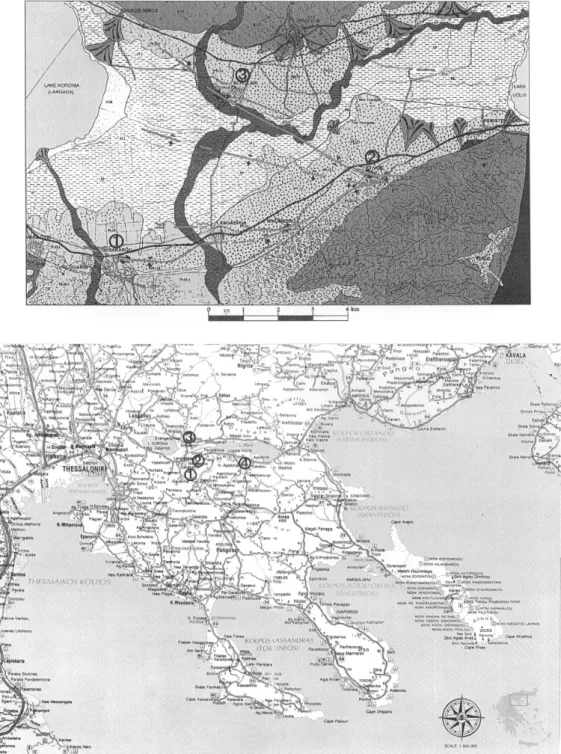
In the Langadas basin, northern Greece, between the Lake Langadas (Lake Koronia) and the Lake Volvi (Figs. 1a and b), there is a great fault, named the Stivos fault, with a
dis-Correspondence to: C. Papastefanou
tant of about 50 km from the city of Thessaloniki (40◦380N, 22◦590E). It is a normal type fault in the Servo-Makedonian Zone (Skordilis, 1985). The background (substrate) of the Servo-Makedonian Zone has been formed from minerals of palaeozoic era or older, which have been metamorphosized during the palaeozoic or mesozoic era. In aging of the crystallic background, the results gave upper palaeozoic or lower kaenozoic. Two series might be distinguished in the crystallo-schistic of the Servo-Makedonian Zone, the lower series of Kerdylia and the upper series of Vertiskos (Figs. 1a and b and the Appendix 1).
At the Stivos fault, large earthquake events of ML =6.5 occurred on 20 June 1978, of ML=5.2 on 19 February 1984 and of ML =5.8 on 4 May 1995. A radon monitoring sta-tion using solid-state nuclear track-etch detectors (cellulose nitrate films of type CA 80-15 Kodak) had been established at that fault in the Stivos village for the period August 1982 – June 1985 (Papastefanou et al., 1989). After a decade, three different radon monitoring stations have been established at Gerakarou, No. 1, at Stivos, No. 2 and at Sholari, No. 3, in the Langadas Basin (Figs. 1a and 1b) for the period starting from December 1996 onwards.
In the Langadas Basin, at the spas of Nea Apollonia, No. 4 (Fig. 1b), 60 km from the city of Thessaloniki, south-east of the Lake Volvi, a radon monitoring station is registering continuously radon anomalies in the waters of spas (ther-mal springs). Two active hot springs, namely Loutra (spa) Langadas (40◦C) and Loutra of Nea Apollonia (49◦C), ex-ist in the area of Langadas Basin. The hot spring action is connected to the neotectonic faulting and must be more in-tensive in the past than today, as indicated by the exin-tensive distribution of travertines along the periphery of the basin and around Lake Volvi, in particular (Loutra of Nea Apollo-nia, Nea ApolloApollo-nia, ApolloApollo-nia, Nea Madytos, Megali (great) Volvi, Nymphopetra, Profitis, Fig. 1b).
The geothermal gradient in the area is high and sev-eral “warm” boreholes were drilled for agricultural purposes (greenhouses) in the vicinity of the Loutra Langadas (35– 40◦C), max 330 m, Loutra of Nea Apollonia (55◦C) and
160 C. Papastefanou et al.: Radon measurements along active faults
Fig. 1. (a) Geological map of Langadas Basin. (b) Geographical map of Langadas Basin.
Nymphopetra (37–44◦C), 100–200 m.
This work reports on data obtained from field measure-ments of radon gas for the period starting from December 1996 up to June 2000 at three radon monitoring stations which were established at Gerakarou, Stivos and Sholari, as well as at the Nea Apollonia spa in the Langadas Basin.
2 Experimental methods
The methods of radon measurements in soil gas and in waters of thermal springs that were applied are as follows.
Radon in soil gas was measured first by alpha spectrom-etry using appropriate Lucas scintillation cells1 (George, 1990), in order to define the places of installation of radon stations. The spectrometer was linked to a portable radon monitor, type AB-5 (PYLON), a trace environmental level radon gas detector which detects radon levels as low as 11 Bq m−3, and a data acquisition unit (instantaneous radon measurements). The volume of Lucas cells is 270 ml with Zns(Ag), an active area of 27 700 mm2, a counting efficiency
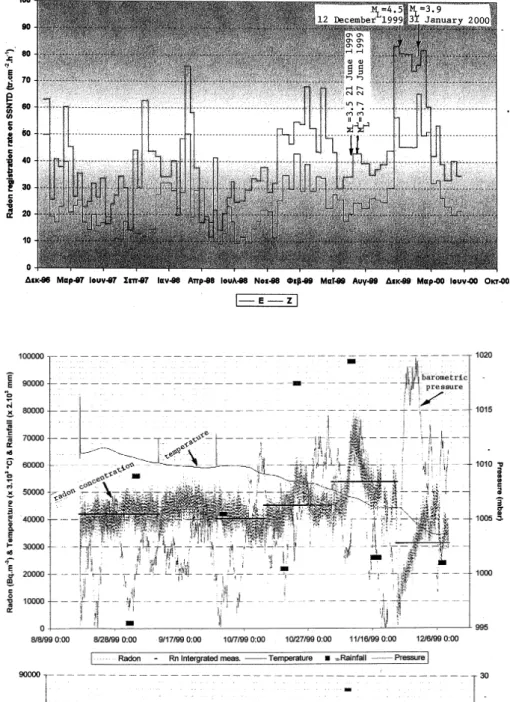
Fig. 2. Radon integrated measure-ments obtained by SSNTDs at Ger-akarou radon station No. 1 in the Lan-gadas Basin.
Fig. 3. (a) Radon concentration in soil gas at Stivos radon station No. 2 during the period of August–December 1999 in correlation with rainfall, soil temper-ature and pressure. (b) Radon concen-tration in soil gas at Stivos radon station No. 2 during the period of February– June 2000 in correlation with rainfall, soil temperature and pressure.
162 C. Papastefanou et al.: Radon measurements along active faults
Fig. 4. Seismic events (ML > 3)
oc-curred in the wide region of interest, ROI with epicenter < 50 km for the pe-riod of January 1997–June 2001.
of 0.75±0.02 cpm dpm−1, a sensitivity of 0.037 cpm Bq−1
m3, radon detection levels as low as 11 Bq m−3. The soil gas
was pulled off at opened holes of 70 cm depth.
Radon in soil gas was also monitored for long time periods by LR-115 Kodak type II, non-strippable nuclear track-etch detectors (integrated radon measurements) (Alter and Fleis-cher, 1981) in specially made devices consisting of a plas-tic tube, 44 mm inner diameter, 50 mm outer diameter and 300 mm in length, with the detectors being on top of the tube, secured appropriately. The plastic tube with radon detector was set inside another plastic tube of 1000 mm in length with a 70 mm inner diameter. The empty space between the two plastic tubes was filled with styrofoam material in granule form to thermally isolate the devices. In order to avoid mois-ture effects on the registration of alpha particles to the detec-tor’s surface, a glass fiber type GF/B was placed in front of the plastic detector. The time of exposure was 15 days.
For continuous monitoring of radon gas exhaling from the ground, appropriate silicon diode detectors2 (Abbad et al., 1995; Pinault and Baubron, 1996; Trique et al., 1999) were applied in the middle of August 1999, having a background counting below 1 event every 24 h, a useful area of 450 mm2, a depleted depth of 100 µm (microns), a sensitivity of 0.02 pulses h−1Bq−1m3, a resolution with the detector placed in
the air 60 keV, a radon detection limit of 50 Bq m−3and a
saturation volumic activity of 3 MBq m−3. Atmospheric pa-rameters, like temperature (◦C), barometric pressure (mbar) and rain precipitation (mm) were recorded simultaneously by the sensors provided by the detector probes. Radon registra-tions were performed every 15 min.
For continous monitoring of radon gas in waters of ther-mal springs, appropriate silicon diode detectors3(Pane et al., 1995) were applied having sensitivity 1 count h−1=362 Bq m−3. A response-function test for this type of detector was performed using a calibrated radon source, type
RN-1025-2Barasol probes
3Clipperton type detectors
20, 20 kBq (PYLON). The data storage units were set far away from the radon detectors that were inside the waters to avoid any influence of electric fields to detecting probes. Specially made detector supporters were provided if the wa-ters were too deep. Radon registrations were performed ev-ery 15 min.
3 Results and discussion
Results of radon integrated measurements by solid-state nu-clear track-etch detectors for the period of December 1996 through June 2000 obtained at the Gerakarou radon station No. 1 (Fig. 1a) are illustrated in Fig. 2. The data showed radon registrations higher than 80 tracks cm−2h−1 at the Gerakarou radon station No. 1, as well as at the Stivos radon station No. 2, following an ML=4.5 earthquake event that occurred on 12 December 1999 and the ML = 3.9 earth-quake event that occurred on 31 January 2000. Earthearth-quake events of ML =3.5 (21 June 1999) and ML =3.7 (17 June 1999) were not associated with significant radon anomalies (Fig. 2). Radon registrations up to 60 tracks cm−2h−1were recorded in the Sholari radon station No. 3. Similar plots to that of Fig. 2 were obtained for the radon stations No. 2 and No. 3.
Results of radon concentrations in soil gas in the continu-ous monitoring of radon by Barasol detectors for the period of August 1999 through June 2000 obtained at the Stivos radon station No. 2 are illustrated in Figs. 3a and 3b. In the period of August 1999 through December 1999, there seems to be a background of 40 kBq m−3for radon in soil gas (Fig. 3a), while in the period of February 2000 through June 2000, the background rose to about 50 kBq m−3for radon in
soil gas (Fig. 3b), possibly indicating higher seismic activity to be followed in the next period. Beside this, only one earth-quake event with a magnitude higher than 4.0 occurred at the region of interest; ROI in the period of measurements, that of
Appendix A Explanations of geological map of Langadas Basin (Fig. 1a)
Acknowledgements. This work was sponsored by the Commission of the European Communities under the contract No. IC15-CT96-0214 of the EMANE project of the INCO-Copernicus Programme.
References
Abbad, S., Robe, M. C., Bernat, M., and Labed, V.: Influence of Meteorological and Geological parameter variables on the concentration of radon in soil gases: Application to seismic forecasting in the Province-Alpes-Cˆote d’Azur region, Environ. Geochim. Health, 16S, 35–48, 1995.
Alter, H. W. and Fleischer, R. L.: Passive integrating radon monitor for environmental monitoring, Health Phys., 40, 693–702, 1981. George, A. C.: An overview of instrumentation for measuring en-vironmental radon and radon progeny, Rep. T-NS/37/2/1/38220, IEEE Trans. Nucl. Sci., 37, 892–901, 1990.
Hauksson, E.: Radon content of ground water as an earthquake pre-cursor: Evaluation of worldwide data and physical basis, J. Geo-phys. Res., 86, 9397–9410, 1981.
King C. Y.: Temporal variations in radon emanation along active faults, EOS Trans. AGU, 58, 434, 1977.
King C. Y.: Anomalous changes in radon emanation and ground water quality, EOS Trans. AGU, 59, 1196, 1978.
ac-164 C. Papastefanou et al.: Radon measurements along active faults
tive faults and possible relation to earthquakes, J. Geophys. Res., 85, 3065–3078, 1980.
Mogro-Campero A., Fleischer, R. L., and Likes R. S.: Changes in subsurface radon concentration associated with earthquakes, J. Geophys. Res., 85, 3053–3057, 1980.
Pane, M. B., Seidel, J. L., Monnin, M., and Morin, J. P.: Radon as a tracer of fluid motion in fractural aquifers, Environ. Geochim. Health, 16S, 325–334, 1995.
Papastefanou, C., Manolopoulou, M., Savvides, E., and Charalam-bous, S.: Radon monitoring at the Stivos Fault following the ML = 6.5 earthquake which occurred at Thessaloniki, Greece on 20 June 1978, Nucl. Geophys, 3, 49–56, 1989.
Pinault, J.-L. and Baubron, J.-C.: Signal processing of soil gas
radon, atmospheric pressure, moisture and soil temperature data: A new approach for radon concentration modeling, J. Geophys. Res., 101(B2), 3157–3171, 1996.
Scholz C. H., Sykes, L. R., and Aggarwal Y. P.: Earthquake predic-tion: A physical basis, Science, 181, 803–810, 1973.
Skordilis, E. M.: Microseismic study of the Servomacedonian Zone and the surrounding area, PhD thesis, Aristotle University of Thessaloniki, Thessaloniki, Greece, 1985.
Trique, M., Richon, P., Perrier, F., Avouac, J. P., and Sabroux, J. C.: Radon emanation and electric potential variations associ-ated with transient deformation near reservoir lakes, Nature, 399, 137–141, 1999.