HAL Id: hal-00708996
https://hal.archives-ouvertes.fr/hal-00708996
Submitted on 16 Jun 2012
HAL is a multi-disciplinary open access
archive for the deposit and dissemination of
sci-entific research documents, whether they are
pub-lished or not. The documents may come from
teaching and research institutions in France or
abroad, or from public or private research centers.
L’archive ouverte pluridisciplinaire HAL, est
destinée au dépôt et à la diffusion de documents
scientifiques de niveau recherche, publiés ou non,
émanant des établissements d’enseignement et de
recherche français ou étrangers, des laboratoires
publics ou privés.
Evaluating a Pattern Approach as an Aid for the
Development of Organisational Knowledge: An
Empirical Study
Colette Rolland, Janis Stirna, Nikos Prekas, Pericles Loucopoulos, Anne
Persson, Georges Grosz
To cite this version:
Colette Rolland, Janis Stirna, Nikos Prekas, Pericles Loucopoulos, Anne Persson, et al.. Evaluating a
Pattern Approach as an Aid for the Development of Organisational Knowledge: An Empirical Study.
12th International Conference on Advanced Information Systems Engineering (CAISE), 2000, Norway.
pp.176 - 191. �hal-00708996�
Evaluating a Pattern Approach as an Aid for the
Development of Organisational Knowledge: An
Empirical Study
Colette Rolland1, Janis Stirna3, Nikos Prekas2, Peri Loucopoulos2, Anne Persson4, Georges Grosz1 1
Centre de Recherche en Informatique Université Paris 1 – Sorbonne
90, rue de Tolbiac 75013 Paris – France
{rolland, grosz}@univ-paris1.fr
2
Department of Computation University of Manchester Institute of Science
and Technology (UMIST) P.O. Box 88 Manchester M60 1QD, UK {N.Prekas, pl}@co.umist.ac.uk
3
Dpt. of Computer and Systems Sciences Royal Institute of Technology and SU Electrum 230, S-16440, Kista, Sweden
4
Department of Computer Science University of Skövde
P.O. Box 408, S-541 28 Skövde, Sweden [email protected]
Abstract: Patterns are a powerful paradigm that has emerged in recent years as a mechanism that can help towards the consolidation and dissemination of design experiences. In the context of the European research project ELEKTRA we developed a pattern approach for capturing best business practices of change management in the electricity sector. In this paper we briefly present this approach and concentrate on the issue of validating the pattern approach through evaluation of its different features. In particular, we define three constituent features, namely the knowledge contained in patterns, the language used to construct patterns and the method for developing the patterns. For each of these features we define an evaluation hypothesis and then test this hypothesis against a set of criteria and metrics. The experiments conducted and the results are presented in summary.
1
Introduction
This paper presents the results of the European research project ELEKTRA (ELectrical Enterprise Knowledge for TRansforming Applications [1]) with respect to the creation of a knowledge base for change management in the electricity sector. In particular, one of the objectives of the project was to “create and capture best business practices of change management for re-using them in similar situations in other Electricity Supply Industry (ESI) companies”. To accomplish this task, we used an approach for disseminating best business practices based on the pattern concept [2, 3]. In this paper we present an overview of the pattern development approach, and we then focus on its validation. In the context of ELEKTRA, patterns are viewed as generic and abstract organisational design proposals. Patterns encapsulate organisational knowledge in a way that facilitates its reuse [4]. The main emphasis is on providing solutions to important and recurring problems within the context of an organisation. The ELEKTRA project has produced a knowledge base that contains patterns of change management for the electricity sector from knowledge mainly developed during the project. The main goal was to produce generic and reusable organisational solutions in the areas of Electricity Distribution and Human Resource
Management. The results are extensively presented in [5]. In order to reach the project goal, we developed a pattern development approach that mainly consists of:
• a language for describing the knowledge embedded in patterns as well as meta-knowledge to facilitate the reuse of patterns,
• a method for supporting the discovery of potentially re-usable business practices and solutions, and their generalisation in a way they can be applicable in more than one organisation.
This paper mainly addresses the validation of the pattern approach. The validation process consists of an evaluation of the three features of the pattern approach, namely (a) the
ESI
knowledge base, (b) the language used to describe the patterns and (c) the method followed to develop them. This evaluation was performed through empirical studies. The evaluators were mainly domain experts from the two electricity supply companies participating in the project. For each feature we defined hypotheses and then, tested the hypotheses against a set of criteria using metrics.The paper is organised as follows. Section 2 outlines the pattern concept and its use in the area of business and organisational development. Section 3 presents the ELEKTRA pattern approach, i.e. the pattern language, the method for pattern development and the pattern repository. Section 4 then presents the methodology for pattern evaluation including hypothesis and experiments, while section 5 discusses the actual evaluation results. Finally, section 6 presents our conclusions and discusses future work.
2
Patterns as Organisational Solutions
Recent years have witnessed an increasing interest in the use of patterns within the software development community and in particular by those advocating and practising object-oriented approaches and re-use. In [6], Alexander defines a pattern as describing “a problem which occurs over and over again in our environment and then describes the core of the solution to that problem, in such a way that you can use this solution a million times over, without ever doing it the same way twice”.
A good number of similar definitions of the term “pattern” exist today [7; 8; 9]. All these definitions share two main ideas. First, a pattern relates a recurring problem to its solution. Second, each problem has its unique characteristics that distinguish it from other problems. The ELEKTRA project has further elaborated the pattern concept and applied patterns towards documenting best business practices in organisations. The patterns that we defined and used in ELEKTRA are generic and abstract organisational design proposals that can be easily adapted and reused in different organisational situations.
ELEKTRA patterns represent solutions to specific problems within the context of an organisation, problems that are important and recurring in a variety of cases. The emphasis, therefore, has been on the fact that patterns address important and repeatable problems within the sector of interest. Each pattern couples a problem with a solution and reflects the context of its applicability, as well as the way in which it can be reused. Patterns address both the description of the enterprise in terms of business processes (and the strategic goals that these processes realise) and the description of the way in which organisations evolve by performing change. This led to the definition of two types of patterns:
• Product Patterns, dedicated to representing and modelling the different situations in the area of interest.
• Change Process Patterns, dedicated to modelling the change process in the area of interest.
This typology of patterns was devised with the purpose of ensuring the repeatability of the change process. The roles that process patterns and product patterns play in the task of managing organisational change are shown in Figure 1.
Product (the current state)
Process (the process of change)
Product
Described by change process patterns
Described by product patterns
(the future state)
Figure 1. The role of patterns in managing the change process [2].
A change process pattern constitutes a proposed solution to the problem of designing a new situation by describing the steps necessary for the implementation of the new situation, i.e. by offering a way of achieving the future state of affairs. A product pattern on the other hand describes the situation itself by detailing individual aspects of the business involved. Product patterns and change process patterns can then be viewed as complementary elements, in that they both contribute towards solving the greater design problem.
3
Pattern Development
This section presents the main features of the ELEKTRA pattern approach – the pattern language, the method used for developing the patterns, and the pattern repository, also called the ESI knowledge base.
3.1 The Pattern Language
In ELEKTRA, we placed emphasis both on developing patterns and on providing enough information about these patterns so as to make them effectively reusable. Thus we made the distinction between the knowledge perspective of the pattern and its usage perspective, captured in the body of the pattern and its descriptor, respectively. The former is the part of the knowledge that is effectively reused whereas the latter aims to provide sufficient information on the pattern and to describe the context in which the body of the pattern can be reused. ELEKTRA patterns therefore consist of four main elements, each is now detailed in turn.
The body presents an overview of the proposed solution. In most cases this type of knowledge was represented using a diagrammatic form, i.e. conceptual models, or natural language. The typology of models used is that proposed by the Enterprise Knowledge Development methodology (EKD). More about EKD can be found in [10] and [11].
The formal signature describes the pattern in such a way as to facilitate its indexing and retrieval. The formal signature consists of the pattern type, the domain of its applicability, and the usage intention according to which it can be used. Formalised natural language was used to represent this part of pattern knowledge.
The informal signature gives a complete description of the pattern. This description consists of the problem that the pattern intends to solve, the context of its applicability, the prevailing forces that influence the situation, and the proposed solution to the problem. The solution field offers a description of the proposed approach to tackling the problem complementary to the one given in the body of the pattern. Additional elements of the informal signature (e.g. the rationale behind the solution, the consequences etc.) complete the pattern description. Natural language was used to represent the informal signature.
The guidelines give advice as to how the pattern is to be reused and applied in a real enterprise context. For representing the guidelines, we used natural language.
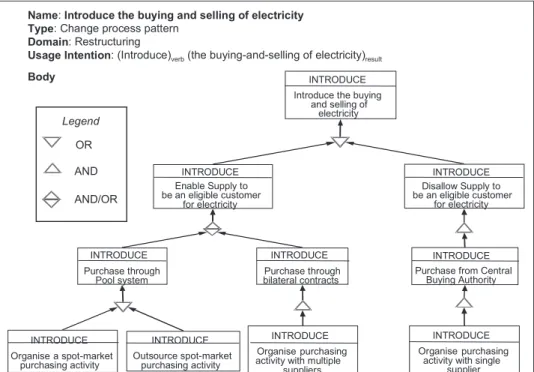
An example of change process pattern is given in Figure 2. The pattern concerns the problem of introducing the buying and selling of electricity. In the goal graph of Figure 2, the proposed solution suggests different alternatives to organise the market in an AND/OR graph, these concern the introduction of a Pool, of bilateral contracts or of a Central Buying Authority.
The
ELEKTRA
pattern language was organised using a hierarchical indexing mechanism presented in [2]. The hierarchy of patterns was built using the formal signature of the patterns, and specifically by associating usage intentions of patterns. The pattern hierarchy was therefore organised in an intentional manner. This solution permits us to keep atomic patterns in the thesaurus while expressing their possible composition through a hierarchy that can be used for indexing and retrieval purposes.3.2 The Pattern Development Method
In order to tackle the increased demands of developing patterns that encapsulate knowledge about change management, we defined a method that involves domain experts and method experts (analysts) in close co-operation. The process is iterative, it consists of the following four steps (see [2 ; 3] for details) :
(a) Elicitation of Candidates aims at identifying potential change process patterns and product patterns. The output of the elicitation process is a list of candidate patterns described at a sufficient level of detail in order to proceed to their evaluations. (b) Suitability Evaluation aims to determine the suitability of a candidate pattern. Domain experts grade the candidate patterns obtained as a result of the previous step so that their further development can be decided upon.
(c) Documenting aims at describing the reusable knowledge in the format of the Pattern Template. The domain experts, in co-operation with the analysts, provide the remaining elements pattern.
(d) Verification aims at determining adequacy of the knowledge embedded in the pattern. The wording of all elements in the pattern template is carefully studied and modified if necessary, as are interconnections between related patterns.
3.3 The Resulting Knowledge base
By applying the aforementioned method, we produced the ESI knowledge base. It consists of two sets of patterns: one for the case of Distribution and one for the case of Human Resource Management (HRM). The total number of patterns developed is 31 for Distribution (12 change process patterns, 19 product patterns) and 31 for HRM (14 change process patterns, 17 product patterns). These patterns represent a number of important and recurring problems that arise when managing change in these two
areas of the ESI sector. They are available in [2]. In addition the ELEKTRA patterns are accessible via the Internet on the following addresses:
Distribution patterns: http://www.co.umist.ac.uk/~prekas/DistributionPatterns/Pattern_Index.html HRM patterns: http://www.dsv.su.se/~danny/patternlibrary/main.html
INTRODUCE Introduce the buying
and selling of electricity INTRODUCE Purchase through Pool system INTRODUCE Purchase through bilateral contracts INTRODUCE Purchase from Central
Buying Authority INTRODUCE Organise a spot-market purchasing activity INTRODUCE Outsource spot-market purchasing activity INTRODUCE Organise purchasing activity with multiple
suppliers
INTRODUCE Organise purchasing
activity with single supplier INTRODUCE Enable Supply to be an eligible customer for electricity INTRODUCE Disallow Supply to be an eligible customer for electricity
Name: Introduce the buying and selling of electricity Type: Change process pattern
Domain: Restructuring
Usage Intention: (Introduce)verb (the buying-and-selling of electricity)result
Body
OR
AND
AND/OR Legend
Problem: In an environment with many electricity producers and many suppliers, electricity has to be bought by
Supply from the producers and sold to the final customers.
Context: The deregulation directives of the EC set a framework for the trading of electricity, where a number of
alternatives are available.
Forces: The way in w hich Supply trades electricity is defined by the overall legal and institutional framework in
which all participants of the electricity market have to operate.
Solution: Depending on the framework chosen for the entire ESI sector, a Supply company will have some
options for trading electricity. If a Pool system is adopted, Supply must participate in a spot market for electricity; this can be done directly through a respective department/activity or it can be outsourced to an external agency. If a system of bilateral contracts is adopted (e.g. minimum ISO), then an activity of negotiating and establishing contracts with electricity producers must be organised. Finally, if a single buyer system is adopted, Supply will be purchasing electricity from the Central Buying Authority.
Consequences: According to the selected framework, Supply will behave either as a captive customer (in the
case of CBA) or as an eligible customer (in the cases of Pool and trading through contracts). This means an entirely different internal structuring and operation. In the latter case the competition in the electricity market is more intense and therefore Supply will also need to behave in a more flexible and adaptive way.
Related patterns: Trading of electricity through CBA system, Trading of electricity through bilateral contracts,
Trading of electricity through Pool, Outsourced trading of electricity through Pool
Guidelines: Selecting one of the modes for trading electricity depends on the direction into which the entire ESI
sector will be heading. If an increased degree of competitiveness in desired, then the options of trading through a Pool or through bilateral contracts will be selected. The option of bilateral contracts in particular offers maximum freedom with respect to negotiation of quantities and prices of power with the producers. If, on the other hand, slower steps towards deregulation are desired, the CBA option offers more centralised control of the market and thus fewer possibilities for autonomous behaviour by Supply.
4
Experimental Method
The method to evaluate the ELEKTRA pattern approach is structured around the three following questions:
• WHAT should be evaluated? We answered this question by identifying the main features of the ELEKTRA pattern approach and by defining hypotheses associated to each feature that were considered important to evaluate. We identified three features, which we believe fully cover the approach. We identified 21 hypotheses, each of them representing an aspect of pattern design that we expect the ELEKTRA pattern approach to improve. It is by evaluating these hypotheses that we can test whether or not the expected improvements have, in fact, been realised.
• WHEN should the evaluation be performed? The evaluation can be performed only after a fairly complete and coherent set of patterns has been developed. We performed the evaluation of ELEKTRA patterns after we had worked for more than one year within the project to define the overall framework and populate the ESI knowledge base.
• HOW should the evaluation be performed? To perform the evaluation we conducted experiments in the form of workshops. We conducted a number of workshops with the participation of 26 ESI experts. In order to determine whether a hypothesis could be validated or not, we adopted the use of evaluation criteria and metrics [12, 13, 14]. We identified evaluation criteria and defined metrics in order to measure each hypothesis in a given experiment against a given criterion. This means that the evaluation frame is a 5-tuple of the form:
< experiment, feature, hypothesis, criterion, metric>.
There is one result for each 5-tuple that represents an atomic evaluation. These atomic results form the basis of more global evaluations and measurements. A detailed presentation of the evaluation process and results is available in [5]. We limit ourselves here to a summary of both, the evaluation process and obtained results.
4.1 Hypotheses
The three features of the ELEKTRA pattern approach that were selected for the evaluation process are as follows:
1. The ESI knowledge embedded in the patterns 2. The pattern language used to express the knowledge 3. The method used to develop patterns
For each of these features, we defined a global hypothesis. Each global hypothesis is further refined into a number of more precise hypotheses that constitute to the evaluation criteria shown in the table below.
Feature 1: ESI knowledge Embedded in Patterns
Global hypothesis : “The ESI knowledge base is potentially useful for solving organisational problems within the Distribution and HRM domain in the context of deregulation”.
CRITERIA HYPOTHESIS
Usefulness H1: Usage of the pattern provides a substantial contribution in the context of a real problem-solving application.
Relevance H2: The pattern addresses a significant problem in the ESI sector. Usability H3: The pattern can be used in the context of a real application. Adaptability H4: The solution advocated by the pattern can be modified to reflect a
particular situation.
Adoptability H5: Domain experts are likely to use the pattern for resolving a particular problem of interest.
Completeness H6: The pattern offers a comprehensive and complete view of the problem under consideration and of the proposed solution.
Coherence H7: The pattern constitutes a coherent unit including correct relationships with other patterns.
Consistency H8: The pattern conforms to existing knowledge and vocabulary used in the ESI sector.
Prescriptiveness H9: The pattern offers a concrete and tangible proposal for solving a problem, in particular with respect to the steps necessary for its implementation as described in the guideline.
Granularity H10: The pattern addresses the given problem at an appropriate level of detail.
Feature 2: The Pattern Language
Global hypothesis: “The pattern language permits an effective knowledge capture and transfer”.
CRITERIA HYPOTHESIS
Usefulness H11: The language captures and conveys the relevant knowledge for describing patterns.
Comprehensi-veness
H12: The different elements of the pattern (formal signature, informal signature and body) are adequate for understanding its purpose.
Richness H13: The language is able to describe the different aspects of a pattern one is expecting in such a description.
Ease of use H14: The language eases knowledge capture in patterns.
Relevance H15: The conceptual primitives chosen are appropriate for expressing the respective parts of pattern knowledge.
Feature 3: The Method to Develop Patterns
Global hypothesis: “The method is an adequate means for guiding the development of the ELEKTRA patterns”.
CRITERIA HYPOTHESIS
Completeness H16: The method offers a comprehensive and complete view of the activities to be performed for developing patterns.
Coherence H17: The method is described in a coherent way.
Prescripti-veness
H18: The method offers a concrete and tangible proposal for developing patterns, in particular with respect to the steps necessary for its implementation.
Relevance H19: The method helps in organising and guiding pattern development. Usability H20: The method can be used in the context of a real application. Usefulness H21: The method offers an adequate means for understanding how
4.2 Experiments
The evaluation was conducted in the form of workshops. Each workshop was devoted to evaluation of one feature. Workshops for evaluation of feature 1: “
ESI
knowledge embedded in patterns” were separated for Distribution patterns and forHRM
patterns.
Participants
In total 26 evaluators were involved in the evaluation task. They were equally assigned for each of the Distribution and HRM cases – 13 for each case. The evaluators were experienced professionals with an extensive amount of knowledge in their respective areas of expertise. In their majority (24 out of 26), they represented the two electricity companies of the ELEKTRA project; two evaluators were independent consultants in the Distribution area. Some of them had some general knowledge about the ELEKTRA project and had been involved in pattern development within the project; no other specific preparations were carried out prior to the evaluation workshops.
Procedure
The evaluation workshops were conducted according to an agenda comprising a common part for all workshops and a specific part for each individual feature evaluated.
The common part included the following items: • presentation of the objectives of the evaluation • presentation of the
ELEKTRA
evaluation approach• background to the patterns work and
EKD
notation used for documenting patterns• presentation of the questionnaire(s) • tutored completion of the questionnaire(s)
• general discussion about the possible use of the
ESI
knowledge baseThe specific part for workshops devoted to evaluation of the knowledge embedded in patterns included:
• presentation of the pattern language
• short presentation of pattern clusters and of each pattern of each cluster The specific part for workshop devoted to evaluation of the method used pattern development included the:
• presentation of the pattern development method
The evaluators were asked to respond to questions in a questionnaire. Questions cover all the hypotheses to be tested against the set of criteria for each. The response was a grading from 1 to 5 for each criterion. Thus, each atomic evaluation is a value from 1 to 5 associated to a 5-tuple
< experiment, feature, hypothesis, criterion, metric>.
For example, the average value of the 5-tuple <Workshop 1, Knowledge embedded in patterns, The knowledge embedded in patterns provides a substantial contribution for an
ESI
company to resolve an existing problem, Usefulness, 1 to 5> was 4.3.Evaluators were also given an opportunity to give additional comments when they felt that these were necessary. Workshops ended with an open discussion about the overall usability of the
ESI
knowledge base and possible ways how it could be improved.5
Evaluation Results
This section presents the results of the evaluation process. We divided the discussion in three parts according to the features of the knowledge base we have evaluated.
5.1 Evaluation Results of the Knowledge Embedded in Patterns
As both parts of the
ESI
knowledge base – Distribution patterns andHRM
patterns -constituted coherent parts, the evaluation of these hypotheses was accordingly divided into two parts. The evaluation process for both parts was similar, but the evaluators were different. For each case, a cluster of patterns from the entire pattern hierarchy was selected for evaluation. The selection of pattern clusters for validation was made with the following goals in mind:• The selected patterns should contain a representative sample of information from the pattern library;
• they should form coherent clusters addressing the most important problems among those included in the knowledge base;
• they should include both change process patterns and product patterns.
We will briefly outline these two pattern clusters along with the respective evaluation results.
Evaluation Results for Distribution patterns
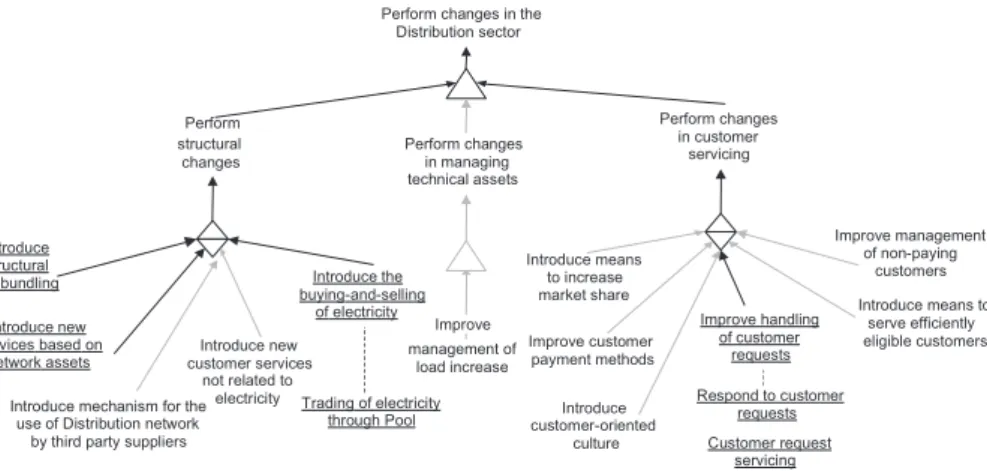
Two clusters of patterns were selected from the original hierarchy of Distribution patterns, as illustrated in Figure 3:
• One cluster addressing the problem of performing structural change in the Distribution business area. The cluster consists of the change process patterns “Introduce structural unbundling”, “Introduce new services based on network assets”, and “Introduce the buying and selling of electricity”. These three patterns address to a great extent the problem of dealing with structural change in the transition from a monopolistic environment to an unbundled, competitive market. Related to the last of these three change process patterns is the one product pattern of this cluster, namely “Trading of electricity through Pool”. This pattern complements the solution to the problem of introducing the trading of electricity, by describing one of the possible ways of organising an electricity market. • One cluster addressing the problem of performing changes in customer servicing
in the Distribution business area. This cluster includes the change process pattern “Improve handling of customer requests”, and the product patterns “Respond to customer requests” and “Customer request servicing” (as well as its refinement through the associated pattern “Customer request servicing by phone”). This group of patterns addresses the problem of handling customer requests and possible ways of improving the services already offered.
Perform changes in the Distribution sector Perform changes in customer servicing Perform changes in managing technical assets Perform structural changes Introduce the buying-and-selling of electricity Introduce new customer services not related to electricity Introduce mechanism for the
use of Distribution network by third party suppliers Introduce new services based on network assets Introduce structural unbundling Improve management of non-paying customers Introduce means to serve efficiently eligible customers Introduce customer-oriented culture Improve customer payment methods Introduce means to increase market share Improve handling of customer requests Trading of electricity through Pool Respond to customer requests Customer request servicing management of load increase Improve
Figure 3. Distribution patterns selected for validation as part of the original Distribution pattern hierarchy. Patterns chosen are underlined.
The full description of the Distribution patterns that were evaluated during the validation process can be found in [2] and [3]. As shown in Figure 4, the average markings achieved by the Distribution patterns in both clusters are encouraging. All patterns achieved an average above 3.50, most of them standing close to or above 4 (see Figure 4). Change process patterns achieved higher overall averages than product patterns. Introduce the buying-and-selling of electricity Introduce new services based on network assets Introduce structural unbundling Improve handling of customer requests Trading of electricity through Pool Customer request servicing Respond to customer requests Customer request servicing by phone 3.60 3.80 4.00 4.20 3,91 3,99 3,89 3,55 4,17 3,66 3,98 4,14
Figure 4. Average values scored by Distribution patterns.
Figure 5 sums up the average marks to test each of the 10 hypotheses for this feature. Overall, the Distribution patterns achieved their highest markings in the questions related to usefulness and relevance, achieving an average of 4.34 for H1 and H2 respectively (see Figure 5). This is, to some degree, an expected outcome: the understanding of what constitutes an important issue in a domain (which produces the candidate patterns and their problem descriptions) is much more likely to be unanimous than the proposed solutions to each problem.
4,34 4,34 4,13 3,98 3,93 3,77 3,86 4,14 3,56 3,49 3 3,5 4 4,5 5 H1 H2 H3 H4 H5 H6 H7 H8 H9 H10
The Distribution patterns were also rated well for their consistency with knowledge and vocabulary used in the
ESI
sector (average 4.14 for H8). This result is encouraging with respect to the process followed to develop the patterns, as it was the involvement of the domain experts in all steps of the process that assured this consistency. A further high average mark was achieved for usability of patterns in real applications (average 4.1 for H3). The patterns received their lowest markings for granularity (average 3.49 for H10), prescriptiveness (average 3.56 for H9) and completeness (average 3.77 for H7). This reflects the evaluators' view that some patterns did not tackle the respective problems in enough depth. In particular, the evaluators noted a need for more detailed solution descriptions as well as a more complete coverage of the options available for solving each problem. Therefore, we can assume that hypotheses H7, H9 and H10 are only partially verified and that improvements have to be done with regard to them before the Distribution patterns can be effectively used.Overall we concluded that the Hypothesis: “the Distribution part of the
ESI
knowledge base is useful for solving organisational problems within the Distribution domain” is verified.
Evaluation Results for HRM Patterns
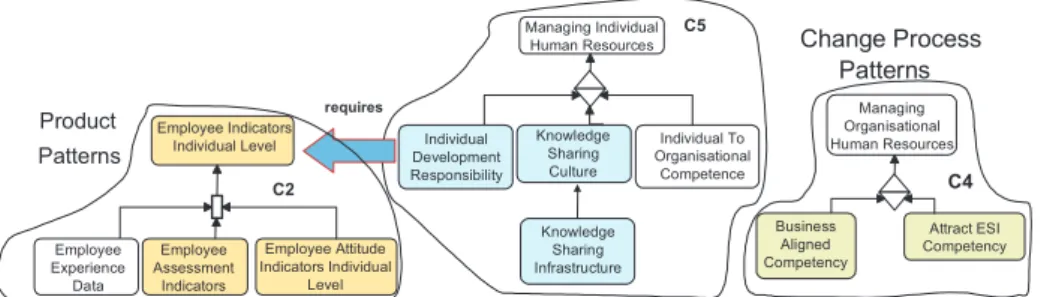
Managing Individual Human Resources Individual Development Responsibility Knowledge Sharing Culture Individual To Organisational Competence Knowledge Sharing Infrastructure C5 requires Employee Indicators Individual Level Employee Assessment Indicators Employee Experience Data Employee Attitude Indicators Individual Level C2 Product Patterns Managing Organisational Human Resources Business Aligned Competency Attract ESI Competency C4 Change Process Patterns
Figure 6. HRM patterns selected for evaluation are grey-shaded.
Three pattern clusters were selected for evaluation (see Figure 6). They serve as a representative sample and cover the most important aspects of the HRM part of the knowledge base.
C5: Managing Individual Human Resources – This cluster of Change Process Patterns aims at improving the management of human resources at the individual level. The proposed solutions include increasing the responsibility of individuals for their own competency development, improving the organisation’s knowledge sharing culture, creating a knowledge sharing infrastructure, and transferring individual competence to organisational competence.
C2: Employee Indicators Individual Level – This cluster of Product patterns provides a proposal how to measure employee related Human Resource properties. The pattern cluster selects types of data (measurable variables) that can be used to formulate goals for individuals. Three types of data are distinguished. Each of them is presented in a separate sub-pattern: Employee attitude indicators, Employee assessment indicators with regard to knowledge, and Employee experience data.
Clusters C5 and C2 are related in the sense that intentions expressed in C5 require certain ways of measuring HR related properties of employees, expressed in C2.
C4: Managing Organisational Human Resources – This cluster of Change Process Patterns aims at improving the management of human resources at the organisational level. The proposed solutions include increasing alignment of competency management with business strategy (further refined in a number of sub-patterns) and improving the attractiveness as an employer in the
ESI
sector. Due to the limited time for evaluation only the two top-level patterns in cluster C4 were evaluated. These patterns are “Business Aligned Competency” and “AttractESI
Competency”.As shown in Figure 7, the average values of HRM patterns are reasonably high: the average marking for all
HRM
patterns is above 3. Two thirds of them are above 4 (see Figure 7). 3,77 3,77 4,12 4,43 4,19 4,47 4,30 3,71 3,91 4,04 3,60 3,80 4,00 4,20 4,40 4,60 Knowledge sharing culture KnowledgesharingInfrastructure Individual development responsibility Cluster C2 Employee indicators individual level Employee assessment indicators Employee attitude indicators individual level Cluster C4 Business aligned competency Attract ESI competency
Figure 7. Average marks scored by HRM patterns.
The highest scoring HRM patterns based on the average values are product patterns in the cluster C4. The average value of the entire cluster is 4.43 while patterns in this cluster scored the following values:
Employee indicators individual level 4,19
Employee assessment indicators 4,47
Employee attitude indicators individual level 4,30
These values are higher than for the remaining change process patterns. Such a high rating of these product patterns can be explained by the fact that they offer more concrete proposals, and therefore they can be easier to appreciate. This can also be the reason why product patterns generally scored a higher average value (4.35) than change process patterns (3.89). Patterns of the cluster C4 also “stick” well together, since relationships between them are well described and easy to grasp. In addition descriptions of these product patterns offer simpler explanations than the ones for process patterns – the pattern body contains a simple diagram (Employee Indicators Individual Level) and textual descriptions in the form of a bullet list. Considering all
HRM
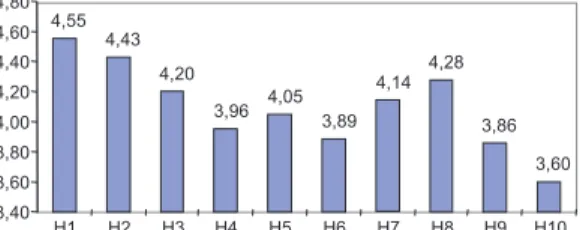
patterns and clusters the highest average values are for overall usefulness (4.56 for H1), relevance to theESI
sector (4.43 for H2) and consistency with domain knowledge (4.28 for H3) – see Figure 8.4,55 4,43 4,20 3,96 4,05 3,89 4,14 4,28 3,86 3,60 3,40 3,60 3,80 4,00 4,20 4,40 4,60 4,80 H1 H2 H3 H4 H5 H6 H7 H8 H9 H10
The lowest average values are for completeness of the knowledge embedded in patterns (3.89 for H6), for prescriptiveness of the proposed solution (3.86 for H9), and for granularity or appropriateness of the level of detail (3.60 for H10). Many evaluators suggested that the level of abstraction is too high and the suggested solutions are not operational enough in order to be easy to implement. Such a rating also influenced the overall rating of some patterns.
Some hypotheses were refined into a number of more precise hypotheses. For example, the hypothesis regarding the completeness of the knowledge embedded in patterns addressed the following three aspects – completeness of the description of the problem, completeness of the proposed solution, and completeness of relationships with other patterns (see Figure 9).
The evaluators also expressed a need to introduce more detailed and precise solutions to the problems addressed. Another contribution towards achieving more complete solutions would be to add specific examples of known cases where similar solutions have been applied. Such patterns would then serve as proposals for organisational designs. It is not surprising, that for these criteria product patterns (cluster C2) scored higher marks than change process patterns since they by nature address more concrete and complete solutions. In particular cluster C4, containing two change process patterns at high abstraction level, received the most of critique to this respect.
From these markings we can conclude that hypotheses regarding completeness of the knowledge (H6), prescriptiveness (H9), and granularity (H10) are only partially verified. The comments received give excellent guidelines towards improving the knowledge base. This leads us to conclude that the overall hypothesis: “the
HRM
part of theESI
knowledge base is potentially useful for solving organisational problems within theHRM
domain” is verified.3,93 3,75 3,99 3,60 3,80 4,00 4,20 H6.1 Problem Completeness H6.2 Solution Completeness H6.3 Relationhips Completeness 4,4 4,0 3,9 3,9 4,6 3,5 4,0 4,5 5,0 H11 H12 H13 H14 H15
Figure 9. Average values of hypotheses regarding completeness
Figure 10. Average marks per criterion scored by the Pattern Language.
5.2 Evaluation Results of the Pattern Language
Figure 10 presents the overall results of the evaluation of the pattern language per hypothesis. The pattern language achieved its highest results in the hypotheses concerning the “Relevance” (H15) and “Usefulness” (H11). This high rating for these two hypotheses indicates that the evaluators believe the structure of a pattern is adequate for conveying the knowledge one can expect from it. The comprehensiveness and the clarity of the language need some improvements.
A study of the evaluation results focused on the different elements of the pattern template indicates that on average, the guidelines received the highest marking (4.7). The informal signature received the second highest marking which is not surprising since this element gives a complete description of both the problem that the pattern is trying to solve, its context of applicability, its forces and the solution proposed to the problem. Despite its formality the formal signature gets a reasonably high marking. Considering that its usefulness can only be appreciated through the retrieval process,
one can conclude that the language is rather right in providing a formal signature. The considerably lower average value (3.5) scored by the pattern body shows that a formal conceptual modelling notation is presumably not clear enough to be easily understood by the large majority of pattern users.
On the basis of this data we conclude that the hypothesis “the pattern language permits an effective knowledge capture and transfer” is verified.
5.3 Evaluation Results of Pattern Development Method
The average value for the evaluation of the method used to develop patterns is 3.8 out of 5 (see Figure 11). This is an encouraging result since not all evaluators were familiar with the problem of pattern development at the beginning of the evaluation process. The method has been well perceived and well understood with regard to its objectives.
All criteria have an average above 3.50, most of them close to 4. Figure 11 gives the average marking per criterion.
4 2,6 4,2 4,2 4,2 4 2 3 4 5 H21 H16 H17 H18 H19 H20
Figure 11. Average values scored by the pattern development method.
"Usefulness" (H21) gets a marking of 4 out of 5. Therefore, evaluators consider that the method offers an adequate means for guiding pattern development. The average marking of “Completeness” (H16) is the lowest of all criteria: 2.6. The evaluators consider that a step is missing to determine the initial pool of candidate patterns. The average marking for the criteria "Coherence" (H17), "Prescriptiveness" (H18), "Relevance" (H19) and "Usability" (H20) is between 4 and 4.2. This means that evaluators found the method consistent (the ordering of the steps as advocated by the method was found correct), relevant and useful. Thus, this hypothesis is partially verified.
6
Conclusion and Discussion
The
ELEKTRA
pattern evaluation case study was a valuable source for drawing important conclusions about organisational patterns. Below we summarise the most important of them:• A too high level of abstraction should be avoided when describing the solution to an organisational problem. The evaluators frequently expressed an opinion that the abstraction level is inappropriate for the kind of problem that is solved, and most often is too high. The links between patterns should also be made more visible. This would create a clearer picture of the context in which a pattern is to be used. • Patterns in clusters are easier to understand and are therefore more appreciated
than isolated patterns. The pattern clusters present broader and therefore more complete solutions. Thus the pattern users can faster grasp the overall idea of how the proposed solutions can be applied in their situation.
• Patterns should describe concrete solutions instead of guidelines and suggestions on how to tackle the problem in general. The proposed solutions should be illustrated by “best practices” and references to similar cases in real life.
• Patterns describing alternative solutions should have guidelines for choosing an appropriate solution depending on a particular situation in organisation. The evaluation confirms that the
ESI
knowledge base is on average useful for solving organisational problems in the context of a deregulated electricity market. It is also most likely thatHRM
patterns, due to their relative independence from the particular domain, can be re-used in different organisational contexts, even outside theESI
sector. The evaluation process also gave us a stimulus for further improvements and refinements of the knowledge contained within patterns, the format used to present patterns to potential users, the coverage of the patterns base, and the method used for developing patterns.The next step will be to broaden the evaluation process and set up a Grand Jury approach like it has been successfully tested in the context of design patterns (see [15] and http://www.cs.clemson.edu/~tmiller/jury/jurorinfo.html).
7.
References
1. Elektra Consortium, ELEKTRA – Electrical Enterprise Knowledge for TRansforming Applications, Project Proposal, ESPRIT Project No. 22927, 1996
2. ELEKTRA Consortium, Molière: The ESI Knowledge Base Specification, ELEKTRA Project Deliverable Document, ESPRIT Project No. 22927, 1999
3. Prekas N., Loucopoulos P., Rolland C., Grosz G., Semmak F., Brash D., Developing patterns as a mechanism for assisting the management of knowledge in the context of conducting organisational change, 10th International Conference and Workshop on Database and Expert Systems Applications (DEXA'99), Florence, Italy, 1999.
4. Rolland C., Grosz G., Loucopoulos P., Nurcan S., A Framework for Encapsulating Best Business Practices for the Electricity Supply Industry into Generic Patterns, 2nd IMACS Int. Conf. on Circuits, Systems and Computers - IMACS-CSC '98, Athens, Greece, 1998. 5. ELEKTRA Consortium, Newton: Validated ESI Knowledge Base, ELEKTRA Project
Deliverable Document, ESPRIT Project No. 22927, 1999
6. Alexander C., S. Ishikawa, M. Silverstein, M. Jacobson, I. Fiksdahl-King, S. Angel, A Pattern Language, Oxford University Press, New York, 1977.
7. Coplien J., D. Schmidt (eds.), Pattern Languages of Program Design, Addison Wesley, Reading, MA, 1995.
8. Gamma E., R. Helm, R. Johnson, J. Vlissides, Design Patterns: Elements of Reusable Object-Oriented Software, Addison Wesley, Reading, MA, 1995.
9. Fowler M., Analysis Patterns: Reusable Object Models, Addison-Wesley, 1997.
10. Bubenko J.A.jr, Stirna J., Brash D., EKD User Guide, Dpt. Of Computer and Systems Sciences, Royal Institute of Technology, Stockholm, Sweden, 1997 available on http://www.dsv.su.se/~js/ekd_user_guide.html
11. Loucopoulos P., Kavakli V., Prekas N., Rolland C., Grosz G., Nurcan S., Using the EKD Approach: The Modelling Component, UMIST, Manchester, UK, 1997
12. Fenton N., Software metrics: A Rigorous approach, Chapman and Hall, NY, 1991 13. P. Oman and J. Hagemeister, Metrics for Assessing Software, System Maintainability,
1992 IEEE Conference on Software Maintenance (Orlando, FL, Nov. 1992), IEEE Computer Society Press.
14. Fonash, P., Metrics for Reusable Code Components, Ph.D. Dissertation, George Mason University, 1993.
15. [Mc Gregor 97] : J.D. Mc Gregor, “Using A Juried Approach for Design Pattern Validation”, Proc. Of the 7th International Conference on Software Quality (7ICSQ), Montgomery, Alabama USA, October 6-8, 1997.
![Figure 1. The role of patterns in managing the change process [2].](https://thumb-eu.123doks.com/thumbv2/123doknet/13331196.400967/4.892.307.586.352.450/figure-role-patterns-managing-change-process.webp)