Discovering the True Chrysoperla carnea
(Insecta: Neuroptera: Chrysopidae) Using Song Analysis,
Morphology, and Ecology
CHARLES S. HENRY,1STEPHEN J. BROOKS,2PETER DUELLI,3
ANDJAMES B. JOHNSON4 Department of Ecology and Evolutionary Biology, University of Connecticut, Storrs, CT 06269Ð3043
Ann. Entomol. Soc. Am. 95(2): 172Ð191 (2002)
ABSTRACT What was once considered a single Holarctic species of green lacewing, Chrysoperla
carnea(Stephens), has recently been shown to be a complex of many cryptic, sibling species, the
carneaspecies group, whose members are reproductively isolated by their substrate-borne vibrational songs. Because species in the complex are diagnosed by their song phenotypes and not by morphology, the current systematic status of the type species has become a problem. Here, we attempt to determine which song species corresponds to StephensÕ 1835 concept of C. carnea, originally based on a small series of specimens collected in or near London and currently housed in The Natural History Museum. With six European members of the complex from which to choose, we narrow the Þeld to just three that have been collected in England: C. lucasina (Lacroix), Cc2 Ôslow-motorboatÕ, and Cc4 ÔmotorboatÕ. Ecophysiology eliminates C. lucasina, because that species remains green during adult winter diapause, while Cc2 and Cc4 share with StephensÕ type a change to brownish or reddish color in winter. We then describe the songs, ecology, adult morphology, and larval morphology of Cc2 and Cc4, making statistical comparisons between the two species. Results strongly reinforce the conclusion that Cc2 and
Cc4deserve separate species status. In particular, adult morphology displays several subtle but useful differences between the species, including the shape of the basal dilation of the metatarsal claw and the genital ÔlipÕ and ÔchinÕ of the male abdomen, color and coarseness of the sternal setae at the tip of the abdomen and on the genital lip, and pigment distribution on the stipes of the maxilla. Furthermore, behavioral choice experiments involving playback of conspeciÞc versus heterospeciÞc songs to individuals of Cc2 and Cc4 demonstrate strong reproductive isolation between the two species. Comparison of the adult morphology of song-determined specimens to that of preserved specimens in the original type series and in other collections in The Natural History Museum, London, indicate that the ÔtrueÕ Chrysoperla carnea (Stephens) is Cc4. Cc2 cannot be conÞdently associated with any previously described species and is therefore assigned a new name, Chrysoperla pallida sp. nov., and formally described.
KEY WORDS systematics, courtship song, tremulation, sibling species, cryptic species, Europe
SYSTEMATICS IS OPENto the use of nearly any type of character, limited only by the resourcefulness of the practitioner. Although the gross physical (morpholog-ical) traits of plants and animals are the ones most commonly used by systematists, the literature abounds with studies that draw heavily from life-his-tory characteristics, ontogeny, ecophysiology, niche dimensions, host or habitat associations, ultrastruc-ture, molecular traits, and behavior. In fact, some clades consist of species that are diagnosed most ac-curately by characters that require special skills or
sophisticated techniques to uncover or assess (for recent examples from diverse groups, see Paterson 1991, Sweeney and Funk 1991, Vrijenhoek et al. 1994, Bernardi and Goswami 1997, Green et al. 1997, Jones 1997, Wilcox et al. 1997, Jackson and Resh 1998, Baric and Sturmbauer 1999). In those cases, one might argue (e.g., as have Tauber et al. 2000) that cryptic species are of little utility, because we cannot easily tell them apart by their physical appearance. However, delin-eating the fabric of biological diversity, whether such diversity is hidden or obvious, is of great importance to every Þeld of organismic biology, providing key insights into both fundamental and applied areas of research.
The biological or reproductive species concept (Mayr 1963, Templeton 1989) assumes no a priori correlation between speciation and morphology, plac-ing emphasis instead upon reproductive isolation and 1E-mail: [email protected].
2Department of Entomology, The Natural History Museum,
Crom-well Road, London SW7 5BD, England, UK
3Swiss Federal Institute for Forest, Snow and Landscape Research,
CH-8903 Birmensdorf, Switzerland.
4Division of Entomology, Department of Plant, Soil, and
Entomo-logical Sciences, College of Agriculture, Moscow, ID 83844.
mate recognition. Nevertheless, most clades of ani-mals or plants manifest at least some consistent mor-phological indication of the differences among their component species; if they do not, their constituents are referred to as sibling or cryptic species (Mayr 1963, Knowlton 1986). Green lacewings of the genus
Chry-soperlaSteinmann include at least one large clade of strikingly cryptic species, informally known as the Ôcarnea groupÕ (Duelli 1996). Originally, this complex was considered to be a single Holarctic species,
Chry-soperla carnea (Stephens), based upon many adult specimens of remarkably similar morphology found all across North America, Europe, northern Africa, and Asia (Tjeder 1960). Several attempts were made to carve additional species out of ÔC. carneaÕ using subtle color differences among adults and larvae (Ho¨lzel 1972; Leraut 1991, 1992), but the results were not very satisfactory (Brooks 1994). Much more promising as diagnostic tools are recently discovered behavioral barriers to gene ßow among lacewing populations, which have led to the realization that Chrysoperla
carneais but one member of a diverse carnea group. Green lacewings of the carnea group produce sub-strate-borne songs by abdominal vibration when sex-ually receptive. The abdomen does not strike the sub-strate, but instead the insect ÔshakesÕ the leaf or conifer needle upon which it is standingÑa process known as tremulation (Henry 1980a, Morris 1980, Michelsen et al. 1982). These vibrational songs cannot attract po-tential mates over great distances but instead serve a discriminatory function at relatively close range. Both sexes sing, thus allowing individuals to match their mating signals to one another during a prolonged het-erosexual duet as a prerequisite to copulation. Because song phenotype is under strict genetic control, indi-viduals that possess different songs will fail to match up, resulting in reproductive isolation of populations characterized by different songs (Henry 1985, Wells and Henry 1992a). At least 15 highly distinct, repro-ductively isolated song populations have been iden-tiÞed within the Holarctic carnea group to date, and it is clear that many more remain to be described (Wells and Henry 1998, Henry et al. 1999a). From a system-atic perspective, these represent cryptic but valid spe-cies within the complex, identiÞable principally or solely by their substrate-borne vibrational songs (Henry et al. 1993). Unfortunately, it is usually difÞ-cult or impossible to assign specimens to such acous-tically diagnosed species, because the taxonomist needs access to living specimens and special training at recognizing song phenotypes (Henry et al. 2001).
Chrysoperla carneawas Þrst described in England (as Chrysopa carnea) by J. F. Stephens (1835). The species was based on a short type series collected in London and Scotland and is presently housed in The Natural History Museum, London, UK (BMNH). Cur-rently, it is impossible to know how many specimens comprised the original type series. According to Kim-mins (1964), StephensÕ specimens “were arranged above a speciÞc label, no names being placed on the specimens themselves. At some time the specimens were moved to what appeared to be their correct
species, but no note was attached to them to indicate their original identiÞcation, apart from attaching the speciÞc name to one of the original series. In conse-quence it is now difÞcult to be certain to which series some of the specimens belonged.” Among the speci-mens moved to the carnea series was the type series of
C. affinisStephens, which included specimens col-lected in London, Dover and Devonshire, as well as specimens identiÞed by Stephens as ÔC. alba (L.)Õ, collected in London and the New Forest. [ÔC. alba (L.)Õ is now a synonym of Chrysotropia ciliata (Wes-mael). It was recognized that the alba specimens in StephensÕ collection were actually C. carnea s. lato and moved them into the carnea series where, to the un-wary, they may seem to be part of the original C. carnea type series. The alba specimens therefore have no validity as type specimens.] Subsequently, Leraut (1991) designated the specimen bearing the label
Ôcar-neaÕ as the lectotype of C. carnea and the specimen bearing the label ÔaffinisÕ as the lectotype of C. affinis. For the past 10 yr, we have been involved in a comprehensive investigation of the song species of England and neighboring Eurasia to determine the extent of hidden taxonomic diversity in the carnea group there. Our initial steps toward that goal were to describe two European song species that loosely matched morphological ÔentitiesÕ that had been de-scribed earlier: Chrysoperla lucasina (Lacroix) and C.
mediterranea (Ho¨lzel) (Henry et al. 1996, 1999b). However, four other song species were discovered in Europe and the Arabian Peninsula, which were not clearly associated with existing morphotypes in the literature (Wells and Henry 1998, Henry et al. 2001). Those have been informally called Cc2 Ôslow-motor-boatÕ, Cc3 ÔMalteseÕ, Cc4 ÔmotorÔslow-motor-boatÕ, and Cc5 Ôgener-atorÕ, using a naming convention Þrst proposed by Duelli (1996) with descriptors reßecting the acoustic properties of the song or the site of Þrst collection. Despite the physical similarity of these four song spe-cies, some workers claim that two of them, Cc2 and
Cc4,can be identiÞed in mainland Europe using a suite of morphological characters that includes the color of the ventral setae on the distal portion of the abdomen (blond versus black), the dark markings on the max-illary stipes (slight versus extensive), and the shape of the basal dilation of the hind pretarsal claws (broad versus narrow) (Leraut 1991 1992, Thierry et al. 1992 1998). More recently, the shape of the genital lip at the apex of sternites 8⫹9 of the male abdomen (short and narrow versus long and broad) has been proposed as a character to separate Cc2 from Cc4 (e.g., Fig. 5, and see also Table 1 in Henry et al. 2001).
In this article, we apply a broad range of information from bioacoustics, behavior, morphology, biogeogra-phy, ecology, ecophysiology, and molecular phylog-eny toward the solution of an important problem in lacewing systematics. If Chrysoperla carnea is a com-plex of many cryptic species, then which one of the four remaining unassigned song species from Europe is the Ôtrue carneaÕ of Stephens, now Þxed by the lectotype specimen? We Þrst describe biogeographic and ecophysiological evidence that implicates Cc2 and
Cc4 as the most probable candidates for the type species and exclude the other two (Cc3 and Cc5) from consideration. Accordingly, we present song descrip-tions of Cc2 and Cc4, testing for signiÞcant differences between each of their shared song features and then comparing their song phenotypes to those of all other known song species of Europe. We show behavioral and ecological data that support their complete re-productive isolation from each other, thereby con-Þrming their distinctiveness and supporting the valid-ity of their status as full species. Results of a comprehensive morphological analysis of both adults and larvae of Cc2 and Cc4 are then presented. Because these two are the very taxa thought by some system-atists to be morphologically separable in mainland Europe (see above), we pay particular attention to the consistency (and diagnostic power) of setal color, maxillary markings, claw basal dilation, abdominal shape, and larval head markings across the full geo-graphical range of each species. Those results are compared with observations and measurements taken
on existing carnea-group specimens in the StephensÕ Collection and in the British Collection at the BMNH to link by adult morphology one or the other of the two song species to the British lacewing fauna in general and to StephensÕ series in particular. Using all available evidence, we designate one of the two song species as
Chrysoperla carnea(Stephens) and assign the name
Chrysoperla pallidasp. nov. to the other song species. Materials and Methods
Collecting, Rearing, and Identification. Living adults of the carnea species-group of Chrysoperla were collected by the authors or their associates from 1977 to 2001 across most of North America and Europe, portions of Asia and northern Africa, the British Isles, Fennoscandia, and several islands and archipelagoes in the Mediterranean Sea and eastern North Atlantic. All insects were shipped or hand-carried to Storrs, CT, USA. They were segregated by song, locality and sex, placed in groups of 10Ð14 individuals under long-day
Table 1. Collecting sites for living Cc2 ‘slow-motorboat’ and Cc4 ‘motorboat’, 1981–2001
Local Site (with nearest city or region) Country Altitude, m Latitude Year Sympatric
KiÞssia (Athens) Greece 300 38⬚ 12⬘ vi-2001 Cc2,a3, luca, med
Cabrera (Madrid) C Spain 1,050 40⬚ 58⬘ 20-vii-95 Cc2,aluca, med
Carce`s S France 180 43⬚ 20⬘ 1994, 1997 Cc2,b3, luca, med
Terrasson and Tulle (Brive-la-Gaillarde) W France 380 45⬚ 10⬘ 25-vii-95 Cc2,aluca Modane (S slope of Alps) E France 1,080 45⬚ 12⬘ vii-1993 Cc4
St. Didier (Aøsta, S slope of Alps) NW Italy 1,000 45⬚ 45⬘ vii-1993 Cc4
Cavaglio & TrafÞume (S slope Alps) N Italy 500 46⬚ 30⬘ iv/vi-1994 Cc2,b3, 4b Campocologno (S slope of Alps) S Switzerland 530 46⬚ 30⬘ vii-1994 Cc4a,b Angeli Custodi (S slope of Alps) S Switzerland 1,130 46⬚ 30⬘ vi-1994 Cc4
Ticino: Monte Caslano, Biasca, Agarone,
Piodina, Brissago (S slope of Alps) S Switzerland 275Ð820 46⬚ 30⬘ 1981-Õ94 Cc2,
b3, 4bluca
Geneva (N slope of Alps) SW Switzerland 450 46⬚ 14⬘ 1999 Cc2
Pfynwald: Sierre (N slope of Alps) SW Switzerland 600 46⬚ 30⬘ 1984Ð1997 Cc2,aluca, med Bolligen (Bern; N slope of Alps) N Switzerland 530 47⬚ 00⬘ 1993Ð1994 Cc4b Betlis (N slope of Alps) N Switzerland 420 47⬚ 06⬘ 22-ix-1994 Cc4
Zu¨rich (N slope of Alps) N Switzerland 520 47⬚ 22⬘ 1983Ð1996 Cc2,b4,bluca
Vouvray (Amboise) C France 50 47⬚ 25⬘ 1999, 2000 Cc2,bCc4
Pont-a`-Mousson (N slope of Alps) NE France 250 48⬚ 55⬘ 27-vii-95 Cc2
Bru¨ckl (Ho¨lzel) Austria 1,000 47⬚ 25⬘ 10-x-1994 Cc4, med
Berchtesgaden (N slope of Alps) S Germany 600 47⬚ 35⬘ 8-ix-1994 Cc4,bluca 10 km N of Lake Balaton (on Quercus) Hungary 300 47⬚ 05⬘ 12-viii-2000 Cc2
Banovce (Czech border; alfalfa) Slovak Republic 300 48⬚ 48⬘ 6-viii-1994 Cc4, luca
Nova Lehota (near Banovce; shrubs) Slovak Republic 600 48⬚ 48⬘ 4-viii-1994 Cc4, med
Harmanci (mountain pass, on Acer) Slovak Republic 800 48⬚ 48⬘ 5-viii-1994 Cc4
Zbraslav (S Praha; at lights) Czech Republic 150 50⬚ 05⬘ 6-viii-1994 Cc4
Praha (N Praha; pine and oak) Czech Republic 150 50⬚ 05⬘ 3-viii-1994 Cc4
Rachiv (Transkarpatia; on grass) Ukraine 400 48⬚ 00⬘ 1995, 1998 Cc4b
Belgorod, Belgorod Russia 150 50⬚ 42⬘ xii-1997 Cc4b
Gembloux Belgium Sea level 51⬚ 20⬘ iii-1995 Cc4a,b
New Forest, Hampshire (heath) S. England ⬍100 51⬚ 01⬘ 11-ix-1994 Cc4, luca
London (NHM and Palace gardens) S. England ⬍100 51⬚ 30⬘ 1994, 2000 Cc2, Cc4
Silwood Park, Ascot (forest edge) S. England ⬍100 51⬚ 30⬘ xi/xii-2000 Cc2, Cc4, luca
Hemyock, Devon (deciduous plants) SW England ⬍100 51⬚ 30⬘ 2-ix-1994 Cc4
Southend-on-sea, Essex SE England Sea level 51⬚ 33⬘ 28-x-1994 Cc4
Minsmere Reserve (Eastbridge) SE England Sea level 51⬚ 33⬘ 29-vii-1995 Cc4, luca
St Albans, England (garden) S England ⬍100 51⬚ 44⬘ ix-1994 Cc4
York University (heath land) C England ⬍100 53⬚ 58⬘ 1-ix-1994 Cc4, luca
East Lothian (Edinburgh; garden) S Scotland 70 55⬚ 56⬘ x-1999 Cc4
Shetland Islands (main island) N Scotland ⬍100 60⬚ 35⬘ 24-x-1994 Cc4
Eidvig (Lita Greve site) C Norway ⬍100 60⬚ 24⬘ 1994 Cc4
Jokioinen & Tammela (agricultural) S Finland ⬍100 61⬚ 1994 Cc4b Abbreviations: luca for C. lucasina and med for C. mediterranea.
aSong conÞrmed and measured but not included in this study. bLarvae also obtained.
photoperiod of 17:7 (L:D) h in low-proÞle clear plastic champagne cups inverted over 10-cm petri dish lids, and supplied with water and a Wheast-based diet (Hagen and Tassan 1970). Field-collected females lay-ing fertile eggs were not sexually receptive (Henry and Busher 1988); in those cases, progeny were reared to adulthood using established methods (Henry 1991, 1993) and then tested for courtship songs. For all individuals, the ground color of the body was recorded at the time of collection, principally to determine the presence or absence of color changes associated with winter diapause (such colors fade in preserved spec-imens).
Individuals were identiÞed to species using play-back of a series of previously recorded song types to each insect from a computer through an ampliÞer and loudspeaker (see below). Morphology was used to conÞrm species determinations in those few species of the carnea group possessing consistently distinctive physical features, e.g., Chrysoperla downesi (Smith), C.
lucasina,and C. mediterranea (Brooks 1994; Henry et al. 1996, 1999b). Several specimens of veriÞed song phenotype from each population were also deep fro-zen at minus 70Ð100⬚C for molecular systematic stud-ies (Henry et al. 1999a), whereas others were depos-ited as vouchers in (1) the collection of C. S. Henry, Storrs; (2) the Connecticut State Museum of Natural History, Storrs (CSMNH); (3) The Natural History Museum, London (BMNH); (4) Yale Peabody Mu-seum, New Haven (YPM); (5) the collection of Peter Duelli, Birmensdorf, Switzerland (SFIFSL); and (6) the W. F. Barr Museum, Moscow, ID (WFBM). As the study progressed, focus shifted to Cc2 Ôslow-motor-boatÕ and Cc4 ÔmotorÔslow-motor-boatÕ. Complete collecting records for all specimens of those two song species are given in Table 1.
Ecology and Ecophysiology. Ecological and eco-physiological observations were noted at the time of collection of individual specimens and recorded from laboratory-reared individuals over a period of about 20 yr. Information about species composition of lace-wings in agricultural lands was obtained by collecting along 5-km transects established through crop Þelds in the Limpach valley near Berne, Switzerland, during the summers of 1987 and 1997 (P.D., unpublished data). Detailed year-long faunal surveys of Þve forest edge sites were also conducted in the same Limpach area during 1994 and 1995 as part of a large project on arthropod biodiversity. An earlier 1983 study (Duelli 1988) assessed weekly movements of lacewings into and out of a 1-ha maize Þeld near Basel, Switzerland, using four sticky grid traps (7 m high by 1 m wide) placed on each side of the Þeld.
Song Analysis. In the laboratory, lacewings will tremulate inside a small cardboard coffee cup covered with plastic wrap (the arena). Their vibrational signals were detected by a piezoelectric transducer touching the plastic wrap and recorded on cassette tape (see Henry 1979, 1980a for details). The same arena was used for playback experiments. Recorded songs from tape or digitized on computer disk were played through a speaker placed just above the arena, causing
the plastic wrap to reproduce the low frequencies faithfully in the speakerÕs near-Þeld.
At least Þve complete courtship songs (⫽shortest repeated units or SRUs) of 10Ð71 individuals of each lacewing species were recorded at 25 ⫾ 1⬚C on cas-sette tape with Dolby disabled. Recordings were then digitized, using a Cambridge Electronic Design (CED, Cambridge, England) 1401plus Intelligent Laboratory Interface or a Data Translation (Marlboro, MA) DT2821 with 32-bit digital signal processing (DSP) board. Songs were analyzed using CEDÕs Spike2, ver-sion 3.13Ð3.15 (Smith 1995) and Engineering DesignÕs (Belmont, MA) Signal/RTS Sound Analysis System, version 3.0 (Beeman 1996). Males and females were induced to sing by playing recorded songs of conspe-ciÞcs. Song features in the frequency domain were measured using both FFT and zero-crossing methods, the latter permitting accurate measurement of fre-quency change over very short time periods in pure-tone signals.
The substrate-borne courtship songs of Chrysoperla green lacewings consist of volleys of low-frequency (30Ð120 Hz) abdominal vibration repeated with a regular period. Each volley can also exhibit carrier frequency modulation. Some taxa, such as Nearctic C.
plorabunda(Fitch) and C. adamsi Henry, Wells & Pupedis have relatively simple songs, composed of single-volley (monosyllabic) SRUs repeated many times (Henry et al. 1993). Other species, including Cc2 and Cc4 (Fig. 1), produce more complex songs that consist of much longer, multisyllabic SRUs, repeated only in response to other such songs (Henry 1980b). In those forms, volley carrier frequency may change over the course of the SRU as well as within a volley. To characterize and analyze the full range of song variation found across the study taxa, 17 song features were measured for each song species. Those included the eleven features shown for Cc2 and Cc4 in Tables 2 and 3, plus six more associated with frequency changes within single volleys selected from different positions in the SRU (see below).
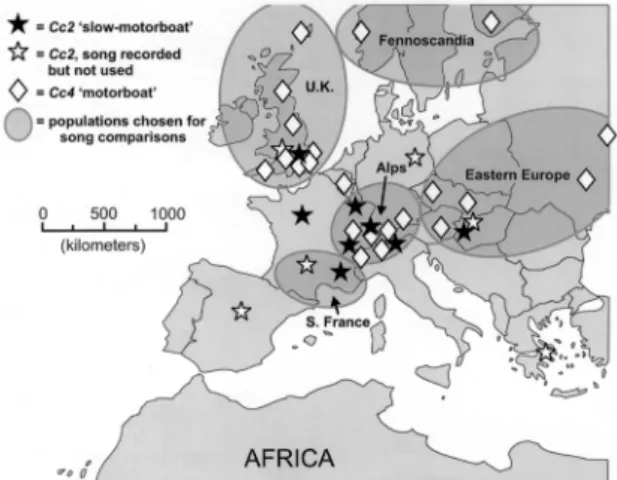
Detailed song analyses were performed on 43 indi-viduals of Cc2 and 71 indiindi-viduals of Cc4. Although many populations throughout Europe were sampled (Table 1), we grouped those into Þve regional areas (Fig. 2): south-central France (6 Cc2, 0 Cc4 individ-uals), the Alps (30, 27), the United Kingdom (7, 16), Fennoscandia (0, 15) and eastern Europe (0, 13). As mentioned above, these two species have complex, long songs in which the SRU contains many similar volleys. Volleys are short but show signiÞcant fre-quency modulation both within each volley and be-tween volleys over the course of the entire SRU (see Figs. 1 and 3). Consequently, several song character-istics were measured multiple times and tabulated as distinct features (Tables 2 and 3). For example, carrier frequency was measured at the start, middle and end of volleys found at the beginning, middle, and end of each SRU (within-volley start and end values are not shown in the tables), to encompass all consistent pitch variation. Similarly, volley duration and period were measured for each of the three different sections of
each SRU. For each feature thus delineated, measure-ments on six volleys per section were averaged to-gether. Then, for each of 5Ð10 SRUs per individual, we calculated the mean value of each song feature and took the mean (i.e., n ⫽ number of repeated song measurements per individual) of those means as the representative value of the feature for each individual. A paired t-test (Snedecor and Cochran 1980) was performed on those individual averages, comparing
Cc2and Cc4 with respect to statistically signiÞcant differences in the population means of each feature. CoefÞcients of variation were also calculated, Þrst for each individual (within-individual variation) and then for each species (between-individual variation).
Fi-Fig. 1. Oscillographs (lower of each pair of traces) and sonographs (upper traces) of typical songs of the European song species Cc2 Ôslow-motorboatÕ and Cc4 ÔmotorboatÕ of the
carneagroup of Chrysoperla, drawn to a common time scale of 24 s. In both song species, sexual partners duet by politely exchanging long, multi-volley SRUs (shortest repeated units). Cc4 has two different types of songs, differing prin-cipally in SRU length; both types are illustrated in the Þgure.
Cc4is the ÔtrueÕ Chrysoperla carnea described originally by Stephens (1835), while Cc2 is Chrysoperla pallida sp. nov.
Table 2. Values at 25 ⴞ 1 °C o f the song features of Cc2 ‘slow-motorboat ’ from central western Europe and England, including comparisons of males to females Frequency measures at mid-volley, Hertz Time measures of volleys, milliseconds SRU features Start of SRU Middle of SRU End of SRU Start of SRU Middle of SRU End of SRU Duration, seconds No. of volleys Duration Period Duration Period Duration Period All songs 52.95 ⫾ 5.24 77.18 ⫾ 5.13 50.23 ⫾ 7.80 193.70 ⫾ 18.21 313.00 ⫾ 32.90 197.64 ⫾ 18.00 289.68 ⫾ 30.28 230.83 ⫾ 36.80 329.44 ⫾ 45.22 12.62 ⫾ 9.80 39.56 ⫾ 27.96 (n ⫽ 43) Males 53.34 ⫾ 5.89 75.40 *** ⫾ 3.58 51.97 * ⫾ 7.42 192.37 ⫾ 17.09 308.91 ⫾ 33.08 196.74 ⫾ 17.30 283.85 ⫾ 29.09 223.59 ⫾ 32.91 319.63 * ⫾ 41.78 10.21 * ⫾ 10.05 32.22 * ⫾ 28.27 (n ⫽ 29) Females 52.08 ⫾ 3.41 80.85 *** ⫾ 5.99 46.61 * ⫾ 7.56 196.68 ⫾ 20.90 322.13 ⫾ 31.86199.50 ⫾ 19.93 301.76 ⫾ 30.13 245.82 ⫾ 41.02 349.77 * ⫾ 46.75 17.62 * ⫾ 7.24 54.76 * ⫾ 20.89 (n ⫽ 14) Each value is the mean of the means of n individuals in the population subsample, ⫾ SD (1 standard deviation). Pairwise comparisons were tested for statistical signiÞcance using a t-test for independent samples. *, P ⱕ 0.05; *** ,P ⱕ 0.001. SRU, shortest repeated unit exchanged between individuals while dueting.
Fig. 3. One-second segments extracted from the songs of
Cc2(C. pallida) and Cc4 (C. carnea), showing amplitude and frequency characteristics of individual volleys of abdominal vibration. The plots of instantaneous frequency (upper of each pair of traces) were produced using the zero-crossing method (see text).
Table 3. Values at 25 ⴞ 1 °C o f the song features of Cc4 ‘motorboat ’ from Europe and Eurasia, including comparisons of males to females and short calls to long calls Frequency measures at mid-volley, Hertz Time measures of volleys, milliseconds SRU features Start of SRU Middle of SRU End of SRU Start of SRU Middle of SRU End of SRU Duration, seconds No. of volleys Duration Period Duration Period Duration Period All songs 46.61 ⫾ 5.22 69.74 ⫾ 3.85 74.68 ⫾ 7.09 117.89 ⫾ 15.69 160.26 ⫾ 20.19 116.59 ⫾ 9.61 146.01 ⫾ 10.72 98.41 ⫾ 13.74 129.89 ⫾ 18.39 19.19 ⫾ 23.8653.05 ⫾ 38.59 (n ⫽ 71) Males 46.68 ⫾ 5.57 69.51 ⫾ 4.07 74.92 ⫾ 7.70 116.05 ⫾ 14.39 157.90 ⫾ 19.74 117.05 ⫾ 9.75 147.75 ⫾ 10.77 97.52 ⫾ 13.71 129.18 ⫾ 18.77 13.08 *** ⫾ 19.89 52.16 ⫾ 5.65 (n ⫽ 56) Females 46.38 ⫾ 3.44 70.59 ⫾ 2.88 73.69 ⫾ 3.81 124.01 ⫾ 18.65 168.14 ⫾ 20.34 114.87 ⫾ 9.18 139.53 ⫾ 7.84 101.95 ⫾ 13.80 102.67 ⫾ 17.15 43.19 *** ⫾ 23.57 74.5 ⫾ 3.54 (n ⫽ 2) (n ⫽ 15) Long songs 46.09 ⫾ 2.70 69.87 ⫾ 3.31 72.86 ⫾ 5.24 127.78 ** ⫾ 12.41 173.70 ** ⫾ 16.53 116.39 ⫾ 8.55 141.24 ⫾ 7.55 101.36 ⫾ 12.82 133.58 ⫾ 16.67 47.69 *** ⫾ 26.47 188.5 (2) ⫾ 157.68 (n ⫽ 21) Short songs 46.81 ⫾ 5.91 69.68 ⫾ 4.09 75.45 ⫾ 7.66 114.10 ** ⫾ 15.25 155.11 ** ⫾ 19.20 116.67 ⫾ 10.11 148.02 ⫾ 11.27 97.14 ⫾ 14.05 128.31 ⫾ 19.02 6.72 *** ⫾ 1.95 47.41 ⫾ 14.50 (n ⫽ 50) Each value is the mean of the means of n individuals in the population subsample, ⫾ SD (1 standard deviation). Pairwise comparisons were tested for statistical signiÞcance using a t-test for independent samples. ** ,P ⱕ 0.01; *** ,P ⱕ 0.001. SRU, shortest repeated unit exchanged between individuals while dueting.
Fig. 2. Collecting sites of Cc2 (C. pallida) and Cc4 (C.
carnea) in Europe, with ellipses drawn around the discrete geographical areas used for song comparisons. For sites la-beled “song recorded but not used,” individuals were nev-ertheless assigned to song species by assessing song pheno-type.
nally, within each species, an analysis of variance (ANOVA) was performed on individual averages us-ing geographic region as the independent variable, and Scheffe´Õs contrast tests (Scheffe´ 1953) were ap-plied to pinpoint signiÞcant differences among pop-ulation means. All statistical analyses were performed using Statistica (1999).
Global analysis of song differences among the cryp-tic species of the carnea group was limited to nine (of 15) ingroup taxa for which complete acoustical data for 20 or more individuals existed. To visualize and clarify differences, a discriminant function analysis was applied to song features. In discriminant function analysis, strong correlations between variables will bias or even preclude an analysis, so we eliminated one of each pair of variables exhibiting high correlation coefÞcients (r ⱖ 0.80). The feature retained was cho-sen for its lower correlations, on average, with the other variables. In the present analysis, 17 song vari-ables yielded six Ôleast correlatedÕ features (Table 4), which were then used to extract six multidimensional roots. Statistical differences in songs among the nine lacewing taxa were determined from the matrix of squared Mahalanobis distances generated by the dis-criminant function analysis, assuming a` priori classi-Þcation probabilities proportional to group sizes (Ta-ble 4).
Behavioral Tests. To test the responsiveness of Cc2 and Cc4 individuals to one anotherÕs recorded songs,
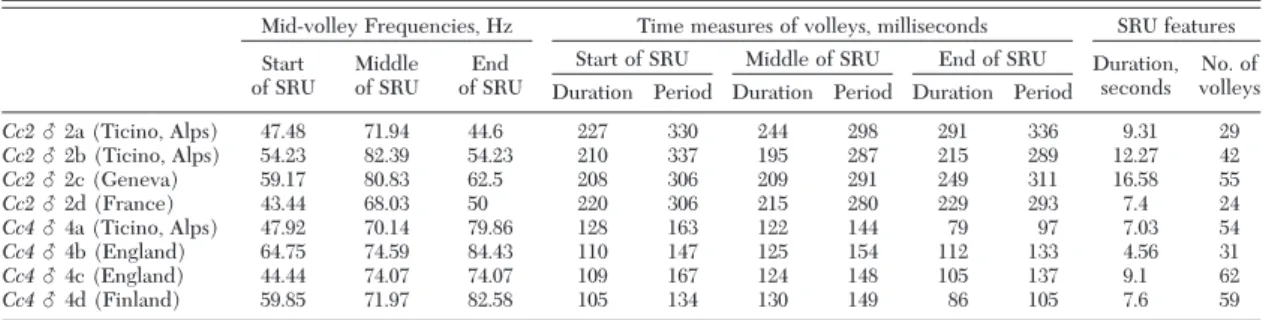
each insect was presented with its own song type and the alternative song type in a paired design (Wells and Henry 1992a). For each of the two species, four dif-ferent stimulus signals were prepared, each from a different male captured at a different geographical site to avoid pseudoreplication (Kroodsma 1989). Each stimulus signal consisted of a single, complete SRU recorded on cassette tape (Dolby off) at 25 ⫾ 1⬚C. To prepare each SRU, the original tape recording was digitized, band-pass Þltered to remove frequencies below 12 Hz (the DC component) and above 200 Hz and normalized to create signals of equal maximum amplitude (⫾5 V). Stimulus signals were played back at constant volume to the experimental animal using a Labworks (Costa Mesa, CA) ET-132Ð203 electronic shaker to vibrate the experimental arena from be-neath. Temporal and frequency characteristics of those songs are given in Table 5.
Responsiveness was tested in one male and one female of Cc2 collected in mid December 1999 in Vouvray, central France; one male and two females of
Cc2collected on 21 February, 2000 in Buckingham Palace Gardens, London, UK; and three males and one female of Cc4 collected in late October 1999 near Edinburgh, Scotland, UK. All experimental animals were maintained at long-day photoperiod until sexu-ally receptive. Each was then tested against four in-dependently selected pairs of stimulus signals, con-sisting of one song (SRU) from Cc2 and the other from
Table 4. Results of a discriminant function analysis of the six ‘least correlated’ song measurements of nine song species of the carnea
group of green lacewings, showing squared Mahalanobis distances (above the diagonal) and F-values (below the diagonal)
plorabunda (N. Amer.)adamsi Ôadamsi-KÕ(Asia) johnsoni mediterranea lucasina (mohave)downesi Ôslow-motoÕCc2 ÔmotorboatÕCc4 plorabunda Ñ 38.60 48.78 49.01 72.65 170.56 88.58 38.37 55.84 adamsi 209.66 Ñ 7.02 30.90 135.98 203.57 144.95 74.36 95.45 Ôadamsi-KÕ 198.49 27.34 Ñ 42.56 145.62 227.88 161.70 113.03 131.14 johnsoni 329.24 193.07 191.99 Ñ 115.18 145.88 118.20 71.35 88.58 mediterranea 373.40 661.02 544.63 675.58 Ñ 41.37 5.43a 69.11 64.50 lucasina 1271.56 1401.17 1101.14 1325.45 265.64 Ñ 31.00 112.28 93.11 downesi 200.18 319.49 313.77 282.47 11.70a 76.78 Ñ 64.83 71.66 Cc2 163.91 303.21 368.26 339.72 270.25 574.94 128.71 Ñ 16.41 Cc4 308.41 496.63 516.59 564.31 318.25 654.62 159.01 67.74 Ñ
Song features in the analysis included (1) volley duration at mid-SRU, (2) volley period at mid-SRU, (3) SRU duration, (4) midvolley frequency at SRU start, (5) end-volley frequency at SRU start, and (6) initial volley frequency at mid-SRU. All F-values were statistically signiÞcant at P ⬍ 0.00000. WilksÕ Lambda ⫽ 0.00016, approximate F ⫽ 287.70; df ⫽ 48, 2,793.
aShortest distance found, between C. mediterranea and C. downesi (mohave).
Table 5. Values of the features (see Figs. 1 and 3) of songs recorded as stimulus signals for Cc2 ‘slow-motorboat’ and Cc4 ‘motorboat’
from Europe
Mid-volley Frequencies, Hz Time measures of volleys, milliseconds SRU features Start
of SRU Middleof SRU of SRUEnd
Start of SRU Middle of SRU End of SRU Duration, seconds volleysNo. of Duration Period Duration Period Duration Period
Cc2 么 2a (Ticino, Alps) 47.48 71.94 44.6227 330 244 298 291 3369.31 29 Cc2 么 2b (Ticino, Alps) 54.23 82.39 54.23 210 337 195 287 215 289 12.27 42 Cc2 么 2c (Geneva) 59.17 80.83 62.5 208 306 209 291 249 311 16.58 55 Cc2 么 2d (France) 43.44 68.03 50 220 306 215 280 229 293 7.4 24 Cc4 么 4a (Ticino, Alps) 47.92 70.14 79.86128 163 122 144 79 97 7.03 54 Cc4 么 4b (England) 64.75 74.59 84.43 110 147 125 154 112 133 4.56 31 Cc4 么 4c (England) 44.44 74.07 74.07 109 167 124 148 105 137 9.1 62 Cc4 么 4d (Finland) 59.85 71.97 82.58 105 134 130 149 86105 7.6 59 These recorded signals were used in the behavioral tests described in the text and Table 6.
Cc4.Each pair of signals was presented twice, ran-domized by coin toss as to order of presentation and in both possible orders, yielding a target of eight paired tests per animal (Table 6). The tendency of the test animal to duet with the playback song was as-sessed by counting the number of correct responses (SRUs) the insect made to Þve replicates of each stimulus signal. Replicates were presented either im-mediately after a positive response by an insect or after a 5-s pause if the insect gave no response. After a signal of one song type had been presented, we waited until the individual stopped tremulating before playing Þve replicates of the second type of song. Once this Þrst pair (set) of song presentations was completed, each song type was presented a second time, with the order of presentation reversed. The entire experimental se-quence was then repeated three more times using a different set of stimulus signals, each chosen at ran-dom from among the 16possible combinations of sig-nals but with the requirement that no stimulus signal
be used in more than one experimental sequence for a given individual.
We used the mean number of responses to each song type given by each individual to a speciÞc pair of stimulus signals as a single data point in our analysis. For all experiments, paired t-tests were performed to compare means.
Adult Morphology. Forty individuals of Cc2 and 39 of Cc4, identiÞed acoustically, were examined for ex-ternal morphological features that might vary be-tween species or among populations of each species across its geographic range. Localities included Carce`s, France (4 Cc2); Vouvray, France (3 Cc2, 1
Cc4); Cavaglio/TrafÞume, Italy (14 Cc2, 4 Cc4); Ticino, Switzerland (3 Cc2, 6 Cc4); Geneva, Switzer-land (8 Cc2); Zu¨rich, SwitzerSwitzer-land (1 Cc2); Berchtes-gaden, Germany (3 Cc4); Bru¨ckl, Austria (1 Cc4); Banovce, Slovak Republic (3 Cc4); Devon, England (2
Cc4); London, England (7 Cc2); Edinburgh, Scotland (14 Cc4); Tammela, Finland (2 Cc4); and Belgorod, Russia (3 Cc4). These sites were a geographically rep-resentative subset of the localities listed in Table 1.
Whenever possible, song-determined adults were examined for the states of 19 characters. These in-cluded ground color of (1) body and (2) palps; pres-ence, extent and color of markings on (3) stipes, (4) gena, (5) clypeus, (6) frons, and (7) postoccipital region; (8) relative abundance and distribution of black and blond setae on pronotum; (9) relative size of basal dilation of tarsal claw expressed as a ratio (see below); (10) extent to which fore wing is rounded or tapered at apex; (11) relative width of fore wing ex-pressed as the ratio of length to breadth at widest point; (12) presence or absence of black markings on wing veins; (13) length and color of costal setae; (14) length of abdominal setae; (15) presence of predom-inantly black or blond setae on the three distal ab-dominal sternites; (16) shape of genital ÔlipÕ and ÔchinÕ at apex of sternite 8⫹9 in males expressed as two ratios (see below); (17) length and color of setae clothing genital lip; (18) relative size of medial lobe (acumen) of tignum in male genitalia expressed as the ratio of length of arm of tignum to length of acumen (see Fig. 9 in Henry et al. 1999b); and (19) presence or absence of dark brown stripe on pleural membrane of second abdominal segment.
The shape of the pretarsal claw was assessed by removing one metathoracic leg, mounting it in Eu-paral on a microscope slide, splaying the claws by ßattening the pretarsus beneath the cover slip, and viewing and drawing one or both claws using a camera
lucida.Two different ratios were then taken from the drawings (Fig. 4). One ratio (method 1) compares line segments drawn between points A, B, and D and takes the form AB/BD (Brooks 1994, Thierry et al. 1998). The other ratio (method 2, Henry et al. 1999b) at-tempts to avoid error due to wear of the claw tip by taking the ratio of total claw width (Wt) to the amount of its basal dilation (Wd). The methods were com-pared with one another by (1) regressing one set of measurements against the other and testing the sig-niÞcance of the correlation and (2) calculating
coef-Table 6. Mean number of dueting responses (SRUs) given by
individuals of Cc2 and Cc4 to stimulus signals (nⴝ independent
trials) prepared from the songs of four different individuals of Cc2 and four of Cc4 (coded as in Table 5)
Responses to Þve Cc2songs Responses to Þve Cc4songs Cc2 么 1 (France), set 2b_4a (n ⫽ 2) 5 0 Cc2 么 1 (France), set 2c_4d (n ⫽ 2) 5 0 Cc2 么 1 (France), set 2d_4c (n ⫽ 2) 5 0
Cc2 么 1 (France), set 2a_4b (n ⫽ 2) 5 0
Cc2 么 2 (London), set 2b_4d (n ⫽ 2) 5 0
Cc2 么 2 (London), set 2c_4b (n ⫽ 2) 5 0
Cc2 么 2 (London), set 2a_4c (n ⫽ 2) 5 0
Cc2 乆 1 (France), set 2c_4c (n ⫽ 2) 4 0
Cc2 乆 1 (France), set 2d_4b (n ⫽ 2) 1.5 0
Cc2 乆 1 (France), set 2a_4a (n ⫽ 2) 4.5 0
Cc2 乆 1 (France), set 2b_4d (n ⫽ 2) 5 0
Cc2 乆 2 (London), set 2d_4b (n ⫽ 2) 4 0
Cc2 乆 2 (London), set 2a_4a (n ⫽ 2) 5 0
Cc2 乆 2 (London), set 2c_4c (n ⫽ 2) 5 0
Cc2 乆 2 (London), set 2b_4d (n ⫽ 2) 5 0
Cc2 乆 3 (London), set 2c_4d (n ⫽ 2) 5 0
Cc2 乆 3 (London), set 2a_4b (n ⫽ 2) 4.5 0
Cc2 乆 3 (London), set 2b_4a (n ⫽ 2) 5 0
Cc2 乆 3 (London), set 2d_4c (n ⫽ 2) 5 0
Cc4 么 1 (Scotland), set 2c_4c (n ⫽ 2) 0 5
Cc4 么 1 (Scotland), set 2c_4d (n ⫽ 2) 0 5
Cc4 么 1 (Scotland), set 2d_4a (n ⫽ 2) 0 5
Cc4 么 1 (Scotland), set 2a_4d (n ⫽ 2) 0 5
Cc4 么 2 (Scotland), set 2a_4a (n ⫽ 2) 0 2.5
Cc4 么 2 (Scotland), set 2c_4b (n ⫽ 1) 0 2
Cc4 么 3 (Scotland), set 2a_4d (n ⫽ 2) 0 5
Cc4 么 3 (Scotland), set 2d_4b (n ⫽ 2) 0 5
Cc4 么 3 (Scotland), set 2c_4a (n ⫽ 2) 0 4
Cc4 么 3 (Scotland), set 2b_4c (n ⫽ 2) 0 5
Cc4 乆 1 (Scotland), set 2b_4c (n ⫽ 2) 0 2.5
Cc4 乆 1 (Scotland), set 2a_4a (n ⫽ 2) 0 5
Cc4 乆 1 (Scotland), set 2c_4b (n ⫽ 2) 0 4
Cc4 乆 1 (Scotland), set 2d_4d (n ⫽ 2) 0 3 Each stimulus signal consisted of Þve replicates of one SRU; each stimulus signal set was a different combination of two stimulus signals randomly paired from the pool of eight SRUs. To be counted as a response, an SRU had to be produced immediately after a stimulus signal. Because no individuals responded to heterospeciÞc signals, statistical tests were not performed. France ⫽ Vouvray; Scotland ⫽ Edinburgh.
Þcients of variation for each of the two sets of mea-surements generated by the methods. To assess misclassiÞcation of Cc2 versus Cc4 based on claw mea-surements alone, a discriminant function analysis was performed comparing the two song species with re-spect to claw ratios (method 1) obtained strictly from song-determined specimens.
To determine the shape of the external genital area of the male abdomen, the tip of the abdomen was removed and placed in glycerol, then viewed, and drawn through a binocular microscope at 100⫻ mag-niÞcation. Measurements of ÔlipÕ and ÔchinÕ dimensions were taken from the drawings (Fig. 5, line segments deÞned by points A through G). The ratio AC/AB reßected the relative prominence of the chin, while that of DE/FG was used to describe the shape of the lip. Setal color was judged to be black, blond, or mixed by examination with reßected light under a dissecting microscope. Internal genitalia of selected males were dissected, stained, mounted, and measured using es-tablished techniques (Bram and Bickley 1963, Brooks 1994).
We also examined preserved specimens conforming to the range of morphological characteristics encom-passed by Cc2 and Cc4 but not identiÞed acoustically. These included (1) six recently collected specimens judged to match either a ÔCc2 morphotypeÕ (three from Buckingham Palace Gardens, London, and two from Vouvray, France) or a ÔCc4 morphotypeÕ (one from the Palace gardens); (2) 10 specimens in the Stephens Collection of the BMNH, containing the female lectotypes of C. carnea and C. affinis, a male and a female labeled ÔC. alba,Õ and a small type series of seven individuals of unspeciÞed diagnosis; and (3) 140 specimens labeled ÔC. carneaÕ from the BMNH British collection. Each insect in the Buckingham Palace/
Vouvray collection and the Stephens Collection was carefully examined for the color of its abdominal setae, the extent of markings on the stipes, the width of the basal dilation of its hind claw (or mesothoracic claws if, as in the lectotype of C. carnea, the hind claws were missing), and the shape of the genital lip (males only). All 140 specimens in the BMNH British collection were then segregated into classes based on abdominal setal color (blond, black, or mixed). Then, to deter-mine the ratio of Cc2 to Cc4 morphotypes in that collection, we recorded the basal claw dimensions of 11 specimens with blond setae and 10 specimens with black setae, using both methods 1 and 2. The genital lip of four male specimens with blond sternal setae was also examined and its shape measured and assessed.
Larval Morphology. We examined a total of 74 Þrst-instar, 124 second-Þrst-instar, and 142 third-instar larvae from eight populations of Cc2 Ôslow-motorboatÕ and 155 Þrst-instar, 202 second-instar, and 201 third-instar larvae from 13 populations of Cc4 ÔmotorboatÕ. These populations represented most of the major regions
Fig. 4. Pretarsal claw of a lacewing, illustrating line seg-ments AB, BD, Wt, and Wd used for calculating a ratio describing the basal dilation of the claw. SpeciÞcally, method 1 calculates the ratio AB ⫼ BD, and method 2 calculates the ratio Wt ⫼ Wd (see text).
Fig. 5. Terminus of male abdomen of Cc2 (C. pallida) and Cc4 (C. carnea), illustrating line segments AC, AB, DE, and FG used for calculating the ratios describing the shape of the genital ÔlipÕ and ÔchinÕ. The lip was judged to be narrow and not protruding if DE ⬎ FG and the chin broad (strong) if AB ⬍ BC.
from which the two song species had been collected (Table 1), with the exception of the United Kingdom (both Cc2 and Cc4 missing) and south-central France (Cc4 missing). SpeciÞc geographic areas and sample sizes (n ⫽ Þrst, second, third instars) included the Ticino region of the Alps of southern Switzerland and northern Italy (Cc2: n ⫽ 64, 100, 90; Cc4: n ⫽ 75, 49, 53); the Alps of northern Switzerland and southern Ger-many (Cc2: n ⫽ 0, 13, 29; Cc4: n ⫽ 15, 37, 54); central and southern France (Cc2: n ⫽ 9, 11, 23; Cc4: none); Belgium (Cc2: none; Cc4: n ⫽ 2, 14, 5); eastern Europe (Cc2: none; Cc4: n ⫽ 27, 18, 21); and southern Finland (Cc2: none; Cc4: n ⫽ 36, 84, 68). When possible, larvae were boiled in 100 cc distilled water with a drop of liquid detergent, allowed to cool, and then transferred to 70% ethanol⫹5% glycerol⫹25% distilled water for storage. Some previously collected larvae had un-avoidably been placed in 70% ethanol, resulting in greater deterioration. Larvae were examined at 50⫻ magniÞcation. Representative individuals were se-lected and illustrated.
Results
Biogeography. Each of the six Eurasian song species of the carnea group was broadly distributed. The spe-cies with the largest range was C. lucasina, which was collected from the Canary Islands to Cyprus and from northern Africa to northern Scotland (Henry et al. 1996). Cc4 ÔmotorboatÕ was also very widely distrib-uted but exhibited a northerly bias. It was found as far south as the southern Alps but ranged northward to the northernmost islands of the United Kingdom and southern Fennoscandia and eastward at least to west/ central Russia (Table 1; Fig. 2). The song species C.
mediterraneaand Cc3 ÔMalteseÕ shared a more south-erly, circum-Mediterranean distribution, except for the northeastward extension of C. mediterranea into eastern Europe (Henry et al. 1999b, Henry et al. 2001) and the westward extension of Cc3 to the Ac¸ores archipelago 2,000 km at sea (specimens courtesy of Ms. Maria da Anunciacao Mateus Ventura, August 2000). Cc5 ÔgeneratorÕ was a Middle Eastern/Asian species whose western range limit appeared to be the extreme eastern margin of the Mediterranean Sea (Henry et al. 2001). Finally, Cc2 Ôslow-motorboatÕ was central European, occurring in an area bounded by central Spain to the west, England to the north, and Greece and Hungary to the south and east (Table 1; Fig. 2). Unlike cold-tolerant Cc4, Cc2 was limited to elevations below 1,000 m in the Alps and was not found north of Berlin in mainland Europe.
Three song species, C. lucasina, Cc2 Ôslow-motor-boatÕ, and Cc4 ÔmotorÔslow-motor-boatÕ, were conÞrmed by song phenotype as present in the United Kingdom.
Chry-soperla lucasinaand Cc4 occurred throughout the Brit-ish Isles and could be quite abundant seasonally. Cc2, previously not found in the United Kingdom, was Þnally collected in February 2000 from Buckingham Palace Gardens, London and again in November and December 2000 from Silwood Park, 40 km west of London. None of the three remaining song species was
found sufÞciently far north in mainland Europe to support any suspicion that their ranges might extend across the English Channel.
Ecophysiology. In temperate regions, all species of
Chrysoperlaoverwinter as diapausing adults; in fact, this is a diagnostic autapomorphy of the genus (Se´-me´ria 1977). However, species within Chrysoperla vary with respect to the color changes they experience in response to temperature and photoperiod during winter diapause: some remain green, while others turn mixtures of yellow, brown, orange, and red (Tauber and Tauber 1986, Thierry et al. 1995). The type of C.
carneawas described by Stephens (1835, p. 103) as exhibiting a “bright rosy-red, or ßesh-color” ground color with additional yellow and red markings, indi-cating its membership in a taxon that changes color. According to observations of our own and of others (Thierry et al. 1995, Henry et al. 1996), British and mainland European representatives of C. lucasina re-mained bright green through all seasons, while adults of both Cc2 and Cc4 underwent marked autumnal change to yellowish-brown (Cc2) and reddish-brown (Cc4). If present-day ranges are representative of the past, then it is clear that only Cc2 or Cc4 could be the Ôtrue carneaÕ of Stephens. We will therefore limit dis-cussion to those two song species.
Song Phenotype. As mentioned earlier, the songs (⫽SRUs) of both Cc2 and Cc4 are long, relatively complex signals consisting of many short, similar vol-leys (syllables) of abdominal vibration. However, the two species differed with respect to nearly every song feature, in both the time and frequency domains. Each also differed signiÞcantly from every other described song species in Eurasia.
Cc2 ‘Slow-Motorboat’. Results of ANOVAs (not shown) indicated that equivalent levels of variation existed in Cc2 among the songs of a single individual and among the individual averages of any given pop-ulation of individuals. Within single individuals, the coefÞcients of variation averaged 9.75% for six major temporal song features and 7.08% for all nine fre-quency features, while between individuals in a pop-ulation, mean coefÞcients of variation measured 11.52 and 12.12%, respectively. Therefore, it was valid to compare sex-delimited or geographic populations us-ing individual averages as has been done in previous studies of song variation in lacewing species (Henry and Wells 1990).
Adult males and females of Cc2 produced a single type of song (⫽SRU), which was used both in solitary calling and dueting. The SRU was multisyllabic, con-sisting of a 3.4- to 90-s series of 12Ð246short, similar volleys separated from each other by very short in-tervals (Fig. 1; Table 2). Volleys averaged ⬇194 ms in length at the beginning of the SRU, gradually increas-ing to 231 ms by its end. Volley period Þrst decreased and then increased over the course of the SRU, start-ing at ⬇313 ms, declinstart-ing to 290 ms, then risstart-ing at the end of the song to 329 ms. Although quite short, each volley nonetheless exhibited internal changes in car-rier frequency, such that the frequency at the mid-point of each volley was 10Ð20 Hz higher than at the
start and end of the volley (Fig. 3). The mid-volley reference frequency increased during the Þrst six or seven volleys of the SRU from ⬇53 Hz to an average maximum of 77 Hz, and then decreased steadily to an average minimum of 50 Hz at the end of the SRU (Table 2; Fig. 1). Each SRU was also characterized by a progressive increase and decrease in intensity that roughly mirrored the rise and fall in volley carrier frequency (Fig. 1). Another notable feature of the Cc2 song was sharp, brief striking of the substrate by the moving abdomen at the start and end of each volley, particularly during the second two-thirds of each SRU (Fig. 1, spikes). Dueting was of the ÔpoliteÕ type, seen in some other lacewings with multisyllabic SRUs (e.g.,
C. mediterranea,Henry et al. 1999b). In this type of duet, each partner answers the other only after an SRU has been completed.
Males and females were similar but not identical with respect to the 17 features measured (Table 2, asterisks: 11 of 17 shown). Females generally displayed longer SRUs than males, showed a slightly greater range of frequency modulation over the course of each SRU, and attained signiÞcantly higher peak fre-quencies at mid-SRU (⬇81 Hz in females versus 75 Hz in males). However, sex differences were judged small enough to warrant pooling all individuals in other comparisons.
Populations of Cc2 from England, from north of the Alps and from south of the Alps (Fig. 2) were com-pared with respect to measurements of all song fea-tures (analysis not shown). Differences were very slight and statistically signiÞcant only for the three Ômid-SRUÕ frequency measures, which were consis-tently elevated in British specimens. That small effect was probably a simple consequence of sex bias (see preceding paragraph): Þve of the seven individuals from England were females (sex ratio ⫽ 0.71), whereas our nonBritish samples consisted largely of males (ratio ⫽ 0.25). For reasons that are less clear, the six individuals from south-central France also differed slightly but signiÞcantly in possessing somewhat shorter, more closely spaced volleys than the other populations.
Cc4 ‘Motorboat’. As in Cc2, within- versus among-individual variation was similar (ANOVA, not shown), validating the use of individual averages in statistical comparisons. Within single individuals of Cc4, the co-efÞcients of variation averaged 9.04% for six major temporal song features and 4.52% for the nine fre-quency features, while between individuals in a pop-ulation, mean coefÞcients of variation measured 11.60 and 8.92%, respectively. Other than in length (see below), male and female songs of Cc4 were indistin-guishable (Table 2). Consequently, data from individ-uals of both sexes were pooled in most analyses.
Two distinct types of songs characterized Cc4, al-though only males produced both types (Fig. 1). We interpreted the shorter of the two as a male calling song (Ewing 1989) or possibly an advertisement song (Wells 1977, Gerhardt 1994), which was often ex-changed between two males in a duet. The long song was probably a courtship song (Ewing 1989, Bailey
1991), always used by both males and females during heterosexual duets, but occasionally delivered spon-taneously by solitary individuals. The long song was exchanged ÔpolitelyÕ between two individuals of dif-ferent sex, that is, without interruption of one partner by the other.
The SRU of the short (male calling) song was mul-tisyllabic, consisting of a 2.5Ð11 s series of 21Ð83 (mean ⫽ 47) very short, similar volleys separated from each other by very short intervals (Fig. 1; Table 3). Volleys averaged 114 ms in length at the beginning of the SRU, gradually decreasing to 97 ms by its end. Volley period also decreased during the course of the SRU from 155 to 128 ms. Although extremely short, each volley exhibited internal changes in carrier fre-quency, such that the frequency at the end of each volley was 10 to 20 Hz higher than at its start (Fig. 3). The mid-volley reference frequency increased in a predictable Ôßipped sigmoidÕ manner during the course of the SRU, from ⬇47 to 75 Hz (Table 3; Fig. 1). Each SRU attained maximum amplitude at its mid-point (Fig. 1).
Long songs were trains of 100 or more nearly iden-tical volleys lasting up to several minutes (Fig. 1). Volleys at the start of a long SRU were slightly but signiÞcantly longer than those at the start of short songs, averaging 128 ms in length and 174 ms in period (Table 2). In every other respect, short and long songs were identical. Long songs did not appear to show the Ôßipped sigmoidÕ changes in mid-volley frequency that were so characteristic of male short songs. Instead, volley carrier frequency quickly rose to a constant, higher value, and sometimes increased further at the very end of the SRU. Heterosexual partners used long songs nearly exclusively when dueting.
Populations of Cc4 from four geographic areas of Europe (Fig. 2), speciÞed as the United Kingtom, Fennoscandia, eastern Europe, and the Alps, were compared with respect to measurements of all song features. Except for SRU duration and SRU volley number, which were strongly inßuenced by sample size and sex ratio, the populations were acoustically indistinguishable (ANOVA, F ⫽ 0.35Ð2.77, df ⫽ 61Ð67; Scheffe´Õs post hoc tests not shown).
Comparison of Songs of Cc2 and Cc4. The two song species, Cc2 and Cc4, differed signiÞcantly from one another with respect to every song feature except the hypervariable traits SRU duration and SRU volley number (paired t-tests, t ⫽ 2.8Ð36.5, df ⫽ 91Ð112; tests not shown). SpeciÞcally, the song of Cc4, compared with Cc2, exhibited shorter and more closely spaced volleys characterized by a distinctly different pattern of within- and between-volley frequency modulation (Tables 2 and 3; Figs. 1 and 3). We noted, however, that the average absolute highest frequency attained in a songÑapproximately 77 Hz at 25⬚CÑwas not signiÞcantly different between the two song species (paired t-test, t ⫽ 1.98, df ⫽ 112).
Global Song Comparisons. When the songs of Cc2 and Cc4 were included with other cryptic song species of the carnea-group in a discriminant function analysis, the magnitude of the differences between the two
species was small but highly signiÞcant (Table 4; Fig. 6). In fact, all nine song species used in the analysis were signiÞcantly different from one another in all pairwise comparisons based on the matrix of squared Mahalanobis distances (Table 4). The two most-sim-ilar species pairs were C. mediterranea/C. downesi (mohave) and C. Ôadamsi-KÕ (Asia)/C. adamsi, both of which were comparisons between completely allopat-ric taxa living on different continents (Henry et al. 1999a)
Behavioral Tests. When sexually receptive adults of either Cc2 Ôslow-motorboatÕ or Cc4 ÔmotorboatÕ were given a choice of their own recorded song versus that of the other song species, they responded by dueting only to their own song (Table 6). This result was obtained regardless of the sex of the experimental animal, the order of signal presentation, or the source (individual and geographic origin) of the stimulus signal. Males of Cc4 always answered stimulus signals with short (calling) songs, while the single tested female responded using long (courtship) songs. Al-though Cc2 did not possess two distinct types of songs, two tested males of that species also responded to all conspeciÞc stimulus signals with relatively short songs (12Ð30 volleys), whereas the female gave longer re-sponses (25Ð87 volleys). Because no individuals of either song species responded to heterospeciÞc sig-nals, statistical tests were not performed on the data.
Ecology. The recognition of song species within the
carneagroup of Chrysoperla is changing our under-standing of their ecology. What had previously been interpreted as ecotypic variation within a single spe-cies (polymorphism) is now seen to be consistent differences among distinct, reproductively isolated species. SpeciÞc habitat associations are known to exist in Chrysoperla, but documentation of such in the
carneagroup has been impeded by taxonomic uncer-tainty. Results from collecting records of song-deter-mined individuals and from examination of morpho-types collected in transects, sticky traps, and comprehensive faunal surveys (Duelli 1988; and D.P., unpublished data) revealed signiÞcant ecological dif-ferences between Cc2 and Cc4. During the growing season, Cc2 was most abundant in the trees and tall shrubs at the edges of forests or in urban areas (also reported by Thierry et al. 1998 for ÔC. carnea,Õ their name for the Cc2 morphotype). In contrast, Cc4 was found during most of the summer on herbaceous veg-etation and tall grasses in open Þelds, although late-instar larvae could also be collected from trees and shrubs. Of the two, only Cc4 was collected from crop-lands, making that species the ecological analog of C.
plorabundain North America. In central and southern Europe, Cc4 coexisted in agricultural Þelds with an-other song species, C. lucasina, which typically
com-Fig. 6. Scatterplot of the Þrst two roots of a discriminant function analysis of six Ôleast-correlatedÕ measurements of the songs of nine distinct song species of the carnea group. Each data point represents a single individual, coded by species. Song features used in the analysis are speciÞed in the footnote for Table 4.
prised ⬇15Ð25% of the lacewings collected at each site (Duelli 2001).
Various collecting methods detected high daily rates of lacewing movement in the spring and fall. Based on careful assessment of morphology (see be-low), only Cc4 were found to be among the dispersers, indicating that Cc4, but not Cc2, moved large distances to and from overwintering sites in forests, forest edges, and buildings (Duelli 1986). Probably as a conse-quence of this migration, Cc4 appeared in large num-bers at the lights of houses in late fall and winter (P.D., unpublished data). In the spring, before moving back to Þelds and croplands, individuals of Cc4 Þrst visited early ßowering trees such as Acer spp., where adults ate pollen. Eggs of both species appeared in April and May, after the spring mating period. Cc4 and northern populations of Cc2 oviposited eggs singly, whereas southern populations of Cc2 laid eggs in loosely orga-nized groups, similar to those typical of C.
mediterra-nea(Henry et al. 1999b). Two to three generations per year characterized both species in central and south-ern Europe, but in northsouth-ern Europe Cc4 was univol-tine.
Adult Morphology. We found no differences be-tween Cc2 and Cc4 for most of the 19 morphological features examined in this study. Results below are therefore conÞned to the pigmentation of abdominal setae and maxillary stipes and to the shape of the pretarsal claw, genital lip, and genital chin.
Specimens Assigned by Song. Song-determined specimens of Cc2 differed, on average, from those of
Cc4 in possessing blond abdominal setae, lightly marked stipes, large basal claw dilations (⫽lower AB/BD ratios; see Fig. 4 and Table 7), and short, narrow genital lips (higher DE/FG ratios and lower AB/BC ratios; see Fig. 5). However, a small percent-age of each song species had the ÔwrongÕ shade of setae
and inappropriately marked stipes (Table 7), and their basal claw dimensions overlapped somewhat. Specif-ically, the range of basal dilation ratios (method 1) was 1.67Ð2.47 (1.67Ð2.14 excluding one outlier) for Cc2 (mean ⫽ 1.94, SD ⫽ 0.15, n ⫽ 39) and 1.67Ð2.76 (1.98Ð 2.76excluding one outlier) for Cc4 (mean ⫽ 2.23, SD ⫽ 0.19, n ⫽ 39). Despite overlap of ranges and inclusion of both outliers, this difference in means was highly signiÞcant (t ⫽ ⫺7.52, df ⫽ 76, P ⱕ 0.000). Using method 1 claw measurements from strictly song-de-termined specimens, a discriminant function analysis misclassiÞed only three of 39 individuals of Cc2 and Þve of 39 individuals of Cc4 (WilkesÕ Lambda ⫽ 0.573,
F ⫽ 56.58; df ⫽ 1, 76; P ⬍ 0.000). The male genital lip
on the abdomen showed the least overlap of any mor-phological feature. In Cc2 the lip was consistently small and narrow above a ÔstrongÕ chin (DE ⬎ FG, AB ⬍ BC), whereas in Cc4 it was always prominent and broad above a ÔrecedingÕ chin (DE ⬍ FG, AB ⬎ BC). Additionally, the setae covering the lip itself were short and Þne in Cc2 but long and coarse in Cc4. More generally, the presence on the lip of black, coarse, long setae also did well at separating individ-uals of Cc4 from most individindivid-uals of C. lucasina, C.
mediterranea, Cc3,and Cc5.
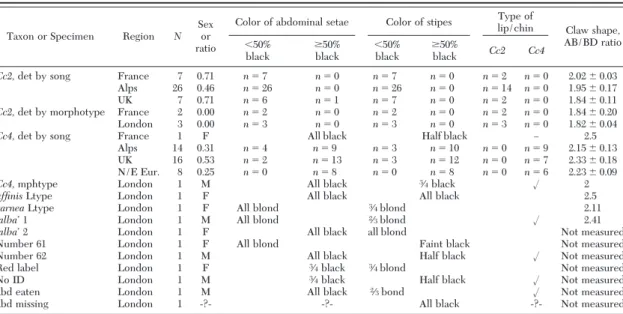
Specimens Assigned by Morphotype. Critical mor-phological characteristics of British and French spec-imens assigned to ÔCc2Õ by morphotype alone are shown in Table 7. As required by such assignment, ÔCc2sÕ were discriminated from ÔCc4sÕ by blond setae, lightly marked stipes, and a small, narrow genital lip. Claw basal dilation ratio for ÔCc2Õ ranged from 1.73 to 2.38 (mean ⫽ 1.83, SD ⫽ 0.14, n ⫽ 5), whereas the single ÔCc4Õ measured 2.00 (actually in the Cc2 range). Also shown in Table 7 are the same characters and measurements for the 10 specimens in the Stephens Collection. Pale setae and lightly marked stipes placed
Table 7. The state of diagnostic morphological features in song-determined and morphotype-determined specimens of Cc2 and Cc4
Taxon or Specimen Region N Sexor ratio
Color of abdominal setae Color of stipes lip/chinType of
Claw shape, AB/BD ratio ⬍50%
black ⱖ50%black ⬍50%black ⱖ50%black Cc2 Cc4
Cc2,det by song France 7 0.71 n ⫽ 7 n ⫽ 0 n ⫽ 7 n ⫽ 0 n ⫽ 2 n ⫽ 0 2.02 ⫾ 0.03 Alps 260.46 n ⫽ 26 n ⫽ 0 n ⫽ 26 n ⫽ 0 n ⫽ 14 n ⫽ 0 1.95 ⫾ 0.17 UK 7 0.71 n ⫽ 6 n ⫽ 1 n ⫽ 7 n ⫽ 0 n ⫽ 2 n ⫽ 0 1.84 ⫾ 0.11
Cc2,det by morphotype France 2 0.00 n ⫽ 2 n ⫽ 0 n ⫽ 2 n ⫽ 0 n ⫽ 2 n ⫽ 0 1.84 ⫾ 0.20 London 3 0.00 n ⫽ 3 n ⫽ 0 n ⫽ 3 n ⫽ 0 n ⫽ 3 n ⫽ 0 1.82 ⫾ 0.04
Cc4,det by song France 1 F All black Half black Ð 2.5
Alps 14 0.31 n ⫽ 4 n ⫽ 9 n ⫽ 3 n ⫽ 10 n ⫽ 0 n ⫽ 9 2.15 ⫾ 0.13 UK 160.53 n ⫽ 2 n ⫽ 13 n ⫽ 3 n ⫽ 12 n ⫽ 0 n ⫽ 7 2.33 ⫾ 0.18 N/E Eur. 8 0.25 n ⫽ 0 n ⫽ 8 n ⫽ 0 n ⫽ 8 n ⫽ 0 n ⫽ 62.23 ⫾ 0.09
Cc4,mphtype London 1 M All black 3⁄4black ⻫ 2
affinisLtype London 1 F All black All black 2.5
carneaLtype London 1 F All blond 3⁄4blond 2.11
ÔalbaÕ 1 London 1 M All blond 2⁄3blond ⻫ 2.41
ÔalbaÕ 2 London 1 F All black all blond Not measured
Number 61 London 1 F All blond Faint black Not measured
Number 62 London 1 M All black Half black ⻫ Not measured
Red label London 1 F 3⁄4black 3⁄4blond Not measured
No ID London 1 M 3⁄4black Half black ⻫ Not measured
abd eaten London 1 M All black 2⁄3bond ⻫ Not measured
abd missing London 1 -?- -?- All black -?- Not measured
the C. carnea lectotype closer to the morphotype of
Cc2than to Cc4, but the mean of its claw measure-ments, 2.11, was clearly (if barely) assignable to Cc4 based on the results of the discriminant function anal-ysis described earlier. The lectotype of C. affinis was a more typical Cc4, exhibiting dark setae, broadly marked stipes, and a large basal dilation ratio of 2.50. The two specimens labeled ÔC. albaÕ, plus one of the unspeciÞed individuals, showed a mix of Cc2 and Cc4 character states, whereas the rest of the type series conformed adequately to the morphotype of Cc4.
Of 140 specimens in the BMNH British Collection, 105 exhibited largely black sternal setae near the apex of the abdomen, 27 showed blond setae, and eight had a mixture of blond and black setae. Using randomly chosen individuals from each setal pure-color class and method 1 of measurement, the basal dilation ratio ranged from 2.05Ð2.49 (mean ⫽ 2.34, SD ⫽ 0.13) for 10 ÔblackÕ specimens and from 2.04Ð2.67 (mean ⫽ 2.29,
SD ⫽ 0.18) for 11 ÔblondÕ ones. Those values were not
signiÞcantly different from one another (t ⫽ 0.733, df ⫽ 19, P ⫽ 0.473). Performing the same analysis using method 2 yielded similar results, with ratios ranging from 1.80Ð2.31 (mean ⫽ 1.98, SD ⫽ 0.14) for the black population and from 1.66Ð2.09 (mean ⫽ 1.88, SD ⫽ 0.15) for the blond population (t ⫽ 1.632, df ⫽ 19, P ⫽ 0.119). Regressing method 1 measurements against method 2 measurements yielded correlation coefÞ-cients (r) of 0.74 for the population with black setae and 0.73 for blond setae, both signiÞcant at P ⬍ 0.05. CoefÞcients of variation were 5.58% (black) and 8.07% (blond) for method 1 measurements and 7.13% (black) and 8.09% (blond) for method 2 measure-ments. Because method 1 was better at separating populations known to be distinct based on song type (see above), it was adopted as the standard protocol for analyzing claw data. With respect to the ratios specifying the shape of the genital lip, four males (of four examined) possessing blond setae conformed to the condition seen in Cc4 rather than to that of Cc2. Larval Morphology. Cc2 and Cc4 larval head capsule markings (Fig. 7) were dominated by a pair of longi-tudinal, dorso-lateral brown stripes with baso-lateral expansions extending toward the eyes. This pattern is typical for larvae of Chrysoperla spp. First-instar larvae had the palest and broadest (relative to head width) dorso-lateral stripes and the least developed baso-lateral expansions. Second-instar larvae were inter-mediate and third-instar larvae had the darkest and relatively narrowest dorso-lateral stripes and most ex-tensive baso-lateral expansions. All instars varied within and among populations. The remainder of the results focuses on third-instar larvae.
Cc2populations (n ⫽ 1Ð55; Fig. 7) had a narrow, usually pale (Swiss populations) to moderately broad and darker (French and Italian populations) dorso-lateral stripe. The size and prominence of the baso-lateral expansion showed a parallel trend, being smaller and paler in the Swiss populations. The prom-inence of the darker spot in the stripe, mesad of the eyes, varied but did not follow a clear geographic pattern. All populations with multiple representatives
revealed variation in the width, color intensity and regularity of the margins of the dorso-lateral stripes, in the prominence of the darker spot mesad of the eyes, and in the development of the baso-lateral expansion. Two other variations were noted (Fig. 7). Some indi-viduals from the TrafÞume, Italy population had a pair of small spots mesad of the dorso-lateral stripe at the level of the antennal bases, while several specimens from the Vouvray and Zu¨rich populations had the lateral stripe behind the eye visible in dorsal view.
Cc4populations (n ⫽ 1Ð68; Fig. 7) showed consid-erably more variation than Cc2 both within and among populations. The dorso-lateral stripes were usually moderately broad to very broad (e.g., Brissago), al-though in some specimens from Russia (Belgorod) they were atypically narrow. The medial portion or the entire dorso-lateral stripe was generally dark. Vari-ation in the width, tone and margins of the dorso-lateral stripe was noted within populations repre-sented by multiple individuals. Except in the atypical Russian specimens just mentioned, the baso-lateral expansion was consistently well developed, but its prominence was obscured by the width of the dorso-lateral stripe in some populations (e.g., Berchtesga-den). Most larvae of Cc4 also possessed a darker spot in the stripe mesad of the eyes, an antero-medial spot at the level of the antennal bases, and a pair of frontal spots near the bifurcation of the epicranial suture. However, these markings were absent in the Russian specimens bearing narrow dorso-lateral stripes. Only larvae from the Ukrainian population (Rachiv) com-monly had the lateral stripe behind the eyes visible in dorsal view.
Some Cc4 larvae from Finland, Russia, and Switzer-land had additional head markings (Fig. 7). The sim-plest of these more extensively pigmented forms had a larger, triangular antero-medial spot that was usually fused to two pairs of additional triangular spots that lay between the dorso-lateral stripes and the antero-me-dial spot (e.g., Tammela). Other ÔornateÕ specimens, taken from the Belgorod, Cavaglio, Bollingen, and Zu¨rich populations, had most of the frons pigmented, uniting all three of the typical spots into a large, tri-angular pigmented area. These larvae also had the dorso-lateral stripe extremely broad, expanded nearly to the eye, and complexly patterned with lighter and darker tones.
When compared, third-instar larvae of Cc2 and Cc4 could be readily distinguished from each other in all areas where they co-occurred and where larvae of both species were examined. Cc2 larvae lacked the antero-medial and frontal spots that were present in all known sympatric populations of Cc4. The only pop-ulation of Cc4 known to include some individuals that lacked the antero-medial and frontal spots (Belgorod, Russia) was situated far to the east of known Cc2 localities. However, the two species could not be so easily separated from larvae of other cryptic species in the carnea group. Chrysoperla lucasina, for example, included populations with larval specimens that re-sembled both Cc2 or Cc4 (see Henry et al. 1996).
Fig. 7. Third-instar larval head capsules of Cc2 (C. pallida) and Cc4 (C. carnea) from selected localities across Europe. Extremes of variation in Cc4 are represented by the specimens from Belgorod, Russia (ÔCc2-likeÕ) and Zu¨rich, Switzerland (ÔornateÕ). The Brissago, Switzerland specimen of Cc4 represents the commonest pattern seen in that species.