CHARLES S. HENRY,1STEPHEN J. BROOKS,2JAMES B. JOHNSON,3MARTA M. WELLS,4 ANDPETER DUELLI5
Ann. Entomol. Soc. Am. 104(4): 649Ð657 (2011); DOI: 10.1603/AN11045
ABSTRACT Chrysoperla agilisHenry et al. (Neuroptera: Chrysopidae) is a widespread, nomadic lacewing in the carnea group of cryptic species. C. agilis has previously been found only in the warm parts of Europe, western Asia, and a few oceanic islands. Like others of the carnea group, C. agilis is identiÞable only by its unique courtship song. Recently, a population with by the C. agilis song was discovered in central Alaska; based on its persistence over several years and its distribution over a wide area near Fairbanks, it seems to be permanent rather than transitory. To assess the relationship of this Western Hemisphere population to C. agilis in the Eastern Hemisphere, we 1) analyzed its courtship song, comparing it to the Eurasian song; 2) compared larval and adult morphology of Alaskan and Eurasian specimens; 3) inferred phylogenetic relationships of Alaskan and Eurasian specimens, by using sequences from the cox2 gene; and 4) crossed Alaskan with European individuals, raising their progeny and analyzing their “hybrid” songs. Alaskan C. agilis generally fell within the range of variation of Eurasian individuals for all acoustic and morphological traits, and their hybrid progeny were also acoustically indistinguishable. Phylogenetically, and despite current geographical isolation, Alaskan individuals clustered with Eurasian C. agilis rather than with Western Hemisphere taxa of the carnea group. We conclude that the Alaskan population is a bona fide member of C. agilis. Examination of the geographical pattern of song variation suggests that dispersal to Alaska took place quite recently in a west to east direction, via eastern Asia and the Bering Strait.
KEY WORDS systematics, mating signal, dispersal, biogeography
Substrate-borne courtship songs in green lacewings were Þrst discovered over 30 yr ago, in the globally distributed species Chrysoperla carnea (Stephens) (Henry 1979). Since then, Chrysoperla carnea s.l. has been separated into⬎16 distinct species, each char-acterized by its own unique vibrational song (Henry 2006). Most of these “song species” are nearly impos-sible to tell apart, either morphologically or ecologi-cally; they are truly cryptic species, comprising what is now known as the carnea species-group of Chrysoperla (Brooks 1994). Most also show broad, extensively overlapping geographic ranges, usually measured in thousands of linear kilometers (Wells and Henry 1998). For example, Chrysoperla plorabunda (Fitch) is found from coast to coast in North America (Henry and Wells 1990); Chrysoperla lucasina
(Lac-roix) ranges across the full width of central and south-ern Eurasia and northsouth-ern Africa (Henry et al. 1996); and Chrysoperla zastrowi (Esben-Petersen) is present from the Indian subcontinent westward to the Middle East and southward to the Republic of South Africa (Henry et al. 2010). However, the Eastern and West-ern Hemispheres each harbors its own unique collec-tion of carnea-group species: thus, the North American taxa constitute one monophyletic clade, whereas the Eurasian-African taxa constitute another one (Henry et al. 1999a).
Like its close relatives, Chrysoperla agilis Henry et al. also is broadly distributed, having been collected across all of southern Europe, the Mediterranean is-lands, and southwestern Asia to northern Iran (Henry et al. 2003). Within the carnea group, C. agilis belongs to the nomadic guild of lacewings, whose other mem-bers include Chrysoperla carnea s.s., C. zastrowi, and Chrysoperla nipponensiss.l. (Okamoto) in the Eastern Hemisphere and C. plorabunda in the Western Hemi-sphere (Duelli et al. 2002). These nomadic species are characterized by high vagility, migratory ßight behav-ior, and a general ecological association with herbs, grasses, and shrubs rather than woodlands or forests (Henry et al. 2002). Given this pedigree, it did not
1Corresponding author: Department of Ecology and Evolutionary
Biology, Unit 3043, 75 North Eagleville Rd., University of Connecticut, Storrs, CT 06269 Ð3043 (e-mail: [email protected]).
2Department of Entomology, The Natural History Museum,
Crom-well Road, London SW7 5BD, United Kingdom.
3The University of Idaho, Ag Science 243, Moscow, ID 83844. 4Ecology and Evolutionary Biology, Yale University, 168b Gibbs
Lab., New Haven, CT 06520.
5Swiss Federal Research Institute WSL, CH-8903 Birmensdorf,
Switzerland.
surprise us when we discovered 10 yr ago that C. agilis had colonized the Azores archipelago, 1,600 km from the nearest land mass (Europe). Nonetheless, we were indeed amazed in the summer of 2007 to Þnd the very same species living in central Alaska, not only under highly atypical climatic conditions but also in a different global hemisphere.
Here, we present acoustical, morphological, and molecular evidence substantiating the occurrence of this Eurasian species on the North American conti-nent. From separate collections in 2007 and 2010, we describe the song phenotype and physical appearance of these Alaskan residents, comparing the results to previously described populations of C. agilis from nine other localities in the Eastern Hemisphere. In addi-tion, molecular sequence data are used to infer the phylogenetic position of the Alaskan population within the carnea group. We then describe crossing experiments between European and Alaskan repre-sentatives of the species, documenting the reproduc-tive compatibility of these distant populations and quantifying the phenotypic characteristics of the Þrst-generation hybrids.
Finally, we consider alternative hypotheses for the movement of C. agilis to Alaska. Because Fairbanks is approximately equidistant from the western limit (Azores) and eastern limit (Iran) of the previously
known range of C. agilis, the species could just as easily have dispersed to Alaska westward across the Atlantic and northern Canada or eastward across Asia and the Bering Strait (Fig. 1). We address those hypotheses using inferences from acoustical and morphological data and from known patterns of global atmospheric circulation. In addition, we examine the possibility of human introduction of C. agilis to Alaska, through past or ongoing agricultural release of commercially-grown lacewings of indeterminate species status ob-tained from Eurasian or North American insectaries (Henry and Wells 2007).
Materials and Methods
Collecting, Rearing, and Identification. Adult green lacewings assignable to the genera Chrysopa Leach and Chrysoperla Steinmann were obtained in two sep-arate years near Fairbanks, AK. Thirty individuals were collected in 2007 between 18 July and 7 August, and 25 were collected on 4 August 2010. Sex ratio from the Þeld was approximately unity. The principal col-lecting site in both years was a grassy Þeld at the Calypso Farm and Ecology Center (64⬚ 50⬘22⬙ N, 148⬚ 07⬘52⬙ W) in Fairbanks, but 10 of 30 individuals in 2007 were collected at the town of Delta Junction, 131 km southeast of Fairbanks. Collectors were Drs. S.
Em-Fairbanks
Azores
Fig. 1. Quasi north-polar projection of the Earth, showing possible dispersal routes for C. agilis from its known range in the Eastern Hemisphere to its distant outpost in central Alaska (large asterisk). The dashed line is the shortest, but it takes the species across the least hospitable regions.
mert and A. Pantoja and their assistants at the USDA Subarctic Agricultural Research Unit (see Acknowl-edgments). Efforts to obtain lacewings during the summers of 2008 and 2009 were not successful due to unfavorable weather conditions. All living specimens were mailed in cardboard tubes to Storrs, CT, for maintenance, rearing, and analysis. The protocols are fully described in other papers (Henry et al. 1996, Henry et al. 1999b), except that “long day” conditions for Alaska required setting photoperiod to 23:1 (L:D) h (⫽summer solstice at Fairbanks).
Upon receipt from the Þeld, the natural ground color of each insect was noted to determine the pres-ence or abspres-ence of color changes associated with win-ter diapause. Then we tried to identify each individual to species using computer playback of previously re-corded duetting songs from North American and Eur-asian species of the carnea group. However, when Þrst obtained, all insects had entered winter reproductive diapause and were unresponsive to courtship songs. Males recovered sexual responsiveness after experi-encing at least one week of long-day conditions, whereas females required 5Ð7 wk to recover. Even so, several individuals failed to emerge from diapause: out of 46 Þeld-collected Chrysoperla spp. that arrived in Storrs in 2007 and 2010, only 18 males and eight fe-males eventually responded to C. agilis playback sig-nals and could therefore be conÞrmed as that species (these included some individuals from both Fairbanks and Delta Junction). An additional seven dark green males were identiÞed acoustically as Chrysoperla downesi(Smith), which has not been reported previ-ously from Alaska (Brooks 1994). This left 13 insects that were unresponsive and therefore of uncertain species status.
Several adult specimens of song-veriÞed C. agilis were placed in 95% ethanol for molecular systematic studies. Additional dried and pinned adults and eth-anol-preserved larval progeny of mated adults were deposited as vouchers in the collection of C. S. Henry, Storrs; the Connecticut State Museum of Natural
His-tory, Storrs (CSMNH); The Natural History Museum, London (BMNH); the collection of Peter Duelli, Bir-mensdorf, Switzerland (SFRI-WSL); and the W. F. Barr Museum, Moscow, ID (WFBM).
Analysis of Songs. An average of seven (range, 3Ð12) complete courtship songs or shortest repeated units (SRUs) of each individual of Alaskan C. agilis were recorded directly to disk at a sampling rate of 500 Hz and analyzed with Cambridge Electronic Design hardware and software on a Windows computer (CED1401plus and Spike2 version 5; Henry et al. 1996, Smith 2003, Henry and Wells 2006). All songs were recorded at 25⫾ 1⬚C. Males and females in the lab-oratory were induced to sing by playing back to them prerecorded songs of C. agilis, by using methods de-scribed previously (Wells and Henry 1992, 1994). Measurements were taken on seven song features (Ta-ble 1; Fig. 2): carrier frequency at the start, middle, and end of each volley (⫽SRU); the difference (delta) between the highest and lowest carrier frequency in the volley; the duration of each volley; the volley period (from the start of one volley to the start of the next); and the duration of the initial “pure tone” por-tion of each volley. The mean of each song feature was calculated from all songs (volleys or SRUs) recorded per individual, and this mean served as the represen-tative value of the feature for each individual in other analyses.
Complete acoustical analyses were performed on the songs of 12 males and eight females of Alaskan C. agilis (Table 1, rows 10 Ð12). Means of males and females were then compared by two-tailed t-tests for independent samples. For regional comparisons of means for each song feature, we performed an analysis of variance (ANOVA) of C. agilis song data from Alaska and nine other geographical populations in the Eastern Hemisphere (Table 1 and Henry et al. 2003). Scheffe´Õs post hoc contrast test (Scheffe´ 1953) was then applied to identify signiÞcant pairwise differ-ences among populations. In addition, a principal com-ponents analysis (PCA) was implemented to
summa-Start Middle End Delta Duration Period
duration Azores (n⫽ 16) 84.35⫾ 4.76 110.57 ⫾ 4.91 99.93 ⫾ 7.73 26.22 ⫾ 3.84 4,428.64 ⫾ 1,057.22 9,350.58⫾ 1,002.36 2,708.19 ⫾ 551.50 S. Spain (n⫽ 4) 81.74⫾ 2.53 105.88 ⫾ 4.21 98.89 ⫾ 5.07 24.14 ⫾ 4.77 5,457.99 ⫾ 1,053.58 9,663.91⫾ 1,100.21 3,296.71 ⫾ 191.09 S. France (n⫽ 5) 83.96 ⫾ 3.24 115.15 ⫾ 4.84 106.76 ⫾ 5.83 31.19 ⫾ 6.36 4,226.84 ⫾ 1,042.90 8,769.62⫾ 1,210.87 2,613.94 ⫾ 608.05 Switz. (n⫽ 10) 77.73⫾ 4.91 102.99 ⫾ 5.06 92.87 ⫾ 7.98 25.26 ⫾ 4.43 4,341.90 ⫾ 1,110.96 8,944.48⫾ 987.70 2,571.50⫾ 381.39 S. Italy (n⫽ 21) 82.38⫾ 4.20 111.78 ⫾ 5.18 99.59 ⫾ 5.77 29.40 ⫾ 3.34 4,651.57 ⫾ 816.33 9,467.79⫾ 1107.37 2,811.26 ⫾ 425.14 Malta (n⫽ 4) 83.04⫾ 7.86 112.72 ⫾ 6.73 102.92 ⫾ 3.32 29.68 ⫾ 2.11 4,132.44 ⫾ 1,238.20 10,395.69 ⫾ 2,307.19 2,702.03 ⫾ 591.55 Greece (n⫽ 10) 71.17 ⫾ 3.07 103.16 ⫾ 4.50 96.59 ⫾ 5.07 31.99 ⫾ 5.97 4,322.31 ⫾ 1,405.82 9,566.16⫾ 1,303.60 3,111.68 ⫾ 876.22 Israel (n⫽ 4) 68.12⫾ 3.51 101.12 ⫾ 8.78 92.27 ⫾ 8.45 33.00 ⫾ 10.53 4,376.71 ⫾ 1,686.94 10,881.50 ⫾ 1,921.34 3,054.82 ⫾ 788.94 Iran (n⫽ 11) 64.89⫾ 3.71 104.65 ⫾ 3.92 92.09 ⫾ 5.32 39.75 ⫾ 5.93 6,957.94 ⫾ 1,173.62 12,475.80 ⫾ 1,144.24 3,525.16 ⫾ 409.62 Alaska (n⫽ 20) 72.26⫾ 6.53 119.32 ⫾ 6.66 100.83 ⫾ 9.30 47.06 ⫾ 8.57 5,450.23 ⫾ 1,536.54 12,638.23 ⫾ 2,586.36 2,558.97 ⫾ 492.82 AK么么 (n ⫽ 12) 71.31 ⫾ 7.35 120.29 ⫾ 6.19 103.67 ⫾ 5.20 48.98 ⫾ 7.96 4,741.39 ⫾ 1,310.81* 1,2321.16 ⫾ 1,519.99 2,394.83 ⫾ 485.08 AK乆乆 (n ⫽ 8) 73.70⫾ 5.18 117.87 ⫾ 7.50 96.59 ⫾ 12.56 44.17 ⫾ 9.17 6,513.49 ⫾ 1,246.93* 13,113.83 ⫾ 3,754.35 2,805.19 ⫾ 417.14 AKxEur (n⫽ 13) 73.51 ⫾ 4.53 110.10 ⫾ 4.20 91.18 ⫾ 6.23 36.60 ⫾ 4.35 4,617.85 ⫾ 973.04 10,178.43⫾ 1,009.66 2,621.50 ⫾ 467.43 Each value is the mean of the means of n individuals in the population subsample,⫾SD (1 SD). All variables showed at least some signiÞcant differences among the ten geographical populations (see text). SigniÞcant differences between the sexes within Alaska (AK) are marked by asterisks (*, P⬍ 0.01).
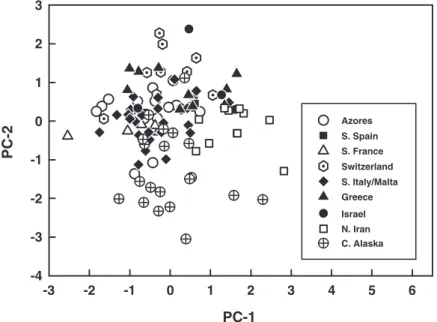
rize and visualize the song differences among the major geographical populations of C. agilis (Fig. 3). The PCA was calculated from six song features; the seventh feature, delta, was excluded because it is de-rived from two other variables. Statistica version 10 (StatSoft 2010) was used for all statistical analyses in this study.
Adult Morphology. Nineteen Alaskan specimens (12 males, seven females) identiÞed acoustically as C. agiliswere examined for the state of 19 external mor-phological characters that might distinguish them from previously described specimens of the species from the Eastern Hemisphere (Henry et al. 2003). These characters included ground color of body; pres-ence, extent, and color of markings on stipes, palps, gena, clypeus, frons, and postoccipital region; relative abundance and distribution of black and blond setae
on pronotum; relative size of basal dilation of tarsal claw (the “claw ratio” AB/BD, see Þg. 4 in Henry et al. 2002); extent to which fore wing is rounded or tapered at apex; relative width of fore wing expressed as the ratio of length to breadth at widest point; presence or absence of black markings on wing veins; orientation of the Rs crossvein with respect to the Rs vein (per-pendicular or oblique, see Þg. 4A in Henry et al. 2006); length and color of costal setae; length of abdominal setae; relative abundance and distribution of black and blond setae on the three distal abdominal ster-nites; shape and relative proportions of male genital “lip” and “chin” at apex of sternite 8⫹9 (see Þg. 4B in Henry et al. 2006); length and color of setae clothing male genital lip; and presence or absence of dark brown stripe on pleural membrane of second abdominal segment.
Fig. 2. Oscillograph (left) and sonograph (right) of the typical vibrational song of C. agilis from Switzerland (A) and central Alaska (B). Each song shown here comprises one volley of abdominal vibration, which in this species is synonymous with the SRU. Pure tone duration represents the initial portion of the volley, preceding the noisy ending.
Fig. 3. Scatterplot of the Þrst two principal components of a PCA of six song features of C. agilis (see text for details). Each data point represents a single individual coded by geographical region.
Larval Morphology. We examined nine Þrst-instar, eight second-instar, and 11 third-instar larvae of Alas-kan C. agilis, all of them offspring of four lab pairings of different Þeld-collected adults. Larvae were boiled in distilled water with a drop of liquid detergent and transferred to 70% ethanol with 5% glycerin. Speci-mens were viewed at 50⫻ magniÞcation. Head mark-ings of selected, representative individuals were illus-trated (Fig. 4) and compared with markings in specimens from the Eastern Hemisphere (Henry et al. 2003).
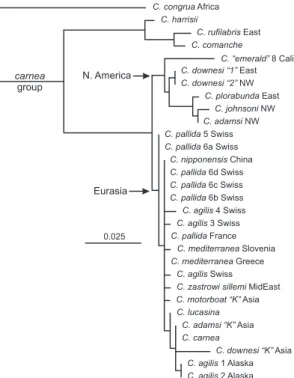
Molecular Affinities. DNA was extracted and 516 bp of the mitochondrial cox2 gene were sequenced for two Alaskan specimens of C. agilis by Dr. Gisella Cac-cone and her associates at Yale UniversityÕs DNA Analysis Facility. These sequences, together with data from several new specimens of C. agilis and C. pallida Henry et al. from Europe, were added to sequences previously assembled for 16 species of the carnea group. Outgroup taxa for the phylogenetic analyses included Chrysoperla harrisii (Fitch), Chrysoperla ru-filabris(Burmeister), Chrysoperla comanche (Banks), Chrysoperla congrua(Walker), and Chrysopa oculata Say. A maximum parsimony (MP) tree was generated in PAUP* 4.0 by using a branch-and-bound search that retained all equally parsimonious trees (MULPARS option). Gaps were treated as missing and all charac-ters were uniformly weighted. A 50% majority rule bootstrap of 1,000 replicates was then performed to produce the Þnal MP cladogram. Additional pheno-grams were generated using minimum evolution (ME) and maximum likelihood (ML; Fig. 5) criteria, by using a GTR⫹Gamma model of evolution (Frati et al. 1997) and 100 bootstrap replicates.
Hybridization Between European and Alaskan In-dividuals. Two crosses were set up, one cross between a Swiss female and an Alaskan male (28 September
2010) and the other cross between an Alaskan female and a French male (26 September). The Swiss spec-imen of C. agilis had been Þeld-collected near Agarone in late August 2010, the French specimen at Mougins, southern France, in mid-August. From 14 adult progeny of the Þrst cross, we recorded and analyzed the songs of Þve males and three females; from 17 adult progeny of the reciprocal cross, the songs of three males and two females were recorded and analyzed. Means of song features for the two recip-rocal crosses were compared using two-tailed t-tests for independent samples. Combined means of these hybrid populations (Table 1, last row) were com-pared with the parental Alaskan and European pop-ulations by using an ANOVA and post hoc contrast tests.
Patterns of Distribution. To see whether variation in song features was correlated with geographic po-sition, we Þrst measured the great-circle distance be-tween each of the adjacent sites from which we had collected C. agilis over the years, by using the web-based Infoplease Distance Calculator (Anonymous 2000 Ð2007). Arranging these nine sites in a sequence of actual geographic distances along the x-axis, we then plotted the value⫾ SD of each song feature for each site (Fig. 6). Hypothesizing that C. agilis could
Fig. 4. Left dorsum of third-instar larval head capsule of
C. agilis, showing the location and distribution of dark pig-mentation (labeled). (A) Most common pattern. (B) Pattern seen in 36% of the specimens, distinguished by a mesal ex-tension of the dorsolateral stripe.
Fig. 5. ML phenogram of the cryptic species of the C.
carneagroup, based on sequences of 516 bp of the mitochon-drial cox2 gene. Branch lengths are in percent sequence divergence (horizontal bar). The two individuals of C. agilis from Alaska are located at the bottom of the Þgure, clustering with each other and within the Eastern Hemisphere clade. C.
oculata, which was included in the analysis as the outgroup for the genus Chrysoperla, is not shown due to its long branch length.
have colonized Alaska from either the east or the west (Fig. 1), we arranged the sites in two ways, one way assuming east-to-west dispersal from Eurasia through the Azores and northern Canada to Alaska and the other way assuming west-to-east dispersal from Eurasia and the Bering Strait to Alaska. We reasoned that the graph reßecting the correct history of colonization would show a smoother, graded series of mean trait values across the geographical range of the species. Analogous plots were created for each of the principal morphological features of larvae and adults (not shown).
C. agiliscould also have arrived in Alaska through the release of imported lacewings purchased from commercial insectaries. With the help of Dr. Derek Sikes, requests for information about such lacewing releases were distributed on the Alaska Entomology list server in December, 2010. Replies were forwarded to one of us (Henry) for compilation. Living individ-uals were then purchased from any extant organiza-tion that had sold lacewings in Alaska over the past 12 yr. When necessary, larvae were reared to adulthood. Adults were identiÞed to species using the playback methods described here.
Results
Song Phenotype. In every respect, the songs of Alas-kan C. agilis closely resembled those of C. agilis from sites in the Eastern Hemisphere (Fig. 2; Table 1). However, the ANOVA found statistically signiÞcant differences among the nine major geographical pop-ulations for all seven song features(F8,96⫽ 3.78Ð25.17, P⬍ 0.001). Post hoc Scheffe´Õs tests revealed that the Alaskan and Iranian populations differed the most from the other populations, especially in their lon-ger periods and larlon-ger deltas (Table 1). As in the species as a whole, sexual dimorphism in Alaskan C. agilis was evident but slight and was manifested largely as signiÞcantly longer volley durations in females than in males (t18⫽ 3.02, P ⫽ 0.007).
The plot of the Þrst two components of the PCA performed on six song features revealed no unique clustering of Alaskan individuals compared with indi-viduals from eight other geographic populations in the Eastern Hemisphere (Fig. 3). In this analysis, PC1 and PC2 explained 71.65% of total variance.
Adult Morphology. At the time of collection from the Þeld, ground color of living specimens of Alaskan
Fig. 6. Mean values and SDs of the song features of C. agilis, arrayed along a geographical distance axis of east to west dispersal to Alaska in the top two panels (A, temporal attributes; C, frequency attributes) or of west to east dispersal to Alaska in the bottom two panels (B, temporal attributes; D, frequency attributes).
photoperiod. Most of the morphological characteris-tics of the Alaskan specimens conformed to those exhibited in specimens of C. agilis from the Eastern Hemisphere (Henry et al. 2003). However, where there were differences in the Alaskan specimens, they are described below.
In all but one of the 19 specimens examined the stipes was entirely brown, and in two of these speci-mens the brown marking was faint. In the remaining specimen the stipes was marked with an apical brown spot only. The palps were marked brown in all spec-imens. In all specimens the gena was dark brown, and this marking was fringed with red in eight specimens. The clypeus was marked dark brown and, in all but six specimens, this marking had a red margin. In seven specimens the frons was unmarked but was margined in red in 12 specimens. The postoccipital region and vertex were unmarked in all but four specimens, which had red markings. The proportion of black (ver-sus blond) setae on the pronotum ranged from 20 to 100%, averaging 72%. The range of the claw ratio was 2.09 Ð2.73, and the mean ⫾ SD (2.36 ⫾ 0.20) was signiÞcantly different from Eastern Hemisphere spec-imens (2.23 ⫾ 0.15; t43 ⫽ ⫺2.54, P ⫽ 0.015). The proportion of black (versus blond) setae on the three apical abdominal sternites ranged from 0 to 100%, averaging 25%.
Larval Morphology. Most of the morphological characteristics of the Alaskan larval specimens of C. agilis conformed with those described for C. agilis from the Eastern Hemisphere (Henry et al. 2003). However, where there were differences in the Alas-kan specimens, they are described below.
Larvae showed limited variation in their head mark-ings (Fig. 4); none had frontal spots, and the dorso-lateral stripes varied little in width. Third-instar larvae from Alaska lacked the angular lateral expansion of the dorsolateral stripe anteriad of the basolateral expan-sion, and 36% of them clearly exhibited a rounded mesal expansion of this stripe (Fig. 4B). Thoracic and abdominal markings were present but not prominent. Phylogenetic Position. Under MP, ME, or ML cri-teria, the two C. agilis specimens from Alaska emerged as most closely related to each other; together, they usually clustered with the 10 species of the Eurasian clade of the carnea group, forming a large polytomy (e.g., Fig. 5). Six North American species (not includ-ing Alaskan C. agilis) comprised the second major clade. Consequently, a hypothesis of dispersal (or in-troduction) of C. agilis from Eurasia to North America was supported, rather than independent (convergent) origin of an agilis-like song in an existing Alaskan population of carnea-group lacewings.
Songs of F1 “Hybrids.” Progeny from the two
re-ciprocal crosses between Alaskan and European C. agilisproduced song features that were statistically indistinguishable (t-tests; not shown), so we pooled data for all hybrids (Table 1, row 13). The songs of
rows 4, 10, and 13 in Table 1). For four features, an ANOVA found statistically signiÞcant differences among hybrids, parents from Europe, and parents from Alaska (period: F2, 39⫽ 3.01, P ⬍ 0.0001; mid-frequency: F2,40⫽ 29.71, P ⬍ 0.0001; end frequency: F2,40⫽ 6.47, P ⫽ 0.004; delta: F2,40⫽ 36.25, P ⬍ 0.0001). Post hoc Scheffe´Õs tests revealed that the features of the hybrid songs were not consistently more different from one parent than they were from the other parent. In combination, these results clearly supported inclu-sion of the Alaskan population within the existing Eurasian species C. agilis.
Colonization of Central Alaska From Eurasia. Plots of means and variance in song features by geographic position did not unequivocally support either an east-ward or a westeast-ward direction of colonization for Alaska (Fig. 6). However, largely due to greater acous-tical similarity between Alaskan and Iranian popula-tions (Table 1), transipopula-tions of song features in both the temporal and frequency domains were visually more linear when it was assumed that C. agilis dispersed to Alaska from eastern Asia rather than from western Europe via the Azores (Fig. 6B and D). Larval and adult morphology showed no apparent clinal trends across the global range of the species that might allow us to conclude where within this range the Alaskan specimens might be derived.
We learned that several commercial purchases and releases of lacewings had taken place in Alaska during the last 12 yr, but only near Anchorage, far to the south of Fairbanks. In all cases, insects had been ordered from two North American companies that were still in business, March Biological in Sherwood, OR, and Ar-bico Organics in Tucson, AZ. We ascertained from song analysis of purchased insectary stocks that both companies had sold us C. rufilabris.
Discussion
Song Phenotype. Although some song features of Alaskan C. agilis differ signiÞcantly from those of East-ern Hemisphere individuals (Table 1), those differ-ences are minor, and the overall form of the song cannot be mistaken for that of any other species in the carneagroup (Fig. 2). This unity of song phenotype across all geographic sites is shown best in the PCA plot, where all populations overlap extensively with one another in acoustic space (Fig. 3). The complexity of the C. agilis song argues against independent origin of the same set of song attributes in different global hemispheres, in contrast to the simple song of North American C. adamsi Henry et al. that has clearly evolved convergently in an unrelated Asian species (Henry et al. 1999a).
The generally intermediate phenotype of “hybrid” songs is an expected result of crossing two variants of a species that possess very similar but measurably different courtship signals. Data from such crosses,
including all details of the courtship and mating pro-cess between European and Alaskan individuals, are completely consistent with the parents being mem-bers of the same species.
Morphology of Adults. Most of the morphological characters of the Alaskan specimens examined in this study fall within the range of variation exhibited by C. agilisspecimens from the Eastern Hemisphere (Henry et al. 2003), although the Alaskan specimens tend toward the more heavily marked end of the spectrum of variation. Compared with specimens from the East-ern Hemisphere, Alaskan individuals are more likely to have red head markings, and they exhibit higher percentages of black setae on the pronotum and apical abdominal segments. In addition, claw ratio in Alaskan specimens is toward the high end of the gradient: on average, the basal dilation is narrower. However all such differences in morphology between global hemi-spheres are quite small.
Morphology of Larvae. Larvae of C. agilis from Alaska fall largely within the range of variation exhib-ited by this species in the Eastern Hemisphere (Henry et al. 2003), although the Alaskan specimens tend toward simpler and lighter markings on the head and body. In contrast to some specimens of C. agilis from the Eastern Hemisphere, Alaskan larvae do not have frontal spots on their head capsules, and approxi-mately one-third of them show a small mesal extension of the basolateral stripe that has not been found in other populations of the species (Fig. 4B). Among the populations previously described, Alaskan larvae most closely resemble specimens from Sicily (Þg. 4A and B in Henry et al. 2003).
Origin of Alaskan Population. Adult and larval mor-phology are uninformative with respect to directional dispersal hypotheses, and plots of song phenotypes versus geographic position provided only modest sup-port for west to east dispersal of C. agilis to central Alaska (Fig. 6). However, eastward movement is con-sistent with the effect of the prevailing westerly winds on many vagile organisms within those latitudes (Johnson 1969, Gressitt 1974, Buden 2010, Chapman et al. 2011). Thus, we tentatively propose that C. agilis arrived in Alaska by dispersing from Europe through Asia and across the Bering Strait (Fig. 1). Based on extremely short branch lengths within the carnea group (Fig. 5), we infer that all species are very young, which in turn suggests that colonization of Alaska by C. agilis has been recentÑ certainly in postglacial times, and perhaps⬍1,000 yr ago. Nonetheless, the species seems to have adapted well to central AlaskaÕs extreme climate, including bitter cold temperatures (to⫺54⬚C) and daylengths of from 1 to 23 h. C. agilis is also well established there, having been collected as the most abundant summer species of Chrysoperla in separate years and at sites⬎100 km apart.
The existence of C. agilis in central Alaska is prob-ably not the result of recent agricultural introduction. Mass release of lacewings has been conÞned to coastal Alaska rather than the Fairbanks region, and the re-cent suppliers of lacewing stocks for biocontrol pur-poses are not currently selling C. agilis. In addition, the
Alaskan population of C. agilis exhibits measurably distinctive phenotypic traits, specialized ecophysi-ological adaptations, and apparent permanence around Fairbanks. These multiple lines of evidence suggest that C. agilis is a dominant, persistent compo-nent of central AlaskaÕs lacewing fauna, which escaped the ecological constraints of its conspeciÞcs in the milder parts of Eurasia and moved into the Western Hemisphere. Furthermore, the existence of this stable population of C. agilis in Alaska predicts that the spe-cies probably occurs farther east in Asia than the current known range.
Acknowledgments
Laboratory facilities, support, and supplies for this study were provided by the University of Connecticut, Storrs, CT. Drs. Susan Emmert and Alberto Pantoja (USDAÐARS, Sub-arctic Agricultural Research Unit, Fairbanks, AK) collected all Alaskan lacewings and generously shipped them to Con-necticut; without their sharp powers of observation, we would not have discovered this anomalous location for C.
agilis. We also appreciate the assistance of Derek Sikes (Uni-versity of Alaska, Fairbanks, AK), who investigated past in-stances in which lacewings had been imported, reared, and released as biological control agents in Alaska. Finally, we offer special thanks to Gisella Caccone and associates (Yale University, New Haven, CT) for invaluable help sequencing the cox2 gene in Alaskan C. agilis and its close relatives in the
carneaspecies group.
References Cited
Anonymous. 2000 –2007. Infoplease atlas distance
calcula-tor: how far is it? Pearson Education, New York. (http:// www.infoplease.com/atlas/calculate-distance.html).
Brooks, S. J. 1994. A taxonomic review of the common green
lacewing genus Chrysoperla (Neuroptera: Chrysopidae). Bull. Br. Mus. Nat. Hist. (Entomol.) 63: 137Ð210.
Buden, D. W. 2010. Pantala flavescens (Insecta: Odonata)
rides west winds into Ngulu Atoll, Micronesia: evidence of seasonality and wind-assisted dispersal. Pac. Sci. 64: 141Ð143.
Chapman, J. W., V. A. Drake, and D. R. Reynolds. 2011.
Recent insights from radar studies of insect ßight. Annu. Rev. Entomol. 56: 337Ð356.
Duelli, P., M. K. Obrist, and P. F. Fluckiger. 2002. Forest
edges are biodiversity hotspots - also for Neuroptera. Acta Zool. Acad. Sci. Hung. 48: 75Ð 87.
Frati, F., C. Simon, J. Sullivan, and D. L. Swofford. 1997.
Evolution of the mitochondrial cytochrome oxidase II gene in Collembola. J. Mol. Evol. 44: 145Ð158.
Gressitt, J. L. 1974. Insect biogeography. Annu. Rev.
Ento-mol. 19: 293Ð321.
Henry, C. S. 1979. Acoustical communication during
court-ship and mating in the green lacewing Chrysopa carnea (Neuroptera: Chrysopidae). Ann. Entomol. Soc. Am. 72: 68 Ð79.
Henry, C. S. 2006. Acoustic communication in neuropterid
insects, pp. 153Ð166. In S. Drosopoulos and M. Claridge [eds.], Insect sounds and communication: physiology, behaviour, ecology and evolution. CRC (Taylor & Fran-cis Group), Boca Raton, FL.
Henry, C. S., and M. M. Wells. 1990. Geographical variation
roptera: Chrysopidae). Behav. Ecol. Sociobiol. 61: 39 Ð51.
Henry, C. S., and M.L.M. Wells. 2007. Can what we donÕt
know about lacewing systematics hurt us? A cautionary tale about mass rearing and release of “Chrysoperla
carnea” (Neuroptera: Chrysopidae). Am. Entomol. 53:
42Ð 47.
Henry, C. S., M.L.M. Wells, and C. M. Simon. 1999a.
Con-vergent evolution of courtship songs among cryptic spe-cies of the carnea-group of green lacewings (Neuroptera: Chrysopidae: Chrysoperla). Evolution 53: 1165Ð1179.
Henry, C. S., S. J. Brooks, J. B. Johnson, and P. Duelli. 1996.
Chrysoperla lucasina(Lacroix): a distinct species of green lacewing, conÞrmed by acoustical analysis (Neuroptera: Chrysopidae). Syst. Entomol. 21: 205Ð218.
Henry, C. S., S. J. Brooks, P. Duelli, and J. B. Johnson. 1999b.
Revised concept of Chrysoperla mediterranea (Ho¨lzel), a green lacewing associated with conifers: courtship songs across 2800 kilometers of Europe (Neuroptera: Chrysopi-dae). Syst. Entomol. 24: 335Ð350.
Henry, C. S., S. J. Brooks, P. Duelli, and J. B. Johnson. 2002.
Discovering the true Chrysoperla carnea (Stephens) (In-secta: Neuroptera: Chrysopidae) using song analysis, morphology, and ecology. Ann. Entomol. Soc. Am. 95: 172Ð191.
Henry, C. S., S. J. Brooks, P. Duelli, and J. B. Johnson. 2003.
A lacewing with the wanderlust: the European song spe-cies ÔMalteseÕ, Chrysoperla agilis sp.n., of the carnea group of Chrysoperla (Neuroptera: Chrysopidae). Syst. Ento-mol. 28: 131Ð148.
Henry, C. S., S. J. Brooks, J. B. Johnson, T. Venkatesan, and P. Duelli. 2010. The most important lacewing species in
Indian agricultural crops, Chrysoperla sillemi Pe-tersen), is a subspecies of Chrysoperla zastrowi (Esben-Petersen) (Neuroptera: Chrysopidae). J. Nat. Hist. 44: 2543Ð2555.
Johnson, C. G. 1969. Migration and dispersal of insects by
ßight. Methuen, London, United Kingdom.
Scheffe´, H. 1953. A method for judging all possible contrasts
in the analysis of variance. Biometrika 40: 87Ð104.
Smith, G. 2003. Spike2 for Windows, version 5.19 computer
program. Cambridge Electronic Design, Ltd., Cambridge, United Kingdom.
StatSoft. 2010. Statistica for Windows, Version 10 computer
program. Tulsa, OK.
Wells, M. M., and C. S. Henry. 1992. The role of courtship
songs in reproductive isolation among populations of green lacewings of the genus Chrysoperla (Neuroptera: Chrysopidae). Evolution 46: 31Ð 42.
Wells, M. M., and C. S. Henry. 1994. Behavioral responses of
hybrid lacewings (Neuroptera: Chrysopidae) to court-ship songs. J. Insect Behav. 7: 649 Ð 662.
Wells, M. M., and C. S. Henry. 1998. Songs, reproductive
isolation and speciation in cryptic species of insects: a case study using green lacewings, pp. 217Ð233. In D. Howard and S. Berlocher [eds.], Endless forms: species and speciation. Oxford University Press, New York.