HAL Id: hal-01616936
https://hal.archives-ouvertes.fr/hal-01616936
Submitted on 15 Oct 2017
HAL is a multi-disciplinary open access
archive for the deposit and dissemination of
sci-entific research documents, whether they are
pub-lished or not. The documents may come from
teaching and research institutions in France or
abroad, or from public or private research centers.
L’archive ouverte pluridisciplinaire HAL, est
destinée au dépôt et à la diffusion de documents
scientifiques de niveau recherche, publiés ou non,
émanant des établissements d’enseignement et de
recherche français ou étrangers, des laboratoires
publics ou privés.
EXPERIMENTAL CHARACTERIZATION OF
GABOON SPECIES UNDER CYCLIC
COMPRESSIVE LOADING
Samuel Ikogou, Claude Feldman Pambou Nziengui, Rostand Moutou Pitti,
Serge Ango
To cite this version:
Samuel Ikogou, Claude Feldman Pambou Nziengui, Rostand Moutou Pitti, Serge Ango.
EXPER-IMENTAL CHARACTERIZATION OF GABOON SPECIES UNDER CYCLIC COMPRESSIVE
LOADING. WCTE 2016 World Conference on Timber Engineering, Aug 2016, Vienna, Austria.
�hal-01616936�
WCTE
2016
World Conference on
Timber Engineering
August 22-25, 2016 | Vienna, Austria
EXPERIMENTAL CHARACTERIZATION OF GABOON SPECIES UNDER
CYCLIC COMPRESSIVE LOADING
Samuel Ikogou
1, Claude Feldman Pambou Nziengui
1, Rostand Moutou Pitti
2,3,4,
Serge Ekomy Ango
4ABSTRACT: In this paper, the stress-strain tests are performed on Gaboon (Aucoumea Klaineana Pierre) specie in
room temperature and humidity. This specie is used, in major part, in collective, individual and industrial construction, in timber structure and also in the fabrication of paper and veneer wood products in Europe. 15 samples have been tested under monotonous loading and 6 others in 5 cycles compression loading with different levels. According to the typical load stress-strain curve, the elastic moduli are obtained and the comparison between envelope of the cyclic load curve and the monotonous loading curve is achieved. The evolution of continuous displacement versus number of cycles shows three different zones representing the mechanical behaviour of the specie. The obtained results are in accordance with these proposed in the literature and the European code and bring important informations to the Gaboon's timber building.
KEYWORDS: Cyclic compressive loading, Aucoumea Klaineana Pierre, tropical specie, experiment
1 INTRODUCTION
123Before the Cop21 forum, we know that environmental issues oblige wood and wood products to take an important place in our life due to their ecological impact in Europe and in equatorial regions such as Gabon, which concentrates various and unknown tropical species [1]. Also, the wood is one of the solutions that sustainably limit the warming of our planet. Thus, in Central Africa and particularly in equatorial region, the forest plays a key role in this regulation. This fact also contributes to sustainable development discussed during the Cop21 meeting in Paris last year [2].
Gaboon (Aucoumea Klaineana Pierre), is an endemic specie in central Africa’s forest which is, since a long time, associated at the life of his population [3-4]. It is internationally considered as one of the most interesting specie in the plywood industry [4]. It is the unique specie in Gabon, for example, which produces lumbers qualities. Also, Gaboon represents 80% of annual wood’s production in this country and 90% of this specie is exported all over the world and particularly in Europa
1 Samuel Ikogou, Ecole Nationale des Eaux et Forêts,
Claude Feldman Pambou Nziengui, [email protected]
2 Rostand Moutou Pitti, Institut Pascal, Université Blaise
Pascal, France, [email protected]
3 CNRS, Intitut Pascal, France
4 Serge Ekomy Ango, CENAREST, IRT, Gabon,
and Asia in a recent past [5]. In addition, Gaboon, one of the well know tropical specie, is used extensively in building, veneer, finished or semi-finished products and in the design of the paper [6-7-8].
However, since 2010, Gabon has stopped the exportation of wood in order to promote the transformation of wood and wood product on site [5-8]. This fact must motivate local population to use a natural material for building and decrease the price of row material as the cement, which appears very expensive for this people. But this challenge is achieved only by the development of studies oriented on tropical woods [9] in order to know the real behaviour of these species in their local environment [10-11]. However, this specie is classified as a lightwood that the mechanic behavior under some loading has not been studied yet.
It was shown that the mechanical behavior of wood materials depends on the loading history [12-13-14], the environmental conditions [15-16-17] and in more cases on the experimental programs, which produce the exact results for the study undertaken [18-19-20-21]. Also, the mechanical behavior of Okume (Aucoumea Klaineana
Pierre) under cyclic compressive loading was not
sufficiently studied yet. The literature background shows that some authors have modeling the stress-strain behavior of Bamboo under cyclic uniaxial loading [22]. However many similarly works have been performed on materials such as concrete [23-24], steel [25] composite [26] and structures [27]. The purpose of those studies is to know their rheological behavior under monotonous and cyclic loading. The work presented here, is based only on the experimental study of the specimens of
Okume standardized ASTM-D-143 [18], in cycle of loading-unloading-recharging.
The first part of the paper presents the material and methods used during the experiment. The method of cutting, the dimensions of samples and the experimental device have shown. The second part proposes the results and discussions about the typical stress-strain under cyclic compressive loading.
2 MATERIAL AND METHODS
Some Gaboons (Aucoumea klaineana Pierre), species from Congo basin rain forest (Gabon), were used for these experiments. These woods have been delivered to laboratory by our partners (Figure 1).
Figure 1: View of Gaboon at parking woods of Equatorial Society of unfurling of Gabon.
Firstly, they have been dimensioned to rafters (figure 2) and installed again at the parking woods for the natural desiccation for 1 or 8 weeks before their sell. The choice of rafters studied here have been done randomly, the aim is to be in the conditions of a potential buyer.
Figure 2: Dimensionally of rafters
And secondly six healthy of these rafters of Gaboon, sawed along the axis of the fibers were dimensioned according to standard ASTM-D-143 [18]. Figure 3
shows the technique used to cut the different samples. The geometric shape of the test pieces and the dimensions are shown (Figure 3, 4 and 6).
Figure 3: Cut up of samples;
Figure 4: Samples dimensioned in preparation.
The specimens, subjected to humidity of 12±4%, were tested on a electronical press "united testing machine" of 100 kN maximum static capacity, equipped with a centralizer who ensures the sending and the collection of information (Figure 5 and Figure 7).
Figure 5: Sample on press and experimental device
Saw
Wood
Sample Spherical heads
Figure 6: Dimensions of specimens
The monotonous compression load testing were performed on 15 specimens in order to obtain the following parameters: modulus of elasticity !!!, maximum rupture stress !!"#! , elastic limit !!!, rupture strain !!"#! and the elastic limit strain !
!!.
Then, cyclic tests are performed on 6 specimens. These specimens were each loaded and unloaded 5 times, axially under a speed of 0.45mms-1. The imposed forces (table 1), were selected randomly in an increasing way in the elastic zone, the objective being to remain in this zone and to avoid the first breakings of material.
Figure 7: Experimental devices
Figure 7 shows experimental devices that allowed to have and collect information during experimentation. It compose of an electronical testing machine, a wood specimen and a centralizer and a computer in order to record different data.
Table 1: Margin settings
Cycles 1 2 3 4 5
Forces(N) 12000 18000 24000 32000 38000
3 RESUSTS AND DISCUSSIONS
Figure 8 is the typical curve of monotonous compressive loading obtained to 15 Gaboon’s specimens. This curve shows the parameters studied. It is characterized by two parts.
- Part 1: represents the linear area; going from origin point to point A
- Part 2: a plastic area characterized by the work hardening of the material starting after the point A
Figure 8: typical curve of stress-strain monotonous compression of Gaboon’s specimens.
According to the typical curve on the monotonous compression loading, of Gaboon’s specimens (Figure 8), Table 2 is obtained and shows the values of all parameters derived from curves of Figure 8.
Table 2: Margin settings
Parameters Values !!!(!"#) 2890 !!"#! (!"#) 20.60 !!!(!"#) 15.88 !!"#! 12.96 !!! 08.44
Figure 9 illustrates the mechanical behavior of Gaboon under cyclic compressive loading. This curve highlights the presence of permanent deformations being formed to load forces less than 50% of the yield strength, obtained during the monotonous loading. The permanents deformations appear despite of the fact that, the maxima peak of load has been taken on the linear area of monotonous loading curve. Under the basis of these results, Gaboon can be characterized as a low elasticity material
Figure 9: Typical stress-strain curve under cyclic
compressive loading 200mm 50mm 50mm Centralizer Press Sample 4 6 8 10 12 14 16 18 20 22 4,21 9,21 14,21 19,21 24,21 Str ess (Mpa ) Strain (‰) B A Str ess (M pa) Strain (‰) Cycle 1 Cycle 2 Cycle 3 Cycle 4 Cycle 5
Some analysis and tests have been done on the permanents deformations, formed to the cyclic compressive loading curve, table 3, 4, 5 and 6 show respectively analysis and tests. These tests have been done on the statistic software R×64 3.0.2.
Table 3: distribution of percentages of permanents deformations by cycle. Permanents deformations’ values
presented here are mean±standard deviation.
C 1 2 3 4 5
P 0.432±0.
28 0.436±0.33 0.438±0.14 0.683±0.61 1.951±3.01
C : Cycles
P(‰): Permanents Deformations
Table 4 shows the differents test done between means of permanent deformations of Zone A. The results obtained show that there are not significatives differences between permanents deformations in this Zone.
Table 4: comparisons between cycles 1, 2 and 3 of Zone
A
Zone A Test value Décision !!!! et !
!!! ! = 0,9826 N.S
!!!! et !
!!! ! = 0,9663 N.S
!!!! et !!!! ! = 0,9914 N.S N.S: Not significative difference
Table 5 shows also the test done between the means of permanent deformation of Zone B. as precedent tests realized in Zone A there is not significative difference between mean of permanents deformations of each cycle.
Table 5: comparison between cycle 4 and cycle 5 of
Zone B
Zone B Test value Decision
!!!! et !!!! ! = 0,355 N.S
Lastly, Table 6 shows the test done between the mean of all permanents deformations of Zone A and those of Zone B. the result shows that there is a significative difference between these permanents deformations.
Table 6: comparison between permanents deformations
of Zone A and Zone B
Test value Decision
Zone A et Zone B ! = 0,02351 S.D
S.D: significative difference
The evolutin of stress versus strain is posted in Figure 10 which shows the beginning of the loss of rigidity of Gaboon in cyclic loading. This limit is determined by the intersection of the envelope curve of the cyclic load and the monotonous load curve. The comparison was made
between the two constraint values of monotonous and cyclic elastic limits shows that:
Figure 10: Comparison between envelope of the cyclic
load curve and the monotonous loading curve
The parameters represented in Figure 10 are given by Equation (1). In this case the elastic limit of the applied cyclics !!"! is obtained by
!!"! = !!!(1 − ∆!) (1)
Where ∆! > 30%; ∆! is a percentage change in the loss of rigidity and is abtained according to the following equation:
! =!!∆!! (2)
Experimental calculation gives θ = 1.515;
Figure 11 shows the variation of the permanent displacement vursus the number of charge cycles.
Figure 11: Continuous displacement vs. number of
cycles
In this figure, three distincts zones are clearly sumeryzed:
- Zone 1: up to 38% of total number of cycles 4 14 24 4,21 14,21 24,21 Str ess ( MP a) Strain(‰) evelope of cyclic loading curve of monotic loading 0 1 2 3 4 5 6 7 0 2 4 6 Risidu al s d ispl aceme nts Number of cycles N+
- Zone 2: represent the linear Zone, from 38% to 69% where the slope (!!) represents the rate of damage to the material,
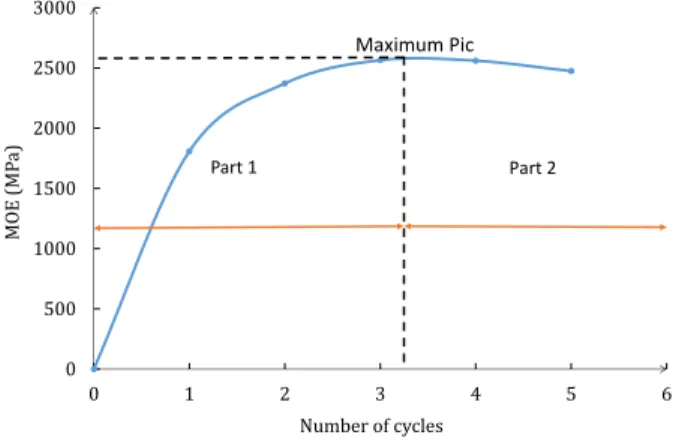
- Zone 3: upper 69%, representing the specimens’ rapid damage leading to breakage. Figure 12 presents evolution of modulus elasticity of each cycle. The “Maximum Pic” corresponding to the ultimate applied load is around 2600 Mpa.
Figure 12: Evolution of Elasticity's modulus Vs number of cycles
We seeing two parts:
- Part 1 representing the great augmentation of elasticity’s modulus up to 68% of number cycles realized.
- Part 2 representing the reduction of elasticity’s modulus.
The fact which can explain the behavior of elasticity’ modulus in these zones, could be the fact that, after 60% of total cycles material would not has damaged yet. We can say that, damaged of material begins after the maximum pic (2564.8 Mpa). This value is appreciably near to the value of elasticity’s modulus (2890± 360.003) finds in monotonous loading (Table 2).
The precedents graphs, are characterized the behaviour of Gaboon under cyclic compressive loading. They show the evolution of samples’ damaging tested.
4 CONCLUSION
The general purpose of this study was to build an experimental study on samples of Gaboon (Aucoumea
Klaineana Pierre) dimensioned according to the
standard ASTM-D-143. The followed protocol permitted us to have an experimental approach of model of Gaboon under monotonous compressive loading, but to have also its behaviour under cyclic compressive loading.
The following results were obtained experimentally and are important:
- The model of monotonous compressive loading of Gaboon show here, coincide with the model presents by all wood; is curve present a linear part up to 80% of his maximum loading of rupture.
- Gaboon loses more than 30% of its capacity of resistance under cyclic loading, the deterioration rate is faster in a cyclical load than in a monotonous loading. Also, there is a relationship between the number N of cycle and permanent displacement of each cycle setting in the form of !!= !!! + !!, where !! represents permanent displacement of Gaboon specimens (Figure 11). These results are similar to those issued by [27] which states that according to EUROCODE 5 requierrments [22], under dynamic loads, assemblies lose 30% of their resistance. Also, the results are used to determine the endurance limit of Gaboon which is the load at which a structure can withstand an infinite number of cycles.
REFERENCES
[1] Fuhr M., Nasi R., Delegue M.A. (2001) Vegetation structure, floristic composition and growth characteristics of Aucoumea klaineana Pierre stands as influenced by stand age and thinning. Forest Ecology and Management. 140, 117-132.
[2] Hourcades JC, Shukla P.R. (2015) Cancun’s paradigm shift and COP 21: to go beyond rhetoric. International. Environmental Agreements: Politics, Law and Economics. Vol. 15 (4). 343-351. ISSN: 1567-9764 (Print) 1573-1553 (Online)
[3] Bakraji E.H, Salman N., Othman I. (2002) Radiation-induced polymerization of acrylamide within Okoume (Aucoumea klaineana pierre). Radiation Physics and Chemistry. 64, 277–281 [4] Medzegue M.J, Grelier S., M’Batchi B., Nziengui
M., Stokes A (2007). Radial growth and characterization of juvenile and adult wood in plantation grown okoume (Aucoumea klaineana
Pierre) from Gabon. Annals of Forest Science,
Springer Verlag/EDP Sciences. 64 (8), pp.815-824. [5] Ikogou S., Moutou Pitti R., Ekomy Ango S (2016). Hydro-mechanical behaviour of Aucoumea klaineana under drying process. Workshop COST Action FP1303, Madrid, Spain; 24-25, February. ISBN 978-91-88349-16-3.
[6] Manfoumbi N., Sauvat N., Dubois F. (2012). Découplage expérimental des déformations d’éléments bois sous chargements hydrique et mécanique variables. European Journal of Civil Engineering. 16 (10), 1168-1186 0 500 1000 1500 2000 2500 3000 0 1 2 3 4 5 6 MOE (MP a) Number of cycles Maximum Pic Part 2 Part 1
[7] Manfoumbi N., Dubois F., Sauvat N. (2012). Behavior in service of beams in flexion: adaptation of the eurocode 5 to a tropical climate. Word Conference on Timber Engineering (WCTE), Auckland, 16-19, July.
[8] Manfoumbi N., Sauvat N. Dubois F., Pop O. (2010). Experimental decoupling of hydrics and postponed phenomena of timber structures in controlled climate conditions. Word Conference on Timber Engineering (WCTE), 20-24 June 2010, Trentino, Italy. ISBN: 9781622761753
[9] Engone N.L., Obiang, Ngomanda A., White L.J.T, Jeffery K.J., Chézeaux E., Picard N. Disentangling the effect of size and competition: a growth model for Mezegue. Annals of Forest Science May 2013. 70(3), 241-249
[10] Brunck, F. and al. (1990). L’Okoumé (Aucoumea
klaineana Pierre) monographie. Centre Technique
Forestier Tropical (CTFT), 120 p.
[11] Sohounhloue A., Y.J. and al. (2014). Caractérisation des joints inter-faciaux des fibres végétales : cas du rotin du Cameroun. Revue Scientifique et Technique Forêt et Environnement du Bassin du Congo. 3, 32-38.
[12] Mapaga D., Verkaar H.J., Koumba Zaou P. (1998) Effect of shade on young Aucoumea klaineana Pierre trees of various provenance under field conditions. Forest Ecology and Management. 106, 107-114
[13] Dinwoodie, J.M. (2000). Timber, its nature and behaviour. Taylor et Francis, Unted Kingdom. ISBN 10: 0419235809 / ISBN 13: 9780419235804 [14] Pot G., Coutand C., Toussaint E., Le Cam J.B.,
Saudreau M. (2014) A model to simulate the gravitropic response and internal stresses in trees, considering the progressive maturation of wood. Wood Science and Technology. 28 (4), 1235-1248 [15] Moutee M., Fafard M., Fortin Y. and Laghdir A.
(2005) Modeling the creep behavior of wood cantilever loaded at free end during drying. Wood and Fiber Science 37(3): 521-534
[16] Moutee M., Fortin Y. and Fafard M. (2006) A global rheological model of wood cantilever as applied to wood drying. Accepté pour publication à la revue Wood Science Technology.
[17] Moutee M., Fortin Y., Laghdir A. et Fafard M. (2010) Cantilever experimental setup for rheological parameter identification in relation to wood drying. Wood Science Technology. 44 (1), 31-49.
[18] ASTM-D-143. Annual book of American Society for Testing Materials. ASTM D143-14, Standard
Test Methods for Small Clear Specimens of Timber. DOI: 10.1520/D0143
[19] AFNOR. (1985). Bois. Essais de compression axiale. Réf. NF B 51-007. Paris, la défense, 3p. [20] Vautrin A. (1997) Mechanics of Sandwich
Structures. Proceedings of the EUROMECH 360 Colloquium held in Saint-Étienne, France. Springer, 13-15 May. ISBN: 90-481-5027-4 (Print) 978-94-015-9091-4 (Online)
[21] EUROCODE 5- COMITE EUROPEEN DE NORMALISATION. Calcul des ouvrages en bois. Première partie : Règles générales et règles applicables au bâtiment. Bruxelles 132p.
[22] Fozao, D.S., Foudjet A.E., Fokwa D. (2014). Modeling the stress-strain behavior of Bamboo under cyclic uniaxial loading. Revue Scientifique et Technique Forêt et Environnement du Bassin du Congo, 2, 9-27.
[23] Aslani F., Jowkarmeimandi, R. (2012) Stress-strain model for concrete under cyclic loading. Magazine of Concrete Research. 64 (8), 673-685.
[24] Bahn, B.Y. and al. (1998). Stress-strain behavior of concrete under cyclic loading. ACI Materials Journal, 95-M18, P. 4-8.
[25] Chen C.C., Chen C.C, Hoang T.T. (2016) Role of concrete confinement of wide-flange structural steel shape in steel reinforced concrete columns under cyclic loading. Engineetring Structure. 110, 79-87. [26] Hossain M.A.K., Rafiei S., Lachemi M., Behdinan
K. Structural performance of profiled composite wall under in-plane cyclic loading. Engineetring Structure. 110, 88-104.
[27] De Melo M., J.D. (1996). Utilisation en structures des résineux à faible densité: Conséquences technologiques de scénarios sylvicoles extrêmes. Thèse de l’Université Henri Poincaré-Nancy I.
ACKNOWLEDGMENTS
The authors would like to acknowledge the National Agency of Research (ANR) for its financial support of this work through the project CLIMBOIS ANR-13-JS09-0003-01 as well as the labelling of the ViaMéca French cluster.