HAL Id: hal-02999992
https://hal.archives-ouvertes.fr/hal-02999992
Submitted on 11 Nov 2020HAL is a multi-disciplinary open access
archive for the deposit and dissemination of sci-entific research documents, whether they are pub-lished or not. The documents may come from teaching and research institutions in France or abroad, or from public or private research centers.
L’archive ouverte pluridisciplinaire HAL, est destinée au dépôt et à la diffusion de documents scientifiques de niveau recherche, publiés ou non, émanant des établissements d’enseignement et de recherche français ou étrangers, des laboratoires publics ou privés.
On Embedding Meta-ecosystems into a Socioecological
Framework
Isabelle Gounand, Eric Harvey, Chelsea Little, Florian Altermatt
To cite this version:
Isabelle Gounand, Eric Harvey, Chelsea Little, Florian Altermatt. On Embedding Meta-ecosystems into a Socioecological Framework. Trends in Ecology and Evolution, Elsevier, 2018, 33 (7), pp.484-486. �10.1016/j.tree.2018.04.004�. �hal-02999992�
On embedding meta-ecosystems into a socio-ecological framework
12
Authors: Isabelle Gounand
1,2,*, Eric Harvey3, Chelsea J. Little1,2 and Florian Altermatt1,23 4
*Corresponding author: Gounand, I. ([email protected]) 5
6
Addresses:
71Eawag, Department of Aquatic Ecology, Überlandstrasse 133, CH-8600 Dübendorf, Switzerland
8
2University of Zurich, Department of Evolutionary Biology and Environmental Studies,
9
Winterthurerstr. 190, CH-8057 Zürich, Switzerland 10
3University of Toronto, Department of Ecology and Evolutionary Biology, 25 Wilcocks street
11
M5S 3B2 Toronto, Ontario, Canada 12 13
E-mail addresses:
14 IG: [email protected] 15 EH: [email protected] 16 CJL: [email protected] 17 FA: [email protected] 18 19Keywords
20Metaecosystem; spatial flows; mental model; ecosystem functioning. 21
Spatial flows of organisms and resources are increasingly recognized as key elements of 22
ecosystem functioning [1,2]. In a previous article [3], we called for an update of the meta-23
ecosystem framework, a key conceptual and theoretical framework regarding spatial dynamics 24
[4]. Specifically, we identified ways to better integrate different types of flows connecting 25
ecosystems and their specific spatio-temporal scales in order to improve our understanding of 26
ecosystem couplings. Building on this article, Roque et al. [5] wrotethat, to be more predictive 27
and operational, the meta-ecosystem framework should also explicitly include the socio-28
ecological mechanisms underlying the impacts of human societies on these flows. Their rationale 29
is that socio-cultural mechanisms govern the way human society interacts with ecosystems and 30
influence spatial flows connecting ecosystems. Roque et al. provide some case studies of such 31
influence, for instance with the perception of ivory trade [6]. 32
We see some potential value of such a socio-ecological perspective, for example to address 33
specific questions about dynamical feedbacks between humans and the environment (e.g., on the 34
environmental sustainability of human practices [7]). However, it is noteworthy that human-35
induced effects on meta-ecosystem dynamics are already integrated within the variation in spatial 36
flow values considered in meta-ecosystem models (e.g., variance and mean quantity/quality of 37
flows) [4]. Thus, studying the effects of processes acting at different scales on ecosystem 38
functioning can already be achieved with the existing meta-ecosystem framework while avoiding 39
additional layers of complexity, which might reduce interpretability and understanding. 40
As we illustrate with a strongly human-shaped landscape in our previous article [3], human 41
activities influence the spatial flows linking ecosystems in various ways. This includes increasing 42
some flows (e.g., leaching of agricultural fertilizers to aquatic systems), regulating the species 43
driving other spatial flows, or even modifying the landscape configuration itself. We here explain 44
one well-known example of the role of human activities in meta-ecosystems including all these 45
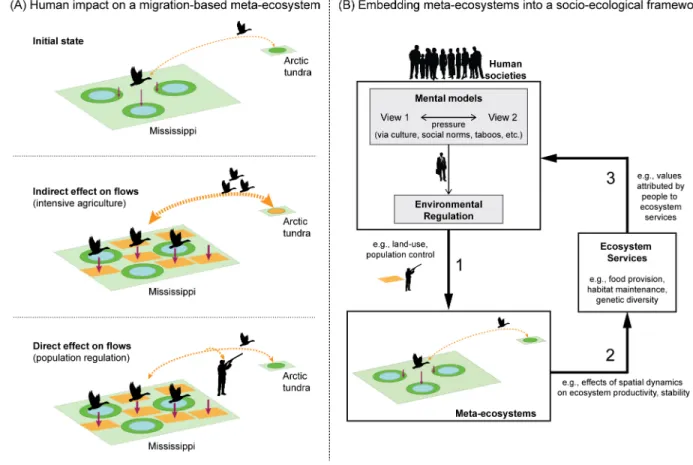
aspects (Fig. 1A): Geese populations in the southern United States massively increased following 46
agriculture intensification in the 1960’s, because the geese shifted their diets from feeding in 47
wetlands to feeding on the augmented resources in agro-ecosystems [8]. This resource 48
augmentation was of course triggered by socio-economic changes in farming practices, and also 49
had effects on local ecosystems (i.e., runoff into waterways). In the context of global meta-50
ecosystems, the subsequent increase in flows of migratory birds dramatically affected arctic 51
tundra ecosystems [8], and this effect was partly modulated by hunting along the geese’s 52
migratory routes, in itself a socio-cultural phenomenon. 53
Thus, along with Roque et al. [5] and others working on socio-ecological linkages [9,10], we 54
agree that culture and mental models are central to the people-nature relationship, and a crucial 55
link in the decision pathway leading to environmental regulation of anthropic impacts on nature 56
(e.g., land use management, hunting rules; see Fig. 1B, arrow 1). However, accounting for these 57
anthropic impacts can already be done by directly implementing the forcing derived from socio-58
cultural processes on flows (e.g., in Fig. 1A adding fields and reducing migratory flow), without 59
explicitly modelling the socio-cultural processes in the meta-ecosystem framework. 60
Thus, when would the additional complexity brought by integrating mental models into the meta-61
ecosystems framework be more useful than the pre-existing implicit consideration of human 62
influences in meta-ecosystems? We find that this may depend on the questions being addressed, 63
for example, when the focus is no longer on the meta-ecosystem dynamics themselves, but rather 64
on the long-term consequences of feedbacks between meta-ecosystem and socio-cultural 65
dynamics. This implies that the ecosystem services provided by meta-ecosystem dynamics ([11], 66
arrow 2 in Fig. 1B) strongly feed back on mental models (arrow 3); in the geese example, this 67
would happen if tundra loss is sufficiently important for public opinion to change agricultural or 68
hunting practices towards “tundra-sustainable” ones. To analyse such scenarios, the meta-69
ecosystem framework could be embedded into a socio-ecological perspective in stylized models 70
explicitly focusing on these feedback links (bold arrows in Fig.1B), similarly to approaches 71
proposed in the study of biodiversity – human society interactions [7]. In such models, however, 72
explicit consideration of meta-ecosystem dynamics is not needed, merely the effects that these 73
meta-ecosystem dynamics produce on ecosystem properties of values for humans. 74
In conclusion, to our opinion, zooming in the meta-ecosystem box (Fig. 1B), or zooming out on 75
the socio-ecological feedback loop, relates to different questions, which might be better 76
addressed with different modelling frameworks (meta-ecosystem versus socio-ecological). In that 77
context, we suggest that the interactions between socio-cultural processes and meta-ecosystem 78
dynamics should be addressed in an iterative scientific process through planned collaborations, as 79
has been proposed for coordinating exchanges between theory and empirical work [12]. Thus, the 80
results of one perspective can inform the other, better hypotheses can be tested, and our 81
understanding can be bolstered by strong inference, without all processes necessarily being 82
integrated into one framework. 83
84
Acknowledgements
85Funding is from the Swiss National Science Foundation Grant PP00P3_150698. 86
References
881 Gounand, I. et al. (2018) Worldwide cross-ecosystem carbon subsidies and their 89
contribution to ecosystem functioning. bioRxiv doi https//doi.org/10.1101/271809 90
2 Polis, G.A. et al. (2004) Food Webs at the landscape level, University of Chicago Press, 91
Chicago and London. 92
3 Gounand, I. et al. (2018) Meta-Ecosystems 2.0 : Rooting the Theory into the Field. Trends 93
Ecol. Evol. 33, 36–46
94
4 Loreau, M. et al. (2003) Meta-ecosystems: a theoretical framework for a spatial ecosystem 95
ecology. Ecol. Lett. 6, 673–679 96
5 Roque, F. de O. et al. (2018) Towards a meta-socio-ecological system perspective. Trends 97
Ecol. Evol. this issue,
98
6 Biggs, D. et al. (2017) Breaking the deadlock on ivory. Science. 358, 1378–1381 99
7 Lafuite, A.-S. et al. (2017) Delayed behavioural shifts undermine the sustainability of 100
social–ecological systems. Proc. R. Soc. B Biol. Sci. 284, 20171192 101
8 Jefferies, R.L. et al. (2004) Agricultural Food Subsidies, Migratory Connectivity and 102
Large-Scale Disturbance in Arctic Coastal Systems: A Case Study. Integr. Comp. Biol. 44, 103
130–139 104
9 Díaz, S. et al. (2018) Assessing nature’s contributions to people. Science. 359, 270 LP-272 105
10 QUINTESSENCE Consortium, T. (2015) Networking Our Way to Better Ecosystem 106
Service Provision. Trends Ecol. Evol. 31, 105–115 107
11 Millenium Ecosystem Assessment Panel (2005) Ecosystems and Human Well-Being: 108
Synthesis, Island Press Washington DC.
12 Angilletta, M.J. and Sears, M.W. (2011) Coordinating theoretical and empirical efforts to 110
understand the linkages between organisms and environments. Integr. Comp. Biol. 51, 111
653–661 112
113 114
115
Figure 1. Meta-ecosystems in the Anthropocene. (A) The left panels show an example of
116
human impacts on meta-ecosystem dynamics with the emblematic case-study on migratory geese 117
linking resource flows between the Mississippi basin with the arctic tundra (top panel): 118
agriculture intensification in the Mississippi in the 1960’s (fields in yellow) increased geese food 119
supply (foraging arrows in magenta), which resulted in higher abundance of migratory geese and 120
associated nutrient flow to the tundra (dotted yellow arrow), triggering catastrophic shifts of 121
arctic communities ([8]; middle panel); hunting on the migratory road illustrates a direct human 122
impact on spatial flow (flow reduction; bottom panel). (B) Meta-ecosystems can be embedded in 123
a socio-ecological framework. Within human societies, culture and social norms drive the 124
dominance of some views in the public opinion regarding the interaction between humans and 125
nature (e.g., profit versus non-profit views on ivory trade [6]). These mental models influence 126
environmental regulation, which modulates the impact of human activities on spatial flows and 127
meta-ecosystem dynamics (e.g., through rules on land-use or hunting; arrow 1). Meta-ecosystem 128
dynamics affect ecosystem properties, such as productivity, or biodiversity, which provide 129
services to people (arrow 2). Depending on the value that people attribute to these ecosystem 130
services, change in meta-ecosystem dynamics might feedback on mental models (arrow 3), for 131
instance (example panel A) the public opinion might shape hunting practices and regulations. 132