Publisher’s version / Version de l'éditeur:
Vous avez des questions? Nous pouvons vous aider. Pour communiquer directement avec un auteur, consultez la
première page de la revue dans laquelle son article a été publié afin de trouver ses coordonnées. Si vous n’arrivez
pas à les repérer, communiquez avec nous à [email protected].
Questions? Contact the NRC Publications Archive team at
[email protected]. If you wish to email the authors directly, please see the
first page of the publication for their contact information.
https://publications-cnrc.canada.ca/fra/droits
L’accès à ce site Web et l’utilisation de son contenu sont assujettis aux conditions présentées dans le site
LISEZ CES CONDITIONS ATTENTIVEMENT AVANT D’UTILISER CE SITE WEB.
Proceedings: Permafrost International Conference, pp. 197-202, 1966-10-01
READ THESE TERMS AND CONDITIONS CAREFULLY BEFORE USING THIS WEBSITE.
https://nrc-publications.canada.ca/eng/copyright
NRC Publications Archive Record / Notice des Archives des publications du CNRC :
https://nrc-publications.canada.ca/eng/view/object/?id=b2a1e6e7-53e3-47bf-9eee-46ce3f2a2818
https://publications-cnrc.canada.ca/fra/voir/objet/?id=b2a1e6e7-53e3-47bf-9eee-46ce3f2a2818
NRC Publications Archive
Archives des publications du CNRC
This publication could be one of several versions: author’s original, accepted manuscript or the publisher’s version. /
La version de cette publication peut être l’une des suivantes : la version prépublication de l’auteur, la version
acceptée du manuscrit ou la version de l’éditeur.
Access and use of this website and the material on it are subject to the Terms and Conditions set forth at
Frost-heaving in soils
Penner, E.
Reprinted from the PROCEEDINGS: PERMAFROST INTERNATIONAL CONFEREl UCE, NAS-NRC, Publicat~on 1 2 8 7
FROST-HEAVING I N SOILS
EDWARD PENNER, National Research Council, Ottawa, Canada
A literature survey shows that present interest in frost action research i s focused on thermodynamic properties o f the i c e - water i n t e r f a c e . This aspect o f the freezing process i s a fascinating field for research and much progress i s being made, but there are many other equally important a s p e c t s , when ice-lensing i s involved in the freezing process, that have not been Investigated since the studies o f Taber [ l ] and Beskow [ Z ]
.
To draw attention to a much wider field in the problem o f frost-heaving, t h i s conference may be an appropriate occasion to summarize some work carried out since 1955 b y the Divi- sion o f Building Research, National Research Council o f Canada. These studies have included changes in soil struc- ture from ice segregation, characteristics o f moisture flow and potentials induced, heaving pressures produced b y frost action, dependence o f unfrozen water content on temperature and soil t y p e , ice proliferation rates in water and in growth retarder solutions, heat and moisture balance during i c e - l e n s i n g , some observations on the structure o f ice in l e n s e s , and the freezing process in porous s y s t e m s .
ICE -LENSING
The formation o f i c e - l e n s e s a s a major cause o f frost-heaving in soils i s well e s t a b l i s h e d , although the 10% phase change expansion also adds significantly t o the total h e a v e . In pro- vlding space for ice a s the l e n s grows, work must be done t o l i f t overburden and any surface surcharges. The necessary supply o f water i s obtained from surrounding soil or ground water, and so further work i s done t o establish and maintain a potential gradient in soil water. The available work b y the freezing process must b e divided therefore between t h e s e two processes which occur simultaneously.
Ice-lenses u s u a l l y form parallel t o the soil surface along an isothermal freezing plane so that the expansion and heaving pressures are always i n the direction o f he'at f l o w . The lateral extent o f one l e n s depends on the homogeneity o f solid material and the uniformity o f water supply and tempera- ture gradient. The t h i c k n e s s o f the l e n s , however, i s a rate- dependent phenomenon that varies between soils but i s always contingent on the balance between moisture supply and heat f l o w .
W h e n , therefore, potential water supply i s equal t o or e x c e e d s the existing heat removal r a t e , the l e n s will continue to grow at one site i n d e f i n i t e l y . W h e n heat removal rate tem- porarily e x c e e d s moisture supply, temperature at the lower face o f the ice-lens decreases; a new location for growth may b e established when a more favorable water supply i s encoun- tered b y the freezing front. As t h e s e e v e n t s are repeated,
they result in rhythmic ice banding.
Heat removal rate can b e increased to a point where a uniform distribution o f ice occurs throughout the frozen soil behind a continuously penetrating frost l i n e , but at the same t i m e , water i s being moved t o the freezing zone so that heaving still occurs. Finally, in the case o f a quick f r e e z e , heaving i s reduced to the 10% expansion when freezing i s too rapid for the movement o f soil moisture, and hence only the in situ water f r e e z e s .
STRUCTURE OF ICE I N LENSES
It i s o f considerable interest t o note the conformation o f i c e - l e n s e s . W h e n grown in soil with a carefully controlled e n v i - ronment o f temperature, pressure, and water supply, the structure o f the l e n s e s were not a s unlform a s anticipated [3].
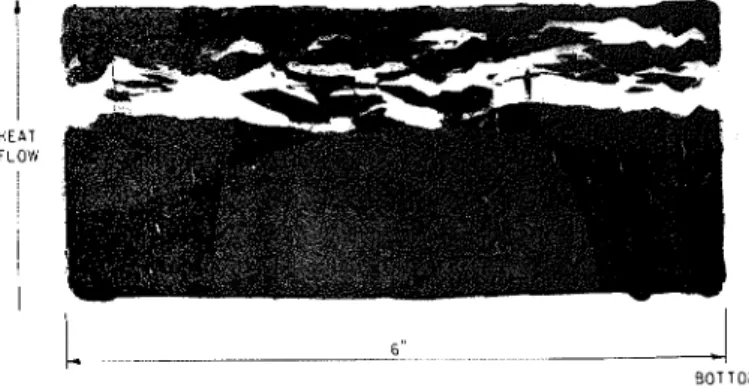
Ice grains were elongated in the direction o f heat f l o w , but d i f f e r e n t optical orientations were o f t e n observed in adjacent c r y s t a l s . Optical orientation w a s determined b y etching a freshly polished ice s u r f a c e . Fig. 1 shows soil structure formed, ice distribution, and shape o f the freezing front in an i c e - l e n s . Fig. 2 shows the disorder o f the e t c h pits on the horizontal face o f the i c e - l e n s . In Fig. 2 the heat flow i s perpendicular t o the plane o f the paper. The c - a x i s (crystal a x l s ) , lower crystal i s almost parallel to the heat f l o w ; the upper crystal 1s at about a 45' angle t o the heat f l o w . Although randomness i s apparent in all l e n s e s examined, the
studies were not statistical enough to establish firmly the
degree o f disorder.
T O P
6
2
B O T T O M
Fig. 1 . Vertical slice o f c l a y specimen after unidirectional freezing
Crystal orientation w a s usually different above and belob.: the s o i l occluded in the i c e - l e n s . Non-unidirectional h e a t flow around occluded s o i l , may have contributed to the randomness observed.
Growth rate of i c e in a pure melt i s g r e a t e s t in the direc- tion normal to the c - a x i s during free growth [ 4 ] . This may be responsible for the change in structure with depth of uni- directionally frozen i c e starting with random nucleation a t the water surface. The grains oriented with the c-axis normal to direction of h e a t flow gained preference a t the e x p e n s e of a l l other directions of orientation [5]. This preference w a s not observed in the ice formed by lensing in s o i l .
SOIL STRUCTURE FORMATION
There are important differences in the structure of frozen s o i l and in the disposition of ice and s o i l resulting from the i c e segregation p r o c e s s e s in different s o i l types [ 6 ] . The con- vex s h a p e s of the lower face of occluded structures and the undulating freezing front in c l a y s (Fig. 3) are in sharp con- t r a s t to the more uniform s i z e of s o i l strata between i c e - l e n s e s common in coarser frost-susceptible s o i l s (Fig. 4) [ 7 ] . When the frost line i s advancing in c l a y s , the shrinking p r o c e s s , due to l o c a l water removal by i c e growth, appears to dominate the shape of the particle plucked away from the freezing front and occluded in the i c e . The lower f a c e , which i s normally convex, i s thought t o be a r e s u l t of uneven shrinking, leaving an irregular freezing fr,ont even though uni- directional h e a t flow conditions are carefully maintained for the sample a s a whole. Suction potential developed in c l a y s i s high, but the permeability i s low; t h i s accounts for the l o c a l shrinkage and hence the kind of structure observed. Fig. 2 . C r y s t a l boundary of ice-lens indicated by arrow
.
.a
INDUCED SUCTION, HEAVING PRESSURES, AND MOISTURE FLOW
Fig. 3 . Laboratory-produced i c e - l e n s ~ n g in si!ty c l a y
&
-
+-
r un&Fig. 4. I c e - l e n s e s (dark) In s i l t (light) 198
Moisture in the liquid phase can flow through constrictions between a d j a c e n t pores more e a s i l y than ice can proliferate through the same porous system in the temperature range normally encountered during s o i l freezing. This i s the b a s i c reason why ice c r y s t a l s grow in pores. If the pores are small enough, the c r y s t a l s develop into i c e - l e n s e s , although water in pores directly beneath may be below O°C. This water would c r y s t a l l i z e if s e e d e d , but i s not cold enough for spontaneous nucleation.
Soils have a low strength in tension and u n l e s s there are confining p r e s s u r e s due to overburden or superimposed s u r - c h a r g e s , the c r y s t a l i s almost free to grow within the
restrictive limits of water supply assuming appropriate thermal conditions. Transfer of water from the film surrounding the s o i l particle to the ice c r y s t a l appears to remove the molecule from the sphere of attraction by the particle. This changes the moisture potential and s e t s up a suction gradient in s o i l w a t e r .
If induced suction i s of sufficient magnitude to overcome capillary p r e s s u r e s , it may empty larger pores and thus the s o i l d e s a t u r a t e s . This d e c r e a s e s the c r o s s - s e c t i o n a l a r e a of the flow path and r e d u c e s the permeability coefficient below the value for full flow. The c h a r a c t e r i s t i c s of change in the unsaturated permeability depend on the properties of the material such a s pore-size r a n g e , pore-size distribution, and nature of the s o l i d . In view of the suction-permeability inter- dependence it i s obviously not correct to use saturated permeability coefficients for predicting heaving r a t e s .
Development of suction during freezing in a c l o s e d system containing P o t t e r ' s flint a t almost no overburden pressure i s shown in Fig. 5 . In the same material the development of heaving p r e s s u r e s w a s followed while the system w a s k e p t fully s a t u r a t e d . When heaving c e a s e d , the suction in the s o i l water w a s z e r o . In both c a s e s , the system w a s initially saturated and a small ice-lens w a s allowed to develop before the experiment w a s s t a r t e d . The importance of t h i s i s
The f i n a l moisture c o n t e n t in the s u c t i o n experiment (Fig. 5)
w a s much b e l o w t h e s a t u r a t e d c o n d i t i o n s maintained in t h e h e a v i n g p r e s s u r e experiment: t h a t i s , a s a s u c t i o n d e v e l o p e d , the f l i n t s a m p l e s d e s a t u r a t e d , a phenomenon not uncommon in t h e f i e l d . T h u s , F i g . 5 d e m o n s t r a t e s two m e t h o d s for r e d u c i n g i c e - l e n s i n g to zero-of c o u r s e , h e a v i n g c a n b e s t o p p e d a l s o by the s i m u l t a n e o u s a p p l i c a t i o n of s u c t i o n a n d overburden p r e s - s u r e . I t i s b e l i e v e d t h a t f o r c e s r e s p o n s i b l e for h e a v i n g and induced s u c t i o n c a n b e a c c o u n t e d for by c o n s i d e r i n g o n l y t h e geometry of t h e porous m a t e r i a l , provlded it i s h y d r o p h i l i c in n a t u r e .
UNFROZEN WATER CONTENT OF FROZEN SOILS
I c e - l e n s i n g a c t i v i t y in s o i l s i s g e n e r a l l y a s s u m e d to b e r e s t r i c t e d t o t h e p l a n e s e p a r a t i n g t h e c o m p l e t e l y unfrozen s o i l a n d t h e l o w e s t i c e - l e n s . Although t h i s may b e the p l a n e of g r e a t e s t h e a v i n g a c t i v i t y , s i n c e in h e a v i e r s o i l s l a y e r s b e t w e e n s u c c e s s i v e l e n s e s a r e frequently s o f t a n d a p p a r e n t l y u n f r o z e n , i t l e n d s w e i g h t t o t h e c o n c l u s i o n t h a t s e v e r a l i c e - l e n s e s , o n e a b o v e t h e o t h e r , may b e i n c r e a s i n g in t h i c k n e s s c o n c u r r e n t l y b u t a t d i f f e r e n t t e m p e r a t u r e s . I t i s o b v i o u s from F i g . 6 a n d from s i m i l a r r e s u l t s g i v e n e l s e w h e r e [ 9 ] t h a t s i m u l t a n e o u s growth of s e v e r a l l e n s e s , o n e a b o v e t h e o t h e r , may b e q u i t e g e n e r a l s i n c e t h e w a t e r in n a t u r a l s o i l s f r e e z e s over a temperature r a n g e , b u t t h e s i m u l t a n e o u s growth of s e v e r a l l e n s e s i s probably m o s t pronounced in c l a y s . During the s e a s o n of h e a t l o s s from t h e soil-when f r o s t - h e a v i n g occurs-the temperature in t h e s o i l i n c r e a s e s with d e p t h . H e n c e , other t h i n g s b e i n g e q u a l , t h e s m a l l e s t unfrozen moisture c o n t e n t would b e n e a r the s u r f a c e .
The p r o c e s s whereby s u c c e s s i v e i c e - l e n s e s b e c o m e e s t a b - l i s h e d h a s not b e e n d e t e r m i n e d , b u t there a r e a t l e a s t two p o s s i b i l i t i e s : (1) "Seeding" of the n e w l o c a t i o n o c c u r s b y i c e proliferation through t h e larger p o r e s until a s t a b l e b a l a n c e of h e a t a n d moisture flow i s r e a c h e d ; o r (2) a s t h e temperature d r o p s a t the i c e - s o i l i n t e r f a c e d u e to n a t u r a l p r o c e s s e s , s p o n t a n e o u s n u c l e a t i o n may o c c u r a h e a d pf t h e previous i c e - l e n s in larger w a t e r f i l l e d p o r e s l e a v i n g a layer of unfrozen s o i l b e t w e e n s u c c e s s i v e i c e - l e n s e s . It i s ; t h e r e - f o r e , of some i n t e r e s t to look briefly a t some a s p e c t s of i c e proliferation in i t s own m e l t .
ICE PROLIFERATION RATES IN SOLUTION
D e n t r i t i c i c e proliferation r a t e s h a v e b e e n m e a s u r e d in pure w a t e r a n d v a r i o u s a q u e o u s s o l u t i o n s [ l o ] . The growth r a t e in a p a r t i c u l a r s o l u t i o n i s n o t p r e d i c t a b l e , e x c e p t t h a t i t i s known in a g e n e r a l w a y t h a t a q u e o u s o r g a n i c s o l u t i o n s a r e
more e f f e c t i v e i e t a r d e r s of growth of i c e than inorganic s o l u t i o n s .
I c e proliferation r a t e s w e r e m e a s u r e d in s m a l l , t h i n - w a l l e d g l a s s c a p i l l a r i e s f i l l e d with s o l u t i o n s of v a r i o u s c o n c e n t r a - tion [ 1 1 , 121 to study how injecting s o l u t i o n s into the pore w a t e r of s o i l s a f f e c t s f r o s t - h e a v i n g
.
Within t h e h e a t - d i s s i p a t i o n l i m i t s , r a t e s w e r e r e a l i z e d to b e r e l a t i v e r a t h e r t h a n a b s o l u t e [ 1 3 ] . The majority of e x p e r i m e n t s w e r e in s o l u t i o n s of c a l c i u m l i g n o s u l f o n a t e , a byproduct of wood pulping b y the s u l f i t e p r o c e s s . The a t t e n u a t i o n of prolifera- tion r a t e i s shown in F i g . 7 a s a f u n c t i o n of s u p e r c o o l i n g for w a t e r a n d a q u e o u s s o l u t i o n s of s u l f i t e liquor up to 50% c o n c e n t r a t i o n .Although i c e proliferation in t h e s e e x p e r i m e n t s w a s by d e n t r i t i c growth and therefore not e n t i r e l y s i m i l a r to i c e - l e n s growth in s o i l , t h e e f f e c t i v e n e s s of f i e l d i n j e c t i o n s with t h i s .
product a g r e e s with t h e r e s u l t s of t h e laboratory e x p e r i m e n t . Some c o n c l u s i o n s b a s e d o n t h e s e r e s u l t s a r e : (1) That a l t e r i n g t h e i c e growth c h a r a c t e r i s t i c s of s o i l w a t e r may b e a u s e f u l a p p r o a c h to p u r s u e for diminishing f r o s t - h e a v e r a t e s ; (2) t h e e f f e c t i v e n e s s of t h e r e t a r d e r i s not r e l a t e d to i t s " a n t i f r e e z e " c h a r a c t e r i s t i c s s i n c e t h e s u l p h i t e liquor (50% c o n c e n t r a t i o n ) lowered the f r e e z i n g point b y l e s s t h a n 3'C ( t h i s i s a l s o s u b - s t a n t i a t e d b y f r e e z i n g point a n d proliferation s t u d i e s in b o t h high and l o w m o l e c u l a r w e i g h t f r a c t i o n s in t h e liquor [12]); (3) t h e c h a r a c t e r of i c e proliferation r a t e s s t u d i e d in t h e p r e s e n c e of l a r g e m o l e c u l e s s h o u l d b e e x t e n d e d to c h a n n e l s b e t w e e n s o l i d p a r t i c l e s a n d t h e p o r e s of porous s o l i d s . HEAT AND MOISTURE BALANCE DURING SOIL FREEZING S i m u l t a n e o u s m e a s u r e m e n t of h e a t f l o w , moisture movement, a n d h e a v e during f r e e z i n g h a s b e e n u s e f u l in identifying s o m e of t h e s i g n i f i c a n t f a c t o r s t h a t s h o u l d d e t e r m i n e a r e a l i s t i c laboratory f r o s t s u s c e p t i b i l i t y t e s t for s o i l s . [ 1 4 ] . The a p p a - r a t u s w a s d e s i g n e d to e n s u r e u n i d i r e c t i o n a l h e a t f l o w t h a t c o u l d b e m e a s u r e d b y h e a t t r a n s d u c e r s a t both e n d s of t h e s p e c i m e n . I t h a s , t h e r e f o r e , b e e n u s e f u l a l s o in m e a s u r i n g t h e thermal c o n d u c t i v i t y of s o i l s [ 1 4 , 1 5 1 .
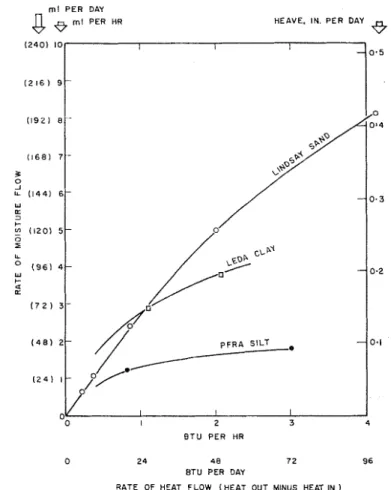
The dominating i n f l u e n c e of h e a t flow o n t h e h e a v i n g r a t e w a s e v i d e n t for a l l s o i l s . Three d i s t i n c t l y d i f f e r e n t r a t e s of h e a t e x t r a c t i o n from s p e c i m e n s w e r e imposed during o n e e x p e r i m e n t . The r e s p o n s e in moisture flow c l o s e l y followed c h a n g e s in n e t h e a t f l o w . Three s o i l s , varying w i d e l y in many c h a r a c t e r i s t i c s , r e s p o n d e d s i m i l a r l y (Fig. 8)
.
The c o n - c l u s i o n i s t h a t it i s m i s l e a d i n g to a s s e s s f r o s t s u s c e p t i b i l i t y of d i f f e r e n t s o i l s (for f i e l d u s e ) in t h e laboratory w i t h the s a m e f r o s t l i n e p e n e t r a t i o n r a t e . Different s o i l t y p e s would n o t f r e e z e a t t h e s a m e r a t e under s i m i l a r c l i m a t i c c o n d i t i o n s b e c a u s e of d i f f e r e n c e s in thermal c o n d u c t i v i t y , w a t e r s u p p l y , in s i t u w a t e r c o n t e n t , e t c .I
I
I
I II
I
24 4 8 72 96 120 146 HOURS F i g , 5 . Development of s u c t i o n a n d h e a v i n g p r e s s u r e in P o t t e r ' s flint- 2 - 4 - 6 - 8 -10 -12 -14 -16 -18 - 2 0
T E M P E R A T U R E 'C
Fig. 6 . Unfrozen moisture content versus temperature
m l PER DAY
8
rnl PER HR HEAVE. IN. PER DAY6
( 2 4 0 1 10
0 T U PER HR
0 2 4 48 7 2 96
0TU PER DAY
RATE OF HEAT FLOW (HEAT OUT MINUS HEAT IN 1 Fig. 8. Rates of moisture flow and heave versus net heat flow
A uniform heat extraction rate consistent with the average field condition appears to be the more r e a l i s t i c approach for evaluating the frost susceptibility of different s o i l s in the laboratory. Furthsr, t h e s e experiments showed that freeze- thaw c y c l e s are not a requirement for ice-lensing [ 161, a s some s t i l l b e l i e v e . Confusion a r i s e s from the f a c t that freeze-thaw c y c l e s do have the effect of "pumping" water In s u c c e s s i v e s t e p s to one plane in the s o i l . This wider separation a t one plane can be particularly destructive to plant root s y s t e m s .
FREEZING OF WATER IN PORES: EXPERIMENT AND THEORY Thermodynamic properties of water freezing in pores and causing frost-heaving have been d i s c u s s e d at length by Gold [ 1 7 ] , Jackson and Chalmers [ 181, Everett [ a ] , and in l e s s spccific terrns by the author [ 1 9 , 20, 211. There i s agreement on the nature of the p r o c e s s , but the treatment by Everett h a s been generally preferable. It s t a t e s the problem simply and precisely, y e t it i s sufficiently comprehensive to be applicable to both unconsolidated and solid porous mater- i a l s . It i s of interest, however, to review some of the experimental f a c t s on which the theory i s based.
Earlier work [19] established t h a t , starting from saturation, the amount of water available for ice-lensing and the maximum suction induced in a closed soil system below the zone of freezing w a s a function of the s t a t e of subdivision in granular material; both were greater for a c l a y than for coarser s o i l s .
Measurements of the maximum heaving pressure, suction, and combinations of these in Potter's flint [20] a t various d e n s i t i e s d o not appear to s a t i s f y completely a self consistent theory. These experiments showed that the maximum heaving
Fig. 7. Rate of linear ice crystallization v e r s u s supercooling pressurit in a fully saturated material w a s greater by a factor
stopped. Such comparisons are of practical importance s i n c e s o i l s in the field desaturate under suction a s did the P o t t e r ' s flint.
The active area a t the ice water interface i s now thought to d e c r e a s e a s desaturation t a k e s p l a c e , emptying the larger pores. This may account for the s u c t i o n s being lower than heaving p r e s s u r e s . As desaturation occurs the p e r m e a b i l ~ t y i s a l s o greatly r e d u c e d , making equilibrium difficult to e v a l u - a t e . In light of t h i s , valid comparisons would seem to b e possible only s o long a s the material s t a y s fully saturated: n o n e t h e l e s s , in the f i e l d , desaturation cannot be avoided.
At equilibrium the r a t e of meltlng e q u a l s the freezing r a t e . Thus the free energy of ice e q u a l s the free energy of water a t the i c e water interface. It follows that the reversible condition i s
v . dP. - s . d T = v dP - S dT
1 1 1 W W W (1)
where i and w are the i c e and water p h a s e s , v i s s p e c i f i c volume, s i s s p e c i f i c entropy, P i s p r e s s u r e , and T i s temperature.
Rearranging and substituting Qf/T for s w
-
s i,
whereQ f i s the latent h e a t of fusion per gram and considering finlte c h a n g e s , the expression becomes
Considering the freezing plane to be in a porous mate- r i a l [ 1 5 ] apparently permits three p o s s i b l e c a s e s in the physical application of pressure to the two p h a s e s of atmos- pheric pressure: The pressure i s on the i c e o n l y , thus the pressure change in water i s zero and h e n c e , vw APw i s zero; or the pressure i s on the water only and the pressure change on the ice i s zero and h e n c e , vi APi i s zero; or the same pressure i s applied equally to both p h a s e s , which w a s the c a s e preferred previously by the author [ 2 1 ] . H e n c e ,
Assuming that heaving pressures resulting from ice-lensing do not influence the pressure in the water p h a s o , then vw A Pw e q u a l s z e r o . Combining the resultant equation with the well-known form of the Thomson equation [ 2 2 ] l e a d s to Everett's relationship which g i v e s the limiting heaving pressure in terms of pore r a d i u s .
where r i s the radius of the smallest constriction of the pore,
and
oiw
i s the interfacial energy. In the same w a y , in thec a s e for zero pressure on the i c e and negative p r e s s u r e s in the w a t e r , the limiting suction (APw i s negative) i s given by
where 'pi i s the d e n s i t y for i c e .
Everett h a s made some e s t i m a t e s using the a u t h o r ' s pub- l i s h e d r e s u l t s for Potter's flint. Based on t h i s , along with other substantiating evidence for porous s o l i d s , h e claims the theory to b e c o n s i s t e n t with experimental r e s u l t s a t l e a s t for heaving p r e s s u r e s . A large pore-size range in the material i s , however, a drawback in making rigorous comparisons of heaving experiments with theory.
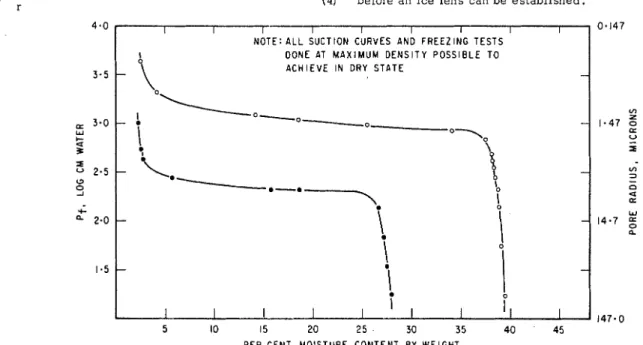
Pressure measurements were made during e a r l y work on frost action in a frost c e l l apparatus [19] on two different s i z e fractions of Potter's f l i n t . The predominant pore s i z e s were determined by water r e l e a s e curves (Fig. 9 ) . Fixing the pore radius of the finer material a t 1.47 p and a t 25 erg/sq cm
for
oiw
,
(4) predicts a maximum heaving pressure of350g/sq c m , whereas the a c t u a l measurement a t saturation g a v e 400 g/sq cm. Taking 9p a s the predominant pore r a d i u s for the coarser fraction, the predicted value i s 55 a s a g a i n s t the measured value 23 g/sq cm. More substantiating evidence i s s t i l l required but these r e s u l t s are of the right order.
As refinements are developed in measuring p r e s s u r e s and s u c t i o n s a s s o c i a t e d with ice-lensing in porous material, a
reliable value for o . and how it i s influenced by temperature
and foreign matter d?l b e of great a s s i s t a n c e . At p r e s e n t , v a l u e s from 10 to 45 erg/sq cm may b e found in the literature. The difference between ice-water and air-water interfacial energy a c c o u n t s for the lower pressure pore entry by i c e , provided that the temperature i s c o n s i s t e n t with ( 2 ) .
Finally, a point by Everett [ 8 ] should be s t r e s s e d regarding the d i f f e r e n c e in pressure exerted by a n i c e - l e n s and that of a n i c e c r y s t a l confined in a pore. The value for l/r in the
e q u a t i o n s above should be replaced by l/r
-
1/R where ri s the radius of the constriction leading from the pore and R
the largest radius of the p o r e . After the l e n s i s e s t a b l i s h e d , R i s large and the term 1/R may be n e g l e c t e d . Thus, the potential heaving p r e s s u r e s are a l w a y s greater after the l e n s
h a s formed-a point to remember in the study of deterioration
of porous s o l i d s by f r o s t a c t i o n , which must break in tension (4) before a n i c e l e n s can be e s t a b l i s h e d .
NOTE: A L L SUCTION CURVES AND F R E E Z I N G T E S T S DONE AT M A X I M U M D E N S I T Y P O S S I B L E TO A C H I E V E IN DRY STATE
5 10 15 2 0 2 5 3 0 3 5 4 0 ' 4 5
P E R CENT M O I S T U R E C O N T E N T BY W E I G H T
Fig. 9. Moisture r e l e a s e curves t c determine the predominant pore radius of two fractions from Potter's flint